
Japanese Arts & Cultural Heritage
The Japonista Athenaeum · The Gateway
Japanese Arts and Cultural Heritage
日本の美術と文化遺産
Japanese culture lives in things: a bowl, a screen, a kettle, a sword guard, a carved Buddha, a folded robe. This is the gateway to all of them, with the essays that join the rooms, a timeline, a glossary and an index of arts, schools and materials.
A Room for Every Art
The rooms below open on the long almanacs and chapters of the Athenaeum. Start with the one that calls you; each links back here and across to its neighbours. In all, 42 rooms are open today, and every one is a full chapter, not a signpost.
The room and the wall
Flowers, trees, scrolls, screens and the brush: the arts that turn a room into a statement.
Tea, clay and the table
The way of tea and the kilns that serve it, from Raku bowls to the porcelain of Kyushu.
The floating world and the stage
Prints, actors, courtesans and the theatres that made them famous.

Sakai Hōitsu, 1816. Two-panel folding screen; ink and color on paper. The Metropolitan Museum of Art, accession 57.156.3.
Look closer: Look at the diagonal: the trunk slants across both panels and the fruit hangs like small lanterns. A Rinpa screen keeps the picture simple and the surface luxurious.
Sakai Hōitsu, Persimmon Tree, 1816. The Metropolitan Museum of Art, Rogers Fund, 1957, accession 57.156.3. Public domain (Met Open Access). Museum record
Warriors and steel
Swords, guards and armour: the arts of the warrior class.
The sacred and the household
Buddhist images, altars and the carved and cast objects of devotion.
Cloth, dress and the chest
Kimono, dye, regional cloth and the tansu that kept it.
Small things and fine metal
Hanging objects, lacquer, bronze and porcelain.
Objects Made to Belong
Japanese arts and cultural heritage are usually met through a surface lens: beauty, fine workmanship, restraint, age. Those qualities are real and they are visible, but they are not the root. At the root lies a different logic, one in which an object is not merely made but situated, not merely owned but entered into, and not merely preserved but continued.
In Japan, culture has been expressed less through declaration than through things: wood, metal, cloth, paper, lacquer, clay and the shaped emptiness of a room. Objects are asked to carry memory, ritual, lineage and restraint. For that reason the arts cannot be sorted cleanly into the Western categories of fine art, craft and design, which arrive late in the story, if they arrive at all. Even the modern statute declines to separate them. The Law for the Protection of Cultural Properties of 1950 gathers structures, paintings, sculpture, crafts, calligraphy, ancient documents and archaeological material under a single heading, tangible cultural property, and sets beside it the intangible (the performing arts and craft techniques), the folk, monuments, cultural landscapes, groups of traditional buildings and the conservation techniques that keep all of it alive.

Maker unrecorded, early 17th century. Earthenware with black raku glaze (Raku ware). The Metropolitan Museum of Art, accession 17.118.74.
Look closer: Look at the lip: it is thick and slightly uneven, made to be warm in two hands and to feel quiet against the mouth. Nothing on the bowl shows off.
Maker unrecorded, Black Raku Tea Bowl, early 17th century. The Metropolitan Museum of Art, Rogers Fund, 1917, accession 17.118.74. Public domain (Met Open Access). Museum record
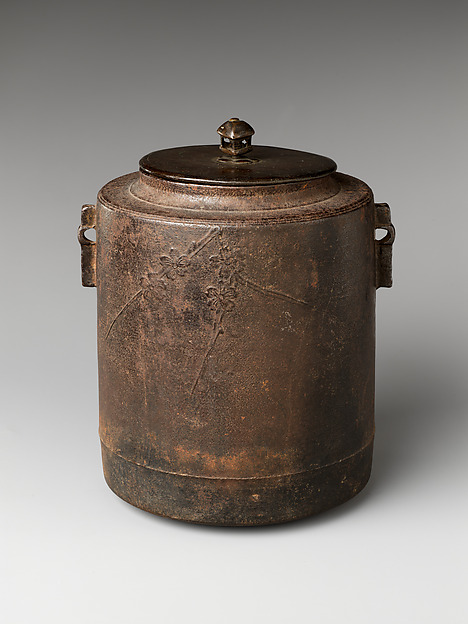
Ōnishi Gorōzaemon, mid-17th century. Cast iron and bronze. The Metropolitan Museum of Art, accession 2024.553.6a, b.
Look closer: Look at the surface: the iron is cast with a faint relief of willow and cherry, then left to age. The rust that forms is part of the kettle's voice when the water sings.
Ōnishi Gorōzaemon, Kettle (Kama) with Willow and Cherry, mid-17th century. The Metropolitan Museum of Art, Gift of Peggy and Richard M. Danziger, 2024, accession 2024.553.6a, b. Public domain (Met Open Access). Museum record
This page explains that system and then hands you onward. Below are the rooms of the arts, each opening on a long, sourced almanac or chapter. Between them lie the essays that join them: five principles, a method for reading any object, a timeline by era, stories and verified curiosities, a collector's eye, a glossary of ninety-nine terms and an A to Z of arts, schools and materials.
Living Structures, Not Ornaments
A Japanese object is rarely designed to stand alone. It is designed to belong: to a room, a season, a gesture, a way of being handled. A tea kettle is not simply a vessel; it is one part of a gathering that governs posture, sound, timing and silence. A folding screen does not only carry a picture; it shapes the space it stands in, directs movement and controls what may be seen from where. A Buddhist image does not exist to be admired in isolation; it works inside ritual, incense, light and chanting.
This relational thinking is foundational. Objects are not expressive end points; they are nodes within a system. The most famous example is the tea room, where a hanging scroll in the alcove, a vessel for flowers, an iron kettle on its hearth and a single bowl are chosen together for one afternoon and one season, then put away again. The ideal tea room is said to measure four and a half tatami mats; it has a low ceiling, a sunken hearth and an alcove (tokonoma) for a scroll and an object, and the host prepares and clears away out of sight in a water room, so that nothing but the occasion remains.
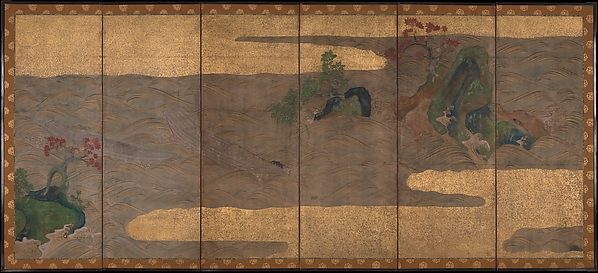
Tawaraya Sōtatsu, mid- to late 17th century. Six-panel folding screen; ink, color, and gold on paper. The Metropolitan Museum of Art, accession 49.35.3.
Look closer: Look at the gold: it is not a background but a light source. A screen was meant to be seen by lamp and daylight in a room with no strong shadows, and the gold gathers that light and gives it back.
Tawaraya Sōtatsu, Boats upon Waves, mid- to late 17th century. The Metropolitan Museum of Art, H. O. Havemeyer Collection, Gift of Horace Havemeyer, 1949, accession 49.35.3. Public domain (Met Open Access). Museum record
It follows that age is not treated as damage to be corrected but as evidence of participation. Patina shows that an object has been used correctly, consistently and respectfully. Repair does not erase history; it marks continuity. The best-known expression is kintsugi, the mending of broken pottery with urushi lacquer dusted or mixed with powdered gold, silver or platinum. One account links it to the fifteenth-century shōgun Ashikaga Yoshimasa, who is said to have sent a damaged Chinese tea bowl to China for repair and received it back with clumsy metal staples, a spur to Japanese craftsmen to find a more beautiful method. Whatever its truth, the philosophy is plain: a break and its repair belong to the object's history.
The bowl at the top of this page belongs to the same thought. Raku bowls are traditionally credited to the tile-maker Chōjirō, whom Sen no Rikyū is said to have commissioned in the sixteenth century to make hand-moulded bowls for wabi tea, and the family name has descended, sometimes through adoption, to a sixteenth generation. To understand Japanese arts one must stop asking what an object represents and begin asking what an object does.
Ritual Comes Before Function
In many cultures function precedes ritual. In Japan the order is often reversed. Ritual defines correct use, and correct use defines form. The tea ceremony is the clearest case: every tool, from the iron kettle to the bamboo whisk and the linen cloth for wiping the bowl, is shaped not for efficiency but for its place in a precise, repeatable sequence. Beauty emerges not from decoration but from restraint, from knowing what not to add. The seasons are written into the sequence: the sunken hearth (ro) is used in the colder months, traditionally November to April, and the portable brazier (furo) from May to October, and bowls, incense, flowers and even the layers of the host's kimono change with them.
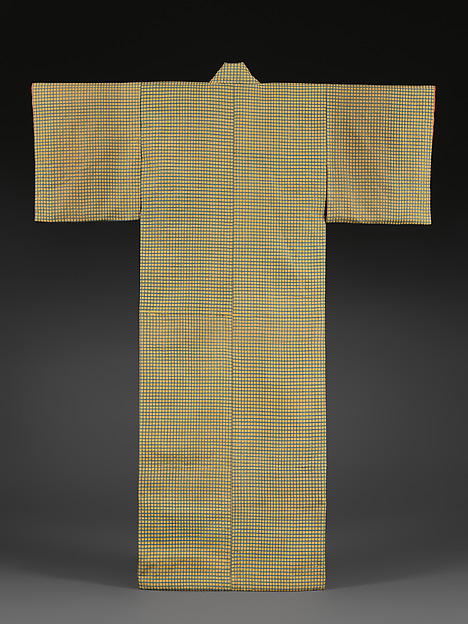
Maker unrecorded, mid-19th century. Extended plain-weave silk. The Metropolitan Museum of Art, accession 91.1.59.
Look closer: Look at the shape: a kimono is cut from a single narrow bolt in straight panels. It is a plain, flat canvas, and season, rank and occasion are added by pattern, colour and the weight of the cloth.
Maker unrecorded, Kimono (Shijira), mid-19th century. The Metropolitan Museum of Art, Edward C. Moore Collection, Bequest of Edward C. Moore, 1891, accession 91.1.59. Public domain (Met Open Access). Museum record
The principle extends everywhere. Kimono are built not to accentuate the body but to provide a neutral canvas on which season, status and occasion are layered. Furniture such as the tansu was designed around movement, storage logic and modularity rather than fixed display. The word is first recorded in the Genroku era (1688 to 1704), and the types are named for what they did: the merchant's chest (chōba-dansu) kept on the raised floor of the shop for account books; the stair chest (kaidan-dansu) built into a farmhouse; the ship's chest (funa-dansu) that went to sea with coastal traders; the wheeled chest that became a merchant's status symbol in the Meiji period. Paulownia (kiri) was favoured for sword chests because it is light enough to carry and protects a blade from oxidation.

Maker unrecorded, late 16th century. Lacquered wood with gold and silver hiramaki-e and mother-of-pearl inlay. The Metropolitan Museum of Art, accession 1989.17a–l.
Look closer: Look at the opened front: the drawers sit behind a hinged panel, so the outside can be sealed and calm while the inside is a dense field of pattern. Storage and display are one idea.
Maker unrecorded, Cabinet of Drawers with Birds, Flowers, and Court Carriage, late 16th century. The Metropolitan Museum of Art, Purchase, Harris Brisbane Dick Fund and Mary Griggs Burke Gift, 1989, accession 1989.17a–l. Public domain (Met Open Access). Museum record
Even religious objects, from the household altar (butsudan) to small okimono figures, are calibrated to domestic space, daily practice and generational transmission. They are sized to a shelf, to a hand, to a household that will hand them on. Function exists, but it is subordinate to meaning. If you wish to follow this principle into the house, begin with the tansu chapter and the Butsudan Almanac.
Craft Without Ego
One of the most radical aspects of Japanese cultural heritage is its historical resistance to individual authorship. For centuries many of the most important objects were produced anonymously. Skill was not a vehicle for personal expression but a duty to tradition. That does not mean innovation was absent; it means innovation took place within constraint. Techniques evolved through repetition rather than disruption, and schools, lineages and regions developed recognisable styles not through branding but through accumulated consensus. The object mattered more than the maker, and mastery was proven by invisibility: the absence of excess, signature or flourish.
The twentieth century gave the idea a name. In 1925 the philosopher Yanagi Sōetsu and the potters Hamada Shōji and Kawai Kanjirō coined mingei, the folk craft movement, after long discussion, and Yanagi declared it formally in 1926. He found beauty in natural materials and hand-making, traditional methods, simplicity, function, plurality (an object that could be made in quantity), low cost, anonymous makers and what he called a beauty of health. A magazine, Kōgei, carried the movement from 1931, and the Japan Folk Crafts Museum (Nihon Mingeikan) opened in 1936. A pot was admired because nobody was showing off.
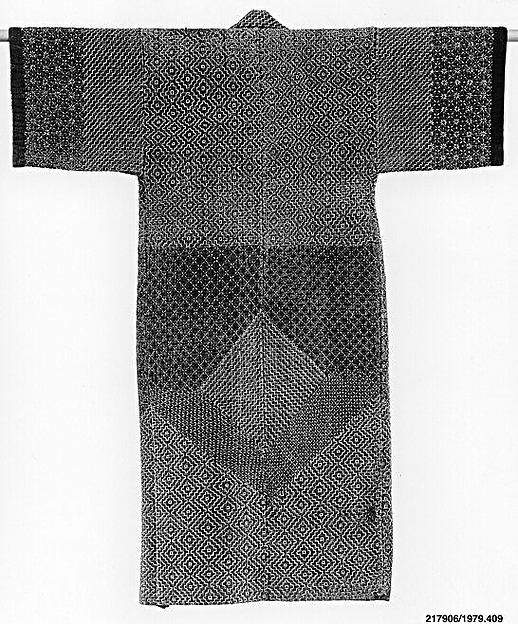
Maker unrecorded, mid-19th century. Indigo-dyed plain-weave cotton, quilted and embroidered with white cotton thread. The Metropolitan Museum of Art, accession 1979.409.
Look closer: Look at the stitching: the pattern is made of thousands of small running stitches that both decorate and strengthen the cloth. The maker is unrecorded; the care is everywhere.
Maker unrecorded, Sashiko Kimono, mid-19th century. The Metropolitan Museum of Art, Purchase, Mrs. Jackson Burke Gift, 1979, accession 1979.409. Public domain (Met Open Access). Museum record

Maker unrecorded, 18th century. Wood, ivory. The Metropolitan Museum of Art, accession 91.1.1012.
Look closer: Look at the back and underside: a netsuke is a working toggle, carved to sit comfortably at the sash and to be handled daily, so every edge is softened.
Maker unrecorded, Netsuke of Boy Wearing an Ivory Mask, 18th century. The Metropolitan Museum of Art, Edward C. Moore Collection, Bequest of Edward C. Moore, 1891, accession 91.1.1012. Public domain (Met Open Access). Museum record
Yet the same culture has always kept names where names carry weight. Schools and lineages are the backbone of the performing arts: Noh has five schools of lead performer (Kanze, Hōshō, Komparu, Kongō and Kita). The Raku family counts its generations. Sword fittings, netsuke and lacquer are signed, and the postwar system of Living National Treasures honours the individuals who hold an important intangible cultural property, a craft technique or an art. The two ideas are not opposed. A name in Japan tends to mean a lineage and a duty, not a brand; the individual is a link, and the chain is the work.
The Sacred in the Everyday Room
Unlike cultures that divide sacred space sharply from daily life, Japan integrates the two. Buddhist images are placed not only in temples but in homes. Seasonal rites take place in ordinary rooms. Gardens work as aesthetic composition and spiritual device at once. The border between art, religion and daily life remains deliberately porous.

Maker unrecorded, 12th century. Wood with traces of gold and color. The Metropolitan Museum of Art, accession 2002.447.2.
Look closer: Look at the right hand and the drape: the hand is lowered in a gesture of giving, and the folds of the robe are carved shallow and flowing. This is an image made for devotion, not decoration.
Maker unrecorded, Shō Kannon, the Bodhisattva of Compassion, 12th century. The Metropolitan Museum of Art, Dr. and Mrs. Roger G. Gerry Collection, Bequest of Dr. and Mrs. Roger G. Gerry, 2000, accession 2002.447.2. Public domain (Met Open Access). Museum record
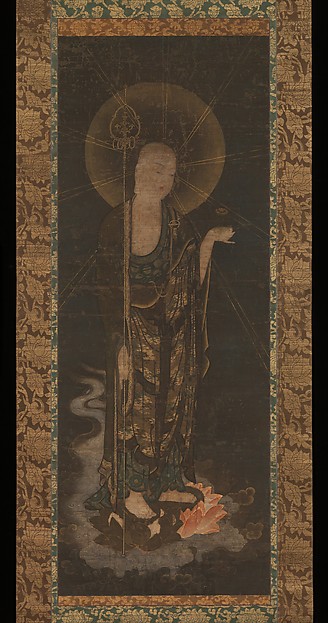
Maker unrecorded, early 14th century. Hanging scroll; ink, color, gold, and cut gold leaf (kirikane) on silk. The Metropolitan Museum of Art, accession 25.215.102.
Look closer: Look at the mounting: the brocade border is part of the image. A devotional scroll is dressed as carefully as the figure it shows.
Maker unrecorded, Welcoming Descent of the Bodhisattva Jizō, early 14th century. The Metropolitan Museum of Art, Fletcher Fund, 1925, accession 25.215.102. Public domain (Met Open Access). Museum record
Flower arrangement began there. Offering flowers at a Buddhist altar became common after Buddhism arrived, and the standard altar set of candle, incense burner and flower vase led to the earliest style, tatebana. The oldest school, Ikenobō, is traced to the Rokkaku-dō temple in Kyoto, whose name is usually glossed as “priest of the lake” after the pond beside it. Its formal style, rikka, grew as a Buddhist expression of natural landscape. The later habit of displaying flowers in the alcove carried the sacred act into the domestic room.
This integration gives objects moral weight. Carelessness is not merely an aesthetic failure; it is a lapse of respect. Preservation, therefore, is not nostalgia but the maintenance of ethical continuity. It is also why Japanese heritage cannot be understood through museum vitrines alone. Objects are meant to be lived with, handled, repaired and put in context, and display without understanding risks stripping them of function and so of meaning.

Standing Buddha in gilt wood, 49 cm, with a funagata (boat-shaped) mandorla and lotus pedestal.
Look closer: Look at the halo: a funagata is shaped like the hull of a boat, and the ridge of light behind the figure is how the eye is led from the lotus to the face.
Photograph by Japonista, Tokyo. All rights reserved. Piece on the shelf
For the household side of the story, see the Buddhism and Zen Almanac, the Butsudan Almanac and the chapter on the household shrine.
Why It Matters Today
In a global culture driven by speed, disposability and surface novelty, the Japanese arts offer an alternative model: value that accumulates slowly, systems that outlast trends and meaning that deepens through repetition. This is not an exercise in romanticism. It is an attempt to describe a working cultural logic that still shapes how Japan makes, keeps and circulates objects now.
The evidence is administrative as well as aesthetic. The 1950 law remains the spine of protection: there were 12,816 Important Cultural Properties in February 2012, among them 1,082 National Treasures, and the folk categories alone stood, in January 2026, at 229 important tangible and 341 important intangible properties. An Important Cultural Property cannot be altered without government permission and generally cannot be exported. The Agency for Cultural Affairs, founded in 1968, carries the work of care.
Public attention has also turned. Noh was inscribed on UNESCO's Representative List of the Intangible Cultural Heritage of Humanity in 2008, and in autumn 2025 the Kyoto City KYOCERA Museum of Art marked a hundred years since the word mingei was coined with an exhibition on Kyoto's legacy of everyday life. Designers have taken up wabi-sabi, the acceptance of imperfection and transience, in no small part since Leonard Koren's 1994 book on the subject, and kintsugi has become a common metaphor for resilience far from any tea room.
None of this is new in kind. The West first met Japanese art at the London International Exhibition of 1862 and the Paris Exposition of 1867, and the French critic Philippe Burty coined Japonisme in 1872 for the enthusiasm that followed. Vincent van Gogh began collecting ukiyo-e prints around 1885 and organised an exhibition of them in Paris in 1887. What is different now is that the whole culture of use, not only the picture, is the subject of interest, and the questions have moved from “is it beautiful?” to “how was it meant to live?”.

Katsushika Hokusai, ca. 1830–32. Woodblock print; ink and color on paper. The Metropolitan Museum of Art, accession JP2569.
Look closer: Look at the horizon: Fuji is tiny and calm while the wave fills the sky. The most exported image in Japanese art is, in composition, a lesson in scale and in tension between the human and the natural.
Katsushika Hokusai, Under the Wave off Kanagawa (Kanagawa oki nami ura), or The Great Wave, from the series Thirty-six Views of Mount Fuji (Fugaku sanjūrokkei), ca. 1830–32. The Metropolitan Museum of Art, The Howard Mansfield Collection, Purchase, Rogers Fund, 1936, accession JP2569. Public domain (Met Open Access). Museum record
How to Read an Object
The rooms of this gateway are not meant to be browsed quickly or consumed in a rush. They are meant to be entered deliberately. Each object, material and tradition is presented with context, not to raise it artificially but to place it correctly. A simple discipline helps. Before you ask what an object is worth, ask it five questions.
| Question | What it asks of you | Where to look first |
|---|---|---|
| What does it do? | Name its job in a ritual, a room or a household before you name its style. | Shape of the mouth, handle, foot or back; signs of handling |
| Where does it sit? | Find its place: alcove, altar, hearth, sash, shelf, wall. An object out of place is half read. | Base, hanging cord, hole for a cord, hinge or lid |
| Whose hands, which school? | Look for lineage before genius: kiln, workshop, school, region. | Seals, signatures, inscription on the box, tool marks |
| What has time done? | Distinguish honest wear from damage, and patina from dirt. | High points, edges, interior surfaces, underside |
| What has been mended? | Repair is information. Ask whether it was done well and declared. | Seams, fills, replaced cords, touched-in pigment |
Read slowly, and let the page lead you out. If one question grips you, follow it to a room: the questions about the alcove lead to the Traditional Arts Almanac; those about hands and schools to the Pottery and Porcelain Almanac; those about the box and the signature to the collector's eye further down this page.
Commerce, where it appears, exists in service of continuity. Pieces from the house shelf are offered not as commodities but as extensions of practice, capable of carrying meaning forward when handled with care. That is why the shelf is placed near the end.
The Arts by Era
Japanese art history is conventionally divided by the seat of political power and by the eras that followed it. The dates below are conventional and, in the earliest periods, approximate; they are drawn from the references listed under Sources. Read it as a map, not a verdict: the arts of one era are always still alive in the next.
Eras are drawn evenly, not to scale, so that every date can be read.
Diagram by Japonista.
The earliest known Japanese artefacts are Jōmon pottery, cord-marked and often extravagantly modelled, together with clay figures called dogū. Lacquer is older still than you might expect: wood from the lacquer tree found at the Torihama shell mound has been radiocarbon-dated to about 12,600 years ago.
Wet-rice farming, copper and bronze, and a plainer, wheel-turned, kiln-fired earthenware arrive. Bronze bells called dōtaku are the period's emblem.
Mounded tombs of clan chiefs are ringed with haniwa, clay cylinders and figures of people, houses and animals, among the first great Japanese sculpture.
Buddhism is introduced, and with it architects, sculptors and a new visual language. Hōryū-ji dates from the early seventh century, with a Shaka Triad dated 623; the great bronze Buddha of Tōdai-ji was completed in 752, and the Shōsōin storehouse holds objects from its dedication.

Maker unrecorded, ca. 3500–2500 BCE. Earthenware with cord-marked decoration and sculptural rim. The Metropolitan Museum of Art, accession 1975.268.182.
Look closer: Look at the rim: the crown of modelled loops is not a handle but pure ornament, made in one of the oldest ceramic traditions in the world.
Maker unrecorded, Deep Cylindrical Vessel (Fukabachi), ca. 3500–2500 BCE. The Metropolitan Museum of Art, The Harry G. C. Packard Collection of Asian Art, Gift of Harry G. C. Packard, and Purchase, Fletcher, Rogers, Harris Brisbane Dick, and Louis V. Bell Funds, Joseph Pulitzer Bequest, and The Annenberg Fund Inc. Gift, 1975, accession 1975.268.182. Public domain (Met Open Access). Museum record
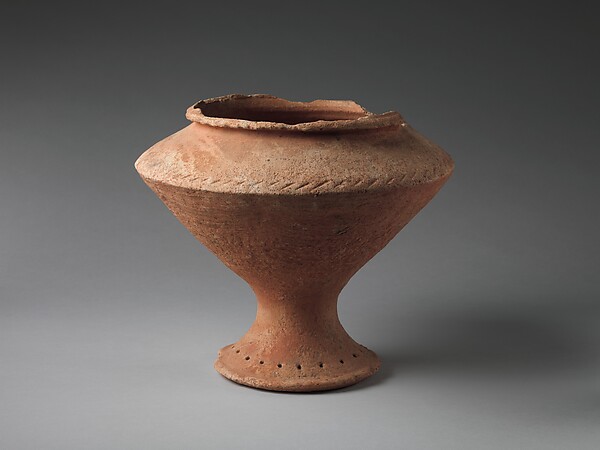
Maker unrecorded, ca. 200–100 BCE. Earthenware with pigment. The Metropolitan Museum of Art, accession 1975.268.379.
Look closer: Look at the contrast with the vessel beside it: smoother, thinner, symmetrical. A change of ways, tools and ideas can be read in the clay.
Maker unrecorded, Tall-Footed Bowl (Hachi), ca. 200–100 BCE. The Metropolitan Museum of Art, The Harry G. C. Packard Collection of Asian Art, Gift of Harry G. C. Packard, and Purchase, Fletcher, Rogers, Harris Brisbane Dick, and Louis V. Bell Funds, Joseph Pulitzer Bequest, and The Annenberg Fund Inc. Gift, 1975, accession 1975.268.379. Public domain (Met Open Access). Museum record
The capital moves to Heian-kyō (Kyoto) in 794 and stays until 1868. Kūkai brings Shingon in 806; Byōdō-in's Phoenix Hall is completed in 1053; illustrated handscrolls (emaki) flourish, among them the Genji scroll of about 1130. The maki-e lacquer techniques that mark Japanese lacquerware are developed.
Warrior government in the east and a sculptors' revival in the west. Unkei (about 1150 to 1223) and Kaikei, with assistants, make the colossal Niō guardians of Tōdai-ji's south gate in 1203, said to have taken 72 days. Bonsai appear in a handscroll of 1299.
Zen painting in ink peaks with Sesshū; Kan'ami and his son Zeami shape Noh under the patronage of the shōgun Ashikaga Yoshimitsu, who builds Kinkaku-ji; Murata Jukō (1423 to 1502) turns tea toward rough clay and wood. Ikebana and the tea ceremony spread from about this time.
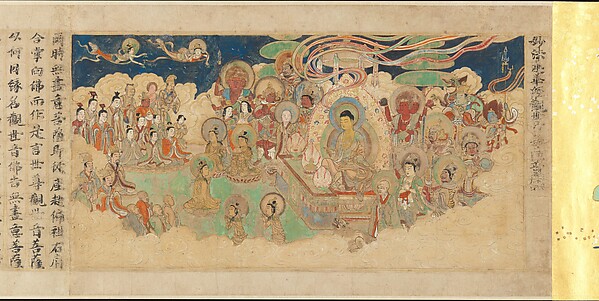
Sugawara Mitsushige, dated 1257. Handscroll; ink, color, and gold on paper. The Metropolitan Museum of Art, accession 53.7.3.
Look closer: Look at the lower register: tiny, brightly coloured figures gather round a seated Buddha, and the text of the Lotus Sutra runs above like a roof. Picture and scripture are one object.
Sugawara Mitsushige, “Universal Gateway,” Chapter 25 of the Lotus Sutra, dated 1257. The Metropolitan Museum of Art, Purchase, Louisa Eldridge McBurney Gift, 1953, accession 53.7.3. Public domain (Met Open Access). Museum record
Oda Nobunaga ousts the last Ashikaga shōgun in 1573; Toyotomi Hideyoshi follows. Kanō Eitoku paints monumental sliding-door landscapes, castles such as Himeji are decorated with gold-leaf screens, and Sen no Rikyū (d. 1591) refines wabi tea and commissions Chōjirō's hand-built bowls.
The Tokugawa shogunate is established in 1603. Kōetsu and Sōtatsu found Rinpa in Kyoto; porcelain begins in Kyushu around 1620 when Korean potters find kaolin; Katsura Imperial Villa is built in 1624; Moronobu begins signing the first ukiyo-e woodblock prints by 1672.
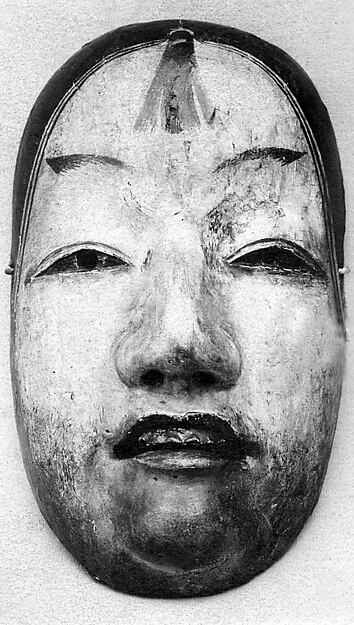
Maker unrecorded, 1336–1573. Lacquered wood. The Metropolitan Museum of Art, accession 17.175.58.
Look closer: Look at the mouth and brows: a Noh mask is made to change expression as the actor tilts it toward or away from the light. The calm face is a trick of angle.
Maker unrecorded, Noh mask, 1336–1573. The Metropolitan Museum of Art, Rogers Fund, 1917, accession 17.175.58. Public domain (Met Open Access). Museum record

Maker unrecorded, armor, ca. 1550; helmet, 18th century. Iron, leather, lacquer, silk, gilt copper. The Metropolitan Museum of Art, accession 14.100.120a–g.
Look closer: Look at the lacing: hundreds of small plates are bound with silk cord into a flexible shell. Colour and pattern of the cord carried family and rank.
Maker unrecorded, Armor (Dō-maru), armor, ca. 1550; helmet, 18th century. The Metropolitan Museum of Art, Gift of Bashford Dean, 1914, accession 14.100.120a–g. Public domain (Met Open Access). Museum record
The merchant city's golden age: Ogata Kōrin (1658 to 1716) and his brother Kenzan (1663 to 1743) consolidate Rinpa; the tansu is first recorded; Kyoto holds yearly bonsai exhibitions in the Tenmei era (1781 to 1788). Export porcelain is strongest until about the 1740s.
Harunobu's full-colour nishiki-e arrive in 1765; Sharaku's brief career runs 1794 to 1795; Hokusai's Great Wave dates from about 1830 to 1832 and Hiroshige's Tōkaidō series from about 1833 to 1834. Bonsai become a popular pastime after 1800.
Japan shows art at Vienna in 1873 and sends 30,000 items to Philadelphia in 1876; the same year a decree largely ends the public carrying of swords. The Artist to the Imperial Household system begins in 1890, and cloisonné enamel has its golden age from about 1890 to 1910, and Satsuma ware is made largely for export.
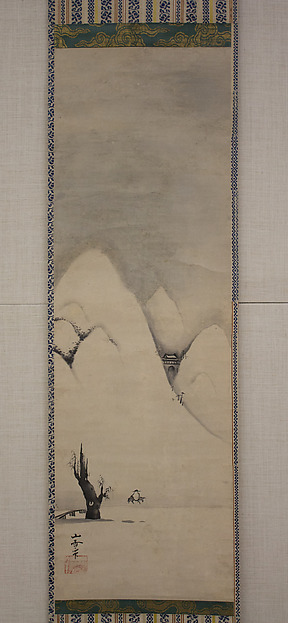
Kano Sansetsu 狩野山雪, second quarter of the 17th century. Hanging scroll; ink on paper. The Metropolitan Museum of Art, accession 36.100.61.
Look closer: Look at the empty paper: the snow is not painted but left as the silk itself. What is not painted does most of the work.
Kano Sansetsu 狩野山雪, Winter Landscape, second quarter of the 17th century. The Metropolitan Museum of Art, The Howard Mansfield Collection, Purchase, Rogers Fund, 1936, accession 36.100.61. Public domain (Met Open Access). Museum record
Shin-hanga is named by the publisher Watanabe Shōzaburō in 1915; sōsaku-hanga begins as a movement in 1918; mingei is coined in 1925 and declared in 1926; Sōgetsu ikebana is founded in 1927; the Japan Folk Crafts Museum opens in 1936.
The Law for the Protection of Cultural Properties comes into force on 29 August 1950; the Gutai group forms in 1954; the Agency for Cultural Affairs is created in 1968.
Noh is inscribed by UNESCO in 2008; the centenary of mingei is marked in Kyoto in autumn 2025; craft techniques and performing arts are still passed down in the lineages that the 1950 law set out to protect.
A table of the same eras, with the first object to look for in each, is kept in the glossary and the A to Z below. For the long histories of each art, the almanacs listed in the rooms above carry their own dated chapters.
Stories Told by Objects
Every tradition keeps its legends about objects, and some are better attested than others. The accounts below are marked as the sources have them: said, traditionally, or recorded.
The bowl that came back mended
The story told of kintsugi belongs to the fifteenth-century shōgun Ashikaga Yoshimasa, who is said to have sent a broken Chinese tea bowl back to China for repair. It returned held together with ugly metal staples, and Japanese craftsmen, so the tale runs, were moved to invent a more beautiful mend in gold lacquer. A rival account says the stapled bowl was prized for its imperfection and gave its own name to the repair. Either way the lesson survives: the mend became the glory of the bowl.
The door too low for an emperor
Sen no Rikyū, tea master to Toyotomi Hideyoshi, is credited with shrinking the tea house and with the crawl-in entrance so low that even the emperor, it is said, would have had to bow to enter. The tale compresses a real principle: in the tea room, rank is left at the door. Rikyū's relationship with Hideyoshi soured, and in 1591 he was ordered to take his own life. His descendants founded the three schools of tea that still teach: Omotesenke, Urasenke and Mushakōjisenke.
Seventy-two days at the south gate
In 1203 the sculptor Unkei, with Kaikei, two other master sculptors and sixteen assistants, made two Niō guardians for the great south gate of Tōdai-ji in Nara. Each stands about 26 feet tall. They were built of many pieces of wood, carved separately and joined, a technique called yosegi, and the work was done in 72 days. The speed is part of the legend; the method explains it.
Ten months of Sharaku
The portraits of Kabuki actors by Tōshūsai Sharaku appeared in 1794 and stopped about ten months later. Nobody has proved who he was. In that brief span he made some of the most striking faces in ukiyo-e, and the Metropolitan Museum of Art alone holds a long run of them. The mystery has given the prints an aura that their candour had earned already.
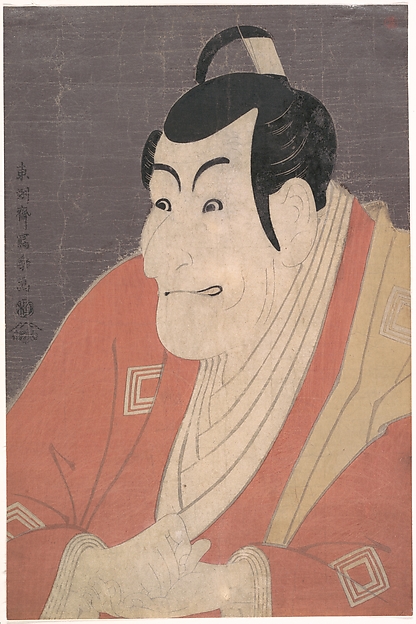
Tōshūsai Sharaku, 5th month, 1794. Woodblock print; ink and color on paper with mica ground. The Metropolitan Museum of Art, accession JP3114.
Look closer: Look at the face: the jaw, the heavy brows and the small, intent eyes are drawn without flattery. Portraits of actors were commercial prints, and Sharaku's honesty may have cost him his market.
Tōshūsai Sharaku, Kabuki Actor Ichikawa Ebizō (Ichikawa Danjūrō V) in the play The Colored Reins of a Loving Wife (Koi nyōbō somewake tazuna), 5th month, 1794. The Metropolitan Museum of Art, Harris Brisbane Dick Fund and Rogers Fund, 1949, accession JP3114. Public domain (Met Open Access). Museum record
A pine older than the peace
Bonsai are often thought of as a modern hobby, but one pine, known as Sandai Shōgun, was already being trained as a bonsai by 1610, and a handscroll of 1299 shows potted trees. Kyoto held yearly bonsai exhibitions in the Tenmei era, 1781 to 1788. The art came from China as penjing, brought by envoys and Buddhist students from the sixth century on, and was refined in Japan over a thousand years.

Kubo Shunman, 1796. Woodblock print (surimono); ink and color on paper. The Metropolitan Museum of Art, accession 2012.248.25.
Look closer: Look at the bench: the pot sits on a low table of its own, which tells you the tree was an object of display and attention, not a decoration in passing.
Kubo Shunman, Bonsai Plum Tree on Bench and Box, 1796. The Metropolitan Museum of Art, Purchase, Marjorie H. Holden Gift, 2012, accession 2012.248.25. Public domain (Met Open Access). Museum record
Van Gogh and the print shop
Vincent van Gogh began collecting ukiyo-e around 1885, organised an exhibition of Japanese prints in Paris in 1887 and put prints in the background of his portrait of Père Tanguy. Claude Monet owned a large collection and shaped his garden at Giverny with Japanese elements. The craze had a name, Japonisme, coined by Philippe Burty in 1872, and it ran through Whistler, the Impressionists and Art Nouveau.
The sword leaves the street
In 1588 Toyotomi Hideyoshi ordered the disarming of the farmers in a sword hunt. In 1876 the Haitōrei edict largely ended the public carrying of swords except by the military and officials, and the market collapsed; many smiths lost their living. Mounts and fittings, tosogu, outlived the edict as collectables and works of art in their own right. The long chapter is on the sword page and the tsuba chapter.
The kimono with no pockets
A kimono has no pockets, so the men of Edo hung their essentials, a medicine case, a tobacco pouch or a purse, from the sash on a cord, anchored by a carved toggle, the netsuke, with a bead, the ojime, sliding on the cord to close an inrō. Netsuke arose in the seventeenth century and were most popular in the Edo period. They declined when dress became Western in the Meiji period, and some of the finest collections are now outside Japan. The chapter is on the netsuke page.
A hundred years of mingei
The word was born in Kyoto, in the talk of Yanagi Sōetsu, Kawai Kanjirō and Hamada Shōji in 1925. In 2025 the city marked the centenary with an exhibition at the KYOCERA Museum of Art, from 13 September to 7 December, on the legacy of everyday life. A movement that prized the anonymous maker had become a thing to celebrate by name.
Fun Facts, Checked Twice
These curiosities were each checked against the references listed under Sources. Where a figure comes from a single reference, the wording says so.
- There are about 450 Noh masks based on roughly sixty types, and the masks mark gender, age and social rank.
- Ikenobō is the only major ikebana school without the suffix -ryū, because it is regarded as the original.
- Sōgetsu ikebana was founded in 1927 by Teshigahara Sōfū; moribana arrangements are set in a shallow vessel on a pin holder (kenzan).
- The ideal tea room measures four and a half tatami mats.
- In tea, the ro season is traditionally November to April and the furo season May to October.
- A shohin bonsai is a one-handed size class, in the range of about 13 to 20 cm (the first shohin exhibition, in 1975, used 13 to 25 cm).
- Rinpa is a Meiji-period name: it combines the last syllable of Kōrin with the word for school.
- The Raku family has passed down its name through sixteen generations, sometimes by adoption.
- The first full-colour ukiyo-e prints (nishiki-e) date from 1765 and sharply reduced the market for limited-palette and hand-coloured prints.
- The Hōryū-ji Buddhist monuments were added to the UNESCO World Heritage List in December 1993.
- A Living National Treasure, a holder of an Important Intangible Cultural Property, receives an annual special grant (two million yen, in the reference used here) to help pass on the skill.
- Wajima lacquer, from Ishikawa Prefecture, is known from the late fifteenth century for undercoats of urushi mixed with diatomaceous earth on zelkova wood.
- Hardware for tansu was largely forged by hand until plate pressing was introduced from England in the 1880s, after which it became more decorative.
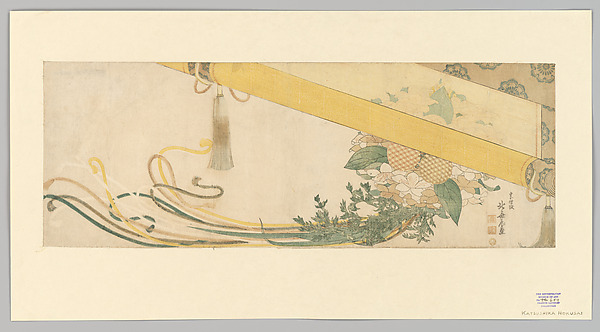
Katsushika Hokusai, ca. 1799–1810. Woodblock print (surimono); ink and color on paper. The Metropolitan Museum of Art, accession JP659.
Look closer: Look at the blind and the basket: flowers in a woven basket seen beside a rolled screen make a seasonal still life, one of many flower subjects in Edo prints.
Katsushika Hokusai, Basket of Flowers with Bamboo Blind, ca. 1799–1810. The Metropolitan Museum of Art, The Francis Lathrop Collection, Purchase, Frederick C. Hewitt Fund, 1911, accession JP659. Public domain (Met Open Access). Museum record

Suzuki Harunobu, probably 1765. Woodblock print; ink and color on paper. The Metropolitan Museum of Art, accession JP863.
Look closer: Look at the line: the branch sweeps to one side while the cluster of flowers balances it. The print is titled for the Ikenobō style, the oldest school.
Suzuki Harunobu, Ike Bana (Flower Arrangement) in the Ike-no-bo Style, probably 1765. The Metropolitan Museum of Art, Gift of Estate of Samuel Isham, 1914, accession JP863. Public domain (Met Open Access). Museum record
What a Collector Looks For
Collecting Japanese objects is a practice of looking before it is a practice of owning. The questions of the method above become habits: you learn to turn a bowl over, to ask what a scroll's mounting says about its age, to read the repair as part of the story. What follows are the first things a careful collector checks, by family of object. It is a starting kit, not a substitute for a specialist's eye.
| Family | First things to check | Honest signs of age | Papers and boxes |
|---|---|---|---|
| Hanging scrolls and screens | Mounting fabric, rollers, cords; paper or silk; seals; whether the hinges of a screen are original | Gentle toning, foxing, old repair to the mount | Inscribed box (hakogaki); dealer or temple labels |
| Tea bowls and ceramics | Foot ring, kiln marks, glaze pooling; bowl held to the light for hairlines | Wear on the foot, rim stains, cracked-and-mended seams | Wooden box with inscription (tomobako) from a master or school |
| Iron kettles | Interior (no flaking rust), lid fit, signature on the lid or body, hole for the cord | Even, dark patina; rust that is stable, not wet | Maker box; leak test |
| Lacquer | Edges and corners of gold work; cracks (nuri layers); inside surfaces | Fine hairlines, rubbed highlights on raised edges | Original storage box; set completeness |
| Sword fittings and armour | Signatures, soldered patches, matching lacing; modern replicas | Even oxidation; worn raised areas | Appraisal papers; school attributions |
| Buddhist images | Separate pieces joined (yosegi); gilt wear; replaced hands or halos | Sooty patina in crevices; rubbed gilding | Temple provenance; inscription inside the body |
| Textiles | Dye (indigo, yūzen, shibori), seams, moth loss; whether re-cut | Fading in folds; softened cloth | Dealer note; tailoring history |
| Tansu | Joints, drawer runners, hardware originals, replaced bottoms | Rubbed edges, darkened wood, honest sun-fade | Region and trade ascribed by joinery and iron |
| Netsuke and inrō | Himotoshi (cord holes) worn smooth; signature; materials | Rounded, darkened high points from handling | Signature reference; material documentation |
| Woodblock prints | Impression quality, colour register, paper, publisher seals; whether a later reprint | Toning, mounting marks, trimmed margins | Edition notes; museum comparison |
Three cautions sit above all the others. First, designation. Objects classified as Important Cultural Property or National Treasure require government permission for alteration and are generally not exportable; a handsome antique that is in private hands in Japan is almost never one of these, but a collector should ask. Second, materials: ivory carries restrictions in many countries, and the trade in ivory from live animals is illegal; our guide to ivory and its substitutes explains the options. Third, candour: repairs, replacements and married parts should be declared in writing, and the best pieces are never the ones with nothing to say.
None of this is meant to make buying difficult. It is meant to make owning rich. A piece with a box, a mend and a story is a piece that can be passed on; the pleasure of the hunt is partly in the questions. If you would like help finding a particular object, the door below is open.

Shibata Zeshin, second half of the 19th century. Gold maki-e on black and brown lacquer, with mother-of-pearl inlay and pewter. The Metropolitan Museum of Art, accession 2015.500.2.53a–g.
Look closer: Look at the corners: on lacquer, the corners and the edges of raised designs show wear first. A softened corner is honest age; a perfect one on a piece said to be old should prompt a question.
Shibata Zeshin, Tiered Box (Jūbako) with Design of Boats and Plovers, second half of the 19th century. The Metropolitan Museum of Art, Gift of Florence and Herbert Irving, 2015, accession 2015.500.2.53a–g. Public domain (Met Open Access). Museum record
Glossary of 99 Terms
The words below recur across the arts. Each is given in English letters, in Japanese, and in a plain definition. Terms that also have long chapters link onward from the A to Z.
A
- Aizome 藍染
- Dyeing with indigo (ai), traditionally from fermented plant leaves; the blues range from pale to near-black and deepen with washing.
B
- Bijin-ga 美人画
- Pictures of beautiful women, a leading subject of ukiyo-e and of painting; the genre records fashion and manners as much as faces.
- Bokuseki 墨跡
- Ink traces: calligraphy by Zen monks, treasured in the tea alcove as the spiritual centre of a room.
- Bonsai 盆栽
- A tree grown and trained in a pot, with roots, trunk and branches shaped over years; the art came from Chinese penjing and developed in Japan over centuries.
- Bunjin-ga 文人画
- Literati painting: ink landscapes and bamboo by scholar-amateurs following Chinese models, popular in the Edo period.
- Butsudan 仏壇
- The household Buddhist altar, a cabinet holding images, offerings and memorial tablets for the family's dead.
- Byōbu 屏風
- A folding screen of paper panels on hinges; the word means wind-wall. Pairs of six-panel screens are the classic format.
C
- Chadō 茶道
- The Way of Tea; also sadō or chanoyu. A discipline of preparing and serving powdered green tea in a prepared setting.
- Chaire 茶入
- A small ceramic caddy for the powdered tea used for thick tea, kept in a silk bag.
- Chasen 茶筅
- The bamboo whisk used to froth powdered tea, cut from a single piece of bamboo.
- Chashaku 茶杓
- The bamboo or wooden tea scoop, often given a poetic name by its maker or the tea master.
- Chashitsu 茶室
- The tea room: ideally four and a half tatami, with a low ceiling, a hearth and an alcove.
- Chawan 茶碗
- The tea bowl; for the tea ceremony it is chosen for the season and the guest.
- Chigaidana 違い棚
- Staggered shelves beside the alcove for display of objects.
- Chokkan 直幹
- Formal upright style in bonsai, with a straight trunk tapering to the apex.

Hayakawa Shōkosai I, ca. 1870s–80s. Timber bamboo and rattan. The Metropolitan Museum of Art, accession 91.1.2068.
Look closer: Look at the weave: a hanakago is built from split bamboo in plaiting patterns that were once the signature of named basket-makers. The mouth is shaped to hold a flower stem and a hidden tube.
Hayakawa Shōkosai I, Karamono-Style Flower Basket (Hanakago), ca. 1870s–80s. The Metropolitan Museum of Art, Edward C. Moore Collection, Bequest of Edward C. Moore, 1891, accession 91.1.2068. Public domain (Met Open Access). Museum record
D
- Dogū 土偶
- Clay figurines of the Jōmon period, often with exaggerated features, whose purpose is still debated.
- Dōtaku 銅鐸
- Bronze bells of the Yayoi period, possibly derived from Korean instruments.
E
- Emaki 絵巻
- A narrative handscroll in which picture and text unfold as the scroll is unrolled from right to left.
F
- Fukusa 袱紗
- A silk cloth used in tea for handling utensils, and a gift cover embroidered with auspicious motifs.
- Furo 風炉
- The portable brazier used in the warm months of the tea year, May to October by tradition.
- Fusuma 襖
- Sliding doors covered in opaque paper, the surface for monumental painting in castles and temples.
G
- Gagaku 雅楽
- The court music and dance of Japan, among the oldest living ensemble music in the world.
- Geta 下駄
- Raised wooden clogs worn with kimono; see also zōri and tabi.
- Gofun 胡粉
- A white pigment made from ground oyster shell, used for the faces of dolls and masks and for white highlights in painting.
H
- Hakogaki 箱書
- An inscription on the box of an object, written by the maker, a master or a school to name and authenticate it.
- Hamon 刃文
- The visible temper line on a Japanese blade, made by differential hardening with clay applied to the edge.
- Hanakago 花籠
- A bamboo flower basket used in ikebana and tea, often woven by named basket makers.
- Haniwa 埴輪
- Clay cylinders and figures set on the mounds of Kofun-period tombs.
- Himotoshi 紐通し
- The cord holes in a netsuke through which the cord passes; worn smooth by use, they are a mark of handling.
- Hina ningyō 雛人形
- Dolls displayed for the Girls' Festival in March, in tiered sets modelled on the imperial court.
- Hiragana 平仮名
- The cursive syllabary developed in the Heian period, used by court women and central to classical poetry and calligraphy.
- Hyōgu 表具
- Mounting of scrolls, screens and albums with silk, paper and wood by a specialist mounter (hyōgushi).
I
- Ikebana 生け花
- The Japanese art of flower arrangement, with schools such as Ikenobō, Ohara and Sōgetsu.
- Inrō 印籠
- A small stacked case, often lacquered, hung from the sash by a cord to carry medicine or seals.
- Irori 囲炉裏
- A sunken hearth in the floor of a farmhouse, centre of daily life and often of display.

Nomura Kyūkoku, active first half of the 19th century. Three cases; lacquered wood with gold hiramaki-e and ivory inlay on mother-of-pearl ground; Netsuke: carved ivory; flowers and grasses with silver butterflies; Ojime: silver and gold quail in autumn grasses. The Metropolitan Museum of Art, accession 14.40.878a, b.
Look closer: Look at the cord: the ojime bead slides to close the stacked compartments and the netsuke at the top anchors the whole at the sash. Three pieces, one working system.
Nomura Kyūkoku, Inrō with Tanabata Story of the Weaver and the Herdboy, active first half of the 19th century. The Metropolitan Museum of Art, Bequest of Benjamin Altman, 1913, accession 14.40.878a, b. Public domain (Met Open Access). Museum record
J
- Jidai 時代
- Era or period; also used of the age and style of an object, as in jidai-mono, old things.
K
- Kaiseki 懐石
- The meal served at a formal tea gathering, built on seasonal ingredients and careful serveware.
- Kakejiku 掛軸
- A painting or calligraphy mounted on silk and a roller so that it can be hung in an alcove and rolled away.
- Kakemono 掛物
- Hanging picture; a synonym for kakejiku in everyday use.
- Kama 釜
- The iron kettle of the tea room, set on the hearth; the casting is a craft of its own.
- Kanji 漢字
- Chinese characters used in Japanese writing, the source of the art of calligraphy.
- Kimono 着物
- The T-shaped robe of straight panels worn by all genders, with kinds for each occasion and season.
- Kintsugi 金継ぎ
- Mending broken ceramics with urushi lacquer and powdered gold, silver or platinum, making the repair visible.
- Koicha 濃茶
- Thick tea: powdered tea kneaded to a paste, shared in one bowl at the heart of a formal gathering.
- Koto 琴
- A long zither with thirteen strings, central to chamber music and classical song.
- Kōgei 工芸
- The crafts: ceramics, textiles, lacquer, metalwork and woodwork made by hand; also the title of the folk craft magazine of 1931.
M
- Maki-e 蒔絵
- Sprinkled picture: lacquer decoration made by dusting gold or silver powder onto wet lacquer.
- Manjū 饅頭
- In netsuke, a round flat form like the sweet bean bun after which it is named.
- Mingei 民藝
- The folk craft movement, coined in 1925 by Yanagi Sōetsu with Hamada Shōji and Kawai Kanjirō.
- Mon 紋
- A crest or emblem, used on kimono, armour, lacquer and tea utensils to mark a family or school.
- Moribana 盛花
- Heaped flowers: ikebana in a shallow vessel, with stems fixed on a pin holder.
N
- Nageire 投入
- Thrown-in flowers: ikebana in a tall vase with a natural, unstructured line.
- Netsuke 根付
- A carved toggle that anchors the cord of a hanging pouch or inrō at the sash.
- Nishiki-e 錦絵
- Brocade pictures: full-colour woodblock prints, first made in 1765.
- Nuri 塗
- Lacquering; in compounds such as Wajima-nuri it names the regional lacquer tradition.
- Nō 能
- The slow, masked stage art that grew from sarugaku and was shaped by Kan'ami and Zeami.
- Nōmen 能面
- A Noh mask, carved in cypress and painted with gofun; about 450 masks derive from roughly sixty types.

Maker unrecorded, first half of the 19th century. Plain-weave-patterned silk gauze brocaded in silk and metallic thread. The Metropolitan Museum of Art, accession 51.137.6.
Look closer: Look at the bands: a Noh costume is built in broad horizontal blocks of woven pattern that read clearly from a distance on a stage lit by daylight and flame.
Maker unrecorded, Noh Costume (Chōken) with Wisteria, Waves, and Purple Bands, first half of the 19th century. The Metropolitan Museum of Art, Purchase, Gifts, Bequests, and Funds from various donors, by exchange, 1951, accession 51.137.6. Public domain (Met Open Access). Museum record
O
- Obi 帯
- The sash of a kimono, which may be a work of art in itself and carries the main seasonal motif.
- Ojime 緒締
- The bead that slides on the cord of an inrō to close the case.
- Okimono 置物
- An object made to be placed: a figure or sculpture designed for display in the alcove or on a shelf.
R
- Raden 螺鈿
- Mother-of-pearl inlay in lacquer, set in cut shapes and polished flush.
- Raku 楽
- Hand-built, low-fired tea ware credited to Chōjirō and the Raku family, in black and red.
- Rikka 立花
- The standing-flowers style of ikebana associated with Ikenobō, a landscape in miniature built on a main stem.
- Rinpa 琳派
- The decorative school of Kōetsu, Sōtatsu, Kōrin and Hōitsu, known for gold grounds and bold simplified nature.
- Ro 炉
- The sunken hearth used in the cold months of the tea year, November to April by tradition.
- Rōji 露地
- The dewy path: the tea garden that leads from the gate to the tea room.
S
- Sabi 寂
- The beauty of age and weathering, one half of the pair wabi-sabi.
- Sagemono 提物
- Objects hung from the sash by a cord: pouches, pipe cases, inrō.
- Sashiko 刺し子
- Small running stitches in repeated patterns, used to strengthen and decorate working cloth.
- Satsuma ware 薩摩焼
- Ceramics from Kagoshima; the later cream-bodied enamelled export ware is known to the West by the name.
- Shakuhachi 尺八
- An end-blown bamboo flute, long associated with Zen practice.
- Shibori 絞り
- Tie-dyeing by binding, folding and stitching cloth before dyeing, in many regional forms.
- Shin-hanga 新版画
- New prints: early twentieth-century woodblock prints on traditional subjects, named by the publisher Watanabe Shōzaburō in 1915.
- Shitsurai 室礼
- The seasonal arrangement of a room with scrolls, flowers and objects.
- Shoin 書院
- The study alcove and the architectural style built around it, the root of the modern Japanese room.
- Shōhin 小品
- Small bonsai, held in one hand, traditionally in the range of 13 to 20 cm.
- Shōka 生花
- The ikebana style with three main stems for heaven, earth and human.
- Sukiya 数寄屋
- The tea-house style of architecture, with natural materials, light proportions and asymmetry.
- Sumi-e 墨絵
- Ink painting, from black ink ground on a stone and water, in monochrome gradations.
- Sōsaku-hanga 創作版画
- Creative prints: woodcuts in which one artist designs, carves and prints, a movement of the 1910s onward.
T
- Tabi 足袋
- Split-toed socks worn with kimono and zōri.
- Tansu 箪笥
- Traditional chests for clothing and goods, first recorded in the Genroku era and named by trade and region.
- Tatami 畳
- Rice-straw mats of standard size; rooms are measured by them.
- Tatebana 立花
- The earliest style of altar flower offering, from the candle, incense and flower set.
- Tokonoma 床の間
- The alcove of a Japanese room for a scroll, flowers and one object, the focus of display.
- Tomobako 共箱
- The wooden box made for an object, inscribed by the maker or a master and kept with it.
- Tsuba 鍔
- The sword guard, in iron, copper or soft metals, carved, inlaid and signed by named schools.
- Tōsōgu 刀装具
- Sword fittings: tsuba (guards), menuki, fuchi, kashira, kozuka and kōgai, a collecting field in itself.

Maker unrecorded, ca. 1615–1868. Iron. The Metropolitan Museum of Art, accession 91.1.750.
Look closer: Look at the openwork: this tsuba shows a bamboo vase of the kind used for ikebana, so the warrior's guard and the flower room meet in one small disc of iron.
Maker unrecorded, Sword Guard (Tsuba) Depicting Bamboo Vase for Ikebana and Plum Branch, ca. 1615–1868. The Metropolitan Museum of Art, Edward C. Moore Collection, Bequest of Edward C. Moore, 1891, accession 91.1.750. Public domain (Met Open Access). Museum record
U
- Ukiyo-e 浮世絵
- Pictures of the floating world: woodblock prints and paintings of actors, beauties and landscapes from Edo.
- Urushi 漆
- Lacquer: the sap of the lacquer tree, applied in many thin layers and cured in humid conditions.
- Usucha 薄茶
- Thin tea: whisked powdered tea served in individual bowls.
W
- Wabi 侘
- The beauty of simplicity, poverty chosen and quiet; the foundation of tea as taught by Rikyū.
- Wabi-sabi 侘寂
- An aesthetic of imperfection, impermanence and quiet, associated with Zen and tea.
- Wagashi 和菓子
- Traditional sweets, eaten before thick or thin tea and shaped to the season.
Y
- Yamato-e 大和絵
- Japanese-style painting of the Heian period onward, in opaque colour, as opposed to Chinese-style ink.
- Yosegi-zukuri 寄木造
- Joined-block wood sculpture, in which a figure is made of many hollow pieces; the technique that let the Niō be made in 72 days.
- Yūzen 友禅
- Resist-paste dyeing for painting pictorial designs on silk, the prestige technique of Kyoto and Kanazawa.
Z
- Zabuton 座布団
- A flat floor cushion; in rooms laid with tatami, the seat of guests.
- Zushi 厨子
- A portable shrine or cabinet with doors that holds a small Buddhist image.
A to Z of Arts, Schools and Materials
90 arts, schools, materials and forms, each with its Japanese name, a line of identity and a route to its own chapter.
- Aizome藍染Indigo dyeing, the commonest and most beloved blue of Japanese cloth.
- Arita and Imari有田・伊万里The Kyushu porcelain towns and the port that gave their ware its name.
- Armour (yoroi)鎧The lacquered, laced armour of the warrior class, from the ō-yoroi to the gusoku.
- Bizen備前Unglazed, wood-fired stoneware from Okayama, famed for its fire marks.
- Bokuseki墨跡Zen calligraphy hung in the tea alcove.
- Bonsai盆栽Trees grown in pots, with styles from formal upright to cascade.
- Bonsai pots鉢The vessels that frame a miniature tree, from Tokoname and Chinese kilns.
- Bronze casting鋳金Wax-and-sand casting of bells, vessels and figures, with Takaoka as a famous centre.
- Bunraku文楽The puppet theatre of Osaka, with three operators to a doll.
- Butsudan仏壇The household altar of Buddhist families.
- Calligraphy書The art of the brush, central to scrolls, seals and tea.
- Chadōgu茶道具The utensils of tea, from caddy to whisk.
- Chagama茶釜The iron kettle of the tea ceremony.
- Cloisonné七宝Enamelled metalware, golden in the Meiji era.
- Dōtaku銅鐸Bronze bells of the Yayoi period.
- Edo prints江戸の版画Woodblock prints of the Tokugawa capital.
- Emaki絵巻Narrative handscrolls of picture and text.
- Folding screens屏風Painted screens of six and two panels.
- Gagaku雅楽Court music and dance.

Utagawa Hiroshige, ca. 1833–34. Woodblock print; ink and color on paper. The Metropolitan Museum of Art, accession JP486.
Look closer: Look at the silence: the snow is made by leaving the paper unprinted and by pressing a blind, textured grey into the sky. Stillness is a printing technique.
Utagawa Hiroshige, A Snowy Evening at Kanbara Station, ca. 1833–34. The Metropolitan Museum of Art, Rogers Fund, 1918, accession JP486. Public domain (Met Open Access). Museum record
- Geta, zōri and tabi下駄・草履・足袋The footwear of the kimono.
- Gusoku具足The full armour of the later warrior era, built for the battlefield and the parade.
- Hagi萩焼A soft stoneware tea bowl that changes with use.
- Hanging scrolls掛軸Pictures and writing mounted for the alcove.
- Haniwa埴輪Clay figures of the Kofun tombs.
- Hibachi and irori火鉢・囲炉裏The household hearths.
- Hina dolls雛人形The Girls' Festival dolls of March.
- Ikebana生け花Flower arrangement as a discipline.
- Ikebana vessels花器The vases, baskets and plates of the flower room.
- Ikenobō池坊The oldest school of ikebana.
- Inrō印籠Lacquered cases for the sash.
- Ivory and substitutes象牙A careful guide to a difficult material.
- Kabuki歌舞伎The theatre of the unusual.
- Kabuki makeup隈取Kumadori lines and the onnagata tradition.
- Kaiseki懐石The meal of the tea gathering.
- Kanō school狩野派The painting lineage of the shōguns' castles.
- Karatsu唐津焼The first ware of western Japan, loved in tea.
- Katana刀The long sword of the samurai.
- Kimono着物The garment and its ladder of formality.
- Kintsugi金継ぎMending with gold; see the glossary.
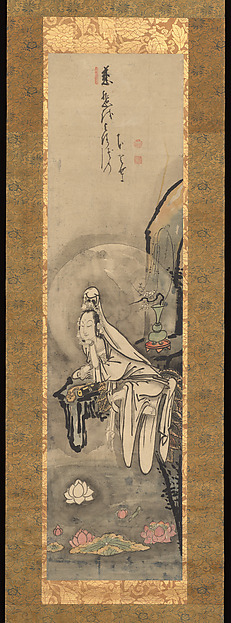
Hakuin Ekaku, 1750s. Hanging scroll; ink and color on paper. The Metropolitan Museum of Art, accession 2025.91.
Look closer: Look at the brushwork: Hakuin paints with a few confident strokes and adds a verse in his own hand. A Zen painting is meant to be read, not just seen.
Hakuin Ekaku, Kannon by a Lotus Pond, 1750s. The Metropolitan Museum of Art, Purchase, Jane and Raphael Bernstein Gift, 2025, accession 2025.91. Public domain (Met Open Access). Museum record
- Kutani九谷焼Colourful porcelain from Ishikawa, with a contested origin.
- Kyōgen狂言The comic art beside Noh.
- Lacquer漆Urushi: layers on wood, with gold powder and shell.
- Maki-e蒔絵Gold powder sprinkled on lacquer.
- Makimono巻物Handscrolls mounted for unrolling.
- Mashiko益子焼The folk kiln of Hamada Shōji.
- Meiji export art明治の輸出美術Bronze, ivory, enamel and Satsuma made for the world's fairs.
- Mingei民藝The folk craft movement of 1925.
- Netsuke根付The carved toggles of Edo.
- Nihon buyō日本舞踊Classical Japanese dance.
- Noh能The masked stage art.
- Noh masks and costume能面・能装束The face and the robe.
- Okimono置物Objects made to be placed.
- Okimono and statues置物と像The almanac of bronze, wood, lacquer and Buddhist images.
- Raden螺鈿Mother-of-pearl inlay in lacquer.
- Raku楽焼Hand-built tea bowls of Kyoto.
- Rakugo落語Comic stories told seated.
- Regional textiles地方の染織Kyoto to Okinawa.
- Rinpa琳派The decorative school of gold and nature.
- Sashiko刺し子Running-stitch reinforcement and decoration.

Maker unrecorded, first half 19th century. Porcelain with underglaze iron brown and blue (Kutani ware). The Metropolitan Museum of Art, accession 91.1.278.
Look closer: Look at the bands: the turned stripes of dark and pale clay read like a stack of lines and carry the whole shape, a rhythm that echoes the vertical sweep of a pine trunk in the alcove.
Maker unrecorded, Sake Bottle (Tokkuri), first half 19th century. The Metropolitan Museum of Art, Edward C. Moore Collection, Bequest of Edward C. Moore, 1891, accession 91.1.278. Public domain (Met Open Access). Museum record
- Satsuma薩摩焼Kagoshima ware and its world-fair fame.
- Screens (byōbu)屏風Painted pairs of folding screens.
- Sen no Rikyū千利休The tea master who made wabi tea.
- Seto and Mino瀬戸・美濃Japan's great kiln belt.
- Shamisen, koto, shakuhachi三味線・琴・尺八The voices of the instruments.
- Shibori絞りTie-dye in many forms.
- Shigaraki信楽焼From sutra jar to tanuki.
- Shin-hanga and sōsaku-hanga新版画・創作版画The prints of the twentieth century.
- Shinto and the household神道Kami, shrines and the household shelf.
- SukajanスカジャンThe embroidered souvenir jacket.
- Sumi-e墨絵Ink painting in monochrome.
- Taiko太鼓The drums.
- Takarazuka宝塚The all-female revue of the modern stage.
- Tansu箪笥Chests for every trade.
- Tatami畳The mats by which rooms are measured.
- Tea schools茶の流派Urasenke, Omotesenke and Mushakōjisenke.
- Tokoname常滑焼Red teapots and climbing kilns.
- Tokonoma床の間The alcove for scroll, flowers and one object.
- Tomobako共箱The inscribed box that keeps an object's name.
- Tsuba鍔The sword guard and its schools.
- Tsuboya壺屋焼Okinawa's yachimun kilns.
- Ukiyo-e浮世絵The floating world in print.
- Ukiyo-e originals and reproductions原画と複製How to tell an impression from a copy.
- Ukiyo-e woodblock process木版From design to carving to printing.
- Urushi漆The sap of the lacquer tree.
- Warrior arts武芸The warrior and the floating world.
- Yamato-e大和絵Japanese-style painting of the Heian period onward.
- Yosegi-zukuri寄木造Joined-block wood sculpture.
- Yoshiwara吉原The licensed quarter that fed the prints.
- Yūzen友禅Painted silk, Kyoto's glory.
- Zen禅The school behind ink painting, tea and gardens.
Asked and Answered
What counts as traditional Japanese art?
In law, the answer is wide. The 1950 Law for the Protection of Cultural Properties covers tangible works (buildings, paintings, sculpture, crafts, calligraphy, documents), intangible ones (the performing arts and craft techniques), folk culture, monuments, cultural landscapes, groups of traditional buildings and conservation techniques. In daily speech it means the arts built on long lineages: tea, flowers, brush painting, prints, theatre, lacquer, ceramics, textiles and metalwork.
Is there a difference between art and craft in Japan?
Less than in the West. A tea bowl, a kettle and a scroll belong to one tea room, and the law groups painting and craft under a single heading. Hierarchies exist: painting has had pride of place and sculpture was long thought a less sympathetic medium. But the line between the maker and the artist is blurred by lineage, school and use.
What is wabi-sabi?
An aesthetic of acceptance: of imperfection, of impermanence, of the beauty of age. Wabi is the austere, subdued beauty of simplicity; sabi the patina of weathering. Its roots are in Zen and tea, and in the sixteenth century Sen no Rikyū made it the ideal of tea. Leonard Koren's 1994 book brought it to designers worldwide. Kintsugi is often seen as its clearest expression.
What is mingei?
The folk craft movement. The word was coined in 1925 by Yanagi Sōetsu with the potters Hamada Shōji and Kawai Kanjirō, and Yanagi declared the movement in 1926. It prized natural materials, hand-making, simplicity, function and anonymous makers, and the Japan Folk Crafts Museum, opened in 1936, remains its home. Kyoto marked the centenary in 2025.

Maker unrecorded, first half 19th century. Twill-weave silk with supplementary weft patterning. The Metropolitan Museum of Art, accession 91.1.18.
Look closer: Look at the lattice: the cloth is woven in a repeating key-fret of gold on teal, with a lotus at the centre. Altar textiles bring the household shrine into the vocabulary of fine weaving.
Maker unrecorded, Buddhist Altar Cloth (Uchishiki), first half 19th century. The Metropolitan Museum of Art, Edward C. Moore Collection, Bequest of Edward C. Moore, 1891, accession 91.1.18. Public domain (Met Open Access). Museum record
What is a Living National Treasure?
An informal name for a holder of an Important Intangible Cultural Property: a master of a performing art or craft technique recognised by the state. In the reference used here the holder receives a special annual grant of two million yen to help pass the skill on. The designation is of a person and a skill, not of an object.
Why do old Japanese objects come in wooden boxes?
The box (tomobako) protects the piece and carries its identity. A box inscribed by the maker, by a master or by a school (hakogaki) is part of the provenance and often of the value. A good box keeps the story with the object. If a box and object do not match, ask why.
How can I tell an original woodblock print from a reproduction?
By looking at the paper, the printing and the history. Early impressions have crisp lines and clear colour registration; later impressions show worn blocks and flatter colour; modern reproductions often use photographic or offset printing. Our chapter on originals and reproductions goes through it step by step.
Can I take Japanese antiques out of Japan?
Objects designated Important Cultural Property or National Treasure generally cannot be exported. Most antiques in private hands can leave, but rules on materials such as ivory, and on antiques in the destination country, vary. We recommend checking before buying, and our concierge can advise on documentation for a specific piece.
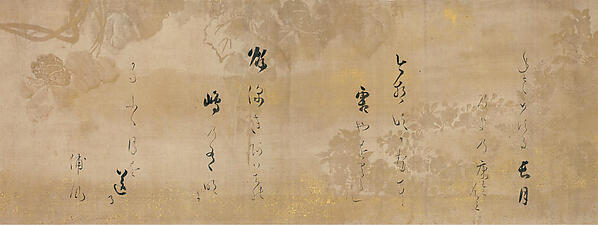
Hon'ami Kōetsu, ca. 1620. Handscroll; ink and gold on silk. The Metropolitan Museum of Art, accession 2015.300.87.
Look closer: Look at the ground: the poem is written on paper already patterned with faint gold-and-silver designs, so that the writing and the painting are one surface.
Hon'ami Kōetsu, Twelve Poems from the New Collection of Poems Ancient and Modern, ca. 1620. The Metropolitan Museum of Art, Mary Griggs Burke Collection, Gift of the Mary and Jackson Burke Foundation, 2015, accession 2015.300.87. Public domain (Met Open Access). Museum record
Where should a beginner begin?
With what you will use or live with. A tea bowl you will hold, a set of sword fittings you can study, a textile you can hang, a print you can look at every day. Then read the chapter on that family, and ask the five questions of the method on this page. The rooms above are arranged so that any one of them is a good first step.
Why do Japanese arts follow the seasons so closely?
Because the room is meant to answer the weather. Tea changes hearth and bowls through the year (ro and furo); ikebana uses native flowers chosen for each season; kimono layers and patterns follow the calendar. The seasonal change is not decoration but the structure of the art.
What is Japonisme?
A French term, coined by Philippe Burty in 1872, for the influence of Japanese art and design on nineteenth-century European artists. Japanese art reached the West at the London exhibition of 1862 and the Paris Exposition of 1867. Monet, Van Gogh, Whistler and the Art Nouveau designers all drew on it, and Van Gogh organised a Japanese print exhibition in Paris in 1887.
How do you start collecting without being overwhelmed?
Choose a room and read it. Visit museums with open collections, handle what you can, and begin with objects that are well documented and honest about repair. Ask for condition notes and boxes. The concierge door at the end of this page is for exactly that: a private request, answered by people who handle these pieces every day.
On the Shelf Today
Real pieces from the house, photographed in Tokyo, each one the kind of object this page describes. The shelf changes as pieces find their homes; the collections behind it are always open.
 Gilt-wood Shaka Nyorai with funagata haloBuddhist sculpture
 Amida Raigō scroll with Kannon and SeishiHanging scroll
 Modern Tōsei Gusoku armour, life-sizeArmour
 Edo katana kake with gold maki-e vinesLacquer
 Ueda Terufusa Nambu tetsubinTea iron
 Meiji bronze usubata ikebana vaseIkebana
 Kunii Dōsei Unjō Kannon-zu scrollHanging scroll
 Carved wood Fūjin and Raijin pairWood carving
 Kannon bodhisattva netsuke, 47 mmNetsuke
 Cast metal standing Kannon on rock pedestalOkimono
Open a whole shelf
Sources and Image Credits
Every dated claim on this page was read in the references below. Where one reference stands alone for a figure, the text says so.
- Chronology of Japan's Fine Arts, Kanzaki
- Japanese art, Wikipedia
- Cultural Property (Japan), Wikipedia
- Mingei, Wikipedia
- The 100th Anniversary of Mingei: Kyoto's Legacy of Everyday Life, Kyoto City KYOCERA Museum of Art
- Ukiyo-e, Wikipedia
- Japanese tea ceremony, Wikipedia
- Ikebana, Wikipedia
- Bonsai, Wikipedia
- Raku ware, Wikipedia
- Kintsugi, Wikipedia
- Rinpa school, Wikipedia
- Netsuke, Wikipedia
- Tansu, Wikipedia
- Japanese sword, Wikipedia
- Noh, Wikipedia
- Japanese lacquerware, Wikipedia
- Japonisme, Wikipedia
- Unkei, Wikipedia
- Wabi-sabi, Wikipedia
- The Metropolitan Museum of Art, Open Access collection (Asian Art)
Image credits are printed beneath each picture. Diagram by Japonista. Last reviewed 28 October 2026. Pictures are public domain (Met Open Access) or our own photographs.
A private request
If a piece in these rooms has caught your eye, or you are looking for an object that has not yet appeared on the shelf, the Otoriyose door is open. Tell us what you are looking for, in a few lines or at length, and the concierge team will reply personally with what can be found and how it would reach you.
Make a private request · Return to the Athenaeum
The Japonista Curation and Concierge Team, Tokyo, Japan