
Ivory and Its Substitutes: A Careful Guide
Materials and Care
Ivory and Its Substitutes: A Careful Guide
Small Japanese carvings are made from a handful of materials, and the one most people name first is also the one most hedged about by law and by conscience. This chapter describes the materials, the history that explains them, and the limits of what a photograph can tell you. It makes no claims about buying or selling, and it gives no legal advice.
Fact sheet
At a glance
- Wood is the majority. The Met reports that about 80 per cent of surviving antique netsuke were carved from native Japanese woods.
- Many materials. Coral, shell, metals, ebony, porcelain, cloisonné, mother-of-pearl and various nuts also appear, according to the Met.
- Substitutes carry their own cautions. Wikipedia reports that the helmeted hornbill, whose casque has been used for carving, is on CITES Appendix I.
- Identification is for specialists. The Schreger pattern is often used to identify ivory, but Wikipedia offers no method for telling it from bone or imitations.
- Rules differ. International and national rules on ivory differ and change, so the chapter points to them without summarising any one country’s law.
What This Guide Covers and Leaves Out
This chapter is a guide to materials and history. It does not value objects, describe how to trade them, or advise on the law, which varies from country to country and changes over time. Anyone who handles an ivory object, carved or worked, should check the current rules with the relevant national authority, and should obtain identification from a qualified specialist before relying on a description.
A few facts frame the subject, all from Wikipedia’s account of the ivory trade. The Asian elephant was placed on Appendix I of CITES in 1975, which banned international trade in its ivory. The African elephant was placed on Appendix I at the meeting of October 1989, and the international commercial trade was banned when the decision took effect in January 1990. The importation and sale of ivory is banned or restricted in many countries, and the United Kingdom’s Ivory Act 2018, the article says, bans buying and selling ivory with some narrow exemptions. Wikipedia also reports that in the 1970s Japan consumed about 40 per cent of the global ivory trade, much of it for hanko name seals, a reminder that the history of ivory in Japan is larger than the history of carving.
The Met’s essay on netsuke notes the practical effect on makers: after international trade restrictions on elephant ivory took effect in 1989, carvers turned to fossilised mammoth and walrus tusks. Everything that follows should be read in that light.
Ivory in Edo and Meiji Japan
Wikipedia’s article on ivory carving says that in Japan the craft became popular around the seventeenth century. Because the kimono had no pockets, people hung containers, sagemono and inrō, from the obi, and the netsuke toggle and the kiseru smoking pipe were often decorated with fine ivory carvings of animals and legendary creatures. The Met’s essay on netsuke puts the materials in order: ivory and wood were the two most commonly used, boxwood was favoured for its fine grain and durability, and about 80 per cent of surviving antique netsuke were carved from native Japanese woods, including cypress, cherry and camphor.

Ryūsa, late 18th century. Ivory. The Metropolitan Museum of Art, accession 10.211.1271. Gift of Mrs. Russell Sage, 1910. Open Access.
Look closer: This is a manju-shaped netsuke carved in layers. Follow the stems from the rim inwards and notice how the carver undercuts every leaf.
The Metropolitan Museum of Art, public domain (Open Access). Source: https://www.metmuseum.org/art/collection/search/60329
Wikipedia’s article on netsuke records that Tomotada and Masanao both appear in the Sōken Kishō, the earliest compilation of netsuke carvers, published in Osaka in 1781. The Met’s essay adds that signatures and seals were common and that the objects were markers of wealth which let merchants display prosperity without breaking sumptuary laws. The museum’s ivories include a tiger by Raku of the late eighteenth century, a dog by Tomotada of the late eighteenth or early nineteenth, and a round carved disc with flowers and a praying mantis by Ryūsa.
The Meiji change, in the same Wikipedia article, hit these workshops hard. Modernisation abolished the samurai class and westernised dress, and many craftsmen, including those who had made netsuke and kiseru from ivory, lost their demand. The Meiji government promoted the exhibition and export of arts and crafts at world’s fairs to give them work and to earn foreign currency, and the imperial family bought excellent works to support them. Ishikawa Kōmei and Asahi Gyokuzan gained a high reputation, and their masterpieces presented to the imperial family are held in the Museum of the Imperial Collections. The chapter on Meiji export art follows this transition.
Wood, Bone, Coral and Nut
Wood is the first answer. The Met’s catalogue includes a boar in wood of the nineteenth century and a figure of a boy wearing an ivory mask, in wood and ivory, of the eighteenth century; in these the ivory is a detail, not the whole. Wikipedia’s article on netsuke also notes that the Iwami school was founded by Seiyōdō Tomiharu (1733 to 1810), who is known for carving boar tusk, and that umoregi, bog wood, is often confused with ebony.

A tusk of the Yukagir mammoth. Photograph, 2007, as described on Wikimedia Commons.
Look closer: A tusk is a long, curved, tapering column. Commons records that this one was sampled by researchers at the University of Michigan to build a life history of the animal.
synchroswimr (via Wikimedia Commons), CC BY 2.0, via Wikimedia Commons. Source: https://commons.wikimedia.org/wiki/File:Yukagir_mammoth_tusk.jpg
Bone appears in the museum’s netsuke too: a chicken of the nineteenth century and an openwork carving of a demon of the eighteenth century are both catalogued as bone. Coral is a material in its own right: the Met catalogues a nineteenth-century netsuke as carved coral. The museum’s essay also lists shell, metals such as shakudō and shibuichi, ebony, porcelain, cloisonné, mother-of-pearl and various nuts. Some netsuke are ivory that has been stained brown, as the museum records for a netsuke of a monkey attacking a boar, which shows how a surface colour can mislead.

18th century. Bone. The Metropolitan Museum of Art, accession 10.211.1220. Gift of Mrs. Russell Sage, 1910. Open Access.
Look closer: The Met catalogues it as bone of the eighteenth century. Notice the dark lines that pick out the openwork edge.
The Metropolitan Museum of Art, public domain (Open Access). Source: https://www.metmuseum.org/art/collection/search/60319

19th century. Wood and ivory. The Metropolitan Museum of Art, accession 10.211.1790. Gift of Mrs. Russell Sage, 1910. Open Access.
Look closer: Wood and ivory together, of the nineteenth century: the pale areas are the ivory, the robe is the wood.
The Metropolitan Museum of Art, public domain (Open Access). Source: https://www.metmuseum.org/art/collection/search/59080
Outside Japan’s own carving tradition, other substitutes exist. Wikipedia’s article on vegetable ivory says it is the very hard white endosperm of certain palm seeds, chiefly Phytelephas species native to South America, that it has been used since the 1880s for buttons and also for artistic carving, dice and chess pieces, and that it is so hard and dense it must be cut with hacksaws and files rather than carved with a knife. It can be dyed, and because the dye does not penetrate past the first layer this helps identify it. The article does not say it was used in Japanese carving, and this chapter does not suggest it was.
Mammoth ivory is the material the Met says carvers turned to after 1989. Wikipedia describes it as coming from the tusks of woolly mammoths frozen in the tundra, with some estimates putting ten million or more mammoths in Siberia, and calls it rare and costly. The same article says trade in it has gone on for 300 years and remains legal, but that statement carries a citation-needed tag, so this chapter does not rely on it: check the rules where you live. A second caution applies to hornbill ivory. Wikipedia says the casque of the helmeted hornbill is the source, historically used by carvers in China and Japan, and that the bird is listed in Appendix I of CITES and was uplisted by the IUCN to critically endangered in 2015. A substitute is not always a better choice.
| Material | Where it comes from | What the sources note | Source |
|---|---|---|---|
| Wood (boxwood, cypress, cherry, camphor) | Native Japanese trees | About 80 per cent of surviving antique netsuke; boxwood favoured for fine grain | Met |
| Bone | Animal bone | Netsuke of a chicken and of a demon catalogued as bone | Met catalogue |
| Coral | Marine | Netsuke catalogued as carved coral | Met catalogue |
| Vegetable ivory | Palm seed endosperm, South America | Hard, dense, dye shows at the surface; no source says it was used in Japanese carving | Wikipedia |
| Mammoth ivory | Tusks frozen in the tundra | Material carvers turned to after 1989; trade rules differ | Met; Wikipedia |
| Hornbill ivory | Casque of the helmeted hornbill | Historically carved in China and Japan; CITES Appendix I | Wikipedia |
Telling One Material From Another
Wikipedia reports that the Schreger pattern, a checkerboard-like arrangement visible in polished samples, is often used to identify ivory, and attributes it to the arrangement of mineralised collagen fibres in the dentine. The same article notes that tusk and tooth ivory share the same basic chemistry across mammal species. It does not give a method for telling ivory from bone, antler or imitations, and neither does this chapter, because the honest answer is that the question cannot be settled from a photograph.

Micrograph labelled Schreger lines, from the United States Fish and Wildlife Service forensic laboratory page on ivory.
Look closer: The crossing arcs are what give the section its checkerboard look. The label points to an angle of less than 90 degrees.
United States Fish and Wildlife Service (via Wikimedia Commons), Public domain, via Wikimedia Commons. Source: https://commons.wikimedia.org/wiki/File:SchregerLines.jpg
What a photograph can do is show the questions. The Met’s stained-ivory netsuke tells you that surface colour is not evidence of material. The vegetable ivory article tells you that dye sits in the surface layer and can identify that nut. And the Schreger micrograph below, from the United States Fish and Wildlife Service forensic laboratory’s page on ivory, shows the kind of pattern a trained specialist looks for in a cut section. For any object whose material matters, a written identification from a qualified specialist, such as a museum conservator or an accredited laboratory, is the only dependable record.
Reading a Description Carefully
A catalogue entry is the most useful thing a reader can learn to read. The Met’s entries for netsuke give a title, a date, a material, dimensions and an accession number, and where it applies a maker. The materials are given plainly, and sometimes with a qualifier that matters: the Met describes one monkey and boar as ivory stained brown, and another figure as wood with an ivory mask. A reader who skims past the qualifier loses the information.
Three habits make a description trustworthy. First, it names the material as recorded rather than as assumed, so that bone is not called ivory and stained ivory is not called wood. Second, it gives the date as a range or a century when the source does, and does not sharpen it. Third, it names the source of any statement about the maker, so that a signature is reported as a signature and not as proof. The Met’s own notes show how far this goes: most works signed Munesuke are not considered genuine, for instance, which is a reminder that a signature on its own is an assertion.
The same habits apply to the rules. A description of a carved object that mentions ivory should say where the information on the material comes from and leave the legal position to the authority that governs the reader’s own country. This chapter follows that practice, and points to Wikipedia’s account of the ivory trade only as background to the history.
Walrus Ivory, Whalers and the Sea
Wikipedia’s article on walrus ivory says it comes from the two modified upper canines of the walrus, that the tusks grow throughout life and may reach a metre in the Pacific walrus, and that the surface shows fine longitudinal cracks and an oatmeal-like or marble-like secondary dentine. It describes walrus-ivory carving and engraving as an important folk art of the peoples of the Arctic since prehistoric times, among them the Inuit, Inupiaq and Yupik of Greenland and North America and the Chukchi and Koryak of Russia.
The article also gives a European history that helps to place the Japanese one. In the early medieval period, it says, supplies of elephant ivory reaching Europe reduced or stopped after the Muslim conquests, and walrus ivory was traded by the Vikings into northern Europe as a replacement. King Alfred the Great of Wessex records a gift of walrus tusks from the trader Ohthere in about 890, and nearly all ivories in Anglo-Saxon art use walrus. Around 1260, at the start of the Gothic period, elephant ivory began to reach Europe again and the industry greatly increased.
Scrimshaw is the sailor’s version. Wikipedia defines it as scrollwork, engravings and carvings in bone or ivory, typically made by whalers from the teeth and bones of sperm whales, the baleen of other whales and the tusks of walruses. It says the practice probably began on whaling ships in the late eighteenth century, that the word first appears in a ship’s logbook of 1826, and that the pictures were brought out with pigments such as candle black, soot or tobacco juice. The earliest authenticated pictorial piece of sperm-whale scrimshaw dates from 1817.
None of this is Japanese, and the chapter does not suggest it is. The comparison is useful because it shows the same material answering the same pressure in different places: when one kind of ivory is hard to obtain, carvers turn to another, and the Met says exactly that of netsuke makers after 1989. Whether a given object is walrus, mammoth or elephant is a question for a specialist and for the paperwork, not for a caption.
Ivory and Its Rules by Date
Dates are those given in the sources named at the end of the chapter. Where the sources differ on a year, the year is left out.
| Date | What happened | Source |
|---|---|---|
| About 890 | King Alfred records a gift of walrus tusks from Ohthere | Walrus ivory, Wikipedia |
| About 1260 | Elephant ivory begins to reach Europe again | Walrus ivory, Wikipedia |
| 17th century | Ivory carving becomes popular in Japan | Ivory carving, Wikipedia |
| 1781 | Tomotada and Masanao appear in the Sōken Kishō, published in Osaka | Netsuke, Wikipedia |
| 1815 to 1817 | Porter’s journal and the first dated pictorial scrimshaw tooth | Scrimshaw, Wikipedia |
| Meiji period | Westernised dress ends much of the demand for netsuke and kiseru | Ivory carving, Wikipedia |
| 1975 | Asian elephant placed on CITES Appendix I | Ivory trade, Wikipedia |
| October 1989 | African elephant placed on CITES Appendix I; commercial trade banned from January 1990 | Ivory trade, Wikipedia |
| After 1989 | Carvers turn to fossilised mammoth and walrus tusks | Metropolitan Museum |
Where Carved Materials Can Be Studied
Displays change; check each institution’s own site before travelling.
| Place | What there is | Source |
|---|---|---|
| The Metropolitan Museum of Art, New York | A large collection of netsuke in ivory, wood, bone and coral, with an essay on materials | Metropolitan Museum |
| Magadan Regional Museum, Russia | A walrus-ivory carving of the 1940s from Chukotka, named in the Wikipedia article | Walrus ivory, Wikipedia |
| Museum of Anthropology, Vancouver | A scrimshaw piece shown in the Wikipedia article | Scrimshaw, Wikipedia |
| A national authority on wildlife trade | The current rules for any ivory object, which differ by country and change | Ivory trade, Wikipedia |
Glossary of Materials
A short vocabulary of the terms in this chapter.
| Term | Meaning |
|---|---|
| Netsuke | The toggle that anchors a cord on the obi |
| Sagemono | A container or object hung from the obi |
| Inrō | A stacked, lidded box hung from the obi |
| Kiseru | The Japanese smoking pipe |
| CITES | The Convention on International Trade in Endangered Species, whose appendices set the international rules |
| Schreger pattern | The checkerboard-like pattern in the dentine of polished ivory |
| Scrimshaw | Engraving or carving in bone or ivory, typically by whalers |
| Vegetable ivory | The hard white endosperm of certain palm seeds, chiefly Phytelephas |
| Mammoth ivory | Ivory from the tusks of woolly mammoths, frozen in the tundra |
| Casque | The helmet-like structure on the head of the helmeted hornbill |
Fun Facts for the Curious
Each of these comes from the sources named at the end of the chapter.
- About 80 per cent of surviving antique netsuke are in native Japanese woods, the Met reports.
- A walrus tusk may reach a metre in the Pacific walrus, according to Wikipedia.
- Nearly all ivories in Anglo-Saxon art use walrus, the same article says.
- The Lewis chessmen are carved in walrus ivory, Wikipedia notes.
- Early scrimshaw was done with sailing needles, and candle black, soot or tobacco juice brought the lines into view.
- Vegetable ivory has been used since the 1880s for buttons, dice and chess pieces, Wikipedia reports.
- The Schreger pattern is attributed to the arrangement of mineralised collagen fibres in the dentine.
Medieval Walrus, Whalers’ Scrimshaw and the Netsuke Carver
The Japanese carver, the Anglo-Saxon workshop and the whaler share a difficulty. Each depended on a material that came from a particular animal, and each had to respond when supply changed. In Europe the response was to turn to walrus when elephant ivory stopped arriving; at sea it was to carve and engrave whatever the voyage supplied; in Japan, as the Met describes, it was wood first, and after 1989 mammoth and walrus.
What differs is the scale of the object. A netsuke is meant to be handled and worn, and the Met stresses that makers signed and sealed them; scrimshaw was a private leisure activity; walrus ivory in the north was a folk art. The sources describe them separately, and this chapter keeps them separate.
Wood, Ivory, Bone and Coral
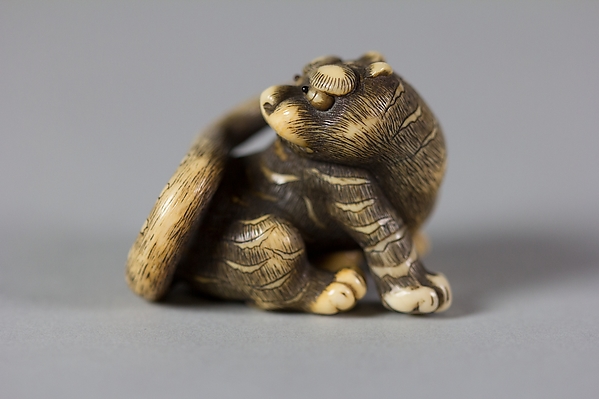
Raku, late 18th century. Ivory. The Metropolitan Museum of Art, accession 10.211.1099. Gift of Mrs. Russell Sage, 1910. Open Access.
Look closer: By Raku, of the late eighteenth century. The stripes are incised lines only a fraction of a millimetre wide.
The Metropolitan Museum of Art, public domain (Open Access). Source: https://www.metmuseum.org/art/collection/search/60289

Tomotada, late 18th century–early 19th century. Ivory. The Metropolitan Museum of Art, accession 10.211.1106. Gift of Mrs. Russell Sage, 1910. Open Access.
Look closer: By Tomotada, a name in the Sōken Kishō of 1781. The Met dates it to the late eighteenth or early nineteenth century.
The Metropolitan Museum of Art, public domain (Open Access). Source: https://www.metmuseum.org/art/collection/search/60290

19th century. Wood. The Metropolitan Museum of Art, accession 91.1.1046. Edward C. Moore Collection, Bequest of Edward C. Moore, 1891. Open Access.
Look closer: Wood is the majority material. The Met records this one as nineteenth-century wood.
The Metropolitan Museum of Art, public domain (Open Access). Source: https://www.metmuseum.org/art/collection/search/59746

19th century. Bone. The Metropolitan Museum of Art, accession 81.1.119. Bequest of Stephen Whitney Phoenix, 1881. Open Access.
Look closer: The Met catalogues the material as bone. Notice the fine feather texture.
The Metropolitan Museum of Art, public domain (Open Access). Source: https://www.metmuseum.org/art/collection/search/59199

19th century. Carved coral. The Metropolitan Museum of Art, accession 10.211.72. Gift of Mrs. Russell Sage, 1910. Open Access.
Look closer: The Met catalogues it as carved coral. The natural branching of the coral governs the shape.
The Metropolitan Museum of Art, public domain (Open Access). Source: https://www.metmuseum.org/art/collection/search/59807

Kōhōsai, 19th century. Ivory inlaid with coral and small blue and white semiprecious stones. The Metropolitan Museum of Art, accession 10.211.899. Gift of Mrs. Russell Sage, 1910. Open Access.
Look closer: By Kōhōsai, of the nineteenth century: ivory inlaid with coral and small blue stones, per the Met.
The Metropolitan Museum of Art, public domain (Open Access). Source: https://www.metmuseum.org/art/collection/search/60193

19th century. Ivory-stained brown. The Metropolitan Museum of Art, accession 91.1.983. Edward C. Moore Collection, Bequest of Edward C. Moore, 1891. Open Access.
Look closer: The Met catalogues the material as ivory stained brown, which shows how colour can mislead.
The Metropolitan Museum of Art, public domain (Open Access). Source: https://www.metmuseum.org/art/collection/search/59695

18th century. Wood, ivory. The Metropolitan Museum of Art, accession 91.1.1012. Edward C. Moore Collection, Bequest of Edward C. Moore, 1891. Open Access.
Look closer: Wood and ivory together, of the eighteenth century. Notice how the ivory is limited to the mask.
The Metropolitan Museum of Art, public domain (Open Access). Source: https://www.metmuseum.org/art/collection/search/59718
Netsuke and Small Carving
This chapter is about materials, not about what the house holds. The netsuke and inrō shelf shows what is here today, with each description naming the material as it is recorded, and the guide to Netsuke, Inro and Maki-e explains the vocabulary.
Answered plainly
What are netsuke made from?
Mostly ivory and wood, according to the Met, which adds that about 80 per cent of surviving antique netsuke are in native Japanese woods. Coral, shell, metals, ebony, porcelain and other materials also appear.
Is ivory covered by international rules?
Wikipedia reports that African elephant ivory was placed on CITES Appendix I in 1989, with the international commercial trade banned from January 1990, and that the Asian elephant has been on Appendix I since 1975. National rules differ and change, and this page gives no legal advice.
How is ivory identified?
The Schreger pattern is often used, according to Wikipedia, but the article gives no method for telling ivory from bone or imitations. A written identification from a qualified specialist is the only dependable record.
Is mammoth ivory a safe alternative?
The Met says carvers turned to fossilised mammoth and walrus after 1989, but rules differ by country and the Wikipedia statement on legality carries a citation-needed tag. Check where you live.
Is hornbill ivory a substitute?
Wikipedia says the casque of the helmeted hornbill was historically used by carvers in China and Japan, and that the bird is on CITES Appendix I and critically endangered.
Where next
Read next: our guide to mammoth tusk netsuke.
Sources and image credits
- Ivory trade, Wikipedia (CITES, Japan, the Ivory Act 2018)
- Ivory, Wikipedia (Schreger pattern, substitutes, mammoth)
- Ivory carving, Wikipedia (Japan, Meiji change)
- Netsuke, Wikipedia (materials, Sōken Kishō, Iwami school)
- Vegetable ivory, Wikipedia
- Helmeted hornbill, Wikipedia
- Mammoth ivory, Wikipedia
- Terry Satsuki Milhaupt, Netsuke: From Fashion Fobs to Coveted Collectibles, The Metropolitan Museum of Art, 1 November 2009
- Tiger, Raku, The Metropolitan Museum of Art
- Dog, Tomotada, The Metropolitan Museum of Art
- Netsuke of Chicken (bone), The Metropolitan Museum of Art
- Walrus ivory, Wikipedia (carving, Vikings, Alfred)
- Scrimshaw, Wikipedia
- Image credits: United States Fish and Wildlife Service (public domain) and synchroswimr (CC BY 2.0), Wikimedia Commons

Last reviewed 28 October 2026. Pictures, where shown, are public-domain or open-access and credited beneath each one.
Questions about a carved piece, its recorded material and its paperwork? The concierge desk replies within one to three business days.
Private concierge
Looking for something in particular?
Describe the piece or the project you have in mind. A senior advisor in Tokyo reads every case file personally and replies within two business days, with fees set out in writing before any work begins.