
Meiji Export Art and the Imperial Household Artists
Fairs and Honours
Meiji Export Art and the Imperial Household Artists
In 1873 Japan sent its first official delegation to a world’s fair. Within a generation its metalworkers, enamellers and lacquer painters were among the most decorated exhibitors of the age, and a small number were given a court title. This chapter follows the fairs, the firms and the honour that made the names.
Fact sheet
At a glance
- A state project. Vienna in 1873 was the first world’s fair the modern Japanese government took part in officially, and it prepared for it with a nationwide survey of holdings.
- Big and bold. The Met’s iron eagle is life-size, 43.5 kilograms of forged feathers on a tree trunk of its own, and was made to say something about the nation.
- Painting in lacquer. Shibata Zeshin painted with lacquer sap on paper and polished a tray to resemble aged bronze.
- A court title. From 1890 the Imperial Household named artists who received a stipend, made gifts for foreign dignitaries and were expected to accept commissions.
- Dates differ. Sources disagree on when individual artists were appointed, so this chapter gives the year the system began and leaves the individual years out.
Vienna and the First Official Showing
According to Wikipedia’s account of the 1873 Vienna World’s Fair, Japan received its invitation in 1871, shortly after the Meiji Restoration, and set up a government bureau to plan its reply. The exposition itself ran from 1 May to 1 November 1873 in the Prater park and drew 7.25 million visitors, the National Diet Library records, and it was the first international exposition in which the modern Japanese government officially took part.

Original drawing. Events are spaced evenly, not to scale.
Look closer: Read it left to right and notice the gap: the awards cluster either side of 1890, the year the court began to name artists of its own.
Diagram by Japonista (original drawing), The Japonista Curation and Concierge Team, Tokyo, Japan.
The preparation was thorough. Wikipedia describes the Jinshin Survey, a months-long inspection of imperial, noble and temple holdings, which verified the art and cultural relics to be shown. The most important products of each province were listed, and two specimens of each were gathered, one for Vienna and one to remain in Japan. Preparatory exhibitions held in Tokyo in 1871 and 1872 produced objects that later formed the core of the collection of what became the Tokyo National Museum.
The delegation numbered 41 Japanese officials and interpreters, six Europeans in Japanese employ, and 25 craftsmen and gardeners who built a main pavilion and a full Japanese garden, with a shrine and a model of a former pagoda from Tokyo. The Library notes that the garden was visited by the Emperor and Empress of Austria. The regional collection concentrated on ceramics, cloisonné, lacquerware and textiles; highlights included a golden female shachi from Nagoya Castle and a papier-mâché copy of the Kamakura Buddha.
The aftermath ran in two directions. Tsunetami Sano’s report on the fair filled 96 volumes in 16 parts and urged the creation of a museum on Western lines in Tokyo, and national industrial exhibitions were held at Ueno Park from 1877. In Europe, the Library says, the showing helped to raise the popularity of Japonisme. Both effects fed the same industry: a country that had learned to present its crafts as national achievements, and a public that now wished to buy them.
| Fair | Year | What the sources report |
|---|---|---|
| Vienna | 1873 | Japan’s first official showing; pavilion, garden and 41 officials (Wikipedia; National Diet Library) |
| Philadelphia | 1876 | Suzuki Chōkichi’s incense burner wins the top award (Japanese national art platform) |
| Paris | 1878 | The same incense burner takes a gold medal (art platform) |
| Chicago | 1893 | Suzuki’s Twelve Bronze Falcons shown, Memorial Prize (art platform); Satsuma ware poorly received (Wikipedia) |
| Paris | 1900 | Honorary Grand Prize, Suzuki (art platform); gold, Namikawa Yasuyuki (Wikipedia) |
| St Louis | 1904 | Top prize for bear and tiger objects, Suzuki (art platform); gold, Namikawa (Wikipedia) |
Companies and Kilns Built for Export
The fairs created a demand that private firms met. The McMullen Museum of Art at Boston College describes Kiryū Kōshō Kaisha, the Pioneering Craft and Commerce Company, as formed to make major artworks for world’s fairs; it adds that Suzuki Chōkichi led its metalworking department in the later 1870s and 1880s. The company’s founding year differs from source to source, and this chapter gives none.

Makuzu Kōzan I (Miyagawa Toranosuke), 1870–80s. Stoneware with polychrome enamels and gold over transparent glaze; wood lid, ivory knob (Makuzu ware). The Metropolitan Museum of Art, accession 91.1.367a, b. Edward C. Moore Collection, Bequest of Edward C. Moore, 1891. Open Access.
Look closer: Read it as a story, not a pattern. Follow the grasshoppers from the left; the cage on the right is the palanquin they escort. The lid is wood and the knob is ivory, as the museum records.
The Metropolitan Museum of Art, public domain (Open Access). Source: https://www.metmuseum.org/art/collection/search/53613
In Kyoto, Namikawa Yasuyuki worked for the Kyoto Cloisonné Company from 1871 to 1874 before forming his own firm, which Wikipedia says he ran until retiring in 1919; the workshop closed in 1923. In Yokohama, according to the Met, the ceramist Makuzu Kōzan I trained in Kyoto and in 1870 set up a workshop that produced work for domestic and international markets. His mizusashi jar below carries a procession of grasshoppers bearing flowers beside an insect cage that resembles a feudal lord’s palanquin, a theme the museum says was drawn from paintings and was an innovative choice for a ceramic vessel.
Satsuma ware shows the whole cycle in one tradition. Wikipedia reports that it was prominent at the Paris exposition of 1867, that painting workshops decorating blank-glazed stoneware appeared in Kobe and Yokohama by 1873, and that the Kinkōzan pottery began heavy exports, especially to America, in 1875. A slump in exports began in the mid-1880s, Satsuma ware was poorly received at Chicago in 1893, and more than twenty decorating factories produced it from the early 1890s to the early 1920s. The Met’s catalogue shows the same decorative habit in one of its own jars: stoneware with polychrome enamels and gold over a transparent glaze.
| House | Craft | What the sources say |
|---|---|---|
| Kiryū Kōshō Kaisha | Export art, metalwork department | Formed to make major artworks for world’s fairs; Suzuki led its metalworking department (McMullen Museum) |
| Kyoto Cloisonné Company | Enamel | Namikawa Yasuyuki worked there 1871 to 1874 (Wikipedia) |
| Makuzu workshop, Yokohama | Stoneware | Established 1870 for domestic and international markets (Met) |
| Kinkōzan pottery | Satsuma ware | Heavy exports from 1875, especially to America (Wikipedia) |
Suzuki Chōkichi and the Life-Size Eagle
The Japanese national art platform records that Suzuki Chōkichi was born on 12 September 1848 in a village in Musashi province, now Sakado in Saitama, learned lost-wax casting under Okano Tōryūsai, and set up his own business in 1864. He was known for realistic birds of prey and for very large lost-wax castings, and he died on 29 January 1919. The same page lists a run of prizes: the top award at Philadelphia in 1876 and a gold medal at Paris in 1878 for one incense burner, a gold medal at Nuremberg in 1885, a Memorial Prize at Chicago in 1893 for his Eagle and Twelve Bronze Falcons, an Honorary Grand Prize at Paris in 1900, and a top prize at St Louis in 1904 for bear and tiger objects.

Attributed to Suzuki Chōkichi, late nineteenth century. Iron, pigment, shakudō, shibuichi and wood. The Metropolitan Museum of Art, 11.105, gift of James R. Steers, 1911.
Look closer: Compare the two textures. The trunk is rough, cracked wood; the bird’s feathers are laid in overlapping rows. The museum records that every feather was individually forged and riveted.
The Metropolitan Museum of Art (via Wikimedia Commons), CC0, via Wikimedia Commons. Source: https://commons.wikimedia.org/wiki/File:Eagle_with_Outstreched_Wings_MET_DP279322.jpg
The Metropolitan Museum’s eagle is life-size. It is posed on an old tree stump with its head cocked, feet spread and wings outstretched. The museum gives the measurements with unusual completeness: the eagle itself is 48.26 centimetres high with a wingspan of 139.7 centimetres and weighs 43.54 kilograms, and the whole assemblage with its trunk stands 210.82 centimetres. The head and talons are cast iron in low relief; the feathers were individually forged, incised and riveted to metal sheets that form an inner core. The materials are iron, pigment, shakudō, shibuichi and wood.
The museum attributes the work to Suzuki and notes that it is unsigned. It reads the bird as Japan asserting itself on the international stage as the country westernised in the late nineteenth century. According to the donor, James R. Steers, the sculpture was shown at the World’s Columbian Exposition in 1893; he bought it personally in Japan in 1903 and gave it to the museum, with its base, in 1911.
A second eagle, at Boston College, carries a different story. The McMullen Museum attributes it to Suzuki by stylistic comparison with the Met’s, since it bears no signature, and says that many of his works are unsigned. Larz and Isabel Anderson bought it in Japan in 1897 and displayed it in the Japanese garden at their Brookline estate, built in 1907; they gave it to Boston College in 1954. Its base was separated from the sculpture when it was mounted on a column in 1955, and the two were reunited in March 2024, after restoration, following the sculpture’s appearance in the 2019 exhibition Eaglemania: Collecting Japanese Art in Gilded Age America. The next chapter in this almanac, on bronze casting, explains the craft behind such works.
Namikawa Yasuyuki and the Hidden Wire
Wikipedia reports that Namikawa Yasuyuki (1845 to 1927) was a former samurai who began as an artist around 1868. Working with Gottfried Wagener, he developed a semi-transparent mirror-black enamel, and by 1893 he could hide the background wires to make areas of solid enamel. The wires are the fine metal strips that define each colour field in cloisonné, which is the reason the achievement mattered: the less the wire shows, the more the surface reads as a painting.

Nineteenth century, cloisonné enamel. George Walter Vincent Smith Art Museum, Springfield, Massachusetts. Photograph, 2012.
Look closer: Look at the red cord against the black. The dark ground is the achievement described above, and the silk is there to be admired as well as to tie the lid.
Daderot (via Wikimedia Commons), CC0, via Wikimedia Commons. Source: https://commons.wikimedia.org/wiki/File:Tea_Jar_by_Namikawa_Yasuyuki_%281845-1927%29%2C_19th_century_-_Japanese_Cloisonn%C3%A9_Collection_-_George_Walter_Vincent_Smith_Art_Museum_-_DSC03750.JPG
His early work used geometric motifs and stylised plants; later pieces became more pictorial, often showing Kyoto landmarks. The article reports that he won prizes at 51 exhibitions between 1875 and 1915, among them second prize at the National Industrial Exhibition of 1881, first prize at the same exhibition in 1895, and gold prizes at Paris in 1900 and at the Louisiana Purchase Exhibition in 1904. He was appointed an Imperial Household Artist, one of only two cloisonné artists so honoured; the other was Namikawa Sōsuke, to whom he was not related.
The pictures show both sides of the practice. The tea jar in the Smith Art Museum, Springfield, Massachusetts, is cylindrical, tied with a red cord, and patterned in tiny flowers and borders on a dark ground. The vase in the gallery below, c. 1900 to 1910 and photographed in a private collection, floats butterflies and chrysanthemums on a black that looks like deep water. Earlier cloisonné can be seen at the Met: a vase 62.9 centimetres tall, dated 1865 to 1871 and catalogued as Edo or Meiji, with no maker recorded.
Zeshin Paints With Lacquer
The Met’s biography says Shibata Zeshin was born in Edo in 1807, apprenticed with the lacquer artist Koma Kansai II to learn decoration, later moved to Kyoto to study the Maruyama-Shijō school of painting, and in 1890 became the first Imperial Household lacquer artist. Wikipedia adds that he died on 13 July 1891, aged 84, that he was named Japan’s representative to the Vienna exposition without attending, and that the Khalili Collection in London holds more than a hundred of his works.
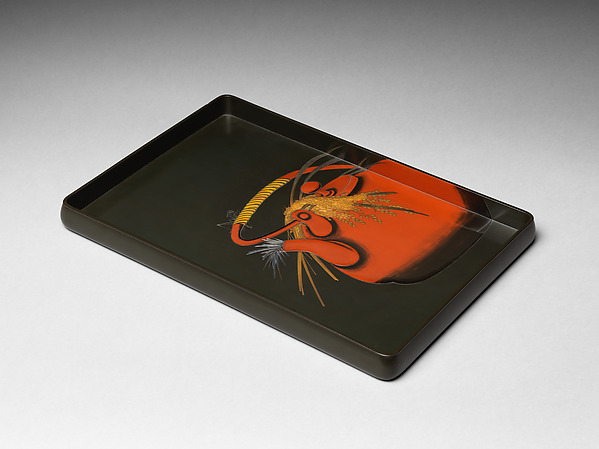
Shibata Zeshin, 1880s. Lacquered wood; gold, silver, red, yellow, black hiramaki-e and takamaki-e on “bronze imitation” (seido-nuri) ground. The Metropolitan Museum of Art, accession 2019.107. Purchase, Henrie Jo Barth Bequest, William R. Appleby Fund, and Gift of Mr. and Mrs. Spielman, by exchange, 2019. Open Access.
Look closer: The tray is wood and lacquer, yet the surface is meant to read as old bronze. That deception, not the kettle, is the subject. Look for the soft green-brown mottling.
The Metropolitan Museum of Art, public domain (Open Access). Source: https://www.metmuseum.org/art/collection/search/52159
The same article credits him with a set of inventions. He developed urushi-e, painting with lacquer sap directly on paper treated so that scrolls would not flake when rolled; he used bronze to imitate the look of iron during the restrictions on gold and silver of the 1830s and 1840s; he added cereal starch to thicken lacquer so that it approached the effect of Western oil painting; and he revived the seikai-ha comb technique for wave patterns, unused for more than a century.
The Met’s tray, from the 1880s, shows the method at work. Zeshin scattered bronze and charcoal powders onto uncured lacquer to make a dark-green ground, then polished it to achieve the lustre and mottled tone of aged bronze ware, according to the museum. On it sits a large red and black tea kettle of the kind farmers carried to the fields at harvest, a grasshopper on its handle and a wisp of straw in its spout; the rice stalks are raised in gold, silver and blue-gold. The inscription reads, in the museum’s translation, Zeshin at the age of seventy-three. Other trays with the same design exist, which suggests it was once part of a set of five.
Takamura Kōun and the Carved Monkey
Wikipedia identifies Takamura Kōun (1852 to 1934), born Nakajima Kōzō in Tokyo, as a sculptor who worked to modernise wood carving. He trained under Takamura Tōun, a sculptor of Buddhist statues whose elder sister became his adoptive mother, and he later taught as a professor at the Tokyo School of Fine Arts. His representative works include Aged Monkey, known in Japanese as Rōen, and the bronze statue of Saigō Takamori in Ueno Park, completed in 1898. He was the father of the poet and sculptor Takamura Kōtarō.
The list of Imperial Household Artists in Wikipedia places him with six other sculptors, among them Ishikawa Kōmei. That grouping is the point of this section: the honour was not confined to objects made for export. It included carvers, and Kōun’s own training came from a sculptor of Buddhist statues, a subject taken up in the later chapters of this almanac on wood and lacquer carving and Buddhist statues and their makers.
The Imperial Household Artists
Wikipedia states that the Imperial Household Artist system was run by the Imperial Household Agency, that appointees made works for the Tokyo Imperial Palace and other residences, and that it began in 1890 and ended after the Second World War. Its table dates the first appointments to 2 October 1890 and the last to 1 July 1944. The article lists some eighty names, though its own text counts 79, which is one of the discrepancies this chapter leaves unresolved.
The terms were simple. Appointees received 100 yen a year, were expected to submit an example of their work on appointment, and were expected to accept commissions. The purposes, as the article gives them, were to promote Japanese art, to inspire a new generation of artists and to preserve older techniques, and the commissions included gifts for foreign dignitaries. Many presentation wares for later gifting were stored, and they often bore the sixteen-petalled chrysanthemum crest of the imperial house. In 1912 a group of artists was commissioned for the Meiji Emperor’s sixty-first birthday; the Emperor died before the presentation, and the works went to the Imperial Household Museum.
The craft names show how wide the honour was. Most of the works are not publicly displayed, the article says, though some are shown at the Museum of the Imperial Collections, the Tokyo National Museum and the Khalili Collection of Japanese Art. Individual appointment years vary among the sources consulted for this chapter, for example for Suzuki Chōkichi and Namikawa Yasuyuki, so the table below lists names by craft and gives no years.
| Craft | Names in the Wikipedia list |
|---|---|
| Metalwork | Suzuki Chōkichi; Hirata Muneyuki |
| Cloisonné | Namikawa Sōsuke; Namikawa Yasuyuki |
| Lacquer and maki-e | Shibata Zeshin; Shirayama Shōsai; Akatsuka Jitoku; Kawanobe Itchō; Ikeda Tadashi |
| Sculpture and carving | Takamura Kōun; Ishikawa Kōmei; Takeuchi Kyūichi; Shinkai Taketarō; Yamazaki Chōun; Asakura Fumio; Hirakushi Denchū |
| Ceramics | Seifū Yohei III; Miyagawa Kōzan; Itō Suzan; Suwa Sōzan |
| Gold carving and engraving | Unno Shōmin; Kagawa Katsuhiro; Katō Natsuo; Tsukada Shūkyō |
Reading Meiji Export Work
Three habits follow from the evidence in this chapter. First, hold attributions loosely. The Met attributes the eagle to Suzuki and says it is unsigned; Boston College attributes its own eagle by comparison with the Met’s. Both institutions say so openly, and the honest way to describe such a work is the one they use.
Second, read the material against the maker’s skill. A tray that looks like bronze is lacquered wood; a mantis the Met catalogues as iron with a gold and silver lining shows, in the museum’s words, an animal long regarded in Japan as a beneficial creature because it preys on crop-damaging insects. The subjects of Meiji export art were often chosen for meaning as well as charm. Third, ask where the object has been. The Met’s Moore bequest of 1891, the Smith Museum’s cloisonné and the Boston College eagle are each a record of who looked at Japan, and when.
| Craft | What to look at | Example here |
|---|---|---|
| Cast and forged metal | Texture contrast; signature or lack of one; how the base is made | Met eagle: forged feathers, unsigned |
| Cloisonné | Wire visibility; the depth of the black; the borders | Namikawa tea jar and butterfly vase |
| Lacquer | Ground effect, raised gold, inscription | Zeshin tray: bronze-imitation ground |
| Stoneware with enamel | Enamel and gold over glaze; lid and knob materials | Makuzu jar: wood lid, ivory knob |
Metal, Enamel and Lacquer

Detail of one of the Twelve Hawks, 1893: bronze, lacquer, casting, gilding and inlay. Photograph by Daderot, 2016.
Look closer: The detail is all in the feathers: dark over gilded, with the head bent to the foot. This is the realism that made Suzuki’s name at Chicago.
Daderot (via Wikimedia Commons), CC0, via Wikimedia Commons. Source: https://commons.wikimedia.org/wiki/File:Twelve_Hawks_by_Suzuki_Chokichi%2C_1893%2C_bronze%2C_lacquer%2C_casting%2C_gilding%2C_and_inlay_-_DSC04878.jpg

Namikawa Yasuyuki, c. 1900 to 1910, cloisonné. Private collection. Photograph, 2014.
Look closer: The black ground is the whole effect. Find the wings: the outlines are fine metal strips, and the colour fields are smooth.
Wmpearl (via Wikimedia Commons), CC0, via Wikimedia Commons. Source: https://commons.wikimedia.org/wiki/File:Cloisonn%C3%A9_vase_with_design_of_butterflies_and_chrysanthemums_by_Namikawa_Yasuyuki.JPG

second half 19th century. Iron, gold, silver lining. The Metropolitan Museum of Art, accession 36.120.669a, b. The Howard Mansfield Collection, Gift of Howard Mansfield, 1936. Open Access.
Look closer: Every joint is articulated like the insect’s own. The Met records iron with a gold and silver lining.
The Metropolitan Museum of Art, public domain (Open Access). Source: https://www.metmuseum.org/art/collection/search/53650

1865–71. Cloisonné enamel. The Metropolitan Museum of Art, accession 16.98.1. Gift of Mrs. Russell Sage, 1916. Open Access.
Look closer: The pattern is carried by wire borders; count the bands on the neck.
The Metropolitan Museum of Art, public domain (Open Access). Source: https://www.metmuseum.org/art/collection/search/40634

Shibata Zeshin, second half of the 19th century. Gold maki-e on black and brown lacquer, with mother-of-pearl inlay and pewter. The Metropolitan Museum of Art, accession 2015.500.2.53a–g. Gift of Florence and Herbert Irving, 2015. Open Access.
Look closer: Zeshin treats the box like a painting: boats near the base, birds rising above.
The Metropolitan Museum of Art, public domain (Open Access). Source: https://www.metmuseum.org/art/collection/search/40491

Shibata Zeshin, 1882. Lacquer on paper. The Metropolitan Museum of Art, accession 36.100.102. The Howard Mansfield Collection, Purchase, Rogers Fund, 1936. Open Access.
Look closer: This is urushi-e: lacquer sap used as paint on paper. Look for the thick, glossy black of the root table.
The Metropolitan Museum of Art, public domain (Open Access). Source: https://www.metmuseum.org/art/collection/search/57185

Shibata Zeshin, 1886. Black lacquer with gold and silver hiramaki-e, colored lacquer application. The Metropolitan Museum of Art, accession 36.100.142a–j. The Howard Mansfield Collection, Purchase, Rogers Fund, 1936. Open Access.
Look closer: The Met dates it to 1886. The gourd is a classic subject, and Zeshin gives it a new, almost painterly shading.
The Metropolitan Museum of Art, public domain (Open Access). Source: https://www.metmuseum.org/art/collection/search/44868
Okimono, Lacquer and Metalwork
The house keeps pieces of this kind on its shelves from time to time. The shelf of Japanese Okimono, Figurines and Statues shows what is here today, the wider Japanese Arts, Vintage and Antiques shelf covers lacquer, metalwork and ceramics, and the earlier house guide to Okimono and Jizai covers the articulated metal creatures.
Answered plainly
What was an Imperial Household Artist?
A craftsman or painter named by the Imperial Household Agency, a system Wikipedia dates from 1890. Appointees received 100 yen a year, submitted an example of their work, and accepted commissions, including gifts for foreign dignitaries.
Who was Suzuki Chōkichi?
A caster born in 1848 and known for realistic birds of prey and very large lost-wax castings, according to the Japanese national art platform. The Met attributes its life-size eagle to him.
What did Namikawa Yasuyuki change in cloisonné?
Wikipedia reports that, working with Gottfried Wagener, he developed a semi-transparent mirror-black enamel, and that by 1893 he could hide the background wires to make areas of solid enamel.
What is urushi-e?
Painting with lacquer sap directly on paper. Wikipedia credits Shibata Zeshin with developing it so that scrolls would not flake when rolled.
Why are some dates missing?
Sources disagree on when individual artists were appointed, and on the founding year of the export firm Kiryū Kōshō Kaisha, so this chapter gives no year where it could not confirm one.
Where next
Sources and image credits
- Imperial Household Artist, Wikipedia (system, dates, terms, appointees by craft)
- 1873 Vienna World’s Fair, Wikipedia (Japan’s preparation, delegation, exhibits, aftermath)
- Vienna International Exposition of 1873, National Diet Library, Japan
- Suzuki Chōkichi, Japanese national art platform (biography and prizes)
- Suzuki Chōkichi’s Eagle, McMullen Museum of Art, Boston College
- Eagle with Outstretched Wings, 11.105, The Metropolitan Museum of Art
- Namikawa Yasuyuki, Wikipedia
- Shibata Zeshin, Wikipedia
- Tray with rice stalks and a grasshopper on a tea kettle, 2019.107, The Metropolitan Museum of Art
- Freshwater Jar with Insect Procession, 91.1.367a, b, The Metropolitan Museum of Art
- Incense Burner in Form of a Praying Mantis, 36.120.669a, b, The Metropolitan Museum of Art
- Takamura Kōun, Wikipedia
- Satsuma ware, Wikipedia
- Image credits: Daderot and Wmpearl, Wikimedia Commons, CC0; The Metropolitan Museum of Art Open Access
Last reviewed 28 October 2026. Pictures, where shown, are public-domain or open-access and credited beneath each one.
Looking for a bronze, a lacquer piece or enamelled work from the Meiji era with its box and its history intact? The concierge desk replies within one to three business days.
Private concierge
Looking for something in particular?
Describe the piece or the project you have in mind. A senior advisor in Tokyo reads every case file personally and replies within two business days, with fees set out in writing before any work begins.