
Wood and Lacquer Carving for the Alcove
Grain and Gloss
Wood and Lacquer Carving for the Alcove
The alcove is built of wood and finished in lacquer before a single object is placed in it. The pillar, the shelf, the stand, the box and the tray all come from the same two crafts, which this chapter follows from the temple workshop to the maker of a writing box, and from the lacquer tree itself to the chests shipped to Europe.
Fact sheet
At a glance
- The big idea. Jōchō, who died in 1057, popularised building one figure from several pieces of wood, so that assistants could carve at the same time.
- A tree of many uses. Lacquer waterproofed containers, decorated objects and glued broken earthenware in the Jōmon period.
- Carved, then coated. In Kamakura-bori the design is carved into the wood, and the base is coated with red lacquer, often over black, according to the Met.
- Worn on purpose. Negoro ware has red over black, and the black shows where the red has been rubbed away.
- A word that travelled. In Europe, Hidaka writes, the word japan came to mean lacquerware in general.
One Tree, Many Hands
Wikipedia’s survey of Japanese sculpture traces how Buddhist figures were made. Early Heian works, from the capital’s move to Kyoto after 794, are massive single-block carvings tied to esoteric Buddhism. Later, the article says, Jōchō perfected the multi-block yosegi-zukuri technique and set a canon for Buddhist sculpture, which raised the status of Buddhist sculptors. The Met holds an example of the earlier method: a Heavenly King of the late eleventh or early twelfth century, 106.7 centimetres high, catalogued as painted wood in the ichiboku technique, carved from a single block.

Original drawing after the Wikipedia articles on Japanese sculpture and Jōchō. Schematic.
Look closer: Notice how the right-hand figure is divided at the neck, shoulders and hips. Each piece can be carved by a different hand, then joined.
Diagram by Japonista (original drawing), The Japonista Curation and Concierge Team, Tokyo, Japan.
The biography of Jōchō in Wikipedia gives the practical meaning. By carving a single figure from several pieces of wood, he made it possible for assistants to work at the same time while he did the finishing. It records that he died in 1057, that he completed the Amida for the Phoenix Hall at Byōdō-in in Uji after 1052 for Fujiwara no Yorimichi, that this is his earliest surviving work, and that he redefined the proportions of Buddhist images, basing measurements on the distance from chin to hairline. His techniques passed down the family line to Kōkei, whose school, the article says, revolutionised sculpture in the Kamakura period.
That school was the Kei school, whose leading figures were Unkei, Kaikei and Tankei. According to Wikipedia, Unkei (about 1150 to 1223) stressed realism and solid, muscular forms. In 1203 he worked with Kaikei, two other master sculptors and sixteen assistants on the two Kongō Rikishi guardians for the Great South Gate of Tōdai-ji, each about 26 feet tall, and the article says they were finished in 72 days using the yosegi technique. The same account cautions that because sculpture was collaborative in this period, it is hard to say how much of the new style was Unkei’s own.
A small figure by Kaikei in the Met shows what the system could produce at the opposite scale. His Jizō of about 1202 is 55.9 centimetres high, in lacquered Japanese cypress with colour, gold, cut gold and inlaid crystal, and an inscription on its interior names Kaikei as maker. The museum calls him one of the two leading sculptors of the early Kamakura period. It is the best evidence in this chapter that wood and lacquer were never separate crafts: the wood was carved, then coated.
| Name | What the sources say | Source |
|---|---|---|
| Jōchō (died 1057) | Popularised yosegi-zukuri; Amida at Byōdō-in completed after 1052 | Wikipedia |
| Unkei (about 1150 to 1223) | Kei school; realistic, muscular forms; Kongō Rikishi, 1203, with Kaikei and others | Wikipedia |
| Kaikei (active 1183 to 1223) | Jizō of about 1202 in lacquered cypress; inscribed inside | Met |
| Mokujiki (1718 to 1810) | Self-taught monk-sculptor; Fudō Myōō of 1805, chisel-carved | Met |
Masks, Netsuke and the Roving Chisel
The same survey notes that in the later medieval and Edo periods the decline of Buddhism reduced large-scale sculpture, which became mainly architectural decoration, while Noh masks, netsuke and inrō flourished as smaller forms. The Met’s Chūjō Noh mask, by Genkyu Michinaga, of the eighteenth century, is cypress wood with white, black and red pigment; a netsuke of a wood carver, from the nineteenth century, is wood and ivory and only 3.5 centimetres high. The alcove would hold the mask’s cousin, the okimono, and the netsuke’s larger relatives; for these, see Okimono: Objects Made to Be Placed.

Mokujiki Shōnin, 1805. Chisel-carved (natabori) wood. The Metropolitan Museum of Art, accession 2016.363.1. Purchase, Friends of Asian Art Gifts, 2016. Open Access.
Look closer: The cuts are left visible. Where Kaikei hides the tool, Mokujiki displays it, and that is why Yanagi Sōetsu loved him.
The Metropolitan Museum of Art, public domain (Open Access). Source: https://www.metmuseum.org/art/collection/search/711870
Wikipedia’s netsuke article says that boxwood and other hardwoods were popular in Edo Japan and are still used. It adds that the Sōken Kishō, the earliest compilation of netsuke carvers, was published in Osaka in 1781, and that the most common type, katabori, is a compact, round, three-dimensional figure, usually one to three inches high.
At the opposite end of refinement stands Mokujiki Shōnin (1718 to 1810). The Met describes him as an amateur monk-sculptor who, out of religious devotion, made thousands of sculptures of Buddhist deities and popular gods of good fortune. His Fudō Myōō of 1805, 90 centimetres high, is catalogued as chisel-carved natabori, a term that means hatchet-carved although, the museum notes, he in fact used round-headed chisels. The Met adds that the critic Yanagi Sōetsu rediscovered his work in the early twentieth century and admired its direct, unaffected style as an expression of popular Japanese art. That admiration is the seed of the folk-craft movement taken up in the next almanac, on Mingei and Folk Art.
The Meiji change is recorded in Wikipedia’s survey: after the separation of Buddhism and Shinto in 1868, Buddhist art was damaged, and sculptors shifted toward export goods and then fine art, adopting Western methods such as plaster casting. The chapter on Meiji export art follows one of them, Takamura Kōun.
Urushi, the Tree and the Coat
Wikipedia identifies the source of urushi as Toxicodendron vernicifluum, the Chinese lacquer tree, native to China and the Indian subcontinent and cultivated in China, Japan and Korea. Workers make five to ten horizontal cuts in the trunk of a ten-year-old tree and collect the greyish-yellow sap, which is filtered, heat-treated or coloured before use. The applied sap dries in a warm, humid chamber over twelve to twenty-four hours, as the urushiol in it polymerises into a clear, hard, waterproof surface. Unpigmented lacquer is dark brown; black is usually made with magnetite and red with rust, and cinnabar red is highly regarded.
Hidaka Kaori of the National Museum of Japanese History writes that the lacquer tree is thought to have reached Japan in the Jōmon period, that wood from Fukui Prefecture shows a lacquer tree that lived about 12,000 years ago, and that lacquer use dates from the early Jōmon, about 7,000 to 5,500 years ago. The Torihama lacquered comb is about 6,100 years old. Lacquer waterproofed containers, decorated objects and glued broken earthenware. She notes that it is a poor heat conductor, lightweight and easy to re-coat, so objects can last a long time.
The basic process, as Wikipedia describes it in its article on Japanese lacquerware, is an object formed from wood, sometimes leather, paper or basketry, sealed by lacquer, and decorated. Generally three coats are used: an undercoat, a middle coat and a final coat, which is sometimes clear so that the decoration shows through. Refining urushi in the Jōmon period took several months, the article says.
A caution belongs in every house that handles the material. Wikipedia reports that urushiol, the allergen named for the Japanese word, in liquid form can cause extreme rashes even from vapours, and that reactions to hardened lacquer are possible but less common. Hidaka makes the same point: lacquer can cause skin rashes, and the trees are difficult to cultivate.
Carved Lacquer and Kamakura-bori
The Met’s covered incense box with tree peonies, of the sixteenth century, shows what happens when the knife comes before the coat. It is catalogued as carved wood with red and black lacquer, in the Kamakura-bori style, 23.5 centimetres across and 3.2 high. A large central peony, framed by its leafy stalk and branches, extends towards the rim. The museum says the bold, sharply carved design reflects Japanese adaptations of early Ming carved lacquer, and that its round form follows Chinese carved lacquers that Chinese Zen masters brought to Japan, which the leaders of the Kamakura shogunate welcomed in the fourteenth and early fifteenth centuries.

16th century. Carved wood with red and black lacquer; Kamakura-bori ware. The Metropolitan Museum of Art, accession 2019.193.13a, b. Gift of Florence and Herbert Irving, 2019. Open Access.
Look closer: Follow the carving from the central peony out to the rim. The edge of every cut is sharp, which is how the carved wood beneath the lacquer shows through.
The Metropolitan Museum of Art, public domain (Open Access). Source: https://www.metmuseum.org/art/collection/search/40274
The difference from the Chinese model is the point. In Chinese practice, the museum explains, thick layers of lacquer were carved; in Kamakura-bori the designs were carved directly into the wood base, which was then coated with red lacquer, often over black. Wikipedia’s account of Japanese lacquerware puts the origin in the Kamakura period, when Song-dynasty carved lacquer was imported and Japanese craftsmen developed Kamakura-bori. The box held incense for Buddhist ceremonies, the Met notes, and so belongs as much in the temple as in the alcove.
Negoro, Red Worn to Black
Negoro ware turns time into decoration. Wikipedia explains that its red lacquer layers are meant to wear away with use, revealing black lacquer beneath. The Met’s account of an Angoya-type tray, inscribed with the year 1384 and the oldest known vessel of its type, gives the origin: the name comes from Negoro-ji, the head temple of the Shingi Shingon sect in Wakayama Prefecture, whose prosperous monastery needed many household and kitchen items. The museum says that Toyotomi Hideyoshi’s 1585 attack left the mountain in ruins, and that the present temple has no surviving Negoro lacquers or production records.
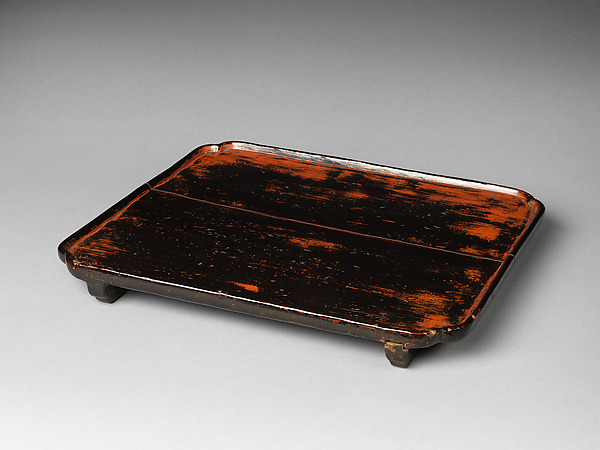
dated 1384. Wood with layers of black and red lacquer (Negoro ware). The Metropolitan Museum of Art, accession 2024.280. Mary Livingston Griggs and Mary Griggs Burke Foundation Fund, 2024. Open Access.
Look closer: The black is the base coat and the red the final coat. Look for the patches where the red has worn thin and the black shows through.
The Metropolitan Museum of Art, public domain (Open Access). Source: https://www.metmuseum.org/art/collection/search/903399
The tray is rectangular, with indented corners and short, rectangular legs, 38.2 centimetres wide, and was used as a go-han, a portable tray, at Busshō-ji. The wood was made by woodworking workshops, the museum says, and the lacquerers then applied the black and red layers. A pair of Negoro candlesticks of the late sixteenth century, in the gallery below, shows the same pairing in another shape: turned wood under layers of black and red lacquer, as the museum catalogues them.
Maki-e, the Sprinkled Picture
Maki-e, literally sprinkled picture, is described in Wikipedia as a technique in which designs are drawn in lacquer and metal powder, gold, silver or another, is sprinkled onto the surface so that it adheres. It first appears in the Heian period. The national government’s publication by Hidaka dates it from the eighth century, flourishing in the Heian period, and says that from the tenth century it was exported to other Asian countries as a Japanese specialty.
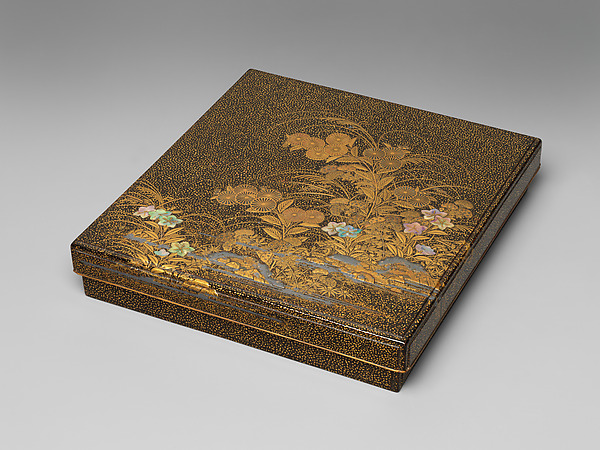
Igarashi Dōho, second half 17th century. Lacquered wood with gold, silver takamaki-e, hiramaki-e, togidashimaki-e, cut-out gold and silver foil application, mother-of-pearl inlay. The Metropolitan Museum of Art, accession 2023.226a–g. Purchase, Elinor Meyer Appleby and The William Meyer Family and William R. Appleby Funds, 2023. Open Access.
Look closer: Look for the mother-of-pearl: the museum says the bellflower petals are inlaid shell, and some chrysanthemum petals are cut foil. Three kinds of gold lie side by side.
The Metropolitan Museum of Art, public domain (Open Access). Source: https://www.metmuseum.org/art/collection/search/894317
The article names the main types. Hira maki-e is the simplest: powder is sprinkled onto wet lacquer, sealed and polished, and it was completed in the Kamakura period and popular in the Azuchi-Momoyama period when mass production was needed. Taka maki-e builds the design up with lacquer mixed with charcoal or mineral particles before sprinkling, and developed in the middle of the Kamakura period. Togidashi maki-e coats the whole surface in black lacquer and polishes it until the powder shows, and was the mainstream technique until the late Heian period. Shishiai togidashi maki-e combines the last two, was developed in the Muromachi period, and is the most complex. The steps include transferring the sketch, applying adhesive lacquer, sprinkling the powder, protecting it with lacquer, and polishing repeatedly.
The Met’s writing box, attributed to Igarashi Dōho, who died in 1678, shows the result. Of the second half of the seventeenth century, it is lacquered wood with gold and silver takamaki-e, hiramaki-e and togidashi maki-e, cut gold and silver foil and mother-of-pearl, with chrysanthemums and autumn grasses on a gold hirame ground over black and an autumn lake scene with mandarin ducks inside. The museum says Igarashi was summoned from Kyoto to Kanazawa in Kaga Province by Maeda Toshitsune around the mid-seventeenth century, and that his workshop became the official lacquerers of the Maeda and helped establish the Kaga lacquer school. It contains an inkstone, a water dropper and two trays.
In the Meiji era, the lacquerware article reports, Shibata Zeshin, whom it calls Japan’s greatest lacquerer, led a renewed interest in lacquer, expanded the range of colours that had been limited to five until the nineteenth century, and government-backed exports at world’s fairs made Japanese lacquer famous abroad. Zeshin’s own story is told in the chapter on Meiji export art.
| Technique | What it is | Period named in the source |
|---|---|---|
| Hira maki-e | Powder sprinkled on wet lacquer, sealed, polished | Completed Kamakura; popular Azuchi-Momoyama |
| Taka maki-e | Design raised with charcoal or mineral lacquer, then sprinkled | Developed mid-Kamakura |
| Togidashi maki-e | Whole surface lacquered, polished until the powder shows | Mainstream until late Heian |
| Shishiai togidashi maki-e | Combination of taka and togidashi | Developed Muromachi; popular Edo |
Nanban Chests and the Word Japan
Hidaka writes that exports of lacquer to Europe began in the late sixteenth century or earlier, mainly to Portugal and Spain, then England and the Netherlands, and that from the early seventeenth century, when the shogunate allowed Western trade only with the Netherlands, the Dutch became the sole exporters. Export pieces were made to order for European tastes, mainly by Kyoto artisans, with Dutch merchants placing orders at Dejima in Nagasaki and checking production in Kyoto. Common forms were multi-drawer chests, coffers, tables, plates and coffee cups, often decorated with maki-e and raden, mother-of-pearl inlay.

18th century. Black lacquer on wood with gold painted design. The Metropolitan Museum of Art, accession 1991.408. Gift of Mr. and Mrs. Norton W. Mailman, 1991. Open Access.
Look closer: The gilt metal mounts at the corners and hinges are European taste; the gold painted designs are Japanese skill. The museum calls it a rare large piece.
The Metropolitan Museum of Art, public domain (Open Access). Source: https://www.metmuseum.org/art/collection/search/45383
The Met’s coffer in the Nanban style, of the eighteenth century, 132.6 centimetres wide, is black lacquer on wood with a gold painted design. The museum explains that Nanban designates objects of European inspiration, mostly made for export, and that Edo-period chests, coffers and writing desks were produced for the Dutch East India Company. Hidaka adds a remark that gives this section its title: the word japan came to be used in Europe for lacquerware in general, and appears in seventeenth-century aristocratic inventories. Marie Antoinette owned a collection, now held at Versailles, the Louvre and the Guimet.
Wikipedia’s article on maki-e adds an echo from the other side of the Pacific: Japanese lacquerware reached Mexico through the Manila galleons in the Namban period, and the Mexican word maque derives from the Japanese word. The article on lacquerware reports that the Victoria and Albert Museum holds about 2,500 pieces, mainly export lacquerware.
Glossary of Carving and Lacquer
The terms below are the ones used in this chapter, each defined as the sources define it.
| Term | Meaning |
|---|---|
| Urushi | The lacquer tree and its sap, harvested, cured and applied in thin coats |
| Maki-e | Sprinkled picture: powder, usually gold, scattered on wet lacquer |
| Hira maki-e | Flat maki-e: powder sprinkled on wet lacquer, sealed and polished |
| Taka maki-e | Raised maki-e: the design built up before the powder is sprinkled |
| Togidashi maki-e | Polished-out maki-e: the whole surface is lacquered and polished until the powder shows |
| Negoro | Red lacquer over black, worn through with use so that the black shows |
| Kamakura-bori | Carved wood finished in lacquer, named for Kamakura |
| Yosegi | Joined-block construction, in which a figure is assembled from separately carved pieces |
| Nanban | Southern barbarian: objects of European inspiration made for export |
Fun Facts for the Curious
Each of these comes from the sources named at the end of the chapter.
- The Mexican word maque derives from the Japanese word for lacquer, according to Wikipedia, because lacquerware reached Mexico on the Manila galleons.
- The Victoria and Albert Museum holds about 2,500 pieces of lacquerware, mainly export work.
- A negoro tray is made beautiful by wear: the red lacquer is rubbed through to the black beneath.
- Edo-period chests, coffers and writing desks were produced for the Dutch East India Company, the Met explains.
Wood, Lacquer and Gold

Kaikei, ca. 1202. Lacquered Japanese cypress, color, gold, cut gold, and inlaid crystal. The Metropolitan Museum of Art, accession 2015.300.250a, b. Mary Griggs Burke Collection, Gift of the Mary and Jackson Burke Foundation, 2015. Open Access.
Look closer: The hanging folds of the monk’s robe carry the gold that remains. The staff is shaken, the museum says, to awaken people from delusion.
The Metropolitan Museum of Art, public domain (Open Access). Source: https://www.metmuseum.org/art/collection/search/53175
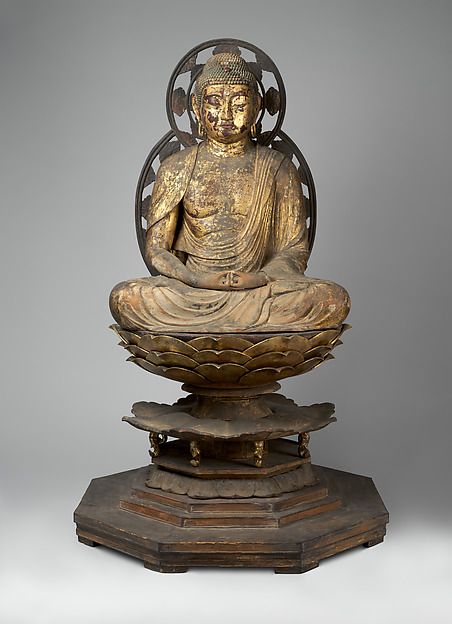
ca. 1250. Wood with lacquer, gold leaf, and color. The Metropolitan Museum of Art, accession 19.140a–c. Rogers Fund, 1919. Open Access.
Look closer: The Met dates it to about 1250 and catalogues it as wood with lacquer, gold leaf and colour.
The Metropolitan Museum of Art, public domain (Open Access). Source: https://www.metmuseum.org/art/collection/search/44890

Genkyu Michinaga, 18th century. Cypress wood with white, black, and red pigments. The Metropolitan Museum of Art, accession 1993.341.2. Purchase, Lila Acheson Wallace Gift, 1993. Open Access.
Look closer: The Met records cypress wood with white, black and red pigment. Notice how little expression the carved face needs in order to change when it is tilted.
The Metropolitan Museum of Art, public domain (Open Access). Source: https://www.metmuseum.org/art/collection/search/45493

19th century. Wood and ivory. The Metropolitan Museum of Art, accession 10.211.1790. Gift of Mrs. Russell Sage, 1910. Open Access.
Look closer: A carver carved. The Met records wood and ivory and a height of 3.5 centimetres.
The Metropolitan Museum of Art, public domain (Open Access). Source: https://www.metmuseum.org/art/collection/search/59080

late 16th century. Wood with layers of black and red lacquer (Negoro ware). The Metropolitan Museum of Art, accession 2015.500.2.18a, b. Gift of Florence and Herbert Irving, 2015. Open Access.
Look closer: The Met dates them to the late sixteenth century and describes the layers of black and red lacquer on wood.
The Metropolitan Museum of Art, public domain (Open Access). Source: https://www.metmuseum.org/art/collection/search/40312

late 16th–early 17th century. Gold lacquer with hiramaki-e and mother-of-pearl inlay; gilt copper fittings. The Metropolitan Museum of Art, accession 2008.182a, b. Purchase, Barbara and William Karatz Gift, 2008. Open Access.
Look closer: The Met records gold lacquer with hiramaki-e and mother-of-pearl, of the late sixteenth or early seventeenth century.
The Metropolitan Museum of Art, public domain (Open Access). Source: https://www.metmuseum.org/art/collection/search/74490

19th century. Gold maki-e with black lacquer. The Metropolitan Museum of Art, accession 29.100.897. H. O. Havemeyer Collection, Bequest of Mrs. H. O. Havemeyer, 1929. Open Access.
Look closer: The inrō is a lacquer box worn at the waist; the Met catalogues it as gold maki-e with black lacquer.
The Metropolitan Museum of Art, public domain (Open Access). Source: https://www.metmuseum.org/art/collection/search/58821
Lacquer, Netsuke and Wood
Lacquer and carved wood come and go on the house shelves. The wider Japanese Arts, Vintage and Antiques shelf shows what is here today, the netsuke and inrō shelf covers small carved and lacquered pieces, and the house guide to Netsuke, Inro and Maki-e explains the vocabulary.
Answered plainly
What is the difference between ichiboku and yosegi?
Ichiboku is carving from a single block of wood; yosegi-zukuri builds a figure from several pieces. Wikipedia says Jōchō perfected the multi-block method, which let assistants work at the same time.
What is Kamakura-bori?
Carved wood coated with red lacquer, often over black. The Met explains that, unlike Chinese practice, which carved thick layers of lacquer, the designs were carved directly into the wood.
What does Negoro mean?
Lacquer ware named for the Negoro-ji temple, with red layers over black that wear away to reveal the black, according to Wikipedia and the Met.
Is lacquer safe to handle?
Hardened lacquer is generally safe, but Wikipedia reports that liquid lacquer can cause extreme rashes even from vapours, and that reactions to hardened lacquer are possible but less common.
Why was Japanese lacquer called japan in Europe?
Hidaka writes that the word japan came to refer to lacquerware in general because of the volume of lacquer exported from Japan from the late sixteenth century.
Where next
Sources and image credits
- Japanese sculpture, Wikipedia (single-block and yosegi, Kei school, Edo and Meiji change)
- Jōchō, Wikipedia
- Unkei, Wikipedia
- Netsuke, Wikipedia
- Urushi, Wikipedia (tree, harvest, cure, allergen)
- Japanese lacquerware, Wikipedia (history, techniques, regions)
- Maki-e, Wikipedia
- Hidaka Kaori, The History and Culture of Lacquer in Japan, Highlighting Japan, Government of Japan, May 2022
- Jizō, Bodhisattva of the Earth Store, Kaikei, 2015.300.250a, b, The Metropolitan Museum of Art
- One of the Four Heavenly Kings, 1974.76, The Metropolitan Museum of Art
- Fudō Myōō, Mokujiki Shōnin, 2016.363.1, The Metropolitan Museum of Art
- Covered Incense Box with Tree Peonies, 2019.193.13a, b, The Metropolitan Museum of Art
- Angoya-type Negoro Tray, 2024.280, The Metropolitan Museum of Art
- Writing box attributed to Igarashi Dōho, 2023.226a–g, The Metropolitan Museum of Art
- Coffer in Nanban Style, 1991.408, The Metropolitan Museum of Art
- Netsuke of Wood Carver, 10.211.1790, The Metropolitan Museum of Art
Last reviewed 28 October 2026. Pictures, where shown, are public-domain or open-access and credited beneath each one.
Looking for a lacquer box, a carved figure or a piece with its original storage box and history? The concierge desk replies within one to three business days.
Private concierge
Looking for something in particular?
Describe the piece or the project you have in mind. A senior advisor in Tokyo reads every case file personally and replies within two business days, with fees set out in writing before any work begins.