
Buddhist Statues and Their Makers
Temple and Household
Buddhist Statues and Their Makers
A Buddhist statue is made twice: once at the foundry or the carver’s bench, and again every time someone stops in front of it. This chapter follows the first making, through bronze, hollow lacquer, joined wood and a travelling monk’s hatchet, and then the century in which the second making almost ended.
Fact sheet
At a glance
- Bronze first. The earliest named maker, Tori Busshi, is linked with a bronze Shaka image of 606 and the Hōryū-ji Shaka Triad of 623, though Wikipedia flags some attributions as uncertain.
- Light as cloth. Dry lacquer builds a figure from cloth soaked in lacquer over a core; Wikipedia says hollow sculptures are comparatively light and portable.
- A thousand statues. After the fire of 1249, Sanjūsangendō received 876 new Kannon from three groups of sculptors over sixteen years.
- A carver on the road. Enkū (1632 to 1695) often gave his statues as payment for lodging; about 5,000 had been found by 1976.
- After 1868. Wikipedia says roughly 18,000 temples were eradicated between 1872 and 1874, and that exact totals are hard to determine.
Fourteen Centuries of Making
Wikipedia’s survey of Japanese sculpture sets out the sequence. Buddhism brought Chinese styles, transmitted through Korea, and skilled craftsmen from the sixth century; the seventh-century Hōryū-ji holds some of the earliest surviving Buddhist art. In the Tenpyō period sculptors adopted high Tang realism, and the giant bronze Vairocana at Tōdai-ji was completed in 752. Early Heian works are massive single-block wood carvings tied to esoteric Buddhism; Jōchō then perfected the multi-block technique, and in the Kamakura period the Kei school made dynamic, realistic works suited to samurai taste.

Original drawing. Events are spaced evenly, not to scale.
Look closer: Notice the long middle of the line: the crafts changed slowly, then the political break of 1868 arrived all at once.
Diagram by Japonista (original drawing), The Japonista Curation and Concierge Team, Tokyo, Japan.
Each material had its own logic. Bronze was cast, wood was carved and joined, and dry lacquer was laid up in cloth. The earlier chapters of this almanac treat the technical side in depth: see Bronze Casting in Japan for the great Buddhas and Wood and Lacquer Carving for Jōchō, Unkei and Kaikei. This chapter keeps the focus on the makers, the places and what happened to their work.
| Material | Period named in the sources | Example |
|---|---|---|
| Bronze | Asuka to Nara | Shaka Triad, Hōryū-ji; Vairocana, Tōdai-ji |
| Dry lacquer | Reached Japan in the eighth century (Met) | Portrait of Ganjin, Tōshōdai-ji |
| Single-block wood | Early Heian | Painted Heavenly King in the Met, ichiboku |
| Joined wood | From Jōchō, Heian; Kamakura Kei school | Amida at Byōdō-in; Kaikei’s Jizō |
| Hatchet-carved wood | Edo | Enkū; Mokujiki |
Bronze, Cloth and Lacquer
Wikipedia’s article on Tori Busshi reports that he finished a bronze Shaka image for Asuka-dera in 606, his first known work, for which Empress Suiko granted him lands and rank. The Shaka Triad at Hōryū-ji was commissioned after the deaths in 621 and 622 of two court ladies, Prince Shōtoku and his consort, and the workshop finished it in 623. The article cautions that the attribution of other works to him is uncertain, including the Yakushi of Wakakusa-dera, whose halo inscription was probably written after 607, and the Kannon of the Yumedono, which is in his style although it is unknown whether his studio made it.

Shaka Triad by Tori Busshi of Hōryū-ji, photograph of 1888 to 1889 as recorded on Wikimedia Commons.
Look closer: Look at the symmetry. The central figure sits upright with a raised hand; the attendants stand at the same height as columns.
Ogawa Kazumasa (via Wikimedia Commons), Public domain, via Wikimedia Commons. Source: https://commons.wikimedia.org/wiki/File:Horyuji_Shaka_Triad.jpg
The Tori style, the article says, derives from Northern Wei China and its front-oriented design, with upright seated Buddhas, geometric triangular silhouettes, elongated heads and stylised curls. Look at the photograph below, which shows the triad in a Meiji-era image: the seated Buddha is frontal and symmetrical, and the flanking figures stand like columns.
Hollow dry lacquer was the Nara period’s lighter alternative. The Met describes the method in the entry for a Chinese Buddha of the early seventh century: a core, often wood, is covered with clay and wrapped in cloth soaked in lacquer, with up to seven or eight more layers to follow. The technique reached Japan in the eighth century, the museum says, where it was widely used for Buddhist sculpture. Wikipedia’s article on dry lacquer adds that in the hollow-core method the clay model is covered with cloth strips and lacquer and the clay is removed after the shell hardens, leaving a figure that is comparatively light and portable. Its Japanese example is the seated portrait of the monk Ganjin, Jianzhen, at Tōshōdai-ji, a hollow dry-lacquer sculpture and a National Treasure. The sources differ on who supervised it, and this chapter names no one.
Heian Blocks, Kamakura Thousand
The Met’s Dainichi, the Cosmic Buddha, of the twelfth century, shows the esoteric Heian image at full scale. It is wood with lacquer and gold leaf; the figure is 92.4 centimetres high and, with base and halo, 218.4. The museum explains that Dainichi Nyorai is the supreme Buddha of the cosmos in Esoteric Buddhism, from whom all things are believed to emanate, and that his gesture, the left index finger placed inside the right hand, is called the wisdom fist and is said to express the union of the spiritual and the material and to restrain passions that hinder enlightenment. The almanac of Buddhism and Zen covers the iconography.
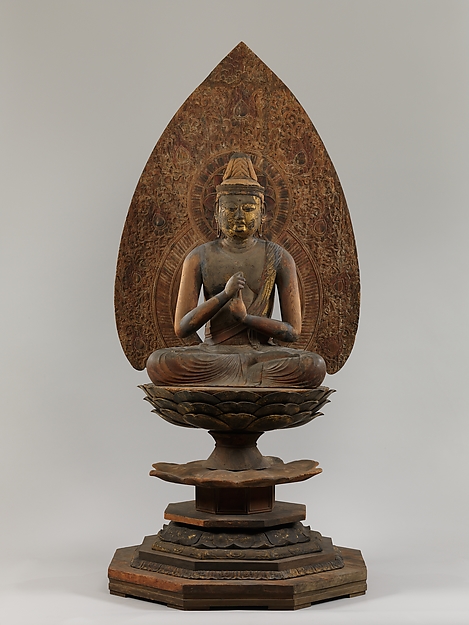
12th century. Wood with lacquer and gold leaf. The Metropolitan Museum of Art, accession 26.118a, b. Rogers Fund, 1926. Open Access.
Look closer: The hands are the lesson. The left index finger is held inside the right fist, the wisdom fist the museum describes.
The Metropolitan Museum of Art, public domain (Open Access). Source: https://www.metmuseum.org/art/collection/search/44838
At Sanjūsangendō in Kyoto, Wikipedia reports, the temple was founded in 1164 by Taira no Kiyomori for the cloistered Emperor Go-Shirakawa. A fire in 1249 destroyed all the original buildings except the main hall, and of the original 1,000 standing Thousand-armed Kannon, only 124 survived. The emperor ordered 876 new statues, and three groups of sculptors, the Kei, En and In schools, made them over sixteen years. The principal image is a seated Thousand-armed Kannon by the Kamakura sculptor Tankei, and the statues are Japanese cypress clad in gold leaf. The principal Kannon, the 1,000 standing Kannon, the 28 attendant deities and the Fūjin and Raijin statues are all National Treasures. The article is inconsistent about the exact count, which it gives as 1,001 in one place and as one thousand in another. See also the almanac pages on Senju Kannon and Fūjin and Raijin.
The workshop system is what made such numbers possible. Wikipedia’s article on Unkei says the Kongō Rikishi at Tōdai-ji’s Great South Gate, about 26 feet tall, were finished in 72 days in 1203 by Unkei with Kaikei, two other master sculptors and sixteen assistants, using the joined-wood technique. The same article cautions that, because sculpture was collaborative, it is hard to say how much of the style was his alone. The word maker in this chapter’s title is therefore sometimes a workshop.
Enkū and the Roving Carvers
Wikipedia reports that Enkū (1632 to 1695) was born in Mino Province, in present-day Gifu, was a Tendai monk, poet and sculptor of the early Edo period, and travelled on pilgrimages to temples throughout Japan, often giving his statues in return for lodging. About 5,000 pieces had been found by 1976, with more still being discovered, especially in Hida and Gifu. Many were roughly made from tree stumps or scrap wood with a few strokes of a hatchet. The vow, repeated in legend, to carve some 120,000 statues is flagged in the article as legend, not a verified figure.

Standing Buddha by Enkū, Japanese cypress, height 80 cm, Tokyo National Museum, as recorded on Wikimedia Commons. Photograph, 2013.
Look closer: The gouges stay visible: the body is only a few strokes of the hatchet, while the face is smoothed. That contrast is the whole method.
Reiji Yamashina (via Wikimedia Commons), CC BY-SA 3.0, via Wikimedia Commons. Source: https://commons.wikimedia.org/wiki/File:Enku_Buddha_Tokyo.JPG
The Brooklyn Museum’s Yakushi, the Buddha of healing, attributed to Enkū, is 43.2 centimetres high and shows the technique at its barest, as does a standing Buddha in cypress, 80 centimetres high, kept in the Tokyo National Museum. A century after Enkū, Mokujiki Shōnin (1718 to 1810) worked in a similar spirit, and the Met’s chisel-carved Fudō Myōō of 1805, described in the chapter on wood, is one of thousands he made. The Met adds that Yanagi Sōetsu rediscovered his work in the early twentieth century; Mingei and Folk Art follows that story.
Images Made to Be Kept
Not every statue lived in a temple. The Met’s portable shrine, a zushi, of the late eighteenth or first half of the nineteenth century, is 10.7 centimetres high with a wooden figure of the Thousand-armed Kannon just 4.2 centimetres tall inside doors painted with figures from the Buddhist pantheon, in wood with lacquer, gold, pigments and metal fittings. The museum notes that the Thousand-armed Kannon grew popular in Japan as a bodhisattva associated with preventing and curing physical ailments such as blindness. The Met also holds a nineteenth-century wooden altar cabinet for Fudō Myōō.
A pair of seated sculptures of Hōnen and Shandao, Edo-period wood with traces of colour and gilt and inset glass eyes, shows how larger images served a family or a temple community. The Met says the Hōnen is one of a pair, depicts a monk of the Kamakura period associated with Pure Land Buddhism with hands positioned to hold a bead chain for counting recitations of Amida’s name, and is identified on the back in ink. The household version of all this is the altar: see The Butsudan Almanac.
Kaikei, Unkei and the Kei School
Wikipedia’s article on Kaikei describes him as a sculptor of the Kamakura period, known alongside Unkei. Because many sculptors of the school have a name that includes the character kei, the school is called the Kei school, Kei-ha. His style is described as intelligent, pictorial and delicate, and most of his surviving works are about three shaku high, which is a little under a metre, and there are many of them.
The article lists a primary work for each stage of the career: the Boston Maitreya of 1189 as the earliest attributable work, the Amida triad at Jōdo-ji in Ono of 1195, the Hachiman at Tōdai-ji of 1201, and the Agyō guardian at Tōdai-ji of 1203, made jointly with Unkei and thirteen assistants. The Met’s Jizō, dated to about 1202 and attributed to Kaikei, is catalogued as lacquered Japanese cypress with colour, gold, cut gold and inlaid crystal, and stands 55.9 centimetres high. Wikipedia lists the same Burke Jizō under 1203; because the two sources differ by a year, this chapter gives the museum’s date.

Kaikei, ca. 1202. Lacquered Japanese cypress, color, gold, cut gold, and inlaid crystal. The Metropolitan Museum of Art, accession 2015.300.250a, b. Mary Griggs Burke Collection, Gift of the Mary and Jackson Burke Foundation, 2015. Open Access.
Look closer: Follow the folds of the robe, where gold still shows against the darker lacquer.
The Metropolitan Museum of Art, public domain (Open Access). Source: https://www.metmuseum.org/art/collection/search/53175
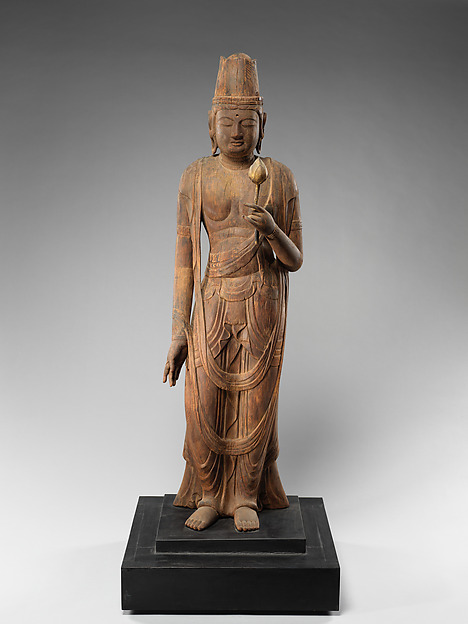
mid-11th century. Cypress wood; single-block construction (ichiboku-zukuri). The Metropolitan Museum of Art, accession 2021.116a, b. Purchase, Bequest of Mary Stillman Harkness, by exchange; Henrie Jo Barth Bequest; and funds from various donors, 2021. Open Access.
Look closer: The museum catalogues the figure as single-block construction; compare its plain surface with the lacquered Jizō beside it.
The Metropolitan Museum of Art, public domain (Open Access). Source: https://www.metmuseum.org/art/collection/search/851372
The point of the pair is the workshop. Unkei and Kaikei finished the Great South Gate guardians at Tōdai-ji, the Wikipedia article on Unkei says, in seventy-two days with two other master sculptors and sixteen assistants. A school with a shared character in the name, a shared method of joined wood, and a shared set of tools can do in a season what one carver could not do in a life. That is also why attributions are cautious: the article separates Kaikei’s primary works from those attributed or alleged, such as the Chōgen portrait at Tōdai-ji, assigned to Kaikei or Unkei or both.
Buddhist Statues by Date
Dates are those given in the sources named at the end of the chapter. Where the sources differ on a year, the year is left out.
| Date | What happened | Source |
|---|---|---|
| 606 | Tori Busshi finishes a bronze Shaka for Asuka-dera | Tori Busshi, Wikipedia |
| 616 | A Kannon from Silla is concealed at Kōryū-ji, according to a temple document | Hibutsu, Wikipedia |
| 623 | The Shaka Triad at Hōryū-ji | Tori Busshi, Wikipedia |
| 669 | Kōfuku-ji is founded in Yamashina | Kōfuku-ji, Wikipedia |
| 738 and 752 | Tōdai-ji is founded, then opened | Tōdai-ji, Wikipedia |
| 1106 | The earliest recorded display of a hibutsu, at Zenkō-ji | Hibutsu, Wikipedia |
| 1189 | Kaikei’s earliest attributable work, the Boston Maitreya | Kaikei, Wikipedia |
| 1203 | Unkei and Kaikei finish the Great South Gate guardians | Unkei, Wikipedia |
| 1249 | Fire at Sanjūsangendō; 124 of the original Kannon survive | Sanjūsangendō, Wikipedia |
| 1632 to 1695 | Enkū, the hatchet carver | Enkū, Wikipedia |
| 1868 | Separation of Shinto and Buddhism begins | Shinbutsu bunri, Wikipedia |
| 2018 | Rebuilding of the Central Golden Hall of Kōfuku-ji is completed | Kōfuku-ji, Wikipedia |
Places to See Buddhist Statues
Hours and displays change, and some images are shown only on certain days; check each temple’s own notice before travelling.
| Place | What there is | Source |
|---|---|---|
| Hōryū-ji, Nara | The Shaka Triad of 623 and some of the earliest surviving Buddhist art | Tori Busshi, Wikipedia |
| Tōdai-ji, Nara | The Great Buddha, the Great South Gate guardians, Hachiman by Kaikei | Tōdai-ji and Kaikei, Wikipedia |
| Kōfuku-ji, Nara | A Fujiwara temple, one of the Seven Great Temples; Central Golden Hall rebuilt in 2018 | Kōfuku-ji, Wikipedia |
| Sanjūsangendō, Kyoto | The hall of Thousand-armed Kannon, founded in 1164 | Sanjūsangendō, Wikipedia |
| Jōdo-ji, Ono | Kaikei’s Amida triad of 1195, a National Treasure | Kaikei, Wikipedia |
| Kanshin-ji, Kawachinagano | A hibutsu Nyoirin Kannon, shown on 17 and 18 April | Hibutsu, Wikipedia |
| The Metropolitan Museum of Art, New York | Kamakura, Heian and Edo images in wood, lacquer and gilt bronze | Metropolitan Museum |
Glossary of Buddhist Sculpture
A short vocabulary of the terms in this chapter.
| Term | Meaning |
|---|---|
| Busshi | A sculptor of Buddhist images |
| Hibutsu | A hidden Buddha, an image concealed from public view |
| Kaichō | A ceremony in which a hidden image is shown |
| Zushi | A portable shrine or cabinet for an image |
| Ichiboku-zukuri | Single-block construction in wood |
| Yosegi-zukuri | Joined-wood construction from several pieces |
| Kei-ha | The Kei school of sculptors, to which Unkei and Kaikei belonged |
| Nyorai | A Buddha, such as Dainichi Nyorai |
| Bosatsu | A bodhisattva, such as Jizō or Kannon |
| Shaku | A traditional unit of length, a little under a third of a metre |
Fun Facts for the Curious
Each of these comes from the sources named at the end of the chapter.
- The Great South Gate guardians at Tōdai-ji were finished in seventy-two days, Wikipedia says.
- Enkū often gave his statues in return for a night’s lodging, and about 5,000 had been found by 1976.
- Of the original 1,000 Thousand-armed Kannon at Sanjūsangendō, 124 survived the fire of 1249.
- The Met’s Jizō is catalogued with inlaid crystal, lacquered cypress and cut gold.
- Wikipedia reports that hidden buddhas are a uniquely Japanese phenomenon, in the view of the art historian Shiro Ito.
- The first recorded display of a hidden buddha was in 1106.
- The Met’s portable shrine holds a Thousand-armed Kannon only 4.2 centimetres tall.
Cult Images, Icons and the Hidden Shrine
Every religion that makes images has to decide who may see them, and when. The Japanese answer, in the form of the hibutsu, is unusual enough that Wikipedia, citing the art historian Shiro Ito, says other Buddhist cultures do not have any equivalent practice. The main image is out of sight for most of the year and shown in a ceremony that, by the Edo period, could draw crowds of thousands.
The workshop has its own lesson. The sources describe the Kei school as a group with a shared name element, a shared method of joined wood and shared assistants. The Great South Gate guardians were made by Unkei and Kaikei with two other masters and sixteen assistants, and are still attributed to the two masters. The master’s hand, in other words, was a collective one, and the attributions in this chapter are given with that in mind.
Separation and Survival
Wikipedia’s article on haibutsu kishaku, literally abolish Buddhism and destroy Shākyamuni, says the Meiji-era movement was triggered by the official policy of separating Shinto and Buddhism, shinbutsu bunri, introduced after 1868, and fed by a popular anger that had built up over centuries because temples were tied to the Tokugawa shogunate through the danka system. It reports that roughly 18,000 temples were eradicated between 1872 and 1874, and perhaps as many again between 1868 and 1872; one estimate puts the national total at about 40,000, and in some places up to 80 per cent of temples were lost. The article adds that exact totals are hard to determine, since some temples disappeared when Buddhist authorities consolidated redundant ones. It gives no figures for statues.
Of Kōfuku-ji in Nara, the article says its land was seized, its priests were forced to become Shinto priests, its walls were torn down and the grounds became part of a city park, and that anti-Buddhist riots damaged all large temples in Nara. Wikipedia’s survey of Japanese sculpture notes the sculptor’s response: Buddhist art was damaged, and sculptors shifted toward export goods and then fine art. The Meiji carver Takamura Kōun, who trained under a sculptor of Buddhist statues, appears in the chapter on Meiji export art.
Images Large and Small

Attributed to Enkū (1628 to 1695), seventeenth century. Wood, 43.2 by 16.5 cm. Brooklyn Museum.
Look closer: The robe is a set of grooves and the face is a few planes. Hatchet, then chisel.
Brooklyn Museum (via Wikimedia Commons), No restrictions, via Wikimedia Commons. Source: https://commons.wikimedia.org/wiki/File:Yakushi_%28Bhaishajaguru%29_by_Enku_%281628-95%29.jpg

Hollow dry lacquer, height 82 cm, in Tōshōdai-ji, Nara, as recorded on Wikimedia Commons. Photograph, 1949.
Look closer: The calm face is the work of cloth and lacquer over a core. The Commons record gives the height as 82 centimetres.
Ogawa Seiyō (via Wikimedia Commons), Public domain, via Wikimedia Commons. Source: https://commons.wikimedia.org/wiki/File:Ganjin_wajyo_portrait.JPG

early 7th century. Dry lacquer with polychrome pigment and gilding. The Metropolitan Museum of Art, accession 19.186. Rogers Fund, 1919. Open Access.
Look closer: Dry lacquer, here from China. The surface shows layers, a hint of the cloth beneath.
The Metropolitan Museum of Art, public domain (Open Access). Source: https://www.metmuseum.org/art/collection/search/42163

early 9th century. Wood. The Metropolitan Museum of Art, accession 2015.500.9.60. Gift of Florence and Herbert Irving, 2015. Open Access.
Look closer: The Met dates this one to the early ninth century and lists the material as wood.
The Metropolitan Museum of Art, public domain (Open Access). Source: https://www.metmuseum.org/art/collection/search/667003

18th–early 19th century. Wood, with traces of color and gilt and inset glass eyes. The Metropolitan Museum of Art, accession 12.37.167. Rogers Fund, 1912. Open Access.
Look closer: The hands are placed to hold a bead chain, the museum says. This is a monk who counts the name of Amida.
The Metropolitan Museum of Art, public domain (Open Access). Source: https://www.metmuseum.org/art/collection/search/62360

18th–early 19th century. Wood, with traces of color and gilt and inset glass eyes. The Metropolitan Museum of Art, accession 12.37.168. Rogers Fund, 1912. Open Access.
Look closer: The pair to Hōnen. The Met calls seated pairs like this unusual.
The Metropolitan Museum of Art, public domain (Open Access). Source: https://www.metmuseum.org/art/collection/search/62361

late 18th–first half 19th century. Wood with lacquer, gold, pigments, metal fittings. The Metropolitan Museum of Art, accession 67.55.62. Bequest of Susan Dwight Bliss, 1966. Open Access.
Look closer: The figure is 4.2 centimetres tall. The doors fold shut over it.
The Metropolitan Museum of Art, public domain (Open Access). Source: https://www.metmuseum.org/art/collection/search/49110
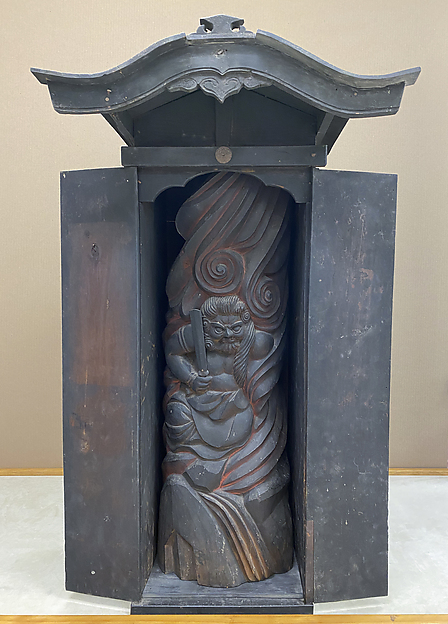
Unidentified artist, 19th century. Wood. The Metropolitan Museum of Art, accession 2016.363.2. Purchase, Gift of Estate of Mrs. E. H. Harriman, by exchange, 2016. Open Access.
Look closer: A cabinet made to house a single figure. The Met records it as nineteenth-century wood.
The Metropolitan Museum of Art, public domain (Open Access). Source: https://www.metmuseum.org/art/collection/search/739543
Statues, Altars and Okimono
The shelf of Japanese Okimono, Figurines and Statues shows the figures that are here today. For the altar itself, see The Butsudan Almanac, and for the iconography of the images, the Buddhism and Zen Almanac.
Answered plainly
Who was the first named Japanese sculptor?
Tori Busshi, who finished a bronze Shaka image for Asuka-dera in 606 and whose workshop finished the Shaka Triad at Hōryū-ji in 623, according to Wikipedia, which flags several attributions to him as uncertain.
What is dry lacquer?
A technique in which a core is wrapped in cloth soaked in lacquer. The Met says it reached Japan in the eighth century and was widely used for Buddhist sculpture, and Wikipedia says hollow works are comparatively light and portable.
Why were so many Buddhist statues lost after 1868?
Wikipedia’s account of haibutsu kishaku says the official separation of Shinto and Buddhism triggered a movement that destroyed or closed a large number of temples, though exact totals are hard to determine and the article gives no figures for statues.
Who was Enkū?
A Tendai monk, poet and sculptor (1632 to 1695) who travelled Japan and often gave statues in return for lodging; about 5,000 had been found by 1976, according to Wikipedia.
What is a zushi?
A shrine cabinet that houses a small image. The Met’s example, from the late eighteenth or early nineteenth century, is 10.7 centimetres high and holds a Thousand-armed Kannon.
Where next
Sources and image credits
- Japanese sculpture, Wikipedia (sequence, Edo and Meiji)
- Tori Busshi, Wikipedia
- Sanjūsangen-dō, Wikipedia
- Haibutsu kishaku, Wikipedia
- Enkū, Wikipedia
- Dry lacquer, Wikipedia
- Unkei, Wikipedia
- Buddha, probably Amitabha, 19.186, The Metropolitan Museum of Art
- Dainichi, the Cosmic Buddha, 26.118a, b, The Metropolitan Museum of Art
- Hōnen, 12.37.167, The Metropolitan Museum of Art
- Portable Shrine with Senju Kannon, 67.55.62, The Metropolitan Museum of Art
- Kaikei, Wikipedia
- Hibutsu, Wikipedia (hidden buddhas)
- Kōfuku-ji, Wikipedia
- Tōdai-ji, Wikipedia
- Jizō, Bodhisattva of the Earth Store, 2015.300.250a, b, The Metropolitan Museum of Art
- The Bodhisattva Kannon, 2021.116a, b, The Metropolitan Museum of Art
- Image credits: Brooklyn Museum; Reiji Yamashina (CC BY-SA 3.0); Ogawa Kazumasa and Ogawa Seiyō (public domain), Wikimedia Commons

Last reviewed 28 October 2026. Pictures, where shown, are public-domain or open-access and credited beneath each one.
Looking for a Buddhist figure, a zushi or a small altar image with its history intact? The concierge desk replies within one to three business days.
Private concierge
Looking for something in particular?
Describe the piece or the project you have in mind. A senior advisor in Tokyo reads every case file personally and replies within two business days, with fees set out in writing before any work begins.