
Fūjin and Raijin
Gods of the Weather
Fūjin and Raijin
風神雷神
The green god of the wind with his bag and the red god of thunder in his ring of drums, a pair from India and China that became a Japanese screen subject.
Identity card
Know the figure at a glance
- A horned demon head. The Thunder God is typically red, with a horned demon head, a simian mouth and clawed hands and feet (JAANUS).
- A ring of drums. He is surrounded by a ring of drums (JAANUS); a clasp on the Cleveland sculpture shows that a ring was once attached to its back.
- A small hammer. He often holds a small hammer to strike the drums (JAANUS). The diagram draws it in the right hand.
- The wind bag. The Wind God carries a large drawstring bag and releases wind from it (JAANUS). The diagram shows it in the left hand so that one figure can serve for both gods; in art Fūjin is a separate, green figure.
- On a cloud. Raijin is usually shown standing on a cloud (Wikipedia).
A pair for wind and thunder
Fūjin and Raijin are almost always shown together, and almost always as demons. The Japan Architecture and Art Net Users System (JAANUS) describes the Wind God as a green, two-horned demon with a grimacing mouth and clawed hands and feet, carrying a large drawstring bag over his shoulder and releasing the wind from it, and sometimes holding a spear with a red pennant. The Thunder God is typically red, with a horned demon head, a simian mouth and clawed hands and feet, surrounded by a ring of drums which he strikes with a small hammer.
Neither is easy to place in a single tradition. JAANUS traces the pair to the Indian deities Vāyu, the wind, and Varuna, linked to rain and water, and to the Chinese deities Fengshen and Leigong, and notes that early Buddhist scripture does not mention them. The Cleveland Museum of Art adds that they first appeared in early Buddhist art in China and Japan, based on Indian imagery drawn from the life of the historical Buddha.
The English Wikipedia articles fill in the portraits. Fūjin, it says, is also called Fūten, 'Heavenly Wind', and appears as a terrifying demon-like figure with red hair and green skin, wearing a tiger or leopard skin loincloth and carrying a large inflated bag of winds, the kazebukuro, on his shoulders. The article on Raijin lists a fierce face, a muscular build and hair that defies gravity, and says he stands on a cloud and beats taiko drums marked with tomoe symbols, using large hammers. Some depictions, it says, show three fingers, said to stand for past, present and future. The same article gives him a son, Raitarō, and a companion, the thunder beast Raijū, usually shown as a dog or wolf.
The colours deserve a note, since the sources do not agree. JAANUS gives the Wind God as green and the Thunder God as typically red, and the Wikipedia article on Fūjin says green skin with red hair. The Cleveland Museum of Art owns a drawing and a print of 1909 to 1910 by Kamisaka Sekka, described below, in which the Thunder God himself is green. The pair are best read as a type in which the colours can be exchanged, and the safest identification is by the objects they carry: the bag for the wind, the ring of drums for the thunder.
From Dunhuang to the Heian court
JAANUS records the earliest known images in China in the sixth-century cave temples at Dunhuang, where they appear beside rain and lightning deities, and later in twelfth-century woodblock-printed books of the Thousand-armed Kannon and the Twenty-eight Attendants. In Japan the earliest depiction it names is in an eighth-century illustration of the Kako genzai ingakyō, where they are among the demons trying to frighten the historical Buddha. Both gods also appear in several Heian-period mandara, including the twelfth-century Konkōmyō saishōōkyō mandara.
Wikipedia suggests a longer road for the wind god: from the Greek Boreas, to Wardo in the Greco-Buddhist art of Bactria, to Feng Bo in Tarim Basin frescoes, to Fūjin, with the windbag and wild hair surviving each change. The article describes this as a suggestion, and it gives no dates for it.
The Indian sources the encyclopaedias name are not obviously the origin of what the sculptors made. The Wikipedia article on Vāyu gives the Vedic wind god, also called Vāta and Pavana, as a warrior who rides a shining coach drawn by horses, whose chief attribute is a white banner, and says that the Rigveda links him closely with Indra and describes the Maruts as born from his belly. The article does not mention a bag. For the bag it is the article on Fūjin that offers an answer, and the answer comes from the opposite end of the Silk Road, as the next section explains.
Vāyu, Varuna and the northwest corner
The Wikipedia article on Vāyu is the fullest English account of the Indian wind god, and it is more cautious than the encyclopaedic phrase 'Vāyu and Varuna' suggests. It says the Rigveda gives Vāyu exceptional beauty and a shining coach with a number of horses that varies by hymn, two, forty-nine or a thousand, and that he and Indra share the first drink of soma. In the Upaniṣads he is praised as Prāṇa, the life breath of the world. As a guardian of the directions he protects the northwest, and the epics make him the father of Hanuman and of Bhima. The article says that in Chinese Buddhism he is Fengtian, sometimes counted among the twenty-four protective deities, and that in Japanese Buddhism, especially Shingon, he is Fūten, one of the Twelve Devas, who presides over the northwest.
The same article says it describes no specific relationship between Vāyu and Varuna in the Vedic texts, and that Varuna appears only in later Buddhist lists of deities. This matters for the pair on the screens: JAANUS names the two Indian gods as the origin of Fūjin and Raijin, but the Wikipedia article on Vāyu does not tie the wind god to a bag, a drum or a demon's face. The idea that the two Japanese figures descend from Vāyu and Varuna is best taken as a statement about which Indian deities of wind and water were absorbed into the East Asian pantheon, not as a statement about their appearance. The Cleveland Museum of Art says the pair were shown among a group of demon-monsters flying through the sky above the meditating Shakyamuni, in an attempt to frighten him out of his concentration, which is a different Indian root, the Buddha's own life.
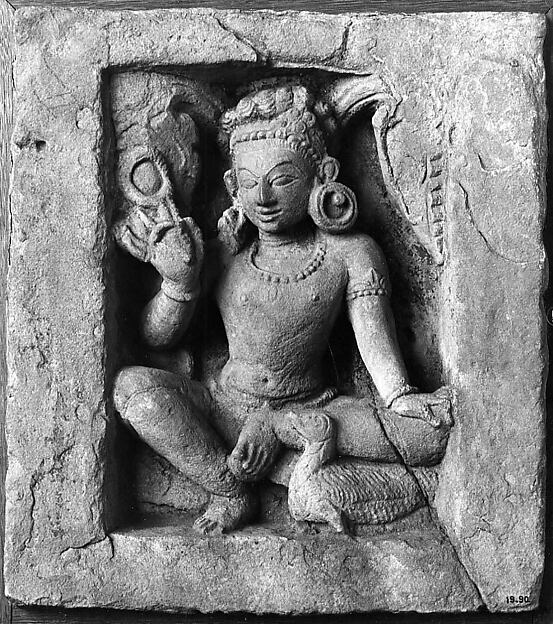
India, 6th–8th century. Sandstone; 31.8 cm. Metropolitan Museum of Art, 19.90.
Look closer: Note the seated figure in his niche and the small swan at his knee: the water god Varuna of the post-Gupta period, as Indian sculptors made him before he reached the Buddhist lists.
The Metropolitan Museum of Art, Rogers Fund, 1919. Open Access.
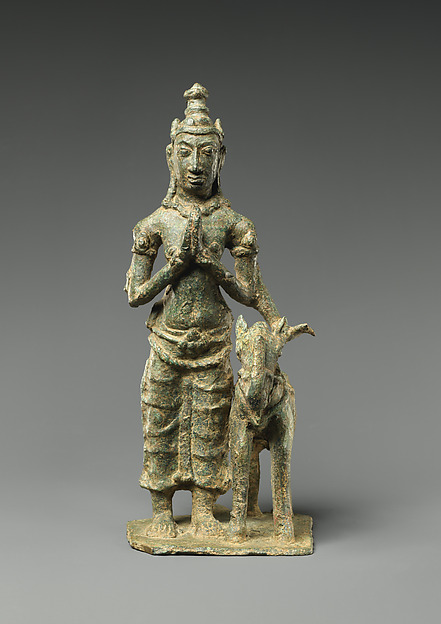
Sri Lanka, 9th century. Bronze; 22.9 cm. Metropolitan Museum of Art, 2004.465.
Look closer: Note the joined hands and the animal at his side: the Met's title calls him Regent of the West, one of the Indian guardians of the directions.
The Metropolitan Museum of Art, Gift of Guardian of the Flame Collection, 2004. Open Access.
From Boreas to Fūjin
The Wikipedia article on Fūjin traces his iconography along the Silk Road. It says the Greek wind god Boreas became Wardo, also spelled Oado, in the Greco-Buddhist art of Bactria, then a Chinese wind deity called Feng Bo in the frescoes of the Tarim Basin, and finally Fūjin, and that the windbag and the dishevelled look survived at each stage. It cites Katsumi Tanabe's catalogue for the 2003 exhibition on Alexander the Great for the remark that the origin of the windbag can be traced back to the shawl or mantle worn by Boreas or Oado: the cloak blown out behind a running figure, in other words, became a bag held at the shoulders. The article also lists Aeolus, Rudra and Vāyu as related wind or storm deities. The article gives no dates for any stage of the chain.
The chain is a hypothesis, and the JAANUS account of the same figures is more modest. JAANUS records the earliest known images in China in the sixth-century cave temples at Dunhuang and says early Buddhist scripture does not mention the pair at all. A scholar who wanted to test the Greek link would look for the mantle on Kushan and Bactrian coins and wall paintings, and the Metropolitan Museum has Kushan gold coins of Kanishka and Huvishka in its collection, but the Met's records give no iconographic description, so this chapter does not use them as evidence.
The Chinese side of the family is better documented in the English sources. The Wikipedia article on Leigong, the Duke of Thunder, describes a fearsome figure with claws, bat wings, a blue face with a bird's beak and only a loincloth, who carries a drum and mallet to make thunder and a chisel to punish evildoers, with a boy named A Xiang who drives his chariot. His wife is Dian Mu, goddess of lightning, who uses flashing mirrors; his assistants include Yun Tong, who whips up clouds, and Yu Shi, who causes rain by dipping a sword into a pot; and Feng Bo, later Feng Po Po, who controls the wind from a goatskin bag. The article says Leigong began as a mortal and became a god after eating a peach from a heavenly tree. The goatskin bag is the Chinese counterpart of the Japanese kazebukuro, and the drum and mallet are the same instruments the Japanese god strikes, though the Japanese Raijin of the sources read here is shown without the bird's beak and the wings.
Attendants of the Thousand-armed Kannon
JAANUS says the two gods were added to the Twenty-eight Attendants, the Nijūhachi bushū, the retinue of the Thousand-armed Kannon. In esoteric Buddhism the Wind God also appears as Fūten, one of the Twelve Devas and one of the Guardians of the Eight Directions, where he guards the northwest, and he is linked to the constellation Sagittarius.
The great setting is Sanjūsangendō in Kyoto. According to the temple's own text, collected by Japan's tourism database, thirty statues stand in front of the 1,001 Kannon figures: twenty-eight guardians and the two gods. The Wind God stands at the right end of the front row, nearest the entrance, kneeling on a cloud-like base with a swollen bag resting lightly on his shoulders. The Thunder God stands at the far left end, ringed by drums he strikes for thunder. The page dates the statues to the Kamakura period, 1185 to 1333 in the English text and 1192 to 1333 in the Japanese, does not name the sculptor, and says visitors are encouraged to kneel and look up into their crystal eyes. JAANUS dates the figures to the thirteenth century and ascribes them to the Kei school.
The Wikipedia article on Sanjūsangen-dō gives the hall's history. It says Taira no Kiyomori founded the temple in 1164 for the cloistered Emperor Go-Shirakawa, that a city fire of 1249 destroyed the other buildings and that of the original 1,000 standing Kannon statues 124 survived. Emperor Go-Saga ordered the main hall rebuilt in 1251, and the work was completed in 1266, with 876 new Kannon made over sixteen years by the Kei, En and In schools. The hall is about 120 metres long and known as the Temple of Thirty-three Bays, and the article says that most of the statues, among them the twenty-eight guardians and the two famous statues of Fūjin and Raijin, are National Treasures. The article's counts are not perfectly consistent, since it gives 1,000 standing Kannon in one place and the temple's own text, collected by the tourism database, counts 1,001 with the seated principal image.
It is worth saying plainly that the Wikipedia article on Raijin, which places the statues at 'the Kaminarimon gate' at Sanjūsangendō, joins two different places. The statues of the Kamakura period belong to the hall in Kyoto; the pair at the Thunder Gate belong to Sensō-ji in Tokyo, and the sources agree that the Tokyo pair were restored in 1960.
Sensō-ji and its Thunder Gate
The best-known pair of the two gods in modern Tokyo stands at a gate. The Wikipedia article on Kaminarimon says the name means 'Thunder Gate' and that its official name is Fūraijinmon, the Gate of the Wind and Thunder Gods. It is the outer of two entrances to Sensō-ji in Asakusa, the inner gate being the Hōzōmon, and it is 11.7 metres high and 11.4 metres wide. Fūjin stands on the east side of the front of the gate and Raijin on the west. A great lantern hangs under the centre, 3.9 metres high, 3.3 wide and about 700 kilograms in weight, and is lowered during festivals such as the Sanja Matsuri so that tall objects can pass.
The gate has burned and been rebuilt several times. The article says the first gate was built in 941 by Taira no Kinmasa near Komagata, that it was moved to its present site in 1635, when the wind and thunder gods are believed to have been placed on it, and that it burned in 1639, was rebuilt, burned to the ground in 1757 and again in 1865. The 1865 fire badly damaged the original sculptures and only their heads survived. The present structure, funded by Konosuke Matsushita, the founder of the company now known as Panasonic, was dedicated in December 1960, and the statues were restored for the rebuilding. The article's own dates are not entirely consistent: it gives 1639 for the fire after the move but 1649 for a rebuilding under Tokugawa Iemitsu.
Behind the pair stand two further figures, Tenryū, a Buddhist deity, and Kinryū, a goddess, donated in 1978 to mark the 1,350th anniversary of the first appearance of Kannon at Asakusa, which led to the founding of Sensō-ji. The article says the master sculptor Hirakushi Denchū carved them when he was 106 years old. The gate is a Buddhist temple's outer door, guarded by two storm gods of Indian and Chinese descent. Their placement of the two outside the temple proper corresponds to the role the Japanese tradition gave them: demons of the weather who have been enlisted as guardians.
Children of Izanami
Wikipedia records that in the Kojiki the thunder deities are found on the body of the dead Izanami in Yomi, the land of darkness, when Izanagi goes to bring her back; ashamed, she sends Raijin and the women of Yomi after him. A second account makes Fūjin and Raijin twin brothers born from Izanami after her death, who escaped through a crack in the boulder Izanagi used to seal the passage. The article also notes a legend that Raijin drives off the Mongol invaders by summoning a storm.
Folk custom keeps him close. Wikipedia reports that some Japanese parents tell children to hide their navels during thunderstorms so that Raijin will not take them, and that he appears in the kabuki play Narukami, trapped under water, which causes a drought.
Michizane, Tenjin and the lightning
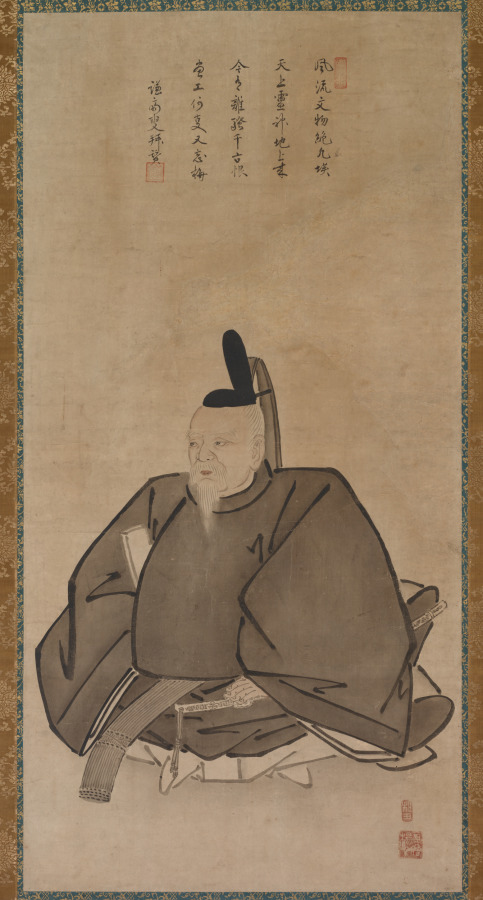
Yōgetsu, Japan, Muromachi period, late 1400s–early 1500s. Hanging scroll; ink and color on paper; 100.8 x 50.2 cm. Cleveland Museum of Art, 2015.491.
Look closer: Note the court hat and the broad robe in loose ink, and the poem above: a Zen painter's portrait of Michizane in his guise as the deity Tenjin.
Cleveland Museum of Art, Gift from the Collection of George Gund III. Open Access (CC0).
The most famous Japanese thunder god is a man. The Wikipedia article on Sugawara no Michizane gives his life as 1 August 845 to 26 March 903. He was born into a family of scholars, rose to the senior third rank by 897 and supported the abolition of the imperial embassies to China in 894. In 901, the article says, Fujiwara no Tokihira accused him of favouring a rival prince as successor and he was demoted to a minor post at Dazaifu in Kyūshū, where he died in exile in 903. Plague, drought, the deaths of Emperor Daigo's sons and repeated lightning strikes on the Shishinden and flooding followed, which the court attributed to his vengeful spirit. It built Kitano Tenman-gū in Kyoto, restored his title and office, and removed the record of his exile.
The article says that about seventy years later he was deified as Tenjin, 'a god of sky and storms', and that over time Tenjin became a benign kami of scholarship, an example of an onryō, a vengeful spirit, made benign by ritual pacification. A posthumous senior first rank is dated 12 June 993. The Metropolitan Museum's own text for its handscrolls of the Kitano Tenjin engi gives a different and earlier date for the shrine, saying that in 942 Michizane's spirit asked to be honoured at a shrine dedicated to the thunder god in the northwestern section of the capital. The two statements are about different steps of a long process, and the sources do not reconcile the dates.
The picture-scrolls that told the story are what JAANUS cites for the thunder god's greatest part. The Met's set, whose five handscrolls are in ink, colour and cut gold leaf on paper and range from 689.4 to 894.5 centimetres in length, dates to the late thirteenth century. The Met calls it one of more than thirty extant sets and second in age and quality only to the early thirteenth-century treasure at the main Kitano Tenjin shrine. Its page describes scenes of retribution, including a slandering minister from whose ears two blue dragons come out as a monk chants mantras, and the miraculous birth of Michizane, but it does not mention Raijin or the thunder god's transformation. The Met's page does not say how the scenes are divided among the five scrolls.
A plum branch and a storm
The thunder god of Michizane's story reached the theatre as a role. The Wikipedia article on Michizane says he appears as Kan Shōjō in kabuki drama, and the Metropolitan Museum's record for a print of about 1780 by Katsukawa Shunshō (1726 to 1792) says the play is Sugawara Denju Tenarai Kagami, 'Sugawara's Secrets of Calligraphy'. Its print of the actor Nakamura Nakazō shows him in a vengeful pose, brandishing a plum branch, the tree the Met says was closely associated with Michizane, in a storm that the museum's page calls the dramatic personification of Michizane's wrathful spirit. The page does not mention thunder or lightning by name and does not say which scene is shown.
Cleveland's print of 1814 by Utagawa Kunisada (1786 to 1865) shows Ichikawa Danjūrō VII as Kan Shōjō in the Mt. Tenpai scene, from the series Famous Kabuki Plays. The museum says the actor plays an exiled statesman transforming himself into a vengeful thunder god, in the red-and-white kumadori make-up of the aragoto style, with crossed eyes and a clenched mouth, and in this role a plum branch is added. It explains that the pose is the mie, held at the most dramatic moment and influenced by the stylised movements of the Bunraku puppets. The sensational transformation of the hero, in Cleveland's words, is the high point of the scene. The wind god does not appear in the print or in the museum's text; the stage thunder is Michizane's alone.

Katsukawa Shunshō 勝川春章, Japan, ca. 1780. Woodblock print (nishiki-e); ink and color on paper; 32.5 x 14.6 cm. Metropolitan Museum of Art, JP1532.
Look closer: Note the raised plum branch, the slanting rain and the pale moon: the vengeful Michizane of the stage, with the weather as his voice.
The Metropolitan Museum of Art, Fletcher Fund, 1929. Open Access.
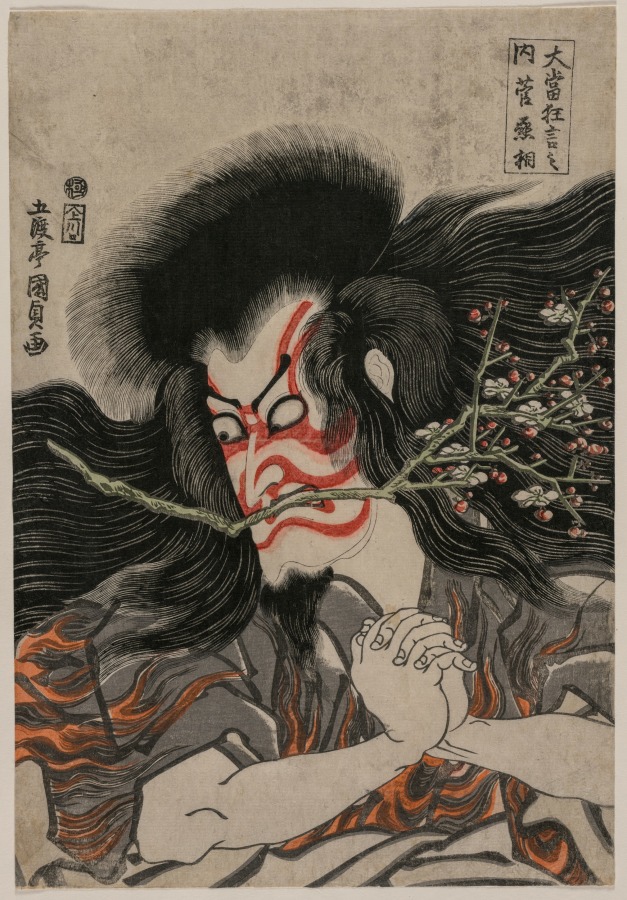
Utagawa Kunisada, Japan, Edo period, 1814. Color woodblock print, with mica; 38 x 25.9 cm. Cleveland Museum of Art, 1985.333.
Look closer: Note the crossed eyes, the clenched hands and the plum branch: the mie pose at the moment when the exiled statesman becomes a thunder god.
Cleveland Museum of Art, The Kelvin Smith Collection, given by Mrs. Kelvin Smith. Open Access (CC0).
Sōtatsu, Kōrin and the paired screens
In the Kitano tenjin engi, JAANUS says, the vengeful spirit of Sugawara no Michizane, who lived from 845 to 903, takes the form of the Thunder God, and the scene became a highlight of many versions of the scroll. It also names two well-known Edo-period folding screens of the pair: one by Tawaraya Sōtatsu, held at Kenninji in Kyoto, and one by Ogata Kōrin, who lived from 1658 to 1716, held at the Tokyo National Museum.
Cleveland holds a Raijin screen of the mid-seventeenth century, painted on paper covered with gold dust, which it attributes to an anonymous painter probably associated with the Sōtatsu workshop. Its museum text says the Thunder God was often paired with the Wind God and reinterpreted by generations of Rimpa artists, and that the screen of the Wind God that would have accompanied this one cannot be located. The Rinpa line runs on into the twentieth century: Kamisaka Sekka's Momoyogusa, Flowers of a Hundred Worlds, of 1909 to 1910, turns the Thunder God into a green figure with drums and hammers on black.
The Wikipedia article on Tawaraya Sōtatsu, who lived from about 1570 to about 1640, gives the screens in more detail. It says the Wind God and Thunder God are a pair of two-fold screens in ink and colour on gold-foiled paper, each 169.8 by 154.5 centimetres, that they are a National Treasure belonging to Kennin-ji in Kyoto, though sometimes shown at the Kyoto National Museum, and that they carry no inscription or seal. The article says the attribution to Sōtatsu is not questioned but gives no creation date. It adds that Ogata Kōrin (1658 to 1716) and Sakai Hōitsu (1761 to 1828) each painted a copy as homage, and that all three versions were shown together for the first time in seventy-five years at the Kyoto National Museum's exhibition 'Rinpa: The Aesthetics of the Capital' in 2015.
The Wikipedia article on Rinpa explains why the theme travels. It says Rinpa began in seventeenth-century Kyoto with Hon'ami Kōetsu (1558 to 1637) and Sōtatsu, that Kōrin and his younger brother Kenzan (1663 to 1743) consolidated it about fifty years later, and that Hōitsu revived it in nineteenth-century Edo, where he painted his Summer and Autumn Grasses on the back of Kōrin's screen of the wind and thunder gods. The name Rinpa, it says, is an abbreviation of Kōrin plus the word for school, coined in the Meiji period. The article has nothing on how the particular subject of the two gods passed from one master to the next, so the lineage given here is a list of the works the sources name and not a claim that each artist copied his predecessor.
The two articles give slightly different dates for Sōtatsu himself, c. 1570 to c. 1640 in one and a death about 1643 in the other, and Cleveland gives c. 1570 to c. 1640, so the death date is best treated as approximate. A museum's attribution can also be careful: Cleveland says its screen was probably made by an anonymous painter associated with the Sōtatsu workshop, using a prototype borrowed from earlier narrative painting and not a mechanical copy of Sōtatsu's image. The 'Inen' seal and the gold-dust technique are the evidence it cites.
A green god on a sketch sheet
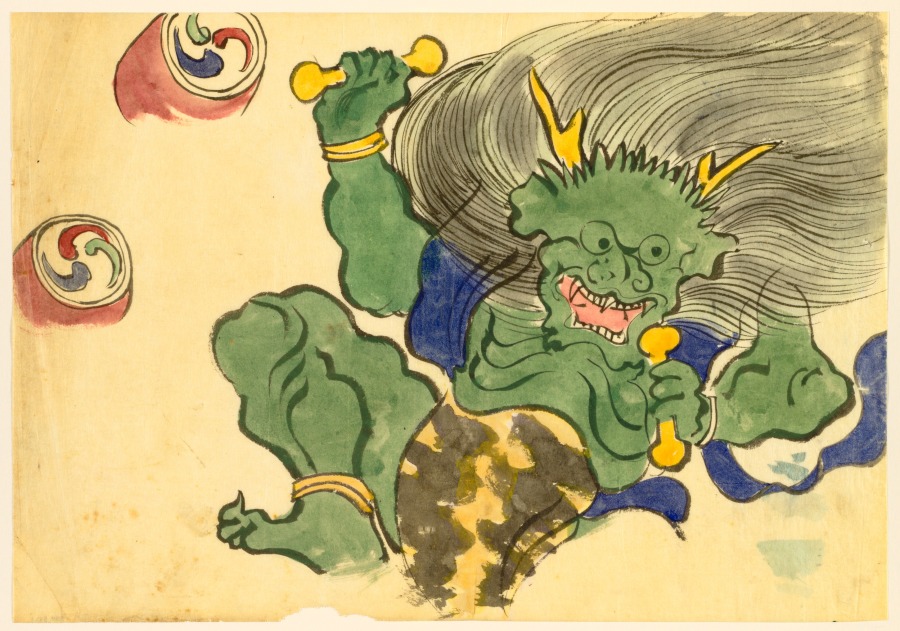
Kamisaka Sekka, Japan, Meiji period, 1909. Ink and color on paper; 27.3 x 39.4 cm. Cleveland Museum of Art, 1989.85.1.
Look closer: Note the green skin, the yellow horns and the swirling marks on the drums: a designer's sketch for the 1909 Thunder God, looser than the finished print.
Cleveland Museum of Art, John L. Severance Fund. Open Access (CC0).
The theme did not end with the Edo screens. The Cleveland Museum of Art owns two works by Kamisaka Sekka (1866 to 1942) in his Flowers of a Hundred Worlds, Momoyogusa, of 1909 and 1909 to 1910. The print in the gallery below is one sheet of a set of three woodblock albums, issued first one by one to subscribers and later in bound form for mass buyers. Cleveland says each print features a vignette from nature or Japanese literature, that many of the scenes have a long history in Japan, originating in the 900s or 1000s, and that Sekka's selections hew closely to precedents from the Rinpa style originated by Sōtatsu and the calligrapher Hon'ami Kōetsu.
Cleveland also holds one of the preparatory drawings. It says Sekka made his preparatory drawings for the series on tracing paper in ink and colour, and that the freehand sketches are much looser than the finished printed compositions. The sketch of the Thunder God shows a green figure with a fierce face and wild hair striking a ring of drums with the swirling marks the Wikipedia article on Raijin calls tomoe. A reader comparing it with the typically red Thunder God that JAANUS describes will see the colour has been changed by a designer who knew the tradition well enough to change it.
Telling the pair apart
The first test is the object in the hand or at the feet. A large drawstring bag over the shoulder, sometimes with a spear carrying a red pennant, marks the wind (JAANUS). A ring of small drums and a hammer or stick marks the thunder (JAANUS, Wikipedia). The second test is the face. A bird's beak and bat wings belong to the Chinese Leigong, not to the Japanese god (Wikipedia). The third is the colour, which is a weak test, as the Cleveland sketch shows. The fourth is the setting: a pair at a gate or flanking the Thousand-armed Kannon is Buddhist, while a single figure with a plum branch and a court hat is Tenjin, not the thunder god of the screens.
A pair can be separated and still be read as a pair. Cleveland says the matching Fūjin of its Kamakura Raijin is in the Fukuoka Art Museum in Japan, and that the screen of the Wind God that matched its Edo Raijin cannot be located. A single thunder god on a shelf is therefore normal, and a collector should not read the absence of a partner as a fault. The Met's own records for its Japanese objects of this theme, including the netsuke, give no description, so the identification rests on titles and on the photographs, which is what the captions say.
Ten small facts
- The Kaminarimon is 11.7 metres high and its great lantern weighs about 700 kilograms (Wikipedia, Kaminarimon).
- Only the heads of the original Kaminarimon statues survived the fire of 1865 (Wikipedia, Kaminarimon).
- The two gods at the rear of the Kaminarimon were carved by a sculptor aged 106 (Wikipedia, Kaminarimon).
- Sanjūsangendō's hall is about 120 metres long and called the Temple of Thirty-three Bays (Wikipedia).
- Sōtatsu's screens measure 169.8 by 154.5 centimetres each and are in ink and colour on gold-foiled paper (Wikipedia).
- Three versions of the screens, by Sōtatsu, Kōrin and Hōitsu, were shown together in 2015 for the first time in 75 years (Wikipedia).
- Michizane lived from 1 August 845 to 26 March 903 (Wikipedia, Sugawara no Michizane).
- The Met's Kitano Tenjin engi is one of more than thirty extant sets (Metropolitan Museum of Art).
- Leigong's wife Dian Mu uses flashing mirrors to make lightning (Wikipedia, Leigong).
- Raijin's companion, the Raijū, is usually shown as a dog or wolf (Wikipedia, Raijin).
Across Asia
The pair crossed Asia as a type, a wind demon and a thunder demon, and changed names at each border.
| Where | Form and name | What the record shows |
|---|---|---|
| India | Vāyu, wind; Varuna, rain and water | Proposed ancestors of the Japanese pair (JAANUS). The Sanjūsangendō text glosses Vāyu as breather of life. |
| China | Fengshen and Leigong | Gods of wind and thunder; the earliest images are in the sixth-century Dunhuang caves (JAANUS). |
| China, print | Twelfth-century printed books | The pair appear in books of the Thousand-armed Kannon and her Twenty-eight Attendants (JAANUS). |
| Japan, Buddhist | Fūjin 風神 and Raijin 雷神 | Attendants of Senju Kannon; Fūten among the Twelve Devas (JAANUS). |
| Japan, Shinto | Children of Izanami | Born of the dead goddess in the Kojiki (Wikipedia). |
| China, Daoist | Leigong; Dian Mu; Feng Bo | The Duke of Thunder with drum and mallet, his lightning wife and the wind god with a goatskin bag (Wikipedia). |
| Greece and Bactria | Boreas; Wardo or Oado | The proposed ancestors of the wind god's cloak (Wikipedia). |
| Japan, Tenjin cult | Tenjin | Michizane as a god of sky and storms (Wikipedia). |
Demons in the heavenly retinue
Fūjin and Raijin stand with the Heavenly Beings as demon gods taken into the service of the Thousand-armed Kannon, and Fūjin has a second place among the Twelve Devas as Fūten.
| Companion | Why they meet |
|---|---|
| Senju Kannon | The two gods were added to the Twenty-eight Attendants of her retinue (JAANUS). |
| Fūten | The Wind God's name among the Twelve Devas, guarding the northwest (JAANUS). |
| Sugawara no Michizane | His spirit takes the Thunder God's form in the Kitano tenjin engi (JAANUS). |
Where to see them
| Place | What to look for |
|---|---|
| Sanjūsangendō, Kyoto | Fūjin at the right end and Raijin at the far left of the front row, Kamakura period (tourism database, JAANUS). |
| Kenninji, Kyoto | The Sōtatsu folding screen of the pair (JAANUS). |
| Tokyo National Museum | The Kōrin folding screen of the pair (JAANUS). |
| Cleveland Museum of Art | A fourteenth-century Raijin sculpture and a Sōtatsu-school Raijin screen, in open access. |
| Metropolitan Museum of Art, New York | An eighteenth-century netsuke of Raijin in clouds, in open access. |
| Sensō-ji, Asakusa, Tokyo | The Kaminarimon, with Fūjin on the east and Raijin on the west of the front (Wikipedia). |
| Kitano Tenman-gū, Kyoto | The shrine to Michizane built after the storms that followed his death (Wikipedia). |
Four views in two museums
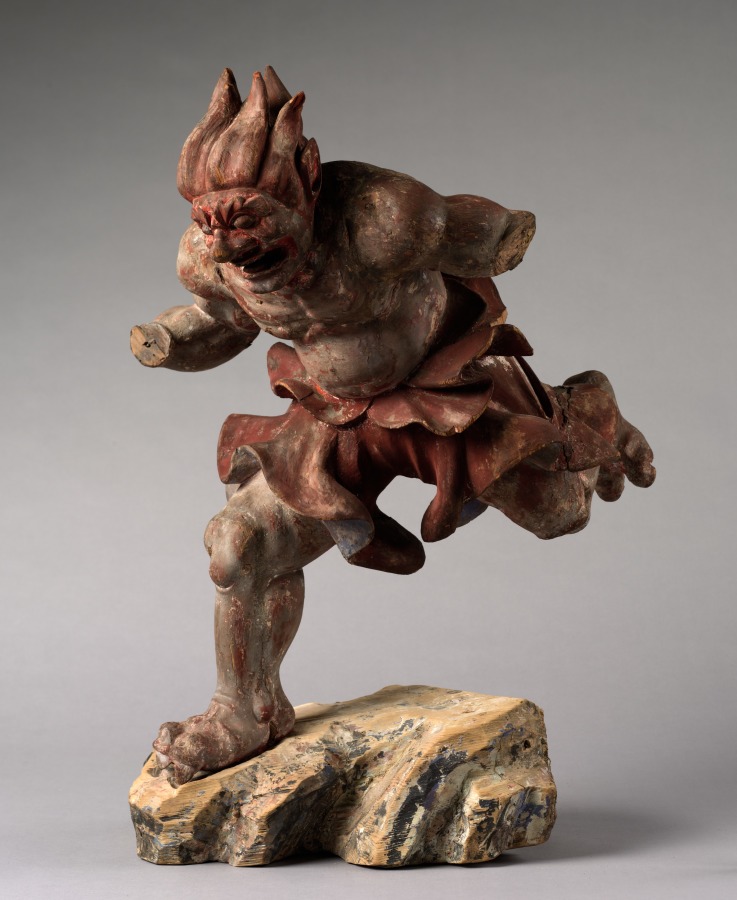
Japan, Kamakura period (1185-1333), 1300s. Wood with traces of gesso and red and black pigment; overall H. 66.7 cm. Cleveland Museum of Art, 1972.64.
Look closer: Note the open mouth and upswept flame-like hair, and the broken ends of both forearms.
Cleveland Museum of Art, Purchase from the J. H. Wade Fund. CC0 (Cleveland Open Access).
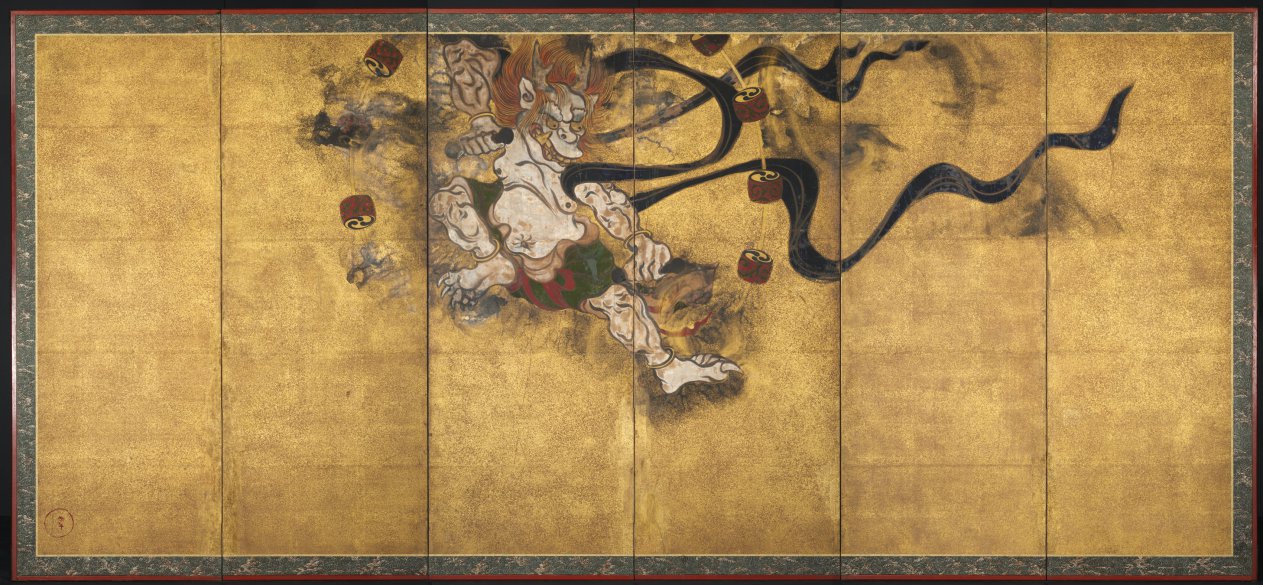
Japan, Edo period, mid-1600s, Sotatsu school. Six-panel folding screen; ink, color and gold on paper; image 150.4 x 343 cm. Cleveland Museum of Art, 2004.86.
Look closer: Note the single figure set to the left of an almost empty gold field, with the drums scattered around him and the dark cloud streaming off to the right.
Cleveland Museum of Art, Andrew R. and Martha Holden Jennings Fund. CC0 (Cleveland Open Access).
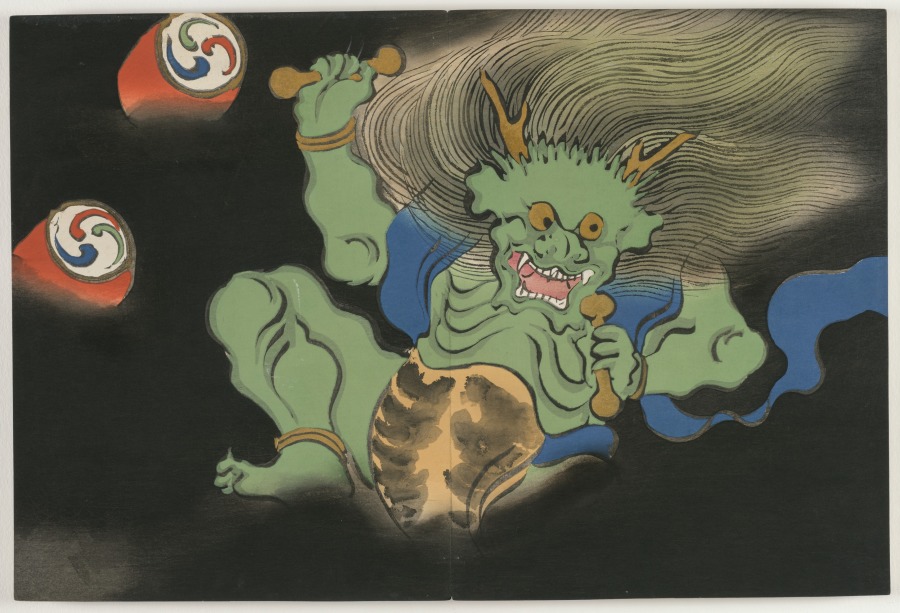
Kamisaka Sekka, Japan, Meiji period, 1909-10. Color woodcut with gold and silver; sheet 29.9 x 22.1 cm. Cleveland Museum of Art, 1988.23.2.19.
Look closer: Note the two hammers in his raised hands and the swirling patterns on the drum faces, set against solid black.
Cleveland Museum of Art, Norman O. Stone and Ella A. Stone Memorial Fund. CC0 (Cleveland Open Access).

Japan, 18th century. Wood; H. 1.9 cm, diam. 4.4 cm. Metropolitan Museum of Art, 10.211.2066.
Look closer: Note the staring inlaid eyes of the demon and the spiralling cloud scrolls that fill the whole disc.
The Metropolitan Museum of Art, Gift of Mrs. Russell Sage, 1910. Open Access.
At the desk
Fūjin and Raijin pieces on the shelves today appear below. If none shows, the concierge desk can look for a print, a netsuke or a screen.
A short glossary
- Fūjin (風神)
- The Wind God.
- Raijin (雷神)
- The Thunder God, also Kaminari or Raiden.
- Fūten (風天)
- The Wind God as one of the Twelve Devas of esoteric Buddhism.
- Kazebukuro (風袋)
- The bag of winds carried on the wind god's shoulders.
- Taiko (太鼓)
- The drums struck by the thunder god.
- Tomoe (巴)
- The swirling comma design painted on the drums.
- Raijū (雷獣)
- The thunder beast that accompanies Raijin.
- Nijūhachi bushū (二十八部衆)
- The Twenty-eight Attendants of the Thousand-armed Kannon.
- Kaminarimon (雷門)
- The Thunder Gate of Sensō-ji in Asakusa.
- Tenjin (天神)
- Sugawara no Michizane as a deity of sky, storms and scholarship.
- Onryō (怨霊)
- A vengeful spirit, as Michizane was before he was pacified.
- Engi emaki (縁起絵巻)
- An illustrated scroll of a shrine's or temple's founding legend.
- Kumadori (隈取)
- The painted lines of kabuki make-up.
- Mie (見得)
- The held pose of a kabuki actor at a moment of great feeling.
- Rinpa (琳派)
- The school of Sōtatsu, Kōrin and their heirs.
- Leigong (雷公)
- The Duke of Thunder of Chinese religion.
Answered plainly
Who are Fūjin and Raijin?
The Wind God and the Thunder God, usually shown as a pair of demons (JAANUS).
Are they Buddhist or Shinto?
Both. They are attendants of Senju Kannon (JAANUS) and, in the Kojiki, children of Izanami (Wikipedia).
How do I tell them apart?
Fūjin is green with a large bag; Raijin is red with a ring of drums and a small hammer (JAANUS).
Where are the famous statues?
At Sanjūsangendō in Kyoto, Kamakura period, at the two ends of the front row (tourism database, JAANUS).
Who painted the famous screens?
JAANUS names Tawaraya Sōtatsu, at Kenninji, and Ogata Kōrin, at the Tokyo National Museum.
Why do parents warn about navels?
Some Japanese parents tell children to hide their navels in thunderstorms so Raijin will not take them (Wikipedia).
Where does the wind god's bag come from?
Wikipedia traces it to the cloak of the Greek wind god Boreas, through Wardo in Bactrian art and Feng Bo in China, but gives no dates (Wikipedia).
Who is the thunder god of the Kitano shrines?
Sugawara no Michizane, who died in exile in 903 and was later worshipped as Tenjin (Wikipedia).
How old is the Thunder Gate?
Wikipedia says the first gate was built in 941 and the present one was dedicated in December 1960 after the fire of 1865.
Is the wind god always green?
No; JAANUS and Wikipedia say green, but Kamisaka Sekka's Thunder God of 1909 is green too (Cleveland).
Were the screens painted by Sōtatsu?
The pair at Kennin-ji is attributed to Sōtatsu without question, but Cleveland attributes its own screen only to his workshop (Wikipedia, Cleveland).
Where next
Sources and image credits
- JAANUS, Fūjin Raijin 風神雷神 (Columbia University)
- Japan Tourism Agency multilingual database, The Wind God and Thunder God, and the Twenty-Eight Attendants (Sanjūsangendō)
- Wikipedia, Fūjin
- Wikipedia, Raijin
- Cleveland Museum of Art, Thunder God (Raijin), 1972.64
- Cleveland Museum of Art, God of Thunder (Raijin), 2004.86
- Cleveland Museum of Art, Momoyogusa: God of Thunder (Raijin) (Kaminari), 1988.23.2.19
- Metropolitan Museum of Art, Netsuke of God of Thunder (Raijin) in Clouds (10.211.2066)
- Wikipedia, Vayu
- Wikipedia, Leigong
- Wikipedia, Kaminarimon
- Wikipedia, Sanjūsangen-dō
- Wikipedia, Sugawara no Michizane
- Wikipedia, Tawaraya Sōtatsu
- Wikipedia, Rinpa
- Metropolitan Museum of Art, Illustrated Legends of the Kitano Tenjin Shrine (25.224a-e)
- Metropolitan Museum of Art, Varuna Holding a Noose and Riding a Swan (19.90)
- Metropolitan Museum of Art, Varuna, Lord of Knowledge; Regent of the West (2004.465)
- Cleveland Museum of Art, Portrait of Sugawara Michizane (2015.491)
- Metropolitan Museum of Art, The Actor Nakamura Nakazō in the Role of Kan Shōjō (JP1532)
- Cleveland Museum of Art, Ichikawa Danjuro VII as Kan Shojo in the Mt. Tenpai Scene, from the series Famous Kabuki Plays (1985.333)
- Cleveland Museum of Art, Flowers of a Hundred Worlds (Momoyogusa): God of Thunder (Raijin) (1989.85.1)
Last reviewed 28 October 2026. Pictures are public-domain or openly licensed, each credited beneath it. Diagrams on this page are drawn by Japonista.
Looking for a Fūjin or Raijin print, netsuke or screen? Tell the concierge desk what you have in mind and we will search Japan for it.
Private concierge
Looking for something in particular?
Describe the piece or the project you have in mind. A senior advisor in Tokyo reads every case file personally and replies within two business days, with fees set out in writing before any work begins.