
Marishiten
The Goddess of Light
Marishiten
摩利支天
A goddess whose name means a ray of light or a mirage, who cannot be seen and so cannot be struck, and who rides a boar into the history of the Japanese warrior.
Identity card
Know the figure at a glance
- Three faces. She may have one, three, five or six faces, and in the many-faced forms one is a sow's (JAANUS). The diagram draws three.
- Six arms. JAANUS gives two to twelve arms. Wikipedia describes a Chinese form with two hands joined and six holding a sun, moon, bell, golden seal, bow and halberd.
- Sun and moon. The sun and moon are among the six attributes of the Chinese form (Wikipedia); Mārīcī means light (JAANUS).
- Bow and halberd. The bow and halberd complete the martial set (Wikipedia), which fits her place among warriors (JAANUS).
- The boar. She rides a sow, or a chariot drawn by seven pigs (JAANUS); Wikipedia adds seven horses or a boar charging.
A goddess made of light
The Japan Architecture and Art Net Users System (JAANUS) gives Marishiten as the Japanese name of the Buddhist goddess Marici. She blends several Hindu antecedents, chiefly the god Marici, said to be a son of Brahma, whom Japanese texts call Bonten, or one of the ten patriarchs created by the first lawgiver Manu. In Buddhism she took female form.
Marici means light or mirage. JAANUS says she was seen as a deification of mirages, and that because she was invisible, or hard to see, she was invoked to escape one's enemies. Wikipedia glosses the Sanskrit as 'Ray of Light' and says the name can also mean mirage; it gives the Chinese Mólìzhītiān, the Korean Marijicheon and the Tibetan 'od zer can ma, Özerchenma.
The Japanese Wikipedia article adds names and a character. It gives the alternate titles Marishi Bosatsu (摩里支菩薩) and Ikō Bosatsu (威光菩薩), 'the bodhisattva of majestic radiance', and says the Sanskrit word marīci means heat shimmer, sunlight or moonlight, which was personified as a deity. It names the dawn goddess Ushas of the Rigveda as the likely source. The goddess it describes has no substance: she cannot be seized, burned, wetted or harmed, her form is hidden, and she always runs ahead of the sun deity Nichiten, which is why, the article says, she became a protector against every kind of harm.
The English article calls her origins obscure. It says she appears to blend Indic, Iranian and non-Indo-Iranian solar goddesses, and links her to the Vedic dawn goddess Uṣas, to Sūrya and, in her martial forms, to Durgā. It adds a curiosity from the colonial period: a writer named Giorgi suggested a link to the Virgin Mary after the Spanish arrived in the Philippines, an idea the article says older artworks and texts later rejected. The Chinese side is a separate matter. The article says she is treated as synonymous with Doumu, the 'Dipper Mother', in Chinese Esoteric Buddhism, and the Japanese article says Doumu Yuanjun brought her into Daoism, where she ranks as a high goddess comparable to Xiwangmu.
Faces, arms and a sow
JAANUS says her forms vary: she may have one, three, five or six faces and two, six, eight, ten or twelve arms. In her many-faced forms one face is a sow's, and she rides either a sow or a chariot drawn by seven pigs. It describes a mandala centred on Marishiten in the Nispannayogavali, and notes that images are common in India but rare in Japan.
Wikipedia fills in the picture. A Chinese depiction shows two hands held together and six holding a sun, a moon, a bell, a golden seal, a bow and a halberd. She may ride a charging boar or sow, or a fiery chariot pulled by seven horses or seven boars, or stand or sit on a lotus, or on a lotus atop seven sows. In East Asia her wrathful forms may wear a necklace of skulls, and in Tibetan literature she appears with five faces and ten hands or with three faces and eight or twelve hands.
The English article lists the forms in more detail. It names a man or woman on an open lotus perched on seven sows; a male deity with two or six arms riding a boar; a fiery chariot drawn by seven savage boars or sows; a multi-armed woman holding a different weapon in each hand, standing or sitting on a boar; and a three-faced figure with six or eight arms. The Chinese form it describes has three eyes on each of three faces, with four arms on each side. Two hands are joined, and the other six hold the sun, the moon, a bell, a golden seal, a bow and a halberd.
Tibetan sources multiply the forms. The article says the Bari Gyatsa gives five descriptions of the goddess, among them Oḍḍiyāna Mārīcī and Aśokakāntā Mārīcī, that the Drub Tab Gyatso gives six, including a white form with five faces and ten hands, a red form with six faces and twelve hands, called Dharmadhātu Īśvarī, and a yellow form, Picumī, with three faces and eight hands, and that the Vajravali describes a mandala with twenty-five surrounding figures. The Japanese article describes the early image more simply, as a two-armed goddess, later also as a male figure, and gives three faces with six or eight arms as the other forms, with some images riding a moon and a boar.
The Metropolitan Museum's Tibetan manuscript covers of the late eleventh century show where the goddess stood in the older Indian scheme. The text says the lower cover illustrates fierce protective deities, with Achala and Marichi at the left and Mahapratisara and Mahakala at the right, flanking a bodhisattva, and notes that although these esoteric figures appear in north Indian art they are grouped together only in Tibet. The page does not describe Marichi's appearance.
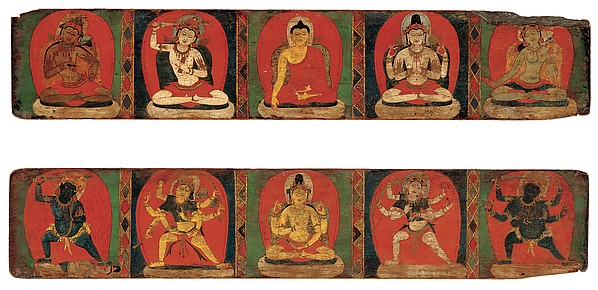
Tibet, ca. late 11th century. Distemper and gilt on wood; 10.8 × 55.9 cm. Metropolitan Museum of Art, 2020.290a, b.
Look closer: Note the lower cover, where the Met's text names Achala and Marichi at the left and Mahapratisara and Mahakala at the right of the bodhisattva: the goddess among fierce protectors in an Indian-Tibetan scheme of about 1090.
The Metropolitan Museum of Art, Gift of Jeffrey Kossak, The Kronos Collections, 2020. Open Access.
The goddess of dawn in India
Wikipedia says that in Mahāyāna texts she is the goddess of dawn, introduced by the Buddha at Shravasti, and that her depictions at Salihundam resemble those of the sun deity Sūrya on a chariot pulled by seven horses. In the Dzogchen tradition she is linked with the sun and its rays. It also reports that she is sometimes seen as a form of Tārā, and in the Nyingma tradition of the twenty-one Tārās she is the twenty-first.
The Metropolitan Museum holds two Indian images of her. The first is a small bronze with silver inlay from Bihar, eleventh to twelfth century, 6.7 centimetres high, titled Marichi, the Goddess of Dawn, with Seven Pigs: a sow with piglets on a lotus pedestal. The second is a leaf from a dispersed Pañcaviṃśatisāhasrikā Prajñāpāramitā manuscript, from Bengal or Bangladesh, about 1090, in opaque watercolour on palm leaf, titled Wrathful Eight-armed and Three-faced Goddess Tara Marichi.
The English article adds the setting of the earliest icons. It says they come from India, in Andhra Pradesh near the port site of Salihundam, and from Tibet, and that at Salihundam she rides a seven-horse chariot like Sūrya's, with Usha and Chhaya beside her. In the Mahāyāna texts, it says, the Buddha introduced her at Shravasti. The Tibetan Kangyur, it says, has three texts of the Kriyā Tantra class on her: the Incantation of Mārīcī, the Sovereign Practices Extracted from the Tantra of Māyāmārīcī and the Seven Hundred Practices of Mārīcī from the Tantras, and the article names no translators and no dates for them.
The solar side of her story is easy to see in objects. The Metropolitan Museum has a small ivory of the second or first century BCE from West Bengal, 5 centimetres high, titled The Sun God Surya(?) in His Chariot with Wives and Attendants, whose page notes that the sky deity is first mentioned in the Vedic hymns of about 1500 BCE. The Cleveland Museum of Art has a brass Sūrya of the early 700s from Kashmir, 50.4 centimetres high, whose text says the god wears a long tunic and boots suited to riding the grassland steppes of Central Asia, because the sun god was of paramount power among peoples such as the followers of Zoroastrianism, and that his image, made in India from the 100s BCE, shows the dress of the people who revered him most. Cleveland also holds a Nepalese forehead pendant of the 1600s or 1700s with Sūrya in a chariot with attendants, made to hang on a sculpture of a deity in a temple, in translucent golden stones set in gold wire. None of these is Marici. They show what the article means when it says she blends solar goddesses, and they show that a seven-horse chariot was the usual way to draw the sun.
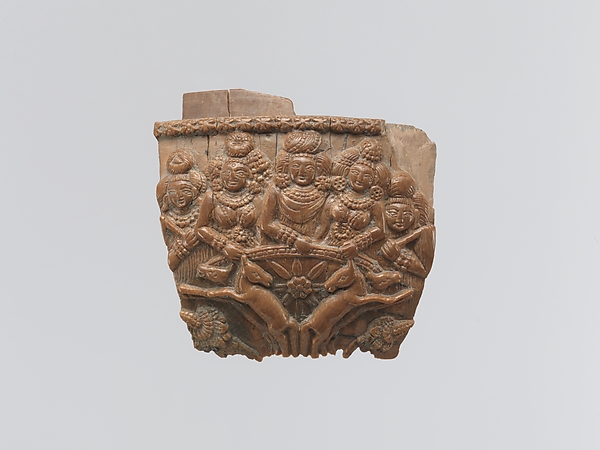
India (West Bengal), 2nd–1st century BCE. Ivory; 5 cm. Metropolitan Museum of Art, 2003.457.
Look closer: Note the row of figures above the wheel: the Met's title reads the central figure as the sun god, with a question mark.
The Metropolitan Museum of Art, Purchase, Friends of Asian Art Gifts, 2003. Open Access.
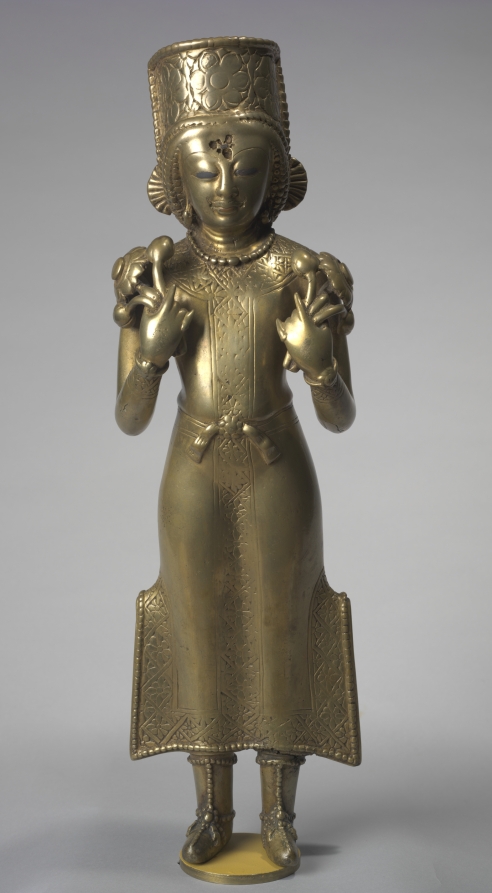
India, Kashmir, early 700s. Brass with inlaid silver eyes and copper inlaid lips; 50.4 cm. Cleveland Museum of Art, 1965.557.
Look closer: Note the long tunic, the boots and the tall crown: Cleveland says this is the dress of the Central Asian peoples who revered the sun god.
Cleveland Museum of Art, Gift of Katharine Holden Thayer. Open Access (CC0).
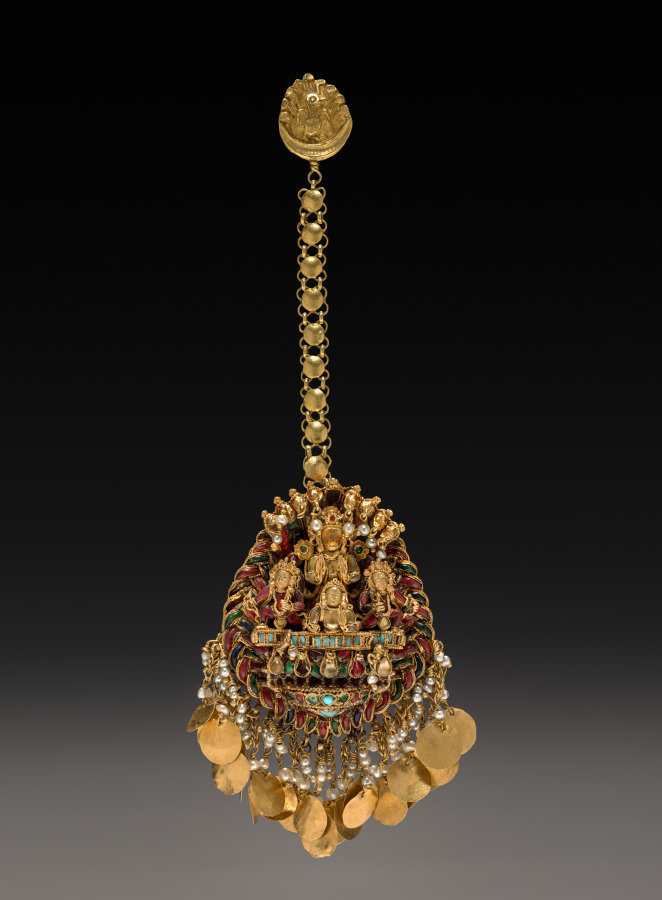
Nepal, Kathmandu Valley, 1600s or 1700s. Gold set with jewels and semi-precious stones; 8 x 4.6 cm. Cleveland Museum of Art, 1915.337.
Look closer: Note the chariot scene at the centre in golden stones and the hanging discs at the base: a pendant made to hang on a temple image in Nepal.
Cleveland Museum of Art, Gift of Mr. and Mrs. J. H. Wade. Open Access (CC0).
Doumu and the northern Dipper
The Chinese goddess has a second life as the Mother of the Dipper. The English article says Mārīcī is worshipped as both a Buddhist and a Daoist deity in China, highly revered in Esoteric Buddhism and counted among the Sixteen, Twenty and Twenty-Four Devas, the guardian devas, and usually enshrined in the Mahāvīra Hall flanking the central altar. Her festival falls on the ninth day of the ninth lunar month. In Daoism, it says, Doumu, 'Dipper Mother', is Queen of Heaven, the goddess of Beidou, the northern Dipper, and mother of the Nine Emperor Gods, with the Buddhist title Fo mu, 'Buddha-mother'. The article cites three Daoist canon texts on her, numbered Dz 45, Dz 621 and Dz 1452, compiled in the Song and Yuan periods.
The article names places and objects where she appears: the White Cloud Temple, the Tou Mu Kung temple, a Ming statue at Huayan Temple in Datong, a Qing statue at the Brooklyn Museum and a painting of 1767 by Ding Guanpeng. The Metropolitan Museum's Star Mandala of the thirteenth or fourteenth century, in ink, colour, gold and cut gold on silk, shows the Dipper as the disks of the second circle around Shakyamuni of the Golden Wheel, within circles of the Nine Luminaries, the zodiac and the twenty-eight lunar mansions. The Met's page does not mention Marishiten, and the Japanese cult of the goddess is not the cult of the star mandala, but the picture shows the world of light, star and protection in which both belong.
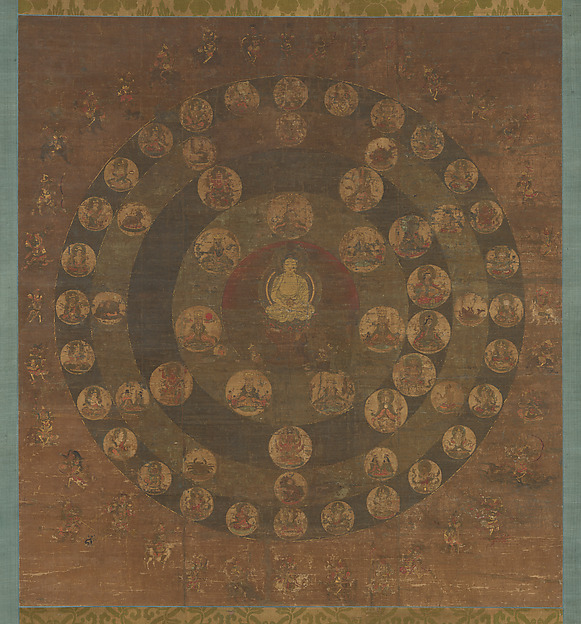
Japan, 13th–14th century. Hanging scroll; ink, color, gold, and cut gold on silk; 128.3 × 117.5 cm. Metropolitan Museum of Art, 2020.391.
Look closer: Note the central Buddha and the second ring of medallions that the Met says are the Big Dipper: the star mandala of the Japanese Esoteric schools, which prevented calamity and prolonged life.
The Metropolitan Museum of Art, Gift of Sue Cassidy Clark, in honor of Bernard Faure, 2020. Open Access.
Sow, boar and seven pigs
Her animal is the most consistent thing about her. JAANUS says she rides a sow or a chariot drawn by seven pigs. The English article says a charging boar or sow, or a chariot of seven boars, and the Japanese article says some images show her riding a moon and a boar. The Ueno Station account of Tokudaiji describes the temple's hidden statue, known only from a drawing in the pamphlet, as Marishiten standing on a charging boar with her left hand raised and a sword in her right, and says the boar represents courage, strength and speed. A boar statue in the grounds carries a sign saying that rubbing it brings spiritual, physical and financial strength.
The Japanese Wikipedia article on Zenkyo-an in Kyoto says its grounds hold many boar statues and carvings, among them a komainoshishi, a guardian boar in the place of the usual lion-dog, and a boar-shaped water basin, which the article links to Marishiten riding a boar. The Metropolitan Museum has a small Japanese ivory boar of the nineteenth century, curled asleep; the record does not mention the goddess, and it is shown here only because the boar is the animal she rides.
Two other boar-headed divinities should not be confused with her. The Cleveland Museum of Art has a sandstone Varāha of the 700s or 800s from central India, 82 centimetres high, and says that in the Hindu myth Vishnu took the form of a boar to rescue his wife Bhū, the Earth, from the bottom of the primordial ocean, and holds out one of his four elbows as a seat for the goddess he has rescued. It also has a gilt bronze Vajravārāhī of the 1300s from Tibet, 36 centimetres high, which it calls the tantric Buddhist counterpart of the Hindu mother goddess Vārāhī, identifiable by the boar head above her right ear. The English article on Marici compares her in some aspects with Vajravārāhī, but the two goddesses are different figures with different iconography.

Japan, 19th century. Ivory; 1.9 cm. Metropolitan Museum of Art, 81.1.115.
Look closer: Note the bristled mane and the curled sleeping pose: a netsuke-sized boar, the animal the goddess rides.
The Metropolitan Museum of Art, Bequest of Stephen Whitney Phoenix, 1881. Open Access.
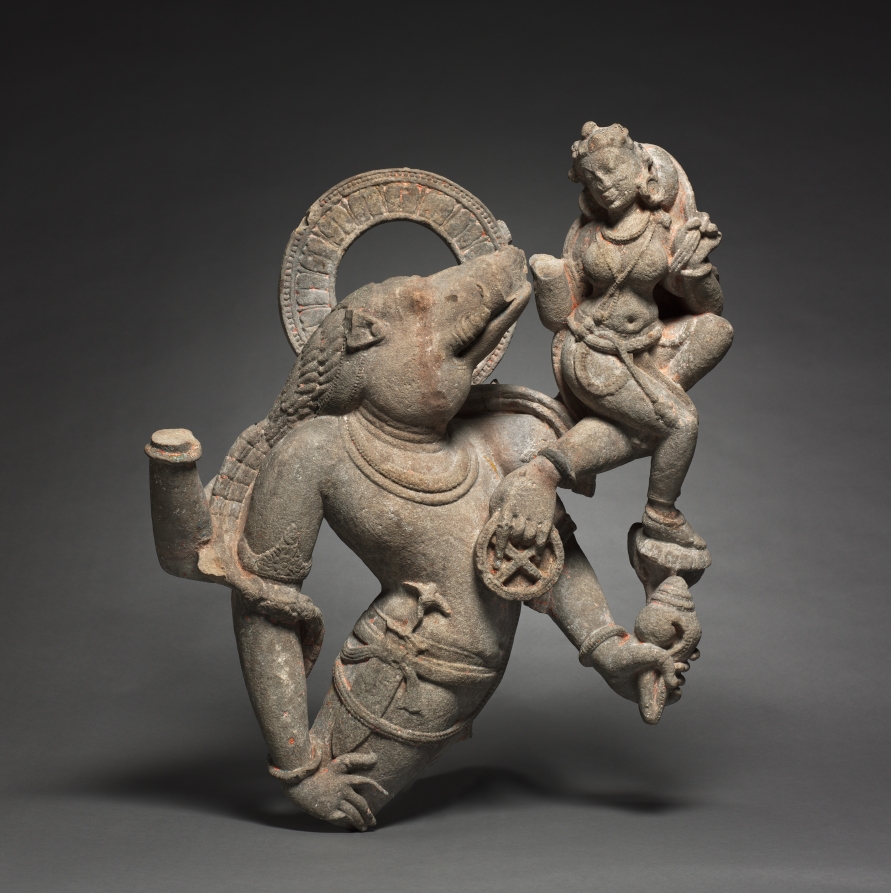
Central India, probably Madhya Pradesh, 700–800s. Sandstone; 82 x 68.5 x 33.5 cm. Cleveland Museum of Art, 2011.148.
Look closer: Note the boar's head, the lunging body and the small goddess seated on his bent arm: the Varāha of the Hindu myth, a different boar from the goddess's mount.
Cleveland Museum of Art, Gift of Maxeen and John Flower in honor of Dr. Stanislaw Czuma. Open Access (CC0).
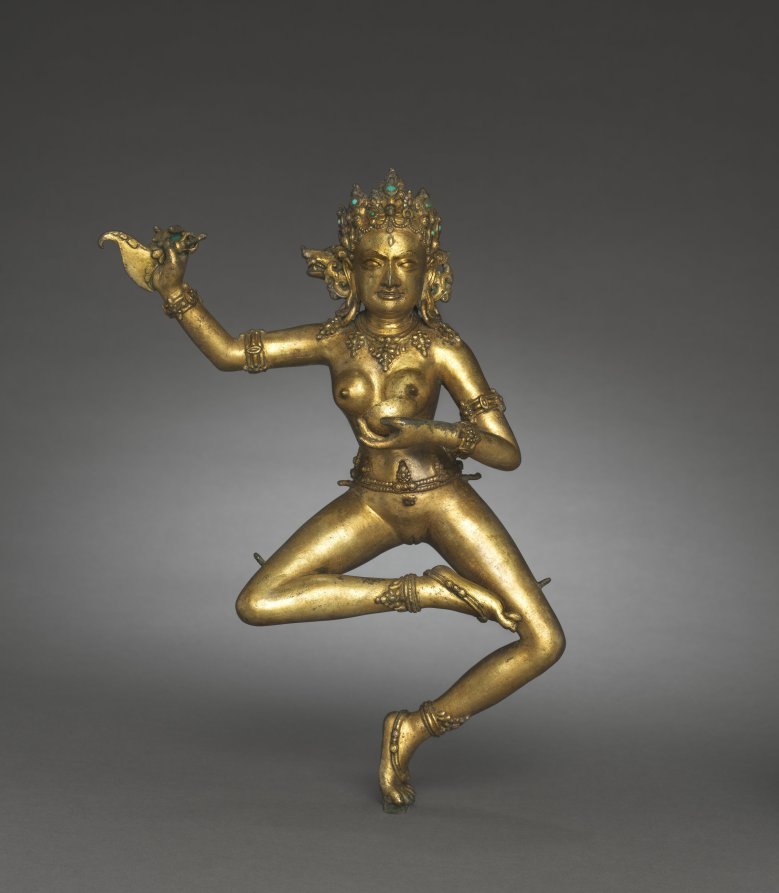
Tibet, 1300s. Gilt bronze with turquoise inlay; 36 cm. Cleveland Museum of Art, 1982.50.
Look closer: Note the dancing pose with one leg raised: Cleveland says a boar head emerges above her right ear, the mark of Vajravārāhī.
Cleveland Museum of Art, Leonard C. Hanna Jr. Fund. Open Access (CC0).
Protector of the samurai
JAANUS says her martial aspect carried over into Japan, where she was revered as a tutelary deity of the warrior class. Wikipedia says the Shingon and Tendai schools made her an important deity and that the samurai adopted her, reportedly invoking her at sunrise to seek victory and to avoid enemies' notice. Some martial schools revered her as a lineage guardian: the blood pledge chart of Tenshin Shōden Katori Shintō-ryū, for example, invokes her punishment for broken rules.
Wikipedia also links her devotion to a meditative state in which warriors stopped fixating on victory or defeat, life or death, a model it notes resembles Zen although her devotions predate Zen. The Met holds a piece of armour that names her: a black-lacquered half mask, or menpō, with a gorget, of about 1615 to 1868, titled Half Mask with Gorget Depicting Bonji Character Representing Marishiten. The title says that the Sanskrit character on the piece stands for her.
The Japanese article describes the rite. From the Kamakura period, it says, she was popular with samurai as a guardian, and it describes the Marishiten no hō, performed before battle: the practitioner extends the index and middle fingers of both hands, the right hand as a sword and the left as its scabbard, cuts the air with the right and sheathes it in the left. The article says this rite was the basis of the nine-syllable hand-sign practice, the kuji goshinhō, that ninja used. The English article agrees that the ninja revered her as a goddess of illusion and invisibility and recited her mantra to gain that power.
The same article lists the warriors named in the tradition. Kusunoki Masashige is reported to have kept a small Marishiten statue inside his helmet. Mōri Motonari and Tachibana Dōsetsu used a 'Marishiten flag' as a battle banner. Other reported devotees are Yamamoto Kansuke, Maeda Toshiie and Tachibana Muneshige. After the medieval period, it says, she was valued for protection and wealth, and the Zen and Nichiren schools both treat her as a protective deity. Several peaks bear her name, among them Kiso Ontake, Norikuradake and Kai-Komagatake.
Two objects at the Metropolitan Museum come from the same world. A whistling arrow of about 1807, 11.4 centimetres high, is a carved wooden capsule that opens in two halves. The Met's page says it was probably made as a votive gift or souvenir linked to a shrine to Tokugawa Ieyasu, that its figures were beings whose aid could be invoked for personal protection and success in battle, and that the left half shows the three monkeys of 'see no evil' and a prayer text while the right half shows Marishiten, described as a goddess especially venerated by archers, and Tokugawa Ieyasu, with seed syllables behind them for Aizen Myōō and Amida Nyorai. A wooden panel of the nineteenth century, painted in ink and colour on cryptomeria, shows Kusunoki Masashige taking leave of his son Masatsura; the Met gives it no description, and the record says nothing of Marishiten, so the link to this chapter is only that the same Masashige is the warrior the Japanese article names as her devotee.

Japan, ca. 1807. Wood and pigments; 11.4 cm. Metropolitan Museum of Art, 36.25.2584a, b.
Look closer: Note the three small monkeys and the prayer text in the left half, and the group in the right half: the goddess beside the standing figure the Met names as Tokugawa Ieyasu.
The Metropolitan Museum of Art, Bequest of George C. Stone, 1935. Open Access.

Japan, 19th century. Ink and color on cryptomeria (sugi) wood; 45.7 x 66 cm. Metropolitan Museum of Art, 1985.396.3.
Look closer: Note the small figures on the hillside and the pale band of cloud above them: a nineteenth-century scene of the warrior whom the Japanese article names as a devotee of the goddess.
The Metropolitan Museum of Art, Gift of Stanley J. Love, 1985. Open Access.
A third among the three heavens
JAANUS records the later turn. Merchants worshipped her for wealth and prosperity, and in the Edo period she was one of three deities, with Daikokuten and Benzaiten, called the santen, the three heavens, invoked for this purpose. Wikipedia likewise says the merchant class worshipped her as a deity of wealth alongside Daikokuten and Benzaiten.
The English article describes the end of the story. It says the cult declined after the feudal system was dismantled and the samurai class abolished, and that Benzaiten largely replaced her in modern veneration. The Ueno Station account of Tokudaiji gives a more cheerful version: samurai of the Edo period prayed to her for strength and protection on the battlefield, and later merchants, entertainers and performers prayed to her for business and success in show business. The three accounts make the same arc, from sword to shop to stage, and none of them gives a date for the turn.
A short prayer in two languages
Wikipedia gives her Sanskrit mantra as Oṃ mārīcyai svāhā. In the Tibetan Nyingma and Dzogchen form it is given as OM MARI ZEYE MUM SVAHA, with MUM as her main seed syllable. It describes her as a guardian and protector of nations, shielding them from the fury of war, associated with illusion and invisibility, especially in Japan, and in Tibetan Buddhism also as a healer. In China, it says, her festival falls on the ninth day of the ninth lunar month.
The Japanese article gives two short mantras, On anichi marishie sowaka and On marishie sowaka, and a longer dhāraṇī, without saying how they are used. The English article notes that in the Dzogchen tradition of the Nyingma her Self-Arisen Vidya Tantra ties her to the source of light rays, and that the sun is used in the thögal practice. It also lists the relations she is said to have: sometimes a form of Tārā, sometimes an incarnation of the bodhisattva Cundī with similar iconography, and compared in some aspects with Vajravārāhī. The Metropolitan Museum also holds a Chinese rubbing of the twentieth century, Marici Sutra and Yellow Emperor's Sutra for Secret Charm Against Evil, by Li Fenggui and Cui Shousu, whose page gives no description and does not discuss the sutra, so it is mentioned here only as evidence that the text was still copied and carved in modern China.
Ueno, Kyoto and Kanazawa
The Japanese Wikipedia article names the three great Marishiten of Japan, and the notable sites around them. Tokudaiji, in Ueno in Tokyo, is a Nichiren temple within the Ameyoko street market, called Shitaya Marishiten. Zenkyo-an, a sub-temple of Kenninji in Kyoto, holds a Marishiten hall. Hōsen-ji of Kōya-san Shingon at Kanazawa in Ishikawa is the third. The article also names Eishōzan Honbō-ji in Kyoto, whose grounds contain a Marishi Sonten-dō, Seisōin, a sub-temple of Myōshin-ji in Kyoto and head of the Seisawa school, which has an important cultural property painting of the goddess, and Zenkyo-in in Kamakura, which it links to the Zen master Seiseki Chōsetsu, Daikan Zenji (清拙正澄).
Tokudaiji is the best documented in English. The Ueno Station account says the temple is believed to be about 400 years old, that the statue was brought there in 1708, that the buildings burned in the fires after the Great Kantō Earthquake of 1923 and the firebombing of Tokyo in 1945 while the statue survived, and that the present building dates from 1964. It says the statue is believed to have been made by Shōtoku Taishi (574 to 622) and is too sacred for public display, and notes that the temple stands on raised ground above the west side of the Ameyoko street market, with an entrance on a side street. JAANUS calls its large image dubiously attributed to Shōtoku Taishi.
The Japanese article on Zenkyo-an gives the Kyoto side. The temple is a Rinzai sub-temple of Kenninji, founded in the Genkō era (1331 to 1333) by Ogasawara Sadamune, military governor of Shinano, for the Nanzenji abbot Daikan Zenji. It is known for the hidden image of Marishiten that the page says the abbot made in Yuan China before coming to Japan in the late Kamakura period. The hall was rebuilt in 1547 by Oda Nobuhide after a fire in the Tenbun era, and was repaired in the Genroku, Kyōhō and Ansei periods. Twelve sliding-door panels by Kaihoku Yūshō are Important Cultural Properties, designated on 8 August 1921, and are on deposit at the Kyoto National Museum. Only the hall is open to visitors.
| Temple | What the sources say |
|---|---|
| Tokudaiji, Ueno, Tokyo | Nichiren temple; statue brought in 1708 and not shown; building of 1964 (Ueno Station, Japanese Wikipedia) |
| Zenkyo-an, Kenninji, Kyoto | Founded 1331 to 1333; hidden image said made in Yuan China; hall rebuilt 1547; many boar carvings (Japanese Wikipedia) |
| Hōsen-ji, Kanazawa, Ishikawa | Kōya-san Shingon; one of the three great Marishiten (Japanese Wikipedia) |
| Honbō-ji, Kyoto | Nichiren head temple with a Marishi Sonten-dō (Japanese Wikipedia) |
| Seisōin, Myōshin-ji, Kyoto | Holds an important cultural property painting of the goddess (Japanese Wikipedia) |
| Zenkyo-in, Kamakura | Linked to the same Zen master as Zenkyo-an (Japanese Wikipedia) |
Telling her from the rest
Three marks identify her more reliably than a name. The first is the animal: a boar, a sow or a team of seven, under a standing or sitting figure. The second is the sun and moon among the attributes of the Chinese form. The third is the number of faces, often three, with a sow's face among them in some forms (JAANUS). A seated goddess with a lion is a different figure; so is a dancing boar-headed one, as the Cleveland Vajravārāhī shows.
A caution applies to the object. The Met's records for its Japanese objects of this theme, including the whistling arrow and the menpō, give the title and a short note, not an iconographic description, and Cleveland's records for its Indian and Tibetan figures say nothing of Marici. The chapter therefore leans on titles, on the museum notes quoted, and on what the photographs show. A collector who sees a small gilt wooden figure on a boar should compare it with the Tokudaiji drawing as the Ueno Station account describes it, a goddess with her left hand raised and a sword in her right, before deciding.
Ten small facts
- Her Sanskrit name means light, and the Japanese article glosses it as heat haze and majestic radiance (JAANUS, Japanese Wikipedia).
- The goddess is said to run ahead of the sun deity Nichiten and cannot be seized, burned or wetted (Japanese Wikipedia).
- At Salihundam in Andhra Pradesh she rides a seven-horse chariot like Sūrya's (Wikipedia).
- Kusunoki Masashige is reported to have kept her statue in his helmet (Japanese Wikipedia).
- Her festival in China falls on the ninth day of the ninth lunar month (Wikipedia).
- Doumu appears in three Daoist canon texts numbered Dz 45, Dz 621 and Dz 1452 (Wikipedia).
- The Tokudaiji statue was brought to Ueno in 1708 and survived the fires of 1923 and 1945 (Ueno Station).
- The hall at Zenkyo-an was rebuilt in 1547 by Oda Nobuhide (Japanese Wikipedia, 禅居庵).
- The Met's whistling arrow of about 1807 carries her beside a figure named as Tokugawa Ieyasu (Metropolitan Museum of Art).
- A Cleveland Vajravārāhī of the 1300s wears a boar head above her right ear (Cleveland Museum of Art).
Across Asia
One ray of light under many names.
| Where | Form and name | What the record shows |
|---|---|---|
| India | Mārīcī; Marichi | Goddess of dawn with seven pigs or horses (Wikipedia, Met). |
| China | Mólìzhītiān 摩利支天 | Two hands joined and six holding sun, moon, bell, seal, bow and halberd; festival on the 9th day of the 9th lunar month (Wikipedia). |
| Korea | Marijicheon 마리지천 | The Korean reading (Wikipedia). |
| Tibet | 'od zer can ma | Several forms, with five faces and ten hands or three faces and eight or twelve hands; also a healer (Wikipedia). |
| Japan | Marishiten 摩利支天 | Tutelary deity of the warrior class, later of merchants (JAANUS). |
| China, Daoist | Doumu; Dipper Mother | Queen of Heaven and goddess of Beidou; in Esoteric Buddhism synonymous with Mārīcī (Wikipedia). |
| Southeast Asia | Malici; Marici | Listed names in Tagalog and Thai (Wikipedia). |
A goddess among the heavens
Marishiten belongs to the Heavenly Beings, as a deva of Indian origin, and is the one goddess here whose cult passed from warriors to merchants.
| Companion | Why they meet |
|---|---|
| Daikokuten and Benzaiten | The three heavens, invoked together by Edo merchants for wealth (JAANUS). |
| Bonten | The god whose son Marici is said to be, in the Hindu line JAANUS traces. |
| Tārā | Sometimes seen as a form of Tārā, the twenty-first in the Nyingma list (Wikipedia). |
Where to see her
| Place | What to look for |
|---|---|
| Shōtakuin, Kyoto | A polychrome painting said to be of Korean provenance (JAANUS). |
| Tokudaiji, Tokyo | A large image dubiously attributed to Shōtoku Taishi (574 to 622) (JAANUS). |
| Metropolitan Museum of Art, New York | Indian bronze and manuscript leaf, and a Japanese menpō, in open access. |
| Tokudaiji, Ueno, Tokyo | The hidden statue is not shown; a boar statue stands in the grounds above the Ameyoko street market (Ueno Station). |
| Zenkyo-an, Kenninji, Kyoto | The Marishiten hall and a boar-shaped water basin (Japanese Wikipedia). |
| Cleveland Museum of Art | A Kashmir Sūrya, a Nepalese Sūrya pendant, a Varāha and a Vajravārāhī, in open access. |
Three views in the Metropolitan Museum

India (Bihar), 11th to 12th century. Bronze with silver inlay; H. 6.7 cm. Metropolitan Museum of Art, 1987.142.345.
Look closer: Note the sow's beaded collar and the piglets crowded beneath her on the lotus.
The Metropolitan Museum of Art, Samuel Eilenberg Collection, Gift of Samuel Eilenberg, 1987. Open Access.
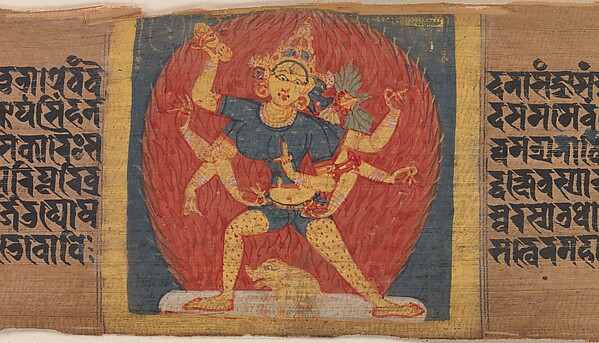
India (Bengal) or Bangladesh, ca. 1090. Opaque watercolour on palm leaf; 5.7 x 57.2 cm. Metropolitan Museum of Art, 55.121.36.9.
Look closer: Note the several arms fanning out and the flame halo that fills the small square panel.
The Metropolitan Museum of Art, Rogers Fund, 1955. Open Access.
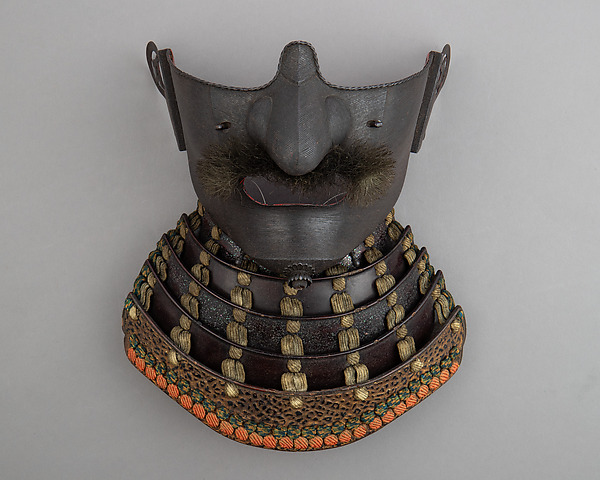
Japan, ca. 1615 to 1868. Lacquer, wood, hair, cord; H. 27.9 cm. Metropolitan Museum of Art, 36.25.293a, b.
Look closer: Note the moustache of hair and the laced plates of the gorget; the museum's title records the Sanskrit character that stands for her.
The Metropolitan Museum of Art, Bequest of George C. Stone, 1935. Open Access.
In the house
Two carved wood figures of Marishiten on a boar are in the house today; they are listed below when the shelf loads.
A short glossary
- Marishiten (摩利支天)
- The Japanese name of the goddess Mārīcī.
- Mārīcī
- The Sanskrit name, 'ray of light' or mirage.
- Santen (三天)
- The three heavens of Edo merchants: Marishiten, Daikokuten and Benzaiten.
- Marishiten no hō (摩利支天の法)
- A rite of the sword-hand signs performed before battle.
- Kuji goshinhō (九字護身法)
- A nine-syllable protective hand-sign practice linked to the rite.
- Menpō (面頰)
- A half mask of armour, here marked with her seed syllable.
- Bonji (梵字)
- Siddham script, used for seed syllables.
- Ikō Bosatsu (威光菩薩)
- The 'bodhisattva of majestic radiance', one of her titles.
- Nichiten (日天)
- The sun deity before whom she is said to run.
- Doumu (斗母)
- The 'Dipper Mother' of Chinese religion.
- Beidou (北斗)
- The northern Dipper.
- Sonten-dō (尊天堂)
- A hall of the honoured deity, as at Zenkyo-an.
- Komainoshishi (狛猪)
- A guardian boar, in place of the lion-dog.
- Hibutsu (秘仏)
- A hidden image, shown rarely or never.
- Vajravārāhī
- The tantric boar-headed goddess, a different figure.
- Cundī
- A bodhisattva with similar iconography, in some accounts a source of Marici.
Answered plainly
Who is Marishiten?
The Japanese form of the Buddhist goddess Marici, whose name means light or mirage (JAANUS).
Why is she shown with a boar?
She rides a sow or a chariot drawn by seven pigs, and in many-faced forms one face is a sow's (JAANUS).
Why did samurai honour her?
Her invisibility made her a protector against enemies, and JAANUS calls her a tutelary deity of the warrior class.
What is the santen?
The three heavens of Edo-period merchants: Marishiten, Daikokuten and Benzaiten (JAANUS).
Is she a form of Tārā?
She is sometimes seen as one, the twenty-first in the Nyingma list (Wikipedia).
Are images common in Japan?
JAANUS says images are common in India but rare in Japan.
Why was she a samurai goddess?
She was invisible and could not be struck, and was invoked to avoid enemies' notice (JAANUS, Wikipedia).
Which temples are the three great Marishiten?
Tokudaiji in Ueno, Zenkyo-an in Kyoto and Hōsen-ji in Kanazawa (Japanese Wikipedia).
Is Marishiten a Daoist goddess too?
In China she is treated as synonymous with Doumu, the Dipper Mother (Wikipedia).
Is she the same as Vajravārāhī?
No; Wikipedia compares them in some aspects, but Vajravārāhī is a separate boar-headed goddess (Wikipedia, Cleveland).
Why did ninja pray to her?
Wikipedia says they revered her as a goddess of illusion and invisibility.
Where next
Sources and image credits
- JAANUS, Marishiten 摩利支天 (Columbia University)
- Wikipedia, Marici (Buddhism)
- Metropolitan Museum of Art, Marichi, the Goddess of Dawn, with Seven Pigs (1987.142.345)
- Metropolitan Museum of Art, Wrathful Eight-armed and Three-faced Goddess Tara Marichi (55.121.36.9)
- Metropolitan Museum of Art, Half Mask with Gorget Depicting Bonji Character Representing Marishiten (36.25.293a, b)
- Japanese Wikipedia, 摩利支天
- Japanese Wikipedia, 禅居庵
- Ueno Station, Marishiten Tokudaiji Temple
- Metropolitan Museum of Art, Pair of Manuscript Covers, Each with Five Deities (2020.290a, b)
- Metropolitan Museum of Art, The Sun God Surya(?) in His Chariot with Wives and Attendants (2003.457)
- Cleveland Museum of Art, Surya, the Sun God (1965.557)
- Cleveland Museum of Art, Forehead Pendant with Sun God Surya in a Chariot with Attendants (1915.337)
- Metropolitan Museum of Art, Whistling Arrow (36.25.2584a, b)
- Metropolitan Museum of Art, Kusunoki Masashige Parting from His Son Masatsura (1985.396.3)
- Metropolitan Museum of Art, Boar (81.1.115)
- Cleveland Museum of Art, Varaha, Boar Incarnation of Vishnu (2011.148)
- Cleveland Museum of Art, Vajravarahi (1982.50)
- Metropolitan Museum of Art, Star Mandala (2020.391)
- Metropolitan Museum of Art, Marici Sutra and Yellow Emperor's Sutra for Secret Charm Against Evil (1977.375.43)
- Metropolitan Museum of Art, Sword Guard (Tsuba) (91.1.810)
Last reviewed 28 October 2026. Pictures are public-domain or openly licensed, each credited beneath it. Diagrams on this page are drawn by Japonista.
Looking for a Marishiten figure, scroll or print? Tell the concierge desk what you have in mind and we will search Japan for it.
Private concierge
Looking for something in particular?
Describe the piece or the project you have in mind. A senior advisor in Tokyo reads every case file personally and replies within two business days, with fees set out in writing before any work begins.