
Kichijōten
Lady of Fortune
Kichijōten
吉祥天
The Indian goddess Lakshmi in Tang court dress: a jewel in one hand, a lotus in the other, and a hemp-cloth portrait at Yakushi-ji that is unveiled only at New Year.
Identity card
Know the figure at a glance
- A jewelled headdress. JAANUS describes an elaborate jewelled headdress above a Tang-period court lady.
- The jewel. The wish-granting jewel rests in the left hand. JAANUS names this as the sign that separates her from Benzaiten.
- The lotus. The right hand holds a lotus or makes the open-palm gesture of charity, yogan-in (JAANUS).
- Rich robes. The Yakushi-ji portrait has a flowered upper garment, a striped skirt and fin-shaped streamers at the sleeves (Japanese Wiki Corpus).
- A lotus seat. The diagram stands her on a lotus; the Yakushi-ji painting shows her stepping forward instead.
Lakshmi arrives in silk
In India she was Śrī Lakṣmī, and the Japan Architecture and Art Net Users System (JAANUS) calls her originally a Brahmanic goddess of fertility, wealth and beauty, linked with Kubera, the god of the north, and counted as the chief consort of Vishnu. Buddhism in China and Japan absorbed her into popular worship under a new name, Kichijōten, 'heavenly being of good omen', also Kichijōtennyo or Kudokuten, 'heavenly being of merit'.
What arrived in Japan was not an Indian figure but a Chinese one. JAANUS describes a beautiful court lady of the Tang period in a richly embroidered gown and an elaborate jewelled headdress, with a wish-granting jewel in her left hand and a lotus in her right. The jewel is the part to remember. JAANUS says it distinguishes her from Benzaiten, with whom she is often confused.
The On-Mark Productions entry on the goddess gives a fuller list of her names. Beside Kichijōten and Kichijō Tennyo it records Kudokuten, 'heavenly being of merit', the Sanskrit forms Śrī-Mahādevī, Mahāśrī and Lakṣmī, and, from Soothill's dictionary, Padmā, the lotus-dweller. It gives the Chinese reading Jíxiáng Tiān and the Korean Gilsang Cheon. In Japanese esoteric practice the seed syllable is pronounced 'Sri', and the mantra it gives is On Makashiri Yaei Sowaka.
Its account of her origin follows Soothill, who quotes M. W. de Visser: she was the wife of Vishnu, or of Narayana, and she sprang from the ocean holding a lotus, which is why the lotus belongs to her. JAANUS calls Vishnu the lord of creation and her his chief consort. The two accounts agree in substance and differ only in the name of the god, Vishnu or Narayana, whose consort she is.
Śrī in the Rigveda and on early coins
The word that Japan translated as 'good omen' was, in India, the name of a goddess of prosperity older than the Buddha. The Wikipedia article on Lakshmi says that the Śrī Sūkta, a hymn of fifteen verses in the appendix of the fifth book of the Rigveda, is possibly pre-Buddhist, and that it describes the goddess as golden-hued, adorned with gold and silver, riding a chariot, and associated with elephants, horses and the lotus. The first two and the last three verses invoke Lakṣmī, while verses three to twelve address Śrī. The same article says the Rigveda, dated there to about 1500 BCE, mentions the word Śrī about 130 times.
The images are older than the sutra. Wikipedia reports that the goddess flanked by elephants who pour water over her, Gaja Lakṣmī, is among the most frequently found images at Indian archaeological sites. It lists a sculpture from Sonkh near Mathura of the pre-Kushan age, a terracotta plaque of the second century BCE from Atranjikhera, terracotta figures of the third century BCE from Vaishali, Shravasti, Kaushambi, Champa and Chandraketugarh, and a first-century BCE image from Kaushambi. A goddess labelled Ommo on Kushan coins holds a lotus and a cornucopia, and the article records a scholarly argument that she is more likely Śrī than Umā. The article also dates a Greek-influenced statue from Kashmir to the sixth century CE, holding a lotus and a cornucopia between elephants and lions.
Buddhism took her over early. Wikipedia says that Buddhism views Lakṣmī as a goddess of abundance and fortune, that she is represented on the oldest stupas and cave temples, and that reverence for Śrī-Lakṣmī predates Buddhism. The article does not name specific sites, and its two statements, that her reverence predates Buddhism and that she appears on the earliest Buddhist monuments, are compatible but come without dates. In Tibet, it adds, Lakṣmī is important in the Gelug school in peaceful and wrathful forms; the wrathful form is called Palden Lhamo and is the principal female protector of the Gelug and of Lhasa. In Nepal and South-East Asia the Buddhist goddess of abundance is Vasudhārā, who shares the Hindu goddess's characteristics with minor differences.
The Jain side of the same story is a sign that she belonged to every Indian religion. The Lakshmi article records that she is an important deity in Jainism, that the Jain Kalpa Sūtra praises her, and that a Jain temple at Khajuraho shows her with Vishnu. The point for a visitor to Nara is that the Japanese goddess has a very long past in which Buddhism was only one of her homes.
The goddess before the sutra
The Metropolitan Museum holds a moulded terracotta plaque from Chandraketugarh in West Bengal, of the first century BCE, titled a goddess who bestows riches, probably Śrī Lakṣmī. The Museum's own title carries the hedge, and the record gives no description beyond the title and the material, so this page does not read more into the figure than the title does. The plaque is about 26.7 centimetres high and shows a richly dressed woman at the centre, with attendants at either side and small figures along the top.
The Museum also has three Gaja Lakṣmī carvings from Kashmir. One is of the sixth century and two are of the eighth, and the earlier and one of the later are shown in the gallery further down this page. The third, 16.2 centimetres high and given to the Museum in 1989, is shown here, and its record gives no description. In the photograph the seated goddess sits within an arch with an elephant at each side of its top. Wikipedia's article on Lakṣmī dates a Greek-influenced statue from Kashmir to the sixth century and says it holds a lotus and a cornucopia between elephants and lions; this page does not claim that it is the same work as the Museum's.
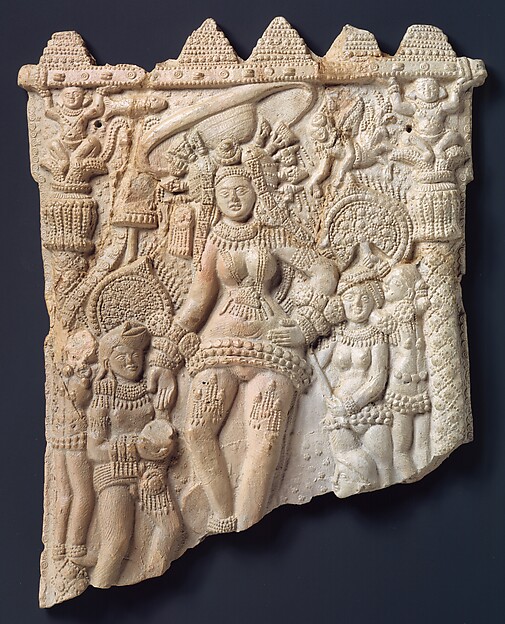
India, Chandraketugarh, West Bengal, 1st century BCE. Molded terracotta; 26.7 cm. Metropolitan Museum of Art, 1990.281.
Look closer: Note the central figure's large headdress and the two attendants at her sides: the goddess of riches centuries before she reached Japan.
The Metropolitan Museum of Art, Purchase, Florence and Herbert Irving Gift, 1990. Open Access.
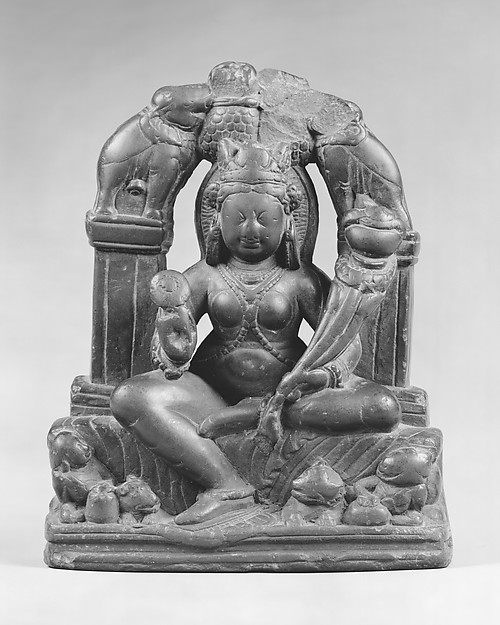
India (Jammu and Kashmir, ancient kingdom of Kashmir), 8th century. Stone; 16.2 cm. Metropolitan Museum of Art, 1989.236.4.
Look closer: Note the two elephants at the top of the arch: the Gaja Lakshmi form, in which elephants pour water over the goddess.
The Metropolitan Museum of Art, Gift of Doris Rubin, in memory of Harry Rubin, 1989. Open Access.
Vasudhārā and Śrī-Devī across Asia
The Cleveland Museum of Art owns a Nepalese Vasudhārā of the fourteenth or fifteenth century, in gilt bronze with semi-precious stones. The Museum's text says that in Nepal she is the female counterpart of the god of wealth and one of the most popular divinities, that the image would have stood in a household shrine or a Buddhist monastery, and that devotees prayed to her for wealth, prosperity and children. Each of her six arms holds an object of life and abundance: jewels, an overflowing pot and a sheaf of wheat, and a Buddhist philosophical text rests on the lotus in her topmost left hand, which the Museum reads as saying that wealth and prosperity can derive from true knowledge.
The Metropolitan Museum has a second Nepalese Vasudhārā, of the fourteenth to fifteenth century, in gilt copper alloy, 13.5 centimetres high. It also has a bronze Seated Śrī-Devī from Java, of the ninth century, 12.2 centimetres high, and a gilt bronze standing figure from Cambodia or Thailand of the thirteenth century, catalogued with a question mark as Lakṣmī. The Museum's own title is guarded, and so is this page. None of these is Kichijōten, and none was made for Japan; they show the family of goddesses of abundance of which she is the Japanese member.
A brass Lakṣmī from Himachal Pradesh, of the seventh century and 27.3 centimetres high, completes the group. In the photograph she sits on a throne with a small figure at each side. The Museum's record gives no description, and this page describes only what the photograph shows.
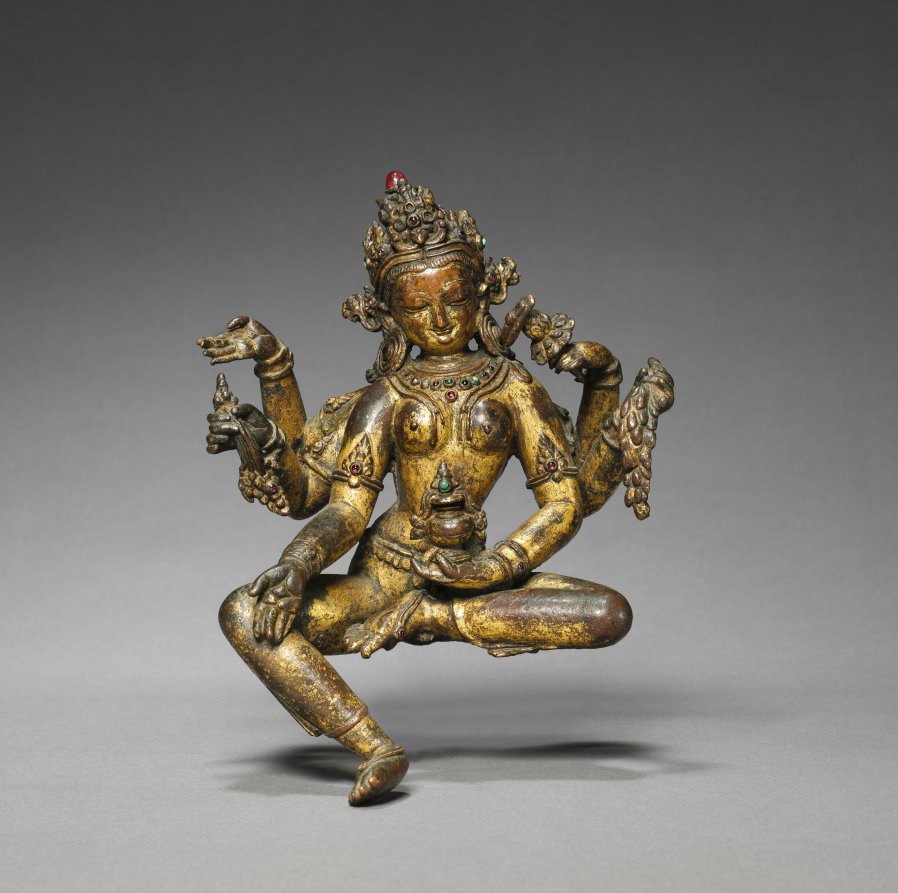
Nepal, 1300s–1400s. Gilt bronze and semiprecious stones; 16.2 cm. Cleveland Museum of Art, 1947.493.
Look closer: Note the many arms holding abundance, the overflowing pot and the sheaf of wheat the Museum describes: a Nepalese goddess of wealth.
Cleveland Museum of Art, Purchase from the J. H. Wade Fund. Open Access (CC0).
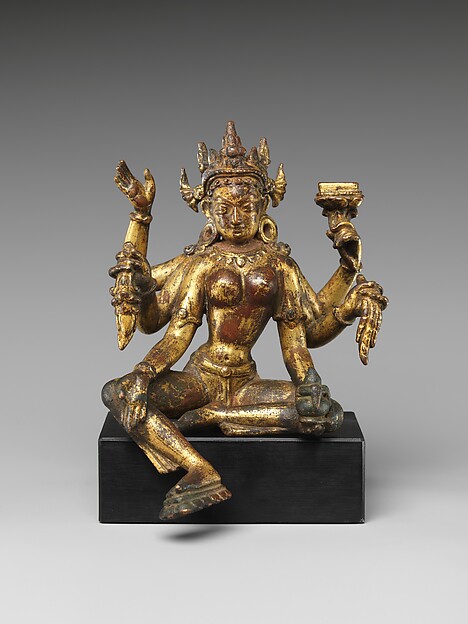
Nepal, Kathmandu Valley, 14th–15th century. Gilt-copper alloy; 13.5 cm. Metropolitan Museum of Art, 1983.547.
Look closer: Note the relaxed seated posture, the crown and the raised hand holding a small object: a second Nepalese Vasudhara.
The Metropolitan Museum of Art, Gift of Dr. and Mrs. Wesley Halpert, in memory of Emanuel Winternitz, 1983. Open Access.
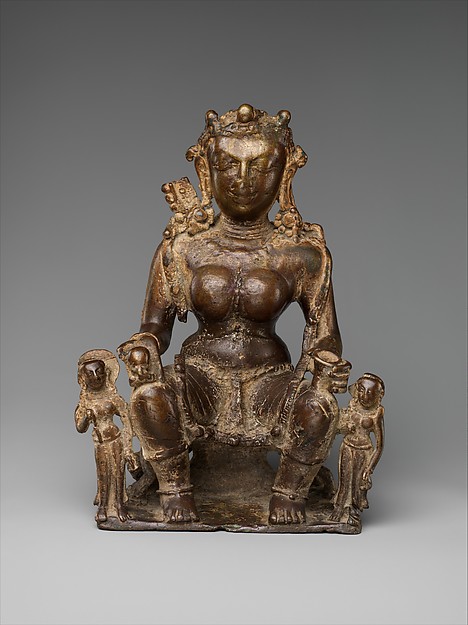
India (Himachal Pradesh), 7th century. Brass; 27.3 cm. Metropolitan Museum of Art, 2014.60.
Look closer: Note the throne and the two small attendants at the sides: a seventh-century goddess of prosperity from the Himalayan foothills.
The Metropolitan Museum of Art, Purchase, Brooke Russell Astor Bequest, Robert and Bobbie Falk Philanthropic Fund Gift, Seymour Fund, Josephine Lois Berger-Nadler Endowment Fund, Elizabeth M. Riley Bequest, in memory of Jean Mailey, funds from various donors; and David E. Stutzman and John D. Lamb, Shelby White, and Jeff Soref Gifts, 2014. Open Access.
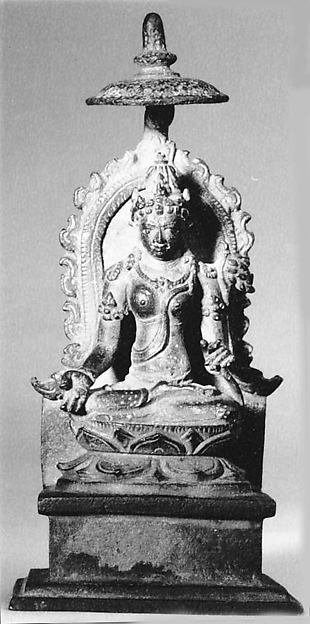
Indonesia (Java), 9th century. Bronze; 12.2 cm. Metropolitan Museum of Art, 1987.142.219.
Look closer: Note the arched halo and the parasol above the figure: a goddess of fortune in Javanese bronze of the ninth century.
The Metropolitan Museum of Art, Samuel Eilenberg Collection, Gift of Samuel Eilenberg, 1987. Open Access.
A vow in the Golden Light Sutra
JAANUS ties her to the Konkōmyō saishōōkyō, the Sutra of the Sovereign Kings of the Golden Light, which associates her with wealth and virtue. Wikipedia reports that in this sutra she introduces her mantra and vows to protect any monk who upholds and teaches it.
Benzaiten has her own chapter in the same sutra, and JAANUS notes that the two are often confused. JAANUS also names a second scripture, the Darani shūkyō, which describes a Kichijōten mandara used in an Esoteric Buddhist ritual to promote worldly happiness and welfare. In the Taizōkai mandara she appears as an attendant of Senju Kannon (JAANUS).
On-Mark adds a third scripture to the two named above. It says the Prajñāpāramitā sutra, the Hannyakyō, is linked with Basūsen (Vasu), an ascetic who carries a palm-leaf text that stands for these scriptures. In the Taizōkai mandara Basūsen and Kichijōten stand as a pair on either side of Senju Kannon, and the page notes that Kudokuten is sometimes substituted for Kichijōten there. Basūsen is counted among the twenty-eight attendants of Senju Kannon, the Nijūhachibushū.
The Wikipedia entry gives a Chinese tradition that does not appear in the Japanese sources. Her Shrīdevī Dhāraṇī, in Chinese Da jixiang tiannü zhou, opens with the invocation Namo buddhāya and includes the words namo śrīmahādevīya, and it is one of the ten short mantras recited in the morning liturgy in Chinese monasteries. The Japanese mantra given by On-Mark is different, so the two should not be treated as one text.
Reading the many names
The name changes at every border. In Sanskrit the goddess is Śrī or Mahādevī, the great goddess, and On-Mark also records Lakṣmī and Padmā. In Chinese the Buddhist name is Jixiang tiannü, which Wikipedia glosses as 'Auspicious Devi', and the alternative Gongde tian, 'Meritorious Devi', the form that gave Japan Kudokuten. In Japanese Kichijōten is read in two ways, Kichijō and Kisshō, and the second reading survives in the ceremony name kisshō keka and in the shortened form Kisshōten.
Names of the ritual belong with the goddess. The Japanese Wiki Corpus gives the ceremony as Kichijō keka, and JAANUS as kisshō keka, with the word keka meaning repentance of faults. Both are the same Chinese characters read in the two available ways, and the rite is the one celebrated at Yakushi-ji in the first fortnight of January. A reader who finds one spelling in a temple notice and the other in a book should know that they are the same rite.
Images of the Nara court
JAANUS says belief in her was widespread in the Nara period, and lists these images: a sculpture at Tōdaiji in 746, another at Hōryūji in 748, one at Saidaiji, and the painted portrait at Yakushi-ji, around 771. A twelfth-century sculpture at Jōruriji in Kyoto is described as typical of the yogan-in type.
The Nara devotion had a name. JAANUS describes the kisshō keka, a New Year ceremony for welcoming good luck and sweeping out bad, in which her image was the principal object of worship. The Japanese Wiki Corpus entry on the Yakushi-ji painting adds that the rite, Kichijō keka, began in the Nara period, was held at the start of the year by the court and the great temples, and aimed at repentance, national prosperity, the happiness of the people and good harvests. It cites the Shoku Nihongi for Shōtoku holding it in 767.
The dates JAANUS gives for the images, 746 at Tōdaiji and 748 at Hōryūji, place the cult within a decade of each other in two of Nara's great temples, and the date of the Yakushi-ji portrait, about 771, places the third a generation later. On-Mark's page, which draws on the same JAANUS entry, adds a Hōryūji wooden image of 116 centimetres with colours, dated by the page's own caption to 1078 in the Heian period. The page does not say whether this is the same object as the 748 image JAANUS names. The safest reading is that Hōryūji has a long tradition of the goddess and that the sources name different works.
The temple of Saidaiji, named without a date, completes the trio. Three of the great temples of Nara, the Tōdaiji, the Hōryūji and the Saidaiji, thus each had an image of Kichijōten, according to JAANUS, and the Japanese Wiki Corpus entry says that the rite began at Yakushi-ji about 771, the year it gives for the portrait.
| Date | Image or event (source) |
|---|---|
| 746 | Sculpture at Tōdaiji (JAANUS) |
| 748 | Sculpture at Hōryūji (JAANUS) |
| 767 | Kichijō keka held by the court, per the Shoku Nihongi (Japanese Wiki Corpus) |
| About 771 | Painted portrait at Yakushi-ji (JAANUS, Japanese Wiki Corpus) |
| 12th century | Sculpture at Jōruriji, Kyoto (JAANUS) |
The portrait on hemp
Yakushi-ji's own pages date the painting to the Nara period and call it the oldest surviving individual image painted on hemp in Nara. It is a registered National Treasure. It shows the goddess stepping forward in patterned robes, with a sense of movement, and in her left palm the nyoi hōju, the gem that grants every good wish.
The Japanese Wiki Corpus gives the numbers and the detail. It was designated a National Treasure in 1951 and measures 53.0 by 31.7 centimetres, colour on hemp cloth, a rare ground when most Japanese paintings were made on silk or paper. The upper garment is patterned in light pink and vermilion, the skirt striped, and the apron decorated with diamond-shaped flower marks on green; fin-shaped ornaments hang from the sleeves as if blown by wind. The S-curve of the body and the face suggest Tang painting.
Until 1868 the painting was kept at the Yasumigaoka Hachiman-gū shrine as the local guardian of Yakushi-ji (Japanese Wiki Corpus). Yakushi-ji says it is unveiled only once a year, at the New Year Buddhist service; the Corpus entry gives January 1 to 15 for its display before the Yakushi triad in the Kondō. The two accounts differ, so check the temple's current notice before travelling.
The same entry places the painting among a very small group of works on hemp. It names two other works of the Nara period on that ground: a bodhisattva among the treasures of the Shōsōin, and the Śākyamuni Preaching on Mount Ryōjusen, originally at Tōdaiji and now in the Museum of Fine Arts, Boston. The Corpus translation itself admits that some of its wording is unclear, since the Shōsōin work is called a statue but listed among paintings, and since the passage on the transfer of the shrine is ambiguous. This page therefore reports only what the entry says plainly.
The Corpus entry also records that the painting is not normally open to public viewing, that it is enshrined in front of the Yakushi triad in the Kondō during the rite from 1 to 15 January and on other special occasions, and that it has been shown in public exhibitions at the Daihōzōden, the temple's treasure house. On-Mark adds that the Tokyo National Museum showed it in August 2004 as part of a display for the Tokyo branch of Yakushi-ji, one of the Six Great Temples of Nara, and that the museum describes the portrait as likely central to Nara-period Buddhist ritual.
On-Mark also reports a disagreement about the date of the work. It says that the Tokyo National Museum dates the painting to the Nara period, the eighth century, and that Yakushi-ji gives it as of the Heian period. The temple's own page, which this page read, says Nara, so On-Mark's statement of the temple's view differs from the temple's text; this page cannot settle it, and a visitor should ask the temple which date its present notice uses.
A small wooden lady at Jōruri-ji
Jōruri-ji, in Kyoto Prefecture and about twenty minutes by car from Kamo Station on the JR Yamatoji Line, keeps the most famous wooden Kichijōten. The Wikipedia article on the temple says the statue is a standing figure within an enclosure, designated an Important Cultural Property, 90 centimetres high and carved in cypress with paint and cut-gold decoration, kirikane. It was enshrined in the Main Hall in 1212, in the Kamakura period, on the left of the central Amida, and it is a hibutsu, a hidden image opened only during certain periods each year. The article describes its construction as having a front-to-back split joint and a split neck.
The hall in which she stands is a singular survival. The article says the Amida Hall of 1107, moved to the present site in 1157, houses nine seated wooden Amida Nyorai, of hinoki cypress with lacquer, the central figure 224 centimetres high and the eight others between 139 and 145 centimetres, all National Treasures. Of more than thirty recorded nine-Amida halls, Jōruri-ji's is the only one still standing, and the temple is commonly called Kutai-ji, the Temple of the Nine Statues. The Kichijōten stands to the left of the central Amida. The temple also keeps Four Heavenly Kings in wood, 167 to 169.7 centimetres high and carved in the late Heian period, all National Treasures.
The founding is uncertain. The article records two theories, that the priest Gyōki founded the temple in 739 under Emperor Shōmu and that Tada Mitsunaka founded it in the Tengen era, 978 to 983, and says that neither has documentary support. It says the Main Hall was built in 1047 by the priest Gimyō Shōnin according to the temple's own record, the Jōruriji Rukinokoto, and that the dating of the nine Amida is disputed between 1047 and 1107. A pond was dug in 1159 by the son of Fujiwara no Tadamichi, and the garden, an early Heian-period paradise garden, was designated a Special Place of Scenic Beauty and a National Historic Site in 1985; Mori Osamu restored it, starting in 1976.
The date of the Kichijōten is another place where the sources overlap without agreeing. Wikipedia gives the enshrining as 1212 and does not say when the statue was carved; JAANUS, as quoted by On-Mark, calls it twelfth-century and typical of the open-palm form; the On-Mark photo caption says Kamakura. The twelfth century and the early Kamakura period overlap, so these accounts are compatible, but a visitor should not take any one of them as the carving date.
Sister of Bishamonten
In both China and Japan, Wikipedia says, she is said to be the sister of Bishamonten. JAANUS gives a fuller family: she is sometimes regarded as a sister of Kariteimo, wife of Bishamonten and mother of Zennishi Dōji, and she is sometimes shown with those two.
The Metropolitan Museum's Mount Kurama Mandala of the fifteenth or sixteenth century, titled Bishamonten Triad, shows how that grouping looks. The warrior king stands in armour within a ring of flames on a hanging scroll 83.4 centimetres high, while a boy holding a box and a crowned lady in layered robes stand below him. The museum's title names only the triad; JAANUS's account of the family is the guide to who the attendants are likely to be.
On-Mark makes the family more specific. It says the Hindu myth makes her Vishnu's wife and the Buddhist myth makes her wife or sister of Bishamonten, and it repeats JAANUS in saying that she is sometimes regarded as sister of Kariteimo, wife of Bishamonten and mother of Zennishi Dōji, and is sometimes shown with them. The Wikipedia entry in addition says that she was regarded as the guardian goddess of geishas; the entry gives no source for the claim, and this page repeats it only as an unsupported statement.
Myōken and the Jimon branch
One of the oddest pieces of the goddess's history is recorded by On-Mark. It says that the Jimon branch of Tendai equates Kichijōten with Myōken, the deity of the Pole Star and the Big Dipper, in Japanese Hokushin and Hokuto. Myōken, it says, combines a Shinto deity of that name with the Pole Star deity of Chinese belief, is popularly called a bodhisattva but properly is a deva, and was invoked for protection against harm and for the healing of eye diseases. The page says that he was revered in the Heian period, later became a tutelary deity of warrior clans, and was adopted by the Nichiren sect.
The iconography it gives is specific. Myōken may have two or four arms and may be shown seated on a cloud or standing on a dragon, and the clan form, Myōkenjin, has a halo of seven stars and holds a sword. The page says that the temple Daigoji in Kyoto holds twenty-six different paintings, and that a Myōken mandala exists. How the identification with a goddess of fortune came about is not explained on the page, and this chapter does not offer an explanation. It records the equation as the page does and marks it as a doctrinal choice of one school.
Standing in for a god of longevity
Wikipedia notes that she is sometimes counted among the Seven Gods of Fortune, replacing either Jurōjin or Fukurokuju, and says the 1783 edition of the Butsuzōzui compendium, reprinted in 1796, shows her replacing Fukurokuju. It describes her as a goddess of happiness, fertility and beauty, worshipped for luck and prosperity, especially on behalf of children.
The other goddess among the Seven is Benzaiten, who has her own chapter. She joins the Seven only in some lists, as Wikipedia notes above.
On-Mark adds a late turn. It says that her image in Japan was largely replaced by Benzaiten from the fifteenth or sixteenth century, and that the two are still often confused. The page does not link this to the lists of the Seven Gods of Fortune, and this page does not either.
Twenty-four protectors of the hall
Wikipedia gives the Chinese side. She is the goddess of fortune and prosperity, one of the Twenty-Four Protective Deities, and her image is often enshrined in the main hall of Chinese monasteries. A Ming dynasty statue of Jixiang Tiannü survives at Huayan Temple in Datong, Shanxi.
Her mantra, the Shrīdevī Dhāraṇī, is one of the Ten Small Mantras commonly recited in Chinese temples during morning services. The Wikipedia text also records a headdress and a phoenix, fenghuang or hōō, as occasional attributes.
Telling her from Benzaiten
A woman in Tang court dress with a jewel in her left hand is Kichijōten. A woman with a biwa is Benzaiten. JAANUS says plainly that the jewel marks the difference, and that the two are often confused, so when in doubt look to the left hand.
A second test is the hand. On-Mark describes the gesture as segan-in, the mudra of charity, with the palm open and facing down, and says the twelfth-century figure at Jōruri-ji is a typical example; JAANUS, as quoted above, speaks of the lotus in the right hand. Different images take different forms, so the jewel in the left hand remains the test.
On-Mark lists the features of the painted type: crescent eyebrows, full cheeks, layered robes and a transparent shawl that seems to flutter in the wind. It says the plump body and mature face are meant to embody the ideal of feminine beauty of old China. It also mentions a tiara bearing a phoenix, but marks that detail as unconfirmed, and so does this page.
Ten small facts
- The Yakushi-ji portrait of Kichijōten is painted on hemp, a rare ground, and measures 53.0 by 31.7 centimetres (Japanese Wiki Corpus).
- It was designated a National Treasure in 1951 (Japanese Wiki Corpus).
- Until 1868 the portrait was kept at Yasumigaoka Hachiman-gū as the local guardian of Yakushi-ji (Japanese Wiki Corpus).
- The Shoku Nihongi records a Kichijō keka held in 767 (Japanese Wiki Corpus).
- Jōruri-ji's wooden Kichijōten is 90 centimetres high and was enshrined in 1212 (Wikipedia).
- Jōruri-ji's Amida Hall is the only surviving nine-Amida hall of more than thirty recorded (Wikipedia).
- The Shrī Sūkta hymn in the Rigveda has fifteen verses (Wikipedia, Lakshmi).
- A goddess labelled Ommo on Kushan coins holds a lotus and a cornucopia (Wikipedia, Lakshmi).
- The Daigoji in Kyoto holds twenty-six paintings of Myōken, whom the Jimon branch equates with Kichijōten (On-Mark).
- The Japanese mantra in On-Mark is On Makashiri Yaei Sowaka (On-Mark).
Across Asia
The same goddess keeps a family of names, each one a translation of fortune, merit or good omen.
| Where | Form and name | What the record shows |
|---|---|---|
| India | Śrī Lakṣmī; Mahādevī | Goddess of fertility, wealth and beauty; chief consort of Vishnu, linked with Kubera (JAANUS). |
| China | Jixiang Tiannü (吉祥天女); Gongdetian (功德天) | Goddess of fortune and prosperity; one of the Twenty-Four Protective Deities (Wikipedia). |
| Japan | Kichijōten (吉祥天); Kudokuten | A court lady with jewel and lotus; the Nara cult and the kisshō keka (JAANUS). |
| India, Vedic | Śrī Sūkta hymn | Fifteen verses, golden-hued goddess with elephants and lotus (Wikipedia). |
| Nepal | Vasudhārā | A goddess of abundance with six arms in Cleveland's record. |
| Java | Seated Śrī-Devī | A ninth-century bronze in the Met. |
A deva of fortune
Kichijōten belongs to the Heavenly Beings. She descends from the Indian goddess Lakshmi, appears in the Taizōkai mandara as an attendant of Senju Kannon, and is sometimes counted among the Seven Lucky Gods.
| Companion | Why they meet |
|---|---|
| Bishamonten | Her brother in Chinese and Japanese belief (Wikipedia). |
| Kariteimo | Sometimes a sister; wife of Bishamonten (JAANUS). |
| Benzaiten | Often confused with her; the jewel is the mark of difference (JAANUS). |
Where to see her
| Place | What to look for |
|---|---|
| Yakushi-ji, Nara | The hemp-cloth portrait of about 771, National Treasure, unveiled at the New Year service (Yakushi-ji, Japanese Wiki Corpus). |
| Jōruriji, Kyoto | A twelfth-century sculpture of the yogan-in type (JAANUS). |
| Tōdaiji, Hōryūji and Saidaiji, Nara | Named in JAANUS as sites of Nara-period or later sculptures. |
| Huayan Temple, Datong, Shanxi | A Ming dynasty statue of Jixiang Tiannü (Wikipedia). |
| Metropolitan Museum of Art, New York | A Bishamonten triad scroll and two Indian Gaja Lakshmi stones, all in open access. |
| Jōruri-ji, Kyoto | A 90-centimetre wooden Kichijōten, a hidden image, beside nine Amida (Wikipedia). |
| Daigoji, Kyoto | Twenty-six paintings of Myōken, whom the Jimon branch equates with her (On-Mark). |
| Cleveland Museum of Art | A Nepalese Vasudhārā of the 1300s to 1400s, in open access. |
Three views in the Metropolitan Museum
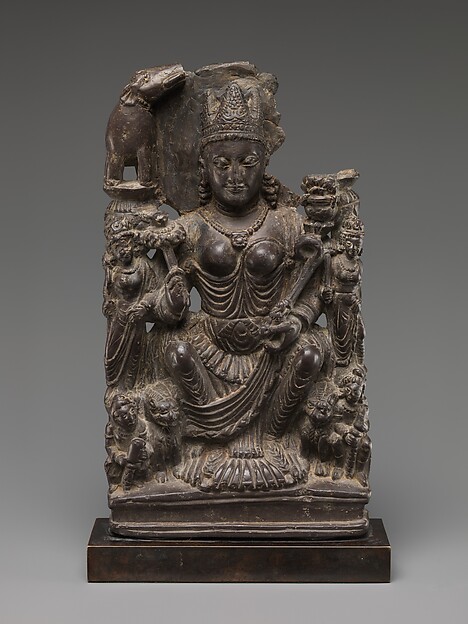
India (Kashmir), 6th century. Stone; H. 25.1 cm. Metropolitan Museum of Art, 1993.194.
Look closer: Note the elephant at upper left, the lotus seat and the small attendants beside her.
The Metropolitan Museum of Art, Purchase, Mrs. Arthur Hays Sulzberger Gift and funds from various donors, 1993. Open Access.
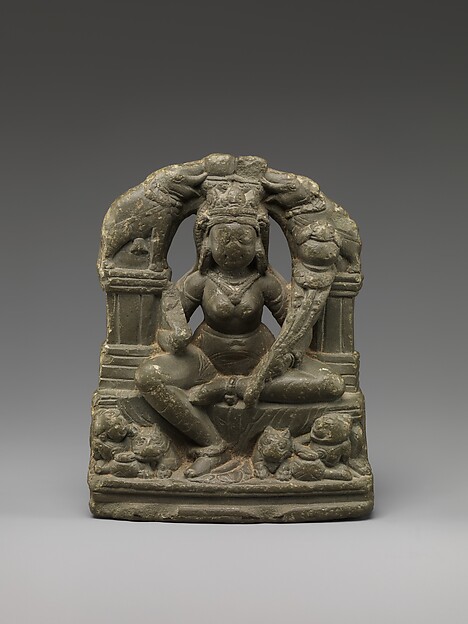
India (Kashmir), 8th century. Stone; H. 12.9 cm. Metropolitan Museum of Art, 1991.407.2.
Look closer: Note the two elephants forming an arch above her crown.
The Metropolitan Museum of Art, Gift of Bette-Ann and William Spielman, 1991. Open Access.
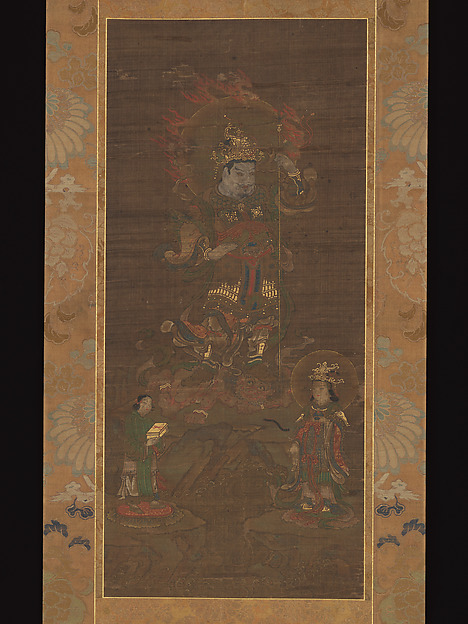
Japan, 15th to 16th century. Hanging scroll; ink, colour and gold on silk; image 83.4 x 37.5 cm. Metropolitan Museum of Art, 2018.76.
Look closer: Note the crowned lady in layered robes at lower right, balanced by the boy at lower left.
The Metropolitan Museum of Art, Purchase, Gift of Chester Holcombe and Anonymous Gift, by exchange, and funds from various donors, 2018. Open Access.
In the house
No piece carries a Kichijōten tag today, so this strip shows the Seven Lucky Gods pieces she is sometimes counted among. It refills from what is available now.
A short glossary
- Kichijōten (吉祥天)
- The goddess of good fortune, the Japanese form of Lakṣmī.
- Kudokuten (功徳天)
- 'Heavenly being of merit', another name for the same goddess.
- Śrī (श्री)
- The Sanskrit name of the goddess, from which Śrī-Mahādevī and Mahāśrī are formed.
- Nyoi hōju (如意宝珠)
- The wish-granting jewel in her left hand.
- Kisshō keka (吉祥悔過)
- The New Year rite of repentance at which her image was the chief object of worship.
- Konkōmyō saishōōkyō (金光明最勝王経)
- The Golden Light Sutra, in which she appears.
- Hibutsu (秘仏)
- A hidden image shown only at set times, as at Jōruri-ji.
- Kirikane (截金)
- Cut-gold decoration on a Buddhist image.
- Gaja Lakṣmī
- Lakṣmī flanked by elephants who pour water over her.
- Vasudhārā
- The Buddhist goddess of abundance in Nepal and South-East Asia.
- Basūsen (婆藪仙)
- An ascetic who stands beside Kichijōten and Senju Kannon in the Taizōkai mandara.
- Myōken (妙見)
- The deity of the Pole Star whom the Jimon branch equates with Kichijōten.
- Segan-in (施願印)
- The mudra of charity, the open palm facing down.
- Yogan-in (与願印)
- A name for the same open-palm gesture used by JAANUS.
- Chinju (鎮守)
- A local guardian deity of a temple, a role the portrait filled at Yakushi-ji.
Answered plainly
Who is Kichijōten?
A Buddhist goddess of fortune, beauty and fertility, the Japanese form of the Indian Lakshmi (JAANUS).
How do I tell her from Benzaiten?
By the jewel in her left hand; Benzaiten is the one with the biwa (JAANUS).
What is the Yakushi-ji painting?
A National Treasure of about 771, colour on hemp cloth, measuring 53.0 by 31.7 centimetres (Japanese Wiki Corpus).
Is she related to Bishamonten?
She is called his sister in China and Japan (Wikipedia), and a sister of his wife Kariteimo in JAANUS.
Is she one of the Seven Lucky Gods?
Sometimes, replacing Jurōjin or Fukurokuju in some lists (Wikipedia).
What is the kisshō keka?
A New Year ceremony for welcoming good luck and sweeping out bad, with her image as the principal object of worship (JAANUS).
What is the oldest Kichijōten in Japan?
JAANUS names images of 746 at Tōdaiji and 748 at Hōryūji, and the Yakushi-ji painting of about 771 survives (JAANUS, Japanese Wiki Corpus).
Where can I see the Jōruri-ji statue?
Jōruri-ji in Kyoto Prefecture, where the 90-centimetre figure is a hidden image shown only at certain periods (Wikipedia).
What does her name mean?
Kichijōten means 'heavenly being of good omen' and Kudokuten 'heavenly being of merit' (JAANUS, Wikipedia).
Is Kichijōten the same as Lakshmi?
Yes: JAANUS calls her originally a Brahmanic goddess of fertility, wealth and beauty and the chief consort of Vishnu (JAANUS).
Who is Myōken?
A deity of the Pole Star whom the Jimon branch of Tendai equates with Kichijōten (On-Mark).
Where next
Sources and image credits
- JAANUS, Kichijōten 吉祥天 (Columbia University)
- Wikipedia, Kichijōten
- Yakushi-ji, Kichijō Tennyo-zō (official page)
- Japanese Wiki Corpus, Yakushiji Kichijoten zo
- Metropolitan Museum of Art, Gaja Lakshmi (1993.194)
- Metropolitan Museum of Art, Gaja Lakshmi (1991.407.2)
- Metropolitan Museum of Art, Mount Kurama Mandala: Bishamonten Triad (2018.76)
- On-Mark Productions, Kichijōten
- Wikipedia, Jōruri-ji
- Wikipedia, Lakshmi
- Metropolitan Museum of Art, Goddess who bestows riches, probably Sri Lakshmi (1990.281)
- Metropolitan Museum of Art, Gaja Lakshmi, Goddess of Fortune (1989.236.4)
- Cleveland Museum of Art, Vasudhara, Goddess of Abundance (1947.493)
- Metropolitan Museum of Art, Vasudhara (1983.547)
- Metropolitan Museum of Art, Lakshmi, Goddess of Prosperity (2014.60)
- Metropolitan Museum of Art, Seated Shri-Devi (1987.142.219)
Last reviewed 28 October 2026. Pictures are public-domain or openly licensed, each credited beneath it. Diagrams on this page are drawn by Japonista.
Looking for a Kichijōten or Lakshmi figure, scroll or print? Tell the concierge desk what you have in mind and we will search Japan for it.
Private concierge
Looking for something in particular?
Describe the piece or the project you have in mind. A senior advisor in Tokyo reads every case file personally and replies within two business days, with fees set out in writing before any work begins.