
Bishamonten
Guardian of the North
Bishamonten
毘沙門天
An armoured god with a tiny pagoda in one hand: the Indian lord of wealth who became the northern Heavenly King, the patron of a Sengoku warlord's banner, the hero of a twelfth-century scroll and, in time, a bringer of good fortune.
Identity card
Know the figure at a glance
- A helmeted warrior. He wears Chinese-style armour and a crown or helmet, as in the Met's twelfth-century figure.
- The pagoda. A small pagoda (hōtō) rests on one hand. Mark Schumacher, cited by Buddhistdoor, reads the left hand as Bishamonten and the right as Tamonten.
- The halberd. The other hand grips a trident-halberd (sansageki) or a baton (JAANUS). The diagram draws a spear.
- Flames behind. The Kurama mandala shows a ring of flames behind the figure.
- On a demon. He stands on one or two jaki, the demons he subdues (JAANUS). The diagram shows one.
One god, two names
In Japan the same figure carries two names, and the name tells you where he stands. The Japan Architecture and Art Net Users System (JAANUS) explains that he is called Tamonten when he is one of the four Heavenly Kings (Shitennō), guarding the north, and Bishamonten when he is worshipped alone or counted among the Twelve Devas. The Sanskrit behind both is Vaiśravaṇa, which JAANUS gives as one of the epithets of Kuvera, the Indian god of wealth and ruler of the north, leader of the yasha and rasetsu.
The Buddhistdoor feature on his iconography adds the structure above him. Devas rank below buddhas, bodhisattvas and the Wisdom Kings. Among the four Heavenly Kings, Tamonten is the chief when Taishakuten is absent. He descends from Kubera, who was imagined as portly, holding a pomegranate or a money sack beside a mongoose. The Japanese image, in Chinese-style armour, is a long way from that portly figure.
The Wikipedia article on Vaiśravaṇa gives the family tree behind both names. The Sanskrit name is linked to the epithet 'son of Viśravas'; the same figure is Kubera and Jambhala in Sanskrit and Kuvera in Pali, and the article suggests a non-Vedic origin, as a spirit or goblin tied to the earth who later became a benevolent leader of the Guhyakas and yakṣas and guardian of the north. In Japan the Tamonten reading is explained by the Chinese translation of the name, 'one who hears much', and the Japanese Wiki Corpus adds that it can be read as 'a man who listens very well'. The same Corpus summary is blunt about the change of job that followed. In India he was a god of treasure and was hardly drawn as a warrior; it was on the road through Central Asia to China that the faith in him as a war god developed.
That change of job is the key to everything on this page. The figure who stands on a demon in a Kamakura carving, who rides in front of a sixteenth-century army and who sits with a laughing fisherman in a New Year print is one god seen in three lights: a king of the north, a captain of soldiers and a keeper of a treasure house. The rest of the chapter follows him through those three roles in turn.
Kubera, the treasure king
To meet Bishamonten at the start of his journey you have to go back to the Pali scriptures. The Wikipedia article on Vaiśravaṇa says that in the Theravāda canon he is Vessavaṇa, one of the four great kings who rule the quarters of the world; he governs the north, including the land of Uttarakuru, and his city is Ālakamandā. He is not a distant figure. The article records that he became a follower of the Buddha and presented the Āṭānāṭā verses, an early form of protective chanting, and that early worship centred on tree shrines where people prayed for children.
The Tibetan record shows what the Indian wealth god looked like when he travelled north rather than east. The Wikipedia article describes the Tibetan Vaiśravaṇa as a lokapāla and dharmapāla in the retinue of Ratnasambhava and king of the north, often painted on the walls outside a temple's main door, shown with a citron and riding a snow lion; Tibetan Buddhists, it says, see his wealth as a way of freeing practitioners to concentrate on the path. The Japanese Wiki Corpus adds that the Tibetan image has a mongoose that spits out gold, silver and jewels. In Japan the mongoose never arrived. Its place was taken by the pagoda, which JAANUS reads as a treasure house that the god both guards and gives away.
Two works in the Metropolitan Museum let you compare the Indian and Tibetan face of the god with the Japanese warrior. The first is a fifteenth-century Tibetan painting on cloth, 81.3 by 73.9 centimetres, titled Vaishravana, the Guardian of Buddhism and Protector of Riches. A central figure with a green aureole is ringed by dozens of smaller figures, a mandala-like crowd that the Met's title identifies as the court of the wealth god. The second is a small nineteenth-century brass figure from Mongolia or China, 9.8 centimetres tall, whose Met title is Vaishravana as Kubera; it is seated with one knee raised and a small animal at his lap, and it keeps the plump wealth-giver of the Indian type that Japan replaced with the soldier.
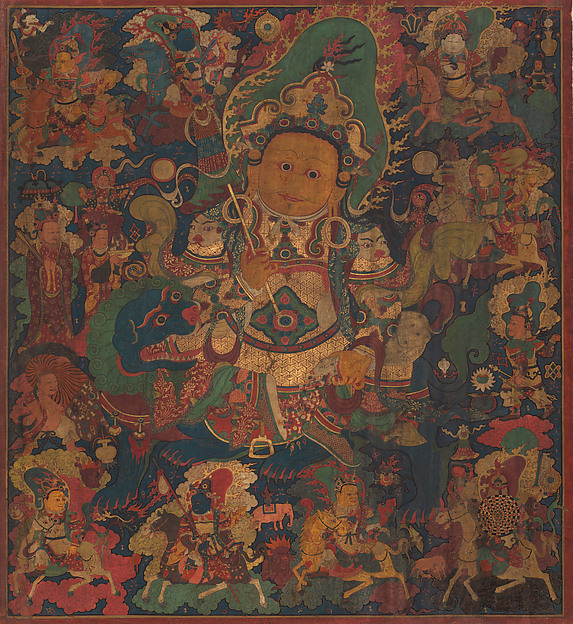
Tibet, 15th century. Distemper on cloth; 81.3 cm. Metropolitan Museum of Art, 2021.290.
Look closer: Note how the central king is surrounded by a crowd of attendants and offerings, a picture of wealth as a court, where the Japanese image isolates the soldier.
The Metropolitan Museum of Art, Purchase, Gift of Florence and Herbert Irving, by exchange, 2021. Open Access.
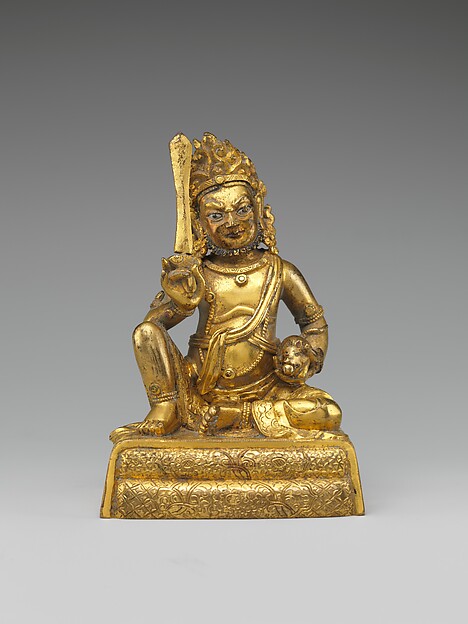
Mongolia or China, 19th century. Brass with traces of pigment, lost-wax cast; 9.8 cm. Metropolitan Museum of Art, 2006.129.
Look closer: Note the small animal at the lap, the mongoose of the Tibetan type that spits out jewels, an attribute that never crossed the sea to Japan.
The Metropolitan Museum of Art, Purchase, Friends of Asian Art Gifts, 2006. Open Access.
Armour, pagoda and demon
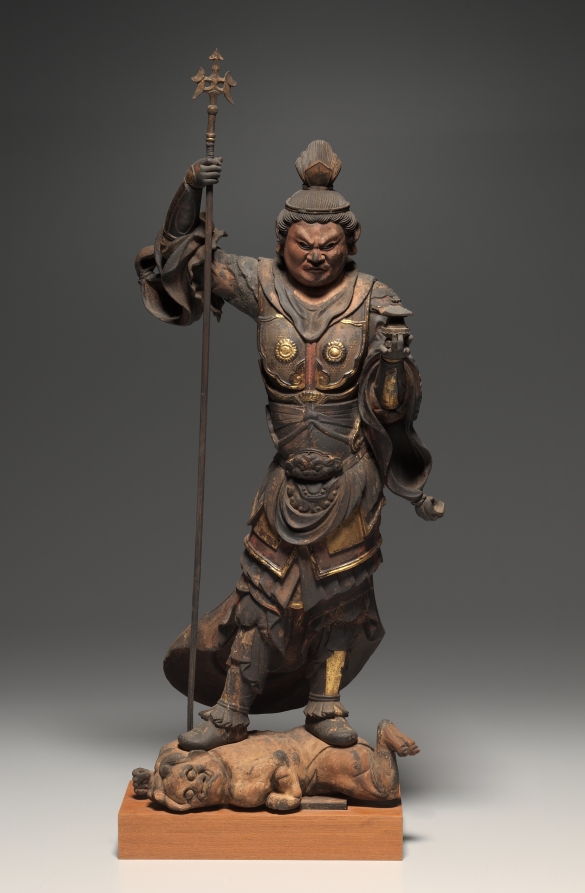
Japan, Kamakura period (1185–1333). Wood with gold polychromy; 76.8 x 28.6 cm. Cleveland Museum of Art, 1959.135.
Look closer: Note the staff held vertically in the raised hand and the small crouching demon under the foot, the two clues that point to Bishamonten.
Cleveland Museum of Art, James Parmelee and Cornelia Blakemore Warner Funds. Open Access (CC0).
JAANUS describes the standard image: a warrior in armour, a hōtō pagoda in one hand and in the other a sansageki, a trident-halberd, or a hōbō, a baton. He stands on one or two jaki, the small demons he treads down. He is often shown with his wife Kichijōten and the youth Zennishi Dōji; Buddhistdoor notes that the two are usually read as wife and son.
The twelfth-century wooden figure in the Metropolitan Museum shows the type at a small scale. A helmeted, scowling figure in layered armour stands on a rocky base, one hand raised and holding a tall staff that ends in a pointed finial with trailing ribbons. The figure is 55.1 centimetres high, made of wood with colour, gold leaf and lacquer.
The Japanese Wiki Corpus is useful because it shows how much the standard image varies from temple to temple. It names his sanmayagyō, the symbolic emblem used in the mandalas, as a treasure club and a pagoda, gives his seed syllable as vai and his mantra as On Beishiramanayasowaka, and records that in the Ryōkai mandala he holds the club in the right hand and the pagoda in the left, in armour. At the Tōdai-ji Kaidan-in the hands are reversed, with the pagoda in the right and the club in the left; at Taima-dera in Nara the pagoda is again in the right hand; at Mimuroto-ji in Kyoto he holds a trident with the other hand on his hip and no pagoda at all. So the rule about the left and right hand is a guide to the common types and not a law. When two sources disagree, as they do here, the safest practice is to record the hand, the object and the temple together.
The Cleveland Museum of Art's Guardian King of the North, of the Kamakura period (1185 to 1333), shows the type at a convenient height. A wooden figure with gold polychromy, 76.8 centimetres tall, it stands in armour on a small crouching figure with a long staff in one hand, and the base beneath its feet carries the jaki. It is the best photograph to study before looking at the Met's twelfth-century figure further down the page.
| Element | What it is | Source |
|---|---|---|
| Armour | Chinese-style, a warrior's dress | Buddhistdoor |
| Pagoda (hōtō) | Held in one hand | JAANUS |
| Sansageki or hōbō | Trident-halberd or baton in the other hand | JAANUS |
| Jaki | One or two demons beneath his feet | JAANUS |
| Kichijōten and Zennishi | Wife and attendant youth in a triad | JAANUS |
The god held up by a goddess
One form stands apart. JAANUS describes Tobatsu Bishamonten as the version that rests on the earth goddess Jiten, the Sanskrit Pṛthivī. Buddhistdoor adds that the armour is tighter and that Jiten is flanked by two demons, Niranba and Biranba.
The Met owns a zelkova-wood example of the late tenth or early eleventh century. A figure with one arm raised, in armour and a tall crown, stands on a small seated figure with a smaller head at each side. It is 125.1 centimetres high.
The form has a story, and JAANUS is careful to call it unproven. The Sōkōsōden says that in 742 Tibet attacked the city of Kizil, that the monk Amoghavajra prayed to Bishamonten, that Kōmyō Daiō appeared and that the enemy was defeated. JAANUS reports that the Tōji image, a Tang-dynasty work, is said to have come in the early Heian period, traditionally by way of Kūkai (774 to 835), and that the Tōhōki records it first standing at the Rajōmon gate. The Seiryōji Tobatsu is a late Heian copy. At Narushima Bishamondō in Iwate an early Heian sculpture almost four metres tall is thought to follow a lost sculpture on Mt Hiei.
| Image | What JAANUS or the Met records |
|---|---|
| Tōji | A Tang image, said to be early Heian and traditionally linked to Kūkai |
| Seiryōji | A late Heian copy of the Tobatsu type |
| Narushima Bishamondō, Iwate | An early Heian sculpture nearly four metres tall |
| Metropolitan Museum | Zelkova wood, late 10th to early 11th century, 125.1 cm |
A general in Chinese armour

Unidentified artist, China (?), 16th century. Framed painting; ink and color on paper; 84.5 x 42.5 cm. Metropolitan Museum of Art, 19.103.3.
Look closer: Note the clouds under the feet and the streaming sashes: the guardian moves through the air, a Chinese way of showing a heavenly king that Japanese sculptors replaced with a firm stance on a demon.
The Metropolitan Museum of Art, Rogers Fund, 1919. Open Access.
The Wikipedia article gives the Chinese picture in plain terms. He is Píshāméntiān, a warrior god and protector of the north, one of the Four Heavenly Kings and one of the Twenty or Twenty-Four Devas, usually enshrined in the Hall of the Heavenly Kings at a temple's entrance. In Chinese iconography the pagoda is in his right hand and the trident in his left. The article adds that Taoist belief merged him with Li Jing, a Tang general who carries a pagoda, and that Tantric sutras said to be by Amoghavajra celebrated him as a military and personal protector.
The Japanese Wiki Corpus fills in the detail. It says that in China he merged with Li Jing (read Risei in Japanese), a Tang warrior revered as a war god, creating a figure called Takutōri-tennō, who in Daoist belief became the father of Nezha in the novel Journey to the West and appears as Li Jing in Fengshen yanyi. It also records a Chinese folk form with a green face, an umbrella in the right hand and a silver mouse in the left. The Japanese-style Tamonten is therefore the descendant of a Tang military guardian, in leather armour, not of the plump Indian treasure king.
The same Corpus preserves a legend of the Silk Road: Bishamonten is said to have appeared with the Tobatsu figure in a western country called Tobatsu, now thought to be Turfan. JAANUS, as the section above reports, tells the better-known version in which Amoghavajra prays to him during a Tibetan attack on Kizil. Both accounts agree on the point that matters for the image. The god of the pagoda was a frontier god, a guardian called upon when an army stood on the edge of the known world.
A sixteenth-century Chinese painting in the Met, catalogued as Vaisravana, Guardian of the North and given a cautious attribution to China, shows the type in motion. A helmeted, bearded warrior in billowing sashes strides over clouds, framed in a decorated border. The Met's record does not carry a description of the iconography, so the details below are read from the picture alone.
From Asuka to the hills of Kurama

Japan, late 11th–early 12th century. Painted wood, ichiboku technique; 106.7 cm. Metropolitan Museum of Art, 1974.76.
Look closer: Note how much character survives in the torso alone: the pulled-in waist, the heavy belt and the shift of weight that tells you this was a standing guardian.
The Metropolitan Museum of Art, Gift of Mary Griggs Burke, 1974. Open Access.
Buddhistdoor reports that worship of the Heavenly Kings reached Japan in the Asuka period and grew popular in the Heian. JAANUS names the oldest Tamonten as the one in the Hōryūji Kondō, from the mid-seventh-century group of the four kings. It also records that images of Bishamonten as a god in his own right date from the Heian period, and that he has a clear role at Kuramadera, a temple built to protect northern Kyoto.
The late Heian Shigisan engi emaki, a scroll of the temple's legends, shows him as the main image on Mt Shigi. By the Muromachi period, JAANUS says, he had become a deity of good fortune, and in the Edo period he became one of the Seven Lucky Gods.
The Japanese Wiki Corpus lists the standard groupings in which a visitor will meet him. At Kurama Temple in Kyoto and at Sekkei-ji in Kōchi he stands in a triad with Kichijōten and Zennishi Dōji; in the Hōryū-ji Kondō he stands with Kichijōten as a pair; at Kōyasan's Kongōbu-ji he is paired with Fudō Myōō; and in Tendai temples such as Myōō-in in Shiga and Bujō-ji in Kyoto a Senju Kannon sits at the centre with Bishamonten and Fudō Myōō at the sides. National-level Tamonten images are recorded at the Tōdai-ji Kaidan-in, Jōruri-ji in Kyoto and Kōfuku-ji in Nara.
A twelfth-century fragment in the Metropolitan Museum shows how much of the Nara and Heian record survives only in pieces. Its 'One of the Four Heavenly Kings' is a painted wooden torso of the late eleventh or early twelfth century, 106.7 centimetres tall, carved in the ichiboku technique, in which the figure is cut from a single block. The arms are gone and the head is badly worn. What remains is the swelling chest, the broad belt and the twist of the hip that give a guardian king his weight.
| Date | Image or event (JAANUS) |
|---|---|
| Mid-7th century | The Tamonten of the Hōryūji Kondō, Japan's oldest |
| 1078 | An image in the Hōryūji Kondō |
| 1162 | A sculpture of the Kawabata family for Nakagawadera, with printed cloth sheets among its dedicatory materials |
| 1178 | A helmeted image at Hagaji, Fukui |
| c. 1225 | Tankei's set of Bishamonten, Zennishi and Kichijōten |
Mount Kurama in silk
The Met's hanging scroll of the fifteenth or sixteenth century is titled Mount Kurama Mandala: Bishamonten Triad. Bishamonten stands in the upper centre, armoured and crowned, with flames rising behind him and a staff in his hand. Below him a youth with a box stands on one side, and on the other a crowned woman in a long robe with a halo. These are the companions that JAANUS names, the youth Zennishi and the goddess Kichijōten. The Met's own title identifies the group as a triad.
A rocky landscape runs along the bottom of the silk. The scroll is 83.4 by 37.5 centimetres in the painted area.
The temple behind the mandala is Kurama-dera, in the far north of Kyoto. The Wikipedia article on it gives the address as Kurama Honmachi in Sakyō ward, calls the setting secluded wilderness at the foot of Mount Kurama and notes that the temple has its own cable car. It gives the founder as Jianzhen (鑑禎), with the completion date marked '770?', and says the origins are historically unclear. It adds that a disciple of the Chinese monk Jianzhen is said to have dreamed in 772 that the mountain had spiritual power, and built an esoteric temple to contain it. The temple burned many times in the medieval period, and the article says the statues and treasures were always saved.
Its worship history is unusual. The article says the temple belonged to the Tendai sect and was subordinate to Shōren-in from the twelfth century until 1949, and that its original objects of worship were Bishamonten, protector of the north, and the thousand-armed Kannon. In 1949 the abbot, Kōun Shigaraki, founded a religious body of his own and separated the temple from Buddhism; the present leadership added a third figure, the Defender Lord, to make a trinity of three 'Spiritual Kings'. The article says the actual worship images are normally hidden, with replicas shown in the main building. The Shinto shrine Yuki-jinja, founded in 940, stands in the grounds. A visitor who wants the Heian Bishamonten should therefore ask the temple which images are on view in a given season; this page has not found a source for current viewing dates and does not guess.
Six at a time
The Met holds a small woodblock print, 21.6 by 13.5 centimetres, dated 1162 and titled Bishamonten. It repeats one armoured figure six times, in two rows of three, each in a nimbus of flames and standing on a low base. A printed sheet of this kind is a reminder that images of the god were multiplied, not only carved singly. JAANUS separately records that the dedicatory materials of a 1162 sculpture for Nakagawadera included printed cloth sheets, and the two facts are given here side by side without further claim.
The tiger, the monk and the flying granary
Mount Shigi, in Ikoma District in Nara Prefecture, is the cradle of the Japanese faith in Bishamonten. The Wikipedia article on the mountain records the legend: Prince Shōtoku prayed for victory over Mononobe no Moriya at the mountain, Bishamonten appeared in the year, the hour and the day of the Tiger and helped him win, and the prince built a shrine in his honour. The article gives no founding year for the temple, and neither does this page. Yokai.jp, a Japanese folklore site, adds that the campaign was in 587, that Shōtoku received a secret treasure of victory, and that the temple holds a grand memorial service every Year of the Tiger; this page carries those as the site's account of temple tradition and not as established history.
The mountain's second claim to fame is a monk. The Wikipedia article on the Shigisan engi emaki says that Myōren was a Buddhist monk who lived on Mount Shigi in Yamato Province at the end of the ninth century, dedicated to Bishamonten, and that he died around 937 to 941; a short autobiography dated 937 records his life. A legend says that during a retreat at Hōryū-ji a dream sent him to the mountain, guided by a purple cloud.
The scroll that tells his story is one of the great works of Japanese painting. The article dates it to the second half of the twelfth century, probably between 1157 and 1180, because the Great Buddha of Tōdai-ji, which burned in 1180, is shown intact in the third scroll. The traditional attribution to the monk Kakuyū, known as Toba Sōjō, is rejected, since he died in 1140; the artist and the patron remain unknown. It is a narrative handscroll of ink and colour on paper, in three surviving rolls, 31.7 centimetres high and 878, 1,276 and 1,417 centimetres long respectively. A fourth scroll, the Taishi gun no maki, is recorded as lost. The scrolls are owned by Chōgosonshi-ji and housed at the Nara National Museum; they were designated a National Treasure on 9 June 1951, and all three were shown fully unrolled for the first time in a 2016 exhibition.
Each scroll tells one story. In the first, the Flying Granary, Myōren sends his alms bowl each day to a rich farmer's house for rice. When the farmer refuses, the bowl lifts the whole storehouse into the air and carries it to the mountain, and the sacks of rice later fly back to the village; the first scroll's text is lost, so it is read from the pictures. In the second, Emperor Daigo falls ill and Myōren cures him by prayer without leaving the mountain; a messenger deity sent by Bishamonten, Ken-no-Gohō, flies to the palace with a wheel of the law. In the third, Myōren's elder sister searches for him for twenty years, is guided by the Great Buddha of Tōdai-ji in dreams and by a purple cloud, and is reunited with her brother on the mountain.
The painting is as notable as the stories. The article describes the style as otoko-e, 'men's pictures', a branch of Yamato-e that prefers lively outdoor scenes and everyday life to courtly interiors. The composition runs continuously, with scenes joined by mist and quiet landscape; the lines in ink are the backbone, with pale watery colours; faces are expressive, almost caricatured; and the artist shows time passing by repeating the same figure in one scene, as the nun appears more than once at Tōdai-ji. For scholars it is also a record of rural life, buildings and the Kisoji trade route. Bishamonten himself does not appear as a statue in these scenes; he works through the bowl, the messenger and the mountain.
The banner with one character
No warlord is more closely tied to Bishamonten than Uesugi Kenshin, who lived from 1530 to 1578. The Wikipedia article on him says that Kenshin believed in Bishamonten, the Buddhist god of war, and that many followers held him to be an avatar of the god, calling him Bishamonten no keshin. It records that his war banners included one bearing the first character of the god's name, that he prayed at a Bishamonten shrine before leaving for battle, and that followers called him the God of War and described him as undefeated in over fifty open battles. Yokai.jp names the banner's character as 毘, and the same site says Kenshin worshipped at the Bishamon Hall at Kasugayama Castle in the present Jōetsu City, Niigata, and that he was born in a Year of the Tiger, the god's animal.
The article gives the main dates of his fighting. He became head of the Nagao clan at nineteen and entered Kasugayama Castle; five engagements are recorded at Kawanakajima, in 1553, 1555, 1557, 1561 and 1564, with the fourth, in 1561, the largest and costliest, its result still debated. He died on 19 April 1578, aged forty-eight, of what the article calls esophageal cancer, though it notes a speculative theory of assassination that it considers less likely. He vowed to become a Zen Buddhist and took the name Kenshin after the vow, having studied from the age of seven to fourteen at Rinsen-ji.
Two nineteenth-century triptychs in the Metropolitan Museum show how Edo printmakers remembered him. Utagawa Yoshitsuna's The Fourth Battle at Kawanakajima, of about 1847 to 1852, shows horsemen splashing through a river; Utagawa Yoshitora's Nagao Kagetora Attacking Nagao Harukage, of the same years, uses Kenshin's earlier name, Nagao Kagetora, and shows an assault on a castle. Each is 35.4 by 25.1 centimetres per sheet. Neither print shows Bishamonten, and neither claims to; they are included as the visual language in which the age of Kenshin was handed down to Edo readers.

Utagawa Yoshitsuna, Japan, ca. 1847–52. Triptych of woodblock prints; ink and color on paper; 35.4 × 25.1 cm. Metropolitan Museum of Art, JP1115.7a–c.
Look closer: Note the river that fills the whole width of the triptych: the battle is staged across three sheets so that the water runs on without a break.
The Metropolitan Museum of Art, Gift of Harold de Raasloff, 1918. Open Access.
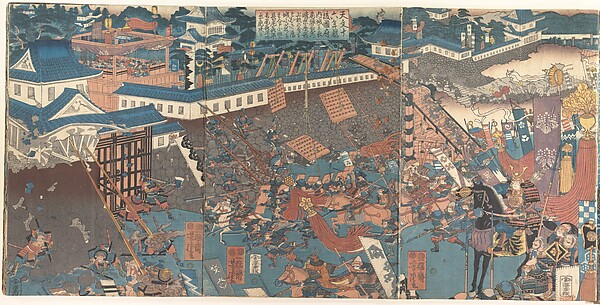
Utagawa Yoshitora, Japan, 1847–52. Triptych of woodblock prints (nishiki-e); ink and color on paper; 35.4 × 25.1 cm. Metropolitan Museum of Art, JP1115.8a–c.
Look closer: Note the gateway and the packed courtyard: the artist uses architecture to divide the attackers from the defenders across the three sheets.
The Metropolitan Museum of Art, Gift of Harold de Raasloff, 1918. Open Access.
Where his name hangs on the gate
Two urban temples carry the god's name on the gate. The first is Bishamondō Monzeki in Yamashina, Kyoto. Its own English page says it is a Tendai temple whose principal image is Bishamonten, built by order of Emperor Monmu in 703 and first placed at Izumoji Bridge, north of the Kyoto Gosho, under the name Izumoji Temple on Mount Gohō. After repeated wars it was rebuilt at Yamashina in 1665, the year in which the Niōmon gate was also rebuilt. The statue is said to have been carved by Saichō, founder of the Tendai sect, from surplus wood left over from the Yakushi Nyorai at Enryaku-ji's Konpon Chūdō. The Shinden, the former residence of Emperor Gosai in the Kyoto Gosho, was moved to the temple in 1693 by Prince Kōben, and the temple has an Edo-period circuit garden, Bansuien, with stones named for a tortoise, a plover and a meditating monk.
The second is Zenkoku-ji, known as Kagurazaka Bishamonten, in Tokyo. The Go Tokyo visitor page says it was first built in 1595 and credits Tokugawa Ieyasu as founder; about two centuries later, the page says, it moved from Shinjuku ward to its present site in Kagurazaka. It holds a bean-throwing festival on 3 February to drive out evil spirits, opens from 9:00 to 17:00 and is five minutes' walk from Exit B3 at Iidabashi Station. Check the temple's current notice before travelling, since the page tells visitors to confirm times on the official website.
| Temple | Place | What the sources record |
|---|---|---|
| Chōgosonshi-ji | Mount Shigi, Nara | The legend of the Tiger day and the home of the Shigisan engi scrolls (Wikipedia) |
| Kurama-dera | Kyoto | Bishamonten as original principal image; Tendai until 1949 (Wikipedia) |
| Bishamondō Monzeki | Yamashina, Kyoto | Tendai monzeki; founded 703, rebuilt 1665 (temple's own page) |
| Zenkoku-ji | Kagurazaka, Tokyo | First built 1595; bean-throwing festival on 3 February (Go Tokyo) |
| Hōryū-ji Kondō | Nara | Oldest Tamonten, with Kichijōten as a pair (JAANUS, Japanese Wiki Corpus) |
Seven friends in a treasure ship
The soldier in armour is the odd man out among the Seven Lucky Gods. The Japanese Wiki Corpus says that in Japan he is one of the seven deities of good fortune and is especially revered for benefiting games; JAANUS dates his rise as a luck-giver to the Muromachi period and his place among the seven to the Edo period. Yokai.jp places the formation of the group in the late Muromachi and the pilgrimages and treasure-ship paintings in the Edo period, and says the five or six 'stages' of the god's transformation are given differently in different parts of the site, a warning that a neat chronology of the faith is easier to draw than to prove.
The Met holds two Edo pictures of the group. Nagasawa Roshū's Seven Gods of Good Fortune, dated 1837, is a hanging scroll in ink and colour on silk, 88.6 by 35.9 centimetres, which crowds the gods together in a tall composition. Katsushika Hokusai's Seven Gods of Good Fortune, a surimono of 1808 to 1827, is a privately issued print with poems that shows the seven in a laughing huddle. In both pictures Bishamonten is the one who keeps his armour; his companions have shed theirs. Look for the helmet and the pagoda and you will find him at once.
A caution about the Seven Lucky Gods belongs here. Each of the others has its own source, and the group was assembled from Indian, Chinese and Japanese figures. Our chapter on the seven gods tells that story; this page notes only that the god of war took his place among them as a guardian of treasure, which brings the figure of the pagoda back to its first meaning.
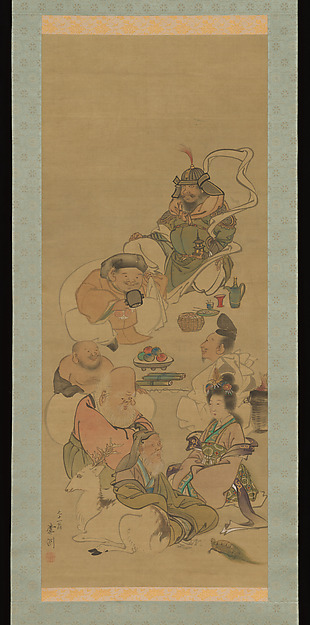
Nagasawa Roshū, Japan, 1837. Hanging scroll; ink and color on silk; 88.6 x 35.9 cm. Metropolitan Museum of Art, 2000.214.
Look closer: Note the one figure who still wears armour among the rest: the group is arranged as a crowd, and the warrior is the clue to Bishamonten.
The Metropolitan Museum of Art, Anonymous Gift, 2000. Open Access.
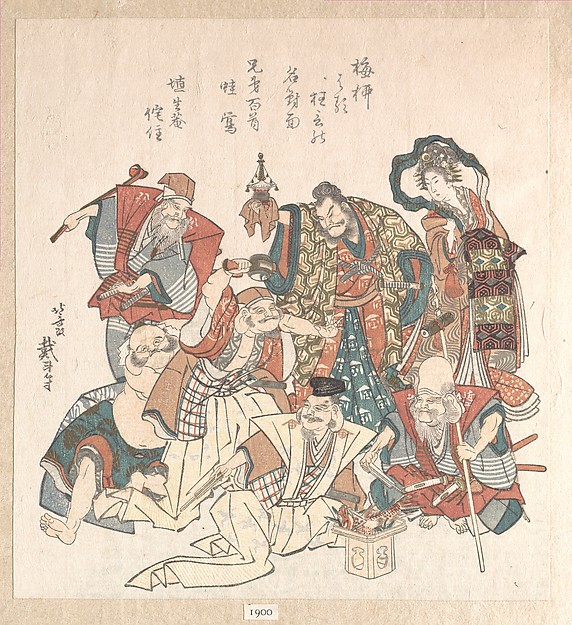
Katsushika Hokusai, Japan, 1808–27. Woodblock print (surimono); ink and color on paper; 21 x 19.1 cm. Metropolitan Museum of Art, JP1900.
Look closer: Note the lines of poetry at the upper right: a surimono was made for private circulation, and the verses explain the picture to those who received it.
The Metropolitan Museum of Art, H. O. Havemeyer Collection, Bequest of Mrs. H. O. Havemeyer, 1929. Open Access.
What a warrior wore
Buddhistdoor, cited above, says the Japanese Bishamonten wears Chinese-style armour, and the Japanese Wiki Corpus calls it the leather armour of the Tang. The Japanese armour of the same long period was another thing, and two Met objects show it. The first is an armour of yoroi type, of the early fourteenth to early fifteenth century, made of iron, leather, lacquer, silk and gilt copper, 69.9 centimetres high, with a helmet carrying a pair of tall gilt horns. The second is a helmet bowl of the seventeenth or eighteenth century in iron, lacquer, gilding and paint, 38.1 centimetres high, shaped like a tall black cap with a human face moulded into the front.
Neither piece is connected with Bishamonten in the Met's records, and they are shown here as context only. They help a reader see what the sculptors of the god chose not to copy. The warrior gods of Japanese temples wear continental armour, sleek and scaled, not the laced plates of the samurai, which is one reason a carving of the god looks, to a modern eye, less like a Japanese soldier than like a visitor from the Tang court.

Japan, early 14th–early 15th century. Iron, leather, lacquer, silk, gilt copper; 69.9 cm. Metropolitan Museum of Art, 28.60.1a–s.
Look closer: Note the laced plates and the broad flared shoulder guards, quite unlike the scaled continental armour of the temple guardians.
The Metropolitan Museum of Art, Fletcher Fund, 1928. Open Access.
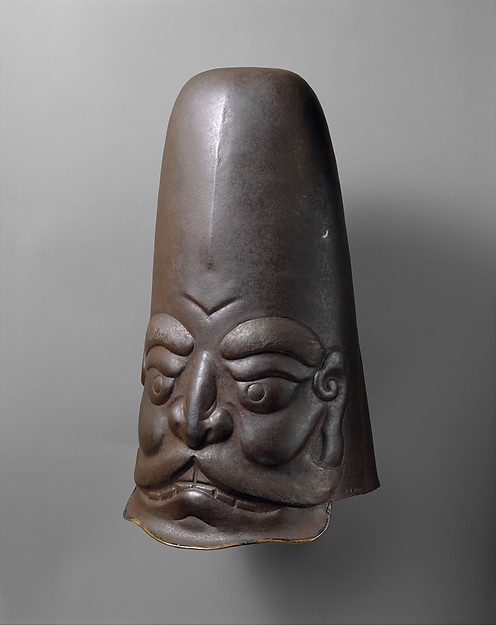
Japan, 17th–18th century. Iron, lacquer, gilding, paint; 38.1 cm. Metropolitan Museum of Art, 36.25.163.
Look closer: Note the moulded face on the helmet: a soldier took on a fierce expression as part of his armour, as the guardians do in carving.
The Metropolitan Museum of Art, Bequest of George C. Stone, 1935. Open Access.
Festival, skating rink and comic book
The god has had a busy modern life. The Wikipedia article on Vaiśravaṇa lists his appearances in popular culture. The manga Noragami, first published in 2011, shows Bishamonten as a woman with modern weapons; the 2021 manga Wind Breaker features a character, Tōma Hiragi, who is Bishamonten in black leather and chains, standing on skulls with a metal pipe; and in the Touhou Project games the tiger yōkai Shou Toramaru serves as the god's avatar and uses a jewelled pagoda to gather treasure. The article marks one further reference, in the anime Record of Ragnarok, as lacking a citation, so it is left out here. The Wikipedia disambiguation page adds the living suit of armour called Bishamon in the Darkstalkers fighting games and, in Samurai Warriors Xtreme Legends, an ultimate weapon named Bishamon used by Uesugi Kenshin.
The warlord has his own revival. The Wikipedia article on Kenshin says the Kenshin Festival in Jōetsu has been held since 1926, every August, with a procession that starts at Kasugayama Castle, and that Yuzuru Hanyu's free skate, titled Heaven and Earth, which portrayed Kenshin, was debuted in December 2020. The same article lists the NHK taiga dramas Fūrin Kazan (2007), in which the singer Gackt played Kenshin, and Tenchijin (2009), with Hiroshi Abe, and Akira Kurosawa's 1980 film Kagemusha in which he appears in a minor role.
The scroll has a modern life too. The Wikipedia article says that all three Shigisan scrolls were shown fully unrolled for the first time in a 2016 exhibition, 800-odd years after they were painted. The Nara National Museum holds them, and the temple, Chōgosonshi-ji, still owns them. Anyone planning a visit should check the museum's schedule, since this page has not found the current display dates.
Telling him from his neighbours
Look for the pagoda. A guardian king in armour who holds a small pagoda on his palm is Tamonten or Bishamonten, and the hand is the clue Schumacher offers. Look beneath the feet: one or two demons, or a goddess rising from the ground, narrow the choice further, since the goddess marks the Tobatsu type.
Look for company too. A triad with a woman and a youth is the Bishamonten family. The same figure appears in lists such as the Twelve Devas, the Seven Lucky Gods and, Buddhistdoor notes, among the twenty-eight generals who serve the thousand-armed Kannon.
Reading a figure on a shelf
For a collector the useful questions about a Bishamonten are practical. Which hand holds the pagoda, and does the figure follow the Bishamonten rule of the left hand or the Tamonten rule of the right? Is there a jaki beneath the feet, or the earth goddess of the Tobatsu type? Does the armour look Tang, with scales and a belt, or has a later carver dressed him as a samurai? The Met's twelfth-century figure and the Cleveland Kamakura figure are the standards against which to measure a wood carving; the Kurama mandala is the standard for a painting.
Material and wear matter more than age claims. A figure in wood with traces of colour and gold leaf, like the Met's, will show flaking and cracks, and the Met's fragment of the eleventh century shows that even great figures survive without their arms. Ask who made the piece, what it is carved in, whether the pagoda or the staff is original, and whether it is a temple figure or a household image. Anyone offering a piece in good faith will answer these before naming a price. If you are searching for a particular type, the concierge desk can look in Japan for the exact hand, the exact base and the exact period you have in mind.
Ten small facts
- He has two names for one face: Tamonten among the four kings, Bishamonten alone (JAANUS).
- His Sanskrit name is linked to the epithet 'son of Viśravas' (Wikipedia, Vaiśravaṇa).
- The Tibetan version carries a mongoose that spits jewels; the Japanese version holds a pagoda instead (Japanese Wiki Corpus).
- Shigisan's founding legend is tied to the Tiger: year, day and hour (Wikipedia, Mount Shigi).
- The Shigisan scrolls are 878, 1,276 and 1,417 centimetres long, and all three were shown fully unrolled together for the first time in 2016 (Wikipedia).
- A fourth scroll, the Taishi gun no maki, is recorded as lost (Wikipedia).
- Kenshin fought five times at Kawanakajima, in 1553, 1555, 1557, 1561 and 1564 (Wikipedia).
- Kurama-dera's own sect broke from Tendai in 1949 (Wikipedia).
- The Kagurazaka Bishamonten in Tokyo holds a bean-throwing festival on 3 February (Go Tokyo).
- A Tendai monzeki temple in Yamashina keeps a statue said to be carved from wood left over from the Yakushi at Enryaku-ji (Bishamondō's own page).
Across Asia
The god began as an Indian king of the north; the record below follows him to China and Japan.
| Where | Form and name | What the record shows |
|---|---|---|
| India | Kuvera; Vaiśravaṇa | God of wealth and ruler of the north, leader of the yasha and rasetsu (JAANUS). |
| China | Tang-dynasty images | The Tōji Tobatsu image is described as a Tang work (JAANUS); a mid-eighth-century story has the emperor ask Amoghavajra to appeal to him during a Tibetan attack (Buddhistdoor). |
| Japan | Bishamonten (毘沙門天); Tamonten (多聞天) | One of the Shitennō and the Twelve Devas, an independent deity from the Heian period and a Lucky God in the Edo period (JAANUS). |
| Tibet | Vaishravana, lokapāla and wealth god | Painted outside temple doors, with a citron, a mongoose and a snow lion (Wikipedia, Japanese Wiki Corpus); a fifteenth-century painting is in the Met. |
| Mongolia or China | Dou Wen Tian | A nineteenth-century brass figure in the Met is catalogued as Vaishravana as Kubera. |
| China, Daoist | Li Jing and Takutōri-tennō | A Tang general who carries a pagoda is merged with the god (Wikipedia, Japanese Wiki Corpus). |
A deva among the kings
Bishamonten belongs to the Heavenly Beings, the tenbu. He sits below the buddhas, bodhisattvas and Wisdom Kings, yet JAANUS records him worshipped on his own. Buddhistdoor reports that he was merged with Hachiman through honji suijaku.
| Companion | Why they meet |
|---|---|
| Taishakuten | Tamonten is chief of the four Heavenly Kings when Taishakuten is absent (Buddhistdoor). |
| Kichijōten | Wife in the family triad (JAANUS). |
| Zennishi Dōji | The attendant youth, usually read as a son (Buddhistdoor). |
| Hachiman | Merged with Tamonten through honji suijaku (Buddhistdoor). |
Where to see him
| Place | What to look for |
|---|---|
| Hōryūji Kondō, Nara | Japan's oldest Tamonten, from the mid-seventh-century group (JAANUS). |
| Kuramadera, Kyoto | An old centre of his worship, built to protect northern Kyoto (JAANUS). |
| Tōji, Kyoto | A Tang-dynasty Tobatsu image, traditionally brought by Kūkai (JAANUS). |
| Narushima Bishamondō, Iwate | An early Heian sculpture nearly four metres tall (JAANUS). |
| Metropolitan Museum of Art, New York | A twelfth-century figure, a Tobatsu sculpture, a Kurama mandala and a printed sheet, all in open access. |
| Chōgosonshi-ji, Mount Shigi, Nara | The founding legend of the Tiger day and the owner of the Shigisan engi scrolls (Wikipedia). |
| Nara National Museum | The Shigisan engi scrolls are housed here; check the museum's current schedule (Wikipedia). |
| Bishamondō Monzeki, Yamashina, Kyoto | A Tendai monzeki founded in 703 and rebuilt in 1665, with an Edo-period garden (temple's own page). |
| Zenkoku-ji, Kagurazaka, Tokyo | First built in 1595; a bean-throwing festival on 3 February (Go Tokyo). |
| Cleveland Museum of Art | A Kamakura-period Guardian King of the North in wood with gold polychromy, open access. |
Four images in the Metropolitan Museum

Japan, 12th century. Wood with colour, gold leaf and lacquer; figure 55.1 cm high. Metropolitan Museum of Art, 59.137.2a-c.
Look closer: Note the long staff with its pointed finial and ribbons, and the rock on which the figure stands.
The Metropolitan Museum of Art, Rogers Fund, 1959. Open Access.
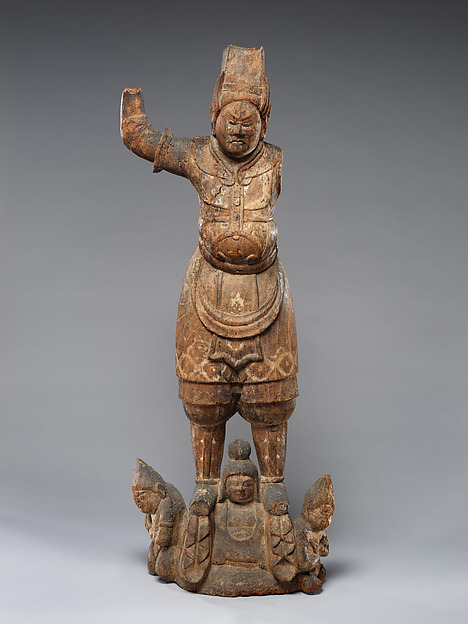
Japan, late 10th to early 11th century. Zelkova wood with traces of colour; 125.1 cm high. Metropolitan Museum of Art, 2015.300.253a, b.
Look closer: Note the small seated figure beneath his feet, the earth goddess who holds him up, between her two companions.
The Metropolitan Museum of Art, Mary Griggs Burke Collection, Gift of the Mary and Jackson Burke Foundation, 2015. Open Access.
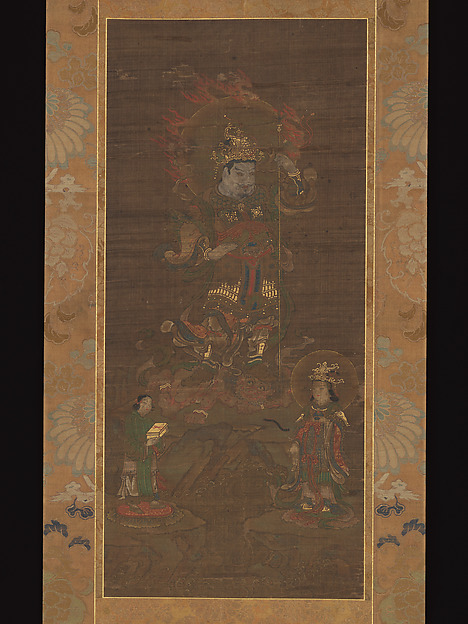
Japan, 15th to 16th century. Hanging scroll; ink, colour and gold on silk; image 83.4 x 37.5 cm. Metropolitan Museum of Art, 2018.76.
Look closer: Note how the two companions are set low and to either side, so that the eye climbs to the armoured king among the flames.
The Metropolitan Museum of Art, Purchase, Gift of Chester Holcombe and Anonymous Gift, by exchange, and funds from various donors, 2018. Open Access.

Japan, dated 1162. Woodblock print; ink on paper; 21.6 x 13.5 cm. Metropolitan Museum of Art, 1975.268.31.
Look closer: Note how one block has been struck six times, each figure standing on its own small base.
The Metropolitan Museum of Art, The Harry G. C. Packard Collection of Asian Art, Gift of Harry G. C. Packard, and Purchase, Fletcher, Rogers, Harris Brisbane Dick, and Louis V. Bell Funds, Joseph Pulitzer Bequest, and The Annenberg Fund Inc. Gift, 1975. Open Access.
In the house
These pieces come from the house's own shelves and carry the Bishamonten tag. The strip refills from what is available now.
A short glossary
- Bishamonten (毘沙門天)
- The god in his independent form, as an armoured guardian with a pagoda.
- Tamonten (多聞天)
- The same god as one of the four Heavenly Kings; the name is read as 'one who hears much'.
- Vaiśravaṇa
- The Sanskrit name, linked to the epithet 'son of Viśravas'.
- Kubera
- The Indian god of wealth from whom the figure descends.
- Hōtō (宝塔)
- The small jewelled pagoda in his hand, read as a treasure house.
- Sansageki
- A trident-halberd, one of his two weapons (JAANUS).
- Jaki
- The small demon or demons he treads on.
- Tobatsu
- The special form that stands on the earth goddess Jiten; also the western country of the legend, now thought to be Turfan.
- Jiten (地天)
- The earth goddess, Pṛthivī, who holds up the Tobatsu form.
- Kichijōten
- His wife in the family triad.
- Zennishi Dōji
- The youth who stands beside them, usually read as a son.
- Monzeki
- A temple whose abbot was traditionally of imperial or noble birth, as at Bishamondō.
- Emakimono
- A narrative handscroll, the form of the Shigisan engi.
- Otoko-e
- 'Men's pictures', the lively outdoor branch of Yamato-e in which the Shigisan scrolls were painted.
- Surimono
- A privately issued woodblock print, often with poems.
Answered plainly
Who is Bishamonten?
The Japanese form of Vaiśravaṇa, a name of the Indian wealth god Kuvera; JAANUS describes him as the ruler of the north.
Is Bishamonten the same as Tamonten?
Yes. JAANUS says he is Tamonten as one of the four Heavenly Kings and Bishamonten when worshipped alone or among the Twelve Devas.
What does he hold?
A pagoda in one hand, and a trident-halberd or baton in the other (JAANUS).
Who are the figures with him?
His wife Kichijōten and the youth Zennishi Dōji (JAANUS).
What is Tobatsu Bishamonten?
The form that stands on the earth goddess Jiten, flanked by the demons Niranba and Biranba (JAANUS, Buddhistdoor).
Is he a Lucky God?
Yes. JAANUS says he became a deity of good fortune from the Muromachi period and one of the Seven Lucky Gods in the Edo period.
Why did Uesugi Kenshin follow Bishamonten?
Wikipedia says Kenshin believed in Bishamonten as the Buddhist god of war, that followers held him to be an avatar of the god, and that his banners bore the first character of the god's name. Yokai.jp names that character as 毘.
What is the Shigisan engi emaki?
A set of three painted handscrolls of the late twelfth century about the monk Myōren, who was devoted to Bishamonten, now owned by Chōgosonshi-ji and kept at the Nara National Museum; a National Treasure since 9 June 1951 (Wikipedia).
Who is the Bishamonten of Noragami?
A woman with modern weapons in the manga first published in 2011, according to the Wikipedia article on Vaiśravaṇa; the series is fiction and takes liberties with the god.
Why does the Tibetan Vaiśravaṇa hold a mongoose?
The Japanese Wiki Corpus says the Tibetan image has a mongoose that spits out gold, silver and jewels, an attribute of the wealth god that Japan replaced with a pagoda.
Where next
Sources and image credits
- JAANUS, Bishamonten 毘沙門天 (Columbia University)
- JAANUS, Tamonten 多聞天 (Columbia University)
- Buddhistdoor, King of kings: the propagation of Bishamonten iconography
- Metropolitan Museum of Art, The Guardian King Bishamonten (59.137.2a-c)
- Metropolitan Museum of Art, Tobatsu Bishamonten (2015.300.253a, b)
- Metropolitan Museum of Art, Mount Kurama Mandala: Bishamonten Triad (2018.76)
- Metropolitan Museum of Art, Bishamonten (1975.268.31)
- Wikipedia, Vaiśravaṇa
- Wikipedia, Bishamon (disambiguation)
- Japanese Wiki Corpus, Bishamonten, Vaisravana
- Wikipedia, Shigisan Engi Emaki
- Wikipedia, Mount Shigi
- Yokai.jp, Bishamon-ten
- Yokai.jp, Shigisan Chōgosonshi-ji
- Wikipedia, Uesugi Kenshin
- Wikipedia, Kurama-dera
- Bishamondō Monzeki, official English page
- Go Tokyo, Bishamonten Zenkoku-ji Temple
- Cleveland Museum of Art, Guardian King of the North (Bishamonten) (1959.135)
- Metropolitan Museum of Art, One of the Four Heavenly Kings (1974.76)
- Metropolitan Museum of Art, Vaishravana, the Guardian of Buddhism and Protector of Riches (2021.290)
- Metropolitan Museum of Art, Vaishravana as Kubera (Dou Wen Tian) (2006.129)
- Metropolitan Museum of Art, Vaisravana, Guardian of the North (19.103.3)
- Metropolitan Museum of Art, The Fourth Battle at Kawanakajima (JP1115.7a–c)
- Metropolitan Museum of Art, Nagao Kagetora Attacking Nagao Harukage (JP1115.8a–c)
- Metropolitan Museum of Art, Seven Gods of Good Fortune (2000.214)
- Metropolitan Museum of Art, Seven Gods of Good Fortune (JP1900)
- Metropolitan Museum of Art, Armor (Yoroi) (28.60.1a–s)
- Metropolitan Museum of Art, Helmet Bowl (36.25.163)
Last reviewed 28 October 2026. Pictures are public-domain or openly licensed, each credited beneath it. Diagrams on this page are drawn by Japonista.
Looking for a guardian king figure or scroll for a home altar? Tell the concierge desk what you have in mind and we will search Japan for it.
Private concierge
Looking for something in particular?
Describe the piece or the project you have in mind. A senior advisor in Tokyo reads every case file personally and replies within two business days, with fees set out in writing before any work begins.