
Shitennō: The Four Heavenly Kings
Guardians of the Quarters
Shitennō
四天王
Four armoured kings who stand at the corners of the altar dais, one for each direction: the oldest guardians in Japanese temples, and a set that was sold off in pieces in 1906.
Identity card
Know the figure at a glance
- North: Tamonten. Vaiśravaṇa, chief of the four and known alone as Bishamonten (JAANUS; Wikipedia).
- East: Jikokuten. Dhṛtarāṣṭra, whom Wikipedia lists with a pipa and with the gandharva musicians.
- South: Zōchōten. Virūḍhaka, whom Wikipedia lists with a sword in his right hand.
- West: Kōmokuten. Virūpākṣa, the 'eye in the sky' (Wikipedia), whom the Chinese tradition pairs with a snake or red cord.
- The centre. In a hall the four stand at the corners of the dais that represents Mt Sumeru, the central mountain of the Buddhist cosmos (JAANUS).
Four kings and a mountain
The Japan Architecture and Art Net Users System (JAANUS) opens its entry with their origin. The four are pre-Buddhist Indian deities who appear in legends helping the Buddha and protecting his teaching. In Japan they are shown as martial figures in Chinese armour, and they usually stand on jaki, small demons they have trodden down.
Their place in a temple is exact. They stand at the four corners of the shumidan, the dais that carries the main image, and the dais stands for Mt Sumeru, the central mountain of the Buddhist cosmos. JAANUS explains that together the four preside over the Shitennōten, the first of the six heavens of the realm of desire, and that they protect Tōriten, the heaven above, which Taishakuten rules.
Wikipedia adds the working life of this guard. The kings serve Śakra, the lord of the devas of Trāyastriṃśa. On the eighth, fourteenth and fifteenth days of each lunar month they send emissaries, or go themselves, to inspect virtue in the human world, and they report to the assembly of Trāyastriṃśa. They guard that heaven against the asuras and have vowed to protect the Buddha, the Dharma and the Buddha's followers.
The word that organises everything below is 'quarter'. The Wikipedia article on the Four Heavenly Kings gives their collective names across Asia: Sa-cheonwang in Korean, rgyal chen bzhi, the 'four great kings', in Tibetan, and Shitennō in Japanese, with Thai, Burmese and Mongolian forms besides. In Sanskrit the devas they rule are the Cāturmahārājika, the devas of the four great kings, and JAANUS, quoted above, places their heaven first among the six heavens of the realm of desire, the one nearest the human world.
Their job is a watchman's, and the Japanese temple hall turns it into a floor plan: four men in armour at the four corners of the raised platform that carries the main image, each a guard of one quarter. This chapter follows them from the Indian directions to the corners of a Nara hall, then across Asia, then into the present day, in which four famous names are borrowed for everything from wrestling to pop music.
Each king and his quarter
The directions are fixed in JAANUS: Jikokuten in the east, Zōchōten in the south, Kōmokuten in the west and Tamonten in the north. Wikipedia gives the Sanskrit names, the colours of the Chinese tradition and the attributes it records. Treat the attributes as a guide only, since sculptors in Japan did not follow one scheme and JAANUS itself mentions only the armour and the demons underfoot.
One spelling differs between the sources. Wikipedia writes the southern king's Japanese name as Zōjōten, while JAANUS writes Zōchōten. Both refer to the same figure.
The Wikipedia article gives the meaning of the four names, and they read as a short job description. Dhṛtarāṣṭra, the eastern king, is 'he who upholds the realm', and the article calls him the god of music, who uses music to convert others and rules the gandharvas, the celestial musicians. Virūḍhaka, the southern king, is 'he who causes to grow', whose sword protects the Dharma and the southern continent and who rules the kumbhāṇḍas. Virūpākṣa, the western king, is 'he who sees all', the eye in the sky who sees and converts non-Buddhists and who rules the nāgas, and the article adds that his ancient name meant 'he who has broad objectives'. Vaiśravaṇa, the northern king, is 'he who hears everything', chief of the four, ruler of the yakṣas, and often associated with the Hindu wealth god Kubera; the article says his animal is the mongoose, which spits jewels and stands for generosity against greed.
The same article records the Chinese saying fēng tiáo yǔ shùn, which it glosses as good, rainy weather for growing crops, and it gives the kings an association with the weather: Vaiśravaṇa with rain and Virūḍhaka with wind in its table of the individual kings. The Japanese sources used for this chapter do not mention the weather reading, and this page reports it only as part of the Chinese account.
| Direction | Japanese | Sanskrit | Colour and attribute (Wikipedia) |
|---|---|---|---|
| East | Jikokuten 持国天 | Dhṛtarāṣṭra | White; a pipa; leads the gandharvas |
| South | Zōchōten 増長天 | Virūḍhaka | Blue; a sword in the right hand; leads the kumbhāṇḍas |
| West | Kōmokuten 広目天 | Virūpākṣa | Red; a snake or red cord; leads the nāgas |
| North | Tamonten 多聞天 | Vaiśravaṇa | Yellow or green; an umbrella or pagoda in the right hand; leads the yakṣas |
The watchmen of Sumeru
On-Mark Productions describes the geography that explains why the four are a set. The four live halfway down the sides of Mount Shumisen, the Japanese form of Sumeru, and protect one continent each, while Taishakuten commands them from the centre. The chapter on Bonten and Taishakuten gives the king of the gods and his Heaven of the Thirty-Three on the summit, and the four kings of this chapter are his captains on the slopes below. In a Japanese hall the dais is the mountain, the main image is the god or Buddha on its summit, and the four stand at the corners.
The Wikipedia article records what the devas of the four kings are like, with the cautions that the article itself adds. It says that, following Vasubandhu, the Cāturmahārājika devas are about a quarter of a krośa tall, which the article converts to about 750 feet, and marks that conversion as unverified. It gives their lifespan as 500 years, with each day equal to 50 human years, which makes about nine million years, and notes that other sources give 90,000 years. The page does not choose between the two figures and neither does this one.
The four have a calendar as well as a map. On the eighth, fourteenth and fifteenth days of each lunar month, according to the same article, they send emissaries or go in person to inspect virtue and morality in the human world, and report to the assembly of Trāyastriṃśa. In China the article adds that the four are counted among the Twenty Devas or Twenty-Four Devas, a group of dharmapālas, and that the Hall of the Four Heavenly Kings is a standard part of a Chinese Buddhist temple.
From a prince's prayer to the Mongol threat
JAANUS tells the Japanese story through the Nihongi. Prince Shōtoku prayed for victory over Soga no Umako and built Shitennōji to commemorate his success. The cult reached its height under Emperor Shōmu, who reigned from 724 to 749, and it continued after Shingon Buddhism was formally introduced in the early ninth century. Interest rose again in the second half of the thirteenth century, when the Mongol invasion threatened. JAANUS adds that the cult did not spread among the general public afterwards.
The doctrinal root is the Konkōmyō saishōōkyō, the Golden Light Sutra. JAANUS says it teaches that the four will protect the country of a king who honours them, and honours their devotees.
The founding legend deserves a second look. JAANUS, as reported above, has Prince Shōtoku praying for victory over Soga no Umako. The On-Mark Productions page, summarising the Nihongi, which it dates to about 720, has him pray to the four to defeat Mononobe no Moriya (who died in 587) and other opponents of Buddhism, and gives 593 as the date of Shitennōji in Osaka. The Wikipedia article on the Four Heavenly Kings adds no date. The two names are not interchangeable: the sources disagree about the enemy, and this page does not try to settle which is meant. All of them agree on what the story is for, which is that the four reached Japan by the late sixth century at the latest and were attached from the first to the defence of the state.
| Set | Date (JAANUS) |
|---|---|
| Kondō, Hōryūji, Nara | Mid-7th century; the oldest in Japan |
| Taimadera, Nara | Late 7th to early 8th century |
| Kaidan'in, Tōdaiji, Nara | 8th century |
| Hokuendō, Kōfukuji, Nara | 791; originally at Daianji |
| Kōdō, Tōji, Kyoto | 839 |
| Jōruriji, Kyoto | 11th to 12th century |
From Hōryūji to Kanzeonji
The On-Mark Productions survey of the old sets is a good map of the subject, and it agrees with JAANUS in most of its dates. At Hōryūji, it says, the set is of the mid-seventh century in painted wood, each figure about 133.5 centimetres, the oldest extant set and National Treasures. Taimadera in Nara has a set of the Hakuhō period (645 to 710) in hollow dry lacquer, except for the Tamonten, which is Kamakura. Tōji in Kyoto has a life-size painted clay set of the mid-eighth century, National Treasures. Kōfukuji has Heian dry-lacquer sets with a wooden core, 134.7 to 139.7 centimetres, and Tōdaiji's Kaidan-in has a set listed by the temple as eighth-century National Treasures.
Taimadera is the best-described of them in print. Nippon.com's photo essay on Buddhist art says that the four stand around the seated Miroku in the Kondō at Taimadera, in Katsuragi, Nara Prefecture, and that all four are Important Cultural Properties. Except for the wooden Tamonten, made in the Kamakura period, the statues are the oldest examples in Japan of dakkatsu kanshitsu, hollow dry lacquer, a technique in which a clay core is wrapped in hemp cloth soaked in lacquer and then removed. The essay says that temple records have the statues brought from Paekche in Korea, that scholars think the standing statues and the Miroku may have come from different places on grounds of style and material, and that the Zōchōten, or Virūḍhaka, is 2.19 metres tall and dated to the late Asuka period (593 to 710).
The same essay describes the Zōchōten's look. It has a lush beard on the chin and facial features that evoke the warriors of the Western Regions of China, and armour of a style that predates the Tang dynasty and resembles Sui or earlier Northern and Southern Dynasties work. He stands upright with the right arm thrust forward and a spear in the left hand. The essay calls the figure a pioneering example of a style that later produced many major sculptures, among them Kōfukuji's Ashura, and gives its own reading of the effect: gentle features, but a fierce determination to fight if necessary, so that despite the relaxed stance no threat will be allowed to pass unnoticed.
Far from Nara, the Japan Tourism Agency's multilingual database records a set at Kanzeonji in Dazaifu, Fukuoka Prefecture. It dates them to the eleventh century, says they are carved from camphor wood, and calls them particularly large images of their type from that time; the Japanese text adds that they are the largest and best-preserved of the period. Each figure stands on the back of a demon-like creature called an amanojaku, which it tramples and subjugates, and the entry says collectively they ward off evil, protect the country and guard the world against malicious spirits. The temple page for the Kaidan-dō at Tōdaiji, finally, says that the four, Kōmokuten, Zōchōten, Tamonten and Jikokuten, are masterpieces of the Nara period and National Treasures, that they have been worshipped in Japan since the Asuka period, and that photography, sketching and flash are prohibited in the hall.
The Wikipedia article on Hōryūji adds the setting for the oldest set. The Kondō is the temple's Golden Hall, and the article says that four wooden statues from the end of the Asuka period stand at the corners of the Shaka Triad and are the oldest such statues in Japan. The article gives about 711 as the time of reconstruction of the temple, notes that some timber was felled before 670, and records the fire of 26 January 1949, in which the building and the murals were heavily damaged, the restoration being completed in 1954; only about 15 to 20 per cent of the original seventh-century materials of the hall remain, it estimates. Hōryūji was registered with Hokkiji in 1993 as Japan's first World Heritage Site, as Buddhist Monuments in the Hōryū-ji Area. The article does not name the individual statues, a sculptor or an inscription, and this page adds none.
The demons that carry lanterns
A guardian king is, in most Japanese halls, standing on someone. JAANUS says they usually stand on jaki, small demons they have trodden down, and the Japan Tourism Agency entry for Kanzeonji names the kind: amanojaku, demon-like creatures that the kings trample and subjugate. The On-Mark Productions page tells a legend about two of them, Tentōki and Ryūtōki, who were said to be evil demons until they were trampled, after which they repented and now carry lanterns. The page gives it as a legend and does not date it.
The legend changes how the figure underfoot can be read. The On-Mark page marks the account as legend, and the sources do not say how far a carver meant it, but on that reading the king is not only a warrior who has won; he has converted an enemy, which fits the Wikipedia account of Virūpākṣa, who sees and converts non-Buddhists, and of Dhṛtarāṣṭra, who uses music to convert others.
Cleveland Museum's record for the Virudhaka scroll points the other way, and shows that Chinese painting gave the demons a larger role. There the demons flank the king at his sides and carry banners and serpents, so that the king is at the centre of a small court of strange attendants. In the Japanese sources the demons are under the feet; in this Chinese painting they stand beside him.
The set that was sold in 1906
Wikipedia traces one famous set from Kōfukuji in Nara. The four statues date to the late Heian or early Kamakura period, though scholars disagree on the date, and their maker is unknown, probably a Nara workshop. The temple had several sets, in the Eastern Golden Hall and in the North and South Octagonal Halls, and the dispersed set is speculated to come from the Northern Hall, though that is unconfirmed.
In the Meiji era, anti-Buddhist and Shinto-separation policies left the temple in disrepair. Photographs taken in 1888 by Ogawa Kazumasa show the statues damaged, with the heads and bodies of three of them swapped. In 1906 Masuda Takashi of Mitsui and Company bought many of the temple's statues in a lot, and the three guardian kings cost 5,000 yen in total. After repairs they passed to the Nara National Museum and the Miho Museum.
In 2024 Tamonten and Zōchōten, both showing flaking paint and splitting wood, received conservation work through the Bank of America Art Conservation Project. The four were brought together in a Nara National Museum exhibition in 1997, and Wikipedia reports that another reunion was scheduled for February 2026.
| King | Height | Now in |
|---|---|---|
| Tamonten | 155.5 cm | Nara National Museum |
| Zōchōten | 163.2 cm | Nara National Museum |
| Kōmokuten | 157.4 cm | Kōfukuji, entrusted to the Nara National Museum |
| Jikokuten | Wikipedia gives two heights | Miho Museum, Shiga |
Three torsos without arms
The Metropolitan Museum holds three wooden figures each titled only One of the Four Heavenly Kings. The earliest, from the late eleventh or early twelfth century, is carved in the ichiboku technique, from a single block, and stands 106.7 centimetres high. The torso is slender and weathered to a pale grey, with an armoured chest and a skirt of armour, and the upper arms end in rough stumps. The head, in a crested cap, is turned slightly to one side.
The other two, of the twelfth century, are 83.8 and 86 centimetres high. Each stands on a rock, wears armour and a cap, and has lost its forearms. One bears a scowl, and its raised shoulder suggests an arm once lifted. The Met's titles do not name which king each is, and with the hands and attributes gone, no one can say from the carving alone.
Three armless figures are not the sad remnant they look. They show what survives when a carved guardian is taken out of its hall: the armour, the cap and the stance, and not the attribute. The Met's titles name no king and its records give no description of the iconography, and this page follows them, so that a visitor looks at the weathered grey of the earliest figure and the rock under the other two for what they teach about the carving and not for a name.
Four kings in China, Tibet and Sri Lanka
The Wikipedia article places statues of the four at Lingyin Temple in Hangzhou, Zhejiang, and says that a Hall of the Four Heavenly Kings is a standard part of a Chinese Buddhist temple. It also notes that statues of the four stood at the royal crematorium of King Bhumibol Adulyadej of Thailand. The Cleveland Museum of Art's hanging scroll of Heavenly King Virudhaka, of the Ming dynasty (1368 to 1644), shows the southern king in the form that Chinese temples knew: a blue face, armour and a sword, with demons flanking him. Cleveland's record describes one demon with an open mouth and three eyes whirling a banner and holding a snake and the other with a dragon slung around his neck, and says the four guardians are placed at the entrance of Buddhist temple halls or hung on all four sides of an altar for protection against evil spirits.
Tibet keeps the northern king as Vaiśravaṇa, the protector of riches. The Met's fifteenth-century distemper on cloth, Vaishravana, the Guardian of Buddhism and Protector of Riches, shows him at the centre of a crowded field of small attendants in dark and bright colours. The Met's small nineteenth-century brass from Mongolia or China, titled Vaishravana as Kubera (Dou Wen Tian), shows the Chinese-reading name Duōwén Tiān, which is the Chinese form of the Japanese Tamonten, for the same figure in his wealth-god form. The Met's Chinese hanging scroll titled A Guardian King, and a Chinese appliqué and embroidery scroll of a guardian king, add the painted and textile tradition.
The Indian regents are the older world behind the four. The Met's ninth-century bronzes from Sri Lanka show a different group of directional guardians, called lokapālas: Indra for the east, Yama for the south, Varuna for the west and Kubera for the north. They are not the Buddhist four, since the Buddhist set has Dhṛtarāṣṭra, Virūḍhaka and Virūpākṣa where the Sri Lankan set has Indra, Yama and Varuna, but the northern regent, Kubera, is the same wealth-god whom the Wikipedia article says is often associated with Vaiśravaṇa. In the picture the Sri Lankan Kubera stands with his hands joined at the chest and a short club raised in another hand, with a small animal at his feet. The Met's record gives no description of his iconography.

China, Ming dynasty (1368–1644). Hanging scroll; color on silk; Painting only: 110 x 75.2 cm. Cleveland Museum of Art, 1918.544.
Look closer: Note the blue face, the armour and the long blade, and the demons whirling a banner and carrying a dragon: the southern king as a Chinese temple painted him.
Cleveland Museum of Art, Worcester R. Warner Collection. Open Access (CC0).
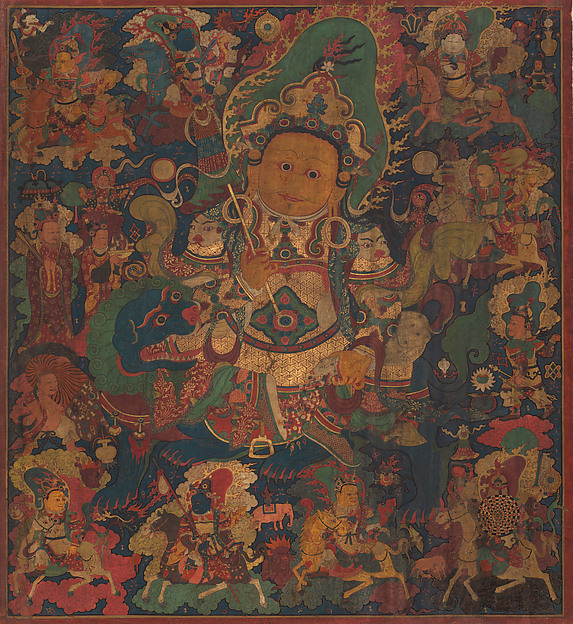
Tibet, 15th century. Distemper on cloth; 81.3 cm. Metropolitan Museum of Art, 2021.290.
Look closer: Note the crowded field around the central king: Tibetan painters filled the ground with attendants, animals and jewels, the opposite of the single armoured figure in a Japanese hall.
The Metropolitan Museum of Art, Purchase, Gift of Florence and Herbert Irving, by exchange, 2021. Open Access.
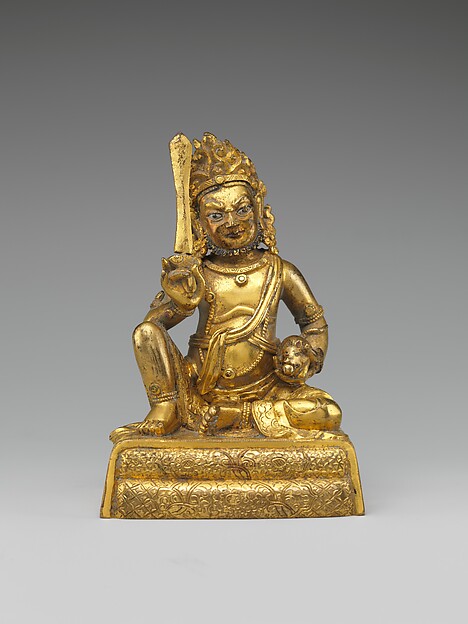
Mongolia or China, 19th century. Brass with traces of pigment, lost-wax cast; 9.8 cm. Metropolitan Museum of Art, 2006.129.
Look closer: Note the seated, relaxed pose with one knee raised and the blade lifted: the northern king in his wealth-god form, small enough to hold in two hands.
The Metropolitan Museum of Art, Purchase, Friends of Asian Art Gifts, 2006. Open Access.
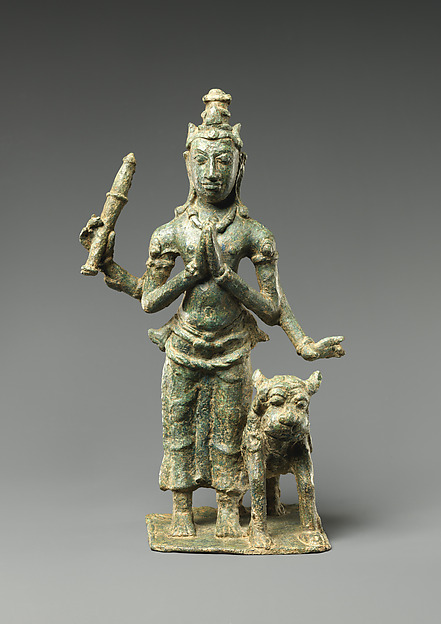
Sri Lanka, 9th century. Bronze; 22.2 cm. Metropolitan Museum of Art, 2003.548.1.
Look closer: Note the joined hands and the small animal at the foot: the Indian regent of the north, Kubera, who is the wealth-god behind the Buddhist Tamonten.
The Metropolitan Museum of Art, Gift of Guardian of the Flame Collection, 2003. Open Access.
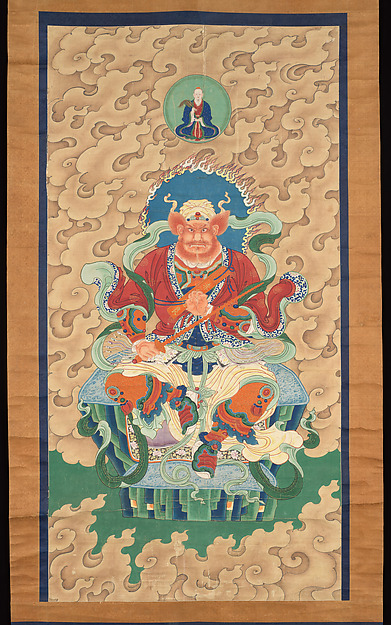
Unidentified artist, China. Hanging scroll; color on silk; 194.3 x 100.3 cm. Metropolitan Museum of Art, 57.175.
Look closer: Note the seated king on a cloud-wreathed throne with a halo and a small figure in a roundel above: the guardian king as an object of worship in his own right.
The Metropolitan Museum of Art, Gift of Georgia Gibbs, 1957. Open Access.
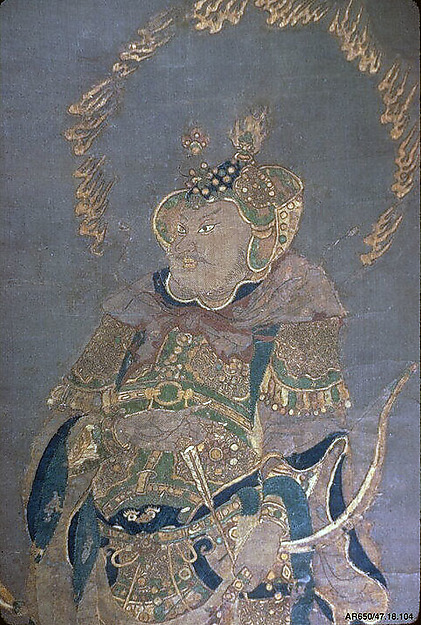
China. Hanging scroll; silk applique and embroidery on plain-weave silk; 95.9 x 47 cm. Metropolitan Museum of Art, 47.18.104.
Look closer: Note the flame-edged halo and the armour built up in layers of cut silk and stitch: a guardian king made in textile and not paint.
The Metropolitan Museum of Art, From the Collection of A. W. Bahr, Purchase, Fletcher Fund, 1947. Open Access.
Wrestlers, singers and a visual-kei band
The Wikipedia article on the Four Heavenly Kings lists the other groups that have borrowed the title, and the list is a small history of popular culture. In Japanese professional wrestling, it says, Mitsuharu Misawa, Kenta Kobashi, Toshiaki Kawada and Akira Taue of All Japan Pro-Wrestling were called the Four Heavenly Kings of Pro Wrestling. In Hong Kong entertainment the title went to the singers Andy Lau, Jacky Cheung, Leon Lai and Aaron Kwok. In the Japanese visual-kei scene of the mid-to-late 1990s, it adds, the title went to the bands Malice Mizer, La'cryma Christi, Fanatic Crisis and Shazna.
The pattern is the same in each case: four people, each at one corner of a field, and the best-known set in their trade. It is the same shape as the temple, with four at the corners of a dais.
Reading a set of four
Start with the north. The king who holds a pagoda is Tamonten, the one the Japanese also worship alone as Bishamonten, and on that figure the pagoda is the surest mark. The others are harder: Wikipedia lists a pipa, a sword and a snake or cord for the east, south and west, but JAANUS records no fixed scheme in Japan, so the position in the set is often the better clue.
Four armoured figures with demons beneath them at the corners of a dais are the Shitennō. JAANUS notes that they also appear at the four corners of a painted mandala.
Three practical tests follow from the sources. First, look at the hands and, where the hands are gone, at the peg holes. The butuzou.com note on how to tell Kōmokuten from Tamonten says the held object is the most reliable identifier, with a small pagoda in the left hand or a treasure symbol and often a spear or staff on the right for Tamonten, and a brush and scroll for Kōmokuten; it adds that missing attributes reduce certainty and that peg holes may show that a separate attribute was once attached. Second, look at what the figure stands on. Many are shown stepping on a small figure, the jaki, and the On-Mark note says that two of them, Tentōki and Ryūtōki, were said to have been evil demons that repented after being trampled and now carry lanterns. Third, look at the position in the set: the commonly taught arrangement has Tamonten in the north and Kōmokuten in the west, but the butuzou.com note says the arrangement varies by region, period and lineage and that shelf displays need not follow the compass.
A set of four is a different object from four singles, and a single king from a broken set is a different object from a king made to stand alone. Ask whether the other three survive, where the missing attributes went, and whether the figure in question is a Tamonten that was also worshipped alone as Bishamonten. The concierge desk can search for a single guardian king or for a complete set.
Ten small facts
- The Taimadera Zōchōten is 2.19 metres tall and its set is the oldest in Japan in hollow dry lacquer, apart from the Kamakura Tamonten (Nippon.com).
- Taimadera's temple records say its four kings were brought from Paekche in Korea (Nippon.com).
- The Hōryūji set is called the oldest extant set in Japan, each figure about 133.5 centimetres (On-Mark).
- The Kōfukuji statues sold in 1906 cost 5,000 yen for the three guardian kings together (Wikipedia, ex-Kōfuku-ji).
- The four inspect the human world on the 8th, 14th and 15th days of each lunar month (Wikipedia).
- The Kanzeonji kings are each about 2.3 metres tall, or 203 centimetres, depending on which text of the entry is read (Japan Tourism Agency).
- Two of the trodden demons, Tentōki and Ryūtōki, are said to have repented and now carry lanterns (On-Mark).
- The Four Heavenly Kings of Pro Wrestling were Misawa, Kobashi, Kawada and Taue (Wikipedia).
- Hōryūji and Hokkiji were registered in 1993 as Japan's first World Heritage Site, under the name Buddhist Monuments in the Hōryū-ji Area (Wikipedia).
- Statues of the four stood at the royal crematorium of King Bhumibol Adulyadej of Thailand (Wikipedia).
Across Asia
The four were guardians long before they were Japanese.
| Where | Form and name | What the record shows |
|---|---|---|
| India | Dhṛtarāṣṭra, Virūḍhaka, Virūpākṣa, Vaiśravaṇa | Pre-Buddhist deities who appear helping the Buddha (JAANUS); they serve Śakra and guard Trāyastriṃśa against the asuras (Wikipedia). |
| China | Chíguó, Zēngzhǎng, Guǎngmù, Duōwén (持国, 增長, 广目, 多闻) | Wikipedia gives the colours white, blue, red and yellow or green, and the pipa, sword, snake or cord and umbrella or pagoda. |
| Japan | Jikokuten, Zōchōten, Kōmokuten, Tamonten | Martial figures in Chinese armour on jaki, at the corners of the shumidan (JAANUS). |
| Tibet | Vaiśravaṇa; rgyal chen bzhi | The four great kings, with Vaiśravaṇa as protector of riches (Wikipedia, Met). |
| Korea | Sa-cheonwang 사천왕 | The Korean names of the four are Jiguk, Jeungjang, Gwangmok and Damun (Wikipedia). |
| Thailand | Four kings at a royal crematorium | Statues of the four stood at the royal crematorium of King Bhumibol Adulyadej (Wikipedia). |
| Sri Lanka | Lokapalas | Ninth-century bronzes of Indra, Yama, Varuna and Kubera as regents of the directions (Met). |
The first heaven's guard
The four belong to the Heavenly Beings. JAANUS places them in the first of the six heavens of desire, below the Tōriten that Taishakuten rules.
| Companion | Why they meet |
|---|---|
| Taishakuten | He rules Tōriten, which the four protect (JAANUS). |
| Bishamonten | The northern king, worshipped alone under that name (JAANUS). |
| Shumisen | The mountain whose dais they surround (JAANUS). |
Where to see them
| Place | What to look for |
|---|---|
| Kondō, Hōryūji, Nara | The oldest set in Japan, mid-seventh century (JAANUS). |
| Taimadera, Nara | A set of the late seventh to early eighth century (JAANUS). |
| Kaidan'in, Tōdaiji, Nara | An eighth-century set (JAANUS). |
| Hokuendō, Kōfukuji, Nara | A set of 791, originally at Daianji (JAANUS). |
| Kōdō, Tōji, Kyoto | A set of 839 (JAANUS). |
| Nara National Museum | Two of the dispersed Kōfukuji kings, with a third entrusted to it (Wikipedia). |
| Metropolitan Museum of Art, New York | Three twelfth-century and earlier armless figures, in open access. |
| Kondō, Taimadera, Katsuragi | A set of the late seventh century in hollow dry lacquer, around a seated Miroku (Nippon.com). |
| Kanzeonji, Dazaifu, Fukuoka | An eleventh-century set in camphor wood, each about 2.3 metres (Japan Tourism Agency). |
| Cleveland Museum of Art | A Ming painting of Virudhaka, the southern king, in open access. |
Three kings in the Metropolitan Museum

Japan, late 11th to early 12th century. Painted wood, ichiboku technique; 106.7 cm high. Metropolitan Museum of Art, 1974.76.
Look closer: Note how the carving follows the single block, from the crest of the cap down to the rough base.
The Metropolitan Museum of Art, Gift of Mary Griggs Burke, 1974. Open Access.

Japan, 12th century. Wood with traces of colour; 83.8 cm high. Metropolitan Museum of Art, 1975.268.164.
Look closer: Note the raised shoulder and the scowl: the forearm is lost, but the pose still reads as a guard on watch.
The Metropolitan Museum of Art, The Harry G. C. Packard Collection of Asian Art, Gift of Harry G. C. Packard, and Purchase, Fletcher, Rogers, Harris Brisbane Dick, and Louis V. Bell Funds, Joseph Pulitzer Bequest, and The Annenberg Fund Inc. Gift, 1975. Open Access.

Japan, 12th century. Wood with traces of colour; 86 cm high. Metropolitan Museum of Art, 1975.268.165.
Look closer: Note the layered armour at the hips and the traces of dark pigment in the folds.
The Metropolitan Museum of Art, The Harry G. C. Packard Collection of Asian Art, Gift of Harry G. C. Packard, and Purchase, Fletcher, Rogers, Harris Brisbane Dick, and Louis V. Bell Funds, Joseph Pulitzer Bequest, and The Annenberg Fund Inc. Gift, 1975. Open Access.
In the house
These pieces come from the house's own shelves and carry the Shitenno tag. The strip refills from what is available now.
A short glossary
- Shitennō (四天王)
- The four heavenly kings, guardians of the four directions.
- Jikokuten (持国天)
- The eastern king, Dhṛtarāṣṭra, 'he who upholds the realm'.
- Zōchōten (増長天)
- The southern king, Virūḍhaka, 'he who causes to grow'.
- Kōmokuten (広目天)
- The western king, Virūpākṣa, 'he who sees all'.
- Tamonten (多聞天)
- The northern king, Vaiśravaṇa, 'he who hears everything', who is also worshipped alone as Bishamonten.
- Shumidan (須弥壇)
- The dais that carries the main image and stands for Mount Sumeru.
- Jaki (邪鬼)
- The small demons trodden underfoot.
- Amanojaku (天邪鬼)
- The demon-like creature the kings trample, in the Kanzeonji entry.
- Cāturmahārājika
- The Sanskrit name for the four great kings and the heaven they rule.
- Lokapāla
- A guardian of a direction in the Indian tradition.
- Dakkatsu kanshitsu (脱活乾漆)
- Hollow dry lacquer, a clay core wrapped in lacquered cloth and then removed.
- Mokushin kanshitsu (木心乾漆)
- Dry lacquer built over a wooden core.
- Ichiboku (一木)
- Carved from a single block of wood.
- Konkōmyō saishōōkyō
- The Golden Light Sutra, source of the doctrine that the four protect a righteous king's country.
- Tianwangdian (天王殿)
- The hall of the heavenly kings at the entrance of a Chinese Buddhist temple.
Answered plainly
Who are the Shitennō?
The Four Guardian Kings, pre-Buddhist Indian deities who guard the four directions (JAANUS).
Which king guards which direction?
Jikokuten the east, Zōchōten the south, Kōmokuten the west and Tamonten the north (JAANUS).
Where do they stand in a temple?
At the four corners of the shumidan, the dais that stands for Mt Sumeru (JAANUS).
Which set is the oldest in Japan?
The set in the Kondō of Hōryūji, from the mid-seventh century (JAANUS).
What is the Konkōmyō saishōōkyō?
The Golden Light Sutra, which teaches that the four protect the country of a king who honours them (JAANUS).
Is Tamonten the same as Bishamonten?
Yes. He is called Tamonten as one of the four and Bishamonten when worshipped alone (JAANUS).
Which is the oldest set of the four in Japan?
The set in the Kondō of Hōryūji, of the mid-seventh century according to JAANUS and On-Mark, or the end of the Asuka period according to Wikipedia.
What are the demons under their feet?
Jaki, or amanojaku, small demons trodden down; one legend says two of them, Tentōki and Ryūtōki, repented and now carry lanterns (JAANUS, On-Mark, Japan Tourism Agency).
How tall are the Kanzeonji kings?
About 2.3 metres in the Japanese and Chinese texts of the entry and 203 centimetres in the English and Korean texts (Japan Tourism Agency).
What do the four kings do on the 8th, 14th and 15th of the month?
They inspect virtue in the human world, in person or through emissaries, and report to the assembly of Trāyastriṃśa (Wikipedia).
Where next
Sources and image credits
- JAANUS, Shitennō 四天王 (Columbia University)
- Wikipedia, Four Heavenly Kings
- Wikipedia, Four Heavenly Kings (ex-Kōfuku-ji)
- Metropolitan Museum of Art, One of the Four Heavenly Kings (1974.76)
- Metropolitan Museum of Art, One of the Four Heavenly Kings (1975.268.164)
- Metropolitan Museum of Art, One of the Four Heavenly Kings (1975.268.165)
- On-Mark Productions, Shitenno, the Four Heavenly Kings
- Nippon.com, Encounters with Buddhist Art (Taimadera)
- Japan Tourism Agency multilingual database, Four Heavenly Kings (Kanzeonji)
- Wikipedia, Hōryū-ji
- butuzou.com, Komokuten vs Tamonten
- Tōdaiji, Kaidan-dō (Four Divine Kings)
- Cleveland Museum of Art, Heavenly King Virudhaka (1918.544)
- Metropolitan Museum of Art, Vaishravana, the Guardian of Buddhism and Protector of Riches (2021.290)
- Metropolitan Museum of Art, Vaishravana as Kubera (Dou Wen Tian) (2006.129)
- Metropolitan Museum of Art, The Lokapala Kubera, Regent of the North (2003.548.1)
- Metropolitan Museum of Art, A Guardian King (57.175)
- Metropolitan Museum of Art, Buddhist Guardian King (47.18.104)
Last reviewed 28 October 2026. Pictures are public-domain or openly licensed, each credited beneath it. Diagrams on this page are drawn by Japonista.
Looking for a guardian king figure for a home altar? Tell the concierge desk what you have in mind and we will search Japan for it.
Private concierge
Looking for something in particular?
Describe the piece or the project you have in mind. A senior advisor in Tokyo reads every case file personally and replies within two business days, with fees set out in writing before any work begins.