
Myōō: The Wisdom Kings
Kings of Brightness
Wisdom Kings
明王
Fierce faces, flame halos and weapons in every hand: the Myōō, who turn the Buddha's compassion on the passions that bind beings. Here are all ten chapters, the family tree, a timeline, a glossary and an A to Z of 123 names.
Compassion with a fierce face
Myōō (明王), the Wisdom Kings, are the fierce guardians of esoteric Buddhism. Their faces blaze with anger and their bodies are wreathed in fire, yet they are expressions of compassion: the stern force of the buddhas, turned on beings too stubborn to be reached by gentleness, and on the passions that bind them. In the four ranks of Japanese Buddhist figures they stand third, after the Buddhas (Nyorai) and the Bodhisattvas (Bosatsu), and before the Heavenly Beings (Ten).
In esoteric teaching a buddha acts in three bodies: the gentle buddha, the bodhisattva who teaches, and the wrathful king who commands. The Myōō are this third body. Their anger is aimed at ignorance and desire, and their weapons are tools of rescue: the sword that cuts delusion, the rope that binds the passions and hauls beings to safety.
The kings came to Japan with esoteric Buddhism in the early ninth century, with Kūkai and the successors of Saichō, and were invoked in the fire ritual, goma. The first Godai in Japan, five sculptures in the Lecture Hall of Tō-ji in Kyoto, was completed in 839, the same year in which the Daigensui rite was brought from Tang China. From the court they spread to the sword-smith, the mountain ascetic and the roadside shrine, and their dynamic forms gave sculptors a new freedom.
Each chapter below is a reading room of its own: stories, iconography, history by era, sites, a glossary, questions and sources. This page is the map that joins them.
Ten chapters
The five great kings first, then the figures who stand beside them. Every tile opens a complete chapter. Batō, a fierce Kannon sometimes counted among the kings, has her own page: Batō Kannon.
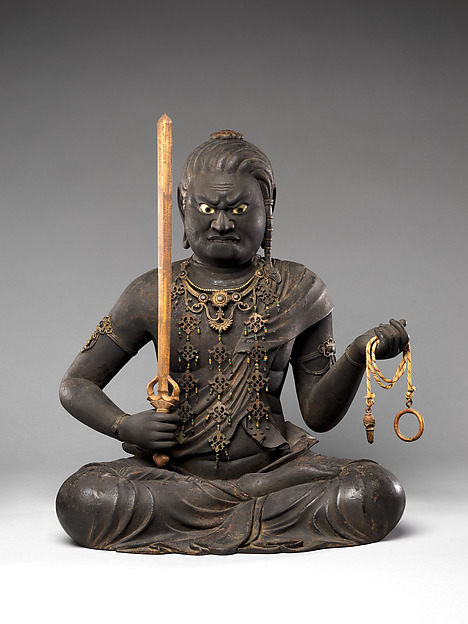


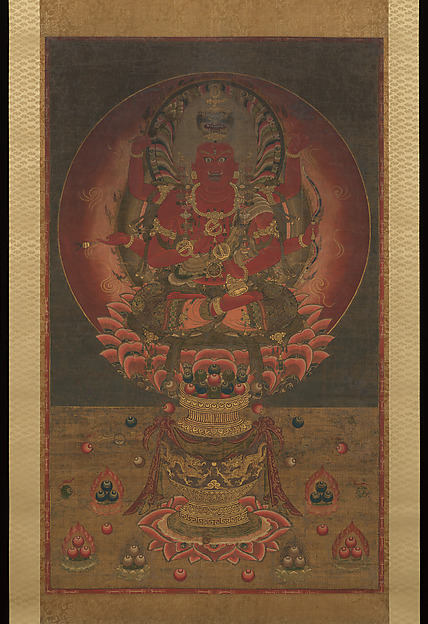


Family tree
The five great kings are the wrathful forms of the five Buddhas of the Diamond Realm, arranged as a compass around the centre. The tree below shows each pairing and the figures that stand outside the five. Each box is a link.
| Direction | King | Buddha whose wrathful form he is | Chapter |
|---|---|---|---|
| Centre | Fudō Myōō | Dainichi | Fudō |
| East | Gōzanze Myōō | Ashuku (Akṣobhya) | Gōzanze |
| South | Gundari Myōō | Hōshō (Ratnasambhava) | Gundari |
| West | Daiitoku Myōō | Amida | Daiitoku |
| North | Kongōyasha Myōō (Tendai: Ususama Myōō) | Fukūjōju (Amoghasiddhi) | Kongōyasha, Ususama |
Telling the kings apart
Count arms and faces and note the weapons: they are the only reliable way to tell the kings apart. The chapters record what each source says.
| King | Look for | Chapter |
|---|---|---|
| Fudō | A sword and a rope, a flame halo, and two boy attendants, Kongara and Seitaka | Fudō |
| Gōzanze | Blue-black body, three or four faces, eight arms | Gōzanze |
| Gundari | Blue body, usually one face and eight arms, snakes at neck, waist, wrists and ankles | Gundari |
| Daiitoku | Six faces, six arms and six legs, riding a water buffalo | Daiitoku |
| Kongōyasha | Blue-black, three faces, six arms, one leg raised on a lotus; eleven eyes in all | Kongōyasha |
| Ususama | Flames, snakes and skulls; two to eight arms; at a toilet or childbirth shrine | Ususama |
| Aizen | Red body, three eyes, six arms | Aizen |
| Daigensui | Blue-black; one image has 18 faces and 30 or 36 arms | Daigensui |
| Kujaku | A gentle face, a peacock for a mount, feathers in the hands | Kujaku |
Dates the chapters give
- 764Empress Kōken offers two Kujaku Myōō and a Makamayuri Daikujaku to the Yakushi Kondō of Saidaiji (JAANUS; Kujaku).
- 810Kūkai presents the Peacock sutra to Emperor Saga (JAANUS; Kujaku).
- 839The five sculptures of the Lecture Hall of Tō-ji are completed, and the Daigensui rite is introduced from Tang China by Jōgyō (Godai; Daigensui).
- 851The Daijō-kan orders the annual performance of the Daigensui rite, the year in which it is generally taken to be established (Daigensui).
- 1088 and 1090The Gōzanze and Gundari scrolls of the Kiburi-ji set are inscribed with these dates (Ususama).
- 1144The Kujaku Hall of Ninna-ji is built for the retired emperor Toba (Kujaku).
- 1200Kaikei's Kujaku sculpture is made for the Kujakudō at Kongōbu-ji on Mount Kōya (Kujaku).
- 1281A seven-deity fire ritual invokes Aizen with the Godai and Daigensui (JAANUS; Aizen).
- 1293The dated Aizen sculpture now in the Freer Gallery is made (Aizen).
- 1701A Shingon-style cabinet of the five great kings is enshrined at Hōzan-ji, Ikoma (Ususama).
- 2004The Kiburi-ji Godai scrolls are designated a National Treasure (Ususama).
A to Z of the Wisdom Kings
123 names, each linking to the chapter or the section where it is explained, with the kanji where the chapter gives one.
A
- 金剛薬叉明王 金剛薬叉明王 A variant writing of the same name, recorded by JAANUS.
- Acala The Sanskrit name, meaning unmoving; the source of the Japanese Fudō (Wikipedia).
- Acala, Acalanātha The Sanskrit name and its fuller form, the Immovable Lord (Wikipedia).
- Achala Vidyaraja The spelling the Met uses in many titles: Achala, unmoving, and Vidyaraja, Wisdom King.
- Agni The Vedic god of fire (JAANUS).
- Aizen Myōō 愛染明王 A red-skinned king with a lion in his hair and a bow in his hands, who teaches one daring doctrine: that longing, turned the right way, is already a road to awakening.
- Aka-Fudō (Red Fudō) 赤不動 The Red Fudō, the image at Myōō-in on Mount Kōya (Wikipedia).
- Aka-, Ki-, Ao-Fudō Red, Yellow and Blue Fudō, each tied to a temple and a story (Wikipedia).
- Amṛta The nectar of immortality; 'not death' (Wikipedia).
- Anchin-hō A rite for which a four-armed Fudō is used (Wikipedia).
- Ao-Fudō (Blue Fudō) 青不動 The Blue Fudō of Shōren-in in Kyoto, a Heian hanging scroll of the mid-eleventh century and a National Treasure (Wikipedia).
- Aragoto The rough style of kabuki created by Ichikawa Danjūrō I (Wikipedia).
- Āṭavaka Sanskrit name of Daigensui, a child-eating demon converted into a protector (JAANUS).
B
- Banjakuza, shitsushitsuza Two kinds of rock seat on which Fudō sits (Wikipedia, JAANUS).
- Bùdòng Míngwáng The Chinese name, the source of the Japanese reading (Wikipedia).
- Butsumo 仏母 Buddha-mother, a title of the deity (JAANUS).
- Butsumo Daikujaku Myōō 仏母大孔雀明王 'Buddha-mother Great Peacock Wisdom King', the name used in the principal sutra (JAANUS).
- Butsumo daikujaku myōōkyō The principal scripture, translated by Bukong, Amoghavajra (JAANUS).
C
- Caṇḍaroṣaṇa A Sanskrit name of the wrathful aspect (Wikipedia).
- Chōren The lotus on the head (Wikipedia).
D
- Daigensuihō 大元帥法 The Great Rite of Daigensui, once performed only before the emperor (Wikipedia).
- Daigensui Myōō 大元帥明王 The blue-black guardian of the realm, a converted yaksha with many faces and many arms, whose New Year rite was once reserved for the emperor alone.
- Daiitoku 大威徳 'Great awesome virtue' (JAANUS). The name that Japanese temples use.
- Daiitoku Myōō 大威徳明王 Six faces, six arms, six legs, and a water buffalo for a mount: the Wisdom King who answers the god of death, and the one soldiers prayed to before a battle.
- Dainichi Nyorai The cosmic Buddha, of whom Fudō is held to be a wrathful emanation (Met).
- Dàwēidé Míngwáng 大威德明王 The Chinese name, the same characters as the Japanese (Wikipedia).
- Dhāraṇī A long mantra of protection; the main Ucchuṣma dhāraṇī is recited 40,000 times (Wikipedia).
- Dōji A boy attendant; Kongara and Seitaka are the best known (Wikipedia, Met).
E
- Enmantoku(ka 焔曼徳迦 The Sino-Japanese transliteration of Yamāntaka, from Yama (Enma) and Antaka (JAANUS).
- Eshaku Kongō 穢跡金剛 'Vajra of Impure Traces'; the name that gave later copyists trouble (JAANUS; Wikipedia).
F
- Fudō Myōō 不動明王 The Immovable Wisdom King, centre of the five great kings: a sword in one hand, a rope in the other, seated before a wall of flame.
- Fudō-son, O-Fudō-san Respectful and affectionate forms used at temples and in daily speech (Wikipedia).
- Fujō Ketsu Kongō 不浄潔金剛 'Impurity-Purifying Vajra' (Japanese Wikipedia).
- Fukūjōju 不空成就 The Buddha of the north in the Diamond Realm, whose wrathful form the king is (JAANUS). Amoghasiddhi in Sanskrit (Wikipedia).
G
- Godai Myōō 五大明王 Five fierce kings arranged like a compass around one immovable centre: the group that carried the Buddhist teaching into the Heian palace, and that still stands in a Kyoto hall as it did in the year 839.
- Godanhō 五壇法 The five-altar rite, first celebrated in 961 on Mount Hiei (JAANUS).
- Gōenmason 降焔魔尊 Subjugator of Yama, the title that states the power over death (JAANUS).
- Gofun, hakudo Two pigments; gofun comes into use from the end of the fourteenth century (Met Journal).
- Goma The fire offering; Fudō is its main image (JAANUS).
- Goshichinichi no mishuhō 後七日御修法 The Latter Seven Days Rite, held yearly in the palace's Shingon'in (JAANUS; Buddhistdoor).
- Gōzanze Myōō 降三世明王 A blue-black king with many faces and eight arms who stands, in the finest paintings and statues, on two prostrate gods: the figure that esoteric Buddhism made to show that even the mighty can be turned.
- Gundali Myeongwang 군다리명왕 The Korean reading (Wikipedia).
- Gundari 軍荼利 A transliteration of the Sanskrit Kuṇḍali (JAANUS).
- Gundari Myōō 軍荼利明王 A blue king wrapped in snakes, with one leg lifted as if mid-step: the keeper of the nectar of immortality, and the Wisdom King of the south in the five-direction group.
- Gundari Yasha Myōō 軍荼利夜叉明王 'Gundari the yaksha'; a name that places him among the fierce spirits (Wikipedia).
H
- Hibutsu A hidden Buddha, an image withheld from ordinary view; the Blue and Yellow Fudō are two (JAANUS, Wikipedia).
- Hōken, kongō-ken, sanko-ken The treasure sword, the vajra sword and the sword with a three-pronged hilt (Wikipedia).
- Honzon The main image of a rite or of a temple hall (JAANUS).
I
- Irezumi The art of the Japanese tattoo, one of the places where Fudō appears (Wikipedia).
J
- Jātaka A tale of a previous birth of the Buddha; he was a golden peacock king in this one (Wikipedia).
- Jikushu, shōshu, kakaishu Three kinds of Fudō mantra (Wikipedia).
- Jīngāng Yèchā Míngwáng The Chinese reading of the same characters, given in Wikipedia's Wisdom King article.
- Jūntúlì Míngwáng 軍荼利明王 The Chinese reading of the same characters (Wikipedia).
- Jushoku Kongō 受触金剛 'Vajra of Contact' (JAANUS; Wikipedia gives the Chinese Shòuchù).
K
- Kakebotoke 懸仏 A hanging Buddha: a metal or wood disc or plaque bearing a deity, like the Asian Art Museum's plaque.
- Kanro 甘露 'Sweet dew'; the Chinese and Japanese rendering of amrita.
- Kanro Gundari 甘露軍荼利 'Sweet-dew Gundari', the king of the nectar; the Sanskrit Amṛtakuṇḍalin (JAANUS).
- Karura-en The Garuda flame; the name of the fiery halo (Wikipedia).
- Katō Kongō 火頭金剛 'Fire-Head Vajra', the name the Buddhas are said to have given him in the Śūraṅgama Sūtra (JAANUS; Wikipedia).
- Kawaya-gami The toilet god of folk belief, most often shown as Ususama (Wikipedia).
- Ki-Fudō (Yellow Fudō) 黄不動 The Yellow Fudō of Onjō-ji (Mii-dera), traced to a vision of Enchin; the original is hidden and a copy survives at Manshu-in (Wikipedia, JAANUS).
- Kirikane Cut gold leaf (Met).
- Kirikiri Myōō 吉里吉里明王 A further name recorded by JAANUS, and by Wikipedia as Kirikiri.
- Kongara Dōji 矜羯羅童子 The calm boy attendant at Fudō's side, called Kiṃkara in Sanskrit; shown with palms joined (Wikipedia, Met).
- Kongō 金剛 Vajra, the diamond thunderbolt.
- Kongōrikishi 金剛力士 The 'vajra-bearing warriors' of temple gates, the Niō pair (see the gate guardians chapter). A different pair of figures altogether.
- Kongōyasha Myōō 金剛夜叉明王 The Wisdom King of the north: three faces with eleven eyes between them, six arms full of weapons, and a role in the Godai that one school gave to someone else.
- Konjiki Kujaku-ō 金色孔雀王 'Golden Peacock King', the name of a different figure, one of the twenty-eight attendants of Kannon at Sanjūsangendō, discussed below.
- Konpon-in 根本印 The root gesture, with both hands joined and both middle fingers extended (Met).
- Kōshin 庚申 The monkey day of the sixty-day cycle and the belief and vigil built on it (Wikipedia; JAANUS).
- Kujaku Butsumo Bosatsu 孔雀仏母菩薩 'Peacock Buddha-mother Bodhisattva', the form used by two commentaries (JAANUS).
- Kujakudō 孔雀堂 The Peacock Hall at Kongōbu-ji, built in 1200 and rebuilt in 1983 (Japanese Wikipedia).
- Kujaku Myōō 孔雀明王 A king in name and a mother in nature: the serene peacock-borne figure who, because the peacock eats poison, was prayed to against snakebite, disease, drought and war.
- Kujaku Myōōkyō hō The Shingon rite, performed at Ninna-ji for disaster, rain, illness and childbirth (JAANUS).
- Kukurizaru Small cloth monkey talismans, hung at Yasaka Kōshin-dō (Wikipedia; Commons).
- Kuṇḍalinī 'Coiled snake'; the latent energy at the base of the spine in yoga (Wikipedia; JAANUS).
- Kurikara The sword of Fudō with a nāga coiled around the blade (Wikipedia).
- Kurikara sword 倶利伽羅剣 The sword of Fudō with a nāga coiled around the blade (Wikipedia).
- Kyōryōrin-shin 教令輪身 The 'embodiment of the wheel of injunction': the fierce body of a buddha (JAANUS; Wikipedia).
M
- Mahāmāyūrī The Sanskrit name, 'great peahen'; the full title is Mahāmāyūrī Vidyārājñī (Wikipedia).
- Mahāvairocana Tantra The text, called Dainichikyō in Japan, that places Fudō in the southwest of the Womb Realm (Wikipedia).
- Mandara 曼荼羅 A diagram of a cosmos; Daiitoku has one of his own (JAANUS).
- Mingei The people's art movement of Yanagi Sōetsu (Met).
- Misshaku Kongō 密跡金剛 'Vajra of Secret Traces', the softened form, which shares its characters with Guhyapāda (Wikipedia).
- Myōhi 明妃 A wisdom queen or consort, the rank JAANUS assigns her.
- Myōō 明王 Wisdom King; a wrathful deity who teaches through fear. In Sanskrit vidyārāja, 'king of those who hold knowledge' (JAANUS).
- Myōō (Vidyārāja Wisdom King, or King of Brightness: a class of fierce protectors in esoteric Buddhism (Met).
N
- Natabori Hatchet-carved: the rough faceted carving of Mokujiki, worked in fact with round-headed chisels (Met).
- Ninnōkyō 仁王経 The Sutra of the Benevolent Kings, whose ceremony called on the five kings to protect the nation (Met; JAANUS).
O
- Omaedachi 御前立 A figure placed before a hidden main image (Commons record).
- Ōtsu-e 大津絵 Folk paintings of the Ōtsu area; here, the scrolls of the blue-faced protector (Met).
P
- Pañcarakṣā The five protective dhāraṇī-queens, to which she belongs (Wikipedia).
R
- Rokusokuson 六足尊 The Six-Footed Venerable, from his six legs (JAANUS).
S
- Sanmokudō 三黙堂 The three silent halls: meditation hall, bath and toilet (nippon.com; Wikipedia).
- Sanrinjin 三輪身 The theory of three wheeled bodies, by which a buddha appears gentle, wise or fierce (Wikipedia).
- Sanshi 三尸 The 'three corpses', beings said to live in the body and report its owner's deeds (Wikipedia).
- Seitaka Dōji 制吒迦童子 The fierce boy attendant, called Ceṭaka in Sanskrit; shown grimacing with a staff, and the subject of a Narita print (Wikipedia, Met).
- Shingon, Tendai The two esoteric schools whose fire rites centre on Fudō (Wikipedia).
- Shōmen Kongō 青面金剛 The 'blue-faced vajra', also called Seishoku Daikongō Yasha 青色大金剛薬叉, a protector against disease demons and the central image of the Kōshin cult (JAANUS). A separate entry from the Wisdom King.
- Shugendō The tradition of the mountain ascetics, who use waterfalls and fire rites in his name (Wikipedia, JAANUS).
- Shuilu Fahui The Chinese rite for water and land, in which he protects the ritual space (Wikipedia).
- Shuji, seed syllable A Sanskrit character that stands for a deity; Chikai's scroll builds its figures from them (Met).
- Surimono A privately commissioned print for a special occasion (Met).
T
- Taigensui Myōō 太元帥明王 Alternative reading of Daigensui Myōō (JAANUS).
- Taimitsu 台密 Tendai esotericism, the school in which Ususama takes the north (JAANUS).
- Taishō Myōō 大咲明王 A name recorded by Wikipedia; its sense is not explained in the sources read.
- Taizōkai mandara 胎蔵界曼荼羅 The Womb Realm mandala, in which she has two arms and no peacock (JAANUS).
- Tenchigan The eyes of heaven and earth, one looking up and one down, in the later type of image (Wikipedia).
- Thirteen Buddhas The memorial series in which Fudō comes first, for the seventh day (Wikipedia).
- Tōmitsu 東密 Shingon esotericism, which keeps Kongōyasha in the north (JAANUS).
- Tōsu 東司 The monastery toilet, one of the seven main halls of a Zen temple (MLIT guide; nippon.com).
U
- Ucchuṣma The Sanskrit name, originally an epithet of Agni (JAANUS).
- Ususama Myōō 烏枢沙摩明王 A god who began as a name of the Vedic fire, who in Japan guards the toilet and presides over childbirth, and who in the Tendai school holds the northern place of the Godai.
V
- Vajrabhairava 'Diamond Terror', the name by which he is still revered in Tibet (JAANUS, Wikipedia).
- Vajrayakṣa The Sanskrit: 'vajra yakṣa'. Also the name of one of the sixteen great bodhisattvas of the Diamond World mandala (JAANUS).
Y
- Yamabushi Mountain ascetics who perform the saitō goma (JAANUS).
- Yama / Enma 閻魔 The lord of the dead and judge of the hells (Wikipedia; JAANUS).
- Yamāri 'Enemy of Yama', an Indian form of the name (JAANUS).
- Yidam A Tibetan meditational deity; Vajrabhairava is the main one of the Gelug school (study centre).
- Yosegi-zukuri Joined-woodblock construction, in which a figure is built from several hollowed pieces (Met).
Z
A short glossary
- Myōō (明王)
- Wisdom King, in Sanskrit vidyārāja, "king of those who hold knowledge": a wrathful deity who teaches through fear (JAANUS).
- Myōhi (明妃)
- A wisdom queen or consort. JAANUS ranks Kujaku in this class, not among the kings.
- Godai Myōō (五大明王)
- The five great kings, one for each direction, matched with the five Buddhas of the Diamond Realm.
- Taimitsu and Tōmitsu
- Tendai and Shingon esotericism. They differ over the northern king: Ususama in Tendai, Kongōyasha in Shingon.
- Mikkyō (密教)
- Esoteric Buddhism, the tradition that brought the Wisdom Kings to Japan in the early ninth century.
- Goma (護摩)
- The fire ritual in which the kings are invoked.
- Dhāraṇī and mantra
- Long and short formulas of protection recited to a deity; several chapters give the words.
- Kurikara sword
- The sword of Fudō with a nāga coiled around the blade (Wikipedia).
- Hidden image (hibutsu)
- An image withheld from ordinary view; the Yellow and Blue Fudō are two (JAANUS, Wikipedia).
- Omaedachi (御前立)
- A figure set before a hidden main image; one of Ususama is shown in his chapter.
- Tendai and Shingon
- The two great Japanese esoteric schools, founded by Saichō and Kūkai.
- Vajra (金剛)
- The thunderbolt-diamond emblem that gives Kongōyasha and Kongōsatta their names.
In the house
These pieces come from the house's own shelves and carry the Wisdom King tag. The strip refills from what is available now.
Answered plainly
What is a Wisdom King?
A Myōō, from the Sanskrit vidyārāja, is a wrathful guardian of esoteric Buddhism: a fierce face turned on ignorance and desire, as an expression of compassion and not of anger at the believer.
How many Wisdom Kings are there?
The best-known group is the five Godai Myōō: Fudō at the centre with Gōzanze, Gundari, Daiitoku and Kongōyasha. Aizen, Daigensui and Ususama stand outside the five, and Kujaku is ranked a wisdom queen.
Which king is the chief?
Fudō, the Immovable Wisdom King, is the chief of the five and the most widely represented of the Myōō.
Why does Ususama sometimes replace Kongōyasha?
In the Tendai school Ususama takes the northern place held in Shingon by Kongōyasha (JAANUS). The Kiburi-ji scrolls in Gifu show the Tendai arrangement.
Which kings are matched with which Buddhas?
Gōzanze with Ashuku in the east, Gundari with Hōshō in the south, Daiitoku with Amida in the west and Kongōyasha with Fukūjōju in the north; Fudō is the wrathful form of the central Buddha, Dainichi.
Where can I see the oldest group of five?
The five sculptures of the Lecture Hall of Tō-ji in Kyoto, completed in 839, are the first Godai in Japan (JAANUS).
Is Kujaku a king?
The title says so, but JAANUS classes Kujaku as a female myōhi, a wisdom queen, and calls her Butsumo, Buddha-mother.
Where do I begin?
Start with Fudō Myōō, then the Godai chapter, and use the A to Z on this page to find a name, a kanji or a term.
Where next
Sources
Each chapter carries its own full source list and image credits. The group-level facts on this page come from the sources below and from the chapters.
- JAANUS, Godai Myōō 五大明王 (Columbia University)
- JAANUS, Kujaku Myōō 孔雀明王
- JAANUS, Ususama Myōō 烏枢沙摩明王
- JAANUS, Kongōyasha Myōō 金剛夜叉明王
Last reviewed 29 October 2026.
Looking for a Wisdom King figure or scroll for a home altar? Tell the concierge desk what you have in mind and we will search Japan for it.
Private concierge
Looking for something in particular?
Describe the piece or the project you have in mind. A senior advisor in Tokyo reads every case file personally and replies within two business days, with fees set out in writing before any work begins.