
Dainichi Nyorai
The Cosmic Buddha
Dainichi Nyorai
大日如来
A Buddha who is not a person but the shining ground of everything, shown as a crowned prince with a fist closed around one finger. Kūkai commissioned twenty-one carved figures to stand around him in a Kyoto hall as a three-dimensional mandala.
Identity card
Know him at a glance
- The five-wisdom crown. A crown bearing five small figures of the Five Wisdom Buddhas, which expresses that Dainichi is identical with all five.
- The wisdom fist. In the Diamond Realm form the clenched right hand covers the extended index finger of the clenched left hand. The fist is called chiken-in.
- The lap seal. In the Womb Realm form both hands rest in the lap, right over left, palms up, thumbs touching: the Dharma-realm concentration seal.
- A prince’s dress. Silk robes, armlets, bracelets and long hair. Where a Shaka or Amida wears a monk’s plain robe, Dainichi is dressed as a bodhisattva.
- The lotus. At the centre of the Womb Realm mandala an eight-petalled red lotus carries him, with four Buddhas and four bodhisattvas around.
The Great Sun
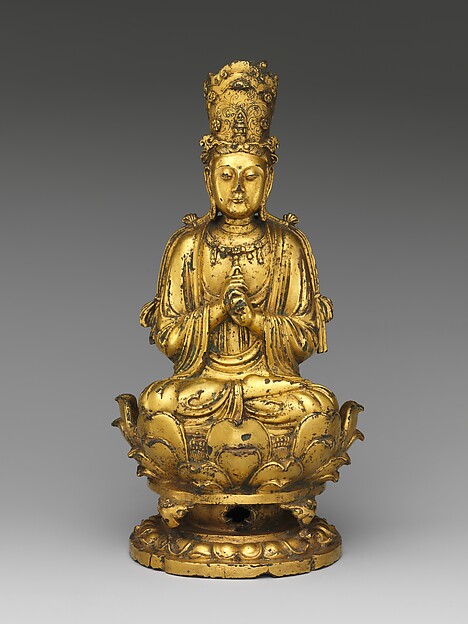
China, Liao dynasty, 11th century. Gilt bronze; lost-wax cast; height 21.9 cm.
Look closer: Look at the hands: the Met reads them as a wisdom fist, with the left hand grasping the right index finger. Then look at the tall pointed headdress and the lotus beneath. This is a Chinese Vairocana of the Liao dynasty, a neighbour of the Japanese figures that follow.
The Metropolitan Museum of Art, Purchase, Lila Acheson Wallace Gift, 2006 (2006.284). Public domain, Open Access.
Inside the Lecture Hall at Tō-ji in Kyoto, twenty-one wooden figures, lacquered and mostly gilded, stand on a central platform in groups, with a seated Buddha at the middle. Kūkai commissioned them as a three-dimensional mandala. Fifteen of the statues date from the early ninth century. The other six replaced figures lost in a fire in 1486, and the central Buddha was rebuilt in 1497 (Japan Tourism Agency multilingual database). He is Dainichi.
The name is a translation. The Sanskrit Mahāvairocana means “Great Sun”, and Dainichi is the Japanese reading of the Chinese characters for it. The shorter Vairocana is glossed in Wikipedia as sun, solar or shining, and elsewhere as radiance or illuminator. Japanese also uses the transliteration Birushana and a longer translation, Dai-Henjō (JAANUS). The Chinese forms are 大日如來 (Dàrì Rúlái, “Great Sun Thus Come One”) and 毘盧遮那佛 (Pílú Zhēnà Fó); the Korean is Birojana Bul, the Tibetan rnam par snang mdzad (Nampar Nangdze), and the Mongolian Biruzana (Wikipedia, “Vairocana”). In the Kegon school he is Rushana, the Buddha of the great image at Tōdai-ji, whom the Birushana chapter follows.
Unlike Shaka, Dainichi did not walk the earth. Wikipedia’s article describes him as the Dharmakāya of all Buddhas, formless, omnipresent, eternal and indestructible, and the source of every manifestation. The Brahmajāla Sūtra places him on a lotus surrounded by a thousand flowers, each bearing a world with its own Shakyamuni, and all these Buddhas have Vairocana as their original body. The Huayan teaching, known in Japan as Kegon, goes further: the universe is his body, and the Lotus Treasury World is his pure land. In Tiantai and Tendai he is identified with the Original Buddha of the sixteenth chapter of the Lotus Sutra. In Shingon, as the next sections show, he is the ground on which everything else is drawn.
The Japanese Architecture and Art Net Users System (JAANUS) says that in Esoteric Buddhism he replaced Shaka as the one who expounds the teaching, and that he is the central figure of both the Womb World and Diamond World mandalas. His fellow Buddhas in this almanac are Amida and Yakushi.
This chapter sits inside the Buddhism and Zen Almanac, on the Nyorai rank. It follows the figure from the Indian scripture to the Heian carvers and the Kyoto and Wakayama sites that still keep him, then to the news of the last few years.
One Buddha, two gestures
Dainichi is among the few Buddhas shown crowned. JAANUS describes him as a seated bodhisattva in silk robes, with armlets, bracelets and long hair, wearing a five-wisdom jewelled crown (gochi hōkan). The crown carries small figures of the five Buddhas of wisdom, because he is identical with the five. He is usually white, the lion is his animal vehicle, and his symbol is the stupa. Butuzou makes the practical point that most Nyorai wear simple robes with no jewellery and plain hair, and that a crowned figure can be taken for a bodhisattva; it advises reading the hands first and the crown second.
The hands carry the doctrine. In the Diamond Realm mandala, the Kongōkai, he makes the knowledge-fist seal, chiken-in: JAANUS gives the right fist over the extended index finger of the left. Wikipedia notes that this form is widely seen in Japanese and Korean Buddhism. In the Womb Realm mandala, the Taizōkai, he makes the Dharma-realm concentration seal, hokkai jōin, with the hands resting in the lap, right over left, palms up and thumbs touching. The Met reads the wisdom fist as the union of the spiritual and material realms and as a restraint on the passions that hinder enlightenment; Butuzou reads the index finger as wisdom, the enclosing fist as method, and the enclosure as integration, not suppression.
Many fine Heian-period Dainichi survive, often enshrined in small pagodas, alone or at the centre of five Buddhas, and images that follow the Kongōkai form predominate among them (JAANUS). The seed syllable is A in the Womb Realm and Vaṃ in the Diamond Realm (Wikipedia, “Vairocana”), and the two together, A-Vaṃ, stand for the pair of mandalas.
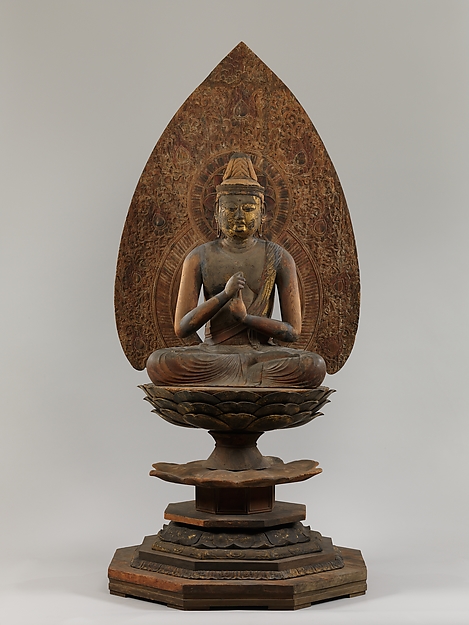
Japan, 12th century. Wood with lacquer and gold leaf; figure height 92.4 cm.
Look closer: Look at the hands at his chest: one closes around the other’s raised finger. Then look at the tall crown, and at the great leaf-shaped halo behind him, which is covered with carved scrolls. The lotus beneath is in two tiers, above an eight-sided base.
The Metropolitan Museum of Art, Rogers Fund, 1926 (26.118a, b). Public domain, Open Access.
| Feature | What it means | Where to look |
|---|---|---|
| Five-wisdom crown | Identity with the Five Wisdom Buddhas | On the head, with five small figures |
| Chiken-in | Knowledge fist; the Diamond Realm form | At the chest, right fist over left finger in the Japanese form |
| Hokkai jōin | Dharma-realm concentration; the Womb Realm form | In the lap, right over left, thumbs touching |
| Bodhisattva dress | A Buddha shown in the finery of a prince | Armlets, bracelets, silk and long hair |
| White body and lion | His colour and animal vehicle | Painted surface; pedestal |
| Stupa | His symbol | A small pagoda beside or above the figure; many Heian images stand inside one |
| Seed syllables | A (Womb Realm), Vaṃ (Diamond Realm) | Written in Siddhaṃ script beside deities in mandala drawings |
A lost Sanskrit original and two diagrams
The scripture behind the Womb Realm is the Mahāvairocana Sūtra, in Chinese Dari jing, whose full Sanskrit title is Mahāvairocanābhisaṃbodhi-vikurvitādhiṣṭhāna-vaipulyasūtrendrarāja-nāma-dharmaparyāya and whose Chinese title is 大毘盧遮那成佛神變加持經. Wikipedia dates its composition to before 674, probably the middle of the seventh century and most likely at Nālandā in north-eastern India. The monk Wuxing, who died in India in 674, sent a manuscript to China decades earlier. The Sanskrit text is lost. What survives is a seven-fascicle Chinese version made in 724 to 725 by Śubhākarasiṃha (637 to 735) and his Chinese disciple Yixing (683 to 727), which preserves the original mantras in Siddhaṃ script, and a Tibetan version completed before 812 by Śīlendrabodhi and Kawa Paltsek.
The text does not call itself a tantra. Wikipedia says the label was applied later by Indian commentators, and that Buddhaguhya, who wrote the major surviving commentary around 760, classed it as a caryātantra, a classification Tibetan Buddhism still keeps. The page calls it the earliest comprehensive manual of tantric Buddhism. Yixing’s commentary, often simply called the Dainichi kyō in Japan, is the most widely used East Asian commentary and is central to both Tendai and Shingon.
Its teaching is that awakening is not a distant prize. Wikipedia’s summary says bodhi is described as inherent in the mind, that enlightenment is the non-dual sphere in which the split between subject and object falls away, and that the mind’s intrinsic nature is itself Mahāvairocana. In Shingon this becomes the doctrine of sokushin jōbutsu, buddhahood in this very body, reached through the three mysteries of body (mudra), speech (mantra) and mind (mandala and meditation). Wikipedia’s account of the sutra also lists four samaya precepts from its second chapter: not to abandon the true Dharma, not to deviate from one’s own enlightened mind, not to withhold the teaching from others, and not to harm any living being.
The second pillar is the Vajraśekhara Sūtra, a compilation of several works made from the end of the seventh century and translated into Chinese around 725 by Vajrabodhi (671 to 741) and his disciple Amoghavajra (705 to 774), whom Wikipedia names as key founders of Chinese Esoteric Buddhism. The Womb Realm is drawn from the first of these texts and the Diamond Realm from the second. Shingon treats the two as complementary; Tendai adds the Lotus Sutra and the Susiddhikāra, so that the Lotus mandala, in which a stupa joins both realms, becomes a third diagram.
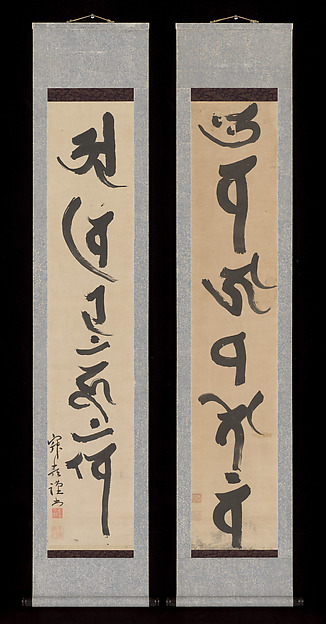
Japan, about 1767 to 1771. Pair of hanging scrolls; ink on paper; each image 124.1 × 24 cm. Calligraphy by Jakugon Taijō.
Look closer: Look at the brushwork: each letter is a single bold, tapering stroke, drawn in the Sanskrit script of the Shingon tradition. The Met titles the pair Mantras of the Two Realms, one scroll for the Womb Realm and one for the Diamond Realm, and names the calligrapher Jakugon Taijō. Find his signature and red seal at the lower left of the left scroll.
The Metropolitan Museum of Art, Purchase, Sue Cassidy Clark Gift, 2025 (2025.296a, b). Public domain, Open Access.
| Text | Date and translators | Realm | Note |
|---|---|---|---|
| Mahāvairocana Sūtra | Before 674; Chinese 724 to 725, Śubhākarasiṃha and Yixing; Tibetan before 812 | Womb (Taizōkai) | Sanskrit original lost; Yixing’s commentary the standard East Asian guide |
| Vajraśekhara Sūtra | Compiled from the late 7th century; Chinese about 725, Vajrabodhi and Amoghavajra | Diamond (Kongōkai) | A compilation of several works, nearer Yogācāra and buddha-nature thought |
| Avataṃsaka (Kegon) Sūtra | Earlier Mahāyāna scripture | Rushana and Tōdai-ji | Vairocana as the cosmic Buddha of the Lotus Treasury World |
| Brahmajāla Sūtra | Mahāyāna scripture | Thousand worlds | Shakyamuni as a manifestation of Vairocana |
Compassion and diamond
Dainichi is rarely shown alone, because he belongs to two paired diagrams. The Womb Realm, Taizōkai, is based on the Mahāvairocana Sūtra and is also called the mandala generated from the womb of great compassion; it depicts Mahāvairocana as a nurturing source of awakening. At its centre an eight-petalled red lotus carries him in regal dress and a jewelled crown, with a Buddha in each of the four directions and a bodhisattva between each pair. The red lotus stands for compassion and the human heart, it blooms and seeds at once, and the eight petals also stand for the eight consciousnesses. Twelve halls radiate outward from it, with an outermost court at the edge. Wikipedia’s outline of the layout has a left block, the Lotus Division Court of Avalokiteśvara, for compassion, and a right block, the Vajra Division Court of Vajrapāṇi, for wisdom (Wikipedia, “Garbhadhatu”).
The Diamond Realm, Kongōkai, is organised in the version Shingon uses as nine assemblies, the kue, based mainly on the Vajraśekhara Sūtra with one panel from the Prajñāpāramitā-naya. The path starts at the central assembly and moves down and to the left; moving outward stands for enlightening others and moving inward from the ninth for enlightening oneself. The sixth is the One Mudra Hall, which shows only Mahāvairocana, in the wisdom fist; the fifth shows him with four vajra bodhisattvas and eight symbols. The Womb Realm stands for compassion and the Diamond Realm for wisdom, and the Shingon principle ryōbu funi, the identity of the two mandalas, holds that they describe one reality. Together they may hold as many as 414 deities.
In Shingon halls the Womb Realm hangs on the east wall and the Diamond Realm on the west. The initiation rite, kanjō, uses them directly: the initiate is blindfolded and tosses a flower on to the mandala, and the place where it lands helps to decide which deity the initiate will follow. Goma fire rituals and the meditations also rest on the pair.
The five Buddhas on the crown are not the same in both worlds, as the table sets out.

Japan, 1083. Handscroll; ink and color on paper; length 542 cm.
Look closer: Every circle holds a single deity drawn in a line as fine as a thread, with the Sanskrit seed syllable written close by. The scroll is nearly five and a half metres long, and what you see is one short section. It is a pattern book for painters of the Diamond World mandala.
The Metropolitan Museum of Art, The Harry G. C. Packard Collection of Asian Art, Gift of Harry G. C. Packard, and Purchase, Fletcher, Rogers, Harris Brisbane Dick, and Louis V. Bell Funds, Joseph Pulitzer Bequest, and The Annenberg Fund Inc. Gift, 1975 (1975.268.3). Public domain, Open Access.
| Mandala | The five Buddhas | Gesture of Dainichi |
|---|---|---|
| Kongōkai, Diamond Realm | Dainichi, Ashuku, Hōshō, Amida, Fukūjōju | Wisdom fist |
| Taizōkai, Womb Realm | Dainichi, Hōtō, Kaifukeō, Muryōju, Tenkuraion | Dharma-realm seal in the lap |
From Nālandā to Kōyasan: a timeline
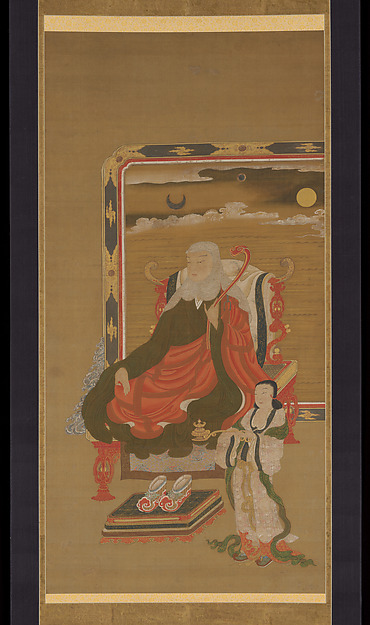
Japan, early 18th century. Hanging scroll; ink, color, and gold on silk; image 117.2 × 58.1 cm.
Look closer: Look at the chair: carved and Chinese in style, an unusual seat for a Japanese patriarch. This is an imagined portrait of Saichō, who sailed with Kūkai in 804 and founded Tendai, the school that borrowed and rivalled his esoteric teaching.
The Metropolitan Museum of Art, Mary and Cheney Cowles Collection, Gift of Mary and Cheney Cowles, 2020 (2020.396.6). Public domain, Open Access.
The history of Dainichi in Japan is the history of an import that the court wanted, a school that was founded around it, and a rivalry that shaped two. The timeline below sets down what the pages I read say, in order, and keeps the disagreements for the fact boxes.
- Mid-7th century, IndiaThe Mahāvairocana Sūtra is composed, probably at Nālandā (Wikipedia). The Vajraśekhara follows from the end of the century.
- 724 to 725Śubhākarasiṃha and Yixing complete the Chinese version of the sutra; Vajrabodhi and Amoghavajra translate the Diamond Realm texts at about the same time (Wikipedia).
- Nara period, 710 to 794Earlier esoteric texts and dharani already circulate in Japan, a period the scholar Ōya Tokujō called nanmitsu (Wikipedia, “Mikkyō”).
- 804 to 806Kūkai sails to China with Saichō, meets Huiguo at Qinglong Monastery in 805, and returns in 806 with texts, paintings and the two mandalas (Wikipedia, “Kūkai”).
- 809 to 823Kūkai lives at Takaosan-ji, now Jingo-ji, on the court’s order, and presides over initiations there in 812; Saichō is given only the first two levels, and the quarrel that follows is never healed.
- 816 to 819Emperor Saga approves a mountain retreat at Kōya, and the ground is consecrated in 819. Kūkai envisions the mountain as a physical mandala (Wikipedia).
- 823Kūkai is given Tō-ji and the exclusive right to use it for Shingon, the first use of the term Shingon-shū.
- 835Kūkai dies on Kōya on 22 April and is entombed on the eastern peak. His faith holds that he remains in meditation there until Miroku comes.
- 10th and 11th centuriesKangen (853 to 925) raises Tō-ji to head-temple status; Kōya declines until the 11th century, when Fujiwara no Michinaga supports its recovery (Wikipedia, “Shingon Buddhism”).
- 1095 to 1143Kakuban blends Pure Land practice into Shingon, clashes with Kongōbu-ji, and his followers move to Negoro. His successor Raiyu’s faction later founds Shingi Shingon, which divides the school into Kogi and Shingi branches.
- 1176Unkei finishes the Enjō-ji Dainichi in Nara, on 19 October (Wikipedia, “Dainichi Nyorai (Enjō-ji)”).
- 13th and 14th centuriesDōhan (1178 or 1179 to 1252) promotes “esoteric Pure Land” culture; Shunjō and Eison lead a revival at Saidai-ji; Yūkai (1345 to 1416) revives doctrinal study.
- 1486 to 1497Fire destroys the Dainichi and other figures in the Tō-ji Lecture Hall; the Dainichi is rebuilt in 1497 (Japan Tourism Agency database).
- 1585Toyotomi Hideyoshi sacks Negoro; Kōya submits and is spared (Wikipedia).
- 1615Tokugawa Ieyasu issues regulations that place Shingon in the administrative temple system.
- 1868 and afterThe Meiji separation of Buddhism from Shinto and the persecutions that follow reshape the temples; “one sect, one leader” is imposed, and Shingon schools are merged into the Dai-Shingon sect in March 1941, later splitting again (Wikipedia).
- 1912 to 1949Shingon reaches America: the Koyasan Beikoku Betsuin in Los Angeles is founded in 1912, the Hawaii Shingon Mission built in 1915 to 1918, and Henjyoji in Portland established in 1949.
- 1984Fifty thousand statues are donated at Okunoin for the 1150th anniversary of Kūkai’s burial.
- 1994 and 2004UNESCO lists Tō-ji in 1994 and the Kii mountain sites, including Kōyasan, in 2004.
- 2008 and afterA Dainichi attributed to Unkei is sold at Christie’s in New York in March 2008; the Tokyo National Museum shows the Enjō-ji Dainichi in 2017; the Kōyasan Reihokan stages an Okunoin exhibition from October 2025 to January 2026.
The man who carried the diagram home
Kūkai was born on 27 July 774 at Zentsū-ji in Sanuki Province, on Shikoku, into the Saeki family, a branch of the Ōtomo clan. His birth name was probably Saeki no Mao. At fifteen he studied the Chinese classics under his maternal uncle; by 791 his family’s fortunes had fallen after the assassination of Fujiwara no Tanetsugu, and he studied at the university in Nara before turning from Confucian studies to Buddhism. At about twenty-two he practised chanting the mantra of Kokūzō, the bodhisattva of the void, in mountain regions, and at twenty-four he published Sangō Shiiki (Wikipedia, “Kūkai”).
He travelled to China in 804 on a government mission, though he was a privately trained monk, and scholars are unsure why he was chosen. Four ships sailed. Kūkai’s was the first and Saichō’s the second; the third turned back in a storm and the fourth was lost. At the Tang capital he studied Sanskrit with the pandit Prajñā, and in 805 he met Huiguo (746 to 805) at Qinglong Monastery. Wikipedia says he had expected to stay about twenty years but became a master within months. Huiguo died soon after, urging him to spread the teaching in Japan, and Kūkai returned in 806 as the eighth patriarch of Esoteric Buddhism.
What he did next was practical. In 809 the court ordered him to live at Takaosan-ji. He became administrative head of Tōdai-ji in 810, performed rituals to protect the state, and in 812 gave public initiations. In 821 he restored the Mannō Reservoir, which Wikipedia calls Japan’s largest irrigation reservoir. In 828 he opened the Shugei Shuchi-in, a private school open to all regardless of rank, which taught Buddhism, Daoism and Confucianism and offered free meals. It closed ten years after his death. He completed his major work, the Jūjūshinron, the treatise on the ten stages of the development of mind, in 830, and he was a recognised master of Chinese calligraphy and poetry and of Siddhaṃ script.
He fell ill in 831, retired to Kōya in late 832, and near the end stopped eating and drinking and meditated deeply. He died at midnight on the 21st day of the third month of 835. He was not cremated but entombed, as he had willed. Shingon believers say he remains in samadhi, and monks bring him meals twice a day.
The quarrel with Saichō
In 812 Saichō asked for initiation. Kūkai gave him the introductory and second levels but refused the final one, because Saichō had not completed the required studies. Wikipedia says the feud was never resolved and later extended to the two schools. Tendai’s esotericism, Taimitsu, and Shingon’s, Tōmitsu, developed in competition and influenced each other: Shingon focuses almost exclusively on esotericism, while Tendai treats the esoteric and exoteric as complementary (Wikipedia, “Mikkyō”).
Legends and the birthday
The Shingon commemoration of his birth falls on 15 June, a date designated centuries later from the lunar calendar. Wikipedia records that popular belief ascribes to him the invention of the kana syllabary and the Iroha poem, a legend the Mikkyō article calls apocryphal. His honorific is Kōbō Daishi, and followers call him Odaishi-sama; the mantra Namu daishi henjō kongō, in which Henjō Kongō is his religious name, is possibly the work of Dōhan (1178 to 1252).
Several figures from the story of his arrival at Kōya appear in the paintings of later centuries: Niu Myōjin, the mountain’s female kami, who is said to have given him leave to build, and her male counterpart Kariba. The Met’s catalogue notes that two dogs, one black and one white, with their master Kariba are said to have guided Kūkai to the remote site.
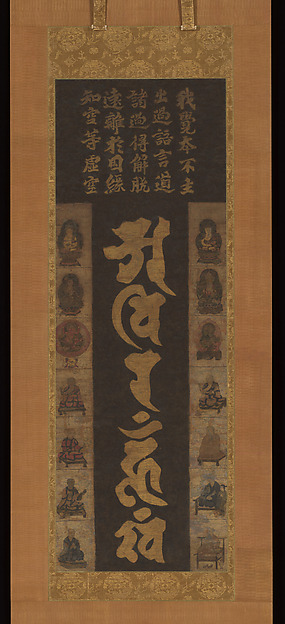
Japan, 13th to 14th century. Hanging scroll; ink, colors, and gold on silk; image 101 × 34.9 cm.
Look closer: Look at the three great gold letters at the centre, which stand in place of a figure and are the mandala itself. Then look at the narrow columns on either side, where small seated masters and deities are painted one above the other. The Met titles it a mandala in Sanskrit with Buddhas, bodhisattvas and the eight patriarchs of the Shingon sect.
The Metropolitan Museum of Art, Purchase, Sue Cassidy Clark Gift, in memory of Koichi Yanagi, 2024 (2024.410). Public domain, Open Access.
Small facts worth the detour
- Four ships sailed for China in 804. Kūkai’s was the first and Saichō’s the second; the third turned back in a storm and the fourth was lost (Wikipedia, Kūkai).
- The Mahāvairocana Sūtra is not called a tantra in its own text; Indian commentators applied the label later, and Buddhaguhya classed it about 760 as a caryātantra (Wikipedia).
- In the Diamond Realm the sixth assembly, the One Mudra Hall, shows only Mahāvairocana, in the wisdom fist (Wikipedia).
- Kūkai restored the Mannō Reservoir in 821, which Wikipedia calls Japan’s largest irrigation reservoir, and in 828 opened a private school that taught Buddhism, Daoism and Confucianism and offered free meals (Wikipedia).
The doctrine’s road across Asia
Vairocana appears across Asia in the largest images ever made and in some of the smallest. The rows record the road of the scripture and the forms given in the sources I read.
| Where | Form and name | What the record shows |
|---|---|---|
| India | Vairocana, Mahāvairocana | The central esoteric text is the Vairocanābhisaṃbodhi Sūtra, composed before 674, probably at Nālandā. The Sanskrit is lost. |
| China | Dà Rì Rú Lái (大日如來); Pí Lú Zhē Nà Fó (毘盧遮那佛) | Esoteric Buddhism arrives through Śubhākarasiṃha, Vajrabodhi and Amoghavajra. The Spring Temple Buddha in Lushan County, Henan, was completed on 29 September 2008. |
| Tibet | rnam par snang mdzad (Nampar Nangdze) | The Tibetan translation of the Mahāvairocana Sūtra was completed before 812; Buddhaguhya’s commentary survives only in Tibetan. |
The sun among the Buddhas
Among the Nyorai Dainichi is the central deity of Esoteric Buddhism, where, JAANUS says, he replaces Shaka as the one who expounds the teaching. In the Thirteen Buddhas he presides over the twelfth anniversary of a death. The five Buddhas on his crown are the key to the structure: in the Diamond Realm they are Dainichi himself with Ashuku, Hōshō, Amida and Fukūjōju. The Met’s catalogue calls Fudō Myōō his wrathful avatar, and the wisdom kings of the Lecture Hall stand to his west, each an aspect of one of the five Buddhas.
| Memorial occasion | Figure | Role |
|---|---|---|
| 2nd anniversary | Amida Nyorai | The Western Pure Land |
| 6th anniversary | Ashuku Nyorai | The sixth-anniversary Buddha |
| 12th anniversary | Dainichi Nyorai | The Great Sun, centre of the two mandalas |
| 32nd anniversary | Kokūzō Bosatsu | The last of the thirteen |
Where to see him
| Place | What to look for |
|---|---|
| Tō-ji Lecture Hall, Kyoto | The central Dainichi among twenty-one figures arranged as a three-dimensional mandala; the second chapter, Dainichi in Japan, walks through it. |
| Jingo-ji, Kyoto | Kūkai’s base from 809 and the temple of the Takao Mandala, a faithful copy of the lost root mandala; the temple holds sixteen National Treasures (Wikipedia). |
| Metropolitan Museum of Art, New York | A twelfth-century wooden Dainichi, a Liao-dynasty gilt-bronze Vairocana, and a 1083 scroll of Diamond World deities, all in the public domain. |
Two small bronzes from Java
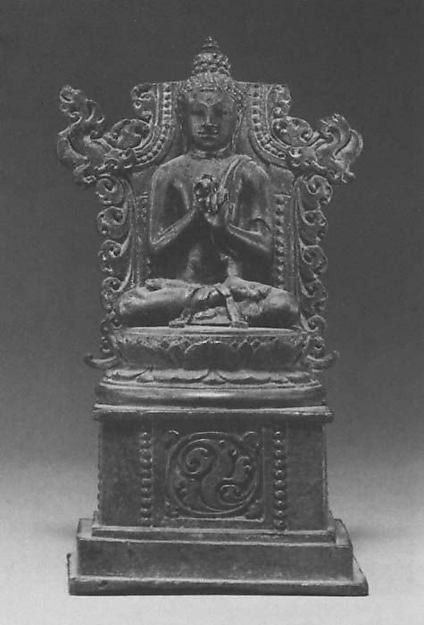
Indonesia (Java), about the second half of the 10th century. Silver figure; bronze pedestal and throne back; height 10 cm.
Look closer: Look at the right hand raised in the gesture that allays fear, and the left in a meditation pose; the Met reads the pair as the sign of Vairochana. Then look at the throne back behind the figure, which rises to a pointed arch.
The Metropolitan Museum of Art, Samuel Eilenberg Collection, Gift of Samuel Eilenberg, 1987 (1987.142.13). Public domain, Open Access.
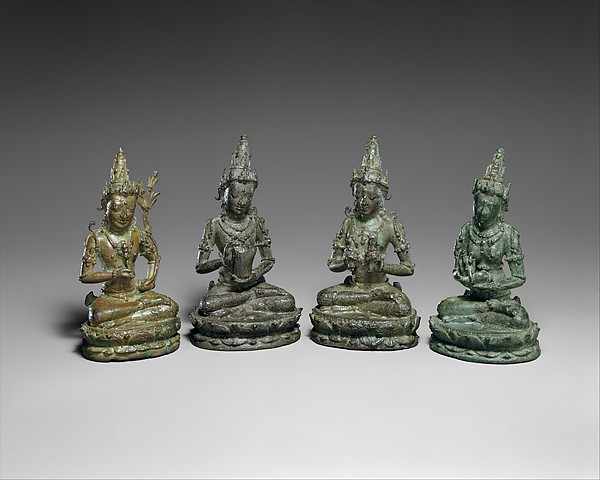
Indonesia (Java, Nganjuk), 10th to 11th century. Bronze; height about 8.9 cm each.
Look closer: Look at the high pointed headdresses and the different hand gestures of each of the four, which the Met catalogues as parts of a Diamond World mandala group. They are each about 9 cm tall and were made in East Java.
The Metropolitan Museum of Art, Samuel Eilenberg Collection, Gift of Samuel Eilenberg, 1987 (1987.142.5, .7–.9). Public domain, Open Access.
In the house
The house keeps pieces that carry the Great Sun. The strip below reads the live shelves, so it shows what is available now.
A short dictionary of the doctrine
Terms are given in Japanese with the Sanskrit or Chinese root where the sources supply one.
- Dainichi (大日)
- The “Great Sun”; Japanese reading of Mahāvairocana.
- Birushana (毘盧遮那)
- The transliteration of Vairocana, used of the Kegon Buddha.
- Taizōkai (胎蔵界)
- The Womb Realm mandala, based on the Mahāvairocana Sūtra.
- Kongōkai (金剛界)
- The Diamond Realm mandala, based on the Vajraśekhara Sūtra.
- Ryōkai mandara (両界曼荼羅)
- The pair of Womb and Diamond mandalas.
- Ryōbu funi (両部不二)
- The Shingon teaching that the two mandalas describe one reality.
- Chiken-in (智拳印)
- The knowledge-fist seal of the Diamond Realm Dainichi.
- Hokkai jōin (法界定印)
- The Dharma-realm concentration seal, hands in the lap.
- Gochi hōkan (五智宝冠)
- The five-wisdom crown, with the five Buddhas.
- Sokushin jōbutsu (即身成仏)
- Buddhahood in this very body.
- Sanmitsu (三密)
- The three mysteries of body, speech and mind: mudra, mantra and mandala.
- Kanjō (灌頂)
- Abhiṣeka, the initiation in which a flower is tossed on to the mandala.
- Tōmitsu (東密) and Taimitsu (台密)
- The esoteric teachings of Shingon (Tō-ji) and of Tendai.
Answered plainly
What does Dainichi mean?
Dainichi is the Japanese reading of the Chinese characters for Mahāvairocana, the “Great Sun”. The shorter Vairocana is glossed as the sun, solar or shining.
How do I recognise a Dainichi statue?
Look for a Buddha dressed as a bodhisattva, with a five-wisdom crown, silk robes, armlets and bracelets. The Diamond Realm form makes the wisdom fist at the chest; the Womb Realm form rests the hands in the lap, right over left, thumbs touching. Check the hands before the crown.
What are the Womb and Diamond mandalas?
The Womb Realm, based on the Mahāvairocana Sūtra, shows him on a central lotus as the source of compassion. The Diamond Realm, based on the Vajraśekhara Sūtra, shows him as wisdom. Shingon teaches that the two describe one reality.
Are Dainichi and Birushana the same?
Both names render the same Sanskrit name. Dainichi is the Japanese reading of the meaning, “Great Sun”; Birushana is a transliteration. In Esoteric Buddhism he is Dainichi, and in Kegon he is Rushana.
Which memorial service belongs to Dainichi?
In the Thirteen Buddhas sequence he presides over the twelfth anniversary of a death.
Who brought the mandalas to Japan?
Kūkai returned from China in 806 with texts, paintings and the two mandalas. Wikipedia’s Mikkyō article adds that some esoteric material was in Japan before him.
Where next
Sources and image credits
- The Metropolitan Museum of Art, object 44838
- The Metropolitan Museum of Art, object 73200
- The Metropolitan Museum of Art, object 44845
- The Metropolitan Museum of Art, object 845127
- The Metropolitan Museum of Art, object 38285
- The Metropolitan Museum of Art, object 921040
- The Metropolitan Museum of Art, object 912998
- Wikipedia, Mikkyō
- Wikipedia, Vairocana (names, mudras, scriptures, monuments)
- Wikipedia, Mahāvairocana Sūtra (Vairocanābhisaṃbodhi)
- Wikipedia, Womb Realm (Garbhadhātu)
- Wikipedia, Diamond Realm
- Wikipedia, Kūkai
- Wikipedia, Shingon Buddhism
- Wikipedia, Tō-ji
- Wikipedia, Mount Kōya
- Wikipedia, Okunoin
- Wikipedia, Jingo-ji
- Wikipedia, Unkei
- Wikipedia, Dainichi Nyorai (Enjō-ji)
- Wikipedia, Honji suijaku
- Wikipedia, Spring Temple Buddha
- Wikipedia, Mendut
- Japanese Architecture and Art Net Users System, Dainichi
- Japan Tourism Agency multilingual database, the three-dimensional mandala at Tō-ji
- Tō-ji, Lecture Hall
- Butuzou, How to identify Dainichi Nyorai: key differences
- Butuzou, Chiken-in mudra
Last reviewed 29 October 2026. Pictures are public-domain or openly licensed, each credited beneath it. Diagrams on this page are drawn by Japonista.
Looking for a Dainichi, a mandala scroll, or a small altar piece for a home shrine? Tell us what you have in mind and we will look.
Private concierge
Looking for something in particular?
Describe the piece or the project you have in mind. A senior advisor in Tokyo reads every case file personally and replies within two business days, with fees set out in writing before any work begins.