
Shaka Nyorai
The Historical Buddha
Shaka Nyorai
釈迦如来
A prince who left his palace, a teacher who never claimed to be a god, and the figure from whom every other Buddha in Japan descends: his names, the quarrel over his dates, and his life told scene by scene from Lumbini to Kushinagar.
Identity card
Know him at a glance
- The ushnisha. A rounded rise on the crown of the head, the thirty-second of the classic thirty-two marks of a Buddha.
- The urna. A small white tuft or dot between the brows, the thirty-first mark, described in the texts as white as cotton.
- The raised right hand. Semui-in, the gesture of fearlessness: palm out, fingers up, at chest height.
- The lowered left hand. Yogan-in, the wish-granting gesture. In Japan the two hands together are called “the form common to Buddhas”.
- A monk’s plain robe. No crown and no jewels. The bodhisattvas beside him wear the finery of princes; he does not.
A child in a basin
On the eighth of April, in temples across Japan, a bronze child no taller than a man’s hand is set in a shallow basin beneath a little canopy of flowers. Worshippers file past and pour sweet hydrangea tea over his head. His right arm points to heaven and his left to earth. This is Shaka in the moment after his birth, and the ceremony, the kanbutsue, is now more often called hanamatsuri, the flower festival. The Japanese Architecture and Art Net Users System (JAANUS) notes that the rite may go back to the seventh century and that statuettes of this kind, five to twenty centimetres tall, are common precisely because the rite requires them.
The child grows into the figure this page follows. Shaka Nyorai is the Japanese form of Śākyamuni, “sage of the Shakya clan”, the historical Buddha. Nyorai is the rank of a Buddha, the counterpart of the Sanskrit tathāgata, the word the Buddha is recorded as using of himself. Of all the Buddhas on the Nyorai page, he alone walked on earth, and that is why Japanese devotion treats him less as a distant presence than as a teacher whose life can be followed scene by scene.
This page is the first of four on the Buddha. It takes his life: the names, the quarrel over his dates, the life in the order the texts tell it, and the death and the relics. Shaka: Image, Sutras and Schools reads the way an image of him is made, the company he keeps in a temple hall, the scriptures that speak in his voice and the schools that read him differently. Shaka in Japan follows his images and his birthday through the temples that keep them: the first Buddha across the sea, the triad of Hōryū-ji, the bathing of April, the walking Buddha of Saga and the giant tea bowl of Saidai-ji. Shaka: Nirvana, Awakening and Relics takes the great pictures of his death, the gaunt man on the mountain, the bones in Nagoya and his place in print and on the stage.
The four sit inside the Buddhism and Zen Almanac. His sibling Buddhas are Amida, Dainichi and Yakushi; the two bodhisattvas who usually flank him are Monju and Fugen. For the deeper background of the faith he founded, the Roots chapter The Buddha and the Roots starts at Lumbini.
A title, a clan and a date nobody can fix

Japan, Nanbokuchō period, 14th century. Hanging scroll; ink, color and gold on silk; image 128.3 × 53.3 cm.
Look closer: Look at the raised right hand, which the Met reads as the preaching gesture linked to turning the wheel of the Law, and at the double disk halo behind the head. The painter has placed the whole figure on a lotus above a tiered hexagonal pedestal and kept the pose strictly frontal and symmetrical.
The Metropolitan Museum of Art, H. O. Havemeyer Collection, Gift of Horace Havemeyer, 1929 (29.160.31). Public domain, Open Access.
Almost none of the words applied to him is a personal name. Wikipedia’s article on the Buddha gives the sequence. Siddhārtha (Pali Siddhattha) is the given name and Gautama (Pali Gotama) the clan name. Buddha, “Awakened One”, is a title, and its earliest attestation is in the third century BCE. Śākyamuni, “Sage of the Shakyas”, names the clan to which he belonged. Tathāgata is the term he most often used for himself, and the article says its meaning is uncertain. Other epithets the same page lists are Bhagavato, “Blessed One”, Sammasambuddho, “Perfectly self-awakened”, Sugata, Lokavidu and Araham.
Each Buddhist country has its own rendering. The article records Dhondup in Tibetan, Xidaduo in Chinese and Siltalta in Korean, glossed as “He Who Achieves His Goal”, and notes that “Buddha” or “Sakyamuni” is used in China, Korea, Japan and Tibet while “Gotama Buddha” or “Samana Gotama” is used in Sri Lanka and Southeast Asia. In Japan the working names are Shaka (the shortened Śākya), Shakamuni, and the honorific Shakuson, “the Venerable Shaka”. Together with Nyorai they give the form used on a temple board: Shaka Nyorai.
The dates are a harder matter. The infobox gives birth c. 563 or 480 BCE and death c. 483 or 400 BCE, at the age of eighty. Behind these figures lie several chronologies, set out in the fact box below. What matters for the reader of a statue is that none of this is needed to read it. The Japanese images are made to the canon of the marks, not to a calendar year.
From Lumbini to the river

Japan, Muromachi period, early 15th century. Section of a wall panel mounted as a hanging scroll; ink, color and gold on silk; image 74.9 × 110.5 cm.
Look closer: Look at the great roof that fills the lower half of the panel, and at the small cloud in the dark sky above it. The Met reads the figure as the departure from the palace and says the two women inside, who may be Yaśodharā and her attendant, are “problematic” to identify.
The Metropolitan Museum of Art, Gift of Alvin E. Friedman-Kien, 1993 (1993.478.5). Public domain, Open Access.
Buddhist tradition, as the Wikipedia article summarises it, fixes the life at four places. He was born at Lumbini, in present-day Nepal, to royal parents of the Shakya clan. He reached awakening at Bodh Gaya in Bihar. He preached his first sermon at Sarnath, near Varanasi. He died at Kushinagar, in modern Uttar Pradesh. A pillar inscription of the mid-third century BCE, set up by Ashoka at Lumbini, marks the birthplace. The site of his childhood home, Kapilavastu, is not certain; it may be Piprahwa in India or Tilaurakot in Nepal.
His father, Śuddhodana, had been elected chief of the Shakya clan, and his mother was Māyā, who in later biographies comes from Devadaha. Legend says that a white elephant with six white tusks entered her side and that the birth followed ten months later. A hermit named Asita examined the child for the thirty-two marks of a great man and predicted that he would be either a great king or a great religious leader. At the naming ceremony on the fifth day eight Brahmin scholars gave similar predictions, and only one of them, Kaundinya, foretold Buddhahood without qualification. The texts give him a wife, Yaśodharā, and a son, Rāhula.
The Met’s Muromachi panel of the birth shows what the Japanese painter chose to keep. Queen Māyā grasps a tree branch as she walks through the gardens of Lumbini and the baby emerges from her side. Heavenly musicians play and throw flowers. The newborn takes seven steps marked by lotus flowers and, raising his right hand, declares, in the Met’s translation, “Among all divine beings, only I am lord, most holy and victorious.” Dragons give him his first bath. That is the gesture, and the bath, which the festival of April repeats.
The story of departure is told through four sights, and the version known today comes from the Nidānakathā of the fifth century CE. The young prince, kept in a sheltered life of plenty, rides out and meets an old man, a sick man, a corpse and an ascetic. Wikipedia notes that the story seems to be adapted from an earlier account of a former Buddha, Vipassī, in the Dīgha Nikāya, and that the oldest sources give a plainer motive: concern with old age, disease and death. The Met’s second Muromachi panel shows the four sights with an unusual change. A birth scene replaces the encounter with the ascetic, a variation the catalogue calls rare and likely to rest on the Lotus Sutra, which preaches four essential sufferings.
He left at night with the charioteer Chandaka and the horse Kanthaka and cut his hair at the river Anomiya. He studied under two teachers, Ārāḍa Kālāma and Udaka Rāmaputta, mastered what each could give him, and left both. The Met’s note on a Muromachi scroll gives the age at departure as twenty-nine and the years of austerity as six, and Wikipedia’s account of the ascetic period describes minimal food, breath control and forceful control of the mind, until the texts describe him as severely emaciated. The turning point was small. He accepted milk and rice pudding from a woman named Sujātā, and the five companions who had practised beside him left in disgust.

Japan, Muromachi period, early 15th century. Section of a wall panel mounted as a hanging scroll; ink, color and gold on silk; image 75.2 × 110.8 cm.
Look closer: Find Queen Māyā at the right with her hand on the branch, then look to the left, where musicians and flower-throwers fill the garden. The dragons are in the sky at the top: the Met reads them as giving the newborn his first bath, the origin of the amacha ladled over his statuette every April.
The Metropolitan Museum of Art, Gift of Alvin E. Friedman-Kien, 1993 (1993.478.1). Public domain, Open Access.

Japan, Muromachi period, early 15th century. Section of a wall panel mounted as a hanging scroll; ink, color and gold on silk; image 74.6 × 111.4 cm.
Look closer: Look at the palace on the right, in the Chinese manner of the Muromachi painters, and at the carriage on the left: this is the prince’s excursion beyond the gates. In the lower right corner the painter has put a birth scene where the canon places the ascetic, the substitution the Met calls rare.
The Metropolitan Museum of Art, Gift of Alvin E. Friedman-Kien, 1993 (1993.478.2). Public domain, Open Access.
The tree, the sermon and the rains
He sat beneath a pipal tree at Bodh Gaya, the tree now called the Bodhi tree, and rose awake. The texts say he stayed there seven days. Legends describe Māra, the tempter, sending his daughters and armies of monsters, and the Buddha calling the earth itself to witness his merit. Kawanabe Kyōsai’s album leaf in the Met, painted about 1888, shows the attack with a flaming dragon, a cave and a gesture that the Met says depart from convention. Then, in the account of the Ariyapariyesanā Sutta, the god Brahmā Sahampati begged him to teach, and he agreed.
He walked to the Deer Park at Sarnath and preached to the five ascetics who had left him. Kaundinya, the same Brahmin who had foretold his Buddhahood, became the first arhat and the first monk. The second discourse taught the mark of not-self, the third, at Gayāsīsa hill, the discourse on fire. Converts followed: Yasa and his family, then three brothers of the Kassapa family with five hundred followers. By the end of the first rainy season there were about sixty awakened monks. Wikipedia says he spent forty or forty-five years teaching on the Gangetic plain.
Two lines of followers matter to the Japanese images. The chief disciples Sāriputta and Mahāmoggallāna had been students of another teacher, Sañjaya Belaṭṭhaputta, and were won over by Assaji. Ānanda, the Buddha’s cousin, would serve him for decades, and Rāhula joined the order as a monk. A cousin, Devadatta, led a schism late in life. Patrons gave shelter. King Bimbisara of Magadha gave a bamboo grove, and the merchant Anāthapiṇḍika gave the Jetavana grove. The Met’s eighth-century scroll, the earliest East Asian painting in its collection, shows the Buddha, with the halo of enlightenment around his head, preaching to Bimbisara. The Muromachi panel of the same king’s conversion adds Vulture Peak, flying heavenly beings and the Four Guardian Kings flanking the king.
He also founded the order of nuns. His stepmother, Mahāprajāpatī Gautamī, was its first member. The Buddha at first refused her request; Ānanda argued the case, and she was ordained with the acceptance of eight special rules. Wikipedia reports that the scholar Anālayo reads the original worry as one of protection for women who would be travelling outside the care of male relatives. The matter is disputed, and I record it only as the way the sources say it.
A contest in the Muromachi cycle shows how the Japanese painter handled a scene of rivalry. The Met’s fourth panel illustrates the competition of magical power between the heretic Raudrākṣa and the Buddha’s disciple Śāriputra, two of the six contests shown at the right: Śāriputra’s wind blows down the tree his opponent has made, and an elephant of his making drinks up a flood. At the left the Buddha’s Law is shown as a still gathering, because the defeat of the heretic is its testimony.

Kawanabe Kyōsai, Japan, ca. 1888. Album leaf mounted as a hanging scroll; ink and color on silk; 36.8 × 27.9 cm.
Look closer: Look at the flames that surround the seated figure and at the dragon coiled beneath him: the Met says the flaming dragon, the cave setting and the gesture all depart from the convention for this scene. The Met reads the scene as Māra’s attack on the Buddha, which he withstands.
The Metropolitan Museum of Art, Charles Stewart Smith Collection, Gift of Mrs. Charles Stewart Smith, Charles Stewart Smith Jr., and Howard Caswell Smith, in memory of Charles Stewart Smith, 1914 (14.76.61.51). Public domain, Open Access.

Japan, Nara period, mid-8th century. Handscroll section mounted as a hanging scroll; ink and color on paper; image 25.7 × 27.3 cm.
Look closer: Look first at the haloed Buddha at the upper left, then at the royal listener, King Bimbisara, below him. The Met calls this the earliest example of East Asian painting in its collection and notes a first attempt at three dimensions in the receding contour lines and alternating light and dark colour. Below the picture, the columns of text carry the sutra itself.
The Metropolitan Museum of Art, Purchase, Louis V. Bell, Harris Brisbane Dick, Fletcher, and Rogers Funds and Joseph Pulitzer Bequest; The Vincent Astor Foundation and Mary and James G. Wallach Foundation Gifts, 2016 (2016.19). Public domain, Open Access.
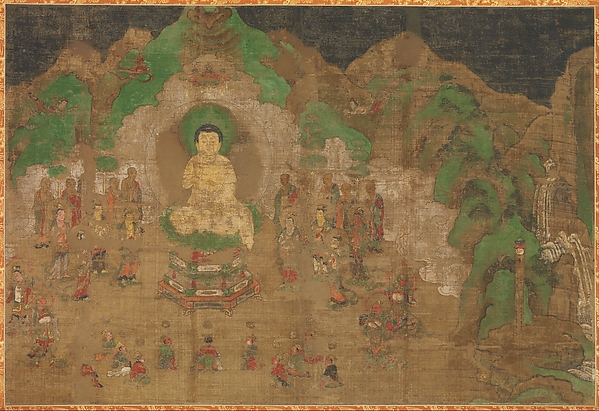
Japan, Muromachi period, early 15th century. One of a cycle of eight scenes; ink, color and gold on silk; image 75.2 × 110.8 cm.
Look closer: Look at the Buddha seated on his lotus pedestal at the centre, his right hand raised in the teaching gesture. The Met reads the scene as the conversion of King Bimbisara at Vulture Peak, with the Four Guardian Kings beside the king and small golden wheels above, which stand for the Dharma.
The Metropolitan Museum of Art, Gift of Alvin E. Friedman-Kien, 1993 (1993.478.4). Public domain, Open Access.

Japan, Muromachi period, early 15th century. Section of a wall panel mounted as a hanging scroll; ink, color and gold on silk; image 74.6 × 110.5 cm.
Look closer: Look at the Buddha at the left, shown as an icon in his halo, and then at the right side, where the Met finds two of the six contests of power: a wind that fells a tree, and an elephant that drinks a flood. The painter turns a story of magic into a lesson about the Law.
The Metropolitan Museum of Art, Gift of Alvin E. Friedman-Kien, 1993 (1993.478.3). Public domain, Open Access.
Kushinagar and the eight monuments
The death is the best documented moment of the life. The Mahāparinibbāna Sutta, number 16 of the Dīgha Nikāya, is the longest sutta of the Pali Canon, and Wikipedia calls it the principal source in most standard studies of the Buddha’s life. It opens a few days before a rainy retreat, when the minister Vassakāra visits the Buddha at Rājagaha on behalf of King Ajātasattu of Magadha. It follows him on the road. It records his passing, the cremation and the division of the relics, and it ends with the building of eight monuments over them. The same article cites Oskar von Hinüber, who proposes that it was composed no later than 350 to 320 BCE, which on the short chronology would be about sixty years after the events; he adds that the text was intended more as hagiography than as exact record. The scholar Bareau, in the same article, holds that the oldest core is the death at Kushinagar and the rites that followed, and that the long additions around it are later.
The event itself, parinirvāṇa, is “final release from conditioned existence”. The Buddha died at Kushinagar, in the Malla republic, at the age of eighty. The texts speak of back pain in old age. The reason for his death is not given in the Wikipedia article, and I leave it unstated. The Mahāyāna Nirvana Sutra mentions only his illness and the meal that Cunda offered on the day of death. The much later Mahāyāna Mahāparinirvāṇa Sūtra, which dates to the second century CE or later, takes the event as a springboard for a different doctrine, and describes nirvāṇa as the realm of the Eternal, Bliss, the Self and the Pure.
Art found a form for it. The Gandhāran relief in the Met, of the third century, shows the Buddha lying on his right side on a couch, with his head resting on his hand and mourners above and below. Later East Asian painters, as the Met’s Japanese scroll of the fourteenth century explains, filled the same moment with a cosmic grief. The Buddha faces west in a final trance. His body is golden and bears the marks. Bodhisattvas show solemn serenity in princely dress, except Jizō, who appears as a monk holding a jewel near the centre of the bier. Shaven-headed disciples weep bitterly. Multi-armed gods and guardians, converted to the Buddhist cause, mourn too, as do men and women of every class and more than thirty animals. Queen Māyā descends weeping from the upper right, and the blossoms of the sala trees change colour. The depth of each figure’s grief reflects the level of his or her understanding.
The relics are the other half of the story. Wikipedia’s account says the Buddha’s body was cremated and the ashes divided among his followers. The earliest stupa known from excavation is the relic stupa at Vaishali in Bihar, whose relics were later removed and may have been redistributed by Ashoka. The Mauryan emperor Ashoka reigned from about 269 to 232 BCE, and his edicts of the middle of that century mention the Buddha and Buddhism. At Piprahwa, in Uttar Pradesh, an engineer named William Caxton Peppé dug into a stupa on his estate in 1898 and found a soapstone urn of bone fragments, buried with about 1,800 jewels in about 240 to 200 BCE, according to The Art Newspaper. The Nittai-ji temple page says the urn’s inscription is thought to date to about the third century BCE; archaeologists took the bones to be a share of the Buddha’s remains. The rest of that story, which runs through Bangkok to a hall in Nagoya and then to the return of the jewels to India in 2025, is told on Shaka: Nirvana, Awakening and Relics.
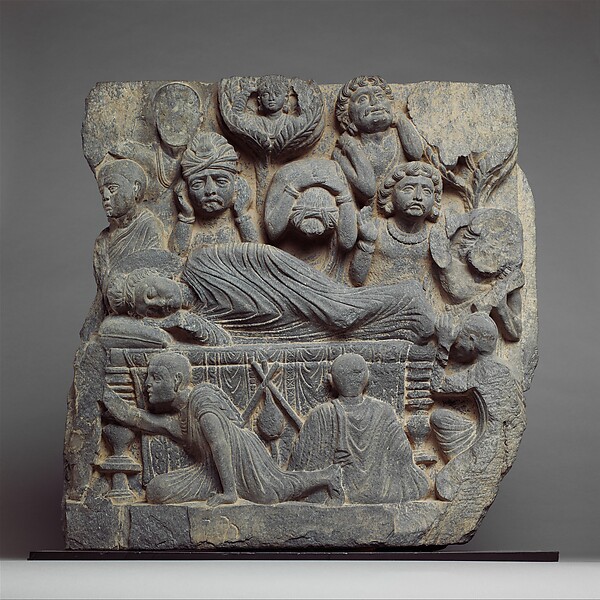
Pakistan (ancient region of Gandhara), ca. 3rd century. Schist; 66 × 66 × 7.6 cm.
Look closer: Look at the reclining Buddha, lying on his right side with a drape of heavy folds, and at the figures crowded above him. The earliest Indian way of showing the death is also the pattern for the Japanese nehan-zu: the right side down, the mourners in rows, and monks seated in grief at the foot of the couch.
The Metropolitan Museum of Art, Gift of Florence and Herbert Irving, 2015 (2015.500.4.1). Public domain, Open Access.

Japan, Kamakura period, 14th century. Hanging scroll; ink, color and gold on silk; image 196.9 × 188.6 cm.
Look closer: Find the Buddha, golden, lying on his bier at the centre of the picture, then look for Jizō beside it as a monk holding a jewel. At the lower edge count the animals: the museum counts more than thirty. At the upper right Queen Māyā, his mother, descends weeping, and the blossoms of the sala trees are changing colour.
The Metropolitan Museum of Art, Rogers Fund, 1912 (12.134.10). Public domain, Open Access.
Small facts worth the detour
- The word Buddha is a title, “Awakened One”, and its earliest attestation is in the third century BCE; Siddhārtha is the given name and Gautama the clan name (Wikipedia).
- A pillar inscription set up by Ashoka at Lumbini in the mid-third century BCE marks the birthplace (Wikipedia).
- No surviving image of the Buddha is known from before about the second century CE; the earliest art showed a footprint, an empty chair, a riderless horse or an umbrella (Wikipedia).
- In the Muromachi panel of the four sights the painter put a birth scene where the canon puts the ascetic, which the Met calls rare and links to the four sufferings preached in the Lotus Sutra.
One teacher, many tongues
Because Shaka is a historical person, every Buddhist land has its own name for him and its own story of how his image came. The rows below keep to what the sources I read record.
| Where | Form and name | What the record shows |
|---|---|---|
| India | Śākyamuni, Siddhārtha Gautama; Tathāgata | The four places of the life are Lumbini, Bodh Gaya, Sarnath and Kushinagar. Tathāgata is the term he most often used for himself, and its meaning is uncertain. |
| Tibet | sangs rgyas shakya thub pa | The Tibetan form given in the Rangjung Yeshe Wiki as the name of the Buddha Shakyamuni. Wikipedia’s Buddha article records Dhondup as a Tibetan name for Siddhārtha. |
| China | Xidaduo; the Udayana image | The sandalwood Shakyamuni of the Udayana legend was said to have been taken over the Himalayas to China, where it moved between temples; a copy made in 985 reached Japan (Tale of Genji site). |
| Korea | Siltalta | Wikipedia glosses the Korean name as “He Who Achieves His Goal”. Tradition says the first Buddha image to reach Japan came from a Korean king in 538. |
| Sri Lanka and Southeast Asia | Gotama Buddha, Samana Gotama | The names used there, as against Buddha or Sakyamuni in China, Korea, Japan and Tibet (Wikipedia). |
| Japan | Shaka Nyorai, Shakuson, Shakamuni | The standard names in Japanese. Still venerated by the Zen sects, the small Ritsu sect and the Nichiren sect. |
The root of the whole tree
The four ranks of Buddhist deities are a map of who may be approached for what. Shaka stands first among the Nyorai because every other Buddha in Japan is, in some way, a statement about what he taught. Amida is the Buddha who promised a paradise; Dainichi is the cosmic Buddha of esoteric teaching; Yakushi is the healer. Shaka is the one who actually walked, begged, sat under a tree and died. His usual attendants are Monju, with a lion, and Fugen, with a white elephant; in the Japanese memorial system he is the second of the Thirteen Buddhas, presiding over the fourteenth day after a death.
| Memorial occasion | Figure | Role |
|---|---|---|
| 7th day | Fudō Myōō | First of the thirteen |
| 14th day | Shaka Nyorai | The historical Buddha |
| 21st day | Monju Bosatsu | Wisdom, with sword and lion |
| 28th day | Fugen Bosatsu | Practice, on a white elephant |
| 35th day | Jizō Bosatsu | Protector of the dead |
| 42nd day | Miroku Bosatsu | The Buddha to come |
| 49th day | Yakushi Nyorai | The healer |
Where to see him
| Place | What to look for |
|---|---|
| Lumbini, Nepal | The traditional birthplace, marked by a pillar inscription set up by Ashoka in the mid-third century BCE. |
| Bodh Gaya, Bihar | Where, according to tradition, he reached awakening under a pipal tree. |
| Sarnath, near Varanasi | The Deer Park, where he preached the first sermon to the five ascetics. |
| Kushinagar, Uttar Pradesh | The place of his death at the age of eighty. |
| Hōryū-ji, Nara | The Shaka Triad of 623, with the Golden Hall that holds it; Shaka in Japan walks through it and the other temples of his life. |
| Metropolitan Museum of Art, New York | Muromachi scenes of the life, a Nanbokuchō Shaka, the Kamakura triad with the Ten Disciples and the death scrolls, all in the public domain. |
| Cleveland Museum of Art | A Heian Shakyamuni carved from a single block and Kamakura and Nanbokuchō triads, all CC0. |
A small Buddha

Japan, 19th century (Edo or Meiji period). Ivory with bronze disk; diameter 4.4 cm.
Look closer: The Met titles this simply Netsuke of Shakyamuni Buddha. Look at the dark bronze disc at the centre, set into an ivory rim, in which the figure is worked in relief. It is only 4.4 centimetres across.
The Metropolitan Museum of Art, Gift of Mrs. Russell Sage, 1910 (10.211.1403). Public domain, Open Access.
In the house
The house keeps pieces that carry the Buddha of history: walking Shaka in a small shrine, Shaka with his attendants, and hanging scrolls of the sixteen arhats. The strip below reads the live shelves, so it shows what is available now.
A short dictionary of the Buddha’s life
Terms are given in Japanese with the Sanskrit or Pali root where the sources supply one.
- Shaka (釈迦), Shakuson, Shakamuni
- The Japanese forms of Śākyamuni, “sage of the Shakya clan”.
- Nyorai (如来)
- The rank of a Buddha, the counterpart of the Sanskrit tathāgata, the term he used of himself.
- Butsuden-zu (仏伝図)
- An illustrated biography of the Buddha, a picture of an episode of his life.
- Tanjōbutsu (誕生仏)
- The newborn Buddha, a small standing figure.
- Shussan Shaka (出山釈迦)
- Shaka emerging from the mountains after austerities.
- Nehan-zu (涅槃図)
- A painting of the Buddha’s death.
- Tathāgata
- The term the Buddha most often used of himself; the source I read says its meaning is uncertain.
- Siddhārtha and Gautama
- The given name and the clan name.
- Parinirvāṇa
- “Final release from conditioned existence”: the death of the Buddha at Kushinagar.
Answered plainly
Is Shaka the same as Siddhartha Gautama?
Yes. Shaka Nyorai is the Japanese name for Śākyamuni, “sage of the Shakya clan”, the title given to Siddhārtha Gautama after his awakening. Nyorai marks his rank as a Buddha.
When did the Buddha live?
Nobody knows exactly. Early twentieth-century historians generally gave 563 to 483 BCE, many scholars now place his death near 410 BCE, and the traditions of Asia give several far older dates. The sources do not agree and I fix none on this page.
Is Buddha a name?
No. Buddha means “Awakened One” and is a title, attested from the third century BCE. Siddhārtha is the given name and Gautama the clan name, and Śākyamuni, “sage of the Shakyas”, names the clan to which he belonged.
Where did the Buddha live and teach?
Tradition fixes the life at four places: born at Lumbini in present-day Nepal, awakened at Bodh Gaya in Bihar, first sermon at Sarnath near Varanasi, died at Kushinagar in Uttar Pradesh. Wikipedia says he spent forty or forty-five years teaching on the Gangetic plain.
What are the four sights?
In the version known today, which comes from the Nidānakathā of the fifth century CE, the young prince rides out and meets an old man, a sick man, a corpse and an ascetic. Wikipedia notes that the oldest sources give a plainer motive: concern with old age, disease and death.
How did the Buddha die, and what happened to his remains?
He died at Kushinagar, in the Malla republic, at the age of eighty; the reason is not given in the article I read. His body was cremated and the ashes divided among followers. A share of the bones found at Piprahwa in 1898 went to the King of Siam, who gave a portion to Japan in 1900; the story is on Shaka: Nirvana, Awakening and Relics.
Where can I read about how his image is made?
On Shaka: Image, Sutras and Schools: the marks, the nine forms, the Ten Disciples and sixteen arhats, the sutras and the schools.
Where can I read about his temples and festivals?
On Shaka in Japan for the first Buddha across the sea, Hōryū-ji, Seiryō-ji, Saidai-ji and the bathing of April, and on Shaka: Nirvana, Awakening and Relics for the pictures of his death, the gaunt man on the mountain, the bones in Nagoya and the manga.
Where next
Sources and image credits
- The Metropolitan Museum of Art, object 45591
- The Metropolitan Museum of Art, object 45209
- The Metropolitan Museum of Art, object 45210
- The Metropolitan Museum of Art, object 45211
- The Metropolitan Museum of Art, object 45212
- The Metropolitan Museum of Art, object 45213
- The Metropolitan Museum of Art, object 54688
- The Metropolitan Museum of Art, object 690059
- The Metropolitan Museum of Art, object 38452
- The Metropolitan Museum of Art, object 44841
- The Metropolitan Museum of Art, object 60372
- Wikipedia, The Buddha (dating, names, life, relics, texts)
- Wikipedia, Mahāparinibbāna Sutta
- Wikipedia, Parinirvana
- Wikipedia, Thirteen Buddhas
- Wikipedia, Nittai-ji
- The Art Newspaper, Sotheby’s returns ancient Buddhist gem collection to India
- Japanese Architecture and Art Net Users System, Shaka
- Japanese Architecture and Art Net Users System, tanjōbutsu
- Tale of Genji site, Shakyamuni, the historical Buddha
- Rangjung Yeshe Wiki, Shakyamuni
Last reviewed 29 October 2026. Pictures are public-domain or openly licensed, each credited beneath it. Diagrams on this page are drawn by Japonista.
Looking for a Shaka, a hanging scroll of the Buddha’s life, or a small altar piece for a home shrine? Tell us what you have in mind and we will look.
Private concierge
Looking for something in particular?
Describe the piece or the project you have in mind. A senior advisor in Tokyo reads every case file personally and replies within two business days, with fees set out in writing before any work begins.