
Amida Nyorai
The Buddha of the West
Amida Nyorai
阿弥陀如来
A Buddha defined by a promise: that anyone who calls his name will be met at the hour of death and carried west. Japan answered with its most radiant halls, a bronze giant under open sky, and a cord tied from a painting to a dying hand.
Identity card
Know him at a glance
- The ushnisha. The rounded rise on the crown that marks every Buddha. Amida has it, as do Shaka and the others.
- The urna. The small tuft or dot between the brows. Wikipedia lists it, with the halo and the śrīvatsa on the chest, among the common marks of an Amida image.
- Hands in the lap. The meditation pose of the seated Amida at Byōdō-in and Kamakura. In a welcoming image the hands change: one rises and one falls, with the thumb touching a finger.
- The halo. Light is his name, so the halo is an emblem as well as a detail. The wooden Amida in the Metropolitan Museum has an openwork one.
- The lotus seat. A lotus pedestal, the usual seat of a Buddha. The Metropolitan Museum’s Amida sits on two tiers of petals.
A name made of light
Since the night of 20 September 1498, when a tsunami washed away the last hall that sheltered him, the Great Buddha of Kamakura has sat in the open air. Bronze, 13.35 metres high including the base, and hollow, so that visitors may step inside, he is Amida. The temple that keeps him, Kōtoku-in, belongs to the Jōdo school, and temple records date the casting to around 1252.
The name that the monks of Kamakura and a hundred other temples recite is a compound of two Sanskrit words. Amitābha joins amita, without bound, to ābhā, light: Measureless Light. A second form, Amitāyus, swaps light for life: Measureless Life. Tibetan Buddhism treats the two as distinct figures, while the East Asian traditions use the names interchangeably (Wikipedia, “Amitābha”). Nyorai is the rank of a Buddha, as on the Nyorai page.
Unlike Shaka, who walked the earth, Amida is known through a scripture and a vow. The sutra tells of a bodhisattva named Dharmākara who made forty-eight vows, in the most common version of the text, and in time became the Buddha Amitābha. The eighteenth vow, the one East Asian Pure Land Buddhism calls the original vow, promises rebirth to beings who trust him and call on him ten times, with exceptions for those who commit the five grave offences or slander the teaching. The land that his vows created, Sukhāvatī, lies in the west, many worlds away, and is open to all who aspire to be born there.
This chapter sits inside the Buddhism and Zen Almanac. His fellow Buddhas are Shaka, Dainichi and Yakushi, and he is attended by Kannon and Seishi.
Reading the hands
A seated Amida and a seated Shaka can look alike from the door. Walk closer and read the hands. In the meditation form the hands rest in the lap with the thumbs touching, as in the wooden Amida shown below. Wikipedia’s article on Amitābha says the Great Buddha of Kamakura makes the meditation gesture, and describes the Byōdō-in image as seated in meditation.
In the form that gave Japan its most affecting images, the hands change. The Art Net Users System defines the raigō-in as a gesture of both hands, the right raised and the left lowered, in which the thumb meets the forefinger, the middle finger or, occasionally, the ring finger. The same source says the gesture is named after the descent of Amida to welcome the dying. In early images, from the Hakuhō and Nara periods, the fingers stayed extended and the thumb touched none of them; in later Amidas the thumb and one finger on each hand curl to meet. The entry also records a reversed version, with the hands switched, known as gyakuraigō or sakate raigō.
There is a further tradition, and a warning. The nine grades of rebirth described in the Meditation Sutra gave rise to nine Amidas, each with a different gesture. The Art Net entry says the scripture itself assigns no gestures to the nine, and that the set of nine became widespread only after a book of Buddhist images was published in the Genroku era (1688 to 1704). The one set to survive from the Heian period is at Jōruri-ji in Kyoto, where the central Amida shows the upper-grade lower-birth gesture and the other eight show upper-grade upper-birth. When someone tells you that a thirteenth-century Amida is making a particular grade, ask which book they are reading from.
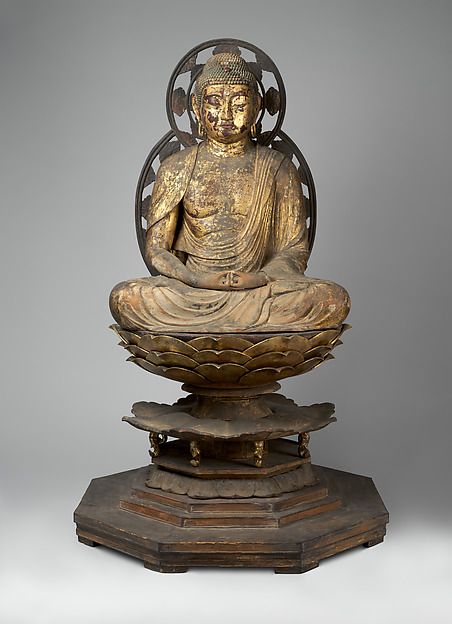
Japan, about 1250. Wood with lacquer, gold leaf, and color; height with pedestal 155 cm.
Look closer: Look at the hands in the lap, the thumbs meeting at the centre. Then look at the lotus, which opens in two tiers, and at the openwork halo behind the head, which lets light through. Gold leaf survives in patches and leaves the wood visible at the shoulders.
The Metropolitan Museum of Art, Rogers Fund, 1919 (19.140a–c). Public domain, Open Access.
| Feature | What it means | Where to look |
|---|---|---|
| Meditation hands | Contemplation; the seated Amida of the great halls | Both hands in the lap, thumbs touching |
| Raigō-in | Welcome at death: right hand raised, left lowered, thumb touching a finger | Standing or seated Amida in a descent painting or carving |
| Halo | Measureless light | Behind the head; often pierced or flame-edged |
| Urna and ushnisha | The marks of a Buddha | Brow and crown |
| Śrīvatsa | An auspicious sign sometimes shown on the chest | Centre of the breast, on some images |
| Attendants | Kannon (right) and Seishi (left) form the Amida triad | Either side of the throne |
A heaven built on a pond
In 998 a minister named Minamoto no Shigenobu built a country villa at Uji. After his death Fujiwara no Michinaga bought it from his widow. Michinaga’s son, the regent Fujiwara no Yorimichi, turned it into a temple in 1052, the year many Japanese believed the age of the degenerate law, mappō, had begun. The following year his carpenters finished a hall on the edge of a pond, officially called Amida-dō and known since the early Edo period as the Phoenix Hall, Hōō-dō, for the birds that stand on its roof (Wikipedia, “Byōdō-in”).
The temple faces east, and the large artificial pond, the Aji-ike, is said to represent the crossing to the Pure Land. The building is a central hall flanked by two L-shaped wing corridors and a tail corridor. UNESCO inscribed it in 1994 as part of the Historic Monuments of Ancient Kyoto, and the hall appears on the face of the ten-yen coin.
Inside sits the Amida that justifies all of it, carved by Jōchō. He died in 1057, and the Byōdō-in Amida is his earliest surviving work. Art historians call him the first of a new kind of master sculptor, because he built a figure from several carved pieces of Japanese cypress joined from the inside, the yosegi method. That let a workshop of assistants carve at once while the master did the finishing. He also fixed a canon of proportion, with the distance from chin to hairline as the unit, and the widely spaced knees that make the seated figure so stable. His style governed Japanese sculpture for about a century and a half, and his descendants in the craft led to Kōkei, whose school reinvented sculpture in the Kamakura period (Wikipedia, “Jōchō”). The doors and panels of the hall carry the earliest surviving independent nine-level welcome images, and small relief carvings of celestials believed to accompany Amida decorate its walls.
A cord to the hand
The most intimate use of an Amida image was at a deathbed. The Art Net Users System says Genshin’s Ōjōyōshū shaped a lineage of descent paintings and deathbed practice: the dying person recited the nembutsu, lay with the head to the north and the face toward the west, and had a sculpture or a painting of the Buddha’s descent set in view. A five-coloured cord ran from the Buddha’s hand to the hand of the dying, so that the last moment of life was a physical link with Amida.
Genshin wrote the Ōjōyōshū, “Essentials of Rebirth”, in 985. It runs to about eighty thousand Chinese characters in ten chapters over three volumes, quotes 654 passages from 160 works, and is remembered for its vivid account of the hells. It also describes the Pure Land and the range of nembutsu practice, from contemplation of the Buddha’s image to plain recitation. Genshin held the contemplative forms to be more refined while allowing that every properly performed nembutsu leads to rebirth. Shinran wrote an influential commentary on it, and Hōnen first met Pure Land teaching through Genshin’s writings (Wikipedia, “Ōjōyōshū”).
The paintings that grew from this teaching are called raigō-zu. The earliest raigō theme is the nine-level welcome, found in the lower outer court of the Taima mandala of the late eighth century, and the first surviving independent example is the one at Byōdō-in. Two Japanese types stand out. In the hayaraigō, the swift-cloud Amida, he descends at about forty-five degrees and usually stands, turned three-quarters to the side, so the picture rushes. In the gentler form he sits facing forward in the raigō gesture. In the Yamagoe no Amida, he rises over a mountain in the foreground. The paintings were set out during the nembutsu for a dying person, and a fragment of five-coloured cord survives on the hand of one such Amida. Legend ties the mountain type to a vision of Genshin; Konkaikōmyō-ji in Kyoto holds a fourteenth-century example (JAANUS, “raigō-zu”, “Yamagoe no Amida”).
| Type | What you see | Reading it |
|---|---|---|
| Hayaraigō | Amida standing and turned aslant, rushing down on cloud | Urgency; certainty of rescue |
| Amida sanzon raigō | Amida flanked by Kannon and Seishi | The classic descending triad |
| Twenty-five bodhisattvas | A retinue limited to twenty-five bodhisattvas | A variant of the welcoming theme |
| Yamagoe no Amida | Amida rising behind a mountain | Deathbed use; legend ties it to Genshin |
| Kaeri raigō | Amida and attendants turn back toward the Pure Land | The returning descent |
One vow, two schools
Amida worship was established in the Nara period (710 to 794) and taught in Tendai in the Heian period. The turning point came with Hōnen (1133 to 1212). A Tendai monk trained on Mount Hiei, he read Shandao’s commentary on the Meditation Sutra and concluded that reciting Amida’s name alone sufficed for rebirth. He left Hiei in 1175 to practise that single act, and taught it to people of every class: laity, merchants, samurai and women. His main work, the Senchaku Hongan Nembutsu Shū, was written in 1198 at the request of the regent Kujō Kanezane. Criticism from the older schools was fierce. After the Jōgen Persecution of 1207, Hōnen and several disciples were exiled and four disciples were executed. He was pardoned and returned to Kyoto in 1211 (Wikipedia, “Hōnen”).
Hōnen’s followers founded Jōdo-shū, the Pure Land school, although in his own lifetime it was a faction within Tendai and became independent only after the fourteenth century. His disciple Shinran (1173 to 1263) went further. Defrocked and exiled to Echigo in 1207, he taught that faith, shinjin, is the true basis of the nembutsu and not the believer’s own effort. His major work is the Kyōgyōshinshō, with a first draft possibly of 1224. The school that grew from his teaching, Jōdo Shinshū, “True Pure Land”, gathered round the Hongwanji, which developed from his mausoleum. Together these two schools became the largest Buddhist tradition in Japan (Wikipedia, “Shinran”; “Amitābha”).
The same devotion left its mark on the older schools too. In the Shingon system of the Thirteen Buddhas, Amida is the tenth, honoured at the second anniversary of a death, and he is linked to the Diamond Realm, while Amitāyus belongs to the Womb Realm (Wikipedia, “Thirteen Buddhas”; “Amitābha”).
Bronze in the rain, a Buddha in the dark
Two Amida images sit at the poles of what a Japanese Buddha may be. The Kamakura bronze is open to every weather. Rudyard Kipling saw it in 1892 and wrote a poem about it; some of its lines later prefaced early chapters of Kim. Wikipedia gives its weight as about ninety-three tonnes in one place and one hundred and twenty-one in another, so no figure is offered here.
Zenkō-ji in Nagano keeps the opposite kind. Its principal Amida is a hibutsu, a secret Buddha, never shown. A replica called the Maedachi Honzon is revealed during the Gokaichō ceremony, held once every six years; the most recent ran from April to June 2022, after a delay from 2021 caused by the pandemic. Temple tradition says the image reached Japan via the Korean peninsula in the sixth century, during the reign of Emperor Kinmei, and legend says it was thrown into a canal during a clan dispute and rescued by Honda Yoshimitsu, whose name gave the temple its own. Beneath the main hall is a pitch-dark corridor where pilgrims grope for a metal key said to open the Western Paradise. The temple belongs to both the Tendai and Jōdo schools (Wikipedia, “Zenkō-ji”).
| Image | Mode of showing | What it teaches |
|---|---|---|
| Kamakura Great Buddha | Open air since 1498; hollow, so visitors may go inside | Compassion offered to all who pass |
| Zenkō-ji principal image | Hidden; replica shown every six years | Grace that is not seen but trusted |
| Byōdō-in Amida | Within a hall beside a pond | The pond as the crossing to the Pure Land |
Dharmākara and the forty-eight promises

Japan, 18th century. Ink, colour and cut silver on silk.
Look closer: Follow the rays. They fan out from the halo until they fill the entire scroll, a picture of light that has no edge.
The Metropolitan Museum of Art, Rogers Fund, 1918 (18.146.1). Public domain, Open Access.
Every Buddha is first someone else, and Amida was first a monk named Dharmākara. The Sutra of Measureless Life tells it this way (Wikipedia, “Amitābha”). Eons ago a king heard the teaching of a Buddha called Lokeśvararāja, gave up his throne and became a monk. For five eons, the sutra says, Dharmākara studied every pure buddha-field in the universe, weighing what made each one fine and what made each one fail. Then he resolved to build the best of them all, and he did something unusual for a would-be Buddha. Before attaining anything, he made a series of vows and tied his own awakening to them: unless these come true, he said, I will not become a Buddha.
Different versions of the text give different numbers of vows. The best known sutra carries forty-eight, and that is the number East Asia remembers. Dharmākara did become a Buddha, the sutra says ten eons ago, and since the Buddha Amitābha now presides over the western paradise, Sukhāvatī, tradition concludes that every one of the vows was fulfilled. Nobody has to wait to see whether the promise holds. The promise is already behind us, and the world it created already exists.
Most of the forty-eight describe the country he meant to build. Beings born there would never fall into the lower realms of rebirth. They would have golden bodies and many powers, would stand firmly on the road to Buddhahood, and would enjoy peace, happiness and a lifespan without limit (Wikipedia, “Amitābha”). A handful of the vows deal with the harder question of how anyone gets in.
The vow that carries the weight
The eighteenth vow is the one East Asian Pure Land Buddhism calls the original or fundamental vow. In the wording given by Wikipedia’s account of the sutra, it promises that beings in the ten directions who trust him sincerely and joyfully, who wish to be born in his land and who think of him even ten times, will be born there. If they are not, Dharmākara will not accept enlightenment. The text makes one exception: those who commit the five grave offences and who abuse the right teaching are excluded. The five are killing a father, killing a mother, killing an arhat, wounding a Buddha, and splitting the monastic community.
That exclusion has a history of its own. Later Pure Land teaching relaxed it. The Contemplation Sutra describes a person guilty of the five gravest offences who, at the last moment, meets a good teacher, calls on Amitāyus ten times and is purified, to be reborn inside a lotus bud (Wikipedia, “Amitābha”). A modified universalism, in which even the exclusion falls away, became a central doctrine and remains part of the tradition’s lasting appeal.
The seventeenth vow is the partner of the eighteenth. In the account given for the Name, Amida vowed that all the Buddhas would praise his name, and that whoever recited it with faith would be assured of birth in the Pure Land (Wikipedia, “Amitābha”). Between them the two vows turn a name into an instrument: the Buddhas spread it, and ordinary people use it.
What the vows table says
| Vow | Promise in the sources | Why it matters |
|---|---|---|
| Seventeenth | All Buddhas will praise Amida’s name | Gives the Name its authority; basis of the nembutsu |
| Eighteenth | Those who trust him and think of him up to ten times will be born in his land, apart from those who commit the five grave offences or abuse the right teaching | The “original vow” of East Asian Pure Land schools |
| Others, in general | No falling into lower realms; golden bodies; many powers; firm footing on the path; unlimited lifespan | Describe the character of the land and its people |
| Count | Forty-eight in the best known sutra; other versions differ | In art, forty-eight light rays can stand for the vows |
Sukhāvatī, a country built from promises
The Sanskrit name Sukhāvatī means “Blissful”, and the land has two Chinese names Japan inherited: Gokuraku, “ultimate bliss”, and Jōdo, “Pure Land”. The Larger Sukhāvatīvyūha describes it as a place of crystal-clear waters, jewelled trees and golden ground, where suffering, old age and death do not exist (Wikipedia, “Sukhāvatī”). The Smaller sutra, in which Shakyamuni describes the land to his disciple Śāriputra, adds seven rows of balustrades, nets and trees made of the seven precious jewels, and says the birds and trees sing the teaching without pause. In both, the point of the beauty is practical. A world with no hunger or fear leaves a mind free to study, and the sutras say that anyone born there reaches non-retrogression and needs only one more birth before Buddhahood.
Birth there is not like birth here. Beings appear fully formed on lotus flowers in the presence of Amitābha. Some lotuses stay closed. They belong to people who still harbour doubts, and those beings wait inside for five hundred years, experiencing the lotus as a palace but deprived of the Buddha’s presence, until their doubts clear and the flower opens (Wikipedia, “Amitābha”). It is one of the gentlest images in Buddhist literature: even doubt is not punished with exclusion, only delayed.
Where is it? The sutras place it billions of worlds to the west and the Art Net Users System says the dying lay with the face toward the west. The Phoenix Hall at Byōdō-in faces east across its pond, so that a visitor must cross water to approach the Buddha in the hall, which sits on the western side of the pond. Chinese Buddhism, Wikipedia notes, holds two readings that are usually combined: the Pure Land as a realm far away, and the Pure Land as non-dual with this world, which looks impure only because of our minds. Shandao held it to be a saṃbhogakāya land, a reward-body realm, while some Tibetan teachers regard it as a nirmāṇakāya land (Wikipedia, “Sukhāvatī”).

Japan, 14th century. Hanging scroll; ink, colour and gold on silk.
Look closer: Find the central Buddha in his hall, then the water in front of him, then the narrow panels running round the edge, which hold the scenes of the story told in the Contemplation Sutra.
The Metropolitan Museum of Art, Rogers Fund, 1957 (57.156.6). Public domain, Open Access.
Three sutras and a long meditation
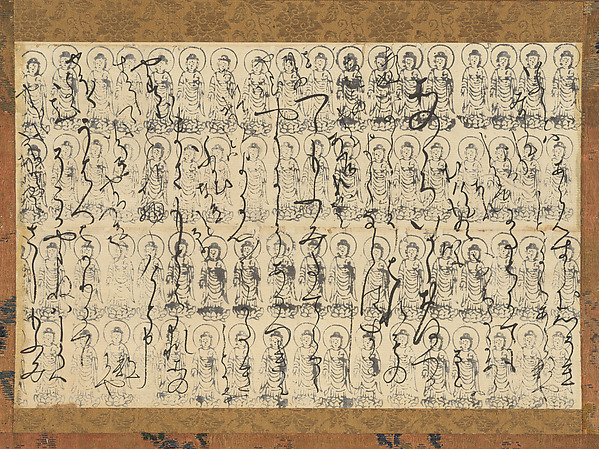
Japan, early 13th century. Hanging scroll; brush-written letter, ink on paper.
Look closer: Look behind the handwriting. Rows of small Amida figures were stamped onto the paper first, and the letter was written across them.
The Metropolitan Museum of Art, Mary and Cheney Cowles Collection, Gift of Mary and Cheney Cowles, 2020 (2020.396.3). Public domain, Open Access.
Pure Land teaching rests on three texts, and East Asian schools call them the Three Pure Land Sutras. Jeff Wilson, writing in Oxford Bibliographies and summarised by Wikipedia, notes that more than a fifth of the sutras in the Taishō canon mention Amitābha, but only three became canonical for East Asia. Kenneth Tanaka counts thirty-one Sanskrit texts and over a hundred Chinese and Tibetan translations that refer to Amitābha or Sukhāvatī.
The earliest sutra to name him is not one of the three. It is the Pratyutpanna Samādhi Sūtra, translated into Chinese by the Kushan monk Lokakṣema. Modern scholars date it between the first century BCE and the second century CE, and a fragment in Gāndhārī, found in 2018, suggests it may have been translated from that language (Wikipedia, “Amitābha”). The Gāndhārī detail matters. It places the cult in the north-west, in the Gandhāran and Kushan world.
The three texts
| Text | What it gives | Use in practice |
|---|---|---|
| Larger Sukhāvatīvyūha (Sutra of Measureless Life) | The story of Dharmākara, the vows, the light and life of Amida, the lotus birth | The foundation of Pure Land doctrine; source of the “original vow” |
| Smaller Sukhāvatīvyūha (Amitābha Sutra) | Shakyamuni’s description of the land; rebirth by holding the Name in mind undistracted for one to seven days | Chanted daily in many temples |
| Contemplation Sutra (Amitāyurdhyāna) | Visualisation stages, from the setting sun to the Buddha and his two attendants; rebirth even for those who have committed the gravest offences | The basis for mandalas, deathbed rites and the Taima mandala |
Thirteen stages or sixteen?
Sources disagree about how long the meditation is. Wikipedia’s article on Amitābha says the Contemplation Sutra teaches thirteen stages of visualisation. Its article on Sukhāvatī says the Buddha teaches the queen Vaidehī sixteen contemplations, beginning with the setting sun, then the Pure Land, then Amitābha and his two attendants. Sixteen is the traditional count in East Asian Pure Land writing. Either way the shape is the same: the practitioner begins with something one can see out of a window, the red sun low in the west, and works inward, step by step, to a living picture of the Buddha. That is the logic of a raigō painting. It is a diagram of the meditation, hung where a dying person can see it.
From a Kushan pedestal to a Kamakura hillside
The record below follows Amida through the centuries, from the first dated image to the most recent repairs, using the sources I read. Where those sources disagree, the disagreement is stated.

Photograph. Wood with gold leaf, 1053.
Look closer: The Amida Jōchō made for the Phoenix Hall in 1053. Notice the calm face, lowered gaze and the hands resting in the lap.
Jhocho, the master sculptor, book:FUKUYAMA TUNEO and MORI TORU, “Amida by Jōchō, Phoenix Hall, Byōdō-in, Uji”, Wikimedia Commons, Public domain. Source: commons.wikimedia.org (file page listed in the sources below).

Photograph, November 2016.
Look closer: The central hall and the wing corridors on either side. The pond lies between the viewer and the Buddha inside.
Martin Falbisoner, “Phoenix Hall, Byōdō-in, Uji”, Wikimedia Commons, CC BY-SA 4.0. Source: commons.wikimedia.org (file page listed in the sources below).
- First to second centuryAmitābha rises to prominence in Gandhāran Buddhism under the Kushan empire. Numerous images turn up in the Greater Gandhāra region from about the first century CE. The earliest epigraphic evidence is the base of a statue from Govindnagar, now in the Mathura museum, dedicated to “Amitābha Buddha” by a family of merchants in the twenty-sixth year of King Huviṣka. Wikipedia’s text dates it to 104 CE and an image caption to 153 CE; the sources disagree, so no year is offered here (Wikipedia, “Amitābha”).
- Fourth to sixth centuryZhi Dun (314 to 366) is among the earliest Chinese witnesses to devotion. Kumārajīva (344 to 413) and Buddhabhadra translate the main sutras. The earliest dated Amitābha image in China is at the Longmen Grottoes, dated 519.
- Sixth to seventh centuryTanluan (476 to 554), Daochuo (562 to 645) and Shandao (613 to 681) shape Chinese Pure Land teaching. Shandao argues that Amitābha is a reward-body Buddha who is nonetheless open to ordinary beings through his other-power. In the Kathmandu valley, inscriptions in Patan from about 610 praise Amitābha, Lokeśvara and Mahāsthāmaprāpta together. In Silla the monk Kyŏnghŭng writes a commentary on the Larger sutra that Shinran later uses.
- Nara period, 710 to 794Amida worship is established in Japan.
- Heian period, 794 to 1185Ennin brings the raigō idea to Japan. Kūya (903 to 972) wanders the country chanting the nembutsu and carrying an Amida image. Genshin (942 to 1017) writes the Ōjōyōshū in 985. In 1052 the Fujiwara regent Yorimichi turns a villa at Uji into a temple in the first year of the Latter Day of the Law, and in 1053 his Amida Hall, the Phoenix Hall, is finished with Jōchō’s Amida inside.
- Kamakura period, 1185 to 1333Hōnen (1133 to 1212) leaves Mount Hiei in 1175 and writes the Senchakushū in 1198. Shinran (1173 to 1263) takes his teaching further. Ippen (1239 to 1289) founds the Jishū. A wooden Great Buddha is completed at Kamakura in 1243, damaged in 1248, and a bronze one follows, dated by temple records to about 1252.
- Muromachi and Edo periodsA fire set by Kusunoki Masashige in 1336 burns many Byōdō-in buildings, but the Phoenix Hall survives. Rennyo (1415 to 1499), eighth head of the Honganji, leads a great expansion of Shin Buddhism. The hall around the Kamakura Buddha is washed away by the tsunami of the Nankai earthquake of 20 September 1498; the bronze has stood in the open since. A full renovation of the Phoenix Hall comes in 1670, and Uji suffers a devastating fire in 1698.
- Modern eraThe 1923 earthquake destroys the base of the Kamakura Buddha, repaired in 1925. The neck is strengthened in 1960 to 1961. The Phoenix Hall and its Amida are designated National Treasures in 1951, and Byōdō-in is inscribed by UNESCO in 1994. A new museum, the Hōshōkan, opens at Byōdō-in in 2001, and the Phoenix Hall is reopened after restoration in March 2014. Further research and preservation work is carried out on the Kamakura statue in early 2016.
Four lives and a deathbed cord

Japan, about 1300. Hanging scroll; ink and colour on silk.
Look closer: Read it from top to bottom: the descent of the Buddha above and the believer’s soul carried up and back below.
The Metropolitan Museum of Art, The Harry G. C. Packard Collection of Asian Art, Gift of Harry G. C. Packard, and Purchase, Fletcher, Rogers, Harris Brisbane Dick, and Louis V. Bell Funds, Joseph Pulitzer Bequest, and The Annenberg Fund Inc. Gift, 1975 (1975.268.21). Public domain, Open Access.
Doctrine is easiest to understand through the lives that carried it. These four are drawn from the sources I read, and each is a short story in its own right.
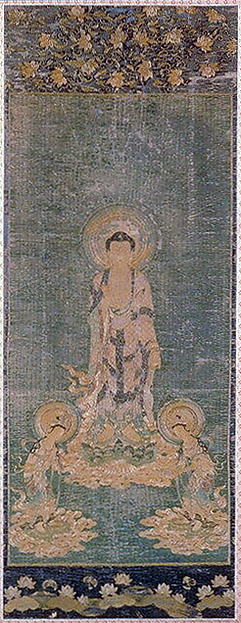
Japan, 13th century. Embroidered silk and possibly human hair.
Look closer: A raigō image worked in embroidered silk. Look for the threads that make the haloes and lotus flowers.
The Metropolitan Museum of Art, Rogers Fund, 1912 (12.37.166). Public domain, Open Access.
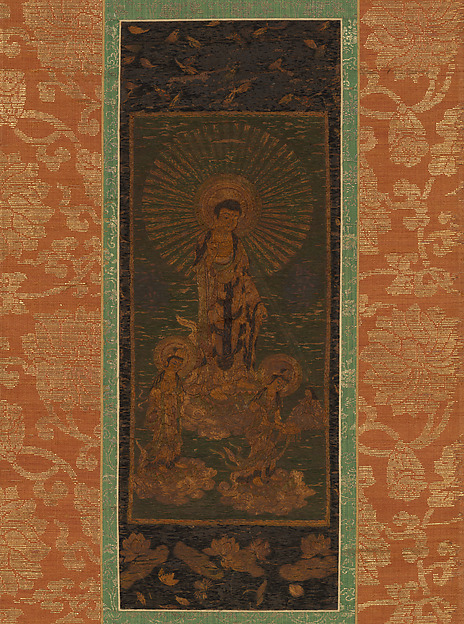
Japan, late 14th to early 15th century. Silk and hair embroidery on silk.
Look closer: Embroidery again, this time in silk and hair: the haloed Buddha above and Kannon and Seishi kneeling below.
The Metropolitan Museum of Art, Purchase, Bequest of Mary Stillman Harkness, by exchange, 2023 (2023.327). Public domain, Open Access.
Hōnen: a child named for Seishi
He was born in 1133 in Mimasaka, in present Okayama, and his parents named him Seishimaru after the bodhisattva Seishi, one of Amida’s two attendants. When he was eight his father, a provincial policing official, was assassinated by an official sent to govern the province. His father’s last words to him, Wikipedia records, were not to hate the enemy but to become a monk and pray for him. The boy entered his uncle’s monastery at nine and Mount Hiei at thirteen, studied the canon, by tradition, five times, and at forty-three read a passage by Shandao that told him the single practice of calling the Name was enough. He came down from the mountain in 1175 and taught crowds in Kyoto: samurai, merchants, outcasts. At eighty, exiled in 1207, he is said to have answered that he had long wished to preach to people in the fields and was now being given the chance (Wikipedia, “Hōnen”). He wrote a one-page testament, the Ichimai-kishōmon, days before he died in 1212.
Shinran: neither monk nor layman
Born in 1173 into a minor branch of the Fujiwara, ordained at nine under the Tendai prelate Jien, Shinran spent twenty years on Mount Hiei as a modest hall monk who sang the perpetual nembutsu. In 1201, spiritually stalled, he went on retreat at Rokkaku-dō and dreamed that Avalokiteśvara, in the form of Prince Shōtoku, directed him to Hōnen. He wrote later that in that year he abandoned the difficult practices and took refuge in the Original Vow. After the 1207 ban he was defrocked and exiled to Echigo, and he called himself Gutoku, the “Bald Fool”, neither monk nor layperson. He married Eshinni, and their letters are some of the best evidence for his life. His name joins a syllable from Vasubandhu and one from Tanluan. He died in 1263 (Wikipedia, “Shinran”).
Kūya: six small Buddhas from one mouth
Kūya (903 to 972) was a wandering holy man, a hijiri, who walked the country with an Amida image chanting the nembutsu to a melody, burying the dead, digging wells and building bridges (Wikipedia, “Pure Land Buddhism”). The sculptor Kōshō, a son of Unkei, made his portrait in the first decade of the thirteenth century. Each of the six syllables of Na-mu-A-mi-da-Butsu leaves his lips as a tiny Amida figure, so that the sound itself becomes a row of Buddhas. It is among the most inventive images in Japanese sculpture, and it states the doctrine of the Name with total clarity: to say it is to release him into the air.
The dying, and the cord
In Genshin’s Ōjōyōshū the moment of death is described as a reception. Amida arrives surrounded by a host of bodhisattvas. Kannon holds out a jewelled lotus dais, and Seishi, with innumerable sages, extends his hands to lead the dying to the Pure Land. At that instant, Genshin says, the practitioner sees it with their own eyes, and finds themselves seated in a lotus on the dais, following Amida in the blink of an eye (Wikipedia, “Raigō”). In practice the dying person gazed at an image, and in some cases held coloured threads attached to the painted hands of the Buddha to make a physical bridge. The Art Net Users System counts five colours in the cord.
Hands, halos and a crown of twelve lights
The earlier section on the hands tells how to identify a seated or standing Amida. Here are the fuller tables, with the Tibetan distinction, which can mislead a viewer used to Japanese images.
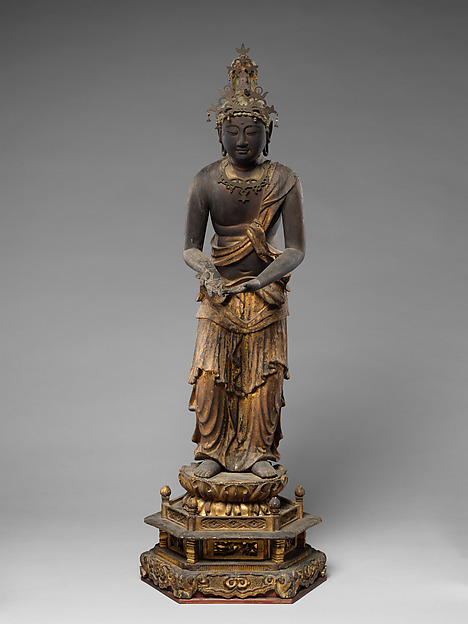
Japan, late 12th to 13th century. Wood with lacquer, gold paint, gold leaf and inlay.
Look closer: Kannon, who stands at Amida’s right in the triad. Hands joined, body slightly bent forward in welcome.
The Metropolitan Museum of Art, Rogers Fund, 1912 (12.134.17). Public domain, Open Access.
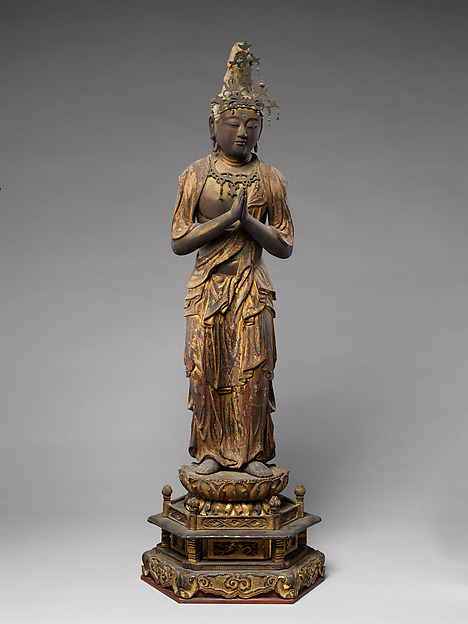
Japan, late 12th to 13th century. Wood with lacquer, gold paint, gold leaf and inlay.
Look closer: Seishi, Kannon’s partner on the other side. Compare the two for the pairing of pose and crown.
The Metropolitan Museum of Art, Rogers Fund, 1912 (12.134.18). Public domain, Open Access.
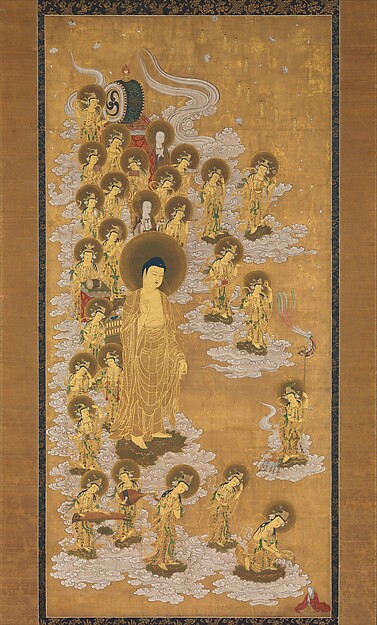
Japan, 1668. Hanging scroll; ink, colour and gold on silk.
Look closer: Count the attendants, then look for the musicians and the figures holding lotus dais. This is the host of twenty-five bodhisattvas.
The Metropolitan Museum of Art, Bequest of Lettice Sands Phelps Stokes, 1988 (1989.359). Public domain, Open Access.
Postures and gestures
| Form | Gesture | Where to see it |
|---|---|---|
| Seated, meditation | Both hands in the lap, palms up, thumb and forefinger forming a circle on each | Byōdō-in’s Phoenix Hall and the Kamakura Great Buddha (the latter with thumbs touching and fingers together, per Wikipedia) |
| Standing, welcoming | One hand raised outward and one lowered, thumb and forefinger touching on each; symbolises wisdom within reach of the lowest beings and compassion directed to those who cannot save themselves | Raigō paintings and standing figures such as the one in Turin (Wikipedia, “Amitābha”) |
| Earth-touching | Reserved for the seated Shakyamuni alone | Not an Amida gesture; useful for ruling out a mistaken identification |
Signs on the body and the halo
Amitābha is credited with 84,000 auspicious marks. In art the common ones are rays of light, a large halo, the white curl between the eyebrows called the ūrṇā, and a circular sign, sometimes a swastika, on the chest, the śrīvatsa. A standing Amida in Turin carries forty-eight rays, one for each of the vows (Wikipedia, “Amitābha”). At Byōdō-in the ūrṇā is read as a third eye that sees the suffering of every creature, the downward gaze as concentration and mercy together, and the hair as short and curled, with the topknot (Wikipedia, “Byōdō-in”).
Twelve lights
The Sutra of Measureless Life gives twelve names of Amida’s light, which the Chinese masters chanted as epithets. Shinran, following Kyŏnghŭng, read them as a medicine chest for the mind. “Pure light” removes greed, “joyful light” removes anger, and “light of wisdom” removes ignorance (Wikipedia, “Amitābha”).
| Name (Chinese) | English | Gloss in the sources |
|---|---|---|
| 無量光 | Boundless light | Cannot be calculated |
| 無邊光 | Unlimited light | There is nothing it does not shine upon |
| 無礙光 | Unobstructed light | Nothing among people or things obstructs it |
| 無對光 | Incomparable light | Beyond all bodhisattvas’ lights |
| 燄王光 | King of blazing light | Radiance unrestricted and unexcelled |
| 清浄光 | Pure light | Rids beings of the defilement of greed |
| 歡喜光 | Joyful light | Rids beings of anger and rage |
| 智慧光 | Light of wisdom | Rids beings of ignorance |
| 不断光 | Uninterrupted light | The eternal light that constantly benefits beings |
| 難思光 | Inconceivable light | The followers of the two lesser vehicles cannot fathom it |
| 無構光 | Indescribable light | Those of other vehicles cannot teach it |
| 超日月光 | Light surpassing sun and moon | It shines day and night, unlike the lights of this world |
Amitābha, Amitāyus and the trap for visitors
In East Asia the two names are used interchangeably. In Tibetan Buddhism they are distinct figures. Amitāyus, the Buddha of Boundless Life, is depicted in fine clothes, an ornate crown and jewels, and is seen as a reward-body Buddha; Amitābha wears the plain monk’s robe, and is seen as a manifestation body (Wikipedia, “Amitābha”). A viewer who meets a crowned and jewelled figure in a Himalayan collection is looking at the Tibetan Amitāyus, while the plainly robed figure is Amitābha. The Tibetan triad also differs. Vajrapāṇi or Padmasambhava replaces Seishi beside Avalokiteśvara.
Triads and hosts
The Japanese norm is Amida with Kannon and Seishi, called the Amida Sanzon. Famous Japanese examples include the Yamada-den Amida Triad (the name as Wikipedia gives it), the Tachibana Shrine triad and the triad at Seiryō-ji, all National Treasures according to Wikipedia. The triad likely began in Gandhāra, where Katsumi Tanabe has counted four lesser-known variations, including Maitreya with Amida and Avalokiteśvara, and Mañjuśrī with Amida and Avalokiteśvara. The host of twenty-five bodhisattvas listed in the Sutra on the Ten Methods of Rebirth, playing music and carrying lotus thrones, is the template for the descent paintings.
The Name, the rebirth dhāraṇī and one seed syllable
Amida’s presence is phonetic as much as pictorial. East Asian Buddhism treats the sounds as handles on the Buddha, and the sources I read give four of them.
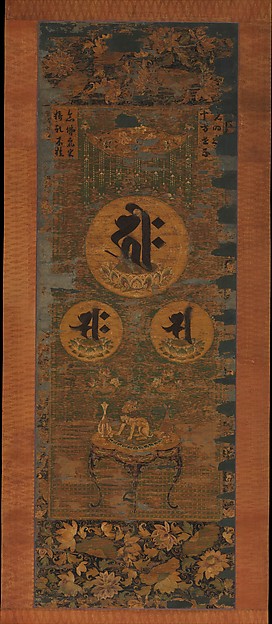
Japan, 13th century. Hanging scroll; silk embroidery and gold-wrapped thread.
Look closer: Instead of three statues, three Siddham letters stand for Amida and his two attendants.
The Metropolitan Museum of Art, The Harry G. C. Packard Collection of Asian Art, Gift of Harry G. C. Packard, and Purchase, Fletcher, Rogers, Harris Brisbane Dick, and Louis V. Bell Funds, Joseph Pulitzer Bequest, and The Annenberg Fund Inc. Gift, 1975 (1975.268.22). Public domain, Open Access.

Japan, first half of the 15th century. Pair of hanging scrolls; ink on paper.
Look closer: A maxim in running script, set as a pair. Nothing here is a picture, yet the characters are the Buddha’s Name in another form.
The Metropolitan Museum of Art, Gift of Sylvan Barnet and William Burto, in memory of John M. Rosenfield, 2014 (2014.719.9). Public domain, Open Access.
Four sounds
| Sound | Form | Tradition and use |
|---|---|---|
| The Name (myōgō) | Namu Amida Butsu (南無阿弥陀仏), “homage to Amida Buddha” | The nembutsu of Jōdo-shū, Jōdo Shinshū and Jishū; reproduced as calligraphy, charms and altarpieces |
| Rebirth dhāraṇī | Namo amitābhāya tathāgatāya | tadyathā | amṛtodbhave | amṛta-siddhaṃbhave | amṛta-vikrānte | amṛtavikrānta | gāmine gagana kīrtakare | svāhā | Chinese monasteries chant it 21, 27 or 49 times a day; counted among the Ten Small Mantras |
| Shingon mantra | On amirita teizei kara un (オン・アミリタ・テイゼイ・カラ・ウン), from oṃ amṛta-teje hara hūṃ | Shingon esoteric devotion; Amitābha is called Amṛta, “sweet dew”, in esoteric texts |
| Seed syllable | hrīḥ (Siddham) | Used on mandalas and seed-syllable triads; the Tibetan mantra is oṃ amideva hrīḥ |
What the Name is
Tanluan said the Name is like a bright lamp carried into a room that has been dark for eons: the darkness does not need to be argued with. Shinran taught that the Name is not a label but the wisdom and compassion of Amida in the form of sound, and that faith is received through it, not produced by the believer. Hōnen held that the Buddha selected the nembutsu and put all his merit into it, so that saying it and hearing it is to meet him (Wikipedia, “Amitābha”; “Hōnen”).
Chinese tradition links the rebirth dhāraṇī to Nāgārjuna, who is said to have received it from Amitābha in a dream, according to the Guṇabhadra translation (Taishō 368), and to have been reborn in the Pure Land through it. Reciting it is also said to pull out the root cause of karmic obstructions and to protect against harmful spirits (Wikipedia, “Amitābha”).
From Tanluan to Rennyo
A school is a chain of people, and the Pure Land chain is unusually clear. Hōnen listed Tanluan, Daochuo, Shandao and Huaigan among the Pure Land patriarchs and leaned on Genshin; Shinran took part of his own name from Vasubandhu and Tanluan. The table compares the three Japanese schools that grew from the root.
Three schools compared
| School | Founder | Core teaching | Notes from the sources |
|---|---|---|---|
| Jōdo-shū (浄土宗) | Hōnen (1133 to 1212) | Exclusive recitation of the nembutsu, trusting the original vow | First independent Japanese Pure Land school; the Kamakura Great Buddha’s temple, Kōtoku-in, belongs to it |
| Jōdo Shinshū (浄土真宗) | Shinran (1173 to 1263); organised by Kakunyo, Zonkaku and Rennyo | Faith (shinjin) awakened by Amida; the nembutsu is gratitude | Centred on Honganji, built where Shinran’s grave lies; Shinran himself married; with Jōdo-shū it forms what Wikipedia calls the largest Buddhist tradition in Japan |
| Jishū (時宗) | Ippen (1239 to 1289) | Even faith is not required; the chanting itself is the whole reality of Amida | A smaller Pure Land sect, founded by a wandering teacher |
The books and the blocks
Hōnen wrote his central work, the Senchaku Hongan Nembutsu Shū, in 1198 at the request of Kujō Kanezane and asked that it not be widely circulated until after his death. While he was in exile his disciples had the text carved for printing, completed in 1211, the first printing of a work by a Japanese Buddhist author in Japanese history, according to Wikipedia. The Tendai monks attacked the print shop in 1227 and destroyed the blocks, and his followers re-carved them in 1239. The Seven Article Pledge of 1204, signed by Hōnen’s followers, promised restraint towards other sects. Shinran’s Kyōgyōshinshō sets out teaching, practice, faith and realisation in a single argument.
Halls, bronze and the cost of a ticket
A practical table for readers who want to see what they have just read about. Opening hours and prices change, so treat the figures as the last ones in my sources and confirm them before travelling.

Photograph, interior view.
Look closer: The Amida at the heart of the hall, high on its platform, seen through the opening of the hall.
Zairon, “Amida in the Phoenix Hall, Byōdō-in”, Wikimedia Commons, CC BY-SA 4.0. Source: commons.wikimedia.org (file page listed in the sources below).

Photograph, September 2014.
Look closer: The phoenix, hōō, whose pair on the ridge gives the hall its common name.
Dr.InSide, “Phoenix, Byōdō-in”, Wikimedia Commons, CC BY-SA 4.0. Source: commons.wikimedia.org (file page listed in the sources below).
| Place | What is there | Figures and notes from the sources |
|---|---|---|
| Byōdō-in, Uji, Kyoto | Phoenix Hall (1053), Jōchō’s Amida, the Hōshōkan museum, the Aji-ike pond, a tea salon | Gardens and museum ¥700; Phoenix Hall interior an additional ¥300; guided tour in Japanese with an English booklet; hall restored March 2014; museum opened 2001 and holds the bell, 26 Bodhisattvas on Clouds and the roof phoenixes; Jōdo and Tendai joint temple |
| Kōtoku-in, Kamakura | Great Buddha of Kamakura, a bronze Amida under open sky | Height 13.35 m with base; Wikipedia’s weight is 93 tonnes in one place and 121 in another; interior open to visitors; four of thirty-two lotus petals remain; summer night illumination |
| Chion-in, Kyoto | A principal Amida image, and a fourteenth-century illustrated life of Hōnen known as the Chion-in version of the Hōnen Shōnin Eden | Both are pictured in Wikipedia’s articles; confirm what is on view before travelling |
| Jōshōkō-ji | Late Heian Amida triad with attendants leaning forward in a crouch | The pose mimics the forward motion of a descending raigō (Wikipedia, “Raigō”) |
| Zenkō-ji, Nagano | A hidden Amida triad and the Gokaichō revelation of its stand-in | Revealed once every six years; see the monuments section above |
| Valley of the Temples, Oʻahu | A half-size concrete replica of the Phoenix Hall | Completed on 7 June 1968; the original is timber without nails (Wikipedia, “Byōdō-in”) |
The Buddha on the coin and in the novel
Few religious images have crossed into daily life as completely as Amida. The Phoenix Hall appears on the ten-yen coin, and the phoenix of its roof is on the ten-thousand-yen note. Japan Post issued three definitive stamps showing the hall, in 1950, 1957 and 1959, engraved at some expense as a mark of respect (Wikipedia, “Byōdō-in”). Rudyard Kipling visited the Kamakura Buddha in 1892 and wrote a poem, “Buddha at Kamakura”, whose verses preface the early chapters of his 1901 novel Kim and appeared in The Five Nations in 1903. The American painter John La Farge made a watercolour of the statue in 1887, and Adolfo Farsari photographed it in the 1880s (Wikipedia, “Kōtoku-in”). A notice at the gate has long asked visitors to remember that they stand on ground hallowed by the worship of ages.
The Name travels too. In Chinese Buddhism, Wikipedia says, Namo Amituofo appears on calligraphy scrolls, public inscriptions, amulets, altarpieces and electronic devices. In Tibet, the Panchen Lamas and the Shamarpas are considered emanations of Amitābha, and the transference of consciousness at death, phowa, calls on his land.
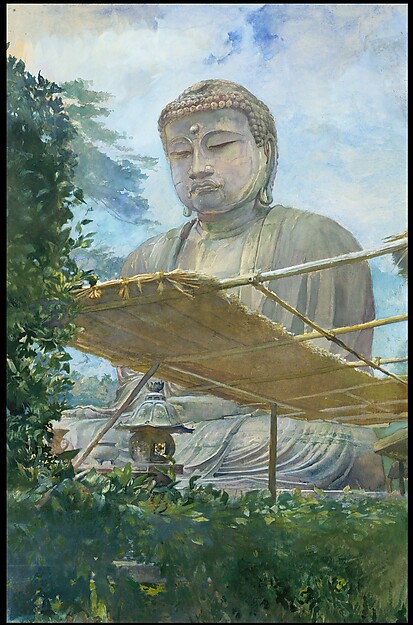
John La Farge, 1887. Watercolour and gouache on off-white wove paper.
Look closer: La Farge painted the bronze from the priest’s garden; the Buddha fills the sky above a leafy, domestic foreground.
The Metropolitan Museum of Art, Gift of the family of Maria L. Hoyt, 1966 (66.143). Public domain, Open Access.
What the world is asking now
The questions readers most often bring to Amida fall into five groups: what the Name means, how Amida differs from Amitābha, whether the Pure Land is a place or a state of mind, whether Amida is a god, and how the two big Japanese schools differ. The questions answered at the end of this chapter take each in turn. The answers rest on the sources listed below, and where those sources disagree the answer says so.
Small facts worth the detour
- The name Amitābha means “limitless light”, and Amitāyus “limitless life”. In East Asia the same Buddha answers to both (Wikipedia, “Amitābha”).
- Hōnen’s childhood name, Seishimaru, honoured Seishi, who would later stand at the Buddha’s left in the very triads his school made famous.
- The first printed book by a Japanese Buddhist author, Hōnen’s Senchakushū, produced its first riot. The blocks were smashed in 1227 and carved again in 1239.
- Shinran’s name is a compound: one syllable from Vasubandhu (Seshin) and one from Tanluan (Donran).
- Closed lotuses in the Pure Land contain doubters, who wait five hundred years in a palace of their own before the Buddha comes into view.
- The Great Buddha at Kamakura once stood in a hall. The tsunami of 20 September 1498 washed the building away, and the bronze has been outdoors ever since.
- The Great Buddha is hollow and visitors can step inside. Wikipedia notes that of the thirty-two bronze lotus petals at its base only four survive.
- The Phoenix Hall is called Amida-dō in its formal name. Hōō-dō, the Phoenix Hall, only became the common name in the early Edo period.
- The Phoenix Hall is on the ten-yen coin, and the phoenix design is on the ten-thousand-yen note.
- In Tibet, Amitāyus is one of three deities of long life, along with White Tārā and Uṣṇīṣavijayā.
- A statue of the wandering monk Kūya, by Kōshō, shows six little Amidas leaving his mouth, one for each syllable of the Name.
- The Kushan pedestal inscription that gives Amitābha his first dated mention was a gift from a family of merchants.
- Dunhuang, the Longmen Grottoes (519) and the Gandhāran sites all hold early Amitābha images, so the cult follows the Silk Road.
- The hall at Byōdō-in faces east and the visitor crosses water to reach it, so that the approach itself is a crossing to the west.
One light, many tongues
The Buddha of Measureless Light travelled the length of Asia and took a new name in each language. The rows below record the forms given in the sources I read.
| Where | Form and name | What the record shows |
|---|---|---|
| India | Amitābha; Amitāyus | The earliest sutra to mention Amitābha, the Pratyutpanna Samādhi Sūtra, is dated between the first century BCE and the second century CE. |
| China | Amituofo (阿彌陀佛) | The recitation of the name is called nianfo; Hōnen drew on the Chinese commentator Shandao’s work on the Meditation Sutra. |
| Korea | Amita-bul (아미타불) | The Korean form of the same name. |
| Tibet | Öpakmé (’od dpag med); Amitāyus is Tsépakmé | Tibetan Buddhism distinguishes the two figures. In the Tibetan triad the attendants include Avalokiteśvara and Vajrapāṇi or Padmasambhava. |
| Vietnam | A Di Đà Phật | The Vietnamese form. |
| Japan | Amida Butsu, Amida Nyorai | Worshipped from the Nara period; the focus of Jōdo-shū and Jōdo Shinshū. |
| Gandhāra and the Kushan world | Amitābha (inscribed Buddhasya Amitābhasya, “of the Buddha Amitābha”) | The first known images and the Mathura pedestal inscription, from about the first century CE onward (Wikipedia, “Amitābha”). |
| Nepal | Amitābha with Lokeśvara and Mahāsthāmaprāpta | A verse inscription in Patan of about 610 and a caitya at Tyagal Tol of the late sixth or early seventh century name the classic triad. |
| Korea, history | Amita-bul; Goryeo triads and hosts | The Silla monk Kyŏnghŭng wrote a commentary on the Larger sutra in the seventh century; a late fourteenth-century Goryeo painting shows Amitabha with eight great bodhisattvas. |
| Indonesia | Amitābha at Borobudur | Wikipedia pictures an Amitābha statue at Borobudur and lists Indonesia among the Southeast Asian regions the cult reached. |
| Mongolia | Avid; Ayusi | The Mongolian forms of Amitābha and Amitāyus (Wikipedia, “Amitābha”). |
The western gate of the pantheon
Amida stands among the Nyorai beside Shaka, Dainichi and Yakushi, and he does a particular job among them: where Yakushi heals the living and Dainichi is the cosmos itself, Amida receives the dead. In the Japanese memorial sequence of the Thirteen Buddhas he presides over the second anniversary, the tenth rite, after the long series of seventh-day rites that begin with Fudō. His usual attendants are Kannon and Seishi, who in a late Heian triad at Jōshōkō-ji lean forward in a crouch to suggest motion. The table below lists the later rites.
| Memorial occasion | Figure | Role |
|---|---|---|
| 100th day | Kannon Bosatsu | Attends Amida on his right |
| 1st anniversary | Seishi Bosatsu | Attends Amida on his left |
| 2nd anniversary | Amida Nyorai | The Buddha of the Western Pure Land |
| 6th anniversary | Ashuku Nyorai | The eleventh of the thirteen |
| 12th anniversary | Dainichi Nyorai | The twelfth of the thirteen |
| 32nd anniversary | Kokūzō Bosatsu | The last of the thirteen |
Where to see him
| Place | What to look for |
|---|---|
| Byōdō-in, near Kyoto | The Phoenix Hall of 1053, with Jōchō’s Amida inside and the nine-level welcome on its doors and panels. |
| Kōtoku-in, Kamakura | The Great Buddha, bronze, 13.35 metres with its base, open to the sky since the tsunami of 1498, with a hollow interior that may be entered. |
| Zenkō-ji, Nagano | The hidden Amida; the replica shown at the Gokaichō every six years; the dark corridor and its key to paradise. |
| Jōruri-ji, Kyoto | The only surviving Heian set of nine Amidas. |
| Konkaikōmyō-ji, Kyoto | A fourteenth-century Yamagoe no Amida. |
| Metropolitan Museum of Art, New York | A wooden Amida of about 1250 and two welcoming-descent scrolls, shown on this page, all in the public domain. |
Two welcoming descents on silk
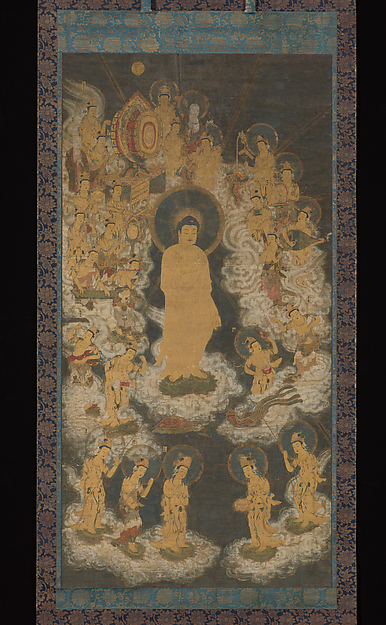
Japan, late 14th century. Hanging scroll; ink, color, and gold on silk; image 167 × 85 cm.
Look closer: Amida is the tall golden figure at the centre, and the whole painting turns toward him. At the lower edge, five bodhisattvas stand on separate clouds. At the upper left the retinue crowds together around a large round shape. The dark ground makes the gold seem to arrive from nowhere.
The Metropolitan Museum of Art, Gift of Abby Aldrich Rockefeller, 1942 (42.25.37). Public domain, Open Access.
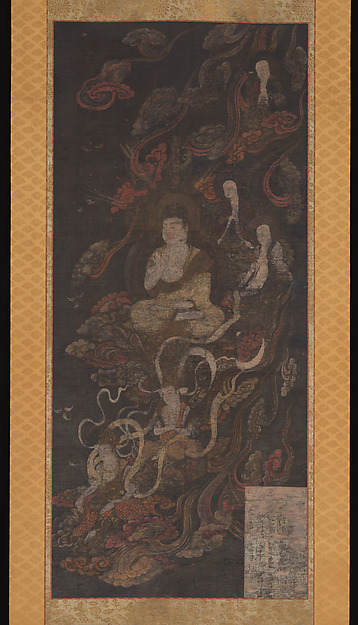
Japan, 14th century. Hanging scroll; ink, color, gold, and cut gold leaf (kirikane) on silk; image 133 × 60 cm.
Look closer: Follow the ribbons and the clouds: the painter has made the air itself move. Search the lower right for the small panel of writing. This is a Buddha arriving rather than waiting.
The Metropolitan Museum of Art, Gift of Sue Cassidy Clark, in honor of Barbara Brennan Ford, 2023 (2023.576). Public domain, Open Access.
In the house
The house keeps pieces that carry the Buddha of the West. The strip below reads the live shelves, so it shows what is available now.
A short dictionary of the Pure Land
Terms are given in Japanese with the Sanskrit or Chinese root where the sources supply one.
- Amida (阿弥陀)
- Japanese form of Amitābha or Amitāyus. Amida Butsu is “Amida Buddha”; Amida Nyorai is “the Tathāgata Amida”.
- Amitābha / Amitāyus
- Sanskrit “Limitless Light” and “Limitless Life”; the same Buddha in East Asia, two figures in Tibet.
- Dharmākara (法蔵)
- The monk Amida was before he became a Buddha, who made the forty-eight vows.
- Lokeśvararāja
- The Buddha whose teaching moved the king who became Dharmākara.
- Sukhāvatī / Gokuraku (極楽)
- The Blissful land in the west; “ultimate bliss”.
- Jōdo (浄土)
- Pure Land, a buddha-field made by a Buddha’s vows.
- Nembutsu (念仏)
- Mindfulness of, or calling on, the Buddha; in Japan chiefly the phrase Namu Amida Butsu.
- Myōgō (名号)
- The Name of Amida, treated as the Buddha’s sound-body.
- Tariki / jiriki (他力 / 自力)
- Other-power and self-power; reliance on the Buddha or on one’s own effort.
- Mappō (末法)
- The Latter Day of the Law, the third age after the Buddha’s death; traditionally dated by many Japanese to 1052.
- Raigō (来迎)
- The welcoming approach: Amida’s arrival at the hour of death. Haya-raigō is the “rapid descent” type.
- Hongan (本願)
- The original vow, chiefly the eighteenth.
- Senchaku (選択)
- Selection; Hōnen’s idea that Amida chose the nembutsu above all other practices.
- Shinjin (信心)
- Entrusting mind, the faith of Shinran’s teaching, received rather than made.
- Bonbu (凡夫)
- Common foolish being, the self-description of Hōnen and Shinran.
- Ōjō (往生)
- Birth in the Pure Land; Ōjōyōshū is Genshin’s “Essentials of Rebirth”.
- Hijiri (聖)
- A wandering holy man outside the great temples, such as Kūya.
- Amida Sanzon (阿弥陀三尊)
- The Amida triad with Kannon and Seishi.
- Ūrṇā (白毫)
- The curl of white hair between the brows, read as a third eye.
- Yosegi (寄木)
- Joined-wood construction, perfected by Jōchō for the Byōdō-in Amida.
- Kirikane (截金)
- Cut-gold-leaf decoration, often used on raigō robes.
- Yamato-e (大和絵)
- Japanese-style painting; the doors of the Phoenix Hall hold early examples.
- Amida-dō / Hōō-dō
- Amida Hall and Phoenix Hall; the Byōdō-in building has both names.
- Aji-ike (阿字池)
- The pond in front of the Phoenix Hall, crossed in imagination on the way to the Pure Land.
- Senchakushū
- Hōnen’s Senchaku Hongan Nembutsu Shū of 1198.
- Ichimai-kishōmon
- Hōnen’s one-page last testament.
- Kyōgyōshinshō
- Shinran’s main work on teaching, practice, faith and realisation.
- Saṃbhogakāya / nirmāṇakāya
- Reward-body and transformation-body, the two Buddha-bodies debated in Amida’s case.
- Phowa
- Tibetan transference of consciousness at death to Sukhāvatī.
- Daibutsu (大仏)
- A great Buddha; Kamakura’s is an Amida, Nara’s is Birushana.
Answered plainly
What does Amida mean?
Amida is the Japanese form of Amitābha, “Measureless Light”, and of Amitāyus, “Measureless Life”. East Asian Buddhism uses the two names interchangeably, while Tibetan Buddhism treats them as distinct figures.
How do I recognise an Amida statue?
Look for a Buddha with the ushnisha and urna, seated on a lotus with a large halo. A seated Amida usually has his hands in his lap in the meditation gesture, while a welcoming Amida has one hand raised and one lowered with the thumb touching a finger. He is often flanked by Kannon and Seishi.
What is a raigō painting?
A raigō-zu shows Amida and his retinue descending from the Pure Land to welcome a dying devotee. The dying person recited the nembutsu and sometimes held a five-coloured cord tied to the painted Buddha’s hand.
What is the nembutsu?
The recitation “Namu Amida Butsu”, homage to Amida Buddha. In Japan it is the central practice of Jōdo-shū and Jōdo Shinshū, whose founders Hōnen and Shinran taught it as the way to rebirth in the Pure Land.
Why is the Phoenix Hall at Byōdō-in so important?
Completed in 1053, one year after the temple was founded, it houses Jōchō’s Amida, the earliest surviving work of a sculptor who changed the proportions of Japanese Buddhist art. Its doors and panels carry the earliest surviving independent nine-level welcome images.
Which memorial service belongs to Amida?
In the Thirteen Buddhas sequence, Amida presides over the second anniversary of a death, the tenth of thirteen rites.
Is Amida the same as Amitabha?
Yes. Amida is the Japanese form of the Sanskrit Amitābha, “Limitless Light”. East Asian Buddhism also uses Amitāyus, “Limitless Life”, for the same Buddha. Tibetan Buddhism keeps them apart as two figures with different imagery.
What does Namu Amida Butsu mean?
It means “homage to Amida Buddha” or “I entrust myself to Amida Buddha”. In Hōnen’s school the speaker says it with trust in the original vow. In Shinran’s school it expresses gratitude for a faith already given. In Ippen’s Jishū the chanting itself is the whole of the practice.
Where is the Pure Land?
The Larger sutra places Sukhāvatī billions of worlds to the west. Chinese teaching combines that with a reading in which the Pure Land is non-dual with this world and seems impure only through the mind. Japanese practice favours the western direction, as in the position of the dying and of the Phoenix Hall.
How many vows did Amida make?
The best known sutra gives forty-eight. Other versions of the text give different numbers. The eighteenth is the most influential and the seventeenth supports it.
Can a wicked person be reborn in the Pure Land?
The Larger sutra excludes those who commit the five grave offences or abuse the right teaching. The Contemplation Sutra describes such a person calling on the Name ten times at the end of life and being reborn in a lotus bud. Later Pure Land teachers moved towards a universal reading.
What is the difference between Jōdo-shū and Jōdo Shinshū?
Jōdo-shū follows Hōnen and stresses exclusive recitation of the nembutsu. Jōdo Shinshū follows his pupil Shinran and holds that faith is awakened by Amida and the nembutsu is the expression of thanks. Shin priests marry; the school centres on the Honganji and is described as the largest Buddhist tradition in Japan.
Why does the Byōdō-in Amida hold his fingers in a circle?
The gesture is a variant of the meditation mudra. Both hands rest in the lap with the thumb and forefinger of each forming a ring. It signifies concentration on the teaching, and the figure’s downcast gaze and smile accompany it.
Why is the Great Buddha of Kamakura outdoors?
It was originally housed in a hall. Storms damaged the hall in 1334 and 1369, and the tsunami from the Nankai earthquake of 20 September 1498 washed the last building away. It has stood in the open since.
What is the Amida mantra?
In Shingon it is On amirita teizei kara un. In Tibetan practice it is oṃ amideva hrīḥ. In Chinese monasteries the Rebirth dhāraṇī is chanted 21, 27 or 49 times. The most widespread chant everywhere is simply the Name.
Is Amida a god?
In the sources Amida is a Buddha, an awakened being who was once a monk. The sutras present him as transcendent, with a limitless lifespan and light, and Pure Land masters such as Shandao call him a reward-body Buddha. Believers do not treat him as a creator, because the Buddhist frame has none.
Is the Phoenix Hall on Japanese money?
Yes. The hall appears on the ten-yen coin, and the phoenix design from its roof is on the ten-thousand-yen note, according to Wikipedia.
Where next
Sources and image credits
- The Metropolitan Museum of Art, object 44890
- The Metropolitan Museum of Art, object 45249
- The Metropolitan Museum of Art, object 752005
- Wikipedia, Amitābha (names, vows, schools, attendants)
- Wikipedia, Byōdō-in
- Wikipedia, Jōchō
- Wikipedia, Ōjōyōshū
- Wikipedia, Raigō
- Wikipedia, Hōnen
- Wikipedia, Shinran
- Wikipedia, Great Buddha of Kamakura
- Wikipedia, Zenkō-ji
- Wikipedia, Thirteen Buddhas
- Japanese Architecture and Art Net Users System, raigō-in
- Japanese Architecture and Art Net Users System, raigō-in Amida
- Japanese Architecture and Art Net Users System, Amida kubon-in
- Japanese Architecture and Art Net Users System, Yamagoe no Amida
- Japanese Architecture and Art Net Users System, raigō-zu
- Wikipedia, Amitābha
- Wikipedia, Sukhāvatī
- Wikipedia, Pure Land Buddhism
- Wikipedia, Kōtoku-in
- The Metropolitan Museum of Art, object 54791
- The Metropolitan Museum of Art, object 39669
- The Metropolitan Museum of Art, object 845124
- The Metropolitan Museum of Art, object 45201
- The Metropolitan Museum of Art, object 44959
- The Metropolitan Museum of Art, object 890456
- The Metropolitan Museum of Art, object 49107
- The Metropolitan Museum of Art, object 49108
- The Metropolitan Museum of Art, object 44602
- The Metropolitan Museum of Art, object 45509
- The Metropolitan Museum of Art, object 60465
- The Metropolitan Museum of Art, object 11375
- Wikimedia Commons, Byodoin_Amitaabha_Buddha.JPG (Jhocho, the master sculptor, book:FUKUYAMA TUNEO and MORI TORU, Public domain)
- Wikimedia Commons, Phoenix_Hall,_Byodo-in,_November_2016_-01.jpg (Martin Falbisoner, CC BY-SA 4.0)
- Wikimedia Commons, Uji_Byodo-in_Phönixhalle_Innen_Amida-Buddha_3.jpg (Zairon, CC BY-SA 4.0)
- Wikimedia Commons, Byōdō-in_Phoenix-Statue_09.2014.jpg (Dr.InSide, CC BY-SA 4.0)


Last reviewed 28 October 2026. Pictures are public-domain or openly licensed, each credited beneath it. Diagrams on this page are drawn by Japonista.
Looking for an Amida, a raigō scroll, or a small altar piece for a home shrine? Tell us what you have in mind and we will look.
Private concierge
Looking for something in particular?
Describe the piece or the project you have in mind. A senior advisor in Tokyo reads every case file personally and replies within two business days, with fees set out in writing before any work begins.