
Monju Bosatsu
Youth, Blade and Scroll
Monju Bosatsu
文殊菩薩
The wisest of the bodhisattvas, always a youth, who rides a lion with a sword raised against ignorance and a scroll of the perfection of wisdom. He out-argued the layman Yuima, sat at Shaka’s side opposite Fugen, and was carried to Japan from a mountain in China.
Identity card
Know him at a glance
- The halo. The disc of light that marks a bodhisattva of high rank.
- The sword. Raised in the right hand. Both the Art Net Users System and Butuzou read it as the wisdom that cuts through delusion.
- The scroll. Held in the left hand, standing for the Prajñāpāramitā, the perfection of wisdom. A lotus sometimes supports it.
- The topknots. The Art Net Users System lists forms by the number of hair knots: one, five, six or eight.
- The lion. His mount, a symbol of fearless wisdom. Butuzou calls the lion’s roar the voice that dispels confusion.
The sword that cuts through
Monju is the figure the traditions ask to speak for wisdom. The Art Net Users System, the standard Japanese art terms reference from Columbia University, calls him the second most popular bodhisattva in Mahayana Buddhism after Kannon, and the wisest. Monju is short for Monjushiri, the Japanese rendering of the Sanskrit Mañjuśrī, which Wikipedia glosses as “Beautiful One with Glory” or “Beautiful One with Auspiciousness”. A second Japanese rendering, Myōkichijō, means “exquisite auspicious one”.
His stock epithet in the scriptures is kumārabhūta, “youthful”, and he stays young in the pictures. Wikipedia describes the usual image as a youthful male bodhisattva with a flaming sword in the right hand that cuts through ignorance and duality, and a lotus in the left that bears a Prajñāpāramitā sutra. The sword is not a weapon against a person. It is the clear thought that cuts through a muddle.
This chapter sits inside the Buddhism and Zen Almanac, on the Bosatsu rank. Monju is paired with Fugen, who stands for practice. Between them, in the triad at Shaka’s side, are the two halves of the Buddhist path.
A lion, a blade and a scroll
Three things identify him. The Art Net Users System says he usually rides a lion, holds the raised sword in the right hand and the scroll of the Hannyagyō in the left, sometimes on a lotus. Wikipedia says the lion is blue and that Chinese and Japanese art sometimes exchange the sword for a ruyi sceptre, especially in scenes with the layman Vimalakīrti. Butuzou’s guide gives the working rule for statues: lion and sword for Monju, white elephant and lotus for Fugen. Smaller statues may omit the animal and seat the figure on a lotus, in which case the attributes carry the identification.
The Met’s fourteenth-century hanging scroll shows the pairing of rider and mount well. A small bodhisattva sits on a lotus raised above a large lion with a green mane and a red mouth, the lion’s feet resting on small lotus blossoms of their own.
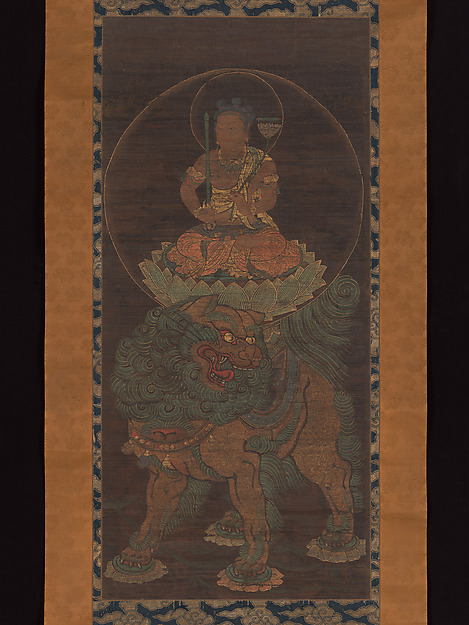
Japan, 14th century. Hanging scroll; ink, color and gold on silk; image 92 × 42 cm.
Look closer: Look at the lion first, with its green curls and open red mouth, then up to the lotus and the small figure who sits calmly above. The Met dates the painting to the fourteenth century and records the artist as unidentified.
The Metropolitan Museum of Art, Gift of Sue Cassidy Clark, in honor of Barbara Brennan Ford, 2020 (2020.75.1). Public domain, Open Access.
| Feature | What it means | Where to look |
|---|---|---|
| Lion | Fearless wisdom; a roar that dispels confusion | The mount under the lotus |
| Raised sword | Wisdom cutting through ignorance | The right hand |
| Scroll | The Prajñāpāramitā, the perfection of wisdom | The left hand, sometimes on a lotus |
| Topknots | The form: one, five, six or eight knots | The top of the head |
| Youthful face | He is always kumārabhūta, a youth | The face and the bare, rounded chest |
| Ruyi sceptre | Replaces the sword in some Chinese and Japanese scenes | The right hand |
The debate with Yuima
Monju is not a quiet saint. The Art Net Users System says he appears in many Mahayana sutras as a leading interlocutor, and is best known for his debate with the layman Yuima, Vimalakīrti, in the Yuimagyō. Wikipedia says the subject of the debate is non-duality. In the Prajñāpāramitā literature his teaching of wisdom has a central place: the Art Net Users System says he plays an important role in the Hannyagyō, which expounds hannya, wisdom.
In the Lotus Sutra Wikipedia says he leads the daughter of the nāga king to enlightenment. This page does not go further into the story than Wikipedia does. What is clear is the pattern: where there is a question of the nature of reality to be answered, Monju is the one chosen to put it.
A seat in the northeast
According to the Kegonkyō, the Avataṃsaka Sutra, Monju dwells on a mountain in the northeast. The Art Net Users System says that in China the mountain was identified as Wutaishan, which became the major centre of his cult. Wikipedia places Wutai in Shanxi, as one of China’s four sacred mountains, and notes the Wenshu Hall of Foguang Temple, built in 1137 under the Jin dynasty.
The monk Ennin (794–864) visited Wutaishan during his travels in China between 838 and 847, and the Art Net Users System credits him with introducing the cult to Japan. From the mountain came pictures as well as faith. The same source names the Tokai Monjuzō, Monju and his retinue crossing the sea on clouds, presumably towards Wutaishan, and says a Kamakura painting of the subject at Daigo-ji in Kyoto is a National Treasure.
It names too the Monju gosonzō, the quintet. Monju is accompanied by four companions: the youth Zenzai Dōji, the king of Khotan Uten’ō, the elder Saishō Rōnin and the monk Buddhapari, or Butsudahari. The well-known sculptures of this group are at Monju-in and Saidai-ji, both in Nara.
| Group | Contents | Source |
|---|---|---|
| Shaka sanzon | Shaka with Monju (wisdom) and Fugen (practice) | Art Net Users System |
| Monju gosonzō | Monju with Zenzai Dōji, Uten’ō, Saishō Rōnin and Butsudahari | Monju-in and Saidai-ji, Nara |
| Tokai Monjuzō | Monju and retinue crossing the sea on clouds | Daigo-ji, Kyoto (National Treasure) |
| Taizōkai Monjuin | Monju attended by the eight Hachidai Dōji | Womb World mandala |
Knots, syllables and a monk’s hall
The Art Net Users System sorts his forms by his mantra and by his hair. By the number of syllables in the mantra there are the one-letter Ichiji Monju, said to guard against natural disasters and nightmares, and the five-, six- and eight-letter forms. By the number of hair knots there are the one-knot Ikkei Monju, said to guard against stillbirth and rain, and the five-, six- and eight-knot forms.
Other forms follow the use of the room. The Sōgyō Monju, in monk’s dress, is enshrined in the dining halls of Tendai temples as an ideal monk. The Shōsō Monju is found in the meditation halls of Zen temples. The Chigo Monju shows a child, because he is believed to be perpetually youthful. The Jōi Monju wears a rope robe, from a Chinese tale that is also the subject of a Zen painting.
In esoteric Buddhism he has places in both mandalas. In the Taizōkai he holds a book in the right hand and a lotus with a five-pronged vajra in the left; as the central figure of his own court, the Monjuin, he holds a lotus topped with a three-pronged vajra. In the Kongōkai the Art Net Users System identifies him with Kongōri, one of the Sixteen Great Bodhisattvas.
| Form | Read as | Note |
|---|---|---|
| Ichiji Monju | One letter of mantra | Guards against natural disasters and nightmares |
| Ikkei Monju | One hair knot | Guards against stillbirth and rain |
| Gokei Monju | Five hair knots | The five-knot form |
| Hakkei Monju | Eight hair knots | The eight-knot form |
| Sōgyō Monju | Monk’s dress | In Tendai dining halls |
| Shōsō Monju | Holy-monk form | In Zen meditation halls |
| Chigo Monju | A child | For his perpetual youth |
Beside the Buddha, opposite Fugen
In the Shaka triad Monju is at one side and Fugen at the other. The Art Net Users System gives one version in which Monju stands on Shaka’s left, symbolising wisdom, and Fugen on the right, symbolising practice. Butuzou’s guide says that left and right vary with the convention and the region and should not be relied on alone. The attributes are the dependable test.
Butuzou reads the pair as complementary wings: wisdom without practice may go cold, and practice without wisdom may lose its way. The same source calls them interpretive keys to Shaka’s awakening and teaching. It gives no dates or events for Japan, only the observation that the triad format has roots in East Asian Buddhist art.
The third of thirteen
In the Thirteen Buddhas sequence of memorial rites Monju presides over the twenty-first day after a death. The Art Net Users System makes the same point in its entry on him. The Wikipedia list gives the neighbours: Shaka on the fourteenth day, Fugen on the twenty-eighth. The three together run through the first four weeks, from the Buddha to wisdom to practice.
One youth, many names
The rows below record the names given in the sources I read.
| Where | Form and name | What the record shows |
|---|---|---|
| India | Mañjuśrī; Mañjughoṣa; Mañjuśrīkumārabhūta | “Beautiful One with Glory”; “Prince Mañjuśrī”. |
| China | Wenshu (文殊); 文殊師利; 妙吉祥 | Wikipedia also lists 大智文殊師利, “Great Wisdom”. |
| Japan | Monju (文殊); Monjushiri; Myōkichijō (妙吉祥) | Monju is the abbreviation of Monjushiri. |
| Korea | Munsu Bosal (문수보살) | Also 만수보살 and 묘길상보살. |
| Vietnam | Văn-thù; Diệu Đức; Diệu Cát Tường | The Vietnamese forms. |
| Tibet | Jampel (འཇམ་དཔལ་); Jampelyang | The Tibetan forms. |
| Thailand | พระมัญชุศรี | The Thai form. |
The bodhisattva of the first month
Monju stands with Fugen at the side of Shaka and presides over the twenty-first day in the Thirteen Buddhas sequence. The table below shows the three bodhisattvas and the Buddha who open it.
| Memorial occasion | Figure | Role |
|---|---|---|
| 7th day | Fudō Myōō | The immovable wisdom king, first of the thirteen |
| 14th day | Shaka Nyorai | The historical Buddha, second of the thirteen |
| 21st day | Monju Bosatsu | Wisdom, third of the thirteen |
| 28th day | Fugen Bosatsu | Practice, fourth of the thirteen |
Where to see him
| Place | What to look for |
|---|---|
| Monju-in, Nara | The Monju quintet: the bodhisattva with four companions (Art Net Users System). |
| Saidai-ji, Nara | The second well-known sculpture of the Monju quintet (Art Net Users System). |
| Daigo-ji, Kyoto | A Kamakura painting of Monju crossing the sea, a National Treasure (Art Net Users System). |
| Tendai dining halls and Zen meditation halls | The monk forms of Monju, the Sōgyō and the Shōsō (Art Net Users System). |
| Metropolitan Museum of Art, New York | Hanging scrolls of Monju on a lion and with five topknots, a gilt-bronze Monju and a lacquered porcelain group, in the public domain. |
Monju in scroll, bronze and lacquer
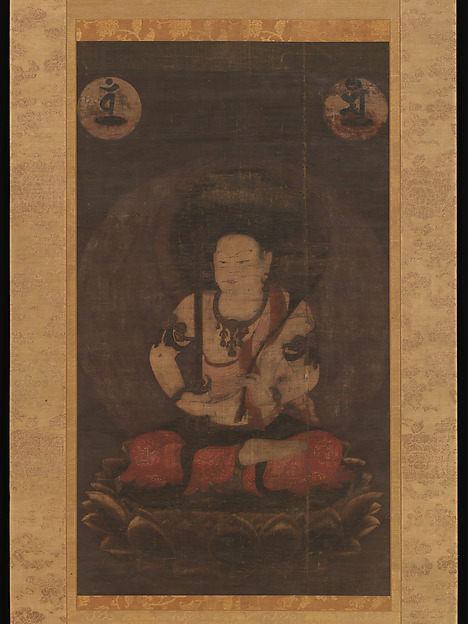
Japan, 13th century. Hanging scroll; ink and color on silk; image 93.3 × 52.7 cm.
Look closer: The Met dates the scroll to the thirteenth century. Look at the two roundels at the top, each with a single Sanskrit seed syllable, and at the figure’s cross-legged pose on the open lotus.
The Metropolitan Museum of Art, H. O. Havemeyer Collection, Bequest of Mrs. H. O. Havemeyer, 1929 (29.100.466). Public domain, Open Access.
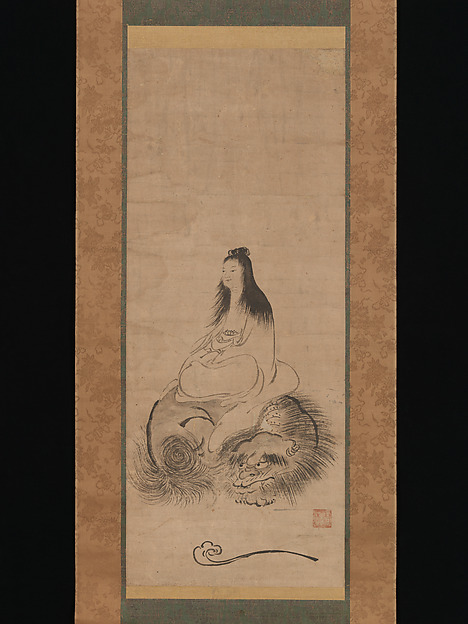
Japan, late 15th century. Hanging scroll; ink on paper; image 81.5 × 33 cm.
Look closer: Painted in ink alone. The Met records the artist as Shūsei and dates the scroll to the late fifteenth century. Look at the loose strokes of the lion’s mane and the single curl of cloud below.
The Metropolitan Museum of Art, Mary Griggs Burke Collection, Gift of the Mary and Jackson Burke Foundation, 2015 (2015.300.45). Public domain, Open Access.

Japan, late 13th century. Gilt bronze; height 16.5 cm.
Look closer: The Met records the figure as 16.5 cm high and dates it to the late thirteenth century. Look at the cluster of topknots on the crown and at the lacy halo, which is cut through in a pattern of leaves and lotus blossoms.
The Metropolitan Museum of Art, Gift of Sue Cassidy Clark, in honor of Barbara Brennan Ford, 2019 (2019.418.1). Public domain, Open Access.

Japan, first half 18th century. Porcelain body covered in black lacquer, gold foil and pigments; height 22.2 cm.
Look closer: The Met attributes this group to Ogawa Haritsu, known as Ritsuō, and dates it to the first half of the eighteenth century. Look at the lion’s broad grimacing face and at the figure’s small patterned robe and headband.
The Metropolitan Museum of Art, H. O. Havemeyer Collection, Bequest of Mrs. H. O. Havemeyer, 1929 (29.100.671). Public domain, Open Access.
In the house
The house keeps figures of Monju on his lion in cast metal. The strip below reads the live shelves, so it shows what is available now.
Answered plainly
Who is Monju?
The bodhisattva of wisdom, always a youth, who rides a lion and holds a raised sword and a scroll. The Art Net Users System calls him the wisest bodhisattva and the second most popular after Kannon.
What does the sword mean?
The raised sword in the right hand stands for wisdom that cuts through delusion and ignorance. Wikipedia adds that it cuts through duality.
How do I tell Monju from Fugen?
Butuzou’s working rule: lion and sword for Monju, white elephant and lotus for Fugen. Left and right placement varies and should not be relied on alone.
What is the debate with Yuima?
The scene from the Vimalakīrti Sutra in which Monju debates the layman Yuima on non-duality. It is the best-known episode of the bodhisattva in the Art Net Users System.
Why five topknots?
Monju’s forms are classed by the number of hair knots: one, five, six or eight. The Art Net Users System lists them without giving a single reason for the number.
Which day of the Thirteen Buddhas is Monju?
The twenty-first day after a death, the third of the thirteen, between Shaka and Fugen.
Where next
Sources and image credits
- The Metropolitan Museum of Art, object 752006
- The Metropolitan Museum of Art, object 45236
- The Metropolitan Museum of Art, object 670971
- The Metropolitan Museum of Art, object 752004
- The Metropolitan Museum of Art, object 47413
- Japanese Architecture and Art Net Users System, Monju
- Wikipedia, Mañjuśrī (names, iconography, Mount Wutai, sutras)
- Butuzou, Fugen Bosatsu vs Monju Bosatsu
- Wikipedia, Thirteen Buddhas
Last reviewed 28 October 2026. Pictures are public-domain or open-access, each credited beneath it. Diagrams on this page are drawn by Japonista.
Looking for a Monju on his lion, a hanging scroll or a small altar figure? Tell us what you have in mind and we will look.
Private concierge
Looking for something in particular?
Describe the piece or the project you have in mind. A senior advisor in Tokyo reads every case file personally and replies within two business days, with fees set out in writing before any work begins.