
Miroku Bosatsu
The Buddha To Come
Miroku Bosatsu
弥勒菩薩
The bodhisattva who is expected to return to earth as the next Buddha. He waits in Tosotsu heaven, his name means the compassionate one, and Japanese art shows him in several ways: seated in thought, crowned with a vase in his hand, or descending on a cloud to meet the faithful.
Identity card
Know him at a glance
- The halo. The disc of light that marks a bodhisattva of high rank.
- The vase. In the central court of the Taizōkai mandala he holds a lotus topped with a vase in his right hand (JAANUS). Wikipedia names the water vase as his attribute.
- The left hand. In the same mandala the left hand makes the semui-in, the gesture that removes fear (JAANUS). This diagram shows that mandala form.
- The crown. Some Japanese images, in the esoteric manner, place a stupa in the crown or in the hand (JAANUS).
- The seat. A lotus seat in this form. The pensive form sits with one leg pendent, which is a different pose from this diagram.
Loving-kindness, waiting
The Japanese Architecture and Art Net Users System, the standard Japanese art terms reference from Columbia University and known as JAANUS, defines Miroku as a bodhisattva who is expected to return to earth as the next Buddha. It adds that both Theravada and Mahayana Buddhists revere him, that the Japanese name Jishi means the compassionate one, and that he is also called Miroku Butsu, Miraibutsu and Shōraibutsu, names that already treat him as a Buddha to come. Wikipedia gives the Sanskrit as Maitreya, from maitrī, loving-kindness.
He is not absent. JAANUS says he lives now in Tosotsuten, the Tusita heaven, and waits there for the hour of his return, which it places 5,670 million years after the death of Shaka. Wikipedia reaches the same figure and calls him the future Buddha of this world, the fifth and last Buddha of the present age.
This chapter sits inside the Buddhism and Zen Almanac, on the Bosatsu rank. Miroku is the one figure in the rank whose work lies ahead. Jizō walks the hells now; Kannon answers now; Miroku is the one for whom the world is still waiting.
A hanging leg, a finger at the cheek
JAANUS describes three families. The first is the bodhisattva seated with one or both legs pendent. Its commonest early type is the hanka shiyui pose, with the left leg pendent, the right leg crossed over the left knee and the right fingers lightly touching the cheek. The second is the Buddha form, with the standard marks of a nyorai, of which it names examples from the late seventh century at Taima-dera and from 711 at Hōryū-ji. The third, from the Heian period on, is an esoteric bodhisattva with a stupa in the crown or in the hand.
Wikipedia adds that he is shown in Indian art as a prince, that the water vase is his attribute, and that Gandharan images give him a loop of hair. The Met’s fourteenth-century scroll of Miroku Bosatsu shows the Japanese painter’s version: a crowned figure in gold on a lotus, seated on a tiered hexagonal stand against a dark ground, with a double halo behind him and a small object held before his chest.
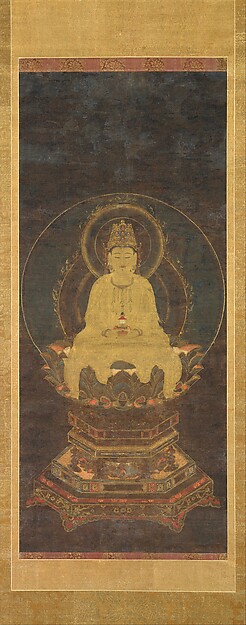
Japan, 14th century. Hanging scroll; ink, color and gold on silk; 106.7 × 47 cm.
Look closer: Look at the way the whole figure is drawn in gold against the dark silk, then at the small object he holds before his chest and the tiered stand below. The Met dates the scroll to the fourteenth century.
The Metropolitan Museum of Art, H. O. Havemeyer Collection, Bequest of Mrs. H. O. Havemeyer, 1929 (29.100.462). Public domain, Open Access.
| Feature | What it means | Where to look |
|---|---|---|
| Pensive pose | Left leg pendent, right ankle over the left knee, fingers to the cheek | Seated sculpture, early type |
| Vase | The water vase, his attribute | The right hand; a lotus topped with a vase in the mandala |
| Stupa | The esoteric form, Heian onward | The crown or the hand |
| Nyorai marks | The Buddha-form images | Taima-dera and Hōryū-ji, Nara |
| Raised left hand | The semui-in of the Taizōkai mandala | The left hand |
| Crown and jewels | The bodhisattva rank | The head and chest |
A welcome from the clouds
JAANUS says that late Heian art shows Miroku descending to earth to welcome devotees and lead them to his heaven, in paintings called Miroku raigō-zu, and names an example at Shōmyō-ji in Kanagawa. The idea parallels the more famous descent of Amida, and the Met’s early fourteenth-century scroll of Miroku in Welcoming Descent shows it: a standing figure on a cloud, hands joined, with rays spreading across the dark silk and a block of text at the top.
JAANUS also describes a Heian revival of the Miroku cult, driven by worry about the end of the age, which was eventually overshadowed by the Pure Land faith. A Tosotsuten mandara at Enmei-ji in Osaka is its example of a painting of the heaven itself.
From Gandhara to Nara
Wikipedia credits the monk Dao’an (312 to 385) with founding the cult of Maitreya in China and says it flourished under the Northern Wei (386 to 534). It adds that the pilgrim Xuanzang vowed to be reborn in the Tusita heaven, and that the cheerful Budai of Chinese temples is regarded as an emanation of Maitreya. In Japan, according to Wikipedia, the Hossō school promoted devotion and an Asuka-period seated Maitreya is known.
JAANUS records a more precise date. An image of Miroku was brought to Japan from the Korean kingdom of Paekche in 584. It names the pensive images at Kōryū-ji in Kyoto and Chūgū-ji in Nara as the great examples of the hanka type, and Taima-dera and Hōryū-ji in Nara as the Buddha type.
| Place | Form | Source |
|---|---|---|
| Kōryū-ji, Kyoto | Hanka shiyui, pensive | JAANUS |
| Chūgū-ji, Nara | Hanka shiyui, pensive | JAANUS |
| Taima-dera, Nara | Buddha form, late 7th century | JAANUS |
| Hōryū-ji, Nara | Buddha form, 711 | JAANUS |
| Daigo-ji, Kyoto and Reiun-ji, Tokyo | Miroku Bosatsu mandara, Kamakura | JAANUS |
Mandala and thirty arms
In the Taizōkai mandala JAANUS places him in the central eight-petalled court, holding a lotus topped with a vase in the right hand and making the semui-in with the left. In the Kongōkai mandala he is one of the sixteen deities of the Auspicious Aeon. The same source describes a thirty-armed form given in texts and in iconographic manuals, and adds that no statues of it are known. It records Miroku mandalas of the Kamakura period at Daigo-ji in Kyoto and Reiun-ji in Tokyo.
The sixth of thirteen
JAANUS says Miroku is one of the thirteen Buddhas who preside over the memorial services, and that he takes the forty-second day after a death. On the Thirteen Buddhas calendar he follows Jizō on the thirty-fifth day and precedes Yakushi on the forty-ninth.
One name, many readings
The rows below record the names given in the sources I read.
| Where | Form and name | What the record shows |
|---|---|---|
| India | Maitreya | From maitrī, loving-kindness. Some texts call him Ajita, “Invincible” (Wikipedia). |
| China | Mílè Púsa (彌勒菩薩) | Dao’an is credited with founding the cult; popular under the Northern Wei. Budai is regarded as an emanation. |
| Japan | Miroku (弥勒); Jishi (慈氏) | Jishi means the compassionate one (JAANUS). Wikipedia also gives Miroku Nyorai. |
| Korea | Mireuk Bosal (미륵보살) | The Korean reading (Wikipedia). An image from Paekche reached Japan in 584 (JAANUS). |
| Vietnam | Di Lặc Bồ Tát | The Vietnamese name as Wikipedia gives it. |
| Tibet | Jampa (byams pa) | The Tibetan name. |
| Thailand | Phra Si Ariya Mettrai | The Thai form. |
The bodhisattva still to come
Miroku presides over the forty-second day in the Thirteen Buddhas sequence. The table below shows him between Jizō and Yakushi.
| Memorial occasion | Figure | Role |
|---|---|---|
| 35th day | Jizō Bosatsu | The earth store |
| 42nd day | Miroku Bosatsu | The Buddha to come, sixth of the thirteen |
| 49th day | Yakushi Nyorai | The healing Buddha |
Where to see him
| Place | What to look for |
|---|---|
| Kōryū-ji, Kyoto and Chūgū-ji, Nara | The great pensive images of the hanka type (JAANUS). |
| Taima-dera and Hōryū-ji, Nara | Buddha-form images of the late seventh century and of 711 (JAANUS). |
| Shōmyō-ji, Kanagawa | A Miroku raigō painting of the late Heian period (JAANUS). |
| Enmei-ji, Osaka | A Tosotsuten mandara (JAANUS). |
| Daigo-ji, Kyoto and Reiun-ji, Tokyo | Kamakura Miroku Bosatsu mandalas (JAANUS). |
| Metropolitan Museum of Art, New York | Scrolls of Miroku, the Hossō Mandala and a lacquer portable shrine, in the public domain. |
Miroku in scroll and lacquer
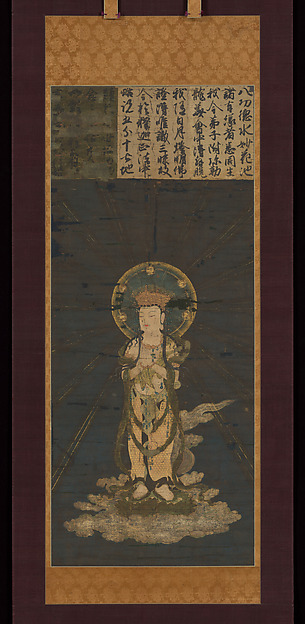
Japan, early 14th century. Hanging scroll; ink, color and gold on silk; image 84.8 × 35.9 cm. Artist unidentified.
Look closer: The Met titles it Miroku Bosatsu in Welcoming Descent and dates it to the early fourteenth century. Look at the cloud under his feet, the rays behind him and the vertical inscription at the top.
The Metropolitan Museum of Art, Gift of Sebastian Izzard, in memory of Miki Aoyagi-Izzard, 2024 (2024.554). Public domain, Open Access.

Japan, 16th century. Hanging scroll; color on silk.
Look closer: The Met titles it Hossō Mandala and dates it to the sixteenth century. Look at the radiating lines behind the central figure, then at the rows of monks below him, each with his own label. Wikipedia says the Hossō school promoted devotion to Maitreya in Japan.
The Metropolitan Museum of Art, Gift of Eileen Hsu, 1991 (1991.384). Public domain, Open Access.

Japan, 19th century. Gold maki-e on black lacquer; height 2.5 cm, diameter 7.3 cm.
Look closer: The Met titles it Portable shrine of Miroku Bosatsu with Sanskrit syllable and dates it to the nineteenth century. Look at the single gold syllable that stands for the deity and the sprinkled gold ground.
The Metropolitan Museum of Art, The Howard Mansfield Collection, Purchase, Rogers Fund, 1936 (36.100.174a, b). Public domain, Open Access.
In the house
Pieces of Miroku, pensive or crowned, appear on the shelves from time to time. The strip below reads the live shelves and appears when one is in the house.
Answered plainly
Who is Miroku?
The bodhisattva expected to return to earth as the next Buddha. The Sanskrit is Maitreya, from loving-kindness. He waits in the Tusita heaven.
When will he come?
JAANUS says 5,670 million years after the death of Shaka. Wikipedia gives the same figure.
What is the pensive pose?
The hanka shiyui pose: left leg pendent, right leg crossed over the left knee, right fingers lightly touching the cheek. Kōryū-ji and Chūgū-ji hold the best known examples.
How do I recognise him?
By the pensive pose, by a vase held in the hand or on a lotus, or by a stupa in the crown. Early Buddha-form images carry the marks of a nyorai.
What is a Miroku raigō?
A painting, late Heian in its first examples, in which Miroku descends to welcome devotees and lead them to his heaven.
Which day of the Thirteen Buddhas is Miroku?
The forty-second day after a death, the sixth of the thirteen, between Jizō and Yakushi.
Where next
Sources and image credits
- The Metropolitan Museum of Art, object 45597
- The Metropolitan Museum of Art, object 892108
- The Metropolitan Museum of Art, object 57172
- The Metropolitan Museum of Art, object 58352
- Japanese Architecture and Art Net Users System, Miroku
- Wikipedia, Maitreya: names, iconography, history of the cult
- Wikipedia, Thirteen Buddhas
Last reviewed 28 October 2026. Pictures are public-domain or open-access, each credited beneath it. Diagrams on this page are drawn by Japonista.
Looking for a pensive Maitreya, a Miroku scroll or a small altar figure? Tell us what you have in mind and we will look.
Private concierge
Looking for something in particular?
Describe the piece or the project you have in mind. A senior advisor in Tokyo reads every case file personally and replies within two business days, with fees set out in writing before any work begins.