
Jizō Bosatsu
The Vow Beneath the Roads
Jizō Bosatsu
地蔵菩薩
A bodhisattva who dresses as a monk, carries a staff and a jewel, and has promised to teach every being in the six realms until Miroku arrives. He was carved in the thirteenth century with eyes of rock crystal, painted walking down from the clouds, and placed by Japan at crossroads, beside graveyards and over its lost children.
Identity card
Know him at a glance
- The shaven head. Wikipedia notes that Kṣitigarbha is shown as a monk with a shaven head, unlike the bodhisattvas dressed as Indian royalty.
- The staff. A ringed staff, the shakujō. The Art Net Users System says the mid-Heian standard form holds it in the right hand.
- The jewel. The wish-granting jewel, hōju, carried in the left hand in the standard form.
- The halo. A disc of light behind the head, the mark of a bodhisattva of high rank.
- The lotus. Seated or standing, Jizō often rests on an open lotus. This diagram is a generic aid; many images stand.
Between two Buddhas
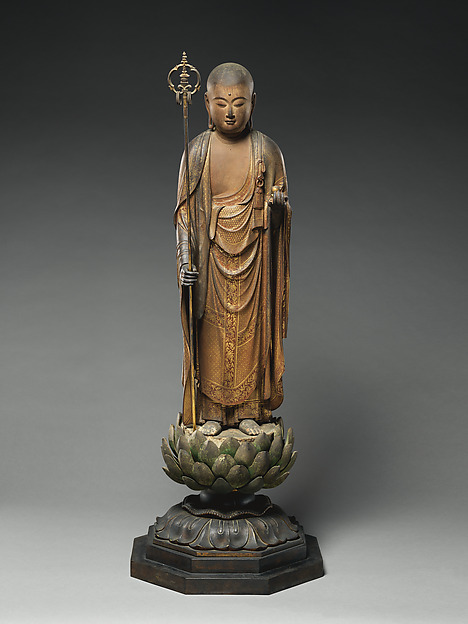
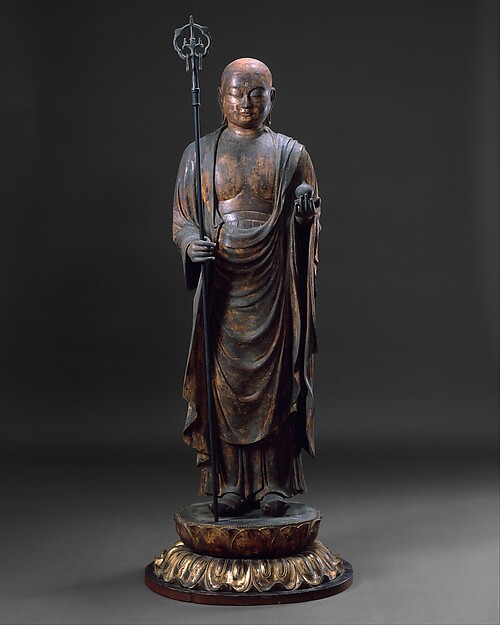
Japan, 1291. Japanese cypress wood with polychrome pigments, gold paint, cut gold leaf and rock-crystal eyes; height with pedestal 135.9 cm.
Look closer: Look at the ringed staff in the right hand and at the quiet, level gaze. Then follow the robe, which is patterned in gold, down to the bare feet on the lotus. The Met names the maker as Intan and dates the carving to 1291.
The Metropolitan Museum of Art, Purchase, Florence and Herbert Irving Acquisitions Fund for Asian Art, Florence and Herbert Irving Acquisitions Fund, by exchange, The Miriam and Ira D. Wallach Foundation Fund, Brooke Russell Astor Bequest, and Fletcher Fund, 2023 (2023.640a–c). Public domain, Open Access.
Every Buddha has a time and a place, and Jizō was given the gap between two of them. The Art Net Users System, the standard Japanese art terms reference from Columbia University, says he saves beings of the six realms in the long interval after the death of Shaka and before the coming of Miroku, which it puts about 5,670 million years later. Wikipedia gives the vow in its sharpest form: Kṣitigarbha will not take Buddhahood until all the hells are empty.
The distinction matters. Most bodhisattvas wait in a paradise and answer prayers that reach them. Jizō is the one who goes down. The Japan Up Close account of the figure says he is found in Buddhist temples, in graveyards, on country roadsides and sometimes on street corners, and Wasshoi Magazine describes him as a guide for wandering souls caught between the living world and the afterlife. Nippon.com calls him the most widely known Buddha among the Japanese people, a loose use of the word Buddha for a bodhisattva, but a fair measure of how familiar he is.
This page sits inside the Buddhism and Zen Almanac, on the Bosatsu rank. The Art Net Users System says Jizō rivalled Kannon in popularity in Japan. Where Kannon hears a cry, Jizō goes to the place it came from. The chapter is in two parts. This first part follows the figure from the sutra to the museum: the scripture, the mountain in China, the kings of hell, the iconography, the Kamakura carvers and the scrolls. The second part, Jizō in Japan, follows him onto the road: the six statues at the village edge, the riverbed of the dead, the memorial rites for unborn children, the folktales, the temples and the festival of the neighbourhood.
Storehouse, womb and treasury
The Sanskrit name, Kṣitigarbha, is built from kṣiti, earth, and garbha, which Wikipedia glosses as treasury, store, matrix or womb. The English renderings therefore vary: “Earth Treasury”, “Earth Store”, “Earth Matrix”, “Earth Womb”. Nippon.com reads the Japanese characters directly: ji is earth and zō is storehouse. The Art Net Users System glosses the Japanese as “earth repository”.
The second half of the Sanskrit word carries a double meaning that later Japanese writers have not ignored. Wasshoi Magazine points out that garbha can mean uterus or origin, and records a reading of the red caps on his statues as a symbol of the placenta, which joins the bodhisattva to the womb of a mother. The same article notes that in Indian Buddhism Kṣitigarbha was depicted as an enlightened maiden, and that in the transmission through Tibet, China and Korea the figure came to be shown as a male monk. That is one account. The Wikipedia article gives the Brahmin girl of the sutra a separate role, described below, and does not make the claim about early images, so this page records the Wasshoi reading as the magazine’s own.
Whatever the etymology, the Japanese people have shortened the title into something close to a name for a neighbour. Nippon.com records jizō-san and jizō-sama as affectionate forms, and the honorific Ojizō-sama appears in nearly every account of roadside practice. The full Chinese title, Dayuan Dizang Pusa, means the Bodhisattva of the Great Vow; in Japan the equivalent is Daigan Jizō Bosatsu.
| Language | Name | Note |
|---|---|---|
| Sanskrit | Kṣitigarbha (क्षितिगर्भ) | Earth Treasury, Earth Store, Earth Matrix or Earth Womb |
| Japanese | Jizō Bosatsu (地蔵菩薩); Ojizō-sama; Daigan Jizō Bosatsu | Ji, earth; zō, storehouse (Nippon.com) |
| Chinese | Dìzàng Púsà (地藏菩薩); Dàyuàn Dìzàng Púsà | Bodhisattva of the Great Vow |
| Korean | Jijang Bosal (지장보살) | The Korean reading of Dizang |
| Vietnamese | Địa Tạng Bồ Tát; Đại Nguyện Địa Tạng Vương Bồ Tát | The full title carries the sense of king |
| Tibetan | Sa Yi Nyingpo (ས་ཡི་སྙིང་པོ་) | Essence of the Earth |
| Thai | พระกษิติครรภโพธิสัตว์ | A transliteration of the Sanskrit |
A monk, not a prince
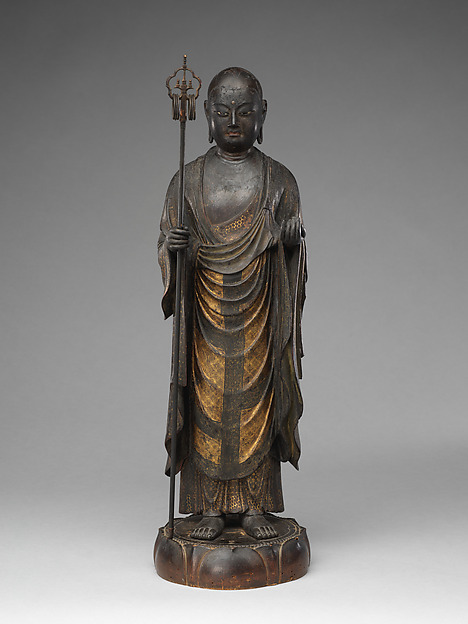
Japan, ca. 1202. Lacquered Japanese cypress, color, gold, cut gold and inlaid crystal; height 55.9 cm.
Look closer: The Met attributes this piece to Kaikei and dates it to about 1202. Look at the dark lacquer of the robe, the gold showing in the lower folds and the thin staff with its rings at the top.
The Metropolitan Museum of Art, Mary Griggs Burke Collection, Gift of the Mary and Jackson Burke Foundation, 2015 (2015.300.250a, b). Public domain, Open Access.
Most bodhisattvas are dressed as Indian royalty, with crowns, scarves and jewels. Wikipedia singles Jizō out as the exception, a shaven-headed monk. The standard Japanese image, the Art Net Users System says, took shape by the middle of the Heian period: the jewel in the left hand and the ringed staff in the right. Earlier images hold the jewel in the left hand and make the wish-granting gesture (yogan-in) with the right. Wikipedia adds three details that appear in Chinese and Japanese images: the wish-fulfilling jewel shaped like a tear, the third eye and the elongated ears that mark an awakened being.
The Met’s Kamakura figure of 1291 shows the type clearly. The cypress statue stands on a lotus on an octagonal base, with a shaven head, rock-crystal eyes, a staff in the right hand and a layered monk’s robe patterned in cut gold leaf. Its maker is recorded as Intan. The Met’s smaller figure, attributed to Kaikei and dated about 1202, is darker: lacquered cypress with gold left showing in the lower folds of the robe.
The staff and the jewel
The Met keeps a bronze finial of a monk’s staff, a shakujō head, 24.1 cm high (07.16), the kind of object a Jizō statue holds in carved form. Butuzou, which sells devotional statuary and writes about it, links the ringed staff to guidance and to safe passage, and the jewel to wisdom and compassionate benefit, in preference to casual wish-granting. Those are the writer’s readings of the attributes, offered as such.
| Feature | What it means | Where to look |
|---|---|---|
| Shaven head | A monk, not a royal bodhisattva | The head, which has no crown |
| Shakujō | The ringed staff of a travelling monk, linked by Butuzou to guidance and safe passage | The right hand in the mid-Heian standard form |
| Hōju | The wish-granting jewel, tear-shaped in Chinese and Japanese images (Wikipedia) | The left hand |
| Lotus | Purity; the seat or the stand | Under the feet |
| Crystal eyes | Inlaid eyes, as in the Met’s Kamakura carvings | Look at the gaze; they catch the light |
| Third eye and long ears | Marks of an awakened being, noted by Wikipedia | The forehead and the lobes |
| Robes | A monk’s layered robe, often painted or gilded | The chest and the long skirt |
A mother in the heaven of the thirty-three
The foundation text is the Kṣitigarbha Bodhisattva Pūrvapraṇidhāna Sūtra, the Sutra of the Past Vows, a popular Mahāyāna scripture. Wikipedia reports the founding scene. The Buddha, speaking in the Trāyastriṃśa heaven, where he preached for his mother Maya, entrusts the beings of the six worlds to Kṣitigarbha. The pledge that follows is the one Japan repeats: he will instruct beings between the passing of the Buddha and the rise of Maitreya, and he will not take Buddhahood until the hells are empty.
The sutra reached Chinese in the closing years of the seventh century. Wikipedia records that it was translated between 695 and 700 CE in the Tang dynasty by Śikṣānanda, a monk from Khotan, who also translated the Avataṃsaka and Laṅkāvatāra sutras. The setting is filial. The Buddha preaches in the heaven to honour his mother, and the bodhisattva’s own origin story begins with a daughter’s grief.
The Brahmin girl
In a distant eon, the sutra says, Kṣitigarbha was a Brahmin maiden called Sacred Girl. Her mother had slandered the Three Jewels, the Buddha, the Dharma and the Sangha. When the mother died, the girl was deeply troubled, and her sorrow led to the vows. Wikipedia gives this much and no more. The detail is small but it explains a good deal of what followed: a bodhisattva whose compassion is directed first at a parent in hell is the natural patron of memorial rites and of the children who cannot protect themselves.
Who wrote it?
No Sanskrit manuscript of the sutra has been found. Wikipedia reports that some scholars suspect a Chinese origin because of the emphasis on filial piety, that Gregory Schopen has argued that Indian Buddhism had filial traditions of its own, and that there is no definitive evidence either way. This page follows that caution.
Whichever side is right, the text found its audience in China and Korea first. Wikipedia lists the scholarship that readers can follow: Zhiru Ng’s The Making of a Savior Bodhisattva (2007) and Hank Glassman’s The Face of Jizo (2012).
Kim Gyo-gak and the body that did not decay
In China the cult of Dizang settled on Mount Jiuhua, one of the Four Sacred Mountains, in what is now Anhui. Chinese traditions say the bodhisattva chose it as his place of practice. Wikipedia names two sources for the tale of how: Fei Guanqing’s Jiuhua shan Huacheng si ji of the ninth century, and Zanning’s Song gaoseng zhuan; Wikipedia gives Zanning’s dates as 919 to 1001.
The human figure at the centre is Kim Gyo-gak, a former prince of Silla who became a monk under the Chinese name Dizang and lived in the Tang period. The story has the shape of a hagiography. A goddess of the mountain, in the form of a scorpion, stung him, and he was unaffected; she later apologised and gave him an antidote and spring water. A nobleman surnamed Zhuge built a temple for him after noticing his austere life. Minrang, the owner of the mountain, offered it to him, and Kim’s robe grew to cover the whole of it. Minrang became his protector, and Minrang’s son later became a monk.
Wikipedia says he lived on the mountain for seventy-five years and died at ninety-nine. His body was found undecayed three years later, and it is still venerated: his preserved body is viewed at the Shrine of the Living Buddha on Mount Jiuhua. For the Chinese tradition that fact settled the question. The bodhisattva had come back in a human body, and the mountain had a living Dizang. This page gives the account as Wikipedia has it, and does not go further.
A judge’s hall and a beast that tells right from wrong
In Chinese devotion the bodhisattva descends furthest. Wikipedia records that the arhat Mulian is said to assist him in saving the beings of hell, and that Mulian is often venerated in Dizang temples. Dizang is sometimes shown riding Diting, a divine beast that can tell good from evil, or standing beside it. His birthday is kept on the thirtieth day of the seventh month of the Chinese calendar. The rituals associated with him include Yujia Yankou, the feeding of hungry ghosts, and Shuilu Fahui, the water-land ceremony.
He also stands inside the legal machinery of the underworld. Wikipedia reports that Korean, Japanese and Chinese art show the Ten Kings of Hell, and that a late eighteenth-century painting of the Joseon dynasty shows Jijang as supreme ruler of the underworld with the ten kings below him. Wikipedia adds that folk and Daoist practice has temples called Dizang’an, where Yanluo Wang and the black and white impermanence figures belong to the same world. For the full tribunal, see Enma and the Ten Kings.
Iconography in China has a few distinct habits. Wikipedia notes a five-Buddha crown, so that observers sometimes confuse the bodhisattva with Tang Sanzang of Journey to the West, and a form with six rays of light for the six paths that is common in Shaanxi, perhaps through the influence of the Sanjiejiao sect.
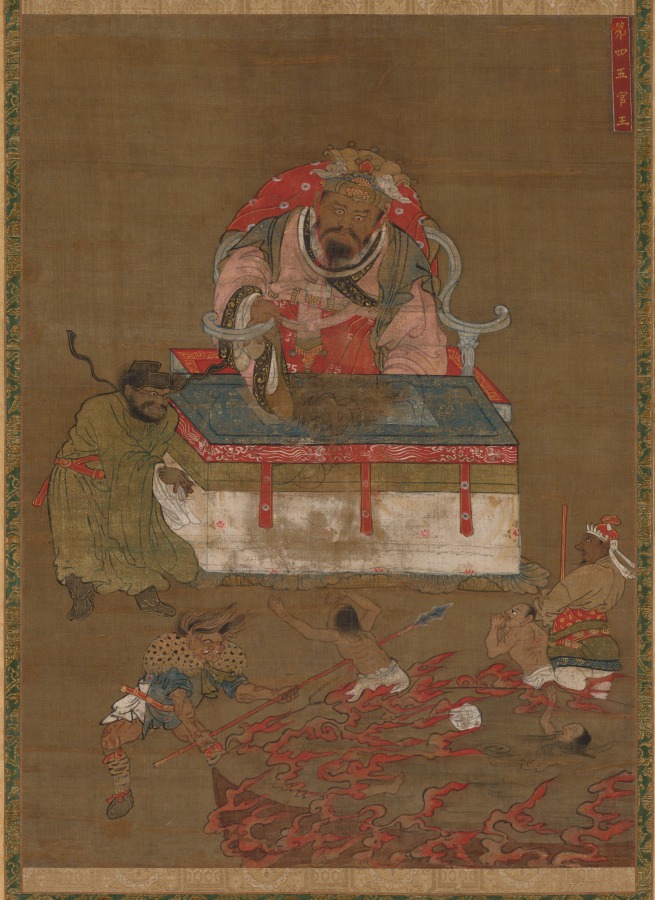
Korea, Goryeo dynasty, late 1300s. Hanging scroll; ink, color and gold ink on silk.
Look closer: This is the fourth of the ten kings of hell, from a set painted in Korea in the late fourteenth century. Look at the king behind his desk like a magistrate, then at the red flames and the demons in the lower half.
Cleveland Museum of Art, Leonard C. Hanna Jr. Fund and museum purchase from various donors by exchange and Partial Gift of The Honorable Joseph P. Carroll and Roberta Carroll, M.D. (2019.224). CC0, Open Access.
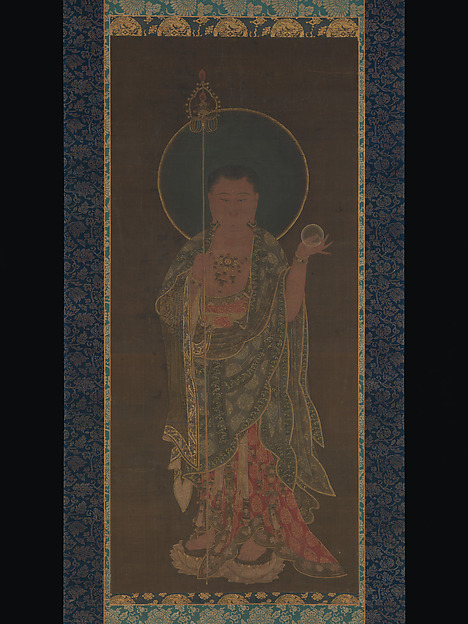
Korea, first half of the 14th century. Hanging scroll; ink, color and gold on silk.
Look closer: Look at the red robe patterned with fine gold, the jewel held up in the right hand and the thin staff, a Korean Jijang of the first half of the fourteenth century.
The Metropolitan Museum of Art, H. O. Havemeyer Collection, Gift of Horace Havemeyer, 1929 (29.160.32). Public domain, Open Access.
Korea
The name Jijang is the Korean reading of the Chinese monk’s name Dizang, and Kim Gyo-gak is the Silla prince of the legend. The Met holds two Goryeo scrolls in the same family as the standing figure above. One shows Amitabha and Kshitigarbha side by side. The Cleveland Museum’s standing Ksitigarbha, catalogued to 1300 to 1350, shows the same figure with a thin staff and a raised hand. The Korean devotional phrase recorded by Wikipedia is Namo Jijang Bosal.
| Element | Role | Source |
|---|---|---|
| Mulian | The arhat who helps him save hell-beings | Wikipedia |
| Diting | A divine beast that can tell good from evil; his mount or companion | Wikipedia |
| Ten Kings of Hell | The judges; Jizō presides over them in a Joseon painting | Wikipedia |
| Yujia Yankou | The ritual of feeding hungry ghosts | Wikipedia |
| Shuilu Fahui | The water-land ceremony | Wikipedia |
| Thirtieth of the seventh month | His birthday in China | Wikipedia |
A prince with a sprout and a bell
In Tibetan Buddhism the bodhisattva does not look like the Japanese monk. Wikipedia describes the peaceful form as usually white, sometimes green-blue, shown as a young Indian prince with one face and two hands, holding a sprout in the right hand and an upturned bell in the left, seated in half-lotus. A wrathful form, Lokastotrapūjā-nātha, the Destroyer of Haughty Ones, is dark blue, with three faces, six arms, four legs and two wings, and embraces a consort named Khamsum Chidul. Rob Mayer’s 2012 study of the Tibetan form is the source Wikipedia gives.
The bodhisattva also appears in a mandala that readers may meet through the Bardo Thödol: among the Forty-Two Peaceful Deities he sits east of Vajrasattva-Akṣobhya, associated with the vajra family and the water element. He is also one of the Eight Great Bodhisattvas, with Mañjuśrī, Avalokiteśvara, Vajrapāṇi, Samantabhadra, Ākāśagarbha, Maitreya and Sarvanīvaraṇaviṣkambin. Wikipedia says that group originated in India and became popular in Central Asia and Tibet, and that Amoghavajra translated the Aṣṭamaṇḍalaka-sūtra in the eighth century. Three of that company, Mañjuśrī, Samantabhadra and Ākāśagarbha, are Monju, Fugen and Kokūzō in Japan, and they have their own chapters: Monju, Fugen and Kokūzō.
The same article lists later East Asian and Vajrayāna forms with six arms, especially in Taiwan and Vietnam, and says that Chinese and Japanese images often show a third eye. Compare with the Japanese standard: the Tibetan prince has hair and ornaments, the Japanese monk has a shaven head and plain robes, but both carry something that signals growth or release, a sprout in one hand and a jewel in the other.
Armed, bound, jawless: a roster of Jizō
Japan did not leave the monk alone. It gave him names for what he does. The Art Net Users System lists several variants: Yata, Enmei, Hadaka, Hibō, Karate, and Shōgun, in which the bodhisattva is armoured. It also names Kosodate, the protector of children, and the Roku Jizō, six Jizō for the six realms. Wikipedia’s Japanese section adds forms attached to particular tales and places, which this chapter sets out in the table. The second part tells the stories behind several of them.
The roster shows how the bodhisattva takes on the needs of a place. A statue at a toothache temple has no jaw. A stone near Tokyo is bound with ropes. A figure at Sugamo is the one who pulls out thorns. Wikipedia adds that the Edo-period haiku poets Issa and Buson both wrote about him, which is a sign that by then he was part of the ordinary landscape.
| Form | What the sources say | Source |
|---|---|---|
| Roku Jizō | Six figures for the six realms, set at roadsides, temple approaches and cemeteries | Art Net Users System; Butuzou |
| Shōgun Jizō | Armoured, the general | Art Net Users System |
| Kosodate Jizō | Protector of children | Art Net Users System |
| Enmei Jizō | The long-life Jizō; the main image at Kōgan-ji in Sugamo | Art Net Users System; Sugamo |
| Togenuki Jizō | The thorn-removing Jizō at Kōgan-ji | Japan Travel; Nippon.com |
| Migawari Jizō | The substitute who takes on a person’s illness and pain | Nippon.com |
| Mizuko Jizō | Guardian of the stillborn, miscarried and aborted | Wikipedia |
| Bound Jizō | At Tōsen-ji in Katsushika, Tokyo; petitioners tie a rope and untie it when the wish is granted | Wikipedia |
| Jizō without a Jaw | Oki island; associated with toothache; worshippers offer a pear | Wikipedia |
| Jizō jūō-zu | A painting type in which he stands among the ten kings | Art Net Users System |
Kamakura hands and crystal eyes
Wikipedia names two carvers connected with the best known Jizō. It records a twelfth-century statue by Unkei at Rokuharamitsu-ji and a thirteenth-century statue by Kaikei, now at the Met. The Met’s own entry dates its Kaikei to about 1202 and records the artist as active between 1183 and 1223. The temple’s own article is more guarded: the Jizō is a seated wooden statue of the Kamakura period that carries no inscription, and temple tradition and its style attribute it to Unkei. The two Wikipedia articles therefore differ on the century, which is why this chapter calls the attribution traditional.
The Met’s catalogue describes the Intan figure of 1291 as Japanese cypress with polychrome pigments, gold paint, cut gold leaf and rock-crystal eyes, which is the Kamakura recipe for a figure that looks back at the worshipper. Wikipedia says it was intended for Kōfuku-ji, and the Met acquired it in 2023 (accession number 2023.640a–c). The Met’s large standing Jizō of the late twelfth to mid-thirteenth century, acquired in 1918, is 181.6 cm with its base and 188.6 cm with its staff.
Japan, late 12th to mid-13th century. Wood with lacquer, gold leaf, cut gold leaf (kirikane) and color.
Look closer: The largest of the Met’s Jizō stands 181.6 cm on its base. Look at the long staff, the weight of the robe falling from the shoulders and the gilded petals of the lotus below.
The Metropolitan Museum of Art, Rogers Fund, 1918 (18.93). Public domain, Open Access.

Japan, second half 13th century. Wood with lacquer, pigment and cut gold; overall height 116.2 cm.
Look closer: This is the seated type. Look at the crossed legs, the hands held before the chest and the circle of radiating rays behind the head, then down the lotus to the gilded octagonal base.
The Metropolitan Museum of Art, The Harry G. C. Packard Collection of Asian Art, Gift of Harry G. C. Packard, and Purchase, Fletcher, Rogers, Harris Brisbane Dick, and Louis V. Bell Funds, Joseph Pulitzer Bequest, and The Annenberg Fund Inc. Gift, 1975 (1975.268.166a–d). Public domain, Open Access.
| Object | Date | Material and size | Credit |
|---|---|---|---|
| The Bodhisattva Jizō (Intan) | 1291 | Cypress, polychrome, gold paint, cut gold leaf, crystal eyes; 135.9 cm with pedestal | Met, 2023.640a–c |
| Jizō (Kaikei) | ca. 1202 | Lacquered cypress, color, gold, cut gold, inlaid crystal; 55.9 cm | Met, 2015.300.250a, b |
| Jizō, standing | Late 12th to mid-13th century | Wood, lacquer, gold leaf, cut gold; 181.6 cm with base | Met, 18.93 |
| Jizō, seated | Second half 13th century | Wood, lacquer, pigment, cut gold; 116.2 cm overall | Met, 1975.268.166a–d |
Descents, a backward glance and a flute
On silk the bodhisattva is not rooted to a lotus. He descends. The Cleveland Museum’s description of its thirteenth-century Welcoming Descent of Jizō is among the clearest in any museum: the bodhisattva appears as a monk carrying a wish-fulfilling jewel and a golden staff topped with rings, descending with each foot balanced on a lotus, borne by clouds to save a suffering believer who has called for help. He is well known among Buddhists, the museum adds, for rescuing people from the many Buddhist hells.
The type is a cousin of the Amida raigō, the welcoming descent, and the Met owns three examples in this family: one of the early fourteenth century (25.215.102), one of the fourteenth century (29.100.525) and a related picture of Jizō with a jewel standing on clouds, of the fifteenth (69.139). The Art Net Users System says worship of Jizō grew in the Heian and Kamakura periods with the fear that the world had entered mappō, the decline of the Dharma, and a bodhisattva who walks into the hells was a more urgent figure than one who waits.
The Met’s fourteenth-century scroll titled The Bodhisattva Jizō “Looking Back” is among the most unusual images of him. The bodhisattva turns his head and glances behind as he walks, which gives the picture an air of waiting for the stragglers. In the seventeenth century the subject entered the repertoire of the Kano painters and of Hanabusa Itchō, who painted him seated on a green lotus above clouds in a robe of red and gold. Kanō Tan’yū’s Jizō playing a flute, of the middle of the seventeenth century, is a surprise: a lightly drawn figure on a cloud in flowing robes, in grey ink, that looks nothing like the carved monk.
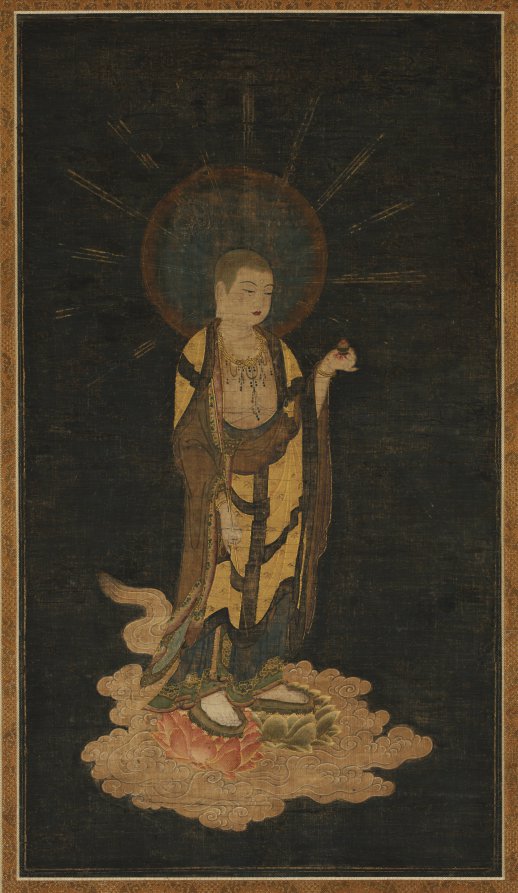
Japan, Kamakura period, 1200s. Hanging scroll; ink, color, gold and cut gold on silk; image 59 × 33 cm.
Look closer: The bodhisattva has just landed on a cloud, a lotus under each foot. Look at the rays around the halo and the jewel raised in the hand: he is coming to meet someone who has called.
Cleveland Museum of Art, John L. Severance Fund (1983.75). CC0, Open Access.

Japan, 14th century. Hanging scroll; ink, color, gold paint (kindei) and cut gold on silk; image 84.5 × 36.8 cm.
Look closer: Look at the turn of the head. The bodhisattva stops on his cloud and glances back, as if checking that those who need him are following.
The Metropolitan Museum of Art, H. O. Havemeyer Collection, Gift of Mrs. J. Watson Webb, 1930 (30.72.2). Public domain, Open Access.
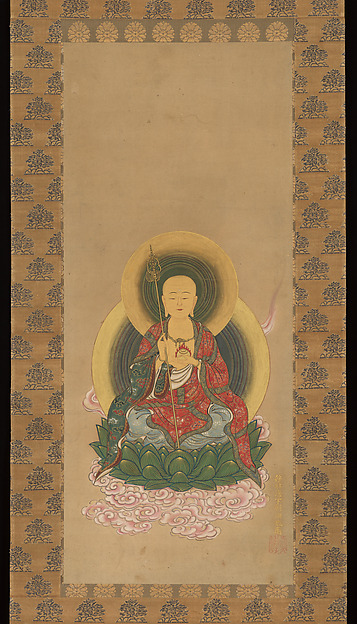
Japan, 1667 to 1698. Hanabusa Itchō. Hanging scroll; ink, color and gold paint on paper.
Look closer: Hanabusa Itchō paints him seated in saturated red and green. Look at the double halo and the lotus on its cloud: a calm, courtly image from the end of the seventeenth century.
The Metropolitan Museum of Art, The Howard Mansfield Collection, Purchase, Rogers Fund, 1936 (36.100.33). Public domain, Open Access.
The flute and the descent

Japan, mid-17th century. Kanō Tan’yū. Hanging scroll; ink and color on paper.
Look closer: Grey ink on pale paper. Look for the hat and the long sleeves that blow behind him and, at the right, the inscription.
The Metropolitan Museum of Art, Mary Griggs Burke Collection, Gift of the Mary and Jackson Burke Foundation, 2015 (2015.300.78). Public domain, Open Access.
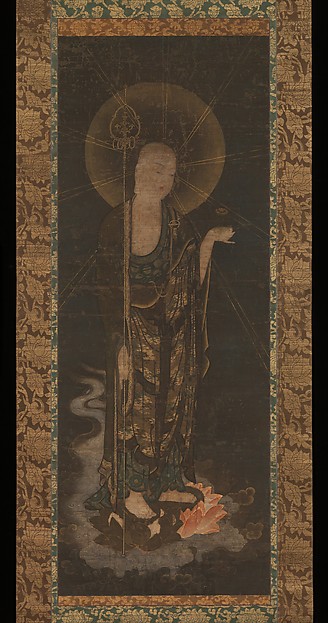
Japan, early 14th century. Hanging scroll; ink, color, gold and cut gold leaf on silk; image 106.7 × 40.3 cm.
Look closer: The Met titles the scroll the Welcoming Descent. Look at the pink lotus and the cloud beneath the feet, as if he were coming down, and at the lines of gold that radiate from the halo.
The Metropolitan Museum of Art, Fletcher Fund, 1925 (25.215.102). Public domain, Open Access.
The fifth of thirteen

Japan, 17th century. Hanging scroll; ink, color and woodblock print on paper.
Look closer: Thirteen figures on one sheet, in rows. Look for the larger figure at the top and the small halos below, each representing one of the rites between the seventh day and the thirty-second anniversary.
The Metropolitan Museum of Art, The Harry G. C. Packard Collection of Asian Art, Gift of Harry G. C. Packard, and Purchase, Fletcher, Rogers, Harris Brisbane Dick, and Louis V. Bell Funds, Joseph Pulitzer Bequest, and The Annenberg Fund Inc. Gift, 1975 (1975.268.143). Public domain, Open Access.
In the Thirteen Buddhas sequence Jizō presides over the thirty-fifth day after a death, between Fugen on the twenty-eighth and Miroku on the forty-second. Wikipedia’s list is the source for the order. It sets the rites of the first fortnight under Fudō and Shaka, and has the later ones pass from Yakushi to Kannon and Seishi and on to Amida, then to Ashuku, Dainichi and Kokūzō. Wikipedia’s article states the thirty-fifth day and the mantra and adds no history of the choice, and this page does the same.
A seventeenth-century Ōtsu-e in the Met, a popular painting made with a woodblock outline and hand colour, gathers the thirteen figures in rows on a single sheet, so that the whole sequence can be seen at once. The Thirteen Buddhas article adds only that each figure has a corresponding memorial service and that the schedule is traditional.
| Memorial day | Figure | Note |
|---|---|---|
| 7th day | Fudō | Acala |
| 14th day | Shaka | Śākyamuni |
| 21st day | Monju | Mañjuśrī |
| 28th day | Fugen | Samantabhadra |
| 35th day | Jizō | Kṣitigarbha |
| 42nd day | Miroku | Maitreya |
| 49th day | Yakushi | Bhaiṣajyaguru |
| 100th day | Kannon | Avalokiteśvara |
| 1st anniversary | Seishi | Mahāsthāmaprāpta |
| 2nd anniversary | Amida | Amitābha |
| 6th anniversary | Ashuku | Akṣobhya |
| 12th anniversary | Dainichi | Vairocana |
| 32nd anniversary | Kokūzō | Ākāśagarbha |
Syllables for the one who walks down
Wikipedia lists the mantras of the bodhisattva by tradition, and the Thirteen Buddhas article adds the Japanese forms. They overlap, since they all read the same Sanskrit seed syllables through a different school. Pronunciations in Japan follow the Shingon and Tendai readings of Sanskrit: On kakaka bisanmaei sowaka in Shingon, and On kakakabi samaei sowaka in Tendai.
What is chanted at a roadside
At a roadside the practice is simpler. Wikipedia notes that small stones are piled before the statues and that distressed parents dress them in red caps and bibs. The sutras chanted at a temple service for a child, according to the Mizuko kuyō article, include the Heart Sutra and chapter 25 of the Lotus Sutra, the Avalokiteśvara Sutra, so the chant that meets a mourner is often addressed to Kannon, and the statue in the yard is the one that gets the red cloth. The relation between the two bodhisattvas is described in Kannon Bosatsu.
| Tradition | Mantra | Source |
|---|---|---|
| Sanskrit | Oṃ ha ha ha vismaye svāhā | Wikipedia, Thirteen Buddhas |
| Shingon | On kakaka bisanmaei sowaka | Wikipedia, Thirteen Buddhas |
| Tendai | On kakakabi samaei sowaka | Wikipedia, Thirteen Buddhas |
| Mahāvairocana Tantra, in Chinese and Shingon | Namaḥ samantabuddhānāṃ, ha ha ha, sutanu svāhā; the effect is a samādhi realm of adamantine indestructible conduct | Wikipedia, Kṣitigarbha |
| Eliminating fixed karma | Oṃ pramardane svāhā; Chinese miè dìngyè zhēnyán | Wikipedia, Kṣitigarbha |
| Chinese devotion | Ná mó Dìzàng wáng pú sà | Wikipedia, Kṣitigarbha |
| Korean devotion | Namo Jijang Bosal | Wikipedia, Kṣitigarbha |
| Tibetan | Oṃ Kṣitigarbha Bodhisatvāya; Oṃ Ha Ha Ha Vismaye Svāhā | Wikipedia, Kṣitigarbha |
| Tibetan wrathful form | Om benza tsenda sarva dushtentaka hung pé | Wikipedia, Kṣitigarbha |
Small facts worth the detour
- A monk of Silla, Kim Gyo-gak, is said to have lived seventy-five years on Mount Jiuhua and died at ninety-nine. Three years after his death his body was found undecayed, and Wikipedia reports that it is venerated there still.
- Jizō is not assigned to any of the twelve Earthly Branches of the Chinese zodiac in the guardian table of Wikipedia’s Thirteen Buddhas article.
- The Met’s 1291 Jizō by Intan has eyes of rock crystal. The museum acquired it in 2023.
- In the Met’s fourteenth-century scroll the bodhisattva looks back over his shoulder while walking. The museum calls it Jizō “Looking Back”.
- The Sutra of the Past Vows was translated into Chinese between 695 and 700 by Śikṣānanda of Khotan, who also translated the Avataṃsaka Sutra (Wikipedia).
- Wikipedia lists Kṣitigarbha among the Eight Great Bodhisattvas, a group whose sutra Amoghavajra translated in the eighth century.
One vow, many names
The rows below record the names and local forms given in the sources I read.
| Where | Form and name | What the record shows |
|---|---|---|
| India | Kṣitigarbha | Read as “Earth Treasury” or “Earth Womb”. No Sanskrit text of the sutra has been found. |
| China | Dizang (地藏) | Mount Jiuhua, Mulian and Diting; the seventh-month birthday. |
| Japan | Jizō (地蔵); Ojizō-sama | Honoured at roadsides and in cemeteries. |
| Korea | Jijang | The Silla prince Kim Gyo-gak; a late Joseon painting of the ten kings. |
| Vietnam | Địa Tạng | Six-armed forms, per Wikipedia. |
| Tibet | Sa Yi Nyingpo | A prince with a sprout and a bell; a wrathful form with six arms and two wings. |
| Taiwan | Dizang | Six-armed forms, per Wikipedia; the mizuko ritual, yingling gongyang, arose in the mid-1970s. |
The bodhisattva who walks down
Among the bodhisattvas Jizō is the one who goes to the beings who cannot come to the Pure Land. In the Thirteen Buddhas sequence he holds the thirty-fifth day, and the table below shows his neighbours.
| Memorial occasion | Figure | Role |
|---|---|---|
| 21st day | Monju Bosatsu | Wisdom, third of the thirteen |
| 28th day | Fugen Bosatsu | Practice, fourth of the thirteen |
| 35th day | Jizō Bosatsu | The earth store, fifth of the thirteen |
| 42nd day | Miroku Bosatsu | The Buddha to come, sixth of the thirteen |
Where to see him
| Place | What to look for |
|---|---|
| Metropolitan Museum of Art, New York | Kamakura carvings of about 1202 and 1291, a seated figure, a welcoming-descent scroll, a Looking Back scroll and Goryeo scrolls, all in the public domain. |
| Cleveland Museum of Art | A Kamakura Welcoming Descent and a Goryeo standing Ksitigarbha, with the Fourth King of Hell, all Open Access. |
| Rokuharamitsu-ji, Kyoto | A seated wooden Jizō of the Kamakura period attributed by temple tradition and style to Unkei (Wikipedia). |
| Kōryū-ji, Kyoto | The earliest surviving image of Jizō in Japan, from the early Heian period (Art Net Users System). |
| Chūson-ji, Hiraizumi | Six Jizō in the Konjikidō (Wikipedia). |
| Mount Jiuhua, Anhui | The preserved body of Kim Gyo-gak, viewed at the Shrine of the Living Buddha (Wikipedia). |
Jizō in silk and ink
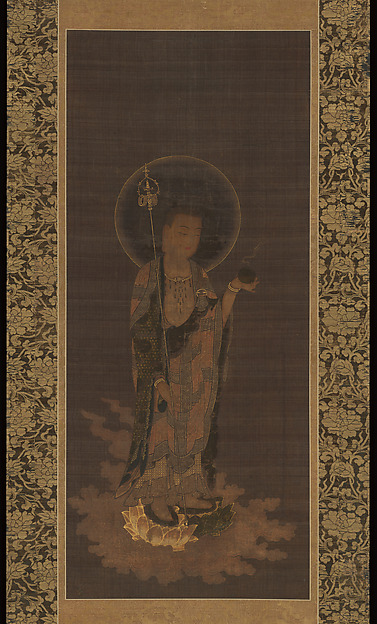
Japan, 14th century. Hanging scroll; ink, color and cut gold on silk; image 92.7 × 39.4 cm.
Look closer: A second Welcoming Descent from the fourteenth century. Look at the pale halo and the cloud under the feet, and at the staff in the right hand.
The Metropolitan Museum of Art, H. O. Havemeyer Collection, Bequest of Mrs. H. O. Havemeyer, 1929 (29.100.525). Public domain, Open Access.

Japan, 15th century. Hanging scroll; ink, color, gold paint (kindei) and cut gold leaf on silk.
Look closer: A fifteenth-century Jizō. Look at the jewel held up between the fingers, the swirling smoke or cloud at the feet and the fine cut gold in the robe.
The Metropolitan Museum of Art, Gift of John M. Crawford Jr., 1969 (69.139). Public domain, Open Access.
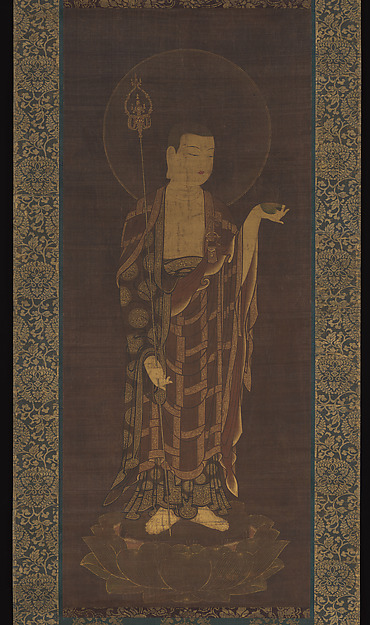
Japan, ca. 1350. Hanging scroll; ink and color on silk; image 99.4 × 41 cm.
Look closer: The Met lists the artist as unidentified and dates the scroll to about 1350. Look at the jewel raised in the left hand, the staff in the right and the patterned robe, drawn in fine gold lines.
The Metropolitan Museum of Art, Mary and Cheney Cowles Collection, Gift of Mary and Cheney Cowles, 2019 (2019.420.3). Public domain, Open Access.
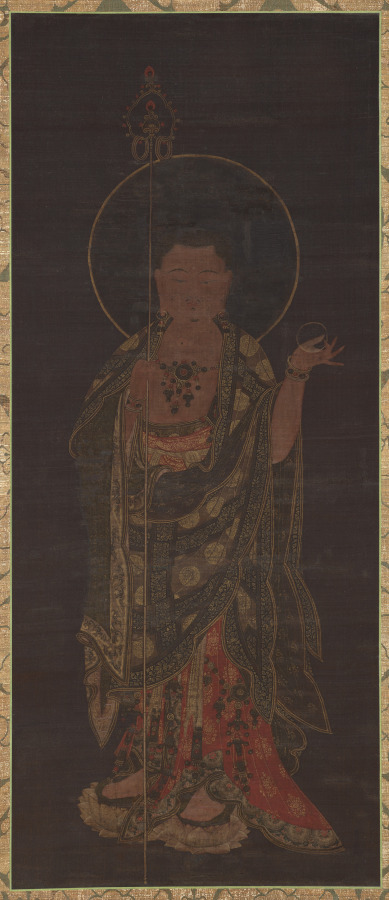
Korea, Goryeo dynasty, 1300 to 1350. Hanging scroll; ink, color and gold on silk.
Look closer: A Goryeo-dynasty Ksitigarbha. Look at the red of the skirt against the dark ground and at the thin staff, the same attribute as in Japan.
Cleveland Museum of Art, John L. Severance Fund (2025.141). CC0, Open Access.
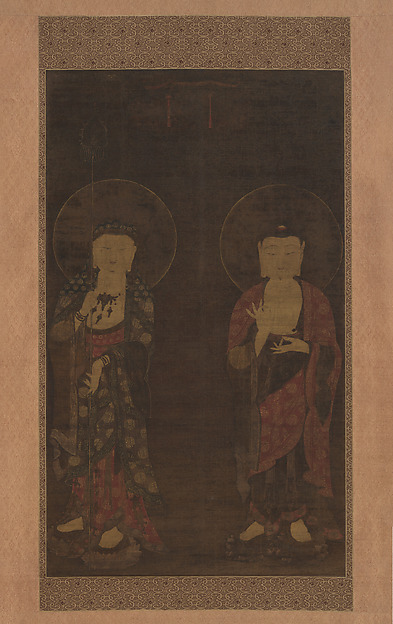
Korea, first half of the 14th century. Hanging scroll; ink and color on silk.
Look closer: Two figures share one picture. Look at the Buddha at the right in red, and at the bodhisattva beside him with the staff: Jizō as the companion of Amida, in a Korean scroll of the first half of the fourteenth century.
The Metropolitan Museum of Art, Rogers Fund, 1913 (13.5). Public domain, Open Access.
In the house
The house keeps Jizō in carved wood, stone and brass. The strip below reads the live shelves, so it shows what is available now.
A short dictionary of Jizō
Terms are given in Japanese with the Sanskrit or Chinese root where the sources supply one.
- Jizō (地蔵)
- The Japanese name for Kṣitigarbha; ji, earth; zō, storehouse.
- Ojizō-sama
- The affectionate honorific used at roadside statues.
- Kṣitigarbha
- The Sanskrit name: Earth Treasury, Earth Store, Earth Womb.
- Dizang (地藏)
- The Chinese name; Dizang Wang, King Dizang, in popular devotion.
- Shakujō (錫杖)
- The ringed monk’s staff carried by Jizō.
- Hōju (宝珠)
- The wish-granting jewel, held in the left hand.
- Yogan-in (与願印)
- The wish-granting gesture of the right hand in the earlier type.
- Rokudō (六道)
- The six realms of rebirth; Jizō appears in all of them.
- Roku Jizō (六地蔵)
- Six Jizō, one for each realm.
- Mappō (末法)
- The age of the decline of the Dharma, which sharpened the cult.
- Raigō (来迎)
- The welcoming descent; Jizō appears in his own versions of the type.
- Jūō (十王)
- The ten kings of the underworld; Jizō presides in the Jizō jūō-zu.
- Thirteen Buddhas (十三仏)
- The sequence of thirteen memorial rites; Jizō holds the thirty-fifth day.
- Hijiri (聖)
- Wandering holy men, many of them former aristocrats, who carried the cult to ordinary people (Nippon.com).
- Kuyō (供養)
- A memorial service or offering for the dead.
Answered plainly
Who is Jizō?
A bodhisattva of the earth store who vowed to teach the beings of the six realms between the death of Shaka and the coming of Miroku, and not to take Buddhahood until the hells are empty. The Sanskrit is Kṣitigarbha.
What does Jizō mean?
The Sanskrit Kṣitigarbha means “Earth Treasury”, “Earth Store” or “Earth Womb”. In Japanese, ji is earth and zō is storehouse.
Why is Jizō dressed as a monk?
Wikipedia notes that he is shown as a shaven-headed monk, unlike bodhisattvas depicted in the dress of Indian royalty. The ringed staff and the wish-granting jewel are his attributes.
Which sutra is Jizō’s?
The Sutra of the Past Vows of Kṣitigarbha, translated into Chinese between 695 and 700 by Śikṣānanda. It is set in the Trāyastriṃśa heaven, where the Buddha preached for his mother. No Sanskrit text has been found.
Is Jizō the same as Dizang?
Yes. Dizang is the Chinese reading of the same name. The Chinese cult centres on Mount Jiuhua, where a Silla prince named Kim Gyo-gak is said to have lived as Dizang and whose body is venerated.
What are the six Jizō?
The Roku Jizō are six figures, one for each of the six realms of rebirth. The Butuzou guide notes that the naming of the six varies from place to place.
What is the Jizō rite in the Thirteen Buddhas?
Jizō presides over the thirty-fifth day after a death, between Fugen on the twenty-eighth and Miroku on the forty-second.
What is the Jizō mantra?
In Shingon, “On kakaka bisanmaei sowaka”; in Tendai, “On kakakabi samaei sowaka”. The Sanskrit is “Oṃ ha ha ha vismaye svāhā”.
Where can I read about the roadside statues and mizuko Jizō?
In the second part of the chapter, Jizō in Japan, which covers the six statues at the village edge, the riverbed of the dead, the red bibs, the memorial rites for unborn children and the temples and festivals.
Where next
Sources and image credits
- The Metropolitan Museum of Art, object 76084
- The Metropolitan Museum of Art, object 53175
- The Metropolitan Museum of Art, object 44891
- The Metropolitan Museum of Art, object 42589
- The Metropolitan Museum of Art, object 45598
- The Metropolitan Museum of Art, object 45599
- The Metropolitan Museum of Art, object 45601
- The Metropolitan Museum of Art, object 45603
- The Metropolitan Museum of Art, object 45733
- The Metropolitan Museum of Art, object 53010
- The Metropolitan Museum of Art, object 829380
- The Metropolitan Museum of Art, object 36112
- The Metropolitan Museum of Art, object 39883
- The Metropolitan Museum of Art, object 39881
- Cleveland Museum of Art, Welcoming Descent of Jizō (1983.75)
- Cleveland Museum of Art, Standing Ksitigarbha (2025.141)
- Cleveland Museum of Art, The Fourth King of Hell (2019.224)
- Wikipedia, Kṣitigarbha (names, sutra, Mount Jiuhua, China, Korea, Tibet, iconography, mantras)
- Wikipedia, Thirteen Buddhas
- Wikipedia, Rokuharamitsu-ji
- Wikipedia, Mizuko kuyō
- Japanese Architecture and Art Net Users System, Jizō
- Butuzou, Roku Jizo
- Wasshoi Magazine, Jizō: Protector of the Innocent and the Weak
- Nippon.com, Jizō statues
- Japan Up Close, The Meaning Behind Jizo Statues
Last reviewed 29 October 2026. Pictures are public-domain or openly licensed, each credited beneath it. Diagrams on this page are drawn by Japonista.
Looking for a Jizō, a hanging scroll or a small altar figure? Tell us what you have in mind and we will look.
Private concierge
Looking for something in particular?
Describe the piece or the project you have in mind. A senior advisor in Tokyo reads every case file personally and replies within two business days, with fees set out in writing before any work begins.