
Jizō in Japan
Roads, Rivers and Rites
Jizō in Japan
日本の地蔵
How a monk-bodhisattva from a Chinese sutra became the nearest sacred figure in Japanese life: six statues at the edge of a village, a stone pile on a riverbed for children who died too soon, a red cloth tied by a grieving parent, and a neighbourhood festival held each August for the children of the street.
Identity card
Know the scene at a glance
- The red cloth. A bib or cap, usually a worshipper’s offering rather than part of the carving. Red is read as protection against illness and harm (Butuzou).
- The six in a row. Roadside sets are often six similar stone figures, one for each realm of rebirth.
- The pile of stones. Small stones heaped before a statue recall the towers built by children on the riverbed of the dead (Wikipedia).
- The pinwheel. At Zōjō-ji, visitors offer pinwheels in place of stones (Tokyo Past).
- The staff. A ringed staff in the right hand, a jewel in the left: the standard monk-bodhisattva of the first part of this chapter.
From court to roadside: a timeline
The sources do not agree on when the cult arrived, and the disagreement is instructive. It shows that the bodhisattva moved from a minor figure of the Buddhist scriptures to a household presence slowly, over a thousand years, and that each century added a use for him. The timeline below sets down what the pages I read say, in order, and marks the points on which they differ.
- Nara period, 710 to 794Jizō texts reach Japan. The Jūrinkyō, the Sutra of the Ten Rings, describes him as a figure the Buddha entrusted with staying close to people (Nippon.com). The Art Net Users System says he was worshipped by this time. Wikipedia records a legend of a first statue under Shōmu and a record of one at Tōdai-ji, for which it finds no evidence.
- Early HeianFallen nobles seek his help. Nippon.com says that in the early Heian period the Fujiwara dominated the regency and lower nobles were treated coldly, and that their despair helped shape the philosophy of the six realms. The Art Net Users System names Kōryū-ji in Kyoto as the home of the earliest surviving image. About 822 the Ryōki tells how Fujiwara Hirotari returns to life with Jizō’s aid (Wikipedia).
- Heian, 10th centuryWikipedia connects the riverbed of the dead in an early form to the monk Kūya. In 951, by the Fusō Ryakuki’s account, Kūya builds a training hall that becomes Rokuharamitsu-ji. In the Heian period, according to the Kyoto tradition recorded by Leaf Kyoto, Ono no Takamura carves six Jizō statues.
- Late Heian and KamakuraInterest in hell and the afterlife grows with Pure Land devotion and the fear of mappō (Japan Up Close; Art Net Users System). Hijiri monks, many of them former aristocrats, carry the cult to ordinary people (Nippon.com). The Konjaku Monogatarishū collects tales of him, and the Jizō Bosatsu Reigenki has twenty-five miracle stories (Wikipedia). The Met’s Kaikei dates to about 1202 and the Intan figure to 1291.
- Muromachi, 1336 to 1573Leaf Kyoto reports that the first Muromachi shogun, Ashikaga Takauji, was said to believe in Jizō, and that the belief spread among ordinary people. Wikipedia says the Sai no Kawara concept appears in the Otogizōshi and that the Fuji no hitoana no sōshi existed by 1527. Osorezan’s temple is abandoned in 1457 (Wikipedia, Osorezan). A fifteenth-century statue at Kenchō-ji is associated with memorials for the doomed.
- 16th centuryWasshoi Magazine says Jizō is fully part of Japanese culture by this century as a protector of women. Kōgan-ji is founded at Yushima in Edo in 1596 (Sugamo). Osorezan’s Bodai-ji is restored in 1530.
- Edo period, 1603 to 1868Jizō becomes widely seen as a protector of children, at a time of high infant mortality (Nippon.com). The practice of dressing statues intensifies (Butuzou). The Sai no Kawara is tied to the Jizō wasan around the seventeenth century. The haiku poets Buson and Issa write of him; Issa’s poem is of 1814 (Wikipedia). Osorezan’s present establishment dates, by Wikipedia’s account, to the early or middle eighteenth century.
- MeijiThe jawless Jizō of Oki loses its temple in 1870, and a hall is built for it two years later (Wikipedia). Kōgan-ji moves to Sugamo in 1891 (Sugamo).
- After 1945Parents begin placing mizuko Jizō at Hase-dera in Kamakura; an estimated 50,000 have been placed since the war (Wikipedia, Hase-dera). Mizuko rites become especially visible from the 1970s (Wikipedia, Mizuko kuyō). Brooks’s article on them appears in 1981 and Hardacre’s book in 1997.
- 2011 to the presentAfter the earthquake and tsunami of 11 March 2011, a new Jizō movement begins in the north-east. The O-Jizo-san Project is founded in December 2011 and erects its first statue at Ishinomaki on 9 March 2013 (Japan for Sustainability). Offerings are stolen in Yamamoto that year (SoraNews24). The Met acquires the Intan Jizō in 2023, and the Cleveland Museum catalogues a Goryeo Ksitigarbha with a 2025 accession number.
Six figures at the village edge
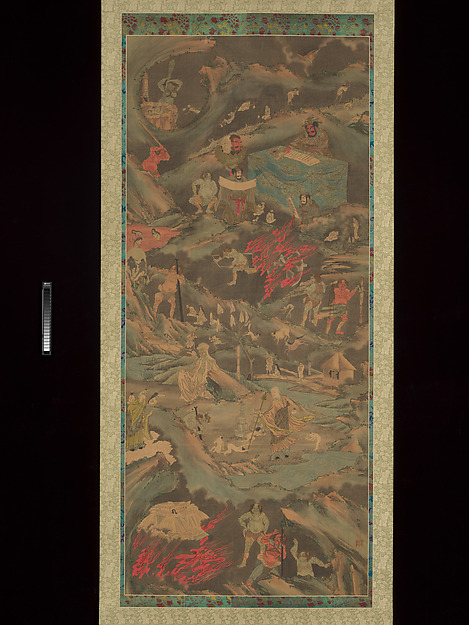
Japan, second half 19th century. Shōsai. Hanging scroll; ink and color on silk; image 195.4 × 84.4 cm.
Look closer: A late nineteenth-century scroll of the hells. Look for the red flames at the left and the clusters of tiny figures: the places Jizō vowed to empty.
The Metropolitan Museum of Art, Purchase, Friends of Asian Art Gifts, 2020 (2020.170). Public domain, Open Access.
The commonest group is the six. Nippon.com says six Jizō statues line village entrances, based on the six realms, and are believed to see off the dead and to protect the community from evil spirits, epidemics and other calamities. Wikipedia’s article on roadside deities describes them as groups of six statues representing Jizō’s vow to exist in all six states of karmic rebirth. The six realms are hell, hungry ghosts, animals, fighting spirits (asura), humans and heavenly beings, in the order Butuzou gives them.
Butuzou’s guide to the Roku Jizō is careful about what is and is not known. It says that some temple traditions assign names and roles to each of the six, that many sets are unlabelled and meant to be understood as one group, and that teachers often read the realms as states of mind and life circumstances: despair, insatiable want, fear, conflict, ordinary vulnerability and complacent pleasure. Roadside sets, it says, often consist of six similar stone figures standing side by side, and the placement reflects Jizō’s association with safe passage for travellers, protection for children and comfort for the grieving. At temples the six may stand in a line, an arc or in pairs on either side of a path.
The figure of the six has its own legends. Leaf Kyoto reports that Ono no Takamura, said to have travelled to the underworld each night from the well at Rokudō Chinnō-ji, carved six Jizō statues, and that this story is linked to the beginning of Jizō-bon. Wikipedia records six Jizō in the Konjikidō of Chūson-ji, and the Art Net Users System lists the Roku Jizō among the named variants. The folktale of the old man and the hats, below, adds a number of its own: in one version he covers six statues, though other versions give one, three, seven or twelve.
A caution about the table
The Butuzou article lists the six realms and the states of mind separately, in matching order, and lists the places and materials separately as well. The table below sets them side by side for reading only. It does not mean that a particular place houses a particular realm, and the guide itself warns that the naming and arrangement vary by region and temple.
| Realm | In the Butuzou reading | Where the six are found |
|---|---|---|
| Hell | Despair | Crossroads and village edges |
| Hungry ghosts | Insatiable want | Mountain paths |
| Animals | Fear | Temple approaches |
| Fighting spirits (asura) | Conflict | Cemetery entrances |
| Humans | Ordinary vulnerability | In a line, an arc or in pairs |
| Heavenly beings | Complacent pleasure | Stone outdoors, wood indoors, bronze for display |
The statue that took over the crossroads
Wikipedia’s article on the roadside deities gives the background. Boundary markers, dōsojin or sae no kami, stood at village edges, crossroads and mountain passes in eastern Japan, as couples, as carved stones, as tall poles or as simple rocks. Their domains were boundaries, roads, travellers, marriage, fertility, health, harvest and protection from epidemics and evil spirits, and in some local traditions a damaged or defaced marker was an omen of epidemic and prompted immediate repair or renewed rites. The article says that sae no kami was later linked with Jizō as a protector of children and that Jizō’s assimilation into the worship of the kami is an example of shinbutsu shūgō.
Japan Up Close says the same thing in its own terms. Jizō’s role as a protector of travellers comes from the older belief in Dōsojin, whose statues were generally shaped like a couple and placed on mountain paths, at crossroads and on village borders. Wikipedia adds that the roadside forms of other figures took similar places: Batō Kannon statues stand beside perilous paths in the north of Japan, like Jizō, and protect travellers and their horses. The bodhisattva took over a place that was already holy. He could do so because the place already belonged to the dead, to children and to people on the move.

Japan, ca. 1840. Utagawa Kuniyoshi. Woodblock print; ink and color on paper.
Look closer: A traveller’s view. Look at how the statue towers over the pines and how the figures below, in the road, pause as they pass.
The Metropolitan Museum of Art, The Francis Lathrop Collection, Purchase, Frederick C. Hewitt Fund, 1911 (JP750). Public domain, Open Access.

Japan, Edo period. Torii Kiyonaga. Woodblock print; ink and color on paper.
Look closer: Look at the kneeling woman and the lantern beside the shrine door: a small Jizō hall is part of an ordinary street. The print is titled for the long-life Jizō.
The Metropolitan Museum of Art, H. O. Havemeyer Collection, Bequest of Mrs. H. O. Havemeyer, 1929 (JP1714). Public domain, Open Access.

Japan. Bronze; height 24.1 cm.
Look closer: Look at the loose rings hanging from the ring-shaped head. The ringed staff is the attribute Jizō carries in the first part of this chapter.
The Metropolitan Museum of Art, Rogers Fund, 1907 (07.16). Public domain, Open Access.
Sugamo, on the Nakasendō
A district of Tokyo keeps the old arrangement alive. The Sugamo Jizō-dōri shopping street lies along the old Nakasendō route. The Sugamo association describes it as protected by the Sugamo Kōshinzuka, a roadside mound that was a resting point for travellers with teahouses, and by two Jizō guardian statues: the Togenuki Jizō at Kōgan-ji and the Edoroku Jizō at Shinshō-ji.
| Boundary figure | Where | What the sources say |
|---|---|---|
| Dōsojin, sae no kami | Village edges, crossroads, mountain passes | Stone couples, carved stones, poles; guard against epidemic and evil (Wikipedia) |
| Chimata-no-kami | Crossroads | Born, in the Kojiki, when Izanagi washed after returning from Yomi (Wikipedia) |
| Sae no kami | Village edges | Born from a stick Izanagi threw at the demoness; large rocks that keep the dead from the living world; later linked with Jizō (Wikipedia) |
| Jizō | Roadsides, passes, temple approaches | Protector of travellers, children and the dead; assimilated to kami worship (Wikipedia) |
| Batō Kannon | Perilous paths in northern Japan | Protects travellers and horses (Wikipedia) |
Stones, demons and a cloak
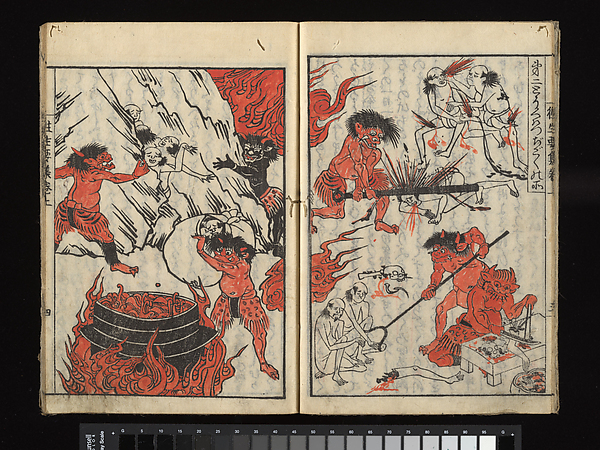
Japan, 1790. Woodblock printed book; ink and color on paper.
Look closer: A woodblock-printed book of 1790. Look for the red demons and the iron cauldron over the fire, and for the small figures below: the world from which the bodhisattva takes the dead.
The Metropolitan Museum of Art, Gift of Betty and Paul Nomura, in memory of Nomura Shōjirō, 2018 (2018.954.38a). Public domain, Open Access.
The story most often attached to Jizō in Japan is not in the sutra. The Sai no Kawara, the riverbank of the Sanzu River, is where children who died before their parents are believed to go. Wikipedia’s account is the plainest. The children stack stones into towers as penance, oni or demons topple them, and Jizō protects them. Japan Up Close adds the explanation: such children cannot cross the river to the afterlife, and they spend the time building stone towers while devils knock them down, until Jizō appears to save the children and look after them in place of their parents. Wasshoi Magazine says the same, and adds that some Buddhist schools hold that the souls gather at the river, and that Mizuko Jizō is said to dwell along it looking for children to protect and console.
The story has a literary history that Wikipedia traces. The concept first appears in the Otogizōshi of the Muromachi period. It is associated with Kūya in the tenth century, and it became attached to the Jizō wasan, the devotional songs, around the seventeenth century. The text Fuji no hitoana no sōshi carries a version of c. 1600 or earlier, with a copy of 1603 used by Kimbrough in 2006, and it existed by 1527. Japan Up Close places a Sai no Kawara in Sado, in Niigata, as a site where the guardianship of children by Jizō is told.
The practice that follows is simple. Wikipedia notes that small stones are piled before statues, believed to relieve a child of penance, and that distressed parents dress statues in red caps and bibs. The pile is the one the children build. A visitor who adds a stone is helping.
A rite for lives that did not begin
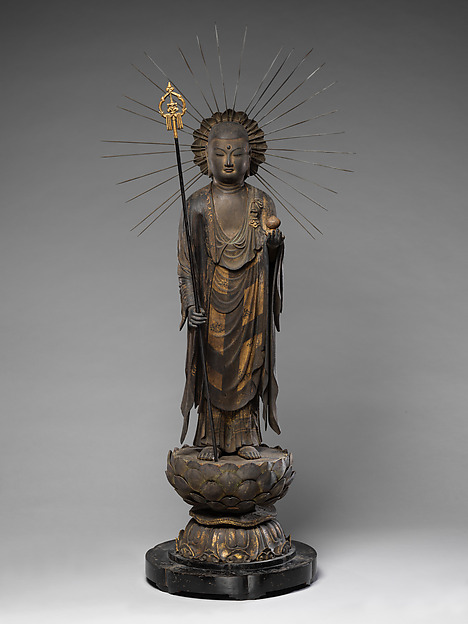
Japan, 14th century. Wood with lacquer, pigment and cut gold; height 78.4 cm.
Look closer: Look at the halo of metal rays, the ringed staff and the small jewel held in the left hand. This is the Kamakura-type Jizō that the red bibs of later centuries dress in cloth.
The Metropolitan Museum of Art, Rogers Fund, 1912 (12.134.16a–h). Public domain, Open Access.
In modern Japan the bodhisattva is revered above all as Mizuko Jizō. Wasshoi Magazine says plainly that in modern Japan Jizō is mainly revered in this form, caring for stillborn children and children who died young. Mizuko, written 水子, means “water child”, a term for an aborted, stillborn or miscarried baby and, archaically, for any dead infant. Kuyō means memorial service. Wikipedia notes that suiji was the earlier Sino-Japanese reading of the same characters, and that the term was originally a kaimyō, a Buddhist name given after death.
The history of the rite is contested. Wikipedia reports that traditionally priests made offerings to Jizō, a bodhisattva believed to protect children, that in the Edo period famine sometimes led poor families to infanticide and abortion and the practice was adapted to cover such cases, and that the rites became especially visible from the 1970s, when shrines devoted solely to the ritual were created. The article says it is unclear whether the practice is historically authentic Buddhism. It records a parallel in Taiwan, yingling gongyang, which emerged in the mid-1970s and grew significantly in the 1980s, drawing on antecedents back to the Han dynasty and on the Japanese rite, and notes that both practices arose alongside modernisation: a growing population, urbanisation, smaller families and changing attitudes towards sexuality.
The motives are given in four words. The Wikipedia article lists parental grief, wanting to comfort the soul of the child, guilt over an abortion and fear of retribution from a vengeful ghost. The service is a plain one. Temples often offer Jizō statues for a fee, dressed in red bibs and caps and displayed in the yard. Both parents may attend, or one, and not necessarily the mother. A service may be a single event or repeated monthly or annually. The priest faces the altar and invokes various Buddhas and bodhisattvas, and the texts chanted include the Heart Sutra and chapter 25 of the Lotus Sutra. A kaimyō is given and a statue is often placed on the grounds.
Zōjō-ji and Hase-dera in Tokyo and Kamakura
At Zōjō-ji in Minato, Tokyo, a temple the Atlas Obscura entry dates to about 1393, a monthly service is open to anyone who has had a pregnancy loss, stillbirth or perinatal loss. Participants make small red cloth pouches as offerings to a chosen figure of compassion, such as Jizō or Jesus. The pouches are draped around the statue while incense is lit and a priest chants, stay in the prayer room for a month, and are then moved to a fence in the garden. The Tokyo Past writer counts around 1,300 statues in rows, in red hats and bibs, and says that visitors offer pinwheels instead of stacking stones; the pinwheel stands for the carefree play of childhood and its spinning for the cycle of birth, death and rebirth. The same writer objects to the name Atlas Obscura uses, the Garden of the Unborn Children, as sensationalist, because the statues also pray for living children and for those who died young after birth. Zōjō-ji has no special name for the area and calls it the Jizō statues.
At Hase-dera in Kamakura, hundreds of small Jizō statues are placed by parents mourning children lost to miscarriage, stillbirth or abortion. Wikipedia says each statue stays for about a year before being removed to make room for new ones, and that an estimated 50,000 have been placed since the war.
Criticism and scholarship
The article records the criticism directly. Some view the service as temples profiting from women’s misfortune after miscarriage or abortion. American religious scholars criticised temples for allegedly exploiting the belief that the dead retaliate for mistreatment. Others argue that the temples are meeting real needs. The works Wikipedia lists for readers are Bardwell Smith’s Buddhism and Abortion in Contemporary Japan (1992), Anne Page Brooks on mizuko kuyō in the Japanese Journal of Religious Studies (1981), Elaine Martin’s 1996 study based on interviews at a Tokyo temple, Helen Hardacre’s Marketing the Menacing Fetus in Japan (1997), Marc Moskowitz’s The Haunting Fetus on Taiwan (2001), Jeff Wilson’s Mourning the Unborn Dead (2008) on the rite in America, and Anzai Ikurō’s Rei wa aru ka (2002). Butuzou’s guide adds a note of caution for readers outside Japan: the subject needs sensitivity, and a memorial presentation should be simple and private.
Dressing the stone
The red cloth is the most recognisable thing about a Japanese Jizō and the least stable. Butuzou says that the red bib, and sometimes a red knit cap, is typically a cloth offering placed by worshippers and not part of the sculpture. Red is associated in folk belief with warding off illness and harmful influences; the article says that this is symbolic and not a guarantee. Placing a bib is an act of giving, like incense or flowers. Bibs are often replaced when they fade, and they can become a record of the grief and compassion of families. The article’s one date is that the practice of clothing Jizō intensified in the Edo period, when roadside and neighbourhood Jizō became part of local life.
Other writers add a layer each. Japan Up Close says red is believed to ward off evil. Wasshoi Magazine says grieving parents bring the garments as a last gesture of parental love and protection, and records the reading of the red cap as a symbol of the placenta that links Jizō to a mother’s womb. Nippon.com says villagers dress the statues in coats, bibs and hats because they see a child’s image superimposed on the stone. Wikipedia adds that Japanese statues are often dressed in bibs, kerchiefs, kasa hats or haori. Wasshoi also explains that red hats and bibs on the Roku Jizō represent a traveller’s equipment.
The explanations are not alternatives. A single bib on a single statue can be an offering of thanks, a protection against illness, a gift to a dead child and an article of travelling dress. The statue does not mind.

Japan, 13th century. Painted wood; height 10.2 cm.
Look closer: Look at the traces of gilding on the robe and the worn face. A figure only ten centimetres tall: the scale of a pocket or household image rather than a temple icon.
The Metropolitan Museum of Art, Fletcher Fund, 1925 (25.223.2). Public domain, Open Access.

Japan, 13th century. Painted wood; height 9.2 cm.
Look closer: Look at how the surface has worn to bare grain at the shoulder and chest, the kind of wear that handling and weather leave on a much-touched image.
The Metropolitan Museum of Art, Fletcher Fund, 1925 (25.223.1). Public domain, Open Access.
| Reading of the red cloth | Source |
|---|---|
| Wards off illness and harmful influences; symbolic, not a guarantee | Butuzou |
| Wards off evil; stone itself has protective power older than Buddhism | Japan Up Close |
| A last gesture of parental love and protection | Wasshoi Magazine |
| A symbol of the placenta, linking Jizō to the womb | Wasshoi Magazine |
| A traveller’s equipment, on the Roku Jizō | Wasshoi Magazine |
| The child’s image is seen in the stone, so it is dressed like a child | Nippon.com |
| The practice intensified in the Edo period | Butuzou |
The old man, the thorn and the swollen eye
Stories are how the bodhisattva was kept near. The Konjaku Monogatarishū contains many tales of him and the Jizō Bosatsu Reigenki has twenty-five miracle stories, according to Wikipedia. Wasshoi Magazine says folk stories of Jizō appearing to help the needy spread as his popularity grew. Several are still told. The ones set out below are those I could read in full.
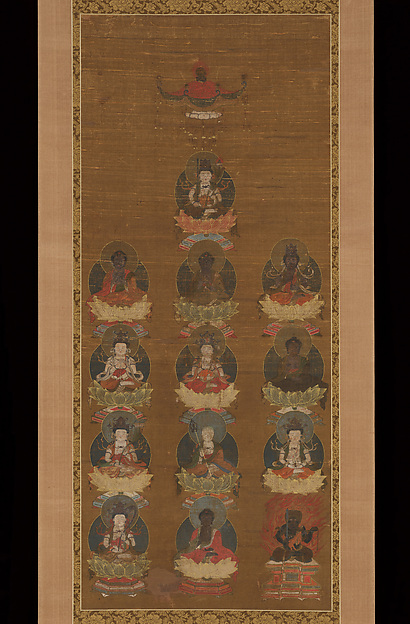
Japan, 16th or 17th century. Hanging scroll; ink, color and gold on silk; image 94 × 39.7 cm.
Look closer: The thirteen figures of the memorial rites arranged in rows. Look at the single figure at the top and then the grouped rows beneath; Jizō is the fifth in the sequence.
The Metropolitan Museum of Art, Gift of Sue Cassidy Clark, in honor of Barbara Brennan Ford, 2021 (2021.396.1). Public domain, Open Access.

Japan, 14th century. Hanging scroll; ink, color, gold paint and cut gold on silk.
Look closer: Look again at the turn of the head. A bodhisattva who glances back is the right companion for the old man’s story: he is checking who has not yet come.
The Metropolitan Museum of Art, H. O. Havemeyer Collection, Gift of Mrs. J. Watson Webb, 1930 (30.72.2). Public domain, Open Access.
The hat statue of the snowy road
An impoverished elderly couple cannot afford mochi for New Year’s Eve. The old man tries to sell hats he has made in town, fails, and walks home through a blizzard. He sees a row of Jizō statues, gives them his hats to keep off the snow, and gives his tenugui cloth to the last one. His wife praises his kindness. That night a pile of gifts, rice, vegetables, gold coins and mochi, appears at their door, and the statues are seen walking off into the snow. This is Wikipedia’s summary.
The tale has many variants, and the article lists them. The old man gives his own hat instead of the cloth. One Jizō returns the gift instead of the group. The Seven Lucky Gods repay him instead of Jizō. The old couple is escorted to the Western Pure Land. In Niigata the Chijimi Jizō version uses ojiya-chijimi fabric. In western Japan the old man carries a Jizō home and rice pours from it, until the greedy wife strikes the statue’s belly and the flow stops. The number of statues is one, three, six, seven or twelve. The origin is unknown; the article says the roots are in Tōhoku and Niigata, the oldest recorded versions come from Hokuriku, and the tale is also found in Hiroshima and Kumamoto. It is told by parents to children to teach moral values, and in Iwate and Fukushima it is known as Kasako Jizō.
Wasshoi Magazine’s version has the man trade his mantle for six hats on the way home from the capital, and has travellers adopt the custom of dressing the statues from that day on.
Togenuki Jizō, who pulls out thorns
At Kōgan-ji in Sugamo the main image is Enmei Jizō, the Long-Life Jizō, known as the Togenuki Jizō, the one who removed a needle. Japan Travel tells it as the story of a woman who swallowed a needle or thorn and coughed it up after swallowing a paper printed with the deity’s image. Nippon.com tells it with a samurai’s maid who drank paper bearing a Jizō image, and coughed up the needle, which then pierced the image. The two accounts agree on the paper and the needle and differ on the person.
The Sugamo association says Kōgan-ji was founded in Yushima, Edo, in 1596, moved to Shimotani Byobuzaka about sixty years later and to Sugamo in 1891. The original statue is normally kept out of public view, and a replica is displayed in the main hall. Japan Travel adds that visitors pour a ladle of water over the temple’s well-known Kannon statue and rub the part that matches the part of their own body that troubles them. It is a Sōtō Zen temple, a four-minute walk from Sugamo Station.
Swollen eye, missing jaw, bound ropes
Nippon.com records that at Jōtoku-ji in Bunkyō, Tokyo, a monk nearly losing the sight in his right eye prayed to a Jizō and recovered, while the statue’s eye swelled instead. The belief that a Jizō takes on a person’s illness and pain is the one the Japanese call migawari, substitute. Wikipedia’s list adds the Jizō without a Jaw on Oki, reportedly made by Ono no Takamura (802 to 853): in the toothache tale, worshippers offer a pear, nashi, which also means “without”. And at Tōsen-ji in Katsushika, Tokyo, the Bound Jizō, associated with the Edo magistrate Ōoka Tadasuke, is tied with ropes by petitioners, who untie them when the wish is granted; the ropes of unfulfilled wishes are cut at New Year.
Wikipedia also records the oldest kind of tale: the Ryōki of about 822, in which Fujiwara Hirotari returns to life with Jizō’s help. The humblest is probably the one Wikipedia’s Tōsen-ji entry implies. A stone that is bound for years and cut free at New Year carries its owners’ hopes and failures in one object.
Eight places where he is kept

Hase-dera, Kamakura. Photograph by Savannah Rivka.
Look closer: Look at the rows of small statues in red caps and the smoke of incense in front: the mizuko Jizo of Hase-dera, each placed by a family.
Savannah Rivka, “Incense burning in front of a crowd of Jizo at Hase-dera”, Wikimedia Commons, CC BY-SA 4.0. Source: commons.wikimedia.org (file page listed in the sources below).
The list below is of places the sources I read describe. It is not a ranking, and it is not complete; every district of Japan has a Jizō of its own.
Osorezan, Aomori
Mount Osore, in the Shimokita Peninsula of northern Tōhoku, is a Buddhist temple and folk-religion pilgrimage site in the caldera of an active volcano, traditionally believed to be one of the gates to the underworld. Its Bodai-ji is a Sōtō Zen temple with Jizō Bosatsu as its main image. The name comes from the Ainu language and was altered to match the Japanese osore, dread. The highest peak of the range, Mt. Kamafuse, is 878 m, and Lake Usori is a caldera lake with highly acidic water. The temple keeps a hot spring resort for pilgrims. The Itako Taisai, the festival of the blind mediums called itako who claim to summon the dead, is held twice yearly, in summer and autumn. Wikipedia notes that the contemporary artist Nara Yoshitomo, a native of Aomori, is believed to have been influenced by the mountain.
Rokuharamitsu-ji, Kyoto
Rokuharamitsu-ji was founded by Kūya, the monk of the dancing nembutsu; the Fusō Ryakuki dates the origin to 951, when he built a training hall for Jūichimen Kannon, under the name Saikō-ji. After his death the monk Chūshin of Enryaku-ji renamed it Rokuharamitsu-ji in 977 and put it under the Tendai school. A fire in 1183, in the Genpei War, destroyed most of it, leaving the main hall, which was rebuilt in 1363. In the Bunroku era (1593 to 1596) Toyotomi Hideyoshi repaired the temple and granted it 70 koku. In 1969 the main hall was dismantled and repaired and about 8,000 mud pagodas were found beneath it, a figure the cultural-property list gives as 1,945.
Its three most famous statues are Kūya, carved by Unkei’s fourth son Yasukatsu, with six small Amida Buddhas emerging from his mouth; a seated priest traditionally identified as Taira no Kiyomori; and a seated wooden Jizō of the Kamakura period, without an inscription, attributed by temple tradition and style to Unkei. The temple lists twelve entries of cultural property, about fifteen statues and buildings, and a collection of 2,163 items of folk religious material.
Kōgan-ji, Sugamo, Tokyo
The Togenuki Jizō temple, described above, stands at 3-35-2 Sugamo, Toshima, beside the Jizō-dōri shopping street. The main image is the Enmei Jizō, the original is kept out of view and a replica is shown in the hall. The street itself lies on the old Nakasendō.
Zōjō-ji, Minato, Tokyo
The Jōdo-shū temple of the Tokugawa mausoleum keeps rows of about 1,300 Jizō in red hats and bibs, with pinwheels beside them. Atlas Obscura lists the temple as built around 1393 and damaged in the Second World War, with the main gate the only original part. The monthly mizuko service and an annual memorial service with a mikoshi are held there.
Hase-dera, Kamakura
Legend says Hase-dera was founded in the Tenpyō era (729 to 749); the monk Tokudō reportedly carved two Kannon statues in 721 and a camphor log came ashore at Nagai Beach in 736. It is a Jōdo-shū temple and the fourth of the thirty-three stations on the Bandō Sanjūsankasho and Kamakura Kannon pilgrimages. Its Jūichimen Kannon stands 9.18 m. The grounds hold hundreds of small Jizō, each placed for about a year, and an estimated 50,000 have been placed since the war. The temple’s Benten-kutsu, a low winding cave, and its hydrangeas, in bloom in June and July, bring the visitors.
Tōsen-ji and Jōtoku-ji, Tokyo
The Bound Jizō of Tōsen-ji in Katsushika and the swollen-eyed Jizō of Jōtoku-ji in Bunkyō are the two Tokyo temples whose stories are told above. Each belongs to the Edo-period practice of treating a statue as a neighbour who can be asked for a particular favour.
Oki and Kenchō-ji
The jawless Jizō of Oki, said to be the work of Ono no Takamura, stood in a temple, 伴桂寺, that closed in 1870; its treasures went to the Hagi temple in Osaka, and a hall for the statue was built two years later. A fifteenth-century Jizō at Kenchō-ji is associated with memorials for the doomed and the suffering. Both come from Wikipedia’s list of notable Jizō; I have not read a page that describes either site further.
Kōryū-ji and Chūson-ji
The Art Net Users System names Kōryū-ji in Kyoto as the home of the earliest surviving Japanese Jizō, of the early Heian period, and Wikipedia records six Jizō in the Konjikidō of Chūson-ji. Neither source describes the temple further, so this page leaves them as a pointer for the visitor.
Children’s Obon and the monthly day
The Jizō festival is a neighbourhood event. Leaf Kyoto describes Jizō-bon as a Kyoto tradition that marks the end of summer, held on the Saturday and Sunday around the 24th, the monthly festival day of Jizō. It is called the children’s Obon because the children are its focus, unlike the general Obon. Lanterns are hung and lit at street corners across the city. Neighbourhood associations prepare a Jizō statue: they move it from a local shrine, wash it, apply make-up and dress it in an apron. It sits on a three- or four-tier altar with offerings of flowers, fruit, water and rice cakes, with lanterns hung nearby. On the day a monk reads sutras, and in some places a rosary is recited. There are lotteries and games and snacks are handed out, which the children look forward to most; many alleys are closed to traffic. Some neighbourhoods display memorial tablets or papers bearing the posthumous names of residents who have died, and hold memorial services and expressions of gratitude.
Leaf Kyoto adds two sobering notes. Child attendance has declined recently, and in some areas only adults gather and chat. And the article puts Jizō-bon beside the Gion Festival, the Rokudō-mairi and the Daimonji Gozan Okuribi fire as the ways of getting through the heat of a Kyoto summer. Its origin story is the one about Ono no Takamura and the six statues carved after his nightly journeys from the well at Rokudō Chinnō-ji.
| When | What | Where | Source |
|---|---|---|---|
| The 24th of each month | Jizō’s monthly festival day | Kyoto neighbourhoods | Leaf Kyoto |
| Saturday and Sunday around 24 August | Jizō-bon, the children’s Obon | Kyoto street corners | Leaf Kyoto |
| Summer and autumn | Itako Taisai | Osorezan, Aomori | Wikipedia, Osorezan |
| Each month | Mizuko kuyō, with red pouches | Zōjō-ji, Tokyo | Atlas Obscura |
| Yearly | Memorial service with a mikoshi | Zōjō-ji, Tokyo | Tokyo Past |
| New Year | Ropes of unfulfilled wishes cut | Tōsen-ji, Katsushika | Wikipedia |
| New Year’s Eve | The night of the hats in the folktale | Everywhere | Wikipedia, Kasa Jizō |
After the wave: new statues, stolen offerings and museum acquisitions
The earthquake and tsunami of 11 March 2011 produced a new strand of Jizō devotion. The Japan for Sustainability report of 5 September 2013 describes the O-Jizo-san Project, a non-profit that sets up statues of the bodhisattva to help disaster victims recover emotionally. Its chairman, Masanori Ashihara, is the chief priest of a Buddhist temple in Yamagata Prefecture, and he founded the organisation with friends in December 2011. The first statue was erected in the Minamihama district of Ishinomaki, Miyagi, on 9 March 2013, two days before the second anniversary of the disaster. The project planned statues in 37 damaged cities and villages across Fukushima, Miyagi and Iwate, about fifty locations in all, funded by donations. The aim, the report says, is to renew the tradition of entrusting worries to the statues of the village.
The same year brought a darker report. SoraNews24, on 5 September 2013, described thefts of religious offerings in Yamamoto, Miyagi. At the site of the Higashi day care centre, whose building was washed away by the tsunami, volunteers had placed prayer sticks, flower altars and five porcelain Jizō statues, three of 20 cm and two of 15 cm, made by monks from Aizuwakamatsu; the size difference stands for the bond between children and their parents. The volunteers reported the theft on 3 September. A 30 kg Kannon statue taken from Fumon-ji in May was returned anonymously eight days after the theft was made public. The group’s representative, Hitomi Kano, said she was shocked that anyone would steal them.
Museums have been buying. The Met’s Intan Jizō of 1291 entered the collection in 2023 and was catalogued 2023.640a–c. The Cleveland Museum’s Goryeo Standing Ksitigarbha carries a 2025 accession number, 2025.141. Jizō also remains the figure to whom the practice of mizuko kuyō is addressed, and Jeff Wilson’s 2008 study, listed by Wikipedia, follows the rite to America.
Jizō in games, films and haiku
Wikipedia’s list of appearances is long. The Saviour Monk (1975), a Hong Kong film directed by Liang Che-Fu, has David Tang Wei as Dizang-wang. The Locker (2004), a Japanese film directed by Kei Horie, turns on the vandalism of a Kṣitigarbha statue. My Date with a Vampire III (2004) has Ricky Chan as Kṣitigarbha. In games, Super Mario Bros. 3 (1988) lets Mario and Luigi become Kṣitigarbha statues, an ability that returns in Super Mario 3D Land (2011) with statues in Super Mario Odyssey; Ninja Gaiden (2004) has a defaced statue in Ryu Hayabusa’s village; and in Ghostwire: Tokyo (2022) praying to Jizō statues increases the player’s ether capacity. My Neighbor Totoro (1988), from Studio Ghibli, puts Jizō statues and shrines in key scenes. In Butsu Zone, a manga, Kṣitigarbha is a main character, and The House of the Lost on the Cape gives Ojizōsama a role in tsunami recovery.
The older arts took him up first. Wikipedia lists haiku on Jizō by Issa (1814) and Buson, and the Met’s collection holds him in prints, from Kiyonaga’s Enmei Jizo to Kuniyoshi’s pine grove. Nara Yoshitomo’s image of a child standing over discarded dolls, in Not Everything But / Green House, is compared by Wikipedia to the dolls seen at Osorezan.
| Work | Year | What happens | Source |
|---|---|---|---|
| The Saviour Monk | 1975 | David Tang Wei as Dizang-wang; Hong Kong; directed by Liang Che-Fu | Wikipedia |
| Super Mario Bros. 3 | 1988 | Mario and Luigi can become Kṣitigarbha statues | Wikipedia |
| My Neighbor Totoro | 1988 | Jizō statues and shrines in key scenes | Wikipedia |
| The Locker | 2004 | Vandalism of a Kṣitigarbha statue is central | Wikipedia |
| Ninja Gaiden | 2004 | A defaced statue in Ryu Hayabusa’s village | Wikipedia |
| Super Mario 3D Land | 2011 | The statue ability returns | Wikipedia |
| Ghostwire: Tokyo | 2022 | Praying to Jizō statues increases ether capacity | Wikipedia |
What the sources count
Each figure below is given in the source named in the last column. They are not all of one kind: some are counts, some are dates, and some are claims by a temple or a writer.
| Figure | Number | Source |
|---|---|---|
| Years Kim Gyo-gak is said to have lived on Mount Jiuhua | 75, to the age of 99 | Wikipedia, Kṣitigarbha |
| Jizō statues at Zōjō-ji, by one count | around 1,300 | Tokyo Past |
| Mizuko Jizō placed at Hase-dera since the war | an estimated 50,000 | Wikipedia, Hase-dera |
| Time each Hase-dera statue stays | about one year | Wikipedia, Hase-dera |
| Miracle stories in the Jizō Bosatsu Reigenki | 25 | Wikipedia, Kṣitigarbha |
| Statues planned by the O-Jizo-san Project | about 50, in 37 cities and villages | Japan for Sustainability |
| Height of the Met’s Intan Jizō with its pedestal | 135.9 cm | The Met |
| Height of the Met’s tallest Jizō with staff | 188.6 cm | The Met |
| Mud pagodas found under Rokuharamitsu-ji’s hall in 1969 | about 8,000 (1,945 in the property list) | Wikipedia, Rokuharamitsu-ji |
| Folk items held by Rokuharamitsu-ji | 2,163 | Wikipedia, Rokuharamitsu-ji |
| Distance of Kōgan-ji from Sugamo Station | about a four-minute walk | Japan Travel |
Small facts worth the detour
- In Niigata one version of the hat story has the old man use a fabric called ojiya-chijimi in place of hats, and the statue becomes the Chijimi Jizō (Wikipedia, Kasa Jizō).
- A Jizō on Oki has no jaw. Worshippers with toothache offer a pear, because nashi means both pear and “without” (Wikipedia).
- At Zōjō-ji visitors offer pinwheels where other temples have stone piles (Tokyo Past).
- On the riverbed of the dead the stone towers are toppled by oni, and the rope-bound statue at Tōsen-ji has its ropes cut at New Year if the wishes were not granted (Wikipedia).
- Statues at Hase-dera stay about a year before being removed to make room for new ones (Wikipedia).
- The old man in the hat story is told in versions with one, three, six, seven or twelve statues (Wikipedia, Kasa Jizō).
- In the early Heian period, Nippon.com says, the despair of lower nobles under the Fujiwara regents helped shape the philosophy of the six realms in which Jizō plays his part.
Neighbours who keep the same vow
Japan’s children’s rite has parallels. Wikipedia’s Mizuko kuyō article says the memorial service is also practised in Thailand and China, and gives Taiwan’s yingling gongyang as an equivalent.
| Where | Form and name | What the record shows |
|---|---|---|
| Taiwan | Yingling gongyang | Emerged in the mid-1970s, grew in the 1980s; draws on Han-dynasty antecedents and the Japanese rite (Wikipedia). |
| China | Dizang, Mount Jiuhua | The birthday of the bodhisattva is the thirtieth day of the seventh month (Wikipedia, Kṣitigarbha). |
| Korea | Jijang | A late Joseon painting shows him as ruler of the underworld with the Ten Kings (Wikipedia). |
| Thailand | Mizuko-like rites | Mentioned by Wikipedia as a place where the memorial service is practised. |
The bodhisattva everyone meets
Of the bodhisattvas, Jizō is the one most often met on foot. The chapters of his neighbours in the memorial rites run from Monju to Miroku, and the table sets out the days.
| Memorial occasion | Figure | Role |
|---|---|---|
| 28th day | Fugen Bosatsu | Practice, fourth of the thirteen |
| 35th day | Jizō Bosatsu | The earth store, fifth of the thirteen |
| 42nd day | Miroku Bosatsu | The Buddha to come, sixth of the thirteen |
Where to see him
| Place | What to look for |
|---|---|
| Osorezan, Aomori | Bodai-ji with Jizō as its main image, in the caldera of an active volcano. |
| Rokuharamitsu-ji, Kyoto | The Kamakura Jizō attributed to Unkei, the Kūya statue and the treasure hall. |
| Kōgan-ji, Sugamo, Tokyo | Togenuki Jizō, the replica in the main hall, and the Jizō-dōri shopping street. |
| Zōjō-ji, Minato, Tokyo | Rows of small Jizō with pinwheels; the monthly mizuko service. |
| Hase-dera, Kamakura | Hundreds of mizuko Jizō in the grounds, replaced about every year. |
| Kyoto neighbourhoods, late August | Jizō-bon, with lanterns on street corners and the statue washed and dressed. |
More Jizō on the road and in the print
Japan, Edo period. Torii Kiyonaga. Woodblock print; ink and color on paper.
Look closer: Look at the kneeling woman before the small shrine.
The Metropolitan Museum of Art, H. O. Havemeyer Collection, Bequest of Mrs. H. O. Havemeyer, 1929 (JP1714). Public domain, Open Access.
In the house
The house keeps Jizō in carved wood, stone and brass. The strip below reads the live shelves, so it shows what is available now.
A short dictionary of Jizō in Japan
Terms are given in Japanese with the Sanskrit or Chinese root where the sources supply one.
- Sai no Kawara (賽の河原)
- The riverbed of the dead where children build stone towers that demons knock down.
- Sanzu no Kawa (三途の川)
- The river souls must cross after death.
- Mizuko (水子)
- A “water child”: a stillborn, miscarried or aborted baby, and archaically any dead infant.
- Mizuko kuyō (水子供養)
- The memorial service for such a child.
- Kaimyō (戒名)
- The Buddhist name given after death.
- Roku Jizō (六地蔵)
- Six Jizō, one for each realm of rebirth.
- Dōsojin (道祖神)
- A roadside boundary deity; also sae no kami.
- Hokora (祠)
- A small roadside shrine.
- Shinbutsu shūgō (神仏習合)
- The merging of kami and Buddhist worship.
- Kasa (笠)
- A woven hat; the hat Jizō wears in the folktale.
- Tenugui (手拭い)
- A cotton cloth, given to the last statue in the tale.
- Migawari (身代わり)
- A substitute who takes on another’s illness or pain.
- Hijiri (聖)
- A wandering holy man who spread the cult.
- Itako (イタコ)
- A medium at Osorezan who claims to summon the dead.
- Jizō-bon (地蔵盆)
- The children’s Obon, held around the 24th of August in Kyoto.
- Ojizō-sama (お地蔵様)
- The honorific for the statue at the roadside.
Answered plainly
Why are Jizō statues dressed in red?
Butuzou says the red bib and cap are a worshipper’s offering, not part of the sculpture. Red is associated in folk belief with warding off illness and harmful influences, and the practice intensified in the Edo period. Other writers read the cloth as parental love, a traveller’s equipment or the placenta.
What is Sai no Kawara?
The riverbank of the Sanzu River where children who died before their parents build stone towers as penance. Demons knock them down, and Jizō protects the children and looks after them in place of their parents.
Why are there six Jizō?
The six stand for the six realms of rebirth: hell, hungry ghosts, animals, fighting spirits, humans and heavenly beings. Nippon.com says they line village entrances to see off the dead and protect the community from evil spirits and epidemics.
What is mizuko Jizō?
Jizō in his role as guardian of stillborn, miscarried and aborted children and of children who died young. The memorial service is mizuko kuyō. Wikipedia notes that it became especially visible from the 1970s and that scholars disagree about its history and about its commercial side.
What is the story of Kasa Jizō?
A poor old man fails to sell his hats, puts them on a row of snow-covered Jizō statues on the way home, and is repaid that night with rice, vegetables, gold coins and mochi. The number of statues and the details vary by region.
What is Togenuki Jizō?
The Jizō of Kōgan-ji in Sugamo, Tokyo, known as the one who pulls out thorns. The tale is of a person who swallowed a needle, drank a paper printed with his image and coughed it up.
What is Jizō-bon?
The children’s Obon of Kyoto, held on the weekend around the 24th of August, in which neighbourhood associations wash and dress a Jizō statue, hang lanterns and hold games for the children (Leaf Kyoto).
Where is Jizō’s most famous mountain?
Osorezan in Aomori, a temple in the caldera of an active volcano whose main image is Jizō and which is traditionally believed to be a gate to the underworld.
Why does Jizō protect travellers?
Japan Up Close says the role comes from the older belief in Dōsojin, whose statues stood on mountain paths, at crossroads and on village borders. Jizō took over that place.
Where can I read about the sutra, the iconography and the art?
In the first part of the chapter, Jizō Bosatsu.
Where next
Sources and image credits
- Wikimedia Commons, Incense burning in front of a crowd of jizo at Hasedera in Japan (30).jpg (Savannah Rivka, CC BY-SA 4.0)
- The Metropolitan Museum of Art, object 826900
- The Metropolitan Museum of Art, object 37194
- The Metropolitan Museum of Art, object 55968
- The Metropolitan Museum of Art, object 74309
- The Metropolitan Museum of Art, object 49112
- The Metropolitan Museum of Art, object 853237
- The Metropolitan Museum of Art, object 45601
- Wikipedia, Kṣitigarbha (Japan, Sai no Kawara, forms, notable images, popular culture)
- Wikipedia, Mizuko kuyō
- Wikipedia, Osorezan
- Wikipedia, Dōsojin (with Jizō and Batō Kannon)
- Wikipedia, Kasa Jizō
- Wikipedia, Rokuharamitsu-ji
- Wikipedia, Hase-dera (Kamakura)
- Wikipedia, Thirteen Buddhas
- Butuzou, Roku Jizo
- Butuzou, Jizo and red bibs
- Japan Up Close, The Meaning Behind Jizo Statues
- Wasshoi Magazine, Jizō: Protector of the Innocent and the Weak
- Nippon.com, Jizō statues
- Japan Travel, Kōgan-ji
- Sugamo Jizō-dōri association, Prayer Visits
- Leaf Kyoto, Jizō-bon
- Atlas Obscura, Garden of Unborn Children
- Tokyo Past, Zōjō-ji Jizō
- Japan for Sustainability, O-Jizo-san Project
- SoraNews24, thefts of offerings in Yamamoto

Last reviewed 29 October 2026. Pictures are public-domain or openly licensed, each credited beneath it. Diagrams on this page are drawn by Japonista.
Looking for a Jizō, a roadside stone or a small altar figure? Tell us what you have in mind and we will look.
Private concierge
Looking for something in particular?
Describe the piece or the project you have in mind. A senior advisor in Tokyo reads every case file personally and replies within two business days, with fees set out in writing before any work begins.