
Fugen Bosatsu
Practice Made Visible
Fugen Bosatsu
普賢菩薩
The bodhisattva whose name means universally good. He rides a six-tusked white elephant, stands for practice where Monju stands for wisdom, protects the people who keep the Lotus Sutra, and in one form is invoked for a longer life.
Identity card
Know him at a glance
- The halo. The disc of light that marks a bodhisattva of high rank.
- The lotus. Held in some images, a sign of purity. The Art Net Users System says Fugen sometimes holds a lotus, a sceptre or a scroll.
- The scroll. Held in some images. The more usual Japanese pose, the Art Net Users System says, is hands clasped in prayer; this diagram shows one of the variants.
- The face. Wikipedia says that in Chinese art Fugen sometimes has feminine features and carries a lotus parasol, a ruyi sceptre or a sutra scroll.
- The elephant. A white elephant with six tusks, the mount described in the Lotus Sutra. Butuzou notes that older images may show several tusks.
Universally good
The Art Net Users System, the standard Japanese art terms reference from Columbia University, says that Fugen means “universally good”, that the Sanskrit is Samantabhadra, and that he is also called Henkitsu. Wikipedia’s entry on Puxian, the Chinese form, renders the name as “Universal Worthy” or “All Good”, and describes him as a great bodhisattva associated with practice and meditation.
Where Monju cuts, Fugen acts. Butuzou’s guide to the pair ties him to practice, vows and compassionate conduct, including everyday ethics such as restraint, generosity and patience. The elephant, it says, suggests dignified strength and steady, patient practice.
This chapter sits inside the Buddhism and Zen Almanac, on the Bosatsu rank. Fugen is seldom shown alone. Wikipedia says that he usually appears in a trinity at the right hand of Shakyamuni, and the Art Net Users System gives the same placement: Fugen on the right for practice, Monju on the left for wisdom.
A white elephant under the lotus
The test is the animal. The Art Net Users System says Fugen is usually shown on an elephant, as the Lotus Sutra describes, with his hands clasped, and sometimes holding a lotus, a sceptre or a scroll. Wikipedia adds that the elephant has six tusks and is white. The Butuzou guide makes this the identifying rule: lion and sword for Monju, elephant and lotus for Fugen. Left and right, it warns, vary with convention and region.
The Met’s thirteenth-century Shaka triad shows the pairing as a painter would arrange it. Shaka sits on a raised hexagonal platform holding a small round object. At his sides sit the two bodhisattvas on lotus seats, and below each stands his animal: a lion on one side and a white elephant on the other.

Japan, 13th century. Hanging scroll; ink, color and gold on silk; image 107.3 × 57.8 cm.
Look closer: Look at the two animals at the foot of the platform. The white elephant stands at one side and a lion at the other. The Met dates the scroll to the thirteenth century.
The Metropolitan Museum of Art, H. O. Havemeyer Collection, Bequest of Mrs. H. O. Havemeyer, 1929 (29.100.469). Public domain, Open Access.
| Feature | What it means | Where to look |
|---|---|---|
| White elephant | Dignified strength; patient practice | The mount, at the foot of the picture |
| Six tusks | The mount as the Lotus Sutra describes it | The elephant’s head |
| Clasped hands | The usual Japanese pose (Art Net Users System) | The chest |
| Lotus | Purity arising in ordinary life (Butuzou) | A hand, or the seat |
| Sceptre or scroll | Held in some images | A hand |
| Position in the triad | On the right of Shaka for practice | Varies with the convention |
Ten promises from the Bhadracarī
Wikipedia lists ten great vows from the Bhadracarī, which are the heart of Fugen’s practice. They run from homage to all Buddhas to the dedication of merit to all beings, and they make a short course in what a bodhisattva does with a life. The Avataṃsaka Sutra, in its final chapter, the Gaṇḍavyūha, has the seeker Sudhana meet Fugen, and the Art Net Users System says Fugen holds a central role in the Kegon (Avataṃsaka) tradition and appears in the mandala of fifty-five saints preserved at Tōdai-ji in Nara.
| The vow | In plain words | |
|---|---|---|
| 1 | Pay homage to all Buddhas | Respect for every awakened one |
| 2 | Glorify the qualities of all tathāgatas | Praise |
| 3 | Make ample offerings to all Buddhas | Giving |
| 4 | Confess and repent misdeeds | Honest repair |
| 5 | Rejoice in others’ merits | Gladness at another’s good |
| 6 | Request the preaching of the dharma | Ask for teaching |
| 7 | Entreat enlightened beings to remain in the world | Ask them to stay |
| 8 | Always study the Buddhas’ teachings | Continuous study |
| 9 | Respond to beings according to their needs | Meet each being as it is |
| 10 | Dedicate merits to all beings for Buddhahood | Give the merit away |
Ten guardians and a scripture to keep
Wikipedia calls Fugen a patron of the Lotus Sutra, whose epilogue is the Samantabhadra Meditation Sutra, and says the Lotus Sutra contains a protective dhāraṇī he teaches. The Art Net Users System ties him to the sutra’s devotees, and names a painting type, the Fugen jūrasetsunyo-zu, in which he sits on the six-tusked elephant with ten rasetsunyo (rākṣasī), the demonesses whom the Lotus Sutra names as the tutelary spirits of the sutra.
The same source gives two examples. A Heian painting at Rozan-ji in Kyoto dresses the ten in Tang Chinese clothes; a Kamakura painting in the Hinohara Collection, Tokyo, dresses them in Japanese clothes.
The form that prolongs years
In one form Fugen is a figure of longevity. The Art Net Users System says Fugen Enmei Bosatsu is invoked in the long-life rite Fugen enmeihō, which it calls important especially in the Tendai school. It names two forms. The two-armed form sits on a lotus supported by three elephants, or one three-headed elephant, with a five-pronged vajra in the right hand and a bell in the left. A mid-twelfth-century painting at Matsunoo-dera in Kyoto shows it. The twenty-armed form sits on a lotus sometimes supported by four elephants and also appears in the Henchiin of the Taizōkai mandala; a painting of 1153 at Jikō-ji in Hiroshima shows this form.
Wikipedia mentions a Heian silk painting of the Bodhisattva of Universal Virtue who Prolongs Life. It adds that the Edo painters Kanō Tan’yū and Itō Jakuchū painted Fugen, and that in Japan he is venerated in Tendai and Shingon Buddhism.
| Form | Mount and hands | Example |
|---|---|---|
| Common form | Six-tusked elephant; hands clasped, or a lotus, sceptre or scroll | Tokyo National Museum (late Heian); Bujō-ji, Tottori (12th century) |
| Fugen Enmei, two arms | Lotus on three elephants or one three-headed elephant; vajra and bell | Matsunoo-dera, Kyoto (mid-12th century) |
| Fugen Enmei, twenty arms | Lotus on four elephants at times; Henchiin of the Taizōkai | Jikō-ji, Hiroshima (1153) |
| Jūrasetsunyo-zu | On the elephant with ten rākṣasī | Rozan-ji, Kyoto (Heian) |
The fourth of thirteen
In the Thirteen Buddhas sequence Fugen presides over the twenty-eighth day after a death. The Art Net Users System says the same. The Wikipedia list places him between Monju on the twenty-first day and Jizō on the thirty-fifth, so that the first five weeks run from Fudō to Shaka, then wisdom, then practice, then the bodhisattva who walks into the hells.
One vow-keeper, many names
The rows below record the names given in the sources I read.
| Where | Form and name | What the record shows |
|---|---|---|
| India | Samantabhadra | “Universal Worthy”; “All Good”. |
| China | Puxian (普賢); Daheng (大行) | Daheng means “He of Great Practice”. Wikipedia names him patron of the monasteries associated with Mount Emei in western China. |
| Japan | Fugen (普賢); Henkitsu (遍吉) | Fugen means “universally good”. |
| Korea | Bohyeon | The Korean reading, found in painting captions (Wikipedia). |
| Vietnam | Pho Hien | The Vietnamese name as Wikipedia gives it. |
| Tibet | Kuntuzangpo (kun tu bzang po) | In the Nyingma school also the primordial Buddha Samantabhadra. |
| Thailand | Phra Samantaphat Phothisat | The Thai form. |
The bodhisattva of the long road
Fugen stands with Monju at the side of Shaka and presides over the twenty-eighth day in the Thirteen Buddhas sequence. The table below shows him between Monju and Jizō.
| Memorial occasion | Figure | Role |
|---|---|---|
| 14th day | Shaka Nyorai | The historical Buddha, second of the thirteen |
| 21st day | Monju Bosatsu | Wisdom, third of the thirteen |
| 28th day | Fugen Bosatsu | Practice, fourth of the thirteen |
| 35th day | Jizō Bosatsu | The earth store, fifth of the thirteen |
Where to see him
| Place | What to look for |
|---|---|
| Tokyo National Museum | A late Heian painting of Fugen (Art Net Users System). |
| Bujō-ji, Tottori | A twelfth-century painting of Fugen (Art Net Users System). |
| Ōkura Shūkokan, Tokyo | A Heian statue of Fugen (Art Net Users System). |
| Tōdai-ji, Nara | The mandala of fifty-five saints, in which Fugen appears (Art Net Users System). |
| Matsunoo-dera, Kyoto and Jikō-ji, Hiroshima | Paintings of Fugen Enmei, of the mid-twelfth century and 1153 (Art Net Users System). |
| Metropolitan Museum of Art, New York | Shaka triads with Monju and Fugen, a lacquered porcelain Fugen on his elephant, and a view of Mount Emei, in the public domain. |
Fugen in scroll and lacquer
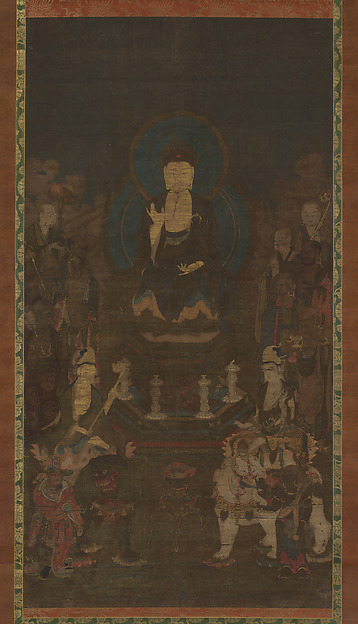
Japan, early 14th century. Hanging scroll; ink, color and gold on silk; image 106.7 × 56.2 cm.
Look closer: The Met titles the scroll Shaka with Two Attendant Bodhisattvas and the Ten Great Disciples and dates it to the early fourteenth century. Look at the two riders in the lower corners, the lion on one side and the white elephant on the other, then at the crowd of standing disciples behind the Buddha.
The Metropolitan Museum of Art, Gift of Sue Cassidy Clark, in honor of Dr. Barbara Brennan Ford, 2009 (2009.156). Public domain, Open Access.

Japan. Ceramic body covered in lacquer and gold foil; height 22.9 cm. Attributed to Ogawa Haritsu (Ritsuō).
Look closer: The Met attributes this piece to Ogawa Haritsu, known as Ritsuō. Look at the elephant’s curled trunk and tusks and at the small patterned robe, with the gold foil rubbed away at the edges.
The Metropolitan Museum of Art, H. O. Havemeyer Collection, Bequest of Mrs. H. O. Havemeyer, 1929 (29.100.672). Public domain, Open Access.
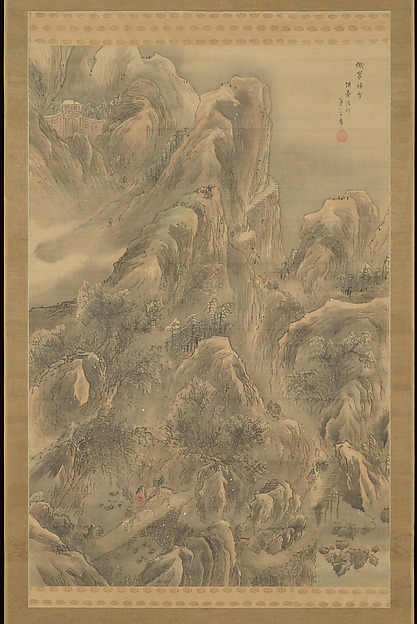
Japan, ca. 1830. Hanging scroll; ink and color on silk; by Yokoi Kinkoku; image 138.7 × 93.7 cm.
Look closer: The Met titles it Mount Emei and dates it to about 1830, by Yokoi Kinkoku. Wikipedia names Fugen patron of the monasteries associated with Mount Emei in western China. Look for the temple roof at the upper left and the tiny travellers climbing at the lower centre.
The Metropolitan Museum of Art, Mary and Cheney Cowles Collection, Gift of Mary and Cheney Cowles, 2023 (2023.583.24). Public domain, Open Access.
In the house
Pieces of Fugen on his elephant are uncommon. The strip below reads the live shelves and appears when one is in the house.
Answered plainly
Who is Fugen?
The bodhisattva of practice and vows, whose name means universally good. The Sanskrit is Samantabhadra. He rides a white elephant with six tusks.
How do I tell Fugen from Monju?
Butuzou’s working rule: elephant and lotus for Fugen, lion and sword for Monju. Left and right vary and should not be relied on alone.
What are the ten vows?
Ten vows from the Bhadracarī, running from homage to all Buddhas and offerings to repentance, rejoicing, study and the dedication of merit to all beings.
What is Fugen Enmei?
A longevity form of Fugen, invoked in a long-life rite that the Art Net Users System calls important especially in the Tendai school. It has two-armed and twenty-armed versions.
Why does Fugen have ten demonesses?
In the Lotus Sutra, ten rākṣasī are named as tutelary spirits of the sutra, and Fugen, protector of its devotees, appears with them in a painting type.
Which day of the Thirteen Buddhas is Fugen?
The twenty-eighth day after a death, the fourth of the thirteen, between Monju and Jizō.
Where next
Sources and image credits
- The Metropolitan Museum of Art, object 45369
- The Metropolitan Museum of Art, object 75297
- The Metropolitan Museum of Art, object 47405
- The Metropolitan Museum of Art, object 897130
- Japanese Architecture and Art Net Users System, Fugen
- Wikipedia, Samantabhadra (Puxian Pusa): names, vows, iconography, Mount Emei
- Butuzou, Fugen Bosatsu vs Monju Bosatsu
- Wikipedia, Thirteen Buddhas
Last reviewed 28 October 2026. Pictures are public-domain or open-access, each credited beneath it. Diagrams on this page are drawn by Japonista.
Looking for a Fugen on his elephant, a Shaka triad or a small altar figure? Tell us what you have in mind and we will look.
Private concierge
Looking for something in particular?
Describe the piece or the project you have in mind. A senior advisor in Tokyo reads every case file personally and replies within two business days, with fees set out in writing before any work begins.