
The Buddha and the Roots
Beginnings · Ganges plain
The Buddha and the Roots
In December 1896 a sandstone pillar was found leaning in the Nepalese plain, and its inscription spoke in the first person: the king had come himself, because the Sage of the Shakyas was born here. Everything this almanac keeps, from a gilt Amida to a hanging scroll of Daruma, grows from a short list of places like that one. The sections below add the stories that every school retells, a reading table of symbols, the relic and pilgrimage news of recent years, a glossary, and a collector's eye for the objects that carry this life into Japanese art.
Fact sheet
Four ideas to carry in
- Pilgrimage came first. A text of the early canon names four places that inspire a faithful person, and a visit to them is the oldest act of Buddhist devotion we can name.4
- Stone outlasts story. The earliest firm evidence is an emperor's inscription, not a biography. The first full life of the Buddha was written about five centuries after his death by the usual reckoning.3
- Dates are an argument. Scholars place the Buddha's death anywhere from the mid-sixth to the late fifth century BCE, and most now cluster around 400 BCE.3
- Councils are a tradition. The great gatherings of monks are known mainly from later accounts, and many scholars doubt the first one as history.11
A Pillar in the Terai
First lookThe pillar stands in the southern plain of Nepal, in a sacred area that the World Heritage Committee describes as including the Maya Devi temple remains, a bathing pond called the Shakya Tank, monasteries and stupas.1 Its sandstone shaft was erected, UNESCO says, by Ashoka in 249 BCE, and its Brahmi script was noticed by a European only in the 1890s.12 The Wikipedia account dates the find to December 1896 and credits it to the German archaeologist Alois Führer and the Nepalese general Khadga Shamsher Jang Bahadur Rana.2
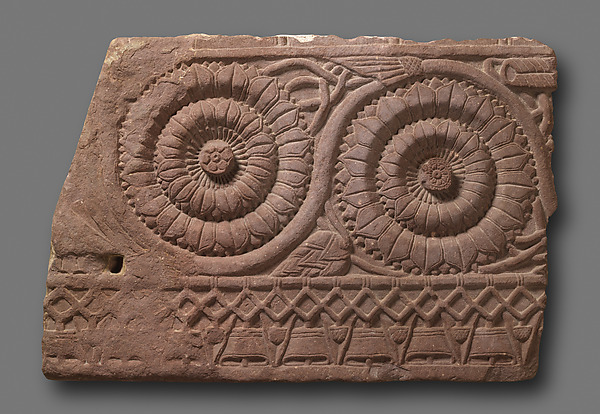
India (Madhya Pradesh) · Shunga period · ca. 1st century BCE · Red sandstone
Look closer: Two spiralling lotus roundels above a band of dentil moulding. Early monuments honoured the Buddha with symbols rather than a human figure, among them the wheel, the Bodhi tree, footprints and the empty throne, as the gateways of Sanchi show.13 At Bharhut, an inscription of about 100 BCE already uses the name Shakyamuni, the title the Lumbini pillar also uses.3
The Metropolitan Museum of Art, New York, Gift of Mr. and Mrs. Earl Morse, 1972, accession 1972.215. Public domain, Met Open Access. Museum record
Read in paraphrase, the inscription is plain to the point of tenderness. Twenty years after his anointment, King Devanampriya Priyadarsin came in person and worshipped, because the Buddha Shakyamuni was born here. He had a stone pillar raised, and he excused the village of Lummini from tax, asking only an eighth share of the produce.2 The king is Ashoka, and the village is the Lumbini of the later texts.

Lumbini, Nepal. Sandstone shaft, third century BCE, photographed in its modern setting
Look closer: The shaft carries the edict described above, but the fence, the cloth about its base and the whitewashed temple behind it show that this is a place of living worship as well as a monument. At this distance the inscription cannot be read.
Photograph: Rangan Datta Wiki. CC BY-SA 4.0, with attribution. Source: Wikimedia Commons. CC BY-SA 4.0 File record

There is a twist that every honest guide has to admit. Führer was later exposed as a forger of other finds and resigned in 1898, which for a time cast a shadow on his greatest discovery.2 The shadow has lifted: the epigrapher Harry Falk judges the pillar's authenticity beyond dispute, and the historian Charles Allen wrote in 2008 that there is no doubt at all.2
Where the Story Stands
First lookOne of the oldest passages of the Pali canon, from the account of the Buddha's last days, tells the monk Ananda that a faithful person can be moved by four places: where the Tathagata was born, where he was awakened, where he set the wheel of the Dharma turning, and where he was finally unbound.4 Pilgrims who die with a bright and confident mind on such a journey, the text adds, are reborn in a heavenly world.4
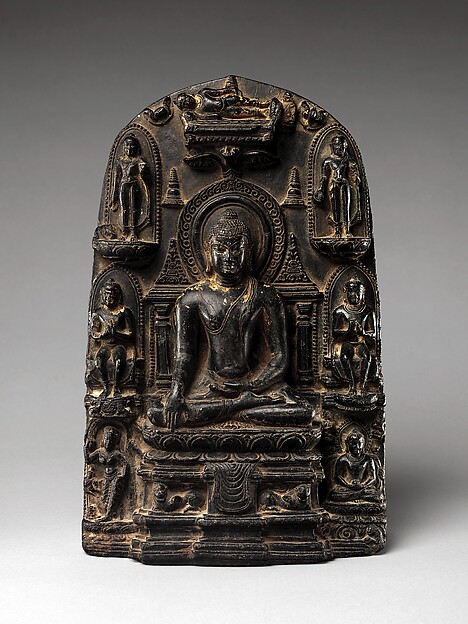
India, Bihar, possibly from Nalanda · Pala period · 10th century · Black schist with traces of gilding
Look closer: Count the smaller scenes that frame the central seated Buddha. The Met catalogues the slab as the Eight Great Events from the life of the Buddha, so a single panel carries the whole journey of this chapter.
The Metropolitan Museum of Art, New York, Gift of Raymond G. and Marsha Vargas Handley, 2009, accession 2009.541. Public domain, Met Open Access. Museum record
Those four places are still the spine of the Buddhist world, and each has a different character today. One is a plain of excavated brick and sacred water, one a soaring brick tower, one a park of ruins and a stupa, and one a small town where a long red sandstone Buddha reclines.
| Place | Event | What a visitor finds | Note |
|---|---|---|---|
| Lumbini (Nepal) | Birth | The Ashokan pillar, Maya Devi Temple remains in brick layers from the 3rd century BCE onward, monasteries and stupas1 | UNESCO World Heritage, criteria (iii) and (vi)1 |
| Bodh Gaya (India) | Awakening | The Mahabodhi Temple: a brick tower over 55 m tall56 | Present tower Gupta-period, 5th to 6th century CE; World Heritage 20025 |
| Sarnath (India) | First sermon | The Dhamek stupa and the ruined monasteries; the Ashokan Lion Capital found here became India's state emblem9 | Pali name Isipatana, the Deer Park7 |
| Kushinagar (India) | Final nirvana | A 6.10 m red sandstone reclining Buddha; the Ramabhar stupa marks the cremation site10 | Relics divided among ten claimants in the canon10 |
Born a Shakya
The connoisseur's eyeThe tradition places the Buddha's birth at Lumbini in the Shakya clan, with his mother Maya dreaming of a white elephant and giving birth in a grove of sal trees.3 The story that follows, of a palace childhood broken by four sights, is a masterpiece of storytelling, and a careful connoisseur notices where it comes from. The four-sights episode appears in a fifth-century commentary, the Nidanakatha, and Wikipedia's survey reports that it was borrowed from the older story of an earlier Buddha, Vipassi, in the Digha Nikaya.3
That does not make the Buddha a myth. It means that the biography as we read it was assembled in layers. The earliest firm evidence is the set of Ashoka's inscriptions in the middle of the third century BCE; Gandharan manuscripts from the first century BCE to the third century CE carry early texts; the first full biography in the usual sense, Asvaghosa's Buddhacarita, dates to the first century CE, and the Lalitavistara to the third.3 A life written four or five centuries after the event is a portrait of a memory, and a careful curator reads it as that.
Even the name is a lesson. Siddhartha, Gautama, Shakyamuni and Tathagata are used in different strata of the record: the Lumbini pillar and the Bharhut monument prefer Shakyamuni, the Sage of the Shakyas, while the canon's own formula is Tathagata.3
| Source | Approximate date | What it gives us |
|---|---|---|
| Ashoka's inscriptions, including Lumbini | Mid-3rd century BCE23 | Firm epigraphic proof of the birthplace and of royal devotion |
| Gandharan manuscripts | 1st century BCE to 3rd century CE3 | Early Buddhist texts preserved in manuscripts from Gandhara |
| Asvaghosa, Buddhacarita | 1st century CE3 | The earliest full biography |
| Lalitavistara | 3rd century CE3 | A later narrative of the life |
| Nidanakatha | 5th century CE3 | The commentary in which the four-sights episode appears |
Bodh Gaya: Brick, Burma and a Contested Shrine
The connoisseur's eyeAwakening is traditionally set at Bodh Gaya under a pipal tree.3 The shrine that marks the spot is one of the great survivals of early brick architecture. Wikipedia reports an archaeological date for the Vajrasana, the diamond throne, in the third century BCE, with the present pyramidal tower built in the Gupta period, in the fifth or sixth century CE, and a central tower rising over 55 metres.5 UNESCO calls it one of the earliest and most imposing structures built entirely of brick in India at that time.5 Britannica attributes the original structure to Ashoka.6

Bodh Gaya, Bihar, India. Niches with seated Buddhas below a cornice of lion-faced brackets
Look closer: Each arched niche holds a seated Buddha, one of them against a gilded ground, and the lion-faced brackets run along the cornice above. The shrine was repaired and restored many times, as the paragraphs below set out, so sculpture and masonry should not be assumed to be of one date.
Photograph: Sumitsurai. CC BY-SA 4.0, with attribution. Source: Wikimedia Commons. CC BY-SA 4.0 File record

Its later history is a history of Asia in miniature. Burmese kings sent missions to repair it from the reign of Kyansittha in the eleventh century to the fourteenth.5 British restorers Cunningham and Beglar began a major restoration in the 1880s, and in 1884 a Pala-period Buddha image was reinstated.5 In 1891 the Sri Lankan reformer Anagarika Dharmapala came and found a Shaiva priest in charge of the temple. He founded the Maha Bodhi Society, in Colombo that year and in Calcutta the next, to bring the shrine back into Buddhist hands.5 Since the Bodh Gaya Temple Act of 1949, a committee of Hindus and Buddhists has managed the site, and UNESCO inscribed it in June 2002.5
Sarnath and the Four Noble Truths
The connoisseur's eyeAt Isipatana, the Deer Park near Sarnath, the Buddha is said to have taught five former companions: Kondanna, Assaji, Bhaddiya, Vappa and Mahanama.7 The sermon, in the Samyutta Nikaya, begins by steering between two extremes, indulgence in sensual pleasure and self-torment, and names a Middle Way.7 Kondanna is recorded as the first to understand, the first arhat.37
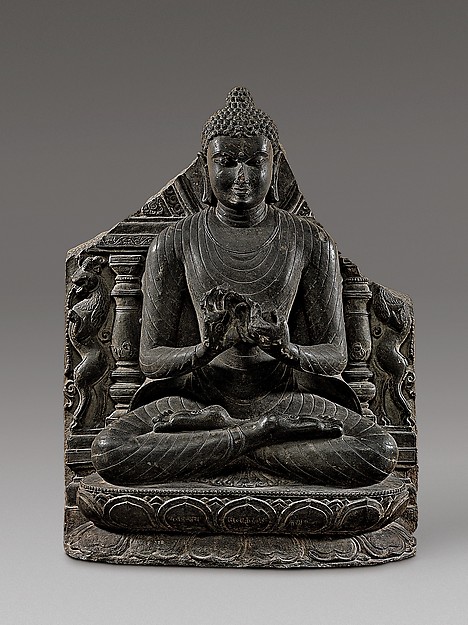
India (Bihar, probably Nalanda) · Pala period · 11th century · Black stone
Look closer: Look at the hands, raised and joined at the chest: the Met catalogues the figure as the Buddha preaching the First Sermon at Sarnath, and the house's guide to mudra explains how such gestures are read. Then look down at the lotus petals carved along the base.
The Metropolitan Museum of Art, New York, Rogers Fund, 1920, accession 20.43. Public domain, Met Open Access. Museum record
The four truths the sermon is remembered for are plainly stated: that there is dukkha, a word that covers suffering, unsatisfactoriness and stress; that it has an origin in craving; that it can cease; and that there is a path to its ceasing, the Eightfold Path.8 The structure is so tidy that scholars have long asked how old it is. A famous nineteenth-century suggestion by Kern, in 1882, compared the four to a physician's diagnosis, cause, prognosis and cure, though later work by Anderson is doubtful about this.8 Some scholars, including Cousins, Batchelor and Gombrich, also point out that the identification of this sermon as the very first may itself be a later one, and that some early accounts omit the four truths entirely.7

Sarnath, near Varanasi, India. A stone-faced drum surmounted by brickwork
Look closer: The lower drum is faced with dressed stone and pierced by shallow arched niches; above it the bare brick of the upper mass rises to a blunt top. It stands in the Deer Park where the tradition places the first sermon.
Photograph: Hardy Explorer. CC0. Source: Wikimedia Commons. File record

The site is easier to read than the scholarship. The Ashokan pillar at Sarnath, whose four-lion capital became the national emblem of India, was found there, and the Dhamek stupa still stands.9 The modern Mulagandhakuti temple, opened in 1931, carries wall paintings by the Japanese painter Kosetsu Nosu: one of the first places where this almanac's two worlds touch.9 The pilgrims Faxian, in the years 400 to 411, and Xuanzang, around 640, both visited, and Xuanzang reported about 1,500 resident monks.9
Kushinagar and the Ten Claimants
The connoisseur's eyeThe canon says that the Buddha died at Kushinagar between a pair of sal trees, was cremated seven days later, and that his relics were divided among ten claimants who raised stupas over them.10 In the tradition's own account, the pattern of a relic, a stupa raised over it and a pilgrimage to it begins here.
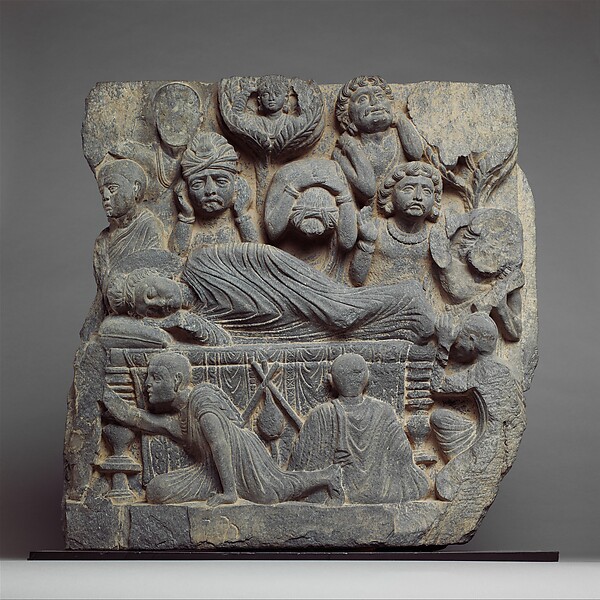
Pakistan (ancient region of Gandhara) · Kushan period · ca. 3rd century · Schist
Look closer: Count the figures pressed around the couch in this shallow relief. The Met catalogues it as the Death of the Buddha from ancient Gandhara, the region the fourth chapter of this wing follows along the Silk Road.
The Metropolitan Museum of Art, New York, Gift of Florence and Herbert Irving, 2015, accession 2015.500.4.1. Public domain, Met Open Access. Museum record
The site, found again by Cunningham in 1861 to 1862, offers a 6.10 metre reclining Buddha in red sandstone and the Ramabhar stupa, identified with the cremation place.10 In 1876, Carlleyle found a copper plate inscribed with the Nidana sutra, a deposit attributed to Haribala.10
The Councils and a Contested Memory
The deep endThe community's memory of itself is organised around councils, and the deep end of the subject is learning how much weight each can bear. Wikipedia's survey of the councils shows how the tradition grows after the first meeting, and how many scholars doubt even that first meeting.11
What emerges is not a single orthodoxy but a family quarrel carried on for centuries. Disputes over ten points of monastic discipline at Vaishali are said to have produced the first division of the community, and the later divide between the Mahasamghikas and the Sthaviras is, on one influential theory, the root from which Mahayana grew.1112 The next chapter picks the story up there.
| Council | Where and when (tradition) | What the tradition says | Caution |
|---|---|---|---|
| First | Rajagriha, soon after the death; Mahakasyapa presided, King Ajatasatru the patron11 | Ananda recited the discourses and Upali the monastic rules11 | Many scholars doubt it as history11 |
| Second | Vaishali, about a century later; King Kalasoka; the monk Revata11 | Ten disputed points of discipline, among them the use of gold and silver; a schism followed11 | Accounts differ by school11 |
| Third | Pataliputra, under Ashoka; Moggaliputta Tissa presided11 | The Kathavatthu recited; missionaries sent out11 | Known only from Theravada sources11 |
| Fourth | Aluvihara, Sri Lanka, 1st century BCE; King Vattagamani Abhaya11 | The texts committed to writing11 | A Sri Lankan tradition11 |
| Kanishka's | Kashmir; held in the Sarvastivada tradition11 | Recorded by one school only11 | Historicity questioned11 |
| Sixth | Yangon, 17 May 1954 to 24 May 1956; U Nu patron; about 2,500 monks11 | A modern recitation and editing of the Pali canon11 | Well documented11 |
Stories the Tradition Retells
First lookFour episodes recur in sutra, sermon and painted scroll more than any others, and each explains an object a visitor will later meet. The first is the Four Sights. The tradition says the young prince left his palace and met, on four successive drives, an old man, a sick man, a corpse and a wandering renunciant. The first three showed him what the household life could not cure; the fourth showed him a way of living with the question. Scholars read the sequence as a later literary arrangement of a single insight, and the earliest texts give it in a more compressed form, but the scheme is the one painted in nearly every Japanese life-of-the-Buddha handscroll.3

Japan · Kamakura period (1185–1333) · 14th century · Hanging scroll; ink, color, and gold on silk
Look closer: Find the golden Buddha lying on his right side at the centre, then the crowd of monks, kings and animals gathered around him, and the moon above. A group of figures arrives on a cloud at the upper right. The animals at the foot of the scroll are part of the convention: all living beings grieve at the final nirvana, which is why this subject was hung in temples on the day of the Nehan-e rite.10
The Metropolitan Museum of Art, New York, Rogers Fund, 1912, accession 12.134.10. Public domain, Met Open Access. Museum record
The second is the story of Kisa Gotami, a young mother whose only child died. She carried the body from door to door asking for medicine, until a teacher told her to bring a mustard seed from a house where no one had died. She found none, and in the search she learned what no argument could have taught her. The tale is told in the commentaries rather than the oldest discourses, and it is a reminder that the tradition preserves teaching as narrative as well as doctrine.3
The third is Angulimala, the bandit who wore a garland of his victims' fingers and who turned to the Buddha, was ordained, and lived out his life as a monk. Preachers used him for centuries as proof that the path was open to anyone. The fourth is the Buddha's last journey: he was ill after a meal at Pava, walked on to Kushinagar, lay down between two sala trees, and spoke his last instruction to the monks. The reclining figure in every temple hall, including the great reclining Buddhas of Japan's nirvana-day (Nehan-e) rites, is this scene.310
Reading the Life in Symbols
The connoisseur's eyeEarly Buddhist art avoided showing the Buddha in human form and used signs for the moments of his life. A visitor who knows the signs can read a relief or a hanging scroll without a caption. The table gives the commonest correspondences; they are conventions of the art, not doctrine, and individual workshops varied.35
| Sign | Moment it stands for | Where to look for it |
|---|---|---|
| Empty throne under a tree | The Awakening | Early Indian reliefs; later echoed by the vajrasana seat of Bodh Gaya5 |
| Wheel (dharmachakra) with deer | The first sermon at Sarnath | Temple roof finials and Tibetan gateways9 |
| Stupa | The final nirvana and the relics | Every pagoda in Japan descends from it10 |
| Footprints | The Teacher's presence after his death | Stone slabs at Yakushi-ji, Nara |
| White elephant | The conception dream of Queen Maya | Birth scenes and Fugen's mount1 |
The practical lesson for a collector is that an object may illustrate the life without any figure of the Buddha at all. A bronze wheel, a stupa-shaped reliquary or a pair of carved footprints belongs to the same story, and a catalogue entry that names only the object will often miss it.
Relics, Pilgrims and the Present Day
The connoisseur's eyeThe life of the Buddha is not only history; it is news. The Piprahwa relics, excavated in 1898 on the Indian side of the border from Lumbini, were in 2025 the subject of a planned commercial sale in Hong Kong. The sale was postponed and the relics were returned to India that July, an outcome widely read as a statement about who owns the physical memory of a faith.15
Lumbini itself has been transformed. UNESCO inscribed it in 1997, a timber shelter was built over the excavated temple remains in 2013 so that the layers of brick could be studied and protected, and the site was receiving roughly 1.5 million visitors a year before 2020.116 At Anuradhapura in Sri Lanka the Sri Maha Bodhi, grown from a cutting of the Bodh Gaya tree and planted according to the Mahavamsa in 288 BCE, is regarded as the oldest tree with a documented planting date, and it is still visited daily.17
These facts matter to anyone working with the objects. They show that the relic, the pilgrimage and the image remain connected in living practice, and that provenance questions about sacred objects are now handled in public view.
A Short Glossary for This Chapter
The connoisseur's eyeTerms used on this page, in the order a newcomer is likely to meet them.
| Term | Meaning |
|---|---|
| Siddhartha Gautama | The personal and clan name of the historical Buddha, before awakening.3 |
| Shakyamuni | Sage of the Shakya clan; the usual title in East Asian art.3 |
| Tathagata | Thus-gone one; the Buddha's own way of referring to himself.3 |
| Dharma | The teaching, and in other contexts the nature of things.3 |
| Sangha | The community of monks and nuns, later all followers.3 |
| Nirvana | Release; the final nirvana (parinirvana) is the death of the Buddha.10 |
| Bodhi tree | The fig tree under which awakening occurred; descendants are venerated in Asia.517 |
| Stupa | A relic mound; the source form of the Japanese pagoda.10 |
| Sutra | A discourse attributed to the Buddha.7 |
| Four Noble Truths | Suffering, its origin, its cessation, and the path; the content of the first sermon.7 |
A Collector's Eye on the Life of the Buddha
The connoisseur's eyeJapanese objects that carry this chapter's story are more numerous than they first appear. Hanging scrolls of the Nirvana scene, small bronze Shaka figures in the 'birth Buddha' pose with one hand raised to heaven and one to earth, wood and lacquer reliquaries shaped like the stupa, and sutra copies illustrated with the life are all in circulation. The birth Buddha, a standing child with an upraised finger, is the figure bathed with sweet tea on April 8 at Hana-matsuri, and the small bronzes made for that rite are among the most accessible Buddhist objects.3
When handling any such piece, ask three questions. Does the iconography follow the life or a later devotional scheme? Does the material and wear fit the claimed century? And is there a temple or workshop mark? A piece that answers the first question clearly is easier to place, and is more instructive to live with.
Buddhas of the Roots in the House
The house does not hold the oldest things named in this chapter: those stand where they were raised, or sit in museums. What it holds are Buddha images, Buddhist sculpture and sacred art from Japan, with a small study group of Asian pieces gathered from collections in Japan. Where a piece is catalogued as a Gandhara-style or Kushan-era-style work, the catalogue says so, and the house's essay on the ethics of collecting religious objects sets out what that wording does and does not claim.14
The strip below fills from the live catalogue on the day you read this. If it is empty, the tags are between pieces: the full shelves are one click away.
Pieces in the house now
- Buddhist Statues and Sacred ArtThe main shelf: Buddhas, bodhisattvas and guardians
- Asian Antiques Found in JapanChinese, Tibetan, Korean and wider Asian pieces
Filter by what you have just read
Answered plainly
Where was the Buddha born?
At Lumbini, in what is now southern Nepal. The Ashokan pillar there records the birth in an inscription that scholars now accept as genuine, after an early controversy about its finder.2
When did the Buddha live?
Nobody knows for certain. The traditional long chronology puts his death in 544 BCE, a short chronology around 368 BCE, and most specialists who met in 1988 placed it within twenty years either side of 400 BCE.3
What are the Four Noble Truths?
Dukkha (suffering or unsatisfactoriness), its origin in craving, its cessation, and the path leading to cessation, which is the Eightfold Path.8
What are the four pilgrimage places?
Lumbini (birth), Bodh Gaya (awakening), Sarnath (first sermon) and Kushinagar (final nirvana). A passage of the early canon names these four as places that inspire a faithful person.4
Were the Buddhist councils real?
Some probably were, and some are known only from later tradition. Many scholars doubt the historicity of the first council, and the third is known only from Theravada sources.11
Is there a Japanese connection at the sacred sites?
Yes. The wall paintings of the Mulagandhakuti temple at Sarnath, opened in 1931, are by the Japanese painter Kosetsu Nosu.9
What were the Four Sights?
An old man, a sick man, a corpse and a wandering renunciant, seen on successive drives from the palace; the first three showed the limits of household life and the fourth a way forward.3
Who was Angulimala?
A bandit who wore a garland of his victims' fingers and who was ordained by the Buddha; the story is retold as proof that the path is open to anyone.3
Are there any Buddhist relics from his own time?
The Piprahwa relics, excavated in 1898, are among the most discussed; a planned 2025 sale was postponed and the relics returned to India that July.15
Which tree is the oldest with a documented planting date?
The Sri Maha Bodhi at Anuradhapura, planted, according to the Mahavamsa, in 288 BCE from a cutting of the Bodh Gaya tree.17
Where next
Sources and image credits
- UNESCO World Heritage Centre, Lumbini, the Birthplace of the Lord Buddha Property description, inscription criteria, pillar and temple remains.
- Wikipedia, Lumbini pillar inscription Discovery in 1896, text of the edict, Führer, Falk and Allen on authenticity.
- Wikipedia, Gautama Buddha Biography tradition, chronology and earliest sources.
- Access to Insight, Maha-parinibbana Sutta (DN 16), chapters 5 and 6, translated by Thanissaro Bhikkhu The four places that inspire a faithful person.
- Wikipedia, Mahabodhi Temple Structure, restorations, Dharmapala, UNESCO 2002.
- Encyclopaedia Britannica, Mahabodhi Temple Height and attribution to Ashoka.
- Wikipedia, Sermon in the Deer Park The five companions, the Middle Way and scholarly caveats.
- Wikipedia, Four Noble Truths The four truths and scholarly debate on their age.
- Wikipedia, Sarnath Ashokan pillar, Dhamek stupa, the 1931 Mulagandhakuti and Kosetsu Nosu, pilgrims' accounts.
- Wikipedia, Kushinagar Cremation, relic division, reclining Buddha, archaeology.
- Wikipedia, Buddhist councils The councils and scholarly doubts.
- Wikipedia, Mahayana Sthavira and Mahasamghika divisions in outline.
- Wikipedia, Sanchi Aniconic symbols at early monuments.
- Japonista, The ethics of collecting religious objects How the house describes style, age and provenance.
- Wikipedia, Piprahwa Excavation of 1898, relic casket, 2025 sale controversy and return.
- Wikipedia, Lumbini Timber shrine of 2013, UNESCO inscription of 1997, visitor numbers.
- Wikipedia, Sri Maha Bodhi Planting date from the Mahavamsa and later history.
Last reviewed 28 October 2026. Dates in this chapter follow the cited pages; where the sources disagree, the chapter says so. Every picture is public-domain or openly licensed, and its credit and licence stand beneath it.
If a Buddha image from Japan or the wider Buddhist world has caught your eye, the concierge desk will search Japan on your behalf.
Private concierge
Looking for something in particular?
Describe the piece or the project you have in mind. A senior advisor in Tokyo reads every case file personally and replies within two business days, with fees set out in writing before any work begins.