
Birushana Nyorai
The Great Buddha
Birushana Nyorai
毘盧遮那仏
A Buddha whose body is the whole cosmos, cast in bronze in Nara in the middle of the eighth century by an emperor facing epidemics and rebellion. The head and hands are later replacements, and only parts of the body and the lotus beneath him date from the eighth century.
Identity card
Know him at a glance
- The curled hair. A Buddha’s head is covered in small tight curls. Wikipedia counts 960 on the Great Buddha at Tōdai-ji; a laser survey reported in 2015 counted 492, so the figure is disputed.
- The raised right hand. Lightly lifted in the gesture of preaching, as the Japanese Architecture and Art Net Users System describes the Nara image.
- The open left hand. Resting on the left knee, palm up, the gesture of giving. Together the two hands signify compassion for all living things.
- The lotus throne. In the Brahma Net Sutra he sits on a lotus of a thousand petals, each a separate world with its own Shaka. At Nara the petals are engraved with Shaka and bodhisattvas.
- The great halo. The halo behind the Nara image is 27 metres across, with sixteen small Buddha figures set in it, each 2.4 metres tall (Wikipedia).
The eyes that opened in 752

Japan, Nara, Tōdai-ji Great Buddha Hall. Bronze with later repairs; photograph by Balon Greyjoy, 21 January 2019.
Look closer: Look at the raised right hand, palm out, and at the gilded halo behind the head with its small seated Buddhas and rays. The figure is photographed from below and to the side, which shows how the bronze rises out of the lotus beneath it.
Balon Greyjoy, “The Great Buddha of Tōdai-ji”, Wikimedia Commons, CC0. Source: commons.wikimedia.org (file page listed in the sources below).
In the fourth month of 752, a crowd gathered at Tōdai-ji in Nara to give a bronze Buddha his eyes. Wikipedia records ten thousand monks and four thousand dancers. The priest who performed the rite was Bodhisena, who had come from India; nippon.com adds that he established the Kegon school in Japan, painted the eyes himself, and that his brush is preserved in the Shōsōin, the temple storehouse. Nippon.com calls the statue the largest bronze Buddhist statue in the world. It is Birushana, usually shortened to Rushana.
Japanese Wikipedia gives the day with more precision. It dates the ceremony to the ninth day of the fourth month, which it converts to 26 May 752, and says that more than ten thousand people attended. The brush used was tied to a cord of about 190 metres, and the congregation touched the cord to form a bond with the Buddha. The same article reports the dedication as postponed by a day for reasons that are not recorded; the favoured explanation for the date is that 752 was the two-hundredth year since Buddhism’s arrival in Japan, by the reckoning of the Nihon Shoki, and the eighth of the fourth month was the Buddha’s birthday.
The name is a transliteration. The Japanese Architecture and Art Net Users System says Rushana abbreviates Birushana, which renders the Sanskrit Vairocana, and that in Esoteric Buddhism the figure usually corresponds to Dainichi. Wikipedia glosses Vairocana as “the sun”, “solar” or “shining”; Japanese Wikipedia reads the transliteration as “light shining everywhere”. It adds a detail of spelling: the Flower Garland Sutra writes the third syllable with the character 舎, while the Mahāvairocana Sutra writes it 遮. In the Flower Garland Sutra, the Kegonkyō, he is the one who expounds the teaching, and the sutra describes him as pervading the whole cosmos. In Huayan thought, Wikipedia adds, Shakyamuni is seen as an emanation of Vairocana, so the Buddha of the Indian legend becomes one body among many of this larger one.
This chapter sits inside the Buddhism and Zen Almanac, on the Nyorai rank. The historical Buddha is Shaka; the esoteric form of the same cosmic Buddha is Dainichi.
Hands that preach and bless
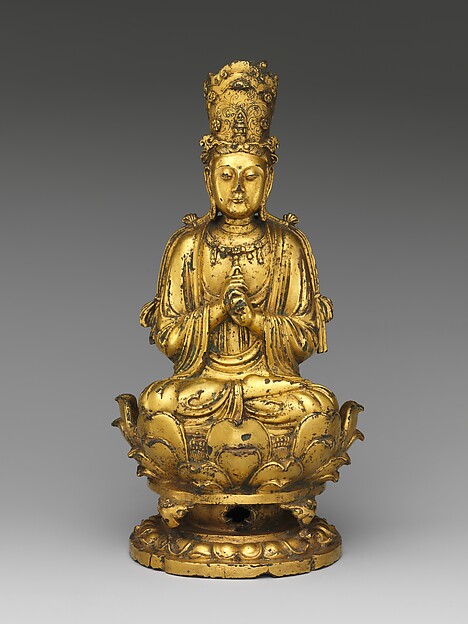
China, 11th century (Liao dynasty). Gilt bronze, lost-wax cast; height 22 cm.
Look closer: A Chinese gilt bronze of the eleventh century, labelled Vairocana. Look at the tall crown and at the hands joined before the chest. The throne is a lotus of overlapping petals on a stepped base. This is a crowned Vairocana, the form closer to Dainichi than to the plain-robed Nara image.
The Metropolitan Museum of Art, Purchase, Lila Acheson Wallace Gift, 2006 (2006.284). Public domain, Open Access.
Start with the hands. The Art Net Users System describes the Nara image’s right hand as lightly raised in the preaching gesture and the left as outstretched on the left knee. Nippon.com names them: the raised right hand is semui-in, the palm out, which signifies reassurance and protection, and the open left is yogan-in, the palm up, which signifies blessing and generosity. Together, it says, they signify the Buddha’s compassion for all living things. Wikipedia notes that the current hands date from the Momoyama period, 1568 to 1615, and the head from the Edo period, 1615 to 1868.
Then the scale. Wikipedia gives the face at 5.33 metres, each eye at 1.02 metres, the ears at 2.54 metres, and the shoulders 28 metres across. It counts 960 curls on the head. The halo behind is 27 metres in diameter with sixteen images set in it, each 2.4 metres tall. The same article says gold was imported and the statue consumed much of Japan’s bronze. According to nippon.com the figure was originally gold-plated. Japanese Wikipedia adds that the gilding was not finished at the eye-opening: it began on 2 April 752 and, by a Shōsōin record, was complete in 757, while the halo was begun in 763 and finished in 771.
The poses are ones the other Nyorai share. Japanese Wikipedia makes the point directly: in appearance the Great Buddha cannot be told from Shaka or other Nyorai, and it is the Flower Garland Sutra, not the pose, that makes him Rushana. What sets this image apart is its size, and what lies beneath it.
| Feature | What it means | Where to look |
|---|---|---|
| Raised right hand | Semui-in: reassurance and protection | Right hand, palm outward |
| Open left hand | Yogan-in: blessing and generosity | Resting on the left knee, palm up |
| Tight curls | The mark of every Buddha; 960 by one count, 492 by another | The whole head |
| Halo | 27 metres across, with sixteen small Buddhas | Behind the head |
| Lotus throne | The thousand-petal lotus of the Brahma Net Sutra | The base |
A body made of worlds
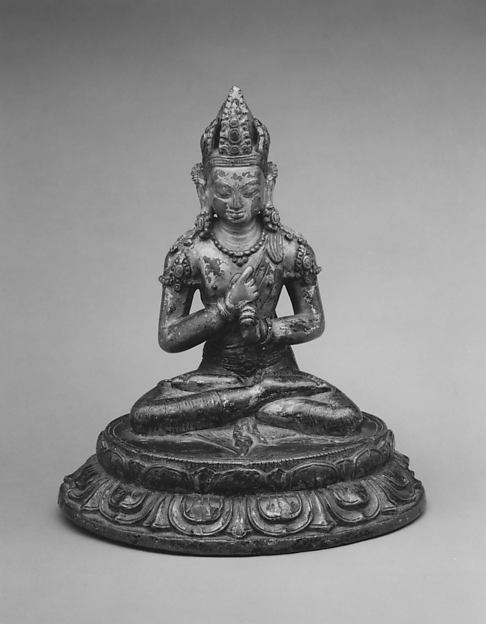
Nepal (Kathmandu Valley), 11th to 12th century. Gilt-copper alloy with gold paint and blue pigment; 19 × 16.5 × 13.3 cm.
Look closer: Look at the hands: the fingers of one wrap the raised finger of the other at the chest, the wisdom-fist sign that Wikipedia names for the Vajra Realm Vairocana. The Met calls him “the Supreme Transcendent Buddha” and dates him to the eleventh or twelfth century.
The Metropolitan Museum of Art, Purchase, Friends of Asian Art Gifts, 1991 (1991.133). Public domain, Open Access.
Vairocana is the clearest case in Buddhism of a Buddha who is not a person. Wikipedia’s article on the Three Bodies teaching sets out the scheme. Every Buddha has a Dharma body, which is the true nature of all things and visible only to Buddhas; an enjoyment body of supernatural size and beauty, visible to advanced bodhisattvas; and an emanation body, the physical form seen by ordinary beings. In Mahayana, Wikipedia says, Vairocana is the Dharma body, and the historical Shakyamuni is his emanation body.
The scriptures say so in vivid terms. The Brahmajāla Sūtra, called the Brahma Net Sutra and in Japanese Bonmōkyō, introduces him seated on a lotus pedestal, with a thousand Shakyamuni Buddhas on a thousand surrounding flowers, each in a world of his own. All of them, the sutra has him say, have Vairocana as their original body. The Flower Garland Sutra, the Buddhāvataṃsaka, describes him as having awakened in an immeasurable past and as presiding over countless bodhisattvas, and a passage Wikipedia quotes says that in a single pore of his body lie countless oceans of worlds.
The Flower Garland Sutra is a collection and not a single composition. Wikipedia says modern scholars treat it as a compilation of smaller sutras that circulated separately; one source it cites places the joining in Central Asia in the late third or fourth century, while Japanese scholars it names hold that the Sanskrit original was compiled in India. Japanese Wikipedia dates its formation to about 400 and says two Chinese translations reached Nara: the sixty-fascicle version of the fifth century, by Buddhabhadra, and the eighty-fascicle version of the late seventh century, by Śikṣānanda. The Brahma Net Sutra is traditionally said to have been translated by Kumārajīva in 406, though several scholars, Wikipedia reports, think it was composed in East Asia in the mid-fifth century, and others disagree.
In China the sutra gave a school its name. Huayan, Wikipedia says, grew in the Tang dynasty and teaches that all phenomena contain and reflect one another. Its best-known image is Indra’s net, an infinite web with a jewel at each knot, every jewel mirroring all the others. Fazang, who lived from 643 to 712, taught that Vairocana expounds the Flower Garland Sutra through ten bodies that between them take in all things, animate and inanimate. Kegon is the Japanese reading of the same school.
There is a pure land in this picture too. Wikipedia says the Flower Garland Sutra’s whole cosmos is a single buddha-field purified by Vairocana, the Lotus Treasury World, of which our world is one small part. The Qing-dynasty Huayan writer Peng Shaosheng, it adds, equated Amitābha’s Sukhāvatī with this world, so that the two great Buddhas become one; and the Shingon monk Dōhan, in the same article, taught that Amida is Vairocana’s Dharma body. For the visitor in Nara the practical point is simpler. The Buddha in front of you is not Shaka, and he is not a king or a saint. He is the cosmos given a face.
One lotus, a thousand worlds
The Art Net Users System explains the scripture behind the throne. In the Brahma Net Sutra, Bonmōkyō, Vairocana lives in the Lotus Matrix World, surrounded by a thousand petals. Each petal is a separate world with its own emanation of Vairocana in the form of Shaka, and each of those worlds contains ten billion further worlds, each with its own Shaka preaching the same sutra. Wikipedia calls the cosmos of the Flower Garland Sutra the Lotus Treasury World: a single pure buddha-field, our own world one small part of it.
At Tōdai-ji the picture was cut into bronze. Nippon.com says the base of the statue has 28 lotus petals, each engraved with Shakyamuni surrounded by 22 bodhisattvas, and below them carvings of the three realms of existence and Mount Sumeru. One original line engraving shows Shakyamuni preaching to a crowd of bodhisattvas. The petals sit too high to read from the floor, so replicas are shown at ground level. The same article says the petals are original eighth-century work.
Japanese Wikipedia describes the engraving in detail. The upturned lotus on which the Buddha sits and the inverted lotus beneath it each have 28 petals, 14 large and 14 small, and the upper petals carry the chisel-cut drawing. At the top is a large Shaka preaching, with 11 bodhisattvas on each side and flying emanation Buddhas on clouds around them. Below runs a band cut by 26 horizontal lines into 25 layers, which together with the Shaka register stand for the 26 realms above Mount Sumeru in the account the article follows; at the bottom are seven small lotus-petals, each holding a Sumeru world with its seven golden mountains and four continents. The drawing was done freehand from a common model, so no two petals are exactly alike.
The throne was once taller. Japanese Wikipedia says the Buddha originally sat on a copper lotus that rested on a second lotus of stone, a double lotus that the Shigisan engi scroll shows before the fire of 1180. Whether the pedestal was cast before or after the figure is still argued. A Heian-period pilgrim, Ōe no Chikamichi, wrote about 1140 that the pedestal was made between 752 and 756; Adachi Yasushi took that up in 1934, and the argument has not been settled, since the inside of the pedestal has never been fully investigated.
Eight pourings, three years
Tōdai-ji’s own account of the century begins with disaster: more than ten years of political struggle, smallpox epidemics and rebellions. Shōmu, it says, saw religion as the way to heal them. Japanese Wikipedia fills in the toll. In 737 smallpox killed in quick succession the four Fujiwara brothers who led the government, an earthquake had struck in 734, droughts and famines came year after year, and in 740 Fujiwara no Hirotsugu rebelled in Kyushu. Wikipedia’s article on Shōmu records a smallpox epidemic of 735 to 737 with adult mortality of about a quarter to a third, and says the emperor moved the capital four times.
The decision itself is traced to a visit. Japanese Wikipedia, following the Shoku Nihongi, says that in 740 Shōmu worshipped a Rushana image at the temple of Chishiki-ji in Kawachi, in what is now Kashiwara, and resolved to make one of his own. In 741 he ordered a national system of provincial temples, the Kokubun-ji; Wikipedia’s article on them says each was to have a statue of Shaka with two bodhisattvas and a copy of the Large Prajñāpāramitā Sutra, and that the formal name of the temples was that of the Golden Light Sutra and the Four Guardian Kings. In 743 he announced a monumental Vairocana, which the temple reads as a reach beyond the provincial scheme toward the harmonious worlds of the Flower Garland Sutra.
The edict was issued from the Shigaraki palace on the fifteenth day of the tenth month, which Japanese Wikipedia converts to 5 November 743. As the article paraphrases the Shoku Nihongi, Shōmu says he holds the wealth and power of the realm and could make the statue easily, but fears that forced labour would turn people against it; whoever wished to take part should bow to Rushana three times a day, and anyone who wished to help with a blade of grass or a handful of earth should be allowed to. Officials were forbidden to extract contributions from the people by force. The first structure was a pillar raised for the statue at Kōka-ji, near Shigaraki, in 744. Wikipedia says fires and earthquakes interrupted the work there, and that it was resumed in Nara in 745, once the court had returned from its wanderings. On the grounds of Kinshō-ji, the temple’s predecessor, work began on the 23rd day of the eighth month of 745.
The work needed whole populations. The monk Gyōki, who lived from 668 to 749, solicited donations across the land. Wikipedia believes Kuninaka-no-muraji Kimimaro directed the building of the image and its hall, and that Takechi-no-sanekuni directed the sculpture; Japanese Wikipedia gives the casters as Takechi no Ōkuni and Takechi no Mamaro. The statue was cast in eight pourings over three years and finished in 749. Nippon.com adds that gold was discovered in Mutsu Province during the work and that Shōmu took this as a sign of divine blessing, and changed the era name to Tenpyō Kanpō. Rōben, who lived from 689 to 773, became the first chief abbot.
Japanese Wikipedia reconstructs the method from the records. A wooden frame was wrapped with branches and rope and covered in clay, coarse near the core and fine toward the surface, to make a full-size core. An outer mould was built over it in eight tiers, from the bottom up, with a release layer between. The mould was split, lifted off and fired, the core was shaved down by the thickness the bronze was to have, and the mould was reassembled with spacers; the Shōsōin documents record 3,350 metal spacers. Then molten copper was poured through channels into the gap. After the pourings came a long finish: patching, filing, attaching the curls, gilding and the halo.
The article’s account of materials is as striking. Records differ on how much copper was used, but about 500 tonnes is accepted, and the temple’s foundation text says it came from the west; the article notes that arsenic in the copper from the Naganobori mine in Yamaguchi closely matches the metal from the original statue found beside the west cloister. Gold had to be imported until gold was found at Wakuya in Mutsu in 749, from which the governor presented 900 ryō, about 13 kilograms. The gilding used mercury, 58,620 ryō, about 820 kilograms, according to a temple record. The article judges that many people must have died from accidents and mercury poisoning, and says that the arsenic in the copper and the mercury were thought to have poisoned several hundred, for whom a hospital was set up. These points come from one article and its cited sources, and they are presented there as inference.

Japan, Nara, Tōdai-ji. Folding screens; colour and gold leaf; 18th century according to the Commons description.
Look closer: Look at the crowds streaming in toward the great seated Buddha in the upper screen and at the same compound with its hall in the lower screen, set among clouds of gold leaf. The Commons file describes the pair as eighteenth-century, from Tōdai-ji; it gives no artist and no further account of the subject.
Artists of the Nara to Edo periods, “Pair of screens of the Great Buddha and the Great Buddha Hall, Tōdai-ji”, Wikimedia Commons, Public domain. Source: commons.wikimedia.org (file page listed in the sources below).
| Year | Event | Source |
|---|---|---|
| 740 | Shōmu worships a Rushana at Chishiki-ji; Shinjō lectures on the Flower Garland Sutra at Kinshō-ji | Japanese Wikipedia |
| 741 | Edict founding the provincial temples | Tōdai-ji official site |
| 743 | Edict for a monumental Vairocana, issued at Shigaraki | Tōdai-ji; Japanese Wikipedia |
| 745 | Court returns to Nara; work begins on the temple grounds | Tōdai-ji official site |
| 747 to 749 | Casting, 29 September 747 to 24 October 749 (Japanese Wikipedia); “eight pourings over three years” (Tōdai-ji) | Japanese Wikipedia; Tōdai-ji |
| 751 | Great Buddha Hall completed (temple); Japanese Wikipedia gives 758 | Tōdai-ji official site; Japanese Wikipedia |
| 752 | Eye-opening ceremony, fourth month | Wikipedia; nippon.com; Japanese Wikipedia |
An emperor, a wanderer and a monk from India
Wikipedia’s article on Shōmu calls the Buddha his lasting legacy and says that later chroniclers accused him of exhausting the country’s reserves of bronze and precious metals. In the fourth month of 749, it says, he went in procession to Tōdai-ji with the empress and the court, stood before the statue, and declared himself a disciple of the Three Jewels. That summer he abdicated in favour of his daughter, took the tonsure and became the first retired emperor to become a Buddhist priest, and his consort Kōmyō became a nun. He died in 756 at the age of 54. The Shōsōin, the temple’s storehouse, houses about nine thousand artefacts connected with Shōmu and Kōmyō.
Gyōki is the most unlikely of the helpers. Wikipedia describes him as a priest who left the monasteries to teach commoners, building 49 monasteries and nunneries that also served as hospitals and organising irrigation and public works. Since regulations confined priests to their compounds, he was an unofficial priest, and he and his followers were persecuted before his popularity earned a pardon. In 745 he became the first priest to hold the rank of daisōjō. He died on 2 February 749, before the Buddha was finished, and the court gave him the title of bosatsu in 751. Japanese Wikipedia says Shōmu summoned him after the monk who led the Chishiki-ji congregation, Manpuku, died in the winter of 740. It reports a scholar’s view that calling on Gyōki, whom an edict of 717 had suppressed, was politically awkward.
Rōben, the first chief abbot, has a legend of his own. Wikipedia says that as an infant he was snatched by an eagle and dropped on a pine tree in front of what is now the Nigatsudō, was raised as a monk, and was reunited with his mother thirty years later. His Japanese popular name is the Golden Bell Practitioner, from Kinshō-ji, the “golden bell” temple that became Tōdai-ji. He studied under Gien, with Gyōki a fellow pupil, and, according to Wikipedia, invited the Silla monk Shinjō to lecture on the Flower Garland Sutra, which led to the founding of the Kegon school with Shōmu’s permission.
Bodhisena is the foreign face of the ceremony. Wikipedia’s article on Tōdai-ji says he performed the eye-opening for Shōmu, and nippon.com that he founded Kegon in Japan. Two years later, in 754, the Chinese monk Ganjin, after twelve years and six attempts to cross the sea, gave ordination at Tōdai-ji to the retired emperor Shōmu, to Empress Kōken and others. Later, Wikipedia says, Saichō and Kūkai were ordained there too, and Kūkai added ordinations for the Brahma Net bodhisattva precepts and for Shingon.
A last item is a legend that reconciles the Buddha with Japan’s own deity. Wikipedia reports that the monk Gyōki went to the Ise Grand Shrine and recited sutras for seven days and nights until the oracle declared Vairocana compatible with worship of the sun goddess Amaterasu. The sources read for this chapter present it as a legend and do not date it.
What survives of the eighth century

Japan, Nara, Tōdai-ji. Timber hall of 1709, steel-framed restoration 1974 to 1980; photograph by Balon Greyjoy, 21 January 2019.
Look closer: Look at the double roof, its grey tiles and the gilded ornaments at the ridge ends, and at the way the hall rises from a plain gravel court. What you see is the building of 1709 as restored with steel in 1974 to 1980, about two-thirds of the width of the first hall according to Japanese Wikipedia.
Balon Greyjoy, “The Great Buddha Hall, Tōdai-ji”, Wikimedia Commons, CC0. Source: commons.wikimedia.org (file page listed in the sources below).
Fire took the Great Buddha twice. Nippon.com dates the fires to 1180 and 1567 and says that the torso from the abdomen to the feet, and the lotus petals of the pedestal, are original Nara-period work, while the present head belongs to the Edo period. Wikipedia agrees on the Edo head and records a reconstruction under Chōgen after 1180. So the colossus that visitors see is a layered thing: an eighth-century body and throne, a Momoyama pair of hands and an Edo head.
Japanese Wikipedia gives the order of events. Within decades of its making the statue cracked and tilted, and in the earthquake of 855 the head fell off; it was repaired and a ceremony of completion held in 861. In 1180, in the fighting between the monks of Tōdai-ji and Kōfuku-ji and Taira no Shigehira, the fire spread and burned the main buildings. The monk Chōgen led the fundraising, working with a Song-dynasty caster, Chen Hequing, and Minamoto no Yoritomo, who had overthrown the Taira, took the lead in the rebuilding. The eye-opening was held in 1185, with the retired emperor Go-Shirakawa wielding the brush, and the hall was consecrated in 1195.
The second fire, in 1567, came during fighting between Matsunaga Hisahide and the Miyoshi forces camped at the temple. Japanese Wikipedia says the cause is unclear: an attack on the hall, an accident in a night raid, and arson by Christians among the Miyoshi troops have all been put forward. Recovery was slow. A temporary hall went up and was blown down in a gale in 1610, and the head, patched with copper plates, stood in the rain for decades. In 1685 the monk Kōkei received the shogunate’s permission to raise funds; the new head and repairs were finished in 1691, and the eye-opening was held in 1692.
The hall has its own history. Wikipedia says the present Great Buddha Hall was finished in 1709, nippon.com says 1706, and the hall is 57 metres long, 50 wide and 49 high. It is about 30 per cent smaller than its predecessor and reduced from eleven bays to seven. Forty-eight cinnabar-lacquered pillars carry the blue-tiled roof, and the hall remained the world’s largest wooden building until 1998. One support post has a hole said to match one of the Buddha’s nostrils, and legend says that those who squeeze through it will be enlightened in the next life. Japanese Wikipedia gives the hall as 57.5 metres wide, 50.5 deep and 49.1 high, about two-thirds of the original width of roughly 86 metres, and says the claim of “largest wooden building” should be “largest timber-framed building”, since modern structures exceed it.
The Meiji era brought the building close to collapse under the weight of its roof. Wikipedia says a first restoration in 1904 to 1913 propped it up, and that a steel-framed restoration, from 1974 to 1980, removed the roof, fixed it with steel and concrete, and gave the hall its present form. About 100,000 people were mobilised. The building was spared the air raids of the Second World War. And in the knee of the statue, Wikipedia adds, X-rays found a human tooth, pearls, mirrors, swords and jewels, believed to be relics of Emperor Shōmu.

Japan, Nara, Tōdai-ji. Handscroll; ink; 18th century, attributed to Kōkan (1652 to 1717); photographed in monochrome.
Look closer: Look at the men straining at the ropes, the huge log with its ring-shaped end, and the overseers in hats standing apart. The Commons description gives the scroll as eighteenth-century, attributed to Kōkan (1652 to 1717), from Tōdai-ji, and its title refers to the “rainbow beams” of the Great Buddha Hall. The sources read do not say which rebuilding it records.
Artists of the Nara to Edo periods, “Hauling the rainbow beams for the Daibutsuden”, Wikimedia Commons, Public domain. Source: commons.wikimedia.org (file page listed in the sources below).
| Part | Date | Source |
|---|---|---|
| Lotus petals and parts of the legs | Eighth century, original | nippon.com; Japanese Wikipedia |
| Much of the body | Eighth century (nippon.com) or Kamakura and later repair (Japanese Wikipedia) | Sources disagree |
| Hands | Momoyama period, 1568 to 1615 | Wikipedia |
| Head | Edo period, 1615 to 1868; finished 1691, eyes opened 1692 | Wikipedia; nippon.com; Japanese Wikipedia |
| Present hall | 1706 or 1709, depending on source | nippon.com; Wikipedia |
| Steel-framed restoration | 1974 to 1980 | Wikipedia |
Sixty scrolls in silver
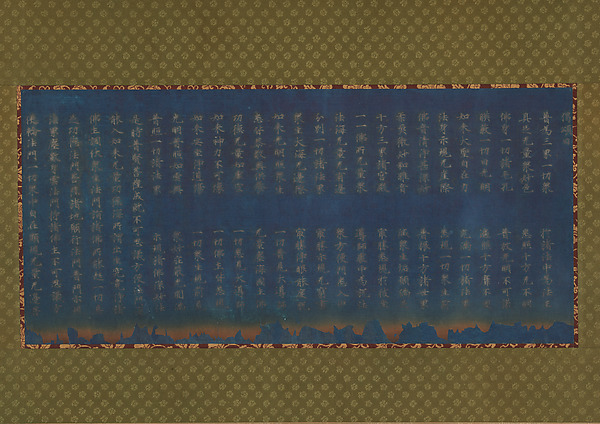
Japan, about 744. Hanging scroll; silver pigment on indigo-dyed paper; image 25 × 54 cm.
Look closer: The columns of characters run in even lines of silver on blue-black ground. Look along the bottom edge, where the paper turns brown and ragged: that is the fire of 1667.
The Metropolitan Museum of Art, Purchase, Mrs. Jackson Burke Gift, 1978 (1981.75). Public domain, Open Access.
The Met holds a fragment of a different kind of monument. The museum’s catalogue says the Flower Garland Sutra was copied in sixty handscrolls and donated to Tōdai-ji in 744, and that in 1667 a fire in the Nigatsudō Hall damaged it. The survivors are called the Nigatsudō Burned Sutras, and their scorched edges are prized. The Portland Art Museum adds that the text is silver ink on indigo-dyed paper, that the usual word for such fragments is yakegyō, and that many have a rusty red lower edge from the flames.
The Met says copying scripture was believed to confer spiritual merit on donors, scribes and craftsmen alike.
A later fragment in the gallery below, with black ink on pale indigo paper flecked with gold, is a twelfth-century section of the same sutra; a further page, written in kana, comes from a Tōdai-ji manuscript of 1120.
Vairocana in other halls
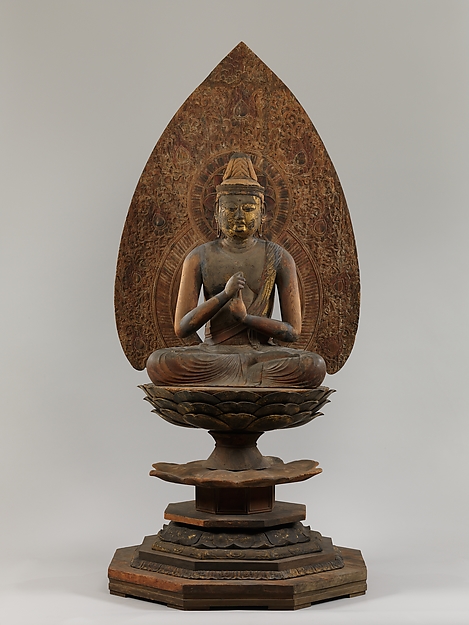
Japan, 12th century. Wood with lacquer and gold leaf; figure height 92.4 cm.
Look closer: Look at the hands, one fist wrapped in the other at the chest: this is the wisdom-fist that Wikipedia describes for the Vajra Realm form, and the tall halo carries a fine pattern of flowers and scrolls. This is Dainichi, the esoteric form of the same Buddha, in the wood-and-lacquer manner of the twelfth century.
The Metropolitan Museum of Art, Rogers Fund, 1926 (26.118a, b). Public domain, Open Access.
The Great Buddha has relatives across Asia. Wikipedia’s article on Vairocana gives the earliest large one: a Tang statue in the Dragon Gate Caves in China, completed in 676, 17.14 metres high with ears two metres long. It also gives the ninth-century temple of Mendut in Java, near Borobudur, dedicated to Vairocana, where a three-metre stone figure sits in the wheel-turning gesture between the bodhisattvas Avalokiteshvara and Vajrapani; and the larger of the two great Buddhas of Bamiyan, which it says was also a Vairocana. The Spring Temple Buddha in Henan, 126 metres high, is the largest, though the article marks its ranking as needing a citation.
In Japan itself, the Art Net Users System lists a second Rushana of the Nara period, the dry-lacquer figure in the Kondō of Tōshōdaiji, with a thousand Buddhas embossed on its halo. Japanese Wikipedia adds that this is the central image of the hall Ganjin founded, and prized as a work of the High Tang style that he brought from China. A third was the Great Buddha of Hōkō-ji in Kyoto, built at Hideyoshi’s order. Japanese Wikipedia gives its height as six jō and three shaku, about 19 metres, which made it taller than the Nara Buddha, and says it was burned by lightning in 1798. The comic novel Tōkaidōchū hizakurige, it notes, describes the Hōkō-ji Buddha, though its first edition was published in 1802.
Kegon is only half the Japanese story. Wikipedia’s article on Vairocana says the same Buddha is the original Buddha of Kegon, Shingon and Tendai, and that in Esoteric Buddhism he appears as Mahāvairocana, the Great Sun, Dainichi. The Vajra Realm form sits in lotus position with the wisdom-fist gesture, both hands together, and the Womb Realm form with the Dharma-realm meditation gesture. Both forms, it says, are widely seen in Japan and Korea. The source of this teaching is the Dainichikyō, the Vairocanābhisaṃbodhi Sūtra, which Wikipedia says was composed before 674 and translated into Chinese in 724 to 725 by Śubhākarasiṃha and Yixing. Kūkai learned of it in 796 and sailed to China for instruction in 804.
The two Japanese schools meet on a small point. Wikipedia’s article says that when Francis Xavier arrived in Japan, Shingon monks welcomed him because he used Dainichi, the Japanese name for Vairocana, to designate the Christian God; as he learned the nuances, he replaced the word with Deusu. Japanese Wikipedia, in turn, says one theory seeks the origin of Mahāvairocana in the Zoroastrian supreme god, Ahura Mazda. The text offers it as one theory among others, and the other sources read do not mention it.
The most popular practice is a Vairocana mantra, the Mantra of Light. Wikipedia says Kūkai brought the text to Japan in the ninth century, that it spread through the Heian period, and that the Kegon monk Myōe, who lived from 1173 to 1232, taught it widely as a way to purify bad karma and to be born in a pure land. Eison convened Mantra of Light assemblies at Saidai-ji, where male and female monastics and laypeople took eight precepts for seven days. A common use was to sprinkle sand blessed with the mantra on a body or a tomb. The mantra remains popular in Shingon and is used in Tendai, Zen and Kegon liturgy.
| Name | Tradition | Where he is centred |
|---|---|---|
| Rushana, Birushana | Kegon, in the Flower Garland and Brahma Net sutras | Tōdai-ji, Nara; Tōshōdaiji Kondō |
| Dainichi | Shingon and Tendai esoteric teaching | The Womb and Diamond mandalas; Tō-ji, Kyoto |
| Vairocana as Original Buddha | Tiantai and Tendai, reading the Lotus Sutra | The sixteenth chapter of the Lotus Sutra |
| Pílúzhēnà Fó (毘盧遮那佛) | Huayan, in China | The Dragon Gate Caves (Wikipedia) |
Telling Rushana from Dainichi
A collector meets this Buddha in three guises: as a large plain-robed Nara-style figure with the preaching hands, as a crowned Dainichi with the wisdom fist, and as a figure in a cosmic composition such as a throne carved with a thousand petals. The labels in common use, “Vairocana”, “Rushana”, “Dainichi” and “Birushana”, point at one Buddha, but the pose and dress point at two traditions.
First, the hands. Preaching hands, with the right palm out and the left open on the knee, are the Nara Rushana. Hands joined at the chest with one fist wrapped in the other are the wisdom fist of Dainichi in the Vajra Realm. But Japanese Wikipedia points out that the Nara Buddha cannot be told from Shaka by its look, so hands alone settle nothing: a figure on a lotus with preaching hands could be Shaka, Rushana or another Nyorai. The inscription, the temple of origin or the lotus petals, if engraved, are what decide.
Second, the crown. A crowned Buddha in the Japanese tradition is, as a rule, Dainichi, as in the Met’s twelfth-century wooden figure, and the Chinese gilt bronze of the Liao period shows the same crowned Vairocana that Wikipedia describes for Chinese and Tibetan art. A plain-robed Rushana in a Japanese temple is usually an image of the Kegon tradition. These are tendencies, not rules.
Third, the petals. A throne engraved with a central Buddha and a ring of bodhisattvas on its petals is the Tōdai-ji manner. Small reproductions of the lotus are made, and the engraved petal remains the most reliable single sign of a Kegon image. Fourth, the paper. Kegon sutra fragments, in silver or black on indigo paper, are collected in their own right, and the scorched edges of the Nigatsudō fragments are valued, as the Portland Art Museum says.
Fifth, condition and history. The Great Buddha shows that a bronze can be repaired for centuries and still be called the original; the head is Edo, the hands Momoyama and the petals Nara. A small bronze with a later head or hands is not unusual and should be described in those terms. The house keeps no Rushana at present, and a private request is the right route for anyone who wants one found. The concierge can discuss condition, boxes and provenance with anyone who writes.
Where the Great Buddha stands now

Japan, Nara, Tōdai-ji Nandaimon. Wood; late 12th century; photograph from Wikimedia Commons, public domain.
Look closer: Look at the furious face with its open mouth, the swelling chest and the open hand raised at the shoulder. The figure is one of the two guardians of the Nandaimon, the Great South Gate, which Wikipedia says were carved at about the end of the twelfth century by Unkei, Kaikei and their workshops and stand 8.5 metres tall. Its pair has the mouth closed.
bijutsushitan, “Agyō, guardian of the Nandaimon, Tōdai-ji”, Wikimedia Commons, Public domain. Source: commons.wikimedia.org (file page listed in the sources below).
The Great Buddha is still a working image. Japanese Wikipedia says the figure was designated a National Treasure on 8 February 1958 as a seated copper Rushana in the Kondō. Each August the temple holds a ceremony in which the Buddha is cleaned, as a photograph on that article shows. The temple’s own page, read on 28 October 2026, gives the Great Buddha Hall as open from 7:30 to 17:30; check the temple before travelling, as hours change with the season.
The precinct holds far more than the Buddha. Wikipedia says the Nandaimon, the Great South Gate, was built at the end of the twelfth century, and that its two guardians, each 8.5 metres tall, were carved at about the same time by Unkei, Kaikei and their workshops. They were restored between 1988 and 1993 by a team of fifteen experts, at a cost of 4.7 million dollars, the first time they had been moved from their niches. The Tōdai-ji Culture Center, opened on 10 October 2011, houses a museum, library and research centre.
Two modern events show how far the Buddha’s reach goes. In 1994 the temple hosted an international music festival, the Great Music Experience, supported by UNESCO and broadcast in 55 countries. After the fire at Notre-Dame de Paris in April 2019, Wikipedia reports, the temple placed a donation box behind the statue with a sign saying it had been rebuilt after every fire and wished to help Paris to do the same; Japanese authorities also announced plans for more fire prevention at historic sites, Tōdai-ji among them.
In scholarship, the most recent news in the sources is the laser survey, reported in December 2015 by a team under Ōishi Takeshi of the University of Tokyo’s Institute of Industrial Science, which counted 492 curls where tradition had said 966. The temple’s own website answers the question of how many curls the Buddha has, according to Japanese Wikipedia, which cites it. The larger open question is the one in the fact boxes above: how much of the Buddha is eighth-century, and whether the pedestal is older or younger than the figure.
Small facts worth the detour
- The brush that opened the Great Buddha’s eyes in 752 was tied to a cord of about 190 metres so that the congregation could touch it; the brush, and the cord, survive in the Shōsōin (Japanese Wikipedia; nippon.com).
- In 855 the head fell off in an earthquake and was replaced by 861 (Japanese Wikipedia).
- A laser survey reported in 2015 counted 492 curls on the head, where the traditional figure was 966 (Japanese Wikipedia).
- In the Buddha’s knee, X-rays found a human tooth, pearls, mirrors, swords and jewels, believed to be relics of Emperor Shōmu (Wikipedia).
- The Hall’s original width was about 86 metres; the present building is about two-thirds of that (Japanese Wikipedia).
- A hole in one of the hall’s posts is said to match the Buddha’s nostril, and those who crawl through it are said to be enlightened in the next life (Wikipedia, via the temple).
- The edict of 743 allowed anyone to help with a blade of grass or a handful of earth, and forbade officials to force contributions (Japanese Wikipedia).
- The Great Buddha of Kyoto’s Hōkō-ji was taller than the one in Nara, until lightning burned it in 1798 (Japanese Wikipedia).
- The Shingon monks who met Francis Xavier welcomed him because he called the Christian God “Dainichi” (Wikipedia).
- The Flower Garland Sutra spells the Buddha’s name with one character and the Dainichi Sutra with another: 舎 and 遮 (Japanese Wikipedia).
- After the Notre-Dame fire of 2019, the temple put out a donation box for the cathedral behind the Great Buddha (Wikipedia).
One Buddha, many scripts
The same Buddha has a different name in each tradition. The rows below record the forms given in the sources read.
| Where | Form and name | What the record shows |
|---|---|---|
| India | Vairocana; Mahāvairocana | Glossed “the sun”, “solar”, “shining”; Mahāvairocana is “Great Sun”. |
| China | Pílúzhēnà Fó (毘盧遮那佛); Dà Rì Rúlái (大日如來) | The Huayan school followed the Flower Garland Sutra and was patronised by Empress Wu. |
| Korea | Birojana Bul (비로자나불) | The Korean reading of the same characters. |
| Tibet | Nampar Nangdze (rnam par snang mdzad) | The Tibetan form given in Wikipedia. |
| Vietnam | Tỳ Lô Giá Na Phật; Tỳ Lư Xá Na; Đại Nhật Như Lai | The Vietnamese forms given in Wikipedia. |
| Java | Vairocana at Mendut, ninth century | Shown with the wheel-turning gesture, flanked by Avalokiteshvara and Vajrapani (Wikipedia). |
| China (Longmen) | Pílúzhēnà Fó; the Dragon Gate Caves statue of 676 | 17.14 metres high with two-metre ears; the Tang counterpart (Wikipedia). |
| Japan | Birushana, Rushana (毘盧遮那仏, 盧舎那仏); Dainichi | Rushana in Kegon at Tōdai-ji; Dainichi in Shingon and Tendai. The Flower Garland Sutra writes 舎, the Dainichi Sutra 遮 (Japanese Wikipedia). |
The same Buddha, two schools
Rushana and Dainichi are two Japanese names for the same Buddha. The Art Net Users System says that in Esoteric Buddhism Rushana usually corresponds to Dainichi. In Kegon he is the preacher of the Flower Garland Sutra, in Shingon and Tendai the centre of the mandala. Wikipedia adds that Tiantai and Tendai identify Vairocana with the Original Buddha of the sixteenth chapter of the Lotus Sutra. The table sets the usage side by side.
| Name | Tradition | Where he is centred |
|---|---|---|
| Rushana, Birushana | Kegon, in the Flower Garland and Brahma Net sutras | Tōdai-ji, Nara |
| Dainichi | Shingon and Tendai esoteric teaching | The Womb and Diamond mandalas; Tō-ji, Kyoto |
| Vairocana as Original Buddha | Tiantai and Tendai, reading the Lotus Sutra | The sixteenth chapter of the Lotus Sutra |
Where to see him
| Place | What to look for |
|---|---|
| Tōdai-ji, Nara | The Great Buddha in the Great Buddha Hall. Original lotus petals and parts of the body under a later head and hands. UNESCO World Heritage, with the Nandaimon guardians at the gate. |
| Shōsōin, Nara | The temple storehouse that, according to nippon.com, preserves the brush that painted the eyes in 752; Japanese Wikipedia adds the 190-metre cord. |
| Tōshōdaiji Kondō, Nara | A dry-lacquer Rushana of the late Nara period, with a thousand Buddhas embossed on its halo (Art Net Users System). |
| Dragon Gate Caves, China | The Tang Vairocana of 676, 17.14 metres high (Wikipedia). |
| Metropolitan Museum of Art, New York | The Nigatsudō Burned Sutra, the twelfth-century Kegon fragment, the crowned Chinese Vairocana, the Nepalese Vairochana and the Japanese Dainichi, all in the public domain. |
The Great Buddha’s temple on paper
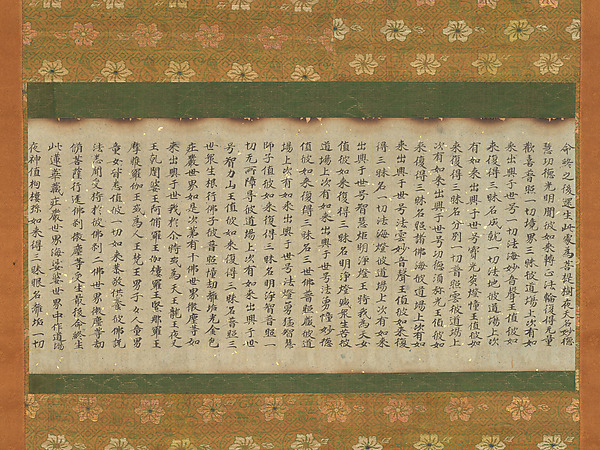
Japan, 12th century. Section of a handscroll mounted as a hanging scroll; ink on pale indigo paper decorated with flakes of gold leaf; image 24 × 51 cm.
Look closer: A later sutra copy, in black ink on pale indigo paper flecked with gold. Compare its calm brushwork with the silver of the eighth century, and look along the top edge for the scorch marks.
The Metropolitan Museum of Art, Mary and Cheney Cowles Collection, Gift of Mary and Cheney Cowles, 2024 (2024.412.1). Public domain, Open Access.

Japan, 1120. Detached page mounted as a hanging scroll; ink on mica paper; image 24 × 14 cm.
Look closer: The Met dates this page from a Tōdai-ji manuscript to 1120. It is written in flowing kana, the Japanese syllabary, rather than Chinese characters. Look at the faint ruled lines and the pale patterned paper under the writing.
The Metropolitan Museum of Art, Gift of Florence and Herbert Irving, 2015 (2015.500.9.6). Public domain, Open Access.
Nepal (Kathmandu Valley), 11th to 12th century. Gilt-copper alloy with gold paint and blue pigment.
Look closer: Look at the hands together at the chest, the wisdom-fist sign of the esoteric Vairocana.
The Metropolitan Museum of Art, Purchase, Friends of Asian Art Gifts, 1991 (1991.133). Public domain, Open Access.
In the house
The house sometimes holds Vairocana pieces. The strip below reads the live shelves, so it shows what is available now and stays hidden if nothing is.
A short dictionary of the Great Buddha
Terms are given in Japanese with the Sanskrit or Chinese root where the sources supply one.
- Birushana (毘盧遮那), Rushana (盧舎那)
- The Japanese transliteration of Vairocana; Rushana is the short form.
- Vairocana
- The Sanskrit name, “the sun”, “solar”, “shining”.
- Daibutsu (大仏)
- A Great Buddha; “the Daibutsu” of Nara is the bronze Rushana at Tōdai-ji.
- Daibutsuden (大仏殿)
- The Great Buddha Hall at Tōdai-ji.
- Kegon (華厳)
- The Japanese school of Huayan, based on the Flower Garland Sutra; Tōdai-ji is its head temple.
- Kegonkyō (華厳経)
- The Flower Garland Sutra, the Buddhāvataṃsaka.
- Bonmōkyō (梵網経)
- The Brahma Net Sutra, the Brahmajāla, which describes the thousand-petal lotus.
- Dainichikyō (大日経)
- The Mahāvairocana Sutra, a central text of Shingon.
- Dainichi (大日)
- The Great Sun, the esoteric name for the same Buddha.
- Rengezō sekai (蓮華蔵世界)
- The Lotus Treasury World, the cosmos purified by Vairocana in the Flower Garland Sutra.
- Semui-in (施無畏印)
- The gesture of reassurance: right hand raised, palm out.
- Yogan-in (与願印)
- The giving gesture: palm up, here on the left knee.
- Chiken-in (智拳印)
- The wisdom fist of the Vajra Realm Dainichi; the term is used here for the gesture Wikipedia describes.
- Rahotsu (螺髪)
- The small snail-shell curls of a Buddha’s hair.
- Kaigen (開眼)
- The eye-opening that brings a new image to life.
- Kokubunji (国分寺)
- The provincial temples ordered by Shōmu in 741.
- Kanjin (勧進)
- Solicitation of donations for a temple, as organised by Gyōki and later by Chōgen.
- Shōsōin (正倉院)
- The storehouse of Tōdai-ji, which holds the eye-opening brush.
- Yakegyō (焼経)
- The scorched fragments of the Nigatsudō sutra, valued for their burned edges.
- Nandaimon (南大門)
- The Great South Gate of Tōdai-ji, with its pair of guardian kings.
- Kokuhō (国宝)
- National Treasure; the Great Buddha was designated on 8 February 1958 (Japanese Wikipedia).
Answered plainly
Who is Birushana?
Birushana, shortened to Rushana, is the Japanese name for Vairocana, the cosmic Buddha of the Flower Garland Sutra. In Esoteric Buddhism he usually corresponds to Dainichi.
What is the Great Buddha of Nara?
A seated bronze Birushana at Tōdai-ji, about fifteen metres high. Emperor Shōmu ordered it in 743, casting finished in 749 and the eyes were opened in 752.
Is the Great Buddha still the original?
Only in part. The torso below the abdomen and the lotus petals are original eighth-century work. The head is Edo period and the hands are Momoyama, after fires in 1180 and 1567.
What is engraved on the lotus petals?
Nippon.com says the 28 petals each show Shakyamuni surrounded by 22 bodhisattvas, in the picture of the Brahma Net Sutra of a thousand worlds on a thousand petals.
What is the difference between Rushana and Dainichi?
They are the same Buddha under two names. Rushana is the Kegon form of the Flower Garland Sutra and Dainichi the Shingon and Tendai form at the centre of the mandalas.
What are the Nigatsudō Burned Sutras?
Fragments of a Flower Garland Sutra copied in silver on indigo paper in 744 for Tōdai-ji. A fire in the Nigatsudō Hall in 1667 scorched them, and the singed edges are now valued.
Why is the Great Buddha called Rushana and not Shaka?
Because the Flower Garland Sutra makes him the cosmic Buddha, of whom Shaka is one emanation. Japanese Wikipedia notes that by appearance he cannot be told from Shaka; it is the sutra and the lotus petals that identify him.
Who made the Great Buddha?
Emperor Shōmu ordered it in 743. Wikipedia credits Kuninaka-no-muraji Kimimaro with directing the work and Takechi-no-sanekuni with the sculpture. The monks Gyōki and Rōben mobilised donations and led the temple.
How many people worked on it?
Wikipedia gives 2,600,000 contributors in all, of whom 350,000 worked on the statue itself, from the temple’s records. Japanese Wikipedia repeats the 2.6 million as a cumulative figure.
Is it true the head fell off?
Yes, in the earthquake of 855, according to Japanese Wikipedia; it was repaired and a ceremony held in 861. Later fires of 1180 and 1567 destroyed more, and the present head is Edo period.
How many curls does it have?
Wikipedia says 960 and Japanese Wikipedia cites 966 from the Heian temple record. A laser survey reported in 2015 counted 492. The sources do not agree.
Where can I see a Vairocana outside Japan?
The Met’s Open Access holdings include a Chinese gilt bronze, a Nepalese gilt copper and a Javan silver figure; the Tang statue at the Dragon Gate Caves, 17.14 metres high, is the best-known large example in China.
Where next
Sources and image credits
- The Metropolitan Museum of Art, object 44909
- The Metropolitan Museum of Art, object 902211
- The Metropolitan Museum of Art, object 78166
- The Metropolitan Museum of Art, object 73200
- Wikipedia, Tōdai-ji (statue, hall, dates)
- Wikipedia, Vairocana
- Tōdai-ji official site, eighth-century history
- nippon.com, Encounters with Buddhist Art
- Japanese Architecture and Art Net Users System, Rushanabutsu
- The Metropolitan Museum of Art, Heilbrunn Timeline, Nigatsudō Burned Sutra
- Portland Art Museum, Daily Art Moment: Tōdaiji scriptorium
- The Metropolitan Museum of Art, object 38497
- The Metropolitan Museum of Art, object 44838
- Wikimedia Commons, 20190121 Tōdai-ji Great Buddha-1.jpg (Balon Greyjoy, CC0)
- Wikimedia Commons, 20190121 Tōdai-ji Great Buddha Hall-1.jpg (Balon Greyjoy, CC0)
- Wikimedia Commons, Consecration of Daibutsu & Daibutsuden (Todaiji).jpg (Artists of the Nara to Edo periods, Public domain)
- Wikimedia Commons, Hauling the rainbow beams for the Daibutsuden (Todaiji).jpg (Artists of the Nara to Edo periods, Public domain)
- Wikimedia Commons, 《金剛力士立像 阿形》東大寺南大門所在.jpg (bijutsushitan, Public domain)
- Japanese Wikipedia, 東大寺盧舎那仏像
- Japanese Wikipedia, 毘盧遮那仏
- Wikipedia, Gyōki
- Wikipedia, Rōben
- Wikipedia, Emperor Shōmu
- Wikipedia, Huayan
- Wikipedia, Avatamsaka Sutra
- Wikipedia, Brahmajāla Sūtra
- Wikipedia, Vairocanābhisaṃbodhi Sūtra
- Wikipedia, Trikāya
- Wikipedia, Kokubun-ji


Last reviewed 28 October 2026. Pictures are public-domain or openly licensed, each credited beneath it. Diagrams on this page are drawn by Japonista.
Looking for a Vairocana, a Buddha in gilt bronze or a scroll of the Flower Garland Sutra? Tell us what you have in mind and we will look.
Private concierge
Looking for something in particular?
Describe the piece or the project you have in mind. A senior advisor in Tokyo reads every case file personally and replies within two business days, with fees set out in writing before any work begins.