
Hōshō Nyorai
Buddha of the South
Hōshō Nyorai
宝生如来
The Buddha whose name means born of the jewel. He holds the south of the Diamond Realm, offers the gesture of giving, and stands for the wisdom that sees all beings as equal. His images in Japan are chiefly part of sets of five; the finest in this chapter come from the Himalayas and Java.
Identity card
Know him at a glance
- The Buddha’s head. A Buddha without a crown. Wikipedia says Ratnasambhava is usually coloured yellow or gold, though the diagram keeps the house palette.
- The halo. A plain disc behind the head. In the Met’s Javanese bronze he sits under an arch with an attendant at each side.
- The giving hand. The right hand opens downward in the mudra of giving, the sign of generosity (Wikipedia).
- The lap. The left hand rests in the lap, as in the usual seated Buddha. Wikipedia describes the jewel as the symbol of his family.
- The lotus throne. He sits on a lotus. In Tibetan lists his mount is a horse or a pair of lions (Wikipedia).
The jewel that gave birth
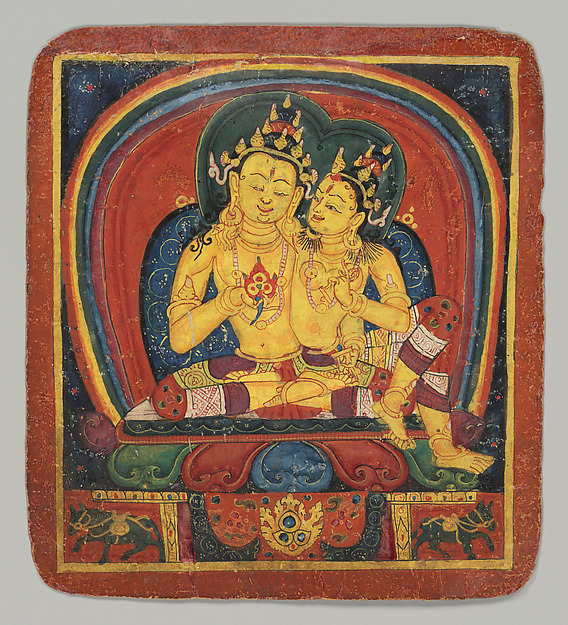
Tibet, early 15th century. Opaque watercolour on paper; 16 × 14.5 cm.
Look closer: Look at the two yellow figures seated close together and at the horses painted at either end of the throne base. The horse is the mount that Wikipedia gives for him, and the yellow of the bodies is his colour.
The Metropolitan Museum of Art, Rogers Fund, 2000 (2000.282.3). Public domain, Open Access.
Wikipedia gives the Sanskrit name Ratnasambhava as Jewel-Born, and counts him among the Five Dhyani Buddhas of Mahāyāna and Vajrayāna Buddhism. His mandalas and mantras, it says, are concerned with developing equanimity and equality and, in Vajrayāna thought, with the attempt to destroy greed and pride. The Japanese Architecture and Art Net Users System, known as JAANUS, lists him as Hōshō, the south of the Five Wisdom Buddhas of the Diamond Realm, and pairs him with the wisdom of equality. Japanese Wikipedia, which cites a standard illustrated dictionary of esoteric images by Yorizomi Motohiro and Shimoizumi Zenkyō (1994), puts the same idea in a plain sentence: this wisdom shows that every existing thing has absolute value.
Few Buddhas are so easy to place and so hard to meet. JAANUS describes the standard arrangement: Dainichi in the centre, Ashuku in the east, Hōshō in the south, Amida in the west and Fukūjōju in the north. Japanese Wikipedia says that nearly all Japanese images of Hōshō were made as one of the five, and that an image of him alone, or worship of him alone, is rare. It names one example, the principal image of a temple it writes as 藤次寺, and this chapter has not found a second source for that temple, so the example should be treated as unconfirmed. Of India it says only that, apart from a three-dimensional mandala excavated at Ratnagiri in Odisha, there are few groups that bring him together with the other four or three Buddhas.
A Buddha of jewels might suggest wealth, but the texts read for this chapter are about something else. Wikipedia connects the jewel to his family, the Ratna or Jewel family, and to the skandha of feeling; Japanese Wikipedia gives the three-petalled jewel as his esoteric symbol. The wealth that his name suggests does appear in the Tibetan tradition: Wikipedia calls Yellow Jambhala, the best known of the wealth gods of that tradition, an emanation of Ratnasambhava. None of the Japanese sources read for this chapter makes that link, so it stays on the Tibetan side of the page. In Japan he is the Buddha of the wisdom of equality, and the jewel is the sign of the family that holds it.
Yellow, giving, and a horse
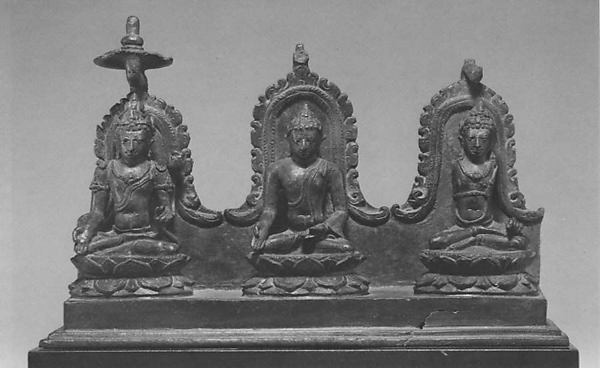
Indonesia (Java), late 9th to early 10th century. Bronze; 11.5 × 17.6 cm.
Look closer: Look at the three arched niches along the base and at the central Buddha between his two attendants. It is a Javanese bronze of the late ninth or early tenth century, the earliest image on this page.
The Metropolitan Museum of Art, Samuel Eilenberg Collection, Gift of Samuel Eilenberg, 1987 (1987.142.156). Public domain, Open Access.
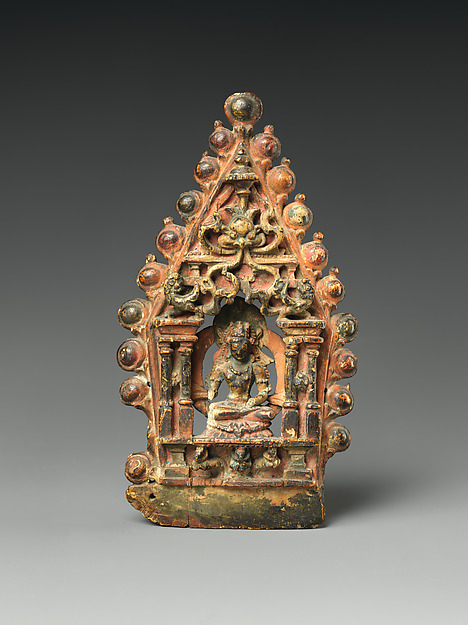
India (Jammu and Kashmir) or western Tibet, 10th to 11th century. Wood with traces of polychrome; 17.5 × 9.8 cm.
Look closer: Look at the ring of jewel-shaped bosses and at the small seated Buddha in the niche. The panel belonged to a ritual crown of the kind worn by an officiant in Tibetan rites.
The Metropolitan Museum of Art, Purchase, Lita Annenberg Hazen Charitable Trust Gift and Cynthia Hazen Polsky Gift, 1992 (1992.299). Public domain, Open Access.
Wikipedia sums up the visual signs plainly. He is usually coloured yellow or gold. He is associated with the element earth, the southern quarter and the season of spring. His mount is a horse or a pair of lions, his consort is Māmakī, and his Buddha field is called Śrīmat. The gesture is giving, the varada mudra, which Japanese sources call yogan-in or segan-in.
Japanese Wikipedia describes the hands in a Japanese idiom. The left hand grips the robe in front of the belly, and the right hand hangs down with the palm turned to the viewer in the giving gesture. The Agency for Cultural Affairs database, in its entry on a set of five Buddhas at Kongō-ji in Ōsaka, adds a useful note on the old pattern. In the iconography of the standard Diamond Realm mandala, it says, the left hand of each of the four Buddhas is held at the abdomen with the five fingers bent, and the right hand differs: Ashuku touches the ground, Hōshō gives, and Fukūjōju offers the fearless gesture. A viewer who wants to know which of three similar figures is the southern Buddha need only look at the right hand.
The Metropolitan Museum of Art holds several images that show how these signs appear in practice. A small bronze from Java, of the late ninth to early tenth century, shows Ratnasambhava flanked by two bodhisattvas: three seated figures stand each in an arched niche along a single base, and a small finial rises above the centre. A Himalayan panel of the tenth or eleventh century from Kashmir or western Tibet shows a single seated figure inside a gabled shrine fringed with round jewels; it was once part of a ritual crown. The most colourful is a Tibetan initiation card of the early fifteenth century, which shows a yellow, crowned Ratnasambhava seated close against a yellow consort beneath a rainbow arch, with a horse painted at each end of the throne base.
Japan has its own single figure for the mount. The Metropolitan Museum’s Japanese handscroll of deities of the Diamond World mandala, dated 1083, draws the animal thrones under the figures, and JAANUS says that these animals mark the Buddhas of the Diamond Realm. Wikipedia’s table of the five families gives the horse to Ratnasambhava, the elephant to Akṣobhya, the peacock to Amitābha and the garuda to Amoghasiddhi, and the lion to Vairocana.

Japan, dated 1083. Handscroll; ink and color on paper; 29.8 cm high, 541.7 cm long.
Look closer: Look beneath each figure: lions under the large central roundel, and in the others an elephant, a horse and birds. These are the animal thrones, chōjūza, that JAANUS says mark the Buddhas of the Diamond Realm, and the horse is Hōshō’s. The scroll is more than five metres long and shows only a short stretch here.
The Metropolitan Museum of Art, The Harry G. C. Packard Collection of Asian Art, Gift of Harry G. C. Packard, and Purchase, Fletcher, Rogers, Harris Brisbane Dick, and Louis V. Bell Funds, Joseph Pulitzer Bequest, and The Annenberg Fund Inc. Gift, 1975 (1975.268.3). Public domain, Open Access.
| Sign | In the record | Source |
|---|---|---|
| Direction | South | JAANUS; Wikipedia |
| Colour | Yellow or gold | Wikipedia; Cleveland Museum of Art |
| Gesture | Giving (varada, yogan-in); left hand at the belly gripping the robe | Wikipedia; Japanese Wikipedia |
| Seat | A horse (two lions in some Tibetan lists) | Wikipedia; Japanese Wikipedia |
| Esoteric symbol | Three-petalled jewel | Japanese Wikipedia |
| Wisdom | Wisdom of equality, byōdōshōchi | JAANUS |
| Family | Ratna, the Jewel family | Wikipedia; JAANUS |
Hōshō, Hōjō and the southern king
The name is written 宝生 and read Hōshō, “born of the jewel”. Onmark Productions says it can also be read Hōjō and that Hōjō is another name for Shaka, translated as “giving birth to treasure”, the treasure being the Dharma that Shaka taught in his first sermon and in every sermon after it. No other source read for this chapter says so. The statement is useful because it shows how a Japanese writer reads the jewel as the teaching, but it should be treated as the opinion of one site, and a reader should not take a figure inscribed Hōjō to be Shaka without further evidence.
The Chinese form is Bǎoshēng Rúlái, the Korean Bosaeng Yeorae, the Tibetan Rin chen ’byung gnas and the Vietnamese Bảo Sanh Như Lai (Wikipedia’s infobox). In Japan the same Buddha takes a second name in the other mandala. JAANUS lists the Womb Realm four as Hōdō (Ratnaketu) in the east, Kaifukeō (Saṃkusumitarāja) in the south, Muryōju in the west and Tenkuraion in the north, and Onmark gives the same list. In the Womb Realm, then, the southern Buddha is Kaifukeō, the King of Opened Flowers, and the Diamond Realm’s Hōshō is the southern Buddha of the other mandala, though the two are not simple equivalents. Wikipedia’s account of the Vairocanābhisaṃbodhi Sūtra says that it gives Saṃkusumitarāja and Ratnaketu in the places that Amoghasiddhi and Ratnasambhava hold in the later set. That is a different pairing from the one a Japanese temple label usually implies.
The labels on the ground show how the two systems were folded together. On the Old Tōkaidō between Okabe and Fujieda in Shizuoka Prefecture, the writer of the Temple Guy’s website found five Buddhas standing in a parking lot, and photographed the name plates above them. The southern one is labelled “Kaifuke-ō (Hōshō)”, the eastern “Hōdō (Ashuku)” and the northern “Fukujoju (Shaka)”. The plates pair the Womb Realm names with the Diamond Realm names and, in the last case, with Shaka. A visitor who reads a plate like this is looking at a convention, not a contradiction: the southern Buddha is Hōshō in one mandala and Kaifukeō in the other.
The same ambiguity runs back to the earliest set of four. JAANUS says the oldest group of four Buddhas of the four directions, in the Golden Light Sutra of about the fourth century, is Ashuku in the east, Hōshō in the south, Muryōju or Amida in the west and Tenkuon in the north. Wikipedia’s article on the Five Tathāgatas, describing the same sutra and dating it to about the fifth century, names the southern Buddha Ratnaketu and the northern Dundubhisvara. The sources read do not say whether the Japanese Hōshō of the Golden Light is the Sanskrit Ratnaketu under another rendering, and this chapter does not decide the question.
The wisdom of equality
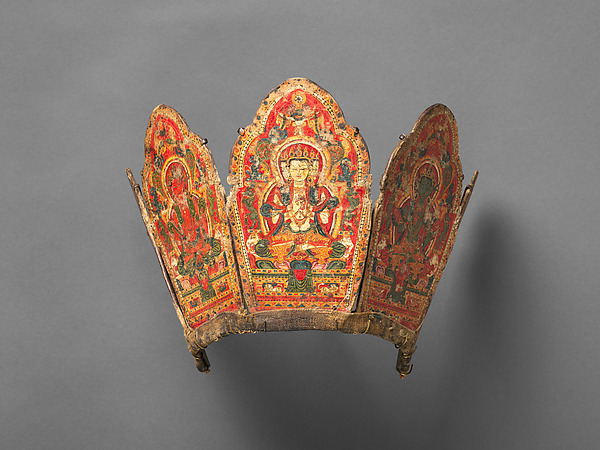
Tibet, late 14th to early 15th century. Opaque watercolour and gold on board.
Look closer: Look at the five painted panels, each with its own seated Buddha: the crown is worn by the officiant so that the five wisdoms sit on his head. JAANUS describes the Japanese counterpart, the five-wisdom crown, as the headgear of the initiate who is to attain a state equal to Vairocana.
The Metropolitan Museum of Art, Gift of Jeffrey Kossak, The Kronos Collections, 1985 (1985.391). Public domain, Open Access.

Japan, Kamakura period, 12th century; attributed to Chūkai (1160–1227). Painting, Nezu Museum.
Look closer: Look at the cross of five roundels at the centre: Dainichi’s in the middle and one for each of the other four Buddhas. Every roundel is crowded with small seated deities, the 81 that the title counts. The corner motifs are flowers and leaves, and the border carries further figures.
忠快[Chukai] (1160-1227), “Diamond Realm Mandala of 81 Deities (Kongōkai hachijūisson mandara)”, Wikimedia Commons, Public domain. Source: commons.wikimedia.org (file page listed in the sources below).
JAANUS explains why the five are called wisdom Buddhas. The Diamond Realm mandala is associated in Japan with wisdom, in contrast with the Womb Realm, which is associated with principle, and each of its five Buddhas matches one of the five wisdoms. Hōshō in the south is paired with byōdōshōchi, the wisdom of equality, which in Sanskrit is samatā-jñāna.
Wikipedia’s article on the five wisdoms gives the doctrine behind the name. Samatā-jñāna is the awareness of sameness, which perceives the commonality of phenomena. It is a transformation of the seventh consciousness, the klistamanas, the afflicted mind that clings to a self; through this wisdom a Buddha sees beyond superficial differences and perceives the fundamental emptiness of all things, and the undifferentiation gives rise to equality for all beings. JAANUS adds that the five wisdoms are a development of the four posited by the Yogācāra school, with the fifth, that of Dainichi, evolving within Esoteric Buddhism to embrace the other four. The same article quotes the Hevajra Tantra’s list of the bone ornaments, which gives the necklace to Ratnasambhava and the wisdom of total sameness.
In the five-family scheme each Buddha turns one of the afflictions into a wisdom. Wikipedia’s table gives Ratnasambhava’s as pride, or greed in some lists, and the aggregate of feeling; Onmark’s page says Hōshō converts pride and greed into the wisdom of equanimity, the essential similarity of all living creatures, and JAANUS’s entry on the Gochidō at Chōgaku-ji says the Buddha of the south “in his wisdom sees the ultimate equality of all living creatures”. The sources agree on the idea. It is worth remembering that the Buddha who is placed beside the jewel is the one whose gift is to remove the sense of rank.
The set of five carries weight in practice. JAANUS says the five Buddhas appear on the five-wisdom jewelled crown seen on Dainichi, Vajrasattva, Miroku and certain other bodhisattvas, that the crown is placed on the head of the initiate at the Shingon rite conferring the rank of master, and that the headgear worn by practitioners of Shugendō is also identified with it. In each case the wearer is to realise the five wisdoms and attain a state equal to that of Vairocana.
Where is south on the page? The mandala is drawn on a flat surface, and the sources do not agree on which side the south falls. Japanese Wikipedia says that in the Diamond Realm mandala Hōshō sits to the south of Dainichi, which on the picture is to Dainichi’s left. The caption to the Tōji mandala detail on Onmark’s page puts north at the top and south at the bottom, with west at the left and east at the right, the layout of a modern map. Both cannot be a rule for the same picture. A viewer in front of a painted mandala should look for the seed syllables or the animal thrones, the horse under the southern Buddha, instead of trusting a compass.
JAANUS describes the Diamond Realm in its entry on the mandala. It is centred on Dainichi making the wisdom-fist mudra and is built from the five wisdom Buddhas, sixteen great bodhisattvas, four pāramitā bodhisattvas, eight offering bodhisattvas and four guardian bodhisattvas, 37 deities in all, divided into five families of which the Jewel family is Hōshō’s. The standard form in Shingon, brought by Kūkai, arranges eight further mandalas about the great one in the nine-assembly form. JAANUS also records a version of 81 deities brought by Ennin, which was used in the Tendai school as one of its pair of mandalas but never widely. The Nezu Museum’s Kamakura-period painting shown here is of that 81-deity kind.

Manuscript from Vikramashila Monastery, Bihar, with paintings made in Kathmandu, Nepal; dated Sunday, 14 September 1119 (Newar Samvat 239). Gum tempera, colours and paper on wood; cover 57 cm long.
Look closer: Look at the left end of the strip: the museum says Ratnasambhava is gold, with the gift-giving mudra, and faces south, at the end of the row; the white Vairochana is in the centre, blue Akshobhya and red Amitabha lie on either side of him, and green Amoghasiddhi is at the other end. The cover belongs to a copy of the Perfection of Wisdom in Eight Thousand Lines, dated 1119.
Cleveland Museum of Art, Purchase from the J. H. Wade Fund (1938.301.b). CC0, Open Access.
Where the southern Buddha first appears
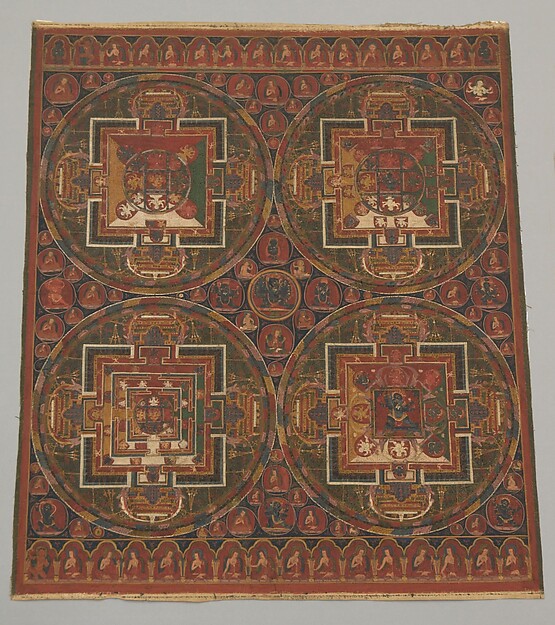
Tibet, 16th century. Distemper and ink on cloth.
Look closer: Look at the four great circles, each with a palace at its centre and rows of tiny deities round it. Wikipedia names the Guhyasamāja Tantra among the first texts to mention Ratnasambhava, and this Tibetan cloth of the sixteenth century shows four mandalas of that cycle.
The Metropolitan Museum of Art, Gift of Doris Rubin, in memory of Harry Rubin, 1989 (1989.236.8). Public domain, Open Access.
Wikipedia says the first documented mention of Ratnasambhava is found in the Suvarṇaprabhāsa Sūtra and in the Guhyasamāja Tantra, which it dates to the fourth century CE, and that he then appears in a number of Vajrayāna texts. The most elaborate account of him, it adds, is in the Pañcākāra section of the Advayavajrasaṃgraha. That sentence sits uneasily beside the article on the Five Tathāgatas, which says that the Sutra of Golden Light has a southern Buddha named Ratnaketu and that the now-standard five appear first in the Compendium of Principles, of the late seventh century. Both are in the same encyclopedia, and a reader should not take the fourth-century date as established. It is a disagreement worth recording and not one this chapter can settle.
The Śūraṅgama mantra gives him a role of command. Wikipedia says that in this dhāraṇī, much recited in the Chinese Chan tradition, Ratnasambhava is named as the host of the Jewel-creating Division in the south, one of five great divisions controlling the demon armies of the five directions. He thus keeps the same compass position in a text from outside the Diamond Realm tradition.
He is also named in a scripture that Japanese readers know well. Wikipedia says that in chapter nine of the Kṣitigarbha Bodhisattva Pūrvapraṇidhāna Sūtra, the scripture of the bodhisattva known in Japan as Jizō, the Buddha of that name is one of those worthy of praise, and that anyone who hears his name and shows respect will soon attain the stage of an arhat. The sources read do not say whether the Buddha of that chapter is the same figure as the tantric one.
In the Tibetan Bardo Thodol, Wikipedia says, he is depicted in union with Māmakī and attended by the male bodhisattvas Ākāśagarbha and Samantabhadra, whom Japan knows as Kokūzō and Fugen, and by the female bodhisattvas Mālā and Dhūpā. The attendants are one more place where lists differ. Wikipedia’s table of the five families gives Mañjuśrī and Ratnapāṇi as his bodhisattvas; the table on Onmark’s page gives Ratnapāṇi; the dictionary quoted by Onmark lists Samantabhadra among his three forms. A Japanese temple that carved a Hōshō with attendants would have followed whichever list its teachers used.
Gundari, the king of the south
Each of the five has a fierce form, a Wisdom King that carries the same wisdom in a wrathful body. Japanese Wikipedia says Gundari Myōō is the wrathful form, kyōryōrinjin, of Hōshō and that among the Five Great Wisdom Kings he is placed in the south. Wikipedia’s article on Ratnasambhava and its table of the five families give the same: his wrathful manifestation is Kuṇḍali. Onmark’s table agrees and gives the Japanese name Gundari.
The Soothill and Hodous dictionary, quoted at the same Onmark page, reverses the pairing of this king with Ashuku’s: it assigns Kuṇḍalī to Akṣobhya and Trailokyavijaya to Ratnasambhava. Three sources therefore put Gundari with Hōshō and one puts him with Ashuku. The Ashuku chapter records the same disagreement from the other side.
Japanese Wikipedia describes the king as one-faced and eight-armed, with three eyes and a coiled snake about the body, two of the arms making the three-pronged vajra seal and the others holding weapons and an axe. He is said to quell obstacles, and in the Esoteric reading to subdue Vināyaka, bringer of plague. In the three-family mandalas of the Diamond Realm he appears as three bodhisattvas, of which the Amṛta Kuṇḍalin corresponds to the Wisdom King; the name means the one with the nectar of immortality, kuṇḍalin being a water-pot or a coiled snake. The article dates the king’s emergence early, noting that the Dhāraṇī-jikkyō of the seventh century already names a Vajra Amṛta Kuṇḍalī Bodhisattva alongside the messenger of Fudō.
The same article records a scholar’s suggestion that the Sanskrit name Kuṇḍalī belongs to a Hindu goddess, a kind of yakṣa and an expression of śakti, and that the figure changed sex on the road through China to become a male king in Japan. It attributes this to the independent Indologist Itō Takeshi, and it is a hypothesis, not an agreed history. The Wisdom Kings have their own chapter, the Wisdom Kings of this almanac, and a reader who wants the fierce form of the southern Buddha should begin there.
Five, never one: the surviving sets
Because Hōshō is rarely made alone, his Japanese history is the history of the sets. JAANUS lists the oldest: the five at Anshō-ji in Kyoto, of the ninth century and at present on view at the Kyoto National Museum; those at Henmyō-in in Okayama, also of the ninth century; at Kongōzanmai-in on Mount Kōya, of the thirteenth century; and at Tōji in Kyoto, which it dates to the sixteenth. The Kyoto National Museum says of the Anshō-ji five that they were designated National Treasures in 2019 and are the oldest extant complete statuary set of the iconography. Its own exhibition list of 2007 shows them then as an Important Cultural Property, so the 2019 designation was a promotion within the register of cultural properties.
The Agency for Cultural Affairs database describes another set, at the Gobutsu-dō of Amano-san Kongō-ji in Ōsaka Prefecture: five Heian-period statues designated Important Cultural Properties on 7 June 2005, with Dainichi at the centre and Ashuku, Hōshō, Amida and Fukūjōju at the four quarters. The four are identified by the seed syllables on the tops of their haloes. The entry says the Anshō-ji set follows the old iconography of the standard mandala, with the right shoulder bare and the left hand held at the belly, and that the Kongō-ji set shows a newer manner: the four Buddhas wear the robe baring the right shoulder and are made with the left hand in the fearless gesture and the right in giving as their basic pattern. It adds that Ashuku and Hōshō sit with the left foot outside, in front of the altar, and Fukūjōju and Amida sit behind them with the right foot outside.
The entry makes a remark of particular interest to anyone who handles images. Hōshō and Fukūjōju at Kongō-ji, it says, have heads and bodies carved of separate materials, and a recent repair found that the bodies of the two appear to have been exchanged. The statues have never been dismantled for repair, and from the state of the joins the present arrangement is judged to be the original specification. In plain words, the two southern and northern Buddhas of the set have each other’s torsos, and the Agency concludes that this is how they were made. The database dates the work to about 1180, by comparison with a Dainichi in a pagoda of the same period, and calls the set a well-preserved example in which even the ornaments of the haloes and thrones survive.
At Tōji the hall itself is the set. A text prepared by the temple and published by the Japan Tourism Agency says that the 21 statues in the Lecture Hall form a three-dimensional mandala, that 15 of them were made in the early ninth century and installed in 839 according to tradition, and that the other six replaced losses after the hall was rebuilt in 1491. At the centre of the dais stand the Five Great Buddhas. The text does not say which are the originals, so this chapter does not say whether the Tōji Hōshō is ninth-century or later; JAANUS’s sixteenth-century date for the set is another figure to hold beside it.
A set of a different kind lies in Miyazaki Prefecture. Japanese Wikipedia’s entry on the site of Hyūga Kokubun-ji in Saito says the temple, founded under Emperor Shōmu’s edict for provincial temples, had as its principal image a Gochi Nyorai set, and that in 1788 the wandering monk and sculptor Mokujiki visited it. The temple was in decline; the local people asked him to stay, and he became its abbot. After a fire in 1791 he rebuilt the halls and carved the five Buddhas, and he left in 1797. The temple was abandoned in 1871 in the persecution of Buddhism that followed the Meiji restoration, but the five statues were protected by local worshippers; they are now a prefectural cultural property, kept in a hall called the Mokujiki Gochi-kan. The page does not state the year of the carving, and this chapter gives only the span the text allows, between the fire of 1791 and the departure of 1797.
The sculptor was an unusual figure. Japanese Wikipedia says Mokujiki lived from 1718 to 1810 and was a wandering ascetic, sculptor and poet, who belonged to no temple or sect and carved single-block figures wherever he stopped. His manner was unlike traditional Buddhist sculpture, with the chisel marks left raw, and his faces are often gentle and smiling. The article counts four years on Sado island and seven in Hyūga as his longest stays. He returned to his native village of Maruhata in Yamanashi, where in December 1800 he carved another Gochi Nyorai for the Eijuan. His statues were rediscovered in 1924 by the critic Yanagi Sōetsu, who led the folk-craft movement.
Smaller sets turn up in unexpected places. JAANUS’s entry on the Gochi-dō at Chōgaku-ji in Nara describes a very small building of the Kamakura period, one bay square, with a great central pillar to which four framed inscriptions are attached in Sanskrit letters: Dainichi is the pillar itself and the four Buddhas are the inscriptions. It is, JAANUS says, a unique architectural three-dimensional mandala, and its original use is not known. JAANUS’s general entry on the Gobutsu-dō adds that the four Buddhas around Dainichi may be sculptures, paintings or simply their names written in Sanskrit letters.

Japan, Miyazaki Prefecture, Saito; carved by Mokujiki between 1791 and 1797. Photograph by Saigen Jiro, 24 August 2013.
Look closer: Look at the five figures as a group: they sit in a single row, with rounded faces and plain robes, carved as a set. Mokujiki’s Buddhas are generally gentle, and Japanese Wikipedia links his “smiling Buddha” manner to his late work in Yamanashi, which came after these were made. The photograph was taken inside the Mokujiki Gochi-kan.
Saigen Jiro, “Gochi Nyorai, Hyūga Kokubun-ji (Mokujiki Gochi-kan)”, Wikimedia Commons, Public domain. Source: commons.wikimedia.org (file page listed in the sources below).
Telling Hōshō from his neighbours
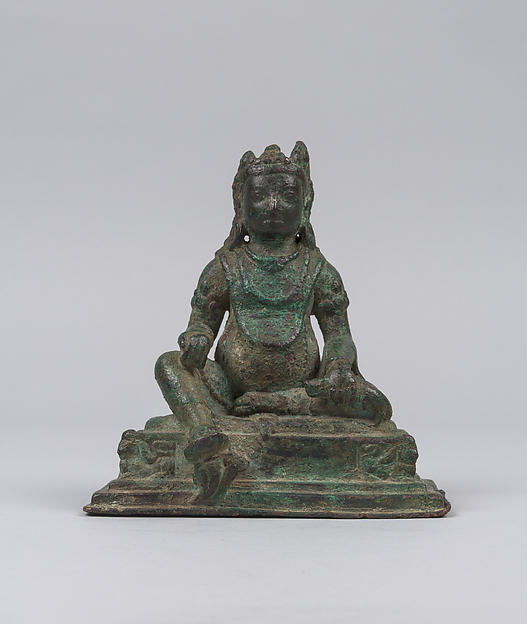
Nepal, Kathmandu Valley, 10th century. Bronze.
Look closer: Look at the stout body and the crown, and at the pendant leg on the stepped base: this is the wealth god Jambhala, who in Tibet is counted in the Jewel family and sometimes in the retinue of Ratnasambhava. It is a useful figure to know before attributing a seated bronze to the Buddha himself.
The Metropolitan Museum of Art, Samuel Eilenberg Collection, Gift of Samuel Eilenberg, 1987 (1987.142.320). Public domain, Open Access.
A collector meets Hōshō in three settings: as one of a set of five, as a single Himalayan or Javanese bronze, and as a painted scroll or card in which he is one figure among many. The first is the commonest in Japan and the one where care matters most.
First, the hand. In a set of five seated Buddhas of the Diamond Realm, the right hand tells them apart: the earth-touching hand is Ashuku, the giving hand is Hōshō, the fearless hand is Fukūjōju, and Amida holds the meditation gesture in the lap. The Agency for Cultural Affairs entry on Kongō-ji says so for the old pattern, and it also shows that a later set may use a different arrangement of the hands, so the rule is a starting point and not a law. Wikipedia’s table of the five families gives the same three gestures for the three Buddhas.
Second, the colour and the seat. Yellow or gold for Hōshō and green for Fukūjōju are the usual colours in Tibetan and Newar painting, and the horse and the garuda are their animal thrones. In a Japanese wooden figure the paint is often lost, and what remains is the gesture and the seed syllable on the halo. At Kongō-ji the four Buddhas are identified from the seed syllables on the top of the halo, a reminder that an inscription is worth more than a pose. If the halo is lost, so is the evidence.
Third, the set. JAANUS’s entry on the Gochi nyorai describes the Japanese sets as groups, and the Agency’s entry on Kongō-ji shows that even a famous set can have exchanged parts. A single Japanese figure offered as Hōshō should therefore be asked three questions: where are the other four, who made the set, and do the head and body belong together. Heads and bodies carved of separate pieces, as at Kongō-ji, may have been joined in the workshop or afterwards, and the record does not always say which. A figure made to stand in a set and now parted from it is still worth having, but its value lies in the set it came from.
Fourth, the wealth gods. Wikipedia says that in Tibet Vaiśravaṇa, known also as Jambhala and Kubera, is considered a worldly protector and is often depicted among the retinue of Ratnasambhava. A small seated bronze with a heavy body and a jewel in the hand may be Jambhala and not a Buddha, and the Met’s Nepalese bronze of the tenth century, shown here, is catalogued under that name. In Japan the corresponding figure is Bishamonten, who has his own chapter; the sources read for this chapter do not connect him to Hōshō.
The house keeps no Hōshō at present, and a private request is the right route for anyone who wants one found. The concierge can discuss condition, boxes and provenance with anyone who writes.
Where the southern Buddha stands now
The living tradition is quiet. In Japan Hōshō is a figure of the Shingon and Tendai mandalas and of the sets of five in their halls; the newest fact in the public record is the elevation of the Anshō-ji five to National Treasures in 2019, the year in which the Kyoto National Museum showed them in Kyoto’s gallery of Buddhist and Shinto images. The Tōji text on the Lecture Hall, prepared in the same year and placed in the Japan Tourism Agency’s database, is the other recent statement of how his hall is read.
In Miyazaki the five by Mokujiki are kept in their own gallery, and they are the best-known set outside the great temples; the Japanese Wikipedia entry says the temple hall was rebuilt, collapsed not long after the war, was rebuilt again, and was demolished when the Mokujiki Gochi-kan was built, so the statues now sit in a purpose-made hall. Visitors should confirm opening times with the local authority before travelling, since the sources read do not give them.
In scholarship the largest question remains the one in the fact boxes above: how the Golden Light’s southern Buddha, the Hōshō of the earliest Japanese lists and the Ratnasambhava of the tantras are related. English Wikipedia reports Tanaka Kimiaki’s argument that the four-Buddha scheme of the sutras, joined to the Vairocana of the Avatamsaka Sutra, developed into the later set of five; it does not settle how the names correspond.
The practical point for a visitor is that Hōshō is best found in company. The museum images read for this chapter are in the Metropolitan Museum and the Cleveland Museum of Art; the Japanese sets are in Kyoto, Mount Kōya, Okayama, Ōsaka and Miyazaki, and each is more rewarding when seen as a whole.
Small facts worth the detour
- His name means Jewel-Born, and the sign of his family is the jewel (Wikipedia).
- JAANUS pairs him with samatā-jñāna, the wisdom of equality, which Wikipedia describes as a transformation of the seventh consciousness.
- Japanese Wikipedia says images of Hōshō alone are rare in Japan; almost all were made as one of five.
- The Agency for Cultural Affairs notes that at Kongō-ji in Ōsaka the bodies of Hōshō and Fukūjōju appear to have been exchanged, and that the present arrangement is judged original.
- A set of five Buddhas on the Old Tōkaidō in Shizuoka labels the southern Buddha “Kaifuke-ō (Hōshō)” (the Temple Guy).
- The Anshō-ji five were named National Treasures in 2019 as the oldest complete set of the iconography (Kyoto National Museum).
- The wandering sculptor Mokujiki, who lived from 1718 to 1810, carved five Wisdom Buddhas at Hyūga Kokubun-ji after a fire in 1791 (Japanese Wikipedia).
- A Kamakura-period hall at Chōgaku-ji in Nara is a Gochi-dō in which the Buddhas are four Sanskrit inscriptions on a pillar (JAANUS).
- Wikipedia counts Yellow Jambhala, a wealth god, as an emanation of Ratnasambhava.
- A Buddha of the same name is praised in chapter nine of the Jizō sutra (Wikipedia).
Names across the Buddhist world
Wikipedia’s infobox gives the forms of the name. The museum records and the Japanese sources add where the images have been found.
| Where | Form and name | What the record shows |
|---|---|---|
| India | Ratnasambhava (रत्नसम्भव) | Sanskrit, Jewel-Born. |
| China | Bǎoshēng Rúlái (寶生如來) | The same Buddha in Chinese. |
| Japan | Hōshō Nyorai (宝生如来) | Śrīmat is his Buddha field in the south (Wikipedia). In Japan he is Hōshō Nyorai, the southern Buddha of the Five Wisdom Buddhas. |
| Korea | Bosaeng Yeorae (보생여래) | The Korean reading. |
| Tibet | Rin chen ’byung gnas | The Tibetan form, in Wylie transliteration. |
| Vietnam | Bảo Sanh Như Lai | The Vietnamese form. |
| Indonesia (Java) | Bronze triad, 9th to 10th century | The Met’s Ratnasambhava flanked by two bodhisattvas, each in an arched niche. |
| Kashmir or western Tibet | Ritual crown panel, 10th to 11th century | A carved wooden panel with a jewelled gable framing the seated Buddha. |
| Tibet | Initiation card and painted mandalas | The Met’s card of the early 15th century with its horses, and a 16th-century cloth of four Guhyasamāja mandalas. |
| Bihar and Nepal | Manuscript cover, dated 1119 | Cleveland’s cover from Vikramashila painted in Kathmandu shows a gold, gift-giving Ratnasambhava at the end of the row. |
| Odisha, India | Ratnagiri, three-dimensional mandala | Japanese Wikipedia names the Ratnagiri mandala as the one Indian group that brings him together with the other Buddhas. |
| Japan | Sets of five | Anshō-ji, Henmyō-in, Kongōzanmai-in, Tōji, Kongō-ji and the Mokujiki set at Hyūga Kokubun-ji. |
| Tibet | Wealth deity | Wikipedia counts Yellow Jambhala as an emanation of Ratnasambhava and places Vaiśravaṇa in his retinue. |
The Buddha of the south
Hōshō belongs to the five of the Diamond Realm. The table sets him among them.
| Position | Buddha | Wisdom |
|---|---|---|
| Centre | Dainichi | The Dharma realm |
| East | Ashuku | Great perfect mirror |
| South | Hōshō | Equality |
| West | Amida | Wondrous observation |
| North | Fukūjōju | Accomplishing action |
Where to see him
| Place | What to look for |
|---|---|
| Metropolitan Museum of Art, New York | The Javanese bronze, the Himalayan crown panel and the Tibetan initiation card, all in Open Access. |
| Kyoto National Museum | JAANUS says the ninth-century set from Anjō-ji is at present on view there; check the museum before travelling. |
| Mount Kōya and Tōji | JAANUS lists sets of the five Buddhas at Kongōzanmai-in and at Tōji. |
| Cleveland Museum of Art | A gift-giving, gold Ratnasambhava on the cover of a manuscript dated 1119, in Open Access. |
| Kyoto National Museum | The Five Wisdom Buddhas of Anshō-ji, a National Treasure since 2019, shown in that year; check the current display. |
| Tōji, Kyoto | The Lecture Hall, Kōdō, with 21 statues forming a three-dimensional mandala and the Five Great Buddhas at the centre of the dais; the present hall dates from 1491. |
| Amano-san Kongō-ji, Ōsaka | The Gobutsu-dō, with five Heian statues of about 1180 that are Important Cultural Properties; confirm access with the temple. |
| Mokujiki Gochi-kan, Saito, Miyazaki | Five statues carved by Mokujiki at Hyūga Kokubun-ji, a prefectural cultural property; confirm opening times locally. |
| Chōgaku-ji Gochi-dō, Nara | A tiny Kamakura-period hall in which the four Buddhas are inscriptions on a pillar (JAANUS). |
Jewel-Born in bronze, wood and pigment
Tibet, early 15th century. Opaque watercolour on paper; 16 × 14.5 cm.
Look closer: Look at the two yellow figures, and at the horses painted at either end of the base.
The Metropolitan Museum of Art, Rogers Fund, 2000 (2000.282.3). Public domain, Open Access.
Indonesia (Java), late 9th to early 10th century. Bronze; 11.5 × 17.6 cm.
Look closer: Look at the three arched niches along the base and at the central Buddha between his two attendants.
The Metropolitan Museum of Art, Samuel Eilenberg Collection, Gift of Samuel Eilenberg, 1987 (1987.142.156). Public domain, Open Access.
India (Jammu and Kashmir) or western Tibet, 10th to 11th century. Wood with traces of polychrome; 17.5 × 9.8 cm.
Look closer: Look at the ring of jewel-shaped bosses and at the small seated Buddha in the niche.
The Metropolitan Museum of Art, Purchase, Lita Annenberg Hazen Charitable Trust Gift and Cynthia Hazen Polsky Gift, 1992 (1992.299). Public domain, Open Access.
In the house
Pieces of Hōshō appear on the shelves from time to time. The strip below reads the live shelves and appears only when one is in the house.
A short dictionary of the Jewel-Born
Terms are given in Japanese with the Sanskrit or Chinese root where the sources supply one.
- Hōshō Nyorai (宝生如来)
- The Japanese form of Ratnasambhava, the Buddha of the south among the Five Wisdom Buddhas.
- Ratnasambhava
- The Sanskrit name: Jewel-Born.
- Hōjō (宝生)
- An alternative reading of the same characters; Onmark says it is also a name of Shaka (single source).
- Gochi Nyorai (五智如来)
- The Five Wisdom Buddhas of the Diamond Realm.
- Kongōkai (金剛界)
- The Diamond Realm mandala, in which Hōshō holds the south.
- Taizōkai (胎蔵界)
- The Womb Realm mandala; its southern Buddha is Kaifukeō.
- Kaifukeō (開敷華王)
- The King of Opened Flowers, the southern Buddha of the Womb Realm (Saṃkusumitarāja).
- Byōdōshōchi (平等性智)
- The wisdom of equality, Hōshō’s wisdom (samatā-jñāna).
- Yogan-in (与願印)
- The wish-granting or giving gesture, the right hand lowered with the palm out.
- Sanmayagyō (三昧耶形)
- The esoteric symbol; for Hōshō, a three-petalled jewel.
- Shuji (種子)
- The seed syllable; Japanese Wikipedia gives trāḥ for Hōshō.
- Chōjūza (鳥獣座)
- The animal throne; Hōshō’s is the horse.
- Gundari Myōō (軍荼利明王)
- The Wisdom King Kuṇḍalī, the fierce form of Hōshō in most sources.
- Kyōryōrinjin (教令輪身)
- The wrathful body in which a Buddha teaches by command.
- Gochi hōkan (五智宝冠)
- The five-wisdom crown, worn at initiation.
- Gobutsu-dō (五仏堂)
- A hall of the five Buddhas, with Dainichi at the centre and the four Buddhas around him.
- Gochi-dō (五智堂)
- A hall of the five wisdoms; the Kamakura-period example at Chōgaku-ji holds Sanskrit inscriptions.
- Mokujiki (木喰)
- A wandering sculptor of 1718 to 1810, who carved a Gochi Nyorai set at Hyūga Kokubun-ji.
- Jūyō bunkazai (重要文化財)
- Important Cultural Property, the register that includes the Kongō-ji and (until 2019) the Anshō-ji sets.
Answered plainly
Who is Hōshō Nyorai?
Hōshō is the Japanese form of Ratnasambhava, the Jewel-Born. He is the Buddha of the south among the Five Wisdom Buddhas of the Diamond Realm.
What does the wisdom of equality mean?
JAANUS pairs Hōshō with the wisdom of equality, byōdōshōchi, one of the five wisdoms of the Diamond Realm.
How can I recognise him?
Wikipedia says he is usually yellow or gold and makes the gesture of giving. His mount is a horse or two lions.
Who are his attendants in Tibetan sources?
Wikipedia, in its article on Ratnasambhava, says the Bardo Thodol gives the male bodhisattvas Ākāśagarbha and Samantabhadra and the female Mālā and Dhūpā. Other lists differ.
Are there independent Japanese statues of him?
This chapter did not find one in the sources read. JAANUS lists Japanese sets of the five Buddhas, and the images on this page come mainly from the Met.
What is the Five Wisdom crown?
JAANUS says it carries the five Buddhas on its panels and is worn by Dainichi and certain bodhisattvas, and placed on the head of an initiate at the Shingon master rite.
What does the name Hōshō mean?
It is written 宝生 and means born of the jewel. It translates the Sanskrit Ratnasambhava, the Jewel-Born, and the jewel is the sign of his family.
Is Hōshō the same as Shaka?
Onmark Productions says the reading Hōjō is another name of Shaka, but no other source read says so. JAANUS, Wikipedia and the Agency for Cultural Affairs all treat Hōshō as the southern Buddha of the Diamond Realm.
What is Hōshō’s fierce form?
Gundari Myōō, the Wisdom King Kuṇḍalī, according to Wikipedia, Japanese Wikipedia and Onmark. The Soothill and Hodous dictionary reverses it with Ashuku’s.
How do I tell Hōshō from Ashuku and Fukūjōju in a set?
Look at the right hand: the giving hand is Hōshō, the earth-touching hand is Ashuku and the fearless hand is Fukūjōju. Yellow, blue and green are the usual colours, but a mandala or a repainted figure can differ.
Where can I see a set of five in Japan?
The Kyoto National Museum showed the Anshō-ji set in 2019; Tōji has the Lecture Hall mandala; Amano-san Kongō-ji in Ōsaka has a Heian set of about 1180; and Mokujiki’s five are in Miyazaki. Confirm access before travelling.
Is Hōshō a god of wealth?
Not in the Japanese sources read. The jewel is the sign of his family and the wisdom he holds is equality. In Tibet, Wikipedia says, the wealth god Yellow Jambhala is an emanation of Ratnasambhava.
Where next
Sources and image credits
- The Metropolitan Museum of Art, object 39035
- The Metropolitan Museum of Art, object 38581
- The Metropolitan Museum of Art, object 61707
- Wikipedia, Ratnasambhava
- Japanese Architecture and Art Net Users System, Gochi Nyorai
- Cleveland Museum of Art, The Five Cosmic Buddhas, top cover of a manuscript (1938.301.b)
- The Metropolitan Museum of Art, object 44845
- The Metropolitan Museum of Art, object 37789
- The Metropolitan Museum of Art, object 37814
- The Metropolitan Museum of Art, object 39117
- Wikimedia Commons, Kongokai 81son mandala.jpg (忠快[Chukai] (1160-1227), Public domain)
- Wikimedia Commons, 日向国分寺 五智如来坐像.JPG (Saigen Jiro, Public domain)
- Wikipedia, Five Tathāgatas
- Wikipedia, Five wisdoms
- Wikipedia, Jambhala
- Japanese Wikipedia, 宝生如来
- Japanese Wikipedia, 軍荼利明王
- Japanese Wikipedia, 日向国分寺跡
- Japanese Wikipedia, 木喰
- Agency for Cultural Affairs, Cultural Heritage Online: 木造五智如来坐像 (Kongō-ji Gobutsu-dō)
- Japanese Architecture and Art Net Users System, Kongōkai mandara
- Japanese Architecture and Art Net Users System, Shibutsu (Four Buddhas)
- Japanese Architecture and Art Net Users System, Gobutsudō
- Japanese Architecture and Art Net Users System, Gochidō
- Onmark Productions, Godai Nyorai (the Five Wisdom Buddhas)
- Tōji, Lecture Hall (Kōdō)
- Japan Tourism Agency multilingual database, Inside the Lecture Hall: A Three-dimensional Mandala
- Kyoto National Museum, Buddhist and Shinto Images of Kyoto (2019)
- National Art Center, Tokyo, Art Commons: Kyoto National Museum, Buddhist Sculpture of the Heian Period (2007)
- The Temple Guy, Words-and-Pictures: The Buddhas of the Five Directions


Last reviewed 28 October 2026. Pictures are public-domain or openly licensed, each credited beneath it. Diagrams on this page are drawn by Japonista.
Looking for a Hōshō, a Five Wisdom Buddhas set or a small altar piece? Tell us what you have in mind and we will look.
Private concierge
Looking for something in particular?
Describe the piece or the project you have in mind. A senior advisor in Tokyo reads every case file personally and replies within two business days, with fees set out in writing before any work begins.