
Fudō Myōō
Wisdom King of Esoteric Buddhism
Fudō Myōō
不動明王
The Immovable One: a fierce, flame-haloed guardian who holds a sword and a rope, rests on solid rock, and has been carved, painted, chanted to and put on the stage in Japan for more than a thousand years.
Identity card
Know the figure at a glance
- Flame halo. A blaze that Wikipedia says takes the form of the Garuda bird, burning away obstacles and delusion.
- The face. Hair braided to hang on the left, eyes that do not match, and fangs that point up and down.
- The sword. Held upright in the right hand, it cuts through ignorance (Met).
- The rope. Held in the left hand, it restrains those who block the path to awakening (Met).
- The rock seat. Immovable by name, he rests on stone, or stands firm upon it.
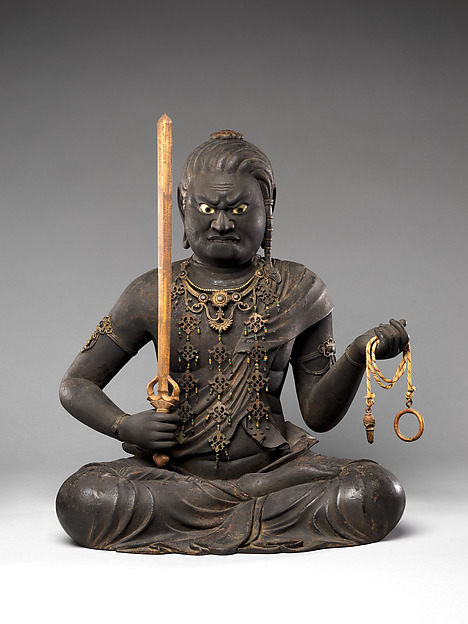
Workshop of Kaikei, Japan, early 13th century. Japanese cypress with lacquer, color, gold, cut gold leaf (kirikane) and inlaid crystal eyes; H. 53.3 cm. Metropolitan Museum of Art, 2015.300.252a-b.
Look closer: Note the sword in the right hand and the rope in the left, and the crystal eyes set into the face so that they catch the light of a dim hall.
The Metropolitan Museum of Art, Mary Griggs Burke Collection, Gift of the Mary and Jackson Burke Foundation, 2015. Open Access.
A king who does not move
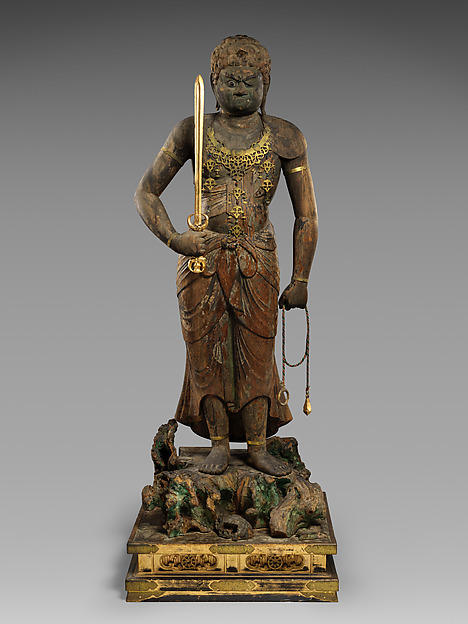
Japan, 12th century. Wood with lacquer, gold leaf and color; joined-woodblock construction (yosegi-zukuri); H. 162 cm. Metropolitan Museum of Art, 1975.268.163.
Look closer: Note the heavy shoulders resting on stiffened legs, which the Museum reads as fitting a deity whose name means The Immovable One.
The Metropolitan Museum of Art, The Harry G. C. Packard Collection of Asian Art, Gift of Harry G. C. Packard, and Purchase, Fletcher, Rogers, Harris Brisbane Dick, and Louis V. Bell Funds, Joseph Pulitzer Bequest, and The Annenberg Fund Inc. Gift, 1975. Open Access.
Fudō Myōō is the best known of the Myōō, the Wisdom Kings of esoteric Buddhism, and the one a visitor to Japan is most likely to meet in person: in a mountain temple, at the end of a fire ritual, beside a waterfall, or in a small shrine on a city street. The name means the Immovable Wisdom King. The Metropolitan Museum calls him the most widely represented of the deities known as Myōō, or Kings of Brightness, a protector of the Buddhist law and a direct emanation of Dainichi Nyorai, the principal Buddha of esoteric Buddhism.
He is also the chief of the group. JAANUS, the Japanese Architecture and Art Net Users System, describes him as the head of the Godai Myōō, the Five Wisdom Kings, and as the main image, the honzon, of the goma fire ritual. Wikipedia adds that he is venerated in the Shingon and Tendai schools, in Zen and Nichiren Buddhism, and in Shugendō, the mountain tradition of the yamabushi. Few figures in Japanese religion are claimed by so many camps at once.
The argument of this chapter is a simple one. Fudō looks like an exception among Buddhist images: a scowling youth with squinting eyes, a pair of fangs, a sword and a noose, standing in a furnace. Yet every part of the picture serves a single idea, which is stillness at the centre of violence. The flames move, the rope lashes, the sword flashes, and he does not. The Museum puts the logic in a sentence when it says that he uses the sword to cut through ignorance and the lasso to restrain those who block the path to enlightenment.
What follows is arranged to be read in order but to be useful out of order. The chapter takes in turn his names, his scriptures, the way to recognise him, his two boy attendants, his history from Tang China to the Kamakura workshops, his colours, his warrior devotees, the rite of fire, the great temple at Narita, the hills and groves of Edo, the stories told about him, the folk carvers who loved him, and the life of his cult today. A glossary, a list of small facts and a set of reader questions close the chapter, and every claim is attributed to the page it came from.
One figure, many tongues
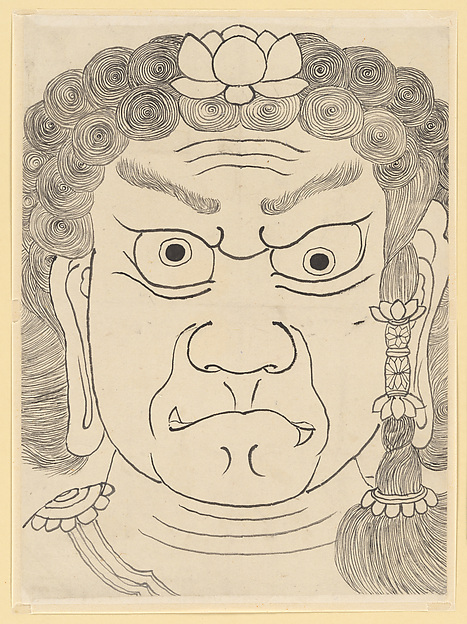
School of Katsushika Hokusai, Japan, 18th-19th century. Ink on paper; 31.3 x 23.3 cm. Metropolitan Museum of Art, 56.121.26.
Look closer: Note the curled hair, the lotus above the brow and the pair of fangs, all set down in ink on a single sheet.
The Metropolitan Museum of Art, Gift of Annette Young, in memory of her brother, Innis Young, 1956. Open Access.
Wikipedia's article on Acala lists the figure's names across Asia, and the list is a small map of Buddhism's spread. In Sanskrit he is Acala, Acalanātha and Caṇḍaroṣaṇa. In Chinese he is Bùdòng Míngwáng, in Korean Budong Myeongwang, in Vietnamese Bất Động Minh Vương, and in Tibetan Miyowa. In Japanese he is Fudō Myōō, Fudō-son, or, in the affectionate form that temple-goers use, O-Fudō-san.
The Sanskrit names carry a good deal of the doctrine. Acala means unmoving, the root of the Japanese Fudō. Acalanātha adds the word for lord. Caṇḍaroṣaṇa, as Wikipedia gives it, belongs to the wrathful side of the figure, a name for fierce anger. The Chinese and Japanese terms translate the first of these and add the royal title: Myōō, or Míngwáng in Chinese, is the Wisdom King, the sovereign of a bright, penetrating knowledge that shines into ignorance. Where the Museum prefers the rendering Kings of Brightness, it is translating the same word with the weight on light rather than on knowledge.
A Japanese reader meets other names too. Wikipedia notes the Kurikara sword, held by a form of Fudō with a nāga coiled around the blade, and the two boys, Kongara and Seitaka, who are spoken of almost as parts of his name. Japanese tradition adds the colour names Aka-Fudō, Red Fudō, and Ki-Fudō, Yellow Fudō, which are treated in their own section below.
Why does this matter for a collector or a visitor? Because the vocabulary is the key to every label. A museum may call the same object Fudō Myōō, Achala Vidyaraja, Acala or Fudō-son, and a catalogue may spell the vowel with a macron or without it. The Met alone uses Fudō Myōō, Achala Vidyaraja and Acala for different objects in its collection. Knowing that all of these are one figure turns a confusing search into a single one.
- Fudō Myōō 不動明王
- The standard Japanese name: the Immovable Wisdom King.
- Fudō-son, O-Fudō-san
- Respectful and affectionate forms used at temples and in daily speech (Wikipedia).
- Acala, Acalanātha
- The Sanskrit name and its fuller form, the Immovable Lord (Wikipedia).
- Caṇḍaroṣaṇa
- A Sanskrit name of the wrathful aspect (Wikipedia).
- Achala Vidyaraja
- The spelling the Met uses in many titles: Achala, unmoving, and Vidyaraja, Wisdom King.
- Bùdòng Míngwáng
- The Chinese name, the source of the Japanese reading (Wikipedia).
Where the sutras first draw him
The figure did not begin in Japan, and he did not begin as a statue. His earliest appearances are in the esoteric texts translated into Chinese during the Tang dynasty. Wikipedia names the Amoghapāśa Sūtra, translated by Bodhiruci between 707 and 709, and JAANUS says that his name first appears in the Fukūkenjaku sutra of Bodhiruci, dated 709. The two pages give the dates a little differently, but they point to the same translator and the same few years at the start of the eighth century.
The great authority for his form is the Mahāvairocana Tantra, called the Dainichikyō in Japan. JAANUS gives its Chinese translation by Śubhākarasiṃha, the Zenmui of the Japanese, as 725. In that work, Wikipedia says, Fudō sits in the southwest of the Womb Realm mandala, and he is described as a stout boy with his hair gathered on the left shoulder, one eye fixed, flames around him and a rock beneath. Commentary followed. Wikipedia mentions Amoghavajra and Vajrabodhi, and the commentary of Yi Xing, the monk whom the Japanese call Ichigyō, who lived from 683 to 727. JAANUS associates Ichigyō with the addition of the word Myōō to Fudō's name.
Not every text is Indian or Chinese. Wikipedia points out that the Japanese tradition produced its own apocryphal scripture, the Shō-Fudō kyō, and that this text, with its thirty-six dōji and eight great dōji, fills the figure's court with named attendants. A text of this kind shows how a figure from the Chinese tradition could be given a Japanese court of its own.
The origin of the figure behind the texts is an open question. Wikipedia reports a suggestion that he may descend from Shiva, and says that Bernard Faure has proposed other ancestors: Trailokyavijaya, Agni, or Vajrapāṇi. None of these can be proved from the surviving texts, and the safest statement is the one that scholars make: that Acala belongs to a family of fierce protectors in the Indian tantric world, took his settled form in Tang China, and found his greatest stage in Japan.
Close to the texts stand the model drawings. The Met's twelfth-century handscroll of Myōō-bu shoson, iconographic drawings of the Five Kings of Wisdom, is a good example of the way an image was passed from workshop to workshop. A sculptor or painter did not invent a Fudō. He consulted a book of precise rules, and then, within the rules, he gave the figure a face.

Japan, 12th century. Handscroll; ink and color on paper; 33.7 x 1285.7 cm. Metropolitan Museum of Art, 1975.268.6.
Look closer: Note that the scroll runs for more than twelve metres, so the five kings you see here are only the opening of a long sequence of model drawings.
The Metropolitan Museum of Art, The Harry G. C. Packard Collection of Asian Art, Gift of Harry G. C. Packard, and Purchase, Fletcher, Rogers, Harris Brisbane Dick, and Louis V. Bell Funds, Joseph Pulitzer Bequest, and The Annenberg Fund Inc. Gift, 1975. Open Access.
How to recognise him
Almost every Fudō follows the same visual grammar, which makes him one of the easiest deities to identify in a temple hall or on a scroll. Start with the hands: a sword upright in the right, a looped rope in the left. The Museum's note on the Kamakura scroll puts them together in one line: he stands on a rock, holding a sword and a lasso, and overcomes any evil that could obstruct the teachings.
Behind the body, flames. The Museum calls the fiery halo a flaming mandorla that emphasises his fierce power, and Wikipedia gives it the name karura-en, the flame of the Garuda, after the bird of Indian myth. The hair is gathered in a braid that falls on the left shoulder. A lotus sits on the head in many versions, called the chōren in Wikipedia's account. The eyes are wide and, in the famous version, not alike: the tenchigan, or heaven-and-earth eyes, one looking up and one looking down. The fangs, in the later type, point in opposite directions, one up and one down.
Wikipedia gives a reading of the fangs that is worth keeping: the upward fang points toward enlightenment, and the downward toward the work of teaching those who have not yet reached it. This is the sort of detail that rewards a long look. It is also a reminder that the terrifying face is a statement of compassion, since he is fierce on behalf of the person who prays.
He is seated on a rock or on a throne of stones, or, from the eleventh century, standing on one. Wikipedia names two seats, the banjakuza, the great-rock seat, and the shitsushitsuza, the seat of a heap of stones, and JAANUS adds that the oldest surviving image, at the Kōdō of Tōji in Kyoto, is seated on a shitsushitsuza with a flame halo. The sword is the hōken, the treasure sword, or the kongō-ken, the vajra sword, or the sanko-ken, a sword with a three-pronged hilt; in one form it is the Kurikara, with a nāga coiled up the blade.
A viewer who knows these marks can read a fragment. A scrap of a flame halo, a lock of braided hair, the grip of a rope: any one of them is enough to say this is Fudō, and the detective work of a museum visit becomes a pleasure.
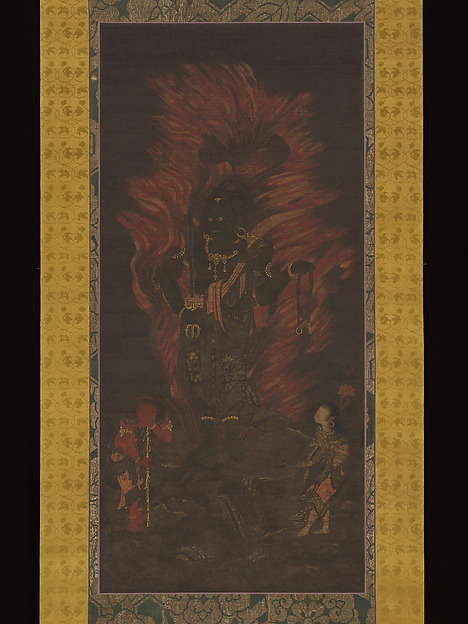
Japan, mid-13th century. Hanging scroll; ink, color and gold on silk; image 76 x 35.2 cm. Metropolitan Museum of Art, 2021.398.7.
Look closer: Note the two small attendants at his feet: the Museum calls Seitaka pale and Kongara red, which is the reverse of the colours given in Wikipedia.
The Metropolitan Museum of Art, Mary and Cheney Cowles Collection, Gift of Mary and Cheney Cowles, 2021. Open Access.

Chikai, Japan, second half of the 15th century. Hanging scroll; ink and color on paper; image 101.5 x 43.4 cm. Metropolitan Museum of Art, 2015.300.2.
Look closer: Note that every figure is built from tiny Sanskrit seed syllables in black ink, with the sword and lasso outlined in red.
The Metropolitan Museum of Art, Mary Griggs Burke Collection, Gift of the Mary and Jackson Burke Foundation, 2015. Open Access.
| Feature | What it means | Where to look |
|---|---|---|
| Sword | Cuts through ignorance and attachment (Met) | Right hand; upright, with a three-pronged or vajra hilt |
| Rope or lasso | Restrains those who block the path (Met) | Left hand; a loop, sometimes outlined in red |
| Flame halo | The karura-en, the Garuda flame, which burns away obstacles (Wikipedia) | Behind the whole body, often cut in gold |
| Braided lock | Hair gathered to the left shoulder (Wikipedia, Met) | At the left of the neck |
| Eyes | Wide, in the later type one looking up and one down (Wikipedia) | Under the heavy brow |
| Fangs | One up toward enlightenment, one down to teach (Wikipedia) | At the corners of the mouth |
| Rock seat | The immovable resolve in the name; banjakuza or shitsushitsuza (Wikipedia) | Under the feet or the folded legs |
| Two boys | Kongara and Seitaka, usually small and flanking him (Wikipedia, Met) | At the base, to left and right |
Seitaka, Kongara and the larger retinue
Fudō rarely travels alone. Wikipedia names two attendants who go with him in most versions: Kiṃkara, called Kongara in Japan, and Ceṭaka, called Seitaka. The Museum's note on its pair of carved boys, made around 1350, explains what the viewer sees. Kongara stands at Fudō's right as a youth with his palms pressed together in a calm, meditative pose. Seitaka, his counterpart, has a fierce grimace, moves with energy and raises both arms; his hair is tied in knots, as is conventional for him, and he was originally painted crimson.
The colours are a good place to see how carefully a scholar must read. Wikipedia describes Kongara as white, with hands joined, and Seitaka as red, holding a vajra staff. The Museum's note on the thirteenth-century scroll says the opposite for that painting: Seitaka pale and looking up at Fudō, Kongara red, leaning on a golden staff and looking down with a deep frown. The Museum's note on the carved pair, as above, gives Seitaka the crimson skin. The sources disagree, and the honest summary is that tradition fixed the character of each boy more firmly than it fixed his colour. One is gentle and one is stern, and a painter who reverses the colours has not necessarily made a mistake.
The pair are more than company. Together with Fudō they form a triad found in many shrines and on many scrolls, and in iron, as on the sixteenth-century plaque shown later in this chapter. One boy is shown quiet and one is shown in movement, and a collector who finds only one of the two on an old altar may fairly ask whether the other has been lost.
The family can grow. JAANUS notes that the number of attendants in different traditions is two, eight, thirty-six or forty-nine. The group of eight, the eight great dōji, appears on the small portable-shrine door above, dated to the fifteenth century. Wikipedia's reference to the thirty-six dōji of the Japanese apocryphal Shō-Fudō kyō completes the picture: a court that expands from the austere pair into a whole retinue of named boys. JAANUS also records a set of eight attendants at the Kongōbuji Fudōdō at Mount Kōya, made in 1198 and said to be by Unkei.
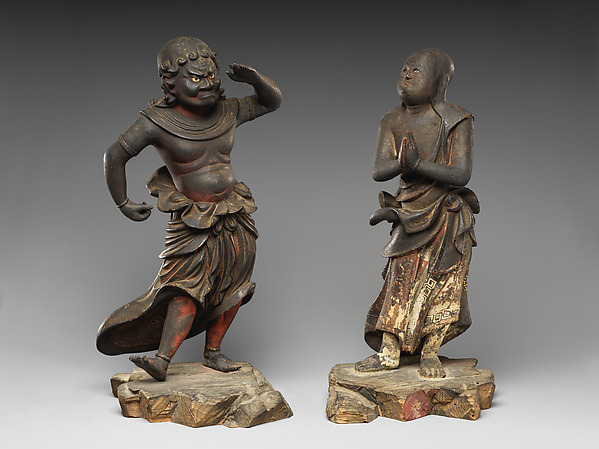
Japan, ca. 1350. Lacquered wood with traces of paint, inlaid glass eyes; yosegi-zukuri; H. 34.3 cm each. Metropolitan Museum of Art, 2018.17.1-2.
Look closer: Note the contrast between the two: one with both arms raised and a grimace, the other with palms pressed together in calm.
The Metropolitan Museum of Art, Purchase, Mary Livingston Griggs and Mary Griggs Burke Foundation Fund and Brooke Russell Astor Bequest, 2018. Open Access.

Ryūshū Shūtaku (Myōtaku), Japan, 1387. Hanging scroll; ink and color on silk; 109.2 x 40 cm. Metropolitan Museum of Art, 1975.268.25.
Look closer: Note the joined hands of the standing boy, the same gesture that the carved Kongara makes.
The Metropolitan Museum of Art, The Harry G. C. Packard Collection of Asian Art, Gift of Harry G. C. Packard, and Purchase, Fletcher, Rogers, Harris Brisbane Dick, and Louis V. Bell Funds, Joseph Pulitzer Bequest, and The Annenberg Fund Inc. Gift, 1975. Open Access.

Japan, 15th century. Door of a portable shrine; ink, color and gold on lacquered wood; H. 25.1 cm, W. 19 cm. Metropolitan Museum of Art, 67.55.38.
Look closer: Note how eight attendants are packed onto a door scarcely twenty-five centimetres tall.
The Metropolitan Museum of Art, Bequest of Susan Dwight Bliss, 1966. Open Access.
From Tang texts to Kamakura workshops
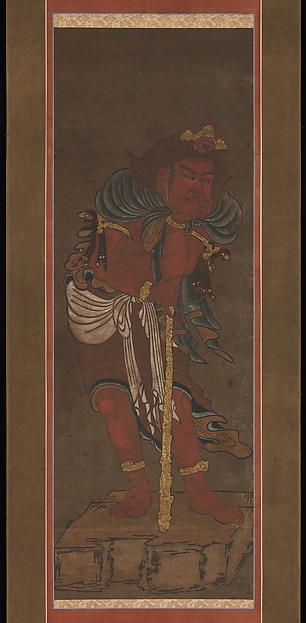
Ryūshū Shūtaku (Myōtaku), Japan, 14th century. One of a triptych of hanging scrolls; hand-colored woodblock print on paper; 106.7 x 35.6 cm. Metropolitan Museum of Art, 1975.268.26.
Look closer: Note how the boy with the golden staff stands on rocks as the lord does, a printed echo of the rock seat above.
The Metropolitan Museum of Art, The Harry G. C. Packard Collection of Asian Art, Gift of Harry G. C. Packard, and Purchase, Fletcher, Rogers, Harris Brisbane Dick, and Louis V. Bell Funds, Joseph Pulitzer Bequest, and The Annenberg Fund Inc. Gift, 1975. Open Access.
The cult entered Japan with Kūkai, the monk known after death as Kōbō Daishi. Wikipedia credits Kūkai with bringing the worship of Fudō to Japan, and the Metropolitan Museum Journal article on the Packard Fudō places Kūkai in China from 804 to 806. A Fudō image was installed in the Kōdō of Kongōbuji on Mount Kōya in 816 and was lost when that hall burned in 1926. The next fixed point is the Tōji image of about 839, carved from a single block of wood, 173.2 centimetres high, the oldest example JAANUS names (JAANUS, Met Journal).
Wikipedia names the priests who were especially devoted to him: Kūkai, Kakuban, Ennin, Enchin and Sōō. Enchin's story, told in the section on colours, produced the yellow Fudō. Both the Shingon and Tendai traditions, Wikipedia says, practise the Fudō rite and the goma fire offering.
The shape of the figure changed with the centuries. The Met Journal article observes that early images are seated, and that standing figures appear from the eleventh century; the Museum's twelfth-century standing Fudō says the same. Wikipedia describes two broad types: the early one, with wide eyes, a straight braid, fangs pointing the same way and a lotus on the head, and a later type, from the late ninth century, with curly hair, the tenchigan eyes, one fang up and one down, and seven topknots.
The technique changed as well. The sculptor Jōchō is the name the Met Journal ties to the joined-wood method, yosegi-zukuri, in which a figure is built from several hollowed pieces rather than carved from a single block. The Museum's standing Fudō, formerly the central icon of Kuhonji Temple northwest of Kyoto, is built of six hollowed pieces. The Met Journal records the Takidani Fudō of 1095, the Bujōji image of 1154 and the Ganjōjuin image of 1186 by Unkei as milestones in the story.
The Museum calls Kaikei a leading sculptor, active from 1183 to 1223, and its seated Fudō from his workshop, dated to the early thirteenth century, shows the fashions of the Kamakura period: inlaid crystal eyes and cut gold leaf. The figure bites its lower lip, has its hair bound to fall over the left shoulder, and is armed with a lasso and a sword. The Met Journal also notes a change of pigment, from hakudo to gofun, the latter coming into use from the end of the fourteenth century.
Fudō was also a figure in the history of the nation. JAANUS records that his image was used in public rites at the time of the Mongol invasions of Japan. An unmoving god is a natural choice when a country needs to feel that it cannot be moved.
- Early 8th centuryFudō's name appears in Tang translations by Bodhiruci, 707 to 709 (Wikipedia, JAANUS).
- 725The Mahāvairocana Tantra is translated into Chinese by Śubhākarasiṃha (JAANUS).
- 804-806Kūkai studies in China (Met Journal).
- 816A Fudō image is installed in the Kōdō at Kongōbuji, Mount Kōya; the hall burns in 1926 (Met Journal).
- 838Enchin has his vision of the Yellow Fudō (Wikipedia).
- ca. 839The Tōji image, carved from a single block, 173.2 cm high (Met Journal).
- 940Narita-san is founded by Kanchō (Narita-san Shinshō-ji).
- 11th centuryStanding images appear; Jōchō develops yosegi-zukuri (Met, Met Journal).
- 1198The Fudōdō at Kongōbuji is built with eight attendants said to be by Unkei (JAANUS).
- Early 13th centuryKaikei's workshop makes crystal-eyed images (Met).
- 14th centuryThe practice of the Thirteen Buddhas places Fudō first, for the seventh day (Wikipedia).
- 1655Tokugawa Ietsuna rebuilds the Main Hall at Narita (Narita-san Shinshō-ji).
- 1805Mokujiki carves his natabori Fudō (Met).
Yellow, blue and red Fudō
JAANUS says that Fudō is traditionally blue-black, with a smooth, youthful body that is often heavily built. That is the default. But Japanese tradition also knows three famous coloured Fudō. Wikipedia's article on Shōren-in lists them as a set: the Blue Fudō of Shōren-in in Kyoto, the Yellow Fudō of Onjō-ji, which is Mii-dera, and the Red Fudō of Myōō-in on Mount Kōya.
The Yellow Fudō, Ki-Fudō, goes back to a vision. Wikipedia says that the monk Enchin saw the figure in 838 while in meditation, and that he had it painted; the original at Mii-dera is a hibutsu, a hidden Buddha, which is shown only to ācāryas at initiation. A hibutsu is a work so sacred that it is withheld from ordinary view, and JAANUS has an entry for the category. The whole body is yellow, the figure stands upon empty sky, and it is a National Treasure. The oldest copy, JAANUS reports, is a late Heian painting at Manshu-in in Kyoto, golden where the usual Fudō is blue-black.
The Blue Fudō, Ao-Fudō, is a Heian hanging scroll of the mid-eleventh century, in colour on silk, showing Fudō with two attendants. Wikipedia's article on Shōren-in records that it is a National Treasure and a hibutsu, so that the version put on display is a replica. The same page reports that the temple completed a large hall for goma rituals, the Seiryūden, in October 2014, at its precinct in the Higashiyama hills, and that the hall is open to the public from October to December. Visitors who plan a trip should check the current dates with the temple.
The Red Fudō, Aka-Fudō, is the image at Myōō-in on Mount Kōya. Wikipedia reports a tradition that connects it to Enchin and describes the colour as coming from his blood, a story that is told rather than proved. What can be said is that the three colours add a device to the iconography: the same figure, with the same sword and rope, is read differently according to the hue of its skin.
One further detail. Wikipedia mentions a four-armed form of Fudō that is used in the anchin-hō rite, a reminder that the standard two-armed figure is not the only body he can take. The reader who wants to understand why one temple shows him in red and another in blue is best served by asking who founded the image and what vision or text stands behind it: each colour in this chapter comes with a story attached.
The patron of swordsmen and lords
Fudō has long been a warrior's god. The Museum, describing its small thirteenth- or fourteenth-century statue, says that he was widely venerated as a protector, especially by samurai. It is easy to see why. He holds a sword, he is unmoved by fear, he binds enemies with a rope, and he stands in fire. An armed man who wants to hold his ground has little need for a gentler saint.
Wikipedia gives a famous case: the warlord Takeda Shingen took Fudō as his patron, and a statue of Fudō is said to have been modelled on his face. The story is a vivid one and the Wikipedia page marks it as a tradition, so this page does the same.
The Museum's sixteenth-century iron plaque by Myōchin Nobuie puts the triad into metal. The Museum's record names the maker, the date and the material, and classes the work as metalwork. Iron is the material of blades and of armour, and the plaque gives the sword-bearing god a body of the same metal.
The link between Fudō and fighting men is not only a matter of rank. JAANUS records that his image was used in public rites at the time of the Mongol invasion. The reader who wishes to follow that thread should turn to the chapter on Daigensui Myōō, the Marshal of the Wisdom Kings, whose own rite JAANUS reports being used against Taira no Masakado and against the Mongol invasion of 1281.
In the Edo period the relationship becomes theatre. The Ichikawa family of kabuki actors, whose founder Danjūrō I lived from 1660 to 1704, were protected by Fudō as worshipped at Narita, according to the Museum, and Wikipedia credits Danjūrō I with creating the rough style called aragoto. The Narita section below tells that story at length. Kunisada's surimono print of about 1824, shown there, makes the point in a single image by drawing the warrior-monk Benkei as Fudō himself.

Myōchin Nobuie, Japan, 16th century. Iron; H. 45.7 cm, W. 76.2 cm. Metropolitan Museum of Art, 06.61.
Look closer: Note how the three figures are worked from iron, a metal more usually shaped into armour, so that sword and flame become hammered edges.
The Metropolitan Museum of Art, Rogers Fund, 1906. Open Access.
Goma fire and the waterfall ascetics
To pray to Fudō, in the great esoteric temples, is to take part in a fire ritual. JAANUS describes him as the main image, the honzon, of the goma, the fire offering, and Wikipedia says that the Fudō-hō, the Fudō rite, together with goma, is a main practice of both the Shingon and Tendai schools. The flame that surrounds the figure on the altar is, in that setting, the flame that burns in front of him.
The mountain branch of the tradition, Shugendō, applies a different method. Wikipedia mentions the waterfalls of Shugendō practice as places where Fudō is invoked, and JAANUS records the saitō goma, a fire rite performed by yamabushi, the mountain ascetics. JAANUS's entry on goma also names the goshichinichi-no-mishuhō performed at Tōji. The same god serves the court temple and the mountain pool.
Wikipedia describes three kinds of mantra attached to Fudō: the jikushu, the mantra of compassionate help, the shōshu, and the kakaishu. It also gives his seed syllables, hāṃ and hāmmāṃ. The Museum's fifteenth-century scroll by the monk Chikai shows what a seed syllable is for: each figure, Fudō and four attendants, is built entirely of tiny Sanskrit characters in black ink, and the sword and lasso are outlined in red. The painter does not draw the god; he writes him.
Not every devotion needs a priest. The Museum's note on its stamped hanging scroll, a grid of small printed images of Fudō, observes that repeating a deity's name, whether by chanting or by inscription, was a common devotional practice, and that artworks with many images of a deity were often sponsored by devotees, a tradition it traces to the earliest stages of Buddhism in Japan. The grid of small Fudō in the gallery below is the visual form of the same instinct: a repeated stamp, made with a woodblock, stands for a repeated invocation.
Finally, a rite that comes after death. In the sequence of the Thirteen Buddhas, kept by Japanese families for the dead, Wikipedia says that Fudō is the first, for the seventh day after a death, and that the practice dates from about the fourteenth century. The chapter on the Thirteen Buddhas follows the full series. In a great many Japanese homes the first memorial ritual is therefore addressed, whether anyone remembers it or not, to the figure with the sword.
- Goma
- Fire offering; Fudō is its main image (JAANUS).
- Fudō-hō
- The Fudō rite, a main practice of the Shingon and Tendai schools (Wikipedia).
- Saitō goma
- The large open-air fire rite of the yamabushi (JAANUS).
- Jikushu, shōshu, kakaishu
- Three kinds of mantra attached to Fudō (Wikipedia).
- Anchin-hō
- The rite for which a four-armed Fudō is used (Wikipedia).
- Thirteen Buddhas
- A memorial series in which Fudō comes first, for the seventh day (Wikipedia).
The temple at Narita and a rebel's fall
No place in Japan is more associated with Fudō than Narita-san Shinshō-ji, the great temple in Narita, in Chiba Prefecture. Its own account, and Wikipedia's article on Narita-san, say that the temple was founded in 940 by the monk Kanchō. The temple's tradition holds that its image of Fudō was carved by Kūkai in 810 by order of Emperor Saga. Wikipedia reports a more cautious view: that the image came from the Gomadō of Jingo-ji, and that art historians date the present image to no earlier than the thirteenth century.
The founding story is martial. In 939 the warrior Taira no Masakado rose in rebellion in the east. Emperor Suzaku, the temple says, ordered Kanchō to carry the Fudō image to the battlefield and perform the goma, and Masakado fell on the last day of the rite. The chapter on Daigensui Myōō follows the other rite that JAANUS says was used against Masakado.
The temple grew with the patronage of the shōgunate. Wikipedia reports that Tokugawa Ietsuna rebuilt the Main Hall in 1655. The buildings that follow are a lesson in the way a pilgrimage temple adds to itself: the Kōmyōdō of 1701, the three-storey pagoda of 1712, 25 metres tall, the Issaikyōdō of 1722, the Niōmon gate of 1830 or 1831, the Shakadō of 1858 and the Gakudō of 1861, a hall hung with votive tablets. The twentieth century adds the Kaisandō of 1938, the park of 1928, which covers 16.5 hectares, the Great Main Hall of 1968, the Great Peace Pagoda of 1984, 58 metres tall, the Shōtoku Hall of 1992 and the Sōmon gate of 2008.
Narita's second life was theatrical. Wikipedia explains that the Edo actor Ichikawa Danjūrō I, who lived from 1660 to 1704 and created the rough style called aragoto, was a devotee. His son, Danjūrō II, made his debut in 1697 in a play in which he appeared as Fudō, and in 1703 the Narita image was brought to Edo for exhibition, together with a play on the subject. The Museum's note on Kunisada's print of about 1824 says the same thing from the other side: Fudō, especially as worshipped at Shinshō-ji in Narita, protects the Ichikawa family, and the privately commissioned surimono may have been a New Year gift celebrating the birth of the future Danjūrō VIII.
The Museum's second Kunisada print, of a certain Maruami Gorō saved by Fudō's attendant Seitaka from Narita, is a reminder that Narita and its attendants were popular subjects for the print-makers. The Museum's record gives the title and the artist and does not retell the story, so this page does not either. What the print shows is the boy on a cloud over water, with a lotus-capped staff.

Utagawa Kunisada, Japan, ca. 1824. Woodblock print (surimono); ink and color on paper; 21.4 x 18.7 cm. Metropolitan Museum of Art, JP1251.
Look closer: Note that the warrior sits on a heap of people while holding a sword, the pose of Fudō taken over by the monk-hero Benkei.
The Metropolitan Museum of Art, Rogers Fund, 1921. Open Access.

Utagawa Kunisada, Japan, 19th century. Woodblock print; ink and color on paper; image 36.5 x 25.1 cm. Metropolitan Museum of Art, 2007.49.274.
Look closer: Note the boy on a cloud above the waves, carrying a staff capped with a lotus, in a print whose title ties him to Narita.
The Metropolitan Museum of Art, Bequest of William S. Lieberman, 2005. Open Access.
- 940
- Founding of the temple by Kanchō (Narita-san Shinshō-ji).
- 1655
- Main Hall rebuilt by Tokugawa Ietsuna (Narita-san Shinshō-ji).
- 1703
- The image and a play about it exhibited in Edo (Wikipedia).
- 1968
- The Great Main Hall (Narita-san Shinshō-ji).
- 1984
- The Great Peace Pagoda, 58 m (Narita-san Shinshō-ji).
- 2008
- The Sōmon gate (Narita-san Shinshō-ji).
Fudō in the hills and groves of Edo
In the Edo period Fudō left the temple hall and entered the landscape. The Museum's record for Toyokuni II's Night Rain at Ōyama, part of a series of Eight Famous Views of Kanagawa made about 1830, explains why. Mount Ōyama, it says, was an ancient centre of mountain asceticism where the guardian Fudō Myōō was enshrined, and in the eighteenth century it became a popular pilgrimage site where prayers for rain were offered. For that reason, the Museum explains, depicting the mountain in rain became standard. The print shows the mountain at night, with Mount Fuji faintly visible in the distance.
That one paragraph carries a whole way of seeing. A god of fire is prayed to for rain; a pilgrimage mountain is remembered by its weather; a series of famous views turns a place of worship into a famous view. The Museum notes that the mountain is drawn without outlines, in contrast to the sharply defined torrents of rain, and compares the print with Hiroshige's Karasaki, which has a similar atmosphere though its rain is a steady downpour.
Hiroshige himself made a print of pilgrims at the Fudō shrine at Meguro between 1833 and 1843. The Museum's record gives only the title, the date and the collection details, and does not describe the scene or name the series. What can be said by looking is that the Meguro shrine in the print sits among trees at the top of a flight of steps, with small figures climbing toward it. Between the mountain of Ōyama and the shrine at Meguro, the two prints show the range of the god's worship in the print-makers' day, from a great pilgrimage mountain to a shrine among the trees.
The prints in this chapter by Toyokuni II, Hiroshige, Kunisada and Yoshitoshi all show the same thing from different angles: a god known well enough to be a subject for the popular print.
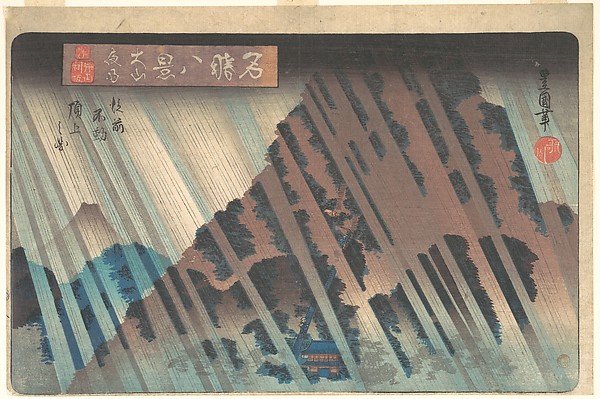
Utagawa Toyokuni II, Japan, ca. 1830. Woodblock print; ink and color on paper; H. 24.1 cm, W. 36.4 cm. Metropolitan Museum of Art, JP1416.
Look closer: Note that the mountain has no outline at all, while the rain is drawn in sharply defined streaks of several tones.
The Metropolitan Museum of Art, Rogers Fund, 1922. Open Access.

Utagawa Hiroshige, Japan, 1833-43. Woodblock print; ink and color on paper; H. 21.9 cm, W. 34.3 cm. Metropolitan Museum of Art, JP1200.
Look closer: Note how small the pilgrims are beside the stairs and trees, so that the shrine seems to grow out of the grove.
The Metropolitan Museum of Art, Rogers Fund, 1919. Open Access.
Tales of fire, swords and dreams
Fudō is a god who has been given stories, and the best of them are not in the scriptures. This section gathers the tales that the pages behind this chapter tell, each with its source. A reader who wants only the headlines may stop here; those who like the details will find them in the sub-sections that follow.

Tsukioka Yoshitoshi, Japan, 1885. Triptych of woodblock prints; ink and color on paper; 37.5 x 25.4 cm per sheet. Metropolitan Museum of Art, 2005.350a-c.
Look closer: Note the sword aimed straight at the kneeling novice while the attendants stand back and watch.
The Metropolitan Museum of Art, Purchase, Friends of Asian Art Gifts, 2005. Open Access.
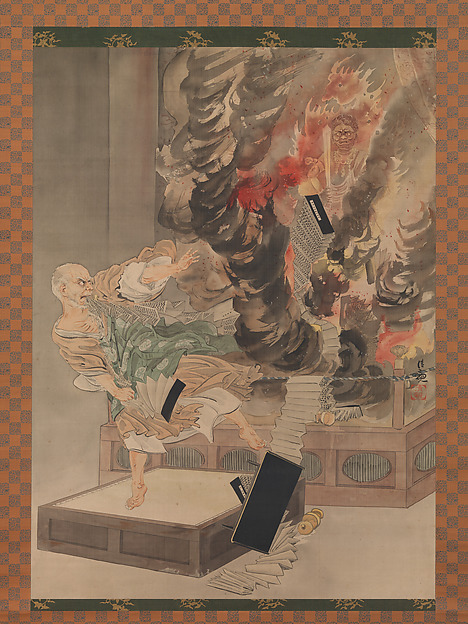
Kobayashi Kiyochika, Japan, ca. 1900. Hanging scroll; ink, color and gold paint on silk; image 108 x 78.7 cm. Metropolitan Museum of Art, 2017.292.
Look closer: Note the Fudō statue at the upper right, whose expression the Museum reads as surprised horror at the monk's tantrum.
The Metropolitan Museum of Art, Purchase, Friends of Asian Art Gifts, 2017. Open Access.
The abbot and the sword
The Museum's label for Yoshitoshi's 1885 triptych tells a legend of Abbot Yūten, who lived from 1637 to 1718 and who was the abbot of Zōjōji. As a novice he prayed to Fudō Myōō for help to become a wise monk. In a dream the statue leaped from its pedestal and forced him to swallow one of its swords. When he woke, he had become an excellent cleric. Yoshitoshi shows the moment of threat: Fudō aims his sword at Yūten while the attendants watch the display of power.
The story has an honest logic. A god who is described as the one who cuts through ignorance is, in the dream, made to do exactly that, and in the most literal way. The Museum adds that Yoshitoshi was one of the great innovators of Meiji ukiyo-e, and that this print uses the airy, theatrical composition of his late style, with a trace of the violence found in his earlier prints.
The monk who was too angry
Kiyochika's scroll, made around 1900, shows a different kind of anger. The Museum explains that Raigō, who lived from 1002 to 1084, was a Buddhist monk who performed magical rituals to ensure the safe birth of a royal heir, in return for the emperor's agreement to let his temple conduct ordinations. When Emperor Shirakawa broke the promise, Raigō became enraged during a goma-e, a fire ritual. The painting shows the monk lurching from the altar, ritual implements scattered, sutra books fallen, a small offering table in free-fall, and flames and smoke surging from the hearth where the ritual would normally be performed with calm and strict protocol.
The Fudō statue, at the centre of the ritual, rises from the flames, and Kiyochika, the Museum says, playfully gives it an expression of surprised horror. The Museum calls the episode a quasi-historical incident and notes that earlier publications called the painting Fudō Myōō. Popular literature and theatre elaborated the story: in those versions Raigō starved himself in protest and was reborn as a monstrous iron rat, tesso, who with his army of rats attacked Miidera, destroying statues and sutras. The Museum adds that the emperor's crown prince died at the age of three, reputedly because of Raigō's curse. Here the god of calm is the only one in the room who is shocked.
The general and the statue
Wikipedia records that Takeda Shingen took Fudō as his patron and that a statue is said to have been modelled on his face. The Museum's note that samurai especially venerated the god supplies the setting for it.
The wrestler's travelling god
The Museum's portable shrine of the eighteenth century carries a small wooden Fudō, 4.8 centimetres tall, inside a shrine about ten centimetres high, with lacquer, gold and metal fittings. Its provenance is the best part. The Museum records that it belonged to the sumo grand champion Hitachiyama Taniemon, who lived from 1874 to 1922, and that he gave it to the Museum in 1908, when he wrestled in New York during a tour of the United States and Europe in 1907 and 1908. A god small enough to travel in a wrestler's baggage across the Atlantic is a good illustration of the way portable shrines were used: as personal devotional objects.
The kabuki hero
The Ichikawa family's devotion to the Narita Fudō, described above, reached the stage: Wikipedia records the debut of Danjūrō II as Fudō in 1697. Kunisada's surimono of Danjūrō VII as Benkei, seated on a heap of people with a sword, merges two heroic identities, the warrior Benkei and the Wisdom King, in one picture. The Museum's note says the print was privately commissioned for a special occasion.
Hatchet-carved by an amateur monk
Among the many hands that have made Fudō, one deserves a place of its own. Mokujiki Shōnin, who lived from 1718 to 1810, was an amateur monk-sculptor. The Museum's note says that his religious enthusiasm led him to make thousands of sculptures of Buddhist deities and popular gods of good fortune, and that his work contrasts with the finely carved pieces of professional sculptors. The Museum's Fudō by Mokujiki is dated 1805.
The technique has a charming name. Natabori means hatchet-carved, the Museum explains, though the artist actually worked with round-headed chisels. The result is a surface of facets and gouges, with the face reduced to a few grand strokes. The art critic Yanagi Sōetsu, who lived from 1889 to 1961 and championed mingei, the people's art, rediscovered Mokujiki's sculptures in the early twentieth century, and admired their direct, unaffected power as an ideal of indigenous Japanese popular art.
The Museum's second object, a nineteenth-century wooden altar cabinet, a zushi, for a Fudō, is by an unidentified maker, and the Museum's page associates its rough, direct carving with Mokujiki. It is a reminder that the sacred has furniture: Fudō stands in a cabinet, and the cabinet opens and shuts. A god who is immovable in doctrine is, in the house, quite portable.
Compare the Mokujiki figure with the Kaikei at the head of this chapter. One is the work of a leading Kamakura workshop, with crystal eyes and cut gold leaf; the other is by an amateur monk, in hatchet-carved wood. Both are Fudō, and the Japanese tradition has room for both.

Mokujiki Shōnin, Japan, 1805. Chisel-carved (natabori) wood; H. 90 cm, W. 37 cm, D. 25 cm. Metropolitan Museum of Art, 2016.363.1.
Look closer: Note the facets left by the chisel, which the maker has not smoothed away, so that the figure seems cut from the log in a few strokes.
The Metropolitan Museum of Art, Purchase, Friends of Asian Art Gifts, 2016. Open Access.
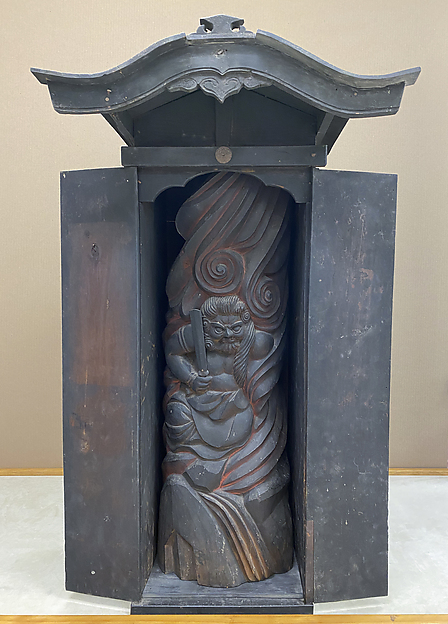
Japan, 19th century. Wood; H. 103 cm, W. 59 cm, D. 46 cm. Metropolitan Museum of Art, 2016.363.2.
Look closer: Note the roofed cabinet with its doors thrown open, a household shrine that can be closed again when the god is not in use.
The Metropolitan Museum of Art, Purchase, Gift of Estate of Mrs. E. H. Harriman, by exchange, 2016. Open Access.
The living cult in the present day
Fudō is not a museum piece. At Narita-san Shinshō-ji the temple holds its fairs on the 1st, 15th and 28th of each month, and the temple's own calendar of events runs from the New Year rites, Oshōgatsu, through Setsubun, the taiko performances, the firelight Noh, the Gion festival and Obon to Shichi-Go-San and the burning of old amulets. The Daihannya-e takes place in January, May and September. Visitors should confirm dates before travelling, since schedules change.
The great fire halls keep working. Shōren-in's Seiryūden, a large hall for goma rituals, opened in October 2014 at its hillside precinct above Kyoto and receives visitors from October to December, according to Wikipedia's entry on the temple. The temple of Narita completed its Sōmon gate in 2008, and the Great Peace Pagoda, 58 metres tall, dates from 1984.
Fudō has also entered popular culture in ways the monks of Kūkai's day could not have imagined. Wikipedia lists Gary Snyder's Smokey the Bear Sutra of 1969 among the works that draw on the figure, and notes that Sailor Mars, in Sailor Moon, invokes the god's mantra. The vocabulary of the sword and the rope still serves popular storytellers because it was designed to be seen at a glance.
Wikipedia also lists irezumi, the art of the Japanese tattoo, among the places where the god appears, and the kabuki tie to Narita is told in the section above. A person who finds a Fudō in a shop, on an altar, or on a sleeve is therefore looking at the continuation of a thousand-year habit, not the survival of one.
Small facts worth keeping
These are the small things that do not fit a section but are worth knowing, each from a page that was read for this chapter.
- A boy's body. JAANUS says that Fudō has the body of a youth, unlike many other deities, and Wikipedia reports that the Mahāvairocana Tantra describes him as a stout boy.
- Fangs in two directions. In the later type of image one fang rises and one descends. Wikipedia gives the reading: up toward enlightenment, down to teach.
- A scroll twelve metres long. The Museum's twelfth-century handscroll of model drawings of the Five Wisdom Kings is 1,285.7 centimetres long.
- A sword swallowed in a dream. In the legend told on Yoshitoshi's triptych, the novice who became Abbot Yūten was made to swallow one of Fudō's swords in a dream, and woke a better priest.
- The last day of the goma. The temple at Narita says that Taira no Masakado fell on the last day of the fire rite that Kanchō performed on the emperor's order.
- A wrestler's travelling god. A Fudō statuette less than five centimetres tall, in a portable shrine, crossed the Atlantic with the sumo grand champion Hitachiyama in 1907 and 1908, and was given to the Met in 1908.
- A painting made of writing. Chikai's fifteenth-century scroll builds Fudō and his four attendants out of tiny Sanskrit seed syllables, with the sword and lasso outlined in red.
- A face for a general. Wikipedia reports that a statue of Fudō was said to be modelled on the face of Takeda Shingen, his devoted patron.
- First of thirteen. In the memorial series of the Thirteen Buddhas, Fudō comes first, for the seventh day after a death; Wikipedia dates the practice to about the fourteenth century.
- An image that moved. JAANUS records that the Fudōdō at Kongōbuji on Mount Kōya was built in 1198 and moved to its present site in 1908.
- Not what the label says. JAANUS notes that the Takayama Fudō at Jōrakuin in Saitama is, iconographically, a Gundari Myōō, a reminder that old names and old images do not always agree.
- Rain for a fire god. The Museum explains that Mount Ōyama was a place where prayers for rain were made to Fudō, so that prints of the mountain are full of rain.
- A pagoda of peace. The Great Peace Pagoda at Narita, completed in 1984, stands 58 metres tall (Narita-san Shinshō-ji).
- Different lists of three. Wikipedia and the dealer butuzou.com name different sets of the three great Fudō, and neither is official.
Across Asia
Japan's Fudō is one branch of a wider Asian figure, and the other branches look different. The Museum's Tibetan Acala of the twelfth century is a stone figure only 11.4 centimetres high, and the Museum says that tantric texts name him as the protector of the rites associated with Mañjuśrī, and that the Kriya Tantra connected with invoking Acala was popularised by Atiśa, who lived from 982 to 1054, and by Lobpon Sonam Tsemo, who lived from 1142 to 1182.
The Nepalese painting of 1525 to 1550 shows Acala as the Museum describes him: crowned and adorned with jewels, brandishing a sword that cuts through ignorance, holding in his left hand a noose tipped with a vajra and embracing his consort Vishvavajri. The Museum explains that the union symbolises the bliss of enlightenment, which comes from joining wisdom and compassion, and that in Nepalese Buddhism he is a fierce form of Mañjuśrī and a manifestation of Chakrasamvara. The painting illustrates the Chandamaharoshana Tantra, a meditation text devoted to him. The sources used for this chapter show the Japanese Fudō without a consort, attended by boys instead; the contrast shows how differently one figure can grow in different valleys.
In China, Wikipedia says, Bùdòng Míngwáng was known in the Tang dynasty, and the Beilin museum in Xi'an, the Dazu carvings of the twelfth century and Yong'an Temple of the Ming period are among the places that preserve him. He is also named as the zodiac guardian of those born in the year of the Rooster. In Singapore the Buddha Tooth Relic Temple has an image of him, and Wikipedia's list of examples also includes a Tibetan bronze in Honolulu and a painting from Khara-Khoto in the Hermitage.
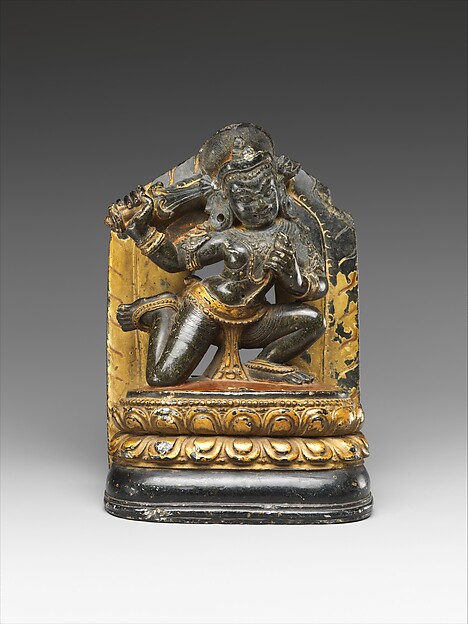
Tibet, 12th century. Chloritic stone with gilding; H. 11.4 cm, W. 10 cm. Metropolitan Museum of Art, 2015.500.4.16.
Look closer: Note the smallness: a gilded stone figure only eleven centimetres high, made for a rite rather than a hall.
The Metropolitan Museum of Art, Gift of Florence and Herbert Irving, 2015. Open Access.
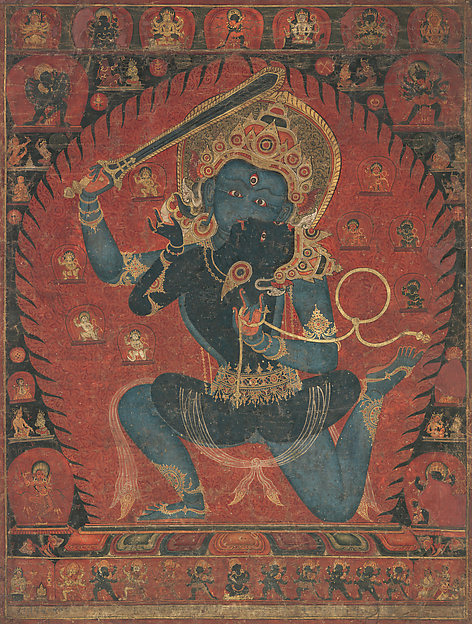
Nepal, Kathmandu Valley, 1525-50. Distemper on cloth; image 86.7 x 65.7 cm. Metropolitan Museum of Art, 2012.456.
Look closer: Note the blue figure with his sword raised in a red flame halo and the consort held in his embrace, a pairing the Japanese tradition does not use.
The Metropolitan Museum of Art, Zimmerman Family Collection, Purchase, Lila Acheson Wallace Gift, 2012. Open Access.
| Where | Form and name | What the record shows |
|---|---|---|
| India | Acala, Acalanātha, Caṇḍaroṣaṇa | The Sanskrit names; the possible origin in Shiva or another fierce protector is discussed in the section on scripture (Wikipedia). |
| China | Bùdòng Míngwáng 不動明王 | Known from the Tang texts; later carvings and a zodiac guardian of the Rooster (Wikipedia). |
| Korea | Budong Myeongwang | The Korean reading of the Chinese name (Wikipedia). |
| Vietnam | Bất Động Minh Vương | The Vietnamese reading (Wikipedia). |
| Tibet | Miyowa | A protector of the Mañjuśrī rites; a twelfth-century stone figure in the Met (Wikipedia, Met). |
| Nepal | Achala with Vishvavajri | A sixteenth-century painting of the Chandamaharoshana Tantra (Met). |
| Japan | Fudō Myōō 不動明王 | Chief of the Godai Myōō; honzon of the goma rite (JAANUS). |
Centre of the five kings
Fudō is the centre of the Godai Myōō, the Five Wisdom Kings, who guard the four directions around him. JAANUS calls him the chief of the five, and the Museum calls him the most widely represented of the Myōō, which is why many people know him without knowing the others.
| Direction | Wisdom King | Quality |
|---|---|---|
| Centre | Fudō Myōō | Immovable resolve |
| East | Gōzanze Myōō | Conquers the three poisons |
| South | Gundari Myōō | Nectar of immortality |
| West | Daiitoku Myōō | Great awesome power |
| North | Kongō Yasha Myōō | Diamond protector |
Where to see him
| Place | What to look for |
|---|---|
| Narita-san Shinshō-ji, Chiba | The most celebrated Fudō temple, founded in 940. Fairs fall on the 1st, 15th and 28th; the Great Peace Pagoda dates from 1984 (Narita-san Shinshō-ji). |
| Tōji, Kyoto | JAANUS names the Kōdō of Tōji as the home of the oldest surviving Fudō, seated on a heap of stones before a flame halo. |
| Fudōdō, Kongōbuji, Mount Kōya | Built in 1198 and moved in 1908, with eight attendants of 1198 said to be by Unkei (JAANUS). |
| Myōō-in, Mount Kōya | The home of the Red Fudō (Wikipedia). |
| Mii-dera (Onjō-ji), Shiga | The hidden Yellow Fudō, shown only at initiation; a copy survives at Manshu-in in Kyoto (Wikipedia, JAANUS). |
| Shōren-in, Kyoto | The Blue Fudō, a National Treasure; the version on view is a replica, and the Seiryūden goma hall opened in October 2014 (Wikipedia). |
| Daigoji and Ishiyamadera | Among the temples with surviving Fudō drawings, including a work of 1282 by Shinkai at Daigoji (JAANUS). |
| Metropolitan Museum of Art, New York | Many Fudō and attendants, in open access, including the pieces on this page. |
Three small Fudō

Japan, 13th-14th century. Painted and lacquered wood with cut gold leaf; yosegi-zukuri; H. 34.9 cm. Metropolitan Museum of Art, 1992.252.3a-c.
Look closer: Note the cut-gold leaf on the robe and the sword in the right hand, in a figure scarcely thirty-five centimetres tall.
The Metropolitan Museum of Art, Gift of Florence and Herbert Irving, 1992. Open Access.

Japan, 18th century. Wood with lacquer, gold, metal fittings; shrine H. 10.1 cm, statuette 4.8 cm. Metropolitan Museum of Art, 08.74.
Look closer: Note the open doors of the shrine, which hold a statuette less than five centimetres tall, small enough for a traveller's baggage.
The Metropolitan Museum of Art, Gift of T. Hitachiyama, 1908. Open Access.
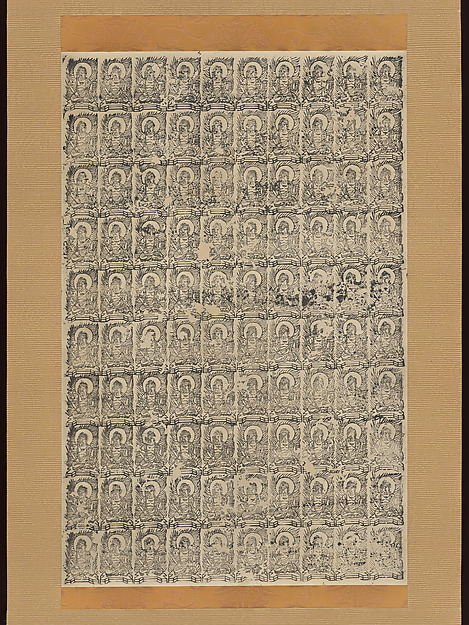
Japan, 14th-15th century. Hanging scroll; woodblock printed images; ink on paper; image 45.1 x 29.2 cm. Metropolitan Museum of Art, 2020.396.5.
Look closer: Note how the same small Fudō is stamped over and over in a grid, the visual form of a repeated invocation.
The Metropolitan Museum of Art, Mary and Cheney Cowles Collection, Gift of Mary and Cheney Cowles, 2020. Open Access.
In the house
These are pieces from the house that carry or relate to Fudō. The strip below fills from the current shelves, so it always shows what is available now.
A small glossary of Fudō
The words below are the ones that appear most often on museum labels and temple notices. Each is defined as the pages behind this chapter use it.
- Acala
- The Sanskrit name, meaning unmoving; the source of the Japanese Fudō (Wikipedia).
- Myōō (Vidyārāja)
- Wisdom King, or King of Brightness: a class of fierce protectors in esoteric Buddhism (Met).
- Godai Myōō
- The Five Wisdom Kings, of whom Fudō is the chief (JAANUS).
- Dainichi Nyorai
- The cosmic Buddha, of whom Fudō is held to be a wrathful emanation (Met).
- Mahāvairocana Tantra
- The text, called Dainichikyō in Japan, that places Fudō in the southwest of the Womb Realm (Wikipedia).
- Shingon, Tendai
- The two esoteric schools whose fire rites centre on Fudō (Wikipedia).
- Shugendō
- The tradition of the mountain ascetics, who use waterfalls and fire rites in his name (Wikipedia, JAANUS).
- Yamabushi
- Mountain ascetics who perform the saitō goma (JAANUS).
- Goma
- The fire offering; Fudō is its main image (JAANUS).
- Honzon
- The main image of a rite or of a temple hall (JAANUS).
- Hibutsu
- A hidden Buddha, an image withheld from ordinary view; the Blue and Yellow Fudō are two (JAANUS, Wikipedia).
- Karura-en
- The Garuda flame; the name of the fiery halo (Wikipedia).
- Banjakuza, shitsushitsuza
- Two kinds of rock seat on which Fudō sits (Wikipedia, JAANUS).
- Kurikara
- The sword of Fudō with a nāga coiled around the blade (Wikipedia).
- Hōken, kongō-ken, sanko-ken
- The treasure sword, the vajra sword and the sword with a three-pronged hilt (Wikipedia).
- Tenchigan
- The eyes of heaven and earth, one looking up and one down, in the later type of image (Wikipedia).
- Chōren
- The lotus on the head (Wikipedia).
- Dōji
- A boy attendant; Kongara and Seitaka are the best known (Wikipedia, Met).
- Aka-, Ki-, Ao-Fudō
- Red, Yellow and Blue Fudō, each tied to a temple and a story (Wikipedia).
- Shuji, seed syllable
- A Sanskrit character that stands for a deity; Chikai's scroll builds its figures from them (Met).
- Anchin-hō
- A rite for which a four-armed Fudō is used (Wikipedia).
- Jikushu, shōshu, kakaishu
- Three kinds of Fudō mantra (Wikipedia).
- Yosegi-zukuri
- Joined-woodblock construction, in which a figure is built from several hollowed pieces (Met).
- Kirikane
- Cut gold leaf (Met).
- Gofun, hakudo
- Two pigments; gofun comes into use from the end of the fourteenth century (Met Journal).
- Natabori
- Hatchet-carved: the rough faceted carving of Mokujiki, worked in fact with round-headed chisels (Met).
- Mingei
- The people's art movement of Yanagi Sōetsu (Met).
- Zushi
- A portable shrine or altar cabinet (Met).
- Surimono
- A privately commissioned print for a special occasion (Met).
- Aragoto
- The rough style of kabuki created by Ichikawa Danjūrō I (Wikipedia).
- Irezumi
- The art of the Japanese tattoo, one of the places where Fudō appears (Wikipedia).
- Thirteen Buddhas
- The memorial series in which Fudō comes first, for the seventh day (Wikipedia).
Answered plainly
What does Fudō Myōō mean?
Fudō means immovable and Myōō means Wisdom King, so the name is the Immovable Wisdom King. It translates the Sanskrit Acalanātha (Wikipedia).
Is Fudō a Buddha?
No. He is a Wisdom King, a protector, held in the esoteric schools to be a wrathful emanation of the Buddha Dainichi Nyorai (Met).
Why does Fudō look angry?
The Museum says that he uses a sword to cut through ignorance and a lasso to restrain those who block the path to enlightenment. His fierce face serves those who pray (Met).
What do the sword and rope mean?
The sword cuts through ignorance and the rope or lasso restrains obstacles to awakening (Met).
Who are the two boys beside him?
Kongara and Seitaka, called Kiṃkara and Ceṭaka in Sanskrit; one is shown calm and one grimacing. The sources disagree on which is red (Wikipedia, Met).
Why does he sit or stand on a rock?
Wikipedia names the rock seats banjakuza and shitsushitsuza. The rock stands for the immovable steadiness in his name.
Why is he sometimes yellow, blue or red?
Three famous coloured images exist: the Yellow Fudō of Mii-dera, the Blue Fudō of Shōren-in and the Red Fudō of Myōō-in. Each has its own story (Wikipedia).
Where did Fudō come from?
From the esoteric texts translated in Tang China in the early eighth century. His deeper origin may lie in Shiva or another fierce Indian protector, though that is unproven (Wikipedia).
Who brought him to Japan?
Wikipedia credits Kūkai with bringing the worship of Fudō to Japan after his years in China, 804 to 806 (Met Journal).
What is the goma fire ritual?
A fire offering of which Fudō is the main image. Both the Shingon and Tendai schools practise it, and the yamabushi perform an open-air form (JAANUS, Wikipedia).
What happens at Narita-san?
The temple holds fairs on the 1st, 15th and 28th of each month, with annual events from the New Year rites to the burning of old amulets. Check the temple for dates (Narita-san Shinshō-ji).
Why did kabuki actors honour him?
The Museum says that Fudō as worshipped at Narita protects the Ichikawa family of actors; Danjūrō II debuted as Fudō in 1697 (Met, Wikipedia).
Which of the Thirteen Buddhas is he?
The first, for the seventh day after a death (Wikipedia).
Is he the same as the Tibetan and Nepalese Acala?
They are one figure in different forms. The Nepalese Achala embraces a consort and is a fierce form of Mañjuśrī, while the Japanese Fudō is shown with boy attendants instead (Met, Wikipedia).
Where can I see the oldest Fudō?
JAANUS names the image in the Kōdō of Tōji in Kyoto as the oldest, seated on a heap of stones before a flame halo.
Can the concierge desk find a Fudō?
Yes. Tell us what you are looking for, a statue, a scroll, a portable shrine or a print, and we will search Japan for it.
Where next
Sources and image credits
- Wikipedia, Acala
- Wikipedia, Narita-san
- Wikipedia, Mii-dera
- Wikipedia, Shōren-in
- JAANUS, Fudō Myōō
- JAANUS, Godai Myōō
- JAANUS, hibutsu
- Japanese Wiki Corpus, Kifudo
- Narita-san Shinshō-ji, the temple
- butuzou.com, Three Most Famous Fudo Myoo in Japan
- Metropolitan Museum Journal, vol. 14 (1979), The Fudo Myo-o from the Packard Collection
- Metropolitan Museum of Art, Fudo Myoo (2015.300.252a-b)
- Metropolitan Museum of Art, Fudo Myoo (1975.268.163)
- Metropolitan Museum of Art, Mask of Fudo Myoo (56.121.26)
- Metropolitan Museum of Art, Five Kings of Wisdom (1975.268.6)
- Metropolitan Museum of Art, Fudo Myoo scroll (2021.398.7)
- Metropolitan Museum of Art, Seed syllables, Chikai (2015.300.2)
- Metropolitan Museum of Art, Kongara and Seitaka (2018.17.1-2)
- Metropolitan Museum of Art, Kongara-doji (1975.268.25)
- Metropolitan Museum of Art, Eight Attendants (67.55.38)
- Metropolitan Museum of Art, Fudo Myoo and Two Attendants (1975.268.26)
- Metropolitan Museum of Art, Iron plaque, Myochin Nobuie (06.61)
- Metropolitan Museum of Art, Danjuro VII's Benkei as Fudo (JP1251)
- Metropolitan Museum of Art, Maruami Goro and Seitaka (2007.49.274)
- Metropolitan Museum of Art, Night Rain at Oyama (JP1416)
- Metropolitan Museum of Art, Pilgrims at the Fudo Shrine, Meguro (JP1200)
- Metropolitan Museum of Art, Fudo Threatening a Novice (2005.350a-c)
- Metropolitan Museum of Art, The Fury of Monk Raigo (2017.292)
- Metropolitan Museum of Art, Mokujiki Fudo (2016.363.1)
- Metropolitan Museum of Art, Altar Cabinet (2016.363.2)
- Metropolitan Museum of Art, Fudo Myoo (1992.252.3a-c)
- Metropolitan Museum of Art, Portable Shrine (08.74)
- Metropolitan Museum of Art, Stamped Images (2020.396.5)
- Metropolitan Museum of Art, Acala, Tibet (2015.500.4.16)
- Metropolitan Museum of Art, Achala with Vishvavajri (2012.456)
Last reviewed 28 October 2026. Pictures are public-domain or openly licensed, each credited beneath it. Diagrams on this page are drawn by Japonista.
Looking for a Fudō statue, a scroll, a portable shrine or a print? Tell the concierge desk what you have in mind and we will search Japan for it.
Private concierge
Looking for something in particular?
Describe the piece or the project you have in mind. A senior advisor in Tokyo reads every case file personally and replies within two business days, with fees set out in writing before any work begins.