Christmas and year-end giftingOrder by 30 November to be on track for Christmas deliveryComplimentary Christmas gifts added to eligible orders, a surprise in the box while stocks last. Delivery varies by destination and carrier, see shipping.
Six faces, six arms, six legs, and a water buffalo for a mount: the Wisdom King who answers the god of death, the western king of the five, and the one that soldiers once prayed to before a battle.
Identity card
JapaneseDaiitoku Myōō (大威徳明王), 'Wisdom King of great awesome virtue' (JAANUS)
Other namesEnmantoku(ka) 焔曼徳迦; Gōenmason 降焔魔尊; Rokusokuson 六足尊, the Six-Footed Venerable (JAANUS)
SanskritYamāntaka, 'terminator of Yama'; also Yamāri and Vajrabhairava (JAANUS, Wikipedia)
RankMyōō, one of the five Godai Myōō
DirectionWest in the Japanese Godai arrangement; east in Indian tantric practice (JAANUS)
Understood asA wrathful form of Amida in Japan; of Monju (Mañjuśrī) in the older Indian reading
BodySix faces, six arms and six legs, riding a water buffalo
RitesSubjugation, imprecation and victory in battle (JAANUS)
Popular roleIn Japan, a god of agriculture and cattle (Asian Art Museum)
Know the king at a glance
Six faces. The sources agree on six faces; the diagram draws five for clarity. The top face is read as a wrathful form of Mañjuśrī (Wikipedia).
Six arms. The Met drawing shows a sword, a trident, a wheel and a jewelled club, with two hands joined in the root gesture (Met). The diagram draws six arms.
Six legs. The Asian Art Museum and the Makisan Denjōji guide both record six legs.
Flames behind. The Met drawing surrounds the figure with a halo of fire.
The water buffalo. He sits on a recumbent water buffalo, which mirrors the mount of Yama himself.
Wisdom King of Great Awe-inspiring Power (Daiitoku Myōō) Japan, Edo period, mid-1800s. Hanging scroll; ink, colour and gold on silk; 250 x 143 cm. Cleveland Museum of Art, 1976.72. Look closer: Note the cluster of small faces around the head, the bow drawn across the body and the green beast below, rendered not as a quiet seat but as something that swims and charges through the waves. Cleveland Museum of Art, John L. Severance Fund, 1976.72. Public domain (CC0), Open Access.
The figure
The king who ends the god of death
Daiitoku Myōō (Yamantaka), one of the Five Guardian Kings, from Tō-ji Japan, Heian period. One of five hanging scrolls; colour on silk; 153.0 x 128.8 cm. Tō-ji, Kyoto. Plate from the Portfolio of National Treasures, vol. 2, Association of Cultural Properties, Tokyo, 1955. Look closer: Note the flame-shaped red ground and the dark body seated on the beast. This is a small reproduction from a 1955 plate, so the surface of the silk is lost; it is shown for the composition, not the colour. Tō-ji, Kyoto; reproduction by the Association of Cultural Properties, 1955, via Wikimedia Commons. Public domain.
In Sanskrit he is Yamāntaka, the one who ends Yama. Yama, in Japan Enma, is the ruler of the dead and judge of the hells. To terminate Yama is the largest claim an image can make. The Japanese government's multilingual guide to Makisan Denjōji glosses the deity as 'one who terminates death', and adds that this is why he became popular as a god of warriors.
In the five-direction Godai Myōō he stands in the west. JAANUS says he is understood as a wrathful form of Amida, whose Pure Land lies in the west; Wikipedia confirms that in Chinese and Shingon Buddhism he is the wrathful emanation of Amitābha. JAANUS also records an older identity. He was originally a wrathful form of Monju, the bodhisattva of wisdom, and in some versions of the Womb World Mandala he appears in the Monju hall. Wikipedia reports that the Tibetan historian Tāranātha makes him an expression of Mañjuśrī, while the Mañjuśrīmūlakalpa makes him an emanation of Vajrapāṇi. In the six-faced form, Wikipedia adds, the top face is the wrathful aspect of Mañjuśrī.
So two answers lie behind the same figure: Amida, in the Japanese five-direction arrangement, and wisdom, in the older Indian one. Daiitoku keeps both. The Cleveland Museum, which holds the scroll above, puts it in a sentence: the Buddhas of the centre and the four directions manifest themselves in fierce forms called Kings of Brightness, and Daiitoku is an avatar of Amida who manages the west.
Many namesIn Tibet the same figure is Vajrabhairava (Wikipedia). The Japanese name Daiitoku is the one the Godai arrangement uses. JAANUS lists the Sino-Japanese transliteration Enmantoku or Enmantokkya 焔曼徳迦, built from Yama and Antaka, both designations of the Indian god of death, and notes that the name was later read as 'he who terminates Yama'.
Vocabulary
A king with many names
A Wisdom King collects titles the way a temple collects inscriptions. JAANUS gives Daiitoku four Japanese names and three Indian ones, and each tells you something about how he was read. Gōenmason, the Subjugator of Yama, states his victory. Rokusokuson, the Six-Footed Venerable, is a count of legs turned into a title. Yamāri, Enemy of Yama, and Vajrabhairava, the Diamond Terror, are the Indian names that travelled with him, and the second is still the one used by Tibetans today.
大威徳 Daiitoku
'Great awesome virtue' (JAANUS). The name that Japanese temples use.
焔曼徳迦 Enmantoku(ka)
The Sino-Japanese transliteration of Yamāntaka, from Yama (Enma) and Antaka (JAANUS).
降焔魔尊 Gōenmason
Subjugator of Yama, the title that states the power over death (JAANUS).
六足尊 Rokusokuson
The Six-Footed Venerable, from his six legs (JAANUS).
Yamāri
'Enemy of Yama', an Indian form of the name (JAANUS).
Vajrabhairava
'Diamond Terror', the name by which he is still revered in Tibet (JAANUS, Wikipedia).
Dàwēidé Míngwáng 大威德明王
The Chinese name, the same characters as the Japanese (Wikipedia).
Story
How Yama was beaten at his own game
Three versions of the myth survive in the sources read for this chapter, and they do not agree on the details. They agree on the shape: a terrible figure of death is met by something more terrible, and the encounter ends with death turned to the service of the teaching.
In the first, told by Wikipedia, Yamāntaka adopted his form to defeat Yama, the lord of death, who was arrogantly interfering with karma by claiming victims before their time was up. Yamāntaka terrorised Yama with a form even more frightening than his own, which at the same time acted as a mirror of Yama's horrible appearance. Yama repented and became a guardian of the Dharma. In the same telling, Mañjuśrī also exposes the illusory nature of the fear of death, and the unreality of death itself.
In the second, retold in the Buddhistdoor feature, an aged hermit is meditating in a cave, close to enlightenment. Two thieves drag a water buffalo into the cave and kill it, though the hermit begs them for a few more moments of quiet. When he protests, they behead him as well. Enraged, the monk rises from death, replaces his own head with the buffalo's and takes the name Yama. He rampages across the region, and the people ask Mañjuśrī to stop him. Mañjuśrī takes on the appearance of Yama and becomes Yamāntaka, 'the destroyer of Yama'. The defeated Yama submits to Mañjuśrī and the Three Jewels, and becomes a judge and protector of the hells, known in Japan as Enma.
The third thread is older and quieter, and it is textual. The sixth-century Mañjuśrīmūlakalpa, Wikipedia says, portrays Yamāntaka as the oath-bound servant of Mañjuśrī who assembles all beings from across the world to hear the Buddha's preaching and vanquishes, and converts, those who are hostile to Buddhism. He is also the personification of Mañjuśrī's dhāraṇī, so that the benefits of the verse and the powers of the figure are the same. He was commonly carved beside Mañjuśrī as a small, yaksha-like attendant, and Wikipedia shows a tenth-century example from Kurkihar in Bihar, now in the Indian Museum in Kolkata. Later, as the attendant became independent, the relationship was turned round, and Yamāntaka came to be understood as an incarnation of Mañjuśrī himself.
Wikipedia also gives the Hindu background. One historic source of the name follows Kālāntaka, an aspect of Shiva who saves his follower from the clutches of Yama. In Buddhist tantra, it adds, the prefix 'vajra' on the wrathful Bhairava is read as a sign of a wholesale conversion to Buddhism, and the subjugation of a non-Buddhist deity, with the acquisition of that deity's special attributes, is a common theme of Buddhist tantric literature.
A caution about the buffaloThe buffalo appears in both of the long myths, once as the victim whose head the hermit borrows and once, in the first telling, as the mirror of Yama's own mount. The Japanese government's guide to Makisan Denjōji notes that the animal is construed by some as support for a local legend of a nutmeg tree at Fukiji temple, but says it also appears in earlier renditions of Yamāntaka in China and India, so that connection is doubtful.
Iconography
Six of everything
Iconographic Drawing of the Wisdom King Daiitoku (Daiitoku Myōō) Japan, Heian period, 12th century. Hanging scroll; ink on paper; 71.8 x 53.7 cm. Metropolitan Museum of Art, 1975.268.13. Look closer: Note the hands joined at the chest, the four implements held outward, the two lotuses under the feet and the column of notes at the left. The red seal at the lower right shows an early owner, the monastery of Kōzanji in Kyoto. No buffalo is drawn. The Metropolitan Museum of Art, The Harry G. C. Packard Collection of Asian Art, Gift of Harry G. C. Packard, and Purchase, Fletcher, Rogers, Harris Brisbane Dick, and Louis V. Bell Funds, Joseph Pulitzer Bequest, and The Annenberg Fund Inc. Gift, 1975. Public domain, Open Access.
The Japanese form is stable: six faces, six arms and six legs, seated on a water buffalo. The Asian Art Museum's Kamakura-period votive plaque describes the same figure: six heads, six arms and legs, seated on a recumbent water buffalo, with the symbolic implements once held in his hands now lost. The Makisan Denjōji guide describes a statue with the same count, seated on a lifelike buffalo.
How the body is arranged is more particular. The Buddhistdoor feature says the figure sits on a buffalo with six legs, two crossed in front and four hanging down, with six arms forming the root gesture, konpon-in, and holding various implements, and six heads that show disgust, anger and resolve. JAANUS records two variants of the posture: in the Jimyōin of the Genzu mandara he is shown seated on a heaped-rock pedestal with three right legs pendant, and in some cases he stands on three legs on the buffalo's back, as in examples at the Nezu Museum, Tokyo, and at Tōshōdaiji, Nara.
The twelfth-century drawing in the Metropolitan Museum, shown here, belongs to a different pictorial type: a standing figure with several faces, a flame halo and two lotuses. The Museum's catalogue says that four hands hold a trident, a wheel, a sword and a jewelled club, while the other two form the root gesture with both middle fingers extended, and that painted Wisdom King images of this kind were used in rituals to protect society from harm. The sheet shows no buffalo, a reminder that an iconographic drawing was a working diagram, not always a picture of the finished statue. The Met itself catalogues it as Daiitoku.
The Tibetan form is larger. Wikipedia describes the most common representation, Vajramahabhairava, with nine heads, thirty-two hands and sixteen legs, standing on Yama and all the devas and asuras. It adds a wrinkle: in the Chinese and Shingon forms he is given a white ox as his mount, not a buffalo.
What each hand holds
The objects in the hands vary, as JAANUS notes, and objects lost from a statue's hands are the usual damage. The Met drawing is the clearest written record: a trident, a wheel, a sword and a jewelled club, with the two remaining hands joined. A dealer's guide read for this chapter says that a sword-like form stands for cutting through delusion and a rope or lasso-like element for restraining unruly impulses, and that not every statue carries all of them. Treat that as a general reading of the type, not as a text specific to Daiitoku.
What the six faces say
The Buddhistdoor feature gives the expressions of the six heads as disgust, anger and resolve. Wikipedia says that each face carries three eyes and that the topmost is the wrathful aspect of Mañjuśrī. On the Cleveland scroll, the central face is the large one with the open mouth, and the smaller faces cluster at the temples and above, so that the head reads as a crowd looking in every direction. That is the point of the multiplication: a king who cannot be taken from behind.
Tradition
Faces, arms, legs
Mount
Japan (JAANUS; Asian Art Museum; Makisan Denjōji)
6, 6, 6
Water buffalo
China and Shingon (Wikipedia)
6, 6, 6
White ox
Tibet, Vajrabhairava (Wikipedia)
9 heads, 32 or 34 hands, 16 legs
Not given here; he stands on Yama and the devas
Met drawing, 12th century
Several faces; four implements and two hands joined
Two lotuses; no buffalo
Teaching
Why the west, and why Amida
The Japanese Godai arrangement is a map as well as a list. Wikipedia sets out the five as Acala at the centre, with Trailokyavijaya in the east, Kuṇḍali in the south, Yamāntaka in the west and Vajrayakṣa in the north, and attaches each to one of the five wisdom buddhas. The fierce kings are held to be the wrathful incarnations, kyōryōrin-shin, of those buddhas, who also appear as gentle bodhisattvas teaching by compassion and as terrifying vidyārājas teaching by fear. This is the theory of the three wheeled bodies, sanrinjin.
On that scheme, Yamāntaka is the fierce body of Amitābha, the buddha of the west. Wikipedia notes that Yamāntaka and Mañjuśrī, under the name Vajratīkṣṇa, Kongōri Bosatsu, were both classified as avatars of Amitābha. The detail is useful, because it explains how a king once read as a form of the wisdom bodhisattva could become the guardian of the setting-sun paradise: the old identity was folded into the new one, not replaced.
JAANUS is careful to record that the direction is a Japanese choice. In Indian tantric Buddhism, it says, he generally presides over the eastern quarter. The Chinese groupings in Wikipedia scatter him further: in the Eight Wisdom Kings he is in the east, in the Ten Wisdom Kings of the Shuilu ceremony in the north-east, and in the five he is in the west. The reader should not take any one of these as the correct answer; each is the answer inside a particular system.
Where the sources disagree on his originJAANUS says he was originally regarded as a wrathful manifestation of Monju. Wikipedia reports that Tāranātha treats him as a wrathful expression of Mañjuśrī while the Mañjuśrīmūlakalpa treats him as an emanation of Vajrapāṇi. Both are stated in the sources; neither is withdrawn by the other.
System (source)
Direction
Read as a form of
Five Wisdom Kings, Japan and China (Wikipedia; JAANUS)
West
Amitābha
Eight Wisdom Kings, China (Wikipedia)
East
Mañjuśrī
Ten Wisdom Kings, Shuilu ceremony (Wikipedia)
North-east
Mañjuśrī
Indian tantric Buddhism (JAANUS)
East, generally
Mañjuśrī or Vajrapāṇi
Ritual
Prayers before battle
JAANUS says that his rites were for subjugation and imprecation and for victory in battle. In Japan, the entry adds, his rite was often performed when seeking victory in battle. At Daiitokuji in Osaka, JAANUS records an image attributed to Eryō (791 to 859), and says the temple was, until recently, a pilgrimage site in times of war. From about the twelfth century, bronze images of Daiitoku were made for use in imprecatory rites, as in the example at the Jizōin in Kyoto. There is also a mandala dedicated to him alone, the Daiitoku Myōō mandara.
The Buddhistdoor feature gives the same use a human face: warriors about to go into battle used his mandala, seeking protection against death. The Japanese government's guide to Makisan Denjōji draws the conclusion that the glossing of his name as 'one who terminates death' is why he became popular as a god of warriors. It is a neat reversal. A warrior prays to the figure who ends death, not out of confidence that he will live, but because the figure represents the power to meet death without fear.
The warriors' god was also, in a quieter register, a farmer's. The Asian Art Museum notes that in Japan he is a popular god of agriculture and cattle, which makes sense of the buffalo. Its votive plaque, a kakebotoke of bronze with gilding and wood, shows how that devotion looked: 14.9 centimetres high and 28 across, dated 1185 to 1300 and reportedly from Wakayama. At Maki Ōdō in Ōita, the annual festival is held, the Ōita tourism site says, for the health and welfare of domesticated animals, including cattle and horses, and a livestock market was once held alongside it.
In the Tibetan tradition the use is different and more inward. The study material of a Gelug teaching centre says that Vajrabhairava was the personal deity-practice of Tsongkhapa, that he made it the principal Gelug yidam meditation, and that it remains among the most important for monastics and lay practitioners. The practice transforms negative energy, usually anger or hatred, into the spiritual path, with the aim of destroying ego-grasping and the afflictions that block awakening. The page quotes Tsongkhapa: with regard to destroying the lord of death, Vajrabhairava is marvellous.
A rite named in two waysJAANUS uses 'subjugation and imprecation', words for ritual cursing, and also 'victory in battle'. The Buddhistdoor feature speaks instead of protection against death. These are not the same thing, and the sources do not say which a given statue was made for.
In Kyoto
Inside the lecture hall at Tō-ji
In Kyoto he is part of the best-known arrangement of the five kings in Japan. The Tō-ji Lecture Hall holds a three-dimensional mandala of twenty-one statues. The temple's own page says the original hall was built around 835 according to records, was damaged by typhoons and earthquakes and repaired several times, and that the present building was completed in 1491. The hall stands in the very centre of the precinct, and its statues are arranged according to a mandala central to Shingon, with Dainichi Nyorai at the centre.
The Japanese government's multilingual guide gives the history of the figures. Fifteen statues date from the early ninth century, tradition holds that Kūkai designed them while he was abbot of Tō-ji, and they were installed in 839. The other six are replacements made after the hall was rebuilt in 1491. All are wood and lacquer, mostly covered in gold leaf. The Five Great Buddhas occupy the centre of the dais, the Five Great Bodhisattvas stand to the east and the Five Wisdom Kings to the west, with the Four Heavenly Kings at the corners and Bonten and Taishakuten flanking the Buddhas. The same text calls the kings 'ferocious-looking' and says they chastise the wicked and discipline the faithful.
The Buddhistdoor feature says that the most famous Japanese example of Daiitoku is at Tō-ji, where Kūkai included him in a three-dimensional mandala, seated on a buffalo with six legs. This chapter cannot say which of the twenty-one figures was one of the six replacements, because the sources read here do not give it. A reader who visits should ask the temple.
The hall is not the whole of Tō-ji's holdings of the king. The painting reproduced above, from a set of five hanging scrolls in the temple, is catalogued as Heian period, colour on silk, 153.0 by 128.8 centimetres, and was published in the 1955 Portfolio of National Treasures. It is the pictorial counterpart of the statue: the same figure, in the same temple, in a second medium.
The Lecture Hall (Kōdō) of Tō-ji, Kyoto Photograph, 2007 (original upload). The hall dates from 1491, with an earlier hall recorded around 835. Tō-ji, Kyoto, Japan. Look closer: Note the broad hipped roof and the plain white wall panels between the red columns. The statues stand on a dais inside, in the very centre of the temple precinct. Photograph by Fg2 (assumed), who released it to the public domain, via Wikimedia Commons. Public domain.
Two dates for one hallThe temple's page headlines the Lecture Hall as an important cultural property 'from the 16th century' while stating that the present building was completed in 1491, which is the fifteenth. The date 1491 is also the one in the government's guide, so it is used here. Wikipedia states that the temple's reconstruction was completed in 1644.
In Kyushu
The largest in Japan, at Kunisaki
Maki Ōdō, Bungotakada, Ōita Photograph, 2016. Maki Ōdō, Bungotakada, Ōita Prefecture, Kyushu. Look closer: Note the plain scale of the hall. The statues kept here are the survivors of a much larger temple, Makisan Denjōji. Photograph by the Wikimedia Commons user 'ボス', 2016. Public domain, via Wikimedia Commons.
The place to see him at his largest is the Makisan Denjōji treasure hall, Maki Ōdō, on the Kunisaki Peninsula in Ōita, where a wooden Daiitoku sits beside the central Amida. The Japanese government's tourism guide records that the figure is of the Heian period, has six faces, six arms and six legs, and at 241 centimetres is the largest wooden statue of this deity in Japan. It notes how lifelike the buffalo is. The Ōita tourism site, by contrast, calls him the best example of his type in Japan, shown riding a white water buffalo.
Makisan Denjōji was, the government's guide says, one of the largest temples on the whole peninsula, a centre of ascetic training. The Ōita tourism site says the temple burned down in the early Muromachi period, and that locals saved nine Buddha statues before the fire. The guide admits there is no clear record of where the statues came from or when, 'another of the historical and spiritual enigmas' of the peninsula. They are the survivors of a lost temple, kept now in a hall of Edo-period origin with an exhibition hall dating to 1955, Wikipedia says.
Kunisaki itself is a good place for a wrathful king. Wikipedia describes valleys radiating from Mount Futago, a religious culture called Rokugō Manzan said to be the birthplace of the mixing of Shinto and Buddhism, and a trail on which more than half of all stone statues in Japan are said to stand. A cattle-god on a buffalo in a farming valley, with a festival for livestock, makes more sense than he would in the capital.
The Maki Ōdō group is not only Daiitoku. To the right of Amida the guide places a rare standing Fudō of over 250 centimetres with two attendants, and Wikipedia lists the group as a seated Amida, a Daiitoku on a cow, a triad of Fudō and four guardian kings, nine Heian statues in all.
National Treasure or Important Cultural Property?The Japanese government's guide says all the statues are Important Cultural Properties, and Wikipedia's Maki Ōdō entry agrees. The Ōita tourism site calls all nine saved statues National Treasures, and Wikipedia's Kunisaki entry says the hall contains National Treasure statues of Amida. The sources read here do not settle it. A visitor should read the sign at the hall. Heights also differ in rendering: the guide's 241 centimetres is the Daiitoku, and 216 centimetres is its figure for the seated Amida, while the tourism site gives 2.17 metres.
Across time
History by era
The record is thin in the earliest periods and richer from the twelfth century, when drawings, bronzes and paintings survive. The list below keeps to dates the sources give, and marks where a date belongs to a tradition, not to a document.
6th centuryThe Mañjuśrīmūlakalpa presents Yamāntaka as Mañjuśrī's oath-bound servant (Wikipedia).
7th to 10th centuryYamāntaka appears in carved sets of wisdom kings in China. Wikipedia dates a cliff relief at Dazu to the seventh century in one entry and calls the Dazu Ten Wisdom Kings Song dynasty, 960 to 1279, in another. A tenth-century Yamāntaka attends Mañjuśrī at Kurkihar (Wikipedia).
Early 9th centuryKūkai and Saichō encounter the six-armed form in China; it reaches Japan through scriptures, diagrams and mandalas (Buddhistdoor).
791 to 859The life dates of Eryō, to whom the image at Daiitokuji in Osaka is attributed (JAANUS).
835 and 839The original Tō-ji Lecture Hall is recorded around 835; tradition says the statues were installed in 839 (Tō-ji; Japanese government guide).
Heian period, 794 to 1185The Maki Ōdō statue is carved; a set of five hanging scrolls at Tō-ji is painted; the Met drawing, the Boston statue (12th century, 87.9 cm, cypress) and the Jizōin bronzes belong to the twelfth century.
1185 to 1300The Asian Art Museum's Kamakura-period votive plaque, reportedly from Wakayama.
Early MuromachiMakisan Denjōji burns; local people save nine statues (Ōita tourism site).
1491The present Tō-ji Lecture Hall is completed; six of its statues are replacements (Tō-ji; Japanese government guide).
Mid-1800sThe Cleveland scroll is painted in the Edo period.
1955The Association of Cultural Properties publishes the Tō-ji scroll in its Portfolio of National Treasures; the Maki Ōdō exhibition hall is built (Wikipedia).
1994Tō-ji becomes part of a UNESCO World Heritage Site (Wikipedia).
Dazu: two dates in one encyclopaediaWikipedia's Yamantaka entry captions a carved cliff relief of Yamāntaka at the Dazu Rock Carvings, from a set of the Ten Wisdom Kings, as seventh century. Its Wisdom King entry captions the Dazu sculptures of the Ten Wisdom Kings as Song dynasty, 960 to 1279. These cannot both describe the same relief, and no source read here resolves which is right; the chapter does not claim either.
Beyond Japan
Vajrabhairava in the high country
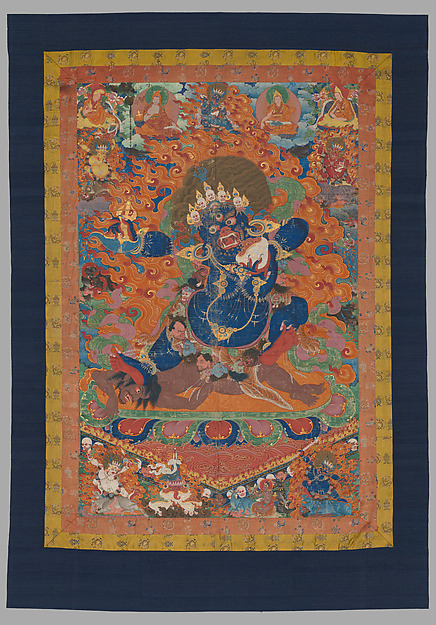
Yamantaka, Destroyer of the God of Death Tibet, early 18th century. Distemper on cloth; image 184.2 x 118.4 cm. Metropolitan Museum of Art, 69.71. Look closer: Note the horned buffalo head at the centre with the crowd of faces above it, and the figures trampled under the feet. The flame is the whole ground of the picture. The Metropolitan Museum of Art, Purchase, Florance Waterbury Bequest, 1969. Public domain, Open Access.
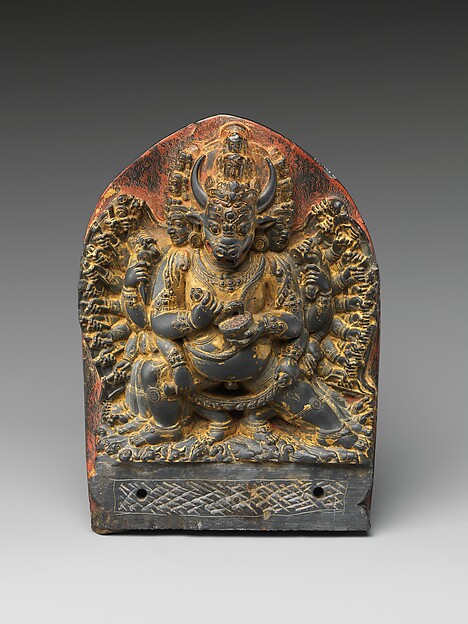
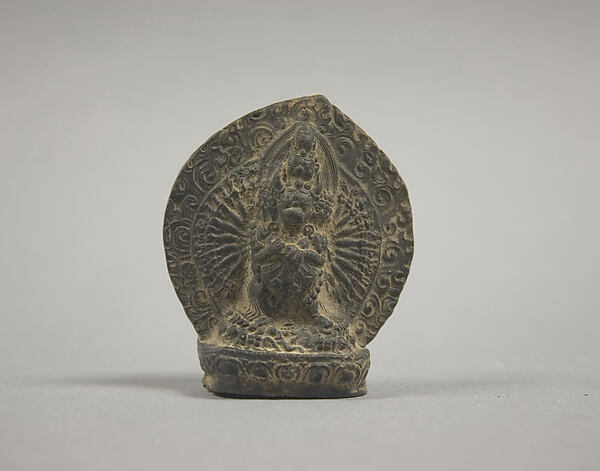
Vajrabhairava Tibet, 15th century. Black stone with traces of polychromy; H. 17.8 cm. Metropolitan Museum of Art, 2015.500.4.20. Look closer: Note the curved horns of the buffalo head, the rows of arms fanned out at both sides and the small crowned faces rising above. The Metropolitan Museum of Art, Gift of Florence and Herbert Irving, 2015. Public domain, Open Access.
In Tibet the king is not a minor guardian but a principal deity. Wikipedia says the best known Yamāntaka belongs to the Anuttarayoga class of tantra and is popular within the Gelug school. The Gelug teaching centre describes him as the forceful form of Mañjuśrī, a father tantra of the highest class, and says that in the Gelug tradition it is the container within which all protector deity practices are done. The tradition traces the elevation to Tsongkhapa.
The images are different from the Japanese ones. The Met's Tibetan painting of the early eighteenth century and its fifteenth-century stone relief show a buffalo-headed figure with a crown of faces and a fan of arms. This is the figure that mirrors Yama, because it has taken Yama's own head. In the Japanese tradition the buffalo has moved down, from the head to the seat, and the king looks like a warrior on a mount.
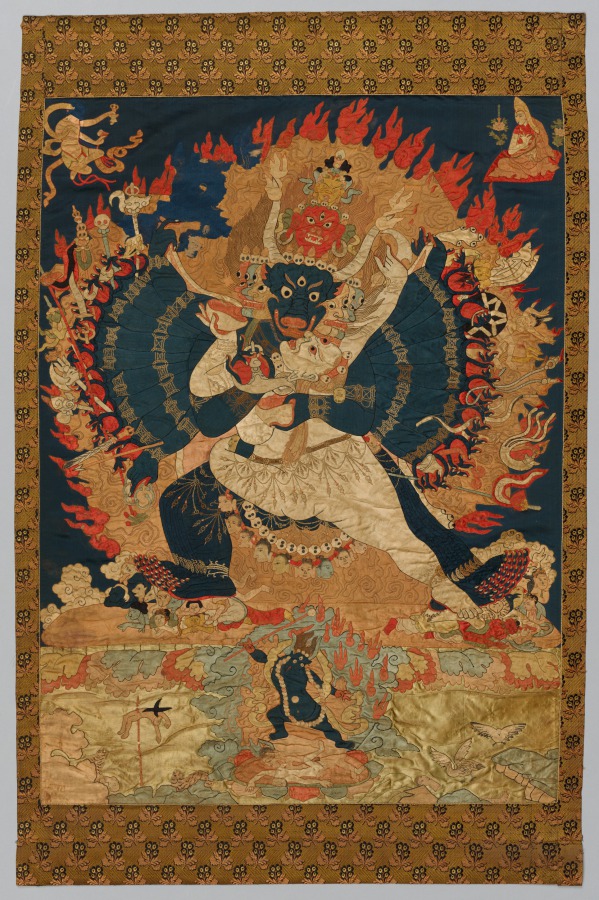
Wikipedia adds that the most common representation is of Vajramahabhairava, with nine heads, thirty-two hands and sixteen legs, standing on Yama and all the devas and asuras, and that he is, like Yama, often shown with a buffalo's head. The Cleveland and Metropolitan catalogues also record versions with a consort, Vajravetali. The Cleveland Museum describes its Qing-dynasty appliqué in terms close to those of the figure's purpose: practitioners meditate on the image to conquer fear of death; Yamāntaka Vajrabhairava, as a manifestation of Mañjuśrī whose gold head is at the apex of his nine heads, demonstrates that wisdom conquers fear and, ultimately, overcomes death itself by leading to enlightenment. With nine heads, thirty-four hands and sixteen legs, it says, he surpasses the powers of Yama, who is the blue figure with the buffalo head below, with only two arms, wielding a skull-topped sceptre.
A mandala in silk
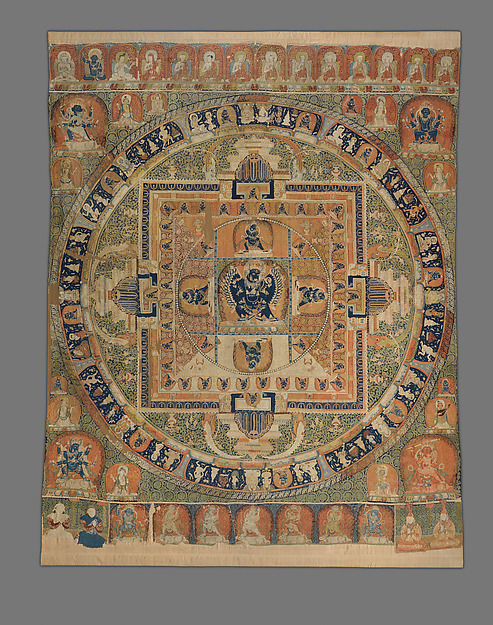
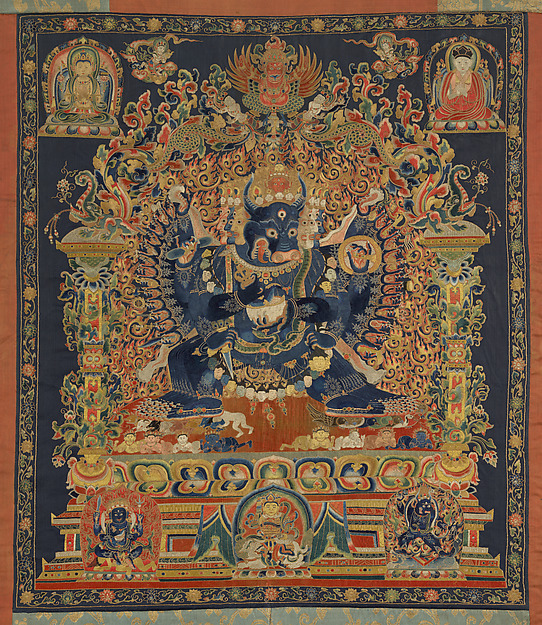
Chinese workshops made the figure in silk for Tibetan and Mongol patrons. The Museum's tapestry mandala of about 1330 to 1332 and its embroidered hanging of the early fifteenth century are both Chinese, and both are catalogued as Vajrabhairava. Neither is Japanese, but the Japanese king is a cousin of both.
Vajrabhairava mandala China, about 1330 to 1332. Silk tapestry (kesi); 245.5 x 209 cm. Metropolitan Museum of Art, 1992.54. Look closer: Look for the dark central deity inside the square palace, the ring of figures around it and the rows of small deities at the top and bottom. The Metropolitan Museum of Art, Purchase, Lila Acheson Wallace Gift, 1992. Public domain, Open Access.The Deity Vajrabhairava, Tantric Form of the Bodhisattva Manjushri China, early 15th century. Silk embroidery with metal thread and horsehair on silk satin; 146.1 x 76.2 cm. Metropolitan Museum of Art, 1993.15. Look closer: Look at the three small deities along the lower edge and the pair of seated teachers in the upper corners. The embroidery is of silk and metal thread. The Metropolitan Museum of Art, Purchase, Lila Acheson Wallace Gift, 1993. Public domain, Open Access.
Yama below
It is a picture of the victory itself. The god of death is not removed from the composition. He is kept at the bottom, small and conquered, which is where the Japanese story also leaves him: converted, and placed in service as a guardian.
Yamantaka Vajrabhairava and consort Vajravetali Southeast China, Qing dynasty, 1700s. Silk appliqué embroidery with paper, metallic thread, hair and ink; 90.2 x 66 cm. Cleveland Museum of Art, 1918.548. Look closer: Look at the small blue figure with a buffalo head in the lower centre. This is Yama, the god of death, shown with only two arms, small beside the terminator who towers above him. Cleveland Museum of Art, Worcester R. Warner Collection, 1918.548. Public domain (CC0), Open Access.
Cousins
Parallels from Asia and the Hindu world
The figure sits where several older stories meet. Hindu Yama, the lord of the dead, is the god Buddhism both inherited and converted. Wikipedia's Yama entry says the Buddhist Yama, though based on the god of the Vedas, developed different myths and functions, and spread far more widely, to China, Nepal, Korea, Japan, Taiwan, Vietnam, Bhutan, Mongolia, Thailand, Sri Lanka, Cambodia, Myanmar and Laos. In the Pali canon, it says, a person who has ill-treated parents, ascetics or elders is taken to Yama at death; and in the Theravāda countries today Yama sends old age and disease as warnings. The Japanese Enma, in the Chinese lineage, is the fifth of the ten kings of the hells, a story told in the chapter on Enma and the Ten Kings.
The Chinese form is the nearest relative. A Ming-dynasty Shuilu ritual painting of Yamāntaka, one of a set of the Ten Wisdom Kings, survives at Baoning Temple in Shanxi, a Ming mural of the ten at Yong'an Temple in Hunyuan, and the Song carvings at Dazu. Wikipedia says that in contemporary Chinese practice the Ten Wisdom Kings are invoked in the Shuilu Fahui ceremony, where they are offered to and entreated to expel evil from the ritual platform, and paintings of them are arranged in a mandala with a direction for each king.
Hindu Shiva is the quiet ancestor. Wikipedia says that one historic source of the name follows Kālāntaka, the aspect of Shiva who saves a follower from Yama, and that the Buddhist prefix 'vajra' on Bhairava marks a conversion. In that reading Daiitoku is a Buddhist answer given in a Hindu idiom, to a question that both religions asked: what is stronger than death?
Figure
Place
What he does
Yama / Enma
India, China, Japan
Judge of the dead; converted to a guardian by Yamāntaka (Wikipedia)
Kālāntaka
Hindu tradition
Shiva as the saviour of a follower from Yama (Wikipedia)
Vajrabhairava
Tibet, Mongolia, China
The nine-headed buffalo-faced form, central to the Gelug school (Wikipedia; Gelug teaching centre)
Dàwēidé Míngwáng
China
One of eight or ten wisdom kings, invoked in the Shuilu ceremony (Wikipedia)
Daiitoku Myōō
Japan
Western king of the five, on a buffalo, with rites for victory (JAANUS)
At the bench
Reading a six-legged king
Votive Plaque with Yamantaka Tibet, about the 8th century or later. Clay; 6.5 x 5.6 cm. Metropolitan Museum of Art, 38.80.9. Look closer: This plaque is only 6.5 centimetres high. Look for the fan of arms behind the figure and the pointed-arch back. It was made to be pressed from a mould in numbers, not carved once. The Metropolitan Museum of Art, Fletcher Fund, 1938. Public domain, Open Access.
Count the legs. A Wisdom King with six legs on a buffalo is Daiitoku; the number is the first sign, and the animal the second. Then count the faces: six in the Japanese form. If the buffalo is missing, as it is from the Met's standing drawing, look for the faces and the weapons.
Weapons are the usual casualty. The Asian Art Museum's plaque has lost the implements its figure once held, and a figure with empty hands is not suspect for that alone. A provenance, such as the plaque's reported Wakayama origin, is worth keeping with the piece.
Beware names. Cleveland catalogues a small early-to-mid-nineteenth-century carved ivory, accession 1920.487, under the title 'Daiitoku'. The carving shows a smiling figure carrying a sack, the type usually identified as the luck god Daikoku, and is nothing like the six-faced king; it is mentioned here only as a warning that the two names are one letter apart and are confused even in museum records. This chapter does not reproduce that object.
Beware reproductions too. A dealer's guide to Daiitoku that was read for this chapter says that Japanese temples still commission new icons, that modern reproductions are acceptable when made with understanding, and that differences in posture or the number of faces and arms can indicate different lineages. Treat that as the dealer's view, and not as scholarship. A modern Tōji-style Godai set is a kind of object that exists, and it is not an antique.
A short checklist
Six faces, six arms, six legs: the Japanese Daiitoku. Nine heads and thirty-odd hands: the Tibetan Vajrabhairava.
A buffalo, or in some sources a white ox, under him. A buffalo's head on the figure itself points to the Tibetan form.
Flames behind. Small trampled figures under the feet in the Tibetan form.
Empty hands do not condemn a statue; look at the wrists and the fingers for the lost implements.
Bronze images of about the twelfth century were made for imprecatory rites (JAANUS), so a small bronze is not necessarily a household altar piece.
Keep any reported provenance with the piece. A temple name or a prefecture is worth more than a date.
Today
Newer facts and modern echoes
The king is still in use. Tō-ji holds a famous flea market on the twenty-first of each month, called Kōbō-san in honour of Kōbō Daishi, which is the day of the memorial service for Kūkai (Wikipedia). Tō-ji has been part of a UNESCO World Heritage Site since 1994. The government's multilingual explanation texts, from which several details above are taken, are written to explain the statues to non-Japanese readers.
In Tibetan communities the practice is current. A Gelug teaching centre advertised a commentary course on Yamāntaka from 11 September to 10 November 2023 with a retreat from 30 November to 18 December 2023, on the condition that participants had received the full initiation into the Highest Yoga Tantra practice. The page records that the practice is open only to those who have been initiated.
In popular culture, the hatnote of Wikipedia's Yamantaka entry points to an album called Yamantaka by Mickey Hart, Henry Wolff and Nancy Hennings. It is the only popular-culture reference this chapter found that rests on a source that was read, and it is mentioned without further claim.
Open to visit
Tō-ji Lecture Hall, Kyoto; Maki Ōdō, Bungotakada (opening hours and fees were not confirmed in the sources read; check before travelling).
On loan or on view
The Met drawing is not currently on view, according to the Museum's page; the Cleveland scroll is catalogued as Open Access.
Recent practice
Gelug teaching on Yamāntaka continued in 2023 (study centre page).
Curiosities
Small facts worth keeping
These are the small things that do not fit a section but are worth knowing, each from a page that was read for this chapter.
Three names, one count. JAANUS names him Rokusokuson, the Six-Footed Venerable, so that the number of his legs is a title.
A drawing that is not a picture. The Met's twelfth-century sheet has a column of notes at the left and no buffalo: it is a model for painters, not a finished icon.
A seal of Kōzanji. The red seal at the lower right of the Met drawing marks an early owner, the monastery of Kōzanji in Kyoto.
The largest wooden Daiitoku. At 241 centimetres, the Maki Ōdō statue is the largest wooden image of the deity in Japan, according to the government's guide.
A buffalo that appears in a legend. The same guide mentions a legend of a nutmeg tree at Fukiji temple and an ox that grew tired, and is doubtful that it explains the buffalo.
Fifteen and six. Fifteen of the twenty-one statues in the Tō-ji Lecture Hall date from the ninth century; six are later replacements.
The god of death is kept small. In the Cleveland appliqué, Yama is the little blue buffalo-headed figure at the bottom, with only two arms.
Wartime pilgrimage. JAANUS says that Daiitokuji in Osaka was until recently a place of pilgrimage in times of war.
A stone with a name. The Met's clay plaque of Yamāntaka is only 6.5 centimetres high and was made in a mould.
Cattle and horses. The Maki Ōdō festival is held for the health and welfare of domesticated animals (Ōita tourism site).
One letter apart. Daiitoku and Daikoku are separated by a single letter of the Roman spelling, and a museum has confused them.
Origins abroad
Across Asia
Yamāntaka appears in Indian, Chinese, Tibetan, Mongolian and Japanese Buddhism, each with its own count of heads and hands. The table sets out what the sources read for this chapter record for each.
Where
Form and name
What the record shows
India
Yamāntaka, 'Terminator of Yama'
Read by Tāranātha as wrathful Mañjuśrī, and in the Mañjuśrīmūlakalpa as Vajrapāṇi; a tenth-century Yamāntaka attends Mañjuśrī at Kurkihar (Wikipedia).
China
Dàwēidé Míngwáng 大威德明王
The wrathful emanation of Amitābha in Chinese Buddhism, with a white ox as mount; one of eight or ten kings; Ming paintings at Baoning Temple and Yong'an Temple (Wikipedia).
Tibet and Mongolia
Vajrabhairava
Nine heads, thirty-two or thirty-four hands, sixteen legs; the principal yidam of the Gelug school (Wikipedia; Gelug teaching centre).
Japan
Daiitoku Myōō (大威徳明王)
West king of the Godai, with rites of subjugation and victory in battle (JAANUS).
Where this figure stands
The king of the west
Daiitoku holds the western point of the Godai Myōō and is, by the doctrine, the wrathful form of Amida. His story, the defeat of death itself, is the largest in the group.
The Buddha of the west whose wrathful form he is (JAANUS; Wikipedia).
Monju (Mañjuśrī)
His older identity in the Indian tradition (JAANUS; Wikipedia).
Enma
The god of death he subdues; in Wikipedia's account Yama repents and becomes a guardian of the Dharma.
Fudō Myōō
The central king of the five, who stands beside him at Maki Ōdō (Japanese government guide).
Pilgrim's notes
Where to see him
Place
What to look for
Makisan Denjōji (Maki Ōdō), Bungotakada, Ōita
A 241 cm wooden Daiitoku of the Heian period, the largest of its kind in Japan, beside the central Amida.
Tōji Lecture Hall, Kyoto
One of the five Wisdom Kings on the west side of the dais; see the Godai chapter. Tō-ji also holds a Heian set of five hanging scrolls.
Daiitokuji, Osaka
An image attributed to Eryō and a wartime pilgrimage site (JAANUS).
Jizōin, Kyoto
Twelfth-century bronze images made for imprecatory rites (JAANUS).
Nezu Museum, Tokyo; Tōshōdaiji, Nara
Examples of the variant in which he stands on three legs on the buffalo's back (JAANUS).
Museum of Fine Arts, Boston
A seated cypress Daiitoku of the twelfth century, 87.9 cm high, bought in Japan in 1905 by Okakura Kakuzō (museum record).
Asian Art Museum, San Francisco
A votive plaque of bronze with gilding and wood, 1185 to 1300, 28 cm across.
Metropolitan Museum of Art, New York
A twelfth-century iconographic drawing, and the Tibetan and Chinese Vajrabhairava works shown above.
Cleveland Museum of Art
The mid-nineteenth-century scroll shown at the top of this page, and the Qing appliqué.
Looking closely
The drawing, once more
Iconographic Drawing of the Wisdom King Daiitoku (Daiitoku Myōō) Japan, Heian period, 12th century. Hanging scroll; ink on paper. 71.8 x 53.7 cm. Metropolitan Museum of Art, 1975.268.13. Look closer: Note the hands joined at the chest and the four implements, with the many faces above. The line is the whole picture: no colour, only ink. The Metropolitan Museum of Art, The Harry G. C. Packard Collection of Asian Art, Gift of Harry G. C. Packard, and Purchase, Fletcher, Rogers, Harris Brisbane Dick, and Louis V. Bell Funds, Joseph Pulitzer Bequest, and The Annenberg Fund Inc. Gift, 1975. Public domain, Open Access.
Beyond the page
In the house
These pieces come from the house's own shelves and carry the Wisdom King tag. The strip refills from what is available now.
Words that recur on labels and in books about the king, with the source for each.
Myōō (明王)
Wisdom King; a wrathful deity who teaches through fear. In Sanskrit vidyārāja, 'mantra king' (Wikipedia).
Godai Myōō (五大明王)
The five great Wisdom Kings, arranged by direction (JAANUS; Wikipedia).
Kyōryōrin-shin (教令輪身)
The 'embodiment of the wheel of injunction', the fierce body of a buddha (Wikipedia).
Sanrinjin (三輪身)
The theory of three wheeled bodies, by which a buddha appears gentle, wise or fierce (Wikipedia).
Konpon-in (根本印)
The root gesture, with both hands joined and both middle fingers extended (Met).
Zuzō (図像)
An iconographic drawing, a model for artists (Met; Cleveland).
Mandara (曼荼羅)
A diagram of a cosmos; Daiitoku has one of his own (JAANUS).
Yidam
A Tibetan meditational deity; Vajrabhairava is the main one of the Gelug school (study centre).
Kakebotoke (懸仏)
A hanging Buddha: a metal or wood disc or plaque bearing a deity, like the Asian Art Museum's plaque.
Yama / Enma (閻魔)
The lord of the dead and judge of the hells (Wikipedia; JAANUS).
Reader questions
Answered plainly
Who is Daiitoku Myōō?
The Wisdom King of the west among the five Godai Myōō, a wrathful form of Amida, called Yamāntaka in Sanskrit, 'the one who ends Yama', the god of death.
What does Daiitoku Myōō mean?
JAANUS reads the name as a Wisdom King of 'great awesome virtue', a god thought powerful enough to conquer death. The Sanskrit name Yamāntaka was later read as 'he who terminates Yama'.
Why does he ride a buffalo?
Wikipedia notes that the animal mirrors Yama, and that Chinese and Shingon forms give a white ox instead. The Japanese government's guide doubts that a local nutmeg-tree legend explains it, because the buffalo also appears in earlier Chinese and Indian images.
How many faces and arms does he have?
Six faces, six arms and six legs in the Japanese form; the Tibetan Vajrabhairava has nine heads and up to thirty-four hands.
What were his rites for?
Subjugation, imprecation and victory in battle, according to JAANUS; warriors about to go into battle used his mandala, according to Buddhistdoor.
Is Daiitoku the same as Vajrabhairava?
Wikipedia treats Vajrabhairava as the Tibetan form of Yamāntaka, with nine heads and up to thirty-four hands. JAANUS lists Vajrabhairava as one of the names and forms he assumed in India.
Where is the largest wooden Daiitoku?
At Maki Ōdō (Makisan Denjōji) on the Kunisaki Peninsula in Ōita, a Heian statue 241 centimetres high.
Which direction does he guard?
The west in the Japanese five-king scheme. JAANUS records that in Indian tantric Buddhism he generally presides over the east, and Chinese groupings of eight and ten place him in the east and the north-east.
Is the Maki Ōdō Daiitoku a National Treasure?
The sources disagree. The Japanese government's guide and Wikipedia's Maki Ōdō entry call the statues Important Cultural Properties; the Ōita tourism site calls them National Treasures. Check the sign at the hall.
Can I see a Daiitoku outside Japan?
Yes. The Museum of Fine Arts, Boston holds a twelfth-century statue; the Metropolitan Museum holds a twelfth-century drawing; the Cleveland Museum holds a mid-nineteenth-century scroll; the Asian Art Museum holds a votive plaque.
Describe the piece or the project you have in mind. A senior advisor in Tokyo reads every case file personally and replies within two business days, with fees set out in writing before any work begins.
Choosing a selection results in a full page refresh.
Opens in a new window.
JAPONISTATOKYO · JAPAN
THE PRIVACY ATELIER
A considered experience.
We use essential cookies for a secure visit. With your permission, additional cookies help us remember your preferences, understand visits and make our communications more relevant. The choice remains yours.
EssentialSecurity, checkout and basic operationAlways active
Essential cookies support secure browsing and checkout. Preference cookies remember your selections. Analytics cookies help us understand site performance. Marketing cookies may be used to measure and tailor advertising.
Optional categories remain off until permission is given where consent is required.
Your preferences are recorded using our store's privacy controls. You may update them whenever you wish.