
Bonten and Taishakuten
The Two Attendants
Bonten and Taishakuten
梵天・帝釈天
Two Hindu gods, a creator and a king of heaven, who knelt before the Buddha and stayed on either side of him for the next two thousand years of temple sculpture.
Identity card
Know the figure at a glance
- Lotus. In triads Bonten usually appears as an ascetic holding a lotus (JAANUS); the Kōfukuji statue holds a lotus flower (MLIT).
- Vajra. Taishakuten may be martial, holding a thunderbolt (JAANUS); Wikipedia places it in his right hand with the left on his hip.
- Four geese. In his esoteric form Bonten rides a lotus platform carried by four geese, his vehicle and a symbol of knowledge (JAANUS).
- Elephant. The early Heian image at Tōji shows Taishakuten on an elephant with one leg hanging over its side (JAANUS).
- Tang robes. At Hokkedō the two wear Tang-style robes and look like bodhisattvas (JAANUS).
- The centre. Two names, one pairing: only dress and mirrored mudra tell them apart in most Japanese images (JAANUS).
A creator and a king
The Japan Architecture and Art Net Users System (JAANUS) opens its entry on Bonten with a single sentence that explains the whole subject: a major Hindu deity, considered the creator of the world, who appears with Taishakuten as a protector of the historical Buddha from the earliest times. Its entry on Taishakuten begins the same way: a major Hindu deity, known in Sanskrit as Indra or Śakra, with two roles in Buddhist literature. He is king of the gods, ruling the Tōriten heaven on the summit of Mount Sumeru, and protector of the Buddha, who helped Shaka during his practice in earlier lives and assisted him in his final life.
Neither gives the Japanese pair an independent cult. JAANUS says each is shown either with the other or as one of the Twelve Devas, and that Taishakuten is linked especially with the east.
A third voice completes the picture. The Wikipedia article on Śakra says that Sakka, the Pali form, is the god of the Heaven of the Thirty-Three on top of Mount Meru, that he is mortal like every deity, and that when one Śakra dies another takes his place. The Wikipedia article on Brahmā in Buddhism makes the matching point about the higher god: in Buddhist texts a Mahābrahmā is described as a protector of the teachings, a dharmapāla, and not as a creator, and in several texts Śakra is the more important of the two. That is a different Brahmā from the one the Hindu tradition calls creator, and the Japanese pair inherits the tension. JAANUS calls Bonten the creator; the Buddhist scriptures keep him in the role of a visitor who asks the Buddha for help.
So the chapter is a double portrait of two gods who changed their jobs. Indra, the thunderbolt-wielding king of the Vedas, becomes a devotee who consults the Buddha on questions of morality. Brahmā, the creator, becomes the senior god who kneels to request a sermon. Neither lost his dignity, and both kept the high seats; what they lost was the claim to be at the top of the cosmos. The Japanese temple halls show them standing a step below the main image, in matching robes, as an honour guard.
The god who asked the Buddha to speak
JAANUS records Bonten's special role as persuading the Buddha to teach after his enlightenment. Wikipedia names the figure who made the request as Brahmā Sahampati, said to be the most senior of the Mahābrahmās, who visited the Buddha after his awakening and encouraged him to teach the Dharma to humans. The Hindu creator, in this story, is the one who comes to ask for the teaching.
Both gods also appear in scenes of the Buddha's life, especially the first bath of the newborn (JAANUS). Wikipedia adds that Śakra often consults the Buddha on questions of morality, and that together with Brahmā he is considered a dharmapāla, a protector of Buddhism.
The Wikipedia article on Brahmā names the other Brahmās who appear in the scriptures, and the list is a small cast of characters. Brahmā Baka, the crane-Brahmā of the Majjhima Nikāya, believes his world is permanent, that he is immortal and that there is nothing higher, and the Buddha criticises that view. Brahmā Ghaṭīkāra, the potter-Brahmā, gave Siddhārtha the eight requisites of a monk when he left home; in a past life he was a potter and a lay disciple of Kāśyapa Buddha. Brahmā Sanatkumāra, 'Ever-young', appears in the Janavasabha Sutta (DN 18), where he makes an illusory presence to be seen by Śakra and the gods of the Thirty-Three. In the Saṃyutta Nikāya a pair of Brahmās is shown conversing with the Buddha. A visitor looking at the stately pair at Tōdai-ji is therefore looking at the portrait of an entire class of beings, not of one named god.
The article also gives the cosmology that makes sense of the pair. Brahmās live in the non-sensual realm, the Brahmaloka, usually in groups under a chief, the Mahābrahmā; texts define seventeen heavenly Brahmā realms or more, in tiers, with Brahmā himself in the highest, Akaniṣṭha. The Dīgha Nikāya says that a student who enters the first jhāna can join a Mahābrahmā in the upper heaven for one kalpa. The Brahmavihāras, the meditative states of loving-kindness and its companions, are linked to the four rūpa-jhānas and to the 'four immeasurables'; Peter Harvey, the article notes, observes that Buddhist scriptures acknowledge that these practices did not originate within Buddhism.
A thunderbolt turned to devotion
The Wikipedia article on Śakra begins its account of the god with a text, the Sakka Saṃyutta of the Saṃyutta Nikāya, which is where, it says, Sakka's mythology and character are set out in the Pali Canon. He plays a significant part in several Jātaka tales. In the Mahāparinibbāna Sutta (DN 16) he speaks a verse that has become standard in Buddhist funeral rites, and in the Mahāparinirvāṇa Sūtra he recites a stanza on the Buddha's death that recognises the Four Noble Truths. He is the central figure of the fourth case in the Book of Equanimity, a Chan koan collection, and the article notes that Śakra is also an epithet of Indra in the Rigveda, where hymn 5.34 centres on him.
He is a king with a family. The article says he is married to Sujā, daughter of the asura chief Vemacitrin (Pali Vepacitti), and that the thirty-three gods and the asuras are generally at war, a war that Sakka resolves with minimal violence and no loss of life. That detail belongs with the chapter on Ashura, where the same asuras appear as one of the eight classes of guardians; here it explains why the Japanese Taishakuten is a general in the Sumeru heaven as well as a courtier of the Buddha.
He is also a god of many names. The article lists Sahassākkha or Sahasrekṣaṇa, 'Thousand Eyes'; Mahendranīla, 'Great Indra the Dark'; and Tiānzhǔ, 'Lord of Heaven'. The Chinese Sahassākkha form is given as Pópo. In Japan he is Taishakuten, Shakudai Kan'in and Indara, and in Tibet brgya sbyin and dbang po. His attributes include the vajra, the indrajāla, a banner, a conch shell and a bow. In Theravāda South-East Asia he has blue or black skin and rides Airāvata, a three-headed elephant; the elephant on which JAANUS places the early Heian Taishakuten at Tōji is the same animal in Japanese dress.
One more statement in the article deserves repeating. The commentator Buddhaghoṣa, it says, identified Sakka with Vajrapāṇi, so that the god is treated as a bodhisattva. That is the doctrine behind the Japanese image of Taishakuten as a bodhisattva-like figure in Tang robes carrying a thunderbolt, the same implement that Vajrapāṇi and the Wisdom Kings carry. The Met's three-pronged vajra of the twelfth century and the Cleveland Museum's three-pronged vajra pestle of the early fourteenth century are the Japanese form of that weapon, a tool of ritual and not of war.
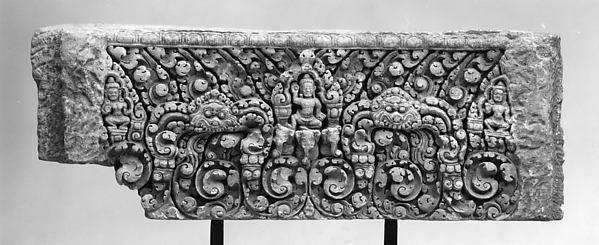
Thailand, 11th–12th century. Grey sandstone; 47 cm. Metropolitan Museum of Art, 1972.214.
Look closer: Note the central figure under the arch with an attendant at each end: Indra appears in the middle of the doorway, a god who guards the threshold.
The Metropolitan Museum of Art, Gift of Mr. and Mrs. Earl Morse, 1972. Open Access.
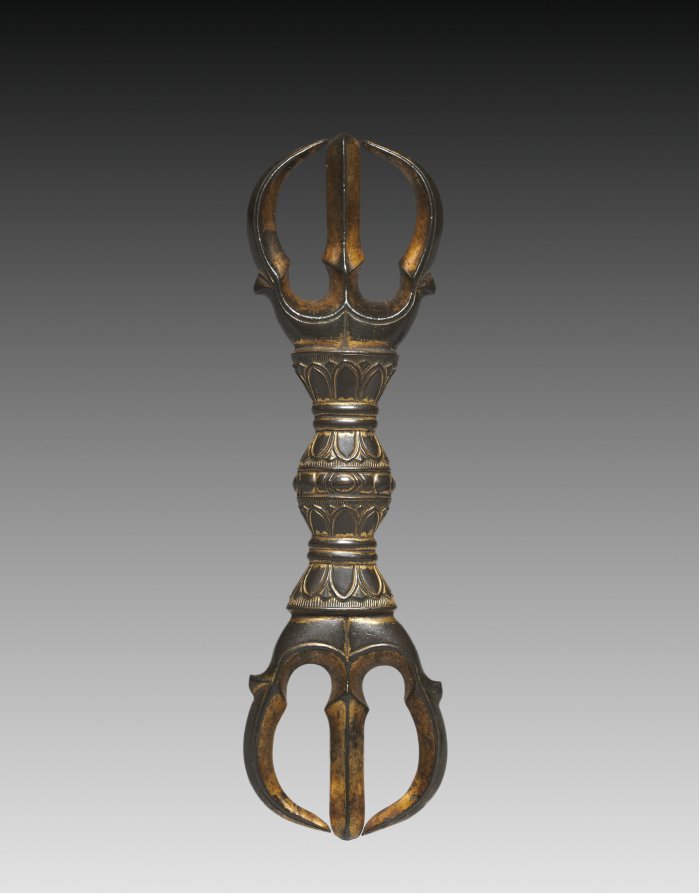
Japan, Kamakura period (1185–1333), early 1300s. Gilt bronze; 17.5 x 5 cm. Cleveland Museum of Art, 1974.264.
Look closer: Note the three prongs meeting at each end around a central blade: the form that Japanese Esoteric Buddhism took from the thunderbolt of Indra.
Cleveland Museum of Art, Gift of Dr. Richard G. Paley. Open Access (CC0).
Four faces and a long beard
The Wikipedia article on Brahmā in Buddhism lists his names across Asia: Fantian in Chinese, Bonten in Japanese, Pomch'on in Korean, Phạm Thiên in Vietnamese, Phra Phrom in Thai and Tshangs pa in Tibetan. In general terms, it says, Buddhist Brahmās are depicted with one face, two arms, two legs and a long beard, a plainer figure than the four-faced god of the Hindu temples. It adds that in Thailand Phra Phrom is seen as a god of order, government, law, students, police, education and the physical world, who is said to have helped shape the world from chaotic matter and to maintain it afterwards.
The Korean record in the Met shows how the god looked to a late sixteenth-century Korean painter. Brahma with Attendants and Musicians is a very large hanging scroll in ink and colour on hemp, 215.9 by 221 centimetres, whose title names a crowd of courtiers and players around a central figure. The central figure is tall and robed, with lines of attendants standing in rows on both sides, and the whole is rubbed and softened by age. The Met's record gives no description of the iconography, and the picture is shown here for what it can teach about scale: a Brahmā who is the centre of a court, not a lone figure in a niche.
Seen together with the Indian and South-East Asian sculptures above, the Korean painting makes a second point. The god keeps his place as a courtly figure across the Buddhist world, but the faces and crowns change with each country. The Japanese Bonten in robes and the Cambodian Brahmā with four faces are one idea in two idioms.
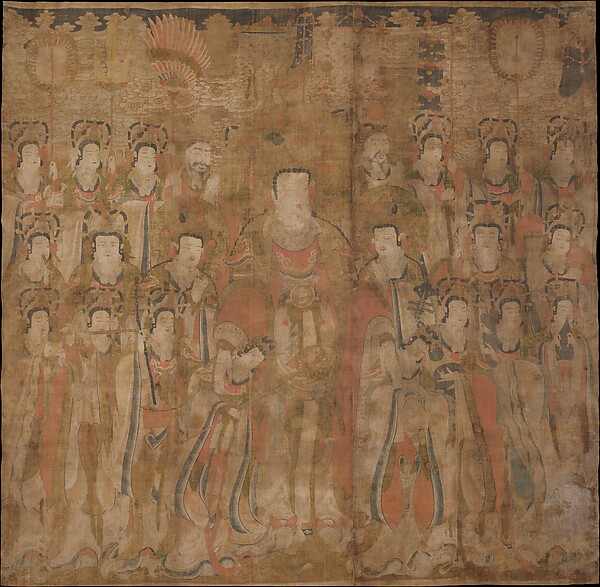
Unidentified artist, Korea, late 16th century. Hanging scroll; ink and color on hemp; 215.9 × 221 cm. Metropolitan Museum of Art, 21.57.
Look closer: Note the rows of standing attendants on both sides of the central figure: the god is the centre of a court, and the artist uses repetition to give the crowd weight.
The Metropolitan Museum of Art, Gift of Mrs. Edward S. Harkness, 1921. Open Access.
Mount Sumeru and the upper realms
Wikipedia places Śakra's Trāyastriṃśa heaven on top of Mount Meru, the polar centre of the physical world around which the Sun and Moon revolve, and calls it the highest heaven in direct contact with humans. Like all deities, it says, Śakra is long-lived but mortal; when one Śakra dies, another succeeds him. In some traditions he is elevated to an enlightened being, a stream-enterer. The Pali form of his name is Sakka, and his character is set out in the Sakka Saṃyutta of the Saṃyutta Nikāya.
Brahmā lives higher. Wikipedia says Brahmā beings occupy the Brahmaloka, among the highest realms in Buddhist cosmology, with ancient and medieval texts counting seventeen or more Brahmā realms. The page sets the Buddhist Brahmā, in general terms, as a figure with one face, two arms, two legs and a long beard, and gives his Tibetan name as Tshangs pa.
Mirror images in Tang robes
JAANUS is candid about the problem. In Japan, it says, the attributes of Bonten are not fixed, and he and Taishakuten differ only slightly, in dress and in mirrored mudra. Only the esoteric forms are distinctive. Bonten there has four heads, a third eye and four arms, rides a lotus platform supported by four geese, wears bodhisattva-style robes and holds a fly whisk, a lotus and a staff, with one palm turned outward. Taishakuten may be a princely figure or a martial one with a thunderbolt, and is seated on an elephant in the early Heian pair at Tōji.
Wikipedia's Twelve Devas table agrees: Bonten may have one or four heads, a third eye and four arms, and sits on a pedestal of four geese, while Taishakuten, dressed as a bodhisattva, is usually martial, with a thunderbolt in his right hand and the left on his hip. JAANUS adds a warning for the bench. Armour under the robe may suggest Taishakuten, but some Japanese paintings show an armoured figure in Bonten's usual place beside the main deity.
The Metropolitan Museum's collection lets you test the JAANUS description against the Indian and South-East Asian originals. A small second-century sandstone head catalogued as Standing Indra, from Mathura or Ahicchatra in Uttar Pradesh, shows the god in a tall turban-like headdress with a plume of vertical ribs; it is 9.4 centimetres high. A twelfth-century gilt copper alloy figure from the Kathmandu Valley shows Seated Indra with one knee raised and an arm resting upon it, inlaid with semiprecious stones, 9.1 centimetres high. A Thai lintel of the eleventh or twelfth century shows Indra and two attendants in the centre of a foliate arch. For Brahmā the Met has a Cambodian sandstone of the first quarter of the tenth century, 120.7 centimetres tall, a standing figure with four faces and a tall tiered crown, and a small Javanese bronze of the late ninth century, 11.4 centimetres, in which a four-armed Brahmā sits on a lotus base with a small bird at the front.
Put those beside the Japanese pair and the family likeness is clear: the four faces, the crown and the extra arms belong to the esoteric Bonten, while the dignified calm of the Nara pair is the face of the same god, retailored in the Tang court style.
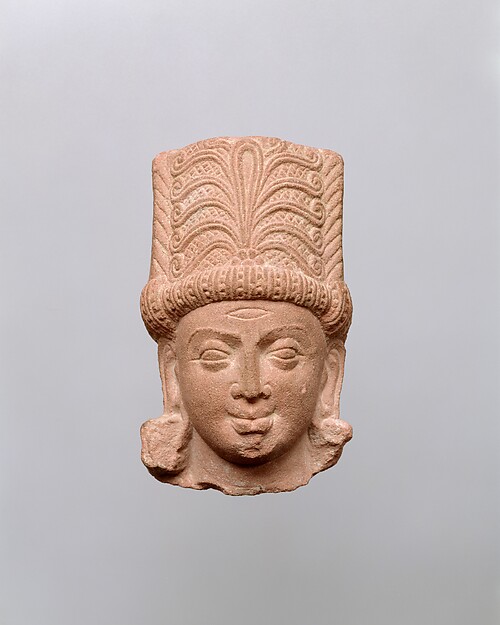
India (Mathura or Ahicchatra), ca. 2nd century. Sandstone; 9.4 cm. Metropolitan Museum of Art, 1987.218.12a, b.
Look closer: Note the tall ribbed headdress, the oldest crown type in this chapter: the Japanese kings and devas wear a descendant of it.
The Metropolitan Museum of Art, Samuel Eilenberg Collection, Ex Coll.: Columbia University, Purchase, Rogers Fund, 1987. Open Access.
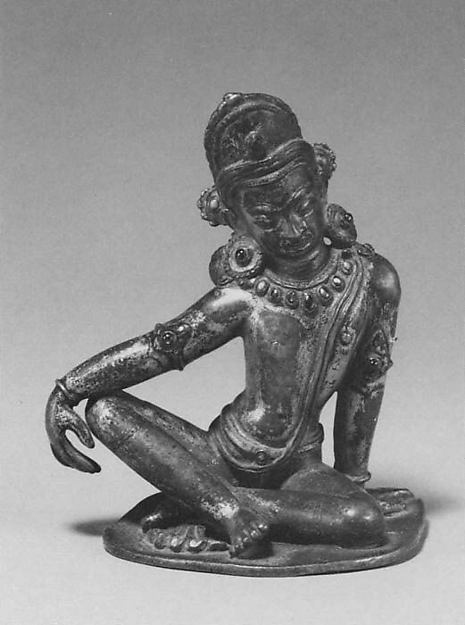
Nepal (Kathmandu Valley), 12th century. Gilt copper alloy, inlaid with semiprecious stones; 9.1 cm. Metropolitan Museum of Art, 1987.142.321.
Look closer: Note the relaxed royal ease, one knee raised and the arm resting on it: a god who is at home in his heaven.
The Metropolitan Museum of Art, Samuel Eilenberg Collection, Gift of Samuel Eilenberg, 1987. Open Access.
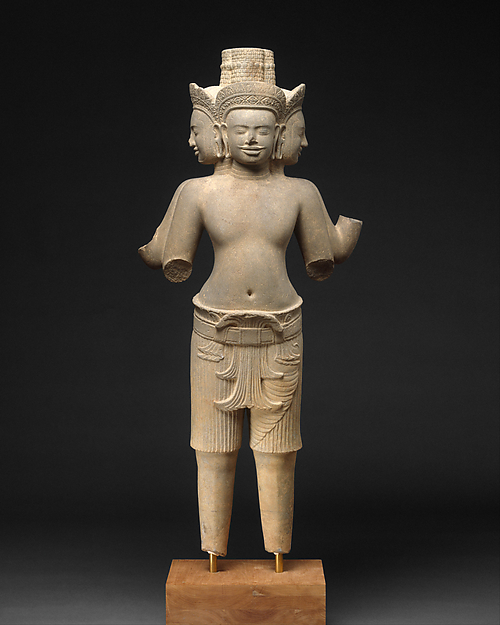
Cambodia, first quarter of the 10th century. Sandstone; 120.7 cm. Metropolitan Museum of Art, 36.96.3.
Look closer: Note the faces turned in four directions under one crown: the multiplication of heads that the esoteric Bonten inherits.
The Metropolitan Museum of Art, Fletcher Fund, 1936. Open Access.
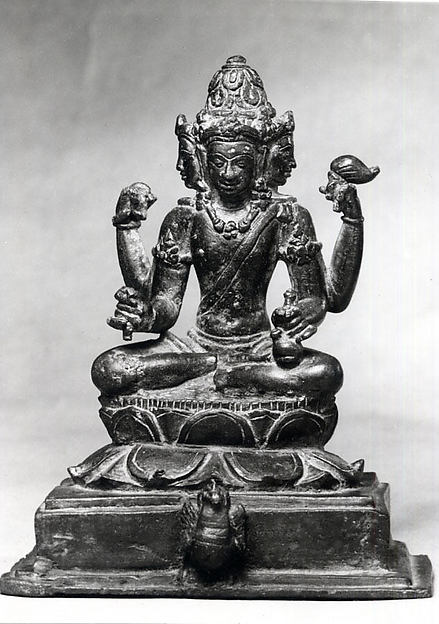
Indonesia (Java), ca. late 9th century. Bronze; 11.4 cm. Metropolitan Museum of Art, 1987.142.168.
Look closer: Note the small bird at the front of the base: the goose of the Brahmā tradition, which JAANUS reads in the esoteric form as four geese beneath a lotus.
The Metropolitan Museum of Art, Samuel Eilenberg Collection, Gift of Samuel Eilenberg, 1987. Open Access.
From Hokkedō to Kōfukuji

Japan, 14th century. Hanging scroll; ink, color, gold, and gold foil on silk; 163.8 x 123.5 cm. Metropolitan Museum of Art, 2000.289.
Look closer: Note the ranks of small deities around the central figure: the guardian gods occupy the outer rings of a mandala, the same place they hold in a temple hall.
The Metropolitan Museum of Art, Mary Griggs Burke Collection, Gift of the Mary and Jackson Burke Foundation, 2000. Open Access.
The earliest pairs named by JAANUS stand in Nara. At the Hokkedō, also called the Sangatsudō, of Tōdaiji, temple tradition holds that the figure to the left of the main image, Fukūkenjaku Kannon, is Bonten and the one to the right is Taishakuten. Both wear Tang-dynasty robes and resemble bodhisattvas. A pair of Nara-period images stands in the Kondō of Tōshōdaiji. At Tōji in Kyoto, JAANUS singles out an early Heian pair as the most striking: Bonten as he appears in the outer court of the Taizōkai mandara, and Taishakuten on his elephant with a single-pronged thunderbolt in the right hand.
The Japanese Ministry of Land, Infrastructure, Transport and Tourism (MLIT) documents a later pair. Two wooden standing statues of the early thirteenth century, Kamakura period and Important Cultural Properties, were originally displayed in the Western Golden Hall, the Saikondō, of Kōfukuji and are now in the National Treasure Hall in Nara. Bonten holds a lotus; Taishakuten wears armour and holds a scroll. MLIT says the statues imitate twelfth-century Song Chinese styles but are adapted to a Japanese taste, visible in the upturned shoe tips with ornate decoration and the wavy pleats along the collars and sleeve cuffs.
The long life of the pair in painting is documented by the Met's twelve-guardian sets. The museum holds several hanging scrolls from fourteenth-century series, each titled One of the Twelve Celestial Guardians, in which individual deities are not named in the title. They show the format in which the Twelve Devas hung at Tōji and other halls: one figure to a scroll, tall and narrow, with a halo or a disc and a ground of dark silk. The Met's mandala of the bodhisattva Hannya, of the fourteenth century, 163.8 by 123.5 centimetres, is another reminder that the heavenly pair stand in the outer rings of larger designs. The central figure of that mandala sits in a square of deities, with ranks of smaller figures outside and a dragon-adorned border at the corners.
| Site | Image (JAANUS, MLIT) |
|---|---|
| Hokkedō, Tōdaiji, Nara | Nara period; by temple tradition flanking Fukūkenjaku Kannon, in Tang robes |
| Kondō, Tōshōdaiji, Nara | A Nara-period pair |
| Tōji, Kyoto | Early Heian pair; Taishakuten on an elephant with a thunderbolt |
| Kōfukuji Saikondō pair, Nara National Treasure Hall | Early 13th century, Kamakura; Bonten with lotus, Taishakuten in armour with a scroll |
Two of the twelve guardians
As Wikipedia sets out, the Twelve Devas guard the directions: Taishakuten the east, Bonten the zenith, with the sun, the moon, earth, fire, water, wind and the other regents. The Twelve Devas paintings at Tōji were used in the esoteric New Year ritual called the Goshichinichi no mishiho, the Latter Seven Days Ritual. In that circle Taishakuten holds the east and Bonten the zenith.
The Metropolitan Museum owns two sets of Japanese hanging scrolls from fourteenth-century Twelve Celestial Guardians series, one hand-coloured print on paper and one ink, colour and gold on silk. The Met's titles do not name the individual guardians. The figure in the first, though, with a crowning small face, a lotus in one hand and a staff in the other, matches the iconography JAANUS gives for Bonten.
A temple of the thunder-king in Katsushika
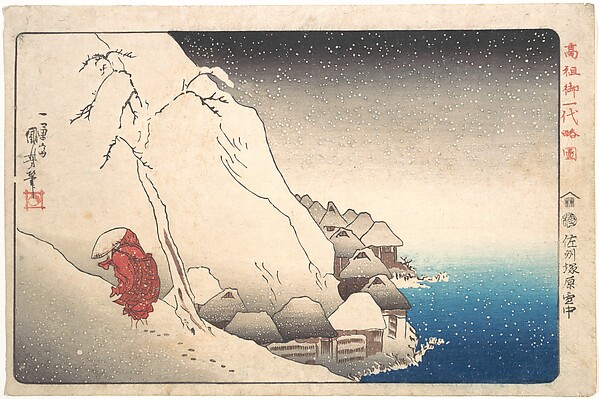
Utagawa Kuniyoshi, Japan, 1835–36. Woodblock print; ink and color on paper; 24.8 x 37.5 cm. Metropolitan Museum of Art, JP2856.
Look closer: Note the single red figure in a white field: the print makes the monk's solitude the subject, and the red is the only strong colour in the sheet.
The Metropolitan Museum of Art, Henry L. Phillips Collection, Bequest of Henry L. Phillips, 1939. Open Access.
The best-known temple of the god in Japan is not an ancient one. Shibamata Taishakuten, whose proper name is Daikyō-ji, stands in Katsushika ward in eastern Tokyo. The Wikipedia article on the temple says it belongs to the Nichiren sect, was founded in 1629 (Kan'ei 6) by Nicchū and Nichiei, has Taishakuten as the main image of its mandala honzon, and lies at 7-10-3 Shibamata. It records that in 1996 the Ministry of the Environment designated the temple and its ferry as one of the 100 Soundscapes of Japan, and that in 2009 the temple and its ferry were selected as one of the 100 Landscapes of Japan.
The visitor directory GLTJP adds that the temple's official name is Kyōeizan Daikyō-ji and that it has ita-honzon, board images, of Taishakuten, said to have been carved by a Nichiren high priest; the site does not describe them as an engraved board. It points out the Carvings Gallery, which displays carvings related to the Lotus Sutra, and the Suikeien garden, and describes the road from Shibamata Station as an old-fashioned shopping street busy every day.
A third source, the Old Tokyo site, supplies the architecture. The Nitenmon gate dates from 1896, with statues thought to be Heian; the main hall, the Soshidō, from 1888; the inner shrine, the Taishakudō naiden, from 1915; the hall of worship, the haiden, from 1929; the guest house from 1929; the bell tower from 1950; and the Suikeien garden was completed in 1965 by Nagai Rakuzan. The carvings, the site says, were made between 1922 and 1934, depict scenes from the Lotus Sutra at the centre, show the Chinese zodiac in the upper section and cranes, birds and flowers below, and are protected by a glass structure; the article calls them '3D paintings' because the figures seem to come alive when seen from the side. It records a charge of 400 yen for the carvings on the east, north and west sides in the summer of 2017, which may have changed.
The temple is also the setting for a film series. Wikipedia and GLTJP both name Otoko wa tsurai yo, the long-running series about the wandering Tora-san, as having used the area, and the Old Tokyo site says the character is shown interested in the carvings introduced in the 1920s. None of the pages gives a film count or a date for the series, and this page does not supply one.
To put the Nichiren connection in context, the Met holds a set of Utagawa Kuniyoshi prints from 1835 and 1836 illustrating the life of the monk Nichiren. One shows the monk in exile on Sado Island, a red-robed figure walking through deep snow beside a village and a deep blue sea. Nichiren's school is the one that places the Lotus Sutra at the centre and that honours the guardians of the sutra, among them Taishakuten; the print is not a picture of the god, and is shown only to give the temple's school a face.
Games, comics and the thousand eyes
The Wikipedia article on Śakra lists the god's modern appearances, with the caution that some are loose. He appears in the mobile game Monster Strike; he is a villain in the Chinese comic Fung Wan and in the manga RG Veda; and the article says that Indra Ōtsutsuki in Naruto is loosely based on him, with a younger brother named Asura. It also suggests that Mr. Popo in Dragon Ball may connect to Sahassākkha's Chinese name Pópo, and that the thirty-two trees on the Lookout parallel the thirty-two palaces of Trāyastriṃśa, with the thirty-third being Sakka's own. The article presents both of these as possible links, and so does this page.
In the wider world the two gods keep a quieter public life. The Wikipedia article notes that Chinese Buddhism sometimes identifies Śakra with the Jade Emperor, that the two share a birthday on the ninth day of the first lunar month, and that he is one of the Twenty-Four Guardian Devas; that Korean folk religion equates him with Haneullim, and that the Samguk yusa makes him the father of Hwanung; that in Mongolian Buddhism Qormusta Tengri is syncretised with him and linked to the creation of fire; and that Bangkok's ceremonial name alludes to him.
As for the pair in Japan, JAANUS and the Wikipedia article on the Twelve Devas stay in the passive voice: they appear in sets and are painted for esoteric ritual. The living face of the god today is the temple at Shibamata, the film road and the festivals of the Nichiren school, together with the museum halls in Nara where the Kamakura pair stand. A reader planning a visit should check the Tōdai-ji and Nara National Museum notices for what is on view; this page has not found current display dates.
Two more of the Met's fourteenth-century guardian scrolls appear below. They are from the same family of twelve-guardian sets as the Bonten and Taishakuten scrolls in the gallery, and show the other members of the circle that the pair guard: one with a disc in its hand and a ground of dark silk, the other wreathed in flames.
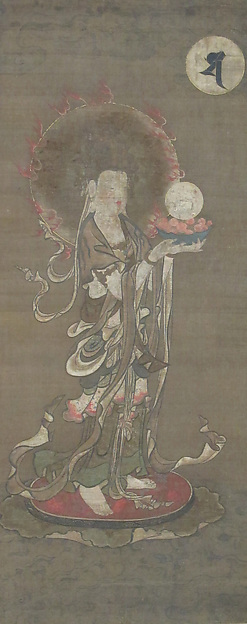
Japan, second half 14th century. Hanging scroll (from a set of twelve) mounted as framed panel; ink, color, and gold on silk; 99.1 x 40.6 cm. Metropolitan Museum of Art, 44.35.5.
Look closer: Note the white disc held in the hand and echoed by the roundel at the upper right: in a twelve-guardian set each figure carries the sign of its office.
The Metropolitan Museum of Art, Gift of Susan Dwight Bliss, 1944. Open Access.
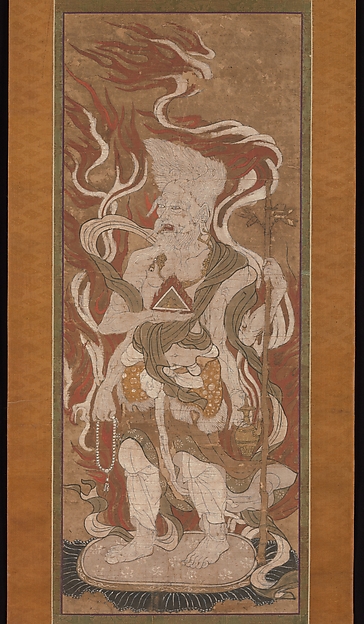
Japan, 14th century. Hanging scroll (from a set of twelve); hand-colored print on paper; 76.5 x 32.1 cm. Metropolitan Museum of Art, 1975.268.30.
Look closer: Note the flames wreathing the body: this guardian is read from its fire, as the other figures are read from their discs and weapons.
The Metropolitan Museum of Art, The Harry G. C. Packard Collection of Asian Art, Gift of Harry G. C. Packard, and Purchase, Fletcher, Rogers, Harris Brisbane Dick, and Louis V. Bell Funds, Joseph Pulitzer Bequest, and The Annenberg Fund Inc. Gift, 1975. Open Access.
Which one is on the shelf
The honest question for a collector is whether a figure is Bonten or Taishakuten at all. JAANUS says the attributes are not fixed in Japan, that the two differ only slightly in dress and in mirrored mudra, and that only the esoteric forms are distinctive. If a figure carries a lotus and wears bodhisattva robes it is likely Bonten; if it carries a scroll or a thunderbolt and wears armour under the robe it may be Taishakuten, though JAANUS warns that some Japanese paintings put an armoured figure in Bonten's usual place. A piece with four faces and four arms on a base of four geese is the esoteric Bonten, and a figure on an elephant with a single-pronged vajra is the esoteric Taishakuten.
Pairs matter. Because the two were made as a matched set, a single figure from a pair may have lost its companion, and the missing partner changes the reading. Ask whether the piece was made to stand to the left or to the right of a main image, since the mirrored gestures only make sense in place. Ask about the wood and the colour, and ask whether the lotus, scroll or vajra in the hand is original. If you are looking for one half of a pair, or for a Twelve Devas scroll, the concierge desk can search Japan for the exact deity and period.
Ten small facts
- Taishakuten's names include 'Thousand Eyes' and 'Great Indra the Dark' (Wikipedia, Śakra).
- Indra's name is an epithet of Śakra in the Rigveda, in hymn 5.34 (Wikipedia, Śakra).
- A Mahābrahmā in Buddhist texts is described as a protector of the teachings, not a creator (Wikipedia, Brahma).
- Brahmā Ghaṭīkāra, the potter-Brahmā, gave the future Buddha the eight requisites of a monk (Wikipedia, Brahma).
- Sakka is married to Sujā, daughter of the asura chief Vemacitrin (Wikipedia, Śakra).
- Shibamata Taishakuten was founded in 1629 (Wikipedia) and its carvings were made between 1922 and 1934 (Old Tokyo).
- The Nitenmon gate of Shibamata dates from 1896; the Suikeien garden was completed in 1965 (Old Tokyo).
- In 1996 the Shibamata temple and its ferry were named among the 100 Soundscapes of Japan, and in 2009 among the 100 Landscapes (Wikipedia).
- Chinese Buddhism sometimes identifies Śakra with the Jade Emperor, and the two share a birthday on the ninth day of the first lunar month (Wikipedia).
- At Tōji the early Heian Taishakuten sits on an elephant and holds a single-pronged thunderbolt (JAANUS).
Across Asia
Two gods carried out of India with their names changed at every border.
| Where | Form and name | What the record shows |
|---|---|---|
| India | Brahmā; Indra | Hindu creator god and king of the gods; Buddhism takes both as dharmapāla (JAANUS, Wikipedia). |
| Sri Lanka | Brahmā and Indra in bronze | Two ninth-century bronzes, Indra as Regent of the East with elephant and vajra, Brahmā standing on a turtle (Met). |
| China | Fantian 梵天; Dishitian 帝釋天 | Dishitian is also written Shìtí Huányīn; Śakra is one of the Twenty-Four Guardian Devas (Wikipedia). |
| Korea | Pomch'on; Jeseokcheon | The Korean readings (Wikipedia). |
| Tibet | Tshangs pa; brgya byin | Brahmā and Śakra in Tibetan (Wikipedia). |
| Japan | Bonten 梵天; Taishakuten 帝釈天 | A pair beside the Buddha, or among the Twelve Devas (JAANUS). |
| Thailand | Phra Phrom; Indra on a lintel | Phra Phrom is a god of order, law and education in Thai thought; the Met has an eleventh- or twelfth-century lintel of Indra (Wikipedia, Met). |
| Korea | Haneullim; Pomch'on | Korean folk religion equates Śakra with Haneullim; a late sixteenth-century Brahmā scroll is in the Met (Wikipedia). |
| Mongolia | Qormusta Tengri | Syncretised with Śakra and linked to the creation of fire (Wikipedia). |
| Cambodia and Java | Brahmā in sandstone and bronze | A tenth-century Cambodian standing figure and a ninth-century Javanese seated one are in the Met. |
The elder gods of the heavens
Bonten and Taishakuten belong to the Heavenly Beings. They are the oldest of the group, Indian gods whom Buddhism took on as protectors and placed beside the Buddha.
| Companion | Why they meet |
|---|---|
| Shaka (the historical Buddha) | The pair stand on either side of him in life scenes such as the first bath (JAANUS). |
| Bishamonten | Fellow member of the Twelve Devas, guarding the north (Wikipedia). |
| Fukūkenjaku Kannon | The central image at Hokkedō, flanked by the pair by temple tradition (JAANUS). |
Where to see them
| Place | What to look for |
|---|---|
| Hokkedō (Sangatsudō), Tōdaiji, Nara | Nara period; by temple tradition on either side of Fukūkenjaku Kannon (JAANUS). |
| Kondō, Tōshōdaiji, Nara | A pair of Nara-period images (JAANUS). |
| Tōji, Kyoto | The early Heian pair, Taishakuten on his elephant (JAANUS). |
| National Treasure Hall, Nara | The Kōfukuji Saikondō pair of the early 13th century (MLIT). |
| Metropolitan Museum of Art, New York | Sri Lankan bronzes of Indra and Brahmā and a set of Twelve Celestial Guardians scrolls, in open access. |
| Shibamata Taishakuten (Daikyō-ji), Tokyo | A Nichiren temple of 1629 with carvings of 1922 to 1934 and a garden of 1965 (Wikipedia, Old Tokyo). |
| Metropolitan Museum of Art, New York | Indra and Brahmā in Indian, Nepalese, Cambodian, Javanese and Korean works, open access. |
| Cleveland Museum of Art | A three-pronged vajra pestle of the early fourteenth century, open access. |
Four views in the Metropolitan Museum
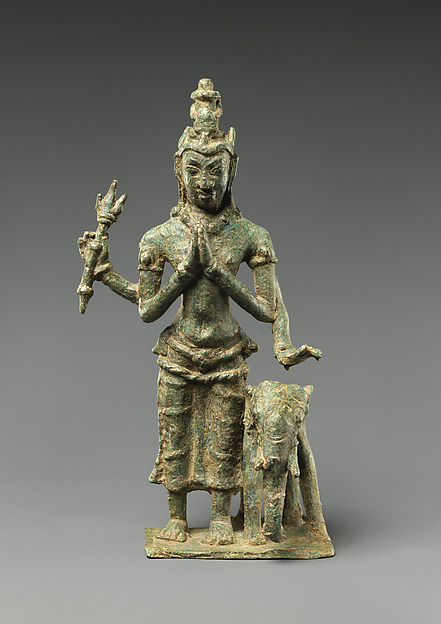
Sri Lanka, 9th century. Bronze; H. 22.9 cm. Metropolitan Museum of Art, 2005.468.2.
Look closer: Note the vajra held up beside the head and the small elephant at the right foot.
The Metropolitan Museum of Art, Gift of Guardian of the Flame Collection, 2005. Open Access.
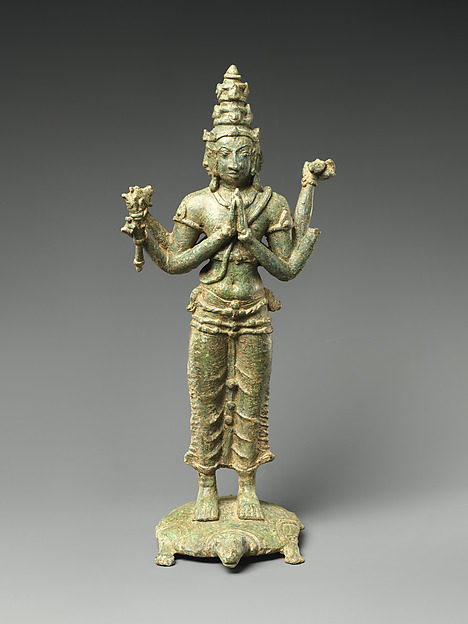
Sri Lanka, 9th century. Bronze; H. 31.8 cm. Metropolitan Museum of Art, 2003.548.2.
Look closer: Note the tall tiered crown and the four arms, two of them joined at the chest.
The Metropolitan Museum of Art, Gift of Guardian of the Flame Collection, 2003. Open Access.

Japan, 14th century. Hanging scroll, hand-coloured print on paper; image 81.3 x 32.4 cm. Metropolitan Museum of Art, 1975.268.29.
Look closer: Note the extra face crowning the head and the lotus and staff, the attributes JAANUS lists for Bonten; the Met does not name the figure.
The Metropolitan Museum of Art, The Harry G. C. Packard Collection of Asian Art, Gift of Harry G. C. Packard, and Purchase, Fletcher, Rogers, Harris Brisbane Dick, and Louis V. Bell Funds, Joseph Pulitzer Bequest, and The Annenberg Fund Inc. Gift, 1975. Open Access.
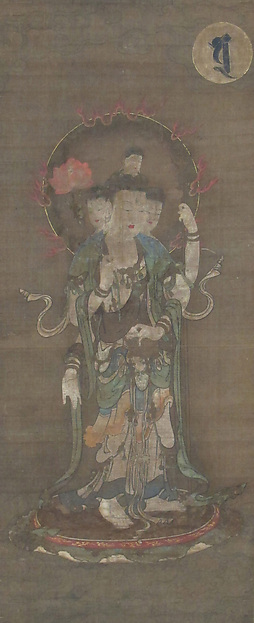
Japan, second half of the 14th century. Hanging scroll mounted as framed panel; ink, colour and gold on silk; 99.1 x 40.6 cm. Metropolitan Museum of Art, 44.35.4.
Look closer: Note the Sanskrit seed syllable in the roundel at the upper right, which marks each guardian in such a set.
The Metropolitan Museum of Art, Gift of Susan Dwight Bliss, 1944. Open Access.
At the desk
No Bonten or Taishakuten piece is on the shelves today. If one arrives it will appear here; meanwhile the concierge desk can look for a figure, scroll or print.
A short glossary
- Bonten (梵天)
- The Japanese name of Brahmā, senior god of the upper realms.
- Taishakuten (帝釈天)
- The Japanese name of Indra or Śakra, king of the Thirty-Three gods.
- Brahmā Sahampati
- The Brahmā who asked the Buddha to teach after his awakening.
- Mahābrahmā
- The chief of a group of Brahmās, a protector of the teachings.
- Brahmaloka
- The Brahmā realms, among the highest in Buddhist cosmology.
- Trāyastriṃśa
- The Heaven of the Thirty-Three on top of Mount Meru, ruled by Śakra.
- Sakka
- The Pali form of Śakra.
- Airāvata
- The three-headed elephant on which Indra rides in South-East Asian tradition.
- Vajra (金剛杵)
- The thunderbolt, the ritual weapon of Indra and of Esoteric Buddhism.
- Sankosho (三鈷杵)
- The three-pronged ritual vajra of Japanese Esoteric Buddhism.
- Jūniten (十二天)
- The Twelve Devas, the guardians of the directions and heavenly bodies.
- Honzon
- The principal image or object of worship at a temple.
- Ita-honzon
- A board image carved in relief and worshipped as a principal image.
- Naiden
- An inner shrine, as at Shibamata Taishakudō.
- Asura
- A class of warrior beings at war with the gods of the Thirty-Three.
Answered plainly
Who are Bonten and Taishakuten?
Hindu gods, Brahmā the creator and Indra or Śakra the king of the gods, adopted as protectors of the Buddha (JAANUS).
What did Bonten do for the Buddha?
He persuaded the Buddha to teach after his enlightenment (JAANUS); Wikipedia names him as Brahmā Sahampati.
How can I tell them apart?
In most Japanese images only dress and mirrored mudra differ (JAANUS); armour or a vajra suggests Taishakuten, a lotus suggests Bonten.
Which direction does each guard?
Taishakuten the east and Bonten the zenith among the Twelve Devas (Wikipedia).
Where are the oldest pairs?
Nara-period images at Hokkedō of Tōdaiji and the Kondō of Tōshōdaiji (JAANUS).
Do they have their own temples in Japan?
No; JAANUS says neither had an independent cult.
Where is the best-known temple of Taishakuten?
Shibamata Taishakuten, properly Daikyō-ji, in Katsushika ward in Tokyo; a Nichiren temple founded in 1629 (Wikipedia).
Is Taishakuten the same as Indra?
Yes. JAANUS gives the Sanskrit as Indra or Śakra; the Wikipedia article on Śakra lists Taishakuten, Shakudai Kan'in and Indara as Japanese names.
Is Bonten a creator god in Buddhism?
Not in the scriptures. The Wikipedia article on Brahmā says a Mahābrahmā is described as a protector of the teachings, not a creator, though JAANUS calls Bonten the creator in the Japanese tradition.
Why does Indra carry a vajra?
The vajra is among his attributes in the Wikipedia article on Śakra; the three-pronged form in Japan is the ritual implement of Esoteric Buddhism.
Where next
Sources and image credits
- JAANUS, Bonten 梵天 (Columbia University)
- JAANUS, Taishakuten 帝釈天 (Columbia University)
- MLIT multilingual database, Statues of Bonten and Taishakuten
- Wikipedia, Twelve Devas
- Wikipedia, Brahma (Buddhism)
- Wikipedia, Śakra (Buddhism)
- Metropolitan Museum of Art, Indra, Lord of the Gods: Regent of the East (2005.468.2)
- Metropolitan Museum of Art, Brahma Standing on a Turtle (2003.548.2)
- Metropolitan Museum of Art, One of the Twelve Celestial Guardians (1975.268.29)
- Metropolitan Museum of Art, One of the Twelve Celestial Guardians (44.35.4)
- Wikipedia, Śakra (Buddhism), second reading
- Wikipedia, Brahma (Buddhism), second reading
- Wikipedia, Shibamata Taishakuten
- GLTJP, Shibamata Taishakuten Daikyo-ji Temple
- Old Tokyo, Shibamata Taishakuten Temple 3D wood paintings
- Metropolitan Museum of Art, Standing Indra (1987.218.12a, b)
- Metropolitan Museum of Art, Seated Indra (1987.142.321)
- Metropolitan Museum of Art, Lintel with Indra and Two Attendants (1972.214)
- Metropolitan Museum of Art, Brahma (36.96.3)
- Metropolitan Museum of Art, Seated Brahma (1987.142.168)
- Metropolitan Museum of Art, Brahma with Attendants and Musicians (21.57)
- Metropolitan Museum of Art, Mandala of the Bodhisattva Hannya (Prajnaparamita) (2000.289)
- Cleveland Museum of Art, Three-pronged Vajra Pestle (Sankosho) (1974.264)
- Metropolitan Museum of Art, Monk Nichiren in Exile on Sado Island, from the series "Illustration of Famous Monks" (JP2856)
- Metropolitan Museum of Art, One of the Twelve Celestial Guardians (44.35.5)
- Metropolitan Museum of Art, One of the Twelve Celestial Guardians (1975.268.30)
Last reviewed 28 October 2026. Pictures are public-domain or openly licensed, each credited beneath it. Diagrams on this page are drawn by Japonista.
Looking for a Bonten or Taishakuten figure, scroll or print? Tell the concierge desk what you have in mind and we will search Japan for it.
Private concierge
Looking for something in particular?
Describe the piece or the project you have in mind. A senior advisor in Tokyo reads every case file personally and replies within two business days, with fees set out in writing before any work begins.