
Benzaiten
Lady of Rivers and Song
Benzaiten
弁才天
A river of the Rigveda that learned to play the lute: the goddess of music, eloquence and fortune, who came to Japan in a sutra, took three island shrines, married her dragon to the cause of peace, and joined the Seven Lucky Gods.
Identity card
Know the figure at a glance
- A jewelled crown. In the Met's scroll she wears a tall crown above a calm, pale face.
- The biwa. The four-stringed lute is the sign of the biwa type (JAANUS) and the parallel of Sarasvatī's veena (Wikipedia).
- The jewel. Wikipedia notes that she may hold a sword and a wish-granting jewel (cintāmaṇi). The diagram draws the jewel.
- The eight arms. The sutra type has eight arms with weapons (JAANUS); the diagram shows the two-armed biwa type.
- The white serpent. JAANUS notes that she is sometimes seated on a white serpent; the Met's 1832 print shows her seated on a white dragon.
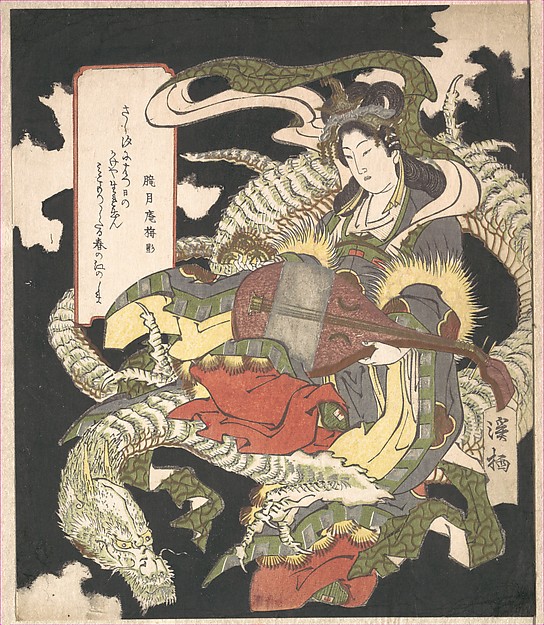
Aoigaoka Keisei, Japan, 1832. Surimono woodblock print; ink and colour on paper; 21.6 x 18.4 cm. Metropolitan Museum of Art, JP2048.
Look closer: Note the dragon's coils framing the lute, the golden flame-tufts at her sleeves and at the dragon's mane, and the verse card at the upper left, which makes this a privately printed greeting rather than a devotional image.
The Metropolitan Museum of Art, H. O. Havemeyer Collection, Bequest of Mrs. H. O. Havemeyer, 1929. Open Access.
A river that became a goddess
Benzaiten began as water. Wikipedia explains that Sarasvatī was a river goddess of the Rigveda, the deification of the Sarasvatī River, later identified with Vāch, the Vedic goddess of speech, and so became a patroness of music, the arts and learning. The Rigveda (6.61.7) even calls her the Vṛtra-slayer, a warrior trait that is easy to forget in the lute-playing figure of later centuries.
The Japan Architecture and Art Net Users System (JAANUS) gives her Japanese form the same range. She is a Buddhist goddess of music, learning, eloquence, wealth, longevity and protection from natural disasters, who was adopted into the Buddhist and later the Shinto pantheon. Her other names are Daibenzaiten, Myōonten and Bionten, and Benten is the most common.
This chapter follows her along the road she took. It begins on the banks of a Vedic river, passes through a Chinese translation of a sutra, and lands on three island shrines, at Enoshima in the east, Chikubushima in the middle and Itsukushima in the west. Along the way she acquires a white snake, fifteen boy attendants, a rice-god alias, a nude form that is never dressed, a coin-washing spring in Kamakura, a place among the Seven Lucky Gods and, in the twenty-first century, an anime signboard. Each stop is dated as far as the sources allow, and where the sources disagree the disagreement is shown.
From river to speech to song
Wikipedia's article on Saraswati gives the Sanskrit name as a compound meaning 'one with plenty of water'. In the earliest passages of the Rigveda the word refers to a river, listed among several rivers of the north-west of the subcontinent, and so the goddess is a river deity. In Book 2 she is praised as the best of mothers, of rivers and of goddesses. Her importance grows in the later Vedas and the Brahmanas, and in those later texts she is increasingly identified with Vāch, the goddess of speech, until the two merge. As the identification advances, her tie to the river weakens and her tie to speech, poetry and music grows.
She was never only gentle. Wikipedia notes that she and Vāch both show warrior traits. She is called the Vṛtra-slayer in Rigveda 6.61.7, she is associated with the Maruts and the Ashvins, and in a hymn of Book 10 Vāch declares that she bends the bow for Rudra. Bernard Faure, writing on the Japanese goddess, observes that these martial attributes may have been retained when she entered Buddhism. That matters for what follows, because the first Japanese images of Benzaiten are not women with lutes but armed figures with eight arms.
In India the later, familiar Saraswati is described by Wikipedia as a woman in white, representing the quality of sattva or goodness, with four arms that hold a book, a rosary, a water pot and a veena. Beside her stands a mount, either a hamsa, the white goose or swan, or a peacock. One of the earliest known shrines to her is Sharada Peeth in Kashmir, dated by Wikipedia to the sixth to twelfth centuries. Her festival is Vasant Panchami, the fifth day of spring, when children are helped to write the letters of the alphabet. The two Indian prints below show the same lute-playing figure that the Japanese biwa answers.
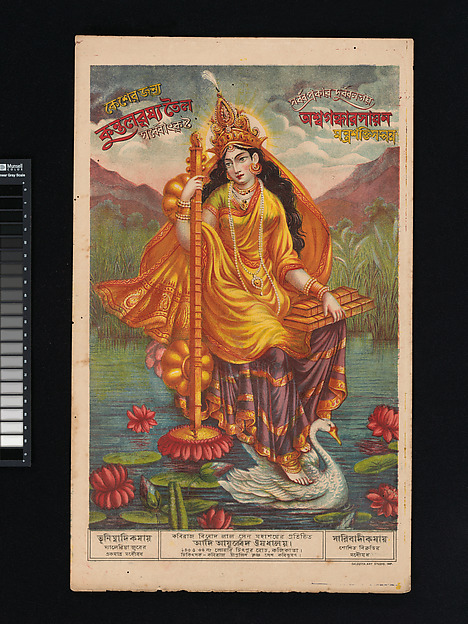
India, ca. 1885-95. Lithograph; image 38.4 x 25.4 cm. Metropolitan Museum of Art, 2013.4.
Look closer: Note the swan beneath her and the lotus-covered water: the river goddess and her bird are both present, and the long veena is held across her lap.
The Metropolitan Museum of Art, Purchase, Anonymous Gift, 2013. Open Access.
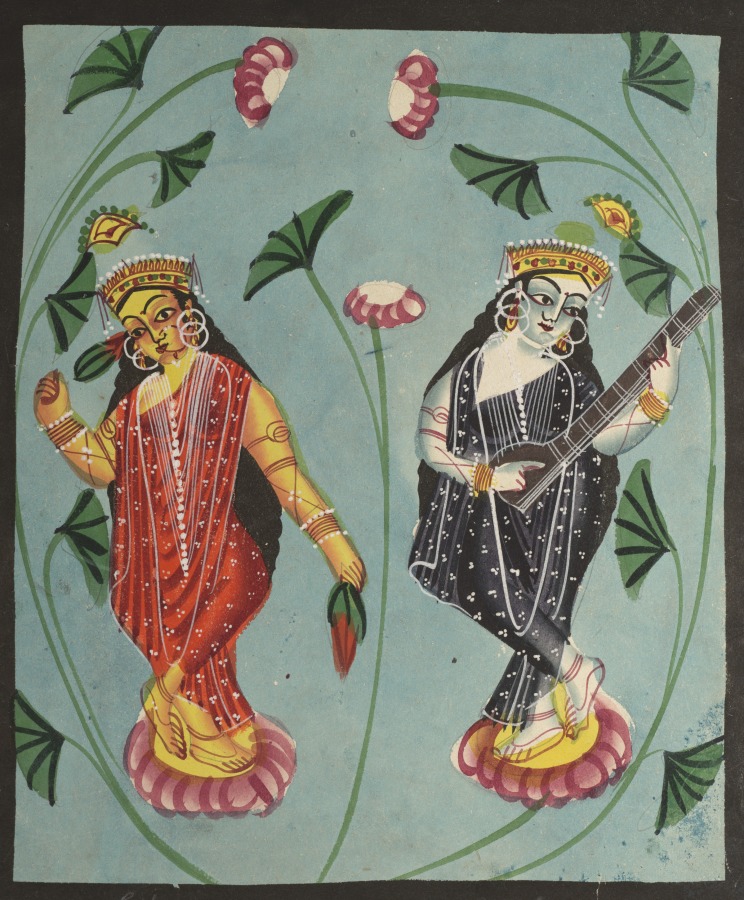
India, Kolkata (Kalighat), c. 1890. Gum tempera, graphite and ink on paper; painting 30.1 x 25.5 cm. Cleveland Museum of Art, 2003.121.
Look closer: Note the pairing: Sarasvati with her stringed instrument beside Lakshmi, the goddess of fortune. Japan later fused the two roles, so that Benzaiten gathered fortune as well as music.
The Cleveland Museum of Art, Gift of William E. Ward in memory of his wife, Evelyn Svec Ward. CC0 Open Access.
Eight arms from the Golden Light Sutra
Her scripture is the Konkōmyō saishōōkyō, the Golden Light Sutra, which Yijing translated into Chinese in the seventh century (JAANUS). In its fifteenth chapter, according to Wikipedia, Sarasvatī, called Daibenzaitennyo, appears before the Buddha's assembly, vows to protect those who believe in, recite or copy the sutra and promises to increase the intelligence of those who recite it. She then teaches mantras for healing illness and escaping misfortune. The brahmin Kauṇḍinya praises her, compares her to Lakṣmī and describes her eight-armed form. Worship reached Japan between the sixth and eighth centuries, mainly through the Chinese translations of this sutra.
Catherine Ludvik, as summarised by Wikipedia, finds three portraits of the goddess in the sutra: first a goddess of eloquence and speech, then a healer who teaches a ritual including a medicinal bath, and finally a goddess of protection and war. The earliest Chinese version, by Dharmakṣema, contains only the first. Because the Golden Light Sutra promises to protect any country where it is chanted, she also became a guardian of the state, a role Wikipedia compares to the warrior goddess Durgā. The eight-armed icon is believed to derive from Durgā's iconography.
JAANUS lists the eight objects held in the hands, and says the earliest Japanese example, an eighth-century sculpture in the Hokkedō (Sangatsudō) of Tōdaiji, is of this type. The table sets the three lists that appear in this chapter's sources side by side, because they are not the same.
| Arm | JAANUS (from the sutra) | Wikipedia (from the sutra) | Enoshima's eight-armed statue (Discover Fujisawa) |
|---|---|---|---|
| 1 | Bow | Bow | Bow |
| 2 | Arrow | Arrow | Arrow |
| 3 | Sword | Sword | Sword |
| 4 | Axe | Spear | Precious stone |
| 5 | Spear | Axe | Wheel |
| 6 | Long pestle | Vajra (single-pronged) | Spear |
| 7 | Iron wheel | Iron wheel | Pestle |
| 8 | Silk rope | Noose | Key |
Into Japan, sixth to twelfth century
The route is long and the dates are loose. Wikipedia puts the arrival of worship in the sixth to eighth centuries. JAANUS gives a first Japanese image in the eighth century. Wikipedia adds that in East Asian Buddhism she became one of the Twenty-Four Protective Deities, and that she was valued as a fierce protector of the state, an idea that suited a court which commissioned sutra readings for the realm.
By the twelfth century the record gets firmer. Onmark Productions, the long-running English-language reference on Japanese Buddhist images, says that the Azuma Kagami, the official record of events between 1180 and 1266, has Minamoto no Yoritomo visiting Enoshima in 1182, where the monk Monkaku conducted tantric rites to Benzaiten for his success. The same source mentions two liturgical texts for Benzaiten by the monk Jōkei, who lived about 1155 to 1213. In the fourteenth century the Tendai compendium Keiran shūyōshū, according to Wikipedia, linked her with the three truths and with esoteric seed syllables.
The most important shift came later and was a change of character. Onmark reports that the Kamakura period (1185 to 1333) saw her sculpted nude, though such statues are rare, and that in the Muromachi period (1392 to 1573) the spelling of her name changed from the character for talent to the character for wealth, after which she became one of the Seven Lucky Gods. That is one source's account and it should be read as such. What can be said without dispute is that JAANUS records the grouping in the Muromachi period and that her popularity with merchants and townspeople grew in the Edo period.
| When | What | Source |
|---|---|---|
| 6th to 8th century | Worship arrives through Chinese translations of the Golden Light Sutra | Wikipedia |
| 8th century | Earliest eight-armed sculpture, Hokkedō of Tōdaiji | JAANUS |
| 1047 | Enoshima Engi written by the monk Kōkei | Wikipedia |
| 1182 | Yoritomo at Enoshima; rites by the monk Monkaku | Onmark, citing the Azuma Kagami |
| 13th century | The biwa-playing type becomes popular | JAANUS |
| Muromachi period | Grouped among the Seven Lucky Gods | JAANUS |
Enoshima and the five-headed dragon

Totoya Hokkei, Japan, 19th century. Surimono woodblock print; ink and colour on paper; 20.2 x 18.4 cm. Metropolitan Museum of Art, JP2045.
Look closer: Note the tiny group at the red mat on the low rock shelf, at the foot of the cliff, with Fuji far across the bay: the island is shown at low tide, as the tide-flat visitors walk over.
The Metropolitan Museum of Art, H. O. Havemeyer Collection, Bequest of Mrs. H. O. Havemeyer, 1929. Open Access.
Enoshima is a small island, about four kilometres round, at the mouth of the Katase River in Sagami Bay, joined to Fujisawa by a bridge of 389 metres (Wikipedia). Wikipedia says the whole island is dedicated to the goddess, who is said to have raised it from the sea floor in the sixth century. The island is also the scene of the Enoshima Engi, a history of its shrines written in 1047 by the monk Kōkei, in which Benzaiten and a five-headed dragon are the central figures. In the Engi, as Wikipedia reports it, she is the third daughter of the dragon-king of Munetsuchi, the lake without heat, which Buddhist cosmology places at the centre of the world.
Japan Journeys retells the island's legend in its popular form. The coast at Koshigoe was terrorised by storms, earthquakes and a ferocious five-headed dragon named Gozuryū. The heavens opened, Benzaiten heard the people's cries and came down, and a rocky spur rose from the sea to become her island. The dragon fell in love and asked for her hand. She was clever and accepted on one condition, that he protect the people instead of terrorising them. He kept to it, earned her admiration, and the district prospered under their joint care. When his spirit passed from the world, he laid his body along the Koshigoe shore, and the hills of Kamakura and Enoshima are said to keep the trace of it.
The same legend appears with variations. A travel essay on Substack, written by a visitor who stayed in Kamakura through a typhoon, says that in some tellings she made the island to contain the dragon, in others as her home on arrival, and that some people believe the dragon lies beneath Enoshima to this day. Kanpai Japan adds a detail from the island's heraldry: the three-triangle emblem used by the Hōjō clan is said to represent the three scales of the protector dragon. A goddess who is also a water deity needs a dragon, and in this story she gets one by negotiation, not by conquest.
Hetsu, Naka and Oku

Utagawa Hiroshige, Japan, ca. 1835. Woodblock print; ink and colour on paper; 25.9 x 12.5 cm. Metropolitan Museum of Art, JP273.
Look closer: Note the scale: two or three visitors stand tiny at the foot of the striped cliff, while the wave curls high over the rocks.
The Metropolitan Museum of Art, Purchase, Joseph Pulitzer Bequest, 1918. Open Access.
Kanpai Japan describes Enoshima Shrine as three pavilions along the island's spine. Hetsunomiya, the outer shrine, is built, it says, in 1206 and was completely renovated in 1976. Nakatsunomiya, the middle shrine, dates to 853 and was last renovated in 1996. Okutsunomiya, the inner shrine, has an unknown date of construction. All three have been rebuilt several times, but the guide says they may descend from an initial shrine built in 552 by Emperor Kinmei in a cave in the south of the island. The three great kami of Enoshima are Tagirihime, Ichikishimahime and Tagitsuhime, the three Munakata goddesses.
Discover Fujisawa, the city's visitor site, adds the gate and the halls. The gatehouse, Zuishinmon, is modelled on Ryūgū-jō, the castle under the sea in the tale of Urashima Tarō. The bronze torii beyond Enoshima Bentenbashi bridge was rebuilt in bronze in 1821, with the donors' names carved on it. The octagonal Hōanden beside Hetsunomiya is modelled on the Yumedono of Hōryū-ji in Nara, and holds two statues. The first is an eight-armed Happi Benzaiten with an effigy of Ugajin above her head, which the guide says Minamoto no Yoritomo donated in 1182 and calls the oldest statue of its kind. The second is the Myōon Benzaiten, popularly the Naked Benzaiten.
The Okutsunomiya was rebuilt in 1842. On the ceiling of its worship area, the visitor essay on Rediscovering Japan reports, is the Eight-Direction-Gazing Turtle painted by Sakai Hōitsu, restored in 1994 and said to glare at you wherever you stand. What you see is a replica, and the original is preserved separately. The same grounds hold a bronze statue of Yamada Kengyō, the Edo-period founder of the Yamada school of koto music, a reminder that Benzaiten was worshipped by blind musicians as well as by actors.
Caves, glaciers of stairs and lovers' locks

Utagawa Hiroshige, Japan, undated. Woodblock print; ink and colour on paper; 22.5 x 35.6 cm. Metropolitan Museum of Art, JP1881.
Look closer: Note the two tiny figures at the cave mouth, dwarfed by the arch and by the white wave that curls along the rocks.
The Metropolitan Museum of Art, H. O. Havemeyer Collection, Bequest of Mrs. H. O. Havemeyer, 1929. Open Access.
Wikipedia lists the Iwaya caves among the island's features. They were formed by wave erosion in ancient times and have long been a place for Buddhist monks to train; the First Cave is 153 metres long and the Second 56 metres, and both can be entered on a ticket. A print by Utamaro, held in Cleveland, shows the scene near their entrance at low tide around 1790. The museum's note observes that by then pilgrimages combined religious feeling with tourism, and that they still do. Hiroshige's later print of the cave mouth, with a wave rolling into it, shows the same place from the water's edge.
The island has been remade many times. In 1880, Wikipedia says, after the separation order of the Meiji government had made the land available, much of the upland was bought by the British merchant Samuel Cocking, in his Japanese wife's name. He built a power plant and large botanical gardens with a greenhouse. The original greenhouse fell in the 1923 Kantō earthquake, but the Samuel Cocking Garden remains, with over half a million visitors a year. Enoshima was the harbour for the 1964 Olympic Games and the sailing venue in 2020.
The modern visitor finds three illuminated escalators, the Luminous Way, which carry people up from the foot of the shrine, an observation tower called the Sea Candle, a winter light show from December to the end of February, and the Ryūren lovers' bell, where couples write their names on padlocks. Rediscovering Japan notes a sadder change: the street of restaurants near Iwaya once had many shops selling shell crafts, a souvenir industry that flourished from the Edo period and was exported after the war, and not a single such shop remains.

Kitagawa Utamaro, Japan, c. 1790. Triptych of colour woodblock prints; each 37.8 x 25.2 cm. Cleveland Museum of Art, 1921.407.
Look closer: Note the dress of the visitors: these are holiday-makers in fine kimono at the cave, not monks, and one woman at far left holds a long fishing rod while Fuji hangs at the horizon.
The Cleveland Museum of Art, Gift from J. H. Wade. CC0 Open Access.
Chikubushima in Lake Biwa
Chikubushima, in the north of Lake Biwa in Shiga, is the second largest island in the lake after Okishima, with a circumference of about two kilometres and a maximum elevation of 197 metres (Wikipedia). The whole island is a granite monolith with steep rock walls and a single port in the south. The shops and shrine buildings stand beside the harbour, and the staff come from outside, so that the island is uninhabited at night. It is both a Place of Scenic Beauty and a Historic Site. The lake bed around it is deep, and the west side is the deepest part of Lake Biwa at 104.1 metres.
Wikipedia says that Chikubushima was held to be a holy island from ancient times. The Shinto shrine of Tsukubusuma claims foundation in 420 and its Buddhist partner Hōgon-ji in 724. During the period of shinbutsu shūgō, the two were a single entity known as Chikubu Benzaiten. It ranked with Enoshima in the east and Itsukushima in the west as one of the Three Great Shrines of Benzaiten, and was the thirtieth stop on the Saigoku Kannon Pilgrimage. In the Sengoku period the retainers of Azai Nagamasa confined his father Hisamasa on the island to force his retirement, and in the Edo period it was chosen as one of the Eight Views of Lake Biwa.
The lake is as important as the island. Edo-period painters knew the Ōmi shore, around Lake Biwa, as a pilgrimage landscape, and Cleveland's pair of screens, from the 1660s to 1690s, shows the lake's famous places with their temples, gates and road. The screens do not show Chikubushima itself, as the museum's note names other places, but they set the scene for a pilgrim's journey. The monk Tenkai, who founded Kan'ei-ji in Edo in 1625, liked Lake Biwa so much that he had Benten Island built in the pond at Ueno as an imitation of Chikubushima, according to Wikipedia's account of Shinobazu Pond.
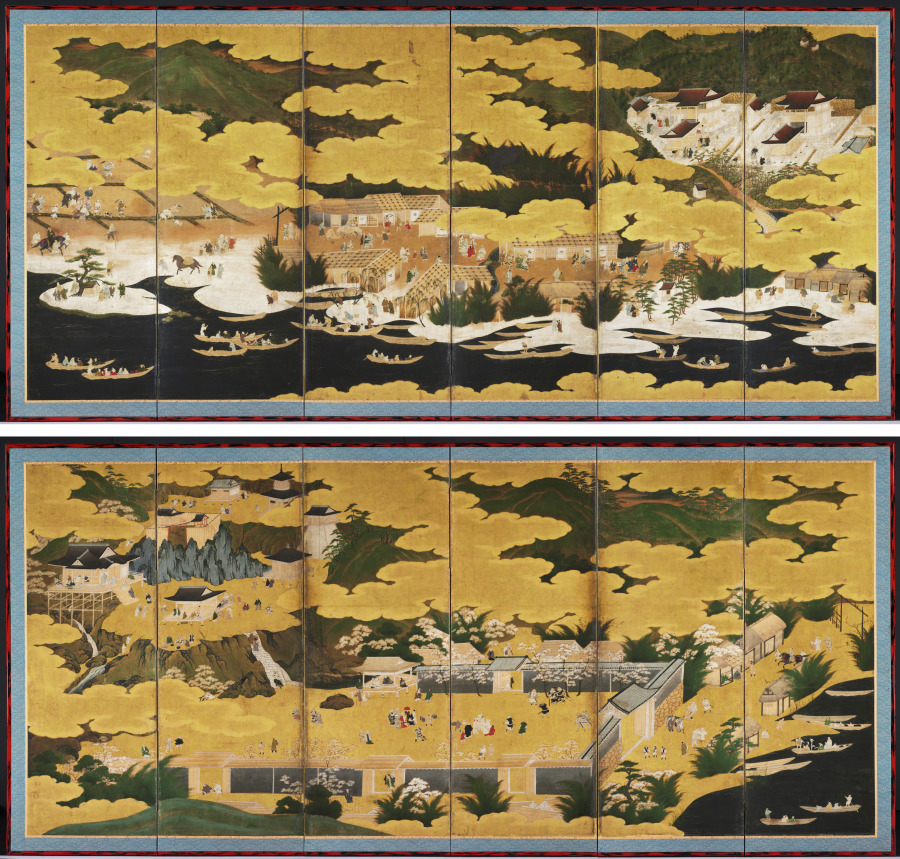
Japan, 1660s-90s. Pair of six-panel folding screens; ink, colour and gold on gilded paper; 170 x 336 cm. Cleveland Museum of Art, 1983.19.
Look closer: Note the seasonal change across the pair, harvested rice at the right and cherry blossom at the left, and the gold cloud bands that divide the lake country into pilgrim stops. The museum names the temple Ishiyamadera and the shrine Hiyoshi Taisha; Chikubushima is not identified in its note.
The Cleveland Museum of Art, Purchase from the J. H. Wade Fund. CC0 Open Access.
Dream, fire and a hidden image
Hōgon-ji, as Wikipedia describes it, belongs to the Shingon Buzan school and its principal image is a hidden statue of Benzaiten. By temple legend, in 724 Emperor Shōmu dreamed that Amaterasu told him that a small island in a lake in Gōshū was sacred to Benzaiten and that a temple there would bring peace to the nation. He ordered the monk Gyōki to enshrine a Benzaiten at Tsukubusuma Shrine, whose own deity was a kami named Azaihime-no-mikoto. Azaihime was the guardian of the Azai clan and a water deity who governed the lake, and towards the end of the Heian period she came to be identified with Benzaiten and later with Ichikishimahime. The two sanctuaries merged.
Fire came often. The buildings burned in 1232 and 1454 and were rebuilt, and burned again in 1558. In 1602 Toyotomi Hideyori had Katagiri Katsumoto rebuild, and brought buildings from Kyoto. The Karamon gate, a National Treasure, came from the Toyokuni Mausoleum of Hideyoshi, and the Kannon-dō was also moved. The open corridor leading to the shrine is said to be built of the wood of Hideyoshi's ship, the Nihonmaru. After the Meiji separation of Buddhism and Shinto, the prefecture ordered the temple abolished in 1871. Hōgon-ji argued that Benzaiten was a Buddhist deity and not a kami, the two sides were divided in 1874 and the property in 1883, and the present main hall was built in 1942.
The island still keeps its hidden image. A visitor's guide on Shiga Mytabi says the great Benzaiten, a hibutsu, is shown only once every sixty years, and that the next opening is due in 2037. The same guide records restoration of the Karamon and Kannon-dō between 2013 and 2020, including rethatching of the roof, repairs to carvings and repainting of lacquer, and notes an Uga Benzaiten statue in the main hall with a small Ugajin on her head under a torii gate.
| Property | Class and date (Wikipedia) |
|---|---|
| Karamon gate | National Treasure; Azuchi-Momoyama period, 1603 |
| Honden of Tsukubusuma Shrine | National Treasure (the former temple main hall) |
| Kannon-dō and two corridors | Important Cultural Properties, 1603 |
| Stone five-storey pagoda | Important Cultural Property, late Kamakura period (1275 to 1332) |
| Preface to the Lotus Sutra (Chikubushima sutra) | National Treasure; Heian period, 11th century; gold and silver ink on decorated paper |
| Painting of Benzaiten, silk | Shiga Prefecture designation; Nanboku-chō period |
| Seated wooden Benzaiten | Nagahama City designation; Muromachi period |
Itsukushima in the Seto Inland Sea
Itsukushima, popularly Miyajima, lies a short ferry ride from Hiroshima. Wikipedia says the shrine is dedicated to the three daughters of Susanoo, Ichikishimahime, Tagorihime and Tagitsuhime, goddesses of seas and storms, and that Taira no Kiyomori, who believed them to be manifestations of Kannon, lavished money on the shrine while governor of Aki in 1168. The island itself is considered a god, so the shrine was built over the water to keep commoners from setting foot on the land. The famous torii stands in the sea and appears to float at high tide.
Benzaiten's place on the island is at Daigan-ji, where, according to Visit Miyajima, the Itsukushima Benzaiten statue is worshipped at a big festival every 17 June. The island's other great Benzaiten day is the Kangen-sai, a boat festival which the shrine's Wikipedia article places on 17 June in the lunar calendar, usually falling between late July and early August. It was begun, the article says, by Taira no Kiyomori. A portable shrine is carried on a boat made of three boats lashed together, accompanied by musicians playing kangen court music, one of the great boat rites of Japan. That the goddess of music is honoured with an orchestra on the water is hardly a coincidence.
Bernard Faure, in the chapter on Benzaiten that the Matheson Trust republishes, gives the founding of the island shrine as around 811 and calls it dedicated to her, with the red torii in the sea its best-known mark. Before the Meiji period the great Shingon temple Daishō-in, on Mount Misen, administered the shrine. The Great Torii underwent a restoration from June 2019, reinforced with stainless steel bands, repainted in vermilion with durable pigments, and declared complete with a purification ritual on 18 December 2022 (Get Hiroshima).
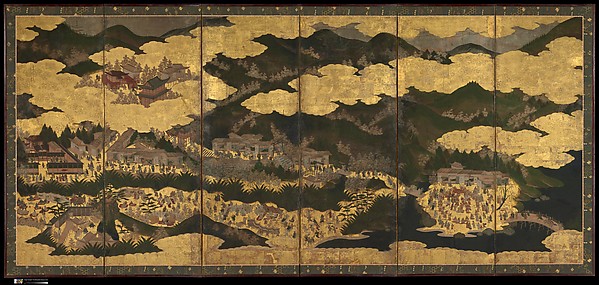
Japan, first half of the 17th century. Pair of six-panel folding screens; ink, colour and gold leaf on paper; each 153.6 x 348.6 cm. Metropolitan Museum of Art, 2015.300.107.1, .2.
Look closer: Note the shrine on its stilts at the left of the pair, small beside the great mountains and bands of gold cloud. The Met's title pairs the island with Yoshino, so this screen is a landscape of two famous cherry-blossom places, not a portrait of a goddess.
The Metropolitan Museum of Art, Mary Griggs Burke Collection, Gift of the Mary and Jackson Burke Foundation, 2015. Open Access.
Ichikishima-hime and the three Munakata kami
The shrines at Itsukushima and Enoshima both enshrine kami of the same trio, and the trio explains why Benzaiten is so often found with a Shinto name beside her Buddhist one. Wikipedia's article on Munakata Taisha says the three Munakata goddesses were born, according to the Kojiki and Nihon Shoki, when Amaterasu bit Susanoo's sword into pieces and blew them out. They are Ichikishimahime at Hetsu-gū on the Kyūshū mainland, Tagitsuhime at Nakatsu-gū on Ōshima and Tagirihime (written Takiribime in the shrine's table) at Okitsu-gū on the island of Okinoshima. Another account in the same article calls them daughters of Susanoo, a difference that Wikipedia states without resolving.
Onmark reports that Benzaiten was identified with Ichikishimahime from around the middle to late twelfth century, and Wikipedia says the same identification was established over time. Munakata Taisha is the head of about six thousand Munakata shrines throughout Japan, and Okinoshima, with its ritual site and over 80,000 national-treasure objects, became a World Heritage Site in July 2017. No woman is allowed to land on Okinoshima, and men must purify themselves before they do. It is a very different island from the shrines of the lute.
What the identification meant in practice was that a sea deity of the Japanese court, who protected voyages to the continent, could be spoken of in Buddhist terms, and a Buddhist goddess of an Indian river could be worshipped at an island shrine of the sea. In Wikipedia's account of Itsukushima, Kiyomori's belief that the three goddesses were manifestations of Kannon is a second such bridge. The pair of names, Benzaiten in the temple and Ichikishimahime in the shrine, stayed on the island until the Meiji separation forced the two to stand apart.
| Munakata kami | Shrine | Island |
|---|---|---|
| Ichikishimahime | Hetsu-gū | Kyūshū (mainland) |
| Tagitsuhime | Nakatsu-gū | Ōshima |
| Takiribime (Tagirihime) | Okitsu-gū | Okinoshima |
Uga Benzaiten

Japan, undated. Colour, gold and lacquer on clay; 10.2 x 9 cm. Metropolitan Museum of Art, 51.60.
Look closer: Note the dark serpent at the lower right, where the surface has survived best, and the two thin vertical lines that fall from the standing figure's hands.
The Metropolitan Museum of Art, Rogers Fund, 1951. Open Access.
Wikipedia reports that Tendai Buddhists considered Benzaiten the essence of the kami Ugajin, so that she is sometimes called Uga Benzaiten or Uga Benten. Ugajin is a human-headed white snake. In her Uga form the goddess carries his effigy on her head, with a torii gate, and she may be eight-armed. Onmark reads the pairing as a link to the Shinto camp and to the agricultural cycle: Ugajin and the gate are purely Japanese conventions, it says, that make her a provider of rain, protector of the harvest and bringer of prosperity, and possibly tie her to Inari. A visitor's essay describes Ugajin as a deity of harvest and fertility shown as the head of an older man or woman on a snake's body.
The paintings of this type follow a formula. Onmark describes the goddess flanked by Daikokuten and Bishamonten, with wish-granting jewels scattered through the scene and waves at the foot, sometimes with the dragon king rising to offer a bowl of jewels. Sun and moon appear, though they are not particular to her, and a cart and a boat loaded with bundles of grain are a common theme. The same source says the oldest extant painting of Uga Benzaiten and her fifteen attendants is an early fourteenth-century hanging scroll at Kotohira-gū in Kagawa, 129 by 52 centimetres, with a snake coiled above her head and a dragon king making offerings at the bottom.
The Metropolitan Museum owns a small clay disc, 10.2 by 9 centimetres, in colour, gold and lacquer, titled Benzaiten and Ugajin. The surface is badly flaked, but a crowned figure still stands in a long robe, two thin lines fall from her hands, and a dark serpent curls at the lower right. The Museum's record gives no date. We have therefore not dated the disc, and have found no published reading of it beyond its title.
Snakes, dragons and the lake without heat
Because she is a water deity, Wikipedia says, Benzaiten was linked with nāgas, dragons and snakes. She is only rarely portrayed with the head of a snake or dragon. More often the creature is her companion: a white snake as messenger, a dragon as seat, a turtle in the ceiling of a shrine. Onmark's index of her animal associations gives dragons, white snakes, turtles, white foxes, peacocks and swans, the last two arriving from her Indian origin, where the peacock and swan are the mounts of Saraswati.
The dragon king of the lake without heat is her father in the Enoshima Engi. Munetsuchi is the Japanese for Anavatapta, which in Buddhist cosmology lies at the centre of the world, and a goddess who is the third daughter of its king is a princess of the dragon world as well as a goddess of the lute. At Chikubushima the pairing of goddess and dragon god is staged on the Noh stage, and at Enoshima it is a marriage of terms. The Rigveda's Vṛtra, the serpent slain by Sarasvatī's epithet, was a drought-bringing monster, and the Japanese tales reverse the pattern by making the dragon a protector.
A related form turns up in the mountains. Onmark describes the Tenkawa Benzaiten with three white snake heads, tied to a shrine at Amanogawa, and says the Keiran shūyōshū of the first half of the fourteenth century tells of two dragons, one good and one bad, at a place that was once a great sea, a story that ends with the subduing of the bad dragon. The Tenkawa shrine is placed by Wikipedia in Tenkawa village in Nara Prefecture, but Onmark quotes Saroj Kumar Chaudhuri placing Amanogawa in Wakayama Prefecture. The Met print by Yashima Gakutei, called Benzaiten ni Ryū, shows the more familiar pairing, in a pine-shaded setting.

Yashima Gakutei, Japan, undated. Surimono woodblock print; ink and colour on paper; 22.1 x 19.1 cm. Metropolitan Museum of Art, JP1433.
Look closer: Note how the dark dragon's long body rises behind her like the pine trunk and its head comes to rest beside her knee. The instrument across her lap looks like a koto rather than a biwa, a reminder that the image is a print about the goddess, not a strict copy of a temple icon.
The Metropolitan Museum of Art, Rogers Fund, 1922. Open Access.
Fifteen boys and a cart of rice

Japan, 13th century. Hanging scroll; ink and colour on paper; 135.9 x 49.2 cm. Metropolitan Museum of Art, 1975.268.11.
Look closer: Note the small objects set among the boys, a cart or boat among them, and the flaming jewels around the halo.
The Metropolitan Museum of Art, The Harry G. C. Packard Collection of Asian Art, Gift of Harry G. C. Packard, and Purchase, Fletcher, Rogers, Harris Brisbane Dick, and Louis V. Bell Funds, Joseph Pulitzer Bequest, and The Annenberg Fund Inc. Gift, 1975. Open Access.
JAANUS links her with the Esoteric Buddhist group known as the Fifteen Sons, the jūgo dōji. Their names read as a catalogue of what a household wished to keep: loveliness, a rice tub, a writing brush and inkstone, oxen and horses, a seal and key, an attendant, measures, clothing, an official sash, silkworm rearing, boats and carts, a spring of sake, life itself, rice seed and gold.
The Metropolitan Museum holds a thirteenth-century hanging scroll, ink and colour on paper, titled Benzaiten and Fifteen Attendants. The goddess stands at the centre under a crown, her figure ringed by a halo with flaming jewels, and holds weapons in several hands. Around her feet sit the boys in rows, each in a pale robe and each holding or beside a small object, with the objects set between them: books, an inkstone, a cart or boat, a bundle, a bowl. The scroll measures 135.9 by 49.2 centimetres. Onmark notes that a related scroll in Boston counts sixteen attendants, one of them Daikokuten, and shows her flanked by Daikokuten and Bishamonten on other versions of the theme.
The sons are therefore not decoration. They are the gifts that the goddess grants, drawn as children who carry the things people ask for, and the cart and boat of grain make the Uga type a rice goddess as much as a musician. The sequence below glosses the characters of each name, as reading aids and not as authoritative translations.
| Son (JAANUS) | Characters | Gloss from the characters |
|---|---|---|
| Aigyō | 愛敬 | Loveliness, affection |
| Hangi | 飯櫃 | Rice tub |
| Hikken | 筆硯 | Brush and inkstone |
| Gyūba | 牛馬 | Oxen and horses |
| In'yaku | 印鑰 | Seal and key |
| Jūsha | 従者 | Attendant |
| Toshō | 斗升 | Measures |
| Ishō | 衣装 | Clothing |
| Kantai | 官帯 | Official sash |
| San'yō | 蚕養 | Silkworm rearing |
| Sensha | 船車 | Boats and carts |
| Shusen | 酒泉 | Spring of sake |
| Shōmyō | 生命 | Life |
| Tōchū | 稲籾 | Rice seed |
| Konzai | 金財 | Gold and wealth |
The lute, the blind minstrels and the court
The biwa is a short-necked wooden lute, usually with four strings, played with a plectrum, and Wikipedia says it arrived in Japan in the seventh century or in the Nara period from China, where it descended from the pipa, which itself derived from West Asian instruments. In Japan it split into several traditions. The gagaku biwa is large and heavy, with four strings and four frets, used for court music. The mōsō biwa is slender and was played by blind monks for rites and mantras. The Heike biwa, a hybrid of the two, was used to recite The Tale of the Heike from the Kamakura period.
Bernard Faure, in the chapter republished by the Matheson Trust, writes that her image as a goddess of music was favoured by court musicians and also by the blind biwa hōshi, and that she became a protector of other blind groups, including minstrel monks and the female mediums and massage specialists of northern Japan. At Enoshima, the statue of Yamada Kengyō reminds the visitor that blind koto masters of the Edo-period guild, the Tōdō, looked to the island's goddess. Wikipedia's article on the biwa notes that guilds supported biwa hōshi for centuries until the guild was abolished in the Meiji period, after which players lost their patronage.
The instrument also sets the iconography. JAANUS describes her biwa type as a plump woman in flowing Chinese robes with a four-stringed lute, popular from the thirteenth century, and names the wooden figure in silk robes at Tsurugaoka Hachimangū as a well-known example. Onmark adds that the nude Benten at Tsurugaoka's Kamakura Museum of National Treasures is dated 1266, was donated by the shrine musician Nakahara Mitsuuji, and was reportedly installed in the Bugaku-in, a centre of shrine dance, with its biwa missing. Of the later biwa traditions Wikipedia lists the Satsuma and Chikuzen schools, which grew from the mōsō biwa, the Satsuma used by samurai for moral and mental training and the Chikuzen by monks for memorial services.
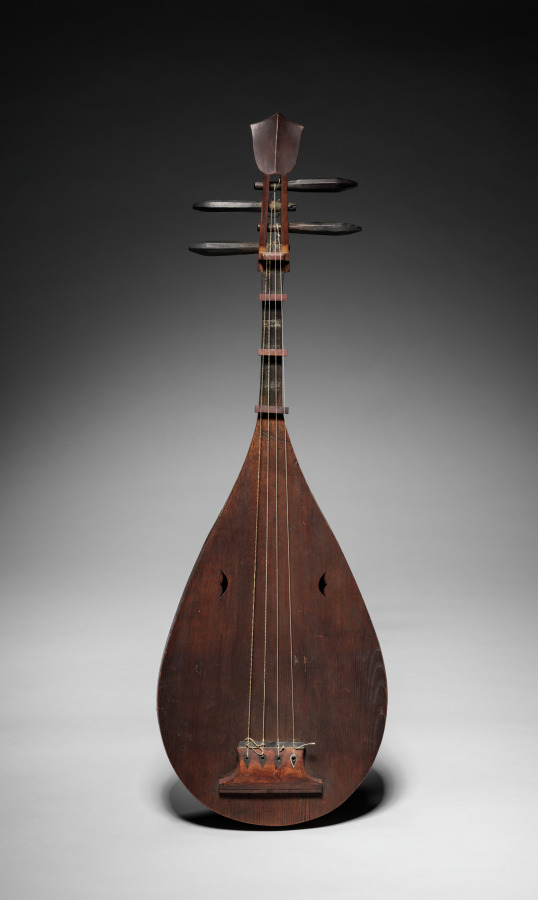
Japan, c. 1850. Wood, bone and silk; overall 92.8 x 30 cm. Cleveland Museum of Art, 1918.342.
Look closer: Note the four strings and the plain, dark body: this is the instrument of narrative recitation, made to carry a voice rather than to be admired.
The Cleveland Museum of Art, The Charles G. King Jr. collection; gift of Ralph King in memory of Charles G. King Jr. CC0 Open Access.
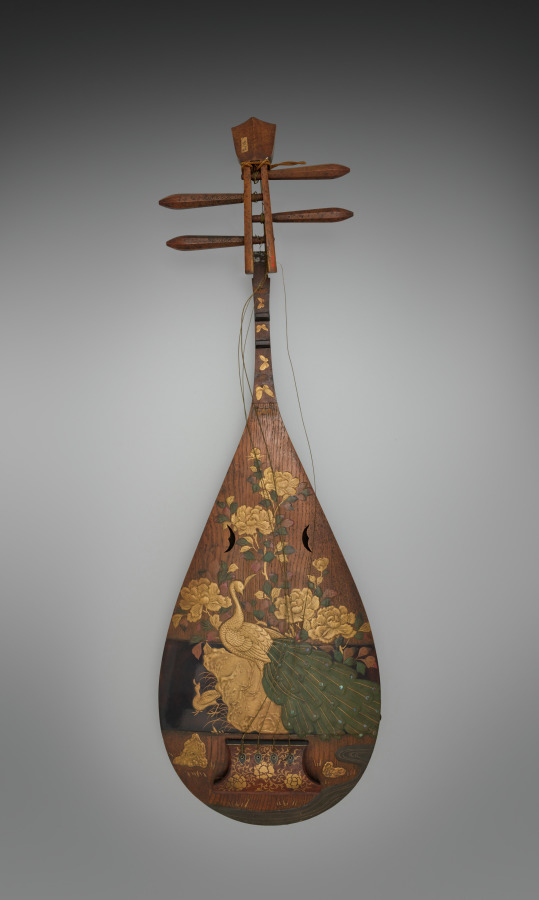
Japan, early to mid-1800s. Wood; overall 85.8 cm. Cleveland Museum of Art, 1918.380.
Look closer: Note the painted decoration, gold flowers and what looks like a peacock on the back of the body, which marks it as an instrument for the court rather than the roadside.
The Cleveland Museum of Art, The Charles G. King Jr. collection; gift of Ralph King in memory of Charles G. King Jr. CC0 Open Access.
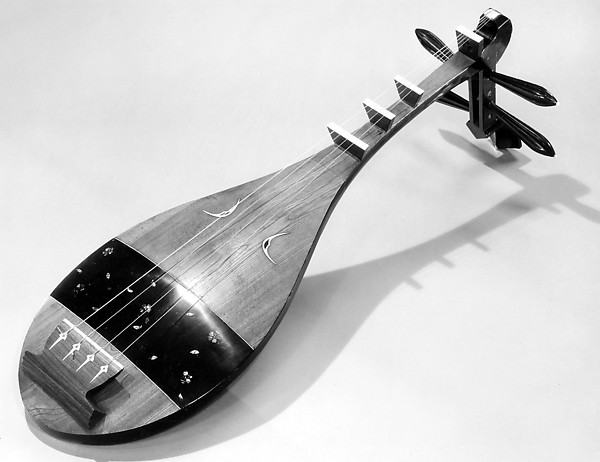
Japan, ca. 1800. Wood, mother-of-pearl and ivory; 88.9 x 30.8 x 29.2 cm. Metropolitan Museum of Art, 68.62.1.
Look closer: Note the dark inlaid panel on the lower body and the wide curve of the soundbox, the type later used for samurai moral training.
The Metropolitan Museum of Art, Rogers Fund, 1968. Open Access.
Warrior, minstrel and nude
Onmark's summary of the forms in Japan gives six: the eight-armed Happi Benzaiten, a warrior goddess and defender of the state, from the eighth century; the two-armed Myōon Benzaiten with a biwa, the main iconic form, from the ninth century onward; the Daibenten who holds a sword and a jewel; the Hadaka or nude Benten who plays a biwa; the Uga form with the snake and gate; and the Tenkawa form with three white snake heads, the last three from the late twelfth century onward. Wikipedia adds that she may be shown with a sword and a wish-granting jewel, and that Ugajin and a torii may stand above her head.
She also dissolves into other figures. JAANUS warns that she is often confused with Kichijōten, and Wikipedia says Kisshōten's fortune role was eventually attributed to Benzaiten in popular belief. Onmark reports that in the twelfth and thirteenth centuries she was fused with Dakiniten, who is shown riding a white fox with a sword and wish-granting jewel, and that the fox is the clue: take the fox away, it says, and the figure would look exactly like Benzaiten. A later esoteric form, the Sanmen Dakiniten, combines Benzaiten, Dakiniten and the elephant-headed Kankiten in a three-headed figure.
Her devotional formulas are short. Wikipedia gives her seed syllable as su (सु), written in Siddhaṃ and read in Japan as so, and her main mantra as Oṃ Sarasvatyai svāhā, in Japanese On sarasabatei-ei sowaka. Onmark gives the day for prayer: the snake day, once every sixty days in odd-numbered months, which it also notes is a bad day for marriages.
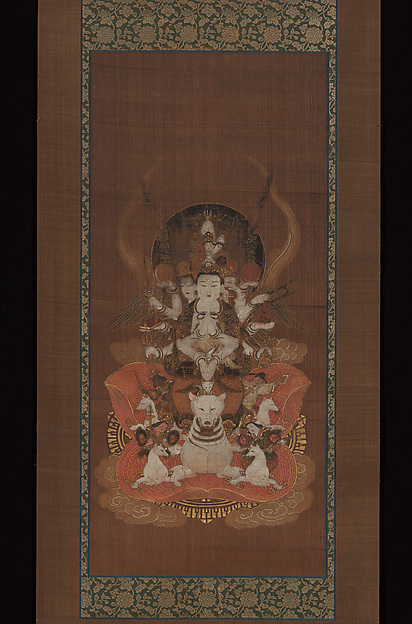
Japan, 17th century. Hanging scroll; ink, colour and gold on silk; image 86 x 38.7 cm. Metropolitan Museum of Art, 2025.795.10.
Look closer: Note the white fox beneath the seated figure and the smaller foxes around it: the animal is the clue that tells this figure from Benzaiten, though Onmark says the two were fused.
The Metropolitan Museum of Art, Mary and Cheney Cowles Collection, Gift of Mary and Cheney Cowles, 2025. Open Access.

Japan, late 19th century. Faience decorated with coloured enamels (Satsuma ware); H. 60.3 cm. Metropolitan Museum of Art, 23.225.361.
Look closer: Note that she holds no biwa: the layered robes and the small ornament in her hair are given, but the Museum's title is what names her, a lesson for anyone who buys or catalogues such figures.
The Metropolitan Museum of Art, Gift of Mrs. V. Everit Macy, 1923. Open Access.
| Form | Look for | Reported date or source |
|---|---|---|
| Happi Benzaiten | Eight arms with weapons; defender of the state | From the 8th century (Onmark); JAANUS cites the Hokkedō sculpture |
| Myōon Benzaiten | Two arms, a biwa | From the 9th century (Onmark); popular from the 13th (JAANUS) |
| Daibenten | A sword and a jewel | Onmark |
| Hadaka Benten | A nude figure with a biwa | Kamakura or Muromachi, by source |
| Uga Benzaiten | White snake with a human head and a torii on her head | From the late 12th century onward (Onmark) |
| Tenkawa Benzaiten | Three white snake heads | Mandalas from the Muromachi period (Onmark) |
A hidden spring that doubles coins
Wikipedia calls Zeniarai Benzaiten Ugafuku Shrine a small shrine in Kamakura that is the second most popular spot in the city after Tsurugaoka Hachimangū, because the water of a spring in its cave is said to multiply the money washed in it. By the sign at its entrance, it was founded in 1185 after Minamoto no Yoritomo dreamed on a snake day in a snake month of the god Ugafukujin, who told him of a miraculous spring in a valley to the north-west. Yoritomo found it and built a shrine to Ugafukujin, whose symbol is a snake with a human head.
The tradition of washing money began later, says Wikipedia, in 1257, when the regent Hōjō Tokiyori came to worship and urged the faithful to wash their coins, promising that Ugafukujin would multiply them. The spring became one of the Five Famous Springs of Kamakura. The object of worship is a stone snake with a human head, a form that merged with Benzaiten under the doctrine that kami are manifestations of Buddhist figures. The innermost hall, the Okugū, is not a building but a cave where visitors wash notes and coins in sieves from the shrine counter, and further shrines honour the Seven Lucky Gods and the water god Mizuhame.
Wikipedia also says that, although the spring and its tradition are certainly old, the shrine itself is not documented that early: Edo-period topographies call the area Kakurezato, the hidden land, and do not mention it, and a Meiji survey mentions one but not the other, so the shrine was probably built in the late nineteenth century. It is an uncommon survivor of the pre-Meiji mixing of Buddhism and Shinto, with dozens of torii, Buddhist statues and incense in the air. It became independent in 1970 under its present name, and its present tunnel entrance dates from 1958.
| Claim | Date | Status in the sources |
|---|---|---|
| Yoritomo's dream and the founding of a shrine | 1185 | The shrine's entrance sign (Wikipedia); the shrine itself is probably late 19th century |
| Hōjō Tokiyori washes coins, urges others to do so | 1257 | Tradition recorded by Wikipedia |
| Tunnel and approach built | 1958 | Wikipedia |
| Shrine becomes independent as Zeniarai Benzaiten Ugafuku | 1970 | Wikipedia |
Three tales retold

Katsushika Hokusai, Japan, ca. 1830-32. Woodblock print; ink and colour on paper; 25.7 x 37.8 cm. Metropolitan Museum of Art, JP22.
Look closer: Note the pale line of Fuji beyond the bay and the packed roofs of the village on the shore: Hokusai makes the island's neighbourhood the subject, with the sacred hill in the background.
The Metropolitan Museum of Art, Rogers Fund, 1914. Open Access.
The dragon and the goddess of Enoshima is told above. Three other stories belong beside it. The first is Chikubushima, the Noh play. Wikipedia's account of Hōgon-ji summarises it: a court official makes a pilgrimage to the island and arrives in the boat of an old couple he meets, and learns his lesson about judging people when the old woman turns out to be Benzaiten and the old man the Dragon God of Lake Biwa. The play ends when both return to their divine homes after performing marvellous dances. A Heike biwa piece, Chikubushima Mōde, and two koto melodies of the same name show how often the island appears in the performing arts (Wikipedia).
The second is Yoritomo's dream. In the sign's account of the founding of the Zeniarai shrine, the first Kamakura shōgun dreams of the snake god Ugafukujin on a snake day, finds the spring in the valley and builds the shrine. The date, 1185, is a claim of the sign, and Wikipedia doubts the shrine's early existence. The story of a ruler guided by a dream to a water source is also the pattern of Hōgon-ji's legend, where the dreamer is Emperor Shōmu and the god who speaks is Amaterasu.
The third is the birth of the three Munakata goddesses. Wikipedia retells the Kojiki and Nihon Shoki account that Amaterasu and Susanoo made a vow, and the three goddesses were born from the pieces of Susanoo's sword that Amaterasu bit and blew out. They descended to the islands of the Genkai Sea to help the heavenly grandson Ninigi. Because Benzaiten was identified with Ichikishimahime, one of the three, that myth of the sea passes into hers. Together the tales explain her island shrines in three ways: as a marriage with a dragon, as a dream from the sun goddess and as a sword broken into goddesses.
The only woman among seven
In the Muromachi period, JAANUS says, Benzaiten was grouped among the seven gods of good fortune, the shichifukujin, and through that association her popularity grew with merchants and urban people in the Edo period, when new temples and shrines were dedicated to her. Onmark places the first appearance of the Seven Lucky Gods around the fifteenth century and sets it against competition between old sects and the new Kamakura schools. Wikipedia says she was eventually worshipped as a bestower of monetary fortune because the role of Kisshōten was ascribed to her.
She is the only goddess in the usual group of seven, and her companions are Daikokuten, Ebisu, Bishamonten, Hotei, Fukurokuju and Jurōjin. The sibling chapters of this series cover them: Daikokuten, Ebisu, Bishamonten, Hotei, Fukurokuju and Jurōjin. The Seven Lucky Gods themselves are the subject of the chapter Shichifukujin. Two Met pictures show how artists drew the party. A hanging scroll of 1837 by Nagasawa Roshū gathers the seven on a single sheet, and a surimono by Hokusai crowds them into a laughing huddle.
Her place on the pilgrimage circuits is concrete. Wikipedia lists Ryōhō-ji in Hachiōji, which enshrines her, as one of the temples of the Hachiōji Shichifukujin Pilgrimage, and Kan'ei-ji's Shinobazu Pond Benzaiten as an Edo Shichibenten, one of a group of seven Benten sites in Edo. Wikipedia's temple list also names the Zeniarai shrine's own Seven Lucky Gods shrine, and the Daishō-in on Miyajima, which keeps statues of the Seven Lucky Gods on and around Mount Misen. Wherever the seven are visited as a set, she is among them.
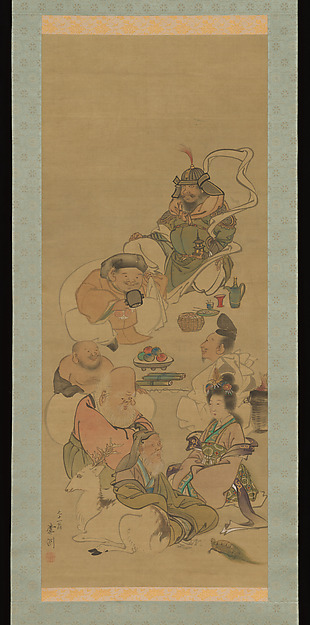
Nagasawa Roshū, Japan, 1837. Hanging scroll; ink and colour on silk; 88.6 x 35.9 cm. Metropolitan Museum of Art, 2000.214.
Look closer: Note that the seven are packed into one tall scroll, bodies overlapping and feasting, and look for the single woman among them.
The Metropolitan Museum of Art, Anonymous Gift, 2000. Open Access.
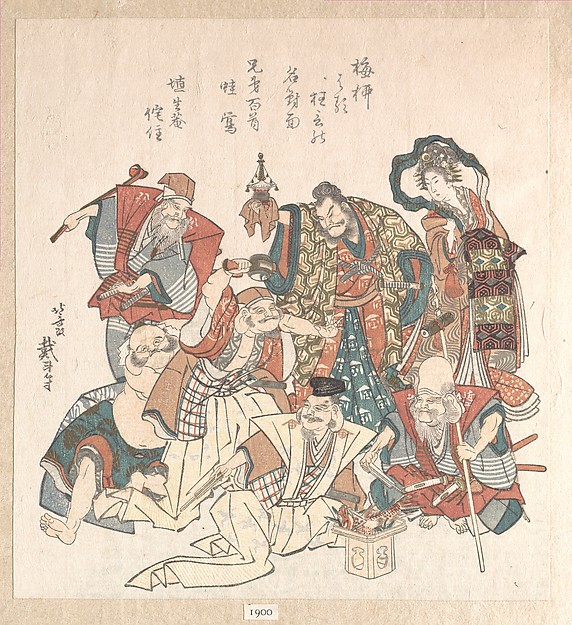
Katsushika Hokusai, Japan, 1808-27. Surimono woodblock print; ink and colour on paper; 21 x 19.1 cm. Metropolitan Museum of Art, JP1900.
Look closer: Note the huddle: the artist treats the seven as friends sharing a party, not as seven separate icons.
The Metropolitan Museum of Art, H. O. Havemeyer Collection, Bequest of Mrs. H. O. Havemeyer, 1929. Open Access.
Ponds, plays and the capital
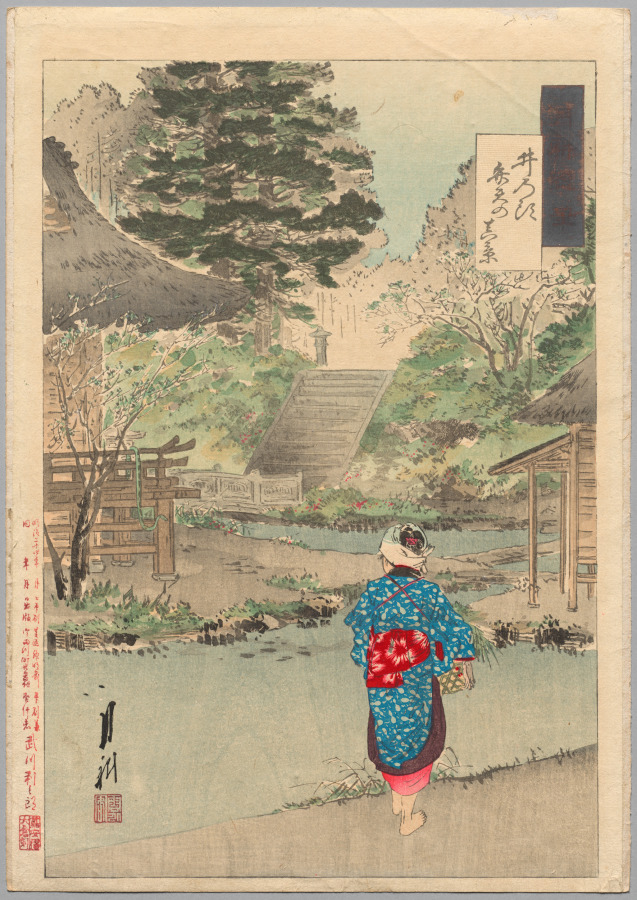
Ōgata Gekkō, Japan, c. 1886-99. Woodblock print; ink and colour on paper. Cleveland Museum of Art, 2017.70.
Look closer: Note the single walker with her back to us on the path and the step-and-gate approach on the left: the shrine is implied by the approach, as the print is about arriving.
The Cleveland Museum of Art, Gift of the Norman W. Zaworski Trust. CC0 Open Access.
The pond at Ueno is the capital's answer to the lake. Wikipedia's article on Shinobazu Pond says the Edo shogunate had Kan'ei-ji built in 1625 as the counterpart of Enryaku-ji on Mount Hiei. Its founder Tenkai, who liked Lake Biwa, had Benten Island built in imitation of Chikubushima and the Benten-dō raised on it. At first the island was reached only by boat; a stone bridge was added on the east. The pond itself was partly filled in 1884 for a horse-racing track, divided into rice paddies in the Pacific War and returned to its form in 1949.
A second Tokyo water goddess sits at Inokashira. The Cleveland Museum's note on Ōgata Gekkō's print True View of Benten at Inokashira calls it a famous place in Tokyo associated with the water deity Benzaiten, and the print shows a visitor in a blue kimono walking up a mossy approach under a pine. Wikipedia's list of temples names Daisei-ji's Inokashira Benzaiten in Mitaka as the modern site. Elsewhere in the city the list names Kōami Shrine at Nihonbashi, Bentenzan at Sensō-ji and Jushō-in in Edogawa.
The goddess also reached the stage. Wikipedia's disambiguation page for Benten lists the Japanese play Benten Kozō, named for a young thief who borrows her name, as well as the Benten Daiba fortress built in the Republic of Ezo of 1868 to 1869 and Benten-jima, an islet off Wakkanai in Hokkaido. These are uses of the name, not signs of worship, but they show how widely the clipped form Benten passed into the language. In Edo, Mythopedia adds, she was especially favoured by courtesans and court musicians, a claim that fits the pattern of her cult among performers.
Sorting gods into shrines and temples
In 1868 the new Meiji government ordered the separation of Shinto and Buddhism, and Benzaiten, who was both, was caught in the middle. Wikipedia's account of Tsurugaoka Hachimangū tells what happened to one shrine-temple. For almost seven hundred years it had been Tsurugaoka Hachimangū-ji, a temple as well as a shrine, and the order forced it to give away or destroy Buddhist things: the giant Niō guardians were sold to Jufuku-ji and the seven-hall temple compound and pagoda were destroyed. Among the losses was a sub-shrine on an island in the Minamoto pond, the Hataage Benzaiten, which was dismantled in 1868 and rebuilt in 1956.
At Chikubushima the pressure was sharp. The prefecture ordered the temple abolished in 1871, and the survivors answered that Benzaiten was a Buddhist deity and not a kami, which saved the temple. The main hall became Tsukubusuma Shrine, the temple lost its hall until 1942, and the two bodies divided the property in 1883. At Itsukushima the shrine and the Shingon temple Daishō-in parted. Munakata's own temple, Chinkoku-ji, was separated from the shrine at the same time. Zeniarai Benzaiten, by contrast, kept its Buddhist objects, as Wikipedia stresses, unlike Tsurugaoka.
Mythopedia argues that Benzaiten's cult did not suffer as much as other continental imports because she was so deeply embedded in Shinto tradition. That is a judgement and not a fact, but the surviving record fits it: her shrines were renamed, split or moved, and none disappeared. Her biwa teachers were harder hit. The biwa guild was abolished in the Meiji period, and Wikipedia says the instrument was nearly abandoned for Western ones until revival by players such as Tsuruta Kinshi.
| Place | What the separation did | Source |
|---|---|---|
| Tsurugaoka Hachimangū | Buddhist buildings destroyed; Hataage Benzaiten dismantled in 1868, rebuilt 1956 | Wikipedia |
| Chikubushima | Temple ordered abolished 1871; temple and shrine divided 1874 and 1883 | Wikipedia |
| Itsukushima and Daishō-in | Temple had administered the shrine before the separation | Wikipedia |
| Zeniarai Benzaiten | Kept its Buddhist objects | Wikipedia |
Pilgrims, anime and the news
Ryōhō-ji in Hachiōji, western Tokyo, enshrines Benzaiten and was founded in 1489 by Keiun Nicchō for his retirement, as a Nichiren temple (Wikipedia). It is among the temples of the Hachiōji Shichifukujin Pilgrimage. In May 2009 it put up an illustrated signboard that showed Buddhist and Shinto deities as anime characters, and the temple became popularly known as Moe-ji, the moe temple. Its enshrined Shingo Benzaiten is an eccentric, stylised form of the goddess, presented through music and entertainment, and the abbot recruited the voice actress and illustrator Toromi, who plays the goddess in cosplay as Toro Benten. In August 2010 the temple released a theme song under a label created by the ensemble IOSYS.
The goddess is also a fictional character. MyAnimeList's page for the character Benten in Urusei Yatsura lists a long run of the series' versions, from the original to the 2022 revival, and Mythopedia names her appearances in the manga Noragami, as a minor character, and as a rock-star Yo-kai in Yo-Kai Watch with a guitar. In all of them the biwa becomes a modern instrument, and the lute-playing goddess moves with it.
The news is of restoration and loss. The Great Torii at Itsukushima was repaired from June 2019 and declared complete on 18 December 2022, while Hōgon-ji's Karamon and Kannon-dō were restored between 2013 and 2020 and the hidden Benzaiten is due to be shown in 2037. On 20 May 2026 Reikadō, the hall of the eternal flame at Daishō-in on Mount Misen, burned down; no one was hurt, and the temple said it had saved the flame and would rebuild (Wikipedia, Euronews). The Tokyo Weekender noted that it was one of a number of fires at temples and shrines across Japan in the first half of 2026.
| Date | Event | Source |
|---|---|---|
| May 2009 | Ryōhō-ji installs its anime signboard | Wikipedia |
| August 2010 | Temple theme song released | Wikipedia |
| 2013 to 2020 | Restoration of the Karamon and Kannon-dō, Chikubushima | Shiga Mytabi |
| June 2019 to 18 December 2022 | Repair of the Great Torii, Itsukushima | Get Hiroshima, Dive Hiroshima |
| 20 May 2026 | Reikadō at Daishō-in destroyed by fire | Wikipedia, Euronews, Tokyo Weekender |
| 2037 | Next scheduled showing of the hidden Benzaiten at Hōgon-ji | Shiga Mytabi |
Is it Benzaiten or Kichijōten
A collector meets Benzaiten in three media: a print, a small figure and a painted scroll. The first rule is to look for the lute. A woman with a biwa is Benzaiten. A woman with weapons in eight hands is the sutra form. A woman with a snake, or with a human-headed white snake above her head and a torii, is Uga Benzaiten. JAANUS warns that she is often confused with Kichijōten, and the two were joined in medieval belief, so look for the lute first and then the jewel.
The second rule is that an unlabelled figure may be anyone. The Met's late-nineteenth-century Satsuma figure, for example, carries no instrument, and the Museum's title is what names her. Look at the hands, the hair ornament and the attributes together, and prefer a record that gives a name and a date over a guess. The third rule is to remember the print tradition: surimono, such as the Met's Aoigaoka Keisei of 1832 and Yashima Gakutei's dragon print, were privately commissioned with verses, and they show Benzaiten as an Edo lady more than as an icon.
The Met and Onmark disagree on one print date, and you should expect such differences. The Met gives the Aoigaoka Keisei surimono as 1832. Onmark's version, which cites the Museum of Fine Arts in Boston for its copy, dates the same design 1833. Where a dealer, a museum and a reference book differ, give both dates and the reason.
| Sign | Reads as | Check |
|---|---|---|
| Biwa, two arms | Myōon or Benzaiten of the usual type | Compare with Kichijōten's jewel |
| Eight arms with weapons | The sutra type (Happi) | JAANUS list or Wikipedia list; the lists differ |
| White snake with a human face, torii | Uga Benzaiten | Ugajin; fifteen boys; a cart of rice |
| Dragon beside her | Enoshima or lake legend | Water, pine, rock |
| Fox beneath her | Dakiniten, possibly fused with her | Onmark's rule of the fox |
| Nude, with a biwa | Hadaka Benten | Rare; a repainted example is not early |
History by era
The dates below gather what the chapter's sources give, with the claim and its source named. Where a date is a tradition and not a record, it is marked.
- Vedic ageSarasvatī is a river and a goddess in the Rigveda, later fused with Vāch (Wikipedia).
- 7th centuryYijing translates the Golden Light Sutra into Chinese; the fifteenth chapter presents her (JAANUS, Wikipedia).
- 6th to 8th centuryWorship arrives in Japan through the Chinese translations (Wikipedia).
- 8th centuryEarliest Japanese image, an eight-armed sculpture in the Hokkedō of Tōdaiji (JAANUS).
- 10th centuryHōgon-ji passes from Tōdai-ji to the Tendai of Enryaku-ji (Wikipedia).
- 1047Kōkei writes the Enoshima Engi (Wikipedia).
- 1182Yoritomo at Enoshima; the monk Monkaku performs rites (Onmark, from the Azuma Kagami).
- 1185Date given on Zeniarai's entrance sign for Yoritomo's dream (Wikipedia).
- 1206Date given for Hetsunomiya at Enoshima (Kanpai Japan).
- 1232, 1454, 1558Fires at Hōgon-ji (Wikipedia).
- 1257Hōjō Tokiyori washes coins at the Kamakura spring (Wikipedia).
- 1266Date given for the Tsurugaoka nude Benten, donated by Nakahara Mitsuuji (Onmark).
- 13th centuryThe biwa type becomes popular (JAANUS).
- Early 14th centuryThe Kotohira-gū scroll of Uga Benzaiten and fifteen attendants (Onmark).
- Muromachi periodGrouped among the Seven Lucky Gods (JAANUS).
- 1489Ryōhō-ji established in Hachiōji (Wikipedia).
- 1602Hideyori orders Hōgon-ji rebuilt (Wikipedia).
- 1625Kan'ei-ji founded; Benten Island built in Shinobazu Pond (Wikipedia).
- 1821Enoshima's bronze torii (Discover Fujisawa).
- 1842Okutsunomiya rebuilt (Rediscovering Japan).
- 1868Separation of Shinto and Buddhism; Tsurugaoka's Hataage Benzaiten dismantled (Wikipedia).
- 1880Samuel Cocking buys Enoshima uplands (Wikipedia).
- 1942Hōgon-ji's present main hall (Wikipedia).
- 1956Hataage Benzaiten rebuilt (Wikipedia).
- 1964 and 2020Enoshima as Olympic sailing harbour (Wikipedia).
- 2009 and 2010Ryōhō-ji's anime signboard and theme song (Wikipedia).
- 2019 to 2022Itsukushima's Great Torii repaired (Get Hiroshima).
- 2026Reikadō on Mount Misen burns, 20 May (Wikipedia, Euronews).
- 2037Next scheduled opening of the Chikubushima hidden image (Shiga Mytabi).
Small facts worth keeping
These are the small things that do not fit a section but are worth knowing, each from a page that was read for this chapter.
- A river with a bow. The Rigveda (6.61.7) calls Sarasvatī the Vṛtra-slayer, and in a hymn of Book 10 Vāch says she bends the bow for Rudra (Wikipedia). The lute came later.
- Eight arms before two. JAANUS says the earliest Japanese example, an eighth-century sculpture in the Hokkedō of Tōdaiji, is the eight-armed type, and Onmark gives the two-armed biwa form from the ninth century.
- A gate for a snake. In her Uga form she carries the effigy of Ugajin, a human-headed white snake, on her head, together with a torii (Wikipedia, Onmark).
- A dragon who kept a promise. In the Enoshima legend retold by Japan Journeys, the five-headed dragon Gozuryū is accepted as her husband on one condition, that he protect the people instead of terrorising them.
- A gatehouse from the sea floor. The Zuishinmon at Enoshima is modelled on Ryūgū-jō, the castle under the sea in the tale of Urashima Tarō (Discover Fujisawa).
- A turtle that watches. The ceiling of the Okutsunomiya at Enoshima holds the Eight-Direction-Gazing Turtle by Sakai Hōitsu; what visitors see is a replica (Rediscovering Japan).
- Sixty years between openings. The hidden Benzaiten of Chikubushima is shown once every sixty years, and the next opening is due in 2037 (Shiga Mytabi).
- A bridge of boats. At the Kangen-sai on Itsukushima a portable shrine rides on three boats lashed together, with musicians playing court music (Wikipedia).
- Washing money in a cave. At Zeniarai Benzaiten in Kamakura, visitors wash notes and coins in sieves in a cave spring; Wikipedia traces the custom to 1257 and the regent Hōjō Tokiyori.
- Seven sites in one city. Wikipedia's list of temples names the Edo Shichibenten, a group of seven Benten sites in the old capital, among them the Benten-dō on the pond at Ueno.
- A moe temple. Ryōhō-ji in Hachiōji put up an anime signboard of deities in May 2009 and became popularly known as Moe-ji (Wikipedia).
- A snake day to pray. Onmark gives her day as the snake day, once every sixty days in odd-numbered months, and adds that it is a bad day for marriages.
Across Asia
The goddess changed her name at each crossing but kept her water. The Museum's twelfth-century stone Vishnu from India shows the setting in which Sarasvatī first stands: the god flanked by two attendant women, whom the Museum names as Lakṣmī and Sarasvatī. A lithograph from Calcutta of the later nineteenth century then shows the popular Sarasvatī of the print shop, a woman in a pale sari seated on a swan above a lotus pond, with a veena across her body.
Wikipedia gives the other names. In Burma she is Thurathadi, in Thailand Suratsawadi, in China Bencaitian, and in Japan Benzaiten. In East Asian Buddhism, it adds, she became one of the Twenty-Four Protective Deities. The Japanese goddess keeps the Indian water, the lute and the weapons, and adds a dragon, a white snake and three island shrines of her own.
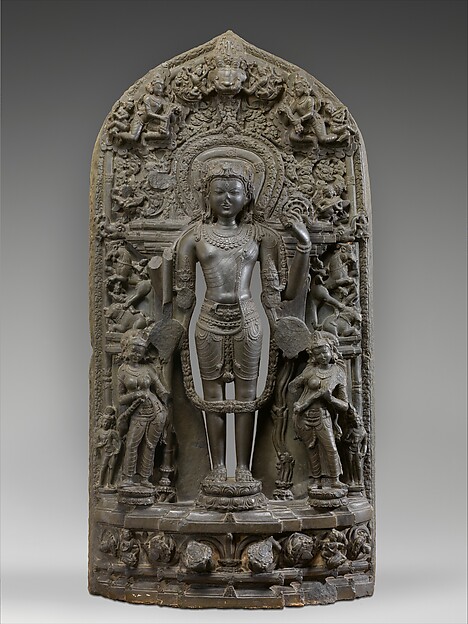
India, 12th century. Black phyllite; H. 119.4 cm, W. 63.5 cm, D. 22.9 cm. Metropolitan Museum of Art, 1991.406.
Look closer: Note the two women at the god's feet, the one on each side that the Museum names as the goddesses, and the carved arch above him crowded with small figures.
The Metropolitan Museum of Art, Gift of Emily M. Goldman, 1991. Open Access.
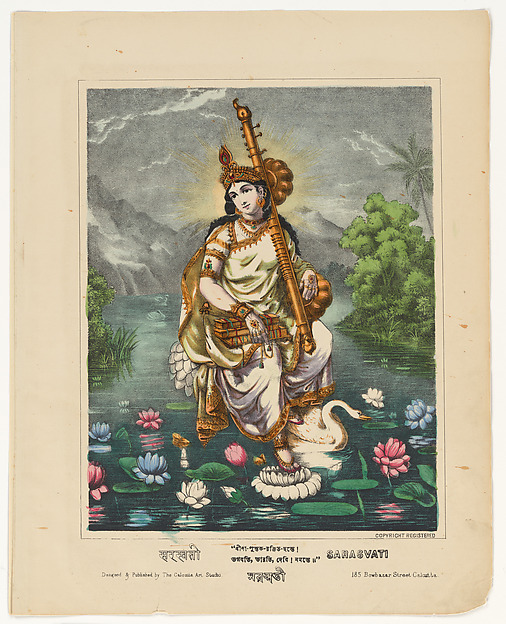
India, Calcutta, 1878-83. Lithograph with black ink, watercolour and varnish on paper; sheet 40.3 x 31.8 cm. Metropolitan Museum of Art, 2021.203.
Look closer: Note the swan beneath her and the long neck of the veena, the two Indian signs that the Japanese goddess translates into a dragon and a biwa.
The Metropolitan Museum of Art, Purchase, The Kipper Family Foundation Gift, 2021. Open Access.
| Where | Form and name | What the record shows |
|---|---|---|
| India | Sarasvatī | A river goddess of the Rigveda, later identified with Vāch, goddess of speech; holds a veena; the festival is Vasant Panchami (Wikipedia). |
| China | Bencaitian (辯才天) | 'Great eloquence deity'; Yijing's translation of the Golden Light Sutra, seventh century; one of the Twenty-Four Protective Deities (Wikipedia, JAANUS). |
| Japan | Benzaiten (弁才天, 弁財天); Benten | Worship arrived between the sixth and eighth centuries; joined with kami and counted among the Seven Lucky Gods (Wikipedia, JAANUS). |
| Burma | Thurathadi | The Burmese form of Sarasvatī (Wikipedia). |
| Thailand | Suratsawadi | The Thai form of Sarasvatī (Wikipedia). |
A goddess among the devas
Benzaiten belongs to the Heavenly Beings. She began as a Hindu river goddess adopted into the Buddhist pantheon, and later into Shinto, and she is the only goddess among the Seven Lucky Gods.
| Companion | Why they meet |
|---|---|
| Kichijōten | Often confused with her (JAANUS); her fortune role was attributed to Benzaiten in popular belief (Wikipedia). |
| Daikokuten | Flanks her in the Uga type of painting, with Bishamonten (Onmark). |
| Bishamonten | The other flanking figure in the Uga type of painting (Onmark). |
| Ugajin | A human-headed white snake, sometimes shown above her head (Wikipedia). |
| The Fifteen Sons | Her attendants in esoteric Buddhism (JAANUS). |
| Ichikishimahime | The Munakata goddess with whom she was identified from the twelfth century (Onmark, Wikipedia). |
Where to see her
| Place | What to look for |
|---|---|
| Hokkedō (Sangatsudō), Tōdaiji, Nara | The earliest Japanese eight-armed sculpture, eighth century (JAANUS). |
| Enoshima Shrine, Fujisawa, Kanagawa | Three halls along the island, the Hōanden with its eight-armed and nude statues, and the Eight-Direction-Gazing Turtle (Kanpai Japan, Discover Fujisawa, Rediscovering Japan). |
| Zeniarai Benzaiten Ugafuku Shrine, Kamakura | The cave spring where coins are washed; independent under its present name since 1970 (Wikipedia). |
| Tsurugaoka Hachimangū, Kamakura | A wooden biwa-type figure in silk robes (JAANUS) and, Onmark reports, a nude Benten dated 1266 in the Kamakura Museum of National Treasures. |
| Hōgon-ji, Chikubushima, Lake Biwa | The hidden Benzaiten, shown once every sixty years, next in 2037; the Karamon is a National Treasure (Wikipedia, Shiga Mytabi). |
| Itsukushima Shrine and Daigan-ji, Miyajima | The great torii in the sea, restored and complete in December 2022; the Benzaiten festival on 17 June (Visit Miyajima, Get Hiroshima). |
| Benten-dō, Shinobazu Pond, Ueno, Tokyo | Benten Island built in imitation of Chikubushima by Tenkai (Wikipedia). |
| Ryōhō-ji, Hachiōji, Tokyo | The moe temple, on the Hachiōji Shichifukujin Pilgrimage (Wikipedia). |
| Metropolitan Museum of Art, New York | A thirteenth-century scroll, a clay disc and several prints, all in open access, including the pieces on this page. |
| Cleveland Museum of Art | Utamaro's Enoshima cave, Gekkō's Inokashira and the Heike biwa, in open access. |
More views of her waters
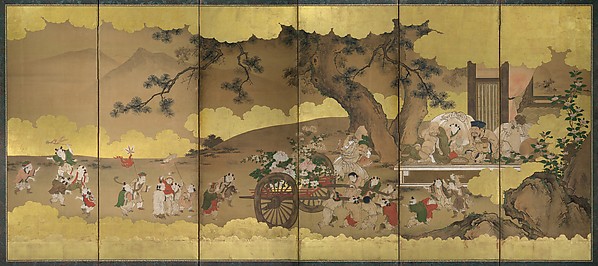
Kano Chikanobu, Japan, 17th-18th century. Six-panel folding screen; ink, colour and gilt on paper. Metropolitan Museum of Art, 29.100.498.
Look closer: Note the huddle of laughing gods on the veranda at the right, set against the children's cart at the centre; the Museum's title is what names the party.
The Metropolitan Museum of Art, H. O. Havemeyer Collection, Bequest of Mrs. H. O. Havemeyer, 1929. Open Access.

Utagawa Hiroshige, Japan, 1848-54. Diptych of hanging scrolls; ink and colour on silk; each image 92.5 x 33 cm. Metropolitan Museum of Art, 2015.300.150a, b.
Look closer: Note how Mount Fuji sits above the rock arch in the right-hand scroll, so that the island and the mountain are read together.
The Metropolitan Museum of Art, Mary Griggs Burke Collection, Gift of the Mary and Jackson Burke Foundation, 2015. Open Access.

Japan, ca. 1830. Woodblock print; ink and colour on paper; 25.1 x 37.1 cm. Metropolitan Museum of Art, JP588.
Look closer: Note the two tiny figures at the cave mouth, which give the scale of the grotto, and the line of foam that runs across the whole sheet.
The Metropolitan Museum of Art, Purchase, Joseph Pulitzer Bequest, 1918. Open Access.
In the house
These pieces come from the house's own shelves and carry the Benzaiten tag. The strip refills from what is available now.
A small glossary of Benzaiten
The words below are the ones that appear most often on shrine notices and museum labels. Each is defined as the pages behind this chapter use it.
- Sarasvatī
- The Sanskrit name; the Rigvedic river goddess, later joined with Vāch, goddess of speech (Wikipedia).
- Benzaiten, Benten
- The Japanese name and its clipped form; the older spelling uses the character for talent, the common modern one the character for wealth (JAANUS, Onmark).
- Konkōmyō saishōōkyō
- The Golden Light Sutra, translated by Yijing in the seventh century, the scripture of her eight-armed form (JAANUS).
- Happi Benzaiten
- The eight-armed warrior form, from the eighth century (Onmark).
- Myōon Benzaiten
- The two-armed form with a biwa, the main iconic form from the ninth century onward (Onmark).
- Hadaka Benten
- The nude form, painted white and never dressed, that plays a biwa (Onmark, Discover Fujisawa).
- Uga Benzaiten
- The form with Ugajin, a human-headed white snake, and a torii above her head (Wikipedia).
- Ugajin
- A kami shown as a human-headed white snake, a deity of harvest and fertility (Wikipedia, visitor's essay).
- Jūgo dōji
- The Fifteen Sons, the boy attendants of the esoteric Buddhist group (JAANUS).
- Biwa
- The short-necked lute; the gagaku, mōsō, Heike, Satsuma and Chikuzen types are named in this chapter (Wikipedia).
- Biwa hōshi
- Blind lute-playing monks who recited the Heike and ritual texts; Benzaiten was their protector (Wikipedia, Faure).
- Shichifukujin
- The Seven Lucky Gods, of whom she is the only woman (JAANUS, Onmark).
- Shinbutsu shūgō
- The mixing of Buddhist and Shinto worship, ended officially by the Meiji separation order of 1868 (Wikipedia).
- Hibutsu
- A hidden Buddha, an image withheld from view; Chikubushima's great Benzaiten is shown once every sixty years (Shiga Mytabi).
- Mi no hi
- The snake day, once every sixty days in odd-numbered months, her day of prayer (Onmark).
- Engi
- A shrine or temple chronicle; the Enoshima Engi of 1047 and the Chikubushima Engi of 931 are cited here (Wikipedia).
- Surimono
- A privately commissioned woodblock print with a verse, often issued for the New Year (Met).
Answered plainly
Who is Benzaiten?
A Buddhist goddess of music, learning, eloquence, wealth, longevity and protection from natural disasters, whose Sanskrit equivalent is the river goddess Sarasvatī (JAANUS, Wikipedia).
What is the difference between Benzaiten and Benten?
Benten is the clipped form of Benzaiten and the most common name (JAANUS, Wikipedia). The spelling with the character for talent is the older; the one with the character for wealth is the usual modern form (Onmark).
Why does she carry a biwa?
The biwa parallels the veena of the Indian Sarasvatī (Wikipedia); the biwa type became popular in the thirteenth century (JAANUS), and the blind biwa players who recited rites and the Heike took her as their patron (Faure).
Why does she sometimes have eight arms?
The Golden Light Sutra describes her with eight arms, and the earliest Japanese example, in the Hokkedō of Tōdaiji, is eighth-century (JAANUS). Wikipedia says the form is believed to derive from the iconography of Durgā. The lists of what the hands hold differ between sources, as the chapter's table shows.
Where are her great shrines?
JAANUS and Wikipedia name Itsukushima, Enoshima and Chikubushima. Visit Miyajima names Takeoshima instead of Chikubushima, and Shiga Mytabi names Hōgon-ji, Daigan-ji and Yōgan-ji. No official list exists.
Is she one of the Seven Lucky Gods?
Yes, and the only goddess among them. JAANUS says she was grouped with them in the Muromachi period; her companions are Daikokuten, Ebisu, Bishamonten, Hotei, Fukurokuju and Jurōjin.
What is Uga Benzaiten?
A form linked with the kami Ugajin, a human-headed white snake, in Tendai belief; she carries his effigy and a torii on her head (Wikipedia). The oldest extant painting of the type is an early-fourteenth-century scroll at Kotohira-gū (Onmark).
Is there a Benzaiten shrine called Utsukushima?
No source read for this chapter names a Benzaiten site of that name. Readers who ask are usually thinking of Itsukushima (厳島), the island shrine at Miyajima, or of Ichikishima, the name of the Munakata goddess with whom she was identified. Utsukushii means beautiful in Japanese, which may explain the slip. We have not verified any place called Utsukushima.
Can I see the hidden Benzaiten of Chikubushima?
Shiga Mytabi says the great Benzaiten at Hōgon-ji is a hibutsu, shown once every sixty years, and that the next opening is due in 2037.
Why do people wash money at Zeniarai Benzaiten?
Wikipedia says the water of the cave spring is believed to multiply the money washed in it, and traces the custom to 1257 and the regent Hōjō Tokiyori. It also notes that the shrine itself is probably a late nineteenth-century foundation, although the spring is old.
Where next
Sources and image credits
- JAANUS, Benzaiten 弁才天 (Columbia University)
- Wikipedia, Benzaiten
- Wikipedia, Saraswati
- Wikipedia, Enoshima
- Wikipedia, Chikubu Island
- Wikipedia, Hōgon-ji
- Wikipedia, Itsukushima Shrine
- Wikipedia, Munakata Taisha
- Wikipedia, Zeniarai Benten Shrine
- Wikipedia, Tsurugaoka Hachiman-gū
- Wikipedia, Shinobazu Pond
- Wikipedia, Biwa
- Wikipedia, Daishō-in
- Wikipedia, Ryōhō-ji
- Onmark Productions, Benzaiten
- Discover Fujisawa, Enoshima Shrine
- Japan Journeys, Enoshima Island
- Kanpai Japan, Enoshima Shrine
- Rediscovering Japan, Enoshima
- Visit Miyajima, Grand Festival of Benzaiten
- Shiga Mytabi, Hōgon-ji Temple
- The Matheson Trust, Bernard Faure, From Goddess to Dragon
- Mythopedia, Benzaiten
- Get Hiroshima, Miyajima shrine gate renovation
- Euronews, Buddhist hall with eternal flame burns
- Tokyo Weekender, Sacred eternal flame hall destroyed in Miyajima fire
- Dive Hiroshima, Itsukushima Shrine renovation
- Curious Ordinary (Substack), Benzaiten
- MyAnimeList, Benten (Urusei Yatsura)
- Metropolitan Museum of Art, Benzaiten and Fifteen Attendants (1975.268.11)
- Metropolitan Museum of Art, Benzaiten and Ugajin (51.60)
- Metropolitan Museum of Art, Benzaiten Seated on a White Dragon (JP2048)
- Metropolitan Museum of Art, Sarasvati (2013.4)
- Metropolitan Museum of Art, Sarasvati (2021.203)
- Metropolitan Museum of Art, Vishnu Accompanied by Lakshmi and Sarasvati (1991.406)
- Cleveland Museum of Art, Utamaro, Enoshima (1921.407)
- Cleveland Museum of Art, Gekkō, Benten at Inokashira (2017.70)
Last reviewed 28 October 2026. Pictures are public-domain or openly licensed, each credited beneath it. Diagrams on this page are drawn by Japonista.
Looking for a Benzaiten figure, scroll or print? Tell the concierge desk what you have in mind and we will search Japan for it.
Private concierge
Looking for something in particular?
Describe the piece or the project you have in mind. A senior advisor in Tokyo reads every case file personally and replies within two business days, with fees set out in writing before any work begins.