
Daikokuten
The Great Black God
Daikokuten
大黒天
A fearsome Indian guardian of the kitchen who crossed Asia, lost his scowl, and arrived in Japan as the smiling god with a sack, a mallet and a seat on the rice bales.
Identity card
Know the figure at a glance
- A soft cap. The Met's clay figure of 1698 and its woodblock print of about 1730 both show a cap, and a broad smiling face.
- The mallet. The mallet in the right hand is a sign JAANUS gives for the Japanese image; Wikipedia calls it the wish-granting uchide no kozuchi.
- The sack. A large sack over the left shoulder (JAANUS). Wikipedia connects it with the money-bag of Kubera and with Ōkuninushi carrying luggage in the Kojiki.
- A dark body. His name means 'Great Black'. The diagram colours the body dark; the Met's photographs are black and white or wood.
- The rice bales. He stands on rice bales, tawara (JAANUS). The diagram draws a plain ground instead.
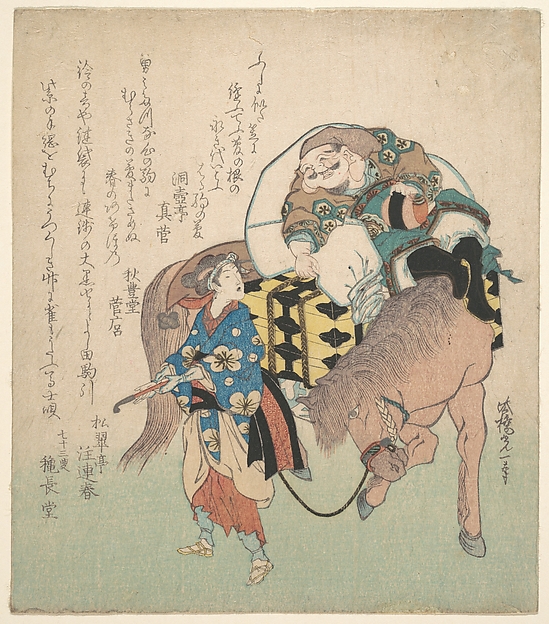
Hokkyō Kōitsu, Japan, probably 1834, year of the horse. Surimono woodblock print; ink and colour on paper; 21.3 x 18.4 cm. Metropolitan Museum of Art, JP3390.
Look closer: Note how the god's round body spills over the horse, with a chest on its flank and the verses packed into the left half of the sheet, which marks this as a privately printed New Year greeting for a horse year.
The Metropolitan Museum of Art, Gift of Mr. and Mrs. Arthur J. Steel, 1960. Open Access.
A god with two faces

Japan, 1698. Clay, glazed and gilt (Kiyomizu ware); H. 21.6 cm. Metropolitan Museum of Art, 93.3.227a, b.
Look closer: Note the cap, the round cheeks and the gathered neck of the bag: the whole modern image is already present in a piece made in 1698.
The Metropolitan Museum of Art, Gift of Charles Stewart Smith, 1893. Open Access.
Two images of Daikokuten could hardly be less alike. The first is the one Japan knows best: a plump, smiling man in a soft cap, a sack over his left shoulder and a mallet in his right hand, standing on rice bales. The Japan Architecture and Art Net Users System (JAANUS) gives exactly this description and adds that he was especially popular in the Edo period as one of the Seven Gods of Good Fortune.
The second image is older and darker. JAANUS says that in India he was a warrior deity called Mahākāla, regarded as an emanation of Shiva. Wikipedia adds that Mahākāla began as an epithet of Shiva as time, the ultimate destroyer, which Buddhism adopted both as a protector of the Dharma and as a fearsome deity who roams the forests at night with hordes of ghouls and demons. The name means 'great black', and the Chinese rendering, Dahei tian, is the 'Great Black Deva'.
This chapter follows the change. It begins with a carved wooden figure that Indian monks oiled until its face went black, crosses China, where the god acquired a cult of his own in Yunnan and at the Mongol court, and lands on Mt. Hiei, where Saichō is said to have met him as an old man and asked him to feed three thousand monks. It then shows how the sound of his name tied him to the Shinto lord of Izumo, how his mallet, sack and rice bales were added, how he joined the Seven Lucky Gods, and where his hidden images are kept. Each step is dated as far as the sources allow, and where they disagree, the disagreement is shown in a fact box.
Food miracles and flesh-eating spirits

Central Tibet, ca. 1500. Distemper on cloth; image H. 162.6 cm, W. 134.6 cm. Metropolitan Museum of Art, 2012.444.4.
Look closer: Note the five-skull crown above the staring eyes and the rows of lamas around the flames: this is the wrathful face that the Japanese god left behind.
The Metropolitan Museum of Art, Zimmerman Family Collection, Gift of the Zimmerman Family, 2012. Open Access.
Wikipedia reports the seventh-century pilgrim Yijing's account: wooden images of the deity stood in the kitchens and porches of Indian monasteries, where food offerings were made, and he was said to bring prosperity to the community and to grant wishes. Yijing described a carved figure two or three feet high, holding a golden bag and seated on a small chair with one foot hanging down, whose face had been blackened by constant wiping with oil. At meal times those who served in the kitchen offered light and incense and set out the prepared food before it.
Yijing also told of a food miracle at the Makuṭabandhana monastery in Kushinagar, where, after one of the female servants prayed and made offerings before his image, the deity supplied food for five hundred visiting monks. Wikipedia suggests that this idea of Mahākāla as one who brought prosperity to monasteries and granted wishes may have helped to make him a god of wealth in Japan. The Encyclopedia of Shinto, quoting the Nankai kikinaihōden of Yijing (635 to 713), says that Indian temples enshrined him on kitchen pillars as a black, two-armed figure holding a sack, and that this cult is what Saichō brought to Japan.
The darker strand survives in the commentary of Yi Xing on the Mahāvairocana Tantra, which tells how Mahākāla swallowed ḍākinīs, flesh-eating demons, and released them only on condition that they eat only the heart of those near death (Wikipedia). A tale in Amoghavajra's translation of the Humane King Sūtra has a heterodox master tell Prince Kalmāṣapāda to offer the heads of a thousand kings to Mahākāla, 'great black god of the graveyard'. JAANUS preserves the first story in Japanese terms: the Dainichikyōshō, a commentary on the Dainichi sutra, says that Dainichi appeared as Daikokuten in order to subdue Dakiniten. The god of the kitchen was also the master of the hungry spirits.
In Hindu India the same name stayed fierce. Wikipedia describes Mahākāla there as a manifestation of Shiva with four arms and three eyes, worshipped at Ujjain, and as one of Shiva's principal attendants, often placed outside the doorway of early temples. In Tibetan Buddhism, it adds, he is one of the most popular protectors, shown in many forms: the two-armed Black-Cloaked Mahākāla of the Karma Kagyu, the four-armed and six-armed types, and Pañjaranātha, the Lord of the Tent, of the Sakya school, the form the Museum's painting shows.
| Where | What the sources report | Source |
|---|---|---|
| India, Hindu | Mahākāla, a fierce form of Shiva as time; temple at Ujjain; four arms, three eyes | Wikipedia, Mahākāla |
| India, Buddhist monasteries | Oiled wooden figure with a gold bag beside the kitchen pillar; food offerings at meals | Wikipedia, citing Yijing |
| Kushinagar | Food for five hundred monks after a servant's prayer | Wikipedia, citing Yijing |
| Tantric commentary | Swallows the ḍākinīs and lets them eat only the hearts of the dying | Wikipedia, citing Yi Xing |
| Tibet and Mongolia | Protector with many forms, one of the most popular guardians; a tutelary god in Mongolian Buddhism | Wikipedia; Digital Dictionary of Buddhism, via Onmark |
Mahākāla, Kubera and the money bag
Almost every account has to deal with a second Indian god of wealth. Kubera, the Hindu lord of treasure, is closely associated with the colour black and with the north, and in Japan he is better known as Tamonten or Bishamonten. Wikipedia says some scholars believe the images Yijing saw may actually have been Kubera, who is carried in Indian art with a money bag, and that the two gods were conflated at some point, since images of both guard temple entrances in India and Nepal and Kubera was closely tied to Shiva. On this reading the sack-carrying Daikokuten of Japan derives from Kubera's iconography.
Meher McArthur, curator of East Asian art at the Pacific Asia Museum and quoted by Onmark, gives a similar account: a Chinese pilgrim reported seated gods with bags of gold at monastery doors, anointed with oil until they turned black, and the bag of gold is an attribute of Kubera, so the deity may have begun as Kubera. In Nepal, she writes, images of Mahākāla closely resemble Kubera. Onmark's own conclusion is more cautious. In Japan, it says, Daikoku is associated more closely with Mahākāla, is not known as Kubera, and Kubera is not known as Daikoku; with no concrete evidence, the site keeps them as separate deities with overlapping iconography.
The two positions are compatible if the question is one of image and not of name. The money bag may well have travelled from Kubera to the black god of the kitchen, while the Japanese cult never said so. In the Japanese esoteric tradition the link that mattered was northern: Wikipedia explains that Mahākāla's ties to Vaiśravaṇa (Bishamonten), Pañcika and Hārītī (Kishimojin), all of the north, are what put the rat, the animal of the northern sign, into his iconography.
| Question | Answer in the sources | Source |
|---|---|---|
| Is the sack from Kubera? | Possibly: scholars think Yijing's images may have been Kubera | Wikipedia |
| Is Daikoku a form of Kubera in Japan? | Not to the site author's knowledge; Kubera is Tamonten or Bishamonten | Onmark |
| Why a rat? | Mahākāla's link with Vaiśravaṇa, Pañcika and Hārītī, all of the north, the Rat's direction | Wikipedia |
| Where else do black, bag and kitchen meet? | Kubera is black and a lord of wealth; the kitchen link is Mahākāla's | Onmark |
From Nanzhao to the Yuan court
Wikipedia traces the Chinese cult. The name was transcribed as Mohejialuo (摩訶迦羅, Makakara in Japanese) and translated as Dahei tian. JAANUS notes that the Daihōdō daijikkyō, translated in the Sui dynasty, renders the name as Daikokuten. Mahākāla is mentioned in many Chinese Buddhist texts, yet pictures of him were rare in the Tang and Song periods. His cult flourished after the ninth century in the Nanzhao and Dali kingdoms of Yunnan, which border Tibet, and under the Mongol-led Yuan dynasty his likeness stood in the imperial palace and in temples inside and outside the capital, though most of those images no longer exist.
The Chinese forms were not gentle. Wikipedia describes a dark-skinned, wrathful deity wearing a diadem and a necklace of skulls with snakes coiled round his neck and arms. One type has three heads and six arms, holding a flayed elephant skin in the upper hands, a trident or sword in the lower hands, and a human figure and a goat in the middle pair. The dictionary of the monk Huilin, the Yiqiejing yinyi, has him standing on the hands of the earth goddess and gives eight arms. Some ninth- and tenth-century images from the Mogao caves at Dunhuang show him standing on a snake.
Chinese practice also gave him a gentle side. During the Qixi Festival, on the seventh day of the seventh month, married women bought dolls or figurines called Móhéluó in the hope of having children, a name that probably descends from Mahākāla, and ritual texts prescribe his worship to women seeking a partner and to pregnant women (Wikipedia). Wikipedia also records that he became a guardian of monasteries and above all of their kitchens, and Chinese kitchens had their own household guardian, Zao Jun, the Stove God, who reports on each family to heaven before the new year. Nothing in the sources read for this chapter joins the Stove God to Mahākāla, but the supervising habit has a Japanese counterpart, Sanbō Kōjin, introduced with the kitchen below.
| Period | Development in China | Source |
|---|---|---|
| Sui | Daihōdō daijikkyō renders the name as Daikokuten | JAANUS |
| Tang and Song | Texts mention him; pictures are rare | Wikipedia |
| 9th century onward | A flourishing cult in Nanzhao and Dali, Yunnan | Wikipedia |
| 9th and 10th century | Dunhuang paintings with the god standing on a snake | Wikipedia |
| Yuan | His likeness in the imperial palace and in temples | Wikipedia |
| Song and Yuan | Móhéluó dolls sold at the Qixi Festival | Wikipedia |
Three faces in the outer court
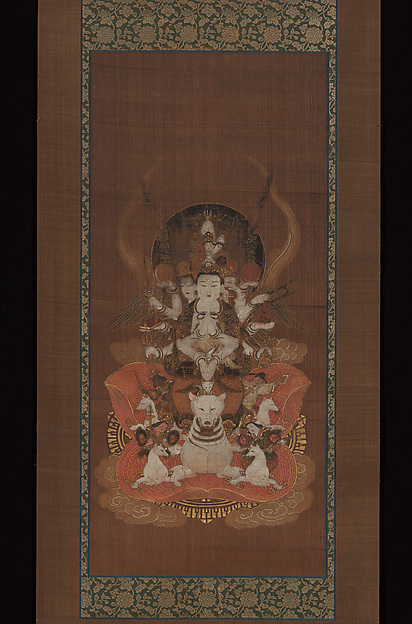
Japan, 17th century. Hanging scroll; ink, colour and gold on silk; image 86 x 38.7 cm. Metropolitan Museum of Art, 2025.795.10.
Look closer: Note the white fox beneath the crowned figure and the ring of foxes below: this is the rider whom, in the Dainichikyōshō story, the great black god subdued.
The Metropolitan Museum of Art, Mary and Cheney Cowles Collection, Gift of Mary and Cheney Cowles, 2025. Open Access.
JAANUS notes that in Japan Daikokuten appears in the Gekongōbuin, the outer court of the Taizōkai mandara, the Womb World mandala, as a seated deity with three faces and six arms. It adds a reservation worth remembering: no independent Japanese image resembles the mandala figure. Wikipedia places him in the outer northeast corner of the Womb Realm mandala, upper left, together with the elephant-headed Vināyaka, and a mandala of Mahākāla and the Aṣṭamātṛkas, the eight mothers, survives in the Kakuzenshō, an early Kamakura compendium of iconography.
The mandala is also where the story of the ḍākinīs entered Japan. JAANUS says that, according to the Dainichikyōshō, Dainichi appeared as Daikokuten to subdue Dakiniten. Wikipedia adds that Acala, Fudō Myōō, is credited in some sources with the same conversion of the ḍākinīs and is also a wrathful form of Vairocana, which is one reason Daikokuten was linked in medieval texts with the wisdom king.
That is the pivot of the whole subject. The ferocious three-faced figure stayed in the diagram. The figure that left the diagram and entered the temple kitchens and, eventually, the house, was a different and kinder god, and the Japanese cult never needed the diagram in order to love him.
Saichō and the kitchens of Mt. Hiei
JAANUS says the practice of placing Daikokuten in monastery kitchens in Japan is said to have begun with Saichō (767 to 822) on Mt. Hiei. Wikipedia gives the legend: when Saichō first climbed Mt. Hiei, Mahākāla appeared to him as an old man and offered to guard the monastic community, later known as Enryaku-ji. It adds that Daikokuten came through both the Tendai and the Shingon schools and that, over time, his images shifted from wrathful to smiling.
The notice board at the Sanmen Shusse Daikoku-dō on the mountain tells the story in more detail. The hall, it says, stands where Saichō met Daikokuten. When Saichō first climbed Mt. Hiei he met a hermit and asked who he was. The hermit answered with a line of the Lotus Sutra about removing the suffering of people and granting peace. Saichō then asked him to protect the livelihood of the mountain, the health of the monks who practised there and the supply of food. The hermit promised to provide food for three thousand people daily, and good fortune and long life to those who worshipped him. Saichō realised that the hermit must be Daikokuten, purified himself, and carved a three-headed image with six arms. Later Saichō's disciple Kōjō (779 to 858) enshrined the sculpture there, and the building became an administrative office and dining hall.
The notice sets the figure out as three in one: Daikokuten in the centre as provider and protector of food supplies, Bishamonten on the left, giver of courage and strength, and Benzaiten on the right, who grants beauty and talent. It says that many such statues are now enshrined throughout Japan but that this was the first. Wikipedia lists the Daikoku-dō in the Enryaku-ji complex as holding a three-faced image attributed to Saichō, who is said to have made it after the god promised to become patron of the monastic community.
Mt. Hiei explains why such a god would be welcomed there. Wikipedia's article on the mountain says Enryaku-ji was founded in 788, grew into a complex of as many as three thousand sub-temples at its peak, and was razed by Oda Nobunaga in 1571; the main hall was rebuilt in 1642 under Tokugawa Iemitsu. A community of that size had a kitchen to feed. The mountain's older shrine was dedicated to Ōyamakui no Kami, known in the Buddhist-Shinto system as Sannō Gongen, and Wikipedia's Daikokuten article says Daikokuten, as patron of Enryaku-ji, was identified with Sannō Gongen of Hiyoshi Taisha at the eastern foot of the mountain.
| Date | Event at Mt. Hiei | Source |
|---|---|---|
| 767 to 822 | Saichō's life; credited with bringing the kitchen cult | JAANUS |
| 788 | Enryaku-ji founded on Mt. Hiei | Wikipedia, Enryaku-ji |
| 779 to 858 | Kōjō, Saichō's disciple, enshrines the sculpture | Enryaku-ji notice board (MLIT) |
| 1571 | Nobunaga razes the complex | Wikipedia, Enryaku-ji |
| 1642 | Main hall rebuilt under Tokugawa Iemitsu | Wikipedia, Enryaku-ji |
Pillars, pots and the priest's wife

Japan, 19th century. Wood; H. 3.5 cm, W. 3 cm, D. 3.3 cm. Metropolitan Museum of Art, 10.211.1814.
Look closer: Note the hunched seat, the cap pulled low and the bag at the figure's side: a domestic god carved to be held in the hand.
The Metropolitan Museum of Art, Gift of Mrs. Russell Sage, 1910. Open Access.
In Japan the kitchen kept its place at the centre of the cult. The Encyclopedia of Shinto says that Saichō's introduction resulted in the practice of enshrining Daikokuten as a kitchen tutelary in Japanese Tendai temples and also led to the custom of calling priests' wives 'Daikoku-san'. Wikipedia says the same: the wife of a Buddhist priest was popularly called Daikoku because of the god's association with the kitchen and the household. Wikipedia also records that he is worshipped in the kitchen for the blessing of the five cereals, wheat and rice among them.
From the kitchen the god moved into the structure of the house. JAANUS explains that the daikokubashira, the 'Daikoku post', was a structural post in vernacular houses considered an embodiment of Daikokuten, who had come to be associated with the kitchen and hearth and was regarded as the tutelary deity of the house. It stood in a variety of places: most commonly at the boundary between the earth-floored doma and the living rooms, which also marked the boundary between the public front half of the house, hare, and the private rear zone, ke. In townhouses it stood between the shop at the front and the rooms behind. It was often the largest post in the house and often the first to be raised when a house was built. As a sacred post it guarded the household's wellbeing and was a status symbol, and houses sometimes also had an Ebisu post.
Folko, an architecture blog on traditional houses, says the term first denoted a pillar or pole that enshrined the deity and later took on its purely architectural meaning, the most important and largest post of a traditional Japanese house, which it calls the heart of the house structurally, symbolically and spiritually. A Japanese-English dictionary entry for the word adds that the figurative sense, the breadwinner or mainstay, is now the more common in everyday speech, as in the phrase for the family's main earner, or for a team's key player. JAANUS also records a third use: the central post in the main hall of a Shinto shrine built in the taisha-zukuri style, the style named for Izumo.
The hearth had a god of its own in Japan, and the two are easy to confuse. Wikipedia describes Kōjin, also Sanbō Kōjin, as the kami of fire, the hearth and the kitchen, sometimes called Kamado-gami, the god of the stove: a deity of uncertain temper who represents violent forces turned toward the betterment of humankind, destroys impurity, and watches over the household, reporting any misdeeds to the kami of the village or city. Those reports are discussed, and rewards or punishments assigned, by an assembly of gods in Izumo province in the tenth month of the old calendar, in Ōkuninushi's own country. Kōjin is represented by a simple paper tablet in many homes, or by a statue in temples with flaming hair, fangs and a contorted face, often with a bow and arrows; some images have three heads, and he is sometimes identified as an incarnation of Fudō Myōō. Wikipedia says the cult is believed to come from Shugendō worshippers of the late Heian or early Kamakura period. Daikokuten gives food; Kōjin guards the fire and keeps the account.
| Place in the house | What stood there | Source |
|---|---|---|
| Kitchen pillar or stove | A Daikokuten image or talisman, often beside Ebisu | Encyclopedia of Shinto |
| Boundary of doma and living rooms | The daikokubashira, between the public and private halves | JAANUS |
| Townhouse: shop to rooms behind | The post at the line between front shop and living space | JAANUS |
| Raising the frame | Often the first post to be erected | JAANUS |
| Priest's household | The priest's wife called Daikoku-san | Encyclopedia of Shinto, Wikipedia |
| By the stove | A paper tablet or statue of Sanbō Kōjin, god of fire and the hearth | Wikipedia, Kōjin |
Daikoku meets Ōkuninushi
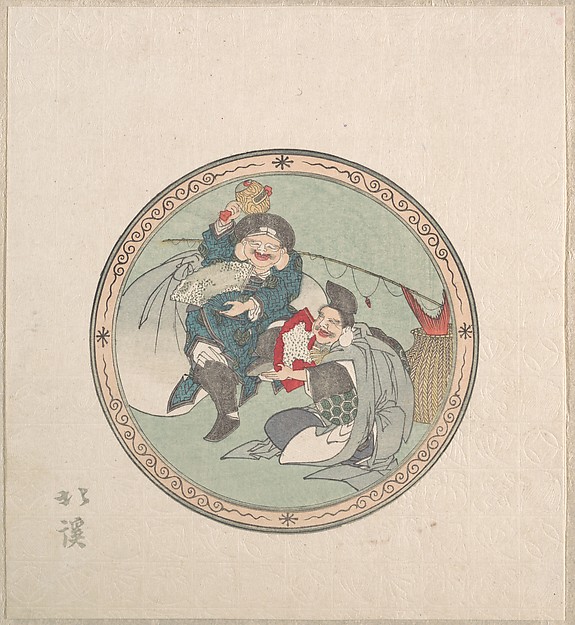
Totoya Hokkei, Japan, 19th century. Surimono from an album of woodblock prints; ink and colour on paper; 20.2 x 18.4 cm. Metropolitan Museum of Art, JP2248.
Look closer: Note the fishing rod over the blue-robed figure's shoulder, which names Ebisu, and how the pair are drawn as one tumbling knot, the way the shrines pair them.
The Metropolitan Museum of Art, H. O. Havemeyer Collection, Bequest of Mrs. H. O. Havemeyer, 1929. Open Access.
The characters 大国 can be read 'Daikoku', which linked the Buddhist god to the Shinto deity Ōkuninushi no Mikoto, 'Master of the Great Land'. JAANUS says the identification reinforced his later closeness to food and good fortune. The Encyclopedia of Shinto says the association rests on the homophonic resemblance of the Sino-Japanese characters, which became possible with the development of shinbutsu shūgō, the mixing of kami and Buddhist deities, from the medieval period. Wikipedia adds that the cult of Enryaku-ji helped: as patron of the monastery, Daikokuten was identified with Sannō Gongen, the god of Hiyoshi Taisha, who was in turn identified with Ōkuninushi or Ōmononushi, the god of Mt. Miwa.
Wikipedia's Ōkuninushi article states the result plainly: the god came to be popularly called Daikoku-sama (大黒様) and was syncretised with Daikokuten in the system that prevailed before the Meiji era. Images of Daikokuten stand in both temples and shrines, though in shrines they are usually revered as the Japanese god Ōkuninushi and not the Buddhist Mahākāla. Medieval exegetes also read the name itself. Wikipedia reports that they took 'Daikoku' to mean 'great darkness', a symbol of fundamental ignorance, and also read the characters as the nonduality of ignorance, 黒, and enlightenment, 大. Because of his foreign origins he was sometimes classed as a jissha, a 'real' god, lower than the gongen who manifest buddhas, though esoteric Buddhism also posited a higher Daikokuten who transmutes ignorance into awakening.
The pairing with Ebisu has its own history. The Encyclopedia of Shinto explains that the practice of enshrining Daikoku and Ebisu together was already observed in the late Muromachi period, and that it began because the main deity of Nishinomiya Shrine was Ebisu Saburō, a figure identified both with Ōkuninushi and with Kotoshironushi. Eventually Ebisu was identified as Kotoshironushi alone, which left Daikoku, as Ōkuninushi, a separate figure. Onmark adds that in many traditions Ebisu is considered Daikoku's son, which matches the Kojiki, where Kotoshironushi is Ōkuninushi's son. In homes the two stood together by the kitchen or oven; merchants worshipped them as patrons of trade and farmers as gods of the rice paddy, ta no kami.
| Level of the fusion | Reported by | Source |
|---|---|---|
| The sound daikoku | 大黒 and 大国 share a reading | Wikipedia, Encyclopedia of Shinto, JAANUS |
| The patron of Enryaku-ji | Daikokuten identified with Sannō Gongen, who was identified with Ōkuninushi or Ōmononushi | Wikipedia |
| The bag | Ōkuninushi carries his brothers' luggage in the Kojiki; Daikokuten carries a sack | Wikipedia |
| The rat | Mice figure in Ōkuninushi's myth and in Daikokuten's northern links | Wikipedia |
| Ebisu as son | Kotoshironushi identified with Ebisu; Ōkuninushi as Daikoku | Encyclopedia of Shinto, Onmark |
From the hare of Inaba to the great shrine

Yashima Gakutei, Japan, probably 1828. Surimono woodblock print; ink and colour on paper; 21 x 18.6 cm. Metropolitan Museum of Art, JP2232.
Look closer: Note how the rat clings to the swollen head of the mallet, and the peony flower on its side: the mallet is drawn as a household object, a god's property left lying around.
The Metropolitan Museum of Art, H. O. Havemeyer Collection, Bequest of Mrs. H. O. Havemeyer, 1929. Open Access.
Behind the fusion lies a story, which Wikipedia retells from the Kojiki. The young Ōnamuji, as Ōkuninushi was first called, carries the bags of his eighty brothers on their way to court the princess Yagamihime of Inaba. On the shore he finds a flayed hare, which the brothers have told to wash in salt water. Ōnamuji advises it to wash in fresh water and roll in cattail pollen, and the hare recovers and predicts that he, and not his brothers, will win the princess. The brothers kill him twice, with a red-hot boulder and a split log, and his mother has him revived each time, first by two clam goddesses.
He flees to Susanoo in the underworld, where he meets Susanoo's daughter Suseribime and undergoes four trials. He sleeps in a room of snakes and in a room of centipedes and bees, and is saved by the magical scarves she gives him. Susanoo then shoots an arrow into a meadow and sets the field on fire, and it is a field mouse that shows Ōnamuji a hole to hide in and brings him the arrow. That is the mouse Wikipedia connects with Daikokuten's rat. Finally Susanoo has him pick lice from his hair, and Ōnamuji pretends to chew and spit out the insects, using a mixture of red clay and nuts. While Susanoo sleeps, the young man ties his hair to the rafters and escapes with Suseribime, Susanoo's bow and arrows and his koto, and Susanoo, grudgingly, renames him Master of the Great Land, Ōkuninushi, and Spirit of the Living Land.
With Sukunabikona, a tiny god who arrives on the waves in a bean pod, Ōkuninushi forms and develops the land; when Sukunabikona crosses to the eternal land, another god, later named Ōmononushi, offers help if worshipped, and is enshrined on Mt. Mimoro in Yamato. In the kuni-yuzuri, the transfer of the land, heavenly envoys press Ōkuninushi to yield his realm. His son Kotoshironushi accepts; his other son Takeminakata, defeated by Takemikazuchi, flees to Suwa; and Ōkuninushi withdraws into the unseen world on condition that a palace rooted in the earth and rising to heaven be built for him. Wikipedia's article on Izumo-taisha says that shrine is that palace in tradition: regarded as the oldest in Japan, with no record of its founding, its taisha-zukuri main hall is now 24 metres high after the rebuilding of 1744, though a record of about 950 gives a height of about 48 metres and the discovery of enormous pillar remains in 2000 lends credence to a taller past.
Izumo-taisha is dedicated to Ōkuninushi as the god of good relationships and marriage, and the shrine is rebuilt in a cycle of sixty to seventy years, the most recent return of the deity to the inner shrine being on 11 May 2013, before more than eight thousand people. Its great festival, the Reisai, is held on 14 to 16 May. In Kyoto and elsewhere, Wikipedia's Daikokuten article lists images that carry both identities: a touchable 'Nade Daikoku' at Jishu Shrine, an Ōkuninushi holding Daikokuten's mallet there, and a statue of Daikokuten-Ōkuninushi at the Kyoto branch of Izumo Taisha in Kameoka.
| Episode in the Kojiki | What happens | Echo in Daikokuten |
|---|---|---|
| The hare of Inaba | Ōnamuji carries his brothers' bags and helps the hare | The sack |
| The field of fire | A mouse shows him a hole and fetches the arrow | The rat |
| The renaming | Susanoo names him Ōkuninushi, Master of the Great Land | The reading daikoku |
| Sukunabikona | A tiny god in a bean pod helps him build the land | Ebisu, in some traditions |
| The transfer of the land | He yields the realm and asks for a great palace | Izumo-taisha |
The mallet, the sack and the rat
Wikipedia lists the symbols: a sack, a mallet and rice bales, with the mouse or rat as his animal. The mallet is the golden uchide no kozuchi, the 'tap-and-it-appears little mallet', which bestows whatever its owner desires, wealth and happiness among them, when struck on the ground. Its origin is uncertain; Bernard Faure (2015), cited by Wikipedia, links it to the Saptamātṛkas, the Seven Mothers, who are pictured holding mallets, as plague deities, in the Madarijin ritual. The treasures of the Takarabune, the ship of the Seven Lucky Gods, also include the magic mallet, the inexhaustible purse and the bag of fortune (Wikipedia).
The sack is older than the mallet. Wikipedia notes that it is already attested in Yijing's description of the Indian images and may come from Kubera's money bag; it also fits Ōkuninushi, the luggage carrier of the Kojiki. Onmark says the sack is slung over the shoulder and the mallet is small and magic, and the Hase-dera notes at Kamakura count him as a god of the five cereals. The Encyclopedia of Shinto, JAANUS and Onmark agree on the basic set: mallet in the right hand, sack over the left shoulder, rice bales underfoot.
The rat arrives by way of the north. Wikipedia explains that Mahākāla's association with Vaiśravaṇa, who is Bishamonten, and with Pañcika, Vaiśravaṇa's general, and Hārītī, who is Kishimojin, all connected with the north, which corresponds to the Rat in the Chinese zodiac, put mice and rats into his iconography. The same article adds that Īśāna, guardian of the northeast and another Buddhicised Shiva, is one of the twelve directional guardians, and that mice also figure in Ōkuninushi's myth. Hence the rat days of the calendar, and hence the Met's netsuke of a figure with a rat on his mallet, in the section on forms below.

Japan, 19th century. Wood; H. 3.8 cm. Metropolitan Museum of Art, 10.211.1969.
Look closer: Note the raised arm and the straw binding on the bale beneath his feet.
The Metropolitan Museum of Art, Gift of Mrs. Russell Sage, 1910. Open Access.

Japan, 19th century. Ivory inlaid with various coloured stones; H. 3.2 cm, W. 4.4 cm. Metropolitan Museum of Art, 10.211.116.
Look closer: Note how the god himself is absent: the bag, the mallet head in mother-of-pearl and the precious stones stand for him, the way a sign stands for a shop.
The Metropolitan Museum of Art, Gift of Mrs. Russell Sage, 1910. Open Access.
| Attribute | What the sources say | Source |
|---|---|---|
| Mallet | Uchide no kozuchi; grants wishes when struck; origin uncertain, perhaps from the Seven Mothers | Wikipedia |
| Sack | From Yijing's gold bag, perhaps Kubera's; also Ōkuninushi's luggage | Wikipedia |
| Rice bales | Two tawara; added from the fourteenth century | JAANUS, Wikipedia |
| Cap | Daikoku-zukin, a peasant's hat, from the early fourteenth century | Onmark |
| Rat | The northern sign, through Vaiśravaṇa and Hārītī; also in Ōkuninushi's myth | Wikipedia |
Two bales, a cap and a forked radish
Rice bales are the newest of his attributes. Wikipedia says Daikokuten's iconography evolved from the fourteenth century, when he increasingly became a smiling man with a rotund belly holding a mallet and standing or sitting on rice bales; JAANUS gives the bales their Japanese name, tawara, and notes that the thirteenth-century carving at Saidaiji, made for Eison, still shows a severe face and has none. Onmark states that since the early fourteenth century the artwork has shown him cheerful and pudgy, wearing a peasant's hat called Daikoku-zukin, standing on bales, with a sack slung over his shoulder and a small magic mallet. It adds that, apart from a female form, in Japan the god is invariably shown on two bales.
The bales carry meaning. Onmark gives Daikoku as the deity of agriculture and rice. The Encyclopedia of Shinto says farmers worshipped him and Ebisu as tutelaries of the paddy, and Wikipedia connects his kitchen cult with the five cereals. The Met's rice-bale netsuke, with a pair of wrestlers hidden inside, shows how quickly the bale became a stage for jokes: its carver packs Daikoku and a long-headed god, whom the Museum's title spells 'Fukurukujin', into a box that opens like a lunch tin.
His fertility side is old and was never hidden. Wikipedia states that he was considered a god of fertility and was portrayed making the fig sign, carrying a suggestively forked daikon radish, sometimes called the 'bride of Daikoku', and, in some images, as a wooden phallus. We note it here and no further: it is part of the record, and it explains why the radish in Hokusai's drawing, in the gallery, is not a vegetable out of place. In China, Wikipedia adds, the god's name was attached to the fertility dolls sold at the Qixi Festival.

Japan, 19th century. Wood; H. 4.8 cm, W. 3.5 cm. Metropolitan Museum of Art, 10.211.1766.
Look closer: Note the bale carved as a barrel with straw bands: it is his seat, and its fat curve echoes his belly.
The Metropolitan Museum of Art, Gift of Mrs. Russell Sage, 1910. Open Access.

Japan, 18th to 19th century. Wood; closed H. 2.5 cm, W. 4.1 cm. Metropolitan Museum of Art, 10.211.2055.
Look closer: Note the hinged lid and the two small wrestlers in the hollow: the bale is a box for a joke.
The Metropolitan Museum of Art, Gift of Mrs. Russell Sage, 1910. Open Access.
Standing, seated and six-fold

Japan, 19th century. Ivory; H. 6.7 cm. Metropolitan Museum of Art, 91.1.934.
Look closer: Note the tiny rat perched on the mallet head and the robe engraved with a lattice: this is the standing type in its Edo form.
The Metropolitan Museum of Art, Edward C. Moore Collection, Bequest of Edward C. Moore, 1891. Open Access.
Wikipedia divides the earliest Japanese images into two types. The Shingon type stands, with the left hand holding a sack slung over the shoulder and the right fist clenched on the hip; it is first mentioned in the tenth-century Yōson dōjōkan and in an apocryphal eleventh-century text, the Daikokutenjin-hō, which describes him as black, wearing a black cap (eboshi), a hunting robe (kariginu) and hakama, with a bag the colour of rat's hair. The Tendai type sits, and first appears in writing in the thirteenth-century Asabashō. Most show him in Japanese dress, a few in armour.
The Chinese-derived wrathful types remained known. Wikipedia describes a Japanese variant, attested in Japan and not in Chinese texts, with one head and two arms, holding a sword in the right hand and a skull cup in the left, and a six-armed form drawn in the Besson zakki. Onmark, quoting the Digital Dictionary of Buddhism, says the Japanese Mahākāla is most commonly the six-armed type and notes two interpretations: an esoteric one, a fierce deity who is the masculine form of Kālī, with one face and eight arms or three faces and six; and an exoteric one, a kindly god of wealth. The Dictionary adds that he is shown as one of the eight fierce guardians, generally blue-black.
The Butsuzōzui of 1690 sets out six forms of Daikoku, the Roku Daikokuten. Wikipedia and Onmark give them with different spellings and some different details, which is why the table below carries both. The commonest, in modern times, is the sixth, shown on two bales holding a mallet. Wikipedia's article on the Seven Lucky Gods adds that the Butsuzōzui records a female Daikoku, Daikokunyo or Daikokutennyo, 'she of great blackness'.
| Form | Wikipedia | Onmark, from the 1690 Butsuzōzui |
|---|---|---|
| Biku Daikoku | In the form of a monk; mallet in the right hand, sword in the left | A priest, mallet in right hand, vajra-hilted sword in left; guardian of the refectory |
| Ōji (Ōi) Kara Daikoku | A prince brandishing a sword and a vajra | A princely figure, sword in right hand and vajra in left; a son of Śiva |
| Yasha Daikoku | Subduer of demons in Japanese aristocratic dress, holding a wheel | A princely figure holding the wheel of the law in the right hand |
| Makakara Daikokunyo | A female figure holding a rice bale above her head | Female, bale of rice on her head, in a Chinese robe; a form of Kālī |
| Shinda Daikoku | A boy with a wish-granting jewel | A boy with a jewel in the left hand |
| Makara Daikoku | The usual benign form with mallet and sack | Mallet in the right hand and bag on the back, on a lotus leaf or bales; the commonest |
Sanmen Daikokuten
The three-faced form joins Daikokuten, Bishamonten and Benzaiten in one body. Wikipedia says the fusion occurred in the late Muromachi period, the sixteenth century, and in a sense reconnected the popular benign god to his less well-known wrathful form. The Mt. Hiei notice reads the three faces as roles: the centre provides and protects food, the left gives courage and strength, and the right bestows beauty and talent. Hokusai drew the type, according to Wikipedia's caption, and the Daikoku-dō on Hiei is described there as holding an example attributed to Saichō.
Wikipedia's temple list shows how the idea spread. Eishin-ji in Taitō, Tokyo, a Jōdo temple founded in 1631, keeps a Sanmen Daikokuten attributed to Kūkai in the Daikoku-dō beside its main hall. Daihō-ji, a Nichiren temple in Moto-Azabu founded in 1597, keeps the image called Sanshin Gusoku Daikoku-sonten, which shows the god with the hairstyle of Benzaiten and the armour of Bishamonten. Kongō-in in Toshima, Tokyo, was announced to open its hidden Sanmen Daikokuten to the public from 1 to 3 January 2014, and a press release says Toyotomi Hideyoshi venerated the image. Yokai.jp, whose caveats are noted above, adds Entoku-in, a Kōdai-ji sub-temple in Higashiyama, Kyoto.
The three-faced Daikokuten is one of the clearest examples in the chapter of how Japanese esoteric Buddhism built a single image out of the fortune gods before the Seven Lucky Gods were fixed as a group. Benzaiten and Bishamonten are dealt with in their own chapters; here it is enough to note that, as the Hiei notice says, the three-faced statue is held to be the first of its kind, and that every other claim of age for a Sanmen image is therefore a claim to be measured against it.
| Temple | Place | What is reported | Source |
|---|---|---|---|
| Enryaku-ji, Daikoku-dō | Mt. Hiei, Shiga | Three-faced image attributed to Saichō; notice calls it the first | Wikipedia; MLIT notice |
| Eishin-ji | Taitō, Tokyo | Sanmen Daikokuten attributed to Kūkai in a hall beside the main hall | Wikipedia |
| Daihō-ji | Moto-Azabu, Tokyo | Daikoku with Benzaiten's hair and Bishamonten's armour | Wikipedia |
| Kongō-in | Toshima, Tokyo | Hidden Sanmen Daikokuten, shown 1 to 3 January in 2014 | Press release (Dreamnews) |
| Entoku-in | Higashiyama, Kyoto | Known for a Sanmen Daikokuten | Yokai.jp |
The oldest statues
The oldest surviving Japanese images show how severe the god once was. JAANUS names the late Heian wooden sculpture at Kanzeonji in Fukuoka Prefecture as the oldest extant image, with a fierce expression. Wikipedia describes the Kanzeon-ji figure at Dazaifu as the oldest standing Daikokuten, wearing eboshi, knee-length hakama and shoes, and dates the oldest examples of both types to about the eleventh century. Onmark gives the figure as camphor wood, 171.8 centimetres high, an Important Cultural Property of the Heian era, and quotes the Dazaifu Cultural Heritage Centre as its source.
The oldest seated image is at Kongōrinji in Shiga, in its sub-temple Myōjuin. JAANUS says it is shown in armour, so that his identity as a war god is still apparent. Wikipedia describes the figure as seated on a rock holding a small bag and a club or staff; Onmark records it as painted wood, 49.9 centimetres high, in armour, holding a sword and a treasure bag. The sources agree on the armour and the bag and disagree on what the other hand holds, which is why we report both.
Later images show the smiling type forming. JAANUS names a thirteenth-century sculpture at Saidaiji in Nara, made by Zenshun for the monk Eison (1201 to 1290) after Eison's vision of Makakara, which still shows a severe face and has no rice bales. It names the 1339 sculpture at Shōjuraigōji in Shiga by Suruga Ajari, a 1319 image at Hokkeji in Nara and a 1609 image at Kojimadera in Nara. Wikipedia adds that a statue from Tōdai-ji dated 1347, in the Nanbokuchō period, is now in the Tokyo National Museum, and that an armoured Daikokuten stands at Manshu-in in Kyoto.
| Image | Date | What to look for | Source |
|---|---|---|---|
| Kanzeon-ji, Dazaifu, Fukuoka | Late Heian | Fierce face, eboshi, short hakama; the oldest extant, standing | JAANUS, Wikipedia, Onmark |
| Kongōrin-ji, Myōjuin, Shiga | Late Heian | Armour; seated on a rock; sword or club, and a small bag | JAANUS, Wikipedia, Onmark |
| Hokkeji, Nara | 1319 | A notable later image | JAANUS |
| Shōjuraigōji, Shiga | 1339 | By Suruga Ajari | JAANUS |
| Tōdai-ji image, Tokyo National Museum | 1347 | Nanbokuchō-period statue | Wikipedia |
| Saidaiji, Nara | 13th century | By Zenshun for Eison; severe face; no bales | JAANUS |
| Kojimadera, Nara | 1609 | A notable later image | JAANUS |
Daikokuten among the Seven
Wikipedia says the Seven Lucky Gods began as remote and impersonal gods and gradually became canonical figures for professions. They came from Mahayana Buddhism (Benzaiten, Bishamonten, Daikokuten, Hotei), from Chinese Taoism (Fukurokuju and Jurōjin), and, in Ebisu's case, from Japan itself. The first two worshipped as a pair, Ebisu and Daikokuten, were gods of business and trade, and merchants prayed to them first. Wikipedia says the gods were mentioned as a group in 1420 in Fushimi, in imitation of the processions of daimyō. The Encyclopedia of Shinto places the counting of Daikoku with Ebisu among the seven in the late Muromachi period, which is consistent with a start in the fifteenth century.
The set was fixed in the Edo period. Onmark records that the monk Tenkai, who died in 1643 and was named Jigen Daishi, symbolised each god with a virtue for the shogun Tokugawa Iemitsu: candour for Ebisu, fortune for Daikokuten, amiability for Benzaiten, magnanimity for Hotei, popularity for Fukurokuju, longevity for Jurōjin and dignity for Bishamonten. Wikipedia says Tenkai chose the gods after speaking with Iemitsu, looking for the perfect virtues, and that the painter Kanō Yasunobu was then ordered to portray them for the first time. Wikipedia's description gives Daikokuten as the god of commerce and prosperity, patron of cooks, farmers and bankers, protector of crops, and a demon hunter: legend says he hung a sacred talisman on a branch in his garden and caught a demon with it.
The Met's screen by Kano Chikanobu shows the party at ease, and Hokusai's two ink drawings in the Museum show how freely the artists could play with them. In one, Ebisu and Daikoku share a cup beside a basketwork wine jar for the New Year. In the other, labelled Daikoku, Juro and Ebisu, a shallow woven boat holds a round bundle painted with tiny figures, which suggests that the artist is drawing the treasure ship by way of a package.
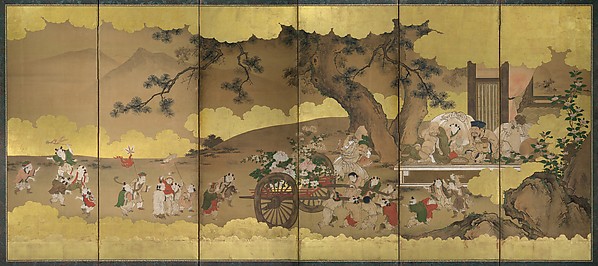
Kano Chikanobu, Japan, 17th to 18th century. Six-panel folding screen; ink, colour and gilt on paper. Metropolitan Museum of Art, 29.100.498.
Look closer: Note the huddle of laughing gods on the veranda at the right, set against the children's cart at the centre; the Museum's title is what names the party.
The Metropolitan Museum of Art, H. O. Havemeyer Collection, Bequest of Mrs. H. O. Havemeyer, 1929. Open Access.
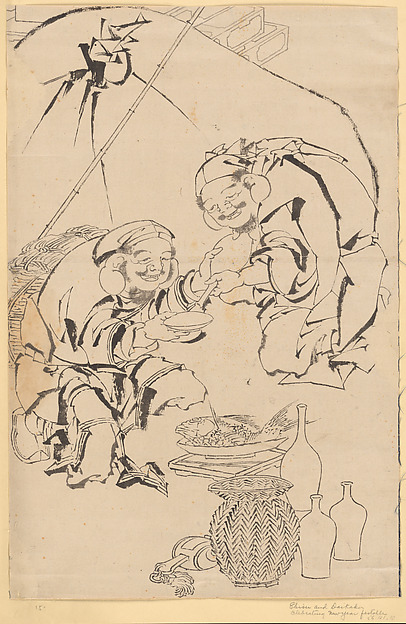
Katsushika Hokusai, Japan, 18th to 19th century. Ink on paper; 47 x 31 cm. Metropolitan Museum of Art, 56.121.10.
Look closer: Note the sake bottles and the basketwork jar at the lower edge and the bamboo above: the pair are placed in a house at the New Year.
The Metropolitan Museum of Art, Gift of Annette Young, in memory of her brother, Innis Young, 1956. Open Access.

Katsushika Hokusai, Japan, 18th to 19th century. Ink and colour on brown prepared paper; 27.9 x 40.6 cm. Metropolitan Museum of Art, 56.121.18.
Look closer: Note the tiny figures on the round bundle: the three gods are shrunk to a design on a parcel of luck.
The Metropolitan Museum of Art, Gift of Annette Young, in memory of her brother, Innis Young, 1956. Open Access.
| God | Virtue given by Tenkai | Origin |
|---|---|---|
| Ebisu | Candour | Japan |
| Daikokuten | Fortune | India, through Buddhism |
| Benzaiten | Amiability | India |
| Hotei | Magnanimity | China |
| Fukurokuju | Popularity | China, Taoism |
| Jurōjin | Longevity | China, Taoism |
| Bishamonten | Dignity | India |
Treasure ships and first dreams

Kubo Shunman, Japan, 1816, year of the rat. Surimono from an album of woodblock prints; ink and colour on paper; 14 x 21 cm. Metropolitan Museum of Art, JP2318.
Look closer: Note the rats in clothes at the stern and the heap of bales amidships: in a rat year the treasure ship is crewed by the god's own animal.
The Metropolitan Museum of Art, H. O. Havemeyer Collection, Bequest of Mrs. H. O. Havemeyer, 1929. Open Access.
Wikipedia describes the Takarabune, the 'treasure ship', as a mythical ship piloted through the heavens by the Seven Lucky Gods in the first three days of the New Year. The gods carry treasures that include the hat of invisibility, rolls of brocade, the inexhaustible purse, the keys to the treasure shed, scrolls of wisdom, the magic mallet, the lucky raincoat, the robe of fairy feathers and the bag of fortune. A picture of the ship forms an essential part of the New Year, and merchants and urban workers associate it with good fortune in business.
By custom a woodblock print of the ship is placed under the pillow on the night of 2 January, to induce a lucky dream, and an unpleasant dream is dispelled by throwing the print into a river. Wikipedia says the habit began around the Muromachi period, was first popular among the nobility, spread to commoners in the later Edo period, and was served by street vendors who sold cheap single-use prints. Many prints show a crane above and a tortoise below, and a palindromic poem about a long night in a boat, with the sound of waves at dawn and smooth sailing ahead.
The same article on the first dream, hatsuyume, records the other lucky dream of the new year: Mount Fuji, a hawk and an eggplant, a belief current since the early Edo period, mentioned in the poetry of Matsuo Bashō. The treasure ship belongs to the same world of New Year omens. The Met's surimono, a privately commissioned print with a verse, is dated to a rat year, 1816, which explains the crew; Daikokuten's animal has taken over the boat.
Seven-god walks of old Edo

Torii Kiyonaga, Japan, ca. 1793. Woodblock print; ink and colour on paper; 24.4 x 18.1 cm. Metropolitan Museum of Art, JP930.
Look closer: Note the cartouche at the upper left, which appears to give the series title as an Edo pilgrimage of seven lucky gods; the gods themselves are absent and the visitors are the subject.
The Metropolitan Museum of Art, Gift of Estate of Samuel Isham, 1914. Open Access.
Pilgrimage is the Seven Lucky Gods' great public practice, and the Daikokuten stop is the one that dates the circuit best. The Tokyo Stroll supplements list the routes. In Asakusa, Sensō-ji is the Daikokuten of the Asakusa Shichifukujin walk, and Asakusa Shrine, Ebisu. In Fukagawa, it is Enjuin. In Mukōjima, Mimeguri Shrine takes both Ebisu and Daikoku. In Ningyōchō, Matsushima Shrine is Daikoku. The Exploring Old Tokyo pages add Daienji in Shimomeguro on the oldest course, the Yamanote route in Meguro, and in Yanaka the Gokokuin, in Ueno Park, where Daikokuten, 'wealth', closes the walk with Benten-dō on the lake.
The Old Tokyo writer notes that Matsushima Shrine's Daikoku is unusually versatile, responsible for sixteen different kinds of wishes, from business prosperity to protection from danger, and that the shrine is one of the Bird Day fairs, the tori-no-ichi of November, a market of lucky rakes. Wikipedia places at Gokoku-in a painting of Daikokuten attributed to Fujiwara no Nobuzane, given to the temple by Tokugawa Iemitsu, the shogun to whom Tenkai is said to have named the seven virtues. In Kamakura the circuit runs differently: Onmark's pilgrimage page gives Hase-dera as the Daikokuten of the Kamakura seven, a wooden image dated 1412.
The general note in the Tokyo Stroll supplement on the practice is this. The pilgrimage is usually done in the first week or two of the year; some shrines and temples take part only then and others all year; a pilgrim may, for a fee, collect a stamped seal, a small statue or an ema at each stop. Because every walk assigns one god to one site, the walks make Daikokuten visible as a figure of the neighbourhood and not only of the household, which is the shift the Edo period made in his cult.
| Walk | Daikokuten's stop | Note | Source |
|---|---|---|---|
| Asakusa | Sensō-ji | Ebisu is at Asakusa Shrine | Tokyo Stroll |
| Fukagawa | Enjuin | Hotei at Fukagawa Inari | Tokyo Stroll |
| Mukōjima | Mimeguri Shrine | Ebisu and Daikoku in a shrine to the left of the main hall | Tokyo Stroll; Exploring Old Tokyo |
| Ningyōchō | Matsushima Shrine | Sixteen kinds of wish; Bird Day fair | Tokyo Stroll; Exploring Old Tokyo |
| Meguro (Yamanote) | Daienji | Called the oldest Tokyo course | Exploring Old Tokyo |
| Yanaka | Gokokuin, Ueno Park | Painting attributed to Nobuzane | Exploring Old Tokyo; Wikipedia |
| Kamakura | Hase-dera | Wooden image dated 1412 | Onmark |
Daikoku in the Edo print shop
Wikipedia says that Daikokuten's rise in popularity among the common people during the late medieval and early modern periods made him a popular subject for art, and the Met's collection shows the range. Okumura Toshinobu's print of about 1730 shows him at a board game with the wild-haired, bearded Shōki, the demon-queller, with his sack and a rice bale behind him; the Museum calls it chess, though what is drawn is a gridded board. Harunobu's Daikoku Dōagé of 1766, a print of a plump man in a green cap swamped by women and children, and Shigemasa's boys dressed as Daikoku and Ebisu, a flat-capped boy with a drum and a boy with a bream on a rod, show the god brought down into the household and the festival.
Surimono, the privately commissioned verse prints given at the New Year, used him as a seasonal sign. Gakutei's mallet and rat, Kōitsu's Daikoku on a horse and Hokkei's tumbling pair are all of this kind, and several are dated by the zodiac animal of their year: the Met notes a year of the horse for Kōitsu's print and a year of the rat for Shunman's treasure boat. Onmark's page reproduces an Ōtsu-e painting of the eighteenth century in the Mingeikan, Japan Folk Crafts Museum, in which Daikoku, nearly naked and in a red hood, climbs a ladder to shave Fukurokuju's elongated head, a picture it takes to show that the immortals have as many foibles as ordinary folk.
Wikipedia's captions add further types. Kawanabe Kyōsai drew Daikokuten with rats pulling a radish mikoshi; Tamagawa Shūchō drew Ebisu and Daikokuten; and a Meiji one-yen banknote bore Daikokuten, engraved by Edoardo Chiossone. These are not in the Met's holdings, so we list them without pictures.

Suzuki Harunobu, Japan, probably 1766. Woodblock print; ink and colour on paper; 27 x 20.6 cm. Metropolitan Museum of Art, JP865.
Look closer: Note the green cap at the centre of the huddle: the god is a person here, a plump man mobbed by the household, and the title names him as Daikoku.
The Metropolitan Museum of Art, Gift of Estate of Samuel Isham, 1914. Open Access.

Kitao Shigemasa, Japan, ca. 1780. Woodblock print; ink and colour on paper; 37 x 24.9 cm. Metropolitan Museum of Art, JP934.
Look closer: Note the sea bream on the line, which marks Ebisu, and the flat cap and drum of the other boy: the two gods are played by children in a festival.
The Metropolitan Museum of Art, Gift of Estate of Samuel Isham, 1914. Open Access.
Five tales retold
The hermit on the mountain. Saichō climbs Mt. Hiei and meets an old man who quotes the Lotus Sutra. Saichō asks him to protect the monks and promises, in the version on the temple's notice, to feed three thousand every day. The hermit agrees, and Saichō recognises Daikokuten and carves a three-faced image (Enryaku-ji notice, Wikipedia).
The servant's prayer. Five hundred monks arrive unannounced at the Makuṭabandhana monastery in Kushinagar, and a female servant prays and makes offerings before the image of Mahākāla in the kitchen. The deity provides food for all of them (Wikipedia, citing Yijing).
The hare and the bags. Ōnamuji carries the luggage of eighty brothers and, out of kindness, heals a flayed hare; the hare says the bag-carrier, and not the brothers, will win the princess. It is the story most often given for why Daikoku carries a sack (Wikipedia).
The demon in the garden. Wikipedia's article on the Seven Lucky Gods says that Daikokuten hung a sacred talisman from a branch in his garden and, using it as a trap, caught a demon. This is one of the few stories of the god acting as a hunter, and the source gives no date or text for it, so we tell it as a legend.
The swallowed spirits. Mahākāla, a form of Vairocana, swallows the flesh-eating ḍākinīs and releases them only when they promise to eat the heart of the dying and nobody else (Wikipedia, citing Yi Xing). JAANUS puts the same act in Dainichi's mouth: Dainichi becomes Daikokuten to subdue Dakiniten.
Daikoku-ya and the house of fortune
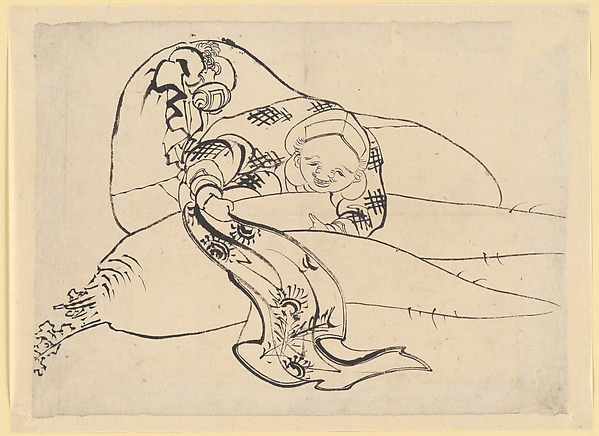
Katsushika Hokusai, Japan, 18th to 19th century. Ink on paper; 24.4 x 33.3 cm. Metropolitan Museum of Art, 56.121.15.
Look closer: Note how the drawing is almost all radish: the god folds himself over a root as big as a bolster, with his sack behind.
The Metropolitan Museum of Art, Gift of Annette Young, in memory of her brother, Innis Young, 1956. Open Access.
The name 'Daikoku-ya', the house or shop of Daikoku, is hard to document. None of the sources read for this chapter describes a tradition of shops named for the god, and we do not assert one. What the sources do show is a set of facts around it. Wikipedia says Daikokuten is a patron of farmers, cooks and workers in money, such as bankers; the Encyclopedia of Shinto says merchants worshipped him and Ebisu as tutelaries of commercial success; Onmark says images of him are found everywhere, in shops and on posters, key chains, mobile-phone accessories and toys. The Old Tokyo writer finds him at Matsushima Shrine in Ningyōchō, a merchants' district, as a god of five cereals and wealth.
The house name itself appears in the history. Wikipedia's article on Daikokuya Kōdayū (1751 to 1828) says he was born in Wakamatsu in Ise Province, now Suzuka, Mie, and was adopted by a merchant, Daikokuya of Shiroko in Ise. As captain of the Shinshō-maru he sailed for Edo in 1782, was blown off course in a storm, drifted for seven months, and landed on Amchitka in the Aleutians; after years in Russia he met Catherine the Great at Tsarskoye Selo and was allowed to return home in 1791. His merchant house, then, carried the name; what the article does not say is why. We leave the reason open and mark it as a gap.
The shop's Daikoku post gives the clearest sign of the idea. JAANUS says that in townhouses the daikokubashira stood at the boundary between the shop at the front and the rooms behind it, or deeper, between the living room and the kitchen, and that in vernacular houses the post marked the line between the public front half, hare, and the private rear, ke. The commercial house and the god of the kitchen met at one beam. A further performance tradition, Daikoku-mai, 'the dance of Daikoku', is reported by Wikipedia: in the medieval and early modern periods, performers, usually hinin, social outcasts, costumed as Daikokuten went from door to door to dance and sing in exchange for donations.
| Thread | What is documented | Source |
|---|---|---|
| Merchants' patron | Merchants worship him with Ebisu as tutelaries of commercial success | Encyclopedia of Shinto |
| Shop and kitchen post | Daikokubashira at the line between shop and rooms behind | JAANUS |
| House name | Daikokuya of Shiroko, Ise, adopted Daikokuya Kōdayū; reason for the name not given | Wikipedia |
| Door-to-door dance | Daikoku-mai by costumed performers, usually outcasts | Wikipedia |
| Priest's wife | Called Daikoku, for the kitchen and the household | Wikipedia |
Rat days and borrowed fortune

Japan, 19th century. Ivory; H. 4.1 cm. Metropolitan Museum of Art, 10.211.429.
Look closer: Note the elder's high bald head and the capped god clasped round him: two members of the seven drawn in one grip.
The Metropolitan Museum of Art, Gift of Mrs. Russell Sage, 1910. Open Access.
Wikipedia describes the folk practice. Rat days, ne-no-hi, are sacred to him, especially the Yang Wood Rat days (kōshi or kinoe-ne), including the first, hatsu kōshi, and the last, osame kōshi, of the year, when special ceremonies and festivals are held at many places of worship. Fukunusubi, 'theft of fortune', began with the belief that whoever stole divine figures was assured good fortune if not caught in the act; the year-end market at Sensō-ji in Asakusa became the main venue for the sale and disposal of such images, with many small stalls selling Daikokuten images on the eve of the new year. Tsubute involved throwing a talisman into a rich house at the hour of the rat, around midnight, to 'steal' the wealth.
An esoteric ritual performed at many Tendai temples where Daikokuten is worshipped is called yokubei-ku, a glutinous-rice offering in which rice porridge is poured over a statue of the god (Wikipedia). The Encyclopedia of Shinto also describes a seal of Daikokuten placed within a home, the Tanohara Daikokuten of Mt. Ontake in Gunma, and Wikipedia adds that pilgrims on Mt. Ontake wear tenugui scarves with the seed syllable of Mahākāla. Hōju-ji at Yonezawa is popularly called the head temple of the kinoe-ne Daikokuten and is shown below.
Everyday sayings carry the god too. Daikoku-bashira, now the word for the breadwinner, is the clearest. Daikoku-san for a priest's wife is another. Onmark's note on pairs is a third: Daikoku and Ebisu are arranged in kitchens as a couple, and in Bizen ware, lacquer and netsuke the two are made as a set, sometimes with Hotei, so that a household can hold the luck of the whole company in a small shelf.
The hidden Daikokuten
A hibutsu, 'secret Buddha', is an image ordinarily kept hidden. Wikipedia explains that hibutsu are generally kept in miniature shrines, zushi, and are unavailable except at certain ceremonies, kaichō, the 'opening of the curtain'; some, called zettai hibutsu, are almost never shown. The practice, it says, is a uniquely Japanese phenomenon according to the art historian Shirō Itō, and the concealment is meant to emphasise potency and transcendence. JAANUS says the practice seems to have developed in the Heian period with the rise of esoteric Buddhism, and that openings may be seasonal, annual, or in cycles of seven, thirty-three or sixty years.
Several Daikokuten are kept this way. At Hase-dera in Kamakura, a retail magazine's page says the original wooden image is 62 centimetres tall, bears an inscription of the nineteenth year of Ōei, 1412, and is a hibutsu, and a travel guide to the Daikoku-dō says its main image is kept in storage and a replacement stands in its place. Onmark independently dates the Hase-dera wooden statue to about 1412. At Daikoku-ji in Fushimi, Kyoto, a magazine feature says the main image, about 24 centimetres tall and enshrined in a gold-leaf cabinet, is a hibutsu that opens once every sixty years. At Kongō-in in Toshima, a press release announced that the hidden Sanmen Daikokuten would be shown on 1 to 3 January 2014.
A caution applies. The Fushimi feature gives the last opening as 2016 and the next as 2076, and calls the cycle a kinoe-ne year, which on the sexagenary calendar falls in 1984 and 2044, not 2016. Either the cycle is counted from another point or the label is loose. We report the dates and the label and advise checking with the temple before travelling. For Mano-dera in Chiba, whose 'Asahi Kaiun Daikokuten' is said by Wikipedia to have been carved by Ennin in 860, none of the sources read gives a display rule, so we do not call it hidden.
| Temple | Image | Reported rule | Source |
|---|---|---|---|
| Hase-dera, Kamakura | Wood, 62 cm, inscribed 1412 | Original kept away; replacement shown | Serai; Rurubu; Onmark |
| Daikoku-ji, Fushimi, Kyoto | About 24 cm, on a lotus, in a gilt cabinet | Opens every sixty years; 2016, next 2076 | Serai |
| Kongō-in, Toshima, Tokyo | Sanmen Daikokuten | Shown 1 to 3 January 2014 | Press release (Dreamnews) |
| Mano-dera, Chiba | Asahi Kaiun Daikokuten, said to be by Ennin, 860 | Not reported | Wikipedia |
Temples and shrines of the Great Black God
Wikipedia lists the principal places of his worship. Enryaku-ji on Mt. Hiei, Tendai, has the Daikoku-dō. Daikoku-ji in Habikino, Osaka, a Sōtō Zen temple, claims to be a candidate for the cult's birthplace; its founding story says that the ascetic En no Gyōja founded it in 665 after a vision of Daikokuten riding a five-coloured cloud. Daikoku-ji in Fushimi, Shingon, is said to be Kūkai's foundation, with a Daikokuten image attributed to him; it was renamed in 1615 when Shimazu Yoshihiro made it a prayer centre for the Shimazu of Satsuma. Myōen-ji in Matsugasaki, Kyoto, a Nichiren temple founded in 1616, is known as Matsugasaki Daikokuten and has an image attributed to Saichō.
Mano-dera in Chiba, founded by Gyōki in 725 and dedicated to the thousand-armed Kannon, enshrines the Asahi Kaiun Daikokuten, attributed to Ennin, who carved it in 860 after a vision at daybreak. Kyōō-ji in Shinjuku, Nichiren, founded in 1598, has an image from Kuon-ji said to be carved by Nippō. Hōju-ji at Yonezawa, Shingon, is popularly called Kinoe-ne Daikokuten Honzan; its image is attributed to Kūkai and came from Dainichi-ji, one of the four administrative temples of Mt. Yudono, after that temple was converted into a Shinto shrine in the Meiji period. Wikipedia also lists Nade Daikoku at Jishu Shrine in Kyoto, the Daikoku-dō of Toyokawa Inari's branch in Akasaka and the Daikokuten-dō at Shinobazu Pond in Ueno.
Dates and attributions like these are traditions, and the three claims of Kūkai's hand, Saichō's hand and Ennin's hand are best read together as the lineages of the god's cult, Shingon and Tendai, not as records. The hall at Hōju-ji, shown here, is a useful reminder that the Meiji separation of Shinto and Buddhism moved images as well as buildings.

妖精書士, Japan, 29 July 2021. Photograph. Hōju-ji, Yonezawa, Yamagata Prefecture.
Look closer: Note the stone figure on its plinth in front of the hall and the rows of lanterns: this is the outdoor face of a temple whose wooden image is attributed to Kūkai.
Photograph by 妖精書士, via Wikimedia Commons. CC0.
| Place | Sect | Claim | Source |
|---|---|---|---|
| Enryaku-ji, Ōtsu | Tendai | Daikoku-dō; three-faced image attributed to Saichō | Wikipedia |
| Daikoku-ji, Habikino | Sōtō Zen | Founded 665 by En no Gyōja after a vision | Wikipedia |
| Daikoku-ji, Fushimi | Shingon | Kūkai's foundation; renamed 1615 | Wikipedia |
| Myōen-ji, Kyoto | Nichiren | Founded 1616; image attributed to Saichō | Wikipedia |
| Mano-dera, Chiba | Shingon | Founded 725; Daikokuten carved by Ennin in 860 | Wikipedia |
| Hōju-ji, Yonezawa | Shingon | Image attributed to Kūkai; moved from Dainichi-ji | Wikipedia |
A god of the present day

Kageakane, Taipei, 15 January 2024. Photograph.
Look closer: Note the black face and gilt cap and the sake bottles laid below: a household offering table on which the god keeps company with other small figures.
Photograph by Kageakane, via Wikimedia Commons. CC0.
Wikipedia says he continues to enjoy an exalted position as a deity of fortune and the household in Japan, and that his images are found in shops throughout the country. Onmark adds that he appears on posters, key chains, mobile-phone accessories and toys. Wikipedia lists a statue in Taipei, and the photograph here shows a household offering table there, on which the god stands before a red roundel of script with sake bottles and smaller wooden figures at his feet, so that the cult has crossed the sea again, the way it came.
In everyday language he has also become an idiom. The Japanese-English dictionary entry for daikokubashira gives the figurative sense of the word, the breadwinner or mainstay, as more common in conversation than the architectural one, as in the family's breadwinner or a team's key player, and for losing one's mainstay. JAANUS gives the building sense. The Tokyo Stroll supplements still describe the seven-god walks as a New Year practice, with stamped seals and small statues collected at each stop.
The first-dream tradition continues in the same way: the Seven Lucky Gods are still drawn on ships, and the ship is still placed under the pillow on the second of January. A god who began as the dark guardian of monastery kitchens, and of the graveyard in the Humane King Sūtra, has become a figure on a household shelf, which says something about the scale of the change this chapter has followed.
Reading a small Daikoku

Japan, 19th century. Wood; H. 1.9 cm, W. 3.5 cm, D. 2.5 cm. Metropolitan Museum of Art, 10.211.739.
Look closer: Note the figure reclining on the coin like a man on a sofa, the mallet and bag set at his side: the attributes read at a glance even in a piece under four centimetres wide.
The Metropolitan Museum of Art, Gift of Mrs. Russell Sage, 1910. Open Access.
Small carvings of Daikoku are among the commonest in the Met's netsuke, and a handful of habits help to read them. The god may sit, stand, ride a bale or recline on a coin; the Museum catalogues examples on a rice bale, on a coin, with a rat, with Fukurokuju and with Hotei. The signs below come from the iconography the chapter has gathered, and the right-hand column says what to check, not what to conclude.
| Sign | Reads as | Check |
|---|---|---|
| Soft cap | Daikoku-zukin, the peasant's hat of the smiling type | A flat cap is the common sign; armour or a black court cap points to the older types |
| Sack on the shoulder or at the side | The treasure bag; Yijing's gold bag, Ōkuninushi's luggage | Is the neck gathered and tied, as in the Met's clay figure of 1698 |
| Mallet | Uchide no kozuchi, the wish-granting mallet | Mallet head often pear-shaped or ringed (Onmark, Iwaki shrine) |
| Rice bales | Tawara; the smiling type from the fourteenth century | Count them: two is the standard |
| Rat | The northern sign; the field mouse of the myth | Look on the mallet head, the bale or the bag |
| Radish | Fertility sign; the 'bride of Daikoku' | A forked root is the tell |
| Companion | Ebisu, Fukurokuju or Hotei | Pairs and sets were made as a unit; check that both halves are present |
| Three faces | Sanmen Daikokuten | Centre Daikoku, Bishamonten on the left, Benzaiten on the right |
History by era
The dates below gather what the chapter's sources give, with the claim and its source named. Where a date is a tradition and not a record, it is marked.
- Vedic and Hindu IndiaMahākāla is an aspect of Shiva as time; the temple at Ujjain (Wikipedia).
- Late 7th centuryYijing describes oiled wooden images by the kitchen pillars of Indian monasteries (Wikipedia).
- 665Date given for the founding of Daikoku-ji at Habikino after a vision (Wikipedia, tradition).
- 725Mano-dera founded by Gyōki (Wikipedia).
- 767 to 822Saichō's life; credited with bringing the kitchen cult to Mt. Hiei (JAANUS).
- 788Enryaku-ji founded (Wikipedia).
- 860Ennin said to carve the Asahi Kaiun Daikokuten (Wikipedia, tradition).
- 9th century onwardCult flourishes in Nanzhao and Dali (Wikipedia).
- 10th centuryStanding type first mentioned in the Yōson dōjōkan (Wikipedia).
- 11th centuryDaikokutenjin-hō; oldest surviving statues, standing and seated, c. late Heian (Wikipedia, JAANUS).
- 13th centurySeated type first mentioned in the Asabashō; Saidaiji image by Zenshun for Eison (Wikipedia, JAANUS).
- 1319Image at Hokkeji, Nara (JAANUS).
- 1339Image at Shōjuraigōji by Suruga Ajari (JAANUS).
- Early 14th centurySmiling, rotund god on rice bales, in a peasant's hat (Onmark, Wikipedia).
- 1347Tōdai-ji statue now in the Tokyo National Museum (Wikipedia).
- 1412Inscription on the Hase-dera image, Kamakura (Serai, Onmark).
- 1420Seven Lucky Gods first mentioned as a group in Fushimi (Wikipedia).
- Late MuromachiDaikoku counted with Ebisu in the Seven Lucky Gods; Sanmen Daikokuten fused (Encyclopedia of Shinto, Wikipedia).
- 1571Nobunaga razes Enryaku-ji (Wikipedia).
- 1597 and 1598Daihō-ji and Kyōō-ji founded in Tokyo (Wikipedia).
- 1609Image at Kojimadera, Nara (JAANUS).
- 1615Daikoku-ji at Fushimi renamed after Shimazu Yoshihiro (Wikipedia).
- 1631Eishin-ji founded (Wikipedia).
- 1643Death of Tenkai, who is said to have named the seven virtues (Onmark).
- 1690Butsuzōzui lists the six forms of Daikoku (Onmark, Wikipedia).
- 1698The Met's Kiyomizu-ware figure (Metropolitan Museum).
- About 1730Toshinobu's print of Daikoku and Shōki (Metropolitan Museum).
- 1744Izumo-taisha rebuilt to its present size (Wikipedia).
- 1782 to 1791Daikokuya Kōdayū adrift and in Russia (Wikipedia).
- 1868Separation of Shinto and Buddhism; images move from temple to shrine, as at Dainichi-ji (Wikipedia).
- 2013Ōkuninushi returned to Izumo-taisha's inner shrine, 11 May (Wikipedia).
- 2016Reported opening of the Fushimi hidden image (Serai).
- 2076Reported next opening of the Fushimi hidden image (Serai).
Small facts worth keeping
These are the small things that do not fit a section but are worth knowing, each from a page that was read for this chapter.
- Black as a name. Dahei tian, the Chinese rendering, means the Great Black Deva, and Daikoku keeps the colour in his Japanese name (Wikipedia).
- A pillar named for him. The daikokubashira of a traditional house is the great central post, and in everyday speech the word now means the breadwinner (JAANUS, dictionary entry).
- Dainichi in disguise. The Dainichikyōshō says Dainichi appeared as Daikokuten to subdue Dakiniten (JAANUS).
- A mouse in the myth. A field mouse shows the young Ōnamuji a hole to hide in when Susanoo sets the meadow on fire, which is the mouse Wikipedia ties to Daikokuten's rat.
- Two bales, always. Onmark notes that, apart from a female form, the Japanese god is invariably shown on two bales.
- A palace for a god. Izumo-taisha is the palace Ōkuninushi asked for when he yielded the land, and its record of about 950 gives a height of about 48 metres (Wikipedia).
- A pillow print. A woodblock print of the treasure ship goes under the pillow on the night of 2 January; a bad dream is dispelled by throwing the print in a river (Wikipedia).
- Rats at the helm. Shunman's surimono of 1816, a rat year, puts three robed rats on the treasure boat (Metropolitan Museum).
- A one-yen god. A Meiji one-yen banknote bore Daikokuten, engraved by Edoardo Chiossone (Wikipedia).
- Sixty years in a cabinet. The small image at Daikoku-ji in Fushimi is reported to open once in sixty years (Serai).
- Rice porridge on the god. The Tendai rite called yokubei-ku pours rice porridge over his statue (Wikipedia).
- A wrestling match in a bale. A Met netsuke of a rice bale opens to show Daikoku and a long-headed god wrestling inside (Metropolitan Museum).
Across Asia
The god changed his temper at each crossing. The Museum's Tibetan painting of Mahakala, Protector of the Tent, from about 1500, shows the wrathful guardian at one end of the road and the Edo print shop shows the smiling householder at the other. Wikipedia's article on the Kitchen God offers a distant parallel: Zao Jun, the Stove God, is the most important of the Chinese domestic gods that protect the hearth and family, and returns to Heaven before the Chinese New Year to report on each household. We make no claim of descent between him and the kitchen Mahākāla.
The names below are those the sources give for each region.
| Where | Form and name | What the record shows |
|---|---|---|
| India | Mahākāla | An epithet of Shiva as time; a dharmapāla in Buddhism; wooden images stood in monastery kitchens (Wikipedia, Yijing). |
| China | Mohejialuo (摩訶迦羅); Dahei tian (大黑天) | Great Black Deva; cult flourished after the ninth century in Nanzhao and Dali and under the Yuan (Wikipedia). |
| Tibet and Mongolia | Mahākāla; Gonpo | A many-formed protector and one of the most popular guardians, shown in the Museum's Central Tibetan painting of about 1500; the Digital Dictionary of Buddhism, via Onmark, places a Mongolian route in the sixteenth century. |
| China and Vietnam, the household parallel | Zao Jun (灶君); Táo Quân | The Kitchen God of Chinese folk religion, Taoism and the wider Sinosphere, a hearth god distinct from Mahākāla (Wikipedia, Kitchen God). |
| Japan | Daikokuten (大黒天); Daikoku-sama | Introduced through Tendai and Shingon; identified with Ōkuninushi; one of the Seven Lucky Gods (Wikipedia, JAANUS). |
A deva of the household
Daikokuten belongs to the Heavenly Beings. He began as an Indian guardian, appears in the outer court of the Womb World mandala, and is counted among the Seven Lucky Gods.
| Companion | Why they meet |
|---|---|
| Ebisu | Enshrined with him in kitchens and shops; counted as his son in some traditions (Encyclopedia of Shinto, Onmark). |
| Bishamonten and Benzaiten | Fused with him in the three-faced Sanmen Daikokuten (Wikipedia). |
| Dakiniten | Subdued by Dainichi appearing as Daikokuten (JAANUS). |
| Ōkuninushi | The Shinto god with whom he is identified (Wikipedia, Encyclopedia of Shinto). |
| Kōjin | The hearth god of the Japanese kitchen, whose pillar and pot are close to his (see the section on the hearth). |
Where to see him
| Place | What to look for |
|---|---|
| Kanzeonji, Dazaifu, Fukuoka | The oldest surviving standing image, late Heian (JAANUS, Wikipedia, Onmark). |
| Myōjuin, Kongōrinji, Shiga | The oldest seated image, in armour (JAANUS, Wikipedia, Onmark). |
| Saidaiji, Nara | A thirteenth-century carving by Zenshun for Eison, with a severe face and no bales (JAANUS). |
| Daikoku-dō, Enryaku-ji, Mt. Hiei | A three-faced image attributed to Saichō (Wikipedia). |
| Eishin-ji, Taitō, and Daihō-ji, Moto-Azabu, Tokyo | Sanmen Daikokuten attributed to Kūkai, and the Sanshin Gusoku Daikoku-sonten (Wikipedia). |
| Hōju-ji, Yonezawa, Yamagata | Popularly called Kinoe-ne Daikokuten Honzan (Wikipedia). |
| Hase-dera, Kamakura | A wooden image inscribed 1412; the original is reported hidden (Serai, Rurubu, Onmark). |
| Daikoku-ji, Fushimi, Kyoto | A hidden image reported to open every sixty years (Serai). |
| Mano-dera, Chiba | The Asahi Kaiun Daikokuten, said to be by Ennin (Wikipedia). |
| Jishu Shrine, Kyoto | The touchable Nade Daikoku (Wikipedia). |
| Izumo-taisha, Shimane | The great shrine of Ōkuninushi (Wikipedia). |
| Metropolitan Museum of Art, New York | Netsuke, prints, an inrō, a clay figure, a Tibetan Mahākāla and a Dakini scroll, all in open access, including the pieces on this page. |
More views of the Great Black God

Okumura Toshinobu, Japan, about 1730. Monochrome woodblock print; ink and colour on paper; 22.9 x 30.5 cm. Metropolitan Museum of Art, JP817.
Look closer: Note the sack looming behind the god and the wild hair of the visitor opposite; the Museum's title says chess, and what is drawn is a gridded board.
The Metropolitan Museum of Art, Gift of Estate of Samuel Isham, 1914. Open Access.

Nikkōsai, Japan, 19th century. Gold lacquer with hiramaki-e and ivory inlay; H. 8.6 cm, W. 5.9 cm. Metropolitan Museum of Art, 29.100.853.
Look closer: Note how the two gods dance around the curve of the case, a basket and a fish for one and a round bag for the other.
The Metropolitan Museum of Art, H. O. Havemeyer Collection, Bequest of Mrs. H. O. Havemeyer, 1929. Open Access.
In the house
These pieces come from the house's own shelves and carry the Daikokuten tag. The strip refills from what is available now.
A small glossary of Daikokuten
The words below are the ones that appear most often on shrine notices and museum labels. Each is defined as the pages behind this chapter use it.
- Mahākāla
- The Sanskrit name, 'great black' or 'great time'; an epithet of Shiva adopted by Buddhism (Wikipedia, JAANUS).
- Makakara
- The Japanese reading of the Chinese transcription of Mahākāla (Wikipedia).
- Dahei tian
- The Chinese 'Great Black Deva' (Wikipedia).
- Daikoku-sama
- The familiar name for the god, shared with Ōkuninushi (Wikipedia).
- Ōkuninushi
- 'Master of the Great Land', the Shinto god of the Kojiki with whom Daikokuten is identified (Wikipedia).
- Shinbutsu shūgō
- The mixing of kami and Buddhist deities, which made the identification possible (Encyclopedia of Shinto).
- Jissha
- A 'real' god of the lower tier, as against the gongen who manifest buddhas (Wikipedia).
- Uchide no kozuchi
- The wish-granting mallet (Wikipedia).
- Tawara
- A straw rice bale; the god stands or sits on two (JAANUS, Onmark).
- Daikoku-zukin
- The soft peasant cap of the smiling type (Onmark).
- Roku Daikoku
- The six forms of Daikoku listed in the Butsuzōzui of 1690 (Wikipedia, Onmark).
- Sanmen Daikokuten
- The three-faced image joining Daikokuten, Bishamonten and Benzaiten (Wikipedia).
- Daikokubashira
- The great central pillar of a house, and by extension the breadwinner (JAANUS, dictionary entry).
- Kōjin
- The Japanese hearth and kitchen god, close to Daikoku in the home (Encyclopedia of Shinto).
- Kinoe-ne, kōshi
- The Yang Wood Rat days of the sexagenary cycle, sacred to him (Wikipedia).
- Fukunusubi
- 'Theft of fortune', the old custom of stealing a figure for luck (Wikipedia).
- Hibutsu
- A hidden Buddha, an image shown only at certain openings (Wikipedia, JAANUS).
- Shichifukujin
- The Seven Lucky Gods (Wikipedia, Onmark).
- Takarabune
- The treasure ship of the Seven Lucky Gods (Wikipedia).
- Surimono
- A privately commissioned woodblock print with a verse, often a New Year greeting (Met).
Answered plainly
Who is Daikokuten?
A god of food, wealth and the household, shown smiling with a sack and a mallet on rice bales, who began as the Indian guardian Mahākāla (JAANUS, Wikipedia).
What does Daikokuten mean?
The characters mean Great Black Deva; the same reading can be written 大国, 'great land', which linked him to Ōkuninushi (Wikipedia, Encyclopedia of Shinto).
Who brought him to Japan?
JAANUS says the practice of placing him in monastery kitchens is said to have begun with Saichō on Mt. Hiei. The Digital Dictionary of Buddhism describes a later, sixteenth-century Mongolian route, and the chapter reports both.
Why does he carry a mallet?
It is the wish-granting uchide no kozuchi; its origin is uncertain, and Faure links it to the Seven Mothers (Wikipedia).
Is he a Buddhist or a Shinto god?
Both: a Buddhist deva identified with the Shinto Ōkuninushi, so that shrine images are usually revered as the Japanese god (Wikipedia).
Why is he linked with rats?
The mouse or rat is his animal, tied to the north and the Rat sign through Vaiśravaṇa and Hārītī, and there are mice in Ōkuninushi's myth (Wikipedia).
What is Sanmen Daikokuten?
A three-faced form joining Daikokuten, Bishamonten and Benzaiten, dated to the late Muromachi period; the Mt. Hiei notice reads the three faces as food, courage and talent (Wikipedia, MLIT).
What are Daikoku-ya traditions?
We could not document a tradition of shops taking the name from the god. The sources show merchants worshipping him, the Daikoku post between shop and house, and a merchant house called Daikokuya in Ise. We say so plainly.
Can I see a hidden Daikokuten?
Reports name Hase-dera in Kamakura, Daikoku-ji in Fushimi and Kongō-in in Tokyo. The Fushimi cycle is reported as every sixty years, but the stated year does not match the kinoe-ne calendar, so check with the temple first.
What happens on a rat day?
The Yang Wood Rat days are sacred to him, with special ceremonies on the first and last of the year (Wikipedia).
Is he one of the Seven Lucky Gods?
Yes. The pairing with Ebisu is old, and Tenkai is said to have given him the virtue of fortune in the set fixed for Tokugawa Iemitsu (Onmark).
Where next
Sources and image credits
- JAANUS, Daikokuten 大黒天 (Columbia University)
- JAANUS, Daikokubashira 大黒柱
- JAANUS, Hibutsu 秘仏
- Wikipedia, Daikokuten
- Wikipedia, Mahākāla
- Wikipedia, Ōkuninushi
- Wikipedia, Izumo-taisha
- Wikipedia, Seven Lucky Gods
- Wikipedia, Takarabune
- Wikipedia, Hatsuyume
- Wikipedia, Hibutsu
- Wikipedia, Mount Hiei
- Wikipedia, Enryaku-ji
- Wikipedia, Daikokuya Kōdayū
- Wikipedia, Kōjin
- Wikipedia, Kitchen God
- Encyclopedia of Shinto, Daikoku (Kokugakuin University)
- Onmark Productions, Daikokuten
- Onmark Productions, Kamakura Seven Lucky Gods pilgrimage
- Digital Dictionary of Buddhism
- Folko, Japanese minka XXV: Daikoku posts
- TKGJE Japanese-English dictionary, daikokubashira
- MLIT multilingual notice database, Enryaku-ji Daikoku-dō
- Serai, Daikoku-ji Fushimi feature
- Serai, Hase-dera hidden Daikokuten (shop page)
- Rurubu, Hase-dera Daikoku-dō
- Dreamnews press release, Kongō-in hidden Sanmen Daikokuten
- Tokyo Stroll, Shichifukujin pilgrimage supplements
- Exploring Old Tokyo, Seven Lucky Gods courses
- Yokai.jp, Daikoku-ten (AI-assisted; used with caution)
- Metropolitan Museum of Art, Netsuke of Daikoku and Mallet on Bale (10.211.1969)
- Metropolitan Museum of Art, Ornament in the shape of Daikoku (93.3.227a, b)
- Metropolitan Museum of Art, Daikoku and Shoki Playing Chess (JP817)
- Metropolitan Museum of Art, Daikoku on Horseback (JP3390)
- Metropolitan Museum of Art, Mahakala (2012.444.4)
- Metropolitan Museum of Art, Treasure Boat with Three Rats (JP2318)
- Metropolitan Museum of Art, Nippori Keinai Ebisu-Daikoku (JP930)
- Metropolitan Museum of Art, Daikoku Dōagé (JP865)
- Wikimedia Commons, Kinoene Daikokuten Honzan (CC0)
- Wikimedia Commons, Daikokuten Taipei (CC0)


Last reviewed 29 October 2026. Pictures are public-domain or openly licensed, each credited beneath it. Diagrams on this page are drawn by Japonista.
Looking for a Daikoku figure, scroll or print? Tell the concierge desk what you have in mind and we will search Japan for it.
Private concierge
Looking for something in particular?
Describe the piece or the project you have in mind. A senior advisor in Tokyo reads every case file personally and replies within two business days, with fees set out in writing before any work begins.