
Ebisu
God of the Catch
Ebisu
恵比須
The laughing god with the rod and the sea bream, the one native Japanese member of the Seven Lucky Gods: patron of fishermen and merchants, deaf to the summons that call every other god to Izumo.
Identity card
Know the figure at a glance
- Eboshi cap. A tall folded hat, the kazaori eboshi (Wikipedia); yokai.jp calls it the ori-eboshi.
- Rod. A fishing rod, held in the right hand in the modern image (yokai.jp).
- Sea bream. A large red sea bream, held in the left hand (yokai.jp); Wikipedia allows a sea bass.
- Kariginu. The hunting robe of the courtier, worn in the modern image (yokai.jp).
- Izumo month. On the 20th of the tenth month he does not answer the call to Izumo (Wikipedia).
- Tōka Ebisu. The festival of 9 to 11 January, largest in the Kansai (yokai.jp, Hyogo Japan).
A god who arrives from afar
Wikipedia gives the god's name in several writings: えびす, 恵比須, 恵比寿, and the older characters 夷 and 戎, with the archaic spelling Webisu and the alternative names Hiruko and Kotoshironushi. yokai.jp links the name to emishi, which it describes as a term for beings or deities who arrive from afar, or from the other world, bringing abundance. On that reading Ebisu is the stranger who comes ashore with the catch.
He is the god of fishermen, luck, wealth and prosperity, and a patron of tradesmen. Wikipedia says scholars believe he first arose among fishermen, and that the legend of Hiruko was attached later, once the worship had spread to merchants and farmers. He is the only one of the Seven Lucky Gods to originate purely in Japan, without Buddhist or Daoist influence, and with Daikokuten he was the most popular of the seven, venerated in almost every Japanese home. In the Kansai he is affectionately called Ebessan.
The child set adrift
According to Wikipedia, in feudal times Ebisu came to be identified with Hiruko, the first child of Izanagi and Izanami. He was born without bones, or in some tellings without arms and legs, because of his mother's transgression during the marriage ritual. Unable to stand, he was set adrift in a reed boat before his third birthday; Wikipedia cites an 1882 translation of the Kojiki by Chamberlain for the story. He is said to have washed ashore, possibly in Ezo, the old name of Hokkaidō, and to have been raised by an Ainu man named Ebisu Saburō. At three he grew legs, and he became Ebisu: slightly crippled and deaf, but cheerful, hence the title of the laughing god.
yokai.jp places the landfall at Nishinomiya in Hyōgo, where local fishermen revered the child as the fisherman of Naruo, and reads the tale as an archetype of deformity, exile and rebirth as a god of abundance in a foreign land. The second lineage is political rather than pathetic. Kotoshironushi, eldest son of Ōkuninushi, was fishing at Mihogasaki when he heard that an envoy had arrived, and advised his father to accept the transfer of the land; yokai.jp reads the story as a religious expression of the integration of central and regional deities, and says the fishing image of Kotoshironushi merged with Ebisu's.
Rod, bream and cap
The modern figure is a smiling old man in the dress of a courtier, in a tall pointed hat, holding a fishing rod in the right hand and a red sea bream, tai, in the left. Wikipedia names the hat kazaori eboshi and adds that the fish may be taken for a sea bass, and yokai.jp says the design was established in the medieval and early modern periods and combines both origin traditions: the fisherman of Hiruko and the angler Kotoshironushi.
Wikipedia notes further associations: jellyfish, and the motifs of fugu restaurants. It also records a body of fishing lore, in which fishermen pray to Ebisu before they set out, and say he keeps the sea clean by pushing debris ashore. Because he has neither arms nor legs, objects such as screws, bolts and umeboshi stones are said to take about seven years to wash up, since he carries them in his mouth and crawls along the seabed. He is believed to be angered by pollution of the sea. He was also linked to drifting things, logs and even corpses, and to large marine animals such as whales and whale sharks, the latter called Ebisu sharks; Wikipedia says that fishermen in north-eastern Japan opposed whaling because they believed whales to be an incarnation of the god.
The god who does not hear
In the tenth month, called Kannazuki, the month without gods, the other deities of Japan are said to gather at the Grand Shrine of Izumo. Ebisu, being deaf, does not hear the summons and stays where he is, available for worship. His own festival falls on the 20th day of that month.
The detail is typical of the god. His deafness, which began as a deformity in the Hiruko story, becomes a kind of faithfulness, and the unfortunate child becomes the one deity who is always at home. Wikipedia also says he is often paired with Daikokuten, sometimes as father and son and sometimes as master and apprentice, and that Fukurokuju is sometimes added as the Three Gods of Good Fortune.
Where the lucky men run
Nishinomiya Shrine, in the city of Nishinomiya in Hyōgo, is described by Wikipedia as the head shrine of the Ebisu sect of Shinto, with about 3,500 shrines said to stand under it. Local people call it Ebessan, the same affectionate name that the Kansai gives the god. The same article admits that it is not clear when the shrine was founded. It is recorded, under the name Ebisu-sha, on the present site in the Heian period, already attracting many worshippers. For many centuries it was known as Nangu-sha, the Southern Shrine, a branch of Hirota Shrine to its north, and Nishinomiya in turn had a similar relation to Koshikiiwa Shrine, which was sometimes called Kita no Ebisu, the Northern Ebisu.
Inside the precinct are three small inner shrines. The first is for Nishinomiya-Ōkami, which is to say Ebisu-no-mikoto, Ebisu himself. The second holds Amaterasu and Ōkuninushi, and the third holds Susanoo. A reader who has met the other lineage will notice the company: yokai.jp makes Kotoshironushi the eldest son of Ōkuninushi, and so the god of the Hiruko tradition is lodged next door to the father of the god of the Kotoshironushi tradition. The sources do not say that the arrangement was designed to join the two stories, and we do not claim it; we note only that the precinct holds both families.
The festival is the reason that most visitors come. Wikipedia says that Nishinomiya is famous for the Tōka Ebisu festival of 10 January, and for a feature particular to it, the Lucky Men race, begun in the Edo period. Before six in the morning on the tenth the participants gather in front of the main gate. At six the shrine's drum sounds, the gates are opened, and the crowd sprints 230 metres to the main hall. The first three to arrive are given the title of Lucky Men, and the winner of the three is called the Luckiest Man. The article says that the race has been known to attract more than 6,000 runners. Nippon.com calls the winners fukuotoko, lucky men, and says they are blessed with good fortune for the year. Hyogo Japan, as the chapter has already noted, counts more than a million visitors across the three days of the festival, a figure for the crowds and not for the runners, so the two numbers do not contradict each other.
Ten days, a million visitors
The great festival is Tōka Ebisu, the Tenth Day Ebisu, held from 9 to 11 January. Hyogo Japan gives the sequence as the eve of Ebisu on the 9th, the main festival on the 10th and the last day of luck on the 11th, and traces the festival to the Edo period, when Ebisu was especially important to merchants and fishermen. yokai.jp calls it the largest Ebisu festival in the Kansai, with Imamiya Ebisu in Osaka, Nishinomiya Shrine and Kyoto Ebisu Shrine drawing hundreds of thousands of visitors, who receive bamboo branches, fukuzasa, and lucky charms.
At Nishinomiya, Hyogo Japan describes a run by men along a 230-metre path to the main hall, with the first three to arrive named the lucky men, and says the three days bring more than a million visitors. At Yanagiwara Ebisu Shrine in Kobe, the same source describes a street of stalls and a large tuna on display, at which visitors throw coins; if a coin sticks, the luck is said to stay. Similar festivals, Bettara Ichi and Hatsuka Ebisu, are held in October in the Kanto, according to yokai.jp.
Kyoto keeps the same day. Green Shinto describes Tōka Ebisu on 10 January at the Ebisu Shrine in Kyoto, centred on the only one of the Seven Lucky Deities who is indigenous to Japan, and says that participants leave with emblems of Ebisu and his companions aboard the Treasure Boat. The Metropolitan Museum holds a woodblock print by Hiroshige, of about 1828, titled Imamiya Tōka Ebisu. Among the Ebisu records we searched, it is the only one whose title names the festival itself. The Museum's record gives the title, date and technique and no description of the scene, so what follows is only what the sheet shows: a crowd walking along a road beside a lantern, under a banded sky. The Imamiya Ebisu Shrine in Osaka is the place yokai.jp names among the great January sites of the Kansai.

Utagawa Hiroshige, Japan, ca. 1828. Woodblock print; ink and color on paper; H. 24.6 cm; W. 37.3 cm. Metropolitan Museum of Art, JP1484.
Look closer: Note the packed crowd on the road and the lantern hung at the left; the title names the Tōka Ebisu festival at Imamiya, and the Museum's record adds no further description.
The Metropolitan Museum of Art, Rogers Fund, 1926. Open Access.
Medetai, the fish of celebration
Nippon.com gives the best short reason for the fish in the god's left hand. The large sea bream, tai, is considered lucky in Japan because of its association with the word medetai, which means auspicious. The god of the catch holds a fish whose name is a pun on good news, and so every bream on a New Year table says the same thing as the picture of Ebisu: the year has begun well. Wikipedia adds a caution about the fish itself. It may be taken for a sea bass, and the Wikipedia article on the Seven Lucky Gods lists a carp, a hake, a cod, a sea bass or any large fish, since what the animal symbolises is the abundance of a feast and not a species. The same article says that his figure is now common in restaurants where fish is served in great quantities and in household kitchens.
Two drawings by Hokusai in the Metropolitan Museum show the god with the fish at hand. In the first, Ebisu and Daikoku, one seated and one kneeling, share a fish on a platter, with tall bottles and a lidded basket at their feet, and the Museum's title says that they are celebrating the New Year festival. In the second, a single stout figure stands with a pole and a large fish, drawn in black line with touches of red; the Museum calls it Ebisu, God of Luck, Protector of Merchants. Both are listed by the Museum with the date '18th to 19th century' and no more exact one, and neither record carries a description.
The god's own fame in modern Japan is of a different sort. Nippon.com says that Ebisu is probably the best known of the Seven Lucky Gods among Japanese people, because he is the icon of Yebisu, the premium beer of Sapporo Brewery, which is often seen in supermarkets and convenience stores. It adds that Ebisu Station on the Yamanote Line was originally built in 1901 specifically for loading and unloading beer, so that the beer and later the district both owe their names to the god, and the choice seems to have been a good one: the beer has remained popular for more than a century and the area has flourished. Wikipedia dates the beer to 1890, when it was first brewed, and adds that Sapporo later acquired the brand.
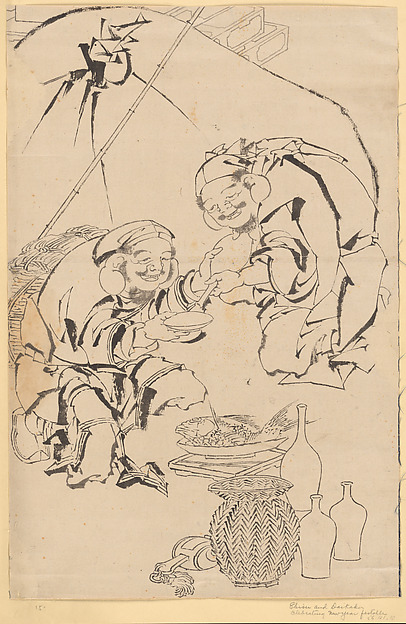
Katsushika Hokusai, Japan, 18th–19th century. Ink on paper; 47 x 31 cm. Metropolitan Museum of Art, 56.121.10.
Look closer: Note the fish on its platter and the bottles at the foot of the sheet, which turn the two gods into a pair of diners at a New Year feast.
The Metropolitan Museum of Art, Gift of Annette Young, in memory of her brother, Innis Young, 1956. Open Access.

Katsushika Hokusai, Japan, 18th–19th century. Ink and color on paper; 27.1 x 17.8 cm. Metropolitan Museum of Art, 56.121.33.
Look closer: Note the broad laughing face and the large fish, drawn in black line with touches of red.
The Metropolitan Museum of Art, Gift of Annette Young, in memory of her brother, Innis Young, 1956. Open Access.
Two gods on one shelf
From the Edo period on, Ebisu is seldom alone. Wikipedia says that he is frequently paired with Daikokuten in displays of the twin patrons by small shopkeepers, in some versions of the myth as father and son or as master and apprentice, and that the two are often joined by Fukurokuju as the Three Gods of Good Fortune. The Wikipedia article on Daikokuten says that in popular belief the two are commonly paired, that Ebisu was sometimes identified with Ōkuninushi's son Kotoshironushi or with the dwarf god Sukunabikona, who helped Ōkuninushi to develop the land of Japan, and that in homes the pair were enshrined in the kitchen or by the oven. Merchants worshipped them as patrons of commercial success, and farmers as gods of the rice paddy, ta-no-kami. The result is a double act in which each god has a trade: the one with the mallet and the rice bales, the other with the rod and the fish.
The pairing recurs among the Metropolitan Museum's small objects and prints. A round print of the nineteenth century by Totoya Hokkei shows a laughing man in blue raising a mallet beside a figure in black cap and red. A gold lacquer inrō by Nikkōsai, of the nineteenth century, is titled by the Museum Ebisu and Daikoku Dancing beneath New Year's Decorations; on its two sides we see one small figure on each face of the box, in coloured lacquer against sprinkled gold, so that the pair is split between front and back and a viewer turning the case sees one figure and then the other. The Museum's records give titles, dates and materials and no description of the figures, so the identification of which side holds which god rests on the title alone.
In these pictures the attributes do the naming: a mallet for one god, a rod and a bream for the other, as in the Shigemasa print of the boys in the gallery below. The god of the catch does not need to be shown at the shore.
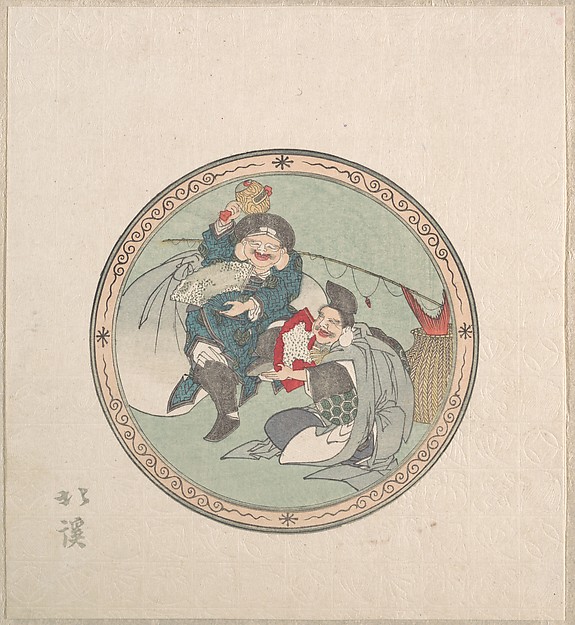
Totoya Hokkei, Japan, 19th century. Part of an album of woodblock prints (surimono); ink and color on paper; 20.2 x 18.4 cm. Metropolitan Museum of Art, JP2248.
Look closer: Note the mallet raised high and the fishing rod slanting across the circle, each framed by a scrolling border.
The Metropolitan Museum of Art, H. O. Havemeyer Collection, Bequest of Mrs. H. O. Havemeyer, 1929. Open Access.

Nikkōsai, Japan, 19th century. Gold lacquer with gold and colored hiramkie sprinkled and polished lacquer and ivory inlay; 8.6 x 5.9 x 2 cm. Metropolitan Museum of Art, 29.100.853.
Look closer: Note how each side of the case holds one small dancing figure, the two gods shown apart, one on each face of the box.
The Metropolitan Museum of Art, H. O. Havemeyer Collection, Bequest of Mrs. H. O. Havemeyer, 1929. Open Access.
Ebisu on the New Year road
Each of the New Year pilgrimages described in the chapter on the Seven Lucky Gods has an Ebisu stop, and the god's stop is often the oldest or the busiest of the round. The sources describe five of them.
In Ningyōchō and Nihonbashi, the Tokyo Stroll Supplement says that the round has eight shrines and no temples, with two for Ebisu, while Benzaiten appears twice, once sharing a shrine with Fukurokuju. The first of the Ebisu stops is Suginomori Shrine, held to be roughly a thousand years old and, in the Edo period, one of three lottery shrines in the city, where lotteries were held to raise funds for the shrine. The Ebisugami Festival is held there in October, a grand festival comes every three years, when a mikoshi of 1.4 tons is carried through the streets, and an annual festival is held on varying days in May. The second Ebisu stop is Takarada Ebisu Shrine.
In Yanaka, Old Tokyo reports that the leaflet of the Yanaka round asserts that the custom of visiting the seven gods originated there, and records that the garden of Tōgakuji holds a statue of Ebisu with his fishing rod in his right hand. The Ebisu stop of the round is a temple that Old Tokyo calls Seiunji, at 3-6-4 Nishi-Nippori in Arakawa Ward.
In Mukōjima, Old Tokyo says that Ebisu and Daikoku are prayed to at a shrine to the left of the main shrine building of Mimeguri Shrine, a shrine closely associated with the Mitsui family, who owned the Mitsui conglomerate until the end of the Second World War. The shrine also holds a triangular three-pillar torii, a mihashira torii, which some think was put up by early Japanese Christians to represent the Trinity; Old Tokyo gives this only as something that some believe.
In Meguro, on the Yamanote round that Old Tokyo calls the oldest in Tokyo and dates to at least the end of the eighteenth century, Ebisu is lodged at Ryūsenji, a Tendai temple founded in 808 and known as Meguro Fudōson, the Black-Eyed Fudō, from which the district takes its name. The temple is the biggest and the oldest on the trail, and its present building dates from 1981.
In Kyoto, the round of 11 January at the Shingon temple of Sennyū-ji, described by Green Shinto, takes the walker through seven subtemples, one for each god. The third of them is the Ebisu subtemple, where the emblems show the god with his tai, and where, in front of the Ebisu Hall, stands a Kannon of an unusual kind, whom Green Shinto calls the Bokefujin Kannon, the one who prevents dementia, with two small figures at her feet that look at first like children and are in fact an old man and an old woman.
| Round | Where Ebisu stands | Source |
|---|---|---|
| Ningyōchō | Suginomori Shrine and Takarada Ebisu Shrine | Tokyo Stroll Supplement |
| Yanaka | Seiunji (Old Tokyo); Shōunji (Japan Experience) | Old Tokyo, Japan Experience |
| Mukōjima | A shrine beside the main shrine building of Mimeguri Shrine | Old Tokyo |
| Meguro (Yamanote) | Ryūsenji, the Black-Eyed Fudō temple | Old Tokyo |
| Sennyū-ji, Kyoto | The third subtemple, with the Ebisu Hall | Green Shinto |
From a god to a brand
yokai.jp says the district name Ebisu in Shibuya is said to derive from the Meiji-era Yebisu Beer brewery, and Wikipedia dates the beer's logo to its first brewing in 1890; the brand was later acquired by Sapporo. The clothing brand Evisu takes its name from the god, and a basketball team in Osaka, the Evessa, is named for the Osaka pronunciation Ebessan. Wikipedia adds that Tokyo has three sets of Ebisu temples and shrines, at Mukōjima, the Yamate and Meguro.
The god thus lives in two registers. In the shrine he is a deity of the sea, of the first catch and of the new venture; in the street he is a signboard for good luck, as likely to appear on a beer bottle as on a scroll. The Met's objects below belong to a third register, the Edo-period picture, in which a courtly old man is a boy at a festival, a walker in the snow beside Benzaiten, or a tiny carved figure at a merchant's belt.
Ebisu in the Met
Two netsuke in the Metropolitan Museum show how small the god can be. A nineteenth-century netsuke of wood and ivory, only 4.1 centimetres high, shows a man in a pointed cap bent over a lidded basket heaped with something red. An eighteenth-century ivory, 3.8 centimetres high, shows a seated man in a black cap with his head thrown back and a cup in his hand. Both are catalogued by the Museum as Ebisu, and both were given in 1910 by Mrs. Russell Sage.
The prints show how the god became a subject for festive play. Kitao Shigemasa, about 1780, shows two boys masquerading as Daikoku and Ebisu, one with the mallet and one with the rod and the sea bream. Torii Kiyonaga, about 1793, titled the scene Nippori Keinai Ebisu-Daikoku, and the print shows women resting at a teahouse; the title appears to belong to a series on a pilgrimage of the seven gods, and Japan Experience places the Ebisu temple of the Yanaka circuit, Shōunji, in Nishi-Nippori, though the print itself names no temple. Utagawa Toyohiro's surimono pairs Ebisu and Benzaiten walking in snow.
Three more objects in the Museum's open collection show how loosely the god's name can be used. The first is a book of 1789 by Kitagawa Utamaro, catalogued as The Young God Ebisu, Waka ebisu, a woodblock printed book with ink, colour and brass dust; the spread shown here has a courtly interior, courtiers in black caps and a rider, and the Museum's record does not explain the connection between the picture and the god. The second is a small wooden netsuke of the nineteenth century, 3.8 centimetres high, given in 1910 by Mrs. Russell Sage like the other two netsuke of the chapter: a figure in a pointed cap clutches a large fish to his chest. The third is a Hokusai drawing on brown paper that the Museum titles Daikoku, Juro, and Ebisu, Gods of Luck. The sheet shows no figures at all, only a woven basket holding two large round objects patterned with a crest. The Museum's record has no description, and we offer no reading of it beyond the plain fact that a title can name the gods while the picture shows only their offerings.

Kitagawa Utamaro, Japan, 1789. Woodblock printed book; ink, color, and brass dust on paper. Metropolitan Museum of Art, 2013.853.
Look closer: Note the pine branches in the foreground and the bands of cloud that drop across the courtiers; the Museum's record gives the title and no description of the scene.
The Metropolitan Museum of Art, Purchase, Mary and James G. Wallach Foundation Gift, 2013. Open Access.

Japan, 19th century. Wood; H. 3.8 cm; W. 2.5 cm; D. 2.2 cm. Metropolitan Museum of Art, 10.211.1970.
Look closer: Note how the fish fills the front of the figure and how the carver let the grain of the wood darken the robe.
The Metropolitan Museum of Art, Gift of Mrs. Russell Sage, 1910. Open Access.

Katsushika Hokusai, Japan, 18th–19th century. Ink and color on brown prepared paper; 27.9 x 40.6 cm. Metropolitan Museum of Art, 56.121.18.
Look closer: Note the crest-patterned round objects in the woven basket; the Museum's title names three gods but the sheet shows no figures, and its record offers no description to explain the title.
The Metropolitan Museum of Art, Gift of Annette Young, in memory of her brother, Innis Young, 1956. Open Access.
Things worth knowing
- Nishinomiya Shrine is said to be the head of about 3,500 Ebisu shrines (Wikipedia).
- The Lucky Men race at Nishinomiya covers 230 metres, and has been known to draw more than 6,000 runners (Wikipedia).
- The tai is lucky because its name is close to medetai, auspicious (Nippon.com).
- Ebisu Station was built in 1901 to load and unload beer, and the district took the god's name through the beer (Nippon.com).
- Suginomori Shrine in Ningyōchō was one of three lottery shrines of Edo (Tokyo Stroll Supplement).
- The Kyoto round of 11 January at Sennyū-ji has an Ebisu Hall and a Kannon said to prevent dementia (Green Shinto).
- Wikipedia says that fishermen in north-eastern Japan opposed whaling because they believed whales to be an incarnation of the god.
Across Asia
Ebisu has no Chinese or Indian counterpart; he is the one Japanese guest on a ship of foreigners.
| Where | Form and name | What the record shows |
|---|---|---|
| India | None | Ebisu is the only one of the seven with no Buddhist or Daoist origin (Wikipedia). |
| China | None | The seven include three Chinese gods, but Ebisu is not among them (Wikipedia). |
| Japan | Ebisu 恵比須 | A fisherman's god of the coast, joined to Hiruko and Kotoshironushi (Wikipedia, yokai.jp). |
The native guest
Ebisu belongs to the Seven Lucky Gods and so to the Heavenly Beings wing of the almanac, though he is a Shinto god by origin. He was placed among the seven, according to yokai.jp, in the late Muromachi period, when Zen and painter-monk circles grouped the deities.
| Lineage | Tradition | Head shrine |
|---|---|---|
| Hiruko | First child of Izanagi and Izanami, set adrift and washed ashore | Nishinomiya Shrine, Hyōgo |
| Kotoshironushi | Son of Ōkuninushi, who advised acceptance of the land transfer | Miho Shrine, Shimane |
Where to see him
| Place | What to look for |
|---|---|
| Nishinomiya Shrine, Hyōgo | Head of the Hiruko lineage and of over 3,500 Ebisu shrines (yokai.jp); the Tōka Ebisu run is held here (Hyogo Japan). |
| Miho Shrine, Shimane | Head of the Kotoshironushi lineage (yokai.jp). |
| Imamiya Ebisu, Osaka, and Kyoto Ebisu Shrine | Major Tōka Ebisu sites (yokai.jp). |
| Tōka Ebisu Shrine, Fukuoka, and Ebisu Shrine, Shibuya | Named by Wikipedia and yokai.jp as other Ebisu sites. |
| Metropolitan Museum of Art, New York | Two netsuke and three woodblock prints, in open access. |
Five small portraits

Japan, 19th century. Wood and ivory; H. 4.1 cm, W. 2.2 cm, D. 2.5 cm. Metropolitan Museum of Art, 10.211.748.
Look closer: Note the pale ivory face against the black wood robe and the red heap in the basket.
The Metropolitan Museum of Art, Gift of Mrs. Russell Sage, 1910. Open Access.

Japan, 18th century. Ivory; H. 3.8 cm, W. 3.5 cm, D. 3.2 cm. Metropolitan Museum of Art, 10.211.348.
Look closer: Note the tilted head and the raised cup, set against the fine incised pattern of the robe.
The Metropolitan Museum of Art, Gift of Mrs. Russell Sage, 1910. Open Access.

Torii Kiyonaga, Japan, ca. 1793. Woodblock print; ink and color on paper; H. 24.4 cm, W. 18.1 cm. Metropolitan Museum of Art, JP930.
Look closer: Note the cartouche at the upper left carrying the title, and the cherry trees seen beyond the teahouse rail.
The Metropolitan Museum of Art, Gift of Estate of Samuel Isham, 1914. Open Access.

Kitao Shigemasa, Japan, ca. 1780. Woodblock print; ink and color on paper; H. 37 cm, W. 24.9 cm. Metropolitan Museum of Art, JP934.
Look closer: Note the sea bream held high on its line and the mallet in the other boy's hand, which tell the two gods apart.
The Metropolitan Museum of Art, Gift of Estate of Samuel Isham, 1914. Open Access.

Utagawa Toyohiro, Japan. Woodblock print (surimono); ink and color on paper; 21.7 x 19.2 cm. Metropolitan Museum of Art, JP2228.
Look closer: Note the red fish in the basket at the old man's side and the long snow-laden line that arches across the top.
The Metropolitan Museum of Art, H. O. Havemeyer Collection, Bequest of Mrs. H. O. Havemeyer, 1929. Open Access.
At the desk
An Ebisu figure, scroll or netsuke appears below when we hold one. If none shows, the concierge desk can search for it.
Words on the Ebisu shelf
The words most often met on a shrine map, a stamp sheet or an Ebisu scroll.
- Tai 鯛
- The sea bream, held in the god's left hand (yokai.jp, Nippon.com).
- Medetai
- Auspicious; the word that makes the bream a lucky fish (Nippon.com).
- Eboshi 烏帽子
- The tall folded cap of the court, worn by Ebisu as the kazaori eboshi (Wikipedia).
- Ebessan
- The affectionate Kansai name of the god, also used by the people of Nishinomiya for their shrine (Wikipedia).
- Hiruko 蛭子
- The first child of Izanagi and Izanami, set adrift and later identified with Ebisu (Wikipedia).
- Kotoshironushi 事代主神
- Eldest son of Ōkuninushi, identified with Ebisu in the second lineage (yokai.jp).
- Tōka Ebisu 十日戎
- The Tenth Day Ebisu, the festival of 9 to 11 January (Hyogo Japan).
- Fukuotoko
- A lucky man; one of the first three runners to reach the main hall at Nishinomiya (Nippon.com, Wikipedia).
- Kannazuki 神無月
- The tenth month, the month without gods, when the others go to Izumo (Wikipedia).
- Nangu-sha
- The Southern Shrine, the old name of Nishinomiya Shrine as a branch of Hirota (Wikipedia).
Answered plainly
Who is Ebisu?
The Japanese god of fishermen, luck, wealth and prosperity, and a patron of tradesmen (Wikipedia).
Is he Japanese in origin?
Yes; he is the only one of the Seven Lucky Gods who is purely Japanese (Wikipedia, yokai.jp).
What does he hold?
A fishing rod and a large red sea bream (Wikipedia, yokai.jp).
Why is he said to be deaf?
In the Hiruko legend he is born deformed and deaf, and so he does not hear the call to Izumo in the tenth month (Wikipedia).
When is Tōka Ebisu?
From 9 to 11 January (yokai.jp, Hyogo Japan).
Is he the namesake of the Tokyo district?
yokai.jp says the district name Ebisu is said to derive from the Meiji-era Yebisu Beer factory.
What is the Lucky Men race?
A run held at Nishinomiya Shrine on 10 January: at six in the morning the gates open and the crowd sprints 230 metres to the main hall, and the first three to arrive are named Lucky Men (Wikipedia).
Why does Ebisu hold a sea bream?
Because the tai is a fish of celebration; its name is linked with medetai, auspicious (Nippon.com). He is the god of fishermen, and the fish also stands for abundance (Wikipedia).
Is Ebisu always paired with Daikokuten?
Very often. Wikipedia describes the two as twin patrons of small shopkeepers, as father and son or as master and apprentice.
Which temple holds Ebisu on the Yanaka round?
Old Tokyo names Seiunji, at Nishi-Nippori; Japan Experience names Shōunji. The sources agree on the district and differ on the name.
Where is the Ebisu shrine that heads the others?
Nishinomiya Shrine in Hyōgo, which Wikipedia calls the head shrine of the Ebisu sect, with about 3,500 shrines under it.
Is there an Ebisu round in Kyoto?
Green Shinto describes a Tōka Ebisu at the Ebisu Shrine on 10 January and, on 11 January, a round of seven subtemples at Sennyū-ji, with an Ebisu Hall on the third stop.
Where next
Sources and image credits
- Wikipedia, Ebisu (mythology)
- Yokai.jp, Ebisu
- Hyogo Japan, Toka Ebisu Festival
- Wikipedia, Seven Lucky Gods
- Japan Experience, Shichifukujin Meguri
- Metropolitan Museum of Art, Netsuke of Ebisu (10.211.748)
- Metropolitan Museum of Art, Netsuke of Ebisu (10.211.348)
- Metropolitan Museum of Art, Nippori Keinai Ebisu-Daikoku (JP930)
- Metropolitan Museum of Art, Boys Masquerading as Daikoku and Ebisu (JP934)
- Metropolitan Museum of Art, Ebisu and Benten Walking in the Snow (JP2228)
- Wikipedia, Nishinomiya Shrine
- Wikipedia, Daikokuten
- Nippon.com, Shichifukujin: Japan's Seven Gods of Fortune
- Green Shinto, Shichifukujin Meguri: Seven Lucky Deities in Kyoto
- Old Tokyo, 7 Lucky Gods Pilgrimage in Yanaka
- Old Tokyo, The oldest 7 lucky god course in Tokyo, Yamanote Meguro
- Old Tokyo, Mukōjima pilgrimage along the Sumida
- Tokyo Stroll Supplement, Ningyōchō pilgrimage
- Metropolitan Museum of Art, Imamiya Toka Ebisu (JP1484)
- Metropolitan Museum of Art, Ebisu and Daikoku Celebrating the New Year Festival (56.121.10)
- Metropolitan Museum of Art, Ebisu (God of Luck, Protector of Merchants) (56.121.33)
- Metropolitan Museum of Art, Ebisu and Daikoku; Two of the Seven Gods of Good Fortune (JP2248)
- Metropolitan Museum of Art, Case (Inrō) with Design of Ebisu and Daikoku Dancing beneath New Year's Decorations (29.100.853)
- Metropolitan Museum of Art, The Young God Ebisu (Waka ebisu) 和歌夷 (2013.853)
- Metropolitan Museum of Art, Netsuke of Ebisu (10.211.1970)
- Metropolitan Museum of Art, Daikoku, Juro, and Ebisu (Gods of Luck) (56.121.18)
Last reviewed 28 October 2026. Pictures are public-domain or openly licensed, each credited beneath it. Diagrams on this page are drawn by Japonista.
Looking for an Ebisu figure, a scroll or a netsuke? Tell the concierge desk what you have in mind and we will search Japan for it.
Private concierge
Looking for something in particular?
Describe the piece or the project you have in mind. A senior advisor in Tokyo reads every case file personally and replies within two business days, with fees set out in writing before any work begins.