
Fukurokuju
Southern Star
Fukurokuju
福禄寿
The long-headed sage of the southern star, a Chinese Daoist hermit who joined the Seven Lucky Gods as the keeper of wisdom, fortune and a long life.
Identity card
Know the figure at a glance
- Tall head. He is shown bald, with an elongated forehead that suggests wisdom and long life (Wikipedia, Metropolitan Museum).
- Staff and scroll. A knobbly staff carries a scroll that records every person's lifespan or holds a magical scripture (Wikipedia).
- Crane. A symbol of longevity in China and Japan, often painted beside him (Onmark Productions).
- Tortoise. The second long-lived companion, paired with the crane (Wikipedia).
- Stag. Sometimes shown as a small-bodied animal; legend says a deer turns black after more than 2,000 years (Wikipedia, Onmark Productions).
- Southern star. He is said to be an incarnation of the Southern Polestar (Wikipedia).
A star in an old man's shape
Fukurokuju is written with three characters, 福禄寿, which Onmark Productions reads as wealth, happiness and longevity. Onmark Productions, quoting a modern reprint of the Butsuzō-zui, adds that the name joins three stars: the wealth star, the happiness star and the longevity star. The theory it reports is that he is a Japanese assimilation of the Chinese Three Star Gods, Fu, Lu and Shou, combined into a single deity. Of the three he most closely resembles Shou, the Old Man of the South Pole, who is associated with wisdom and longevity.
Wikipedia says he is also described as an incarnation of the Southern Polestar, which outside Asia is known as Canopus. Onmark Productions records a variant, in which one source describes him as the personification of that star and another says he represents the stars of the Southern Cross, and it presents the two identifications side by side without choosing between them. Both place him in the southern sky.
Fu, Lu and Shou
Behind the single god stand three. Wikipedia's article on the Sanxing, the Three Stars, describes them as the gods of three celestial bodies of particular importance in Chinese astronomy and folk religion: Jupiter, Mizar in Ursa Major, and Canopus. Fu, Lu and Shou embody Fortune, which presides over Jupiter; Prosperity, which presides over Mizar; and Longevity, which presides over Canopus. Their familiar image as three old, bearded, wise men goes back to the Ming dynasty, when the gods of the stars were first shown in human form. The names are also used as shorthand for the three attributes of a good life.
The same article describes how they are kept. Statues of the three stand on the fronts of folk temples and ancestral shrines, in homes and in many Chinese-owned shops, often on a small altar with a glass of water, an orange or another auspicious offering, especially at the Chinese New Year. They are arranged from right to left, with Shou on the left of the viewer, Lu in the middle and Fu at the far right, as Chinese characters are traditionally written.
Each of the three has a figure of his own. Fu, whose planet Jupiter was called the Year Star because it circles the sky in about twelve years, is shown in a scholar's dress with golden trim, holding a scroll that sometimes carries the character for fu, and sometimes with a child. Lu, whose character means the salary of a government official, is the deity of rank and influence, shown in a mandarin's dress with a ruyi sceptre, and worshipped on his own by candidates for the imperial examinations. Shou, the third, is the one from whom Wikipedia's Sanxing article says the Japanese god is derived, and he is described in the next section.
In Japan the three were folded into one. Wikipedia reports the theory that Fukurokuju is a Japanese assimilation of the Chinese Three Star Gods, combined in a single deity. Onmark Productions quotes a modern reprint of the Butsuzō-zui, the Illustrated Compendium of Buddhist Images, which says that Fukurokuju and Jurōjin are the same deity and that, together with the southern pole star, they represent three other stars of the Southern Cross, rolled into one: the wealth star, the happiness star and the longevity star, shown with the crane or tortoise to bring the gift of longevity.
The Old Man of the South Pole
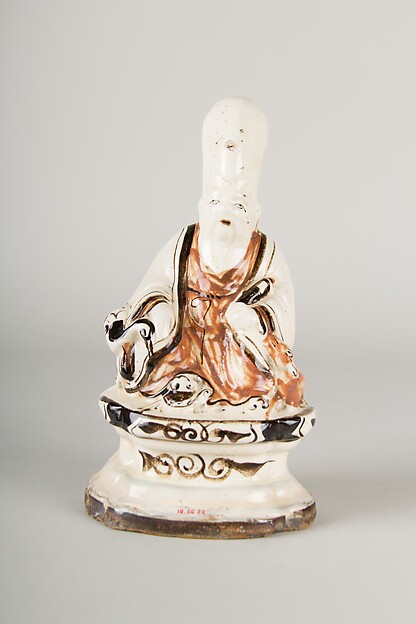
China, 15th–16th century. Stoneware with black and brown decoration over white slip (Cizhou ware); H. 19.7 cm; W. 11.3 cm; D. 7.9 cm. Metropolitan Museum of Art, 18.56.22.
Look closer: Note the tall rounded head painted in white slip above a small seated body, the Chinese model for the long forehead.
The Metropolitan Museum of Art, Rogers Fund, 1918. Open Access.
Shou is the star of the old. Wikipedia's article on the Old Man of the South Pole calls him the Taoist deification of Canopus, the brightest star of the constellation Carina. He is typically portrayed with long white hair and beard, a protruding forehead and a healthy pink complexion. In his right hand he often holds a peach, and in his left a walking staff with a calabash gourd said to contain the elixir of life. He may ride a crane or a deer, often accompanied by disciples. The article, which carries a tag asking for better citations, adds that he is one of the symbols of happiness and longevity in the Far East.
The star itself explains some of this. Wikipedia says that because Canopus lies so far south it is rarely seen in northern China, and when it is seen in good weather it looks reddish near the southern horizon. Red is the colour of happiness and longevity, so the star is known in China, Korea, Japan and Vietnam as the Star of Old Age. The Sanxing article adds that Sima Qian recorded it in the Shiji as the longevity star of the south polar region, and that its appearance over China was held to herald a time of peace. The title Old Man of the South Pole is thus a name given to a rare southern sight, and the sources do not present it as a measurement.
The tall forehead is already in the Chinese description, which is worth keeping in mind when reading the Japanese jokes about the head. The Metropolitan Museum has a Cizhou stoneware figure of the fifteenth or sixteenth century, which it calls a seated god of longevity, and its tall rounded head is painted in white slip above a small body. The open-access record that we read gives title, date, materials and size and no description, so the picture is our own reading of it, and the head is the only feature we point to.
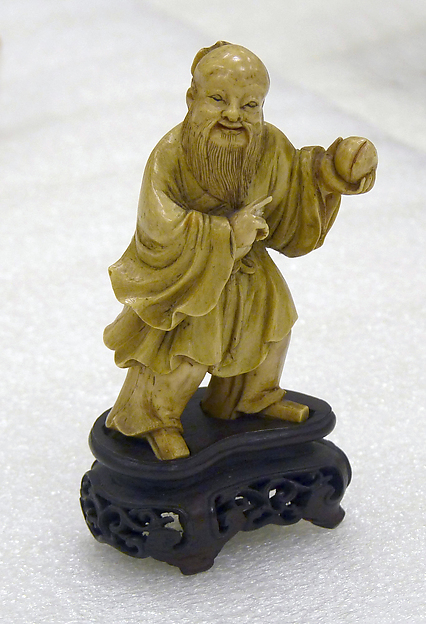
China, 18th century. Ivory; rosewood stand; H. 7.3 cm; H. 9.2 cm; W. 4.1 cm. Metropolitan Museum of Art, 65.86.127a, b.
Look closer: Note the raised hand with its rounded fruit, which the Museum's title gives as a peach, and the loose robe that falls in long folds.
The Metropolitan Museum of Art, Alfred W. Hoyt Collection, Bequest of Rosina H. Hoppin, 1965. Open Access.
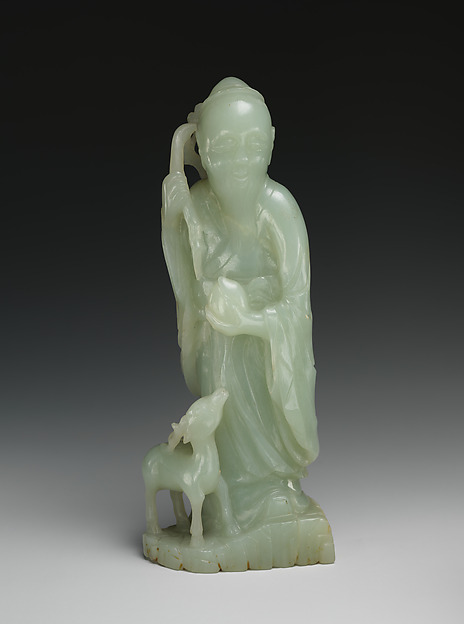
China, 18th–19th century. Jade (nephrite); H. 15.9 cm; Gr. 6.4 cm. Metropolitan Museum of Art, 65.86.188.
Look closer: Note the small deer at the old man's feet, the companion that the Museum's title names beside the god of longevity.
The Metropolitan Museum of Art, Alfred W. Hoyt Collection, Bequest of Rosina H. Hoppin, 1965. Open Access.
A hermit of the Song
Wikipedia says he probably derives from an old Chinese tale about a Daoist hermit sage famous for miracles in the Northern Song period, which it dates from 960 to 1127. In China this hermit was believed to embody the powers of the southern polar star, and he was also called Jurōjin. Some accounts add that before he became a god he was a hermit of the Song and a reincarnation of the Daoist deity Xuantian Shangdi, whom the Wikipedia article on the Seven Lucky Gods calls Hsuan-wu. As a man he was a sennin, an immortal, who could live without eating.
Onmark Productions preserves a second origin, which it draws from the Japanese Architecture and Art Net Users System. In this story he is Yangzheng, an adviser to Emperor Wu of the Liang, a ruler the page dates from 464 to 549. He advised the emperor to end the conscription of slaves from one province, and so became a god of happiness in that region. The page does not say how this adviser relates to the hermit of the Song, and neither do we. One power is credited to him alone among the seven: Wikipedia says he is the only one believed able to revive the dead.
The forehead of a sage
According to Wikipedia he is usually shown bald, with long whiskers and an elongated forehead. Onmark Productions adds that he wears the garments of a Chinese scholar, that in sculpture his hands are typically hidden inside wide sleeves, and that the head, often covered by a cloth cap, can take on forms the page calls phallic. He holds a long, knobbly staff with a scroll or book attached. Wikipedia says that scroll is said either to record the lifespan of every person on earth or to hold a magical scripture.
The Metropolitan Museum's note on a scroll by Katsukawa Shunshō reads the figure more simply. It describes a truncated body and an elongated head that suggest wisdom and long life, and a sutra scroll carried on a walking stick. In that reading the proportions are an argument: a god with a head that size has had a long time to fill it.
A head too large to carry
The Japanese carvers took the forehead as a challenge. Onmark Productions quotes the Flammarion guide, which gives the bald head as three times the height of the body, and Chiba Reiko, who gives it as more than half the god's height. In the small figures called netsuke, which hung from a cord at the belt, the head is often the greater part of the object. The four ivory netsuke shown here were all given to the Metropolitan Museum by Mrs Russell Sage in 1910, and they show the god in several moods.
One ivory of the nineteenth century, 5.7 centimetres high, is titled Netsuke of Fukurokujin with Tall Head and Two Children Climbing on It: the head is a smooth, egg-like dome, and small figures scramble over the top. A second, 6.4 centimetres high, shows the god smiling beneath his long smooth head, with a boy at his side whom the Museum's title calls a karako; we use the word as the title does. A third ivory, of the eighteenth century and only 3.8 centimetres high, is titled Hotai and Fukurokujin, Hotai being the Museum's spelling of Hotei: a laughing, round-bellied god and the tall-headed sage sit shoulder to shoulder. A fourth, of the nineteenth century, is titled Netsuke of Daikoku and Fukurokuji and shows the two as a single locked shape. The Museum's titles use three spellings for the god, Fukurokuju, Fukurokujin and Fukurokuji, and we have followed each title as it stands.
In clay he is larger, and quieter. A Takatori ware figure of 1840, 26 centimetres high, is catalogued by the Museum as Fukurokujin. The glaze passes from light green to brown, and runs down a long robe as if it had been poured. The open-access record gives the title, date, size and glaze, and nothing about the subject, so we do not say what the figure holds.

Japan, 19th century. Ivory; H. 5.7 cm; W. 1.6 cm; D. 2.5 cm. Metropolitan Museum of Art, 10.211.730.
Look closer: Note the egg-like head that takes up much of the figure's height, with the small climbing figures that the Museum's title names as children.
The Metropolitan Museum of Art, Gift of Mrs. Russell Sage, 1910. Open Access.

Japan, 19th century. Ivory; H. 6.4 cm; W. 3.2 cm; D. 3.8 cm. Metropolitan Museum of Art, 10.211.1427.
Look closer: Note the long smooth head and the smiling face set low beneath it; the Museum's title calls the small companion a karako boy.
The Metropolitan Museum of Art, Gift of Mrs. Russell Sage, 1910. Open Access.

Japan, 18th century. Ivory; H. 3.8 cm; W. 3.2 cm; D. 2.2 cm. Metropolitan Museum of Art, 10.211.366.
Look closer: Note the two gods seated shoulder to shoulder, the laughing figure at the left and the tall head and staff at the right.
The Metropolitan Museum of Art, Gift of Mrs. Russell Sage, 1910. Open Access.

Japan, 19th century. Ivory; H. 4.1 cm. Metropolitan Museum of Art, 10.211.429.
Look closer: Note how the two figures are locked into one compact shape, small enough for the palm; the Museum's title names the pair as Daikoku and Fukurokuji.
The Metropolitan Museum of Art, Gift of Mrs. Russell Sage, 1910. Open Access.
Crane, tortoise and stag
Wikipedia says he is accompanied by a crane and a turtle, both symbols of longevity, and sometimes by a black deer, since legend holds that a deer turns black after more than two thousand years. Onmark Productions lists four animals linked to him: the bat, the tortoise, the crane and the stag. Cranes often appear in paintings with him, and a stag is sometimes shown at his side as a small-bodied animal.
His other signature is a game. Onmark Productions records that he loves chess, and tells of a farmer who watched two old men play a long match, was given strange food, and found on returning home that two hundred years had passed. A saying it credits to him, through Chiba Reiko, holds that a person who can watch a game of chess without comment is a great man. The Wikipedia article on the Seven Lucky Gods goes further and calls him the patron of chess players.
He is also allowed to be funny. Onmark Productions describes eighteenth-century Ōtsu-e paintings in which Daikoku climbs a ladder to shave Fukurokuju's elongated head, a scene the Mingeikan museum reads as showing the playful, human side of the deities. In an 1882 print by Yoshitoshi, the page adds, he writes calligraphy with his forehead while the others watch, and one of the seven perches beneath his head.
Which animal belongs to whom
The animals matter because they are said to be the surest way to tell Fukurokuju from Jurōjin. The sources do not agree on which creature belongs to which god, and the table sets out what each says about Fukurokuju. A fuller account of Jurōjin has its own page.
| Source | With Fukurokuju | Said of Jurōjin or the Old Man |
|---|---|---|
| Wikipedia, Fukurokuju | A crane and a turtle, and sometimes a black deer, since legend says a deer turns black after two thousand years | Confused with him; by differing accounts his grandson, or in the same body |
| Onmark Productions, quoting JAANUS | Usually a bat and a tortoise, and occasionally a stag with a small body | Often confused with him, and told apart by the animals shown |
| Onmark Productions, quoting Flammarion | A crane, often, in paintings | Sometimes confused with him |
| Nippon.com | Not named; the deer is offered as the way to tell the two apart | Frequently shown standing with a deer |
| Wikipedia, Old Man of the South Pole | Not mentioned | A white-bearded old man with a deer, or riding a crane or a deer |
The bargain over a lifespan
The Chinese Old Man has a story of his own, and it resembles the farmer's tale told earlier. Wikipedia reports a legend in which he was once a sickly boy named Zhao Yen, who had been predicted to die at the age of nineteen. He was advised to go to a certain field with a jar of wine and dried meat, where two men were intent on playing checkers under a tree. He was to offer them the wine and meat, and to avoid answering their questions. When the two had eaten and drunk, they decided to thank him by exchanging the figures of his life expectancy, from nineteen years to ninety-one. He was told later that one of the two was the star of the North Pole, which fixes the date of birth, and the other the star of the South Pole, which fixes the date of death.
The two stories share a board game and a strange effect on time, but they are different tales. In Onmark Productions' version, taken from Chiba Reiko, a farmer watches two old men play chess, is given strange-tasting food, and finds on reaching home that two hundred years have passed. In Wikipedia's version the visitor is a boy, the players are the stars of the north and south, and the result is a longer life. Wikipedia calls the game checkers and Onmark calls it chess, and we have kept each source's word.
Wikipedia adds a few appearances of the Old Man in Chinese fiction. In the novel Investiture of the Gods he is the eldest disciple of Yuanshi Tianzun, and his own disciple is the White Crane Boy; in Journey to the West his white deer escapes to the underworld, becomes a demon, and is defeated by the Monkey King Sun Wukong and taken back. In folklore the white snake spirit Bai Suzhen visits his cave to steal medicinal herbs, and the article notes that the poet Du Fu mentions the Old Man in one of his poems. It gives no dates for the folk legends.
Popularity and a borrowed place
Wikipedia says the Seven Lucky Gods were first mentioned as a group in 1420 in Fushimi, in a parade meant to imitate the processions of the daimyō. Onmark Productions says a standard set existed by the seventeenth century, when the monk Tenkai assigned each member a virtue; Fukurokuju's was Popularity. Wikipedia names the seven virtues as longevity, fortune, popularity, sincerity, kindness, dignity and magnanimity, and says Tenkai chose the gods after consulting the shōgun he served, Tokugawa Iemitsu. Shortly afterwards, it adds, the painter Kanō Yasunobu was commissioned to depict them for the first time.
He was not always there. Both Wikipedia and Onmark Productions record that in early Japanese representations of the seven he was often absent, and that Kichijōten, the goddess of fortune, beauty and merit, sometimes took his place, as the Butsuzō-zui compendium records. He later became a standard member. Onmark Productions says the Butsuzō-zui of 1690 includes an illustration of him, and that a modern reprint of its expanded Meiji edition describes him as an amalgam of the stars of wealth, happiness and longevity.
Then there is Jurōjin, the god who stands so close to him that the two are constantly confused. Wikipedia says accounts differ over whether Jurōjin is Fukurokuju's grandson or occupies the same body. Onmark Productions says the two may be different manifestations of one celestial being, so that telling them apart relies largely on the animals shown with each, and it argues that a painting by Ogata Kōrin once labelled Jurōjin should be read as Fukurokuju because of its elongated head. During the first three days of the new year, Wikipedia adds, the seven are said to sail the heavens aboard the Takarabune, the treasure ship.
On the pilgrim's road
In the first days of the year the god is visited at many addresses. In Yanaka, Old Tokyo describes Tōgakuji at 2-7-3 Tabata as the usual starting point of the round, and notes that in this pilgrimage he is put down as the god of popularity. Elsewhere the same writer calls him the god of virtue and longevity. In the Yamanote round at Meguro his stop is Myōenji, a Nichiren temple founded in 1620 at 3-17-5 Shirokanedai, whose buildings date from 1954 after the war damage. Jurōjin is also worshipped there, so that at this temple the two gods who are so often confused share one roof. The author notes that it was the only temple on that course where he had to go inside, without shoes, to a side building where three monks seated at a low table stamped his shikishi board and wrote the calligraphy.
In Mukōjima his shrine stands inside Mukōjima Hyakkaen, the garden of a hundred flowers, which Old Tokyo calls the only surviving flower garden of the Edo period, and which it notes is an unusual place for a shrine, a park with no obvious religious function. In the Ningyōchō round, which the Tokyo Stroll Supplement says has eight shrines and no temples, he shares Koami Shrine with Benzaiten. Old Tokyo says that shrine has a history of about a thousand years, was destroyed in the Great Kantō Earthquake of 1923, that its present buildings of 1942 are of cypress, and that at this shrine, unlike many others where the god is hard to find, small statues are easy to see, a brown one of Fukurokuju and a green one of Benzaiten in her boat.
The Tokyo Stroll Supplement lists two stops for him on the Asakusa round, at Imado Shrine and at Yasaki Inari Shrine, and one in Fukagawa, at Shingyōji. In Kyoto, Green Shinto describes the round of 11 January through the sub-temples of Sennyū-ji, where the pilgrim is handed a branch with a red paper ribbon and the first stop is Fukurokuju. It names the sub-temple as Shokujo-in, and says that his emblem there is a storehouse full of rice, a symbol of wealth and happiness that enables longevity. The author was surprised to find what looked like dog guardians at that sub-temple, and was not sure whether they were dogs or wolves.
| Round | Fukurokuju's stop | Source |
|---|---|---|
| Yanaka | Tōgakuji, Tabata, with a garden of all seven gods | Old Tokyo |
| Meguro (Yamanote) | Myōenji, shared with Jurōjin | Old Tokyo |
| Mukōjima | A small shrine in Mukōjima Hyakkaen | Old Tokyo, Tokyo Stroll Supplement |
| Ningyōchō | Koami Shrine, shared with Benzaiten | Old Tokyo, Tokyo Stroll Supplement |
| Asakusa | Imado Shrine and Yasaki Inari Shrine | Tokyo Stroll Supplement |
| Fukagawa | Shingyōji | Tokyo Stroll Supplement |
| Sennyū-ji, Kyoto | The first of the seven sub-temples, Shokujo-in as spelled by Green Shinto | Green Shinto |
A Japanese rumour at the lathe
One more history runs through him, and it leads to Russia. Wikipedia's article on the matryoshka says that the first Russian nesting doll was carved in the 1890s at the Children's Education Workshop by the turner Vasily Zvyozdochkin from a design by Sergey Malyutin, a painter of folk crafts at Abramtsevo. The set had eight dolls, with a mother holding a red-combed rooster outermost and a baby innermost.
The article then says that the inspiration is not clear. There have been speculations that the dolls were inspired by a nesting doll imported from Japan, but it says there are serious doubts. It adds that the workshop where Zvyozdochkin was a lathe operator received, in the late 1890s, a five-piece cylinder-shaped nesting doll featuring Fukuruma, which it equates with Fukurokuju, and that this doll is now in the collection of the Sergiev Posad Museum of Toys. It also names other possible sources: the Japanese kokeshi, which cannot be nested; the round hollow daruma; and the nesting Easter eggs turned on a lathe by Russian woodworkers in the late nineteenth century. Its pictures include a set of nesting dolls of the Seven Lucky Gods from Hakone.
The idea is attractive, since a tall head is a natural thing to hollow out, but the article's own wording is guarded and we follow it.
Fukurokuju in the Met
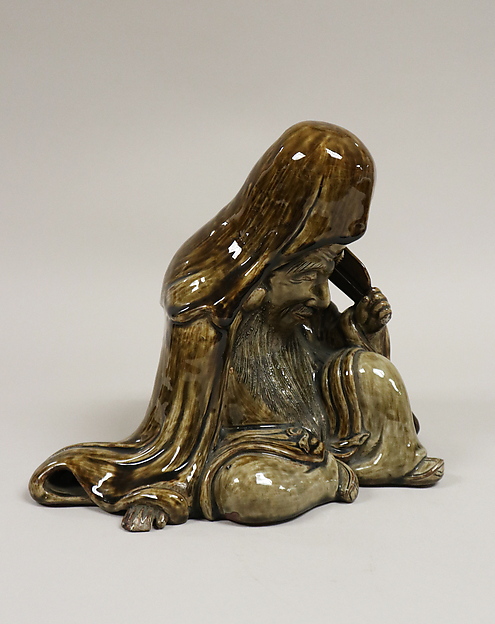
Japan, 1840. Pottery covered with lustrous glaze passing from light green to brown (Takatori ware); H. 26 cm; Diam. 31.9 cm. Metropolitan Museum of Art, 23.225.373.
Look closer: Note how the glaze runs from light green to brown down the long folds of the robe, so that the whole figure seems to pour towards the base; the Museum's record gives only title, date and medium.
The Metropolitan Museum of Art, Gift of Mrs. V. Everit Macy, 1923. Open Access.
The Museum's hanging scroll by Katsukawa Shunshō is dated 1798 and shows him with the truncated body and tall head described above. The Museum's note calls it a work in an eccentric, bravura ink style, probably made late in the artist's life, and says the poem at the top is by the kyōka poet Tegara no Okamochi, who lived from 1734 to 1812, and was added after the painting was made. The poem, titled Year's End, is about old age: it opens on the years breaking across the forehead in wrinkles and goes on to a sudden regret at their passing. The record gives Shunshō's years as 1726 to 1792, which sits oddly beside the date of 1798, and it does not explain the difference.
In Isoda Koryūsai's print of about 1768 a young woman glances up at a painting of the god hung in the alcove behind an egret-shaped incense burner. The Museum calls her a courtesan, and describes the painted god as an old man with a staff and a rolled scroll believed to hold wisdom about the meaning of life. The poem in the cloud-shaped cartouche is a haiku by Matsuo Bashō, who lived from 1644 to 1694, on the moon and flowers as the true masters of poetry.
Smaller objects carry him too. A nineteenth-century carved ebony inrō shows him riding a flying crane before a waterfall, with Kinko Sennin riding a carp on waves on the reverse. An ivory netsuke of the late eighteenth or early nineteenth century, inlaid with tortoiseshell, is 4 centimetres wide. A nineteenth-century sword guard is by Gotō Mitsuakira, who lived from 1816 to 1856 and whom the Museum calls the sixteenth-generation master of the main line of the Gotō school; the Museum says the fineness of the engraving marks it as one of his masterpieces. Its note describes the god, shown with a stag, as the Shinto god of happiness, wealth and longevity, a phrase that sits oddly beside the Daoist origin given above. Both are recorded here as found.
Things worth knowing
- Only the third character, 寿, means the same thing in every source: longevity (Wikipedia, Onmark Productions).
- In China the three stars are set out from right to left, Fu, Lu and Shou, as Chinese characters are written (Wikipedia).
- Canopus looks reddish near the southern horizon, and red is the colour of happiness and longevity (Wikipedia).
- A boy's life of nineteen years was exchanged for ninety-one in the legend of Zhao Yen (Wikipedia).
- The Met's catalogue uses three spellings for the god: Fukurokuju, Fukurokujin and Fukurokuji.
- At Myōenji in Meguro, Fukurokuju and Jurōjin share one temple (Old Tokyo).
- A Fukuruma nesting doll reached the workshop where Russia's first matryoshka was made, though the article doubts it was the model (Wikipedia).
Across Asia
Fukurokuju is the Seven Lucky Gods' clearest debt to China, and his name still carries the three stars of Fu, Lu and Shou.
| Where | Form and name | What the record shows |
|---|---|---|
| China | Fú Lù Shòu 福祿壽; Nánjí Lǎorén 南极老人 | Three star gods of good fortune, a good life and longevity; the Old Man of the South Pole (Wikipedia). |
| Cantonese | Fūk Luhk Sauh | The Yale romanisation given for the three star gods (Wikipedia). |
| Japan | Fukurokuju 福禄寿 | One of the Seven Lucky Gods, with the virtue of Popularity (Onmark Productions). |
| Elsewhere | Canopus | The Southern Polestar he is said to embody (Wikipedia). |
A star among the gods
Fukurokuju sits with the Seven Lucky Gods in the Heavenly Beings wing, though he is by origin a Daoist star-sage rather than a Buddhist deity, and his closest companion in the group is Jurōjin.
| Companion | What it carries | Source |
|---|---|---|
| Crane | A symbol of longevity in China and Japan | Wikipedia, Onmark Productions |
| Tortoise | A symbol of longevity, paired with the crane | Wikipedia, Onmark Productions |
| Stag | A small-bodied companion; a deer turns black after 2,000 years | Wikipedia, Onmark Productions |
| Bat | Listed among the animals linked to him | Onmark Productions |
| Staff and scroll | Every lifespan, or a magical scripture | Wikipedia |
Where to see him
| Place | What to look for |
|---|---|
| Tōgakuji, Tabata, Tokyo | The Fukurokuju temple of the Yanaka circuit, founded in 1491 and moved to Tabata around 1600; its garden holds a statue of each lucky god (Old Tokyo). |
| The Yanaka circuit, 1 to 10 January | Stamps are given between 1 and 10 January, from 9:00 to 17:00 (Old Tokyo). |
| Goryō Jinja, Kamakura | A treasure hall of ten old masks, one of them Fukurokuju; the festival runs from 12 to 18 September and ends with a mask procession (Onmark Productions). |
| Iwaki Jinja, Kamakura | A stone carving of Fukurokuju with an elongated forehead, shown beside Daikoku (Onmark Productions). |
| Metropolitan Museum of Art, New York | A scroll, a print, an inrō, a netsuke and a sword guard, in open access; the sword guard is recorded on view in Gallery 378. |
Five ways to draw a long head

Katsukawa Shunsho, Japan, 1798. Hanging scroll; ink and color on paper; image 85.7 x 28.6 cm. Metropolitan Museum of Art, 1975.268.131.
Look closer: Note how the head rises almost to the top of the figure, so that the face seems to sit low beneath it.
The Metropolitan Museum of Art, The Harry G. C. Packard Collection of Asian Art, Gift of Harry G. C. Packard, and Purchase, Fletcher, Rogers, Harris Brisbane Dick, and Louis V. Bell Funds, Joseph Pulitzer Bequest, and The Annenberg Fund Inc. Gift, 1975. Open Access.

Isoda Koryusai, Japan, ca. 1768. Woodblock print (nishiki-e); ink and color on paper; 25.4 x 18.7 cm. Metropolitan Museum of Art, JP558.
Look closer: Note that the god appears only as a small picture within the picture, while the woman's upward glance carries the whole scene to him.
The Metropolitan Museum of Art, Purchase, Joseph Pulitzer Bequest, 1918. Open Access.

Japan, 19th century. Wood, ebony, carved relief; 7.2 x 4.5 x 2.1 cm. Metropolitan Museum of Art, 29.100.772.
Look closer: Note the waterfall lines cut into the ebony, which turn the crane's flight into a vertical rush.
The Metropolitan Museum of Art, H. O. Havemeyer Collection, Bequest of Mrs. H. O. Havemeyer, 1929. Open Access.

Japan, late 18th to early 19th century. Ivory; inlaid tortoiseshell; H. 2.1 cm, W. 4 cm. Metropolitan Museum of Art, 1985.399.29.
Look closer: Note how the tall head becomes the top of the whole egg-like form, with the folded arms and beard below.
The Metropolitan Museum of Art, Gift of Alvin H. Schechter, 1985. Open Access.
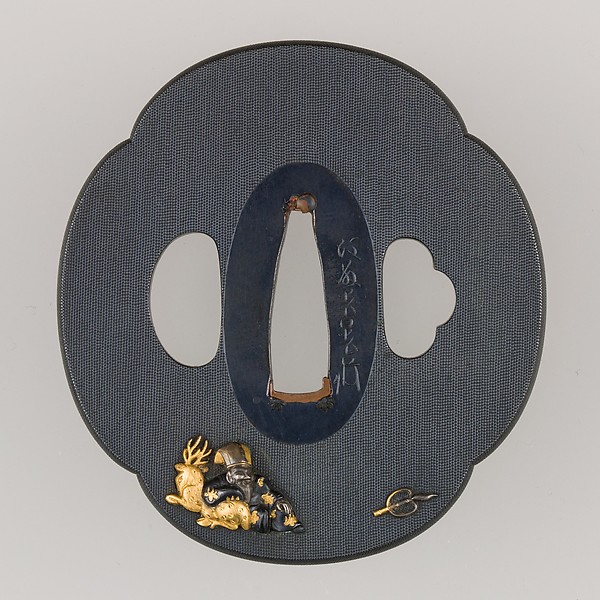
Goto Mitsuakira, Japan, 19th century. Copper-gold alloy (shakudo), gold, silver, copper; H. 7 cm, W. 6.5 cm. Metropolitan Museum of Art, 2012.528.3.
Look closer: Note how small the god and his stag are against the wide, patterned ground, a single bright corner on a dark field.
The Metropolitan Museum of Art, Gift of the Baber Family, in loving memory of Charles Chenault Baber, 2012. Open Access.
At the desk
A Fukurokuju figure, scroll or netsuke appears below when we hold one. If none shows, the concierge desk can search for it.
Words on the Fukurokuju shelf
The words most often met on a scroll, a netsuke or a stamp sheet.
- Fukurokuju 福禄寿
- Fuku, roku and ju: three characters read as the three stars, and the god who joins them (Onmark Productions, Wikipedia).
- Sanxing 三星
- The Three Stars of Chinese folk religion: Fu, Lu and Shou (Wikipedia).
- Shou 壽 / 寿
- Longevity, and the star god of Canopus (Wikipedia).
- Nankyokusei 南極星
- The southern pole star, with which Fukurokuju and Jurōjin are both linked (Onmark Productions, Nippon.com).
- Nanji Laoren 南极老人
- The Old Man of the South Pole, the Chinese form of Shou (Wikipedia).
- Sennin 仙人
- An immortal who can live without eating, the term Wikipedia uses for his human life.
- Butsuzō-zui 仏像図彙
- The Illustrated Compendium of Buddhist Images, printed in 1690 and quoted for his picture (Onmark Productions).
- Ōtsu-e
- Popular paintings of the Edo period, among them the scene of Daikoku shaving his head (Onmark Productions).
- Netsuke
- A carved toggle that hangs from a cord at the belt; the Met holds several of him.
- Karako
- The word the Museum's title uses for the boy beside the god in one netsuke.
Answered plainly
Who is Fukurokuju?
A Daoist-derived god of wealth, happiness and longevity, one of the Seven Lucky Gods, shown with a very tall bald head (Wikipedia, Onmark Productions).
Why is his head so tall?
The Metropolitan Museum's note on the Shunshō scroll says the elongated head suggests wisdom and long life; sources differ on how tall it is (Metropolitan Museum, Onmark Productions).
Are Fukurokuju and Jurōjin the same god?
They are often confused; accounts differ over whether they are grandfather and grandson or share one body (Wikipedia).
What does he carry?
A knobbly staff with a scroll that records every person's lifespan or holds a magical scripture (Wikipedia).
Which animals go with him?
A crane and a tortoise, and sometimes a black deer (Wikipedia).
Where is his temple in Tokyo?
Tōgakuji in Tabata is the Fukurokuju temple of the Yanaka circuit (Old Tokyo).
Who are Fu, Lu and Shou?
The Three Stars of Chinese folk religion, gods of Jupiter, Mizar and Canopus, shown as three bearded old men (Wikipedia).
Is Fukurokuju the Old Man of the South Pole?
He is the Japanese form of Shou, the god of Canopus, though Wikipedia's article on the Old Man says Jurōjin took that role in Japan (Wikipedia, Nippon.com).
Is the deer his or Jurōjin's?
Wikipedia and JAANUS, as quoted by Onmark Productions, put a stag beside Fukurokuju, while Nippon.com uses a deer to mark Jurōjin; the sources conflict (Wikipedia, Onmark Productions, Nippon.com).
What is the Zhao Yen story?
A sickly boy foretold to die at nineteen was given ninety-one years by two board-game players, the stars of the north and south poles (Wikipedia).
Did a Fukurokuju doll inspire the Russian matryoshka?
The matryoshka article says it was speculated, and has serious doubts; a Fukuruma nesting doll did reach the workshop in the late 1890s (Wikipedia).
Where do the New Year rounds put him?
Among others at Tōgakuji in Yanaka, Myōenji in Meguro, Koami Shrine in Ningyōchō and Sennyū-ji in Kyoto (Old Tokyo, Tokyo Stroll Supplement, Green Shinto).
Where next
Sources and image credits
- Wikipedia, Fukurokuju
- Wikipedia, Seven Lucky Gods
- Onmark Productions, Fukurokuju
- Old Tokyo, 7 Lucky Gods Pilgrimage in Yanaka
- Metropolitan Museum of Art, Fukurokuju, Katsukawa Shunsho (1975.268.131)
- Metropolitan Museum of Art, Courtesan Viewing a Painting of Fukurokuju, Isoda Koryusai (JP558)
- Metropolitan Museum of Art, Case (Inro) with Design of Fukurokuju (29.100.772)
- Metropolitan Museum of Art, Netsuke of Fukurokuju (1985.399.29)
- Metropolitan Museum of Art, Sword Guard (Tsuba), Goto Mitsuakira (2012.528.3)
- Wikipedia, Sanxing (deities)
- Wikipedia, Old Man of the South Pole
- Wikipedia, Matryoshka doll
- Nippon.com, Shichifukujin: Japan's Seven Gods of Fortune
- Old Tokyo, The oldest 7 lucky god course in Tokyo, Yamanote Meguro
- Old Tokyo, Mukōjima pilgrimage along the Sumida
- Old Tokyo, Chasing the 7 lucky gods in Ningyōchō
- Tokyo Stroll Supplement, Ningyōchō pilgrimage
- Tokyo Stroll Supplement, Fukagawa pilgrimage
- Tokyo Stroll Supplement, Mukōjima pilgrimage
- Tokyo Stroll Supplement, Asakusa pilgrimage
- Green Shinto, Shichifukujin Meguri: Seven Lucky Deities in Kyoto
- Metropolitan Museum of Art, Shoulao, the God of Longevity, Holding a Peach (65.86.127a, b)
- Metropolitan Museum of Art, God of Longevity (Shoulao) and a deer (65.86.188)
- Metropolitan Museum of Art, Seated god of longevity (Shoulao) (18.56.22)
- Metropolitan Museum of Art, Netsuke of Fukurokujin with Tall Head and Two Children Climbing on It (10.211.730)
- Metropolitan Museum of Art, Netsuke of Fukurokujin with Karako Boy (10.211.1427)
- Metropolitan Museum of Art, Netsuke of Hotai and Fukurokujin (10.211.366)
- Metropolitan Museum of Art, Netsuke of Daikoku and Fukurokuji (10.211.429)
- Metropolitan Museum of Art, Fukurokujin (23.225.373)
Last reviewed 28 October 2026. Pictures are public-domain or openly licensed, each credited beneath it. Diagrams on this page are drawn by Japonista.
Looking for a Fukurokuju figure, a scroll or a netsuke? Tell the concierge desk what you have in mind and we will search Japan for it.
Private concierge
Looking for something in particular?
Describe the piece or the project you have in mind. A senior advisor in Tokyo reads every case file personally and replies within two business days, with fees set out in writing before any work begins.