
Jurōjin
Long Life
Jurōjin
寿老人
The small old man with a staff, a scroll and a deer, a Daoist immortal of the southern star who became Japan's god of long life, wisdom and a happy old age.
Identity card
Know the figure at a glance
- Tall head. He has a long white beard and a notably tall, bald head (Wikipedia).
- Staff and scroll. A scroll tied to his staff is said to record the lifespans of all living things, or all good and bad deeds, or a book of knowledge (Wikipedia, Onmark Productions).
- Round fan. A round fan is among his objects, according to the dictionary that Onmark Productions relays.
- Deer. The deer, the chief symbol of longevity, often serves as his messenger (Onmark Productions).
- Crane. The crane, like the tortoise, is one of the long-lived animals that may accompany him (Wikipedia, Onmark Productions).
- Sake gourd. A sake gourd appears in a stone statue at Kamakura, in keeping with his love of wine (Onmark Productions).
Old Man of Long Years
Jurōjin is written 寿老人 and means, roughly, the Old Man of Longevity. Wikipedia calls him the god of longevity, and adds that popular belief credits him with wisdom and venerates him for safety and a happy life. Popular belief also holds that he has lived in the world for fifteen hundred years. He is one of the Seven Lucky Gods, though Wikipedia notes that he has no separate following in Japan apart from the other six gods.
His roots are in China. Wikipedia says he derives from the Daoist figure the Old Man of the South Pole, also called the Star of the Old Man, and that he is known as an immortal of the Northern Song dynasty, which it dates from 960 to 1127, who may have been a real historical figure of that era. Onmark Productions gives the Chinese name as Shoulaoren and adds a detail from the Japanese Architecture and Art Net Users System: that the man behind the legend may have lived in the late eleventh century and was said to be unusually tall, with a notably elongated head. He is identified with the imagined Southern Polar Star, which people call the South Star.
The virtue every list agrees on
Onmark Productions says the monk Tenkai gave Jurōjin longevity, and longevity is the one word that none of the sources we read disputes. Wikipedia names the seven virtues as longevity, fortune, popularity, sincerity, kindness, dignity and magnanimity, and says Tenkai selected the gods after speaking with the shōgun he served, Tokugawa Iemitsu, in search of whoever possessed those perfect virtues. Nippon.com, which calls Tenkai the founder of Kan'ei-ji at Ueno and a onetime political adviser to the shōgun Tokugawa Ieyasu, gives the list as longevity, prosperity, popularity, integrity, dignity, kindness and magnanimity. Onmark Productions gives longevity, fortune, popularity, candour, amiability, dignity and magnanimity, and the version it quotes from the art historian Patricia Graham has the same seven.
The three lists agree on four words, longevity, popularity, dignity and magnanimity, and differ on three: fortune or prosperity, sincerity or integrity or candour, and kindness or amiability. Onmark Productions is the only one of the three to give each virtue to a god: candour to Ebisu, fortune to Daikokuten, amiability to Benzaiten, magnanimity to Hotei, popularity to Fukurokuju, longevity to Jurōjin and dignity to Bishamonten. Longevity stands first in all three lists.
The same Onmark page relays a second-hand reading of the list. Graham, it says, reports that the twentieth-century explanation has Tenkai matching each god to a virtue that kings give their subjects when they follow the Sutra of the Benevolent Kings, the Ninnō-kyō. The table sets the three wordings side by side.
| Virtue | Wikipedia | Nippon.com | Onmark Productions (Graham's list, Onmark's gods) |
|---|---|---|---|
| First | Longevity | Longevity | Longevity (Jurōjin) |
| Second | Fortune | Prosperity | Fortune (Daikokuten) |
| Third | Popularity | Popularity | Popularity (Fukurokuju) |
| Fourth | Sincerity | Integrity | Candour (Ebisu) |
| Fifth | Kindness | Dignity | Amiability (Benzaiten) |
| Sixth | Dignity | Kindness | Dignity (Bishamonten) |
| Seventh | Magnanimity | Magnanimity | Magnanimity (Hotei) |
An old man seen from the south
Behind Jurōjin stands a star. Wikipedia's article on the Old Man of the South Pole explains that in Chinese the star Canopus is usually called the Star of the Old Man, or the Star of the Old Man of the South Pole. Canopus belongs to the southern constellation Carina, so it is rarely seen in northern China, and when it is seen in good weather it looks reddish near the southern horizon. Red is the colour of happiness and longevity in China, so the star is also known in China, Korea, Japan and Vietnam as the Star of Old Age. In Japan, the article says, it became Jurōjin. Nippon.com agrees on the idea: it calls him the deification of the nankyokusei, the southern pole star, and says that seeing the star is said to extend one's life.
The Chinese old man is drawn much as the Japanese one is. Wikipedia says he is typically shown with long white hair and beard, a protruding forehead and a healthy pink complexion, holding a peach in one hand and a walking staff with a calabash gourd, said to hold the elixir of life, in the other. He may ride a crane or a deer. The article also says he is often pictured as a white-bearded old man with a deer by his side, and links this picture to a story of a Northern Song emperor who invited such an old man in from the street and afterwards took him as the sign of his own long life. That sentence carries a citation-needed tag in the article, so we repeat it as a story told and not as history. The article as a whole carries a notice asking for better citations.
Wikipedia also tells the legend of the sickly boy Zhao Yen, who was foretold to die at nineteen and was given ninety-one years by two men playing checkers under a tree, one of them the star of the North Pole and the other the star of the South Pole. The fuller account, with the Japanese tale of a chess game that lasted two hundred years set beside it, is on the page for Fukurokuju.
Two figures show the step from China to Japan. The Metropolitan Museum's Chinese porcelain Shoulao, made in the Kangxi period at Jingdezhen and 48.3 centimetres high, has the high rounded head and long beard of the god in a robe painted with flowers and medallions. Beside it stands a Japanese netsuke of the nineteenth century, titled God of Longevity with a Peach, which is under four centimetres high. The Museum's records give titles, dates, materials and sizes and no description, so what we say about them is what the photographs show. A scroll of the seventeenth century in the same collection is titled Eight Daoist Immortals Welcoming Jurōjin, and in the photograph a small figure rides a crane through clouds towards the faces turned up to him; the Museum's title speaks of eight immortals, and the scroll as photographed shows four people below.
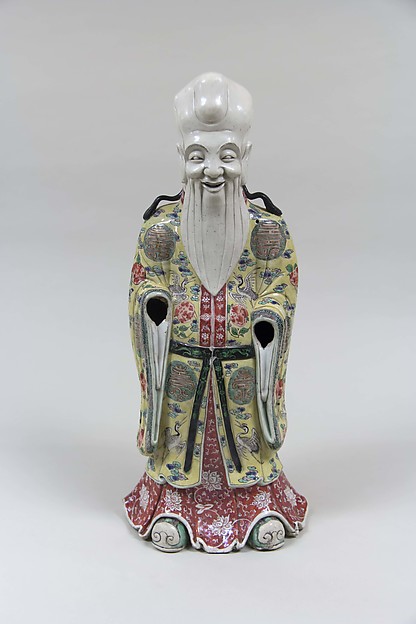
China, late 17th–early 18th century. Porcelain painted in polychrome enamels over the biscuit (Jingdezhen ware); H. 48.3 cm; W. 21.3 cm; D. 13.3 cm. Metropolitan Museum of Art, 14.40.203.
Look closer: Note the high rounded white head and the long beard on a figure nearly half a metre tall, the Chinese model for the Japanese god.
The Metropolitan Museum of Art, Bequest of Benjamin Altman, 1913. Open Access.

Japan, 19th century. Wood; stained red in places; H. 3.8 cm. Metropolitan Museum of Art, 10.211.1694.
Look closer: Note how much character the carver packed into a figure under four centimetres high, the peach held against the knee and the lined, smiling face.
The Metropolitan Museum of Art, Gift of Mrs. Russell Sage, 1910. Open Access.

Japan, 17th century. Hanging scroll; ink and color on silk. Metropolitan Museum of Art, 14.76.52.
Look closer: Note the small figure riding a crane at the upper right and the faces turned up to him; the Museum's title names him as Jurojin and speaks of eight immortals, and the scroll as photographed shows four people below.
The Metropolitan Museum of Art, Charles Stewart Smith Collection, Gift of Mrs. Charles Stewart Smith, Charles Stewart Smith Jr., and Howard Caswell Smith, in memory of Charles Stewart Smith, 1914. Open Access.
Beard, staff and fan
Wikipedia says he carries a staff and a fan, and that a scroll tied to the staff records the lifespans of all living things; some sources, it adds, take the scroll to be a Buddhist sutra. Onmark Productions lists three readings of the scroll: the lifespans of all living things, a record of all good and bad deeds, or a book of knowledge. It also reports a wide forehead and a distinctive elongated cranium, and says the Flammarion guide finds his forehead narrower, and his head less elongated, than that of Fukurokuju. The fan is round, according to the dictionary it relays.
The Metropolitan Museum's note on a scroll by Yosa Buson names the same equipment, a staff, a scroll and a flowing white beard, and adds a manner: his Daoist robe slips from his shoulders, which the catalogue reads as the carefree demeanour of an enlightened sage at ease in nature. Another Museum scroll, by Kishi Ganku, gives him a tall cap and a bamboo staff, with a rolled scroll tangled in the branches above his head.
Another old man in the name
The word for old man is the middle of his name. Onmark Productions glosses the three characters as ju for longevity, rō for old and jin for person. It also relays a remark from the Flammarion guide that he is sometimes called Rōjinseishi in Japan when he is identified with the Chinese sage Laozi, and adds its own editor's note that Laozi is the founder of Chinese Daoism. No other source we read makes the identification, and the Wikipedia article does not mention it.
The sources thus offer a short crowd behind one figure: an immortal of the Northern Song who, on the dictionary's account, may have been a real man of the late eleventh century; the Old Man of the South Pole, who is a star; and, in one guide, Laozi. They are not necessarily rivals, since a legend can gather several men, but nothing we read says which of them the Japanese painters had in mind.
A deer of many colours
The deer is his best-known companion. Onmark Productions calls it the main symbol of longevity and says it often serves as his messenger, though not always; stags, cranes and tortoises also accompany him as other long-lived animals. Wikipedia likewise says a deer, a symbol of longevity, usually accompanies him, and that the crane and the tortoise also appear. The plum tree is another longevity symbol linked to him, according to Onmark Productions, and the Wikipedia article on the Seven Lucky Gods adds that a peach tree is a common setting, since peaches were associated with prolonging life.
The colour of the deer is a calendar. Onmark Productions quotes Chiba Reiko for the Chinese tradition that a deer of a thousand years is blue, one of fifteen hundred years is white and one of two thousand years is black, and says his own deer is typically black. It also records a white stag said to be fifteen hundred years old, which is the age Wikipedia gives for the god himself. The Museum's Buson scroll adds a small piece of evidence from the box: a collector's label on the inner box reads, in the Museum's translation, Buson, beneath the aged pine, Jurō, crane, tortoise.
| Source | What it says of the deer | Whose deer |
|---|---|---|
| Chiba Reiko, as quoted by Onmark Productions | Blue at a thousand years, white at fifteen hundred, black at two thousand; his deer is typically black | Jurōjin |
| JAANUS, as quoted by Onmark Productions | A white stag said to be fifteen hundred years old | Jurōjin |
| Flammarion guide, as quoted by Onmark Productions | A crane, a black deer or a tortoise | Jurōjin |
| Wikipedia, Jurōjin | A deer, a symbol of longevity, usually but not always with him; no colour given | Jurōjin |
| Nippon.com | A deer standing beside him is the way to tell him from Fukurokuju | Jurōjin |
| Wikipedia, Fukurokuju | A black deer, since legend says a deer turns black after more than two thousand years | Fukurokuju, sometimes |
| Metropolitan Museum, Kishi Ganku scroll of 1838 | A pale deer with a small dark fungus in its mouth, as photographed | Jurōjin |
The man who drank a koku
Legends make him a great lover of wine and rice wine, and fond of female company, according to Onmark Productions; the Wikipedia article on the Seven Lucky Gods agrees that he is cheerful and fond of rice and wine. The best-known story is told by Chiba Reiko. Invited to an imperial feast and allowed to drink freely, he drank about one koku in a night, which Onmark Productions glosses as nearly forty gallons, and was entirely sober the next day. He predicted a long and prosperous reign for the emperor, then vanished in white mist.
Devotees who offer him a drink are said to be rewarded: he taps his head and shares some of his wisdom. The same page describes a stone statue in a private garden in Kamakura in which he holds a sake gourd and a scroll, which makes the joke visible: the keeper of everyone's lifespan is also the guest who cannot be put under the table.
Both stories about wine, the koku in a night and the head that is tapped to pass on wisdom, belong to Chiba Reiko as Onmark Productions relays her. No source we read names the emperor of the feast or his dynasty, and we have not supplied them.
Twin of the long head
No god is so often mistaken for Jurōjin as Fukurokuju. Onmark Productions says they are frequently confused because both are Daoist-born lucky gods who appear with deer, and that the Butsuzō-zui, the Japanese picture compendium of 1690, which was expanded in 1783, says they are the same deity. The Butsuzō-zui connects Jurōjin with three stars, of wealth, happiness and longevity, which together form the name Fukurokuju. The Flammarion guide, it adds, calls him a close relative of Fukurokuju and suggests a shared origin. Wikipedia's Fukurokuju article records that accounts differ over whether Jurōjin is Fukurokuju's grandson or occupies the same body.
The Seven Lucky Gods were given their virtues in the seventeenth century by the monk Tenkai, for the shōgun Tokugawa Iemitsu, according to Onmark Productions, and longevity is Jurōjin's; the section on the seven virtues above records a scholar's doubt about that attribution. The Old Tokyo account of the Yanaka circuit associates him with virtue as well as long life.
A sage for Zen brushes
Wikipedia says he is a popular subject of Japanese ink wash painting and that Zen Buddhist painters introduced him into Japanese art. Depictions span the Muromachi period, which it dates from 1337 to 1573, through the Edo period, from 1603 to 1868. Among the artists it names are Sesshū, who lived from 1420 to 1506, Sesson Shūkei, from 1504 to 1589, Kanō Tan'yū, from 1602 to 1674, and Maruyama Ōkyo, from 1733 to 1795. Paintings and statues of him are considered auspicious.
A god who stands for a long life is a natural subject for a hanging scroll to be shown at the New Year. The Museum's note on its Kanō Tanshin scroll says exactly this: he is said to have lived in China at the end of the eleventh century, he is shown as an old man with a long beard, carrying a staff or sometimes a scroll and accompanied by a deer, and in Japan he is counted among the seven lucky gods, with an image especially suited to New Year celebrations as an emblem of long life.
Rocks, ink and a boat
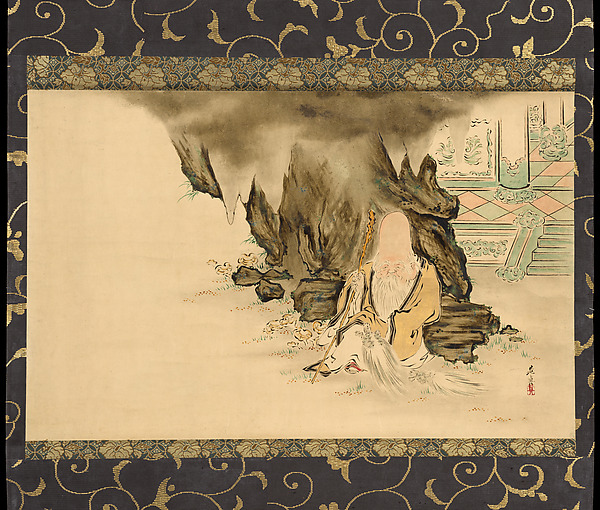
Shibata Zeshin, Japan, 19th century. Hanging scroll; ink on paper; Image 34.6 x 54.3 cm. Metropolitan Museum of Art, 51.137.4.
Look closer: Note how small the seated old man is beneath the great wash of dark rock, and the tall staff he holds.
The Metropolitan Museum of Art, Purchase, Gifts, Bequests, and Funds from various donors, by exchange, 1951. Open Access.
Wikipedia names four painters of the god, Sesshū, Sesson Shūkei, Kanō Tan'yū and Maruyama Ōkyo, and the Metropolitan Museum's scrolls in the gallery below add Buson, Ganku and Kanō Tanshin. Three more scrolls in the same collection extend the list. The Museum's records give titles, dates, materials and sizes and no description, so what follows is our reading of the photographs.
Shibata Zeshin, whom the Museum dates 1807 to 1891, made a hanging scroll in ink on paper in the nineteenth century, titled Jurōjin, whose image is 34.6 by 54.3 centimetres. It is wider than tall, unlike the tall scrolls in the gallery. A white-bearded old man in an ochre robe sits with a tall staff beneath a great wash of dark rock, beside a green and pink railed building at the right. He is small and the rock is not.
Kanō Tsunenobu, dated 1636 to 1713, painted the late seventeenth or early eighteenth century scroll that the Museum catalogues as Painting of Jurōjin, one of a triptych of hanging scrolls, in ink and colour on paper with an image 89.2 centimetres high. The Museum's record does not say what the other two scrolls show, so we do not guess. In this one the figure is built from a few wide strokes: a tall rounded head, a long beard and a robe of black lines.
Soga Shōhaku, dated 1730 to 1781, painted The God of Good Fortune Jurōjin about 1773, a hanging scroll of ink and colour on paper whose image is 134 by 56.7 centimetres. Here the god leans out of a small boat over the water towards a tortoise, with a pale deer lying in the boat, a pine branch above and a crane flying at the upper left. The three long-lived animals that the Japanese Architecture and Art Net Users System and Onmark Productions link to him, the deer, the tortoise and the crane, are all in one frame, with a pine overhead, as in the Buson scroll's box label.
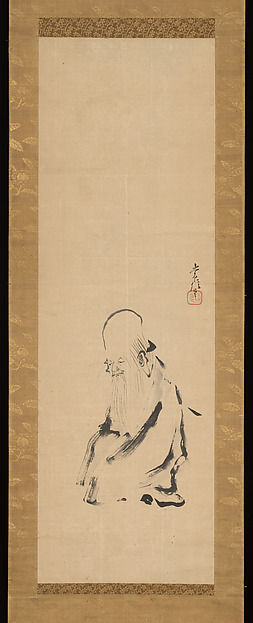
Kano Tsunenobu, Japan, late 17th–early 18th century. One of a triptych of hanging scrolls; ink and color on paper. Metropolitan Museum of Art, 61.63.
Look closer: Note how few strokes build the whole figure, the tall head and the long beard above all.
The Metropolitan Museum of Art, Purchase, Gifts, Bequests, and Funds from various donors, by exchange, 1961. Open Access.
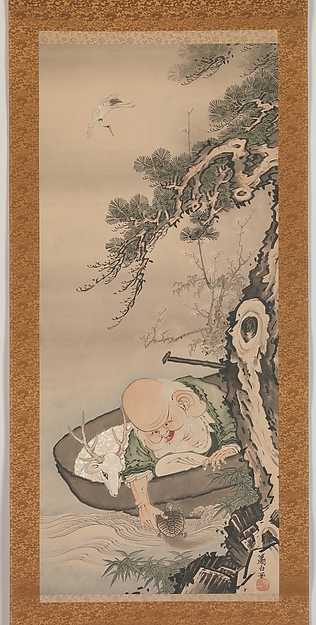
Soga Shōhaku, Japan, ca. 1773. Hanging scroll; ink and color on paper; Image 134 x 56.7 cm. Metropolitan Museum of Art, 2011.572.1.
Look closer: Note the god leaning out of a small boat towards a tortoise, with a deer in the boat, a pine above and a crane in the sky: every long-life emblem in one view.
The Metropolitan Museum of Art, Fishbein-Bender Collection, Gift of T. Richard Fishbein and Estelle P. Bender, 2011. Open Access.
A god drawn by his belongings

Totoya Hokkei, Japan, 19th century. Part of an album of woodblock prints (surimono); ink and color on paper; 13.7 x 18.7 cm. Metropolitan Museum of Art, JP2390.
Look closer: Note that no person appears: an antler, a plum branch and a hat stand in for the god, and the characters for Jurojin can be read in the first column of text.
The Metropolitan Museum of Art, H. O. Havemeyer Collection, Bequest of Mrs. H. O. Havemeyer, 1929. Open Access.
The Museum's catalogue titles one print Hat, Deer-Horn and Plum Branch, Representing Jurōjin, the God of Life. It is by Totoya Hokkei, dated 1780 to 1850, a woodblock print of the nineteenth century that is part of an album of surimono, 13.7 by 18.7 centimetres, from the H. O. Havemeyer Collection. No person appears in it. A deer antler lies across a flowering plum branch beside a dark hat with a red lining, and the characters for Jurōjin can be read in the first column of text at the upper left.
The three things are the god's own signs. Onmark Productions, quoting the Japanese Architecture and Art Net Users System, says he is often accompanied by a white stag and is often shown beneath the plum tree, another symbol of longevity; the hat is the cap of the scrolls, and the Museum's note on its Ganku scroll gives him a tall cap. A viewer who knew his signs could name him without a figure. We have not translated the poem and do not guess its sense.
A god small enough to carry

Kakōsai, Japan, 19th century. Gold and nashiji ('pear skin') lacquer with metal inlay and gold, silver, and brown hiramakie sprinkled and polished lacquer; 8 x 5.2 x 1.8 cm. Metropolitan Museum of Art, 29.100.866.
Look closer: Note the whole set of cord, coral bead and carved toggle, and the tiny figures of the god and the boy among the pine and the water.
The Metropolitan Museum of Art, H. O. Havemeyer Collection, Bequest of Mrs. H. O. Havemeyer, 1929. Open Access.
Five inrō in the Metropolitan Museum carry the god. An inrō is a small case of stacked lacquered tiers that hangs from a cord with a bead and a toggle; the Museum's records name the toggle, the netsuke, and the bead, the ojime, for several of them. All five are between 8 and 9.1 centimetres high, and in each the god is on one face, the Museum's obverse, while a second subject is on the other. The titles give the pairs, and the table sets them out.
Read across the five, the emblems repeat. A tortoise or turtle appears in three, once with a boy offering it, once with a small boy, and once as a long-tailed turtle under bamboo. The stag appears in two, the crane, the plum and the pine once each. A boy appears in three of the titles, and in one the Museum calls him a karako. On the case by Tachibana Gyokuzan the record adds that the netsuke is a lacquered wood figure of Jurōjin, so that the god is on the case and on the toggle. The titles agree with the sources on his animals.
The black lacquer case by an artist of the Somada school is catalogued as four cases, and its toggle is a lacquered wood manju with a basket of chrysanthemums in mother-of-pearl. The god is set into it in mother-of-pearl as well, holding a round fan, which is the fan that Wikipedia and Onmark Productions give among his objects.

Tachibana Gyokuzan, Japan, 19th century. Gold and coloured lacquer with relief and foil decoration; 8.4 x 5.3 x 1.9 cm. Metropolitan Museum of Art, 13.67.25.
Look closer: Note the tall head and the scroll tied to the staff on one face, and on the other the boy raising a tortoise overhead.
The Metropolitan Museum of Art, Rogers Fund, 1913. Open Access.

Japan, 19th century. Lacquer, kinji, gold, silver and black hiramakie, kirigane, metal inlay; 9.1 x 4.7 x 2.7 cm. Metropolitan Museum of Art, 14.40.864a, b.
Look closer: Note the flowering plum branches behind the standing god and the small figure of the boy on the other face.
The Metropolitan Museum of Art, Bequest of Benjamin Altman, 1913. Open Access.

Japan, 18th–19th century. Lacquer, nashiji, hirame, gold and coloured hiramakie, takamakie; 9.1 x 4.4 x 2.5 cm. Metropolitan Museum of Art, 29.100.868.
Look closer: Note the stag with its branching antlers on one face and the crane on the other, set against a ground of scattered gold flecks.
The Metropolitan Museum of Art, H. O. Havemeyer Collection, Bequest of Mrs. H. O. Havemeyer, 1929. Open Access.
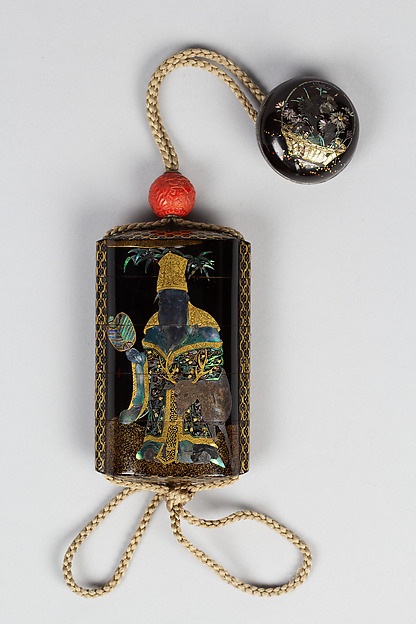
Somada School artist, Japan, late 18th to early 19th century. Lacquered wood with gold and mother-of-pearl on a black lacquer ground; H. 8.5 cm; W. 5.2 cm; D. 2.5 cm. Metropolitan Museum of Art, 29.100.729.
Look closer: Note the mother-of-pearl shimmer in the robe, the round fan in his hand and the stag standing at his side.
The Metropolitan Museum of Art, H. O. Havemeyer Collection, Bequest of Mrs. H. O. Havemeyer, 1929. Open Access.
| Case | God's face | Other face | Emblems named in the title |
|---|---|---|---|
| Tachibana Gyokuzan, 19th century (13.67.25) | Deity of longevity | Boy offering a tortoise | Tortoise |
| Unsigned, 19th century (14.40.864) | God of longevity beside a flowering plum tree | Karako walking on a bridge | Plum |
| Unsigned, 18th to 19th century (29.100.868) | Jurōjin seated beside a stag | Sage with a crane and fly whisk | Stag, crane |
| Kakōsai, 19th century (29.100.866) | God of longevity and a small boy with a tortoise | Pine tree by a stream | Tortoise, pine |
| Somada school, late 18th to early 19th century (29.100.729) | God of longevity and a stag | Long-tailed turtle under bamboo | Stag, turtle, bamboo |
Many houses for one old man
In the first days of the year the god is visited at many addresses, and each city has its own circuit. The pilgrim buys a sheet and has it stamped at each stop; Onmark Productions says the sheet is called a kinen shikishi, and the Tokyo Stroll Supplement lists other relics, among them a printed sheet of the seven gods, a bamboo branch hung with small votive tablets, and statuettes.
In Yanaka, Old Tokyo describes Chōanji at 5-2-22 Yanaka as the fifth temple on the route and the Jurōjin temple, a Rinzai temple established in the early eighteenth century and the smallest of the seven; the writer went inside to receive the stamp. In the Yamanote round at Meguro his stop is Myōenji at 3-17-5 Shirokanedai, where he shares the roof with Fukurokuju. In Mukōjima it is the Shirahige Shrine at 3-5-2 Mukōjima, which Old Tokyo says was established in the middle of the tenth century, was burnt down in 1990, and has been rebuilt. Shirahige means white-bearded, the writer notes, which is how the god is usually drawn.
In Ningyōchō the shrine is Kasama Inari at 2-11-6 Nihonbashi-Hamachō, which Old Tokyo calls a three-hundred-year-old shrine destroyed twice, in the earthquake of 1923 and again in the war, with a troop of very small fox statues on the left of the building. The Tokyo Stroll Supplement lists the Fukagawa stop as the Fukagawa Shinmei Shrine. Its Asakusa round gives him two houses, Ishihama Shrine and Ōtori Shrine; it says the route therefore has nine places, with two for Fukurokuju and two for Jurōjin, and a length of about 7.8 kilometres. The supplement adds that Jurōjin was enshrined at Ishihama in 1977 as part of the revival of the Asakusa route.
Outside Tokyo, Onmark Productions places Myōryūji, three hundred metres north-east of Kamakura station, on the Kamakura circuit as the temple of Jurōjin, the seventh site, and Green Shinto describes a round on 11 January through the sub-temples of Sennyū-ji in Kyoto in which the final stop, named in its text as Honen-in, honours the god of old age. The writer sees a circle in it: the round began with Fukurokuju, and ends with the god who is so like him.
| Round | Jurōjin's stop | Source |
|---|---|---|
| Yanaka | Chōanji, 5-2-22 Yanaka | Old Tokyo |
| Meguro (Yamanote) | Myōenji, 3-17-5 Shirokanedai, shared with Fukurokuju | Old Tokyo |
| Mukōjima | Shirahige Shrine, 3-5-2 Mukōjima | Old Tokyo, Tokyo Stroll Supplement |
| Ningyōchō | Kasama Inari Shrine, 2-11-6 Nihonbashi-Hamachō | Old Tokyo, Tokyo Stroll Supplement |
| Asakusa | Ishihama Shrine and Ōtori Shrine | Tokyo Stroll Supplement |
| Fukagawa | Fukagawa Shinmei Shrine | Tokyo Stroll Supplement |
| Kamakura | Myōryūji, seventh site of the circuit | Onmark Productions |
| Sennyū-ji, Kyoto | The final sub-temple, Honen-in as spelled by Green Shinto | Green Shinto |
Jurōjin in the Met
Yosa Buson's scroll, made about 1758 to 1769 in ink and colour on silk, shows the god with a staff, a scroll and a white beard, beside a crane and beneath a pine. The Museum calls Buson a poet-painter based in Kyoto, born in 1716 and dead in 1783, and says the layered, tactile rocks are a signature of his painting in this period. The lid of the box reads, in the Museum's translation, Jurōjin, painted by Sha Buson, and the reverse of the lid says that Go Shun, Buson's student, who lived from 1752 to 1811, authenticated it on a winter day in 1809.
Kishi Ganku's scroll is dated 1838 and shows a deer with a magical fungus in its mouth beside the god. The Museum says Ganku, who lived from 1749 to 1838, studied the Maruyama-Shijō school in his twenties, later founded his own lineage and sought to blend Japanese painting with Western realism, and that his treatment of the god's face shows an interest in naturalism. Isoda Koryūsai's tall pillar print of about 1770, titled The Bijin Jurōjin, casts a beauty in the god's role with a crane and a pine beside her; the Museum's record gives no description of it.
In three dimensions he is smaller and rounder. A Hirado ware porcelain figure of the nineteenth century, 14 centimetres high, seats him on a tortoise. A nineteenth-century figure in ivory and wood, 22.2 centimetres high, is titled God of Longevity and Wisdom. The Museum's records for both are bare, and this page describes only what the photographs show.
Things worth knowing
- Longevity is the first virtue on all three lists of the seven that this page compares (Wikipedia, Nippon.com, Onmark Productions).
- Shirahige, the name of his shrine at Mukōjima, means white-bearded (Old Tokyo).
- Jurōjin was enshrined at Ishihama in 1977 as part of the revival of the Asakusa round (Tokyo Stroll Supplement).
- The Asakusa round has nine stops because two of the gods have two each, Fukurokuju and Jurōjin (Tokyo Stroll Supplement).
- A deer of a thousand years is blue, one of fifteen hundred is white and one of two thousand is black, according to Chiba Reiko as quoted by Onmark Productions.
- A Museum surimono shows him with no figure at all, only a hat, an antler and a plum branch (Metropolitan Museum).
- The painter Hakuin is said to have dropped Bishamonten from a scroll of the seven and put in Shōki, the demon queller (Patricia Graham, as quoted by Onmark Productions).
- A late nineteenth-century print puts the seven on a catfish treasure ship, in the clothes of the trades that earn from an earthquake (Onmark Productions).
Across Asia
Jurōjin is a Chinese star-god who has kept his star.
| Where | Form and name | What the record shows |
|---|---|---|
| China | Shoulaoren; the Old Man of the South Pole | A Daoist figure also called the Star of the Old Man (Wikipedia, Onmark Productions). |
| Japan | Jurōjin 寿老人 | The god of longevity among the Seven Lucky Gods, with no separate following (Wikipedia). |
| Sky | The Southern Polar Star | The imagined star he is identified with, the South Star (Wikipedia). |
A star among the gods
Jurōjin sits with the Seven Lucky Gods in the Heavenly Beings wing, though he is by origin a Daoist star-sage rather than a Buddhist deity, and his closest companion in the group is Fukurokuju.
| Artist | Work | Dates |
|---|---|---|
| Sesshū | Named among painters of the god | 1420 to 1506 (Wikipedia) |
| Sesson Shūkei | Named among painters of the god | 1504 to 1589 (Wikipedia) |
| Kanō Tan'yū | Named among painters of the god | 1602 to 1674 (Wikipedia) |
| Maruyama Ōkyo | Named among painters of the god | 1733 to 1795 (Wikipedia) |
| Yosa Buson | Hanging scroll with crane and pine | ca. 1758 to 1769 (Metropolitan Museum) |
| Kishi Ganku | Hanging scroll with deer and fungus | 1838 (Metropolitan Museum) |
| Kanō Tanshin | Hanging scroll with deer | Early 19th century (Metropolitan Museum) |
| Kano Tsunenobu | Painting of Jurōjin, one of a triptych | Late 17th to early 18th century (Metropolitan Museum) |
| Soga Shōhaku | Hanging scroll with boat, deer, tortoise and crane | About 1773 (Metropolitan Museum) |
| Shibata Zeshin | Hanging scroll with rock and building | 19th century (Metropolitan Museum) |
| Totoya Hokkei | Surimono of hat, antler and plum branch | 19th century (Metropolitan Museum) |
Where to see him
| Place | What to look for |
|---|---|
| Chōanji, Yanaka, Tokyo | The Jurōjin temple of the Yanaka circuit, a Rinzai temple of the early eighteenth century and the smallest on the route; visitors can enter the building to receive the stamp (Old Tokyo). |
| The Yanaka circuit, 1 to 10 January | Stamps are given between 1 and 10 January, from 9:00 to 17:00 (Old Tokyo). |
| Myōryūji, Kamakura | Jurōjin statues; one of the seven sites of the Kamakura pilgrimage to the Seven Gods (Onmark Productions). |
| Shirahige Shrine, Mukōjima, Tokyo | The Jurōjin shrine of the Mukōjima round; the name means white-bearded, and the wooden building was burnt in 1990 and rebuilt (Old Tokyo). |
| Kasama Inari Shrine, Nihonbashi-Hamachō, Tokyo | The Jurōjin shrine of the Ningyōchō round, with a troop of very small fox statues on the left of the building (Old Tokyo). |
| Ishihama Shrine and Ōtori Shrine, Asakusa round | His two stops on the Asakusa route; he was enshrined at Ishihama in 1977 (Tokyo Stroll Supplement). |
| Fukagawa Shinmei Shrine, Tokyo | His stop on the Fukagawa round (Tokyo Stroll Supplement). |
| Metropolitan Museum of Art, New York | Seven scrolls, two prints, five inrō, two porcelain figures, an ivory and a netsuke, in open access. |
Six ways to draw an old man
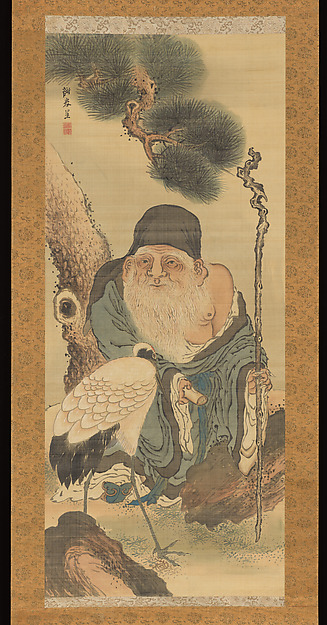
Yosa Buson, Japan, ca. 1758 to 1769. Hanging scroll; ink and color on silk; image 119.7 x 51 cm. Metropolitan Museum of Art, 2024.577.1.
Look closer: Note the robe falling from his shoulders and the crane at his feet, both set against the layered rock.
The Metropolitan Museum of Art, Mary and Cheney Cowles Collection, Gift of Mary and Cheney Cowles, 2024. Open Access.
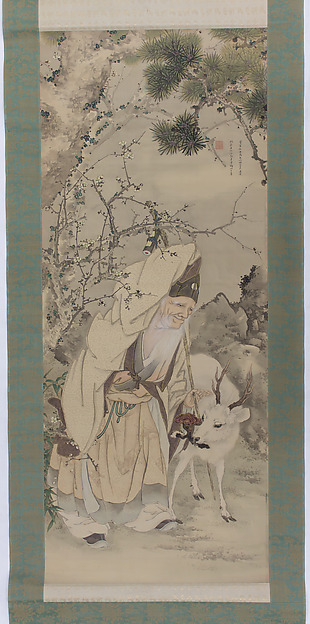
Gan Ku (Kishi Ganku), Japan, 1838. Hanging scroll; ink and color on silk; image 139.8 x 57 cm. Metropolitan Museum of Art, 2018.853.31.
Look closer: Note the smiling, finely observed face and the deer holding a small dark fungus in its mouth.
The Metropolitan Museum of Art, Mary and Cheney Cowles Collection, Gift of Mary and Cheney Cowles, 2018. Open Access.

Kano Tanshin (Moromichi), Japan, early 19th century. Hanging scroll; ink on silk; image 92.7 x 38.1 cm. Metropolitan Museum of Art, 1975.268.54.
Look closer: Note how the knotted staff and the pale deer frame the figure on either side.
The Metropolitan Museum of Art, The Harry G. C. Packard Collection of Asian Art, Gift of Harry G. C. Packard, and Purchase, Fletcher, Rogers, Harris Brisbane Dick, and Louis V. Bell Funds, Joseph Pulitzer Bequest, and The Annenberg Fund Inc. Gift, 1975. Open Access.

Isoda Koryusai, Japan, ca. 1770. Woodblock print; ink and color on paper; 70.5 x 10.6 cm. Metropolitan Museum of Art, JP674.
Look closer: Note how the crane stands at the young woman's knee, bringing the god's usual company into a scene of fashionable beauty.
The Metropolitan Museum of Art, The Francis Lathrop Collection, Purchase, Frederick C. Hewitt Fund, 1911. Open Access.

Japan, 19th century. Porcelain with enamels (Hirado ware); H. 14 cm, W. 10.5 cm, D. 16.2 cm. Metropolitan Museum of Art, 23.225.90.
Look closer: Note the tortoise carrying the god, its glazed face as cheerful as his.
The Metropolitan Museum of Art, Gift of Mrs. V. Everit Macy, 1923. Open Access.

Japan, 19th century. Ivory, wood; H. 22.2 cm, W. 10.3 cm. Metropolitan Museum of Art, 65.86.130.
Look closer: Note how the long beard falls in a single line down the robe, echoing the tall head above it.
The Metropolitan Museum of Art, Alfred W. Hoyt Collection, Bequest of Rosina H. Hoppin, 1965. Open Access.
At the desk
A Jurōjin figure, scroll or netsuke appears below when we hold one. If none shows, the concierge desk can search for it.
Words on the Jurōjin shelf
The words most often met on a scroll, an inrō or a stamp sheet.
- Jurōjin 寿老人
- Ju for longevity, rō for old and jin for person: the Old Man of Longevity (Onmark Productions, Wikipedia).
- Nankyokusei 南極星
- The southern pole star, which he is said to personify (Onmark Productions, Nippon.com).
- Shoulaoren
- The Chinese name for the god given by Onmark Productions, from the dictionary it quotes.
- Sennin 仙人
- An immortal of Daoist tradition, the word Onmark Productions uses for him.
- Shichifukujin 七福神
- The Seven Lucky Gods: shichi seven, fuku luck, jin god (Onmark Productions).
- Shaku 尺
- A traditional length, about 30 centimetres; the sources give his height as three shaku, and disagree on the equivalent (Wikipedia, Onmark Productions).
- Koku
- A measure that Onmark Productions glosses as nearly forty gallons, in the tale of the feast.
- Shikishi 色紙
- A coloured sheet of paper for calligraphy, the sheet that is stamped on a pilgrimage (Onmark Productions, Old Tokyo).
- Takarabune 宝船
- The treasure ship in which the seven are pictured sailing in at the new year (Onmark Productions).
- Inrō, netsuke, ojime
- A tiered case, the toggle that holds it at the belt and the bead on its cord, as the Museum catalogues them.
Answered plainly
Who is Jurōjin?
The Daoist-born god of longevity among the Seven Lucky Gods, an old man with a staff, a scroll and a deer (Wikipedia).
How old is he said to be?
Popular belief holds that he has lived in the world for 1,500 years (Wikipedia).
Why does a deer go with him?
The deer is the main symbol of longevity and often serves as his messenger (Onmark Productions).
Is he the same god as Fukurokuju?
They are often confused; the Butsuzō-zui calls them the same deity, and other accounts differ (Onmark Productions, Wikipedia).
What is on his staff?
A scroll said to record the lifespans of all living things, all good and bad deeds, or a book of knowledge (Wikipedia, Onmark Productions).
Where is his temple in Tokyo?
Chōanji in Yanaka is the Jurōjin temple of the Yanaka circuit (Old Tokyo).
What does Shirahige mean?
White-bearded; Old Tokyo says the name of the Mukōjima shrine explains the god worshipped there, since a white beard is how Jurōjin is usually drawn (Old Tokyo).
What is the Old Man of the South Pole?
The Daoist deification of the star Canopus, which Wikipedia says became Jurōjin in Japan (Wikipedia, Nippon.com).
Is Jurōjin's deer black or white?
The sources differ: Chiba Reiko and the Flammarion guide give a black deer, JAANUS a white stag of fifteen hundred years (Onmark Productions).
Who chose the Seven Lucky Gods?
Tradition credits the monk Tenkai, but Patricia Graham notes that his known writings do not mention them (Wikipedia, Onmark Productions).
Where can I meet Jurōjin at New Year?
At Chōanji in Yanaka, Myōenji in Meguro, Shirahige Shrine in Mukōjima, Kasama Inari in Ningyōchō, Ishihama and Ōtori in Asakusa, Fukagawa Shinmei, Myōryūji in Kamakura and a sub-temple of Sennyū-ji in Kyoto (Old Tokyo, Tokyo Stroll Supplement, Onmark Productions, Green Shinto).
Why does a Museum print show a hat and an antler?
The Museum titles it Hat, Deer-Horn and Plum Branch, Representing Jurōjin: the objects stand for the god (Metropolitan Museum).
Which round is the oldest?
Onmark Productions says Yanaka, Old Tokyo says Meguro, and the sources do not date either with a document (Onmark Productions, Old Tokyo).
Where next
Sources and image credits
- Wikipedia, Jurōjin
- Wikipedia, Seven Lucky Gods
- Onmark Productions, Jurōjin
- Old Tokyo, 7 Lucky Gods Pilgrimage in Yanaka
- Metropolitan Museum of Art, Jurojin, Yosa Buson (2024.577.1)
- Metropolitan Museum of Art, Jurojin, Gan Ku (2018.853.31)
- Metropolitan Museum of Art, Jurojin, Kano Tanshin (1975.268.54)
- Metropolitan Museum of Art, The Bijin Jurojin, Isoda Koryusai (JP674)
- Metropolitan Museum of Art, Jurojin, Hirado ware (23.225.90)
- Metropolitan Museum of Art, Jurojin, God of Longevity and Wisdom (65.86.130)
- Wikipedia, Old Man of the South Pole
- Wikipedia, Fukurokuju
- Wikipedia, Sanxing (deities)
- Onmark Productions, Seven Lucky Gods of Japan
- Onmark Productions, Kamakura pilgrimage to the Seven Lucky Gods
- Nippon.com, Shichifukujin: Japan's Seven Gods of Fortune
- Old Tokyo, The oldest 7 lucky god course in Tokyo, Yamanote Meguro
- Old Tokyo, Mukōjima pilgrimage along the Sumida
- Old Tokyo, Chasing the 7 lucky gods in Ningyōchō
- Tokyo Stroll Supplement, Seven Lucky Gods pilgrimages
- Tokyo Stroll Supplement, Asakusa pilgrimage
- Tokyo Stroll Supplement, Fukagawa pilgrimage
- Tokyo Stroll Supplement, Mukōjima pilgrimage
- Tokyo Stroll Supplement, Ningyōchō pilgrimage
- Green Shinto, Shichifukujin Meguri: Seven Lucky Deities in Kyoto
- Metropolitan Museum of Art, God of Longevity (Shoulao) (14.40.203)
- Metropolitan Museum of Art, God of Longevity with a Peach (10.211.1694)
- Metropolitan Museum of Art, Eight Daoist Immortals Welcoming Jurōjin (14.76.52)
- Metropolitan Museum of Art, Jurōjin (51.137.4)
- Metropolitan Museum of Art, Painting of Jurōjin (61.63)
- Metropolitan Museum of Art, The God of Good Fortune Jurōjin (2011.572.1)
- Metropolitan Museum of Art, Hat, Deer-Horn and Plum Branch, Representing Jurōjin, the God of Life (JP2390)
- Metropolitan Museum of Art, Case (Inrō) with Design of God of Longevity (Jurōjin) and a Small Boy with a Tortoise (obverse); Pine Tree by Stream (reverse) (29.100.866)
- Metropolitan Museum of Art, Case (Inrō) with Design of Deity of Longevity (Jurōjin) (obverse); Boy Offering a Tortoise (reverse) (13.67.25)
- Metropolitan Museum of Art, Case (Inrō) with Design of God of Longevity (Jurōjin) beside Flowering Plum Tree (obverse); Karako Walking on Bridge (reverse) (14.40.864a, b)
- Metropolitan Museum of Art, Case (Inrō) with Design of Jurōjin (God of Longevity) Seated beside Stag (obverse); Sage with Crane and Fly Whisk (reverse) (29.100.868)
- Metropolitan Museum of Art, Inrō with God of Longevity (Jurōjin) and a Stag (obverse) and Long-Tailed Turtle (Minogame) under Bamboo (reverse) (29.100.729)
Last reviewed 28 October 2026. Pictures are public-domain or openly licensed, each credited beneath it. Diagrams on this page are drawn by Japonista.
Looking for a Jurōjin figure, a scroll or a netsuke? Tell the concierge desk what you have in mind and we will search Japan for it.
Private concierge
Looking for something in particular?
Describe the piece or the project you have in mind. A senior advisor in Tokyo reads every case file personally and replies within two business days, with fees set out in writing before any work begins.