
Hachibushū and Ashura
The Eight Legions
Hachibushū and Ashura
八部衆・阿修羅
Eight classes of Indian beings, converted by the Buddha and set to guard his teaching, and the three-faced, six-armed Ashura who became their best-known face at Kōfukuji in Nara.
Identity card
Know the figure at a glance
- Ten. Deva, the heavenly beings. Kōfukuji's statue of this class is named Gobujō (JAANUS).
- Ryū. Naga, the dragon kings. Kōfukuji names its statue Sakara or Shagara (JAANUS).
- Yasha. Yaksa, spirits of the earth. Kōfukuji names its statue Kubanda (JAANUS).
- Kendatsuba. Gandharva, celestial musicians (JAANUS).
- Ashura. Asura, a class of fierce beings; at Kōfukuji it is the three-faced, six-armed statue (tourism database).
- Karura. Garuda, the bird-like class (JAANUS).
- Kinnara. Kimnara, the class of celestial singers and players (JAANUS).
- Magoraga. Mahoraga, the great serpent class; Kōfukuji's Hibakara is probably this one (JAANUS).
Eight classes of guardians
Hachibushū is short for Tenryū hachibushū, which the Japan Architecture and Art Net Users System (JAANUS) explains as eight classes of Indian deities who were converted by Shaka, the historical Buddha, and are regarded as protectors of the Dharma. The classes are Ten, Ryūō, Yasha, Kendatsuba, Ashura, Karura, Kinnara and Magoraga. Behind each name is an Indian class of being: the deva, the naga, the yaksa, the gandharva, the asura, the garuda, the kimnara and the mahoraga.
The list is not fixed. JAANUS notes that the names given to the eight differ from text to text, and that Kōfukuji in Nara, the temple that holds the most famous set, uses Gobujō for the heavenly being, Shagara or Sakara for the dragon, and Kubanda for the yasha, with Hibakara probably standing for Magoraga. Wikipedia's article on the Eight Legions makes the same point from another side: Kōfukuji's list substitutes Gobujō, Sagara and Kubanda for the deva, naga and yaksa, and it explains Gobujō as the personification of the heaven of the fourth dhyāna, with five gods.
The On-Mark Productions page on the group adds the other names the eight go by: Ninpinin, 'not human and not not human', Tenryū kijin, the devas, dragons and spirits, and Tenryū hachibushū in full. It stresses that the names are not fixed and that one deity may stand for its whole class. It also makes a point that changes how the statues are read. The eight are not objects of worship as a group, although some devas, among them Bishamonten, Benzaiten and Daikokuten, are worshipped alone; they are an audience, the beings who gathered to hear the Buddha and who then undertook to protect what he taught.
Only two of the eight, the deva and the dragon, appear often in Japanese art, according to the same page. The other six are much rarer, and this is one reason the Kōfukuji set of 734 is such a treasure: it is the one place where the whole company stands together in sculpture, each in a distinct form. The rest of this chapter takes the eight in turn, then the scriptures and the death-of-the-Buddha pictures where they gather, then the 2009 exhibition that made one of them famous, and finally what a reader should ask of a figure that claims to be one of the eight.
From the Lotus Sutra to the Golden Light
The Japanese Wiki Corpus article on the Hachibushū says the usual list is drawn from the Sharihotsu-mon, the Lotus Sutra and the Golden Light Sutra. JAANUS adds that the eight appear in the Lotus Sutra usually within larger groups of beings, such as the crowds of attendants gathered around the Buddha in pictures of his death, the nehan-zu, and that they emerge as a distinct group of eight only from the Nara period.
That late arrival matters for reading the statues. The eight are not a single ancient formula carried unchanged from India; they are a Japanese arrangement made from lists that vary, and the Kōfukuji sculptors worked from a text, the Golden Light Sutra, that the tourism database names as the source for their set.
The Wikipedia article on the Eight Legions gives the Sanskrit name Aṣṭasenā, 'eight legions', and says the eight appear among the audiences the Buddha addresses in Mahāyāna sutras, including the Lotus Sutra and the Golden Light Sutra. It also gives the longer Chinese title Tiānlóng bābù, the eight classes of devas and nāgas, which the On-Mark page renders as Tenryū hachibushū, and it records that the novelist Jin Yong took the same phrase as the Chinese title of a famous novel. The article notes that many of the eight belong to the lower heavens of the Cāturmahārājikakāyika and the asura realm, and that most of them began as nature spirits. It does not give a date for the group.
The On-Mark page places the gathering at the Vulture Peak, where the Buddha is said to have taught the Flower Garland and Lotus teachings, and says the eight were present when he preached. They came from Hindu mythology, were converted by hearing him, and became guardians of the teaching. JAANUS, as quoted above, adds that they appear as a distinct group in art only from the Nara period; before that they are part of the crowd.
Each class in turn
The Wikipedia article gives the eight in Sanskrit, Chinese and Japanese: deva (Tiānzhòng, ten), nāga (Lóngzhòng, ryū), yakṣa (Yèchā, yasha), gandharva (Gāntàpó, kendatsuba), asura (Āxiūluuó, ashura), garuḍa (Jiālóuluó, karura), kiṃnara (Jǐnnàluó, kinnara) and mahoraga (Móhóuluójiā, magoraga). The On-Mark page describes each in Japanese terms, and the descriptions below follow it, with the Wikipedia article where it adds something.
The Ten, the devas, sit at the sixth level of existence, above humans and Ashura but below bodhisattvas and Nyorai. They are represented by Bonten, Taishakuten, the four Shitennō, especially Bishamonten, and Benzaiten, and the page says they are heavily represented in the Nichiren school and in mandalas. The Ryū, the nāgas, are serpentine water spirits with human form and a crown of serpents, attendants of Kōmokuten, and mortal enemies of the Karura. The Hachi Ryūō, the eight dragon kings, are named as Nanda, Upananda, Sagara, Vasuki, Takshaka, Balavan, Anavatapta and Utpala, and the page tells the legend that Nāgārjuna, about 150, was given the Prajñāpāramitā by the nagas. Chinese dragon lore, it adds, is older than Buddhism: bronze and jade pieces of the Shang and Zhou dynasties, in the sixteenth to ninth centuries BC, show dragon-like creatures, and by the ninth century AD the dragon had been merged into Buddhist iconography.
The Yasha, the yakṣas, are fierce warriors and nature spirits, early forms of which were spirits of trees, forests and villages that could be kind or demonic. They are the soldiers of Tamonten and the protectors of Yakushi Nyorai, and Kubera, the Hindu god of wealth, is sometimes considered their king. The page notes that Kariteimo was once a child-devouring yakṣa named Hārītī who converted and became a protector of children. The Kendatsuba, the gandharvas, are gods of music, medicine and children, led by Jikokuten of the east, who feed on fragrance: the page gives their Chinese names as scent-eater, scent-seeker and scent god, and says they do not drink wine or eat meat. Sendan Kendatsuba is a king among them and the central figure of the Dōjikyō mandala, used in esoteric rites to protect children. The page adds that they are seldom represented in Japan.
The Karura, the garudas, are bird-men with a human head and a bird's body, the mortal enemies of the nagas. Only a dragon who carries a Buddhist talisman, or who believes in Buddhism, can escape them, according to the page. Japanese sculptures show ornate birds with human heads treading on serpents, and Karura masks are common in gyōdō processions and in Noh. The Kinnara, the kiṃnaras, are celestial musicians and dancers. Early depictions give them a human body with a horse's head, later ones a bird with a human head playing an instrument, and they serve Kubera and Tamonten; at Sanjūsangendō one Kinnara plays a drum as an attendant of Taishakuten. The Magoraka, the mahoragas, are the vaguest of the eight: some Chinese dictionaries define them as serpents who walk on their breasts, and they are serpentine musicians from the Brahmanic pantheon, partly absorbed into the dragon in Buddhism.
Eight statues of 734
The famous set stands at Kōfukuji. Japan's tourism database lists its eight statues as Ashura, Gobujō, Sakara, Kendatsuba, Kinnara, Kubanda, Hibakara and Karura, dates them to 733 to 734 in the Japanese text and to 734 in the English, and says they were made in the dry-lacquer technique, with a hollow core. JAANUS likewise calls the best-known Japanese set dry lacquer, of 734, made to accompany a Shaka image.
They belonged first to the Saikondō, the West Golden Hall. The database says the hall burned four times, the last in 1717, and was never rebuilt; all eight statues survived and are now kept in the Kokuhōkan, the treasure hall, where they are National Treasures. The Japanese Wiki Corpus article adds that the Saikondō was built in 734 by Empress Kōmyō to honour her late mother Tachibana no Michiyo, and the database names Kōmyō, who lived from 701 to 760 and was a daughter of Fujiwara no Fuhito, as the patron of the statues.
The sources differ on weight. The Japanese text of the database gives about ten to fifteen kilograms for each figure, while its English text says most are under ten. The database does not say how they were saved, only that none was lost. Four of the eight, Ashura, Gobujō, Sakara and Kendatsuba, are described as having boyish faces.
Three more accounts fill in the setting. The Nara sightseeing note on the National Treasure Hall says the figures were commissioned in 734 by Empress Kōmyō, consort of Emperor Shōmu, to honour the repose of her mother, who was the wife of Kōfukuji's founder. It adds that the temple was a family temple of the Fujiwara, so that its images and buildings were bound up with family affairs, and that the eight were made as a contemporary series with the Ten Great Disciples of the Buddha by what it calls the same sculptor, the two sets once standing around a statue of the historical Buddha that is now missing.
The same note describes what a visitor sees in the hall. The eight are drawn from Indian mythology: a deva, a naga, a garuda, a yaksa, a group of heavenly and serpentine musicians and the Ashura. Some wear elephant or wild-cat heads set like trophy helmets, some of the animal features echo the masks of Japanese court dance, and all have boyish, expressive faces that are individual yet resemble one another like members of a family. Ashura, the note says, is the only one of the group without animal features, and the only one in a simple skirt, where the others wear armour like Central Asian warriors.
Alan Gleason's Artscape review of the 2009 exhibition gives a different and older history of the building. It says the Chūkondō, the Main Golden Hall, was built in 710 and has burned down and been rebuilt seven times, with statues rescued from each fire, and that the temple was then restoring it to its original specification for the 1300th anniversary. The tourism database speaks of the Saikondō, the West Golden Hall, as burned four times and never rebuilt after 1717. The two are different halls, and both statements can be true; the Artscape review does not say which hall the eight first stood in, and this page follows the tourism database and the Japanese Wiki Corpus, which both say the Saikondō.
Three faces and six arms
Ashura is the figure that made the group famous. The database gives his height as 153.4 centimetres and his date as 734. He has three faces: a calm, repentant face in front, a resentful one at the right and an angry one at the left. He has six arms. The upper pair once held the sun and the moon, the middle pair a bow and an arrow, and the front pair is pressed together in prayer. His body is slender and upright, with flowing robes and trousers.
The database describes how unusual this is. Ashura is normally armoured, red-faced and fanged. At Kōfukuji he is a thin, upright youth with a repentant face, and it adds that CT scans have revealed another face beneath the front one, and that some scholars believe Empress Kōmyō had the face recarved in a gentler form in memory of her son. That is presented there as a scholarly view, and it is worth holding as one.
Why does an Ashura look like this? The On-Mark page gives the background in India: in the Vedic stories the asura was a god of conquered peoples, later demoted to demon, who was defeated by Indra and hid in a lotus in Lake Anavatapta. In Buddhist teaching the Ashura sit in the realm of the demigods, powerful and quarrelsome, partly good and partly evil, and in Japan the usual figure has three faces and six arms with violent side faces. The Artscape review traces the name further back to the Aryan Ahura, the highest divinities, of which Ahura Mazda is an example, and says Buddhists in China and Korea rehabilitated the figure before it reached Japan, though the Ashura are still ranked below humans.
The On-Mark page says the Ashura arrived in Japan in the sixth century from Korea and China, and that the king of the Ashura, Ashura-ō, is described in the Flammarion guide as holding the sun, the moon, a bow, arrows and a mirror. The Kōfukuji figure keeps the sun and moon and the bow and arrow in the upper and middle hands, but gives the front pair the gesture of prayer.
Gleason's review reads the figure by its look, and his judgement is worth recording as one visitor's. He finds the arms and torso slender and, in his view, feminine, against the stockier, armoured figures around it; he finds the front face more subtly expressive than the others, combining pride and suffering, with anger confined to the side faces; and he suggests that Ashura may be the most human of the Buddhist deities, which explains the affection the statue receives. The Nara sightseeing note adds that the six arms are unusually long and slender and are wrapped in thin ribbons with lacquer and gold-leaf ornaments, and that the statue is among the oldest dry-lacquer statues in Japan.
A word on the child's face. The butuzou.com note, which is a dealer's article and gives no sources, reads the youthful face as inner conflict and the possibility of change. That is an interpretation. The documented point, from the tourism database, is that CT scans found another face beneath the front one and that some scholars think the face was recarved in a gentler form; this page treats both as reported views and not as settled fact.
A demigod's place in the wheel
The On-Mark page places two of the eight in the six states of existence. The lowest three, it says, are the hell beings, the hungry ghosts and the animals; the upper three are the Ashura, humans and devas. The Ashura are therefore above humans but not beyond the wheel. They are powerful, proud and quarrelsome, they fight the devas, and the Artscape review makes the same point when it says the Ashura are still placed below humans spiritually, known for anger and violence and bound to the cycle of rebirth.
That placement is what makes the Kōfukuji statue so strange. A creature defined by rage is carved with a face that is not raging, and a being who belongs to the wheel stands in prayer at its end. The tourism database says the front face is calm and repentant and the side faces are resentful and angry. The three faces are, on this reading, the three states of one being: the pride that fights, the anger that follows and the regret that comes after. This is a reading of the iconography and not a statement found in the sources, and a visitor can test it by walking round the statue, as the 2009 crowds did, and watching which face is turned toward them.
At the death of Shaka
JAANUS, as reported above, says the eight appear in the Lotus Sutra within larger groups, such as the crowds of attendants around the Buddha in pictures of his death, the Nehan-zu. The On-Mark page repeats the point: the eight also appear around Shaka in Nehan-zu paintings. These pictures are the best way to see the eight as they were first imagined, not as a set of eight statues but as a crowd of beings of every kind gathered round a reclining figure, the whole animal and spirit world weeping.
The Metropolitan Museum owns two Japanese Nehan-zu in the open-access collection. The earlier, of the fourteenth century, is a large hanging scroll in ink, colour and gold on silk, the image about 197 by 189 centimetres, and the later, of the fifteenth century, is a narrower one about 188 by 110 centimetres. Both show the reclining Buddha among trees, with mourners crowding the ground around him and, in the Met's tags, birds, elephants, horses and monkeys among the creatures who grieve. The Met's records give no description of which figures in the crowd are devas, nagas or garudas, and this page does not guess.
Two parallels show how long the scene lasted. A Gandharan schist relief of the second or third century, also in the Met, shows the same moment in a few figures: the Buddha lying on a couch, with mourners standing and kneeling beside him and trees at either edge. A colour woodblock print of about 1710 to 1720 in the Cleveland Museum of Art shows the scene again as a tall hand-coloured sheet, with a pavilion at the centre and animals massed below. A Meiji-era Ōtsu-e hanging scroll of the same subject, also in Cleveland, shows how the picture survived as a folk image. Seen together they make the point that the guardians of the eight classes were first a crowd, and only later, at Kōfukuji, a company of individuals.

Japan, 14th century. Hanging scroll; ink, color, and gold on silk; 196.9 × 188.6 cm. Metropolitan Museum of Art, 12.134.10.
Look closer: Note the reclining Buddha at the centre and the animals and mourners that press in from every side: the whole world of beings, among which the eight classes were first counted.
The Metropolitan Museum of Art, Rogers Fund, 1912. Open Access.
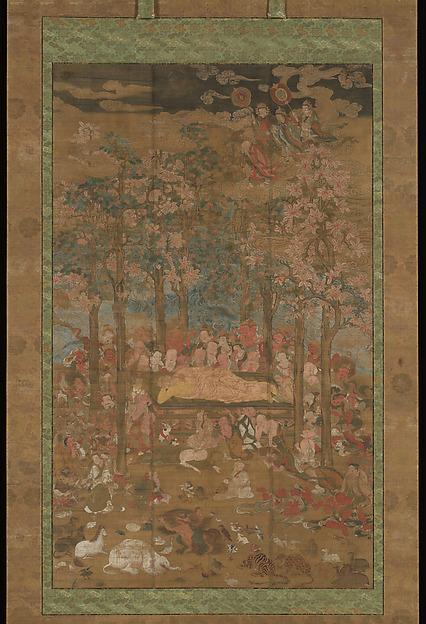
Japan, 15th century. Hanging scroll; ink, color, and gold on silk; 188 x 110 cm. Metropolitan Museum of Art, 44.35.1.
Look closer: Note the figures in clouds above and the animals below: the scene is built in layers, from heaven down to the creatures on the ground.
The Metropolitan Museum of Art, Gift of Susan Dwight Bliss, 1944. Open Access.
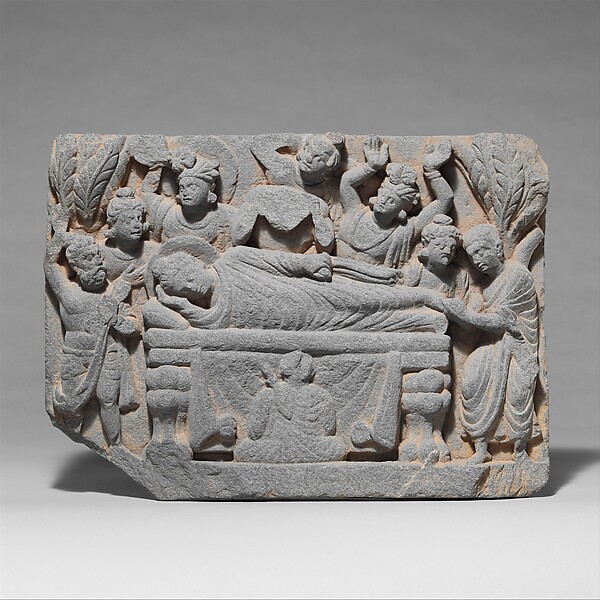
Gandhara (present-day Pakistan), 2nd–3rd century. Gray schist; 29.8 cm. Metropolitan Museum of Art, 67.43.13.
Look closer: Note how few figures carry the scene: the same subject that fills a Japanese scroll with hundreds is told here in a handful of mourners.
The Metropolitan Museum of Art, Gift of Paul E. Manheim, 1967. Open Access.
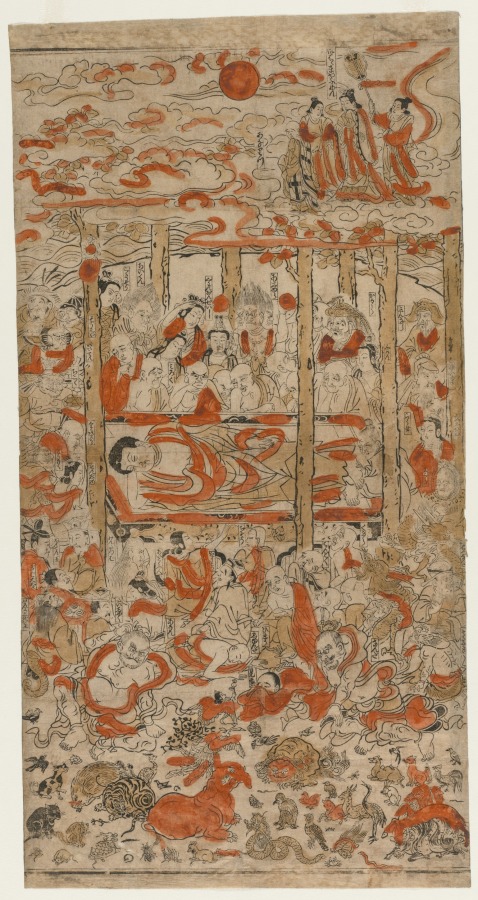
Japan, Edo period (1615–1868), c. 1710s. Color woodblock print; 54 x 27.8 cm. Cleveland Museum of Art, 1916.1141.
Look closer: Note the orange-red colour laid on by hand over the printed lines and the animals massed along the bottom edge: the eighteenth-century printmaker kept the crowd.
Cleveland Museum of Art, Gift of Mr. and Mrs. J. H. Wade. Open Access (CC0).
Eight hosts in a water-land rite
The Cleveland Museum of Art holds a Chinese painting that shows the same classes in a quite different setting. Its record, The Eight Hosts of Deva, Naga, and Yakshi, dated 1454, explains that the grandest of Buddhist mortuary rites is the Water-Land ritual, a weeklong esoteric ceremony conducted for the salvation of all souls of the dead on land and sea. It was performed for imperial ancestors and high officials from the Song to the Ming dynasties and drew large crowds. On the second day, paintings were hung in the inner altar.
This scroll, Cleveland says, represents the Eight Hosts of Celestial Nagas and Yakshis as described in the Lotus Sutra, and with a companion it belongs to a set of 36 Water-Land ritual paintings that are the finest of their type known from the Ming period, with bright opaque colour and fine gilt line intact and unfaded. The provenance in the record starts with the Ming imperial collection of the Jingtai era, 1450 to 1456.
The painting shows what Japanese temples chose not to. Where Kōfukuji gives each class a single carved figure, the Chinese painter gives the whole court: a crowded sky of richly dressed beings in cloud, a green-faced figure with a halo at the centre and a figure in blue robes below. It is a reminder that the eight hosts were also, in China in the mid-fifteenth century, a body of beings to be honoured in a rite for the dead, and that the Kōfukuji set belongs to a longer and wider tradition.
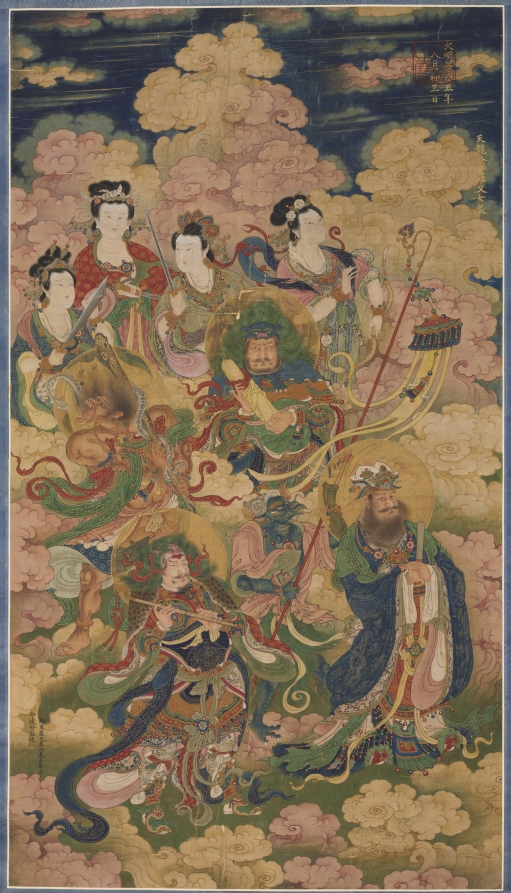
China, Ming dynasty (1368–1644), 1454. Hanging scroll; ink and color on silk; 140.2 x 78.8 cm. Cleveland Museum of Art, 1973.70.2.
Look closer: Note the density: dozens of attendants packed into one picture, and the gilt line on the robes, still bright after more than five centuries.
Cleveland Museum of Art, John L. Severance Fund. Open Access (CC0).
The statue the country queued for
The Tokyo National Museum opened the exhibition The National Treasures Ashura and Masterpieces from Kohfukuji on 31 March 2009, to mark the 1300th anniversary of the founding of the temple, with 75 works including the eight, the Ten Great Disciples, votive objects from the Central Golden Hall and other Buddhist statues, according to the Tokyo Research Institute for Cultural Properties. It ran to 7 June, and the same notice reports more than 940,000 visitors, which it links to the growing popularity of Buddhist statues in recent years. The show then moved to the Kyushu National Museum from 14 July to 27 September.
The Japan Times, writing in April 2010, puts the Tokyo attendance at 946,000 and says visitors queued about an hour, day after day, to see the statue close up; it adds that the figure was displayed so that it could be seen from all sides without glass, and that the show became a social phenomenon, with the Art Newspaper naming it the most visited museum exhibition in the world for 2009. The Artscape review describes the same arrangement: the Ashura had its own hall and stood on a central dais, visitors walked round it in a clockwise circle, and the other seven guardians were shown separately. The review mentions an Ashura Fan Club with celebrity members and records a hubbub over the nickname 'Japan's Venus de Milo', which its author treats with some scepticism.
The two accounts of the numbers differ slightly, since 940,000 and 946,000 are not the same figure and neither source says when its count was taken. The 'most visited in the world' claim is the newspaper's, as reported by the Japan Times, and this page has not checked it against the Art Newspaper itself. What is not in doubt is that a thirteen-hundred-year-old statue of a quarrelsome demigod in a skirt became, for one spring, the most sought-after sight in Tokyo.
Dragon, bird and musician
The Japanese Wiki Corpus article gives details of other members. Gobujō wears an elephant-headed crown and is badly damaged, and its right hand, the article says, is now at the Tokyo National Museum, donated in 1904. Hibakara is older and bearded. The article also records a suggestion that Ashura may trace to a sun deity in Central Asian and Iranian regions, and a Kyoto National Museum mandala that suggests the eight stood in pairs flanking the principal image.
Museums outside Japan hold figures that share the same Indian classes, which helps the eye. The Metropolitan Museum has a Japanese hanging scroll of a Dragon King from the sixteenth or seventeenth century, a gandharva carved in slate in India in the eleventh century, and a tenth-century Javanese bronze of a kinnari playing a vina. Cleveland has a Cambodian bronze labelled as a four-armed Ashura from the tenth century. None of these is a Japanese Hachibushū statue; they show how widely the same class names travelled.
The Artscape review gives one more date for the Kōfukuji set: it lists the Karura as one of the eight and dates it to 734. It also reports that the other figures in the 2009 exhibition included a Yakuō Bosatsu of 1202 and a Jikokuten of 1189, both Kamakura works made after fires had destroyed the earlier sets.
A Karura in Kyoto, a clay Ashura at Hōryūji
A reader who has seen the Kōfukuji eight can find the same classes elsewhere, and the On-Mark page is the guide. At Hōryūji the oldest Ashura, a seated clay figure of the eighth century, belongs to the same Nara world as the dry-lacquer set. At Sanjūsangendō in Kyoto the page names the Karura as the best known of its kind in Japan, and records a twelfth-century life-size wooden Ashura; it also says that one Kinnara there plays a drum as an attendant of Taishakuten. At Kōryūji the Magoraka is a Heian figure by the sculptor Chōsei. The page adds that the members of the Eight Legions also belong to the Tenbu and to the Twenty-Eight Legions.
The point of these other sets is the contrast. The Kōfukuji figures are hollow lacquer of one year, 734, made as a set and meant to stand together; the Hōryūji, Sanjūsangendō and Kōryūji figures are clay or wood of different centuries, made for different halls. A visitor moving from one to the other sees the same beings made by different hands, and learns how little of the eight is fixed beyond the names.
Garuda, serpent kings and yakshas in stone
Before the Japanese carvers there were the Indian ones, and the Metropolitan Museum holds three that show the classes at their source. A Gandharan schist group of the second or third century is titled Garuda Vanquishing the Naga Clan. It shows a large eagle-headed bird with spread wings behind a cluster of human figures, among them a woman, and it is the plainest picture in the museum of the enmity the On-Mark page describes between the Karura and the nagas.
A red sandstone Standing Nagaraja, from Uttar Pradesh or Madhya Pradesh in about the middle of the fifth century, shows a serpent king in human form, standing at ease with a small object in one hand and a serpent's coils behind his legs. A sandstone Patravahaka yaksha from Madhya Pradesh of about 50 BCE shows the class that became the Yasha: a thickset figure with a grimacing face and a cap, the arms lost. The Met's records for all three give no description of their iconography, and what is said here is what the eye finds.
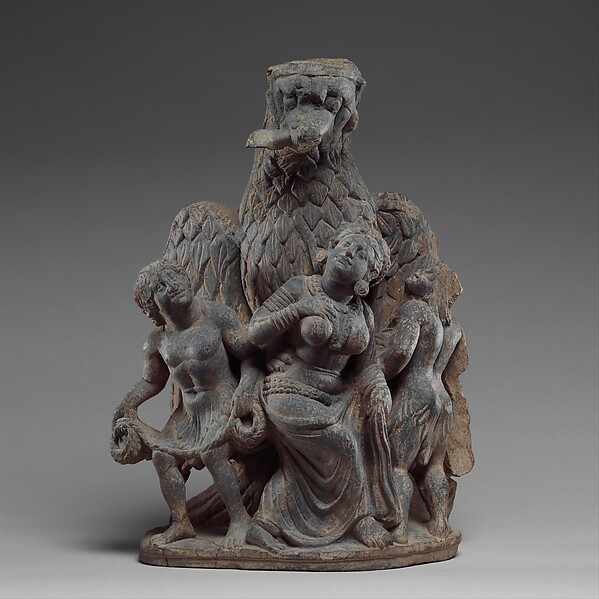
Gandhara (present-day Pakistan), ca. 2nd–3rd century. Schist; 33.3 cm. Metropolitan Museum of Art, 1980.325.
Look closer: Note the bird's hooked beak and the crowd of figures pressed against it: the eagle in Gandharan carving is a living figure, not a symbol.
The Metropolitan Museum of Art, Purchase, Bernice Richard Gift, 1980. Open Access.
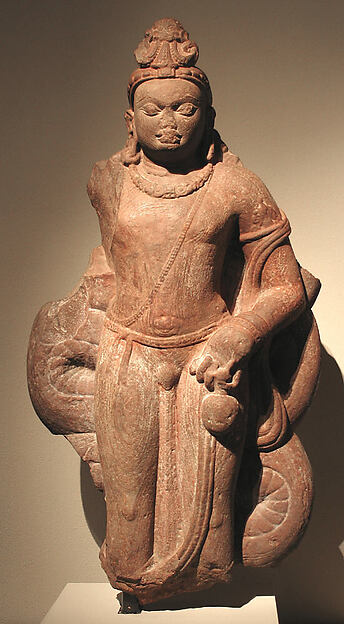
India (Uttar Pradesh or Madhya Pradesh), ca. mid- 5th century. Red sandstone; 149.9 cm. Metropolitan Museum of Art, 1991.83.1.
Look closer: Note the heavy coil behind the legs: the serpent king is a man above and a snake below, the form the Japanese called Ryūō.
The Metropolitan Museum of Art, Gift of Jeffrey B. Soref, in honor of Anthony Gardner, 1991. Open Access.
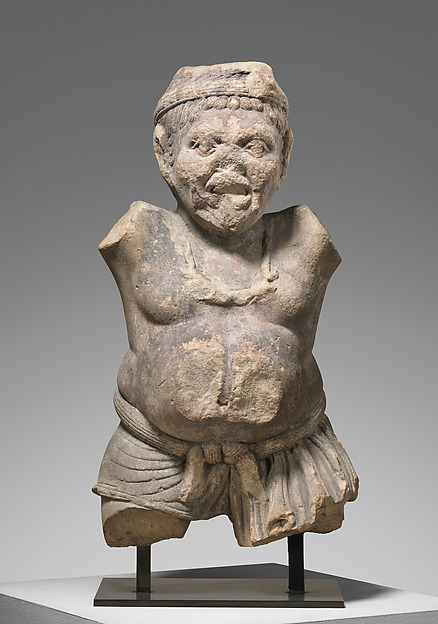
India, Madhya Pradesh, ca. 50 BCE. Sandstone; 88.9 cm. Metropolitan Museum of Art, 1988.354.
Look closer: Note the swollen belly and the open, grimacing mouth: the yaksha was a nature spirit of trees and villages before the Buddhists made him a guard.
The Metropolitan Museum of Art, Gift of Jeffrey B. Soref, in honor of Martin Lerner, 1988. Open Access.
Reading a figure said to be one of the eight
Begin with the group. A single figure of the eight cannot tell you which set it came from, and the sources say the lists differ, so ask first which list the figure follows. The common list of Ten, Ryū, Yasha, Kendatsuba, Ashura, Karura, Kinnara and Magoraka, and the Kōfukuji list with Gobujō, Sakara, Kubanda and Hibakara, name different figures.
Then look at the form. An Ashura has three faces and six arms, with the sun, the moon, a bow and an arrow among the hands; the On-Mark page says the usual Japanese Ashura has three faces and six arms with violent side faces, and the Kōfukuji one departs from the type in being slender and youthful. A Karura is a bird with a human head, usually treading on a snake. A dragon king wears a crown with a serpent. A Kendatsuba or Kinnara may carry an instrument.
Third, ask about material and date. The Kōfukuji set is dry lacquer over a hollow core, a technique of the Nara period, and a figure in wood, bronze or clay belongs to a different tradition and should be judged as such. Fourth, ask about the context: most surviving figures of the eight outside Kōfukuji are single members of a set, and a Karura or a dragon king may have belonged to a set of twenty-eight guardians rather than to the eight. The concierge desk can search for a figure of a given class, and will say plainly which list it follows.
Ten small facts
- The Tokyo National Museum's 2009 show of the Kōfukuji eight ran from 31 March to 7 June and drew more than 940,000 visitors (Tokyo Research Institute for Cultural Properties).
- The Ashura was displayed without glass, and visitors walked round it clockwise (Artscape, Japan Times).
- Ashura is the only one of the eight at Kōfukuji without animal features, and the only one in a simple skirt (Nara sightseeing note).
- The oldest Ashura image in Japan is a seated clay figure of the eighth century at Hōryūji (On-Mark).
- The eight dragon kings are Nanda, Upananda, Sagara, Vasuki, Takshaka, Balavan, Anavatapta and Utpala (On-Mark).
- The Kendatsuba, in Chinese, are the 'scent-eaters', since they feed on fragrance (On-Mark).
- A Ming painting in Cleveland shows the eight hosts of a Water-Land rite and belongs to a set of 36 (Cleveland).
- The Saikondō, where the eight first stood, burned four times, and was never rebuilt after 1717 (Japan Tourism Agency).
- The Japanese text of the tourism database gives each figure's weight as ten to fifteen kilograms, the English as under ten (Japan Tourism Agency).
- The Chinese title Tiānlóng bābù, 'the eight classes of devas and nāgas', was also used by Jin Yong for a novel (Wikipedia).
Across Asia
The eight classes come from India and travelled with the Buddhist texts; the names below are the ones JAANUS gives.
| Where | Form and name | What the record shows |
|---|---|---|
| India | Deva, naga, yaksa, gandharva, asura, garuda, kimnara, mahoraga | The eight classes of being converted by the Buddha (JAANUS). |
| Japan, names | Ten, Ryūō, Yasha, Kendatsuba, Ashura, Karura, Kinnara, Magoraga | The usual Japanese names for the eight (JAANUS). |
| Japan, Kōfukuji | Gobujō, Sakara, Kubanda, Hibakara | The names the temple uses in place of some of these (JAANUS). |
| Japan, art | Dry-lacquer set of 734 | Eight National Treasures in the Kokuhōkan at Kōfukuji (tourism database). |
| Cambodia, Java, India | Ashura, kinnari and gandharva figures | Examples held by Cleveland and the Met. |
| China | Tiānlóng bābù 天龍八部 | The eight classes of devas and nāgas; a Ming painting of the eight hosts in a Water-Land rite (Wikipedia, Cleveland). |
| Gandhara | Garuda and nagas in stone | A Gandharan schist group of Garuda vanquishing the Naga clan (Met). |
| India | Nagaraja and Patravahaka yaksha | Serpent king of the fifth century and a yaksha of about 50 BCE in sandstone (Met). |
The eight among the heavens
The Hachibushū rank with the Heavenly Beings as guardians who were once something else: beings of the old Indian world who accepted the Buddha's teaching and now stand guard around it.
| Companion | Why they meet |
|---|---|
| Jūni Shinshō | Another group of Indian yasha, twelve of them, who guard Yakushi rather than Shaka. |
| Shitennō | Another guardian group of the Heavenly Beings, standing at the four directions. |
| Bonten and Taishakuten | The deva class, Ten, is the first of the eight; Bonten and Taishakuten are its best-known members. |
Where to see them
| Place | What to look for |
|---|---|
| Kōfukuji, Nara | The eight dry-lacquer statues of 734, in the Kokuhōkan, National Treasures (tourism database). |
| Tokyo National Museum | The right hand of Gobujō, donated in 1904 (Japanese Wiki Corpus). |
| Metropolitan Museum of Art, New York | A Dragon King hanging scroll, a gandharva and a kinnari, in open access. |
| Cleveland Museum of Art | A Cambodian bronze labelled a four-armed Ashura, in open access. |
| Sanjūsangendō, Kyoto | A twelfth-century life-size wooden Ashura and the best-known Karura in Japan (On-Mark). |
| Hōryūji, Nara | The oldest Ashura image in Japan, a seated clay figure of the eighth century (On-Mark). |
| Kōryūji | A Heian Magoraka by the sculptor Chōsei (On-Mark). |
| Metropolitan Museum of Art, New York | Two Japanese Nehan-zu and Indian stone nagas, yakshas and a Garuda, in open access. |
| Cleveland Museum of Art | A Ming painting of the eight hosts of a Water-Land rite, and a Japanese woodblock of the Buddha's death, in open access. |
Four views of the classes
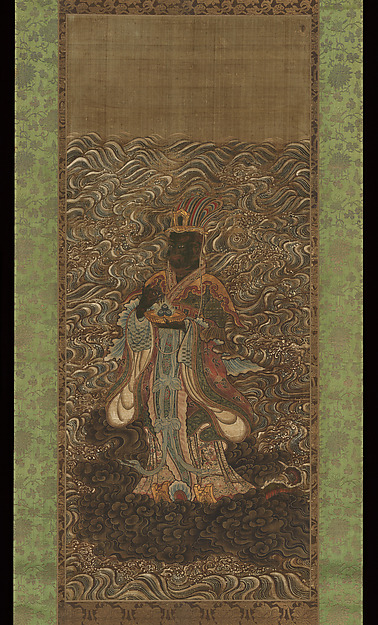
Unidentified artist, Japan, 16th-17th century. Hanging scroll; ink, color and gold on silk; image 99.2 x 41.2 cm. Metropolitan Museum of Art, 2019.420.20.
Look closer: Note the crowned figure in layered court robes, standing on a cloud above the scrolling waves.
The Metropolitan Museum of Art, Mary and Cheney Cowles Collection, Gift of Mary and Cheney Cowles, 2019. Open Access.
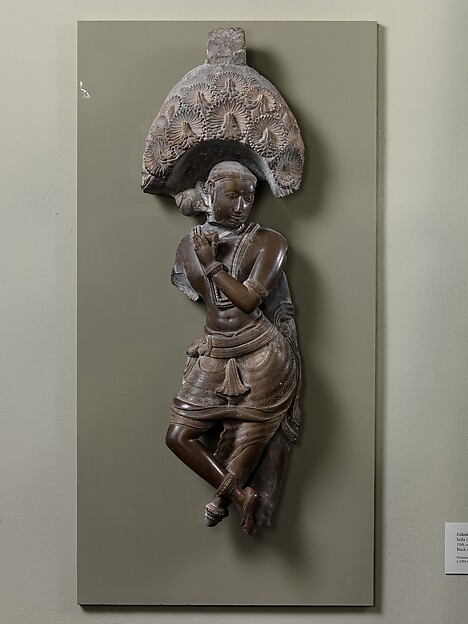
India (Karnataka, possibly Dharwar), 11th century. Slate; H. 103.5 cm. Metropolitan Museum of Art, 2008.537.
Look closer: Note the fan-shaped headdress behind the head and the crossed ankles that give the figure its dancing balance.
The Metropolitan Museum of Art, Gift of Florence and Herbert Irving, in honor of Philippe de Montebello, 2008. Open Access.
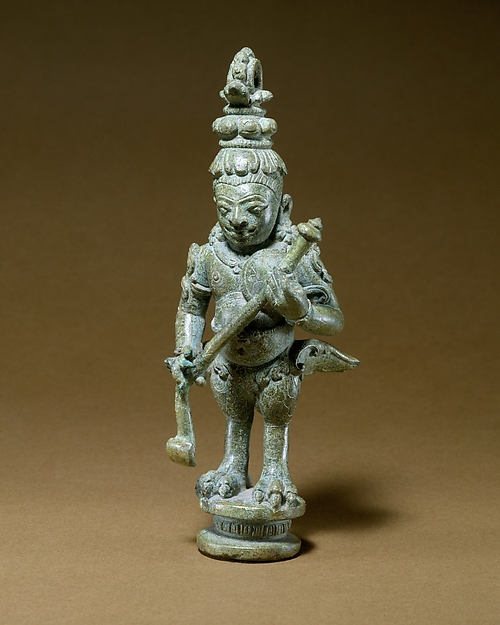
Indonesia (Java), ca. first quarter of the 10th century. Bronze; H. 15.4 cm. Metropolitan Museum of Art, 1987.142.16.
Look closer: Note the claws in place of feet and the long vina held diagonally across the body.
The Metropolitan Museum of Art, Samuel Eilenberg Collection, Gift of Samuel Eilenberg, 1987. Open Access.
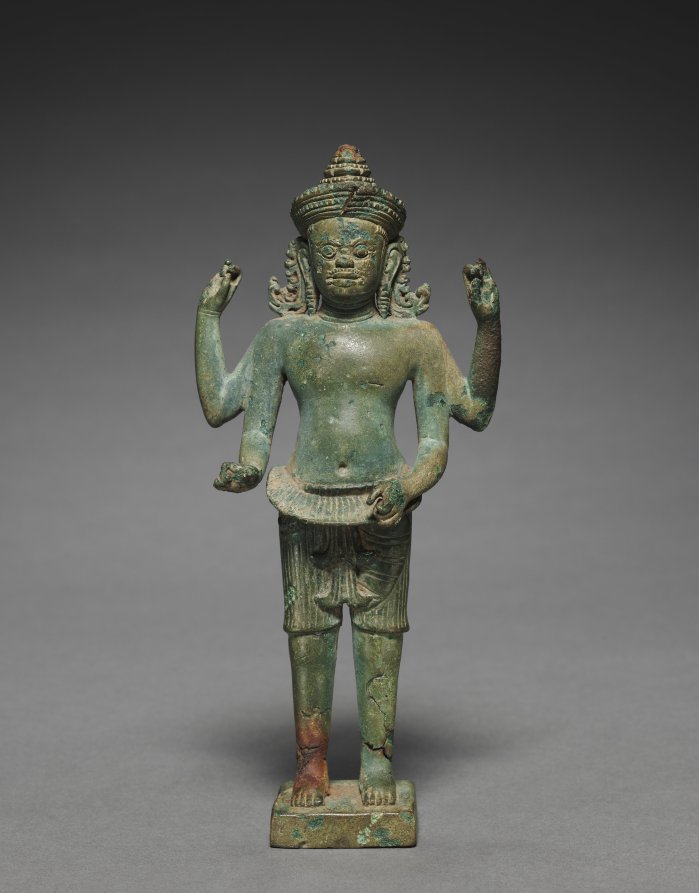
Cambodia, Koh Ker style, 925-950. Bronze; overall H. 17.2 cm. Cleveland Museum of Art, 1972.221.
Look closer: Note the four arms, the two upper ones raised, and the stern face under the stepped crown.
Cleveland Museum of Art, Gift of George P. Bickford. CC0 (Cleveland Open Access).
At the desk
We hold no Hachibushū or Ashura piece at present. If you are looking for a print, a bronze or a carving of one of the eight, the concierge desk can search for it.
A short glossary
- Hachibushū (八部衆)
- The Eight Legions, eight classes of Indian beings who guard the Buddha's teaching.
- Tenryū hachibushū (天龍八部衆)
- The full name: the eight classes of devas, dragons and the rest.
- Ashura (阿修羅)
- The asura, a quarrelsome demigod, usually shown with three faces and six arms.
- Karura (迦楼羅)
- The garuda, a bird-man, enemy of the nagas.
- Kendatsuba (乾闼婆)
- The gandharva, a celestial musician who feeds on fragrance.
- Kinnara (緊那羅)
- The kiṃnara, a celestial musician and dancer, half human and half horse or bird.
- Magoraka (摩睫羅伽)
- The mahoraga, a serpentine being, the vaguest of the eight.
- Yasha (夜叉)
- The yakṣa, a warrior and nature spirit, soldier of Tamonten.
- Ryūō (竜王)
- A dragon king, the naga in his royal form.
- Gobujō (五部浄)
- In the Kōfukuji list, the figure standing for the deva class.
- Kanshitsu (乾漆)
- Dry lacquer, the technique in which lacquered cloth is built over a core.
- Nehan-zu (涅槃図)
- A painting of the Buddha's death, with a crowd of mourners that includes the eight.
- Rokudō (六道)
- The six paths of rebirth, in which Ashura stand above humans.
- Saikondō (西金堂)
- The West Golden Hall of Kōfukuji, the first home of the eight.
- Kokuhōkan (国宝館)
- The National Treasure Hall of Kōfukuji, where the eight are kept.
Answered plainly
What is the Hachibushū?
Eight classes of Indian beings converted by Shaka and regarded as protectors of the Dharma (JAANUS).
Who are the eight?
Ten, Ryūō, Yasha, Kendatsuba, Ashura, Karura, Kinnara and Magoraga (JAANUS).
Which set is the most famous?
The eight dry-lacquer statues of 734 at Kōfukuji in Nara, National Treasures (tourism database).
Why does Ashura have three faces?
The tourism database describes calm, resentful and angry faces; CT scans found another face under the front one.
Who commissioned the statues?
Empress Kōmyō, 701-760, according to the tourism database.
Are the names the same everywhere?
No. Kōfukuji uses Gobujō, Sakara and Kubanda for the first three classes (JAANUS).
Why is the Kōfukuji Ashura so famous?
Its slender, youthful form and gentle front face are unlike the usual fierce Ashura, and the 2009 Tokyo exhibition drew more than 940,000 visitors (Tokyo Research Institute for Cultural Properties; Japan Times).
When was the Ashura exhibition?
In Tokyo from 31 March to 7 June 2009, then at the Kyushu National Museum from 14 July to 27 September (Tokyo Research Institute for Cultural Properties).
Who are the eight dragon kings?
Nanda, Upananda, Sagara, Vasuki, Takshaka, Balavan, Anavatapta and Utpala (On-Mark).
Where can I see another Karura?
The page on the subject names the Karura at Sanjūsangendō in Kyoto as the best known in Japan (On-Mark).
Are the eight worshipped?
As a group they are not objects of worship, though some devas are worshipped alone (On-Mark).
Where next
Sources and image credits
- JAANUS, Hachibushū 八部衆 (Columbia University)
- Japan Tourism Agency multilingual database, The Eight Legions of Kōfukuji
- Japan Tourism Agency multilingual database, Ashura
- Japanese Wiki Corpus, Hachibushu
- Wikipedia, Eight Legions
- Metropolitan Museum of Art, Dragon King (2019.420.20)
- Metropolitan Museum of Art, Celestial Musician (Gandharva) (2008.537)
- Metropolitan Museum of Art, Kinnari Playing the Vina (1987.142.16)
- Cleveland Museum of Art, Standing Ashura with Four Arms, 1972.221
- On-Mark Productions, Hachi Bushu, the Eight Legions
- Artscape, The Ashura exhibition at the Tokyo National Museum (Alan Gleason)
- Tokyo Research Institute for Cultural Properties, news of the Ashura exhibition
- The Japan Times, Gods are on the boom (25 April 2010)
- Nara sightseeing, Fantastical Human Beings at the Kohfukuji National Treasure Hall
- butuzou.com, Asura statue child face meaning
- Metropolitan Museum of Art, Death of the Historical Buddha (Nehan-zu) (12.134.10)
- Metropolitan Museum of Art, Death of the Historical Buddha (Nehan-zu) (44.35.1)
- Metropolitan Museum of Art, Death of the Buddha (Parinirvana) (67.43.13)
- Cleveland Museum of Art, The Parinirvana of the Buddha (1916.1141)
- Cleveland Museum of Art, The Eight Hosts of Deva, Naga, and Yakshi (1973.70.2)
- Metropolitan Museum of Art, Garuda Vanquishing the Naga Clan (1980.325)
- Metropolitan Museum of Art, Standing Nagaraja (Serpent King) (1991.83.1)
- Metropolitan Museum of Art, Patravahaka yaksha (1988.354)
Last reviewed 28 October 2026. Pictures are public-domain or openly licensed, each credited beneath it. Diagrams on this page are drawn by Japonista.
Looking for an Ashura or Hachibushū print, bronze or carving? Tell the concierge desk what you have in mind and we will search Japan for it.
Private concierge
Looking for something in particular?
Describe the piece or the project you have in mind. A senior advisor in Tokyo reads every case file personally and replies within two business days, with fees set out in writing before any work begins.