
Jūni Shinshō: The Twelve Generals
Guardians of the Healing Buddha
Jūni Shinshō
十二神将
Twelve yaksha generals who vowed to protect everyone devoted to the Medicine Master Buddha, and who came to stand for the twelve hours, the twelve months and the twelve animals.
Identity card
Know the figure at a glance
- Kubira, rat. Sanskrit Kiṃbhīra; honji Maitreya, in the standard Japanese account (Wikipedia).
- Basara, ox. Sanskrit Vajra; honji Mahāsthāmaprāpta, in the standard Japanese account (Wikipedia).
- Mekira, tiger. Sanskrit Mekhila; honji Amitābha, in the standard Japanese account (Wikipedia).
- Anchira, rabbit. Sanskrit Antila; honji Avalokiteśvara, in the standard Japanese account (Wikipedia).
- Anira, dragon. Sanskrit Anila; honji Mārīcī, in the standard Japanese account (Wikipedia).
- Sanchira, snake. Sanskrit Saṇṭhila; honji Ākāśagarbha, in the standard Japanese account (Wikipedia).
- Indara, horse. Sanskrit Indala; honji Kṣitigarbha, in the standard Japanese account (Wikipedia).
- Haira, sheep. Sanskrit Pāyila; honji Mañjuśrī, in the standard Japanese account (Wikipedia).
- Makora, monkey. Sanskrit Mahāla; honji Yamāntaka, in the standard Japanese account (Wikipedia).
- Shindara, rooster. Sanskrit Cidāla; honji Samantabhadra, in the standard Japanese account (Wikipedia).
- Shōtora, dog. Sanskrit Caundhula; honji Vajrapāṇi, in the standard Japanese account (Wikipedia).
- Bikara, boar. Sanskrit Vikala; honji Śākyamuni, in the standard Japanese account (Wikipedia).
Twelve yasha around Yakushi
The Jūni Shinshō are, in the words of the Japan Architecture and Art Net Users System (JAANUS), twelve yasha who attend Yakushi, the healing Buddha. A yasha is a yaksha, a spirit of the Indian tradition, and these twelve are protective: they guard people who are devoted to Yakushi and who chant the Yakushikyō, the sutra of the Medicine Master. JAANUS considers them emanations of Yakushi himself, each with 7,000 emanations of his own, 84,000 in all.
Their names are not fixed. JAANUS notes that they vary because the names were transliterated from Sanskrit into Chinese, and Wikipedia says the same, giving one table, based on one Sanskrit transcription of the sutra, and cautioning that texts and regional traditions differ. The names used on this page, from Kubira to Bikara, follow that table.
The On-Mark Productions page on the twelve adds that they were Hindu yakshas absorbed into Buddhism as protective warriors, and that they are counted among the Tenbu, the heavenly beings. It lists the jobs they are given: to protect Yakushi, to protect those who spread faith in him, to fight the enemies of Buddhism and to wage war on sickness. Their faces are always fierce and their stances menacing, and they are usually armoured, with a helmet or spiked hair, because their anger is aimed at evil deeds and evil people and not at the faithful.
The count is less fixed than the name suggests. On-Mark says that some traditions describe nine generals, not twelve, that Marishiten is sometimes counted among them, and that the number of their followers is 84,000 in JAANUS and 80,000 in other sources. It also records another reading of the number: the twelve vows of Yakushi, the twelve daylight hours, the twelve months, the twelve directions of space and the twelve animals of the zodiac have each been offered as the reason there are twelve, and the page presents them as alternatives and not as a single answer.
This chapter follows the twelve in turn: the sutra and the names, the three conflicting lists of zodiac animals, the clay set at Shin-Yakushi-ji with its confusing double naming, the later sets and the leader Kubira, who became the Shinto-Buddhist Konpira of the sea. It then turns to the animals themselves, which were Chinese before they were Japanese, and to the Medicine Buddha's other homes in Korea, China and Japan.
A vow made on hearing the Buddha's name
JAANUS places them in the Yakushi rurikō nyorai hongan kudoku kyō. After hearing the Buddha praise Yakushi, the yasha chanted his name and vowed to protect those who spread the sutra. The Cleveland Museum of Art, describing a thirteenth-century painting of the group, says that from the 700s people in Japan began praying to the Medicine Master Buddha for longevity, and that rectangles at the top of the painting, made to look like decorative paper slips, carry excerpts from a sacred text in which Yakushi asks that the sick who speak his name should become well, and that all who hear it might have their purity restored.
One detail in the On-Mark account is worth holding on to: the early Chinese translations of the Yakushikyō do not describe the appearance of the generals at all. Everything a visitor sees, the armour, the helmets, the animals and the fierce faces, was therefore added by the artists and not dictated by the text. The twelve are sworn protectors of the faithful, and JAANUS says each commands 7,000 emanations. On-Mark adds that they are said to command the pores of the skin in defending the health of the faithful, which is how the figure of 84,000, or 80,000 in some sources, arises: pores, not soldiers.
Twelve names, none fixed
The names were carried from Sanskrit into Chinese and then into Japanese, and each step is a chance for variation, so the lists in different sources do not match. On-Mark gives one standard table, with the Sanskrit names, the colours and the usual weapons, and warns that attributes, colours and sometimes the names themselves vary from source to source. The table below is that one, with the animals of its main list. It describes the generals as the page does and should be read, like all lists of the twelve, as a convention.
Two names deserve a note. Basara, from Vajra, is described by On-Mark as protecting mankind and helping people to fulfil their aspirations, and Kubira, from Kumbhīra, is the leader of the twelve and the one with a following of his own, described below. The page also says that the generals are shown with a sword, a trident, a mallet, a bow or a vajra, but that no single scheme is followed.
| General | Sanskrit (On-Mark) | Colour and attribute | Animal (main list) |
|---|---|---|---|
| Kubira 宮毘羅 | Khumbhira | Yellow; a vajra | Rat |
| Basara 伐折羅 | Vajra | White; a sword | Ox |
| Mekira 迷企羅 | Mihira | Yellow; a vajra | Tiger |
| Anchira 安底羅 | Andira | Green; a mallet or a fly-whisk | Rabbit |
| Anira 頞儞羅 | Anila | Red; a trident or an arrow | Dragon |
| Sanchira 珊底羅 | Sandilya | Grey; a sword or a conch shell | Snake |
| Indara 因達羅 | Indra | Red; a staff or a halberd | Horse |
| Haira 波夷羅 | Pajra | Red; a mallet, a bow or an arrow | Sheep |
| Makora 摩虎羅 | Mahoraga | White; an axe | Monkey |
| Shindara 真達羅 | Sindura or Kimnara | Yellow; a rope, a fly-whisk or a pilgrim's staff | Rooster |
| Shotora 招杜羅 | Catura | Blue; a mallet or a sword | Dog |
| Bikara 毘羯羅 | Vikarala | Red; a three-pointed vajra | Boar |
The animals and the hours
The link with the zodiac came early in China. JAANUS reports that in Dunhuang Cave 220, carved in 642, the figures in the Yakushi Pure Land scenes have animals on their crowns. In Japan the Kakuzenshō and the Asabashō connect the generals to the twelve animals, and Saichō's Yakushi nyorai kōshiki says they govern the twelve hours. JAANUS adds that from the Kamakura period on, the figures were tied to the protection of time, hours, days and months, and of ritual space.
Wikipedia's table gives each general a place in the Japanese zodiac and a buddhist original, or honji: Kubira with the rat and Maitreya, Basara with the ox and Mahāsthāmaprāpta, and so on to Bikara with the boar and Śākyamuni. It says these are the standard Japanese correspondences while noting that texts and regional traditions vary. The sculptures at Shin-Yakushi-ji, JAANUS points out, do not show the animals, nor does the Hōryūji Kondō painting.
The On-Mark page sets out the animals in three lists, and the lists do not agree. In its main list Kubira is the rat, Basara the ox, Mekira the tiger, Anchira the rabbit, Anira the dragon, Sanchira the snake, Indara the horse, Haira the sheep, Makora the monkey, Shindara the rooster, Shotora the dog and Bikara the boar. In a second list Bikara is the rat, Shotora the ox, Shindara the tiger, Magora the rabbit, Haira the dragon, Indara the snake, Sanchira the horse, Anira the sheep, Anchira the monkey, Mekira the rooster, Basara the dog and Kubira the boar. A third, kept at the Kakuonji in Kamakura, runs Kubira, Catura, Shindara, Makora, Haira, Indara, Sanchira, Anira, Anchira, Mekira, Bachira and Bikara. The page credits M. W. de Visser (1935) for the zodiac charts.
Nippon.com's description of the set at Shin-Yakushi-ji adds a fourth ordering, based on the temple's own names: the rat is Bigyara, the ox Shōtora, the tiger Shindara, the rabbit Makora, the dragon Haira, the snake Indara, the horse Santera, the sheep Anira, the monkey Antera, the rooster Meikira, the dog Bazara and the boar Kubira. The same article says that the animals were added to the generals' heads from the Kamakura period, that the statues at Shin-Yakushi-ji predate that practice, and that the temple adapted to the later belief. Many visitors, it says, come early in the new year to pray to the general who guards their zodiac year; the author notes that 2026 is the year of the horse, for which Santera is responsible.
The Cleveland Museum of Art's Kamakura general, one of the twelve in wood with lacquer, colour, gold and crystal eyes, puts the pattern in one figure. Cleveland's record says that he wears Chinese armour, that Japanese sculptors linked each general to a Chinese zodiac animal, and that the horse on this general's head corresponds to the year of the horse and a time of day associated with the horse. The lists differ, so the safest rule for a viewer is the one the sources imply: read the animal on the head, not the name on the label.
Clay generals at Shin-Yakushi-ji
JAANUS calls the Shin-Yakushi-ji sculptures the oldest surviving ones of the group, of the Nara period. Wikipedia says the temple was founded in March 747 as Kōyaku-ji by Empress Kōmyō, who hoped to cure her husband, Emperor Shōmu, of an eye ailment. The twelve generals there are roughly life-size standing figures of unbaked clay, once brightly painted with gold foil, and they stand in a circle around the seated Yakushi, facing outward. Eleven of the twelve are National Treasures; Haira was damaged in an earthquake at the end of the Edo period and replaced with a wooden figure in 1931, which is not a National Treasure. Wikipedia gives the span 729 to 749 for the generals.
The Hōryūji Kondō holds the earliest Japanese representation JAANUS names, four generals painted on one wall of Yakushi's Pure Land. At Kōfukuji, it says, records suggest eight figures belonged to the sculptural group of Yakushi's Pure Land in the five-storey pagoda, and late Heian reliefs and Kamakura sculptures survive there too. It also records sculptures made by Chōzei in 1064 for Kōryūji, and a late Heian painting of the group at Yōchiin in Wakayama Prefecture; from the Kamakura period on, representations became common.
The Wikipedia article on Shin-Yakushi-ji fills in the temple around the generals. It says the name is usually read as 'new Yakushi' but is also said to mean 'miraculous', and that there is no connection with the nearby Yakushi-ji beyond the shared veneration of the Medicine Master. According to records at Tōdaiji, it was founded in March 747 as Kōyaku-ji by Empress Kōmyō in the hope of curing the eye ailment of Emperor Shōmu, with a large nine-bay Kondō holding the Seven Buddhas of Healing, a complete seven-hall layout of about 200,000 square metres and more than a hundred monks.
A lightning fire in 780, thirty-three years after the founding, destroyed many buildings, the Kondō was lost in the mid-Heian period, and the temple declined. In the Kamakura period, the priests Jōkei and Myōe restored it, the East Gate, South Gate, belfry and Jizō Hall were built around then, and the Hondō was thoroughly restored in the Kengen era, 1302 to 1303. The Hondō itself is the oldest structure on the site, of the Nara period and thought to have been a refectory, and the sources agree that it holds the clay generals in the dim, earth-floored hall where they stand today.
A ring of clay, facing out
The Nippon.com photo essay on Shin-Yakushi-ji describes the generals as possibly the oldest and one of the largest sets of the motif in Japan. They stand in the main hall around the seated Yakushi, and the essay adds that although twelve are visible, each is said to lead 7,000 soldiers, for a total of 84,000. It dates them to the Tenpyō era, 729 to 749, gives their heights as 1.52 to 1.66 metres, and says they are national treasures except Haira, the 'Dragon General', which is a reproduction of 1931. Its other source, the Edo-period temple history, says the figures came from Iwabuchiji, an important Nara-period temple that no longer survives, and the essay notes that their origin is unclear.
The technique is the unusual part. The essay says the figures are made by the sozō method, with clay and other soft organic material built over a wooden frame and left to harden, rope wrapped round the inner core and three layers of clay sculpted over it, and that the technique reached Japan from Tang China in the Tenpyō era. Earlier Buddhist images in Japan, it says, were mostly carved from a single piece of wood or cast in bronze, so clay allowed more realistic and dynamic figures. The Wikipedia article adds that the generals were originally coloured, with salmon-coloured skin, inked beards, bright armour and gold foil, and that Minobusan University's department of Buddhism made 3D scans of them in 2001 and 2002.
The essay lists the twelve beginning with Bazara and moving counterclockwise, and notes that temple custom usually runs clockwise. It remarks that each figure has a distinct character, as if the sculptor had caught a different personality, and that Santera, for example, holds his left hand at his waist and a spear in his right. The Wikipedia article on the temple describes Bazara in the temple's naming as a figure whose hair stands on end and whose mouth is open as if crying out, holding a sword in his right hand, and says that he appeared on a 500-yen postage stamp.
The principal image they face is not of the same date. Wikipedia describes it as a seated Yakushi of 191.5 centimetres, carved from a single cypress with no paint or lacquer except on the facial features, on a round dais nine metres across and 90 centimetres high that nearly fills the hall, with six small Buddha figures on the halo making up the Seven Buddhas of Healing. It is generally considered a work of the end of the eighth century, early Heian, and probably not one of the original dry-lacquer statues of the first Kondō; eight scrolls of the Lotus Sutra of the early Heian period were found inside it during an investigation in 1975, and are designated national treasures.
After the clay: Kōryūji, Tōji and Kamakura
The On-Mark page lists the later sets, and the list shows how the group moved from clay to wood. At Kōryūji in Kyoto it names Heian wooden statues by the sculptor Chōsei, with Anchira, Indara, Makora, Mekira and Sanchira among those that survive, and JAANUS, as reported above, gives 1064 for the work. At Tōji in Kyoto it records a wooden set dated 1603, carved by Kōshō, who lived from 1534 to 1621. At the Kakuonji in Kamakura it reports life-size wooden statues of all twelve, carved, it says, around 1401 to 1411 in the Muromachi period; the page's own word is 'reportedly', and this page repeats the caution.
The On-Mark page also gives a gloss on the early images. Yakushi and the generals arrived in Japan in the Asuka period from Korea and China, in the sixth and seventh centuries, and the page records the earliest known representations as the four generals painted on a wall of Yakushi's Pure Land in the Hōryūji Kondō, neither of which shows the animals. In China the animals appear in the Dunhuang cave 220 of 642, where the figures in the Yakushi scenes have animals on their crowns, and the page adds that images of the twelve in China seem to have been made in the Sui period, a hedged claim that this page does not press.
The change from the Nara figures to the Kamakura ones is a change of purpose. The Nara clay set stands, as Nippon.com says, as vassals of the Buddha. By the Kamakura period, JAANUS says, the generals were tied to the protection of time, hours, days and months, and of ritual space, and the On-Mark page says that from that time they were linked to the animals and carry them on their crowns. A viewer who finds an animal on a general's head can date the figure approximately by that alone: it is a sign of the later, calendar-minded tradition.
Kubira, who became Konpira
The On-Mark page tells the story of the one general who has a following of his own. Kubira, or Kompira in another reading, is the Buddhist counterpart of the Shinto deity Konpira, worshipped as the protector of seafarers, navigation, fishing and irrigation water. He is also counted among the Sixteen Protectors of Shaka Nyorai. The chief shrine is on Mount Zōzu in Kagawa Prefecture, Shikoku, a mountain of 531 metres, where pilgrims climb 785 stone steps to the main sanctuary and 1,368 to the inner shrine, and the page reports a legend that Konpira flew from India to a cave at Matsuodera.
The page records that in 1868, in the Meiji period, the site was converted to a Shinto shrine, Kotohiragū, as part of the policies against Shugendō and Buddhist faith, and says that the principal image nevertheless remains the Buddhist deity. It mentions Emperor Sutoku, who lived from 1119 to 1164, as a pilgrim, and says the cult became especially popular in the fourteenth century. The claim that the cult is older than Buddhism's arrival in Japan is one the page itself presents as a claim.
Kubira is therefore the clearest case of what the twelve could become. Most generals are known only as members of a ring; the leader of the ring, in the Indian reading of the Yakushi sutra, became a patron of travellers on the sea, and a mountain pilgrimage grew around him. The Met's six generals of the early fourteenth century, and the Cleveland general with his horse, belong to the ring; Kubira on the steps of Mount Zōzu does not.
Twelve animals on the tombs of China
The twelve animals that the Kamakura sculptors put on the generals' heads were older than the generals' Japanese story. The Cleveland Museum of Art has a set of Northern Wei mortuary figures of the zodiac signs, of the sixth century, in grey earthenware with traces of slip, and its record says that the twelve-animal series signifies a traditional Chinese concept of time structured in a cyclical order, and that their use as tomb furniture suggests they gave the afterlife a cosmological structure. The Metropolitan Museum has a set of twelve zodiac animals of the eighth century, from China, in earthenware with white slip, each about 30 centimetres high.
The two sets are not Buddhist and do not show the generals. What they show is how the animals were carried: as robed human figures with animal heads, a form that the Japanese sculptors could adopt for the crown of a warrior. JAANUS, as reported above, dates the first Chinese appearance of animals on the crowns of the Yakushi figures to Dunhuang cave 220 of 642. Seen together, the tomb figures and the cave suggest a line from the zodiac as a table of time to the zodiac as a protective device, with the twelve generals as one of its late forms.
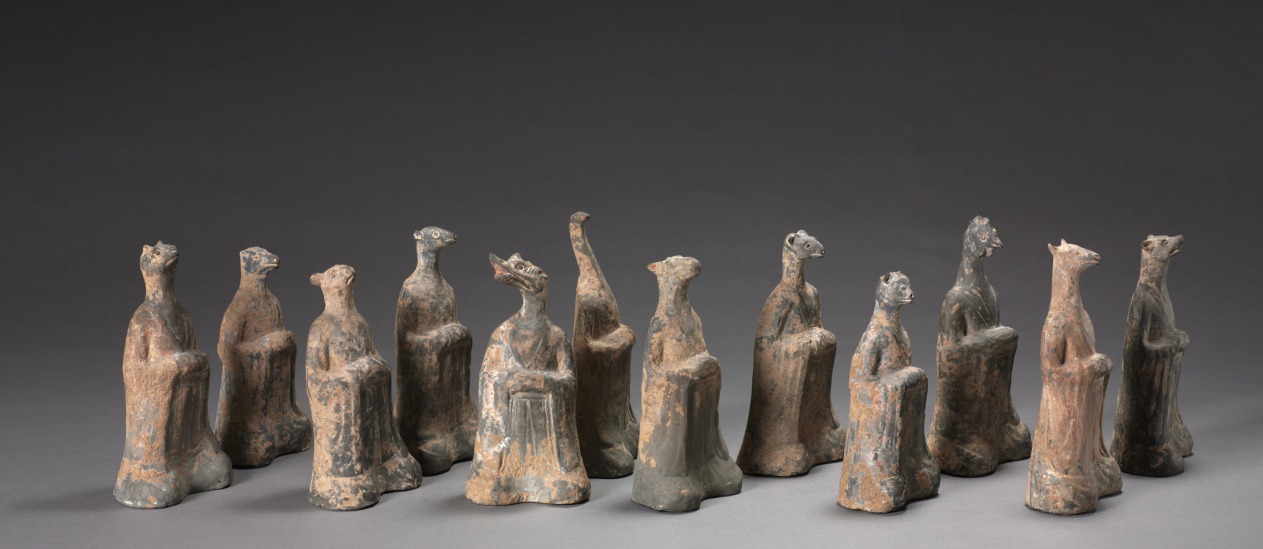
China, Northern Wei dynasty (386–534), 500s. Gray earthenware with traces of slip; 22.6 cm. Cleveland Museum of Art, 1972.76.
Look closer: Note the animal heads on robed human bodies: the form later used for the animals on the generals' crowns.
Cleveland Museum of Art, The Norweb Collection. Open Access (CC0).

China, 8th century. Earthenware with white slip; 30.5 cm. Metropolitan Museum of Art, 2000.662.7a–l.
Look closer: Note the long robes and the animal heads set in a curve: the zodiac as a procession, one animal for each year of the cycle.
The Metropolitan Museum of Art, Gift of Charlotte C. Weber, 2000. Open Access.
Medicine Buddha in Silla, Yuan and Edo
The Cleveland record for the thirteenth-century painting of the group says that from the 700s people in Japan began praying to the Medicine Master Buddha for longevity, and that the painting shows Yakushi flanked by the bodhisattvas of the sun and moon, Nikkō and Gakkō, with the twelve around him. The same museum owns a Heian wooden Nikkō of about 800, and a small Korean gilt-copper plaque of the Unified Silla period, 676 to 935, showing a seated Medicine Buddha with two standing attendants among scrolling clouds. The plaque is the earliest picture here of the triad that the Japanese set copies.
The Metropolitan Museum has the largest. It is a Chinese wall painting of the Medicine Buddha, dated to about 1319, in water-based pigment over a foundation of clay mixed with straw, about 7.5 metres high and 15 metres wide, and shown in the museum with a seated Buddha at the centre of a crowded assembly. It also has a Japanese hanging scroll of the seventeenth or eighteenth century, titled Triad of the Medicine Master Buddha Yakushi, in ink, colour, metallic paint and cut gold on silk. The Met's records give no description of the figures beyond the triad of the title, and this page does not name the attendants.
The point of the comparison is the missing generals. Neither the Silla plaque nor the Edo scroll shows the twelve, and the Chinese wall is too crowded to be sure which figures are protectors. The twelve in a ring around the Buddha are mostly a Japanese arrangement, and the oldest of them is at Shin-Yakushi-ji, standing in a hall built for another purpose.

Korea, Unified Silla period (676–935). Embossed copper plate covered with gold leaf; 11.5 x 11 cm. Cleveland Museum of Art, 1987.59.
Look closer: Note the seated Buddha with an attendant on each side: the triad that the Japanese generals were later added around.
Cleveland Museum of Art, Purchase from the J. H. Wade Fund. Open Access (CC0).
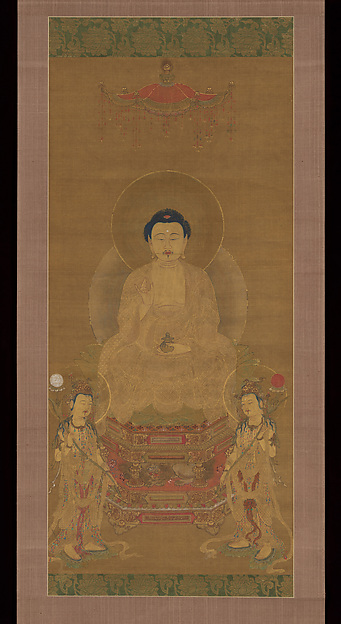
Unidentified artist, Japan, 17th or 18th century. Hanging scroll; ink, color, metallic paint, and kirikane (cut gold) on silk; 101.6 × 48.3 cm. Metropolitan Museum of Art, 2021.396.3.
Look closer: Note the gold line on the robes and halo and the two standing attendants below: an Edo-period triad.
The Metropolitan Museum of Art, Gift of Sue Cassidy Clark, in honor of Barbara Brennan Ford, 2021. Open Access.

China, ca. 1319. Water-based pigment over foundation of clay mixed with straw; 751.8 cm. Metropolitan Museum of Art, 65.29.2.
Look closer: Note the scale, set against the two benches: a Buddha of Medicine in a Chinese temple painting of about 1319, a wall and not a scroll.
The Metropolitan Museum of Art, Gift of Arthur M. Sackler, in honor of his parents, Isaac and Sophie Sackler, 1965. Open Access.
A painting, a drawing and two sets of carvings
The Metropolitan Museum holds three works that show the long afterlife of the type: a set of figures of the early fourteenth century, of which six are pictured below, carved in wood with lacquer, colour, gold and inlaid crystal eyes; two roughly carved wooden figures of about 1700; and a pair of ink hanging scrolls of 1164 titled Anchira-taisho Jochi. The Cleveland painting shows the whole group at once: Yakushi at the centre, seated in meditation with his right hand in the gesture of fearlessness and a medicine jar in his left, flanked by the bodhisattvas of the sun and moon, Nikkō and Gakkō, with the twelve generals around him.
The pair of ink hanging scrolls of 1164, titled Anchira-taisho Jochi, are the earliest of the Met's three works and the only ones that show one general in two views, as a drawing. The Met's records give no description of the pose; a visitor should look for the armour and the weapon, which are what a drawing of this kind was made to teach a sculptor, and for the stance, which is the same fierce one the carved figures keep.
Reading a general
Start with the whole. A general without his ring is a fragment, and the sources say the set has to be read together. Ask whether the other eleven survive, whether the figure came from a Kamakura set with animals on the crowns, and whether any label names the general by temple, by designation or by one of the three On-Mark lists, because the names do not match.
Then read the head. A general with an animal on his crown belongs to the later, calendar-minded tradition, which the Cleveland general with the horse shows; a general without an animal, as at Shin-Yakushi-ji and the Hōryūji painting, belongs to the earlier one. Look at the armour, which Cleveland says is Chinese in design, the fierce face and the attribute: a sword, a mallet, a vajra, a bow, a trident.
Finally look at the material. Clay is rare and fragile and should be handled by specialists; wood with lacquer, colour, gold and crystal eyes, as in the Met and Cleveland figures, is the usual Kamakura set. The concierge desk can search for a general or for a set and will say plainly which list of names and animals the figure follows.
Ten small facts
- Shin-Yakushi-ji was founded in March 747 as Kōyaku-ji by Empress Kōmyō to cure Emperor Shōmu's eye ailment (Wikipedia).
- The Shin-Yakushi-ji generals are made of unbaked clay over a wooden frame, with three layers of clay on a rope-wrapped core (Nippon.com).
- Haira, the 'Dragon General' at Shin-Yakushi-ji, is a wooden replacement of 1931 (Nippon.com, Wikipedia).
- The principal Yakushi at Shin-Yakushi-ji is carved from a single cypress and sits on a dais nine metres across (Wikipedia).
- Eight scrolls of the Lotus Sutra were found inside the Yakushi in 1975 (Wikipedia).
- Kubira is the Buddhist form of Konpira, protector of seafarers, whose mountain shrine in Kagawa has 785 steps to the main sanctuary (On-Mark).
- Dunhuang cave 220, carved in 642, already shows animals on the crowns of the Yakushi figures (JAANUS).
- The Kakuonji's set of twelve is reported to date from about 1401 to 1411 (On-Mark).
- The Tōji set of 1603 was carved by Kōshō, who lived from 1534 to 1621 (On-Mark).
- Early Chinese translations of the Yakushi sutra do not describe how the generals look (On-Mark).
Across Asia
The generals travelled with the Medicine Master Buddha and kept their numbers while their names shifted.
| Where | Form and name | What the record shows |
|---|---|---|
| India | Twelve yaksha in a sutra | The Medicine Master sutra names twelve yasha who vow to protect (JAANUS). |
| China, Sui onward | Twelve generals in images | Chinese images date from the Sui period; Dunhuang Cave 220 of 642 gives them crown animals (JAANUS). |
| China, Hangzhou | Zhendaluo 真達羅 and Zhaoduluo 招杜羅 | Statues of these two stand about three metres tall at Lingyin Temple (Wikipedia). |
| Japan, Nara | Jūni shinshō 十二神将 | Clay figures at Shin-Yakushi-ji, the oldest surviving set (JAANUS, Wikipedia). |
| Japan, Kamakura | The generals and the hours | Tied to the protection of hours, days, months and ritual space (JAANUS). |
| China, Northern Wei | Zodiac figures from tombs | Twelve animals as robed figures, sixth century (Cleveland). |
| Korea, Silla | Medicine Buddha triad plaque | A gilt copper relief of 676 to 935 (Cleveland). |
| China, Yuan | Wall painting of the Medicine Buddha | About 1319, in the Met. |
Yasha among the heavenly guardians
The Jūni Shinshō stand with the Heavenly Beings as yasha taken into the Buddhist fold, set in a ring around a Buddha rather than on a lotus of their own.
| Companion | Why they meet |
|---|---|
| Yakushi Nyorai | The Medicine Master Buddha, whom they attend and protect (JAANUS). |
| Nikkō and Gakkō | The bodhisattvas of the sun and moon who flank Yakushi in the Cleveland painting (Cleveland). |
| Śākyamuni | Honji of Bikara in the standard account (Wikipedia). |
Where to see them
| Place | What to look for |
|---|---|
| Shin-Yakushi-ji, Nara | Twelve clay generals in a ring around Yakushi; one replaced in 1931 (Wikipedia). |
| Hōryūji Kondō, Nara | The earliest Japanese images, four generals painted on a wall (JAANUS). |
| Kōfukuji, Nara | Heian reliefs and Kamakura sculptures of the group (JAANUS). |
| Cleveland Museum of Art | A thirteenth-century painting of Yakushi and the Twelve Divine Generals, in open access. |
| Metropolitan Museum of Art, New York | Carved sets of about 1300 and about 1700, and a 1164 drawing of one general, in open access. |
| Kōryūji, Kyoto | Heian wooden generals by Chōsei, including Anchira, Indara, Makora, Mekira and Sanchira (On-Mark). |
| Tōji, Kyoto | A wooden set dated 1603 by Kōshō (On-Mark). |
| Kakuonji, Kamakura | Life-size wooden statues of all twelve, reported from about 1401 to 1411 (On-Mark). |
| Kotohiragū, Kagawa | The shrine of Konpira, the Shinto form of Kubira (On-Mark). |
| Cleveland Museum of Art | A Kamakura general with the horse of the zodiac on his head, a painting of the group, and tomb figures of the zodiac, in open access. |
Four views in two museums
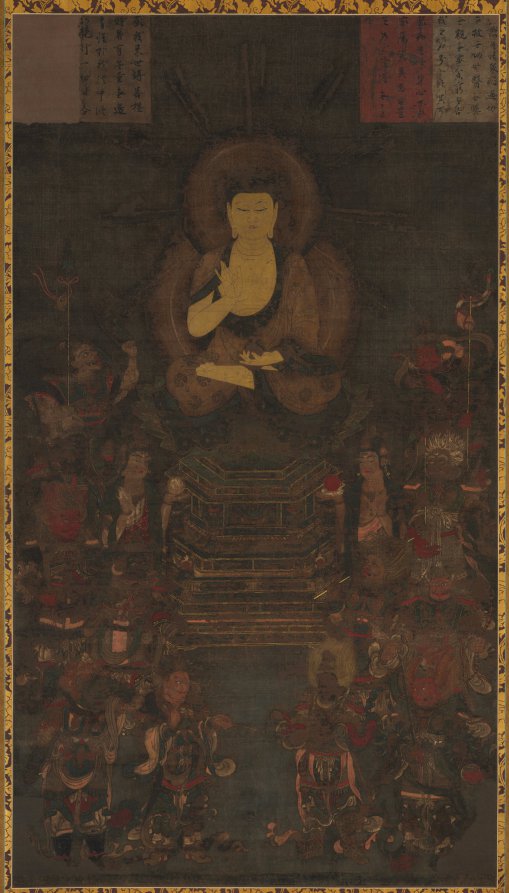
Japan, Kamakura period, 1200s. Hanging scroll; ink, color, gold and silver on silk; image 151.2 x 84.1 cm. Cleveland Museum of Art, 1938.422.
Look closer: Note the generals gathered in the lower half, some with red faces and flaming hair, and the two inscription panels at the top corners.
Cleveland Museum of Art, Edward L. Whittemore Fund. CC0 (Cleveland Open Access).

Japan, early 14th century. Wood with lacquer, color, gold, and inlaid crystal eyes; each H. 49 cm. Metropolitan Museum of Art, 2015.300.254a-l.
Look closer: Note how each figure turns a different way, with flame-like hair on some and plain topknots on others, and traces of gold on the armour.
The Metropolitan Museum of Art, Mary Griggs Burke Collection, Gift of the Mary and Jackson Burke Foundation, 2015. Open Access.
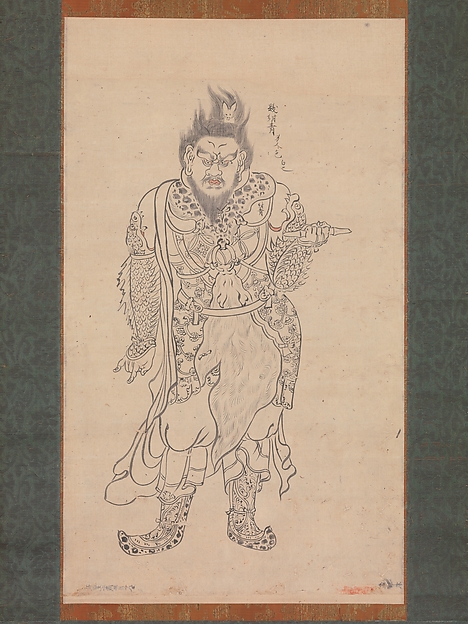
Japan, 1164. Pair of hanging scrolls; ink on paper; image (a) 55.6 x 32.1 cm. Metropolitan Museum of Art, 1975.268.14a, b.
Look closer: Note the small animal rising from the flames of his hair, and the pattern of scales on his sleeve and the cloth over his hips.
The Metropolitan Museum of Art, The Harry G. C. Packard Collection of Asian Art, Gift of Harry G. C. Packard, and Purchase, Fletcher, Rogers, Harris Brisbane Dick, and Louis V. Bell Funds, Joseph Pulitzer Bequest, and The Annenberg Fund Inc. Gift, 1975. Open Access.

Japan, ca. 1700. Wood; H. 51.5 cm and 52.3 cm. Metropolitan Museum of Art, 1975.268.169a, b.
Look closer: Note the simple, chisel-marked surface of the wood and the topknot on each head.
The Metropolitan Museum of Art, The Harry G. C. Packard Collection of Asian Art, Gift of Harry G. C. Packard, and Purchase, Fletcher, Rogers, Harris Brisbane Dick, and Louis V. Bell Funds, Joseph Pulitzer Bequest, and The Annenberg Fund Inc. Gift, 1975. Open Access.
At the desk
No Jūni Shinshō piece is on the shelves today. If one arrives it will appear here; meanwhile the concierge desk can look for a figure or a scroll.
A short glossary
- Jūni Shinshō (十二神将)
- The twelve divine generals, yasha who guard Yakushi and his followers.
- Yakushi Nyorai (薬師如来)
- The Medicine Master Buddha, lord of the Pure Land of the East.
- Yakushikyō (薬師経)
- The Medicine Master sutra, in which the twelve vow to protect its followers.
- Yasha (夜叉)
- The yakṣa, an Indian spirit who here becomes a guardian.
- Kubira (宮毘羅)
- The leader of the twelve, also the Buddhist form of Konpira.
- Konpira (金毘羅)
- The protector of seafarers, worshipped at Kotohiragū on Mount Zōzu.
- Basara (伐折羅)
- The general from Vajra, said to protect mankind.
- Nikkō and Gakkō (日光・月光)
- The sun and moon bodhisattvas who flank Yakushi.
- Honji (本地)
- The original Buddhist form of a deity, in the honji suijaku system.
- Sozō (塑造)
- Clay modelling over a wooden frame, as in the Shin-Yakushi-ji generals.
- Jūnishi (十二支)
- The twelve zodiac animals, borne on the crowns of the generals.
- Kondō (金堂)
- The Golden Hall, the main hall of a temple.
- Kōyaku-ji (香薬寺)
- The original name of Shin-Yakushi-ji.
- Shichibutsu Yakushi (七仏薬師)
- The Seven Buddhas of Healing, enshrined in the first Kondō at Shin-Yakushi-ji.
- Kakuzenshō and Asabashō
- Iconographic manuals that link the generals to the zodiac.
Answered plainly
Who are the Jūni Shinshō?
Twelve yasha who attend Yakushi and protect those devoted to him (JAANUS).
Where do they come from?
The Yakushi rurikō nyorai hongan kudoku kyō, in which they vow to protect its followers (JAANUS).
Are they the twelve zodiac animals?
They were matched with the animals in later tradition; the Shin-Yakushi-ji statues do not show them (JAANUS).
Where is the oldest set?
At Shin-Yakushi-ji in Nara, in clay, Nara period (JAANUS, Wikipedia).
Do their names ever change?
Yes, because they were transliterated from Sanskrit into Chinese (JAANUS).
How many protectors in all?
Eighty-four thousand: twelve generals with 7,000 emanations each (JAANUS).
When was Shin-Yakushi-ji founded?
In March 747, as Kōyaku-ji, by Empress Kōmyō to cure Emperor Shōmu's eye ailment (Wikipedia).
How are the Shin-Yakushi-ji generals made?
Of unbaked clay over a wooden frame, with three layers of clay on a rope-wrapped core (Nippon.com).
Which general is Konpira?
Kubira, whose cult at Kotohiragū in Kagawa protects seafarers (On-Mark).
Is there one list of the zodiac animals?
No. On-Mark gives three lists, Nippon.com a fourth, and the lists disagree (On-Mark, Nippon.com).
Why is Haira different at Shin-Yakushi-ji?
The original was damaged in an earthquake at the end of the Edo period and replaced with a wooden statue in 1931 (Wikipedia).
Where next
Sources and image credits
- JAANUS, jūni shinshō 十二神将 (Columbia University)
- Wikipedia, Twelve Heavenly Generals
- Wikipedia, Shin-Yakushi-ji
- Cleveland Museum of Art, Medicine Master Buddha and the Twelve Divine Generals, 1938.422
- Metropolitan Museum of Art, Six of the Twelve Divine Generals (2015.300.254a-l)
- Metropolitan Museum of Art, Anchira-taisho Jochi (1975.268.14a, b)
- Metropolitan Museum of Art, Two Generals from the Twelve Divine Generals (1975.268.169a, b)
- On-Mark Productions, The Twelve Heavenly Generals
- Nippon.com, Encounters with Buddhist Art (Shin-Yakushi-ji)
- Cleveland Museum of Art, A Heavenly General (One of the Junishinshō) (1988.53)
- Cleveland Museum of Art, Mortuary Figures of the Zodiac Signs (1972.76)
- Metropolitan Museum of Art, Set of twelve zodiac animals (2000.662.7a–l)
- Cleveland Museum of Art, Plaque with the Image of Medicine Buddha Triad (1987.59)
- Metropolitan Museum of Art, Triad of the Medicine Master Buddha Yakushi (Bhaisajya Buddha) (2021.396.3)
- Metropolitan Museum of Art, Buddha of Medicine Bhaishajyaguru (Yaoshi fo) (65.29.2)
Last reviewed 28 October 2026. Pictures are public-domain or openly licensed, each credited beneath it. Diagrams on this page are drawn by Japonista.
Looking for a Jūni Shinshō figure or scroll? Tell the concierge desk what you have in mind and we will search Japan for it.
Private concierge
Looking for something in particular?
Describe the piece or the project you have in mind. A senior advisor in Tokyo reads every case file personally and replies within two business days, with fees set out in writing before any work begins.