
Okimono: Objects Made to Be Placed
Alcove and Cabinet
Okimono: Objects Made to Be Placed
The word means simply a thing that is set down. A Japanese sculptor might spend months on the thing, a daimyo might wait years for it, and a Parisian collector might later hang a label on it, but its first job was to stand quietly in a room and be looked at.
Fact sheet
At a glance
- A placed thing. Okimono are display objects, small enough to stand in an alcove and finished on every side.
- Not a netsuke. The netsuke was a working toggle for the cord of a hanging pouch; the okimono is for the room. Scholars note the line between them is not always sharp.
- An export habit. In the Meiji era, makers and merchants shaped the okimono for foreign buyers, and western museums such as the Met still hold the evidence.
- Signature is a clue. A name on the underside is the start of a question. The Met says most works signed Munesuke are not considered genuine.
- Read the metal. Cast copper alloy with a green patina, hammered steel, inlaid silver: material is the quickest honest witness.
A Thing That Is Set Down
Wikipedia defines okimono (置物) as a Japanese term for an ornament for display or a decorative object, and notes that the nearest Western equivalent is probably objet d’art. The word joins oku, to put, place or set, with mono, a thing. The Oxford English Dictionary, as Wikipedia reports, defines the loanword as a standing ornament or figure, especially one placed in a guest room, and records its first English use in 1886, by William Anderson.
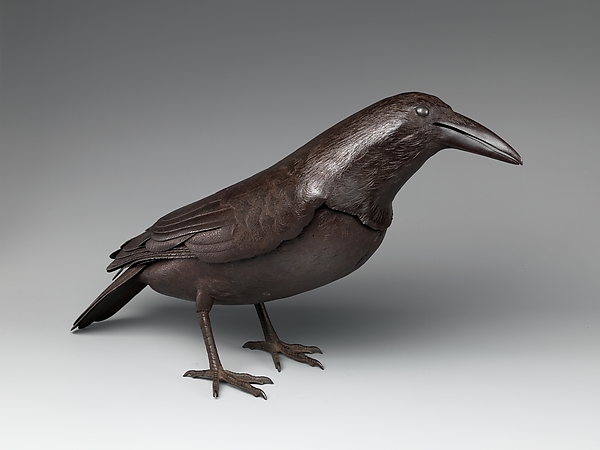
Myōchin Munesuke, early 18th century. Steel. The Metropolitan Museum of Art, accession 13.112.20. Rogers Fund, 1913. Open Access.
Look closer: The eye goes first to the beak. The Met points out that it is unusually large and distinctively shaped, which is how the maker tells a raven from a crow. Then follow the folded wing: the feathers are raised from the steel by embossing, not cast.
The Metropolitan Museum of Art, public domain (Open Access). Source: https://www.metmuseum.org/art/collection/search/22176
The Metropolitan Museum’s steel raven, below, shows how much a plain definition can hold. It is a hammered and embossed steel bird, 45.7 centimetres from beak to tail, attributed to Myōchin Munesuke, a master of the Myōchin family working in Edo in the early eighteenth century, and the museum says it was designed as a decorative piece for the tokonoma of a reception room. Its size and quality, the museum adds, suggest a wealthy daimyo patron. Nothing about it is useful. Everything about it is attentive.
The materials are as wide as the makers’ skills. Wikipedia lists wood, ivory, ceramic and metal, and adds that the subjects range across animals, mythical beasts, people, gods, fruit, vegetables and objects, sometimes grouped as ensembles meant to be shown together. The same article gives okimono a usual size of no more than a few centimetres. The raven, at nearly half a metre, is a reminder that museum and trade practice has always stretched the word; this almanac follows the wider use.
The Alcove and the Altar
An okimono has to be somewhere. Wikipedia’s account of the tokonoma (the setting also explored in the tea almanac), the recessed space in a Japanese-style reception room where items for artistic appreciation are displayed, is the best single key to the whole subject. The word combines toko, floor or bed, with ma, space. The page records two origin stories. One derives the alcove from the shinden-zukuri room of the Heian period, 794 to 1185. The other derives it from the Zen monastery rooms of the Kamakura period, which held an oshiita, a board carrying candlesticks, incense burners and vases before a Buddhist scroll, and which developed into the alcove of the shoin-zukuri style in the Muromachi period.

Original drawing after the description of the tokonoma in Wikipedia. Not a plan of any particular room.
Look closer: Notice that the scroll hangs at the back, the objects stand forward on the raised floor and the guest sits beside it. The alcove is a stage for three kinds of thing at once.
Diagram by Japonista (original drawing), The Japonista Curation and Concierge Team, Tokyo, Japan.
What goes into the space is a short list: calligraphic or pictorial scrolls, flower arrangements, and also bonsai and okimono, although Wikipedia notes that bonsai were traditionally thought not quite worthy of so honoured a place. The page adds a rule of conduct that explains much of the okimono’s manners. The most important guest sits nearest the alcove, in the kamiza, the seat furthest from the entrance, and stepping into the alcove is forbidden except to change the display.
That is why the okimono is finished on all sides and rarely demonstrative. It is seen across a room, at the height of a seated person, in a space the guest does not enter. Wikipedia’s okimono article also names the household altar, the butsudan, as the second home of such objects; for that setting the house keeps a separate almanac, and for the scroll behind the okimono there is the guide to scrolls and screens.
| Element | Job in the alcove | Source |
|---|---|---|
| Toko-bashira, the alcove pillar | Chosen wood sets the formality of the space, from rough trunk with bark to a straight-grained square heartwood | Wikipedia, Tokonoma |
| Scroll | Calligraphy or painting on the back wall | Wikipedia, Tokonoma |
| Flower arrangement | Seasonal, set before the scroll | Wikipedia, Tokonoma |
| Okimono | Sculptural counterpoint to scroll and flower | Wikipedia, Tokonoma; Met, raven |
Cousin of the Netsuke
The usual way to define an okimono is by what it is not. A netsuke has a job. Terry Satsuki Milhaupt’s essay for the Metropolitan Museum explains that Edo men wore the kimono held by an obi, which has no pockets, so tobacco, medicine and seals travelled in hanging containers, the sagemono and the stacked inrō. The netsuke was the anchor, a counterweight at the top of the cord, which ran through two holes, the himotoshi, with a bead, the ojime, to open and close the box. Wikipedia’s okimono article makes the contrast directly: netsuke have a specific purpose, whereas okimono are described as purely decorative and displayed in the tokonoma.

19th century. Ivory. The Metropolitan Museum of Art, accession 10.211.900. Gift of Mrs. Russell Sage, 1910. Open Access.
Look closer: Count the small figures and notice that the base is carved as thoroughly as the elephant. That is the katabori rule the Met describes: sculpture in the round, finished on the underside.
The Metropolitan Museum of Art, public domain (Open Access). Source: https://www.metmuseum.org/art/collection/search/60194
It then qualifies it. Wikipedia reports that some scholars question the distinction, suggesting that okimono often served both utilitarian and decorative purposes, especially before Western influence, citing Akiko Mabuchi’s 1998 article on the Cernuschi collection of okimono in the journal Ebisu. The honest reading is that the two categories overlap in the hand and part in the room. The Met’s essay shows how they were bound by market as well as by form: the most numerous netsuke, the katabori, are three-dimensional figures carved in the round, and the underside of the base is carved as fully as the rest. In form, a katabori netsuke comes very close to a small okimono with two holes bored through it.
The market is where the two categories became one. Japan opened its ports to foreign trade in 1854, the essay says, Western dress replaced the kimono in public life, and the fashion accessory lost its use. Foreign residents built a collector market and netsuke were exported in large numbers because they were small, portable and suited to souvenirs of an exotic East. The essay names the collectors: Peter Carl Fabergé, Mrs Russell Sage, whose gift in 1910 gave the Met most of its netsuke, Edward C. Moore, chief designer for Tiffany and Company, Benjamin Altman, Stephen Whitney Phoenix and Louisine Havemeyer. They are, in effect, the first audience for the display carving as a western category.
Built for Show, Shipped Overseas
Wikipedia records, citing Mabuchi, that during the Meiji period and afterwards many okimono were made for export to the West. The Met’s own holdings give the shape of that trade. When the museum describes the Edward C. Moore collection of Japanese metalwork, it counts more than fifty pieces, nearly all from the nineteenth century and most made for the Western market. Moore, the Met’s essay on netsuke reminds us, was Tiffany’s chief designer; he bequeathed his collection in 1891.

second half 19th century. Copper alloy. The Metropolitan Museum of Art, accession 91.1.510. Edward C. Moore Collection, Bequest of Edward C. Moore, 1891. Open Access.
Look closer: The patina is the picture. Green on brown, uneven, deepest in the shell grooves. Modern reproductions are often coloured evenly; an old surface has history in its low places.
The Metropolitan Museum of Art, public domain (Open Access). Source: https://www.metmuseum.org/art/collection/search/54293
One of the pieces is a turtle, 16.5 centimetres long, in cast copper alloy with a green patina. The museum calls it a highly naturalistic okimono, notes that turtles symbolise longevity and were linked to Mount Hōrai, the mythical island of immortality, and observes that realistic animal figures in metal were a distinctive genre of Meiji art. A second Moore piece, a vase of copper alloy with inlaid silver, is described as an unusual composition set among waves and birds, its design imitating dripping glaze or overflowing liquid, with tiny birds and a fretwork pattern at the mouth in fine silver inlay.
The path to those shelves began earlier. The Met’s essay on Japonisme says that after the ports reopened in 1853 shiploads of Oriental bric-à-brac reached England and France, among them fans, kimonos, lacquers, bronzes and silks, and that Parisians first saw a formal exhibition of Japanese arts and crafts when Japan took a pavilion at the World’s Fair of 1867. The next chapter in this almanac follows the makers who answered that demand, and the imperial appointments that made some of them famous.
Reading an Okimono
Three habits help. First, treat the signature as a question. The Met’s entry on the raven reads the underside inscription, Myōchin Shikibu Ki no Munesuke, as naming the twenty-second master to use that name, active in Edo in the early 1700s and known for ornate helmets, armour and repoussé metalwork. It then adds that most works signed Munesuke are not considered genuine. Bashford Dean, who founded the Met’s Department of Arms and Armor, judged in 1918 that this one is the finest repoussé metalwork of the early eighteenth century. A signature does not make a piece, and a great piece can survive the doubt that surrounds a name.
Second, read the material and the making together. The raven is hammered and embossed steel; the turtle is cast; the vase is inlaid. These are different crafts with different weaknesses, and the next three chapters take them in turn: bronze casting, wood and lacquer, and the ivory question.
Third, follow the paper trail. The raven belonged to the French collector Edouard Mène, a noted collector of Japanese ironwork, and was shown in the late nineteenth and early twentieth centuries at the Musée Guimet and the Musée Cernuschi in Paris, among other places. Cernuschi’s name also appears in the title of the 1998 article by Mabuchi cited above. Provenance of this kind does not prove authorship, but it places an object inside a recorded history of looking.
| What to look at | What it can tell you | Worked example |
|---|---|---|
| The underside | Signature, seal, repairs, the quality of the finish where no one is meant to look | Raven: signed on the underside |
| The metal | Cast, hammered, inlaid, patinated; the technique shapes the price of a mistake | Turtle: cast copper alloy; raven: steel; vase: copper alloy with silver inlay |
| The subject | Longevity, strength, luck, a story the owner was meant to recognise | Turtle: longevity and Mount Hōrai |
| The history | Who owned it, where it was shown, what was written about it | Raven: Mène, Guimet, Cernuschi |
Japonisme and the Collector’s Cabinet
Wikipedia defines Japonisme as a French term for the popularity and influence of Japanese art and design among Western European artists in the nineteenth century, and says the critic and collector Philippe Burty first described it in 1872. Its effects were most pronounced in the visual arts, the article says, but they reached architecture, gardens and clothing, and even the stage: Gilbert and Sullivan’s The Mikado of 1885, it reports, was performed by seventeen companies some nine thousand times within two years of its premiere. For this chapter the useful sentence is a quieter one. Japanese decorative arts, including ceramics, enamels, metalwork and lacquerware, were as influential in the West as the graphic arts.
The background is a long seclusion. During most of the Edo period, Wikipedia says, Japan was closed and only one international port stayed active: Tokugawa Iemitsu ordered an island, Dejima, built off the shore of Nagasaki, and the Dutch were the only Westerners allowed to trade there. The early exports were silver, prohibited after 1668, gold, mostly in oval coins, prohibited after 1763, and then copper in bars. As those were withdrawn, exports shifted to craftwork: ceramics, hand fans, paper, furniture, swords, armour, mother-of-pearl objects, folding screens and lacquerware. Even in the years of seclusion, the article adds, Japanese goods stayed a luxury sought after by European elites.
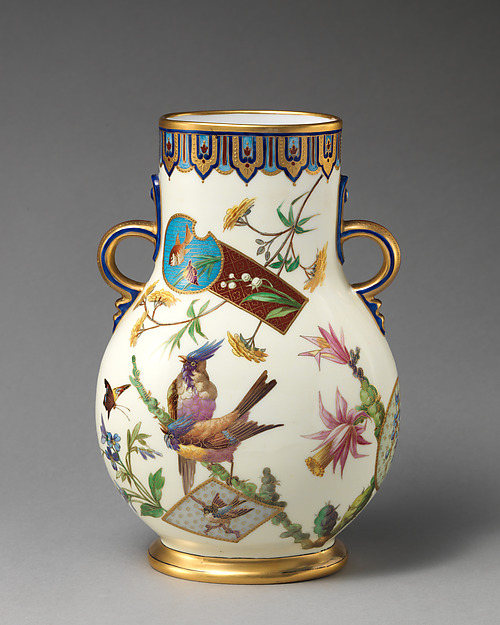
Minton(s), 1879. Bone china. The Metropolitan Museum of Art, accession 2018.62.58. Gift of Helene Fortunoff and Robert Grossman, 2017. Open Access.
Look closer: Minton’s vase of 1879, bone china, with birds and fan-shaped panels. The museum’s own title names the movement.
The Metropolitan Museum of Art, public domain (Open Access). Source: https://www.metmuseum.org/art/collection/search/771056
The reopening changed the scale. Wikipedia describes foreign merchant ships of many nationalities visiting Japan in the Kaei era, 1848 to 1854, and says that after the Meiji Restoration of 1868 Japanese art and artefacts began to appear in small curiosity shops in Paris and London. Japonisme began, in its words, as a craze for collecting. Around 1856 the French artist Félix Bracquemond found a copy of the Hokusai Manga in his printer’s workshop; shops such as La Porte Chinoise, which sold Japanese and Chinese imports, drew Whistler, Manet and Degas; and world’s fairs, the article says, put Japanese decorative art before millions of visitors. Collectors such as Siegfried Bing and Christopher Dresser displayed and wrote about the objects.
The metalwork is the part that belongs to this chapter. Wikipedia observes that from a long history of making weapons for samurai, Japanese metalworkers had achieved an expressive range of colours by combining and finishing alloys, and that Japanese cloisonné enamel reached its golden age between 1890 and 1910. That is the background to the Met’s turtle and vase of the previous sections. It is also a reason to look at what Western workshops made in the same years. The museum’s American Wing and European decorative arts hold pieces of about 1879 to 1880 that carry Japanese motifs: a silver teapot and a chocolate pot by Tiffany and Company, in mixed metals with fish, reeds and a lobster, and a bamboo vase from the Worcester factory in gilded bone china.
The chapter claims no more than the museum’s labels do. The Tiffany pieces are American and the vases are English; the Met’s title for the Minton vase of 1879 names Japonisme, and the other pieces show Japanese subjects, bamboo, cherry blossom and fish among reeds, without the labels saying what they were copied from. They are included because they show the habit of looking that made an export okimono make sense: a Western house in 1880 was ready to put a Japanese-looking object on a shelf and call it art.

Tiffany & Co., ca. 1880. silver, copper, ivory, and jade. The Metropolitan Museum of Art, accession 2017.157.3. Purchase, Louis and Virginia Clemente Foundation Inc. and Emma and Jay A. Lewis Gifts, 2017. Open Access.
Look closer: A Tiffany and Company teapot of about 1880 in silver, copper, ivory and jade, with a fish among reeds.
The Metropolitan Museum of Art, public domain (Open Access). Source: https://www.metmuseum.org/art/collection/search/20124

Tiffany & Co., 1879. Silver, patinated copper, gold, and ivory. The Metropolitan Museum of Art, accession 2017.156a, b. Purchase, Louis and Virginia Clemente Foundation Inc. and Emma and Jay A. Lewis Gifts, 2017. Open Access.
Look closer: A Tiffany and Company chocolate pot of 1879 in silver, patinated copper, gold and ivory, with an applied lobster.
The Metropolitan Museum of Art, public domain (Open Access). Source: https://www.metmuseum.org/art/collection/search/20121

Worcester factory, 1880. Bone china "ivory porcelain" with gilding. The Metropolitan Museum of Art, accession 2018.62.107. Gift of Helene Fortunoff and Robert Grossman, 2017. Open Access.
Look closer: The Worcester factory’s vase of 1880 in bone china with gilding: bamboo and cherry blossom, two of the oldest Japanese motifs.
The Metropolitan Museum of Art, public domain (Open Access). Source: https://www.metmuseum.org/art/collection/search/771039
One more fact from the same article frames the whole shelf. Wikipedia reports that Marie Antoinette and Maria Theresa collected Japanese lacquer, and that an extravagant way to show porcelain in a European home was to build a porcelain room, with shelves throughout, to display the exotic ware. The okimono in a Paris cabinet had a long line of ancestors on the other side of the world.
The Okimono by Date
Dates are those given in the sources named at the end of the chapter. Where the sources differ on a year, the year is left out.
| Date | What happened | Source |
|---|---|---|
| 1603 to 1867 | Edo period; Japan largely closed, with Dejima as the one international port | Japonisme, Wikipedia |
| Early 18th century | Myōchin Munesuke’s steel raven, a piece for the tokonoma of a reception room | Metropolitan Museum |
| About 1856 | Félix Bracquemond finds a copy of the Hokusai Manga | Japonisme, Wikipedia |
| 1867 | Japan takes a pavilion at the Paris World’s Fair | Metropolitan Museum, Japonisme essay |
| 1868 | The Meiji Restoration; imports from Japan reach curiosity shops in Paris and London | Japonisme, Wikipedia |
| 1872 | Philippe Burty first describes Japonisme | Japonisme, Wikipedia |
| About 1879 to 1880 | Tiffany, Worcester and Minton wares of the Japonisme years | Metropolitan Museum |
| 1885 | The Mikado opens and is performed nine thousand times in two years | Japonisme, Wikipedia |
| 1891 | Edward C. Moore bequeaths his collection of Japanese metalwork | Metropolitan Museum |
| 1910 | Mrs Russell Sage’s gift gives the Met most of its netsuke | Metropolitan Museum, netsuke essay |
| 1918 | Bashford Dean judges the raven the finest repoussé of its century | Metropolitan Museum |
| 1998 | Akiko Mabuchi’s article on the Cernuschi okimono, in Ebisu | Okimono, Wikipedia |
Places to See Okimono
Hours and displays change; check each institution’s own site before travelling.
| Place | What there is | Source |
|---|---|---|
| Any traditional reception room with a tokonoma | The setting the okimono was made for: scroll, flowers and a placed object | Tokonoma, Wikipedia |
| Tokyo National Museum, Tokyo | Okimono on display, among them a carved figure group of a woman and a kneeling child | Image credit, Wikimedia Commons |
| The Metropolitan Museum of Art, New York | The Moore collection of Japanese metalwork, with the raven, the turtle and the vase | Metropolitan Museum |
| Musée Guimet, Paris | Shown the raven in the late nineteenth and early twentieth centuries | Metropolitan Museum |
| Musée Cernuschi, Paris | Shown the raven; the subject of Mabuchi’s article on its okimono | Metropolitan Museum; Okimono, Wikipedia |
Glossary of the Okimono
A short vocabulary of the terms in this chapter.
| Term | Meaning |
|---|---|
| Okimono | An ornament or object for display; from oku, to place, and mono, a thing |
| Tokonoma | The recessed alcove of a reception room where scroll, flowers and objects are displayed |
| Toko-bashira | The pillar of the alcove, whose wood sets its formality |
| Kamiza | The seat of honour, nearest the alcove, for the principal guest |
| Netsuke | The toggle that anchored a cord on the obi |
| Himotoshi | The two holes through which a netsuke cord runs |
| Ojime | The bead that opens and closes the cord of a hanging box |
| Inrō | The stacked box worn as a hanging container |
| Sagemono | Hanging containers worn from the obi |
| Katabori | A netsuke carved in the round, in three dimensions |
| Repoussé | Metal worked into relief by hammering from behind |
| Japonisme | The nineteenth-century Western enthusiasm for Japanese art and design |
| Objet d’art | The nearest Western equivalent of okimono, according to Wikipedia |
Fun Facts for the Curious
Each of these comes from the sources named at the end of the chapter.
- The Met’s steel raven is 45.7 centimetres long, far larger than the few centimetres Wikipedia gives as a usual okimono size.
- The raven’s beak is unusually large and distinctively shaped, the museum says, which is how its maker tells a raven from a crow.
- The most important guest sits nearest the alcove, in the seat called the kamiza.
- Most works signed Munesuke are not considered genuine, according to the Met.
- Edward C. Moore, Tiffany’s chief designer, bequeathed his collection of Japanese metalwork to the Met in 1891.
- The Oxford English Dictionary defines okimono as a standing ornament, especially one set in a guest room, Wikipedia reports.
- The Mikado of 1885 was performed about nine thousand times by seventeen companies within two years.
- A revolving stage invented for Kabuki reached a Munich theatre in 1896 under the influence of Japonisme.
Objet d’Art, Porcelain Rooms and the Peacock Room
Wikipedia gives objet d’art as the nearest Western word for okimono, and the comparison helps in both directions. In Japan the object was set in an alcove that was kept nearly empty and changed with the season, so that one piece could be looked at for what it was. In the West, the porcelain room, as the Japonisme article describes it, covered walls with shelves of exotic ware, and ownership of a few pieces was possible for a widening range of the middle class.
The article also lists James McNeill Whistler’s Peacock Room of 1876 to 1877 among the works of Japonisme, and Christofle and Cie’s vases and corner cabinet of 1874 to 1878. The Western rooms that grew from the habit kept the Japanese object but not its manners: the alcove’s rule of one placed thing and a seasonal change gave way to the shelf and the cabinet. A reader who has met both can see why a collector of 1880 and a guest in a tokonoma looked at the same raven so differently.
Meiji Metal and Small Carving

Photograph of a figure group displayed in the Tokyo National Museum.
Look closer: The robe is carved with surface pattern in low relief. Look for how the artist separates the cloth of the woman from that of the child using different textures.
Pierre André Leclercq, CC BY-SA 4.0, via Wikimedia Commons. Source: https://commons.wikimedia.org/wiki/File:Tokyo%2C_okimono_dans_le_Mus%C3%A9e_National.jpg

Josō, second half 19th century. Ivory. The Metropolitan Museum of Art, accession 10.211.539. Gift of Mrs. Russell Sage, 1910. Open Access.
Look closer: The guardian is just 5.4 centimetres high, yet it carries the open-mouthed fury of temple gate figures. Scale does not weaken the iconography.
The Metropolitan Museum of Art, public domain (Open Access). Source: https://www.metmuseum.org/art/collection/search/60023

19th century. Bronze. The Metropolitan Museum of Art, accession 91.1.492. Edward C. Moore Collection, Bequest of Edward C. Moore, 1891. Open Access.
Look closer: Even a desk object is modelled like a piece of sculpture. Run your eye round the stump: no two sides are alike.
The Metropolitan Museum of Art, public domain (Open Access). Source: https://www.metmuseum.org/art/collection/search/52198

second half 19th century. Copper alloy. The Metropolitan Museum of Art, accession 91.1.518. Edward C. Moore Collection, Bequest of Edward C. Moore, 1891. Open Access.
Look closer: The bamboo joints are the whole design. Nature is not decoration here; it is the form.
The Metropolitan Museum of Art, public domain (Open Access). Source: https://www.metmuseum.org/art/collection/search/39578

second half 19th century. Copper alloy with inlaid silver details. The Metropolitan Museum of Art, accession 91.1.519. Edward C. Moore Collection, Bequest of Edward C. Moore, 1891. Open Access.
Look closer: Find the silver: the birds and the fretwork around the neck are inlaid in a lighter metal.
The Metropolitan Museum of Art, public domain (Open Access). Source: https://www.metmuseum.org/art/collection/search/59861
Okimono, Figurines and Statues
Pieces of this kind come and go through the house. The shelf of Japanese Okimono, Figurines and Statues shows what is here now; the earlier house guide to Okimono and Jizai covers the articulated metal creatures, and the guide to Netsuke, Inro and Maki-e covers the toggle and the box.
Answered plainly
What does okimono mean?
A thing that is placed or set down: 置物, from oku, to put, and mono, a thing. Wikipedia glosses it as an ornament or object for display, with objet d’art as the nearest Western equivalent.
Is an okimono the same as a netsuke?
No, though they overlap. A netsuke was the toggle that held a hanging pouch or inrō to the obi, according to the Metropolitan Museum; an okimono is a display object. Wikipedia reports that some scholars question how strictly the two were separated before Western influence.
Where were okimono displayed?
In the tokonoma, the alcove of a reception room, and on household altars, according to Wikipedia. The principal guest sits nearest the alcove.
Were okimono made for export?
Yes. Wikipedia, citing Akiko Mabuchi, says many were made for the West during the Meiji period and afterwards, and the Met notes that most of the more than fifty Japanese metalwork pieces in the Moore collection were made for the Western market.
Does a signature prove who made it?
No. The Met says most works signed Munesuke are not considered genuine, even while it ranks its own raven as a masterpiece of early eighteenth-century repoussé.
Where next
In the Lexicon: okimono.
Sources and image credits
- Okimono, Wikipedia (definition, etymology, materials, export, Mabuchi 1998)
- Tokonoma, Wikipedia (origins, parts, display, etiquette)
- Terry Satsuki Milhaupt, Netsuke: From Fashion Fobs to Coveted Collectibles, The Metropolitan Museum of Art, 1 November 2009
- Japonisme, Wikipedia (term, seclusion, early exports, reopening, decorative arts, porcelain room)
- Japonisme, Heilbrunn Timeline of Art History, The Metropolitan Museum of Art
- Teapot, 2017.157.3; Chocolate Pot, 2017.156a, b, Tiffany and Company; Bamboo vase, 2018.62.107; Vase, 2018.62.58, The Metropolitan Museum of Art
- Okimono in the Form of a Raven, Myōchin Munesuke, 13.112.20, The Metropolitan Museum of Art
- Turtle, 91.1.510, The Metropolitan Museum of Art
- Vase, 91.1.519, The Metropolitan Museum of Art
- Image credit: Pierre André Leclercq, okimono in the Tokyo National Museum, CC BY-SA 4.0, Wikimedia Commons

Last reviewed 28 October 2026. Pictures, where shown, are public-domain or open-access and credited beneath each one.
Looking for an okimono, a bronze or a carving with its box and its history intact? The concierge desk replies within one to three business days.
Private concierge
Looking for something in particular?
Describe the piece or the project you have in mind. A senior advisor in Tokyo reads every case file personally and replies within two business days, with fees set out in writing before any work begins.