
Hibachi, Irori and Kotatsu: The Household Hearth
Warmth Before the Furnace
Hibachi, Irori and Kotatsu: The Household Hearth
A Japanese house of the old kind had no furnace and made a virtue of it. Warmth was made in one small place, and the family came to it: a pit in the floor, a bowl of ash, a quilt over a frame.
Fact sheet
At a glance
- One fire, three furnishings. The irori, the hibachi and the kotatsu are relatives: Wikipedia traces the kotatsu to the irori, and Edward S. Morse found the hibachi in every house from the most exalted to the humblest.
- Heating by gathering. The hibachi heats by radiation and is too weak to warm a room, and the kotatsu warms only the lower body; households warmed themselves by sitting close, not by heating air.
- The fire as a calendar. The tea ceremony divides the year into a sunken-hearth season and a brazier season, and moves the whole room, the incense and even the bowl with it.
- Fire kept alive. Morse was told in the 1880s that a family in Tokyo had kept its hibachi fire burning for more than two hundred years.
- Still in every house. Wikipedia reports that by 1997 81 percent of Japanese homes had a kotatsu, now heated by electricity.
One Fire, Many Furnishings: How a Japanese House Kept Warm
Most Japanese housing, Wikipedia’s article on the kotatsu points out, is not insulated to the same degree as a Western home and has no central heating, so it relies on space heating, and heating a draughty house is expensive. Families, it adds, may choose to concentrate their activity in a single spot to save energy. That one sentence is the thesis of this chapter. The old Japanese house was not warmed. People were warmed, one household at a time, by a small fire in a place the whole family could reach.
Three furnishings carry the idea, and they are best understood as relatives. The irori is a sunken hearth let into the floor, fired with charcoal and used for heating, cooking and light. The hibachi is a bowl of ash and a few coals that can be carried from room to room and set in front of a visitor. The kotatsu is a low frame covered with a quilt, with the heat source underneath, so that a seated family can tuck its legs into a pocket of warm air. Wikipedia traces the kotatsu directly to the irori: by the fourteenth century, it says, a seating platform was introduced to the irori and its cooking function became separated from its seating function. The hibachi, which the same encyclopedia calls a brazier believed to date to the Heian period, took the fire out of the floor altogether.
The American zoologist Edward S. Morse, whose Japanese Homes and Their Surroundings carries a preface dated November 1885, saw the system whole. He wrote that an inseparable accompaniment of every Japanese home, from the most exalted to the very humblest, is the hibachi, and he recorded the country fireplace, the kitchen stove, the bedroom floor with its square hole for coals and the lamps that lit them all. His figures are wood engravings, period illustrations rather than photographs, and several of them appear below as the nearest thing to a view into a house of the 1880s.

Period engraving. Edward S. Morse, Japanese Homes and Their Surroundings (Boston: Ticknor and Company, 1886), figure 174. Wood-engraved illustration, public domain.
Look closer: Morse’s description: a kettle hung over the fire by a chain, a rack overhead for fish and meat, and a straw cushion into which small skewered fish are thrust like pins.
Edward S. Morse, 1886, public domain, via Project Gutenberg ebook 52868. Source: https://www.gutenberg.org/ebooks/52868
The chapter follows the fire through the house. It begins with the irori and the hooks that hang a kettle over it, moves to the hibachi and the small box that serves a smoker, turns to the kotatsu and its quilts, steps into the tea room where the hearth changes with the season, and ends in the evening with the lamps. A table of eras, a set of stories, a glossary and a collector’s eye close the chapter. This is a guide to history and objects, not a manual of safe practice: burning charcoal produces carbon monoxide and fine particles, and the sources are blunt about it.
The Irori: Kitchen, Lamp and Family Circle in One Pit
Wikipedia defines the irori as a traditional Japanese sunken hearth fired with charcoal, used for heating the home and for cooking food, and basically a square, stone-lined pit in the floor. It is equipped with an adjustable pothook, the jizaikagi, generally consisting of an iron rod within a bamboo tube, used for raising or lowering a suspended pot or kettle by means of an attached lever that is often decoratively designed in the shape of a fish. Historically, the article says, the irori served as the main source of residential heating and lighting, providing a place to cook, dry clothing and act as a communal gathering location. It lists seven jobs, and each one rewards a closer look.

Period engraving. Edward S. Morse, Japanese Homes and Their Surroundings (Boston: Ticknor and Company, 1886), figure 175. Wood-engraved illustration, public domain.
Look closer: A complex hook with a curious joint, so that the kettle may be hoisted or lowered at will.
Edward S. Morse, 1886, public domain, via Project Gutenberg ebook 52868. Source: https://www.gutenberg.org/ebooks/52868
Heating comes first. The irori was generally located in the centre of the room and used for heating the whole room. Cooking follows. Fish and other foods were often skewered and stuck into the ashes around the fire, or buried in the ashes to be grilled, and a tokkuri filled with sake was sometimes heated by burying it there too. In the Hokuriku region, the article says, cooking was done with the irori until the kamado, the cooking stove, became widespread in the 1950s, while in warm western Japan people disliked using the irori in summer and had long used a kamado and an irori separately depending on the season.
Lighting was the third use. In the pre-modern era, when fire was the primary source of illumination, the irori could safely light up rooms; in ancient times, the article adds, only oil and candles were used for lighting otherwise. Drying was the fourth. Clothes, food and raw wood were dried on a hidana, a wood lattice hung from the ceiling over the irori, or on clothing racks placed beside it. Fifth, the fire in the irori was kept burning, and was used as the source for making a fire in the kamado or for lighting equipment, especially at a time without matches.
The sixth use is the one that makes the irori more than a stove. It was a place of family communication. During meals and at night, people gathered round it, and each member of the family generally had a fixed place. Wikipedia names the seats, which vary from region to region, as the yokoza, kakaza, kyakaza, kijiri and geza. The yokoza, the seat furthest from the doma, the earthen entryway, was the seat of the family head. The children sat in the seat nearest the doma. Guests and the head’s wife sat on both sides of these seats. The irori, the article concludes, functioned as an area to reaffirm the hierarchical order within the family: the shape of the household was drawn in the way it sat round the fire.

Period engraving. Edward S. Morse, Japanese Homes and Their Surroundings (Boston: Ticknor and Company, 1886), figure 171. Wood-engraved illustration, public domain.
Look closer: The shichirin, which Morse calls a convenient and economical device for small messes and for boiling water.
Edward S. Morse, 1886, public domain, via Project Gutenberg ebook 52868. Source: https://www.gutenberg.org/ebooks/52868
The seventh use is the most surprising. The irori improved the durability of the house. The fire filled the room with warm air, which lowered the moisture content in the wood and made it less susceptible to decay, and the tar in the smoke permeated the beams and the thatched roof, making them insect-resistant and waterproof. The same smoke could cause eye disease and other health problems. Wikipedia’s section on hazards is plain on the cost: burning charcoal produces fine particulates and carbon monoxide, the latter an immediate hazard in a poorly ventilated space, and long-term exposure to fine particulate matter has been implicated in raised rates of glaucoma and cataracts.
Morse met the irori in the north and in the country. He described a common arrangement for the kitchen in the north of Japan, and in the country everywhere, where the fireplace is in the centre of the room. A kettle is suspended over the fire by a chain, and other kettles are huddled around it to be heated. Overhead hangs a rack from which fish and meat are suspended, so that the smoke which ascends from the fire is used in curing them. Sometimes, he adds, a large cushion of straw is suspended above the smoke and little fish skewered on pointed sticks are thrust into it like pins in a pin-cushion. It is a complete domestic economy in a single picture, and it matches the seven uses of the modern article point for point.
Pothooks, Kettles and the Adjustable Chain
The jizaikagi deserves a section of its own, because its name tells the whole story. Morse records a simple bamboo version used in the hut of the peasant, which he calls a ji-zai, adding that the word means at one’s will. The pot hangs from a pole, and the cook raises or lowers it to bring the contents nearer to the flame or further from it. A modern encyclopedia describes the same arrangement as an iron rod within a bamboo tube, with a lever; in both cases the point is to raise or lower the suspended pot.

Period engraving. Edward S. Morse, Japanese Homes and Their Surroundings (Boston: Ticknor and Company, 1886), figure 173. Wood-engraved illustration, public domain.
Look closer: A bamboo version of the pothook: ji-zai means at one’s will.
Edward S. Morse, 1886, public domain, via Project Gutenberg ebook 52868. Source: https://www.gutenberg.org/ebooks/52868
In another of his figures Morse shows what he calls the best fireplace, in which a more elaborate affair is used from which to suspend the teakettle: a complex mechanism with a curious joint, so that it may be hoisted or lowered at will. In the front of that figure, he notes, is a square copper box with two round openings, filled with water that becomes heated by the fire and used for warming the sake. The tongs are stuck into the ashes in one corner. These consist of a long pair of iron chopsticks held together at one end by a large ring, so that one leg of the tongs may not get misplaced. No inconsiderable skill is required, Morse remarks, to pick up hot coals with this implement, since in unaccustomed or awkward hands the ring prevents the points from coming together.
He saw a third device from a boat coming down the Kitakami River, which he thought was probably used in the north of Japan though he had never seen it in a house: an upright stick with a groove through the centre, in which fitted a jointed stick resting horizontally, so arranged that it could be adjusted at any height. The picture he drew of it shows a pot hanging from the arm and two fish on skewers standing in the ashes beside the fire. It is a reminder that the same problem was solved in different materials and by different hands up and down the country, and that the solutions share one idea.

Period engraving. Edward S. Morse, Japanese Homes and Their Surroundings (Boston: Ticknor and Company, 1886), figure 176. Wood-engraved illustration, public domain.
Look closer: An upright with a groove and a jointed arm that slides to any height; Morse saw it in a boat on the Kitakami River.
Edward S. Morse, 1886, public domain, via Project Gutenberg ebook 52868. Source: https://www.gutenberg.org/ebooks/52868
The kettles themselves belong to the tea chapter, but one point needs making here. Wikipedia’s article on the chagama, the iron kettle of the tea ceremony, notes that the kama has a lug on each side, for inserting metal handles called kan, which are used to carry the kama or to hang it over the ro. Kettle, hook and hearth are thus designed as one system, and a hanging kettle with its lugs is as much a part of the irori as the pit in the floor.
The Hibachi: A Bowl of Ash and a Few Coals
The hibachi, which means fire bowl, is described by Wikipedia as a traditional Japanese heating device: a brazier, a round, cylindrical or box-shaped, open-topped container made from or lined with a heatproof material and designed to hold burning charcoal. It is believed to date back to the Heian period, 794 to 1185. It is filled with incombustible ash, with the charcoal sitting in the centre of the ash, and the coals are handled with a pair of metal chopsticks called hibashi, in a way similar to Western fire irons or tongs.

Period engraving. Edward S. Morse, Japanese Homes and Their Surroundings (Boston: Ticknor and Company, 1886), figure 197. Wood-engraved illustration, public domain.
Look closer: A box, a jar and two rods: the cheapest and commonest form in Morse’s account.
Edward S. Morse, 1886, public domain, via Project Gutenberg ebook 52868. Source: https://www.gutenberg.org/ebooks/52868
Wikipedia is candid about what it could not do. Hibachi were originally used for heating, not cooking, and it heats by radiation, which is too weak to warm a whole room. Sometimes a tetsubin, an iron kettle, was placed over the hibachi to boil water for tea. By the 1900s, the article says, some cooking was also done over it. Traditional Japanese houses were well ventilated, so poisoning by carbon monoxide or suffocation was of lesser concern, but the risks exist and the hibachi must never be used in airtight rooms such as those in Western buildings.
Morse supplies the variety. The vessel, he says, may be of bronze, iron, porcelain, earthenware or even of wood lined with copper, or a wooden box containing an earthen vessel. The most usual form is a square wooden box lined with copper, with a layer of clay or plaster between the copper and the wood. A very cheap and common form is a wooden box in which stands a cylindrical jar of black unglazed earthenware. A pair of iron rods generally held together at one end by a large ring answer as tongs, used after the manner of chopsticks. They are stuck in the ashes or, where the box holds the fire vessel separately, kept in a bamboo tube secured in the corner of the box. In bronze hibachi there are handles or rings on the sides, in the square box hibachi cleats are nailed on opposite sides, and, more usually, narrow holes are cut through the sides to take the fingers.

Period engraving. Edward S. Morse, Japanese Homes and Their Surroundings (Boston: Ticknor and Company, 1886), figure 198. Wood-engraved illustration, public domain.
Look closer: A single piece of turned hardwood, with the grain brought into relief and the inside lined with copper.
Edward S. Morse, 1886, public domain, via Project Gutenberg ebook 52868. Source: https://www.gutenberg.org/ebooks/52868
A very favourite wooden form, he adds, is a single piece of oak or other hardwood turned in a cylindrical form, the grain brought into relief by special treatment and the inside lined with copper, and an old one richly coloured and polished by age is much esteemed. Much art and skill, he writes, are displayed in the bronze and iron hibachi, and forms such as might be found in an ordinary house would be regarded as gems in collections at home. He recalls an old wooden one of the richest grained wood with drawers at one end to hold pipes and tobacco and a deep band of black lacquer round the base inlaid with mother-of-pearl, the design representing in various positions the iron bits of a horse.
A large hibachi, Morse explains, can serve as a stove: an iron ring with three legs or a grid across the box supports the tea-kettle, or even fishes to be broiled. It is a sort of portable fireplace, round which the family gather to gossip, drink tea or warm their hands, and one will often see a Japanese absent-mindedly stirring the coals or ashes with the tongs, just as we are fond of doing at home. His figure of a hibachi with a kettle and a pot on top and a child wrapped in a thick night-garment shows the whole scene in a few strokes.

Period engraving. Edward S. Morse, Japanese Homes and Their Surroundings (Boston: Ticknor and Company, 1886), figure 199. Wood-engraved illustration, public domain.
Look closer: Morse’s figure shows a little child warming itself, wrapped in a thick night-garment.
Edward S. Morse, 1886, public domain, via Project Gutenberg ebook 52868. Source: https://www.gutenberg.org/ebooks/52868
Hospitality was the hibachi’s other job. Whenever you call on a friend, winter or summer, Morse reports, his very first act of hospitality is to place the hibachi before you; even in shops it is present, or is brought in and placed on the mats when a visitor enters. At a winter party the hibachi are previously arranged by the servants, one to each guest, and the place where each is to sit is often indicated by a little square cloth cushion. A sentiment, he adds, prompts many families to keep the hibachi fire burning continually, and he was told that in one family in Tokyo the fire had been kept alive continuously for over two hundred years.

Period engraving. Edward S. Morse, Japanese Homes and Their Surroundings (Boston: Ticknor and Company, 1886), figure 200. Wood-engraved illustration, public domain.
Look closer: In a winter party, one hibachi to each guest, with a square cushion to mark the place.
Edward S. Morse, 1886, public domain, via Project Gutenberg ebook 52868. Source: https://www.gutenberg.org/ebooks/52868
The care of the fire was a small art. When the hibachi is properly arranged, Morse says, it is customary to heap the ashes in a pyramidal pile about the coals and mark a series of radiating lines on it. The charcoal to replenish the fire is kept in a basket, often of a rich brown colour from age, with a pair of old brass or copper rods to handle the coal. A single stick of charcoal buried vertically in the ashes burns for several hours. The charcoal-vendor, he adds, mixed the small and pulverised fragments with a kind of seaweed, formed the mass into round balls the size of a large orange as if making snowballs, and dried them in the sun; they seemed to burn very well.

Period engraving. Edward S. Morse, Japanese Homes and Their Surroundings (Boston: Ticknor and Company, 1886), figure 204. Wood-engraved illustration, public domain.
Look closer: The dai-ju-no, in which a servant brings burning coals to replenish the hibachi.
Edward S. Morse, 1886, public domain, via Project Gutenberg ebook 52868. Source: https://www.gutenberg.org/ebooks/52868
Wikipedia ends its article with a caution about the word. In North America, it says, hibachi refers to a small cooking stove heated by charcoal, which the Japanese call a shichirin, or to an iron hot plate, called a teppan, used in teppanyaki restaurants. The Japanese hibachi of this chapter is the heating bowl.

Isoda Koryūsai, ca. 1775. Woodblock print; ink and color on paper. The Metropolitan Museum of Art, accession JP140. Rogers Fund, 1914. Open Access.
Look closer: The Met’s title names the hibachi; the bowl is large enough for several women to warm their hands together.
The Metropolitan Museum of Art, public domain (Open Access). Source: https://www.metmuseum.org/art/collection/search/36619
Tabako-bon: The Smoker’s Box and the Visitor’s Welcome
Wikipedia’s see-also list gives the tabako-bon as a mini brazier to light tobacco in kiseru pipes, one of the traditional heating devices that belong with the hibachi. Morse puts it in its place in the etiquette of a visit. A smaller form of hibachi, he says, called a tabako-bon, is also usually brought to a visitor. It is a convenience used by smokers, and is commonly in the form of a square wooden box containing a small earthen vessel for holding hot coals and a segment of bamboo, with or without a cover.

Period engraving. Edward S. Morse, Japanese Homes and Their Surroundings (Boston: Ticknor and Company, 1886), figure 201. Wood-engraved illustration, public domain.
Look closer: The smoker’s box: earthen vessel for coals and a bamboo segment.
Edward S. Morse, 1886, public domain, via Project Gutenberg ebook 52868. Source: https://www.gutenberg.org/ebooks/52868
The bamboo was a hand cuspidor, and Morse devotes a sentence to the refinement of using it, either by averting the head or by screening the mouth with the hand; the cuspidor, or spittoon, as commonly used in his own country, seemed vulgar in comparison. He notes that the tabako-bon is sometimes made from the burl of an oak in which a natural depression occurs, that this form is often seen in Japanese picture-books, and that there are many and various designs, some of them very odd.

Period engraving. Edward S. Morse, Japanese Homes and Their Surroundings (Boston: Ticknor and Company, 1886), figure 202. Wood-engraved illustration, public domain.
Look closer: Morse says the tabako-bon is sometimes made from the burl of an oak in which a natural depression occurs.
Edward S. Morse, 1886, public domain, via Project Gutenberg ebook 52868. Source: https://www.gutenberg.org/ebooks/52868
To replenish the hibachi with hot coals, he adds, a shallow iron bowl called a dai-ju-no is provided: a bent strip of iron riveted to its bottom is secured to a stand of wood, and an iron socket on the bowl takes a wooden handle. In this vessel burning coals are brought by the servant. It is a precise picture of how fire moved through a house, from the kitchen fire to the guest’s box on a long handle.

Period engraving. Edward S. Morse, Japanese Homes and Their Surroundings (Boston: Ticknor and Company, 1886), figure 203. Wood-engraved illustration, public domain.
Look closer: A third form, with a carrying handle: Morse notes that there are many and various designs, some of them very odd.
Edward S. Morse, 1886, public domain, via Project Gutenberg ebook 52868. Source: https://www.gutenberg.org/ebooks/52868
The Cleveland Museum of Art holds a colour woodblock print by Chōbunsai Eishi from the mid 1790s whose title names a smoking chest: The Courtesan Ariwara of the Tsuruya Seated by a Smoking Chest, from the series A Collection of Modern Beauties. The print is a reminder that the smoker’s box was part of the furniture of a room, not an afterthought, and that it appears in Edo-period pictures.
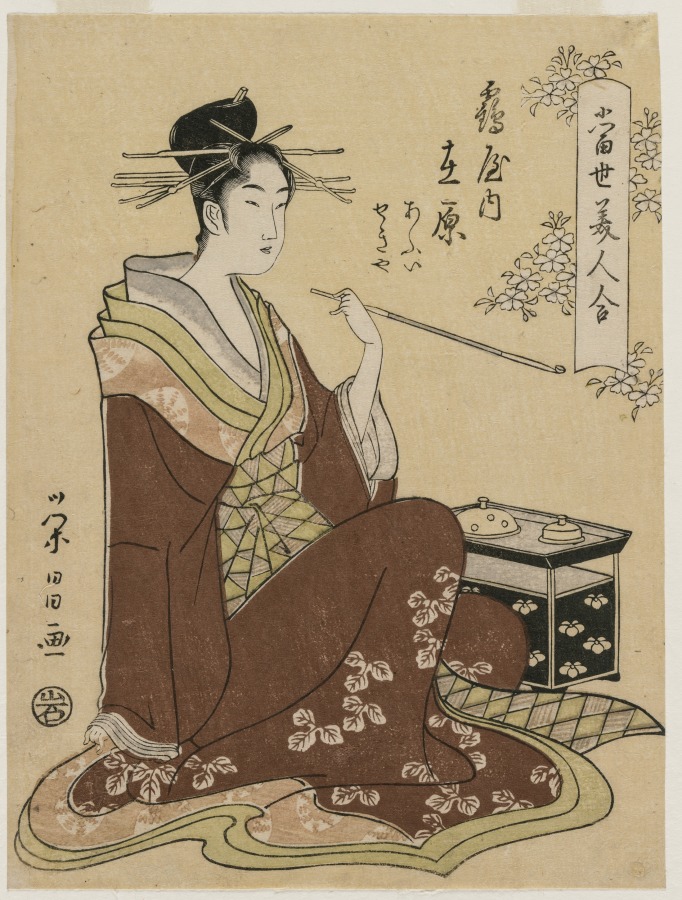
Chōbunsai Eishi (Japanese, 1756–1829), mid 1790s. The Cleveland Museum of Art, accession 1921.346. Gift from J. H. Wade. Open Access (CC0).
Look closer: The title names a smoking chest; the pipe and the box beside her belong to the same habit of hospitality as the tabako-bon.
The Cleveland Museum of Art, CC0 (Open Access). Source: https://clevelandart.org/art/1921.346
The Kotatsu: From Dug Pit to Electric Table
Wikipedia defines a kotatsu as a low, wooden table frame covered by a futon, or heavy blanket, upon which a table top sits. Underneath is a heat source, formerly a charcoal brazier but now electric, often built into the table itself. Kotatsu, it says, are used almost exclusively in Japan, although similar devices for the same purpose are used elsewhere.
The history it gives is a short family tree. The kotatsu begins in the Muromachi period, in the fourteenth century, and its origins lie in the irori. By that century a seating platform had been introduced to the irori and its cooking function became separated from its seating function. On top of the wooden platform a quilt, known as an oki, was placed, which trapped and localised the heat of the charcoal burner. This early ancestor of the modern kotatsu was called a hori-gotatsu, the dug kotatsu. In the Edo period, in the seventeenth century, the formation changed slightly: the floor around the irori was dug out into a square in the ground, the wooden platform was placed round it, and the blanket was placed on top again, where one could sit with legs underneath to stay warm.
The movable kotatsu came later, from the same concept. It came about with the popular use of tatami matting in Japanese homes: instead of placing the charcoals in the irori, they were placed in an earthen pot on the tatami, which made the kotatsu transportable. This style is known as the oki-gotatsu, the placed kotatsu. In the middle of the twentieth century charcoal was replaced with electricity, and an electric heating fixture could be attached directly to the frame. The kotatsu became completely mobile, and a common feature of Japanese homes in winter. By 1997, the article says, 81 percent of homes had one.
Morse met the same idea in the bedrooms of inns. Many rooms, he wrote, have a square hole in the floor in which, when needed, a fire of charcoal may be kindled, called a ro. Above the ro a square frame of wood is adjusted, and the bedclothes, being placed over this frame, are thoroughly heated, so that one may go to bed in the warmest of nests. In the daytime one may gather a portion of the bedclothes about him and keep warm by the little coal fire burning beneath. A little wooden box holding an earthen receptacle for coals could be taken to bed as a substitute for the hot stone or brick used at home. From the inflammable nature of the bedding, he adds, many fires must originate from carelessness in the use of this luxury. The frame he drew is, in all but name, a kotatsu in 1885. He adds that thin square cushions are often provided for guests to sit upon, and a light round cushion used as an elbow-rest when one is reclining.

Period engraving. Edward S. Morse, Japanese Homes and Their Surroundings (Boston: Ticknor and Company, 1886), figure 195. Wood-engraved illustration, public domain.
Look closer: The frame that keeps bedclothes from falling on the coals below, in the form Morse met in inns: the ancestor in plain sight of the kotatsu.
Edward S. Morse, 1886, public domain, via Project Gutenberg ebook 52868. Source: https://www.gutenberg.org/ebooks/52868
Wikipedia distinguishes two kinds in use today. The electric kotatsu, the oki-gotatsu, is a table with an electric heater attached to the underside, usually set on a thin futon like a rug, with a second, thicker blanket draped over the frame and the tabletop placed above. The charcoal kind, the more traditional, is a table placed over a recessed floor, the hori-gotatsu: a pit about 40 centimetres deep cut into the floor, with a charcoal heater in its floor, walls or the table frame. There are also pit-type kotatsu with an electric heater.
The garments matter. Wikipedia says the kotatsu was designed when people most commonly wore traditional Japanese clothes, where the heat would enter through the bottom of the robes and rise to exit around the neck, thus heating the entire body. A person sits on the floor or on zabuton cushions with the legs under the table and the blanket over the lower body. A first blanket, the shitagake, is draped over the frame and heater and under the tabletop, and a second, heavier blanket, the kotatsu-gake, covers it. Historically, kotatsu-gake were made of bast fibres; later, as cotton was introduced, which the article places between the 1300s and the 1700s depending on region, they were usually bast-filled quilts of recycled cotton, dyed with indigo and pieced from old garments in the boroboro style. The kotatsushiki, the floor covering under the kotatsu, was made the same way, and in the 2010s the kotatsu-gake were often decorative, designed to match the home décor.

Period engraving. Edward S. Morse, Japanese Homes and Their Surroundings (Boston: Ticknor and Company, 1886), figure 196. Wood-engraved illustration, public domain.
Look closer: The round cushion Morse describes as an elbow-rest for reclining, the companion of the square sitting cushion.
Edward S. Morse, 1886, public domain, via Project Gutenberg ebook 52868. Source: https://www.gutenberg.org/ebooks/52868
The social life of the kotatsu is described with some relish. During the winter months the kotatsu often is the centre of domestic life, and in the evening family members gather round it to enjoy food, television, games and conversation while keeping the lower half of their bodies warm. In the summer the blanket may be removed and the kotatsu used as a normal table. Sleeping under one is possible, the article says, but is generally considered acceptable for naps and not for the night, for reasons that include uneven heating and the risk of touching heating elements when moving in sleep. Traditionally, children are told that they will catch a cold if they sleep under a kotatsu. Cats, being small enough to fit completely underneath, frequently sleep there anyway.
Ro and Furo: The Tea Room’s Two Hearths
The tea ceremony took the hearth and made it a calendar. Wikipedia’s article on chanoyu says tea practitioners traditionally divide the year into two main seasons: the sunken hearth, or ro, season, corresponding with the colder months, traditionally November to April, and the brazier, or furo, season, corresponding with the warmer months, traditionally May to October. The weather determines which is used. During the ro season the host opens the sunken hearth in the middle of the tea room, where it heats the water and is the only form of heat in the room during the winter. During the furo season the water is heated in a raised brazier.
The details follow the fire. In the winter, the article says, a kneaded incense called neriko is used, while in the summer other incense woods are burned. Guests drink from a more cylindrical bowl in winter to keep in the heat and from a flatter bowl in summer to release it. Participants wear a double-layered kimono outside the summer and a single layer in it. The configuration of the tatami in a four-and-a-half mat room often changes with the season too. In the hearth season the tea room has a special tatami with a cut-out section providing access to the hearth; in summer the hearth is covered with a small square of extra tatami or, more commonly, the hearth tatami is replaced with a full mat, totally hiding the hearth.
The article on the tea room puts the architecture beside the fire: a tea room may have a floor area as small as one and three-quarter tatami mats, with a daime mat for the portable brazier or the sunken hearth to be situated and for the host to sit and prepare the tea, and four and a half mats is generally considered the ideal. The sunken hearth is located in the tatami adjacent to the host’s tatami and is covered with a plain tatami, invisible in the warm months, when the portable brazier is used instead. In the shoulder weeks, Wikipedia adds, when a brazier does not provide enough heat but the hearth is too warm, the host could cover the hearth with the lid and put the brazier on top of it.
The article on the chagama gives the hardware. The kama, the cast-iron tea kettle, is heated over a portable brazier, the furo, or in a sunken hearth, the ro, depending on the season. The ro is used in autumn and winter, a hole in the tatami in which the kama sits over the fire, surrounded by a box-like frame called the robuchi. A kama in such a hole warms faster and stays warm longer, and, the article notes, it provides an image of warmth during the colder seasons. The furo, used in spring and summer, comes in a variety of shapes: the earliest were bronze, later iron and clay braziers became more common, and the unglazed clay furo coated with black lacquer was preferred for formal use and placed on a lacquered board to prevent heat damage. A bed of ashes, the hai, is laid inside, the charcoal placed on it is lit, and a fire window or cut-out on the edge provides the draught. Kama for the furo are slightly smaller than those used for the ro.
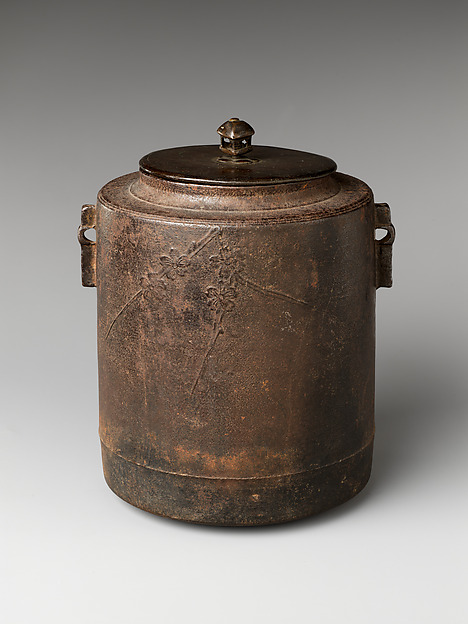
Ōnishi Gorōzaemon, mid-17th century. Cast iron and bronze. The Metropolitan Museum of Art, accession 2024.553.6a, b. Gift of Peggy and Richard M. Danziger, 2024. Open Access.
Look closer: The lugs on either side are the places where the kan, the carrying handles, are inserted.
The Metropolitan Museum of Art, public domain (Open Access). Source: https://www.metmuseum.org/art/collection/search/913853
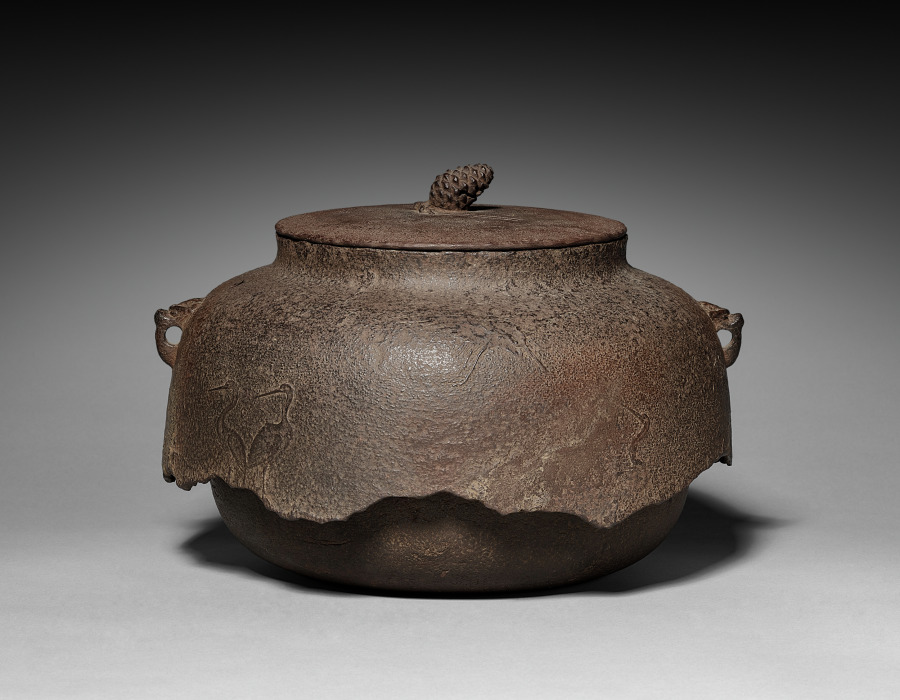
1392–1573. The Cleveland Museum of Art, accession 1980.11. Purchase from the J. H. Wade Fund. Open Access (CC0).
Look closer: A kama of the Muromachi period, with its lugs for hanging or carrying, in a different shape from the tall cylinder.
The Cleveland Museum of Art, CC0 (Open Access). Source: https://clevelandart.org/art/1980.11
The household iron kettle, the tetsubin, is the cousin of the chagama. Wikipedia describes it as a cast-iron kettle with a pouring spout, lid and a handle crossing over the top, traditionally heated over charcoal; in chanoyu the special portable brazier for this is the binkake. They range from about half a litre to about five litres, and the historical origin is uncertain, though one authoritative Japanese source states that it developed from the tedorigama, a spouted and handled water kettle already used in chanoyu in the era of Sen no Rikyū, 1522 to 1591. One hypothesis links the popularity of the tetsubin to sencha, introduced from China around the middle of the seventeenth century and drunk informally in the eighteenth. Tetsubin became a standard household utensil in the eighteenth century, and in the nineteenth century designs went from simple iron kettles to elaborately engraved masterpieces. Iwate and Yamagata are best known for producing them.
The simplest tea procedure shows how the household hearth and the tea room touch. Wikipedia describes the obon temae as a simple procedure for making thin tea in which the bowl, whisk, scoop, cloth and caddy are placed on a tray and the hot water is prepared in a tetsubin heated on a brazier. It is usually the first temae learned, and it can be done sitting at a table. Seen this way, the tea room’s brazier and the family’s are close cousins.
Andon, Candle and Lantern: The Lamps of a Hearth Age
The fire lit the room, but only just. Morse writes that before kerosene oil was introduced into Japan the means of illumination were of the most meagre description, and that one can hardly realise the difficulty a student must have had in studying the Chinese classics by the feeble light of tiny wicks or the dim and unsteady flame of a vegetable-wax candle, a light made all the more feeble when filtered through a paper lantern. He counts kerosene among the greatest boons the Japanese took from the West, because everywhere in the Empire the bright light of kerosene has lengthened the day for all.
Japanese candles, he explains, are made of a vegetable wax, with a wick consisting of a roll of paper. The wick, being hollow, is fitted to a sharp spur of iron about an inch long in the candlestick, a design that England had dropped centuries earlier but Japan retained. At the top of the candle the wick projects in a firm hard point. When a candle has burned low it is removed and placed on the end of a new candle, which is then adjusted on the spur, so that all the candle is used. A superior kind made in the province Morse spells Aidsu, which is to say Aizu, is beautifully painted in bright colours with flowers and other ornamental subjects. Candles were depended upon to illuminate rooms and to light the hand lanterns carried in the streets, and the house lanterns consisted of a square or hexagonal frame covered with paper on the end of a short handle.

Period engraving. Edward S. Morse, Japanese Homes and Their Surroundings (Boston: Ticknor and Company, 1886), figure 205. Wood-engraved illustration, public domain.
Look closer: The te-shoku: a wide disk against dripping wax, a ring to hold the candle upright and a long arm to lift it.
Edward S. Morse, 1886, public domain, via Project Gutenberg ebook 52868. Source: https://www.gutenberg.org/ebooks/52868
The common candlestick, the te-shoku, is a rude affair of iron on three legs with a wide disk to prevent the melted wax from dropping on the mats and a ring about the candle to prevent its falling over; it is easily picked up from the floor by its longer arm. Another form is a hemispherical base of brass, ten or fifteen inches in diameter, with a rod of the same metal two feet or more high ending in the usual cup and spur. The snuffer is usually a blunt pair of tweezers, though servants often take the hibashi, the tongs, and thrust the burnt wick into the ashes of the hibachi, a small and telling link between the two kinds of light and heat. Candlesticks of rustic design, made of curious woods, were made at Nikko and other famous resorts, more as mementos to carry away than as tools.
The lamp proper, he says, is usually in the form of a shallow saucer in which vegetable oil is burned. The wick is a long slender rod of pith, held down by a little ring of iron with a spur for a handle, and the unburned portion projects beyond the saucer and is moved along as it burns. The saucer rests in an iron disk or ring suspended within a frame covered with paper. This is the andon: a square wooden frame covered with paper, open above and below, with one side a movable lid which can be raised when the lamp needs tending, secured to two uprights springing from a wooden stand that may hold a drawer with spare wicks and snuffers. The light from this night-lamp, Morse says, is feeble and uncertain, and by it one can barely see his way about the room.

Period engraving. Edward S. Morse, Japanese Homes and Their Surroundings (Boston: Ticknor and Company, 1886), figure 206. Wood-engraved illustration, public domain.
Look closer: A common form of andon: a square paper-covered frame, open above and below, with one side a movable lid.
Edward S. Morse, 1886, public domain, via Project Gutenberg ebook 52868. Source: https://www.gutenberg.org/ebooks/52868
Morse records the variety. One form is cylindrical, composed of two frames, one within the other, with the outer frame revolving in a groove in the stand, half of each covered with paper, so that turning the outer frame brings the openings together and gives access to the lamp. Another opens in a different way, with a little shelf in one corner to hold the saucer of oil. A third was copied from an old coloured picture-book: an elaborate lacquered stand mounted in metal, with a lamp on top. In passageways and at the head of stairways, lamps are often fixed to the wall, and in Osaka he saw a curious one, a frame hung by hinges to a board on the wall and lifted like a cover when the lamp needed attention.

Period engraving. Edward S. Morse, Japanese Homes and Their Surroundings (Boston: Ticknor and Company, 1886), figure 207. Wood-engraved illustration, public domain.
Look closer: Another andon, opening in a different way, with a little shelf in one corner for the saucer of oil.
Edward S. Morse, 1886, public domain, via Project Gutenberg ebook 52868. Source: https://www.gutenberg.org/ebooks/52868

Period engraving. Edward S. Morse, Japanese Homes and Their Surroundings (Boston: Ticknor and Company, 1886), figure 208. Wood-engraved illustration, public domain.
Look closer: Copied, Morse says, from an old coloured picture-book.
Edward S. Morse, 1886, public domain, via Project Gutenberg ebook 52868. Source: https://www.gutenberg.org/ebooks/52868
Pottery lamps, he notes, are rarely seen. He sketches an old lamp of Oribe ware from his collection, in which an inclined portion within supports the wick and the cover is notched in front and behind to let the wick pass, and another made in the province of Iga, with a hole in the wick tube and a slot in the handle so that it can be hung on the wall, which he thinks may have been made for the kami-dana, the shelf that supports the household shrine. He adds a pottery candlestick of Owari ware. These are small objects of kiln and household shrine, and they point to the shelf of the household shrine as one more place where a small light was kept.

Period engraving. Edward S. Morse, Japanese Homes and Their Surroundings (Boston: Ticknor and Company, 1886), figure 211. Wood-engraved illustration, public domain.
Look closer: An old lamp of Oribe ware from the author’s collection; the cover is notched to let the wick pass.
Edward S. Morse, 1886, public domain, via Project Gutenberg ebook 52868. Source: https://www.gutenberg.org/ebooks/52868
In the streets, the same lights ran out of doors. Morse’s figure of a fixed street lantern shows a round paper lantern on a post, with a small roof above it and a three-comma crest on the paper. A museum picture of a ghost clinging to a tall oil lamp, painted by Tani Bun’ichi in 1810, shows the same idea in another register: the flame on its black stand was a thing a household understood as part of the night.

Period engraving. Edward S. Morse, Japanese Homes and Their Surroundings (Boston: Ticknor and Company, 1886), figure 214. Wood-engraved illustration, public domain.
Look closer: A lantern on a post for the street: lights of the hearth age ran outdoors too.
Edward S. Morse, 1886, public domain, via Project Gutenberg ebook 52868. Source: https://www.gutenberg.org/ebooks/52868

Tani Bun'ichi (Japanese, 1787–1818), 1810. The Cleveland Museum of Art, accession 1992.71. Kelvin Smith Fund. Open Access (CC0).
Look closer: A tall black lamp stand with its flame at the top, in a painting of 1810.
The Cleveland Museum of Art, CC0 (Open Access). Source: https://clevelandart.org/art/1992.71
Regional Parallels: The Warm Table Around the World
Similar warm-table devices turn up in many countries, and Wikipedia’s section on other countries is the most useful table of comparison. In Spain and Portugal, it says, the mesa camilla is a small round table with a brasero, a brazier, placed underneath. The Netherlands used to use a foot stove. During the First World War, British Royal Engineers built what they called Japanese footwarmers in the trenches. The eighteenth-century traveller Lady Mary Wortley Montagu describes a similar device, the tendour, in her Turkish Embassy Letters. Tajikistan and Afghanistan have the very similar sandali, still used in many traditional houses as a warm family eating place, and a similar item called the korsi is used the same way in Iran.
In China and Korea, by contrast, underfloor heating is the tradition, and the comparable devices are respectively the kang bed-stove and the ondol, while the Romans used a hypocaust. The contrast is instructive. Where a house can be heated from below, the family does not need to cluster; where it cannot, the cluster is the heating. The Japanese solution, a localised pocket of warm air trapped under a quilt, is, Wikipedia says, a relatively inexpensive way to stay warm.
The brazier itself is a common human furniture, and Wikipedia’s hibachi article lists it with the kamado, the kitchen stove; the shichirin, the portable brazier; the tabako-bon; and the kotatsu. The tea hearth belongs in the same family. What distinguishes the Japanese household is not the invention of any one of these but the way each has a settled place, a vocabulary and a season: the ro in November, the furo in May, the hibachi at the door of the visitor, the kotatsu through the winter months.
The Hearth by Era
The dates below are the ones given by the sources used for this chapter, with the source named. Where an origin is described as believed or uncertain, the table says so.
| Period | What the sources say | Source |
|---|---|---|
| Heian, 794 to 1185 | The hibachi is believed to date from this period | Wikipedia, Hibachi |
| Muromachi, 14th century | A seating platform is introduced to the irori and cooking and seating separate; the hori-gotatsu begins | Wikipedia, Kotatsu |
| Era of Sen no Rikyū, 1522 to 1591 | The tedorigama, ancestor of the tetsubin according to one Japanese source, is already used in chanoyu | Wikipedia, Tetsubin |
| Edo, 17th century | The floor around the irori is dug out and a wooden platform placed round it; sencha reaches Japan around mid-century | Wikipedia, Kotatsu and Tetsubin |
| Edo, 18th century | Sencha drunk informally; tetsubin become a standard household utensil | Wikipedia, Tetsubin |
| Edo, 19th century | Tetsubin designs go from simple to elaborately engraved | Wikipedia, Tetsubin |
| 1885 preface | Morse records the hibachi, the tabako-bon, the ro with a frame for bedclothes, the country fireplace and the lamps | Morse, Japanese Homes and Their Surroundings |
| By the 1900s | Some cooking is also done over the hibachi | Wikipedia, Hibachi |
| Mid 20th century | Charcoal replaced by electricity in the kotatsu; the kamado becomes widespread in Hokuriku in the 1950s | Wikipedia, Kotatsu and Irori |
| 1997 | 81 percent of Japanese homes have a kotatsu | Wikipedia, Kotatsu |
| 2010s | Kotatsu-gake often decorative and designed to match home décor | Wikipedia, Kotatsu |
Stories from the Hearth
The fire that was never let out. Morse was told in the 1880s that a family in Tokyo had kept its hibachi alight continuously for more than two hundred years. He does not vouch for the claim, and nor does this chapter, but the sentiment he describes is firmly recorded: a feeling that prompts many families to keep the fire burning continually. The old irori served the same purpose in a practical way, since a fire that never went out was the source for lighting the kamado and the lamps in the time before matches.

Torii Kiyonaga, ca. 1785. Woodblock print; ink and color on paper. The Metropolitan Museum of Art, accession JP134. Rogers Fund, 1914. Open Access.
Look closer: A tall, narrow print format; the title names the hibachi, the fire bowl at the heart of the scene.
The Metropolitan Museum of Art, public domain (Open Access). Source: https://www.metmuseum.org/art/collection/search/36613
The student and the incense stick. Morse relates that in former times devout students of the Chinese classics were accustomed at night to read a single character at a time by the dim glow of a coal at the end of an incense stick held close to the page. He gives it as something that is related, not something he saw, and it is as much a story about the price of light as about study. The kerosene lamp, he thought, did more good for the Japanese than almost anything they took from the West.
The first thing a visitor is given. Whenever one calls on a friend, Morse writes, the very first act of hospitality is to place the hibachi before the visitor on the mats. Even in shops, the brazier was brought in when a customer entered. The custom turns an object of heat into a gesture of respect, and explains why so many hibachi were made with such care.
Tar in the thatch. Wikipedia’s article on the irori records a strange benefit of the smoke: the tar in it permeated the beams and the thatched roof, making them insect-resistant and waterproof. A farmhouse with a living fire was a house that preserved itself. The cost, of course, was paid in the lungs and eyes of the people who lived there.
Cats and children. The kotatsu has its own folklore. Traditionally, Wikipedia says, children are told that they will catch a cold if they sleep under a kotatsu, while pets, such as cats, frequently sleep under it, being small enough to fit completely underneath. The advice and the contradiction are both part of the household fire.
Fun Facts for the Curious
Each of these is drawn from one of the sources listed at the end of the chapter.
- The jizaikagi lever is often made in the shape of a fish, Wikipedia says.
- The yokoza, the family head’s seat at the irori, was the one furthest from the earthen entryway.
- Wikipedia says a kotatsu pit of the traditional type is about 40 centimetres deep.
- Morse describes charcoal-vendors who rolled the powdered waste of charcoal and seaweed into balls the size of a large orange and dried them in the sun.
- A single stick of charcoal buried upright in the ashes burned for several hours, according to Morse.
- British Royal Engineers built what they called Japanese footwarmers in the trenches of the First World War.
- The tetsubin may hold around half a litre or as much as five litres.
- Iwate and Yamagata are the prefectures best known for tetsubin.
- In the tea ceremony, guests drink from a more cylindrical bowl in winter to keep in the heat and a flatter one in summer to release it.
- The kotatsu-gake blanket was historically of bast fibre, and later of indigo-dyed recycled cotton pieced from old garments.
Modern Facts: Heaters, Habits and the Winter Table
The modern kotatsu is almost always electric. Wikipedia says that in the twenty-first century it typically consists of an electric heater attached to the frame, which is no longer limited to wood but may be made of plastic or other materials, with a blanket draped over the frame and the tabletop above it. It remains inexpensive as a way of keeping warm, the article notes, because the futons trap the warm air, and in summer the blanket may be removed and the frame used as a normal table.
The irori’s jobs were given up region by region rather than all at once. In the Hokuriku region, Wikipedia says, cooking was done with the irori until the kamado, the cooking stove, became widespread in the 1950s, and in warm western Japan people had long used a kamado and an irori separately depending on the season.
The word hibachi, meanwhile, has travelled. Wikipedia notes that in North America it refers to a small cooking stove heated by charcoal, which the Japanese call a shichirin, or to an iron hot plate, a teppan, used in teppanyaki restaurants; the heating bowl of this chapter is a different object. The tetsubin, by contrast, keeps its own following: Wikipedia observes that tetsubin range widely in size and many have unusual shapes, making them popular with collectors.
Glossary of the Household Hearth
A short vocabulary of the fire, the box and the light.
| Term | Meaning |
|---|---|
| Irori | A sunken hearth in the floor, fired with charcoal; a square stone-lined pit |
| Jizaikagi | The adjustable pothook over an irori, an iron rod in a bamboo tube with a lever |
| Ji-zai | Morse’s spelling of a bamboo pothook; the word means at one’s will |
| Hidana | A wooden lattice hung from the ceiling over an irori for drying |
| Doma | The earthen floor of the entryway |
| Yokoza | The family head’s seat at the irori, furthest from the doma |
| Hibachi | A fire bowl: a brazier holding ash and charcoal |
| Hibashi | Metal chopsticks used to handle charcoal |
| Shichirin | A small portable charcoal stove; the thing North Americans call a hibachi |
| Tabako-bon | A small box with an earthen vessel for coals and a bamboo segment, for a smoker |
| Dai-ju-no | Morse’s term for the shallow iron bowl in which burning coals are brought |
| Kotatsu | A low table frame under a quilt with a heat source beneath |
| Hori-gotatsu | A kotatsu over a recessed pit in the floor |
| Oki-gotatsu | A movable, placed kotatsu, now usually electric |
| Kotatsu-gake | The heavy blanket over a kotatsu |
| Ro | A sunken hearth, in the tea room used in the cold months |
| Furo | A portable brazier, in the tea room used in the warm months |
| Robuchi | The box-like frame around a ro |
| Kama | A cast-iron kettle of the tea ceremony |
| Tetsubin | A cast-iron kettle with a spout and a handle across the top |
| Binkake | The portable brazier for a tetsubin in chanoyu |
| Andon | A paper-covered lamp frame holding a saucer of oil |
| Te-shoku | A three-legged iron candlestick with a disk and a ring |
| Kami-dana | The shelf that supports the household shrine |
A Collector’s Eye for Braziers and Lamps
This house does not value or authenticate individual pieces in its chapters, and the points below are a way of reading the sources, not a test of age. They are drawn from the descriptions already quoted.
Look first at the vessel. Morse lists the materials: bronze, iron, porcelain, earthenware, copper-lined wood, and a wooden box that holds a separate earthen jar. A box-form hibachi should show the copper lining, the clay or plaster layer between the metal and the wood, and the finger holes or cleats that served as handles. A turned wooden form should show grain brought into relief, and Morse notes that an old one richly coloured and polished by age is much esteemed.
Look next at the tools. A hibachi is not complete without its hibashi, the pair of iron rods joined by a ring, and a tabako-bon is not complete without its earthen vessel and its bamboo segment. Look for the bamboo tube in the corner of a hibachi box where the tongs were kept. For lamps, look for the three parts of the andon, the frame, the saucer and the ring that suspends it, and for the iron spur of a candlestick, which holds the paper-core wick of a Japanese candle.
Look last at what has changed. Wikipedia’s caution applies to every fire bowl: a hibachi must never be used in an airtight room. Any piece offered as a heater should be understood as an object first, and a heater only in a well-ventilated room with an understanding of the carbon monoxide risk the sources describe.
The Hearth on the Shelf
The house holds no fire bowls, kotatsu frames or lamps at present, and this chapter does not value or authenticate individual pieces. For lacquered furniture of a related kind, see the Temple Furniture tag on the Japanese Arts, Vintage and Antiques shelf. The archive page Tansu and Traditional Furniture gives a short working map, and the guide to importing large items from Japan covers freight for heavy cast-iron and bronze pieces.
Answered plainly
What is a hibachi?
A traditional Japanese heating device: a brazier, a round, cylindrical or box-shaped open-topped container made from or lined with a heatproof material and designed to hold burning charcoal in a bed of ash. It heats by radiation and is too weak to warm a whole room.
Is a Japanese hibachi the same as a barbecue grill?
No. In North America the word hibachi means a small charcoal cooking stove, which the Japanese call a shichirin, or an iron hot plate, a teppan. The Japanese hibachi was originally a heater, not a cooker.
What is an irori?
A traditional sunken hearth fired with charcoal, a square stone-lined pit in the floor with an adjustable pothook over it. It was used for heating, cooking, lighting, drying and as the family’s gathering place.
What is a jizaikagi?
The adjustable pothook of an irori, generally an iron rod within a bamboo tube with a lever, often shaped like a fish, used to raise or lower a pot or kettle over the fire.
Where did people sit round an irori?
In fixed places. The seat furthest from the doma was the family head’s, the children sat nearest the doma, and the guests and the head’s wife sat on both sides of them, according to Wikipedia.
What is a kotatsu?
A low wooden table frame covered by a futon or heavy blanket with a tabletop above and a heat source beneath, formerly a charcoal brazier and now usually electric.
How old is the kotatsu?
Wikipedia dates its origins to the Muromachi period, in the fourteenth century, from the irori, with the dug hori-gotatsu changing slightly in the seventeenth century and the movable oki-gotatsu appearing later with the use of tatami.
Is it safe to sleep under a kotatsu?
Wikipedia says it is generally considered acceptable for naps but not for overnight sleeping, because the body is not completely covered and heating is uneven, and the low table risks accidental contact with heating elements.
What is a tabako-bon?
A small brazier box for a smoker, commonly a square wooden box holding a small earthen vessel for hot coals and a segment of bamboo, brought to a visitor.
What is the difference between ro and furo?
The ro is the sunken hearth used in the cold months, traditionally November to April, and the furo is the portable brazier used in the warm months, May to October, in the tea ceremony.
How was a Japanese house lit before electricity?
By the irori fire, by oil lamps called andon, by candles of vegetable wax on iron spurs and by paper lanterns, as Morse records in 1885.
Can a hibachi be used indoors today?
Wikipedia warns that proper handling is necessary and that a hibachi must never be used in airtight rooms such as those in Western buildings, because burning charcoal produces carbon monoxide.
Where next
Sources and image credits
- Hibachi, Wikipedia
- Irori, Wikipedia
- Kotatsu, Wikipedia
- Chagama, Wikipedia
- Tetsubin, Wikipedia
- Japanese tea ceremony, Wikipedia
- Chashitsu, Wikipedia
- Edward S. Morse, Japanese Homes and Their Surroundings, preface dated November 1885, Project Gutenberg ebook 52868 (period wood-engraved illustrations)
- The Metropolitan Museum of Art, Open Access collection
- The Cleveland Museum of Art, Open Access collection
Last reviewed 28 October 2026. Pictures, where shown, are public-domain or open-access and credited beneath each one.
Looking for a piece of Japanese furniture with its history intact? The concierge desk replies within one to three business days.
Private concierge
Looking for something in particular?
Describe the piece or the project you have in mind. A senior advisor in Tokyo reads every case file personally and replies within two business days, with fees set out in writing before any work begins.