
Tansu: Chests for Every Trade
The Movable Household
Tansu: Chests for Every Trade
A tansu was never meant to sit still. It stood in a storehouse, beside a shop platform or in the closet of a farmhouse, and when the street filled with smoke it was lifted by its iron handles and carried away.
Fact sheet
At a glance
- A bureau that travels. Edward S. Morse, writing in 1885, called the tansu a chest of drawers not unlike an American bureau, kept inside the closet behind sliding screens.
- Made for fire. Morse saw bureaus and chests with long iron handles that turn up into loops, so a pole could be passed through and the chest carried on men’s shoulders.
- Class before region. In the Edo period the type of chest followed the owner’s class and trade. Strong regional styles came after 1868, says Wikipedia.
- A staircase with drawers. The kaidan-dansu is a stair built from cupboards and drawers, used in Tōhoku farmhouses to reach the attic.
- One word, two worlds. The Metropolitan Museum’s lacquered book cabinet carries the same character, 箪笥, in its Japanese title.
A Chest Built to Be Moved
Wikipedia defines tansu (箪笥) as traditional Japanese mobile storage cabinets, commonly used for clothing, particularly kimono. The two characters, tan and su, appear to have stood at first for objects with separate jobs, the storage of food and the carrying of firewood. Because the radical for bamboo sits inside both, the article surmises that bamboo, not wood, was the first material. The word was first recorded in the Genroku era (1688 to 1704) of the Edo period (1603 to 1867).

Photograph of a tansu, released to the public domain by the photographer.
Look closer: Count the iron. Each drawer has its own loop handle and a round lock plate, and every corner is capped. The hardware is part of the structure, as the next chapters explain.
Alexander Guy, Public domain, via Wikimedia Commons. Source: https://commons.wikimedia.org/wiki/File:Tansu.jpg
The adjective matters more than the noun. Wikipedia says tansu were rarely used as stationary furniture. A traditional interior was divided by movable partitions, so that rooms could grow and shrink, and a chest had to move with them. It was not visible in the home except at certain times for certain purposes. It lived in the kura, the storehouse beside the house; in the nando, a storage room; in the oshiire, the closet alcove; on the choba, the raised platform of a shop; and aboard some coastal ships. Mobility came from attached wheels, iron carrying handles, or upper rails that stood out so that the chest could be lifted.
Edward S. Morse, an American zoologist and former professor at the University of Tokyo whose preface is dated November 1885, noticed first what the Japanese house lacked. The few necessary articles, he wrote, are stowed away in boxes, cupboards and the spaces beneath the floors. Of the closets closed by sliding fusuma he adds that the tansu, a chest of drawers not unlike our bureau, is often placed within, together with trunks and chests. Furniture, in other words, was a lining for the walls, taken out when needed.
The Fire That Made the Wheeled Chest
The oldest documented kind of tansu is the nagamochi kuruma-dansu, a coffer on wheels. Wikipedia’s account rests on the diaries of a trade delegation from the Dutch East India Company settlement on Dejima, Nagasaki, which reached Edo in March 1657. The diaries refer to big chests on four wheels that so blocked the roads that people could not escape. The mission of Zacharias Wagenaer witnessed by chance what became known as the Great Fire of Meireki, in which, the article says, 107,000 people died.

Woodblock illustration reproduced from Ty and Kiyoko Heineken, Tansu: Traditional Japanese Cabinetry. Commons describes it as Edo citizens escaping advancing flames with their chests during the great Meireki fire of 1657.
Look closer: Follow the chests, not the flames. At right two men carry a lidded chest between them on a pole; at left a second chest sits among the fleeing crowd.
Ty and Kiyoko Heineken, CC BY-SA 3.0, via Wikimedia Commons. Source: https://commons.wikimedia.org/wiki/File:Meireki_fire_woodblock.jpg
A woodblock reproduced from the Heinekens’ book Tansu: Traditional Japanese Cabinetry shows townspeople in the smoke with their chests. The picture is crowded: a lidded chest stands among the fleeing figures at left, another is borne on a pole between two men at right, and the smoke and flames run across the whole page. Whatever else a household owned, the cloth and papers inside such a chest were its means of starting again.
Two centuries later the habit had not changed. Morse describes the fear of conflagration that every city dweller lived with, the lookout platform on the roof ridge with its bucket and brush, and the square basket-like box with straps in which the more precious objects were packed so they could be carried on a man’s shoulders. He also noticed that bureaus and chests of drawers have long hanging iron handles which turn upward to make loops through which a stick may be passed, so that in case of fire the chest can easily be transported on the shoulders of men. That is the whole design brief in a sentence.
Later the wheeled chest changed its meaning. Wikipedia records that the kuruma choba-dansu became a merchants’ status symbol across Japan in the Meiji period. It had begun in the Edo period but spread only from the 1860s, probably because fear of official censure under the sumptuary laws had held demand back. It was kept on the choba beside the owner, to hold account books and to impress customers, and was often chained to a stout post. The article adds that the families who now show such chests in their best room are not showing them as they were first seen.
Six Chests of the Edo Period
During the Edo period, Wikipedia says, the type of tansu a person used was largely determined by social class. The age was feudal, travel was regulated and conspicuous consumption was discouraged by sumptuary laws. Tansu of the time therefore reflect the class and occupation of the owner rather than any regional originality. The local personalities came after the Meiji Restoration of 1868, when the rigid class structure loosened, and the next chapter follows them.

Commons describes it as an Edo period ryōbiraki chest on chest used by merchant-class women for clothing storage. Reproduced from Ty and Kiyoko Heineken.
Look closer: The two doors at the top are the signature of the type. The plain, unlacquered surface is what the 1789 reform allowed.
Ty and Kiyoko Heineken, CC BY-SA 3.0, via Wikimedia Commons. Source: https://commons.wikimedia.org/wiki/File:Ryobiraki_tansu.jpg
The six chests the article names for the Edo period are as much a record of work as of furniture. The choba-dansu held the account books, the daifukuchō, of merchants (chōnin). When it faced the customer, its face wood and hardware could be of high quality to give a favourable impression. The katana-dansu held sword blades and belonged to blade polishers, who chose paulownia (kiri) for the case to help protect steel from oxidation in the humid summer months, and because the wood is light enough to carry between samurai customers. The apothecary’s kusuri-dansu, with many small drawers for herbs, was also carried by itinerant salesmen and was built of light kiri or sugi (cedar), with iron used sparingly.
A drug chest of that kind survives in the Saga Prefectural Museum, where the museum label is described on Commons as a chest of drawers used to store crude drugs for kampō medicine. A second, photographed by Motokoka, shows the same grid of tiny drawers with paper labels. The pattern repeats: the drawer is the unit, and the trade decides how many there are.
The sixth chest records the law as well as the trade. The ryōbiraki kasane-dansu, a chest on chest with double doors, stored women’s clothing. Wikipedia reports that the Kansei Reforms promulgated in 1789 by the shōgun’s regent, Matsudaira Sadanobu, designated this design as acceptable for merchant-class women. Because that two-section clothing chest was already popular in Edo, the limitation to an unlacquered finish, the article observes, may not have seemed excessive.
| Chest | Who used it | What the source says |
|---|---|---|
| Choba-dansu | Merchants (chōnin) | Usually one section with many compartments; account books; fine face wood where customers could see it |
| Kaidan-dansu | Households; Tōhoku farmhouses | Modular drawers and sliding doors, built to fit the architecture yet movable if needed |
| Katana-dansu | Blade polishers | Long drawers for sword blades; paulownia case against rust and for lightness |
| Kusuri-dansu | Travelling apothecaries | Many small drawers; light paulownia or cedar; iron used sparingly |
| Nagamochi kuruma-dansu | Townspeople of Edo, per the 1657 diaries | Coffer on wheels; the oldest documented mobile cabinet; described in 1657 |
| Ryōbiraki kasane-dansu | Merchant-class women | Chest on chest with double doors for clothing; unlacquered under the Kansei Reforms of 1789 |
The Staircase Chest
The kaidan-dansu (階段箪笥), the step chest, is the tansu that tries hardest not to be furniture. Wikipedia describes it as often modular, with drawers and sliding doors, intended mainly as a stationary part of the building yet designed to be moved if necessary. In the Tōhoku region north of Tokyo, farmhouses placed step chests to give access to the attic, where silkworms were raised under the thatch. The article compares this use of structural dead space for storage, which keeps the floor open, with the Shakers of nineteenth-century America.

Original drawing after the description in Edward S. Morse, Japanese Homes and Their Surroundings, fig. 177. Not a measured drawing of any one chest.
Look closer: Read left to right and you climb through the whole inventory of a household: closed boxes, a cupboard, a run of drawers, a closet with a door.
Diagram by Japonista (original drawing), The Japonista Curation and Concierge Team, Tokyo, Japan.
Morse drew one in a Japanese kitchen and described it with a naturalist’s care. Inns and large farmhouses, he says, often had a staircase that looked like a number of square boxes piled one on another, a compact structure of compartments that could be separated. In the example he sketched, the first two steps were closed. Then came a low cupboard with sliding doors at the side, its upper corner forming another step. On the cupboard rested three more steps, each with a drawer that pulled out at the side. Next stood a high closet, and on top of it two or three more steps. The closet usually had a swinging door, a feature he found rarely seen elsewhere within the Japanese house.
He lists what the closet held: the night lamp, or andon, tall candlesticks, the bedding and pillows, or trays and dishes. He also remarks that these steps are less steep than a ladder, have no baluster or rail and are remarkably solid. Then he turns to the surface. He looked for wax on the staircase wood and found none; the curious information he was given was that water from the bath is often used to moisten the cloth with which the wood is wiped, and he guessed that the oils of the skin did much of the polishing.
No tansu is more architectural than this one. It is a stair, a cupboard, a bedroom closet and a set of drawers in a single body, and it shows how little separated furniture from joinery in the Japanese house.
One Word in Gold Lacquer
At the far end of the household from the drug chest stood the lacquered cabinets of the court and the daimyo, and the Metropolitan Museum holds several. A portable writing cabinet with Tokugawa crests, made in the late seventeenth century, has three drawers. The two upper drawers held paper and documents and the bottom drawer the inkstone, water dropper and brushes. The museum says it was made for the Tokugawa family in one of their official maki-e workshops, probably the Kōami family’s, with chrysanthemums, symbols of longevity and autumn, each flower rendered in a different colour or technique.

early 17th century. Lacquered wood with gold and silver hiramaki-e, takamaki-e, gold foil application, and mother-of-pearl inlays on black ground; gilt-bronze fittings. The Metropolitan Museum of Art, accession 2015.500.2.45a–h. Gift of Florence and Herbert Irving, 2015. Open Access.
Look closer: Every drawer front is a separate small picture of autumn flowers and shells, divided by geometric bands. The Met says the unusual size and imagery suggest a special commission.
The Metropolitan Museum of Art, public domain (Open Access). Source: https://www.metmuseum.org/art/collection/search/42617
The Met’s eighteenth-century book cabinet is a smaller object and a clearer link. Its Japanese title, 秋草蒔絵書箪笥, ends in the same two characters. It was designed to hold the forty-two volumes of the Taiheiki, the epic of the fourteenth-century wars, in six drawers, and inscriptions inside show which volume belongs in which drawer. Its outside is autumn grasses with silver-inlaid dewdrops, and mist in finely graded togidashi maki-e. The word that covers a staircase also covers a lacquered box fifteen and a half inches long.
There is a third group, the nanban cabinets. The museum explains that nanban, a term for southern foreigners, names the lacquer made for Portuguese, Spanish and, later, Dutch buyers from the later sixteenth century. A late-sixteenth-century cabinet of drawers with a court carriage is based on the European vargueño or escritorio, a drop-front chest that doubled as a writing surface. Another, from the early seventeenth century, belongs to a type with six drawers that, the museum notes, usually had a fall-front door; one of the earliest export cabinets without a fall front is recorded at Schloss Ambras in Austria around 1607. These are Japanese furniture in European shapes, made for another eye, and the tansu proper is something different: the working chest of the Japanese household.

late 16th–early 17th century. Gold lacquer with hiramaki-e and mother-of-pearl inlay; gilt copper fittings. The Metropolitan Museum of Art, accession 2008.182a, b. Purchase, Barbara and William Karatz Gift, 2008. Open Access.
Look closer: The diamond panels and the line of the drawer show how a low chest was divided into fields.
The Metropolitan Museum of Art, public domain (Open Access). Source: https://www.metmuseum.org/art/collection/search/74490
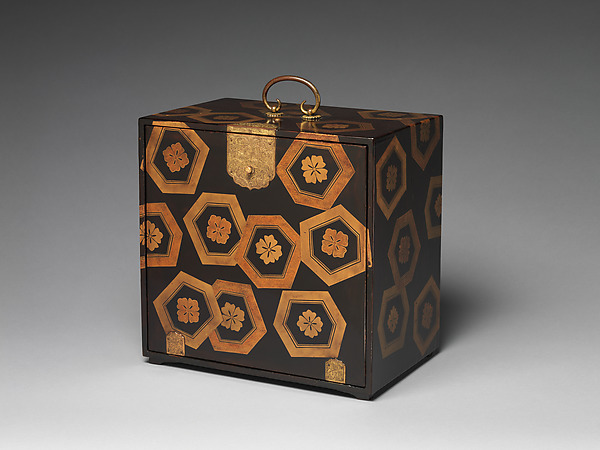
late 16th–early 17th century. Powdered gold (maki-e) on black lacquer; gilt-bronze handle, lock, and hinges. The Metropolitan Museum of Art, accession 2015.500.2.34a–e. Gift of Florence and Herbert Irving, 2015. Open Access.
Look closer: The hexagons run across the join of door and side without a break; the pattern belongs to the whole box.
The Metropolitan Museum of Art, public domain (Open Access). Source: https://www.metmuseum.org/art/collection/search/40359
Two smaller lacquered pieces in the Met’s collection show the court end of the range from another angle. A low chest with a single drawer, in gold lacquer with mother-of-pearl inlay and gilt copper fittings, stands 24.4 centimetres high, and a small black lacquer cabinet with gilt-bronze handle, lock and hinges, decorated with stylised tortoiseshell patterns in gold, stands 36.2 centimetres high; the museum dates both to the late sixteenth or early seventeenth century.
The Tansu by Date
Dates are those given in the sources named at the end of the chapter. Where the sources differ on a year, the year is left out.
| Date | What happened | Source |
|---|---|---|
| 1657 | The Dutch delegation from Dejima reaches Edo in March; its diaries describe the wheeled coffer | Tansu, Wikipedia |
| 1688 to 1704 | The Genroku era, in which the word tansu is first recorded | Tansu, Wikipedia |
| Edo period | The type of chest follows the owner’s class and trade | Tansu, Wikipedia |
| 1789 | The Kansei Reforms of Matsudaira Sadanobu limit lacquer on women’s chests | Tansu, Wikipedia |
| From the 1860s | The wheeled merchant’s chest spreads as a status symbol | Tansu, Wikipedia |
| After 1868 | Strong regional styles develop | Tansu, Wikipedia |
| November 1885 | The date of the preface to Morse’s Japanese Homes and Their Surroundings | Morse, Project Gutenberg |
| 1981 | Ty and Kiyoko Heineken publish Tansu: Traditional Japanese Cabinetry | Tansu, Wikipedia |
Places to See Chests and Cabinets
Displays change; check each institution’s own site before travelling.
| Place | What there is | Source |
|---|---|---|
| Saga Prefectural Museum | A wheeled chest and a hyakumi-dansu medicine chest, shown in the gallery | Wikimedia Commons |
| The Metropolitan Museum of Art, New York | Lacquered cabinets: the nanban cabinet, the portable writing cabinet and the book cabinet | Metropolitan Museum |
| A traditional farmhouse in Tōhoku | The staircase chest, where it still stands as part of the building | Tansu, Wikipedia |
| A reconstructed shop or merchant house | The choba-dansu, faced to the customer | Tansu, Wikipedia |
Glossary of the Tansu
A short vocabulary of the terms in this chapter.
| Term | Meaning |
|---|---|
| Tansu | Traditional Japanese mobile storage cabinet, written 箪笥 |
| Nagamochi | A coffer or long chest, often carried with poles |
| Kuruma-dansu | A wheeled chest, the oldest documented kind of mobile tansu |
| Choba-dansu | The merchant’s chest that held account books |
| Kaidan-dansu | The staircase chest, built from cupboards and drawers |
| Katana-dansu | The sword polisher’s chest, in paulownia |
| Kusuri-dansu | The apothecary’s chest of many small drawers |
| Ryōbiraki kasane-dansu | A chest on chest with double doors for women’s clothing |
| Kiri | Paulownia, the light wood used for many chests |
| Nanban | Lacquer made for Portuguese, Spanish and later Dutch buyers |
Fun Facts for the Curious
Each of these comes from the sources named at the end of the chapter.
- Both characters of the word tansu carry the bamboo radical.
- The oldest documented tansu is a coffer on wheels, described in 1657.
- Morse saw chests whose iron handles turn up into loops so that a pole could be passed through.
- The staircase chest was used in Tōhoku farmhouses to reach the attic where silkworms were raised.
- The Met’s book cabinet was made to hold the forty-two volumes of the Taiheiki, in six drawers.
- Paulownia is used for sword and apothecary chests because it is light and protects against rust.
- The Kansei Reforms of 1789 made lacquered clothing chests unlawful for merchant women, in Wikipedia’s account.
Bureaus, Shakers and the Mobile Chest
The tansu is easiest to understand next to its Western relatives. Morse himself compared it to an American bureau, and the comparison is useful in one direction only: a bureau is built to stay where it is, a tansu to leave. Where the Western house filled its rooms with heavy furniture, the Japanese house kept a few chests and moved them with the partitions.
The sources do not claim a direct link with any European form, and this chapter does not either. Wikipedia’s own comparison is with the Shakers of nineteenth-century America, whose builders also used structural dead space for storage and kept the floor open, and the nearest parallel in the diaries is the chest on wheels of the Dutch delegation: a household object whose first duty was to survive a fire.
Chests in the Round

Commons: a kuruma-nagamochi, a traditional wheeled chest of Japan, documented as an early type of tansu, on display at the Saga Prefectural Museum.
Look closer: The rounded wooden wheels sit under the body like rockers. Imagine two men on a pole and you have the picture of 1657.
Pekachu, CC BY-SA 4.0, via Wikimedia Commons. Source: https://commons.wikimedia.org/wiki/File:Kuruma-Nagamochi_at_Saga_Prefectural_Museum.jpg

Commons: a hyakumi-dansu, a traditional chest of drawers used to store crude drugs for kampō medicine, at the Saga Prefectural Museum.
Look closer: The name means a hundred flavours. Each tiny drawer held a single remedy.
Pekachu, CC BY-SA 4.0, via Wikimedia Commons. Source: https://commons.wikimedia.org/wiki/File:Hyakumi-Dansu_at_Saga_Prefectural_Museum.jpg

Commons: an old yakumi tansu, a medicine box in Japan.
Look closer: Read the paper labels: the chest was its own index.
Motokoka, CC BY-SA 4.0, via Wikimedia Commons. Source: https://commons.wikimedia.org/wiki/File:Old_Yakumi_Tansu%2C_medicine_box_in_Japan.jpg

Kōami School, late 17th century. Lacquered wood with gold and silver takamaki-e, hiramaki-e, and applied gold foil on nashiji ground. The Metropolitan Museum of Art, accession 81.1.133a–h. Bequest of Stephen Whitney Phoenix, 1881. Open Access.
Look closer: The open drawer shows where the inkstone sat. Nearly every chrysanthemum was worked in its own colour or technique, the Met notes.
The Metropolitan Museum of Art, public domain (Open Access). Source: https://www.metmuseum.org/art/collection/search/57585

18th century. Lacquered wood with gold togidashimaki-e, hiramaki-e, and silver inlay; gilt bronze fittings. The Metropolitan Museum of Art, accession 2015.300.285.1. Mary Griggs Burke Collection, Gift of the Mary and Jackson Burke Foundation, 2015. Open Access.
Look closer: Forty-two volumes of the Taiheiki lived in six drawers of this size. The top of the box, with its mist and cloud, is painted as delicately as a hanging scroll.
The Metropolitan Museum of Art, public domain (Open Access). Source: https://www.metmuseum.org/art/collection/search/670964

late 16th century. Lacquered wood with gold and silver hiramaki-e and mother-of-pearl inlay. The Metropolitan Museum of Art, accession 1989.17a–l. Purchase, Harris Brisbane Dick Fund and Mary Griggs Burke Gift, 1989. Open Access.
Look closer: Open the front and the form becomes obvious: a Spanish writing chest, decorated with Japanese court carriages and blossoms.
The Metropolitan Museum of Art, public domain (Open Access). Source: https://www.metmuseum.org/art/collection/search/44577
Furniture on the Shelf
The house holds no tansu at present, and this chapter does not value or authenticate individual chests. What the shelves do carry in the way of furniture is lacquered temple and altar furniture: the Temple Furniture tag on the Japanese Arts, Vintage and Antiques shelf, and the household altar almanac for the cabinet that stands in the same rooms. The earlier archive page, Tansu and Traditional Furniture, gives a short working map, and the guide to importing large items from Japan covers freight for heavy pieces.
Answered plainly
What does tansu mean?
Traditional Japanese mobile storage cabinets, commonly used for clothing, according to Wikipedia. The word is written 箪笥, with the bamboo radical in each character, and was first recorded in the Genroku era, 1688 to 1704.
Were tansu fixed furniture?
No. Wikipedia says they were rarely stationary, and Morse, writing in 1885, describes handles that turn into loops so that a chest could be carried on men’s shoulders in a fire.
What is a kaidan-dansu?
A staircase chest, built of cupboards and drawers. In Tōhoku farmhouses it gave access to the attic where silkworms were raised, according to Wikipedia.
Why was paulownia used for sword chests?
Wikipedia says kiri protected blades from oxidation in humid summers and was light enough to move between customers. The wood is discussed further in the chapter on materials.
Is the Met’s lacquered book cabinet a tansu?
Its Japanese title, 秋草蒔絵書箪笥, uses the same word. It is a small drop-front cabinet of six drawers, a court object, not a household chest.
Where next
Sources and image credits
- Tansu, Wikipedia (word, history, types, regional styles, hardware, finishes)
- Edward S. Morse, Japanese Homes and Their Surroundings, preface dated November 1885; Harper and Brothers, New York, 1889 edition, Project Gutenberg ebook 52868 (closets, handles, fire, staircase chest, fig. 177, fig. 302)
- Ty Heineken and Kiyoko Heineken, Tansu: Traditional Japanese Cabinetry, Weatherhill, 1981 (cited by Wikipedia; source of the Commons woodcut and photographs)
- Nanban Cabinet with Drawers, 2015.500.2.45a–h, The Metropolitan Museum of Art
- Cabinet of Drawers with Birds, Flowers, and Court Carriage, 1989.17a–l, The Metropolitan Museum of Art
- Book Cabinet (Shodansu) for a set of The Chronicle of Great Peace, 2015.300.285.1, The Metropolitan Museum of Art
- Portable Writing Cabinet with Tokugawa Family Crests, 81.1.133a–h, The Metropolitan Museum of Art
- Chest with a Single Drawer, 2008.182a, b, The Metropolitan Museum of Art
- Cabinet with Design of Stylized Tortoiseshell Patterns, 2015.500.2.34a–e, The Metropolitan Museum of Art
- Image credits: Alexander Guy (public domain); Ty and Kiyoko Heineken (CC BY-SA 3.0); Pekachu and Motokoka (CC BY-SA 4.0); Wikimedia Commons
Last reviewed 28 October 2026. Pictures, where shown, are public-domain or open-access and credited beneath each one.
Looking for lacquered temple furniture, or a chest with its history intact? The concierge desk replies within one to three business days.
Private concierge
Looking for something in particular?
Describe the piece or the project you have in mind. A senior advisor in Tokyo reads every case file personally and replies within two business days, with fees set out in writing before any work begins.