
Yanagi Sōetsu and the Mingei Idea
The Eye for Ordinary Things
Yanagi Sōetsu and the Mingei Idea
In the mid-1920s a philosopher and two potters decided that the most beautiful objects in Japan were not in the temples or the tokonoma but in the kitchen, the bedroom and the barn, and that they had been made by people whose names nobody had written down.
Fact sheet
At a glance
- A new word for old things. Mingei was coined in 1925 from minshū, common people, and kōgei, craft. Yanagi rendered it in English as folk craft, to stop anyone thinking of it as individually inspired high art.
- Seeing before knowing. Yanagi called his method chokkan, direct perception: look at an object without prior knowledge or analysis coming between you and it.
- Eight marks of beauty. Natural materials, tradition, simplicity, function, plurality, low cost, anonymity and the beauty of health.
- A movement in four parts. A theory, a magazine, an association and a museum, with a shop, Takumi, to sell the things the museum taught people to admire.
- A movement with critics. Scholars have asked whether mingei owed more to William Morris than Yanagi admitted, and whether his view of Korean art was a colonial one. This chapter sets both questions out.
The Beauty of Things Made to Be Used
Wikipedia’s article on mingei begins by saying that the word, variously translated as folk craft, folk art or popular art, was developed from the mid-1920s in Japan by a philosopher and aesthete, Yanagi Sōetsu, together with a group of craftsmen, among them the potters Hamada Shōji and Kawai Kanjirō. It was, the article adds, a conscious attempt to distinguish ordinary crafts and functional utensils, such as pottery, lacquerware and textiles, from the higher forms of art then much admired in a Japan that was westernising, industrialising and urbanising at speed.
That sentence carries the whole argument. A tea bowl in a museum case, a hanging scroll in an alcove and a sword fitting in a collector’s hand had long been valued as art, with a maker’s name, a school and a price. A rice bowl, a bamboo basket, a quilt cover or a storage jar had not. Yanagi’s claim was that the second group, made by hand in quantity by people who did not sign their work, contained a kind of beauty that the first group could not match, and that Japan was losing it as the country modernised.

second half 18th century. Porcelain. The Metropolitan Museum of Art, accession 1979.413.1. The Harry G. C. Packard Collection of Asian Art, Gift of Harry G. C. Packard, and Purchase, Fletcher, Rogers, Harris Brisbane Dick, and Louis V. Bell Funds, Joseph Pulitzer Bequest, and The Annenberg Fund Inc. Gift, 1975. Open Access.
Look closer: A Korean moon jar of the second half of the eighteenth century: the kind of unsigned, plain vessel from which Yanagi began.
The Metropolitan Museum of Art, public domain (Open Access). Source: https://www.metmuseum.org/art/collection/search/45432
The claim is easy to state and hard to live inside. It asks the viewer to give up the habits of connoisseurship, to stop asking who made a thing and when, and to look at what it is. It asks the maker to give up the ambition to be an artist. It asks a society to value the plain over the rare. This chapter follows the idea from its beginning in a Korean jar, through its coinage and its institutions, to its critics and its afterlife, and ends with a short guide to looking at such objects with the same eye.
It sits in the Tansu, Mingei and Furniture Almanac because the movement gave Japan one of its most durable ways of admiring household things. The chests, braziers and storage jars of the other chapters were nameless, serviceable and made in quantity, which are the qualities Yanagi’s list prizes.
Korea and the Nameless Potter
The idea begins, according to Wikipedia, with a liking for Joseon ceramics. Joseon is the Korean dynasty of 1392 to 1910, and Yanagi, as a young man, developed an affection for its pottery. In 1916 he made his first trip to Korea, where he began to collect, especially pottery made by local Korean craftsmen.
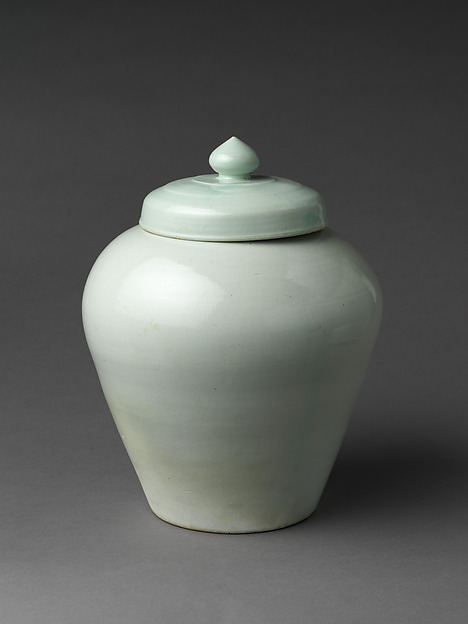
15th–16th century. Porcelain with transparent glaze. The Metropolitan Museum of Art, accession 2021.125a, b. Purchase, Michael and Kathleen Linburn Gift, 2021. Open Access.
Look closer: A Korean covered jar of the fifteenth or sixteenth century, with a plain form and a thin, even glaze.
The Metropolitan Museum of Art, public domain (Open Access). Source: https://www.metmuseum.org/art/collection/search/851661
The discovery that mattered was a negative one. Realising that the Yi Dynasty wares he admired had been made by nameless craftsmen, Yanagi felt that there must be a similar kind of art form in Japan. He came home, Wikipedia says, interested in his own country’s cultural heritage, and began to collect what he saw as vanishing craft items: woodwork, lacquerware, pottery and textiles, from Okinawa and from Hokkaidō, the land of the Ainu, as well as from the main islands.
The movement therefore owed a good deal to Korea. In 1924 Yanagi established a Chōsen Folk Art Museum in one of the old palace buildings in Seoul. The article on Yanagi himself adds that the 1916 trip, taken out of curiosity about Korean crafts, led to that museum and, soon after, to the coining of the word mingei. The Metropolitan Museum’s Korean porcelain, several pieces of which came as gifts in recent years, gives a sense of what such wares look like: round moon jars, plain covered jars, jars painted with a few strokes of iron brown or copper red.
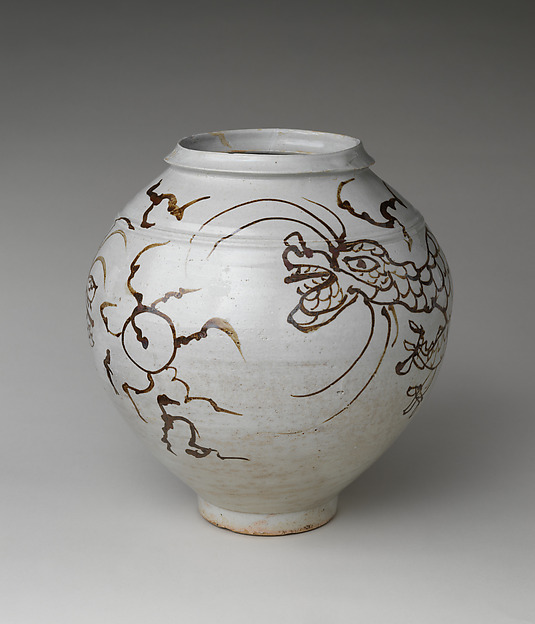
17th century. Porcelain with underglaze iron-brown design. The Metropolitan Museum of Art, accession 2022.437. Gift of Michael B. Kim and Kyung Ah Park, 2022. Open Access.
Look closer: A seventeenth-century Korean jar painted in iron brown, the dragon drawn freely in a few strokes.
The Metropolitan Museum of Art, public domain (Open Access). Source: https://www.metmuseum.org/art/collection/search/892635

mid-18th century. Porcelain with underglaze copper-red design. The Metropolitan Museum of Art, accession 1979.413.2. The Harry G. C. Packard Collection of Asian Art, Gift of Harry G. C. Packard, and Purchase, Fletcher, Rogers, Harris Brisbane Dick, and Louis V. Bell Funds, Joseph Pulitzer Bequest, and The Annenberg Fund Inc. Gift, 1975. Open Access.
Look closer: A mid-eighteenth-century Korean jar with a copper-red leaf, the red fired to a soft, uneven tone.
The Metropolitan Museum of Art, public domain (Open Access). Source: https://www.metmuseum.org/art/collection/search/39885
Yanagi was not an artist or a craftsman himself, Wikipedia is careful to say. He was a critic, a philosopher and a collector, and his first method was to look. That choice shapes everything that follows: a movement built on the eye of a viewer, rather than on the hands of a maker, and a theory that would always have to decide how far the viewer’s idea of beauty could be asked of someone else’s work.
Two Words Joined: Minshū and Kōgei
In 1925, Wikipedia says, after considerable discussion with the two potter friends Hamada Shōji and Kawai Kanjirō, the phrase that they coined to describe the craftsman’s work was mingei, written 民藝. It was a hybrid term. The first part came from minshū, 民衆, common people. The second came from kōgei, 工藝, craft. Neither word was new. The new thing was the joining of them, which put the ordinary person and the made object into a single idea.

Period engraving. Edward S. Morse, Japanese Homes and Their Surroundings (Boston: Ticknor and Company, 1886), figure 28. Wood-engraved illustration, public domain.
Look closer: A carpenter’s portable nail box, a round basket on a cord.
Edward S. Morse, 1886, public domain, via Project Gutenberg ebook 52868. Source: https://www.gutenberg.org/ebooks/52868
Yanagi wanted the public to be educated in his view of the beauty of Japanese crafts, and he set about it with articles, books and lectures. His first complete book on the subject, Kōgei no Michi, The Way of Crafts, was published in 1928. In 1931 he started a magazine, Kōgei, Crafts, in which he and a close circle of like-minded friends could set out their views.
The date of the formal start of the movement is itself a small puzzle. Wikipedia reports that Yanagi formally declared the Folk Craft Movement, Nihon Mingei Undō, in 1926, but that it really began with the magazine, whose readers multiplied his followers. The easy way to hold the dates together is to see them as a staircase: 1925 for the word, 1926 for the declaration, 1928 for the book, 1931 for the magazine and the association, 1936 for the museum.
The word has one more quality that matters. Because Yanagi chose folk craft over folk art, he was making a claim about how things are made, not about how they look. The article on the Japan Folk Crafts Museum says that he defined folk crafts based on how they were made, wanting to highlight the beauty in that which was made by non-professional artists for more utilitarian purposes. The Wikipedia article on Yanagi himself puts the point differently: he was concerned with how folk crafts were made, rather than with these crafts as objects in themselves.
The Eight Marks of True Folk Craft
In The Way of Crafts, as Wikipedia summarises it, Yanagi argued that utilitarian objects made by the common people were beyond beauty and ugliness, and set out a list of criteria that he considered essential to true mingei. The article gives them as eight points, and the Yanagi article gives a shorter list of six. The table below follows the longer version and says in each case what the point asked of a maker or a viewer.

Period engraving. Edward S. Morse, Japanese Homes and Their Surroundings (Boston: Ticknor and Company, 1886), figure 172. Wood-engraved illustration, public domain.
Look closer: Morse’s bamboo rack and the knife case below, with which, he says, almost every kitchen is supplied.
Edward S. Morse, 1886, public domain, via Project Gutenberg ebook 52868. Source: https://www.gutenberg.org/ebooks/52868
None of the eight marks is a style. A mingei piece may be a brown jar or a blue-and-white one, a quilt cover or a bucket. The marks describe the conditions under which something is made, which is why Yanagi could recognise the same quality in a Korean jar, an Ainu robe and a rural Japanese bowl.

19th century. Bamboo. The Metropolitan Museum of Art, accession 91.1.2107. Edward C. Moore Collection, Bequest of Edward C. Moore, 1891. Open Access.
Look closer: A small nineteenth-century bamboo basket, in the Edward C. Moore collection.
The Metropolitan Museum of Art, public domain (Open Access). Source: https://www.metmuseum.org/art/collection/search/62206
| Mark | What it means | What it excludes |
|---|---|---|
| Natural materials, natural handwork | Clay, wood, bamboo, bast and cotton, worked by hand | Synthetic and machine-made substitutes |
| Traditional methods and design | Forms and techniques handed down in a region | The novel for its own sake |
| Simplicity | Plain shapes, few ornaments | Display and fussiness |
| Functionality | A form that does its job | Objects made only to be looked at |
| Plurality | Made in quantity, copied and repeated | The unique masterpiece |
| Inexpensiveness | Cheap enough to be used by anyone | The luxury object |
| Anonymity | Made by unknown craftsmen, not named artists | Signed, celebrated work |
| The beauty of health | A healthy attitude in the making gives healthy things | Work made for profit or fame |
Direct Perception and Self-Surrender
The marks above are the outward part of Yanagi’s thought. The inward part, Wikipedia explains, has two halves: one for the viewer and one for the maker.
For the viewer, the method is chokkan, 直観, translated variously as intuition, the seeing eye and direct perception. To appreciate beauty, Yanagi held, one should not allow previous knowledge, prejudice or subjectivity to cloud one’s judgement. A craft object should be seen for what it is, without any prior knowledge or intellectual analysis between object and onlooker, so that it can communicate its inherent beauty directly. Wikipedia notes that this made chokkan very much part of his spiritual approach to aesthetics, since it defied logical explanation, but also something that anyone could do who perceived things directly.
For the maker, the corresponding discipline is tarikidō, 他力道, self-surrender, literally the way of other power. Wikipedia explains it through Pure Land Buddhism: just as a follower of Amida believed he could be saved by reciting the nenbutsu and denying his self, so the craftsman could attain a pure land of beauty by surrendering his self to nature. The point is not the denial of the self so much as freedom from the self. No craftsman, Yanagi said, had within himself the power to create beauty, and the beauty that came from self-surrender was incomparably greater than anything produced by individual genius.
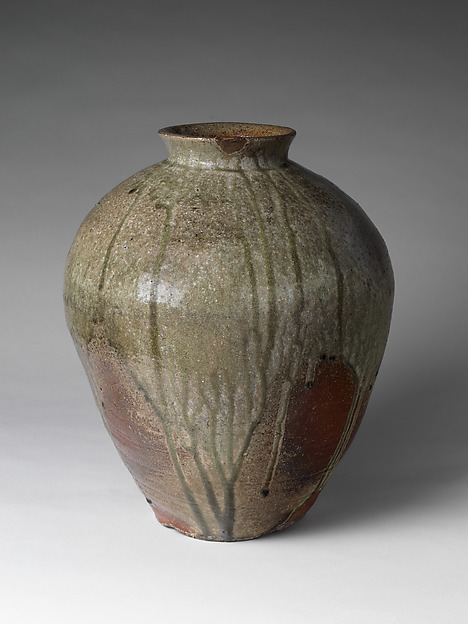
14th–15th century. Stoneware with natural ash glaze (Tanba ware). The Metropolitan Museum of Art, accession 2002.447.16. Dr. and Mrs. Roger G. Gerry Collection, Bequest of Dr. and Mrs. Roger G. Gerry, 2000. Open Access.
Look closer: A Tanba ware jar of the fourteenth or fifteenth century with natural ash glaze: no decoration is needed.
The Metropolitan Museum of Art, public domain (Open Access). Source: https://www.metmuseum.org/art/collection/search/49271
Seen together, the two halves explain why the movement has the character of a faith. Yanagi himself admitted, according to Wikipedia, that his theory was not simply a craft movement based on aesthetics but a spiritual movement in which craftsmen should work according to ethical and religious ideals if beauty were to be achieved. Beauty was also, in his opinion, unchanging, created by an immutable spirit: Song period ceramics and medieval Gothic architecture came, in his view, from the same spirit, and the present and the past were joined by beauty.
That is a large claim, and it has a practical corollary. If beauty is a gift of self-surrender and not of skill, then the maker’s fame is irrelevant, and so is the maker’s name. It is why a movement of such intellectual energy was so interested in objects with no author.
Journal, Association, Shop and Museum
Yanagi’s movement had an unusual completeness. Wikipedia identifies three manifestations of it. The first is the museum, where objects judged to be truly mingei were shown in order to establish a standard of beauty. The second is the Japan Folk Craft Association, Nihon Mingei Kyōkai, founded in 1931, which promotes his ideals throughout Japan and publishes two monthly magazines. The third is Takumi, a shop that acts as a major folk craft retail outlet in Tokyo.

Period engraving. Edward S. Morse, Japanese Homes and Their Surroundings (Boston: Ticknor and Company, 1886), figure 177. Wood-engraved illustration, public domain.
Look closer: A stair-tansu in the version Morse found in a kitchen: stairs and storage as one piece of joinery.
Edward S. Morse, 1886, public domain, via Project Gutenberg ebook 52868. Source: https://www.gutenberg.org/ebooks/52868
The magazines were the first engine. Kōgei began in 1931, and a second magazine, Mingei, was launched in 1939 and remains the official organ of the association. The Yanagi article gives Kōgei’s years as 1931 to 1951, while the mingei article says it was absorbed into Mingei in 1952, so this chapter notes only that the two magazines were later merged. Whatever the exact year, the effect was the same: a continuous voice that carried the theory to readers who would never visit Tokyo.
The museum, in turn, is the movement’s physical argument. It is described in more detail in the next chapter of this wing, which also follows the makers who worked within the movement. Here it is enough to say that Yanagi, with financial help from a few wealthy Japanese businessmen, was able to open the Japan Folk Crafts Museum in 1936, and that the museum’s opening exhibition, Wikipedia says, was an Exhibition of Crafts by Contemporary Artists with work by potters such as Hamada Shōji, Kawai Kanjirō and Tomimoto Kenkichi.
The shop completes the cycle. A movement that insists that beauty lives in cheap, useful things needs somewhere for the cheap, useful things to be bought, and Takumi existed so that a person who had been persuaded to love a plain bowl could take one home.
William Morris and the Arts and Crafts Question
Yanagi’s emphasis on nature, cooperation and the dignity of handwork has an obvious English cousin. Wikipedia’s article on mingei says that his criticism of modern industrialised society echoed the theories of William Morris and the followers of the Arts and Crafts movement in the United Kingdom. Both men argued that there was a close connection between the incentive for profit and the quality of work produced under a capitalist system of wage labour.

Period engraving. Edward S. Morse, Japanese Homes and Their Surroundings (Boston: Ticknor and Company, 1886), figure 27. Wood-engraved illustration, public domain.
Look closer: Morse’s plate of an adze, saws and planes, the hand tools of the Japanese carpenter.
Edward S. Morse, 1886, public domain, via Project Gutenberg ebook 52868. Source: https://www.gutenberg.org/ebooks/52868
The difference, the article suggests, lies in what each wanted to change. Morris’s immediate enemy was the division of labour afforded by mechanisation and industrialisation, and he asked society to change. Yanagi’s was individualism, and he asked individuals to change: change the nature of society, said Morris; change the nature of individualism, said Yanagi, if people wished to have beauty in their lives. A second difference is the Buddhist thinking Yanagi introduced, drawn especially from Daisetsu Suzuki and Kitarō Nishida, which was completely lacking in the British movement.
Whether Yanagi learned from Morris is a long-running question. Wikipedia reports the scholar Brian Moeran’s argument that two of Yanagi’s closest friends, the potters Bernard Leach and Tomimoto Kenkichi, introduced him to Morris’s ideas, but adds that Yanagi was already deeply steeped in Western science, philosophy, literature and art, and that numerous articles on Ruskin and Morris had been published in Japanese before he outlined mingei. It adds that although Yanagi and his followers denied any debt, the similarities are too many to ignore, while similarity in thought should not be taken for identity.
The scholar Yuko Kikuchi goes further. As summarised in the same article, she has argued that mingei theory is a hybridisation and appropriation of Occidental ideas such as Morris’s, and that Yanagi’s failure to recognise the influence echoed the cultural nationalism of Japanese intellectuals at the time. This chapter does not decide the question. It records that the answer matters for how the movement is told, and that the Wikipedia article and its sources are the place to follow it further.
Colonial Eyes, Korean Sorrow and Cultural Nationalism
The movement’s Korean beginnings are also its most contested part. Wikipedia records that Yanagi defined a beauty of sadness, hiai no bi, as the innate, original beauty created by the Korean race, and that he believed a long history of foreign invasions of Korea was reflected in Korean art, especially in the sad and lonely lines of its pottery. Korean scholars, the article says, have criticised the theory as an aesthetic of colonialism, and Korean intellectuals have called Yanagi’s Korea and its Art a colonialist view of history.
The picture is not one-sided. The Yanagi article adds that after the March First Movement of 1919, the independence movement in which thousands of Koreans died at the hands of the Japanese police and military, Yanagi wrote articles in 1919 and 1920 expressing sympathy for the Korean people and appreciation for Korean art, and that his theory of the beauty of sorrow has been said to have influenced the Korean idea of han. The same article also records that he cautioned against the independence movement, and that in 1984 he was posthumously awarded the Bogwan Order of Cultural Merit, the first non-Korean to receive it.

19th century. Elm-bark fiber with appliqué of indigo-dyed tabby (atsushi). The Metropolitan Museum of Art, accession 1980.29. Gift of Mrs. Risa Sussman, 1980. Open Access.
Look closer: A nineteenth-century Ainu robe of elm-bark fibre with indigo appliqué, the kind of object Yanagi gathered from Hokkaidō.
The Metropolitan Museum of Art, public domain (Open Access). Source: https://www.metmuseum.org/art/collection/search/70652
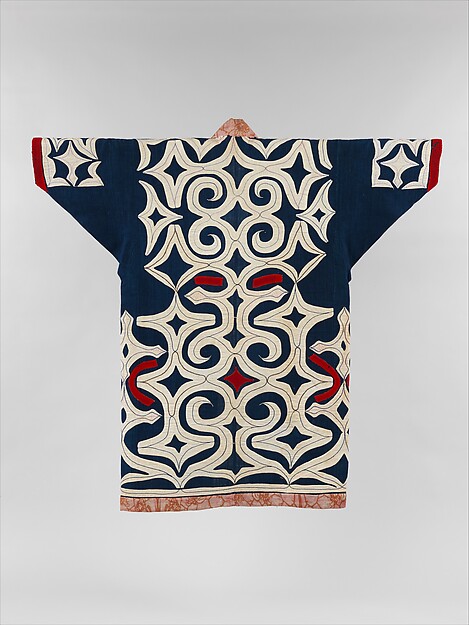
Cotton and wool with applique (kiri-fuse). The Metropolitan Museum of Art, accession 67.172.2. Seymour Fund, 1967. Open Access.
Look closer: A robe with cut-cloth appliqué in swelling spirals, in cotton and wool.
The Metropolitan Museum of Art, public domain (Open Access). Source: https://www.metmuseum.org/art/collection/search/65614
Kikuchi’s argument, as the mingei article reports it, is that the formation of mingei theory cannot be separated from power relations and nationalism. When Yanagi put forward his criterion of beauty in Japan in 1927, it was a period of rising militarism, and he applied the criterion to the crafts of the Okinawans and the Ainu in the Japanese peripheries and to those of the colonies, including Korea, Taiwan and Manchuria. Kikuchi called the pattern Oriental Orientalism, and Moeran has called it inverse or counter-orientalism.
A useful reading of these critiques is not that mingei objects are less beautiful, or that Yanagi’s eye was unreliable, but that every way of seeing has a position and a history. The Korean jars, the Ainu robes and the Ryūkyū textiles that fill this chapter were made by people with their own names, communities and ideas, and the habit of calling them nameless is Yanagi’s habit, not theirs.

18th century. Cotton. The Metropolitan Museum of Art, accession 1989.207. Mrs. Teruyoe Shinohara Gift, 1989. Open Access.
Look closer: Eighteenth-century bingata from the Ryūkyū Islands, one of the regions Wikipedia names as sources of Yanagi’s collection.
The Metropolitan Museum of Art, public domain (Open Access). Source: https://www.metmuseum.org/art/collection/search/44589

19th century. Resist-dyed and painted (bingata) silk crepe. The Metropolitan Museum of Art, accession 2001.428.56. Purchase, Roy R. and Marie S. Neuberger Foundation Inc. and several members of The Chairman's Council Gifts, 2000 Benefit Fund, and funds from various donors, 2001. Open Access.
Look closer: A nineteenth-century Ryūkyū robe in resist-dyed and painted silk crepe.
The Metropolitan Museum of Art, public domain (Open Access). Source: https://www.metmuseum.org/art/collection/search/61851
National Treasures, the Mingei Boom and Its Paradoxes
After the Second World War, Wikipedia says, many of Japan’s traditional ways were destroyed. The outbreak of the Korean War in 1950 led the Japanese government to institute a system to protect what it considered the national treasures of Japan and individual artist-craftsmen, popularly called ningen kokuhō, living national treasures, holders of important intangible cultural skills. Hamada Shōji’s article records that the Cultural Property Protection Act was amended in May 1954, and that in 1955 Hamada was designated a Living National Treasure, the first time for someone from the field of crafts.
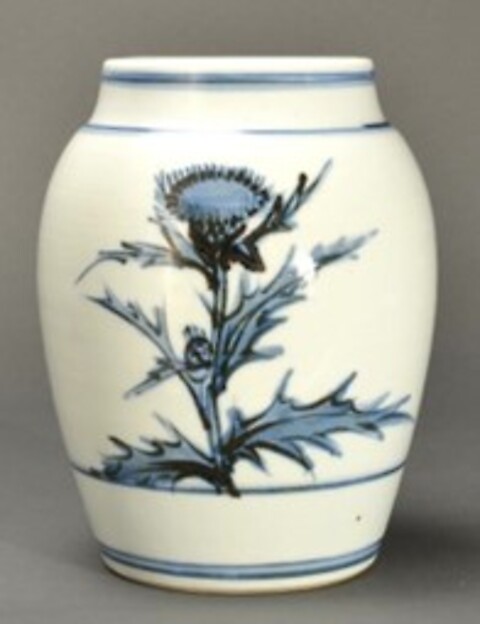
Kondō Yūzō, ca. 1950. Porcelain with underglaze cobalt blue. The Metropolitan Museum of Art, accession 2024.443.6. Mary and Cheney Cowles Collection, Gift of Mary and Cheney Cowles, 2024. Open Access.
Look closer: Made around 1950 by Kondō Yūzō: a twentieth-century porcelain jar with a thistle drawn in cobalt.
The Metropolitan Museum of Art, public domain (Open Access). Source: https://www.metmuseum.org/art/collection/search/902207
These developments helped the spread of Yanagi’s ideas, the mingei article says, so that by about 1960 the concept was known not just to a small circle in Tokyo, Kyoto and Osaka but, through the media, to almost everyone in Japan. The result was an enormous consumer demand for handmade folk crafts, which many people took to include things as far from Yanagi’s thought as toothpicks and log cabins. The demand, called the mingei boom, lasted until the mid-1970s, then gradually declined until, by the 2000s, it had become almost irrelevant to contemporary Japanese.
The boom produced paradoxes, which the article numbers. Yanagi had said beauty would be born, not created, in a communal society, but consumer demand led to mechanisation that relied far less on cooperative work. Mechanisation also reduced the use of the natural, local materials he had insisted on. Media exposure encouraged the emergence of the artist-craftsman, the geijutsuka, intent on making money, and the gradual disappearance of the less profit-motivated unknown craftsman. Consequently, mingei as folk craft gradually came to be seen as mingei as folk art, which is the very label Yanagi had rejected.
Purists also complained. New kilns were set up everywhere, and the day of the instant potter had arrived, they said, to accompany the other instants of everyday life in Japan: coffee, noodles and geisha. The average craftsman, in this view, was interested in mingei for the money rather than for its beauty, and the whole thing was little more than an urban elitist fad. That judgement is not this chapter’s, but it is reported here because it shows how a movement can be undone by its own success.
Hamada, Kawai and Leach: Three Potters
The movement was a conversation among friends, and three potters stand at its centre. Hamada Shōji, born in Kawasaki in 1894, studied ceramics at the Tokyo Institute of Technology with Kawai Kanjirō under Itaya Hazan. As the only students at the school who wished to become artist-potters, Wikipedia says, they soon became friends. They worked together in Kyoto, experimenting on glazes with various minerals. Kawai’s article says the two are said to have conducted more than ten thousand experiments on glazes.
Kawai Kanjirō, born in Yasugi, Shimane, in 1890, built his own climbing kiln in Kyoto in 1920, the Shokeiyo, with eight chambers. Trained in chemical glazes and widely recognised for them in his early twenties, he was ultimately dissatisfied and, thanks in large part to a chance encounter with Yanagi and Hamada, turned to natural glazes and to nature. He is regarded as a master of glazes, especially warm red copper, rich brown iron, chrome and cobalt, and his pots come in asymmetrical shapes with techniques such as slip trailing, wax resist and white slip.
Kawai refused all official honours, including the designation of Living National Treasure, and, like Hamada, never signed his work. He is quoted as saying that his work itself was his best signature. A 1953 book of his writings was titled We Do Not Work Alone. The cheerful paradox of the movement is plain: it prized anonymity, and its leading figures were among the best-known craftsmen in Japan.
The third, Bernard Leach, was born in Hong Kong in 1887 and returned to Japan in 1909, intending to teach etching. Wikipedia says he joined the Shirakaba group of writers and artists with Yanagi, took up pottery about 1911 and studied under Urano Shigekichi, the sixth Kenzan. Hamada, deeply impressed by a Tokyo exhibition of Leach’s ceramics, wrote to him and became a friend. When Leach decided in 1920 to return to England, Hamada accompanied him, and the two established the Leach Pottery at St Ives in Cornwall, building a traditional Japanese climbing kiln, the first built in the West.

Period engraving. Edward S. Morse, Japanese Homes and Their Surroundings (Boston: Ticknor and Company, 1886), figure 212. Wood-engraved illustration, public domain.
Look closer: A lamp of Iga ware from Morse’s own collection, with a slot in the handle so that it can be hung from a wall.
Edward S. Morse, 1886, public domain, via Project Gutenberg ebook 52868. Source: https://www.gutenberg.org/ebooks/52868
Hamada returned to Japan in 1923 after three years at St Ives, travelled to potteries and stayed for some weeks at Tsuboya in Okinawa, and eventually established his workshop in Mashiko, about 100 kilometres north-east of Tokyo. There, Wikipedia says, he committed himself to using only materials found locally, including clay, glazes and even the brushes he made himself from dog hair and bamboo. His work in Mashiko, and its effect on the town, is the subject of a separate page on this site, linked below.
Leach carried the movement westward. His A Potter’s Book of 1940 defined his craft philosophy, and Wikipedia reports that his advocacy of simple, utilitarian forms had a lasting influence on counter-culture and modern design in North America. He translated and adapted Yanagi’s The Unknown Craftsman for its 1972 English edition, and Wikipedia’s article on Leach says the Times described his role in establishing the mingei movement in the United Kingdom.
Looking at Ordinary Things: Jars, Cloth, Baskets
The best way to understand the mingei idea is to look at the kind of object it loves. The pictures in this section are not all strictly Yanagi’s examples; they are objects from the Metropolitan Museum’s Open Access collection that illustrate the categories he collected: pottery, textiles, basketry and woodwork. Labels and dates are the museum’s.
Start with the Korean jars. Wikipedia’s mingei article names Joseon ceramics as the beginning of his enthusiasm, and the Met holds several. The moon jar of the later eighteenth century is simply a rounded white porcelain vessel whose beauty is in its proportion and the softness of its glaze. A fifteenth- or sixteenth-century covered jar is plainer still. Even a jar painted with a dragon in iron brown, or a leaf in copper red, uses decoration the way a speaker uses a gesture: quickly, and without fuss.
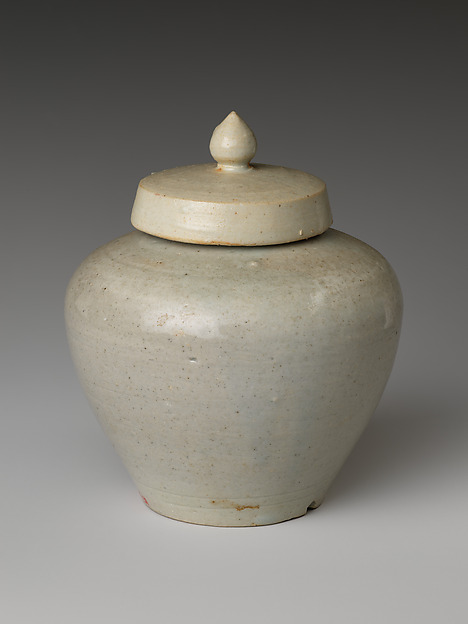
15th–16th century. Porcelain. The Metropolitan Museum of Art, accession 2022.267.2a, b. Gift of the children of Lea R. Sneider, 2022. Open Access.
Look closer: A small Korean covered jar of the fifteenth or sixteenth century, shown to give a sense of the range Yanagi collected.
The Metropolitan Museum of Art, public domain (Open Access). Source: https://www.metmuseum.org/art/collection/search/853841
Move to cloth. The Ainu robes of the nineteenth century, in elm-bark fibre and in cotton and wool with appliqué, and the bingata of the Ryūkyū Islands, belong to the regions Wikipedia names as sources of Yanagi’s collection, Hokkaidō and Okinawa. Futon covers, as plain as bed linen and as lively as any painting, show that even the thing one sleeps beneath could be dyed with a crane, a turtle and the three friends of winter. The pieces are admired today by museums, which is part of the movement’s success and part of its irony.

early 19th century. Cotton. The Metropolitan Museum of Art, accession 65.44.1. Rogers Fund, 1965. Open Access.
Look closer: An early nineteenth-century futon cover in painted and printed cotton, the pattern running without a break from edge to edge.
The Metropolitan Museum of Art, public domain (Open Access). Source: https://www.metmuseum.org/art/collection/search/70388

19th century. Cotton. The Metropolitan Museum of Art, accession 2004.559.1. Gift of Sue Cassidy Clark, in honor of Dr. Barbara Brennan Ford, 2004. Open Access.
Look closer: A nineteenth-century cover whose auspicious motifs are drawn in resist: bedding as a blessing.
The Metropolitan Museum of Art, public domain (Open Access). Source: https://www.metmuseum.org/art/collection/search/72664
Then to basketry. A bamboo basket of the nineteenth century has no signature and no school, and its beauty is the beauty of a structure in which each strip does a job. The Met’s Edward C. Moore collection, bequeathed in 1891, holds many.

19th century. Bamboo. The Metropolitan Museum of Art, accession 91.1.2082. Edward C. Moore Collection, Bequest of Edward C. Moore, 1891. Open Access.
Look closer: A seventeen-and-a-half-inch bamboo basket of the nineteenth century, with a high handle and a lattice weave.
The Metropolitan Museum of Art, public domain (Open Access). Source: https://www.metmuseum.org/art/collection/search/62182
Last, a very large jar. A storage jar of Tanba ware of the fourteenth or fifteenth century, with natural ash glaze, carries no painted decoration, and the streaks of ash glaze that ran during the firing are the decoration. In the language of self-surrender, this is decoration that the maker has left to the kiln. It is a good place to end, because it shows that the ideal is not only a theory: in a wood-fired kiln the maker really does give up part of the work to fire.
Regional and International Parallels
The movement had cousins in several countries, and the sources for this chapter record a handful. The British Arts and Crafts movement, discussed above, is the closest. Wikipedia’s article on Bernard Leach shows the other direction of travel: Leach established a pottery in Cornwall that trained apprentices from across the world, among them Michael Cardew, Katherine Pleydell-Bouverie and his son David Leach in Britain, Warren MacKenzie and Byron Temple from the United States, four Canadian potters who shaped the pottery scene in Vancouver and on the west coast during the 1960s and 1970s, the New Zealander Len Castle, the Cypriot Valentinos Charalambous and an Indian potter, Nirmala Patwardhan.
Two conferences in 1952 made the movement international. Leach and Muriel Rose organised an International Conference of Potters and Weavers at Dartington Hall in July of that year, with Hamada and Yanagi among the participants, and Wikipedia quotes Brent Johnson’s verdict that it organised the modern studio pottery movement and gave Leach, Hamada and Yanagi celebrity status. That same year a pottery seminar at Black Mountain College in the United States, attended by many younger and later prominent potters, had Leach, Hamada and Yanagi as influential participants.
Hamada’s influence was felt in the United Kingdom and the United States, and, as Wikipedia notes, in India, where a young Sardar Gurcharan Singh met him and developed his own style. Wikipedia’s see-also list for mingei also names the Mingei International Museum in San Diego.
Yanagi’s own influence, in the article on him, extended to the potter Bernard Leach, the sculptor Isamu Noguchi and the architect Bruno Taut. His son, Sori Yanagi, was a renowned industrial designer, and the family’s craft continued in his great-grandnephew Shinya Yanagi, a weaver of the third generation of the Yanagi family of weavers. The interior and design chapters of the Athenaeum pick up that thread.
Edmund de Waal’s criticism of Leach supplies another parallel. In the West, Wikipedia reports, Leach was seen as a natural child of the East, and in the East as someone who saw deeper into Japanese culture than any Westerner since Lafcadio Hearn. De Waal’s 1998 book called this picture into question and noted that Leach could barely speak Japanese at the time of his training with Kenzan VI.
The Movement by Era
The dates below are given in the sources named. Where two sources disagree, the table says nothing about the year or gives a range.
| Date | What the sources say | Source |
|---|---|---|
| 1889 | Yanagi Sōetsu is born, a son of a hydrographer of the Imperial Navy | Wikipedia, Yanagi Sōetsu |
| 1894 and 1890 | Hamada Shōji is born in Kawasaki; Kawai Kanjirō is born in Yasugi | Wikipedia, Hamada and Kawai |
| 1909 | Bernard Leach returns to Japan to teach etching | Wikipedia, Bernard Leach |
| 1916 | Yanagi’s first trip to Korea | Wikipedia, Mingei and Yanagi |
| 1920 | Leach and Hamada found the Leach Pottery, St Ives; Kawai builds his kiln in Kyoto | Wikipedia, Leach and Kawai |
| 1923 and 1924 | Hamada returns to Japan; Yanagi opens the Chōsen Folk Art Museum in Seoul | Wikipedia, Hamada and Mingei |
| 1925 | The word mingei is coined | Wikipedia, Mingei |
| 1926 | Yanagi formally declares the Folk Craft Movement | Wikipedia, Mingei |
| 1928 | Kōgei no Michi, The Way of Crafts, published | Wikipedia, Mingei |
| 1931 | The magazine Kōgei begins; the Japan Folk Craft Association is founded | Wikipedia, Mingei |
| 1936 | The Japan Folk Crafts Museum opens in September | Wikipedia, Japan Folk Crafts Museum |
| 1939 | The magazine Mingei is launched | Wikipedia, Mingei |
| 1940 | Leach’s A Potter’s Book is published | Wikipedia, Bernard Leach |
| 1952 | Dartington Hall conference and Black Mountain College seminar | Wikipedia, Bernard Leach and Yanagi |
| 1955 | Hamada is designated a Living National Treasure | Wikipedia, Hamada |
| 1961 | Yanagi dies; Hamada becomes second director of the museum | Wikipedia, Yanagi and Hamada |
| About 1960 to mid-1970s | The mingei boom | Wikipedia, Mingei |
| 1972 | The Unknown Craftsman appears in English, adapted by Bernard Leach | Wikipedia, Mingei |
| 1977 and 1978 | Hamada opens the Mashiko Sankōkan; Hamada dies | Wikipedia, Hamada |
| 1984 | Yanagi is posthumously awarded the Bogwan Order of Cultural Merit | Wikipedia, Yanagi |
Sites to Visit
The movement left a map of places that can still be visited, and each is named in the sources used here. Check opening days before travelling, as museum hours change.
| Place | What there is | Source |
|---|---|---|
| Japan Folk Crafts Museum, Komaba, Meguro, Tokyo | The founding museum, with a stone-roofed nagaya-mon gate brought from Tochigi Prefecture, a main building of 1936, a new building of 1982 and Yanagi’s former residence | Wikipedia, Japan Folk Crafts Museum |
| Kawai Kanjirō’s House, Gojōzaka, Kyoto | His house, restored in 1973 and now a museum run by his relatives, with his ceramics, sculpture and woodcarvings, tansu and tatami, and the studio and noborigama kiln at the rear | Wikipedia, Kawai Kanjirō |
| Mashiko Sankōkan, Mashiko, Tochigi | Hamada’s museum of 1977 at his home, with the collection of folk crafts he gathered from Japan and abroad | Wikipedia, Hamada Shōji |
| Mashiko Museum of Ceramic Art | Hamada’s residence, donated and rebuilt there in 1989, with his studio, living quarters and craft collections | Wikipedia, Hamada Shōji |
| Mashiko pottery festivals | Twice a year, in the first week of May and the first week of November, potters and craftsmen set up stalls in the town | Wikipedia, Mashiko ware |
| Leach Pottery, St Ives, Cornwall | Still in operation, with a museum of pieces by Leach and his students | Wikipedia, Bernard Leach |
| York Art Gallery, England | Holds works by Hamada | Wikipedia, Hamada Shōji |
| Mingei International Museum, San Diego | Named in Wikipedia’s mingei article | Wikipedia, Mingei |
Stories of the Movement
The brush made from a dog. Hamada, Wikipedia says, committed himself in Mashiko to using only materials found locally, not only the clay but the glazes and the brushes, which he made himself from dog hair and bamboo. The detail is small, and it is the movement in a sentence: a potter deciding that even the tool that paints the pot should come from the place.

Period engraving. Edward S. Morse, Japanese Homes and Their Surroundings (Boston: Ticknor and Company, 1886), figure 213. Wood-engraved illustration, public domain.
Look closer: A candlestick of Owari pottery from Morse’s own collection.
Edward S. Morse, 1886, public domain, via Project Gutenberg ebook 52868. Source: https://www.gutenberg.org/ebooks/52868
Ten thousand experiments. Hamada and Kawai are said to have conducted more than ten thousand experiments with glazes together in Kyoto. Kawai, who gained wide recognition for chemical glazes while still in his early twenties, was dissatisfied with that early work and turned to natural glazes. The story is a reminder that the movement’s ideal of simplicity was reached by people who had mastered the complicated.
The kiln that wasn’t good. Leach and Hamada built a Japanese climbing kiln at St Ives in 1920, the first in the West. It was poorly built, and was rebuilt in 1923 by Matsubayashi Tsurunosuke. A movement that taught that craft is a matter of the right attitude was undone, briefly, by a matter of bricks.
The honour refused. Kawai refused every official honour, including the Living National Treasure designation that Hamada accepted. What the two friends shared was a refusal to sign their work, and Kawai’s remark that his work itself was his best signature has become one of the movement’s best-known sentences.
Three names. The Yanagi article lists three people on whom he was a considerable influence: the potter Bernard Leach, the sculptor Isamu Noguchi and the architect Bruno Taut. It is a short list that reaches from Cornwall to Berlin, and it shows how far an idea about nameless things travelled on the strength of one named man.
A nagaya-mon in Tokyo. Hamada, who preserved traditional farmhouses, stone warehouses and nagaya-mon gatehouses on his property at Mashiko, is also remembered in the Tokyo museum, whose own gate was brought from Tochigi Prefecture and reconstructed in front of the building. The two properties, a hundred kilometres apart, share a form of architecture and a spirit of rescue.
Fun Facts for the Curious
Each of these is drawn from one of the sources listed at the end of the chapter.
- Yanagi was not himself an artist or a craftsman, Wikipedia is careful to point out.
- Mingei is a hybrid term, written 民藝, from minshū, common people, and kōgei, craft.
- Yanagi’s son was the industrial designer Sori Yanagi, and his great-grandnephew Shinya Yanagi is a weaver.
- Kawai Kanjirō’s kiln firing lasted forty-eight hours, consumed more than two thousand bundles of firewood and reached 1,350 degrees Celsius.
- Kawai’s house in Kyoto combines Japanese and Western living styles, with tansu and tatami and some Western furnishings.
- Hamada was the first craftsperson to be designated a Living National Treasure, in 1955.
- The Leach Pottery’s climbing kiln of 1920 was the first Japanese climbing kiln in the West.
- Leach could barely speak Japanese when he began to study under Kenzan VI, according to Edmund de Waal.
- In 1952 Yanagi was an honoured lecturer at the pottery seminar at Black Mountain College in the United States.
- The Japan Folk Crafts Museum’s opening exhibition, in September 1936, had work by Hamada, Kawai and Tomimoto Kenkichi.
- An Important Cultural Property in the museum’s collection is a painted Karatsu jar with a reed pattern, registered in 2003.
- The Japan Society in New York showed Kawai Kanjirō: House to House from 10 March to 10 May 2026, which Wikipedia calls the first United States retrospective of his work.
Modern Facts: Boom, Revival and Memory
Mingei has had a double afterlife. The boom of the postwar decades has passed, and Wikipedia says that by the 2000s the concept had become almost irrelevant to contemporary Japanese. Yet the three institutions Yanagi founded are all still at work: the museum in Komaba, the association and its magazine, and the Takumi shop in Tokyo.
The museum, managed today by the Japanese Folk Crafts Museum Foundation, a public interest corporation, has also been reinforced and renovated. Wikipedia reports that in 2001 each of its buildings was reinforced and renovated with support from the Nippon Foundation. Its main building and the Western building, Yanagi’s former residence, are Tokyo-designated tangible cultural properties.
Kawai’s work reached a wider audience abroad in 2026, with the first United States retrospective. Hamada’s Mashiko, meanwhile, continues as a destination for day tourists and a working pottery town, with two festivals a year and a line of potters who followed him there, among them his students Shimaoka Tatsuzō and Kamoda Shōji. Wikipedia says that after Hamada, people looking to return to a more traditional Japanese lifestyle settled in the area.
The questions the critics raised have also settled into the literature. Books named in the sources’ reading lists include Kim Brandt’s Kingdom of Beauty: Mingei and the Politics of Folk Art in Imperial Japan, Yuko Kikuchi’s Japanese Modernization and Mingei Theory, Brian Moeran’s Folk Craft Potters of Onta, Japan, and Yanagi’s own The Unknown Craftsman and the Penguin selection The Beauty of Everyday Things. A reader who wants the movement’s own voice, and its critics, will find both there.
Glossary of Folk Craft
A short vocabulary of the movement and the objects it admired.
| Term | Meaning |
|---|---|
| Mingei | Folk craft; from minshū, common people, and kōgei, craft |
| Minshū | Common people |
| Kōgei | Craft |
| Bijutsu | Fine art, the category from which Yanagi wished to separate mingei |
| Chokkan | Direct perception, the seeing eye; looking without prior knowledge in the way |
| Tarikidō | Self-surrender, the way of other power, the maker’s discipline |
| Nihon Mingei Undō | The Japanese Folk Craft Movement |
| Nihon Mingeikan | The Japan Folk Crafts Museum, Tokyo |
| Nihon Mingei Kyōkai | The Japan Folk Craft Association |
| Takumi | The folk craft shop in Tokyo |
| Kōgei no Michi | The Way of Crafts, Yanagi’s first complete book, 1928 |
| Hiai no bi | The beauty of sadness, Yanagi’s theory of Korean art, now widely criticised |
| Ningen kokuhō | Living National Treasure, a holder of an important intangible cultural property |
| Geijutsuka | An artist, the figure who displaced the unknown craftsman in the boom |
| Noborigama | A climbing kiln with several chambers on a slope |
| Tsutsugaki | A decorative technique named in the Kawai article, there glossed as slip-trailed decoration |
| Bingata | A resist-dyed and painted cloth of the Ryūkyū Islands |
| Nagaya-mon | A long gatehouse with rooms either side of the entrance |
| Ōtsubo | A large storage jar |
A Collector’s Eye for Folk Craft
This house does not value or authenticate individual pieces in its chapters, and the points below are a way of reading the sources, not a test of age.
Look first for use. A mingei piece shows wear in the places where it was held: the rim of a bowl, the handle of a basket, the folds of a quilt cover. Wear that is not in the right place is a reason to ask questions. The same is true of the chests and household things in the earlier chapters of this wing.

Period engraving. Edward S. Morse, Japanese Homes and Their Surroundings (Boston: Ticknor and Company, 1886), figure 193. Wood-engraved illustration, public domain.
Look closer: The makura: a closed wooden box with a buckwheat-hull cushion, and a case of folded paper.
Edward S. Morse, 1886, public domain, via Project Gutenberg ebook 52868. Source: https://www.gutenberg.org/ebooks/52868
Look next for the absence of a name. Hamada and Kawai never signed their work, which makes the usual habits of looking for a mark both less and more useful. A signature, a seal or a box inscription is evidence of the artist-craftsman’s world, not the unknown craftsman’s; many pieces made by the potters of the movement are authenticated in other ways, by boxes, labels, exhibitions and provenance.
Look then for region. Yanagi said folk crafts should represent the regions where they were made, in local materials. A piece should look as if it belongs to a place: the clay of Mashiko, the bast of the north, the dye of Okinawa. A piece that could have come from anywhere is probably not what he meant.
Look last for the context of the object’s fame. Many things that came to be called mingei did so in the boom, and the paradoxes of that time apply: a piece may be a good and honest object while still belonging to the world of the artist-craftsman and not that of the nameless maker. Neither is a fault, and the distinction helps explain the object.
Folk Craft on the Shelf
The house holds no folk-craft pieces at present, and this chapter does not value or authenticate individual objects. For furniture and household objects of a related kind, see the temple furniture on the shelf, or write to the concierge desk with a question.
Answered plainly
What does mingei mean?
Folk craft. The word, written 民藝, is a hybrid of minshū, common people, and kōgei, craft, coined in 1925 by Yanagi Sōetsu with the potters Hamada Shōji and Kawai Kanjirō, according to Wikipedia.
Who founded the mingei movement?
Yanagi Sōetsu, the philosopher and art critic, 1889 to 1961, who formally declared the Folk Craft Movement in 1926 with a circle of potters and friends.
Is mingei folk art or folk craft?
Yanagi translated it as folk craft, not folk art, to stop people thinking of it as an individually inspired high art. Wikipedia notes that over the years mingei as folk craft came to be seen as folk art.
What are the main characteristics of mingei?
Wikipedia lists natural materials and handwork, traditional methods, simplicity, functionality, plurality, inexpensiveness, anonymity and the beauty of health.
What is the Japan Folk Crafts Museum?
The Nihon Mingeikan, founded by Yanagi in 1936 in Komaba, Meguro, Tokyo, to collect, preserve, research and exhibit mingei. Hamada Shōji became its second director.
What is chokkan?
Direct perception: the idea that a craft object should be seen for what it is, without prior knowledge or analysis coming between object and viewer.
What was Yanagi’s connection to Korea?
He first travelled there in 1916, collected Korean pottery and founded a Chōsen Folk Art Museum in Seoul in 1924. His view of Korean art, especially his idea of a beauty of sadness, has been strongly criticised.
Was mingei influenced by William Morris?
Wikipedia says the similarities with Morris and the Arts and Crafts movement are too many to ignore, though Yanagi and his followers denied it, and that Yanagi added Buddhist thinking absent from Morris.
Who were Hamada Shōji and Kawai Kanjirō?
Two potters and lifelong friends who helped coin the word mingei. Hamada established Mashiko as a pottery centre and was named a Living National Treasure in 1955. Kawai worked in Kyoto and refused all official honours.
What was the mingei boom?
A postwar surge in consumer demand for handmade folk crafts, from about 1960 to the mid-1970s, that made potters comparatively well-off and produced a number of paradoxes for Yanagi’s theory.
Why did Bernard Leach matter to mingei?
He studied pottery in Japan, belonged to Yanagi’s circle, took Hamada to England in 1920, founded the Leach Pottery at St Ives and helped to spread the folk-craft ideal in the West. He also adapted The Unknown Craftsman for its 1972 English edition.
Where can I see mingei today?
At the Japan Folk Crafts Museum in Tokyo, Kawai Kanjirō’s House in Kyoto, the Mashiko museums and the Leach Pottery in Cornwall, among others named in this chapter.
Where next
Sources and image credits
- Mingei, Wikipedia
- Yanagi Sōetsu, Wikipedia
- Shōji Hamada, Wikipedia
- Kawai Kanjirō, Wikipedia
- Bernard Leach, Wikipedia
- Mashiko ware, Wikipedia
- Japan Folk Crafts Museum, Wikipedia
- Edward S. Morse, Japanese Homes and Their Surroundings, 1886, Project Gutenberg ebook 52868 (period wood-engraved illustrations)
- The Metropolitan Museum of Art, Open Access collection
Last reviewed 28 October 2026. Pictures, where shown, are public-domain or open-access and credited beneath each one.
Looking for a piece of Japanese furniture or folk craft with its history intact? The concierge desk replies within one to three business days.
Private concierge
Looking for something in particular?
Describe the piece or the project you have in mind. A senior advisor in Tokyo reads every case file personally and replies within two business days, with fees set out in writing before any work begins.