
Ukiyo-e: A History in Masters | Japonista
Craft and Ceremony Wing · Pictures of the Floating World
Ukiyo-e: A History in Masters
浮世絵
For two and a half centuries the printmakers of Edo sold pictures of the pleasures of a city: its actors, its beauties, its roads and rivers. This chapter follows the story through the six masters whose names are carried by every collector, and through the rules, fashions and accidents that shaped their work.
Fact sheet
At a glance
- A team, not a hand. Production was divided among the artist, the carver, the printer and the publisher, and normally only the artist’s and publisher’s names were credited.
- Ten months. Sharaku appeared suddenly in 1794 and disappeared just as suddenly ten months later; his identity is still unknown.
- A thousand publishers. Wikipedia reports that over a thousand publishers are known from throughout the period, peaking at around 250 in the 1840s and 1850s.
What the Floating World Meant
Ukiyo-e, Wikipedia says, is a genre of Japanese art that flourished from the seventeenth through the nineteenth centuries, producing woodblock prints and paintings of beautiful women, kabuki actors and sumo wrestlers, scenes from history and folk tales, travel scenes and landscapes, flora and fauna, and erotica. The term translates as “picture of the floating world”. After 1603 Edo became the seat of the Tokugawa shogunate, and the chōnin, the merchants, craftsmen and workers at the bottom of the social order, benefited most from the city’s economic growth and began to patronise kabuki, geisha and the courtesans of the pleasure districts. The word ukiyo described that hedonistic way of life. It was homophonous with an older Buddhist term meaning “this world of sorrow and grief”, a pun that gives the genre some of its edge.
The prints were made for the people who lived the life they showed. A merchant could decorate his house with them, and from the Meiji period onward the West took them to be the face of Japanese art. The Met’s impression of Hokusai’s Under the Wave off Kanagawa, made about 1830 to 1832, is the best known of them, but it came late in the story. The genre’s first prints, by Hishikawa Moronobu in the 1670s, used black ink alone, by the article’s account.
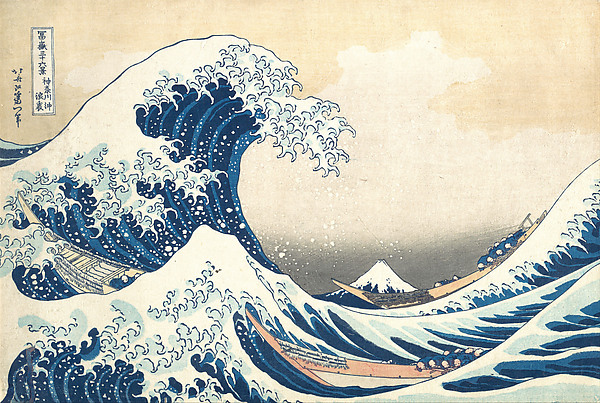
Katsushika Hokusai · ca. 1830–32 · Woodblock print; ink and color on paper
Look closer: the wave’s claw-like foam repeats in smaller waves, and the boats sit in its trough.
Katsushika Hokusai, Under the Wave off Kanagawa (Kanagawa oki nami ura), also known as The Great Wave, from the series Thirty-six Views of Mount Fuji (Fugaku sanjūrokkei), ca. 1830–32. The Metropolitan Museum of Art, H. O. Havemeyer Collection, Bequest of Mrs. H. O. Havemeyer, 1929 (accession JP1847). Public domain, Met Open Access. Record

Dates as given in the cited Wikipedia articles; Sharaku shown for his documented active period
Look closer: the golden decades overlap; the later masters do not meet the earliest.
Diagram by Japonista. Drawn from the facts cited in this chapter; schematic, not to scale.
Moronobu to Harunobu
The earliest ukiyo-e artists came from painting. Hishikawa Moronobu (1618 to 1694), the article says, produced the first ukiyo-e woodblock prints; by 1672 he began to sign his work, and he began to produce illustrations not only for books but as single-sheet images. His pair of lovers in the Met, dated about 1675 to 1680, is printed in strong outline with little background. Colour came gradually. Hand-tinted prints, pink beni-e and lacquer-like urushi-e were followed in 1744 by benizuri-e, the first successes in colour printing, using one block for each colour. Then in 1765, with Suzuki Harunobu’s “brocade prints”, full colour became standard, with ten or more blocks for a print. The Met’s Harunobu pillar print of a beauty under an umbrella in the snow, about 1770, shows his restrained, graceful manner.

Hishikawa Moronobu · ca. 1675–80 · Woodblock print; ink and color on paper
Hishikawa Moronobu, Two Lovers, ca. 1675–80. The Metropolitan Museum of Art, The Francis Lathrop Collection, Purchase, Frederick C. Hewitt Fund, 1911 (accession JP676). Public domain, Met Open Access. Record
The article gives a precise account of how nishiki-e began. The first to emerge were expensive calendar prints, printed with multiple blocks on very fine paper with heavy, opaque inks, with the number of days in each month hidden in the design. They were sent at the New Year as personalised greetings and bore the name of the patron, not of the artist; later the blocks were reused for commercial production, and the patron’s name replaced with the artist’s. The article adds that the later popular colour prints were called nishiki-e, “brocade pictures”, because their brilliant colours resembled imported Chinese brocades.
Kiyonaga, Utamaro and Sharaku
The peak came in the late eighteenth century. Torii Kiyonaga (1752 to 1815) printed realistic, idealised women in the latest fashions on large sheets, often as horizontal diptychs or triptychs; the Met’s triptych of a boating party beneath Azuma Bridge, about 1785, is a perfect example. A law of 1790 required prints to bear a censor’s seal of approval; censorship tightened over the following decades, and from 1799 even preliminary drafts needed approval. A group of Utagawa-school offenders including Toyokuni had their works repressed in 1801, and Utamaro was imprisoned in 1804 for making prints of Toyotomi Hideyoshi.

Kitagawa Utamaro · 1790 · Woodblock print; ink and color on paper
Kitagawa Utamaro, “Hour of the Rat: Mistress,” from the series Women’s Daily Customs (Fuzoku bijin tokei), 1790. The Metropolitan Museum of Art, Rogers Fund, 1922 (accession JP1278). Public domain, Met Open Access. Record
Utamaro (about 1753 to 1806) made his name in the 1790s with bijin ōkubi-e, “large-headed pictures of beautiful women”, focusing on the head and upper torso, a manner others had used for actors. According to the article he experimented with line, colour and printing to bring out subtle differences in features, expressions and backdrops, and his individuated beauties contrast with the stereotyped, idealised images of earlier decades. The Met’s Hour of the Rat: Mistress, from the 1790 series Women’s Daily Customs, shows a mother with her child at close range. The article notes that his output declined after the death of his patron, the publisher Tsutaya Jūzaburō, in 1797, and that Fenollosa and others saw him as a degenerate symbol of decline, a verdict later scholarship reversed.
Sharaku is the stranger case. He appeared suddenly in 1794 and disappeared ten months later; his actor portraits introduced a greater realism that emphasised the differences between the actor and the role, and their expressive, contorted faces contrast with the serene, mask-like faces of Harunobu or Utamaro. Published by Tsutaya, his work met resistance, and in 1795 his output ceased as mysteriously as it began. The Met’s portrait of Ichikawa Ebizō in the play The Colored Reins of a Loving Wife, fifth month of 1794, is one of the best examples. By the article’s account the artist’s real identity is still unknown.
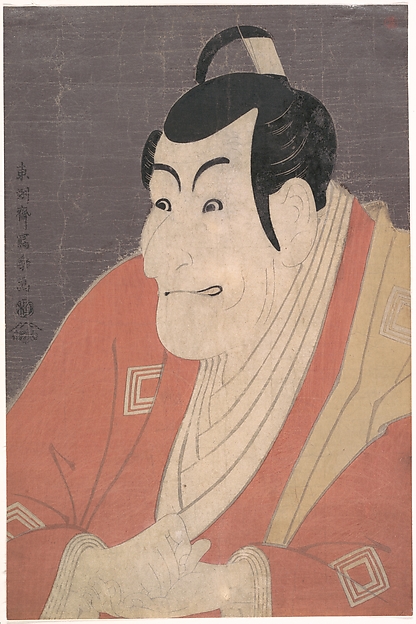
Tōshūsai Sharaku · 5th month, 1794 · Woodblock print; ink and color on paper with mica ground
Tōshūsai Sharaku, Kabuki Actor Ichikawa Ebizō (Ichikawa Danjūrō V) in the play The Colored Reins of a Loving Wife (Koi nyōbō somewake tazuna), 5th month, 1794. The Metropolitan Museum of Art, Harris Brisbane Dick Fund and Rogers Fund, 1949 (accession JP3114). Public domain, Met Open Access. Record
Hokusai and Hiroshige
The Tenpō Reforms of 1841 to 1843, Wikipedia says, sought to suppress displays of luxury, including courtesans and actors, so artists turned to travel scenes and nature. But the landscape had already come into its own with Hokusai (1760 to 1849), the self-proclaimed “mad painter”, whose Thirty-six Views of Mount Fuji popularised the genre. In contrast with the older masters, the article says, his colours were bold, flat and abstract and his subject was the lives and environment of the common people at work. The Great Wave article adds that the series’ use of Prussian blue revolutionised Japanese prints, and that only about a hundred impressions are thought to have survived into the twenty-first century. The Hokusai biography lists his output: the Manga, begun in 1814, a giant Daruma portrait painted in Nagoya in 1817 (a larger festival Daruma of 1804 is reported only as a story), and his stated hope that at one hundred and ten each dot and line would possess a life of its own.
Hiroshige (1797 to 1858) was Hokusai’s greatest rival. According to the article his work was more realistic, subtly coloured and atmospheric, and mist, rain, snow and moonlight were prominent. He is best known for the Fifty-three Stations of the Tōkaidō and the Sixty-nine Stations of the Kisokaidō. The Met holds Sudden Shower at Shōno from the Tōkaidō series, 1834 to 1835, with its travellers bent beneath a driving diagonal of rain, and Sudden Shower over Shin-Ōhashi Bridge and Atake from the 1857 series One Hundred Famous Views of Edo. The article observes that Hiroshige’s adopted son and son-in-law, Hiroshige II and III, carried his style into the Meiji era.
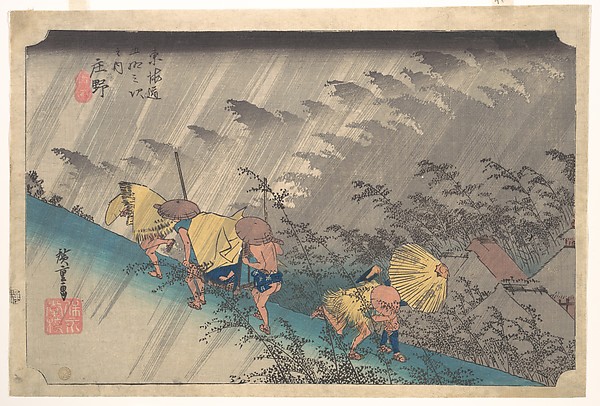
Utagawa Hiroshige · 1834–35 · Woodblock print; ink and color on paper
Utagawa Hiroshige, Sudden Shower at Shōno, from the series Fifty-three Stations of the Tōkaidō, 1834–35. The Metropolitan Museum of Art, Rogers Fund, 1914 (accession JP41). Public domain, Met Open Access. Record
The house’s own essays go deeper on each: see Hokusai’s Great Wave: Impressions, Editions and Faithful Recuts, Why You Might Regret Discovering Hokusai and Hiroshige: The Tōkaidō, Edo and the Poetry of Weather.
Kuniyoshi, Yoshitoshi and the Meiji Light
The Utagawa school came to dominate late Edo output. Kuniyoshi (1797 to 1861), by the article’s account, tried a variety of themes and styles much as Hokusai had; his historical scenes of warriors in violent combat were popular, especially the Suikoden heroes of 1827 to 1830 and Chūshingura of 1847, and he was adept at landscape and satire. The Met’s triptych Ghosts of the Taira at Daimotsu Bay, 1843 to 1847, sets spectral warriors and a ship across a great dark-blue sea. See the house essay Kuniyoshi: Warriors, Cats and Spectres.
The article says that synthetic pigments imported from Germany began to replace traditional organic ones in the mid-nineteenth century and that many prints of the time made extensive use of a bright red, called aka-e, “red pictures”. Yoshitoshi (1839 to 1892) led a trend in the 1860s of gruesome scenes of murder and ghosts, monsters and heroes; his One Hundred Aspects of the Moon (1885 to 1892) depicts fantastic and mundane themes with a moon motif. The Met holds his triptych of 1868, The Spirit of Akugenta Yoshihira Strikes Nanba Jirō, in which a spirit blasts rays of red through black cloud, and his 1888 print Waking Up: A Girl of the Kōka Era, a young woman in a blue kimono beside morning glories. See Yoshitoshi and the Last Great Ukiyo-e Master.
Kiyochika (1847 to 1915), the article says, is known for prints documenting the modernisation of Tokyo, railways, and Japan’s wars with China and with Russia; his Fireworks at Ikenohata of 1881, in the Met, shows a crowd in silhouette under rockets and paper lanterns. After the deaths of Hokusai and Hiroshige and the Restoration of 1868 the article says ukiyo-e suffered a sharp decline; woodblock printing turned to journalism and faced competition from photography, and by the 1890s the tradition was moribund.
How the West Came to Own Them
Wikipedia traces the Western discovery from the Swedish naturalist Carl Peter Thunberg at Dejima and the Dutch merchant Isaac Titsingh to the arrival of Commodore Perry in 1853. Prints appeared in Paris from at least the 1830s, and Japanese art drew notice at the International Exhibition of 1867. The art critic Philippe Burty coined the term Japonism. Collectors included Degas, who traded his own paintings for prints, and Van Gogh, who painted oil copies of prints by Hiroshige and Eisen. Toulouse-Lautrec signed work with his initials in a circle, imitating the seals on Japanese prints.
The article records a darker note. The Paris dealer Tadamasa Hayashi’s Tokyo office exported ukiyo-e in such quantities that Japanese critics later accused him of siphoning Japan of its national treasure. The largest collection, with over 100,000 items, is at the Museum of Fine Arts, Boston, begun when Ernest Fenollosa gave his collection in 1912, and the British Museum began collecting in 1860. When the prints reached the West, the article adds, woodblock printing was the most common mass medium in Japan and the Japanese considered it of little lasting value. The tale of the next chapters, the process and the afterlife of the prints, begins there. See How a Print Was Made and Shin-hanga and Sōsaku-hanga.
Six Masters Compared
The table compares the six masters of the brief by the characteristic each is remembered for, as the sources above describe them.
| Master | Dates | Known for | Characteristic |
|---|---|---|---|
| Utamaro | About 1753 to 1806 | Bijin ōkubi-e | Large-headed portraits of individuated beauties |
| Sharaku | Active 1794 to 1795 | Kabuki actor portraits | Realism and expressive, contorted faces |
| Hokusai | 1760 to 1849 | Landscapes; Thirty-six Views | Bold, flat colour; Prussian blue |
| Hiroshige | 1797 to 1858 | Travel series | Atmosphere, weather, subtle colour |
| Kuniyoshi | 1797 to 1861 | Warriors, heroes, satire | Violent combat and spectres |
| Yoshitoshi | 1839 to 1892 | Ghosts, Hundred Aspects of the Moon | Gruesome and supernatural scenes; the last great master |
Stories, Legends and Slender Facts
Every master in this chapter has a story attached, and a careful reader learns to ask of each one which part is record and which part is legend. Wikipedia’s account of Hokusai is a good example. It counts at least thirty names across his life, more than any other major Japanese artist, and the name changes divide his career into periods. He was Shunrō when he published his first actor prints in 1779, took the name Hokusai in the late 1790s (“north studio”, a reference to the North Star deity of Nichiren Buddhism), became Taito in 1811 when he began the drawing manuals, and signed himself Gakyō Rōjin Manji, “the old man mad about art”, from 1834. His colophons count his years like a man ticking off milestones: “at seventy-three”, “at eighty-six”.
Two episodes belong to the borderland between fact and fable. On 5 October 1817 he is recorded painting a gigantic Daruma, measuring 18 by 10.8 metres, outside the Nagoya branch temple of Hongan-ji; the original was destroyed in 1945. A second tale, of a still larger Daruma drawn with a broom and buckets of ink at an Edo festival in 1804, is reported by the same source as a story rather than a documented event. In 1839 a fire destroyed his studio and much of his work. At eighty-three he travelled to Obuse and painted there from 1842 to 1843. He died in Edo on 10 May 1849 aged eighty-eight, and is reported to have said that he needed only five more years. His youngest daughter, Ei, known as Ōi, worked as his assistant and is the subject of the manga and film Miss Hokusai, released in Japan on 28 May 2021.
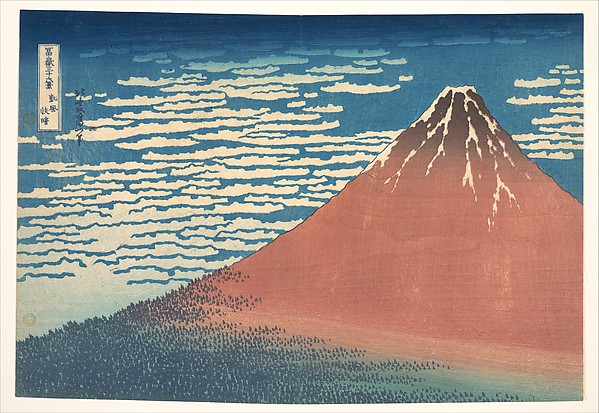
Katsushika Hokusai · ca. 1830–32 · Woodblock print; ink and color on paper
Look closer: the mountain is almost abstract: a flat red cone, a dark base of forest, and a few white clouds.
Katsushika Hokusai, South Wind, Clear Sky (Gaifū kaisei), also known as Red Fuji, from the series Thirty-six Views of Mount Fuji (Fugaku sanjūrokkei), ca. 1830–32. The Metropolitan Museum of Art, Rogers Fund, 1914 (accession JP9). Public domain, Met Open Access. Record
Hiroshige’s legend is quieter. Born Andō Tokutarō in 1797, he inherited the post of fire warden for the Yayosu Quay area in 1809, when he was twelve, after both parents had died within the same year. He began to paint under Toyohiro about the age of fourteen and by 1812 had permission to sign as Hiroshige. In 1832 he joined an official procession to Kyoto and sketched the Tōkaidō along the way; the Fifty-three Stations of the Tōkaidō of 1833 to 1834, drawn from some 490 kilometres of road, made his name. In 1856 he “retired from the world” and became a Buddhist monk, the same year in which he began One Hundred Famous Views of Edo. He died on 12 October 1858 in the cholera epidemic that swept the city. His farewell poem speaks of leaving his brush in the capital and setting out to see the famous places of the Western Land, a phrase that also names the paradise of Amida Buddha.

Utagawa Hiroshige · 1857 (Ansei 4), 2nd month · Woodblock print (nishiki-e); ink and color on paper
Look closer: the near trunk and the palanquin are cropped at the edges.
Utagawa Hiroshige, Plum Garden at Kamata (Kamata no umezono), from the series One Hundred Famous Views of Edo (Meisho Edo hyakkei), 1857 (Ansei 4), 2nd month. The Metropolitan Museum of Art, The Howard Mansfield Collection, Purchase, Rogers Fund, 1936 (accession JP2510). Public domain, Met Open Access. Record
Utamaro’s story is one of success and then of trouble with the authorities. His first work for the publisher Tsutaya Jūzaburō appeared in 1783, and he lived in Tsutaya’s house for about five years. A law of 1790 required prints to bear a censor’s seal, and in 1804 he was imprisoned over prints depicting Toyotomi Hideyoshi; he was held in manacles for fifty days. He died on 31 October 1806. The output behind that short, turbulent career is large: more than two thousand prints, over 120 series of beauties, illustrations for nearly a hundred books and about thirty paintings.

Kitagawa Utamaro · ca. 1792–93 · Woodblock print; ink and color on paper
Look closer: the face is drawn with a few fine lines, yet each woman in the series has her own expression.
Kitagawa Utamaro, Young Woman Blowing a Popen (glass noisemaker), from the series “Ten Classes of Women’s Physiognomy” (Fujo ninsō juppen), ca. 1792–93. The Metropolitan Museum of Art, H. O. Havemeyer Collection, Bequest of Mrs. H. O. Havemeyer, 1929 (accession JP1662). Public domain, Met Open Access. Record
Sharaku is the great mystery. Henderson and Ledoux narrowed his active career to ten months, from 1794 to the first month of 1795, in which he produced 144 known actor portraits, about one every two days. The first group, twenty-eight large prints from the fifth month of 1794, were set against black mica grounds. More than fifty theories about his identity have been advanced. One holds that he was a Noh actor in the service of the lord of Awa Province, and in 1910 Julius Kurth named the Noh actor Saitō Jūrōbei. The Edo public received the portraits poorly. Kurth’s book of the same year did the opposite for Europe, placing the actor portraits beside those of Rembrandt and Velázquez.

Tōshūsai Sharaku · 5th month, 1794 · Woodblock print; ink, color, white mica on paper
Look closer: the startled eyes and set mouth are the sort of expression that the Edo public found too frank.
Tōshūsai Sharaku, Kabuki Actor Morita Kan’ya VIII as the Palanquin-Bearer in the Play A Medley of Tales of Revenge (Katakiuchi noriaibanashi), 5th month, 1794. The Metropolitan Museum of Art, Harris Brisbane Dick Fund and Rogers Fund, 1949 (accession JP3117). Public domain, Met Open Access. Record
Kuniyoshi, born on New Year’s Day 1798, entered the studio of Utagawa Toyokuni in 1811 and was independent by 1814. His breakthrough came in 1827 with the series One Hundred and Eight Heroes of the Popular Suikoden, whose tattooed heroes are said to have influenced Edo fashion. When the Tenpō Reforms of 1841 to 1843 banned pictures of courtesans and actors, he turned in part to caricature, and his design of the warrior Minamoto no Yorimitsu asleep and haunted by the Earth Spider (1843) is read as a satire on the shogunate. He drew cats in the place of people in kabuki and in parodies such as Cats suggested as the Fifty-three Stations of the Tōkaidō. Palsy in 1856 weakened his late work, and he died on 14 April 1861.
Yoshitoshi, his most important pupil, was apprenticed at eleven in 1850 and received the name Yoshitoshi from Kuniyoshi. His violent series Twenty-eight Famous Murders with Verse dates from 1866 to 1868. Around 1872 he reportedly suffered a complete mental breakdown after his recent designs were poorly received. He recovered, made “news nishiki-e” of sensational crimes for the newspapers from 1873, and in his last years produced One Hundred Aspects of the Moon (1885 to 1892) and New Forms of Thirty-six Ghosts (1889 to 1892). He died of a cerebral haemorrhage on 9 June 1892, aged fifty-three. In 1885 a magazine had ranked him the foremost ukiyo-e artist of the day.

Tsukioka Yoshitoshi · February, 1886 · Woodblock print; ink and color on paper
Look closer: the moon is the only calm thing in the picture; the flames are printed in bold, swirling bands.
Tsukioka Yoshitoshi, Moon in the Flame from the Series One Hundred Images of the Moon (Tsuki hyaku sugata-enchūgetsu), February, 1886. The Metropolitan Museum of Art, Bequest of William S. Lieberman, 2005 (accession 2007.49.310). Public domain, Met Open Access. Record
Four Earlier Hands: Moronobu, Harunobu, Kiyonaga and the Katsukawa
The masters above stand on a century of earlier work. Hishikawa Moronobu, born in 1618 in Hoda in Awa Province at the far end of Edo Bay, was the son of a respected embroiderer. His earliest datable illustration is One Hundred Warrior Poets of 1672, and by the time he died in Edo on 25 July 1694, aged seventy-six, he had produced more than a hundred sets of illustrations, perhaps as many as 150. About twenty of the sets were erotic. Others, such as Kokon Bushidō ezukushi of 1685, retold heroic samurai tales so simply that the title suggests children as readers.
The leap to full colour belongs to Suzuki Harunobu. In 1764 he was chosen to help samurai patrons produce the calendar prints known as egoyomi, and the first nishiki-e, brocade pictures, date to 1765. He used as many as ten colours on a sheet, where the earlier benizuri-e had managed three or four, and his wealthy patrons paid for the materials and the extra blocks. In a few series, such as the Zashiki hakkei (“Eight Parlour Views”, a parody of the old Eight Views of Ōmi), the patron’s name appears in place of the artist’s. Harunobu died on 8 July 1770, said to be forty-six; in the five years of colour printing he made more than twenty illustrated books and over a thousand colour prints. Some artists, such as Harushige, boasted of their ability to forge his work.

Suzuki Harunobu · ca. 1770 · Woodblock print (pillar print); ink and color on paper
Look closer: the narrow pillar format suits the slim, long-necked figure that Harunobu made his own.
Suzuki Harunobu, Beauty under an Umbrella in the Snow, ca. 1770. The Metropolitan Museum of Art, Rogers Fund, 1922 (accession JP1376). Public domain, Met Open Access. Record
Torii Kiyonaga (1752 to 1815), born Sekiguchi Shinsuke, took the Torii name by adoption and trained under Torii Kiyomitsu from 1765. His women are taller, fuller and more mature than Harunobu’s, and much of his work is in diptych or triptych form; Twelve Months of the Southern Quarter dates from about 1784. When Utamaro replaced him as the leading painter of beauties in 1794 he turned to surimono, illustration and painting, and his last known print is dated 1813. Some scholars see his manner as an intermediate step toward the bold, realistic style of Sharaku.

Torii Kiyonaga · 1782 · Woodblock print; ink and color on paper
Look closer: the figures are taller and more solid than Harunobu’s, and move in a loose procession.
Torii Kiyonaga, Ichikawa Danjuro V and His Family, 1782. The Metropolitan Museum of Art, The Howard Mansfield Collection, Purchase, Rogers Fund, 1936 (accession JP2608). Public domain, Met Open Access. Record
The Katsukawa school supplied a fourth link. Katsukawa Shunshō introduced the large-headed actor portrait in the 1760s, and Shunshō and Shunkō are credited with popularising the glittering mica ground that Utamaro and Sharaku would later use for effect. The sequence from Moronobu through Harunobu and Kiyonaga to Utamaro and Sharaku is not a ladder with each rung a better print; it is a sequence of answers to a changing audience.
A Timeline from 1618 to 1892
The dates below come from the biographical articles cited at the foot of the page. Where Wikipedia gives a range or says “reported”, the table does the same.
| Year | Event |
|---|---|
| 1618 | Hishikawa Moronobu born in Hoda, Awa Province |
| 1672 | Moronobu’s One Hundred Warrior Poets, his earliest datable illustration |
| 1694 | Moronobu dies in Edo, aged seventy-six |
| 1765 | Harunobu’s first full-colour nishiki-e |
| 1770 | Harunobu dies, said to be forty-six |
| 1783 | Utamaro’s first work for the publisher Tsutaya Jūzaburō |
| 1790 | Law requires a censor’s seal on prints |
| 1794 | Sharaku’s ten months begin; Utamaro succeeds Kiyonaga as the leading painter of beauties |
| 1804 | Utamaro held in manacles for fifty days |
| 1806 | Utamaro dies on 31 October |
| 1827 | Kuniyoshi’s Suikoden heroes |
| 1831 to 1833 | Hokusai’s Great Wave; Hiroshige’s Tōkaidō trip and series |
| 1841 to 1843 | Tenpō Reforms ban actor and courtesan prints |
| 1849 | Hokusai dies on 10 May, aged eighty-eight |
| 1858 | Hiroshige dies on 12 October in the cholera epidemic |
| 1861 | Kuniyoshi dies on 14 April |
| 1885 to 1892 | Yoshitoshi’s One Hundred Aspects of the Moon |
| 1892 | Yoshitoshi dies on 9 June, aged fifty-three |

Utagawa Hiroshige · 1834–35 · Woodblock print; ink and color on paper
Look closer: the rain is a field of fine grey lines, and the hats make a pattern against the dark water.
Utagawa Hiroshige, Spring Rain at Tsuchiyama, from the series Fifty-three Stations of the Tōkaidō, 1834–35. The Metropolitan Museum of Art, Rogers Fund, 1918 (accession JP520). Public domain, Met Open Access. Record
Fun Facts for the Curious
These are checkable curiosities, each attributed to the source named at the foot of the page.
- The Great Wave is the first print in Hokusai’s Thirty-six Views of Mount Fuji. The three boats are oshiokuri-bune, fast barges that carried live fish to the Edo Bay markets; thirty men are represented, but only twenty-two are visible.
- The wave is estimated at ten to twelve metres high, after Hokusai reduced the vertical scale by thirty per cent. The boats themselves were twelve to fifteen metres long.
- Its blue is Prussian blue, called Berlin ai, imported from Holland from 1820 and in Japan in large quantity by 1829. The publisher Nishimuraya Yohachi advertised the new pigment in early January 1831.
- Debussy asked for the print to appear on the cover of the original 1905 score of La Mer. Apple’s wave emoji strongly resembles it, and the Bank of Japan announced in 2022 that it would appear in the redesigned banknotes; a 1,000-yen note carrying it was issued in 2024.
- About a thousand copies of the Great Wave were printed at first and an estimated eight thousand in all. As of 2022, 113 first-edition impressions were counted as surviving, 35 of them in American museums.
- Sharaku’s surviving impressions number just over six hundred, and only about a hundred of them remain in Japan.
- Van Gogh copied two prints from Hiroshige’s One Hundred Famous Views of Edo, among them Plum Garden in Kameido, in 1887.
- Edmond de Goncourt published Outamaro in 1891, the first monograph on Utamaro.
- Hiroshige II (Suzuki Chinpei) married Hiroshige’s daughter Otatsu and took the name Shigenobu; after 1858 he took the master’s name. Otatsu separated from him in 1865 and married Shigemasa, who became Hiroshige III.
- Wikipedia counts over a thousand publishers across the period, with a peak of about 250 in the 1840s and 1850s.

Katsushika Hokusai · ca. 1830–32 · Woodblock print; ink and color on paper
Look closer: the peak stands clear in blue sky while the storm rages on the lower slopes, a contrast Hokusai repeated in the Red Fuji.
Katsushika Hokusai, Storm below Mount Fuji (Sanka no haku u), from the series Thirty-six Views of Mount Fuji (Fugaku sanjūrokkei), ca. 1830–32. The Metropolitan Museum of Art, Rogers Fund, 1914 (accession JP11). Public domain, Met Open Access. Record
Glossary of Terms Used Here
A short vocabulary of the words a collector meets in catalogues.
| Term | Meaning |
|---|---|
| Ukiyo-e | “Pictures of the floating world”; woodblock prints and paintings of Edo urban life |
| Chōnin | The merchants, craftsmen and workers of Edo who patronised the genre |
| Nishiki-e | “Brocade pictures”; full-colour prints, from 1765 |
| Benizuri-e | Earlier prints in a few colours, red-led, before nishiki-e |
| Bijin-ga | Pictures of beautiful women |
| Ōkubi-e | “Large-head pictures”; close portraits of the head and shoulders |
| Yakusha-e | Portraits of kabuki actors |
| Musha-e | Warrior pictures |
| Meisho-e | Pictures of famous places |
| Egoyomi | Pictorial calendars prized by samurai patrons |
| Surimono | Privately commissioned prints for poetry circles and gifts |
| Mitate | A visual parody or reworking of a classical subject |
| Hanmoto | The publisher who financed, commissioned and sold the print |
| Kiwame | The censor’s seal required on prints after 1790 |
| Mica ground | A sparkling background of powdered mica pressed into the paper |

Kitagawa Utamaro · ca. 1792–93 · Woodblock print; ink and color on paper
Look closer: the series title speaks of women’s physiognomies, and the close crop is the ōkubi-e defined in the table above.
Kitagawa Utamaro, “Woman Holding Up a Parasol” from the series Ten Classes of Women’s Physiognomy (Fujo ninsō juppen: Higasa o sasu onna), ca. 1792–93. The Metropolitan Museum of Art, The Howard Mansfield Collection, Purchase, Rogers Fund, 1936 (accession JP2730). Public domain, Met Open Access. Record
What Is Being Shown and Sold Now
The floating world has never been more visible. Two large exhibitions were running or about to open as this page was last reviewed. Edo in Focus: Japanese Treasures from the British Museum showed about two hundred works, with more than a hundred ukiyo-e sheets signed by eight masters including Utamaro, Sharaku, Hokusai and Hiroshige, at the Tokyo Metropolitan Art Museum from 25 July to 18 October 2026. It moves to the Nakanoshima Museum of Art in Osaka from 31 October 2026 to 31 January 2027. At the Sapporo Art Museum, 5 Stars of Ukiyo-e Artists brings together about 140 works by Utamaro, Sharaku, Hokusai, Hiroshige and Kuniyoshi from 10 October 2026 to 11 January 2027.
The sale rooms tell a similar story. Wikipedia records a print of Hokusai’s Great Wave sold in 2023 for US$2.8 million, from a family that had held it since the early 1900s and lent it to the Glyptotek in Copenhagen, and another, from the Okada Museum of Art, sold at Sotheby’s in Hong Kong on 22 November 2025 for the same sum. Utamaro’s Fukaku shinobu koi set the record for a ukiyo-e print in 2016 at €745,000, and a Sharaku portrait of the actor Arashi Ryūzō I as Ishibe Kinkichi reached €389,000 in Paris in 2009, up from US$25,000 in 1975. The lesson for the careful collector is the one the first section gave: prices follow impression, state and condition, and a famous name alone does not decide them.
The Collector’s Eye
A collector learns the six masters by their habits. Utamaro’s heads fill the sheet and each face is differentiated; Sharaku’s actors strain against the frame; Hokusai’s colour is flat and his line decisive; Hiroshige’s weather is soft; Kuniyoshi’s warriors crowd and twist; Yoshitoshi’s late sheets are the most theatrical. The earlier hands teach other lessons. Harunobu’s sheets are small and delicate; Kiyonaga’s figures stand taller; Moronobu’s are in black line, often in books.
Questions to ask of any impression are the same across the period: the publisher’s mark and censor’s seal, the state of the blocks, the strength and freshness of the colour, any trimming of the margins, fading from light, and the evidence of restoration. The chapter on originals and reproductions sets these out in detail, and the chapter on the making of a print explains why two impressions from one set of blocks can look so different. The house describes each print with its edition and condition, and records what is not known as plainly as what is.
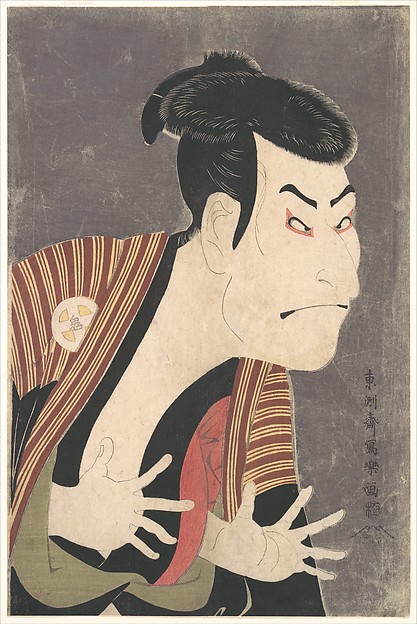
Tōshūsai Sharaku · 1794 · Woodblock print; ink, color, and white mica on paper
Look closer: the hands and the glare are the whole picture, and the dark ground sets them off.
Tōshūsai Sharaku, Kabuki Actor Ōtani Oniji III as Yakko Edobei, 1794. The Metropolitan Museum of Art, Henry L. Phillips Collection, Bequest of Henry L. Phillips, 1939 (accession JP2822). Public domain, Met Open Access. Record
The masters at the Metropolitan Museum

Torii Kiyonaga · ca. 1785 · Triptych of woodblock prints; ink and color on paper
Torii Kiyonaga, A Boating Party under Azuma Bridge, ca. 1785. The Metropolitan Museum of Art, The Howard Mansfield Collection, Purchase, Rogers Fund, 1936 (accession JP2620a–c). Public domain, Met Open Access. Record
Suzuki Harunobu · ca. 1770 · Woodblock print (pillar print); ink and color on paper
Suzuki Harunobu, Beauty under an Umbrella in the Snow, ca. 1770. The Metropolitan Museum of Art, Rogers Fund, 1922 (accession JP1376). Public domain, Met Open Access. Record

Utagawa Hiroshige · 1857 · Woodblock print; ink and color on paper
Utagawa Hiroshige, Sudden Shower over Shin-Ōhashi Bridge and Atake (Ōhashi Atake no yūdachi), from the series One Hundred Famous Views of Edo (Meisho Edo hyakkei), 1857. The Metropolitan Museum of Art, The Howard Mansfield Collection, Purchase, Rogers Fund, 1936 (accession JP2522). Public domain, Met Open Access. Record

Utagawa Kuniyoshi · 1843–47 · Triptych of woodblock-printed books (nishiki-e); ink and color on paper
Utagawa Kuniyoshi, Ghosts of the Taira at Daimotsu Bay, 1843–47. The Metropolitan Museum of Art, Fletcher Fund, 1929 (accession JP1565). Public domain, Met Open Access. Record

Tsukioka Yoshitoshi · 1868 · Triptych of woodblock-printed books (nishiki-e); ink and color on paper
Tsukioka Yoshitoshi, The Spirit of Akugenta Yoshihira Strikes Nanba Jirō during Kiyomori’s Visit to Nunobiki Waterfall, 1868. The Metropolitan Museum of Art, Bequest of William S. Lieberman, 2005 (accession 2007.49.307a–c). Public domain, Met Open Access. Record

Tsukioka Yoshitoshi · 1888 · Woodblock print; ink and color on paper
Tsukioka Yoshitoshi, Waking Up: A Girl of the Kōka Era (1844–1848), 1888. The Metropolitan Museum of Art, Purchase, Friends of Asian Art Gifts, 2005 (accession 2005.349). Public domain, Met Open Access. Record

Kobayashi Kiyochika · 1881 (Meiji 14) · Woodblock print; ink and color on paper
Kobayashi Kiyochika, Fireworks at Ikenohata, 1881 (Meiji 14). The Metropolitan Museum of Art, Gift of Sebastian and Miki Izzard, 2016 (accession 2016.577). Public domain, Met Open Access. Record
The Print Shelf
Woodblock prints and printed books are gathered on a small, carefully described shelf. The concierge desk can search Japan for a particular master or series.
In the Lexicon: ukiyo-e, shunga.
Answered plainly
What does ukiyo-e mean?
“Picture of the floating world”, from the hedonistic urban life of Edo.
Who made the first ukiyo-e prints?
Hishikawa Moronobu, from the 1670s, according to Wikipedia; some scholars favour Iwasa Matabei as founder of ukiyo-e painting.
What is nishiki-e?
Full-colour “brocade pictures” printed from ten or more blocks, standard from 1765.
Why did Sharaku disappear?
Nobody knows; Wikipedia records that his output ceased as mysteriously as it appeared, and his identity is unknown.
Why did ukiyo-e decline?
After Hokusai and Hiroshige died and Japan modernised after 1868, printing turned to journalism and faced competition from photography.
How many names did Hokusai use?
At least thirty, according to Wikipedia, more than any other major Japanese artist; the changes divide his career into periods.
Who was Sharaku?
His identity is unknown. Over fifty theories have been advanced; Julius Kurth’s 1910 suggestion was the Noh actor Saitō Jūrōbei. His career lasted ten months, from 1794 to 1795.
Why was Utamaro handcuffed?
He was imprisoned in 1804 over prints depicting Toyotomi Hideyoshi and held in manacles for fifty days.
How many original impressions of the Great Wave survive?
As of 2022, 113 first-edition impressions were counted, 35 of them in American museums, according to Wikipedia. About a thousand were printed at first and an estimated eight thousand in all.
What is the Great Wave worth?
Wikipedia records sales at US$2.8 million in 2023 and again at Sotheby’s Hong Kong on 22 November 2025.
Which ukiyo-e artist inspired Van Gogh?
Hiroshige; Van Gogh copied two prints from One Hundred Famous Views of Edo in 1887, including Plum Garden in Kameido.
Who was the last great ukiyo-e master?
Tsukioka Yoshitoshi (1839 to 1892), described as the last great master; his One Hundred Aspects of the Moon dates from 1885 to 1892.
What is the difference between Harunobu’s prints and earlier ones?
In 1765 Harunobu’s patrons funded the first full-colour nishiki-e, with as many as ten colours, where earlier benizuri-e had used three or four.
Where can I see ukiyo-e in Japan now?
Edo in Focus at the Nakanoshima Museum of Art in Osaka from 31 October 2026 and 5 Stars of Ukiyo-e Artists at the Sapporo Art Museum until 11 January 2027. Check each museum for current hours and rotations.
Where next
References and image credits
- Ukiyo-e, Wikipedia
- Hokusai, Wikipedia
- The Great Wave off Kanagawa, Wikipedia
- Hiroshige, Wikipedia
- Kitagawa Utamaro, Wikipedia
- Sharaku, Wikipedia
- Utagawa Kuniyoshi, Wikipedia
- Tsukioka Yoshitoshi, Wikipedia
- Suzuki Harunobu, Wikipedia
- Hishikawa Moronobu, Wikipedia
- Torii Kiyonaga, Wikipedia
- Edo in Focus: Japanese Treasures from the British Museum, Artprice news
- 5 Stars of Ukiyo-e Artists, Sapporo Art Museum
- Metropolitan Museum of Art Open Access: Asian Art collection records (credited beneath each image)
Last reviewed 28 October 2026. Every photograph is public domain or openly licensed and credited beneath it; drawn diagrams are by Japonista.
Looking for a print by one of these masters, with its edition and condition described? The concierge desk replies within one to three business days.
Private concierge
Looking for something in particular?
Describe the piece or the project you have in mind. A senior advisor in Tokyo reads every case file personally and replies within two business days, with fees set out in writing before any work begins.