
Shamisen, Koto and Shakuhachi: The Voices of the Instruments
Plucked and blown
Shamisen, Koto and Shakuhachi: The Voices of the Instruments
三味線 箏 尺八
Three strings stretched over a drum, thirteen strings over movable bridges, and one length of bamboo with five holes: with the biwa, these are the voices that the stage arts of Japan keep coming back to.
Fact sheet
At a glance
- Different necks for different theatres. A thin-necked shamisen for kabuki, a thick-necked one for the puppet theatre.
- A national instrument. The koto is called the national instrument of Japan.
- Meditation as music. The shakuhachi was a spiritual tool of the Fuke Zen monks.
- Stories on strings. The biwa carried The Tale of the Heike from village to village.
Why the strings matter to the stage
First lookA shamisen accompanies the dance on the kabuki stage. In the puppet theatre it sits beside the narrator and must answer every turn of the voice. At a geisha's banquet it is the music of the evening. The stage arts described in this almanac lean on a handful of instruments, and this chapter looks at those instruments themselves.
Grouped for orientation; the instruments appear together in many ensembles.
Diagram by Japonista.
Four are described here: the shamisen, the biwa, the koto and the shakuhachi. Three of them arrived from China, and the shamisen came by way of the Ryukyu Kingdom, now Okinawa. All four have long since become Japanese, adapted by players, makers and schools until they are inseparable from the theatres in which they sound.
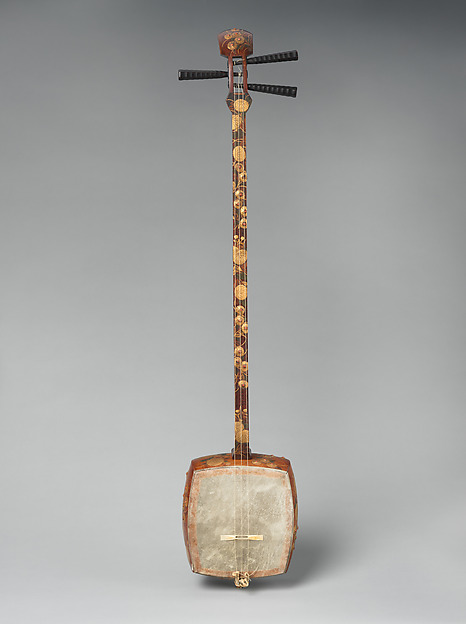
Takechi Matsukawa, 1891. Wood, catskin, rope, silk string, lacquer, red coral. The Metropolitan Museum of Art, accession 69.271.2a, b.
Look closer: Notice how slender the neck is and how the body resembles a small drum.
Takechi Matsukawa, Shamisen, 1891. The Metropolitan Museum of Art, Gift of the Estate of Mary Flagler Cary, 1969, accession 69.271.2a, b. Public domain (Met Open Access, CC0). Museum record
The shamisen, slender and sturdy
The connoisseur's eyeThe shamisen is a three-stringed instrument, plucked with a plectrum called a bachi, and descended from a Chinese instrument. Its body resembles a drum: a hollow frame covered front and back with skin, over which the strings are stretched on a bridge. Traditionally the skin was dog or cat, with cat favoured for finer instruments. The neck has no frets, is slimmer than a guitar's, and divides into three or four pieces that lock together for travel. The lowest string is laid purposely low at the nut so that it buzzes against the neck, a characteristic timbre.
Its construction varies with the theatre. The shamisen that accompanies kabuki has a thin neck, which allows the agile and virtuosic playing the genre requires. The one used for the puppet theatre and for folk songs has a longer, thicker neck and a bigger plectrum, to match the more robust music. Three sizes are named: hosozao (thin neck), chuzao (middle) and futozao (fat). The fat-neck shamisen is the one of the puppet theatre.
| Neck | Japanese | Where you hear it |
|---|---|---|
| Thin-necked | 細棹 (hosozao) | Kabuki and nagauta, also kouta |
| Middle-necked | 中棹 (chuzao) | Jiuta and related chamber styles |
| Fat-necked | 太棹 (futozao) | Gidayu in the puppet theatre, and folk styles |
It reached Japan in the sixteenth century. It was introduced through the Ryukyu Kingdom, where it developed into the Okinawan sanshin, and its ancestor is believed to have entered through the port of Sakai, near Osaka. It can be played alone, in ensemble, with singing, or as accompaniment to drama, notably kabuki and bunraku. Both men and women have traditionally played.
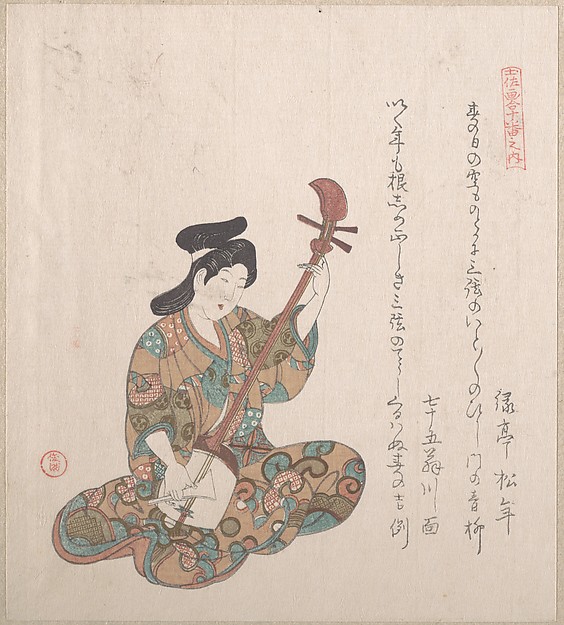
Kubo Shunman, probably 1815. Part of an album of woodblock prints (surimono); ink and color on paper. The Metropolitan Museum of Art, accession JP2277.
Look closer: A woman's right hand holds the plectrum over the skin of the body: the shamisen is struck as well as plucked.
Kubo Shunman, Woman Playing on the Shamisen, probably 1815. The Metropolitan Museum of Art, H. O. Havemeyer Collection, Bequest of Mrs. H. O. Havemeyer, 1929, accession JP2277. Public domain (Met Open Access, CC0). Museum record
The most celebrated and most demanding of the narrative styles is gidayu, named for Takemoto Gidayu (1651 to 1714), a leading figure of the Osaka puppet theatre. The singer-narrator must speak all the roles of the play as well as sing the commentary, and the shamisen player must know the entire work so well that he can answer every shift. A very different style, tsugaru-jamisen, grew from the folk songs of northern Honshu in the early twentieth century, when players such as Takahashi Chikuzan (1910 to 1998) added improvisation and flashy fingerwork. Kouta, the little song, was historically cultivated by geisha and is the music heard most often at their banquets.
The koto and its dragon
The deep endThe koto is a plucked half-tube zither, and is called the national instrument of Japan. It is derived from a Chinese instrument that reached Japan in the seventh and eighth centuries, and the modern koto grew from the instrument of the court ensemble. It is made of paulownia wood. The most common kind has thirteen strings stretched over movable bridges, which are moved to tune the instrument; seventeen-string koto act as the bass in ensembles.
Every part of the koto has a traditional name, because the body is likened to a dragon: the top is the dragon's shell, the underside the dragon's belly, and the end where the colourful cloth cover is removed is the dragon's head. Straight-grained wood is cheaper to make; a swirling grain costs more and is kept for elegant models. The seventeenth-century example shown here is inlaid with ivory and tortoiseshell.
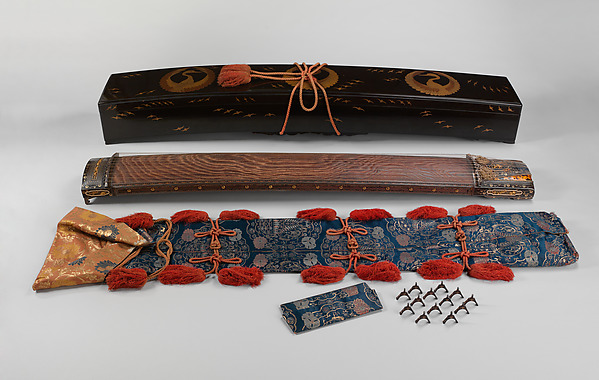
Metalwork by Goto Teijo, 9th generation Goto master, Japan, early 17th century. Various woods, ivory and tortoiseshell inlays, gold and silver inlays, metalwork, cloth, laquer, paper. The Metropolitan Museum of Art, accession 2007.194a–f.
Look closer: Ivory and tortoiseshell inlay, and metal fittings by Goto Teijo, make this an instrument for the eye as well as the ear.
Metalwork by Goto Teijo, 9th generation Goto master, Japan, Koto (箏), early 17th century. The Metropolitan Museum of Art, Purchase, Amati Gifts, 2007, accession 2007.194a–f. Public domain (Met Open Access, CC0). Museum record
Two names mark its history. Yatsuhashi Kengyo (1614 to 1685), a blind musician from Kyoto, is called the father of modern koto, for the new tunings and the suites of songs that he composed. Miyagi Michio (1894 to 1956), also blind, was the first Japanese composer to combine Western music with traditional koto music, wrote more than three hundred new works, and is regarded as the person who kept the instrument alive when traditional arts were being displaced by westernisation. In The Tale of Genji the hero falls deeply in love with a woman he has never seen after hearing her play the koto.
The shakuhachi and the monks of nothingness
The deep endThe shakuhachi is an end-blown bamboo flute, tuned to a minor pentatonic scale. Its name is a measurement: it means 1.8 shaku, the standard length of the flute. It is cut from the root end of a bamboo culm, and the player blows across a sharp edge rather than into a duct, which gives much more control of pitch. By adjusting the angle of the blow the player bends the pitch by a whole tone or more, and the music relies on this tone colour.
An ancient bamboo flute reached Japan from China in the Nara period and is preserved today in the Shosoin Treasure Repository, which holds eight examples; it fell out of use by the tenth century. The shakuhachi proper was developed in the sixteenth century. It was used by the monks of the Fuke sect of Zen, who were known as the priests of nothingness. For them blowing was a form of meditation, and their songs were paced to their breathing.
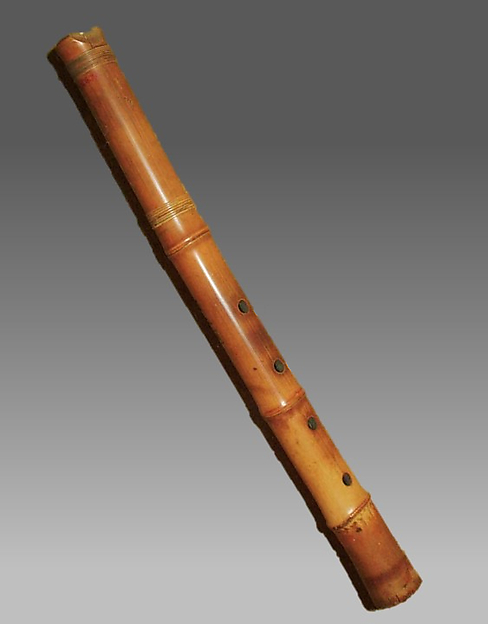
Japanese, 18th century. Bamboo. The Metropolitan Museum of Art, accession 48.126.7a, b.
Look closer: A single length of bamboo: no keys, no valves, five finger holes.
Japanese, Shakuhachi, 18th century. The Metropolitan Museum of Art, Gift of Mrs. Howard Mansfield, 1948, accession 48.126.7a, b. Public domain (Met Open Access, CC0). Museum record
With the Meiji Restoration the Fuke sect was abolished, the playing of the flute was forbidden for some years, and much of its repertoire was lost. It returned first as an accompanying instrument to the koto and shamisen, and only later as a solo instrument. A new shakuhachi is the work of years: because each piece of bamboo is different, flutes cannot be mass-produced.
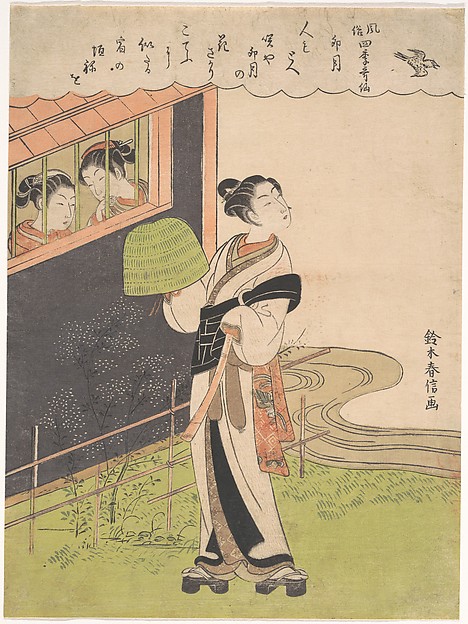
Suzuki Harunobu, ca. 1768. Woodblock print; ink and color on paper. The Metropolitan Museum of Art, accession JP1634.
Look closer: Harunobu shows a monk playing the flute in a series of prints organised by the months; this is the fourth month.
Suzuki Harunobu, A Flute-Playing Monk (Komusō); The Fourth Month (Uzuki), from the series Fashionable Poetic Immortals of the Four Seasons (Fūzoku shiki kasen), ca. 1768. The Metropolitan Museum of Art, H. O. Havemeyer Collection, Bequest of Mrs. H. O. Havemeyer, 1929, accession JP1634. Public domain (Met Open Access, CC0). Museum record
Biwa: the lute of the Heike
The biwa is a short-necked wooden lute, usually with four strings, played with a large plectrum. It arrived in Japan in the seventh century, and its best-known use is for reciting The Tale of the Heike, the great war epic of the Kamakura period. For centuries it was the instrument of blind monks, the biwa hoshi, who used it to accompany scriptures and tales.
Several kinds are distinguished. The court biwa of gagaku has four strings and four frets, is held on its side and is used only in that ensemble. The Heike biwa, with four strings and five frets, is smaller, which suited the travelling minstrels who first played it. The Satsuma biwa, with four strings and four frets, belongs to the Satsuma Domain, now Kagoshima, where samurai used it for moral and mental training. Its frets are raised high from the neck so that notes can be bent, and the boxwood plectrum is much wider than the others. The body is traditionally made from Japanese mulberry.
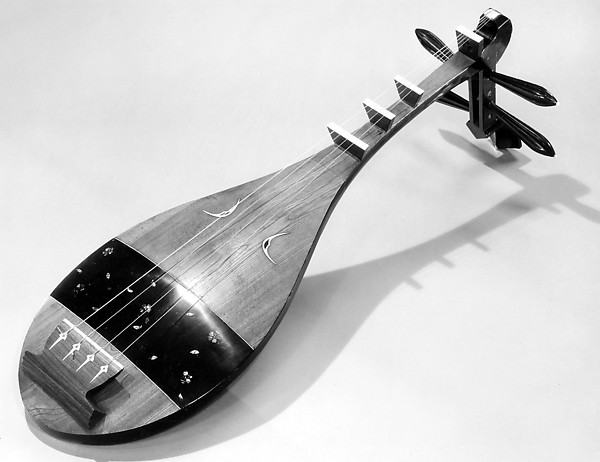
Japanese, ca. 1800. Wood, mother-of-pearl and ivory. The Metropolitan Museum of Art, accession 68.62.1.
Look closer: A short neck, raised frets and a broad body: this is the biwa of the Satsuma tradition.
Japanese, Satsuma Biwa (薩摩琵琶), ca. 1800. The Metropolitan Museum of Art, Rogers Fund, 1968, accession 68.62.1. Public domain (Met Open Access, CC0). Museum record
The biwa nearly vanished in the twentieth century, as western instruments replaced it, but a revival is under way, led by musicians who have brought it into new compositions. Benzaiten, goddess of music, is shown playing one in a nineteenth-century print; the Benzaiten page follows her story.
Answered plainly
What is a shamisen?
A three-stringed Japanese instrument with a drum-like body, played with a plectrum called a bachi. It accompanies kabuki, bunraku and geisha entertainments.
Why does the koto have movable bridges?
The bridges are moved along the strings to tune the instrument, and different pieces may call for different tunings.
What does shakuhachi mean?
It means 1.8 shaku, the standard length of the flute. Other lengths exist, but all are called shakuhachi.
Who were the Fuke monks?
Monks of the Fuke sect of Zen who played the shakuhachi as a form of meditation, known as the priests of nothingness.
What is the biwa used for?
Chiefly to accompany storytelling, especially The Tale of the Heike. A separate court biwa is used in gagaku.
Where next
Sources and image credits
- Shamisen, Wikipedia
- Koto (instrument), Wikipedia
- Shakuhachi, Wikipedia
- Biwa, Wikipedia
- Nagauta, Wikipedia
- Gagaku, Wikipedia
- Metropolitan Museum of Art Open Access (images)
Image credits, in order of appearance:
- Takechi Matsukawa, Shamisen, 1891. The Metropolitan Museum of Art, Gift of the Estate of Mary Flagler Cary, 1969, accession 69.271.2a, b. Public domain (Met Open Access, CC0). Museum record
- Kubo Shunman, Woman Playing on the Shamisen, probably 1815. The Metropolitan Museum of Art, H. O. Havemeyer Collection, Bequest of Mrs. H. O. Havemeyer, 1929, accession JP2277. Public domain (Met Open Access, CC0). Museum record
- Metalwork by Goto Teijo, 9th generation Goto master, Japan, Koto (箏), early 17th century. The Metropolitan Museum of Art, Purchase, Amati Gifts, 2007, accession 2007.194a–f. Public domain (Met Open Access, CC0). Museum record
- Japanese, Shakuhachi, 18th century. The Metropolitan Museum of Art, Gift of Mrs. Howard Mansfield, 1948, accession 48.126.7a, b. Public domain (Met Open Access, CC0). Museum record
- Suzuki Harunobu, A Flute-Playing Monk (Komusō); The Fourth Month (Uzuki), from the series Fashionable Poetic Immortals of the Four Seasons (Fūzoku shiki kasen), ca. 1768. The Metropolitan Museum of Art, H. O. Havemeyer Collection, Bequest of Mrs. H. O. Havemeyer, 1929, accession JP1634. Public domain (Met Open Access, CC0). Museum record
- Japanese, Satsuma Biwa (薩摩琵琶), ca. 1800. The Metropolitan Museum of Art, Rogers Fund, 1968, accession 68.62.1. Public domain (Met Open Access, CC0). Museum record
Last reviewed 28 October 2026. Pictures are public-domain or openly licensed and credited beneath each one; diagrams are drawn by Japonista.
Instruments are fragile, and few come to us. If you are looking for a shamisen, a koto or a shakuhachi, or for the prints that show them, tell us what you have in mind.
Private concierge
Looking for something in particular?
Describe the piece or the project you have in mind. A senior advisor in Tokyo reads every case file personally and replies within two business days, with fees set out in writing before any work begins.