
Bunraku: The Puppet Theatre of Osaka
Dolls that carry the drama
Bunraku: The Puppet Theatre of Osaka
文楽
Three men in black, in full view of the audience, move a doll about two-thirds the size of a person until you stop seeing them. Beside them a single narrator voices every role. Bunraku is the art of watching someone not be there.
Fact sheet
At a glance
- Seen, then unseen. Puppeteers work in full view, in black, and the audience's attention passes them by.
- One voice. The tayu recites every character, male and female, and narrates.
- The shamisen. A larger, lower-voiced shamisen accompanies the chant.
- An author's theatre. The chanter lifts the text and bows to it before beginning.
A theatre built on a paradox
First lookThe puppets are large and articulated, with elaborate costumes and individual faces. Three puppeteers, visible to the audience, work each major figure from behind a waist-high screen. A narrator and a shamisen player sit on a projecting platform at the side. And within a few minutes the viewer has stopped noticing the men in black and is watching a woman hesitate at a door.
UNESCO's description of the art, proclaimed a Masterpiece in 2003 and inscribed in 2008, ranks Ningyo Johruri Bunraku with Noh and Kabuki as one of Japan's foremost stage arts. It emerged in the early Edo period, around 1600, when puppetry was joined to johruri, a popular narrative genre of the fifteenth century. The plots come from two sources: historical plays set in feudal times (jidaimono) and contemporary dramas of the conflict between the heart and social obligation (sewamono). The best known sewamono are the lovers' suicide plays, a theme the art is particularly noted for.

Ellywa, July 2008. Wikimedia Commons.
Look closer: Notice there is no torso: the costume is hung on a shoulder board and a bamboo frame.
Ellywa, Bunraku doll in national theatre Osaka 1. Wikimedia Commons, CC BY-SA 3.0. Source file

How three people make one gesture
All but the most minor characters need three puppeteers. The chief puppeteer, the omozukai, controls the head with the left hand, inserted through a hole in the back of the costume, and the right arm with his right. The left-hand puppeteer, the hidarizukai, moves the left arm by means of a rod at the elbow. The foot puppeteer, the ashizukai, moves the legs. There is no torso: it would only obstruct the movement of the limbs, so the carved head is attached to a grip thrust down through a shoulder board, a bamboo frame forms the hips, and the costume is sewn over the whole.
Each puppeteer controls a separate part; all three must breathe together.
Diagram by Japonista.
The apprenticeship is famously long. Practitioners in the National Theatre describe a decade on the feet, a decade on the left hand and a decade on the heads of secondary characters before a puppeteer is ready to lead. In most traditions all three wear black hoods. The National Bunraku Theatre leaves the chief puppeteer's face visible, a style called dezukai.
Heads that transform
The connoisseur's eyeThe heads (kashira) and hands are carved by specialists, while the bodies and costumes are often built by the puppeteers themselves. Heads are divided by gender, social class and personality. There are about 80 broad types, and the Japan Arts Council's digital library lists 129. Some are made for a single role; others serve several, changing with costume and paint, and every head is repainted and prepared before a presentation.
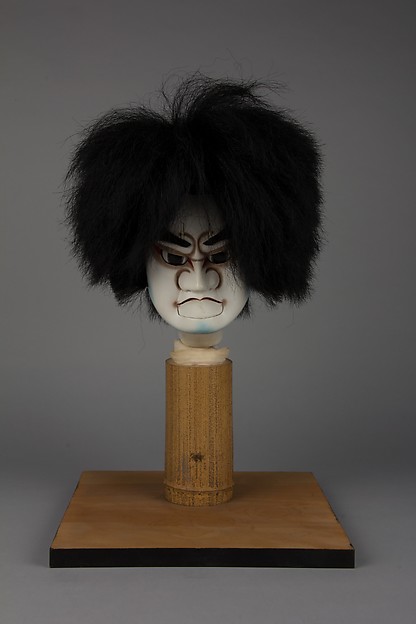
Japan, 19th century. Painted wood. The Metropolitan Museum of Art, accession 1987.256.
Look closer: Look for the hole in the base of the head, where the grip passes down to the chief puppeteer's hand.
Japan, Bunraku Puppet Head for Young Male Role, 19th century. The Metropolitan Museum of Art, Gift of Donald Keene, 1987, accession 1987.256. Public domain (Met Open Access, CC0). Museum record
Some carry tricks. In plays of the supernatural, a pull on a string can turn a beautiful woman's face into a demon's: the head called the gabu opens the mouth to the ears, brings out fangs, turns the eyes gold and raises horns, so that a woman can become a hannya without a change of head. In a head for the fox-spirit Tamamo-no-Mae, a string draws a fox mask across the face. Hair is human, sometimes with yak tail for volume, dressed with water and beeswax rather than oil to protect the head.
| Element | Japanese | Detail |
|---|---|---|
| Puppet head | Kashira 頭 | Carved wood; about 80 broad types; some change by string |
| Head grip | Dogushi 胴串 | The handle that carries the controls of the eyes, brows and mouth |
| Narrator | Tayu 太夫 | Voices all roles; kneels behind a lectern and lifts the script |
| Shamisen | Futozao 太棹 | The largest shamisen, lowest in register |
| Stage platform | Yuka 床 | Projecting platform at the right of the auditorium, with a revolving turntable |
| Railings | Tesuri 手摺 | Three partitions; the puppeteers stand in the pit behind the second |
The costumes are designed by a costume master, layered like human clothing, with sash, collar, underkimono, kimono and outer robe, lined with cotton to stay soft, and changed by the puppeteers in a process called koshirae. They connect the stage to the tradition of cloth described in Kimono Textile Heritage.
Chikamatsu, Gidayu and the Osaka stage
The deep endThe art's roots go back to the sixteenth century, but its modern form is traced to the 1680s and the collaboration between the playwright Chikamatsu Monzaemon (1653 to 1724) and the chanter Takemoto Gidayu (1651 to 1714), who founded the Takemoto puppet theatre in Osaka in 1684. Chikamatsu wrote more than a hundred plays and is sometimes called the Shakespeare of Japan.

Mc681, 5 August 2014, 16:02:51. Wikimedia Commons.
Look closer: The home of the government-supported troupe.
Mc681, National Bunraku Theatre in 201408. Wikimedia Commons, CC BY-SA 4.0. Source file

The word bunraku originally named a single theatre founded in Osaka in 1805, the Bunrakuza, after the ensemble of Uemura Bunrakuken (1751 to 1810), a puppeteer from Awaji whose efforts revived the fortunes of the art. UNESCO records that the genre acquired its present full name in the late nineteenth century, when the Bunrakuza was a leading theatre.
Bunraku shares themes and plays with kabuki, among them the story of the forty-seven ronin. It differs in being an author's theatre: before the performance the chanter holds up the text and bows to it, promising to follow it faithfully, whereas in kabuki the actors add puns, ad-libs and references that depart from the script. Until the late nineteenth century hundreds of professional, semi-professional and amateur troupes performed across Japan; since the Second World War there have been fewer than forty, most playing once or twice a year at local festivals. The government designated the art in 1955, and of the roughly 700 works written in the Edo period about 160 remain in the repertoire.
Answered plainly
How is Bunraku different from Western puppetry?
The puppets are large, three people work each major figure in full view, and a single narrator voices every character. The drama is carried by text and chant as much as by movement.
Where can I see Bunraku?
The National Bunraku Theatre in Osaka is the main home of the art. Its troupe also plays in Tokyo and tours. At the time of writing the theatre lists an autumn performance from 31 October to 23 November and a New Year performance from 3 to 24 January 2027.
Do I need to read Japanese?
Not necessarily. The Japan Arts Council's English pages carry an introductory video and a ticket guide; check the theatre's guidance on English support when you book.
Who writes the plays?
The great dramatist was Chikamatsu Monzaemon, who wrote more than a hundred. Many plays were also adapted for kabuki.
Why do the puppeteers wear black?
Black is the convention for invisibility, as for stagehands in the West. In most traditions the puppeteers also wear black hoods; in the National Theatre the chief puppeteer's face is shown.
Where next
Sources and image credits
- Bunraku, Wikipedia
- UNESCO, Ningyo Johruri Bunraku puppet theatre
- Chikamatsu Monzaemon, Wikipedia
- Joruri, Wikipedia
- Japan Arts Council, National Bunraku Theatre (Osaka)
- National Bunraku Theatre, Wikipedia
- Metropolitan Museum of Art Open Access (images)
Image credits, in order of appearance:
- Ellywa, Bunraku doll in national theatre Osaka 1. Wikimedia Commons, CC BY-SA 3.0. Source file
- Japan, Bunraku Puppet Head for Young Male Role, 19th century. The Metropolitan Museum of Art, Gift of Donald Keene, 1987, accession 1987.256. Public domain (Met Open Access, CC0). Museum record
- Mc681, National Bunraku Theatre in 201408. Wikimedia Commons, CC BY-SA 4.0. Source file
Last reviewed 28 October 2026. Pictures are public-domain or openly licensed and credited beneath each one; diagrams are drawn by Japonista.
Puppet heads, theatre textiles and prints of the Osaka stage are scarce and seldom stay. If you are looking for one, we will watch for it.
Private concierge
Looking for something in particular?
Describe the piece or the project you have in mind. A senior advisor in Tokyo reads every case file personally and replies within two business days, with fees set out in writing before any work begins.