
Ukiyo-e Art
The Japonista Athenaeum · Woodblock Gateway
Ukiyo-e and the Floating World
浮世絵
Four centuries of Japanese woodblock prints, from the first signed sheets of Edo to the revival workshops of the twentieth century. Start here for the whole map: the workshop, the subjects, the stage, the warriors, the collector’s eye, and a glossary and an A to Z to carry with you.
Where to Go Next
Every route below is a full page in the Athenaeum, not a signpost. The Almanac is the master work for the print; the stage and warrior pages explain the people and weapons the prints show; the neighbouring arts show the same subjects in other materials.
The Almanac
Read the whole world in order
Reference
Look something up
The stage
The actors on the sheets
Warriors
The heroes on the sheets
Neighbouring arts
The painted and the carried
A City That Printed Its Own Portrait
Ukiyo-e (浮世絵) means “pictures of the floating world”, and the phrase is a small joke with a long shadow. The word ukiyo once described the sorrowful, transient world a Buddhist was supposed to rise above. By the seventeenth century, in the booming city of Edo, the same sounds were written with a different character for “floating”, and the world it described had turned into something to be enjoyed: the theatre, the teahouse, the pleasure quarter, the festival, the road. Ukiyo-e is the picture-making of that world, made by a commercial publishing trade for a public that had money and curiosity.
That is the first thing to understand about the woodblock print, and the one most often lost when a sheet is framed and hung as décor. A print was not a precious object when it was made. It was news, fashion plate, travel brochure, theatre poster, calendar, love token and gossip, produced in editions, sold cheaply and handed on. Its beauty is real, and it was engineered: a designer, a carver, a printer and a publisher, each a specialist, collaborated on a sheet that had to sell. The greatest names, Hokusai, Hiroshige, Utamaro, Sharaku, are the visible tip of a trade of hundreds.

Look closer: Look at the small white peak framed inside the wave's hollow. The whole composition turns on a scale reversal: the sacred mountain is tiny, the water enormous, and the boatmen are bent low over their oars. The deep blue is imported Prussian blue, printed in flat tone and in a gradated edge.
Katsushika Hokusai, Under the Wave off Kanagawa (Kanagawa oki nami ura), or The Great Wave, from the series Thirty-six Views of Mount Fuji (Fugaku sanjūrokkei), ca. 1830–32. The Metropolitan Museum of Art, The Howard Mansfield Collection, Purchase, Rogers Fund, 1936, accession JP2569. Public domain (Met Open Access). Museum record
This page is the gateway to that world. It routes you into the Japonista Ukiyo-e Almanac and its chapters, into the theatre pages that explain the actors on the sheets, into the warrior pages that explain the heroes, and onto the shelf where objects touched by the tradition are kept. It also stands on its own as a reading: a timeline, the workshop explained, a method for reading a sheet, a collector's eye, a glossary of fifty-seven terms and an A to Z of the artists, series and forms you will meet in any museum or catalogue.
Four Centuries on One Sheet of Paper
The tradition runs from the first signed prints of the 1670s to the revival movements of the twentieth century. It can be read as a series of technical breakthroughs and a series of censorship crises, each pushing artists toward a new subject. The outline below follows the standard scholarly sequence; each era links to the longer chapter in the Almanac.
Edo became the seat of the Tokugawa shogunate in 1603, and a merchant class grew rich beneath it. Painted scrolls of beauties appeared in the Kanbun era (1661 to 1673), and by the 1670s Hishikawa Moronobu (1618 to 1694) was designing black-and-white printed books and single sheets, signing them in a way that made him the first print designer to be known by name. The Torii family took up kabuki posters and theatre pictures; the Kaigetsudō line produced standing beauties until their leader was exiled in 1714.

Look closer: Look at the line. Early prints are drawn, not painted: the ink contour is thick, the sleeves swell like sails, and colour, where it exists, is brushed on by hand after printing.
Torii Kiyomasu I, Kabuki Actors Nakamura Gentaro and Ikushima Shingoro, ca. 1710. The Metropolitan Museum of Art, The Francis Lathorp Collection, Purchase, Frederick C. Hewitt Fund, 1911, accession JP654. Public domain (Met Open Access). Museum record
Hand-tinted prints in orange and green (tan-e) gave way to pink and then to lacquer-black accents (urushi-e). The decisive step came in 1744 with benizuri-e, prints in two or three colours using more than one block. Okumura Masanobu (1686 to 1764) was inventive in format and in the use of geometric perspective. For three decades colour printing was a craft of limited palettes.

Look closer: Look at the black-and-white density: this sheet is printed in ink alone, with a scale bar at the foot added by the museum's photographer. It shows how much expression a single block of cherry wood could carry before colour.
Okumura Masanobu, Ichikawa Danjūrō I as Soga Gorō, ca. 1710. The Metropolitan Museum of Art, Rogers Fund, 1918, accession JP547. Public domain (Met Open Access). Museum record
In 1765 Suzuki Harunobu (about 1725 to 1770) and a circle of patrons commissioned calendar prints (egoyomi) printed in many colours on thick, absorbent paper. The effect looked so rich that the new prints were called nishiki-e, “brocade pictures”. Within a few years the older colour methods had all but vanished. Harunobu's slender, dreamlike young lovers set a template for a generation.

Look closer: Look at the shape. This is a hashira-e, a pillar print, made in a tall narrow format to hang on a wooden post. The artist composes with the page's proportion, sending the snow diagonally across a vertical slot.
Suzuki Harunobu, Beauty under an Umbrella in the Snow, ca. 1770. The Metropolitan Museum of Art, Rogers Fund, 1922, accession JP1376. Public domain (Met Open Access). Museum record
Torii Kiyonaga (1752 to 1815) designed tall, composed women in multi-sheet panoramas. Kitagawa Utamaro (about 1753 to 1806) made his name in the 1790s with bust-length portraits of beauties (ōkubi-e) printed with mica grounds and delicate gradations. Tōshūsai Sharaku appeared in 1794 and, over about ten months, produced the most psychologically raw actor portraits in the tradition before disappearing from the record. A censor's seal became compulsory for prints in 1790; a repressive turn followed, and Utamaro was imprisoned in 1804. His publisher Tsutaya, who had also published Sharaku, had died in 1797.
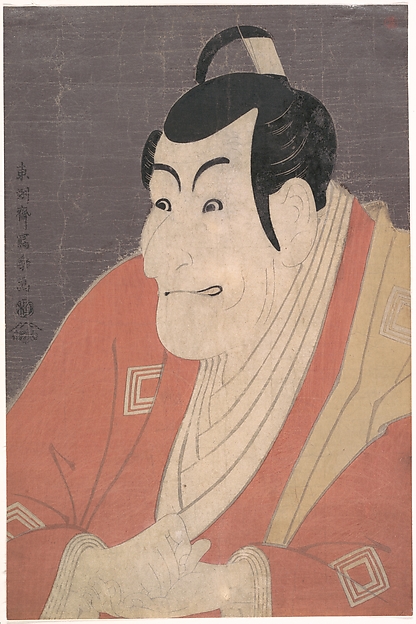
Look closer: Look at the face. Sharaku exaggerates the features: the asymmetrical eyes, the tense mouth, the heavy chin. The pose is frozen at the climax of a play, and the grey ground, once sparkling with mica, isolates the figure like a spotlight.
Tōshūsai Sharaku, Kabuki Actor Ichikawa Ebizō (Ichikawa Danjūrō V) in the play The Colored Reins of a Loving Wife (Koi nyōbō somewake tazuna), 5th month, 1794. The Metropolitan Museum of Art, Harris Brisbane Dick Fund and Rogers Fund, 1949, accession JP3114. Public domain (Met Open Access). Museum record

Look closer: Look at how little line does so much. Utamaro models faces with a thin contour and a few fine strokes for the hair; the baby and mother are close, intimate, quietly composed. The series pairs hours of the day with the lives of different women.
Kitagawa Utamaro, “Hour of the Rat: Mistress,” from the series Women’s Daily Customs (Fuzoku bijin tokei), 1790. The Metropolitan Museum of Art, Rogers Fund, 1922, accession JP1278. Public domain (Met Open Access). Museum record
After the Tenpō reforms of 1841 to 1843 suppressed actors and courtesans as subjects, the market turned to landscape, birds and flowers, history and legend. Katsushika Hokusai (1760 to 1849) published his Thirty-six Views of Mount Fuji (the series is dated by the Met to about 1830 to 1832). Utagawa Hiroshige (1797 to 1858) made the Tōkaidō series and, at the end of his life, One Hundred Famous Views of Edo. Utagawa Kuniyoshi (1797 to 1861) turned warriors, monsters and satire into theatre on paper.

Look closer: Look at the silence. The snow is the unprinted paper itself, and the grey sky is pressed in as a gradated tone. Stillness is a printing technique.
Utagawa Hiroshige, A Snowy Evening at Kanbara Station, ca. 1833–34. The Metropolitan Museum of Art, Rogers Fund, 1918, accession JP486. Public domain (Met Open Access). Museum record

Look closer: Look at the spread. A triptych is three sheets that join into one panorama, and Kuniyoshi uses the gaps for drama: the ship in the centre, the wave in the right-hand sheet, the spirits in the sky.
Utagawa Kuniyoshi, Ghosts of the Taira at Daimotsu Bay, 1843–47. The Metropolitan Museum of Art, Fletcher Fund, 1929, accession JP1565. Public domain (Met Open Access). Museum record
After the Meiji Restoration of 1868 ukiyo-e declined sharply, although it did not stop. Tsukioka Yoshitoshi (1839 to 1892) produced ghosts, historical scenes and, from 1885 to 1892, One Hundred Aspects of the Moon. Kobayashi Kiyochika (1847 to 1915) recorded gas lamps, railways and wars with a technique of light and shadow borrowed from photography.

Look closer: Look at the flame and the sword. Yoshitoshi shows Fudō with a rope and a sword in a halo of fire, a direct bridge to the Buddhist pages of this Athenaeum.
Tsukioka Yoshitoshi, Fudō Myōō Threatening a Novice, 1885. The Metropolitan Museum of Art, Purchase, Friends of Asian Art Gifts, 2005, accession 2005.350a–c. Public domain (Met Open Access). Museum record
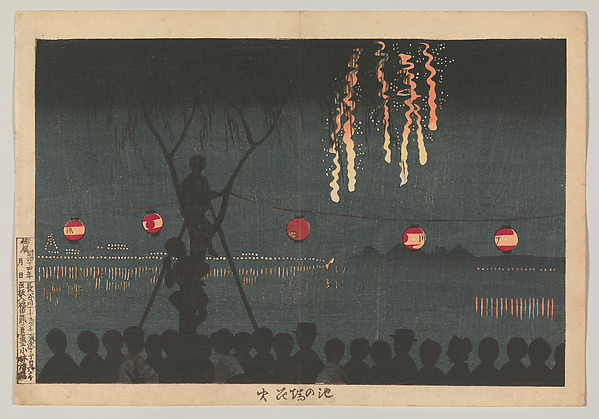
Look closer: Look at the dark. The audience is a row of silhouettes against a night sky, a Meiji-period way of seeing that reads like a photograph in woodblock.
Kobayashi Kiyochika, Fireworks at Ikenohata, 1881 (Meiji 14). The Metropolitan Museum of Art, Gift of Sebastian and Miki Izzard, 2016, accession 2016.577. Public domain (Met Open Access). Museum record
Watanabe Shōzaburō's shin-hanga (“new prints”) of about 1915 revived the full workshop system for a new market, and sōsaku-hanga (“creative prints”) argued that the artist should draw, carve and print alone. The two movements are explained in the Almanac chapter on the new and the creative. They are why a twentieth-century sheet may be a living artist's own impression.
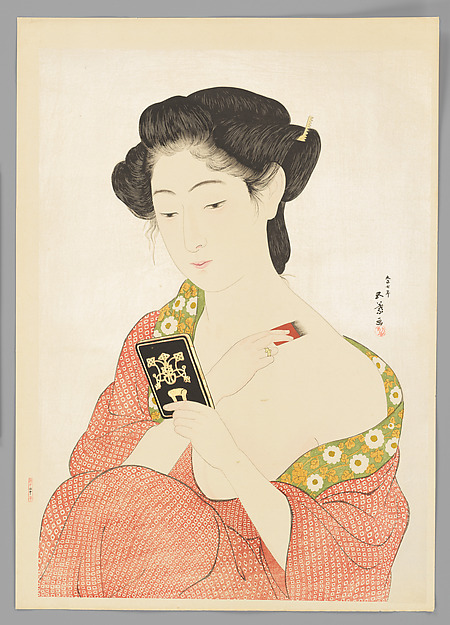
Look closer: Look at the skin and the hair. Goyō's shin-hanga prints use bokashi and fine hair lines to give a porcelain softness, a modern face in an Edo technique.
Hashiguchi Goyō, Woman Applying Makeup, 1918 (Taishō 7). The Metropolitan Museum of Art, Purchase, Mary and James G. Wallach Foundation Gift, 2024, accession 2024.334. Public domain (Met Open Access). Museum record
Read in order, the eras are a lesson in how technology and politics shape art. Colour printing made luxury cheap; censorship moved subjects; a trade that fed on novelty eventually met a camera, and then a revival that valued the craft itself.
Four Hands and a Pigment Tray
A print is a relay. The publisher (hanmoto) commissions and sells; the designer (eshi) draws the composition; the carver (horishi) cuts it into wood; the printer (surishi) lays down colour on handmade paper. None of them worked alone, and the signature on a sheet usually names only the designer. This is the collaborative system the Almanac chapter on the woodblock process explains in detail.
Publisher to designer to carver to printer and back to the publisher. The sheet is the product of the whole chain.
Diagram by Japonista.
From drawing to block
The designer's ink drawing on thin paper was pasted face down on a block of cherry wood, and the carver cut away everything that was not line. The drawing was destroyed in the process, which is why original designs by print artists are rare. Proofs of the keyblock were then used to prepare the colour blocks, one for each colour, and every block carried registration marks (kentō) so that the sheets would align as they went from block to block.
On the printing bench
The printer worked with water-based pigment and rice paste on dampened paper, rubbing the back of each sheet with a baren, a flat pad of bamboo-sheath over a coiled cord. The pressure of the hand decided the depth of colour. A designer could ask for effects that look simple and are not: bokashi, the gradation of a colour wiped on the block so that sky fades into horizon; karazuri, blind embossing that gives a robe a woven relief; kirazuri, mica ground that makes a background shimmer; and burnishing, for a gloss on hair or lacquer.

Look closer: Look at the sky and water. The gradated band of dark blue at the top and the paler horizon at the bridge are bokashi: ink wiped on the block by the printer, and different in every impression.
Utagawa Hiroshige, Fireworks at Ryōgoku Bridge, from the series One Hundred Famous Views of Edo, 1858. The Metropolitan Museum of Art, Purchase, Joseph Pulitzer Bequest, 1918, accession JP642. Public domain (Met Open Access). Museum record
Because each effect depended on the printer's hand, no two impressions are identical, and an early pull from fresh blocks looks different from a later pull from worn ones. This is the foundation of the collector's habit of looking at line and colour rather than at the subject alone, taken up in the sections below.
Seven Kinds of Picture
Ukiyo-e is a family of genres, and the family resemblance is the printing technique more than the subject. The usual map has seven rooms. Each has its own vocabulary, its own heroes and its own pitfalls for the new viewer.
Bijin-ga: pictures of beautiful people
Beauties are fashion plates and social portraits. Hairstyles, obi, hem patterns and accessories tell you a woman's rank, her season, sometimes her profession. The tradition moves from Harunobu's delicate girls to Kiyonaga's tall, composed women to Utamaro's bust portraits and Eisen's full-length urban figures. The beauty on a sheet is typically a type, not a portrait.

Look closer: Look at the long horizontal. Three sheets join into a single river scene, and the figures are grouped so that the eye travels along the deck. The pale wooden bridge supports a rhythm of verticals above.
Torii Kiyonaga, A Boating Party under Azuma Bridge, ca. 1785. The Metropolitan Museum of Art, The Howard Mansfield Collection, Purchase, Rogers Fund, 1936, accession JP2620a–c. Public domain (Met Open Access). Museum record
Yakusha-e: actor prints
Actor prints are the oldest line of business in the trade and the closest to celebrity media. A fan could buy the star in a famous role, a scene from a play, or a portrait of the actor out of costume. They are explained in the Performing Arts pages: the kabuki stage, the make-up and the layers of costume that these pictures record.
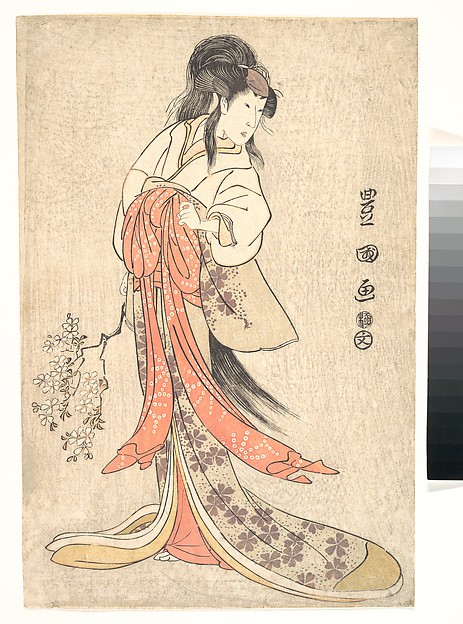
Look closer: Look at the hair and the line of the sleeve. A female role was played by a male specialist (an onnagata), and the artist records the performance's pose, not the actor's own face.
Utagawa Toyokuni I, Kabuki Actor Segawa Kikunojō III in a Mad Female Role, 1798 (Kansei 9). The Metropolitan Museum of Art, Fletcher Fund, 1929, accession JP1529. Public domain (Met Open Access). Museum record
Meisho-e and fūkei-ga: famous places and landscape
Famous-place pictures were the travel brochures of an age of pilgrimage, road-going and seasonal outings. Hokusai and Hiroshige turned the genre into a landscape art in the nineteenth century, one by structure and wave, the other by weather and mood. A Tōkaidō sheet is rarely a map; it is an invitation.

Look closer: Look at the rain. Fine diagonal lines of grey fall across the whole sheet, and the stream is printed with a deep blue gradation. The travellers hunch under straw capes, the hero of the picture is the weather.
Utagawa Hiroshige, Spring Rain at Tsuchiyama, from the series Fifty-three Stations of the Tōkaidō, 1834–35. The Metropolitan Museum of Art, Rogers Fund, 1918, accession JP520. Public domain (Met Open Access). Museum record
Musha-e: warrior prints
Warriors from the Heike and Genji wars, Chinese heroes and the Edo-period tales of loyal retainers fill the sheets of Kuniyoshi and Yoshitoshi. The Warrior pages of the Athenaeum explain the armour, swords and codes behind the pictures.
Kachō-e, yōkai-e and surimono
Bird-and-flower prints, ghosts and monsters, and privately commissioned surimono, small luxury cards printed with poems for New Year and social occasions, complete the map. Surimono used the best paper, metallic pigments and the finest cutting, and were never meant for the street.

Look closer: Look at the poem. The writing is the half of the picture that makes it a gift: surimono were commissioned by poetry clubs and given to members.
Totoya Hokkei, Preparations for the New Year, from Spring Rain Surimono Album (Harusame surimono-jō, vol. 1), 1817. The Metropolitan Museum of Art, H. O. Havemeyer Collection, Bequest of Mrs. H. O. Havemeyer, 1929, accession JP1948. Public domain (Met Open Access). Museum record

Look closer: Look at the shape. The cat's body bends like a ribbon of light, an example of ghost prints as popular entertainment.
Utagawa Kuniyoshi, Scene from a Ghost Story: The Okazaki Cat Demon, ca. 1850. The Metropolitan Museum of Art, Fletcher Fund, 1929, accession JP1563. Public domain (Met Open Access). Museum record
Shunga
Shunga, the erotic print, was part of the Edo publishing trade, much of it by the same artists, and scholars treat it as serious cultural history. It is adult material and is not illustrated on this page.
Kabuki on Paper, and Where to Read On
To read an actor print you must know the stage. The Performing Arts pages cover it in three layers: the kabuki stage itself, the red-and-white make-up of kumadori and the art of the onnagata, and the costume that changes on stage in a moment. Noh, the older and quieter theatre, has its own chapters on masks, silence and the bridgeway and the face and the robe. The hub for all of them is the Performing Arts Almanac.
A stage print compresses a three-hour play into one gesture. The pose, the mie, in which an actor freezes with crossed eyes at the peak of emotion, is what the print preserves. Look for the crest on the sleeve and the name of the role: both tell you which actor is meant, and a connoisseur could often name the actor from the family crest alone.
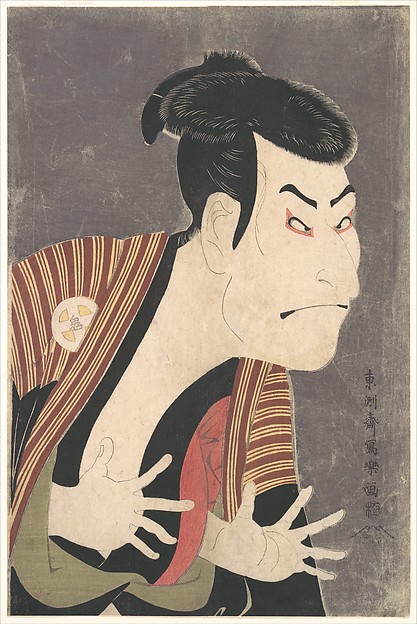
Look closer: Look at the hands. The claw-like fingers repeat the angle of the arms and the jaw, a drawn emphasis that carries the menace of the role.
Tōshūsai Sharaku, Kabuki Actor Ōtani Oniji III as Yakko Edobei, 1794. The Metropolitan Museum of Art, Henry L. Phillips Collection, Bequest of Henry L. Phillips, 1939, accession JP2822. Public domain (Met Open Access). Museum record
Heroes, Armour and Steel
Warrior prints are the other great theatre of the sheet. The Almanac of the Warrior and the Floating World joins the two worlds, with chapters on the Japanese sword, the tsuba and samurai armour. Learning to see a lacing pattern, a helmet crest or a mounting on a sword in a print is how the pictures begin to speak.
The warrior in a print is rarely history as it happened. He is a repertoire: the loyal retainer, the boastful hero, the monster-slayer, the doomed beauty-in-armour. Kuniyoshi and Yoshitoshi gave each a face and a sleeve pattern. The shelf of samurai armour, swords and art on this site, at the foot of the page, is the real-world side of that picture.

Look closer: Look at the glance. A warrior of the old order watches a steamship go by: the series plays on the Tōkaidō format, and the picture sets the sword age beside the new machine.
Tsukioka Yoshitoshi, Fifty-three Stations of Suehiro: Warrior Looks at Passing Steamship, ca. 1865. The Metropolitan Museum of Art, Gift of Lincoln Kirstein, 1959, accession JP3178. Public domain (Met Open Access). Museum record
How to Read a Sheet
A print rewards slow looking, and the order matters. Start with the whole composition, then the signature and seals, then the paper and edges, and finally the colour. A reliable order is the one below, learned in the study room and kept at the dealer's table.
| Step | Look at | What it tells you |
|---|---|---|
| 1. Composition | Viewpoint, format, number of sheets | Genre and function: a triptych is a spectacle, a pillar print a decorative panel, a small card a surimono. |
| 2. Title cartouche | Series title, sheet title, number | Which series, and whether the sheet is part of a numbered set. |
| 3. Signature and seal | Designer name, studio, red or black seals | The artist and sometimes the date; compare the form with reference examples. |
| 4. Publisher and censor marks | Publisher mark; aratame or kiwame seal | The publisher; an approval seal that fixes a sheet to the censorship period of 1790 to 1842. |
| 5. Paper | Surface, fibres, warmth, thickness | Handmade washi has long fibres and a soft, absorbent feel; modern coated stock looks and feels different. |
| 6. Line | Edge of the keyblock line | Crisp, springy line suggests early impression; softened, broken line can mean worn blocks. |
| 7. Colour | Layering, gradation, fading | Original colour has depth and variation; flat dot-pattern colour points to a modern process. |
| 8. Margins | Trimmed or intact | Trimming removes information and value. |

Look closer: Look at it beside the Kanbara print above. Two impressions of one design can differ in the grey of the sky, in the blue of the shadow, in the warmth of the paper. This is why a good impression is judged sheet by sheet.
Utagawa Hiroshige, Evening Snow at Kanbara, from the series "Fifty-three Stations of the Tōkaidō", ca. 1833–34. The Metropolitan Museum of Art, The Howard Mansfield Collection, Purchase, Rogers Fund, 1936, accession JP2492. Public domain (Met Open Access). Museum record
Series logic helps too. Many of the best-known images are sheets from a set: fifty-three stations, thirty-six views, one hundred famous views. A sheet from a numbered set can be placed, and a complete or near-complete set tells a story that a single sheet cannot.
Original, Later Pull and Copy
Three words cover almost every question that arises when a collector meets a sheet. An early impression is one pulled soon after the blocks were cut, when line and colour were at their freshest. A later impression is pulled from the original blocks after wear or re-cutting, with changes to colour or line; it can be handsome and honest. A reproduction or facsimile is made from new blocks or by a photomechanical process, often to a high standard, and should be priced and described as what it is. The Almanac chapter on originals and reproductions works through the distinctions with examples.
| Kind | How it was made | What to expect |
|---|---|---|
| Early impression | Original blocks, first runs | Strongest line, crisp registration, finest colour; valued highest when in good state. |
| Later impression | Original or recut blocks, later runs | Softer line, altered colours; sometimes a legitimate, attractive sheet. |
| Modern woodblock reprint | New blocks cut by a modern workshop | Craft-made and often handsome; description should say so. |
| Photomechanical reproduction | Offset or digital printing | Even dot pattern under a loupe; fine as décor or study material. |
Condition matters in a different way from many antiques. Fading in colour is the commonest and most important issue: some pigments are fugitive and a print kept in light may lose its reds and purples. Toning, foxing, wormholes, folds, trimming and backing paper all affect the look and the value. The rule of thumb at the dealer's table is integrity first: a print with all four margins, no repairs, and with colours that still hold the design is worth more than a brighter sheet that has been cut down or heavily restored.
What We Look For
The house position is plain: we prefer a coherent shelf to a famous name. A good collection is built around a question, such as how Hiroshige used weather, how an actor's family crest travels from print to print, or what bijin-ga says about hairstyle. The question tells you what to look for, and what to leave.
- Impression first. Line quality and colour layering over fame of subject.
- Margins and seals. Is the publisher and censor information intact?
- Paper. Warm, fibrous washi, not coated stock; no unexplained glue or tape.
- Honest condition. Ask what has been repaired, backed, trimmed or toned. A good report names every fault.
- Series and set. A coherent group is worth more than the sum of its parts.
- A reason to own it. Every sheet should answer a question you actually have.

Look closer: Look at the mica ground and the mirror's rim. The mica gives the pale ground a quiet sparkle, a surface that photographs badly and shines in a hand-held light.
Kitagawa Utamaro, Two Ladies, Each with a Portion of a Lacquered Mirror, 1790s. The Metropolitan Museum of Art, H. O. Havemeyer Collection, Bequest of Mrs. H. O. Havemeyer, 1929, accession JP1673. Public domain (Met Open Access). Museum record
Care at home
Keep prints out of direct light and away from heat and damp; mount and frame with acid-free, reversible materials and ultraviolet-filtering glazing; rotate by season rather than hanging one sheet for years; and store flat, interleaved with archival tissue. If a sheet is valuable, show a good facsimile and keep the original in a drawer. The care guidance in the Almanac chapter on the woodblock process goes further.
Where a piece is beyond the shelf, the house concierge can search for it. Describe what you are looking for in a private request at the foot of this page; the team in Tokyo will reply personally.
Dates That Hold the Story Together
| Year | Event |
|---|---|
| 1603 | Edo becomes the seat of the Tokugawa shogunate; the city’s merchant class begins to grow. |
| 1661 to 1673 | Kanbun era: painted scrolls of beauties establish ukiyo-e as an independent school. |
| 1670s | Hishikawa Moronobu designs the first signed printed books and single sheets. |
| 1714 | The Ejima-Ikushima scandal; Kaigetsudō Ando is exiled and the school ends. |
| 1744 | Benizuri-e: first successful multi-block colour printing. |
| 1765 | Harunobu’s calendar prints launch nishiki-e, the full-colour brocade print. |
| 1790 | Censor’s seal required on prints. |
| 1794 to 1795 | Sharaku produces his actor portraits in about ten months. |
| 1797 | Tsutaya, publisher of Utamaro and Sharaku, dies. |
| 1804 | Utamaro imprisoned during a censorship crackdown; he dies in 1806. |
| about 1830 to 1832 | Hokusai’s Thirty-six Views of Mount Fuji, including the Great Wave (Met dating). |
| about 1833 to 1834 | Hiroshige’s Fifty-three Stations of the Tōkaidō. |
| 1841 to 1843 | Tenpō reforms suppress actor and courtesan prints; landscape and legend expand. |
| 1853 to 1854 | Perry’s ships arrive; the Convention of Kanagawa opens Japan. |
| 1856 to 1858 | Hiroshige’s One Hundred Famous Views of Edo. |
| 1867 | Japanese art draws crowds at the Paris International Exhibition; Japonisme follows. |
| 1868 | Meiji Restoration; ukiyo-e declines sharply. |
| 1885 to 1892 | Yoshitoshi’s One Hundred Aspects of the Moon. |
| 1904 | Yamamoto Kanae’s Fisherman, usually taken as the start of sōsaku-hanga. |
| about 1915 | Watanabe Shōzaburō’s shin-hanga movement begins. |
| 1918 | The Japanese Woodcut Artists’ Association is founded. |
| 2023 | A rare early impression of the Great Wave sells at Christie’s New York for about 2.76 million US dollars. |
| 2024 | The Great Wave is printed on the new 1,000-yen banknote. |
Five Tales From the Workshop and the World
The man who vanished in ten months
Sharaku's career is among the strangest in art history. His portraits date from 1794 and 1795, and then he is gone. No firm record of who he was survives; one tradition names an actor of the Noh stage. Whatever the truth, his publisher Tsutaya put out an astonishing run of faces in a short season, and the trade did not know what to do with them. They were too frank for fans and are now prized for the same reason.
Blue from Berlin
The deep, cold blue in Hokusai's Great Wave is Prussian blue, a synthetic pigment imported from Europe that reached Japanese printmakers around 1829 to 1830. It was stable, it printed beautifully in gradation, and it was suddenly fashionable. The dramatic wave is partly a story of trade.
The publisher who ran a literary salon
Tsutaya Jūzaburō was a bookseller who became the best-known publisher of his generation. He backed Utamaro, brought Sharaku into print and worked with writers of comic verse. When he died in 1797, Utamaro's output slowed. The lesson: in this art the publisher mattered as much as the designer.
The paper that was a packing material
A story told in many books is that Japanese prints first impressed Europeans when they were used as wrapping for porcelain. It is hard to prove and probably tidier than the truth. Prints reached Europe by several routes, and by the 1860s they were being collected and copied, as the Almanac chapter on the Japonisme period explains.
Van Gogh copies Hiroshige
Vincent van Gogh made oil copies of Hiroshige prints in 1887, painting the Japanese compositions in thick colour and adding calligraphic borders of his own. Western painters did not simply admire the prints; they learned cropping, flat colour and viewpoint from them.
Small Things Worth Knowing
- A Hokusai sketchbook, the Manga, ran to fifteen volumes with over four thousand sketches.
- One expert quoted at the 2023 Christie’s sale ranked that sheet among about twenty of the best surviving impressions of the Great Wave.
- Prints were often colour-balanced by the printer, not the artist, so two sheets of one design can feel quite different.
- The red seal in the corner of many prints is the artist's, the publisher's, or a censor's approval; reading them is a skill.
- A triptych prints three sheets that were sold and could be displayed separately.
- Stage prints record the actor's family crest on the costume, a trade secret decoded by every fan.
Why the Floating World Still Surfaces
The tradition has never left popular culture. The Great Wave is on the back of Japan's 1,000-yen banknote; Kuniyoshi's warriors and monsters feed tattoo design and manga; the garments called sukajan, the embroidered souvenir jackets of postwar Yokosuka, regularly borrow the compositions. Museums, from the Met to the Sumida Hokusai Museum in Tokyo, keep large holdings and present them in rotation to protect them from light.
Prices have followed. A rare early impression of the Great Wave sold at Christie's in March 2023 for about 2.76 million US dollars, and an early impression was reported at about 2.8 million at Sotheby's in Hong Kong in November 2025; a complete set of the Thirty-six Views reached about 3.56 million at Christie's in 2024. Those are the peaks. The great majority of prints that reach private hands are far more modest, and the best way to learn to see a good one is in a museum study room, where many institutions allow viewing by appointment.
What readers ask, searching today: whether a print is original, how to date a sheet, what the signature says, and what to do with a family inheritance. The FAQ and the collector's guide on this page answer the first three; for the fourth, the concierge team is glad to talk.
Glossary of 57 Terms
The words below recur in every catalogue. Each is given in English letters, in Japanese where it has a Japanese form, and in a plain definition. For a longer reference, the dedicated glossary of ukiyo-e print terms goes further.
A
- Aizuri-e 藍摺絵
- A print made mainly in shades of blue (ai), often with Prussian blue, popular in the 1820s and 1830s.
- Aratame 改
- A censor’s examination seal, found on prints made between 1790 and the early 1840s.
B
- Baren 馬連
- The flat disc of coiled cord and bamboo sheath that the printer rubs against the back of the paper to take up pigment from the block.
- Benizuri-e 紅摺絵
- An early colour print, from 1744, made with two or three blocks in red and green tones.
- Bijin-ga 美人画
- Pictures of beautiful people: portraits and fashion studies of women, the largest single genre of ukiyo-e.
- Bokashi ぼかし
- Gradation of colour, made by wiping pigment on the block so that it fades from dark to pale, as in a sky or the edge of a wave.
- Burnishing
- Rubbing the printed surface with a hard, smooth tool to give hair or lacquer a gloss.
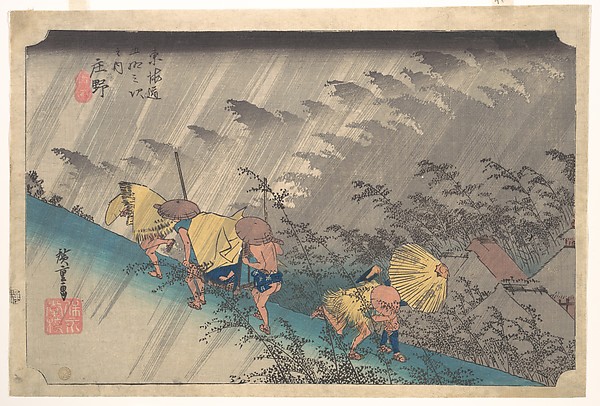
Look closer: Look at the bamboo. The grove is a diagonal screen of dark stalks against grey rain, with figures bent and scattering. Rain here is drawn with fine lines and tone, one of the most imitated effects in the tradition.
Utagawa Hiroshige, Sudden Shower at Shōno, from the series Fifty-three Stations of the Tōkaidō, 1834–35. The Metropolitan Museum of Art, Rogers Fund, 1914, accession JP41. Public domain (Met Open Access). Museum record
C
- Chūban 中判
- A medium print format, about 26 by 19 centimetres.
E
- Egoyomi 絵暦
- Picture calendars, privately commissioned for the new year; the 1765 examples launched full-colour printing.
- Eshi 絵師
- The designer or artist who drew the composition, usually the only name on a sheet.
F
- Facsimile
- A copy of a print made by modern means; a good facsimile is honest about what it is.
- Fūkei-ga 風景画
- Landscape pictures; the genre that rose in the 1830s with Hokusai and Hiroshige.
G
- Gofun 胡粉
- A white pigment made from ground shell, used for highlights and for faces in some hand-coloured work.
H
- Hanmoto 版元
- The publisher who commissions, finances, sells and often prescribes the subject of a print.
- Hanshita-e 版下絵
- The designer’s drawing prepared for the carver, pasted face down on the block and destroyed in cutting.
- Hashira-e 柱絵
- A pillar print: a tall, narrow format meant to hang on a post.
- Hoso-e 細絵
- A narrow format, about 33 by 15 centimetres, used for some actor prints.
- Hōsho 奉書
- A fine, thick paper made from mulberry fibre, often used for the best prints.
I
- Impression
- A single printed copy from a set of blocks; early and later impressions can differ.
K
- Kabuki-e 歌舞伎絵
- Kabuki pictures; the theatre prints, a synonym for actor prints in a broad sense.
- Kachō-e 花鳥絵
- Bird-and-flower pictures, made as small decorative sheets.
- Karazuri 空摺
- Blind embossing: pressing the paper on an uninked block to give a raised pattern.
- Kentō 見当
- Registration marks cut into the block to align the sheet.
- Keyblock 主版
- The block that prints the black outline, from which the colour blocks are derived.
- Kirazuri 雲母摺
- Printing with mica to give the background a faint metallic shimmer.
- Kiwame 極
- A censor’s seal meaning “approved”, used in the censorship period from 1790.
- Kumadori 隈取
- The stylised painted lines on the face of a kabuki hero; often visible in actor prints.
- Kōzo 楮
- Paper mulberry, the bark fibre from which strong washi is made.

Look closer: Look at the box and the poems. A surimono is a private card: the object is a box of poetry materials, and the poems are the message.
Ryūryūkyo Shinsai, Surimono and a Box, 1808. The Metropolitan Museum of Art, H. O. Havemeyer Collection, Bequest of Mrs. H. O. Havemeyer, 1929, accession JP2024. Public domain (Met Open Access). Museum record
M
- Meisho-e 名所絵
- Pictures of famous places and travel routes.
- Mie 見得
- A frozen pose at the climax of a kabuki scene, with crossed eyes and tensed limbs; a favourite moment for actor prints.
- Mon 紋
- A family crest, used on costume and on prints to identify an actor.
- Musha-e 武者絵
- Warrior prints: heroes, battles, and legends.
N
- Nishiki-e 錦絵
- The full-colour “brocade” print, introduced in 1765 and standard for the rest of the Edo period.
- Nori 糊
- Rice paste, used to hold pigment on the block and to bind the paper.
O
- Onnagata 女形
- The male actor who plays women in kabuki; a recurrent subject of prints.
P
- Pillar print
- See hashira-e.
- Prussian blue ベロ藍
- A synthetic blue imported into Japan; adopted by printmakers from about 1829 to 1830 (called bero-ai).
R
- Registration
- The alignment of one colour block with the next, achieved by the kentō marks.
S
- Series 揃物
- A set of prints issued under one title, often numbered; the unit in which most famous images were made.
- Shin-hanga 新版画
- The “new prints” movement of about 1915, led by the publisher Watanabe Shōzaburō, reviving the workshop system for a new market.
- Shunga 春画
- Erotic prints, part of the Edo publishing trade; adult material and treated as cultural history.
- Sumizuri-e 墨摺絵
- A print in black ink only; the earliest form, before colour.
- Surimono 摺物
- Privately commissioned luxury prints, usually small, with poems, for gifts and occasions.
- Surishi 摺師
- The printer who inks the blocks and presses the paper.
- Sōsaku-hanga 創作版画
- The “creative prints” movement, in which the artist designs, carves and prints alone.
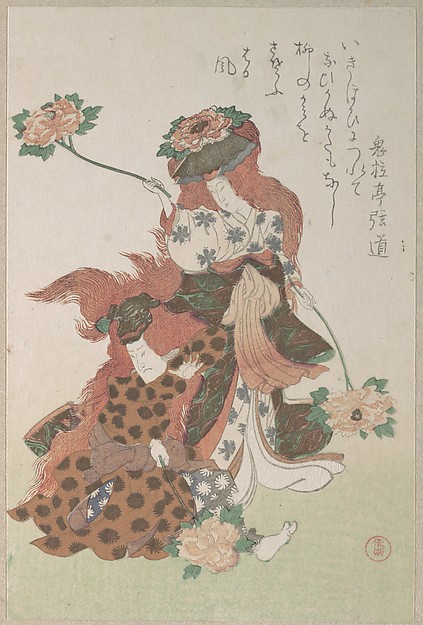
Look closer: Look at the dancers. Two figures in matching white lion wigs, a theatre dance reduced to a small privately printed card.
Kubo Shunman, Two Dancers Performing a “Shakkyōmono” Kabuki Dance, from Spring Rain Surimono Album (Harusame surimono-jō), vol. 3, ca. 1805–10. The Metropolitan Museum of Art, H. O. Havemeyer Collection, Bequest of Mrs. H. O. Havemeyer, 1929, accession JP2291. Public domain (Met Open Access). Museum record
T
- Tan-e 丹絵
- Early prints hand-coloured with an orange-red lead pigment (tan) and green.
- Tanzaku 短冊
- A tall, narrow poem-slip format.
- Triptych 三枚続
- Three sheets that join into one composition, a staple of spectacle subjects.
U
- Uki-e 浮絵
- “Floating pictures”: prints using Western-style linear perspective, popular in the 1740s and after.
- Ukiyo 浮世
- The “floating world”: the pleasure districts and urban culture of Edo, originally a Buddhist term for a transient world.
- Urushi-e 漆絵
- “Lacquer pictures”: prints using glue-thickened black ink and hand colour to imitate lacquer.

Look closer: Look at the moon and the bridge. The Ryōgoku bridge was the crowded heart of the pleasure districts, and Hiroshige records it at dusk.
Utagawa Hiroshige, Twilight Moon at Ryōgoku Bridge. The Metropolitan Museum of Art, Rogers Fund, 1922, accession JP1312. Public domain (Met Open Access). Museum record
W
- Washi 和紙
- Japanese handmade paper, made from kōzo, gampi or mitsumata fibres.
Y
- Yakusha-e 役者絵
- Actor prints: portraits of kabuki actors in their roles.
- Yamazakura 山桜
- Mountain cherry, the preferred wood for woodblocks, fine-grained and hard.
- Yōkai-e 妖怪絵
- Pictures of ghosts, spirits and monsters, made for entertainment.
Ō
- Ōban 大判
- The commonest print size, about 38 by 25 centimetres.
- Ōkubi-e 大首絵
- A “large head” picture: a bust portrait, associated with Utamaro and Sharaku.
A to Z of Artists, Series and Forms
60 entries: designers, publishers, series, formats and the neighbouring pages that explain what the prints show. Where an entry has its own page, the name is a link.
- Bijin-ga美人画Pictures of beautiful people; the largest genre.
- BokashiぼかしGradation printing, the soft fade in skies and water.
- Byōbu screens屏風The folding screens that carry the same subjects.
- Calligraphy and seals書The inscriptions and seals on a sheet.
- Eisen, Keisai渓斎英泉Designer (1790 to 1848) of long, sultry urban beauties.
- Fifty-three Stations of the Tōkaidō東海道五十三次Hiroshige’s 1833 to 1834 breakthrough.
- Hashiguchi Goyō橋口五葉Shin-hanga designer of the 1910s; Woman Applying Makeup, 1918.
- Hiroshige II二代広重Pupil who took his master’s name; designer of picture albums in the 1860s.
- Hiroshige, Utagawa歌川広重Landscape master (1797 to 1858); Tōkaidō and Edo series.
- Hishikawa Moronobu菱川師宣First signed print designer (1618 to 1694).
- Hokkei, Totoya魚屋北渓Pupil of Hokusai and a leading surimono designer.
- Hokusai Manga北斎漫画Fifteen volumes of sketches, over four thousand drawings.
- Hokusai, Katsushika葛飾北斎Painter and printmaker (1760 to 1849); the Great Wave, the Fuji series, the Manga.
- How a print was made摺The field guide to technique.
- Ichikawa Danjūrō市川團十郎The great kabuki dynasty whose members appear in countless actor prints.

Look closer: Look at the inn forecourt. Women call to travellers from the doorways, a famous comic device of the Goyu station and an example of how Hiroshige records the human side of the road.
Utagawa Hiroshige, Goyu, Tabibito Ryujo, ca. 1833–34. The Metropolitan Museum of Art, Rogers Fund, 1918, accession JP506. Public domain (Met Open Access). Museum record
- Isoda Koryūsai礒田湖龍斎Designer of beauties and pillar prints in the 1760s to 1780s.
- Japanese sword日本刀The blade seen in battle and portrait prints.
- JaponismeジャポニスムThe French-named fashion for Japanese art after 1867.
- Kabuki歌舞伎The theatre whose actors fill the yakusha-e.
- Kabuki costume歌舞伎衣装The layered robes that actor prints record.
- Kaigetsudō school懐月堂Early eighteenth-century makers of standing beauty paintings and prints.
- Kakejiku mounting掛軸How hanging scrolls are mounted.
- Kawase Hasui川瀬巴水Shin-hanga landscape artist (1883 to 1957).
- Kitagawa Utamaro喜多川歌麿Master of bust portraits of beauties (about 1753 to 1806).
- Kiyochika, Kobayashi小林清親Meiji designer of light-and-shadow views (1847 to 1915).
- Kiyomasu, Torii鳥居清倍Early actor-print designers of the Torii family.
- Kiyonaga, Torii鳥居清長Designer of tall, composed women (1752 to 1815).
- Koson, Ohara小原古邨Twentieth-century bird-and-flower designer.
- Kumadori隈取The painted lines of the kabuki hero’s face.
- Kunichika, Toyohara豊原国周Late-Edo and Meiji actor-print designer.
- Kunisada, Utagawa歌川国貞Prolific designer of actor prints and beauties (1786 to 1865).
- Kuniyoshi, Utagawa歌川国芳Master of warriors, monsters and satire (1797 to 1861).
- Masanobu, Okumura奥村政信Innovator of format and perspective (1686 to 1764).
- Munakata Shikō棟方志功Twentieth-century creative-print artist known for bold, wood-grain black-and-white.
- Netsuke根付Small carvings that often copy print subjects.

Look closer: Look at the sleeve crest and the eyebrow. The crest names the actor's house and the brows lift into a fierce frown.
Tōshūsai Sharaku, The Actor Sawamura Sojuro III, 1794–95. The Metropolitan Museum of Art, The Howard Mansfield Collection, Purchase, Rogers Fund, 1936, accession JP2645. Public domain (Met Open Access). Museum record
- Nishiki-e錦絵The full-colour brocade print from 1765.
- Noh能The older theatre, with masks and robes.
- Onchi Kōshirō恩地孝四郎Pioneer of abstract creative prints.
- One Hundred Aspects of the Moon月百姿Yoshitoshi’s last great series, 1885 to 1892.
- One Hundred Famous Views of Edo名所江戸百景Hiroshige’s late masterpiece, 1856 to 1858.
- Originals and reproductionsHow to tell an impression from a copy.
- Painting schools画派The Kanō, Rinpa and other schools around the print.
- Print glossary用語集A longer glossary of print terms.
- Publishers directory版元Publishers and editions.
- Samurai armour鎧The armour read in warrior prints.
- Scrolls and screens掛軸・屏風The painted counterparts of the print.
- Sharaku, Tōshūsai東洲斎写楽Actor portraitist, active about ten months in 1794 to 1795.
- Shin-hanga and sōsaku-hanga新版画・創作版画The twentieth-century revivals.
- Shunman, Kubo窪俊満Designer of surimono and beauties.
- Shunshō, Katsukawa勝川春章Actor-print designer who made realistic portraits (1726 to 1793).
- Surimono摺物Luxury privately printed cards.

Look closer: Look at the page. A sketchbook was printed as a book: faces, poses, birds and tools, each drawn as a lesson for the reader.
Katsushika Hokusai, Transmitting the Spirit, Revealing the Form of Things: Hokusai Sketchbooks, first volume (Denshin kaishu: Hokusai manga, shohen), after 1828. The Metropolitan Museum of Art, Rogers Fund, 1931, accession JIB81.1. Public domain (Met Open Access). Museum record
- Suzuki Harunobu鈴木春信Creator of the first brocade prints (about 1725 to 1770).
- Thirty-six Views of Mount Fuji冨嶽三十六景Hokusai’s series, about 1830 to 1832; the Great Wave belongs here.
- Toyokuni, Utagawa歌川豊国Actor-print designer (1769 to 1825) and teacher of the Utagawa school.
- Tsuba鍔The sword guard and its schools.
- Tsutaya Jūzaburō蔦屋重三郎Publisher of Utamaro and Sharaku, died 1797.
- Watanabe Shōzaburō渡邊庄三郎Publisher who led the shin-hanga movement from about 1915.
- Yamamoto Kanae山本鼎Founder of the creative-print movement; Fisherman, 1904.
- Yoshida Hiroshi吉田博Shin-hanga landscape artist and mountaineer.
- Yoshitoshi, Tsukioka月岡芳年Master of historical drama and the Hundred Aspects of the Moon (1839 to 1892).
Asked and Answered
What is the difference between ukiyo-e and a woodblock print?
Ukiyo-e is a movement and a subject world: the pictures of Edo’s floating world, which include paintings as well as prints. A woodblock print is a technique. Most ukiyo-e that survive are prints, and most prints from the Edo period are ukiyo-e, but a twentieth-century shin-hanga sheet is a woodblock print that is not strictly ukiyo-e.
How can I tell an original from a reproduction?
Look at the line under magnification, at the paper and at the colour. Hand printing leaves fine variations, a pressed edge and an absorbent surface, while a photomechanical copy shows an even dot pattern. The chapter on originals and reproductions explains the differences with examples; for a family piece, ask a specialist.
What do the seals and signatures on a print mean?
The signature usually names the designer and sometimes the studio or pen name; red or black marks can be the publisher’s mark or a censor’s seal. A seal that reads aratame or kiwame is a censor’s approval from the period 1790 to the early 1840s, and it helps to place a sheet in time.

Look closer: Look at the red lantern at the top of the frame. A giant lantern hangs over the gate; Hiroshige places it close to the eye so that the temple precinct opens behind it.
Utagawa Hiroshige, Kinryūsan Temple at Asakusa, from the series "One Hundred Famous Views of Edo", 1856. The Metropolitan Museum of Art, The Howard Mansfield Collection, Purchase, Rogers Fund, 1936, accession JP2519. Public domain (Met Open Access). Museum record
Is the Great Wave a rare print?
The design was printed many times and later impressions are numerous, but early, crisp impressions are scarce. One expert quoted at the 2023 Christie’s sale placed that sheet among about twenty of the best surviving impressions.
Why are prints so often faded?
Some vegetable and early synthetic colours are fugitive in light. Reds, purples and some greens are the most vulnerable. Prints kept in dark portfolios, or displayed rotating and under protective glazing, keep their colour far better.
How should I display a woodblock print?
Away from direct sun and heat, behind ultraviolet-filtering glazing, in acid-free, reversible mounts, and in rotation rather than permanently. A good facsimile is the traditional answer for a spot that gets light.
What was shin-hanga and why does it matter?
Shin-hanga, “new prints”, was a movement from about 1915 in which the publisher Watanabe Shōzaburō revived the collaborative workshop for new subjects and a new, partly foreign, audience. It matters because the sheets are real woodblock prints, many in limited editions, and because they link the Edo trade to the modern art market.
What is sōsaku-hanga?
“Creative prints”: a movement, dated from Yamamoto Kanae’s Fisherman of 1904 and the 1918 founding of the Japanese Woodcut Artists’ Association, in which one artist drew, carved and printed. It stands for personal expression rather than the workshop.

Look closer: Look at the circle of the moon and the flame. Yoshitoshi sets a quiet moon in a field of dramatic fire.
Tsukioka Yoshitoshi, Moon in the Flame from the Series One Hundred Images of the Moon (Tsuki hyaku sugata-enchūgetsu), February, 1886. The Metropolitan Museum of Art, Bequest of William S. Lieberman, 2005, accession 2007.49.310. Public domain (Met Open Access). Museum record
What is the best way to start a collection?
Pick a question rather than a famous name: a series, an actor, a season, a bridge. Visit museum study rooms, learn the four vocabularies of subject, process, condition and edition, and buy fewer, better sheets with an honest condition report.
Are there erotic prints, and are they collectable?
Shunga was made throughout the Edo period by the same artists, is studied by museums and is collected by specialists. It is adult material and is not illustrated here; the Almanac treats it as cultural history.
What objects carry ukiyo-e designs today?
Textiles, souvenir jackets, lacquer, netsuke, tea ware and scroll mounts all borrow print subjects. The shelf at the foot of this page shows some of them from the house.
Can the concierge find a particular print?
Yes. Send a private request with what you have in mind, a budget range and any condition preferences; the Japonista Curation and Concierge Team in Tokyo will reply personally.
On the Shelf Today
Real pieces from the house, photographed in Tokyo, that carry the language of the floating world: embroidered ukiyo-e, a Buddhist assembly print mounted as a scroll, and a contemporary edition. The shelf changes as pieces find their homes; the collections behind it are always open.
 Hokusai-inspired whale and wave sukajanUkiyo-e embroidery on a vintage jacket
 Tedman ukiyo-e sukajanRaijin, oiran, pagoda and Mount Fuji
 Satori tiger and dragon sukajanHokusai-style wave, reversible
 Buddhist assembly kakejikuWoodblock-style print on a navy-gold mount
 Takashi Murakami circular printA contemporary edition of 300
 Reversible samurai and dragon sukajanUkiyo-e warrior scene and nihonga dragon
Open a whole shelf
Further Reading and Neighbouring Worlds
Three outbound references for study: the open-access holdings of the Metropolitan Museum, and the two Tokyo museums devoted to Hokusai and to ukiyo-e. Within the Athenaeum, the neighbouring worlds are the stage, the warrior, the scroll and the screen, all linked above.
Sources and Image Credits
Dated claims on this page were read in the references below. Where a single source stands alone for a figure, the text names it.
- Wikipedia, Ukiyo-e (history, dates, process outline)
- The Metropolitan Museum of Art, Open Access collection (every image on this page, with object records)
- Japan Times, Hokusai Great Wave print sells for 2.76 million dollars, 23 March 2023
- Deccan Herald, Hokusai’s Great Wave off Kanagawa sets record at Hong Kong sale
Image credits are printed beneath each picture: every print is from the Metropolitan Museum of Art Open Access collection (public domain), and shelf photographs are our own. Diagram by Japonista. Last reviewed 28 October 2026.
A private request
If a print, a scroll or a piece of the floating world has caught your eye, or you are looking for something that has not yet appeared on the shelf, the Otoriyose door is open. Tell us what you are looking for, in a few lines or at length, and the concierge team will reply personally with what can be found and how it would reach you.
Make a private request · Return to the Ukiyo-e Almanac · Return to the Athenaeum
The Japonista Curation and Concierge Team, Tokyo, Japan
Private concierge
Looking for something in particular?
Describe the piece or the project you have in mind. A senior advisor in Tokyo reads every case file personally and replies within two business days, with fees set out in writing before any work begins.