
Tokoname: Coiled Jars, Red Teapots
Pottery Almanac · Aichi
Tokoname: Coiled Jars, Red Teapots
Tokoname is one of the Six Ancient Kilns and the one most closely tied to the sea. Its early jars were coiled by hand and glazed by falling wood ash. Its later fame rests on red clay, and on teapots that are left unglazed inside.
Fact sheet
At a glance
- A medieval giant. Cleveland's catalogue calls Tokoname the largest centre of ceramic production in medieval Japan.
- Coils and ash. Early jars were built by piling coils of clay, then finished on the wheel at the rim, and glazed by wood ash falling in the kiln.
- Red clay. Iron-rich local clay fires red. The prefecture names shudei-yaki, red-clay ware, as the leading product.
- Climbing kilns. About sixty climbing kilns once operated in Tokoname, and the Tōei Kiln, built in 1887, is the largest that survives in Japan.
- A Living National Treasure. Yamada Jōzan III was named a Living National Treasure in 1998 for making small pouring vessels.
Ise Bay and the Chita Peninsula
Tokoname ware is a stoneware produced in and around Tokoname in Aichi Prefecture, in central Japan. The Japan Tourism Agency's sightseeing database, in an entry prepared with the Tokoname Tourism Association, describes the local tradition as about a thousand years old and says the area suited pottery for four reasons: soft soil, gentle hills for digging tunnel kilns, abundant good clay, and the sea nearby for shipping.
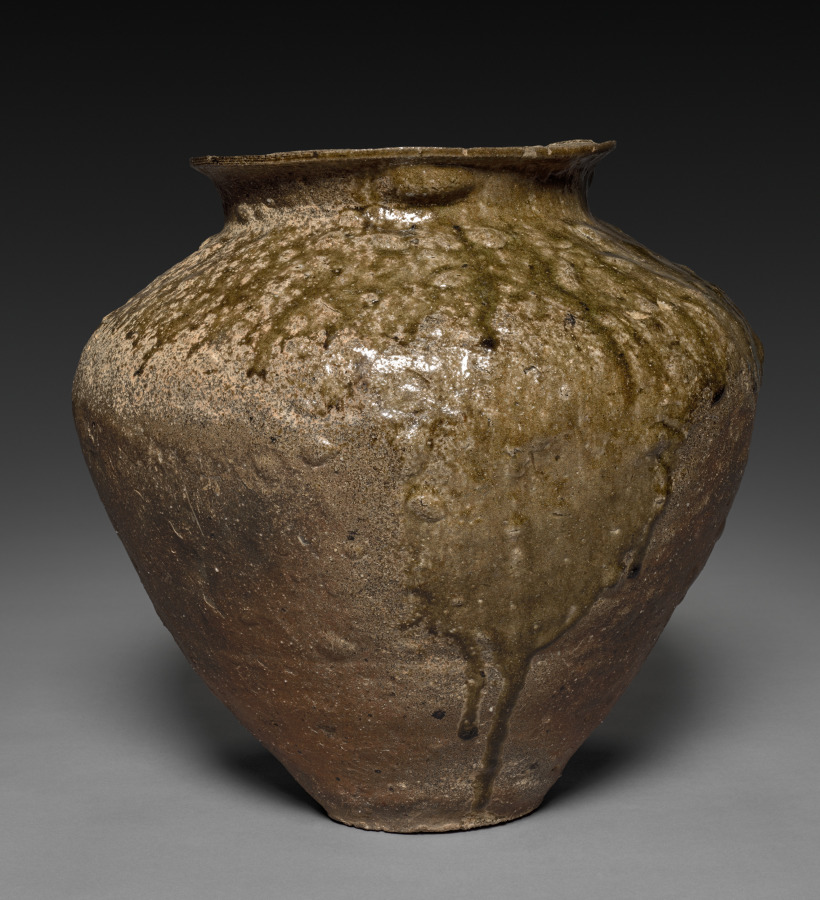
Storage Jar, late 1100s, Stoneware with natural ash glaze (Tokoname ware). The Cleveland Museum of Art, Gift from the Collection of George Gund III, accession 2015.495.
Look closer: the lip is wide and flat, the shoulder is covered in glossy olive-green and amber ash glaze, and green drips run down the brown body. The museum catalogues it as stoneware with natural ash glaze, of the late 1100s, 37 cm high.
Image: The Cleveland Museum of Art, Open Access (CC0)
The Cleveland Museum of Art, in the catalogue entry for a late twelfth-century jar, calls Tokoname, on Ise Bay, the largest centre of ceramic production in medieval Japan, active since the Heian period, and says wide-mouthed jars like this one are called kame and were favoured for use in tea practice. JAANUS traces the predecessors further back, to the Sanage kilns at the foot of Mt Sanage, which made ceramics between the Kofun and Heian periods, and says kilns operated across the Chita Peninsula from the Heian through the Muromachi periods.
The products were first plain. The Tourism Agency entry says that by the fourteenth century potters used the coil method, himozukuri, to make large storage jars and cooking utensils, and that jars served practical purposes including the transport of liquor. JAANUS adds that large jars for household and ceremonial use were made in great quantities. The Cleveland jar pictured here is catalogued as stoneware with natural ash glaze, 37 centimetres high.
Coils, Ash and a Small Base
Cleveland's catalogue explains how a medieval Tokoname jar was made. It was built by piling coils of clay on top of one another, smoothing the inside and outside, and letting the clay dry before adding another section. The wide rim and mouth were then added using a potter's wheel. Because of its small base, the museum says, the vessel could stand safely on a narrow step on the steep slope of a rising kiln floor. Such kilns were built into a hillside and fired with wood, and the natural ash glazes took about a week to ten days to form.
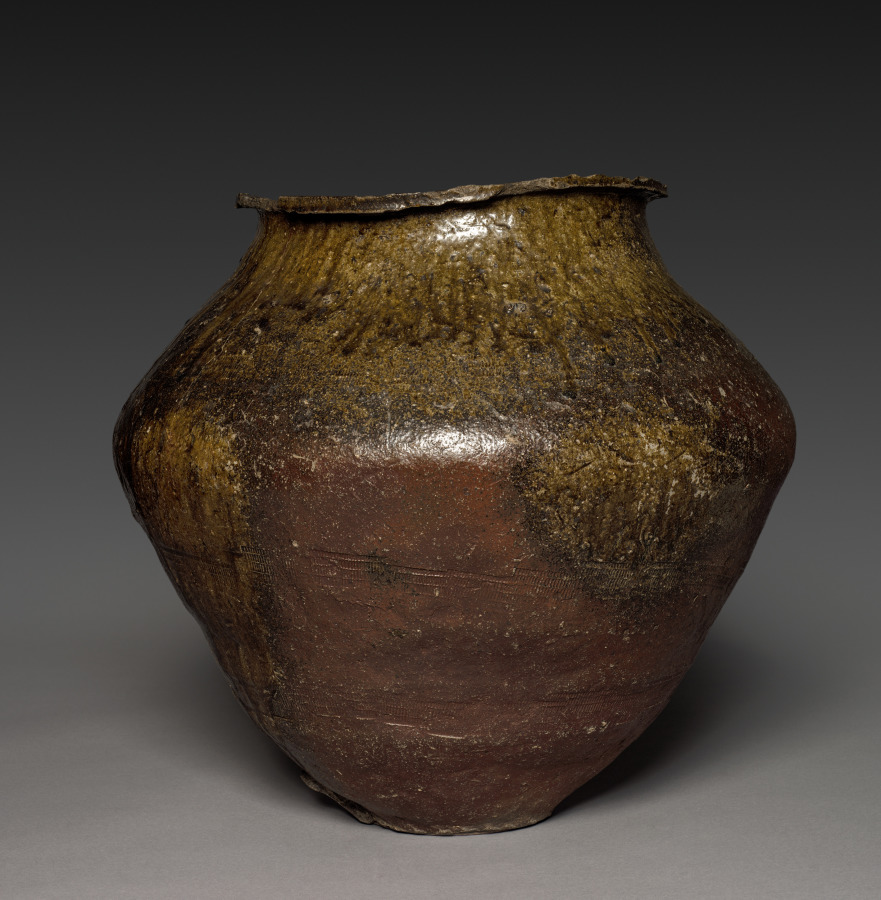
Storage Jar, 1350–99, Stoneware with natural ash glaze and impressed designs (Tokoname ware). The Cleveland Museum of Art, Gift of George Gund, accession 1992.356.
Look closer: the rim is wide and thin, the shoulder is sharply angled, the ash glaze is olive over the upper half, and the lower wall is red-brown. The museum catalogues it as stoneware with natural ash glaze and impressed designs, of 1350 to 1399, 51 cm high.
Image: The Cleveland Museum of Art, Open Access (CC0)
JAANUS describes the ware in similar terms: rugged, reddish-brown stoneware, dark vessels formed by coiling and pinching ropes of clay, with natural ash glaze on the shoulders. The Tourism Agency adds that large kilns, ogama, appeared in the late fifteenth century and raised output. The Cleveland jar of 1350 to 1399 pictured here is 51 centimetres high and carries impressed designs, as the museum records.
One early vessel in the Met's collection has a particular purpose in its title. A jar for sutra burial, a sankinko, of the early twelfth century, it is catalogued as stoneware with natural ash glaze, 24.8 centimetres high, in the late Heian period. The museum's entry records what it was for, and the object shows that the Tokoname kilns made vessels for the burial of scripture as well as for the kitchen.
The Teapot Trade
The Aichi prefectural website lists the main products of Tokoname today as tea ceremony goods, flower vases, liquor cups, ornaments and flowerpots. It says Tokoname is one of Japan's old kilns, that in the Momoyama period tea bowls and other tea ceremony items were made, and that in the Edo period the production of shudei, red clay, hakudei, white clay, and hiiro, fire-colour, wares used the area's iron-rich clay. Shudei-yaki, which uses iron in the clay to produce a red colour, is the leading product.

Deep Cup, 19th century, Clay, the lower half covered in salt glaze style, the upper half with a white glaze (Tokoname ware) (?). The Metropolitan Museum of Art, Gift of Mr. and Mrs. Samuel Colman, 1893, accession 93.1.83.
Look closer: the lower half is dark and finely ridged, and the upper half is covered in a pale glaze with dark flecks. The museum catalogues it as clay with the lower half in a salt-glaze style and the upper half in white glaze, as Tokoname ware with a query, of the Edo or Meiji period, 13.3 cm high.
Image: The Metropolitan Museum of Art, Open Access (CC0)
The prefecture also describes the making. Pieces are formed on the wheel, in a press mould or by hand, and the surface is burnished with cloth, a process it calls unique to Tokoname. Salt is added in the final firing, which the page links to the town's position near the sea, and unglazed pieces are polished with feathers after firing.
The teapot story comes from the Tourism Agency entry. Techniques from China in the mid-nineteenth century led to red-clay teapots, kyusu. The clay is iron-rich, reddish, heat-retaining and porous, and the pots are left unglazed inside, which the entry says is said to soften the astringency of green tea. Wikipedia names redware teapots among the town's best-known products, together with wind chimes, shochu servers and bonsai pots, and notes that antique Tokoname bonsai pots are collectors' items.
The best-known maker is recorded by Wikipedia. Yamada Jōzan III, who lived from 1924 to 2006, was named a Living National Treasure in 1998, after recognition as a National Intangible Cultural Asset for making small pouring vessels, and his son Yamada Jōzan IV took the title after his death. In January 2007, the article adds, Tokoname was officially protected as a local brand. The Tourism Agency records that by 1950 Tokoname was Japan's top producer of maneki neko figurines, and that production peaked in the 1950s, when hundreds of kilns operated.
The Tōei Climbing Kiln
Wikipedia says about sixty climbing kilns, nobori-gama, formerly operated in Tokoname. One of them is the Tōei Kiln, built in 1887 and used until 1974, which it calls the largest climbing kiln existing in Japan. The government designated it an Important Tangible Cultural Property in 1982. It has eight firing chambers on a 17-degree incline and ten chimneys of varying height.
The article also ties the Koie family to the climbing kiln. Koie Hokyu, towards the end of the Edo period, completed a chambered climbing kiln, and his son Koie Hoju established the town's reputation, laid the foundations for earthenware pipe making, and introduced the redware for which the town became renowned. The Meitetsu Tokoname Line, built in the Meiji era, encouraged production and carried the increasing tile output of the Taishō era.
Other makers carried the craft through the Shōwa era. The article names Ezaki Issei, who lived from 1918 to 1992, and two of his students, Takeuchi Kimiaki and Osako Mikio. The INAX company, it adds, runs museums in Tokoname showing the history of industrial production.
Reading a Tokoname Jar
Begin with the colour of the body. JAANUS says Tokoname stoneware is reddish brown, with ash glaze on the shoulders, and the pictured jars bear that out, the upper half glossy with olive and amber ash and the lower wall a dry red-brown. Then look at the lip and the foot. A wide, thin lip added on the wheel and a small base, as the Cleveland catalogue describes for one jar, belong to the medieval jar form.
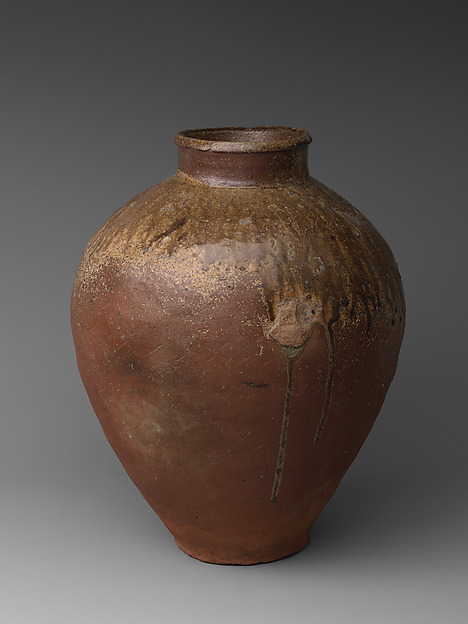
Large Storage Jar (Ōtsubo), 16th century, Stoneware with natural ash glaze (Tokoname ware). The Metropolitan Museum of Art, Mary Griggs Burke Collection, Gift of the Mary and Jackson Burke Foundation, 2015, accession 2015.300.275.
Look closer: the body is tall and ovoid with a short neck, the clay is red-brown, and amber ash gathers on the shoulder with a dark streak down one side. The museum catalogues it as stoneware with natural ash glaze, of the 16th century, 54.6 cm high.
Image: The Metropolitan Museum of Art, Open Access (CC0)
The Met's sixteenth-century large storage jar pictured here is catalogued as stoneware with natural ash glaze, 54.6 centimetres high, and the pitted ash on its shoulder and the dark streak down one side are the kind of surface the catalogue entries describe. For comparison, the house has chapters on the neighbouring kilns of Shigaraki and Bizen, linked below.
Jars, Bowls and Burial Vessels

Storage Vessel: Tokoname Ware, 1100s, stoneware with natural ash glaze. The Cleveland Museum of Art, Seventy-fifth anniversary gift of Takako and Iwao Setsu, accession 1992.137.
Look closer: the shoulder is glossy olive-brown, the rim is thin and flared, and the lower body is dry and red-brown. The museum catalogues it as stoneware with natural ash glaze, of the 1100s, 35.5 cm high.
Image: The Cleveland Museum of Art, Open Access (CC0)
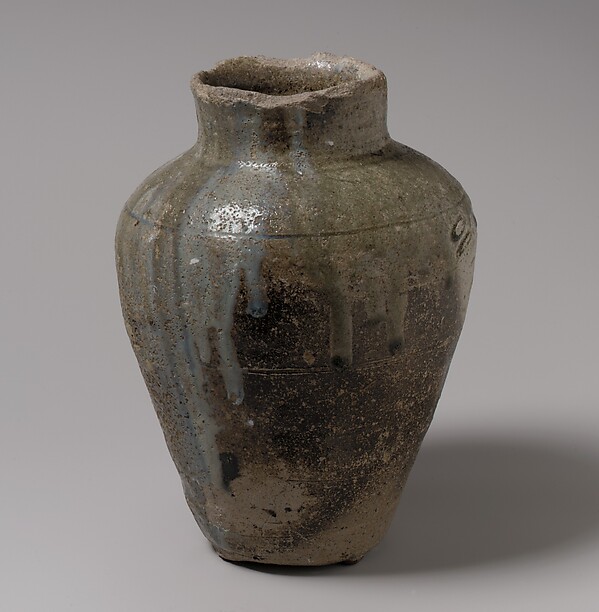
Jar for Sutra Burial (Sankinko), early 12th century, Stoneware with natural ash glaze (Tokoname ware). The Metropolitan Museum of Art, Dr. and Mrs. Roger G. Gerry Collection, Bequest of Dr. and Mrs. Roger G. Gerry, 2000, accession 2002.447.12.
Look closer: the mouth is pinched and uneven, the shoulder carries grey-green ash glaze, and blue-grey drips run down the sides. The museum catalogues it as stoneware with natural ash glaze, of the early 12th century, 24.8 cm high.
Image: The Metropolitan Museum of Art, Open Access (CC0)

Bowl, 13th century, Stoneware with natural ash glaze around inside walls (Tokoname ware). The Metropolitan Museum of Art, Gift of Felice Fedder Oriental Art Inc., 1980, accession 1980.268.
Look closer: the bowl is wide and shallow, with a rough ash-covered inside wall and a drip of glaze down the outside. The museum catalogues it as stoneware with natural ash glaze around the inside walls, of the 13th century, 14 cm wide; the photograph is black and white.
Image: The Metropolitan Museum of Art, Open Access (CC0)

Bowl, 14th century, Stoneware with ash glaze (Tokoname ware). The Metropolitan Museum of Art, Purchase, Jack C. Greene Gift, 1978, accession 1978.195.
Look closer: the inside is dark and spattered with ash, and a pale patch sits on the floor. The museum catalogues it as stoneware with ash glaze, of the 14th century, 17.8 cm in diameter; the photograph is black and white.
Image: The Metropolitan Museum of Art, Open Access (CC0)
Tokoname at the Desk
At the time of writing no piece catalogued as Tokoname ware is with the house. The house does keep a page on Tokoname bonsai pottery, and the guide to caring for ceramics applies to jars and teapots alike.
Answered plainly
What is Tokoname ware?
A stoneware from Tokoname in Aichi Prefecture, one of the Six Ancient Kilns, known for coil-built medieval jars with ash glaze and, later, for red-clay tea ware.
Why are Tokoname teapots red?
The local clay is iron-rich and fires red. The prefecture names shudei-yaki, red-clay ware, as the leading product of Tokoname.
What is the Tōei Kiln?
A climbing kiln built in 1887 and used until 1974, said to be the largest that exists in Japan, designated an Important Tangible Cultural Property in 1982.
Who is Yamada Jōzan III?
A Tokoname potter, 1924 to 2006, named a Living National Treasure in 1998 for making small pouring vessels.
Where next
Sources and image credits
- Tokoname ware, Wikipedia
- Tokonameyaki, JAANUS
- Tokoname Ware, Japan Tourism Agency sightseeing database
- Tokonameyaki, Aichi Prefectural Government
- Six Ancient Kilns, Wikipedia
- Object record, Storage Jar, The Cleveland Museum of Art
- Object record, Storage Jar, The Cleveland Museum of Art
- Object record, Deep Cup, The Metropolitan Museum of Art
- Object record, Large Storage Jar (Ōtsubo), The Metropolitan Museum of Art
- Object record, Storage Vessel: Tokoname Ware, The Cleveland Museum of Art
- Object record, Jar for Sutra Burial (Sankinko), The Metropolitan Museum of Art
- Object record, Bowl, The Metropolitan Museum of Art
- Object record, Bowl, The Metropolitan Museum of Art
Last reviewed 28 October 2026. Pictures, where shown, are public-domain or open-access and credited beneath each one.
Looking for a Tokoname teapot, jar or bonsai pot, or a view on one you own? The concierge desk replies within one to three business days.
Browse Japanese porcelain and ceramics · Make a private request
Private concierge
Looking for something in particular?
Describe the piece or the project you have in mind. A senior advisor in Tokyo reads every case file personally and replies within two business days, with fees set out in writing before any work begins.