
Raku: Hand-Built, Fired Hot
Pottery Almanac · Kyoto
Raku: Hand-Built, Fired Hot
Raku is the one Japanese tea ware that is shaped by hand, fired briefly and drawn glowing from the kiln. It began in Kyoto as a tile-maker's commission, and its name is both a pottery style and a family that has made it for generations.
Fact sheet
At a glance
- A tile-maker's bowls. Sen no Rikyū had Chōjirō, a tile-maker, produce hand-moulded tea bowls for wabi-style tea. They were first called ima-yaki, contemporary ware.
- Hand-shaped, fired hot. Raku is characterised by hand-shaping, a porous body from low firing, lead glazes, and removal from the kiln while still glowing hot.
- A seal and a family name. Toyotomi Hideyoshi presented Chōjirō's son Jōkei with a seal bearing the character for raku, and the name passed to the family.
- Black and red. Black raku is tied to Rikyū's wabi taste. Red raku became more common from the early seventeenth century.
- Two meanings. Western raku, developed by studio potters in the twentieth century, differs from the Japanese process, and the Raku family has objected to the name being used for it.
A Tile-Maker's Bowl
Raku ware is a type of Japanese pottery traditionally used in tea ceremonies, most often as chawan, the tea bowl. Wikipedia sets its beginnings in the sixteenth century. Sen no Rikyū, the tea master, was involved with the construction of the Jurakudai, Toyotomi Hideyoshi's palace in Kyoto, and had a tile-maker named Chōjirō produce hand-moulded tea bowls for the wabi-style tea ceremony that was Rikyū's ideal. The bowls were first referred to as ima-yaki, contemporary ware, and were also distinguished as Juraku-yaki.

Black Raku Tea Bowl, early 17th century, Earthenware with black raku glaze (Raku ware). The Metropolitan Museum of Art, Rogers Fund, 1917, accession 17.118.74.
Look closer: the walls are almost straight, the rim dips and rises a little, and the glaze is a deep, soft black. The museum catalogues it as Momoyama in date, of the early 17th century.
Image: The Metropolitan Museum of Art, Open Access (CC0)
Chōjirō's own life is thinly recorded. The article on him gives his dates as 1516 to 1592, names his father as Ameya, a potter from Fujian in China, and credits him with being the first generation of the Raku family. It describes his bowls as hand-built rather than wheel-thrown, unadorned, asymmetrical and made in black or red, and says Rikyū singled out seven of them as masterpieces, the group known as the uchi shichishu, the inner seven.
The Met's black bowl pictured here, catalogued as Momoyama in date, is nearly cylindrical, with a rim that dips slightly.
Hand-Shaped, Fired Hot, Cooled in Air
Wikipedia characterises Japanese raku by four things: hand-shaping, a high degree of porosity from low firing temperatures, lead glazes, and the removal of pieces from the kiln while still glowing hot. In the traditional process the fired piece is allowed to cool in the open air.
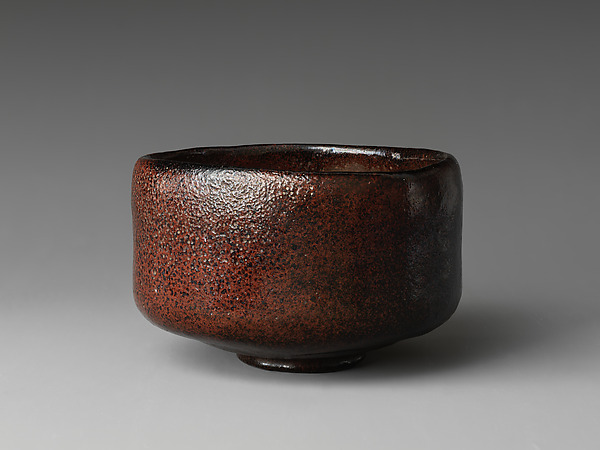
Black Raku Teabowl, named “Setting Sun” (Sekiyō), late 17th century, Earthenware with black raku glaze (Raku ware). The Metropolitan Museum of Art, Mary and Cheney Cowles Collection, Gift of Mary and Cheney Cowles, 2024, accession 2024.443.1.
Look closer: the glaze is dark but speckled with red-brown, the body is low and rounded, and the foot is small. The museum catalogues it as black raku glaze on earthenware, of the late 17th century.
Image: The Metropolitan Museum of Art, Open Access (CC0)
The Japan Architecture and Art Net Users System, known as JAANUS, adds detail. A raku bowl is hand-moulded, often with a spatula, rather than thrown on a wheel. Potters typically use soft Kyoto clays and a low-fire lead glaze, usually red or black and occasionally white. The bowl is fired briefly, at about 1000 degrees Celsius, in a saggar inside a small kiln, then removed and cooled quickly in air. The result is a porous body that holds heat and insulates the hand against hot tea. JAANUS notes that early bowls are often of the hanzutsu form, a half-cylinder with a rounded lower body and straight sides.
The Met's late seventeenth-century bowl, named Sekiyō, Setting Sun, shows what a black raku glaze can do. The museum catalogues it as earthenware with a black raku glaze, and in the photograph the surface is flecked with red-brown, so that it reads as dark and warm at once.
The Seal, the Family and the Branch Kilns
Raku became the name of a family because of a seal. Wikipedia says that Toyotomi Hideyoshi presented Jōkei, Chōjirō's son, with a seal bearing the Chinese character for raku, which means enjoyment. The article on Chōjirō gives the year as 1598, six years after Chōjirō's death, and says the character was taken from the name of the Jurakudai. The ware then became known as Juraku-yaki, shortened to raku, and Raku became the name of the family that produced it. Both name and style have been passed down, sometimes by adoption, to the present sixteenth generation, Raku Kichizaemon XVI.
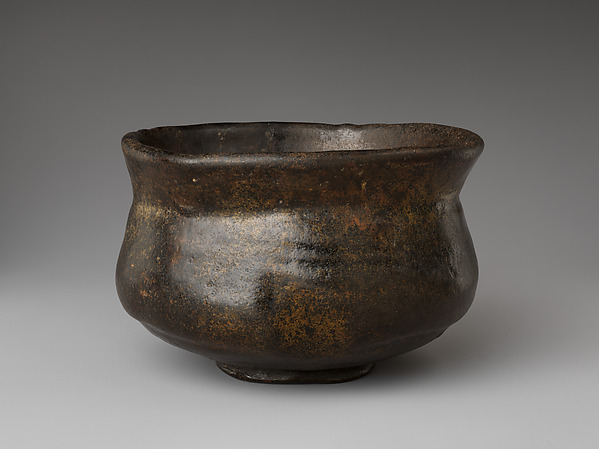
Black Raku Tea Bowl, Named “Kaedegure” (Twilight by the Maples), 17th century, Earthenware with black Raku glaze (Raku ware). The Metropolitan Museum of Art, Gift of Peggy and Richard M. Danziger, 2024, accession 2024.553.19.
Look closer: the bowl is waisted with a flaring rim, and the black glaze breaks to brown on the shoulder. The museum catalogues it as black raku glaze on earthenware, of the 17th century.
Image: The Metropolitan Museum of Art, Open Access (CC0)
Wikipedia places raku at an important point in the history of Japanese ceramics: it was the first ware to use a seal mark, and the first to focus on close collaboration between potter and patron. JAANUS gives the third head, Dōnyū, credit for a highly viscous glaze, makugusuri, the thick, skin-like glaze for which later raku bowls are known. The Raku ware article lists Dōnyū, a grandson of Chōjirō who lived from 1574 to 1656, among the clay artists of the period, together with Hon'ami Kōetsu and Ogata Kenzan, who lived from 1663 to 1743.
Kōetsu's link to the Raku house is described in his own article. He was regarded as one of the top pupils of Furuta Oribe and of the Raku style, and was given clay by Dōnyū. One of his tea bowls, called Fuji-san, is designated a National Treasure. The Met owns a red raku bowl catalogued as a copy of the Kaga Kōetsu tea bowl, of the eighteenth century.
Outside the main line, the Raku ware article records branch kilns, wakigama, founded by Raku family members or by potters who apprenticed at the head family's studio. One of the best known is Ōhi ware. After the publication of a manual in the eighteenth century, raku ware was also made in numerous workshops by amateur potters and tea practitioners in Kyoto, and by professionals and amateurs around Japan, and it influenced Hōraku ware from Nagoya in the later Edo period.
Raku Leaves Japan
The Western version of raku was developed in the twentieth century by studio potters. Wikipedia credits Bernard Leach with bringing raku to the West: in 1911 he attended a party where he witnessed raku firing, his first experience of ceramics. The first Japanese-style kiln in the West was built by Tsuronosuke Matsubayashi at the Leach Pottery in St Ives in 1922. The technique was largely forgotten after the 1930s, and became popular with American potters in the late 1950s, helped by Paul Soldner.
The Western process differs. Wares are typically fired at a high temperature and, once out of the kiln, placed in an open-air container of combustible material, which is not traditional Raku practice in Japan. The use of a reduction chamber at the end of the firing was introduced by Soldner in the 1960s. Western potters rarely use lead as a glaze ingredient because of its toxicity, and the article adds that Japanese potters substitute a non-lead frit.
The difference was argued over in person. At a craft conference in Kyoto in 1979, a heated debate arose between Soldner and the youngest of the dynastic Raku succession, of the fourteenth generation, about the right to use the title raku. The Japanese side maintained that work by other craftspeople should carry their own names, as in Soldner-ware, since that was how raku was intended. For a collector the point is practical: a bowl in the Kyoto tradition and a smoke-blackened studio vessel are different things, and the house describes them as such.
Reading a Raku Bowl
Begin with the colour and the glaze. Black raku is tied by JAANUS to Rikyū's wabi taste, and red raku became more common from the early seventeenth century. Then look at the shape: JAANUS says early bowls are often of the half-cylinder form, with a rounded lower body and straight sides.

Red Raku Tea Bowl (copy of the Kaga Kōetsu Tea Bowl), 18th century, Earthenware with red slip under clear lead glaze (Raku ware). The Metropolitan Museum of Art, The Howard Mansfield Collection, Gift of Howard Mansfield, 1936, accession 36.120.492.
Look closer: the glaze is a soft orange, lightly speckled, and the rim is cut with vertical grooves. The museum catalogues it as a copy of the Kaga Kōetsu tea bowl, of the 18th century, in earthenware with a red slip under a clear lead glaze.
Image: The Metropolitan Museum of Art, Open Access (CC0)
Then ask how the piece has been kept. The body is porous, a result of the low firing, and the house keeps a plain guide to caring for ceramics, linked below. The journal's note on tomobako and hakogaki, the boxes and inscriptions that accompany tea ceramics, is a companion for any bowl that comes with its box.
Black, Red and Frothy Edge

Teabowl, ca. 1650, Clay covered with a shiny black glaze and frothy edge of glaze (Raku ware). The Metropolitan Museum of Art, Rogers Fund, 1917, accession 17.118.76.
Look closer: the glaze is glossy black and gathers into a frothy edge at the rim. The museum describes clay covered with a shiny black glaze and a frothy edge of glaze, of about 1650.
Image: The Metropolitan Museum of Art, Open Access (CC0)

Teabowl, ca. 1650, Clay covered with a dull red glaze (Raku ware). The Metropolitan Museum of Art, Rogers Fund, 1917, accession 17.118.77.
Look closer: the glaze is dull and pitted over a rounded body. The museum describes clay covered with a dull red glaze, of about 1650; the photograph is black and white.
Image: The Metropolitan Museum of Art, Open Access (CC0)

Red Raku Tea Bowl (Chawan), 18th century, Earthenware with red slip under milky glaze (Raku ware, unknown workshop); gold lacquer repairs. The Metropolitan Museum of Art, The Howard Mansfield Collection, Gift of Howard Mansfield, 1936, accession 36.120.525.
Look closer: a dark, branching line runs across the red glaze of a rounded bowl. The museum catalogues it as a red raku tea bowl of the 18th century, from an unknown workshop, and records gold lacquer repairs.
Image: The Metropolitan Museum of Art, Open Access (CC0)

Teabowl, early 17th century, Earthenware covered with light red glaze (Raku ware). The Metropolitan Museum of Art, Rogers Fund, 1917, accession 17.118.64.
Look closer: the glaze is thick, pitted and uneven on a straight-sided bowl. The museum describes earthenware covered with a light red glaze, of the early 17th century; the photograph is black and white.
Image: The Metropolitan Museum of Art, Open Access (CC0)
Raku at the Desk
At the time of writing no piece catalogued as Raku ware is with the house. The concierge desk can say when one arrives. The journal's guide to Raku ware tea bowls, its note on tomobako and hakogaki and the plain guide to caring for ceramics are good companions to this chapter.
Answered plainly
What is Raku ware?
A Japanese pottery made for the tea ceremony, hand-shaped, low-fired with a lead glaze and removed from the kiln while still glowing hot, then cooled in open air.
Who made the first Raku bowls?
Chōjirō, a tile-maker in Kyoto, who made hand-moulded tea bowls for Sen no Rikyū's wabi-style tea.
Why is it called Raku?
Toyotomi Hideyoshi presented Chōjirō's son Jōkei with a seal bearing the character raku, and the name passed to the family and to the ware.
Is Western raku the same?
No. Western raku was developed by studio potters in the twentieth century and typically uses a reduction chamber of combustible material, which is not traditional in Japan.
Where next
Sources and image credits
- Raku ware, Wikipedia
- Chōjirō, Wikipedia
- Hon'ami Kōetsu, Wikipedia
- Rakuyaki, JAANUS
- Rakuyaki, Global Japanese Tea Association (consulted; a body that also runs a shop)
- Object record, Black Raku Tea Bowl, The Metropolitan Museum of Art
- Object record, Black Raku Teabowl, named “Setting Sun” (Sekiyō), The Metropolitan Museum of Art
- Object record, Black Raku Tea Bowl, Named “Kaedegure” (Twilight by the Maples), The Metropolitan Museum of Art
- Object record, Red Raku Tea Bowl (copy of the Kaga Kōetsu Tea Bowl), The Metropolitan Museum of Art
- Object record, Teabowl, The Metropolitan Museum of Art
- Object record, Teabowl, The Metropolitan Museum of Art
- Object record, Red Raku Tea Bowl (Chawan), The Metropolitan Museum of Art
- Object record, Teabowl, The Metropolitan Museum of Art
Last reviewed 28 October 2026. Pictures, where shown, are public-domain or open-access and credited beneath each one.
Looking for a Raku tea bowl or a view on one you own? The concierge desk replies within one to three business days.
Browse Japanese porcelain and ceramics · Make a private request
Private concierge
Looking for something in particular?
Describe the piece or the project you have in mind. A senior advisor in Tokyo reads every case file personally and replies within two business days, with fees set out in writing before any work begins.