
Potters and Living National Treasures
Pottery Almanac · Makers
Potters and Living National Treasures
A Japanese pot can be read as a place, a kiln or a hand. This chapter is about the hand: the state honour that names a master, the families that hand a single name down for generations, the potters who refused every honour, and the two Edo-period Kyoto masters whose names still sell later work.
Fact sheet
At a glance
- A popular title. Living National Treasure is not a term the law uses. The formal title is Preserver of Important Intangible Cultural Properties.
- Skill, not objects. The honour certifies a person who holds an art, and carries a yearly grant of two million yen.
- Names descend. Tokuda Yasokichi, Kakiemon and Imaemon are names taken by successive heads of a workshop.
- Some refused. Kawai Kanjirō declined every honour and Rosanjin declined the title in 1959.
- Two Kyoto masters. Ninsei and Kenzan are Edo-period names that museums also use for later work in their style.
What the Honour Means
Wikipedia begins with a correction. Living National Treasure is a popular term, it says, and does not appear in the law. The people it describes are certified as Preservers of Important Intangible Cultural Properties by the Minister of Education, Culture, Sports, Science and Technology, under the Law for the Protection of Cultural Properties. The article on Hamada Shōji records that the Cultural Property Protection Act was amended on 29 May 1954, and that the preserver designation followed. Before 1947, the article on the Living National Treasures adds, an older system of Imperial Household Artists was in place.
What the system protects is a skill. Intangible cultural properties are defined there as dramatic, musical, artistic and other intangible cultural artefacts of high value in terms of Japanese history or art, and those of special importance may be designated. There are three kinds of certification: individual, for a person who has attained high mastery of an art or craft; collective, for a group of two or more working together; and preservation group, for large groups in crafts where individual character is not emphasised. Of the three, Wikipedia says, only the individual holders are commonly called Living National Treasures, and in the crafts the certification is either individual or by preservation group.
The state pays each holder a grant of two million yen a year. The total has been fixed since 2002 at 232 million yen, which, the article calculates, caps the number of living holders at 116: when the roll is full, nobody new is designated until a place falls vacant. By 1 December 2020, Wikipedia says, 371 persons had been designated, of whom 111 were still living on 1 February 2021. Wikipedia says that treasures have been certified in sixteen categories of intangible cultural property, among them the performing arts and the crafts.
Thirty-Six Names on the Ceramics Roll
The English Wikipedia list of crafts holders names thirty-six individuals in ceramics and two groups: the Kakiemon Pottery Technique Preservation Society, certified in 1976, and the Onta-yaki Technique Preservation Society, certified in 1995. The table reproduces the individuals, ordered by year of designation, with the subcategory as the list gives it. Names follow Japanese order. Death years are left out because the sources used here do not always agree on them.
Read down the last column and the map of this almanac appears. Shino-yaki, Bizen-yaki, Hagi-yaki, Karatsu-yaki, Mashiko-yaki, Tokoname-yaki and Ryukyuan pottery are places, each with a chapter of its own. The other headings name techniques that cross the borders of kilns. Bizen leads the roll with five holders, from Kaneshige Tōyō in 1956 to Isezaki Jun in 2004, and Hagi has two.
Four ceramics holders share the year 1955: Tomimoto Kenkichi, Ishiguro Munemaro, Hamada Shōji and Arakawa Toyozō. Kondō Yūzō is the one name whose year the sources give differently; the box at the end of the chapter explains.
| Name | Born | Designated | Subcategory on the list |
|---|---|---|---|
| Tomimoto Kenkichi | 1886 | 1955 | Iroe |
| Ishiguro Munemaro | 1893 | 1955 | Tetsugusuri |
| Hamada Shōji | 1894 | 1955 | Mashiko-yaki |
| Arakawa Toyozō | 1894 | 1955 | Shino-yaki |
| Kaneshige Tōyō | 1896 | 1956 | Bizen-yaki |
| Katō Hajime | 1900 | 1961 | Iroe |
| Miwa Kyūwa | 1896 | 1970 | Hagi-yaki |
| Fujiwara Kei | 1899 | 1970 | Bizen-yaki |
| Nakazato Muan | 1895 | 1976 | Karatsu-yaki |
| Miwa Jusetsu | 1910 | 1983 | Hagi-yaki |
| Tsukamoto Kaiji | 1912 | 1983 | Seihakuji |
| Shimizu Uichi | 1926 | 1985 | Tetsugusuri |
| Kinjō Jirō | 1912 | 1985 | Ryukyuan pottery |
| Kondō Yūzō | 1902 | Sources differ | Sometsuke |
| Fujimoto Yoshimichi | 1919 | 1986 | Iroe |
| Tamura Kōichi | 1918 | 1986 | Tetsue |
| Yamamoto Tōshū | 1906 | 1987 | Bizen-yaki |
| Imaizumi Imaemon XIII | 1926 | 1989 | Iroe |
| Matsui Kōsei | 1927 | 1993 | Neriage |
| Suzuki Osamu | 1934 | 1994 | Shino-yaki |
| Inoue Manji | 1929 | 1995 | Hakuji |
| Katō Takuo | 1917 | 1995 | Sansai |
| Fujiwara Yū | 1932 | 1996 | Bizen-yaki |
| Shimaoka Tatsuzō | 1919 | 1996 | Folk pottery (Jōmon) |
| Miura Koheiji | 1933 | 1997 | Seiji |
| Tokuda Yasokichi III | 1933 | 1997 | Saiyū |
| Yamada Jōzan III | 1924 | 1998 | Tokoname-yaki |
| Sakaida Kakiemon XIV | 1934 | 2001 | Iroe |
| Yoshita Minori | 1932 | 2001 | Yūri-kinsai |
| Itō Sekisui V | 1941 | 2003 | Mumyōi-yaki |
| Isezaki Jun | 1936 | 2004 | Bizen-yaki |
| Hara Kiyoshi | 1936 | 2005 | Tetsugusuri |
| Nakashima Hiroshi | 1941 | 2007 | Seiji |
| Katō Kōzō | 1935 | 2010 | Setoguro |
| Maeta Akihiro | 1954 | 2013 | Hakuji |
| Fukushima Zenzō | 1959 | 2017 | Koishiwara-yaki |
When a Name Passes Down
Several of the great workshops keep a single name and number its holders, as the list does for Imaizumi Imaemon XIII, Sakaida Kakiemon XIV and Yamada Jōzan III. The clearest account in the sources is that of the Tokuda family of Kutani, whose four holders are summarised in the table.
Wikipedia's article on Tokuda Yasokichi tells the story of the family in four generations. Yasokichi I was born when Kutani was the leading export ceramic of Japan, though the article says its quality had fallen since the first wares of 1655. He trained as a painter, then under a potter from Komatsu who was working to restore Kutani, and learned the five bold colours of Ko-Kutani: dark green, deep blue, red, yellow and purple. His pieces became so close to Ko-Kutani and to the Yoshidaya style that, the article says, he began to sign them to keep them apart.
Yasokichi III, according to the article, is said to have been handed a document at the age of twenty-two containing the formulae for over a hundred shades of glaze. In the 1980s, after changing to an electric kiln, he left a firing on longer than usual, and the glazes liquefied and ran into one another, giving a gradient of colour in place of a sharp edge. The article calls the technique saiyū, quoting the Handbook for the Appreciation of Japanese Traditional Crafts for the view that saiyū is the more proper name, and says he was recognised as a Living National Treasure for it in 1997.
The same article lists how the III signed: early works under the name Masahiko until about 1982, then as Tokuda Yasokichi III until about 1991, then with a signature reading "made by Yasokichi", and from 1997 with the character saku added after his designation. It also notes that works resembling his, produced by firms such as the Musubi Kiln in Nara Prefecture, tend to be unsigned or to carry a red mark for the firm. The signature is therefore a dating tool as well as a name.
| Holder | Years | From the Wikipedia article |
|---|---|---|
| Tokuda Yasokichi I | 1873 to 1956 | Born near Kaga, Ishikawa; trained in painting and then in the Ko-Kutani manner; began to sign his work so that it could be told from old Kutani. |
| Tokuda Yasokichi II (Momokichi) | 1907 to 1997 | Adopted in 1923; took the name in 1956; passed it to his eldest son in 1988 and called himself Momokichi. |
| Tokuda Yasokichi III (Masahiko) | 1933 to 2009 | Took the name in 1982; certified in 1997 for the saiyū glaze technique. |
| Tokuda Yasokichi IV (Junko) | born 1961 | Took the name in 2010, so that it would not die out; exceptional as a woman at the head of a ceramic dynasty, according to the article. |
Hamada, Kawai and the Folk-Craft Idea
The best-known twentieth-century potters in the West were friends who met as students. Wikipedia says that Hamada Shōji and Kawai Kanjirō studied together at the Tokyo Institute of Technology and later worked in Kyoto, where they are said to have carried out more than ten thousand glaze experiments. Kawai built his own eight-chambered climbing kiln in Kyoto in 1920; his house and kiln, the article says, are now a museum, and a firing of two days consumed over two thousand bundles of firewood and reached 1,350 degrees Celsius.
In 1925, after discussion with the two potters, the philosopher Yanagi Sōetsu coined the word mingei, from minshū, the common people, and kōgei, craft. Yanagi translated it as folk craft rather than folk art, the mingei article explains, to stop people thinking of it as individually inspired high art. He declared the movement in 1926 and opened the Japan Folk Crafts Museum in 1936.
Hamada accompanied the English potter Bernard Leach when Leach returned home in 1920, and the two founded the Leach Pottery at St Ives, building the first climbing kiln in the West. Leach had himself learned pottery in Tokyo from Urano Shigekichi, who stood as the sixth Kenzan, a link to the Edo master discussed below. Hamada returned to Japan in 1923, stayed for weeks at Tsuboya in Okinawa, and settled at Mashiko, where, the article says, he committed himself to local clay, local glazes and brushes he made himself from dog hair and bamboo. He was certified in 1955 and became the second director of the Folk Crafts Museum after Yanagi's death in 1961.
Kawai took the opposite course. Wikipedia says he refused all official honours, including the designation, and that, like Hamada, he never signed his work, saying that the work itself was his signature.
Rosanjin and the Dish for the Dinner
Kitaōji Rosanjin came to ceramics from calligraphy, seal-cutting and food. Wikipedia describes him as a calligrapher, engraver, painter, lacquer artist, restaurateur and potter, who began to experiment with decorated ceramics in Kyoto and Kanazawa in 1915 and developed the idea that a dish should be designed in relation to the food served on it. After the Tokyo earthquake of 1923 destroyed most of his collection of ceramics, he began to make pottery to replace it, and in 1926, with the help of Arakawa Toyozō, built a kiln at Kamakura.
He began, the article says, by imitating the classic forms of Mino, Shigaraki, Bizen and Kutani, and the blue-and-white and coloured porcelains of Ming China, and then moved to simple, daring designs of his own, sometimes incorporating calligraphy. One of his Oribe pieces was designated an Important Cultural Property in 1955. In 1959 he was designated a Living National Treasure and, the article notes, was one of the very few people to decline.
Ninsei and Kenzan
Two Kyoto potters of the seventeenth and eighteenth centuries are the names most often attached to pieces they did not make. Of Nonomura Ninsei, Wikipedia says that little is known of his life; he is believed to have been born in Tamba, near Tachikui, learned the making of tea jars in Seto, and about 1644 to 1648 opened the Omuro kiln in front of the gate of the Ninna-ji temple. He was given the name Ninsei, with a seal, and is credited with perfecting colourfully painted pottery in Kyoto. Cleveland's tea storage jar, catalogued as Ninsei, is described by the museum as a reinterpretation of a Shigaraki jar for tea masters who sought a touch of rusticity.
Ogata Kenzan was the third son of the wealthy Kariganeya kimono merchants of Kyoto and the younger brother of the painter Ogata Kōrin. He had early lessons in pottery from the grandchildren of Hon'ami Kōetsu, founded his Shuseidō hall south of Ninna-ji in 1689, studied with Ninsei, and in 1699 set up his own kiln on a mountain villa given him by Nijō Tsunahira. In 1731 he was invited to Edo, where he died at the age of eighty-one. His distinctive style was freely brushed grasses, blossoms and birds, and Wikipedia says he often collaborated with his brother, after whom the Rinpa school is named.
A dish in the Cleveland Museum of Art shows how. Cleveland's account is that Kenzan shaped the square dish, Kōrin drew the plovers over waves in iron oxide, Kenzan covered it in clear glaze and fired it, and each signed: Kōrin beside his design, Kenzan on the back. The Met catalogues many dishes, bowls and jars under Kenzan's name with dates in the eighteenth century, and describes later Kyoto pieces as Ninsei-style or Kenzan ware. Those words describe a manner of making, which is why the chapter on made in Japan and collected in Japan treats style names as a question rather than a proof.
A Shard at Mutabora
Arakawa Toyozō, who lived and worked in Mino, found shards in 1930 at the site of an ogama kiln at Mutabora. They showed, Wikipedia says, that the Shino and Oribe wares of the Momoyama and early Edo periods had been made in Mino and not, as had been thought, in the Seto area. In 1933 he built a kiln that reproduced the original at Mutabora and rediscovered the techniques for making Shino glazes. The list names him under Shino-yaki and gives the year 1955.
At Bizen, the list dates Kaneshige Tōyō to 1956, and the Kaneshige article records that he helped found the Japan Kōgei Association in 1955.
Reading a Maker's Name
The sources above give a few clear rules of thumb. A signature can change over a career, as Tokuda Yasokichi III's did, so the form of the signature is part of the date. Some of the greatest potters of the century did not sign at all, so an unsigned piece is no proof of anything either way. A mark can sit beside a design or beneath it, as on the Cleveland dish, so both the face and the base are worth looking at.
At the desk, the house reads a name together with the form, the clay, the glaze and the date, and says which parts of the evidence the piece supports. The chapter on made in Japan and collected in Japan takes up what a style name, such as Kutani or Ninsei-style, can and cannot tell a buyer.
Eleven Works from the Kyoto and Modern Masters
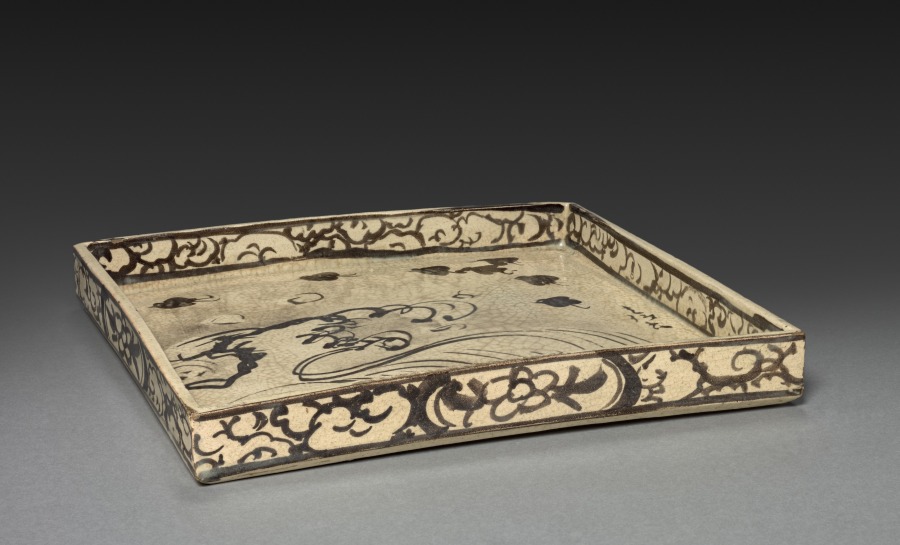
Ogata Kōrin, Square Dish with Design of Plovers over Waves, c. 1700, Glazed stoneware with iron oxide underglaze slip. The Cleveland Museum of Art, Purchase from the J. H. Wade Fund, accession 1966.365.
Look closer: a patterned border frames a painted scene in iron oxide. The museum catalogues it under both Ogata Kōrin and Ogata Kenzan, c. 1700, glazed stoneware, 22 cm square.
Image: The Cleveland Museum of Art, Open Access (CC0)
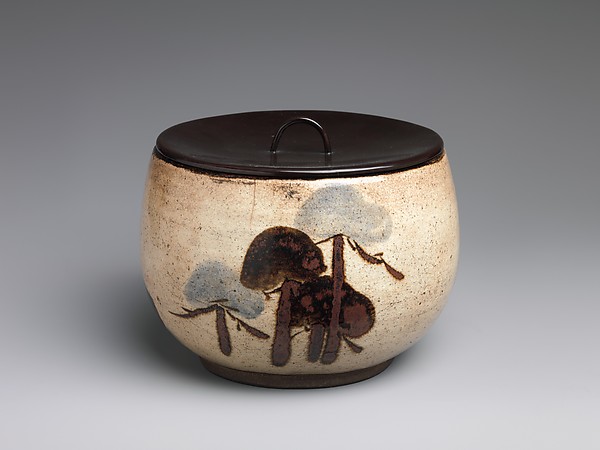
Water Jar (Mizusashi) with Pine Trees, ca. 1720, Stoneware with underglaze iron oxide; lacquer cover. The Metropolitan Museum of Art, H. O. Havemeyer Collection, Bequest of Mrs. H. O. Havemeyer, 1929, accession 29.100.614a, b.
Look closer: a bold iron-painted pine sits on a cream ground beneath a black lid. The museum catalogues it under Ogata Kenzan, about 1720, stoneware with underglaze iron oxide and a lacquer cover, 12.7 cm high.
Image: The Metropolitan Museum of Art, Open Access (CC0)

Dish with Bamboo Leaves, 18th century, Stoneware painted with cream slip, cobalt blue, and iron brown under transparent glaze; gold lacquer repairs. The Metropolitan Museum of Art, Rogers Fund, 1917, accession 17.118.89.
Look closer: bamboo leaves in brown and blue spread across the cream ground, and gold lacquer repairs are recorded. The museum catalogues it under Ogata Kenzan, 18th century, 17.5 cm across.
Image: The Metropolitan Museum of Art, Open Access (CC0)

Set of Five Camellia-Shaped Side Dishes (Mukōzuke) with Camellia Patterns, 18th century, Stoneware with white slip under and polychrome enamels over transparent glaze (Kyoto, Kenzan ware). The Metropolitan Museum of Art, Gift of Florence and Herbert Irving, 2019, accession 2019.193.56a–e.
Look closer: each dish is shaped as a flower, white inside with a yellow centre and green outside. The museum catalogues the set under Ogata Kenzan, 18th century, Kyoto Kenzan ware, each 10.5 cm across.
Image: The Metropolitan Museum of Art, Open Access (CC0)
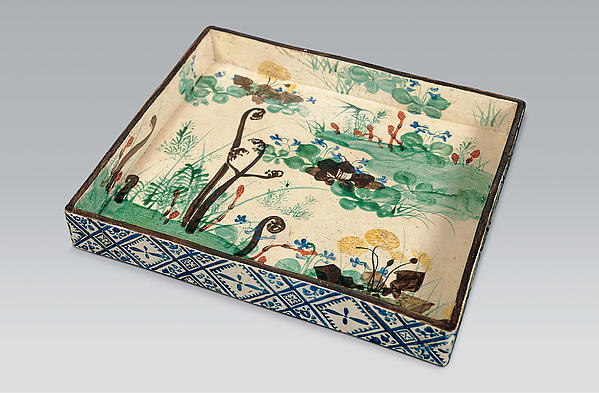
Square Dish with Spring Flowers and Grasses, 18th century, Stoneware with polychrome enamels under transparent glaze (Kyoto ware). The Metropolitan Museum of Art, Mary Griggs Burke Collection, Gift of the Mary and Jackson Burke Foundation, 2015, accession 2015.300.269.
Look closer: spring plants are painted in colour inside a blue-and-white border. The museum catalogues it under Ogata Kenzan, 18th century, Kyoto ware, 36.7 cm wide.
Image: The Metropolitan Museum of Art, Open Access (CC0)

Teabowl (Chawan), second half 18th century, Stoneware with black glaze and inlaid white slip (Kyoto ware). The Metropolitan Museum of Art, Edward C. Moore Collection, Bequest of Edward C. Moore, 1891, accession 91.1.361.
Look closer: pale marks of inlaid slip cross the black glaze. The museum catalogues it under Ogata Kenzan, second half of the 18th century, stoneware with black glaze and inlaid white slip, 7.8 cm high.
Image: The Metropolitan Museum of Art, Open Access (CC0)

Tea Caddy, named Tall (Seitaka), second half of the 17th century, Stoneware with iron glaze (Kyoto ware). The Metropolitan Museum of Art, The Howard Mansfield Collection, Gift of Howard Mansfield, 1936, accession 36.120.559a–f.
Look closer: the glaze runs in streaks down a very slender body. The museum catalogues it under Nonomura Ninsei, second half of the 17th century, stoneware with iron glaze, Kyoto ware, 15.2 cm high with its lid.
Image: The Metropolitan Museum of Art, Open Access (CC0)

Tea jar, ca. 1660, Clay; black glaze with two bands of crackled white glaze; (Awata ware). The Metropolitan Museum of Art, H. O. Havemeyer Collection, Bequest of Mrs. H. O. Havemeyer, 1929, accession 29.100.666.
Look closer: two pale crackled bands cross the black body. The museum catalogues it under Nonomura Ninsei, about 1660, Awata ware, 8.9 cm high.
Image: The Metropolitan Museum of Art, Open Access (CC0)

Incense Box with Design of the Seven Flowers of Autumn, ca. 1648–1649, Glazed stoneware, colored enamels and gold. The Metropolitan Museum of Art, Gift of Mrs. V. Everit Macy, 1923, accession 23.225.236a, b.
Look closer: autumn flowers in enamels and gold spread over a cream lid. The museum catalogues it under Nonomura Ninsei, about 1648 to 1649, glazed stoneware with enamels and gold, 8.4 cm across.
Image: The Metropolitan Museum of Art, Open Access (CC0)
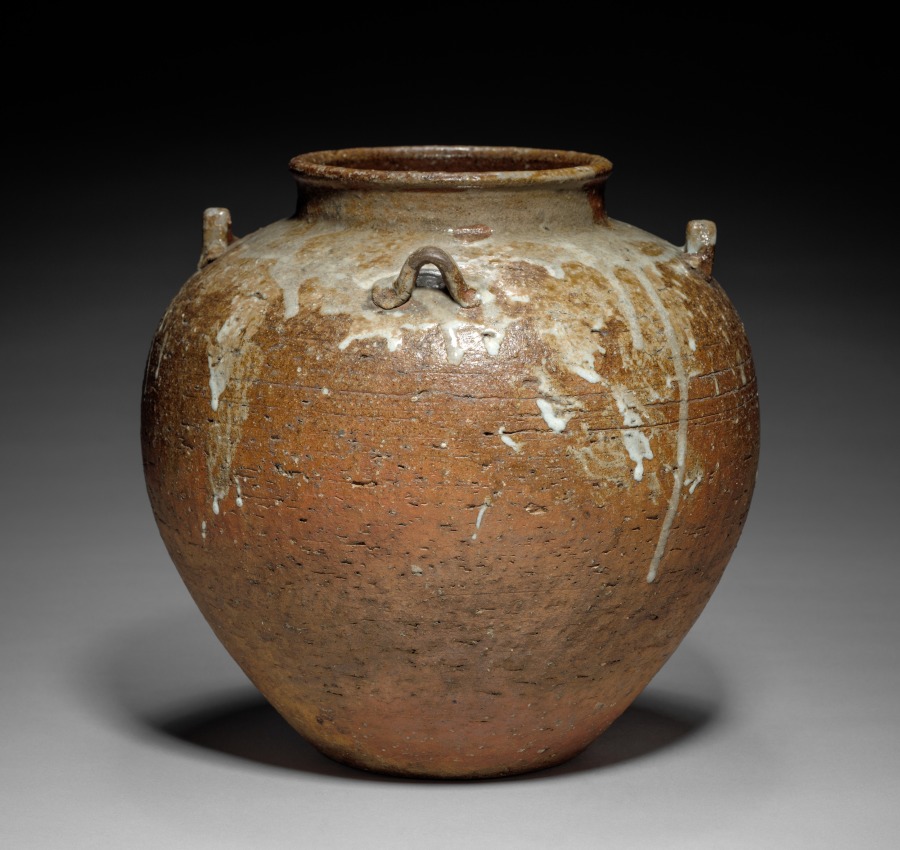
Nonomura Ninsei, Tea Storage Jar, mid- to late 1600s, Stoneware with white glaze (Shigaraki style). The Cleveland Museum of Art, Purchase from the J. H. Wade Fund, accession 1978.6.
Look closer: pale glaze runs down a warm brown body with small loop handles at the shoulder. The museum catalogues it under Nonomura Ninsei, mid to late 1600s, stoneware with white glaze in the Shigaraki style, 28.3 cm high.
Image: The Cleveland Museum of Art, Open Access (CC0)
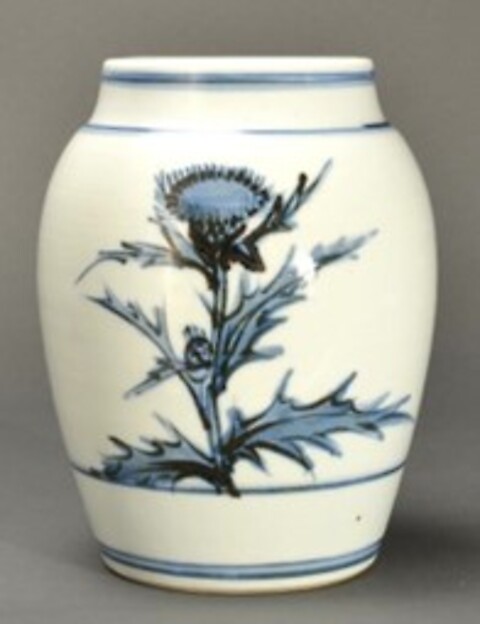
Jar with Thistle, ca. 1950, Porcelain with underglaze cobalt blue. The Metropolitan Museum of Art, Mary and Cheney Cowles Collection, Gift of Mary and Cheney Cowles, 2024, accession 2024.443.6.
Look closer: a thistle in cobalt blue sits within bands of blue lines. The museum catalogues it under Kondō Yūzō, about 1950, porcelain with underglaze cobalt blue, 18.9 cm high.
Image: The Metropolitan Museum of Art, Open Access (CC0)
Works by Named Hands
Pieces by named makers pass through the house under the Kutani and Kyoto ware tags. The concierge desk can say what a signature, a box inscription or a seal supports. Companions to this chapter are the directory of Living National Treasures in ceramics and the folk-art page.
Answered plainly
Is Living National Treasure an official title?
It is the popular name. The formal title is Preserver of Important Intangible Cultural Properties, certified under the Law for the Protection of Cultural Properties.
How many ceramics holders are on the Wikipedia list?
Thirty-six individuals and two groups, the Kakiemon and Onta-yaki preservation societies.
Did Hamada Shōji sign his pots?
Wikipedia says Kawai Kanjirō never signed his work and that, like Hamada, he did not sign.
Who refused the title?
Wikipedia says Kawai Kanjirō refused all official honours, and that Rosanjin was one of the very few to decline the designation in 1959.
Where next
Sources and image credits
- Living National Treasure (Japan), Wikipedia
- List of Living National Treasures of Japan (crafts), Wikipedia
- Shōji Hamada, Wikipedia
- Kawai Kanjirō, Wikipedia
- Mingei, Wikipedia
- Yanagi Sōetsu, Wikipedia
- Bernard Leach, Wikipedia
- Rosanjin, Wikipedia
- Tokuda Yasokichi, Wikipedia
- Ninsei, Wikipedia
- Ogata Kenzan, Wikipedia
- Toyozō Arakawa, Wikipedia
- Kaneshige Toyo, Wikipedia
- Celadon, Wikipedia
- Kondō Yūzō, Los Angeles County Museum of Art
- Object record, Square Dish with Design of Plovers over Waves, The Cleveland Museum of Art
- Object record, Water Jar (Mizusashi) with Pine Trees, The Metropolitan Museum of Art
- Object record, Dish with Bamboo Leaves, The Metropolitan Museum of Art
- Object record, Set of Five Camellia-Shaped Side Dishes (Mukōzuke) with Camellia Patterns, The Metropolitan Museum of Art
- Object record, Square Dish with Spring Flowers and Grasses, The Metropolitan Museum of Art
- Object record, Teabowl (Chawan), The Metropolitan Museum of Art
- Object record, Tea Caddy, named Tall (Seitaka), The Metropolitan Museum of Art
- Object record, Tea jar, The Metropolitan Museum of Art
- Object record, Incense Box with Design of the Seven Flowers of Autumn, The Metropolitan Museum of Art
- Object record, Tea Storage Jar, The Cleveland Museum of Art
- Object record, Jar with Thistle, The Metropolitan Museum of Art
Last reviewed 28 October 2026. Pictures, where shown, are public-domain or open-access and credited beneath each one.
Holding a piece with a name on its base or its box? The concierge desk replies within one to three business days.
Private concierge
Looking for something in particular?
Describe the piece or the project you have in mind. A senior advisor in Tokyo reads every case file personally and replies within two business days, with fees set out in writing before any work begins.