
Sen no Rikyū and Wabi-cha
Tea Almanac · The Founding Master
Sen no Rikyū and Wabi-cha
Every bowl, scoop and tea room in this almanac stands in his shadow. Sen no Rikyū, a merchant's son from Sakai, took a drink for monks and warlords and made of it a discipline of poverty, attention and hospitality. He served two of the most powerful men of his century, and was ordered by one of them to die. This chapter follows the man, the rooms and the objects, and says plainly where the record is silent.
Fact sheet
At a glance
- The teacher of simplicity. Rikyū is regarded as the most important influence on the Japanese tea ceremony, especially the tradition of wabi-cha.
- A small room. At the core of his taste was a tea room smaller than four and a half mats; Taian, attributed to him, is a National Treasure.
- A potter's friend. Raku tea bowls began when Rikyū had the tile maker Raku Chōjirō make bowls for him.
- A hard ending. Hideyoshi ordered him to end his life in 1591; the reason has never been fixed.
- A living line. Three houses of tea descend from him and mark his memorial every year in March.
A Discipline Made of Poverty
The argument of this chapter is simple. Sen no Rikyū did not invent tea, simplicity or the beauty of worn things. What he did, according to every account used here, was to bring those ideas to a point so clear that later centuries took the point for the whole. Wikipedia calls him a Japanese tea master considered the most important influence on the Japanese tea ceremony, particularly the tradition of wabi-cha, and the first to emphasise rustic simplicity, directness of approach and honesty of self. Those aspects, it says, persist.
A man whose reputation rests on poverty is awkward to describe, because poverty in the tea room was always chosen and never suffered. Rikyū was the son of a warehouse owner, a townsman of the rich port of Sakai, and the tea master of regents. His rustic rooms were built for powerful guests. The tension is the subject. A bamboo scoop, a bowl of black clay and a room two mats wide were instruments in a conversation that included the most powerful man in Japan, and the conversation ended in a sentence of death.
The chapter proceeds in the order of a life. It begins with what tea was before him, goes through his early years and his teachers, sets out the aesthetic that bears the name wabi, describes his tea room and his objects, follows him to the court of Hideyoshi and to his death, and then traces what he left: the disciples, the three houses, the memorials and the objects that now bear his name in museums. It closes with the words a collector needs, a glossary, a short run of fun facts and the questions readers ask.
Throughout, claims come from pages read for this chapter, chiefly Wikipedia's articles on Rikyū, wabi-cha, Murata Jukō, Takeno Jō'ō, Sen no Sōtan, Furuta Oribe, Kobori Enshū, the tea ceremony, the chashitsu, kaiseki and wabi-sabi, with the Metropolitan Museum of Art's catalogue pages for the objects, the Kyoto Prefecture page on Taian, and the nippon.com report on a recent book about tea rooms. Where they differ, a box says so and the figure is left out.
What Tea Was Before the Master
Wikipedia's article on the tea ceremony dates the first documented tea in Japan to the ninth century, when the Nihon Kōki records the monk Eichū bringing tea back from Tang China and serving it to Emperor Saga on an outing in 815. Plantations were ordered in the Kinki region the next year, and then, the article says, interest faded. The tea of that age was pressed cake tea, ground and mixed with other herbs and flavourings. Lu Yu's Classic of Tea, written in the early ninth century, was heavily influenced by Zen Buddhism and, it says, strongly influenced Japanese tea culture.

Tea Ceremony Apparatus, Album leaf; lacquer on gold paper. The Metropolitan Museum of Art, The Howard Mansfield Collection, Purchase, Rogers Fund, 1936, accession 36.100.120.
Look closer: a kettle steams over a hearth beside a dark bowl and a small red tray, all painted in lacquer on gold paper. The museum catalogues it as Tea Ceremony Apparatus, an album leaf in lacquer on gold paper by Shibata Zeshin, 12.1 by 8.9 cm, and gives no date; it shows the things the tradition handed on, not an object of Rikyū's own time.
Image: The Metropolitan Museum of Art, Open Access (CC0)
The method that Rikyū inherited came later. Around the end of the twelfth century, the monk Eisai brought back from China the style of preparation called tencha, in which powdered tea is placed in a bowl, hot water added and the two whipped together, and he brought seeds with him, which in time produced what the article calls the finest tea in Japan. The powdered tea was first used in religious rituals in monasteries. By the thirteenth century, under the Kamakura shogunate, tea and its luxuries had become a status symbol among the warrior class, and there were tasting parties called tōcha at which contestants won prizes for guessing the best tea.
The Muromachi period then gave tea a setting and an aesthetic. The article places the rise of Kitayama culture around Ashikaga Yoshimitsu and his villa, later Kinkaku-ji, and of Higashiyama culture around Ashikaga Yoshimasa and his retirement villa, later Ginkaku-ji, and treats the period from about 1336 to 1573 as the budding of what is generally regarded as traditional Japanese culture. In the matcha article's words, it became fashionable among the elite to drink from expensive Chinese ceramics known as karamono. The article on the tea room adds an account that Yoshimasa built the first chashitsu at his Higashiyama villa, a small room of four and a half tatami set apart from the main residence.
That is the world Rikyū was born into: a drink of the temple, a game of the warrior, a display of imported things, and a first small room. What was missing was a reason for the smallness. Three men are credited with supplying it, and Rikyū was the third.
Three Men and One Idea
Wikipedia's article on wabi-cha says that three main figures are credited with the development of the wabi aesthetic in chanoyu: first Murata Jukō, then Takeno Jō'ō, and finally Sen no Rikyū. The order matters, because each took something from the one before and made it harder to ignore.
Murata Jukō, born in Nara in 1423, is known in the article about him as the founder of the Japanese tea ceremony, the early developer of the wabi-cha style of tea with native Japanese implements. As a youth he met the loud tasting gatherings of connoisseurs, which held no appeal for him; tea interested him as a stimulant to keep him awake during his studies. He learned the aristocratic practice from Nōami in Kyoto and studied Zen under the priest Ikkyū Sōjun, whose teaching that the Buddha dharma is also in the Way of Tea is said to have inspired Jukō's creation of the ceremony. The article cautions that the account of his employment by the shōgun Yoshimasa at Ginkaku-ji is unlikely to be true.
Jukō set out his theories in a letter to his pupil Furuichi Chōin of around 1488, the Kokoro no fumi, or Letter of the Heart, which Rikyū is said to have praised highly. It has been explained as an attempt to establish the merchant class within the field of tea, since it stresses Japanese ceramics alongside imported ones. Jukō favoured unglazed stoneware from the Bizen and Shigaraki schools, but his style did not forbid Chinese ware; the letter contains several injunctions to harmonise Japanese and Chinese tastes. For him an excessive concern with the rustic imperfections of Japanese pieces was as bad as a preoccupation with the perfect glazes of Chinese ones, and he argued that beginners should start with Chinese pieces. He developed the four-and-a-half-mat room that would become standard under Rikyū, and tried to bring into tea the poetic ideals of hie, chill, and kare, withered.
Takeno Jō'ō, born in 1502, was a wealthy merchant of Sakai whose family dealt in leather goods used by warriors. He took the tonsure in 1532, and until about the age of thirty-five aspired to be a teacher of linked verse; he studied the secrets of waka under Sanjōnishi Sanetaka. When tea became fashionable in Kyoto he set out to develop a style suited to the customs of Sakai, helped by his Zen training and his poetic circle. His pupils in Sakai included the wealthy Imai Sōkyū, who married his daughter, and Sen no Rikyū. When he died in 1555 his legitimate son, Takeno Shingorō, was six years old, and Imai Sōkyū acted as guardian.
A Warehouse Owner's Son in Sakai
Rikyū was born in 1522 in Sakai, now in Osaka Prefecture. His father, a warehouse owner named Tanaka Yohei, later also used the family name Sen, and his mother was Gesshin Myōchin; his childhood name was Yoshirō. As a young man he studied tea under a townsman of Sakai named Kitamuki Dōchin, and at nineteen, through Dōchin's introduction, he began to study under Takeno Jō'ō. He is believed to have received the Buddhist name Sōeki from the Rinzai priest Dairin Sōtō of Nanshū-ji in Sakai. He married a woman known as Hōshin Myōju around the age of twenty-one and trained in Zen at Daitoku-ji in Kyoto. Wikipedia adds only that not much is known about his middle years.
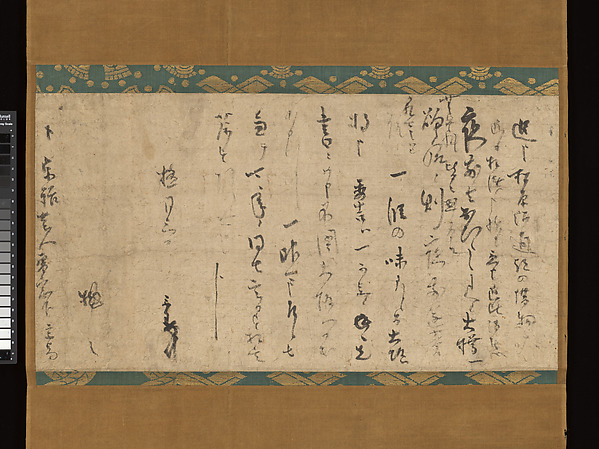
Sen no Rikyū, Letter about Sake, ca. 1583, Hanging scroll; ink on paper. The Metropolitan Museum of Art, Gift of Peggy and Richard M. Danziger, 2024, accession 2024.553.24.
Look closer: the handwriting runs in quick, linked strokes down the sheet. The museum catalogues it as a letter about sake by Sen no Rikyū, about 1583, ink on paper, most likely sent to a friend from his tea circle in Sakai; in it he invites the friend to tea in thanks for a barrel of fine sake and says he means to share some with Hideyoshi.
Image: The Metropolitan Museum of Art, Open Access (CC0)
The silence of the middle years is worth keeping. A Sakai warehouse owner's family lived by trade, and the port's merchants, as the sources about Jō'ō and Imai Sōkyū show, took tea as an accomplishment equal to wealth. Rikyū entered the world of tea as a merchant among merchants, learned its poetry and its Zen, and came to the notice of the men who were reuniting the country. The tea ceremony article calls him the leading tea master of the regent Toyotomi Hideyoshi, who supported him in spreading the way of tea as a means of solidifying his own political power.
He wrote and composed. The Rikyū article says he was a writer and poet who also practised ikebana, and it records one of his sayings about the vessels of tea: that though one may wipe the hands and brush off the dust from the vessels, the fuss is of no use if the heart is still impure. One of his favourite gardens was said to be at Chishaku-in in Kyoto. His letters were kept and, as the Metropolitan Museum's catalogue observes, so many were wanted that forged letters were produced throughout the seventeenth century, a point to which the chapter returns in the collector's section.
The Meaning of Wabi
Wabi has no neat English equivalent, and the sources that try say so. Wikipedia's article on wabi-sabi gives, from the Stanford Encyclopedia of Philosophy, wabi as subdued, austere beauty and sabi as rustic patina, and describes the pair as centred on the acceptance of transience and imperfection. It derives them from the Buddhist teaching of the three marks of existence, which include impermanence and emptiness, and lists their characteristics as asymmetry, roughness, simplicity, economy, austerity, modesty and the appreciation of natural objects. The article on wabi-cha notes that the term wabi-cha itself came into use in the Edo period; before that the style was known as wabi-suki, with suki meaning artistic inclination and wabi meaning forlorn.
Rikyū's contribution, as that article puts it, was to give wabi its most profound and paradoxical meaning: a purified taste in material things as a medium for human interaction transcending materialism. It cites two poems from the early thirteenth-century anthology Shin Kokin Wakashū that he used to show what he meant. The first, by Fujiwara no Teika, which was also a favourite of Jō'ō's, looks across a bay at a hovel of reeds in the autumn dusk, where there are neither flowers nor red leaves. The second, by Fujiwara Ietaka, speaks to those who wait only for flowers and shows them the grass pushing through the snow in a mountain village, and with it the spring. The first poem takes beauty away; the second finds it where nobody was looking.
The wabi-sabi article explains how the taste reached ceramics. As the preference for simplicity grew, Zen masters came to regard ornate Chinese ceramics as overly decorative, and Japanese potters began to explore freer expressions of beauty, moving away from uniformity and symmetry. The tea ceremony article gives the same tale from the table: wabi, it says, emphasises simple, unadorned objects and architectural space, and celebrates the mellow beauty that time and care impart to materials. It says Rikyū introduced a much smaller tea house and rustic, distorted ceramic tea bowls, and emphasised the ceremony on the aesthetic of wabi.
The principles he set forward, the article says, are harmony, respect, purity and tranquility, in Japanese wa, kei, sei and jaku, and they are still central to tea. Wikipedia's account of Jukō gives a slightly different set of four, kin, kei, sei and jaku, as the values of Jukō's ceremony; the two accounts are recorded together in the box below, and neither is preferred.
The Two-Mat Tea House
At the core of Rikyū's aesthetic, says the wabi-cha article, was a tea room smaller than four and a half tatami. His radical simplification of the interior, and his reduction of space to the bare minimum needed for a sitting, was the most practical way of focusing tea practice on the communion of host and guests. The one extant tea house attributed to his design is Taian, at Myōkian temple in Yamazaki, Kyoto, designated by the Japanese government as a National Treasure.
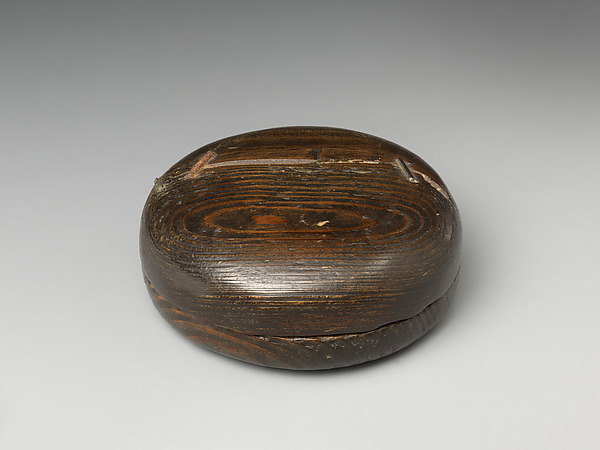
Round Wooden Incense Container (Kōgō) with Sen no Rikyū’s Signature, 16th century, Wood, iron, and silver clamps; lacquer. The Metropolitan Museum of Art, Gift of Peggy and Richard M. Danziger, 2024, accession 2024.553.13a, b.
Look closer: the wood is grained and worn, the lid clamped with small metal fittings. The museum catalogues it as a round wooden incense container, sixteenth century, wood, iron and silver clamps and lacquer, 3 by 6.4 cm, with the signature of Sen no Rikyū; incense is part of the tea room, and a sixteenth-century box signed by him is the kind of object to which provenance matters.
Image: The Metropolitan Museum of Art, Open Access (CC0)
The Kyoto Prefecture's page for visitors says the interior of Taian measures two tatami mats, that it is attributed to Rikyū, that it is one of only three tea houses in Japan designated National Treasures, and that it is described as the oldest in Japan; it can be visited by appointment, with a fee of 1,000 yen, a short walk from JR Ōyamazaki Station. A Columbia University page on a reconstruction of the room gives the date of the original as between 1582 and 1583. A nippon.com report of September 2024 on a new book by the architect and historian Fujimori Terunobu and the model Hana says Taian is the oldest surviving tea room by Rikyū, that it was reportedly built for Hideyoshi, who was then his friend, and that, as a Zen-influenced enclosed space, it was meant for introspection.
The report also makes a point that is easily lost. Tea rooms were not always so small. A disciple of Rikyū, Urakusai, felt such rooms were too cramped for guests, and the book includes larger ones. Rikyū's small room was a position in an argument, not the only possible shape of a room for tea.
The general features of a tea room, set out in the article on the chashitsu, are those Rikyū's circle fixed: a low ceiling, tatami floor, a scroll alcove called the tokonoma, small windows covered with paper-faced shōji that are not meant to provide a view, a sunken hearth for the cold months, a stone basin where guests rinse their hands and mouths, and a low square door, the nijiriguchi, requiring guests to bend, which symbolically separates the small, quiet interior from the crowded outside world. The article names the garden path that leads to the room the roji, dewy ground. Wikipedia's article on wabi-sabi adds a quoted account of a tea house with a door so low that even the emperor would have to bow to enter, a reminder of humility.
Wikipedia's chashitsu article describes the floor of the smallest tea room as one full mat for the guests and a three-quarter mat for the host, a total of one and three-quarter tatami; Taian, with two mats, is on the generous side of that limit.
Chōjirō and the Hand-Made Bowl
The best-known thing that Rikyū asked of a craftsman was a bowl. The Rikyū article states that Raku ware chawan originated in his collaboration with a tile maker named Raku Chōjirō, and the wabi-cha article repeats that Raku ware tea bowls originated from Rikyū having Chōjirō create bowls for him. He preferred, in the first article's words, simple, rustic, locally made items to the expensive Chinese-made items then fashionable.
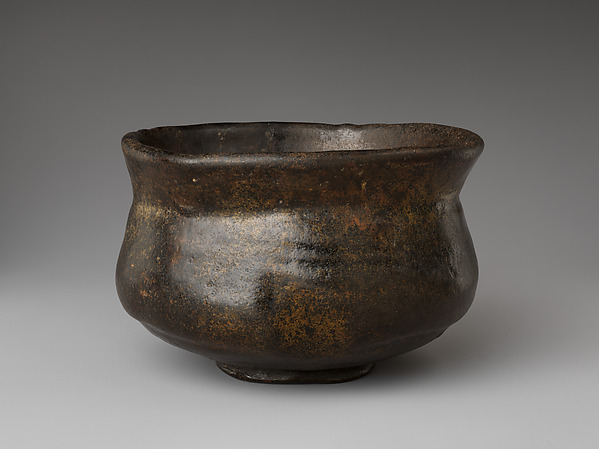
Black Raku Tea Bowl, Named “Kaedegure” (Twilight by the Maples), 17th century, Earthenware with black Raku glaze (Raku ware). The Metropolitan Museum of Art, Gift of Peggy and Richard M. Danziger, 2024, accession 2024.553.19.
Look closer: the glaze is black with patches of brown and gold and the rim flares slightly. The museum catalogues it as Black Raku Tea Bowl, named Kaedegure, in the style of Raku Chōjirō, seventeenth century, earthenware with black Raku glaze, 9 cm high and 12.1 cm across.
Image: The Metropolitan Museum of Art, Open Access (CC0)
The Metropolitan Museum's catalogue gives the technical picture. Its page for a black Raku bowl of the early seventeenth century says that Raku ware is lightweight glazed earthenware moulded by hand and not thrown on a wheel, that the clay is rough and covered by an opaque glaze, that it could be fired in small indoor kilns, which helped it become popular in Kyoto, a major tea centre, and that the Raku family of potters traces its lineage to the time of Rikyū and still produces Raku ware. It adds that, according to legend, Rikyū himself stimulated and supervised Chōjirō's production of tea bowls, and it attributes the bowl only tentatively to Chōjirō.
The museum is careful in the same way with a second black bowl, named Kaedegure, Twilight by the Maples. It is catalogued as in the style of Raku Chōjirō, of the seventeenth century, and the description says that Chōjirō invented the Raku tea bowl based on Rikyū's original concepts, that early Raku bowls vary widely in form and have been grouped into types, and that this bowl, hand-formed with the area about the foot carved, has almost no warping, a tea-puddling reserve inside and an interior worn by long use by tea masters.
A century later, a young potter named Ichinyū took over the Raku workshop in Kyoto. The catalogue records that around the late seventeenth century collectors and makers returned to the preferences of Rikyū, including admiration for Chōjirō's bowls, and that Ichinyū made many bowls in that manner; the red of his vermilion glaze, the page says, seems to float on the black. The Raku chapter of this almanac sets the family out in full; here the point is that the oldest ceramic tradition built for the tea room begins in a request from one man to another.
Rikyū's attitude to other bowls was not narrow. In the Black Seto bowl named Iron Mallet, the Met's page for the Mino kilns says that Rikyū preferred imperfect, spontaneously potted domestic ceramics and used them as the basis of the austere wabi style, and the museum does not link this particular bowl to him. The wabi-cha article, drawing on the same period, says that the tile-maker's bowls and the bamboo flower containers he cut himself were part of a larger wish to design his own wares, sometimes having them made by local craftsmen.
The Scoop He Cut Himself
The chashaku is the smallest important thing in the tea room: a slip of bamboo or wood, bent at one end, which lifts the powdered tea from the caddy to the bowl. The wabi-cha article says Rikyū made flower containers of bamboo he cut himself. The Met's page for a tea scoop attributed to him says it is carved from a single narrow piece of bamboo, that the raised, rounded end transfers powdered tea from the caddy to the bowl, and that the museum catalogues it as attributed to Sen no Rikyū, of the 1580s, 17.9 centimetres long.
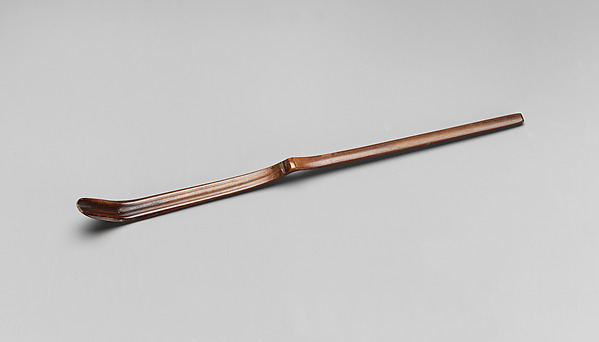
Attributed to Sen no Rikyū, Tea Scoop (Chashaku), 1580s, Bent and carved bamboo. The Metropolitan Museum of Art, Gift of Peggy and Richard M. Danziger, 2024, accession 2024.553.23.
Look closer: the shaft is thin and slightly bent near the middle, and the scoop is a shallow curved hook. The museum catalogues it as a tea scoop attributed to Sen no Rikyū, 1580s, bent and carved bamboo, 17.9 cm long.
Image: The Metropolitan Museum of Art, Open Access (CC0)
The qualifier matters. The museum writes attributed, not by. A second scoop in the collection, catalogued as probably of the early seventeenth century and of wood, is also catalogued under Rikyū's name, and the museum's black-and-white photograph shows it beside a tall narrow box; and a third, named Imogase, of the first half of the seventeenth century, is catalogued under his grandson Sen no Sōtan. Names are given to scoops as they are to bowls and caddies, and the name is part of the object's history.
A scoop is as plain as an object can be, and the museum's careful wording, attributed to, is the right way to name it.
The Regent and the Tea Master
The tea ceremony article says that Hideyoshi supported Rikyū in spreading the way of tea as a means of solidifying his own political power, and that his tastes were influenced by his tea master, though he also had his own ideas to cement his power. Two of them were the Golden Tea Room and the Grand Kitano Tea Ceremony of 1587. The article describes the symbiotic relationship between politics and tea as at its height, and increasingly at odds with the rustic aesthetic advertised by his tea master.

Black Seto (Seto-guro) Tea Bowl, named Iron Mallet (Tettsui), late 16th century, Stoneware with black glaze (Mino ware, Black Seto type). The Metropolitan Museum of Art, Mary Griggs Burke Collection, Gift of the Mary and Jackson Burke Foundation, 2015, accession 2015.300.272.
Look closer: the black glaze is pitted and the rim uneven. The museum catalogues it as a Black Seto tea bowl named Iron Mallet, late sixteenth century, stoneware with black glaze, Mino ware, 9.3 cm high and 12 cm across; the same decades as Rikyū and Hideyoshi, and the museum does not link it to either.
Image: The Metropolitan Museum of Art, Open Access (CC0)
The Golden Tea Room, according to Wikipedia's article on the chashitsu, was a portable gilded tea room constructed in the sixteenth century for Hideyoshi's gatherings, made to impress guests with the regent's might; the original is lost and several reconstructions have been made. The article notes that its opulence stood in contrast to the rustic aesthetics codified under Rikyū, that it is speculated Rikyū might have helped in the design, that the clean lines of the overall design could be seen as within the canon, and that the extent of his involvement is not known, though he was present on a number of occasions when tea was served in the room.
The Grand Kitano Tea Ceremony of 1587 was the largest tea party of the age. Wikipedia's article says it opened on the first day of the tenth month of Tenshō 15 at the Kitano Tenmangū shrine in Kyoto and was planned to last ten days. Hideyoshi's signboards invited anyone with a serious interest in tea, regardless of rank or wealth, including warriors' attendants, townspeople and farmers, and the invitation extended beyond Japan. Participants were to bring their own kettle, well bucket, drinking bowl and tea, with powdered roasted rice accepted as a substitute, and each was to set up a room of about two tatami, or simpler mats or rice-hull bags for wabi practitioners. Hideyoshi would show his famous tea objects and prepare tea himself for wabi practitioners. A diary by Yoshida Kanemi recorded more than 800 tea houses and tea spaces by the twenty-eighth day of the ninth month, and estimates put the total at about 1,500 to 1,600 by the day before the opening.
Rikyū was one of Hideyoshi's three chief tea masters, with the Sakai merchants Tsuda Sōgyū and Imai Sōkyū, and their venues were among the event's attractions. The regent then cut the gathering short after a single day; the source gives no reason. The art historian Louise Cort, the article reports, describes the event as a crisis in the personal relationship between Hideyoshi and Rikyū, who were its chief designers. The Kitano shrine holds a tea offering, the Kencha-sai, which a festival page traces to the 1587 event; its date should be checked with the shrine.
The ceremony article gives one innovation from these years that remains in every thick-tea service: the sharing of a single bowl of koicha among several guests, which first appears in documents in 1586 and is considered to have been invented by Rikyū. The host serves thin tea to each guest in an individual bowl, while one bowl of thick tea is shared, symbolising a deep connection among guests.
The Order to Die
Wikipedia states the facts as far as they are known. Although Rikyū had been one of Hideyoshi's closest confidants, because of crucial differences of opinion, and because he was too independent, Hideyoshi ordered him to take his own life. A year earlier, after the Siege of Odawara, his famous disciple Yamanoue Sōji had been tortured and beheaded on Hideyoshi's orders. The article states that Hideyoshi's reason may never be known for certain. Rikyū died at his residence within Hideyoshi's Jurakudai palace in Kyoto on the twenty-eighth day of the second month of 1591, which is 21 April in the modern calendar, at the age of seventy.
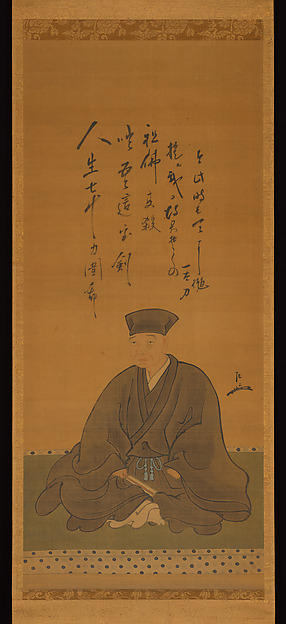
Portrait of Sen no Rikyū with his Death Poem, early 17th century, Hanging scroll; ink and color on silk. The Metropolitan Museum of Art, Mary and Cheney Cowles Collection, Gift of Mary and Cheney Cowles, 2020, accession 2020.396.20.
Look closer: a man in a plain robe and cap sits on a mat with a closed fan in his hand, and the poem fills the upper part of the silk. The museum catalogues it as a portrait of Sen no Rikyū with his death poem by an unidentified artist, early seventeenth century, ink and colour on silk, 77.7 by 34.3 cm.
Image: The Metropolitan Museum of Art, Open Access (CC0)
According to Okakura Kakuzō in The Book of Tea, as the article reports, his last act was to hold an exquisite tea ceremony. After serving the guests he showed each piece of the equipment, with a hanging scroll Okakura describes as a wonderful writing by an ancient monk on the evanescence of all things, gave each guest a piece as a souvenir, and broke the bowl, saying that it should never again be used by man after the lips of misfortune. One guest remained as witness. The account is Okakura's; it is told here as a literary account.
His death poem, in verse addressed to the dagger, speaks of a life of seventy years, of striving to the limit and of the sacred sword with which he kills both patriarchs and the Buddha, which he abandons to the heavens. The Metropolitan Museum owns an early seventeenth-century hanging scroll, Portrait of Sen no Rikyū with his Death Poem, by an unidentified artist, which pairs a Chinese verse and a Japanese poem with a seated portrait; the catalogue says it follows a portrait attributed to Hasegawa Tōhaku, which the Omotesenke school treats with near-religious reverence, and records that the original carried an inscription dated 1595 by Sen'oku Sōen, a Daitoku-ji master and one of Rikyū's spiritual advisers. The record gives the inscriber's dates as 1705 to 1751, so the inscription and the painting may not be contemporary.
Hideyoshi, the article says, was known for his temper and is said to have expressed regret. When he was building his lavish residence at Fushimi the following year, he remarked that he wished it to please Rikyū. The Hideyoshi article adds that after Rikyū's death the regent turned his attention from tea to Noh, which he had been studying, and performed lead roles. Rikyū is buried at the Jukō-in sub-temple in the Daitoku-ji compound in Kyoto, under the posthumous Buddhist name Fushin'an Rikyū Sōeki Koji.
The Meal Before the Bowl
Rikyū's shaping of tea reached the table. Wikipedia's article on kaiseki says there are two meal styles of that name. The second, written with the characters 懐石, literally breast-pocket stone, is the simple meal the host of a tea gathering serves before the tea, also known as cha-kaiseki. The characters are thought to have been taken by Rikyū to indicate the frugal meal of the austere style of tea. The idea came from the practice of Zen monks, who warmed stones and tucked them into the front folds of their robes near the stomach to ward off hunger.
The article continues that before those characters came into use, the word was written with characters that mean only a cuisine for a gathering, and that both writings remain in use. It names tea cuisine, from the fifteenth century in the Higashiyama period, as one of the four traditions on which modern kaiseki draws, with the court, temple and samurai cuisines, and says temple and tea cuisine are the more restrained. Modern kaiseki, the article says, balances taste, texture, appearance and colour, using fresh seasonal ingredients and plates chosen to match the season.
Rikyū's grandson Sōtan is recorded in the article on him as the author of a cookery diary, Sōtan Chakai Kondate Nikki, dated 1587 in that article, a record of the menus of tea gatherings; its date is given in a way that conflicts with his birth year, so it is not relied on here.
Seven Luminaries and Two Chroniclers
The Rikyū article names two primary disciples: Nanbō Sōkei, a somewhat legendary Zen priest, and Yamanoue Sōji, a townsman of Sakai who lived from 1544 to 1590. Another was Furuta Oribe, who became a celebrated tea master after Rikyū's death. Nanbō is credited as the original author of the Southern Record, a record of Rikyū's teachings, but there is debate over whether Nanbō existed, and some scholars argue that the writings were by the samurai littérateur Tachibana Jitsuzan, who lived from 1655 to 1708 and claimed to have found and transcribed them. Yamanoue's chronicle, the Yamanoue Sōji ki, comments on Rikyū's teaching and on the state of tea in its time.
The Rikyū Shichitetsu, the Seven Foremost Disciples, are seven high-ranking daimyō or generals who were direct pupils: Maeda Toshinaga, Gamō Ujisato, Hosokawa Tadaoki, Furuta Oribe, Makimura Toshisada, Dom Justo Takayama and Shibayama Munetsuna. The set was first mentioned by Rikyū's grandson Sen no Sōtan, and in a list of 1663 given by Sōtan's son, Maeda Toshinaga is replaced by Seta Masatada. The lists are neat and the facts under them are not: a list that changes between one generation and the next is a list of reputations.
Furuta Oribe, born in 1544 in Mino, was a retainer of Oda Nobunaga and Toyotomi Hideyoshi. He became the foremost tea master in the land after Rikyū's death, taught the shōgun Tokugawa Hidetada and counted among his pupils Ueda Sōko, Kobori Enshū and Hon'ami Kōetsu. His style is called Oribe-ryū, the ceramics attributed to his influence are called Oribe ware, and he designed a type of stone lantern for the roji known as the Oribe lantern. In 1615, during the Osaka campaign, he was forced to plot in Kyoto against the Tokugawa on behalf of the defenders of Osaka; after that, he and his son were ordered to end their lives. A manga about him, Hyōge Mono, was made into an anime series in 2011.
Kobori Enshū, born in 1579, an aristocrat, garden designer, painter, poet and tea master, taught the third Tokugawa shōgun, Iemitsu, designed tea houses at Daitoku-ji, and is credited with garden designs at the Sentō Imperial Palace and the Katsura Imperial Villa. A famous anecdote says that he accepted the work at Katsura only on condition of limitless time and money. Oribe taught the second Tokugawa shōgun, Hidetada, and Enshū the third, Iemitsu, so that within two generations the tea of a Sakai merchant was taught to the rulers of the country.
From Sōtan to the Three Houses
After Rikyū's death the family's position was complicated. The article says Rikyū had a son, Sen no Dōan, and a daughter, Okame, who married Sen Shōan, the son of Rikyū's second wife by a previous marriage. Because of complex circumstances, Sen Shōan, not the legitimate heir Dōan, was recognised as the second-generation figure of the Sen family tradition.
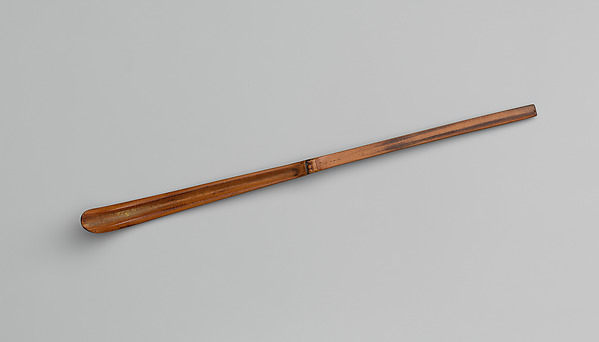
Sen Sōtan, Chashaku, named "Imogase", first half 17th century, Bamboo. The Metropolitan Museum of Art, Gift of Peggy and Richard M. Danziger, 2024, accession 2024.553.11a, b.
Look closer: the bamboo is pale and smooth with a single node and a gentle bend. The museum catalogues it as a chashaku, named Imogase, first half of the seventeenth century, bamboo, 17.5 cm long, by Sen Sōtan, the grandson through whom the family tradition passed to the three houses.
Image: The Metropolitan Museum of Art, Open Access (CC0)
Sen no Sōtan, who lived from 1578 to 1658, was the son of Shōan and Okame and so Rikyū's grandson. He is remembered as Rikyū's third-generation successor in Kyoto, through whose efforts and by whose very being, as the blood descendant, the ideals and style of Rikyū's tea were passed forward. At about ten he was sent to live at Daitoku-ji, at the sub-temple Sangen'in, at Rikyū's wish; during the years after Rikyū's death, when the Sen family was disbanded and his father found shelter with Gamō Ujisato in Aizu Wakamatsu, he was able to stay safely at the temple. When his father was permitted to return and re-establish the family in Kyoto, Sōtan left the priesthood and came home. He built the tea house named Konnichi-an, the Hut of This Day, and he is remembered for helping to popularise tea.
Three of his sons became the founders of the three houses. His third son, Kōshin Sōsa, became heir to the main house, which came to be called Omotesenke, the front Sen house. His fourth and youngest son, Sensō Sōshitsu, became heir to the retirement quarters, which became Urasenke, the rear Sen house. His second son, Ichiō Sōshu, adopted as a child into a family of lacquer artisans, later chose to carry on the tea tradition and built a tea house on Mushakōji street, which is the Mushakōjisenke; he gave up the lacquer business to the artisan Nakamura Sōtetsu, which, the article notes, was the birth of the Nakamura Sōtetsu line of lacquerers who have made much of the lacquer ware for the Sen families.
The article on the tea ceremony says that the three houses together are called the san senke, that they are dedicated to passing forward Rikyū's teachings, and that because of them tea spread to the daimyō and samurai class and then to the general public, which led to the schools that continue to this day. It also notes that the ten artisans who provide utensils to the three houses hold the honorary title Senke Jusshoku. The separate chapter on the schools in this almanac sets out their differences.
How the Houses Remember Him
The Rikyū article records that memorials are observed annually by many schools. The Omotesenke school's annual memorial takes place at the family's headquarters each year on 27 March, and the Urasenke school's at its own headquarters on 28 March. The three Sen families take turns holding a memorial service on the twenty-eighth of every month at their mutual family temple, the sub-temple Jukō-in at Daitoku-ji. A day of the lunar month that was his last has become a monthly observance.
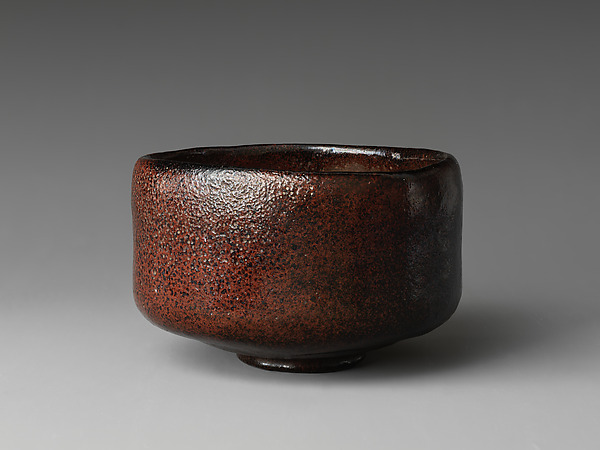
Raku Ichinyū, Black Raku Teabowl, named “Setting Sun” (Sekiyō), late 17th century, Earthenware with black raku glaze (Raku ware). The Metropolitan Museum of Art, Mary and Cheney Cowles Collection, Gift of Mary and Cheney Cowles, 2024, accession 2024.443.1.
Look closer: a vermilion-flecked glaze seems to float over black on a low, wide bowl. The museum catalogues it as a black Raku teabowl named Setting Sun by Raku Ichinyū, late seventeenth century, earthenware with black Raku glaze, 7.5 cm high and 11.1 cm across.
Image: The Metropolitan Museum of Art, Open Access (CC0)
His portrait is kept in a similar spirit. The Metropolitan Museum's page for the death-poem portrait notes that the Tōhaku-attributed original is treated by Omotesenke with near-religious reverence and that its inscription set a precedent for later portraits to carry inscriptions by prominent Zen or tea masters. In tea, the master's likeness and his poem are a kind of altar.
A modern irony is noted in the wabi-cha article: achieving the aura of rustic simplicity demanded by wabi-cha can now be expensive. Even the cheap items used by Rikyū and his followers have gained status and value; authentic Raku bowls are among the most expensive and sought-after available, and creating the look of simplicity in a tea room can also be costly. The same irony is the collector's problem, to which the next section turns.
Collecting Near the Master
Rikyū's name is the most valuable in tea, which makes it the most imitated. The Met's catalogue note to his letter says that Rikyū's letters were carefully preserved as a legacy, and that demand was so high that forged letters were produced throughout the seventeenth century. A reader who meets a Rikyū letter, scoop or box should therefore expect the wording of the catalogue to be careful.
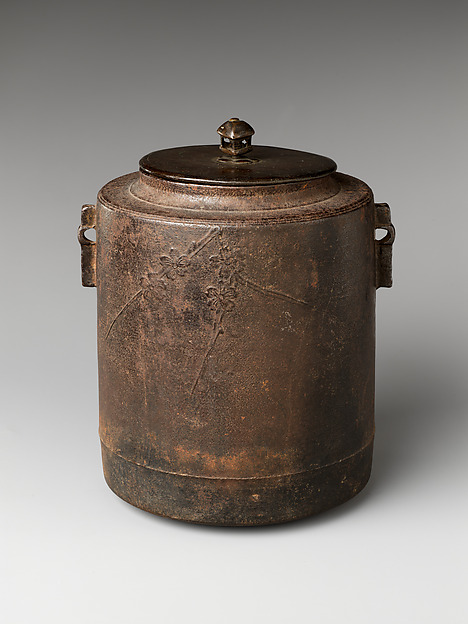
Ōnishi Gorōzaemon, Kettle (Kama) with Willow and Cherry, mid-17th century, Cast iron and bronze. The Metropolitan Museum of Art, Gift of Peggy and Richard M. Danziger, 2024, accession 2024.553.6a, b.
Look closer: the iron is dark and plain, with faint engraved willow and cherry branches and two loop handles at the shoulders. The museum catalogues it as a kama, cast iron and bronze, mid-seventeenth century, by Ōnishi Gorōzaemon, 20.3 cm high; the kettle is the heart of a tea room, and the chapter on kettles takes it up.
Image: The Metropolitan Museum of Art, Open Access (CC0)
The museum's own labels are the model. A bamboo scoop is attributed to Rikyū, not given to him; a bowl is in the style of Raku Chōjirō, not by him; a Raku bowl is tentatively attributed; a portrait follows an earlier original and may carry a later inscription. Each of these phrases is a small act of honesty, and each lowers the price relative to an unqualified name. The words to ask for are the ones the Met uses: attributed to, in the style of, tentatively attributed, after.
The practical rules that follow are modest. Look for the box and its inscription, since the journal essay on tomobako and hakogaki explains how such boxes document provenance in tea. Ask who first recorded the attribution and when. Be as wary of a perfectly rustic, perfectly aged object as of a perfect one, since the wabi-cha article reminds that the look of simplicity can be reproduced. And remember that Rikyū's own wish was for objects used honestly in a room; a name that is claimed for a piece that was never used is a different kind of claim.
Pieces in the Raku, bamboo, iron and tea-utensil traditions pass through the house under the tags the house uses for tea, and the concierge desk will say in plain words what a given attribution does and does not claim.
Stories Told About Him
The best-known story is the last tea, which the Rikyū article takes from Okakura Kakuzō: a master serving a final gathering, giving the guests his utensils and breaking his own bowl so that it would never be used by unlucky lips. It is a story of generosity and refusal, and it is told in English by a writer of the early twentieth century; it should be enjoyed as literature.
A second story is the debate about the Southern Record. The text records Rikyū's teachings, but the article says there is debate whether the priest said to have written it, Nanbō Sōkei, ever existed, and some scholars hold that the writings were by Tachibana Jitsuzan, who claimed to have found and copied them in the seventeenth century. A book of the master's sayings may be the master's, a disciple's or a later hand's, and the honest answer is that the question is open.
A third story concerns hospitality. The Met's catalogue of the letter about sake gives a small, human Rikyū: a man who has received a fine barrel of sake, tasted it, and invites a friend to tea in thanks, mentioning that he means to share some with Hideyoshi. It is a reminder that the severe master wrote friendly notes about drink.
The fourth is a story of numbers. A diary kept by a courtier at the time of the Kitano gathering counted more than 800 tea houses and tea spaces by the twenty-eighth day of the ninth month, and estimates reach 1,500 to 1,600 by the day before the opening, each a small room of about two mats built by a guest for a gathering the regent ended after a single day.
Fun Facts
- Rikyū's childhood name was Yoshirō, and his father used the family name Sen later in life, according to Wikipedia.
- The Buddhist name Sōeki, by which he is often called in the sources, is believed to have come from a Rinzai priest of Nanshū-ji in Sakai.
- Taian, his surviving tea room, has an interior of two tatami mats and is one of only three tea houses in Japan designated National Treasures, according to Kyoto Prefecture.
- The shared bowl of thick tea first appears in documents in 1586 and is credited to Rikyū.
- The word kaiseki is written with characters meaning breast-pocket stone, thought to have been adopted by Rikyū from the Zen monks' habit of warming stones against the stomach.
- The Omotesenke memorial is held on 27 March and the Urasenke memorial on 28 March, and the three houses take turns at a monthly service on the twenty-eighth.
- Hideyoshi's Grand Kitano Tea Ceremony was planned for ten days and ended after one.
- After Rikyū's death Hideyoshi turned his attention from tea to Noh, according to Wikipedia's article on the regent.
- Furuta Oribe's life is the subject of the manga and 2011 anime Hyōge Mono, and of a confectionery company's advertisement, according to Wikipedia.
- The Seven Foremost Disciples included Dom Justo Takayama, with Maeda Toshinaga, Gamō Ujisato, Hosokawa Tadaoki and Furuta Oribe.
News and the Present Day
A great many of the objects in the Met's Rikyū-related holdings arrived in 2024. The credit lines on the letter about sake, the bamboo scoops, the signed incense container and the Kaedegure bowl read gift of Peggy and Richard M. Danziger, 2024, and the catalogue pages say that the scoop and the Raku bowl are on view in Gallery 228 at The Met Fifth Avenue, while the letter and the incense container are not on view. The visitor should check the museum's website before a visit.
Taian can still be visited. Kyoto Prefecture's page says appointments are required, that visits cost 1,000 yen, that the site is closed for about a month before a given date and that it is a three-minute walk from JR Ōyamazaki Station. A book published by Tankōsha in September 2024, Nippon Chashitsu Journey, records a year and a half of visits to twenty-one tea rooms in nine prefectures by Fujimori Terunobu and the model Hana, according to nippon.com, which describes tea rooms as a unique form of building found only in Japan.
The old rivalry between display and austerity also continues. Wikipedia notes that reconstructions of the Golden Tea Room have been made, and the ceremony article observes that the symbiotic relationship between politics and tea reached its height in the age of Hideyoshi. A reader of tea-world news today will meet the same pairing: tea is at once the most modest and one of the most prestigious practices in Japan, and its leading houses and patrons still carry Rikyū's name.
A Timeline of Tea Down to Rikyū
The table gathers the dates used in this chapter in order. Where a source gives a date that the chapter cannot check against another, the date is stated as that source's.
| Date | Event | Note |
|---|---|---|
| 815 | The monk Eichū prepares tea for Emperor Saga; tea plantations are ordered in 816. | Tea in Japan before the ceremony |
| Late 12th century | Eisai brings powdered-tea preparation and tea seeds from China. | Monastery tea |
| 1423 to 1502 | Murata Jukō, remembered as the founder of the tea ceremony, lives and teaches. | Zen and tea joined |
| About 1488 | Jukō writes the Letter of the Heart to his pupil Furuichi Chōin. | The first statement of principle |
| 1502 to 1555 | Takeno Jō'ō, merchant of Sakai, carries the simple style forward. | Rikyū's teacher |
| 1522 | Sen no Rikyū is born in Sakai. | Childhood name Yoshirō |
| 1582 to 1583 | The original Taian is dated to these years in one account. | Rikyū's surviving tea room |
| 1586 | The shared bowl of thick tea first appears in documents. | Credited to Rikyū |
| 1587 | Hideyoshi holds the Grand Kitano Tea Ceremony. | Rikyū among its designers |
| 1590 | Rikyū's disciple Yamanoue Sōji is executed on Hideyoshi's orders. | A year before Rikyū's own end |
| 21 April 1591 | Rikyū dies by order of Hideyoshi, on the 28th day of the 2nd lunar month. | Aged about seventy |
| 1578 to 1658 | Sen no Sōtan, Rikyū's grandson, carries the family tradition. | Three sons found three houses |
| 1615 | Furuta Oribe is ordered to end his life after the Osaka campaign. | Rikyū's pupil |
A Glossary of Rikyū's Tea
These are the words the chapter uses, with the sense the sources give them.
| Term | Meaning |
|---|---|
| Chanoyu | 茶の湯. Literally hot water for tea; the name of the ceremony. |
| Sadō, chadō | 茶道. The way of tea. |
| Wabi | 侘. Subdued, austere beauty, as the Stanford Encyclopedia of Philosophy renders it in Wikipedia's article. |
| Sabi | 寂. Rustic patina. |
| Wabi-cha | わび茶. The style of tea associated with Murata Jukō, Takeno Jō'ō and Sen no Rikyū, which emphasises simplicity. |
| Sōan-cha | The grass-thatched hermitage style of chanoyu, a name for Rikyū's new form. |
| Karamono | 唐物. Refined Chinese tea implements, the fashion that wabi-cha stood against. |
| Koicha, usucha | 濃茶, 薄茶. Thick tea and thin tea; the shared bowl of koicha is credited to Rikyū. |
| Chashitsu | 茶室. A tea room; ideally four and a half tatami in floor area. |
| Taian | 待庵. The tea house attributed to Rikyū at Myōkian, in Yamazaki, a National Treasure. |
| Raku ware | 楽焼. Hand-formed tea bowls begun by the tile maker Raku Chōjirō for Rikyū. |
| Chashaku | 茶杭. The tea scoop, which Rikyū cut from bamboo himself. |
| Kaiseki | 懐石. The simple meal before tea; the characters, literally breast-pocket stone, are thought to have been adopted by Rikyū. |
| Iemoto | 家元. A head house; Omotesenke, Urasenke and Mushakōjisenke descend from Rikyū. |
| San senke | 三千家. The three Sen houses. |
| Rikyū Shichitetsu | 利休七哲. The Seven Foremost Disciples of Rikyū. |
| Nanpōroku | The Southern Record, a record of Rikyū's teachings; its authorship is debated. |
| Kokoro no fumi | 心の文. Jukō's Letter of the Heart. |
| Ichi-go ichi-e | 一期一会. The idea that each meeting should be treasured, since it cannot be reproduced. |
| Tokonoma | 床の間. The scroll alcove of the tea room. |
Who Taught Whom
The line of teachers from Jukō to Rikyū's grandson is short. This table sets out each figure's contribution as the sources give it.
| Figure | Contribution | Note |
|---|---|---|
| Murata Jukō | Wabi-cha's first figure; wrote the Letter of the Heart | Wikipedia's account names the four values as kin, kei, sei and jaku. |
| Takeno Jō'ō | Merchant of Sakai, pupil of Jukō's pupils; teacher of Rikyū | Followed the trend towards simplicity and minimalism. |
| Sen no Rikyū | Brought wabi-cha to its fullest; Taian, Raku bowls, bamboo scoops | Wikipedia's article on the ceremony names the principles as wa, kei, sei and jaku. |
| Yamanoue Sōji | Pupil and chronicler; executed in 1590 | His record comments on Rikyū's teaching. |
| Furuta Oribe | Pupil who became the foremost tea master after Rikyū | Oribe ware is attributed to his influence. |
| Sen no Sōtan | Rikyū's grandson; kept the family tradition | Father of the three tea houses' founders. |
More Pieces in the Master's Tradition

Sen no Rikyū, Tea Scoop (chashaku), probably early 17th century, Wood. The Metropolitan Museum of Art, Fletcher Fund, 1925, accession 25.215.51.
Look closer: a thin scoop lies beside its tall, narrow box. The museum catalogues it as a tea scoop, probably early seventeenth century, wood, 17.8 cm long, under the name of Sen no Rikyū; the box beside it is part of the object, as the chapter explains.
Image: The Metropolitan Museum of Art, Open Access (CC0)

Black Raku Tea Bowl, early 17th century, Earthenware with black raku glaze (Raku ware). The Metropolitan Museum of Art, Rogers Fund, 1917, accession 17.118.74.
Look closer: the bowl is hand-formed and black. The museum catalogues it as a black Raku tea bowl of the early seventeenth century, earthenware, tentatively attributed to Chōjirō, 9.2 cm high and 9.5 cm across.
Image: The Metropolitan Museum of Art, Open Access (CC0)
Near the Master
Raku, bamboo, iron and other tea-room pieces pass through the house, and the concierge desk will say in plain words how each attribution reads. The atlas of chanoyu utensils and the glossary of tea utensils are companions to this chapter.
Answered plainly
Who was Sen no Rikyū?
A tea master of Sakai, 1522 to 1591, considered the most important influence on the Japanese tea ceremony and especially the tradition of wabi-cha.
What is wabi-cha?
A style of tea associated with Murata Jukō, Takeno Jō'ō and Sen no Rikyū that emphasises simplicity. Wikipedia says the term came into use in the Edo period; before that it was wabi-suki.
Why was Rikyū ordered to take his own life?
Wikipedia says Hideyoshi ordered it because of crucial differences of opinion and because Rikyū was too independent, and that the reason may never be known for certain.
What is Taian?
The only tea house attributed to Rikyū's design, at Myōkian temple in Yamazaki, Kyoto, a National Treasure with an interior of two tatami mats.
Who made the first Raku bowls?
The tile maker Raku Chōjirō, working with Rikyū, according to Wikipedia. The Met's catalogue cautions that the attribution of individual bowls to him is tentative.
What are the three Sen houses?
Omotesenke, Urasenke and Mushakōjisenke, founded by the sons of Sen no Sōtan, Rikyū's grandson.
What is the Southern Record?
A record of Rikyū's teachings credited to Nanbō Sōkei, though scholars debate whether Nanbō existed and some attribute the text to Tachibana Jitsuzan.
Did Rikyū invent the tea ceremony?
No. Wikipedia credits Murata Jukō as its early developer and Takeno Jō'ō as Rikyū's teacher; Rikyū is regarded as the most important influence on it.
Are Rikyū letters and scoops genuine?
Some are. The Met notes that forged Rikyū letters were produced throughout the seventeenth century, and that its scoop is attributed to him, not given to him outright.
Can I visit Taian?
Yes, by appointment. Kyoto Prefecture's page lists a fee of 1,000 yen and a three-minute walk from JR Ōyamazaki Station.
Where next
Sources and image credits
- Sen no Rikyū, Wikipedia
- Wabi-cha, Wikipedia
- Murata Jukō, Wikipedia
- Takeno Jō'ō, Wikipedia
- Sen no Sōtan, Wikipedia
- Furuta Oribe, Wikipedia
- Kobori Enshū, Wikipedia
- Japanese tea ceremony, Wikipedia
- Chashitsu, Wikipedia
- Kaiseki, Wikipedia
- Wabi-sabi, Wikipedia
- Grand Kitano Tea Ceremony, Wikipedia
- Toyotomi Hideyoshi, Wikipedia
- Kencha-sai at Kitano Tenmangū, Ohmatsuri
- National Treasures of the Yamashiro area, Kyoto Prefecture
- The Reconstruction of Taian, Columbia University
- A Pair of Authors Explore the World of Japan's Traditional Tea Rooms, nippon.com
- Object record, Tea Ceremony Apparatus, The Metropolitan Museum of Art
- Object record, Letter about Sake, The Metropolitan Museum of Art
- Object record, Round Wooden Incense Container (Kōgō) with Sen no Rikyū’s Signature, The Metropolitan Museum of Art
- Object record, Black Raku Tea Bowl, Named “Kaedegure” (Twilight by the Maples), The Metropolitan Museum of Art
- Object record, Tea Scoop (Chashaku), The Metropolitan Museum of Art
- Object record, Black Seto (Seto-guro) Tea Bowl, named Iron Mallet (Tettsui), The Metropolitan Museum of Art
- Object record, Portrait of Sen no Rikyū with his Death Poem, The Metropolitan Museum of Art
- Object record, Chashaku, named "Imogase", The Metropolitan Museum of Art
- Object record, Black Raku Teabowl, named “Setting Sun” (Sekiyō), The Metropolitan Museum of Art
- Object record, Kettle (Kama) with Willow and Cherry, The Metropolitan Museum of Art
- Object record, Tea Scoop (chashaku), The Metropolitan Museum of Art
- Object record, Black Raku Tea Bowl, The Metropolitan Museum of Art
Last reviewed 28 October 2026. Pictures, where shown, are public-domain or open-access and credited beneath each one.
Looking for a tea bowl, scoop, caddy or kettle in the tradition of the master? The concierge desk replies within one to three business days.
Browse tetsubin, chagama and tea ceremony pieces · Make a private request
Private concierge
Looking for something in particular?
Describe the piece or the project you have in mind. A senior advisor in Tokyo reads every case file personally and replies within two business days, with fees set out in writing before any work begins.