
Room, Hearth and the Turning Year
Chanoyu Almanac · Space, Fire, Season
Room, Hearth and the Turning Year
A tea room is a small space that is rebuilt in the mind every season. The mats are turned, the fire is moved from the floor to a stand and back again, the flower changes, the bowl changes, and a jar sealed in spring is opened in autumn to begin the year again. This chapter walks the path to the door, sits down inside, and then follows the room through twelve months.
Fact sheet
At a glance
- One room, two fires. The room has a sunken hearth for the cold months and a portable brazier for the warm ones, and the change between them opens and closes the tea year.
- A path before a room. Guests walk a garden, rinse their hands at a stone basin and crawl through a low door, so that the room is entered as a different place.
- Space measured in mats. The ideal modern room is four and a half tatami, and a tea room may be as small as one and three-quarter mats.
- A calendar of tea. Hatsugama in January, Shoburo in May, Nagori in October and Robiraki in November are among the named gatherings of the year.
- A living room. Seasonal flowers, incense, bowls, clothing and even the tatami layout change with the months.
A Room That Changes
Ask a person who studies tea what the tea room is and the first answer will be a size. The Wikipedia article on the chashitsu says that the most typical floor size is four and a half tatami mats, which it gives as 7.4 square metres, about 80 square feet. That figure is the beginning of the story and not the end of it. The same article says a tea room can be as small as one and three-quarter mats, one full mat for the guests and a three-quarter mat for the host, the hearth or brazier and the preparation of the tea, or as large as ten mats or more. Between those extremes the room is arranged, furnished and used differently in every month of the year.

Tea Ceremony Apparatus, Album leaf; lacquer on gold paper. The Metropolitan Museum of Art, The Howard Mansfield Collection, Purchase, Rogers Fund, 1936, accession 36.100.120.
Look closer: a rounded brown kettle with a red cord sits behind a small red dish and a plain black bowl, all on a ground of gold-coloured paper. The museum catalogues it as Tea Ceremony Apparatus by Shibata Zeshin, an album leaf in lacquer on gold paper, 12.1 by 8.9 cm; it paints the things that a room is built around, a kettle, a bowl and a small dish, and nothing else.
Image: The Metropolitan Museum of Art, Open Access (CC0)
The argument of this chapter is that a tea room is best understood as a sequence and not as a plan. A guest does not arrive in a room; the guest arrives at a garden gate, waits, walks, washes, bends, enters, looks, sits, eats, leaves and returns, and the room is the middle of that sequence. The year then repeats the sequence with changes, so that the same four and a half mats can be an autumn room, a winter room, a summer room and a room for the first tea of January. Both the sequence and the year are described in the sources with a precision that is easy to admire and that this chapter tries to keep.
The chapter takes the room first, with its measurements and its history and the single surviving room that Wikipedia credits to Sen no Rikyū. It then follows a guest along the garden path and through the low door, looks at the alcove and the fire, and moves to the calendar. After the calendar come a formal gathering from start to finish, the table form of tea, the dress of the year, the rooms worth knowing, a collector's note on the objects of the seasons, a timeline, a glossary, and the questions readers most often ask.
The sources are Wikipedia's articles on the chashitsu, the roji, the tokonoma, tatami, the sukiya style, kaiseki, the irori and the tea ceremony; the Kids Web Japan guide to tea, published by the Japanese government's web-japan site; the Japanese Culture Center's description of the world of chado; three tea teachers' pages on the November opening of the hearth and the tea jar; a visitor's page on Taian; and the catalogue records of the Metropolitan Museum of Art for the objects shown. Where they disagree, a box says so.
Four and a Half Mats
The mat is the unit of the room. The tatami article describes it as a soft mat covered with a weft-faced weave of rush on a warp of hemp or cotton, made in standard sizes twice as long as wide, about 0.9 by 1.8 metres, depending on the region. It gives three regional sizes: the Kyōma mat of 1.91 by 0.955 metres, the Chūkyōma of 1.82 by 0.91 and the Edoma of 1.76 by 0.88. In the traditional units a mat is one ken by a half ken, or six shaku by three, and a room of four and a half mats is nine shaku by nine shaku, which the article gives as about 2.73 metres square in the Nagoya region. The article adds that Japanese tea rooms are frequently four and a half mats.
Diagram by Japonista. Schematic, not a particular room; the mat pattern follows Wikipedia's description of a centre mat with four mats set round it in a circle.
Look closer: the central half mat is the pale tan square, with four full mats set round it like the blades of a pinwheel. The dark square is the sunken hearth, which in the warm months is covered over; the red bars mark the guests' crawl-in door and the host's door.
Diagram by Japonista
The tea ceremony article describes how those mats are laid. In a four-and-a-half-mat room the mats are placed in a circular pattern around a centre mat, which is a half mat. The tea-room arrangement differs slightly from the layout of a regular Japanese-style room and may vary by season where mats can be rearranged. The centre mat is treated as a kind of table: utensils are placed on it for viewing, prepared bowls are placed on it for serving, and people avoid stepping on it or placing their hands palm-down on it, so that they walk round it or shuffle on hands and knees. The diagram above shows the pattern as a schematic plan.
Two other mats appear in tea. The tatami article says a half mat is a hanjō and a mat of three-quarter length is a daimedatami, which is used in tea-ceremony rooms. The small room that Sōtan built, Konnichian, is described by Wikipedia as having a floor of one full tatami, a three-quarter daime tatami and a wooden board at the head of the daime mat, with no recessed alcove. That is the one-and-three-quarter-mat room of the smaller kind, which the chashitsu article gives as the smallest.
The chashitsu article divides rooms by this measure. Those larger than four and a half mats are called hiroma, big rooms, and those smaller are called koma, small rooms. The division affects the style of ceremony that can be conducted, the equipment and decoration used, the placement of features and the hearth, and the number of guests who can be accommodated. Hiroma are often shoin-style rooms and are for the most part not limited to tea. It is the koma, the small room, that carries the particular meaning of the wabi style.
A tea house is more than the room. The chashitsu article says the smallest tea house has two rooms, the main room where the host and guests gather and a mizuya, where the host prepares the sweets and equipment, and may have a floor area of only three mats. A very large tea house may have several tea rooms of different sizes, a well-equipped mizuya resembling a modern kitchen, a large waiting room, a welcoming area where guests remove and store their shoes, separate toilets, a changing room, a storage room and a garden with a roji path and one or more privies. The room that appears in photographs is the quiet centre of a small building with many service spaces behind it.
| Unit | Size in the sources | Where it appears |
|---|---|---|
| Full tatami (Nagoya size) | About 1.82 by 0.91 m | Tatami article; used for the nine-shaku room |
| Kyōma tatami | 1.91 by 0.955 m | Tatami article; Kyoto origin |
| Edoma tatami | 1.76 by 0.88 m | Tatami article; Tokyo origin |
| Half mat (hanjō) | Half a full mat | The centre mat of a four-and-a-half-mat room |
| Daimedatami | About three-quarters of a mat | The host's mat in the smallest rooms |
| Four and a half mats | Nine shaku square, about 2.73 m | The ideal size in modern tea rooms |
From Shoin to Hut
The chashitsu article gives the early history in three layers. The word chashitsu itself came into use only after the start of the Edo period, around 1600. In earlier times, it says, spaces used for tea were called by various names, among them chanoyu zashiki, the sitting room for tea; sukiya, a place for poetically inclined pursuits such as tea; and kakoi, a partitioned-off space. An account the article reports says that the shōgun Ashikaga Yoshimasa built the first chashitsu at his Higashiyama villa in Kyoto, a small room of four and a half mats separated from the main residence.
The article then quotes the historian Moriya Takeshi, in an essay called The Mountain Dwelling Within the City, for the idea that the ideal of wabi tea had its roots in the urban society of the Muromachi period, from 1336 to 1573, and took form in tea houses that townspeople built at their residences, which in turn affected the look of thatched huts in mountain villages. Before that, he notes, tea was generally enjoyed in rooms of the shoin style, a style still frequently used today. A reader should hold on to the paradox: the hut in the mountains is a town invention, and the rustic room is a product of a city's taste.
Tea houses, the article says, first appeared in the Sengoku period, from the mid-fifteenth to the early seventeenth century, when the central government had almost no practical power and wars and uprisings were commonplace. Samurai were busy acquiring and defending territory, and many of the poor sought the salvation of the afterlife taught by Buddhism. Tea houses were built mostly by Zen monks or by daimyō, samurai and merchants who practised tea, and they sought simplicity and tranquillity, which the article calls central tenets of Zen philosophy.
The sukiya article adds the architectural thread. It says that suki, written with characters meaning refined, well-cultivated taste, refers to the enjoyment of the exquisitely performed tea ceremony; the word sukiya originally meant a small structure for tea, and has come to name a style of building that takes tea-house aesthetics into public and private architecture. In 1587, it says, Toyotomi Hideyoshi employed Rikyū as his adviser on aesthetic matters, and in the compound of Hideyoshi's Jurakudai castle in Kyoto Rikyū designed an eighteen-mat building known as the Coloured Shoin, thought to be the first example of sukiya-zukuri. The style then developed through the rest of the Azuchi-Momoyama period, characterised by small rooms of usually four and a half mats, or fewer, with a tokonoma and shelves, entered through a garden by an indirect curved or diagonal path that would not allow an instant view of the tea house.
The article contrasts the style with the shoin. The shoin of the warrior class, it says, was a large, magnificent reception area, the setting for the pomp and ceremony of the feudal lords, with frieze rails, coffered ceilings, decorated walls and an alcove, shelves and desk arranged by a fixed formula. Sukiya, by contrast, often used unsquared columns, even simple polished tree trunks, earthen plaster, ceilings of boards, and a free arrangement of the alcove and shelves. There is also a difference of seating: in a shoin the flower arrangement in the alcove shows the wealth of the host while the guest sits with their back to it, whereas in a tea room the guest sits facing the alcove to enjoy it. In the Edo period, the article adds, sukiya-zukuri became popular among townspeople, and the majority of houses came to be built in that style.
One famous room runs the other way. The Golden Tea Room, the article says, was a portable gilded room built in the sixteenth century for Hideyoshi's tea gatherings, to impress guests with the regent's might, in contrast to the rustic aesthetic codified under Rikyū, although it is speculated that Rikyū might have helped in the design. The original room is lost and a number of reconstructions have been made. The extent of Rikyū's involvement, the article says, is not known, though he was in attendance on a number of occasions when tea was served in it.
Garden, Basin and Low Door
A guest comes to the room by the roji. The word means dewy ground, and the roji article describes it as the garden through which one passes to the tea room, a transitional space leading from the entry gate to the tea house that cultivates an air of simplicity and purification. It developed in the Momoyama era, from 1573 to 1603, as the tea ceremony established itself, and the article names Rikyū as important in its development. It is usually divided into an outer and an inner garden, with a machiai, a waiting arbour, and its features include the tsukubai, the ablution basin, stone lanterns, stepping stones and a wicket gate. Ostentatious planting is avoided in favour of moss, ferns and evergreens, though plum and Japanese maple can be used.
The article gives two anecdotes of Rikyū's gardens. At his tea house Taian, it says, the sleeve-brushing pine gained its name from the garden's diminutive size. At his tea house at Sakai he planted hedges to hide the view over the Inland Sea, so that only when a guest bent over the basin did the view appear. Rikyū explained the design, the article says, by quoting a verse by the poet Sōgi, a glimpse of the sea through the trees and the flash of the stream at my feet. Whatever else the garden is, it is a device for controlling what is seen and when.
The roji also works as a ritual. The host, the article says, carefully cleans the garden before the ceremony begins, so that preparing the garden is an extension of the ceremony and is meant to clean and order the host's mind. During the gathering the roji is sprinkled with water three times as repeated purification: once before the guests arrive, once during the nakadachi, the break in the middle, and once before the guests leave. The guests, for their part, purify themselves at the basin before they enter the tea house by washing their hands and rinsing their mouths.
The chashitsu article describes the last step. The stone basin stands near the tea house, and the guests enter the room through the nijiriguchi, the low square crawling-in door, which requires bending low to pass through and, the article says, symbolically separates the small, simple, quiet inside from the crowded, overwhelming outside world. The nijiriguchi leads directly into the room. Besides the guests' door there may be several more entrances; at minimum there is the sadōguchi, the host's door, which gives access to the mizuya.
Tobi-ishi, the stepping stones, have a history of their own, according to the roji article, which cites Sadler. They were originally placed to protect the garden's moss, and eventually took on an aesthetic function: the stones slow visitors on the way to the tea house and encourage contemplation of the everyday. The stone lanterns, tōrō, were originally used to light the path for ceremonies held at night, and were soon adopted as decoration in other kinds of garden, a practice that continues. The article also says the roji, with its small size, harmonious proportions and simple suggestiveness, served as a model for domestic Japanese courtyard gardens.
Alcove, Window and Scroll
Inside, the chashitsu article says, the room has a low ceiling and no furniture; guests and host sit on the floor in the formal kneeling posture called seiza. All materials are intentionally simple and rustic. Windows are generally small and covered with shōji, translucent paper that lets natural light filter in; they are not intended to provide a view, which would detract from the participants' concentration. The only decoration, the article says, is the tokonoma holding a scroll of calligraphy or brush painting and perhaps a small simple flower arrangement called chabana.
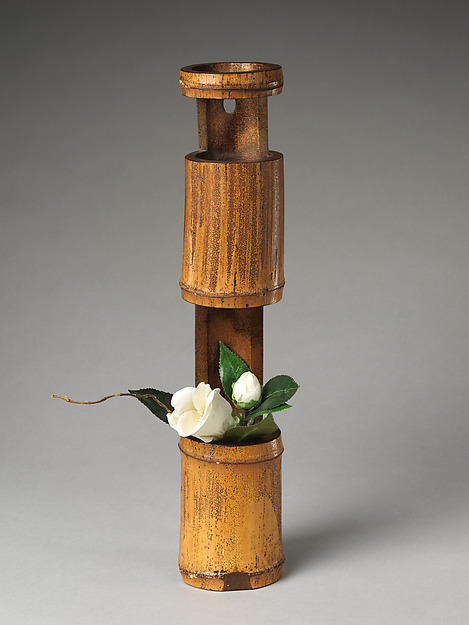
Double-cut (Nijū-giri) Flower Container (Hanaire), named Cool Summer Morning (Shinryō), early 17th century, Bamboo, lacquer, gold. The Metropolitan Museum of Art, Purchase, Diane and Arthur Abbey Gift, 2019, accession 2019.571a, b.
Look closer: a pale bamboo tube is cut with two windows, one above the other, and a white camellia stands in the lower opening. The museum catalogues it as a Double-cut Flower Container (hanaire), named Cool Summer Morning (Shinryō), by Kōgetsu Sōgan, early seventeenth century, bamboo, lacquer and gold, 42.9 cm high; it is a tall narrow container of the kind the sources describe for chabana.
Image: The Metropolitan Museum of Art, Open Access (CC0)
The tokonoma has its own article. It describes the alcove as a recessed space in a Japanese-style reception room in which items for artistic appreciation are displayed, and gives two theories of its origin: that it derives from the room structure of the Heian shinden-zukuri, or from the board called oshiita in Zen monasteries of the Kamakura period, which held Buddhist altar fittings, with a hanging scroll on the wall behind. In the shoin of the Muromachi period, the article says, the alcove became a room decoration. Its typical contents are a calligraphic or pictorial scroll and an ikebana arrangement; bonsai and okimono are also common, though traditionally bonsai were not considered worthy of a place of such respect.
Etiquette follows the alcove. The article says that the most important guest is seated closest to it, at the place furthest from the entrance, the kamiza, and that stepping within it is strictly forbidden except when changing the display, which has its own etiquette. The pillar at one side, the toko-bashira, is made of specially prepared wood and may range from a seemingly raw trunk with the bark attached to a square piece of heartwood with very straight grain; its choice determines the level of formality of the alcove.
The tea ceremony article adds what is hung and why. Calligraphy, mainly in the form of hanging scrolls, plays a central role in tea; scrolls, often written by famous calligraphers or Buddhist monks, are chosen on the theme of the occasion and the season, and may feature Buddhist subjects, poems, descriptions of famous places or words associated with tea. It cites the historian Haga Kōshirō for the point that Rikyū, from the teachings recorded in the Nanpōroku, preferred to hang bokuseki, the ink traces of Zen priests, and that the suitability of a scroll depends not only on its subject but on the virtue of the writer. A typical example might read wa-kei-sei-jaku, harmony, respect, purity and tranquillity.
Flowers follow rules of their own. Chabana, the article says, is a style of flower arrangement that is simple and natural, in which unnatural or out-of-season materials are never used. Arrangements typically comprise few items and little or no filler material; in summer, when many flowering grasses are in season, it is seasonally appropriate to arrange several of them in an airy basket-type container. Unlike ikebana, which often uses shallow wide dishes, tall narrow containers called hanaire are frequently used in chabana. The Metropolitan Museum's double-cut bamboo container shown here holds a white camellia; a tea teacher's page on the November opening of the hearth, noted below, says that camellias are the only flowers used once the winter hearth season begins.
Hearth in Winter, Brazier in Summer
The tea ceremony article gives the central rule of the tea year. Practitioners divide the year into two seasons: the sunken hearth season, ro, which corresponds to the colder months, traditionally November to April, and the brazier season, furo, corresponding to the warmer months, traditionally May to October. The weather determines when each is used. In the hearth season, the article says, the host opens the sunken hearth in the middle of the tea room, where it heats the water and is the only form of heat in the room in winter; in the brazier season water is heated in a raised brazier. And in the weeks when the brazier does not give enough heat to keep guests warm but the hearth would be too hot, the host may cover the hearth with its lid and put the brazier on top of it.

Kettle (Kama) and Brazier (Furo), 18th century, Iron. The Metropolitan Museum of Art, Fletcher Fund, 1925, accession 25.215.32.
Look closer: a squat kettle sits on a small brazier inside a shelf stand, with a folding screen behind and a few small vessels on the table in front. The museum catalogues the objects as a Kettle (Kama) and Brazier (Furo), iron, eighteenth century, 17.5 cm high, and the photograph shows them arranged together; the kettle is the tool that the fire is for.
Image: The Metropolitan Museum of Art, Open Access (CC0)
The chashitsu article describes the hearth itself. A sunken hearth is located in the tatami next to the host's mat, for use in the cold months; it is covered with a plain tatami and is not visible in the warm months, when a portable brazier is used instead. The tea ceremony article says purpose-built rooms have a special tatami with a cut-out section providing access to the hearth, and that in summer the hearth is covered either by a small square of extra tatami or, more commonly, by replacing the hearth mat with a full mat. A Japanese Culture Center page adds a practical difference: the furo fire is smaller and kept farther from the guests, which helps keep the room cooler, whereas the ro is a fire pit cut into the floor between the host and guests with a coarser ash arrangement and a larger fire.
The hearth is not an invention of tea. The irori article describes the irori as a traditional Japanese sunken hearth fired with charcoal, used for heating the home and for cooking, a square stone-lined pit in the floor with an adjustable pothook, which once served as the main source of residential heating and lighting and as a communal gathering place. The article says that in warm western Japan people disliked using it in summer and used a separate cooking stove in the warm months and the irori in the cold ones, a seasonal division that the tea year also keeps. The resemblance is a likeness of form, and the sources do not say that the tea hearth descends from the farmhouse one.
The change of fire is itself a gathering. Kids Web Japan, a government guide, says that in October the furo is put away and the ro is brought back, and that the Nagori no chaji marks the switch. The ro is first opened in November at the Robiraki ceremony, where tea is made with powder from leaves picked earlier in the year. The same guide names the first gathering of the warm season, in May, Shoburo, the first furo. A tea teacher's page on Robiraki adds details of what was displayed at one such gathering: a peacock feather, large charcoal cylinders, iron rings for carrying the kettle and a boar-shaped incense container, with the fire-building tools shown in a hollowed-out gourd; the page also describes the serving of zenzai, a sweet red bean soup with toasted mochi, and the use of a higher-grade tea in a twenty-gram caddy. These details are that teacher's own, and they illustrate the occasion without defining it.
Preparing the room for winter involves more than the fire. A tea teacher's note on the season says the shōji paper screens are repapered and pine needles are spread over the moss and bare earth of the garden where frost is expected. The Japanese Culture Center agrees that after the ro is opened the tatami are recovered, the shōji paper is replaced and the host sits angled toward the guests, and that the garden moss is covered with pine needles to protect it from the cold. A room that is made ready for the first fire of winter is a room that is renewed.
A Feather for the Ash
A hearth brings its own small tools, and the Metropolitan Museum owns several of them. One is a feather brush, called a habōki in the catalogue, a single long feather tied to a short shaft, 33.7 centimetres long. The catalogue does not date it. A tea teacher's account of the Robiraki gathering names a peacock feather among the objects displayed, and the feather brush is the kind of tool that the sources associate with sweeping a hearth, but neither page says that the museum's feather was used at a particular gathering and this chapter does not claim it.
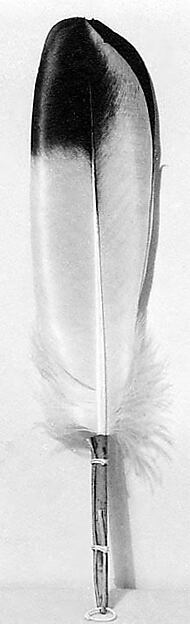
Feather Brush (Habōki) for Tea Ceremony, Feather. The Metropolitan Museum of Art, Fletcher Fund, 1925, accession 25.215.33.
Look closer: a long white feather shades from white to dark grey at the tip and is bound at the base to a short shaft. The museum catalogues it as a Feather Brush (Habōki) for Tea Ceremony, 33.7 centimetres long, from the Fletcher Fund of 1925; it is undated in the record.
Image: The Metropolitan Museum of Art, Open Access (CC0)
The same collection, given by the Fletcher Fund in 1925, includes an iron kettle and brazier, a kettle-lid rest, a ring to lift the kettle, and a Bizen water pot with a lacquer cover. The catalogue dates the lid rest to the eighteenth century and the lifting ring to about 1775. Together they describe the working fire of the tea room: a kettle on a stand, a rest for its lid when it is lifted, and a ring to carry it. Those are the objects that the kettle chapter of this almanac takes up in detail.
Charcoal has its own container. The museum's charcoal basket, catalogued as Chinese-style, a sairō-sumitori for sencha tea ceremony, is mid-nineteenth-century work in timber bamboo, dwarf bamboo and rattan, 13.3 centimetres high and 25.4 across, and belongs to the sencha tradition that the Japanese tea ceremony article describes as a separate way of steeped leaf tea. It is a reminder that more than one tradition of tea takes the fire seriously.
Twelve Months of Tea
The tea year does not begin in January. Several of the pages consulted agree that November, with the opening of the hearth and of the tea jar, is the tea practitioner's New Year. A tea teacher's page says Robiraki is the tea New Year, which marks the change of season and is a chance to sample the year's matcha harvest; the Japanese Culture Center says that opening the ro changes most of the tea-making process, so that this time is often called the New Year for tea, and that matcha leaves picked, steamed and stored in May are aged and usually sold starting in November, when the tea is described as the freshest of the year.
Diagram by Japonista. Months and event names from Kids Web Japan and the Japanese tea ceremony article.
Look closer: the gold band is the hearth season and the green band the brazier season; the first marks, at the left, are the November events that begin the tea year, and the last, at the right, is the October gathering that closes the brazier season.
Diagram by Japonista
Kuchikiri, the opening of the seal, belongs to the same season. A page of the tea association gjtea says that the Kuchikiri tea gathering is held in November, on a day of the boar in the old calendar, and is also called the New Year for tea practitioners; early in the year the best leaves are chosen, wrapped and stored in a jar called a tsubo, which is sealed with a wooden lid and decorated with cloths and ropes. At the gathering, the page says, the main guest may ask to see the jar and taste the tea, and the host traditionally agrees on this occasion. Historically the tea was ground on the spot with a stone mill; today it is usually pre-ground and the jar is mainly decorative. Another tea teacher's page says the jar may be displayed in a mesh bag with three decorative knots, placed formal in front, semiformal to the right and informal to the left.
Kids Web Japan lists the year's gatherings by month. In January there is Obukucha, the first tea of the year, and Hatsugama, the New Year's tea ceremony. In February comes the Akatsuki no chaji, a ceremony begun around four in the morning in the coldest season. In March is the Rikyū-ki, a memorial for the death of Rikyū. In spring and autumn the Kenchashiki is held at shrines and temples at irregular times. In May comes Shoburo, the first furo, and the brazier season begins. In August there is Hassaku, on the first of the month, when students visit their tea master, and the Asa chaji, a morning ceremony around six. In October comes the Ichiō-ki, held around the nineteenth to honour Sen Ichiō Sōshu, and the Nagori no chaji marks the switch from brazier to hearth. In November comes the Kuchikiri no chaji, with matcha ground from leaves matured in jars. December brings Kotohajime, around the eleventh, which begins preparations for the new year, the Yobanashi no chaji by candlelight, and Jōyagama, the last tea of the year, on the thirty-first.
The detail of the year is in the small things. The tea ceremony article says that in winter a kind of incense formed into pellets, neriko, is used, that jin or byakudan are used in summer, and that at the end of spring or the beginning of autumn kokukobei or umegako are put out. Guests drink from a more cylindrical bowl in winter to keep in heat and a flat bowl in summer to release it, and different designs appear on bowls by season. Participants wear lined kimono in winter and unlined in summer, and flowers subtly reflect the season. The tatami arrangement of a four-and-a-half-mat room often changes with the season as well, and at certain times of year, primarily the Japanese New Year, the places where guests sit may be covered with red felt.
The Japanese Culture Center page makes a wider point, that traditional Japanese culture counts twenty-four seasonal markers rather than four seasons, and it gives some of the November words: shimofuri-zuki, the frost-falling month; yukimachi-zuki, the month of waiting for snow; ritto, the first day of winter, around 8 November; and heiden, the flat, empty fields after the harvest. The tea year borrows that finer calendar for its scrolls, its sweets and its flowers.
| Month | Gathering named by Kids Web Japan | What it marks |
|---|---|---|
| January | Obukucha, Hatsugama | The first tea of the year and the New Year's ceremony |
| February | Akatsuki no chaji | A ceremony begun around four in the morning, in the coldest season |
| March | Rikyū-ki | A memorial for the death of Rikyū |
| Spring and autumn | Kenchashiki | Tea offered at shrines and temples at irregular times |
| May | Shoburo | The first furo; the brazier season begins |
| August | Hassaku, Asa chaji | Students visit their teacher on the first; a morning ceremony around six |
| October | Ichiō-ki, Nagori no chaji | A memorial for Sen Ichiō Sōshu; the brazier is put away |
| November | Robiraki, Kuchikiri no chaji | The hearth is opened; the tea jar is opened |
| December | Kotohajime, Yobanashi no chaji, Jōyagama | Preparations for the new year, tea by candlelight, the last tea of the year |
A Gathering, Start to Finish
The tea ceremony article describes the formal noon gathering, the chaji, as the host's best account of a day in the tea room. Gatherings are either informal, a chakai, a relatively simple course of hospitality with sweets, thin tea and perhaps a light meal, or formal, a chaji, which usually includes a full-course kaiseki meal followed by confections, thick tea and thin tea and may last up to four hours. The noon gathering with one host and a maximum of five guests is considered the most formal chaji.
The guests arrive a little before the appointed time, store unneeded items such as coats and put on fresh tabi socks in an interior waiting room, which ideally has a tatami floor and an alcove with a scroll alluding to the season or the theme. They are served a cup of hot water, kombu tea, roasted barley tea or sakurayu, and then go to the outdoor waiting bench in the roji, where they stay until the host summons them. After a silent bow between host and guests they proceed to the stone basin, wash their hands and rinse their mouths, walk the garden to the tea house, remove their footwear and enter by the crawl-in door. They view the alcove and any tea equipment placed ready, and are seated on the mats in order of prestige. When the last guest has taken their place they close the door with an audible sound to alert the host, who enters, welcomes each guest and answers the first guest's questions about the scroll and other items.
In the cool months the chaji begins with the laying of the charcoal fire that heats the water. A meal in several courses follows, accompanied by sake and followed by a small sweet eaten from special paper called kaishi, which each guest carries and which can also be used to wipe down equipment or clean hands. Then comes the break, the nakadachi, during which the guests return to the waiting shelter; the host uses the interval to sweep the room, take down the scroll and replace it with a flower arrangement, open the shutters and prepare to serve the tea.
The guests are summoned back by the sound of a bell or gong rung in prescribed ways. They purify themselves again and examine the items in the room. The host enters, ritually cleanses each utensil in the presence of the guests in a precise order and arranges them according to the procedure being performed, and then prepares thick tea. The guests take the bowl in turn, bowing, raising it in a gesture of respect, turning it so as not to drink from the side that faces the host, taking a sip, complimenting the host on the tea, and wiping the rim before passing it on. Each then has an opportunity to admire the bowl before it returns to the host. The article says that sharing a bowl of thick tea first appeared in historical documents in 1586 and is considered to have been invented by Rikyū.
The change from the formal to the casual part of the gathering is marked by the fire. The host rekindles the fire and adds more charcoal, which the article says signifies a change from the more formal portion to the more casual, then brings a smoking set and more confections, usually dry sweets, to accompany the thin tea, and possibly cushions. Each guest is served an individual bowl of thin tea, and in the usucha portion, after a ritual exchange, the guests may converse more casually. Finally the guests ask to see some of the utensils, including the tea caddy and the tea scoop, which they examine with extreme care, often with a special brocaded cloth, to show respect and admiration for the host.
The Meal of the Breast-Pocket Stone
Kaiseki is the meal that comes before the tea. The Wikipedia article distinguishes two meals with the same sound. One, written with characters for a gathering, is a set menu served on individual trays; the other, written 懐石, is the simple meal that the host of a chanoyu gathering serves before a ceremonial tea, also called cha-kaiseki. The characters, the article says, mean breast-pocket stone and are thought to have been adopted by Rikyū to indicate the frugal meal of the austere style of tea. The idea came from the practice of Zen monks warding off hunger by putting warm stones into the front folds of their robes near their stomachs.
The tea ceremony article says that in cha-kaiseki only fresh seasonal ingredients are used, prepared in ways that aim to enhance their flavour, and that great care is taken in selecting the ingredients and types of food. The finished dishes are presented on serving ware chosen to enhance the appearance and the seasonal theme of the meal, often with real edible leaves and flowers as garnishes. Each diner has a small lacquered tray, and very important people may have their own low lacquered table.
The kaiseki article places the tea meal among the roots of the modern cuisine. It says modern kaiseki draws on four traditions: the imperial court cuisine of the Heian period, from the ninth century; the Buddhist temple cuisine of the Kamakura period, from the twelfth; the samurai cuisine of the Muromachi period, from the fourteenth; and the tea ceremony cuisine, from the fifteenth. Court and samurai cuisine, it says, are more ornate, while temple and tea cuisine are more restrained. The article also says that originally kaiseki comprised a bowl of miso soup and three side dishes, and that this is now the standard form of Japanese-style meal generally. The meal of the tea room is therefore both the model for a modern restaurant tradition and, as the sources describe it, a simple thing.
Chairs, Tables and the Open Air
Not all tea is taken on the floor. The tea ceremony article describes the ryūrei style, in which the host sits on a chair at a special table and the guests are seated at tables as well. It can be conducted nearly anywhere, even outdoors. In the article's list of procedures, the table-based form sits alongside the simple tray procedure, obon temae, which is usually the first temae learned and may easily be done sitting at a table, or outdoors, using a thermos pot in place of the kettle and a portable hearth.

Table for Tea Ceremony, 18th century, Black lacquer. The Metropolitan Museum of Art, Fletcher Fund, 1925, accession 25.215.54a–f.
Look closer: four slim black legs carry a thin rectangular top, with a lower shelf near the floor. The museum catalogues it as a Table for Tea Ceremony, eighteenth century, black lacquer, 67.9 cm high, from the Fletcher Fund of 1925; the record lists it as six parts.
Image: The Metropolitan Museum of Art, Open Access (CC0)
Tea can also be taken outdoors. The article describes nodate, a tea gathering held picnic-style in the open, for which a red parasol called a nodatekasa is used. It adds that any place where the necessary utensils can be set out and the host can make the tea in the presence of the seated guests can serve as a tea venue, though a purpose-built mat room is considered the ideal.
The Metropolitan Museum owns a black lacquer table for tea ceremony of the eighteenth century, with a lower shelf, 67.9 centimetres high, with a width of 90.2 and a depth of 40, and the record describes it as made in six pieces. The record does not say what the table was used for, and a reader should not take it for a ryūrei table in the modern sense; it is a reminder that Japanese tea has long had objects raised from the floor.
Dress for the Season
A guest's clothing is part of the room. The tea ceremony article says that most tea ceremonies are conducted in kimono, and that though students may practise in Western clothes they will need to wear kimono at some point. Attire is usually subdued and conservative so as not to distract. For women the kimono is usually an iromuji, a solid-coloured unpatterned garment, worn with a nagoya obi in an appropriate plain-weave fabric; slub-weave silks, shibori patterns and generally bright-coloured obi are not worn. Edo komon kimono may also be worn, as their patterns are small enough to be unobtrusive.
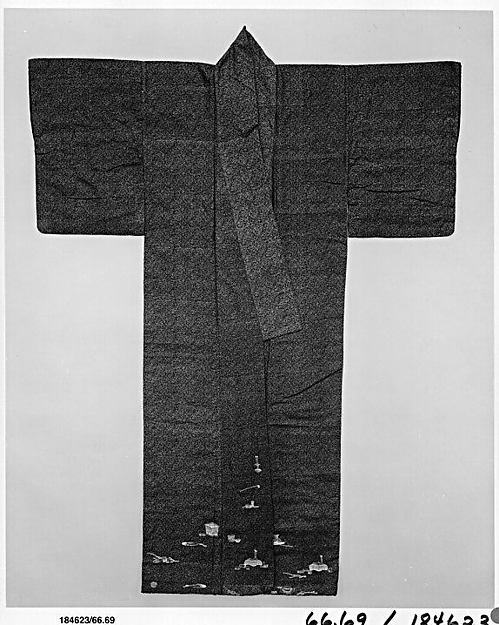
Kosode with Pattern of Tea-Ceremony Utensils on a Small Pattern (Komon) of Auspicious Objects, 19th century, Paste-resist and brush dyeing (yuzen) on a background of stencil-resist-dyed plain-weave silk. The Metropolitan Museum of Art, Seymour Fund, 1966, accession 66.69.
Look closer: the robe is a deep blue-black with a very fine overall texture; look at the lower hem, where small pale shapes are scattered. The museum catalogues it as a Kosode with Pattern of Tea-Ceremony Utensils on a Small Pattern (Komon) of Auspicious Objects, nineteenth century, paste-resist and brush dyeing on stencil-dyed silk, 168.3 by 127 cm.
Image: The Metropolitan Museum of Art, Open Access (CC0)
Men may wear kimono only, or for more formal occasions kimono with hakama, and those who have earned the right may wear a kimono with a jittoku jacket in place of hakama. For formal occasions both men and women wear montsuki kimono with three to five family crests, and both wear white tabi. Lined kimono are worn by both sexes in winter and unlined ones in summer.
The Metropolitan Museum owns a nineteenth-century kosode whose pattern shows tea-ceremony utensils on a small komon pattern of auspicious objects, made in paste-resist and brush dyeing on a ground of stencil-dyed silk, 168.3 centimetres long. It is a record that a household of the nineteenth century wore the vocabulary of tea on a garment. The museum also owns a tea-ceremony jacket, a chabaori, of paper and silk, late eighteenth to mid nineteenth century, which appears in the gallery below.
Rooms Worth Knowing
The chashitsu article lists the rooms by which the others are measured. Taian, it says, built in 1582, is the only extant chashitsu designed by Rikyū, representing his concept of wabi tea; it stands at Myōki-an in Yamazaki, Kyoto, and is designated a National Treasure. A visitor's page on the temple says the room is two mats, one for the guest and one for the host, six feet square, with a crawling-in entrance about seventy centimetres high and a ceiling of 170 centimetres, with a one-mat anteroom to the west and a one-mat preparation space to the north. It says the room is usually closed to public visits, and a reader should check the temple's own information before travelling.
Jo-an, the article says, was built in Kyoto in 1618 by Urakusai, the younger brother of Oda Nobunaga, moved to Inuyama in Aichi in 1972 and designated a National Treasure in 1951. Konnichian, the Today Hut built by Sōtan at what became the Urasenke estate, has the floor of one full mat and a three-quarter mat with a board and no recessed alcove; Fushin-an, the Doubting Hut, is said to have been made by Rikyū and moved by his son Shōan to the Omotesenke estate; Zangetsu-tei, the Morning Moon Arbour, belongs to Omotesenke. These are described in the chapter on the schools of tea.
The article names three famous rooms, the san-meiseki: the Sarumen tea room, the Monkey-face room, at Nagoya Castle, a former National Treasure until its destruction in 1945 and rebuilt in 1949; Hasō-an, the Eight Windows room at Isshin-ji in Osaka, designed by Kobori Enshū; and Rokusō-an, the Six Window Hut, from Kōfuku-ji in Nara, now in the gardens of the Tokyo National Museum. It also lists Shōkin-tei at the Katsura Imperial Villa in Kyoto, the Golden Tea Room, and a modern work, the Glass Tea House Kou-an, the Light Hut, designed by Tokujin Yoshioka, born in 1967. A shorter list names Shigure-tei, a unique two-storied tea room at Kōdai-ji in Kyoto, among others.
Names, the article says, usually include a character for hut, an, hall, dō, or arbour, tei, and reflect the spirit of rustic simplicity and the teachings of Zen. It gives examples such as Mugai-an, the Introvert Hut; Mokurai-an, the Silent Thunder Hut; Shō-an, the Pine Hut; Ichimoku-an, the One Tree Hut; Rokusō-an, the Six Window Hut; and Bōji-tei, the Forgotten Path Arbour. The names are a form of poetry in themselves, and a visitor who learns to read them learns what the builder valued.
| Room | Place | What the sources say |
|---|---|---|
| Taian | Myōki-an, Yamazaki, Kyoto | Built 1582; the only extant room attributed to Rikyū; National Treasure |
| Jo-an | Inuyama, Aichi | Built in Kyoto in 1618 by Urakusai; moved in 1972; National Treasure since 1951 |
| Konnichian | Urasenke estate, Kyoto | One mat and a daime mat; no recessed alcove |
| Fushin-an | Omotesenke estate, Kyoto | Said to be by Rikyū; moved by Shōan |
| Sarumen room | Nagoya Castle | Destroyed 1945; rebuilt 1949 |
| Hasō-an | Isshin-ji, Osaka | Eight Windows; designed by Kobori Enshū |
| Rokusō-an | Tokyo National Museum gardens | Six Window Hut, from Kōfuku-ji in Nara |
| Shōkin-tei | Katsura Imperial Villa, Kyoto | A tea pavilion in the villa |
| Kou-an | Designed by Tokujin Yoshioka | A glass tea house, the modern work |
The Room in the Present Day
Few readers now live in tatami rooms. The tatami article says houses built today have few or no tatami-floored rooms and that having just one such room is common; such rooms and their features are called washitsu, Japanese-style rooms. Yet tea persists in them. The tea ceremony article says most people who study tea in Japan join a circle that meets at a school, a college, a community centre, a dedicated tea school or a private house, and that any place where the host can make tea in the presence of the seated guest can serve as a venue.
The room has also become a design problem for architects. The Glass Tea House Kou-an, designed by Tokujin Yoshioka, appears in Wikipedia's list of notable tea rooms alongside Taian and Jo-an; the sukiya article observes that the formal and spatial concepts of sukiya-zukuri are kept alive in contemporary architecture in modern materials such as steel, glass and concrete. It is in the encounter of ancient measure and modern material that a room built from the same proportions can be a hut or a tower.
For the traveller, the practical news is on the temple pages. A visitor's page says Taian is usually closed to public visits, so a visitor intending to see it must check with Myōki-an. The Fushin-an page of Real Japanese Gardens says the garden and tea house of Fushin-an are not open to the public, as noted in the chapter on schools. Those who wish to experience a tea room are more likely to find one in a park, a museum or a temple than in a private estate; the chashitsu article notes that tea houses are commonly found in the grounds of private homes, temples, museums and parks.
The year itself remains the best way in. Gatherings such as Hatsugama in January, Shoburo in May, Nagori in October and Robiraki in November are open to students of the schools and, in many places, to visitors, and the schools' public programmes are a good place to ask. The sources consulted do not give a current schedule, and a reader should consult the school or a local tea association.
What the Season Does to Objects
A collector of tea objects learns that a season is a filter. The tea ceremony article says that equipment, with particular styles and motifs, is selected to match various events and seasons. A bowl that is right for the hearth months is cylindrical, to keep in heat; one that is right for summer is flat and wide, to release it. A water jar, a scoop, a caddy and a flower container all belong to one part of the year more than another. The practical effect is that an object is not simply good or bad, but good for something.
The first question, therefore, is when. A summer bowl and a winter bowl may be equally fine, and the page on the object should say what it is for. The second is what the object's record claims. The Metropolitan Museum's catalogue for its Bizen water pot of about 1625 and its Tanba water pot, both shown in the gallery, give a date, a medium and a size and say nothing about the season in which they would have been used; a reader should be wary of any description that supplies a season without a source. The third is the box: a box inscription may say when and for whom a piece was chosen, and the journal essay on tomobako and hakogaki explains how to read one.
The concierge desk will say in plain words what an object does and does not claim, including whether a pattern, a bowl or a jar suits a season by its own evidence or only by custom. The objects of the room, kettles, braziers, caddies, scoops, bowls and water jars, are the subject of the companion chapters of the tea almanac, and the shelf below leads to the pieces in the house.
Tales of the Room
The first story is of a garden that hid the sea. At his tea house at Sakai, the roji article says, Rikyū planted hedges to obscure the view over the Inland Sea, and only when a guest bent over the basin did the water appear. He explained it with a verse by the poet Sōgi: a glimpse of the sea through the trees, and the flash of the stream at my feet.
The second is of a pine. At Taian, the roji article says, the sleeve-brushing pine took its name from the diminutive size of the garden, so close that a passing guest's sleeve brushed the needles.
The third is of a gold room. The Golden Tea Room, the chashitsu article says, was a portable gilded room built to impress guests with the regent's might, in contrast to the rustic aesthetic codified under his tea master. Whether Rikyū helped design it is, the article says, speculated and not known; he was in attendance on a number of occasions when tea was served in it.
The fourth is of a jar. At Kuchikiri, the page of the tea association says, the jar sealed in spring is opened before the guests in the autumn, and the aroma of the stored tea is released; historically the tea was ground on the spot with a stone mill and served that day. It is the single moment of the year at which the room smells of what is to come.
The fifth is of a monk's warm stone. The kaiseki article says the characters for the tea meal mean breast-pocket stone, from the practice of Zen monks warding off hunger by putting warm stones into the front folds of their robes. A room built to be small has a meal named for something small enough to carry in a robe.
Fun Facts
- The word chashitsu came into use only after about 1600; earlier rooms for tea had other names, including sukiya and kakoi.
- The smallest tea house may have only three mats in two rooms, a main room and a mizuya.
- A four-and-a-half-mat room is nine shaku square, or about 2.73 metres in the Nagoya region.
- Guests close the door of the tea room with an audible sound to tell the host that the last guest has sat down.
- The roji is sprinkled with water three times during a formal gathering: before the guests arrive, at the break, and before they leave.
- Taian is a National Treasure and is usually closed to visitors, according to a visitor's page.
- The tea-room centre mat is treated as a table: people avoid stepping on it and avoid putting their hands palm-down on it.
- In the hearth season, the tea ceremony article says, guests drink from a cylindrical bowl to keep the tea warm; in summer the bowl is flat.
- Sharing one bowl of thick tea among several guests first appears in historical documents in 1586.
- A chaji may last up to four hours; a chakai may be little more than sweets and thin tea.
A Timeline of the Room
The table gathers the dates used in this chapter, each with the source that gives it. Where an account cannot be checked against a second source, the account is attributed.
| Date | Event | Source |
|---|---|---|
| Muromachi period, 1336 to 1573 | The ideal of wabi tea has its roots in the urban society of this period, according to the historian Moriya Takeshi. | Wikipedia, Chashitsu |
| Mid-15th to early 17th century | Tea houses first appear in the Sengoku period, built by Zen monks, daimyō, samurai and merchants. | Wikipedia, Chashitsu |
| 1582 | The date commonly given for Taian, the tea room at Myōki-an in Yamazaki. | Wikipedia; Mai-ko |
| 1587 | Hideyoshi makes Rikyū his adviser on aesthetic matters; at Jurakudai Rikyū designs an eighteen-mat building, the Coloured Shoin, thought to be the first example of sukiya-zukuri. | Wikipedia, Sukiya-zukuri |
| About 1600 | The word chashitsu comes into use, after the start of the Edo period. | Wikipedia, Chashitsu |
| 1618 | Jo-an is built in Kyoto by Urakusai, the younger brother of Oda Nobunaga. | Wikipedia, Chashitsu |
| Late 17th century | Tatami reach the homes of commoners. | Wikipedia, Tatami |
| 1945 and 1949 | Nagoya Castle's Sarumen tea room is destroyed in 1945 and rebuilt in 1949. | Wikipedia, Chashitsu |
| 1951 | Jo-an is designated a National Treasure. | Wikipedia, Chashitsu |
| 1972 | Jo-an is moved to Inuyama in Aichi. | Wikipedia, Chashitsu |
A Glossary of the Room
The words of the chapter, with the sense the sources give them.
| Term | Meaning |
|---|---|
| Chashitsu | 茶室. A tea room, or a free-standing tea house; the word dates from after about 1600. |
| Sukiya | 数寄屋. An older word for a tea room, and the name of the house style built on tea-house taste. |
| Mizuya | 水屋. The water room where the host prepares, cleans and stores the utensils. |
| Roji | 露地. The dewy ground, the garden path that leads to the room. |
| Machiai | 待合. The waiting arbour or bench in the garden. |
| Tsukubai | 蹲踞. The stone basin where guests rinse their hands and mouths. |
| Nijiriguchi | 躙口. The low crawling-in door for guests. |
| Sadōguchi | 茶道口. The host's door, which leads to the mizuya. |
| Tokonoma | 床の間. The alcove that holds a scroll and flowers. |
| Kamiza | 上座. The seat of honour, furthest from the entrance and nearest the alcove. |
| Ro | 炉. The sunken hearth used from November to April. |
| Furo | 風炉. The portable brazier used from May to October. |
| Daimedatami | 台目畳. A mat of three-quarter length used in tea rooms. |
| Koma, hiroma | 小間, 広間. A small room under four and a half mats and a big room of more. |
| Chaji | 茶事. A formal gathering with a meal, thick tea and thin tea; it may last up to four hours. |
| Chakai | 茶会. An informal gathering with sweets and thin tea. |
| Nakadachi | 中立ち. The break in a formal gathering when guests return to the garden. |
| Kaiseki | 懐石. The simple meal served before the tea, written with characters meaning breast-pocket stone. |
| Nodate | 野点. Tea taken outdoors, picnic fashion, under a red parasol. |
| Ryūrei | 立礼. Tea at a table, with host and guests on chairs. |
| Robiraki | 炉開き. The opening of the sunken hearth in November. |
| Kuchikiri | 口切り. The opening of the seal of the tea jar, held in November. |
| Nagori | 名残. The farewell gathering when the summer brazier is put away in October. |
| Shoburo | 初風炉. The first brazier gathering of the year, in May. |
Objects of the Room and the Fire
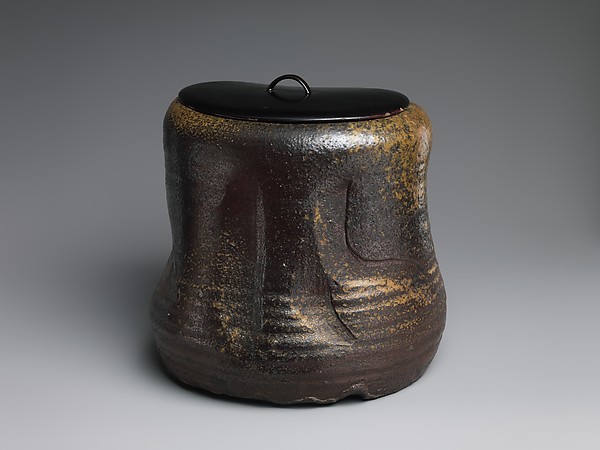
Water pot, ca. 1625, Bizen pottery; lacquer cover. The Metropolitan Museum of Art, Fletcher Fund, 1925, accession 25.215.47a, b.
Look closer: the body is dark and rough, grooved low on the belly, and capped with a smooth black lid. The museum catalogues it as a Water pot, Bizen pottery with a lacquer cover, about 1625, 17.1 cm high and across, from the Fletcher Fund of 1925.
Image: The Metropolitan Museum of Art, Open Access (CC0)
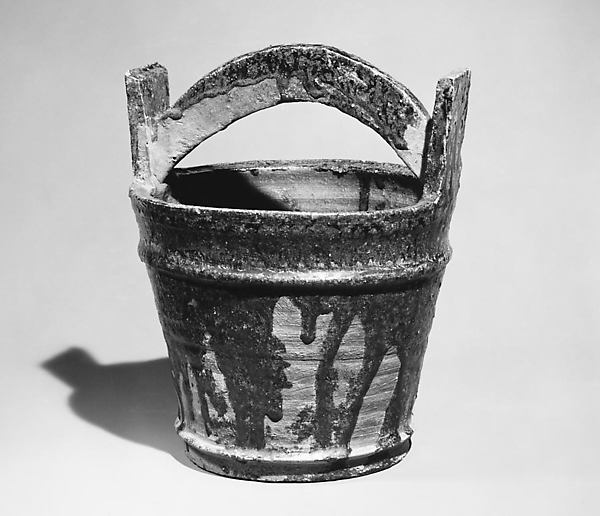
Water Pot for Tea Ceremony (Mizusashi), Stoneware with drip iron glaze (Tanba ware). The Metropolitan Museum of Art, The Harry G. C. Packard Collection of Asian Art, Gift of Harry G. C. Packard, and Purchase, Fletcher, Rogers, Harris Brisbane Dick, and Louis V. Bell Funds, Joseph Pulitzer Bequest, and The Annenberg Fund Inc. Gift, 1975, accession 1975.268.430.
Look closer: a bucket-shaped pot with a high arched handle and pale glaze that drips down dark walls. The museum catalogues it as a Water Pot for Tea Ceremony (Mizusashi), stoneware with drip iron glaze, Tanba ware, 23.5 cm high; the record gives no date.
Image: The Metropolitan Museum of Art, Open Access (CC0)

Chinese-Style Charcoal Basket (Sairō-sumitori) for Sencha Tea Ceremony, mid-19th century, Timber bamboo, dwarf bamboo, and rattan. The Metropolitan Museum of Art, Edward C. Moore Collection, Bequest of Edward C. Moore, 1891, accession 91.1.2081.
Look closer: the lid and sides are plaited in several bands, with a rope-like edge. The museum catalogues it as a Chinese-Style Charcoal Basket (Sairō-sumitori) for Sencha Tea Ceremony, mid-nineteenth century, timber bamboo, dwarf bamboo and rattan, 13.3 cm high and 25.4 across.
Image: The Metropolitan Museum of Art, Open Access (CC0)

Jacket for Tea Ceremony (chabaori), late 18th–mid-19th century, Paper, silk. The Metropolitan Museum of Art, Gift of Sue Cassidy Clark, 2011, accession 2011.434.
Look closer: large panels of green and grey meet across the chest and shoulders like a patchwork. The museum catalogues it as a Jacket for Tea Ceremony (chabaori), paper and silk, late eighteenth to mid-nineteenth century, 102 by 128 cm.
Image: The Metropolitan Museum of Art, Open Access (CC0)
Tea Ware for the Room
Iron kettles, kettle stands and tea-room pieces pass through the house. The concierge desk will say in plain words what each is and what it is not. The atlas of utensils and the glossary of tea utensils are companions to this chapter.
Answered plainly
How big is a tea room?
The most typical size is four and a half tatami mats, about 7.4 square metres. A tea room can be as small as one and three-quarter mats or as large as ten mats or more.
Why do you crawl into a tea room?
The low door, the nijiriguchi, requires bending low to pass through; Wikipedia says it symbolically separates the small, quiet inside from the crowded, overwhelming outside world.
What is the difference between ro and furo?
The ro is a sunken hearth used in the colder months, traditionally November to April; the furo is a portable brazier used in the warmer months, traditionally May to October.
When does the tea year begin?
In November, with Robiraki, the opening of the hearth, and Kuchikiri, the opening of the tea jar. Several tea teachers call it the tea New Year.
What is Kuchikiri?
The opening of the seal of the tea jar, held in November. Leaves chosen and sealed in the jar early in the year are tasted by the guests, and historically were ground on the spot.
What is Nagori?
The Nagori no chaji marks the switch from the summer brazier to the winter hearth in October, according to Kids Web Japan.
What does the host do during the break?
During the nakadachi the host sweeps the room, takes down the scroll, replaces it with a flower arrangement, opens the shutters and prepares to serve tea.
Which tea room is the oldest?
Wikipedia says Taian, built in 1582, is the only extant tea room designed by Sen no Rikyū. A visitor's page says there is no actual proof Rikyū designed it, and the sources are set out in the box above.
Can I visit Taian?
A visitor's page says Taian is usually closed to public visits. Check with Myōki-an before travelling.
Is tea only taken on the floor?
No. The ryūrei style uses a table and chairs, and nodate is tea taken outdoors under a red parasol.
What is kaiseki in tea?
The simple meal served before the tea. The characters mean breast-pocket stone, and are thought to have been adopted by Rikyū for the frugal meal of the austere style of tea.
Where next
Sources and image credits
- Chashitsu, Wikipedia
- Roji, Wikipedia
- Tokonoma, Wikipedia
- Tatami, Wikipedia
- Sukiya-zukuri, Wikipedia
- Kaiseki, Wikipedia
- Irori, Wikipedia
- Japanese tea ceremony, Wikipedia
- Chado, Kids Web Japan
- The World of Chado, Japanese Culture Center
- Kuchikiri Tea Ceremony, gjtea
- Robiraki, winter's first tea, Samovar Tea
- November Seasonal Notes, Issoan Tea
- Tai An Tea House, Mai-ko
- Object record, Tea Ceremony Apparatus, The Metropolitan Museum of Art
- Object record, Double-cut (Nijū-giri) Flower Container (Hanaire), named Cool Summer Morning (Shinryō), The Metropolitan Museum of Art
- Object record, Kettle (Kama) and Brazier (Furo), The Metropolitan Museum of Art
- Object record, Feather Brush (Habōki) for Tea Ceremony, The Metropolitan Museum of Art
- Object record, Table for Tea Ceremony, The Metropolitan Museum of Art
- Object record, Kosode with Pattern of Tea-Ceremony Utensils on a Small Pattern (Komon) of Auspicious Objects, The Metropolitan Museum of Art
- Object record, Water pot, The Metropolitan Museum of Art
- Object record, Water Pot for Tea Ceremony (Mizusashi), The Metropolitan Museum of Art
- Object record, Chinese-Style Charcoal Basket (Sairō-sumitori) for Sencha Tea Ceremony, The Metropolitan Museum of Art
- Object record, Jacket for Tea Ceremony (chabaori), The Metropolitan Museum of Art
Last reviewed 28 October 2026. Pictures, where shown, are public-domain or open-access and credited beneath each one.
Looking for a kettle, a brazier or another piece for the tea room? The concierge desk replies within one to three business days.
Browse tetsubin, chagama and tea ceremony pieces · Make a private request
Private concierge
Looking for something in particular?
Describe the piece or the project you have in mind. A senior advisor in Tokyo reads every case file personally and replies within two business days, with fees set out in writing before any work begins.