
Whisk and Scoop: Tea's Bamboo Pair
Chanoyu Almanac · Chasen, Chashaku, Mei
Whisk and Scoop: Tea's Bamboo Pair
Two slivers of bamboo do the quiet work of the tea room. One is cut into a hundred hair-fine tines and turns powder and hot water into a green foam; the other is a spoon so slender that it can be named like a poem. This chapter follows the whisk from Song China to the workshops of Takayama, takes it apart, counts its tines and teaches its care, and then turns to the scoop, its three ranks, its carvers and the names inscribed on its box.
Fact sheet
At a glance
- One joint of bamboo. A whisk is hand-carved from a single piece of bamboo, its tines split and thinned until the tips are translucent.
- A town of makers. Takayama, in Nara Prefecture, has made whisks since the Muromachi period, and the Kōgei Japan page says each is completely handmade.
- Counted by tines. Thicker, fewer tines knead thick tea; finer, more numerous tines whip thin tea into foam.
- The scoop has ranks. JAANUS gives three: ivory or jointless bamboo, a joint at the handle end, and a joint in the middle.
- A name for every scoop. Tea masters have carved their own scoops and named them, and the name often decides which scoop a host uses.
Two Slivers in the Hand
Before the guest sees the bowl, the host has handled the whisk and the scoop. The Wikipedia article on the tea ceremony says that the host enters the room, ritually cleanses each utensil, including the tea bowl, the whisk and the tea scoop, in a precise order and with prescribed motions, and then places them in an exact arrangement according to the procedure being performed. The preparation of tea is, in this account, a long conversation between the host and a handful of objects, and the two lightest of them are made of bamboo.

Teabowl and Accessories, 18th century, Clay, transparent glaze and thick overglaze in spots; accessories consist of black lacquer tea jar, small cylindrical wooden holder with bamboo tea whisk and jointed bamboo spoon; brocade covers for bowl and tea jar; these form a set for a traveler (Karatsu ware). The Metropolitan Museum of Art, The Howard Mansfield Collection, Gift of Howard Mansfield, 1936, accession 36.120.496a–h.
Look closer: a bowl, a black lacquer caddy and a small cylinder that holds a pale bamboo whisk are laid in a row with a slim bamboo spoon between them, with two brocade covers beside them. The museum catalogues it as Teabowl and Accessories, 18th century, Karatsu ware, clay with transparent glaze and thick overglaze in spots, with a black lacquer tea jar, a small cylindrical wooden holder with a bamboo tea whisk, a jointed bamboo spoon and brocade covers; its record says that these form a set for a traveller.
Image: The Metropolitan Museum of Art, Open Access (CC0)
The whisk, chasen, is the more visible. The Wikipedia article on tea utensils says it is hand-carved from a single piece of bamboo, and that styles differ by the type of bamboo, the shape of the tines, their number, the thickness and length of the bamboo and the colour of the thread that binds the tines. The scoop, chashaku, is the more intimate. The same article says that it transfers powdered tea from the caddy to the bowl, and that tea masters have traditionally carved their own and given them a poetic name, often written on the tube in which the scoop is kept. A host selecting a scoop for a gathering, the article says, chooses largely by its name.
The Metropolitan Museum owns a scoop of the 1580s attributed to Sen no Rikyū, a gift of 2024, and its note says he cut the bamboo for his utensils himself. The Kōgei Japan page on Takayama whisks says the town's whisks hold a top-class share of Japan's tea whisk market and that each is completely handmade.
This chapter takes the whisk first. It traces the tool from Song China, draws its parts in a diagram, counts its tines, follows the eight steps of its making, and looks at the bamboo, the town, the schools' preferences and the care that keeps a whisk alive. It then turns to the scoop: its ranks, its materials, its carvers and its names. The sources are Wikipedia, JAANUS, the Metropolitan Museum of Art, the Kōgei Japan page on Takayama, the Swiss Chado page on the world of chasen, the Ueda Sōko school's essay on scoop names, a general Japanese-English dictionary, and two retailers, Tezumi and a retailer of copies of Rikyū-style scoops, which are named wherever they are used and treated as attributed.
From Song Foam to Takayama
The whisk arrived with the tea. The Wikipedia article on matcha says that powdered tea developed in China before it came to Japan, and that in the Song dynasty, from 960 to 1279, whisks, bowls and other tools first appeared to froth a drink called mo cha, powdered tea, made from steamed and dried leaves. It names two famous Song references, Cai Xiang's Record of Tea of 1049 to 1053 and Emperor Huizong's Treatise on Tea of 1107, and describes the method: the tea is ground, sifted, poured into a bowl, covered with hot water and whisked. The monk Eisai, the article says, brought this Song style to Japan around 1191. Tezumi adds that the early bamboo whisks used for whipping Song tea reached Japan without the division between inner and outer tines.
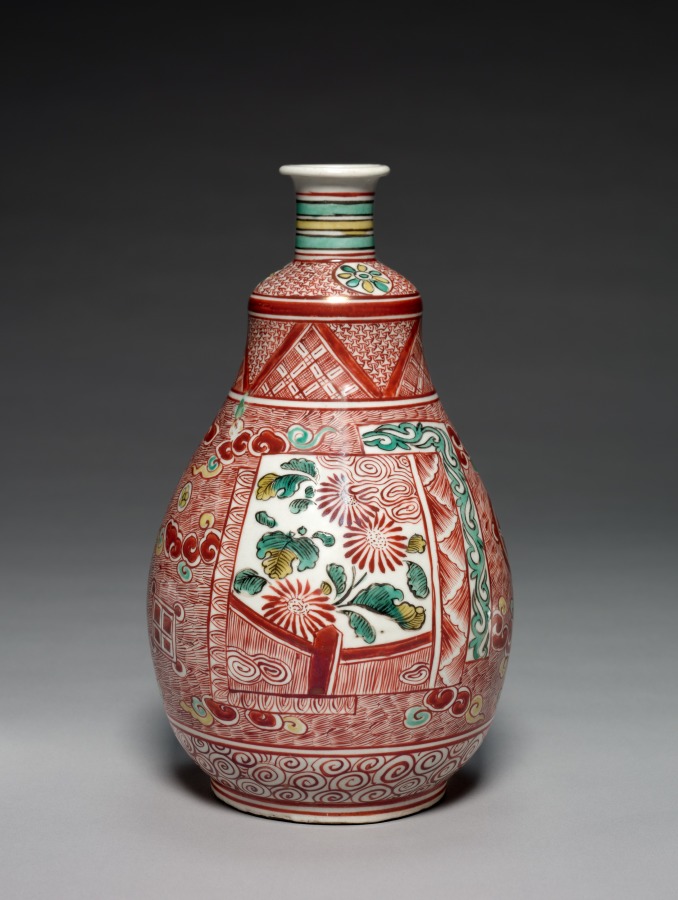
Tea Whisk-Shaped Sake Bottle, 1660s–early 1670s, Porcelain with overglaze enamel (Hizen ware, early iro-e). The Cleveland Museum of Art, Severance and Greta Millikin Purchase Fund, accession 2014.391.
Look closer: a tall, round-shouldered bottle with a narrow neck and a body that swells and tapers, covered in red hatching and panels of flowers in green, blue and yellow. The museum catalogues it as a Tea Whisk-Shaped Sake Bottle, 1660s to early 1670s, Edo period, Hizen ware, early iro-e, porcelain with overglaze enamel, 25.4 cm high, and says it resembles a whisk used to prepare powdered green tea, with the handle at the top and the body of the brush flaring out below.
Image: The Cleveland Museum of Art, Open Access (CC0)
The Kamakura period supplies a small picture. According to the matcha article, guests held tenmoku bowls filled with powdered tea while servants carrying a hot-water pot and a whisk went round, pouring and stirring. The whisk, in that scene, was an implement of service and not yet of ceremony. By the time of the Muromachi period it had a place of manufacture. The Kōgei Japan page on Takayama says that production began in the middle of that period, 1336 to 1573, and that Murata Jukō, known as the founder of the simple tea ceremony, wabi-cha, asked Minbunojō Nyūdō Sōsetsu Takayama to make tea whisks. Murata presented them to Emperor Go-Tsuchimikado, who named them Takaho, so that they became known as Takaho chasen. The page adds that the kanji for taka in the place name was changed to match the kanji in Takaho, and that little is known in detail about this period.
Tezumi tells a shorter version. Takayama, in the north-west of Nara Prefecture, has produced whisks for more than five hundred years, it says, and the first recorded bamboo whisks in Japan date to the middle Muromachi period; the tea master Murata Jukō requested high-quality Takayama whisks, which were later presented to the emperor. Its writer notes that the whisk makers, chasen-shi, include masters who belong to the eighteenth or the twenty-fifth generation of their families. These are the retailer's statements, and the Kōgei Japan page names the maker and the emperor where Tezumi does not.
A second reading of the town's good fortune is practical. The Kōgei Japan page says the local industry succeeded because of good bamboo from the mountains near Takayama and a ready market in nearby Kyoto and Osaka. The World of Chasen page, which names the tea schools that grew from Sen no Rikyū's descendants, Omotesenke, Urasenke and Mushakōjisenke, adds that the whisk varieties were designed to suit each school's purpose and tine count, and that more than a hundred varieties exist today.
What a Whisk Is Made Of
Tezumi names five parts. The handle is the thicker, shorter section left after the bamboo is split, and the tines are the split sections that form the head, inner and outer. The node is a joint in the bamboo, positioned about a third of the way down the piece; the tine tips are the thin, flexible, translucent ends, curled into shape in the making; and the threading is the binding that holds the inner and outer rings in place, usually black and tied in a knot at the front. The World of Chasen page gives Japanese names to a similar set: jiku for the shaft, fushi for the node, karami-ito for the string and hosaki for the tines or teeth, and it adds the chajimi, which it translates as the ear and does not place. The diagram below draws the parts the two sources agree on.
Diagram by Japonista. Schematic; the part names follow Tezumi and the World of Chasen page.
Look closer: the pale block at the top is the handle, and the small ring beneath it is the node. The dark band beneath that is the thread, the pale tines flare outward below it, and a shorter inner group curls inward at the centre; the tips of the outer tines curl inward at the bottom.
Diagram by Japonista
The dimensions are small. The World of Chasen page gives a typical whisk as made from bamboo two to two and a half centimetres thick and nine to twelve centimetres long, harvested traditionally in winter and dried for over a year. Tezumi says the bamboo is cut into pieces of about twelve centimetres, and that it must be dried for at least one to two years before crafting. The Kōgei Japan page says the bamboo is aged one or two years before being cut to size, and that the whisk is made from a tube about ten centimetres long.
The anatomy explains the use. The outer tines are the ones the guest sees; the inner tines, shorter and closer to the centre, lie inside the ring. In the standard shape, Tezumi says, the tines are mostly straight, with a gentle curve near the top and a loop at the tip that relaxes with use, and the same page calls this shape strong for frothing. The shin style, which has a narrow handle and a more gradual curve and no looped tips, is chosen mainly for its appearance, the page says, and its frothing power is no different.
Counting the Tines
A whisk is named by its tines, and the numbers are a source of confusion. Tezumi says the count is a rough estimate, usually of the outer tines alone, and that the real number often differs from the label. Wikipedia says that the kind used for whisking thin tea, usucha, has eighty, a hundred or a hundred and twenty fine tines, typically carved from a flexible but robust bamboo such as Phyllostachys bambusoides, known as madake or kashirodake. The World of Chasen page names two main types, the chūaraho, with a thick and dense ear, for thick tea, and the kazuho, with finer tines and a thin, sparse ear, for thin tea.
The logic is plain and the sources agree on it. Tezumi says more tines means thinner tines and easier foam for thin tea; fewer tines means thicker, sturdier tines suited to thick tea. The coarse styles, the ōaraho and the chūaraho, are for kneading koicha and are poorly suited to usucha, especially the ōaraho, and higher tine counts have a wider diameter. The Wikipedia article on the tea ceremony says koicha is kneaded with the whisk to blend a large amount of powder smoothly with the water, while usucha is whipped. The whisk is cut for the tea.
The table gives the named styles and what the sources say they are for, without their numbers; the numbers are in the box above the table.
| Style | Kanji | What the sources say |
|---|---|---|
| Ōaraho | 大荒穂 | The coarsest of the named styles; Tezumi says it and the chūaraho are for kneading thick tea and poorly suited to thin tea. |
| Chūaraho | 中荒穂 | A medium-coarse style for thick tea; Tezumi and the World of Chasen page both treat it as a thick-tea whisk. |
| Kazuho | 数穂 | Tezumi calls it the standard all-round whisk in Japan; the Kōgei Japan page gives it as the thin-tea whisk. |
| Hachijūpondate | 八十本立 | An eighty-tine style, one of the three counts Wikipedia names for thin tea. |
| Hyakupondate | 百本立 | A hundred-tine style, one of the three counts Wikipedia names for thin tea. |
| Hyakunijūpondate | 百二十本立 | A hundred-and-twenty-tine style, the finest of the three counts Wikipedia names for thin tea. |
Eight Steps from One Joint of Bamboo
Tezumi describes the making in eight steps, using the Japanese names of the craft. The table gives them in its order. The steps are the retailer's description of Takayama practice, and the Kōgei Japan page gives a compatible but not identical sequence: the bamboo cut and aged, the end split by halving it again and again, a second splitting of each base tine into large and small, a softening of the tips in hot water, a shaving and thinning of them, a chamfering of the outer tines, the binding, an adjusting of the inner tines, and a finish.
The fourth step is the one on which the others depend. Tezumi calls aji-kezuri the most delicate and says it takes years to master; it is here that the final centimetre or two of each tine is thinned until it is flexible and translucent. The Kōgei Japan page agrees on its importance, calling the shaving of the tips important to the flavour of the matcha. Takayama whisks, Tezumi says, have finer, thinner, more elastic tips than others, and the skill shows in this step; the same page says the whisks are entirely handmade, without machines or chemicals, from local bamboo grown without fungicides, with the natural irregularities preserved.
The fifth step, the shaving of the corners, has a purpose. Tezumi says it removes rough edges and reduces the sticking of matcha, and the Kōgei Japan page adds that unshaved edges can trap tea and stop bubbles from clearing. These are small and practical reasons, and they describe the whisk as a tool first. The binding too is practical. The Kōgei Japan page says the outer tines are bound twice with thread, usually black, and that the colour changes with the occasion: white for the Sekishū school, yellow for Buddhist memorial services, and red, or red and white, for celebrations.
| Step | Name and kanji | What happens |
|---|---|---|
| 1 | Haratake 原竹 | The bamboo is cut into pieces of roughly twelve centimetres, with the node about a third of the way down; the longer part will become the tines and the shorter part the handle. |
| 2 | Katagi 片木 | The outer skin is shaved from the tine side, the piece is split repeatedly into segments, and the soft inner flesh is removed, leaving the hard outer skin. |
| 3 | Kowari 小割 | Each segment is split again, giving the full number of tines for the style. |
| 4 | Aji-kezuri 味削り | The whisk is soaked in hot water and each tine is tapered from base to tip; the last centimetre or two becomes thin, flexible and translucent, and the tips are curled inward while the bamboo is soft. |
| 5 | Mentori 面取り | The corners of each tine are shaved to remove rough edges and to stop the tea sticking. |
| 6 | Shita-ami and ua-ami 下編・上編 | The tines are threaded into inner and outer rings, two more rows of threading secure them, and the thread is knotted at the front. |
| 7 | Koshinarabe 腰並べ | The tines are splayed and adjusted into their final shape, the inner tines often twisted into a knot. |
| 8 | Shiage 仕上げ | A lead craftsman inspects the whisk for even spacing and an even circle. |
White, Black and Soot
The bamboo itself is chosen with care. Tezumi names three kinds. White bamboo, shiratake, and black bamboo, kurotake, occur naturally, and their colours develop as young green bamboo dries. The third, susudake, is soot-coloured bamboo from the ceilings of traditional Japanese houses, which years of smoke from sunken hearths stain a deep brown over decades or centuries; each piece is unique, and the page says it is becoming rarer and more expensive as traditional houses decline.
The Kōgei Japan page gives the same three in more detail. White bamboo, it says, is the henon type, boiled to remove oil and lye and then bleached naturally in the sun for about a month; black bamboo is henon that darkens with age, with a purplish-brown trunk; and soot-coloured bamboo is taken from old house roofs or ceilings and is stained by smoke over a hundred or two hundred years. The World of Chasen page adds a fourth, aodake, fresh green bamboo cut only in December and used for New Year ceremonies, and advises against ordering it from abroad because its colour fades.
The same page links the colours to the schools. It says the dried white bamboo, which it calls hachiku, is used by Urasenke, soot-coloured bamboo by Omotesenke, and black bamboo by Mushakōjisenke. Tezumi, for its part, says that the straight style associated with Mushakōjisenke is among the oldest and is represented by the Kankyū-an style, and that it is widest and hardest to use and produces little foam, which suits schools that prefer a thin layer. The World of Chasen page adds that dark, smoke-coloured bamboo is scarcer and costs more.
A Valley of Whisk-Makers
Takayama is a town in the city of Ikoma, in Nara Prefecture, and the Kōgei Japan page classifies its whisks under the wood and bamboo crafts of the Kinki region. Tezumi says the highest-quality whisks are still handmade there, and that only about a dozen chasen masters remain. To preserve their traditions, the page says, the masters have begun taking apprentices from outside their families. The same page says about a dozen Takayama families produce nearly all Japanese whisks, and that scarce skilled craftspeople and limited suitable bamboo keep supply small.
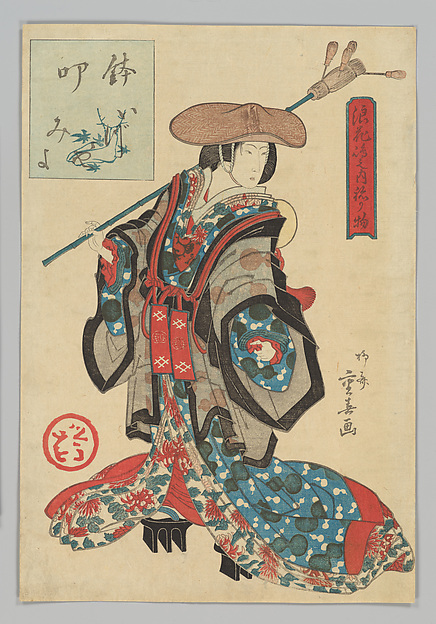
The Courtesan Miyo of the Izutsuya Brothel as a Tea Whisk Vendor, from the series Costume Parade of the Shimanouchi District in Osaka (Naniwa Shimanouchi nerimono, Hachitataki Izutsuya Miyo), 1828, sixth month, Wood-block print (nishiki-e); ink and color on paper. The Metropolitan Museum of Art, Gift of the Pinkowitz family, 2025, accession 2025.796.7.
Look closer: a standing figure in a flat, round hat and a layered robe patterned in red, blue and white carries a long staff over one shoulder, with tufted bundles tied to its end, against a plain ground with a small green cartouche at the top left. The museum catalogues it as The Courtesan Miyo of the Izutsuya Brothel as a Tea Whisk Vendor, 1828, by Ryūsai Shigeharu, from the series Costume Parade of the Shimanouchi District in Osaka; its note says the title's term hachitataki refers to a Buddhist mendicant who went door to door in winter striking a bowl for alms, and that the tea whisk vendor is a playful disguise.
Image: The Metropolitan Museum of Art, Open Access (CC0)
The World of Chasen page remarks that the industry is conservative, so that few artisans reach the required skill. It names, as attributed to its shop, whisks by individual makers made for particular schools: a thick-tined whisk for Urasenke thick tea, a hundred-and-twenty-tine whisk for thin tea described as a favourite of the main Urasenke tea house, a shin whisk described as easy to use and durable, a soot-bamboo shin whisk used mainly by Omotesenke for tea offerings with tenmoku bowls, and a black-bamboo straight whisk for Mushakōjisenke. These are the retailer's descriptions, and they are quoted for what they show, namely that the houses of tea name their preferences as they name their bowls.
The market has changed recently. Tezumi says that the 2025 matcha boom sharply increased demand, making Takayama whisks scarcer and more expensive, and that retailers are often sold out while artisans prepare new batches. It also notes that some retailers now offer higher-quality whisks made in China by craftsmen trained in Takayama; it calls these better than other Chinese whisks but not as finely made as Takayama versions. The World of Chasen page warns that cheap imported whisks may contain preservatives or anti-mould agents unsafe in hot water, and says that Japanese whisk bamboo is dried for over a year without them. The claim is the page's and is given as such.
Straight, Shin and School Styles
Tezumi describes three main shapes. The standard whisk has mostly straight tines with a gentle curve near the top and a loop at the tip, the loop relaxing with use. The shin has a narrow handle and a more gradual curve, popular, the page says, with the Urasenke and Omotesenke schools. The straight whisk, one of the oldest styles, is preferred by Mushakōjisenke, with the Kankyū-an style as its example; it is wider and harder to use, best suited to wide-based bowls, and produces little foam, which suits schools that prefer a thin layer.
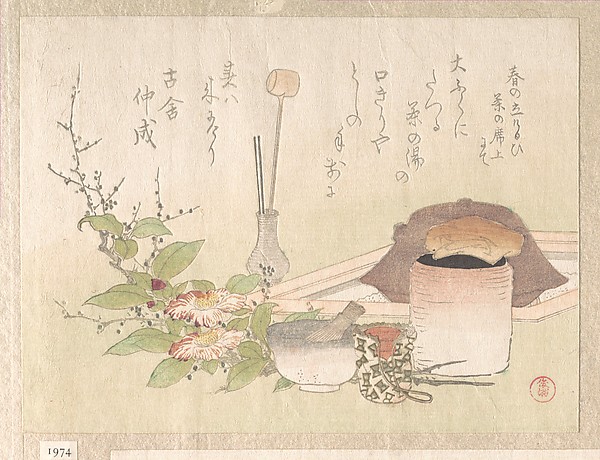
Set of Utensils for the Tea Ceremony, 1810s, Woodblock print (surimono); ink and color on paper. The Metropolitan Museum of Art, H. O. Havemeyer Collection, Bequest of Mrs. H. O. Havemeyer, 1929, accession JP1974.
Look closer: a pale, softly coloured still life: a flowering branch rises at the left, a cylindrical vessel stands at the centre with a small pot and a bowl in front, and a lacquered stand and a patterned pouch rest at the right, with poem text in the corner. The museum catalogues it as Set of Utensils for the Tea Ceremony, 1810s, a surimono by Kubo Shunman, woodblock print, ink and colour on paper; its note says it shows items prepared for a New Year's gathering with a camellia branch and carries a comic poem that puns on tea terms.
Image: The Metropolitan Museum of Art, Open Access (CC0)
It adds a catalogue of other styles. The tenmoku-date is long-handled, for tenmoku bowls; there is a bottom-noded style used by the Yūraku school, a shorter style used by the Yabunouchi school, and angular designs used by the Enshū school. The page notes a foaming whisk by a twenty-fifth-generation artisan that has kazuho tines but a longer handle to speed the foam. The Wikipedia article on tea utensils says the same thing in a different register: different schools prefer different styles for thin tea, thick tea, tea offerings in tenmoku bowls, tea in tall cylindrical bowls, a portable boxed set, outdoor tea-making, New Year and other auspicious occasions.
The article also names the styles by their famous patrons. There is a Rikyū model, the Rikyū-gata, and a style attributed to Rikyū's son Dōan, called the Dōan-gonomi, and other styles favoured, konomi, by famous tea masters, so that, the article says, the styles have continued to increase. The World of Chasen page adds the special whisks it knows of: the tenmoku type, the nodate whisk, smaller, for outdoor gatherings, the chabako whisk, small and thin, for the tea set in a box, and the kotobuki whisk, with red and white string, for celebrations such as New Year. It also names a hana-chasen, with three rows of tines, which cannot sit on a whisk stand and whose irregular shape, the page says, is considered unsuitable for the Way of Tea.
For the reader of an object description the point is a practical one. A whisk is not a generic accessory. It is chosen for the tea, the bowl, the school and the occasion, and a description that does not say which of these it was made for has told the buyer very little.
Green Bamboo and Red Thread
Occasion changes the whisk. The Kōgei Japan page says the thread that binds the tines is usually black, but that the Sekishū school uses white, that yellow is used for Buddhist memorial services, and that red, or red and white, is used for celebrations. The World of Chasen page says the kotobuki whisk, with red and white or other coloured string, is made for occasions such as New Year, and that fresh green bamboo, aodake, cut only in December, is used for New Year ceremonies, and the page advises against ordering it from abroad because its colour fades.
The Kōgei Japan page records a quite different use for the whisk, in regional tea. It says that somewhat larger whisks are used for buku-buku cha, the frothy tea of Okinawa, and for bote-bote cha, the soup-like tea of Matsue. The bamboo whisk is thus a tool of ordinary drinking as well as of the tea ceremony, and the same instrument reappears, enlarged, in those two regional teas.
An Osaka print in the Metropolitan Museum gives a glimpse of the whisk in popular play. It shows a courtesan of the Izutsuya house, in the costume parade of the Shimanouchi district in 1828, dressed as a hachitataki, a mendicant who in winter went from door to door striking a bowl for alms; the museum's note calls the costume a playful disguise and says she is shown as a tea whisk vendor. The note does not say whether the historical mendicants sold whisks, and this chapter does not claim it. What the print shows is that a whisk could be made into a costume in the Osaka of 1828.
Moisten, Rinse, Dry Upright
A whisk is a consumable, but a long-lived one with proper care. Tezumi says that practitioners traditionally treat whisks as consumables, and that with care they can last many years. Its advice is consistent and short. Dip the whisk in warm or hot water for a few seconds before use, because bamboo is about twenty per cent stronger when wet, and soaking for minutes is unnecessary. Whisk gently, avoiding heavy pressure against the bowl, especially a rough-glazed one. Rinse immediately after use, with fingers or a cloth, and avoid soap, which can damage the porous bamboo. Stand the whisk upright to dry so that the tines are free of pressure.

Tea Ceremony Apparatus, Album leaf; lacquer on gold paper. The Metropolitan Museum of Art, The Howard Mansfield Collection, Purchase, Rogers Fund, 1936, accession 36.100.120.
Look closer: a small gold-leaf panel carries a brown kettle on a low black base with a red lid beside it and a dark bowl at the right, with a long thin handle laid across the kettle, all in soft, matt lacquer. The museum catalogues it as Tea Ceremony Apparatus, an album leaf in lacquer on gold paper, by Shibata Zeshin, 12.1 by 8.9 cm, from the Howard Mansfield Collection.
Image: The Metropolitan Museum of Art, Open Access (CC0)
The World of Chasen page differs on one point and agrees on others. It advises soaking for about thirty minutes before each use, if possible, to make the whisk more elastic and less likely to break, and it also says to keep the whisk upright, including during a ceremony, since resting it on its tines may damage them. After use, rinse with water and air dry completely to prevent mould; use a stand to dry and reshape the tines; and store in a cool, ventilated place. Tezumi adds that very dry air can crack the bamboo, and that a new whisk may fray or splinter depending partly on humidity, with loose pieces usually coming off easily when soaked in hot water.
The stand has its own name and a place. The Wikipedia article on tea utensils says that the kusenaoshi is a shaper for bamboo whisks, made of wood or ceramic, on which a wet whisk is placed and allowed to dry, restoring its shape. It is used in the mizuya, the back room, and is not seen in the tea room. Tezumi gives an important qualification: press the shaper gently but firmly into the wet tines to splay them and then let the whisk dry normally, and do not leave the whisk on the stand to dry, since poor airflow slows drying and promotes mould, and constant stress can weaken the bamboo. The two sources thus give nearly opposite instructions about leaving a whisk on the stand, and the chapter reports both.
Whisk in Motion
The Wikipedia article on the tea ceremony describes the whisk's two jobs. For koicha, the article says, the powder and hot water are kneaded with the whisk to blend the large amount of tea smoothly; for usucha, the matcha and hot water are whipped. The first is a slow stirring and the second a fast one, and the whisks are cut for the difference. After the tea is made, the host cleans the utensils to put them away, and the guest of honour may ask to examine some of them.
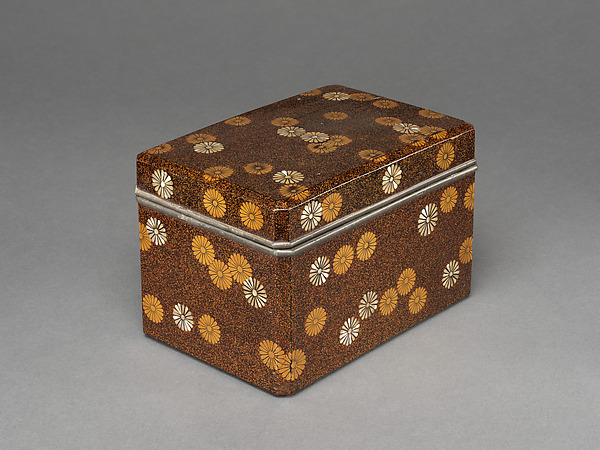
Tea utensil box (chabako), 17th century, Mother-of-pearl and makie. The Metropolitan Museum of Art, Gift of Florence and Herbert Irving, 2019, accession 2019.193.34a, b.
Look closer: a squat, lidded box rests on a grey ground, its dark gold surface scattered with round white and gold chrysanthemum flowers and edged with a pale band where lid meets base. The museum catalogues it as a Tea utensil box (chabako), 17th century, mother-of-pearl and makie, 21 cm high and 23 cm wide, a gift of Florence and Herbert Irving, 2019.
Image: The Metropolitan Museum of Art, Open Access (CC0)
The simplest procedure is the first the student learns. The article says the obon temae, the tray procedure, places the bowl, whisk, scoop, chakin and caddy on a tray, with the hot water prepared in a kettle on a brazier; it can be done at a table, or outdoors with a thermos pot and a portable hearth. In the chabako procedure the equipment is removed from a special box, and the basic contents are the bowl, the whisk, kept in a special container, the scoop, the caddy, a linen wiping cloth in its container and a container for small sweets; the gathering takes about thirty-five to forty minutes. The Metropolitan Museum's Karatsu travelling set, of the eighteenth century, puts the same family of objects on a small scale, with a bowl, a lacquer jar, a small cylindrical wooden holder with a bamboo whisk and a jointed bamboo spoon.
Among the first things new students learn, the article says, is how to ritually clean the tea equipment and how to wash and fold the chakin. Once they have mastered the basics, students are taught to prepare the powdered tea, fill the caddy, and finally measure the tea and the water and whisk it to the proper consistency. The TKG Japanese-English Learner's Dictionary, a general dictionary, says that thin tea takes about one and a half to two scoops of matcha per bowl and thick tea about three scoops per guest; the figures are the dictionary's and are given as such.
The Slender Scoop
The scoop is a small thing with a long history. JAANUS defines the chashaku as a spoon-like utensil, literally tea scoop, used to move powdered tea from the tea container into the guest's bowl. It says the utensil began as an ivory medicine spoon, and that after the middle of the seventeenth century tea masters preferred bamboo, although mulberry wood, tortoiseshell and silver have also been used. The Wikipedia article on tea utensils agrees that the original scoops imported from China were ivory, and that scoops are now typically made of a narrow, thin piece of bamboo, although there are also those made of wood or ivory.
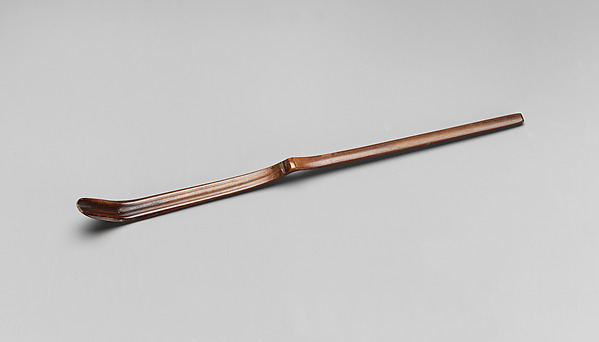
Tea Scoop (Chashaku), 1580s, Bent and carved bamboo. The Metropolitan Museum of Art, Gift of Peggy and Richard M. Danziger, 2024, accession 2024.553.23.
Look closer: a single narrow strip of bamboo, golden-brown and slightly glossy, with a small raised joint a little beyond the middle and a gently curled scoop at its left end. The museum catalogues it as a Tea Scoop (Chashaku), 1580s, Momoyama period, bent and carved bamboo, attributed to Sen no Rikyū, 17.9 cm long, a gift of Peggy and Richard M. Danziger, 2024.
Image: The Metropolitan Museum of Art, Open Access (CC0)
JAANUS describes the form. The scoop end is bent and rounded, and the piece is carved along the vertical grain of the bamboo, thinned towards the handle and cut straight at the bottom edge; the entry calls it a miniature work of art and names its parts: the tip, the paddle tip, the groove, the bend, the joint with its upper and lower parts, the scraped-out back of the joint, the handle and the end of the scoop. It adds that a bamboo tube-like case, the oritame, stores the scoop and often carries a name. The Metropolitan Museum's note on its scoop of the 1580s says it is carved from a single narrow piece of bamboo and that its raised, rounded end was used to move powdered green tea from the caddy to the bowl.
The size is small and the sources give it differently. The Wikipedia article says scoops are generally about eighteen centimetres in length; JAANUS gives an average length of about nineteen to twenty-one and a half centimetres and a width of about one centimetre; the Metropolitan Museum's attributed Rikyū scoop is seventeen point nine centimetres, and the scoop named Imogase by Sen Sōtan is seventeen and a half. The reader should treat all of these as ranges.
A word on ivory is necessary. The Wikipedia article says ivory has historically been valued in tea utensils, particularly for scoops and for the lids of caddies, and that in the hierarchy of utensils ivory scoops are often classified as shin, formal, the highest rank, distinguishing them from the bamboo scoops associated with wabi taste. It adds that the continued domestic trade in ivory for traditional arts has faced scrutiny: it names the Environmental Investigation Agency and TRAFFIC as reporting that Japan's domestic market lacks rigorous traceability for cut ivory pieces, and says that critics argue the demand for high-status ivory implements undermines efforts to combat elephant poaching. The article gives this as the view of those groups and of critics. The concierge desk will say what the record shows about the material of a scoop and about its provenance.
| Source | Length given for a scoop |
|---|---|
| Wikipedia, Japanese tea utensils | Generally about 18 centimetres |
| JAANUS, Chashaku | An average of about 19 to 21.5 centimetres |
| The Metropolitan Museum of Art, attributed to Sen no Rikyū | 17.9 centimetres |
| The Metropolitan Museum of Art, Imogase by Sen Sōtan | 17.5 centimetres |
Three Levels of a Scoop
JAANUS gives the scoop the same three levels of formality that run through the tea room. The formal scoop is of ivory or of smooth bamboo with no joint. The semi-formal is of mulberry or of bamboo with a joint at the handle end. The informal is of bamboo with a joint in or near the middle, which the entry calls the most common type and says was probably created by Sen no Rikyū. The diagram draws the three with the joint marked.
Diagram by Japonista. Schematic; the three levels follow JAANUS.
Look closer: three narrow strips lie one above another, each with a rounded, curled scoop at the left. The top strip is smooth and pale, the middle one has a small joint at its right end, and the bottom one has a joint about halfway along.
Diagram by Japonista
The Wikipedia article on Sen no Rikyū says that he developed many tea utensils, among them bamboo flower containers, tea scoops and lid rests, and used everyday objects in new ways. The TKG dictionary says he popularised the bamboo scoop, which it calls the standard utensil today. The Metropolitan Museum says he favoured modest, rustic simplicity, which helped establish the simpler wabi style, and that he cut the bamboo for his utensils himself. The sources therefore agree that Rikyū belongs to the story of the bamboo scoop, though they do not agree on the exact claim: popularised, developed, probably created the informal type, or, in the museum's phrasing, made a scoop that is attributed to him.
The Ueda Sōko school's essay on scoop names adds a detail about the end of the scoop. It says the node at the end is in what it calls Jōō's favoured style, and that the scooping end opens up wide and deep. The page does not say more of Jōō, and the chapter claims nothing more.
The Poem on the Tube
A scoop is named. The Wikipedia article says tea masters have traditionally carved their own bamboo scoops, giving them a bamboo storage tube, the tsutsu, and a poetic name, the mei, often inscribed on the tube, and that the selection of the scoop for a gathering depends largely on that name. The Ueda Sōko school's essay on poetic names says that naming works of art with a mei has existed in Japan since the Heian period, 794 to 1185, and gives five approaches to the naming.
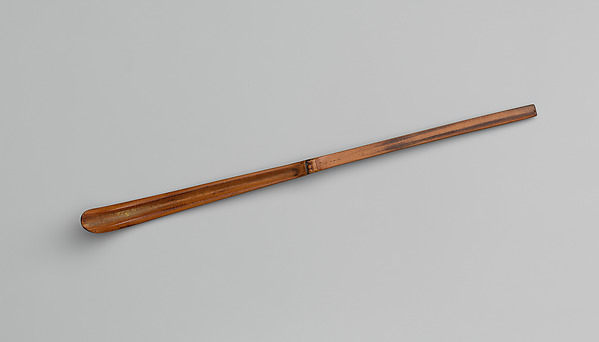
Chashaku, named "Imogase", first half 17th century, Bamboo. The Metropolitan Museum of Art, Gift of Peggy and Richard M. Danziger, 2024, accession 2024.553.11a, b.
Look closer: a narrow strip of bamboo, slightly darker and redder than a plain pale reed, with a gentle curve at the scoop end and a small joint close to the middle. The museum catalogues it as a Chashaku, named Imogase, first half of the 17th century, bamboo, by Sen Sōtan, 17.5 cm long, a gift of Peggy and Richard M. Danziger, 2024.
Image: The Metropolitan Museum of Art, Open Access (CC0)
The first is metaphorical: the name alludes to the object's form, and the essay's example is a scoop called the Nomad's Flute, for its node, its pores and its wide scooping end. The second is historical, poeticising the object's origin. The third is seasonal, capturing the season of crafting, as with a scoop called Ghostly Winter Wood, carved from a twig of a fallen winter branch. The fourth is playful, using wit or punning, as with scoops called praying mantis and green caterpillar, named for their look and for the personalities of their carvers. The fifth uses a whole poem, the utamei, and the essay credits Kobori Enshū as the first to do so, with a scoop that had a single hole, which reminded him of one star seen through a break in the clouds before the summer rains.
The names are drawn from waka, haiku and collections. The essay mentions the Manyōshū, compiled around 759 to 800, the Kokinshū, 890 to 920, and the Shinkokinshū, around 1439, and says that the Zen words list is usually of a heavier register and is often used in koicha, with a lighter, seasonal word for usucha. The dates are the essay's. The Wikipedia article says that the choice of scoop for a gathering largely depends on its name, and the TKG dictionary says the name is chosen to suit the season or the theme of the gathering.
The Metropolitan Museum has a scoop named Imogase by Sen Sōtan, of the first half of the seventeenth century, in bamboo, 17.5 centimetres long, a gift of 2024; the museum's record gives the name and the maker and the chapter does not go further.
Scoops with a Story
The Ueda Sōko school's essay tells the story of a scoop named Teki-gakure, Waiting for the Enemy. It says Ueda Sōko made it in the first year of the Genwa period, as the page spells it, 1615, and that during the Battle of Kashii he refused to withdraw and, while waiting, carved two scoops with his small sword from fine bamboo he found in a grove. The page gives the story as the origin of the name, and the chapter reports it as the school's account.
A second story is told by a retailer of scoop copies, and the chapter takes it with the reserve it deserves. The retail page says that when Rikyū was ordered to commit ritual suicide, he left three scoops he had made himself, one of them the Namida scoop, the scoop of tears; that it was left to his first disciple, Furuta Oribe, who kept it in a black holder with a small prayer window as a keepsake until his death; and that after Oribe it was held for a long time by the Tokugawa government. The page does not say where the original is now, gives no evidence for the claims, and sells a replica made by a living Kyoto bamboo artist. The story is told because it is told in the tea world, and it is not endorsed.
The third is the story of the Takayama whisk, in the version the Kōgei Japan page gives, of a founder of the wabi tea asking a maker in a mountain town for whisks and of an emperor naming them. It is told above with its own reservations. The fourth is a joke. The Osaka print of the whisk vendor, in which a courtesan dresses as a mendicant who sells tea whisks, shows how well known the humble tool had become by 1828.
The stories have something in common. They tell of a bamboo object which, by its association with a maker, a name or an owner, acquires a history. A bamboo spoon becomes a thing worth recording because someone wrote down who carved it, under what circumstances and what it was called.
Cloth, Case and Care of the Scoop
The scoop is cleansed with a cloth. The Wikipedia article on tea utensils says the fukusa, a double-layer silk cloth about thirty centimetres square, is used for the symbolic cleansing of the tea scoop and the caddy; the host and assistants wear it tucked into the obi. By tradition the host of a formal tea ceremony uses a new, previously unused fukusa, and the colours differ for men, usually purple, and women, orange or red. The size and way of making fukusa were purportedly established by Sen Sōon, Rikyū's second wife, according to the article.

Tea Scoop (chashaku), probably early 17th century, Wood. The Metropolitan Museum of Art, Fletcher Fund, 1925, accession 25.215.51.
Look closer: the photograph, from the museum's older record, shows a thin pale scoop with a curled end standing on its own next to a taller, dark, slightly faceted case, with a ruler and the museum's name along the bottom edge. The museum catalogues it as a Tea Scoop (chashaku), probably early 17th century, wood, attributed to Sen no Rikyū, 17.8 cm long, Fletcher Fund, 1925; the record lists only the scoop.
Image: The Metropolitan Museum of Art, Open Access (CC0)
The scoop's case is a utensil in its own right. The article says tea masters carve a bamboo storage tube, the tsutsu, for the scoop they carve, and JAANUS calls the case the oritame. The tube is where the mei is usually inscribed, which is why the case matters to the history of the scoop. The article on tea utensils says more generally that valuable tea utensils are usually stored in purpose-made wooden boxes, sometimes in several layers, and that the boxes of particularly old and distinguished objects often carry inscriptions that validate their history and provenance. The boxes are not equipment in themselves but, the article says, hold importance in the practice of chanoyu.
At the end of the gathering the guest of honour may ask to see the scoop. The article on the tea ceremony says the guest of honour requests that the host allow the guests to examine some of the utensils, and each guest in turn examines each item, including the caddy and the tea scoop, to show respect and admiration for the host; the items are treated with extreme care, since they may be priceless handmade antiques, and guests often use a special brocaded cloth to handle them.
What to Ask of Whisk and Scoop
The questions that follow from the sources are short. For a whisk: for which tea was it made, thick or thin; what is the style, standard, shin or straight, and for which school; of what bamboo, white, black, soot-coloured or green; and where was it made. A Takayama whisk, according to the retailer sources, is handmade from local bamboo; a whisk without a place has told the reader nothing about the maker. The condition is as important. A whisk is a consumable, and an old one that has been used should be asked about before it is used again; that is the chapter's advice and not a source's.
For a scoop, the questions are different. What is it made of, and is that material one the house can describe: bamboo, wood or ivory? At which level of formality does it stand, as JAANUS gives the levels? Where is the joint? Is there a mei, and is it inscribed on the tube, which the sources say is the usual place? Who carved it, and what does the record say of the attribution? The Metropolitan Museum's wording, attributed to Sen no Rikyū, is a model of how to describe a scoop that is said to be by a famous hand without claiming it is.
The third question is the one the sources raise most often. Where a dealer, a retailer or a catalogue attributes a scoop to a famous maker, the claim should be read as attributed until the record shows its basis. The pottery almanac's chapter on made in Japan and collected in Japan sets out the vocabulary of attribution and style that applies to scoops as to bowls, and its chapter on marks, seals and signatures explains the stamps and inscriptions that accompany the other utensils.
The last question is of provenance. For ivory, the question is explicit in the Wikipedia article, which says that the traceability of cut ivory in Japan's domestic market has been criticised. The concierge desk will say in plain words what an object is, what its record shows and what it does not.
Fun Facts
- A whisk is hand-carved from a single piece of bamboo, according to the Wikipedia article on tea utensils.
- The Kōgei Japan page says each Takayama whisk is completely handmade and that more than sixty types are made.
- Bamboo is about twenty per cent stronger when wet, Tezumi says, which is why a whisk is moistened before use.
- The kusenaoshi, the whisk shaper, is used in the preparation room and is not seen in the tea room, according to Wikipedia.
- JAANUS says the scoop was originally an ivory medicine spoon.
- The Wikipedia article says that ivory scoops are often classified as shin, the highest rank.
- The Metropolitan Museum says Sen no Rikyū cut the bamboo for his utensils himself.
- A Matsue tea called bote-bote and an Okinawan tea called buku-buku are both whisked with larger whisks, the Kōgei Japan page says.
- A scoop named for a praying mantis and another for a green caterpillar are named, the Ueda Sōko essay says, for their look and for the personalities of their carvers.
- Kobori Enshū is credited in the Ueda Sōko essay as the first to name a scoop with a whole poem.
A Timeline of Whisk and Scoop
Dates are given as the sources give them, with the source named. Where an event is only an account, it is marked as such.
| Date | Event | Source |
|---|---|---|
| 960 to 1279 | Whisks and bowls first appear in China to froth the powdered tea called mo cha. | Wikipedia, Matcha |
| About 1191 | The monk Eisai is credited with bringing the Song style of whisked tea to Japan. | Wikipedia, Matcha |
| Kamakura period | Servants carrying a hot-water pot and a whisk circulate among guests who hold bowls of powdered tea. | Wikipedia, Matcha |
| Middle Muromachi period, 1336 to 1573 | Production of whisks begins at Takayama in Nara; the founder of wabi-cha, Murata Jukō, is said to have asked for them. | Kōgei Japan; Tezumi |
| 1522 to 1591 | Life of Sen no Rikyū, who developed tea scoops among other utensils. | Wikipedia, Sen no Rikyū; The Metropolitan Museum of Art |
| 1580s | A bamboo scoop in the Metropolitan Museum is dated to this decade and attributed to Sen no Rikyū. | The Metropolitan Museum of Art |
| 1615 | Ueda Sōko, the page says, carves two scoops from bamboo he found in a grove at the Battle of Kashii, naming one Teki-gakure. | Ueda Sōko Ryū (attributed) |
| First half of the 17th century | Sen Sōtan makes a scoop named Imogase, now in the Metropolitan Museum. | The Metropolitan Museum of Art |
| After the middle of the 17th century | Tea masters come to prefer bamboo to ivory for the scoop. | JAANUS, Chashaku |
| 18th century | A Karatsu travelling set includes a bamboo whisk and a jointed bamboo spoon. | The Metropolitan Museum of Art |
| 1828 | An Osaka print shows a courtesan dressed as a tea whisk vendor. | The Metropolitan Museum of Art |
| Today | About a dozen Takayama families are said to make nearly all Japanese whisks. | Tezumi (attributed) |
A Glossary of Whisk and Scoop
The words of the chapter, with the sense the sources give them.
| Term | Meaning |
|---|---|
| Chasen | 茶筅. The bamboo whisk; written 茶筌 at Takayama, according to two of the sources. |
| Chashaku | 茶杓. The tea scoop that moves powdered tea from the caddy to the bowl. |
| Chasen-shi | 茶筅師. A whisk maker. |
| Takayama | 高山. The town in Ikoma, Nara, where the whisks are made. |
| Jiku | 軸. The shaft or handle of the whisk. |
| Fushi | 節. The node, the joint of the bamboo. |
| Karami-ito | 絡み糸. The thread that binds the tines. |
| Hosaki | 穂先. The tine ends, glossed by the Kōgei Japan page as the tines or teeth. |
| Kazuho | 数穂. The all-round or thin-tea whisk. |
| Araho | 荒穂. A coarse-tined whisk for thick tea. |
| Shin | 真. A formal whisk with a narrow handle and a gradual curve; also the highest level of formality. |
| Susudake | 煤竹. Smoke-stained bamboo from old house roofs or ceilings. |
| Shiratake | 白竹. White bamboo. |
| Kurotake | 黒竹. Black bamboo. |
| Aodake | 青竹. Fresh green bamboo, cut in December for the New Year. |
| Kusenaoshi | The shaper on which a wet whisk is dried to restore its form. |
| Mizuya | 水屋. The preparation room behind the tea room. |
| Usucha | 薄茶. Thin tea. |
| Koicha | 濃茶. Thick tea. |
| Mei | 銘. The poetic name of a scoop. |
| Tsutsu | 筒. The tube in which a scoop is kept. |
| Oritame | The bamboo tube-like case for the scoop, in JAANUS. |
| Utamei | 歌銘. A scoop name taken from a whole poem. |
| Fukusa | 帛紗. The silk cloth with which the host symbolically cleanses the scoop and caddy. |
| Chabako | 茶箱. The portable box that holds bowl, whisk, scoop and caddy. |
| Konomi | 好. A style favoured by a famous tea master. |
| Tenmoku-date | A long-handled whisk for tenmoku bowls. |
More Bamboo to Look At

Case (Inrō) with Design of Objects for Tea Ceremony, 18th century, Lacquer, roiro, gold and brown hiramakie, wood, raden, various inlay; Interior: roiro and fundame. The Metropolitan Museum of Art, H. O. Havemeyer Collection, Bequest of Mrs. H. O. Havemeyer, 1929, accession 29.100.776.
Look closer: the four-tiered case, shown front and back, is black with gleaming mother-of-pearl and gold inlays of tea-room objects: a kettle on a stand, a small round fan-like object and a long pale strip laid across the back. The museum catalogues it as a Case (Inrō) with Design of Objects for Tea Ceremony, 18th century, lacquer with gold and brown hiramakie, wood, raden and various inlay, 7.3 by 6.7 by 2.5 cm, H. O. Havemeyer Collection.
Image: The Metropolitan Museum of Art, Open Access (CC0)
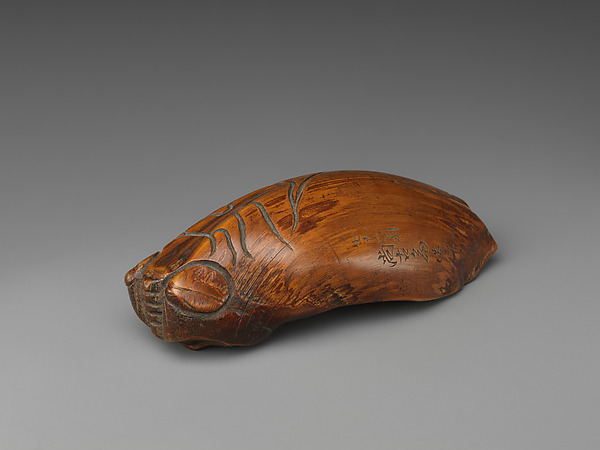
Tea Scoop (Chagō) in the Shape of a Cicada, 1891, Bamboo. The Metropolitan Museum of Art, Purchase, Diane and Arthur Abbey Gift, 2022, accession 2022.12.
Look closer: a squat, glossy brown piece of bamboo is carved into a cicada, its head at the left and its wings marked with fine lines. The museum catalogues it as a Tea Scoop (Chagō) in the Shape of a Cicada, 1891, bamboo, 3.8 cm high and 5.1 cm wide.
Image: The Metropolitan Museum of Art, Open Access (CC0)

Tea Utensils, second half 19th century, Ivory. The Metropolitan Museum of Art, Gift of Mrs. Russell Sage, 1910, accession 10.211.95.
Look closer: a tiny group is carved in pale ivory, a lidded pot with a spout, a pile of logs or boxes and a roll of tools, pressed together into a single compact form. The museum catalogues it as Tea Utensils, second half of the 19th century, ivory, a netsuke 2.2 cm high, a gift of Mrs. Russell Sage, 1910.
Image: The Metropolitan Museum of Art, Open Access (CC0)
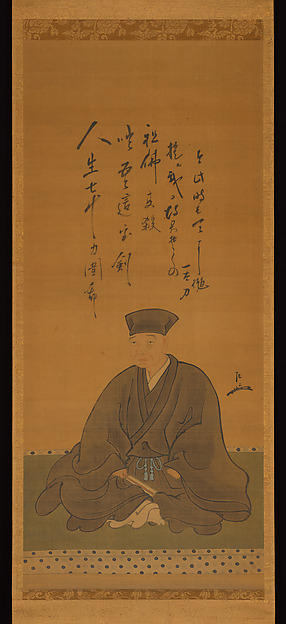
Portrait of Sen no Rikyū with his Death Poem, early 17th century, Hanging scroll; ink and color on silk. The Metropolitan Museum of Art, Mary and Cheney Cowles Collection, Gift of Mary and Cheney Cowles, 2020, accession 2020.396.20.
Look closer: a seated figure in dark robes and a black cap at the foot of a tall gold-brown silk scroll, with lines of calligraphy rising above him. The museum catalogues it as a Portrait of Sen no Rikyū with his Death Poem, early 17th century, hanging scroll, ink and colour on silk, by an unidentified artist.
Image: The Metropolitan Museum of Art, Open Access (CC0)
Whisks, Scoops and Tea-Room Ware
Whisks, scoops, caddies, kettles and bowls pass through the house with the rest of the tea room. The concierge desk will say in plain words what each is made of, who made it where the record says so, whether it has been used or repaired, and what the record does and does not show. The atlas of utensils and the glossary of tea utensils are companions to this chapter.
Answered plainly
What is a chasen?
A bamboo whisk used to prepare matcha. Wikipedia says it is hand-carved from a single piece of bamboo.
What is a chashaku?
The tea scoop, which transfers powdered tea from the caddy to the bowl. JAANUS says it began as an ivory medicine spoon.
Where are tea whisks made?
Takayama, in Ikoma, Nara Prefecture, is the town the Kōgei Japan page and Tezumi name, with whisks made there since the Muromachi period.
How many tines does a whisk have?
The sources give different numbers, and the chapter gives them as each source's own; Wikipedia says whisks for thin tea have eighty, a hundred or a hundred and twenty.
Why do thick-tea whisks have fewer tines?
Tezumi says fewer, thicker tines are sturdier and suit kneading thick tea, while more numerous, thinner tines make foam for thin tea more easily.
How should a tea whisk be cleaned?
Both Tezumi and the World of Chasen page say to rinse it in water after use and to dry it upright; Tezumi advises against soap.
What is a kusenaoshi?
A wood or ceramic shaper on which a wet whisk dries and regains its form. Wikipedia says it is used in the preparation room and is not seen in the tea room.
What are the three kinds of tea scoop?
JAANUS gives formal, of ivory or jointless bamboo; semi-formal, of mulberry or bamboo with a joint at the handle end; and informal, of bamboo with a joint in or near the middle.
Did Sen no Rikyū make tea scoops?
The Metropolitan Museum catalogues a scoop of the 1580s as attributed to him and says he cut the bamboo for his utensils himself; the sources describe his part differently, as the chapter shows.
What is a mei?
A poetic name given to a scoop, often inscribed on its tube, and the sources say the choice of scoop for a gathering largely depends on it.
Is ivory used for tea scoops?
Wikipedia says ivory has historically been valued for scoops and ranked as formal, and that the traceability of Japan's domestic ivory trade has been criticised.
Where next
Sources and image credits
- Japanese tea utensils, Wikipedia
- Japanese tea ceremony, Wikipedia
- Matcha, Wikipedia
- Sen no Rikyū, Wikipedia
- Chashaku, JAANUS
- A Guide to Chasen, Tezumi
- Takayama chasen, Kōgei Japan
- The World of Chasen, Swiss Chado
- Poetic Names for Tea Scoops, Ueda Sōko Ryū
- Chashaku, TKG Japanese-English Learner's Dictionary
- Namida Chashaku Utsushi, Rikyucha (retail page, attributed)
- Object record, Teabowl and Accessories, The Metropolitan Museum of Art
- Object record, Tea Whisk-Shaped Sake Bottle, The Cleveland Museum of Art
- Object record, The Courtesan Miyo of the Izutsuya Brothel as a Tea Whisk Vendor, from the series Costume Parade of the Shimanouchi District in Osaka (Naniwa Shimanouchi nerimono, Hachitataki Izutsuya Miyo), The Metropolitan Museum of Art
- Object record, Set of Utensils for the Tea Ceremony, The Metropolitan Museum of Art
- Object record, Tea Ceremony Apparatus, The Metropolitan Museum of Art
- Object record, Tea utensil box (chabako), The Metropolitan Museum of Art
- Object record, Tea Scoop (Chashaku), The Metropolitan Museum of Art
- Object record, Chashaku, named "Imogase", The Metropolitan Museum of Art
- Object record, Tea Scoop (chashaku), The Metropolitan Museum of Art
- Object record, Case (Inrō) with Design of Objects for Tea Ceremony, The Metropolitan Museum of Art
- Object record, Tea Scoop (Chagō) in the Shape of a Cicada, The Metropolitan Museum of Art
- Object record, Tea Utensils, The Metropolitan Museum of Art
- Object record, Portrait of Sen no Rikyū with his Death Poem, The Metropolitan Museum of Art
Last reviewed 28 October 2026. Pictures, where shown, are public-domain or open-access and credited beneath each one.
Looking for a whisk, a scoop or another piece of tea-room ware? The concierge desk replies within one to three business days.
Browse tea ceremony and chagama pieces · Make a private request
Private concierge
Looking for something in particular?
Describe the piece or the project you have in mind. A senior advisor in Tokyo reads every case file personally and replies within two business days, with fees set out in writing before any work begins.