Rare Vintage, Antiques and Art Collector / Curator / Personal Shopper From Japan
Edo-Period Black Japanese Katana-Kake with Gold Maki-e Lacquer, Samurai Sword Stand Rack
Edo-Period Black Japanese Katana-Kake with Gold Maki-e Lacquer, Samurai Sword Stand Rack
Couldn't load pickup availability
Have a reasonable price in mind? Submit your best offer and our concierge will review it personally.
Edo Period Japanese Katana Kake Sword Stand, Black Urushi Gold Maki-e Three-Tier Samurai Sword Rack
A Samurai Interior Object Where Function Becomes Ceremony
A Japanese sword was never merely laid aside. Within the traditional samurai interior, the manner in which a sword was received, positioned, displayed, and protected formed part of the larger discipline surrounding the weapon itself.
This striking antique katana kake sword stand transforms that practical requirement into decorative art.
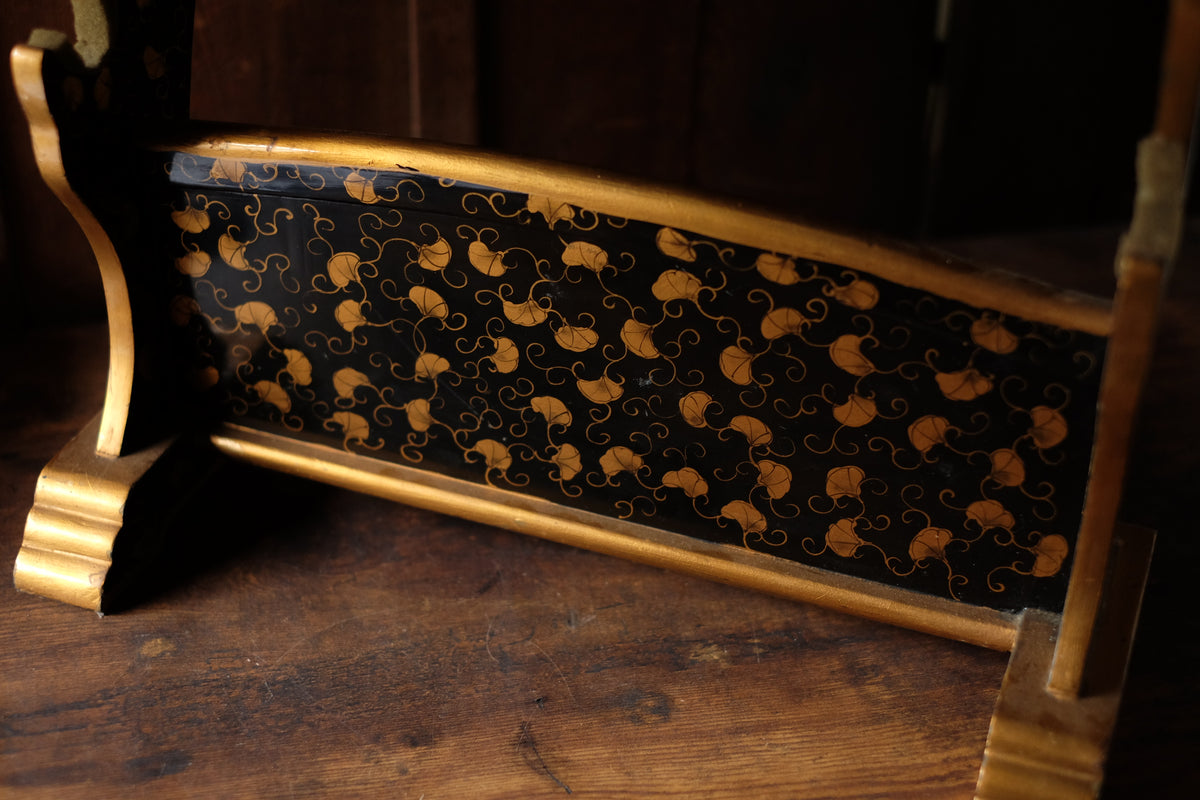
Constructed in wood and finished in lustrous black lacquer, the stand is richly ornamented with repeating gold maki-e vine motifs across almost every visible surface. The dark lacquer acts as a visual night sky for the warm gold decoration, while broad gilded borders trace the architectural silhouette of the uprights, feet, and central panel.
Its tall branching supports provide three separate sword-resting levels, making this considerably more elaborate than a simple single-sword display stand. The tiered construction gives the object a commanding architectural quality even when displayed without swords.
With approximate dimensions of 36.3 cm high × 48 cm wide × 19.5 cm deep, it has enough physical presence to stand as an independent work of Japanese decorative art.
Black Lacquer and Gold Maki-e
The most immediate feature is the contrast between the deep black lacquer ground and the dense gold decoration.
Rather than concentrating ornament into a single crest or pictorial panel, the artisan covered the stand with a continuous field of delicate scrolling vines and stylized botanical forms. Small gold motifs repeat rhythmically across the broad center panel, the vertical sword supports, and the lower feet, creating movement without overwhelming the restrained form of the object.
The effect changes dramatically according to light.
From a distance, the stand reads primarily as an elegant black silhouette edged in gold. At closer range, the surface opens into dozens of individually articulated motifs linked by fine curling tendrils.
This relationship between darkness and reflected gold is one of the great visual pleasures of traditional Japanese lacquerwork.
Under warm directional lighting, the ornament appears almost suspended over the black ground, giving the stand an understated ceremonial richness.
An Elaborate Three-Tier Katana Kake
The upright ends reveal that this is not a simple one-level sword rest.
Each side incorporates three shaped supports, allowing multiple swords or sword-related objects to be arranged vertically.
Historically, Japanese sword stands existed in many configurations depending upon household, purpose, and display context. A multi-level example such as this offered both additional capacity and considerably greater decorative presence.
For a contemporary collector, that architecture provides flexibility. It can be used to present a curated grouping of Japanese swords and koshirae, or displayed entirely on its own as a sculptural lacquer object.
The curving profile of the uprights is particularly elegant. Seen from an angle, their repeated branching forms create a strong rhythm that contrasts with the long horizontal sweep of the central panel.
The substantial stepped feet stabilize the composition and give the stand the quiet authority expected from an object associated with samurai material culture.
A Framework for the Sword, Not a Competitor to It
The finest sword furniture understands restraint.
A heavily ornamented stand can easily overwhelm the sword placed upon it, yet this example works differently. Its black lacquer provides a calm visual foundation while the gold ornament becomes most apparent only as the viewer approaches.
A polished black or dark saya would sit naturally against the gold pattern. An iron, shakudo, silver, gilt, or mixed-metal koshirae would also be framed beautifully by the restrained palette.
The sword remains the protagonist.
The katana kake becomes its architecture.
This relationship between object and setting is one of the reasons antique Japanese display furnishings are increasingly appreciated beyond the traditional field of arms collecting. They belong equally to the histories of lacquer, furniture, interior design, decorative arts, and samurai culture.
The Decorative Motif
The repeating gold pattern is formed from stylized botanical or gourd-like forms connected by curling vines.
Rather than forcing a specific botanical identification where the stylization makes certainty difficult, the pattern can be understood within the broader Japanese decorative vocabulary of trailing vines and repeating auspicious plant forms.
The scrolling movement is particularly effective across the long central panel.
Instead of a symmetrical crest positioned rigidly in the center, the decoration appears to travel freely across the surface. This creates a more organic counterpoint to the disciplined geometry of the stand itself.
The pattern continues onto the vertical supports and feet, demonstrating that the decoration was conceived for the whole object rather than simply added to its most visible face.
Edo Period Character
The piece has been described as an Edo-period katana kake, and its construction, proportions, lacquered wooden body, gold maki-e ornamentation, and overall vocabulary are compatible with traditional Japanese sword-display furniture of that broad period.
Comparable museum examples demonstrate that lacquered katana kake were indeed part of Edo-period sword culture. The Metropolitan Museum of Art holds an 18th-century Japanese wood-and-lacquer sword stand measuring 38.7 cm high, while the Birmingham Museum of Art holds an Edo-period example dating to around 1700 in wood, lacquer, steel, and gold.
As with many privately preserved Japanese decorative objects, exact dating should ultimately be considered together with construction, lacquer technique, provenance, storage history, and any accompanying documentation.
For that reason, the historical character of the piece is presented with respect rather than exaggerated certainty.
The Samurai Domestic Interior
The katana kake occupies an interesting place in Japanese material culture because it sits at the boundary between weapon accessory and furniture.
The sword itself was an intensely personal object, yet when brought into an interior it required an appropriate architectural setting.
A stand gave the weapon a defined place.
It elevated the sword from an object simply resting on a surface into a formally presented possession.
Within a carefully composed room, the stand could therefore communicate order, rank, refinement, and attention to etiquette without needing monumental scale.
That is precisely why lacquer was such an effective material.
Black urushi offered visual gravity. Gold maki-e introduced distinction without sacrificing discipline. Together they created an object luxurious enough to acknowledge the importance of the sword while remaining restrained enough not to compete with it.
Beautiful Even Without Swords
One of the strongest qualities of this particular stand is that it does not require swords to make visual sense.
Its long low body, upward-flaring supports, stepped feet, black-and-gold palette, and dense ornamentation allow it to function as a decorative object in its own right.
It can be displayed in:
a Japanese sword collection
a study or library
a tokonoma-inspired alcove
a traditional or contemporary Japanese interior
a gallery cabinet
a collector's room
a martial arts dojo reception space
a wabi-sabi interior
a dark minimalist room
an Asian decorative arts collection
a museum-inspired display
Placed against timber, plaster, stone, or a neutral wall, the glossy black surface creates a particularly beautiful visual bridge between antique Japanese furniture and contemporary interior architecture.
Original Storage and Stewardship
A particularly desirable aspect of an important lacquer object is the survival of its wooden storage box.
Traditional Japanese storage was not incidental packaging. It formed part of the long-term stewardship of sensitive materials such as lacquer, protecting them from unnecessary abrasion, handling, dust, and prolonged exposure while the object was not being displayed.
For collectors, the presence of an associated storage box strengthens the sense that the katana kake was treated as an object worthy of preservation rather than merely functional household equipment.
Lacquer is durable, but its preservation rewards thoughtful handling.
Avoid prolonged direct sunlight, excessive dryness, strong heat sources, abrasive polishing compounds, and aggressive cleaning. Gentle dusting with a very soft clean cloth is generally preferable to repeated polishing.
Surface, Patina and Age
The photographs reveal minor age-related surface marks, rubbing, abrasions, and variation to the lacquer and gilt decoration.
These characteristics are appropriate to an older functional object that was handled, stored, assembled with swords, and displayed over an extended period.
They are not visually dominant.
More importantly, the overall decorative program remains extremely legible. The black lacquer retains excellent depth, the gold ornament remains abundant, and the architecture of the stand presents strongly from every photographed angle.
The small padded areas visible inside several sword rests also provide an interesting functional detail and help protect a resting scabbard from direct contact with the wooden support.
Please examine all photographs carefully, as they form an important part of the condition description.
Collector Relevance
This piece crosses several collecting fields simultaneously.
For a Japanese sword collector, it offers a historically sympathetic display structure considerably more appropriate than a modern mass-produced stand.
For a lacquer collector, it offers architectural scale, broad decorated surfaces, and extensive maki-e work.
For a samurai-art collector, it represents the domestic culture surrounding the sword rather than the weapon alone.
For an interior collector, it is a rare piece of functional sculpture whose silhouette remains compelling even without its original purpose being activated.
That versatility is important.
The strongest Japanese decorative objects often survive shifts in context precisely because the artistry remains understandable even after the original ritual or household environment has disappeared.
Object Details
Object Type: Katana kake / Japanese sword display stand
Configuration: Three-tier / multi-sword rack
Origin: Japan
Period: Edo period attribution / traditional antique Japanese production
Material: Wood
Surface: Black urushi-style lacquer
Decoration: Gold maki-e botanical and scrolling vine motifs
Trim: Gilt / gold-finished edges and architectural accents
Use: Katana, wakizashi, tanto or Japanese sword display
Includes: Associated wooden storage box
Dimensions: Approximately 36.3 cm H × 48 cm W × 19.5 cm D
Sword or sword fittings shown or referenced are not included unless expressly stated otherwise.
Condition
Antique condition with age-related wear consistent with historical use and storage.
Expected characteristics may include small scratches, lacquer abrasions, minor losses or softening to gold decoration, surface rubbing, handling marks, minor age-related movement of wooden components, and natural variations associated with traditional construction.
The overall structure presents attractively and the extensive black-and-gold decorative scheme remains visually strong.
Please review all photographs carefully before purchase and contact us if additional detail photographs or measurements would be helpful.
Purchase, Shipping and Vintage Policy
Some pieces in our collection have a little room for negotiation while others are offered closer to a firm price. Respectful best offers are welcome and are considered individually.
We make every effort to represent our objects accurately through detailed photography and description. Please contact us before purchasing if you would like additional photographs, measurements, condition clarification, or information about any particular area.
Vintage and antique objects naturally carry evidence of age, handling, traditional production, previous ownership, patination, oxidation, surface wear, minor irregularities, and restoration where applicable. These characteristics form part of the individuality and history of collectible objects.
Preparation, packing, shipping and handling normally require 5–10 business days or earlier. Antique lacquerware receives careful protective packing appropriate to its shape and surface.
Worldwide shipping is available to many destinations using an appropriate tracked service from Japan. Shipping method may vary according to destination, packed dimensions, insurance requirements, and carrier restrictions.
Any applicable import duties, customs charges, VAT, brokerage charges, or destination-country taxes are the responsibility of the buyer unless explicitly stated otherwise.
If you are looking for this type of katana kake in another size, configuration, decorative motif, or period, please feel free to message us. Although availability cannot be guaranteed, we may be able to locate the same or a closely related piece through our sourcing network.
#JapaneseKatanaKake #KatanaKake #JapaneseSwordStand #KatanaStand #SwordRack #SamuraiDecor #SamuraiAntique #JapaneseLacquer #Urushi #Makie #GoldMakie #BlackLacquer #JapaneseAntique #EdoPeriod #EdoArt #JapaneseDecorativeArt #JapaneseFurniture #JapaneseSwordCollection #SwordCollector #SamuraiCollection #JapaneseWeaponArt #KatanaDisplay #WakizashiDisplay #TantoDisplay #JapaneseInterior #Tokonoma #JapaneseArt #AsianAntiques #AsianDecorativeArt #Lacquerware #JapaneseLacquerware #GoldLacquer #TraditionalJapaneseCraft #SamuraiInterior #JapaneseHeritage #JapaneseCraftsmanship #AntiqueLacquer #JapaneseCollectibles #MuseumStyleDecor #CollectorDisplay #WabiSabiInterior #JapaneseDesign #MakiEArt #UrushiArt #SwordDisplayStand #HistoricJapan #JapaneseCulture #ArtFurniture #SamuraiArt #JapaneseLuxury
japanese katana, katana kake, sword stand, samurai decor, japanese lacquer, gold makie, edo period, sword rack, katana display, japanese antique, samurai antique, urushi lacquer, sword collector
Material Tags
wood, black lacquer, urushi style lacquer, gold maki-e, gilt decoration, traditional lacquerwork, wooden sword stand