
Aizome: The Indigo Dyer’s Craft
Techniques · Blue from the leaf
Aizome: The Indigo Dyer’s Craft
藍染
A blue that deepens with every dip, made from a leaf and a vat of living ferment. For most of the Edo period it was the colour of working Japan, from the fire brigade's coats to the curtain over a shop door.
Fact sheet
The blue in one glance
- Ai. The indigo plant, sown in early March.
- Sukumo. The dried and fermented leaf from which the vat is made.
- Aigame. The pot that holds the liquid dye.
- Dipping. Cloth is dipped, then aired so the colour develops.
- Japan blue. The name given to the deep blue of aizome.
A colour grown in a field
Aizome, written with the characters for indigo and dyeing, is the Japanese word for indigo dye, and by extension for the cloth dyed with it. An article on the craft from the Fun Japan site explains that it is a traditional dyeing technique using dye extracted from ai, the indigo plant, and that the deep blue is known as ‘Japan blue’. The main plant is tade-ai, Japanese indigo, which the article says is grown in Hokkaido, Aomori, Hyōgo, Tokushima and Okinawa prefectures. Wikipedia calls the plant Persicaria tinctoria, dyer’s knotweed, and notes that it contains indigo precursors in its green leaves.

Noren with Design of Flowering Cherry Tree, 19th century, Indigo-dyed hemp. The Metropolitan Museum of Art, Seymour Fund, 1980, accession 1980.493.1.
Look closer: Look at the white and the blue. The Met explains that rice paste resists the dye, and that repeated dipping and oxidation bring the ground to a dark blue.
Image: The Metropolitan Museum of Art, Open Access (CC0)
The calendar is the first thing to notice. Ai seeds are sown around early March, the article says, and from late June into summer the harvested plants are dried and fermented to make sukumo, the dye material. The sukumo is placed in an aigame, a pot for storing the liquid dye, and fermented with lye, lime and other ingredients. Cloth is dipped in the liquid and then exposed to air so that the indigo colour develops; the article says this is repeated ten to twenty times to reach the desired depth, after which the cloth is rinsed and dried.
Wikipedia’s article on indigo dye describes the pre-industrial Japanese vat in more technical terms. Indigo was dissolved in a heated vat maintained with thermophilic, anaerobic bacteria, which produce hydrogen, and the hydrogen converts insoluble indigo into soluble indigo white. The craft is therefore at once agricultural, chemical and manual, and the best records of the result are the cloths themselves.
From court colour to common cloth
The Fun Japan article gives the long history. Indigo reached Japan from China by way of the Silk Road in the Asuka to Nara periods. In the Heian period it was a noble colour worn by the imperial court and upper nobility, and indigo fabrics from that age are preserved at the temple Hōryūji and in the Shōsōin. Wikipedia’s account of Persicaria tinctoria adds that the plant was the most important blue dyestuff in East Asia until species of Indigofera were introduced from the south, and that it yielded less dye per crop and was surpassed by them.

Noren with Design of Oak-Leaf Crest, Plovers, and Waves, Resist-dyed plain weave, probably hemp. The Metropolitan Museum of Art, Funds from various donors, 1988, accession 1988.206.
Look closer: Look at the birds. The Met explains that plovers carry associations of longevity and good fortune, and that the design is in tsutsugaki, white pattern on a blue ground.
Image: The Metropolitan Museum of Art, Open Access (CC0)
The Edo period is the great age of aizome. Wikipedia’s indigo article states that commoners were banned from wearing silk, which led to more cotton cultivation, and in turn more indigo, one of the few substances that could dye cotton. The Fun Japan article lists the uses: armour liners for samurai, commoners’ kimono and obi, work clothes, yukata and noren. It adds that aizome kimono were placed in chests to deter insects, and that firefighters’ uniforms and the clothing of railway boiler workers and sailors were made from it because of its durability and insulation. The same source says samurai wore aizome undergarments beneath their armour.
Cloth dyed in this way was decorated with shibori, kasuri, katazome and tsutsugaki, the Wikipedia article records, citing Hokusai’s works as examples, and the techniques that follow in this almanac are in that sense all tributaries of the indigo vat. The Met’s noren with a flowering cherry tree, of the nineteenth century, is indigo-dyed hemp, and its label explains the logic: the design is drawn with a paper cone with a metal tip that trails rice paste onto the cloth, the cloth is then dyed, usually with indigo, and the areas covered with paste resist the dye and remain white while the ground, through repeated dipping and oxidation, attains a dark blue. It measures 163 by 152 centimetres.
The decline came with the Meiji period. The Fun Japan article says that synthetic dyes and cheaper, faster-dyeing Indian indigo caused domestic indigo production to fall sharply. Wikipedia places the chemistry on the record: Adolf von Baeyer began work on the synthesis in 1865 and determined the structure in 1883, BASF had a commercially viable process by 1897, and plant-sourced production, about 19,000 tons in that year, had fallen to 1,000 tons by 1914. About 50,000 tons of synthetic indigo were made worldwide in 2011.
Reading the blue
The Met’s second noren is a good lesson in reading a design. Its subject is an oak-leaf crest, plovers and waves, and it dates from the Meiji period; the medium is resist-dyed plain weave, probably hemp, and it measures 121.9 by 198.1 centimetres. The label says plovers, chidori, are ubiquitous along Japan’s shores and especially apparent in winter, that they inspired several poems in the early anthologies, and that in the Man’yōshū they had melancholy associations. By the time of the tenth-century Kokinshū, it adds, the chirp of the plover was heard as chiyō, ‘one thousand years’, which gave it auspicious connotations of longevity and good fortune. The museum describes the technique as tsutsugaki and notes that areas covered with rice paste resist the blue dye, resulting in a white pattern on a blue ground.
A reader looking at an indigo textile should look at the evenness of the blue, the sharpness of the white where a resist was used, and the fibre. Both of the Met’s noren are on hemp; cotton, as in the Met’s pieces from the Stinchecum gift, dated to the Meiji or Taishō period, is the other ground of the age, and one of the few that Wikipedia says indigo could dye. The Met’s small cotton pieces, each about 28 by 34 centimetres, are catalogued simply as indigo-dyed cotton, which is a useful reminder that a textile need not be a garment to be worth keeping.
Colour in aizome is a matter of dips, and the Fun Japan article’s ten to twenty is a range rather than a standard. The darker the blue, the more times the cloth went into the vat, and the more patience and time the work required. For the collector, the plain reading of what is in front of you is the safest: a deep, even blue on an old cloth may reflect many dips, and the paler blue of a worn edge reflects use.
The production areas named by the article give the chapter its geography. They are Awa Ai in Tokushima Prefecture, Izumo Ori in Shimane Prefecture and Bushū Ai in Saitama Prefecture, and the city of Fukaya in Saitama, where aidama, solidified blocks of indigo, were once traded in quantity and which is the birthplace of Eiichi Shibusawa, who appears on the current ten-thousand-yen note. The regional dimension is treated in Regional Textiles from Kyoto to Okinawa.
| Stage | What happens | Note from the sources |
|---|---|---|
| Sowing | Ai seeds are sown | Early March |
| Fermenting | Harvested plants are dried and fermented into sukumo | From late June into summer |
| Vat | Sukumo goes in the aigame with lye and lime | A heated, fermenting vat |
| Dipping | Cloth is dipped, then exposed to air | Ten to twenty times |
| Finishing | Cloth is rinsed and dried | The colour deepens by dips |
The ban on silk and the cotton of the people
The most illuminating fact in the sources is the one that links dress to law. Because commoners were banned from wearing silk in the Edo period, cotton cultivation expanded, and with it the cultivation of indigo, which dyed cotton when few other substances would. The colour of the working wardrobe was therefore a consequence of regulation as much as of taste, and the blue-and-white cloth of the shop curtain, the fire-brigade coat and the farm jacket is the product of a society that made a virtue of what it was allowed.
The result is visible across this almanac. The Happi, Hanten and the Fire Brigade Coat chapter shows the indigo coat of the fire brigade, and the Sashiko and Boro: The Mended Cloth chapter the white thread stitched on blue. The Yukata: The Summer Cotton Robe chapter treats the summer cotton, the Tsutsugaki and Katazome: Paste and Stencil chapter the paste-resist drawing, and the Kasuri: Ikat Woven from Dyed Thread chapter the woven patterns that used indigo-dyed thread. A reader who wants the vocabulary of the dyer’s palette will find the traditional colour names in the glossary of traditional Japanese colours.
The craft survives in a smaller form. Tokushima, Shimane and Saitama, the three areas named above, give their names to the regional indigos, and contemporary designers use aizome for new garments, as the shelf strip below shows in its patchwork bomber. The fabric of the past remains the standard: the Met’s noren, in hemp and cotton, are what a good old indigo cloth looks like.
Within the house, the concierge desk can look for an indigo garment, a length of old cloth or a piece with a particular resist pattern on request, and will describe its fibre and its dyeing as plainly as the museum does.
Blue cloth in the Met

Sashiko Jacket, second half of the 19th century, Indigo-dyed plain-weave cotton, quilted and embroidered with white cotton thread. The Metropolitan Museum of Art, Seymour Fund, 1967, accession 67.172.1.
Look closer: Look at the blue. The Met records indigo-dyed plain-weave cotton, with white cotton thread laid over it in sashiko.
Image: The Metropolitan Museum of Art, Open Access (CC0)
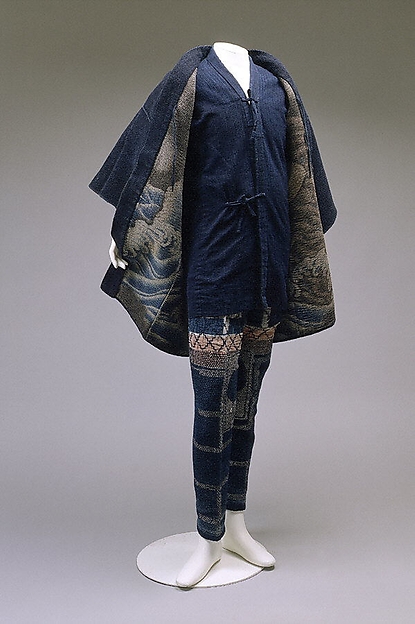
Fireman’s Jacket (Hikeshi-Banten) with Susanoo-no-mikoto Deity Scene, mid-19th century, Quilted cotton with tube-drawn paste-resist dyeing (tsutsugaki) with hand-painted details. The Metropolitan Museum of Art, Purchase, Irene Lewisohn and Alice L. Crowley Bequests, 1983, accession 1983.158a–c.
Look closer: Look at the contrast. The Met explains that the commoner's coat had a plain indigo exterior and an elaborately decorated interior.
Image: The Metropolitan Museum of Art, Open Access (CC0)

Piece, Indigo-dyed cotton. The Metropolitan Museum of Art, Gift of Amanda Stinchecum, 1982, accession 1982.385.4.
Look closer: Look at the scale. The Met gives about 28 by 34 centimetres, and indigo-dyed cotton from the Stinchecum gift of 1982.
Image: The Metropolitan Museum of Art, Open Access (CC0)

Piece, Indigo-dyed cotton. The Metropolitan Museum of Art, Gift of Amanda Stinchecum, 1982, accession 1982.385.9.
Look closer: Look at the pair. The Met catalogues a run of small indigo-dyed cotton pieces together, a record of cloth kept as cloth.
Image: The Metropolitan Museum of Art, Open Access (CC0)
Indigo in the house
The shelf holds antique indigo pieces, a fire-brigade coat and a contemporary aizome patchwork. Each is described as what it is, with its age and condition set out plainly on its own page.


Kimono and textile heritage
Antique cloth of every kind is gathered in one collection, and the concierge desk can look for a particular fibre, dye or region on request.
Answered plainly
What is aizome?
The Japanese word for indigo dyeing, and for the cloth dyed with indigo.
What is sukumo?
The dried and fermented leaf of the indigo plant, from which the vat is made.
How many dips does it take?
The Fun Japan article says dipping and airing are repeated ten to twenty times.
Why was indigo so common in the Edo period?
Commoners were banned from silk, cotton spread, and indigo was one of the few substances that could dye it.
Why did it decline?
In the Meiji period synthetic dyes and cheaper Indian indigo reduced domestic production.
Where is it made?
The article names Awa Ai in Tokushima, Izumo Ori in Shimane and Bushū Ai in Saitama.
Where next
Sources and image credits
- What is Aizome? Process, history, famous production areas, Fun Japan
- Indigo dye, Wikipedia
- Persicaria tinctoria, Wikipedia
- Noren with Design of Flowering Cherry Tree, Metropolitan Museum of Art
- Noren with Design of Oak-Leaf Crest, Plovers, and Waves, Metropolitan Museum of Art, 1988.206
- Piece (indigo-dyed cotton), Metropolitan Museum of Art, 1982.385.4
- Sashiko Jacket, Metropolitan Museum of Art, 67.172.1
- Fireman’s Jacket (Hikeshi-Banten), Metropolitan Museum of Art, 1983.158a–c
- Object record: Piece, The Metropolitan Museum of Art
Last reviewed 28 October 2026. Pictures, where shown, are public-domain or open-access and credited beneath each one.
Looking for an indigo garment or a length of old blue cloth you have seen described here? The concierge desk replies within one to three business days.
Private concierge
Looking for something in particular?
Describe the piece or the project you have in mind. A senior advisor in Tokyo reads every case file personally and replies within two business days, with fees set out in writing before any work begins.