
Buddhist Statues and Sacred Art
The Japonista Athenaeum · Gateway
Buddhist Statues and Sacred Art
仏像
Fourteen centuries of Japanese images made to be lived with: Buddhas, bodhisattvas, wisdom kings and guardians in wood, lacquer, gold and stone. Start here for the whole map: how to look, what they are made of, what the hands say, how they are mounted and kept, and where every hub lies.
Where to Go Next
Every route below is a full page in the Athenaeum, not a signpost. The almanacs are the master works; the four rank hubs lead to every principal figure; the guides teach the eye; the altar pages cover the settings in which figures live.
The almanacs
Read the whole world in order
The four ranks
One hub for each family of figures
Learning to look
The guides, in the order we would read them
Altars and ritual objects
Beyond the figure
The principal figures
One page for each
Schools and glossaries
Context and vocabulary
Images Made to Be Lived With
A Japanese Buddhist statue is not a portrait and not an ornament. It is a support for attention: a figure placed where a person can sit before it, light a stick of incense and be reminded of something larger than the day. For fourteen centuries sculptors, painters, lacquerers and metalworkers made such images for temples, for noble houses and, from the seventeenth century, for ordinary households. The craft that grew around them is among the most refined in the world, and it was made to be looked at slowly.
That purpose still shapes how a figure should be approached. A statue has a name, a rank, a gesture and a set of objects that tell you what it is for; it has a body of wood, clay, lacquer, bronze or stone that tells you when and how it was made; and it has a surface, worn or restored, that tells you where it has been. This page is the gateway to all three kinds of reading. It sends you into the Buddhism and Zen Almanac, the Okimono and Statues Almanac, the butsudan pages and the hubs for Buddhas, bodhisattvas, wisdom kings and heavenly beings, and it stands on its own as a short course in how to look.
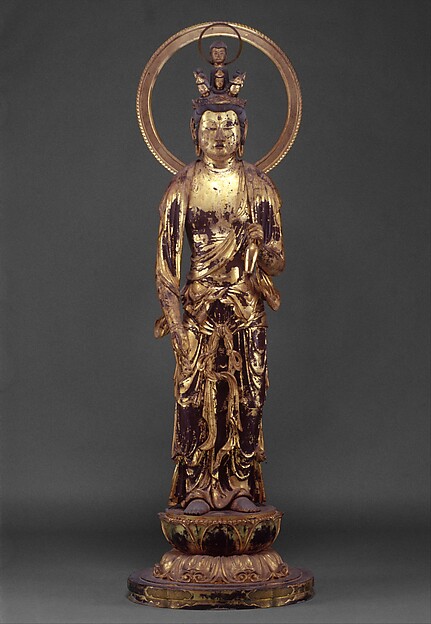
Look closer: Look at the crown. Small heads rise above the main face, the sign of the eleven-headed form of Kannon, who watches in every direction at once. The surface is lacquer under gold leaf, laid over carved wood.
Maker unrecorded, Jūichimen Kannon, the Bodhisattva of Compassion with Eleven Heads (Avalokiteshvara), mid- to late 14th century. The Metropolitan Museum of Art, The Harry G. C. Packard Collection of Asian Art, Gift of Harry G. C. Packard, and Purchase, Fletcher, Rogers, Harris Brisbane Dick, and Louis V. Bell Funds, Joseph Pulitzer Bequest, and The Annenberg Fund Inc. Gift, 1975, accession 1975.268.167. Public domain (Met Open Access). Museum record
Fourteen Centuries of Making
Buddhist images in Japan follow the history of the faith itself. Buddhism arrived from the Korean peninsula in the sixth century, was embraced by the court, and from the start demanded images. The outline below follows the standard sequence of periods; each era has its own materials, its own favourite figures and its own workshop habits. The longer chapter on periods is linked in the routes above.
The earliest great images were bronze and wood, cast and carved in the continental manner. The Shaka Triad of 623 in the Golden Hall of Hōryū-ji, in gilt bronze and usually credited to the sculptor Tori Busshi, is the best-known survivor. Faces are calm and frontal, the drapery falls in regular folds, and the effect is of an image meant to be seen from the front.
The state built a great temple network. In 752 the colossal gilt-bronze Vairocana (Birushana) of Tōdai-ji was completed, and workshops developed clay modelling (sozō) and dry lacquer (kanshitsu), in which layers of cloth soaked in lacquer are built up over a core. Dry lacquer could be light and expressive, and it gave the period some of its most naturalistic faces.

Look closer: Look at the eye. Even where the surface is broken and stained, the socket and the lid are modelled with care. Dry lacquer, built up from cloth and lacquer over a core, could take fine detail of this kind.
Maker unrecorded, Fragment: Head of Buddhist Image, 8th century. The Metropolitan Museum of Art, Rogers Fund, 1919, accession 19.157.2. Public domain (Met Open Access). Museum record
The new esoteric schools, Tendai and Shingon, brought fierce wisdom kings and elaborate mandala systems. Sculptors favoured the single block (ichiboku-zukuri), usually cypress or a similar wood, left with a sober, almost unpainted surface. Later in the period the master Jōchō perfected joined-wood construction (yosegi-zukuri), in which several hollowed pieces are assembled, a method that made large, gentle, gilded figures possible and could be shared among a workshop.
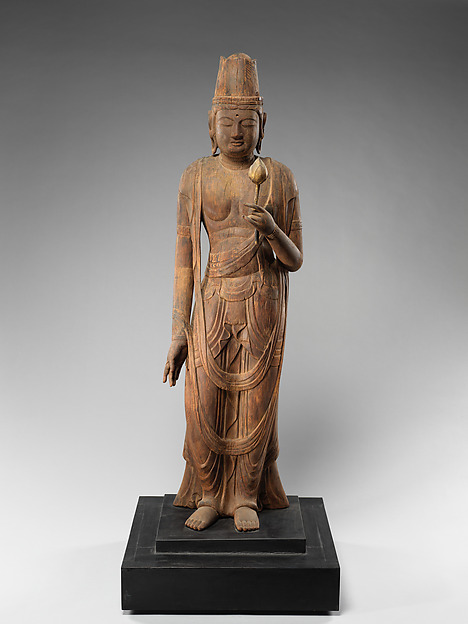
Look closer: Look at the grain. This Kannon is carved from a single block of cypress (ichiboku-zukuri), and the soft, long fall of the robes is cut straight into the trunk.
Maker unrecorded, The Bodhisattva Kannon (Avalokiteshvara), mid-11th century. The Metropolitan Museum of Art, Purchase, Bequest of Mary Stillman Harkness, by exchange; Henrie Jo Barth Bequest; and funds from various donors, 2021, accession 2021.116a, b. Public domain (Met Open Access). Museum record
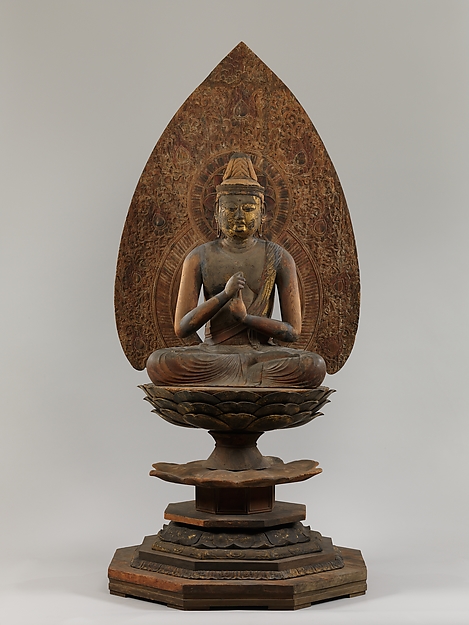
Look closer: Look at the halo and the lotus. The leaf-shaped back and the raised pedestal frame the figure like an architecture of its own.
Maker unrecorded, Dainichi, the Cosmic Buddha (Mahavairocana), 12th century. The Metropolitan Museum of Art, Rogers Fund, 1926, accession 26.118a, b. Public domain (Met Open Access). Museum record
After the temples of Nara were burned in the war of 1180, a generation of sculptors rebuilt them. The workshops of Unkei, Kaikei and their successors, the Kei school, favoured realism, muscular energy and, for many figures, eyes of inlaid crystal set from the inside (gyokugan). The two Niō guardians of the great south gate of Tōdai-ji, made in 1203, are the high point of the style. Joined-wood construction by now allowed large figures to be made quickly by teams.
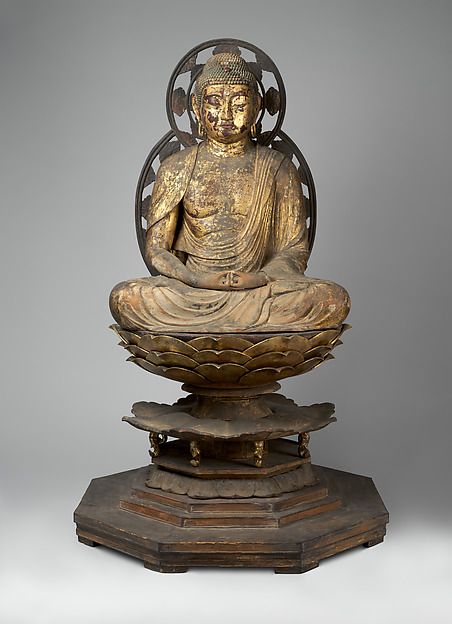
Look closer: Look at the halo and the pedestal. The Met catalogues this figure in three parts: the Buddha, the pierced halo behind it and the lotus base beneath, a reminder that a Buddha is always shown in a setting.
Maker unrecorded, Amida, the Buddha of Limitless Light, ca. 1250. The Metropolitan Museum of Art, Rogers Fund, 1919, accession 19.140a–c. Public domain (Met Open Access). Museum record
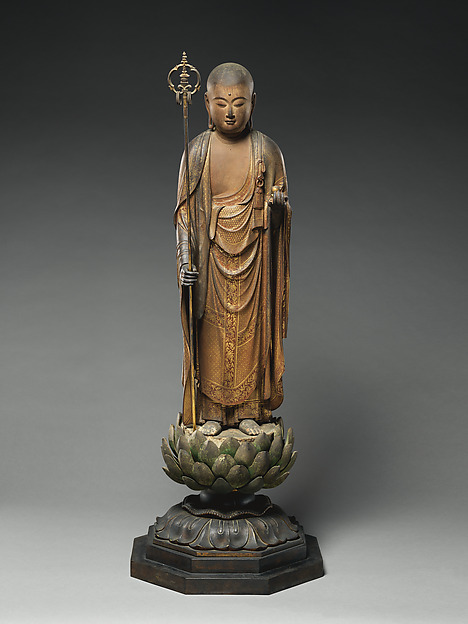
Look closer: Look at the robe and the staff. Jizō is shown as a shaven monk, carrying a ringed staff, the one bodhisattva who is not crowned and jewelled. This figure is dated 1291.
Intan, The Bodhisattva Jizō, 1291. The Metropolitan Museum of Art, Purchase, Florence and Herbert Irving Acquisitions Fund for Asian Art, Florence and Herbert Irving Acquisitions Fund, by exchange, The Miriam and Ira D. Wallach Foundation Fund, Brooke Russell Astor Bequest, and Fletcher Fund, 2023, accession 2023.640a–c. Public domain (Met Open Access). Museum record
Large commissions declined, but images multiplied. The wandering monk Enkū (1632 to 1695) carved thousands of rough-hewn, unpainted Buddhas, and in the seventeenth century the Tokugawa government required every household to be registered with a temple, a policy that helped to bring the family altar (butsudan) and the small portable shrine (zushi) into ordinary homes. Hanging scrolls, portable shrines and small figures became the commonest form of Buddhist image.

Look closer: Look at the doors. A zushi is a shrine that closes: open, it shows a small Kannon in a gilded niche with painted figures on the doors; shut, it is a plain black box for travel or for a household shelf.
Maker unrecorded, Portable Shrine (zushi) with Senju Kannon, the Thousand-armed Bodhisattva of Compassion, late 18th–first half 19th century. The Metropolitan Museum of Art, Bequest of Susan Dwight Bliss, 1966, accession 67.55.62. Public domain (Met Open Access). Museum record
In 1868 the new government ordered Shinto and Buddhism to be separated, and for several years temples and their images were attacked and sold. A reaction followed: the first laws to protect old temples and their art, and, from 1950, the Law for the Protection of Cultural Properties. Today the most important figures are national treasures and cannot be exported, while the great household tradition continues in family altars and in new carving.
Read in order, the periods describe a movement from continental imitation to Japanese invention, from state patronage to household devotion, and from a few great workshops to a wide, living craft. The figures a collector meets today are mostly from the later end of that arc, and each carries something of the earlier ones.
How to Look at a Buddhist Statue
The order of looking matters. A beginner who starts with the face is soon lost; a practised eye begins with the rank, because rank decides everything that follows. The usual sequence is below, and each step is explained further in the page on reading a statue.
| Step | Look at | What it tells you |
|---|---|---|
| 1. Rank | Dress, jewellery, expression | Whether the figure is a Buddha (plain monastic robe, no ornament), a bodhisattva (princely jewellery, crown), a wisdom king (fierce face, flames) or a heavenly being (armour or court dress). |
| 2. Posture | Standing, seated, cross-legged, riding | A seated figure in meditation is most often a Buddha; a standing figure with a lowered hand may be welcoming; a figure on an animal has a specific identity. |
| 3. Hands | Mudra: the position of the fingers | The message of the figure: protection, gift, meditation, teaching, welcome. The commonest gestures are in the next section. |
| 4. Head | Topknot, urna, ear lobes, hair | A raised cranial bump (ushnisha) and a mark between the brows (urna) belong to Buddhas; a crown or high chignon to bodhisattvas; extra heads or arms to esoteric forms. |
| 5. Attributes | What is held: lotus, jewel, vase, staff, sword | Names the figure. A sword and rope mean Fudō; a staff and jewel mean Jizō; a lotus bud suggests Kannon. |
| 6. Seat and halo | Lotus pedestal, mandorla, rock or animal | The setting reads as part of the figure: a boat-shaped halo is typical of a standing Buddha, a flame halo of a wisdom king. |
| 7. Construction | Joins, back, base, interior | Single block or joined wood, hollow or solid, original or later base. See the section on materials. |
| 8. Surface | Gilding, lacquer, colour, wear | Original, restored or later finish; honest wear on the hands and base is a sign of age and care. |
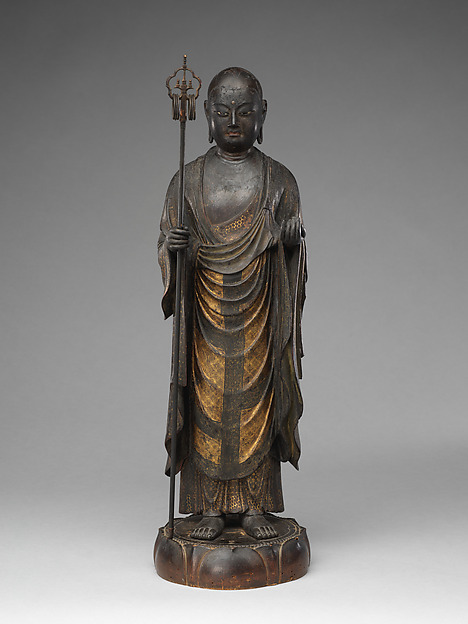
Look closer: Look at the robe. The patterns are cut gold (kirikane), thin strips of gold leaf laid by hand in lines. The ringed staff and the shaven head identify Jizō, the guardian of the earth and of travellers, as clearly as a label.
Kaikei, Jizō, Bodhisattva of the Earth Store (Kshitigarbha), ca. 1202. The Metropolitan Museum of Art, Mary Griggs Burke Collection, Gift of the Mary and Jackson Burke Foundation, 2015, accession 2015.300.250a, b. Public domain (Met Open Access). Museum record
The four ranks
Japanese tradition sorts Buddhist figures into four ranks, and the sorting is useful to the eye. Nyorai, the Buddhas, have attained awakening and wear a plain monastic robe with no jewellery. Bosatsu, bodhisattvas, delay their own final peace to help others, and are shown as princes in silk and jewels, except Jizō, who appears as a monk. Myōō, the wisdom kings, are the fierce messengers of the Buddhas, with angry faces and flame halos. Ten, the heavenly beings, are the protectors adopted from India and China, shown in armour or court dress. The page on deity ranks sets out the whole scheme.

Look closer: Look at the fury. The scowl and the sword are not anger but protection: the wisdom king burns away obstacles with the sword in one hand and binds ignorance with the rope in the other.
Maker unrecorded, Fudō Myōō (Achala Vidyaraja), 13th–14th century. The Metropolitan Museum of Art, Gift of Florence and Herbert Irving, 1992, accession 1992.252.3a–c. Public domain (Met Open Access). Museum record
Hands, Mudras and What They Say
The hands of a Buddhist figure speak before the face does. A mudra (in Japanese, in or inzō) is a fixed hand position with a fixed meaning, and a handful of them cover most of the figures a collector will meet. Learning five or six is the quickest way to begin reading statues, paintings and scrolls.
| Gesture | Japanese | Hand position | Meaning and usual figures |
|---|---|---|---|
| Fearlessness | Semui-in | Right hand raised, palm out | Reassurance and protection; common on standing Shaka and Yakushi. |
| Wish-granting | Yogan-in | Hand lowered, palm open and turned out | The giving of gifts; paired with the raised hand on many standing Buddhas. |
| Meditation | Jō-in | Both hands in the lap, palms up | Concentration; the posture of many seated Amida figures. |
| Teaching | Seppō-in | Hand raised, thumb and finger forming a circle | The first sermon and the preaching of the law. |
| Welcoming | Raigō-in | Hand lowered, with thumb and finger touching | Amida coming to welcome the dying to the Pure Land. |
| Fist of wisdom | Chiken-in | One forefinger enclosed by the other hand | The diamond-realm Dainichi of the esoteric schools. |
| Prayer | Gasshō | Palms pressed together | Reverence; common on Kannon, on attendants and on the faithful. |

Look closer: Look at the hands. One is raised and one lowered, the pair of gestures that mean protection and gift together. Even where the gilding has gone, the gestures are what remain.
Maker unrecorded, Shō Kannon, the Bodhisattva of Compassion, 12th century. The Metropolitan Museum of Art, Dr. and Mrs. Roger G. Gerry Collection, Bequest of Dr. and Mrs. Roger G. Gerry, 2000, accession 2002.447.2. Public domain (Met Open Access). Museum record
A gesture is not decoration, and a figure made with the wrong one is a mistake that a priest would notice at once. For the collector it is also a safeguard: the hands, the head and the attributes either agree on a figure's identity or they do not, and a mismatch is a reason to look more closely at the history of the piece. The dedicated page on mudras and the glossary of mudras and mantras go through the full vocabulary, including the esoteric gestures used in ritual.
Wood, Lacquer, Gold and Crystal
Japanese Buddhist sculpture is a family of materials, each with its own character, and the fastest way to understand a figure is to know what it is made of and how the maker put it together. Wood dominates, because the climate and the forests made it the natural medium, but the other materials appear throughout the history.
| Material | Japanese | How it was used | What to look for |
|---|---|---|---|
| Cypress and other woods | Hinoki and related timber | Carved from one block or from several joined pieces; the standard material from the Heian period onward. | Straight grain, joint lines, a hollow back, a base cut for a pedestal. |
| Dry lacquer | Kanshitsu | Layers of lacquer-soaked cloth built over a core, mainly in the Nara period. | Light weight, a smooth, slightly cracked skin; very rare outside temples and museums. |
| Clay | Sozō | Modelled over a wooden armature, painted; used in the Nara period. | Fragility; surviving examples are almost all in temples. |
| Bronze | Seidō | Cast by the lost-wax method and gilded; used for large temple images and small household ones. | Even patina, casting seams, mercury-gilt traces. |
| Stone | Sekibutsu | Roadside, garden and graveyard figures, often Jizō. | Weathering, moss, soft lines from age; modern carving is crisper. |
| Lacquer and gold | Urushi and kinpaku | A surface skin: lacquer layers under gold leaf, sometimes with cut gold lines (kirikane). | Original gilding sinks softly into the lacquer; later regilding sits harder on top. |
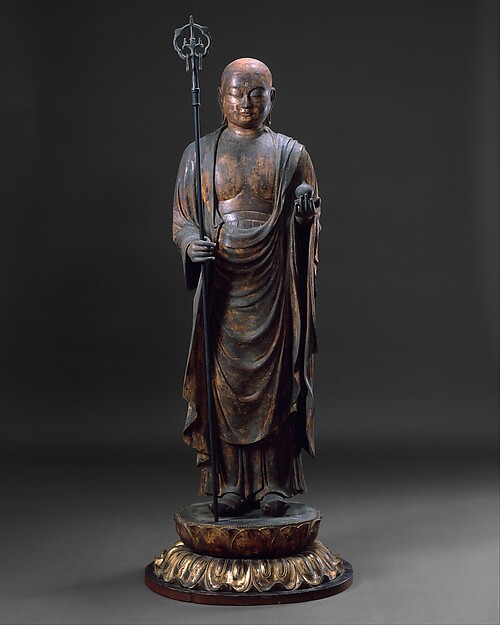
Look closer: Look at the gold pattern on the robe. This is kirikane: gold leaf cut into thin strips and laid by hand to draw patterns on the lacquer. The method is old and it takes a steady hand.
Maker unrecorded, Jizō, the Bodhisattva of the Earth Store, late 12th–mid-13th century. The Metropolitan Museum of Art, Rogers Fund, 1918, accession 18.93. Public domain (Met Open Access). Museum record
Single block and joined wood
The two great wood techniques are worth knowing by name. In ichiboku-zukuri, the figure is carved from a single trunk, usually hollowed from behind to prevent splitting; the result is a heavy, grain-rich body. In yosegi-zukuri, associated with Jōchō and with the Kamakura workshops, several pieces are carved separately, hollowed and joined. The second method is lighter, resists cracking and, importantly, lets a team of carvers work at once, which is how the great workshops produced large figures at speed.
Eyes, interiors and the opening ceremony
From the late Heian period and especially in the Kamakura, many figures were given eyes of rock crystal (gyokugan), cut and painted on the back and set in from inside, which gives the gaze a wet, living glint. The inside of a hollow figure is often the most informative part: dedications are written in ink, and small objects (nōnyūhin) such as sutras, relics, small images or grains may be placed inside. A statue is traditionally made alive by a ceremony of eye-opening (kaigen), after which it is no longer only an object, a point that matters for how a figure is later handled, moved or retired.
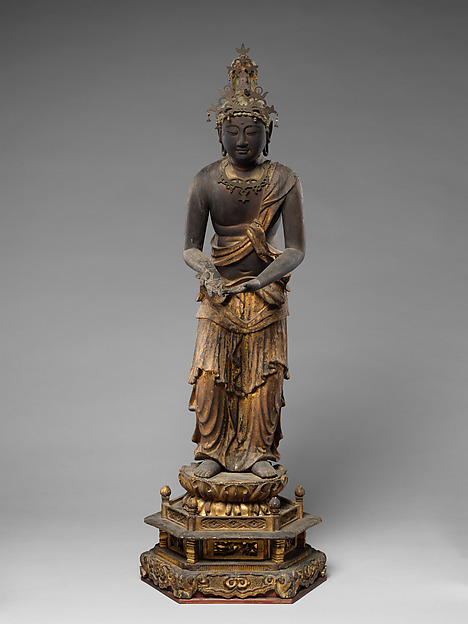
Look closer: Look at the eyes. The catalogue records inlaid crystal in this figure, the technique that gives a Kamakura gaze its living glint, and the gilded crown shows the princely adornment of a bodhisattva.
Maker unrecorded, Attendant Bodhisattva Kannon, late 12th–13th century. The Metropolitan Museum of Art, Rogers Fund, 1912, accession 12.134.17. Public domain (Met Open Access). Museum record
Pedestals, Halos and Shrines
A statue is never alone. It stands or sits on a pedestal (daiza), most often a lotus (rendai), and it is framed by a halo (kōhai), a shape that tells you almost as much as the hands. A leaf-shaped or boat-shaped halo (funagata) suits a standing Buddha; a flame halo suits a wisdom king; a ring halo behind the head suits many bodhisattvas. These parts are often separate pieces of wood, and an original halo and base are a mark of completeness. A replaced base or halo is not a fault, but it should be named.
Figures also live inside buildings made to hold them. The zushi is a cabinet with doors, from pocket size to the size of a wardrobe, that shelters a figure and can be closed. The butsudan is the household altar, with the central figure (honzon), memorial tablets (ihai) and offerings. Altar cloths (uchishiki) of silk brocade are laid on altar tables, and hanging scrolls bring the same figures into a room without needing a shelf. Each of these has its own page in the Athenaeum, linked above.
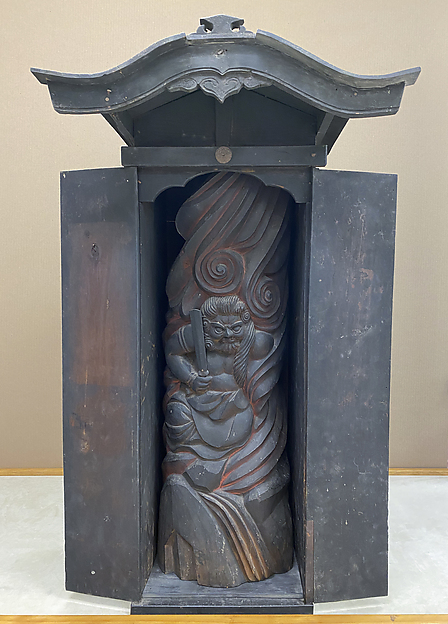
Look closer: Look at the inside. The cabinet is made to hold a single figure, here Fudō Myōō among flames, and the doors close to protect it. A closed zushi is a plain wooden box, and is often mistaken for furniture.
Unidentified artist, Altar Cabinet (Zushi) for Fudō Myōō, 19th century. The Metropolitan Museum of Art, Purchase, Gift of Estate of Mrs. E. H. Harriman, by exchange, 2016, accession 2016.363.2. Public domain (Met Open Access). Museum record

Look closer: Look at the pattern. The lotus roundel on a geometric ground is a classic altar-cloth design: woven silk with supplementary weft, made to lie flat on an altar table beneath offerings.
Maker unrecorded, Buddhist Altar Cloth (Uchishiki), first half 19th century. The Metropolitan Museum of Art, Edward C. Moore Collection, Bequest of Edward C. Moore, 1891, accession 91.1.18. Public domain (Met Open Access). Museum record
A traveller’s shrine or a small portable figure belongs to the same family. The tiny peach-shaped shrine shown in the collector’s section below holds a seated Amida in a hinged case, made so that a person could carry a figure of devotion in a pocket or a sleeve. For the collector these small things are often the most approachable way to start, because they bring the whole vocabulary of a shrine, a figure, a halo and a base into a few centimetres.
The Families of the Pantheon
The Japanese Buddhist pantheon is large but it is orderly, and most of what a collector meets belongs to a few families. The routes at the top of the page lead to the hub for each one and to the page for every principal figure. The summary below is the map.
| Family | Character | Principal figures |
|---|---|---|
| Nyorai (Buddhas) | Awakened; plain robe, serene face, no jewellery | Shaka (the historical Buddha), Amida (Pure Land), Yakushi (healing), Dainichi (cosmic Buddha of the esoteric schools) |
| Bosatsu (bodhisattvas) | Compassion in action; princely dress, crown, ornament (Jizō as a monk) | Kannon, Jizō, Monju, Fugen, Miroku, Seishi |
| Myōō (wisdom kings) | Fierce protectors of the esoteric teaching; flames, weapons, wrathful faces | Fudō, Aizen, the Five Great Kings (Godai Myōō), Daiitoku |
| Ten (heavenly beings) | Guardians and gods adopted from India and China | Bishamonten, Benzaiten, Daikokuten, the Four Heavenly Kings (Shitennō), the Niō gate guardians |
| Others | Disciples, patriarchs, lucky gods and founders | Rakan (arhats), Daruma, Kōbō Daishi (Kūkai), the Seven Lucky Gods (Shichifukujin) |
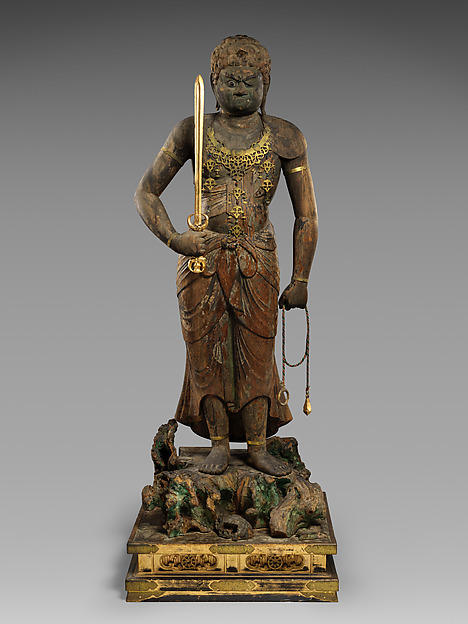
Look closer: Look at the stance and the weapon. The sword is raised and the rope hangs from the other hand: the two tools of the figure, shown here standing.
Maker unrecorded, Fudō Myōō (Achala Vidyaraja), 12th century. The Metropolitan Museum of Art, The Harry G. C. Packard Collection of Asian Art, Gift of Harry G. C. Packard, and Purchase, Fletcher, Rogers, Harris Brisbane Dick, and Louis V. Bell Funds, Joseph Pulitzer Bequest, and The Annenberg Fund Inc. Gift, 1975, accession 1975.268.163. Public domain (Met Open Access). Museum record
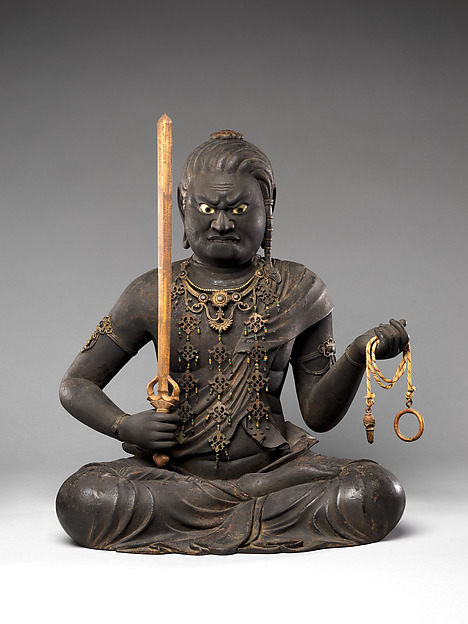
Look closer: Look at the seated form. Fudō may stand or sit; this seated figure holds the sword upright and a cord in the other hand, and the gold patterns on the dark robe are cut gold leaf.
Kaikei, Fudō Myōō, the Immovable Wisdom King (Achala Vidyaraja), early 13th century. The Metropolitan Museum of Art, Mary Griggs Burke Collection, Gift of the Mary and Jackson Burke Foundation, 2015, accession 2015.300.252a, b. Public domain (Met Open Access). Museum record
Two guardian families deserve a separate word because they appear at the entrances of nearly every temple. The Niō are the paired gatekeepers, one with the mouth open, one with the mouth closed, said to speak the first and last sounds of the Sanskrit alphabet. The Shitennō, the four heavenly kings, stand at the four corners of the central altar and guard the four directions. The wisdom king Fudō is the most commonly seen of his rank in household shrines and in temple altars alike.

Look closer: Look at the muscles and the stance. The Niō are shown in a moment of defence, with flexed arms, tensed chest and a fierce mouth: they stand at the gate to guard what is behind.
Maker unrecorded, Temple Guardian (Nio, one of a pair), early 14th century. The Metropolitan Museum of Art, Gift of Mr. and Mrs. Samuel Josefowitz, 1964, accession 64.292.1. Public domain (Met Open Access). Museum record

Look closer: Look at the armour and the staff. Bishamonten, the guardian of the north, is dressed as a general; he is also one of the Seven Lucky Gods.
Maker unrecorded, The Guardian King Bishamonten, 12th century. The Metropolitan Museum of Art, Rogers Fund, 1959, accession 59.137.2a–c. Public domain (Met Open Access). Museum record
Scrolls, Mandalas and Painted Images
Not every sacred image is sculpture. Buddhist painting (butsuga) has always run alongside the carved figure, and in the household it has often been the more common of the two. A hanging scroll (kakejiku) of Amida with attendants, a wisdom king in flames or a figure of Kannon takes little room, travels well and hangs from a wall or a hook. A mandala, a diagram of the Buddhist cosmos in which figures are arranged by rank around a centre, is both a painting and a map.
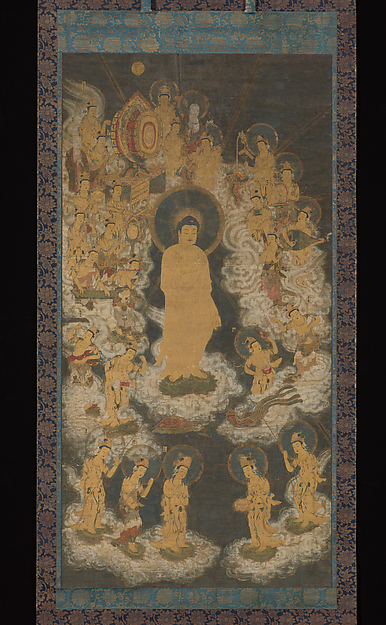
Look closer: Look at the descent. Amida comes down among clouds with a host of attendants to welcome a dying believer, a subject known as raigō. The scroll was made to hang before a sick person.
Unidentified artist, Welcoming Descent of Amida and Bodhisattvas, late 14th century. The Metropolitan Museum of Art, Gift of Abby Aldrich Rockefeller, 1942, accession 42.25.37. Public domain (Met Open Access). Museum record

Look closer: Look at the layout. This mandala shows the western paradise of Amida in tiers, with buildings, ponds and figures; it is a picture of a place, not a single deity.
Maker unrecorded, Taima Mandala, 14th century. The Metropolitan Museum of Art, Rogers Fund, 1957, accession 57.156.6. Public domain (Met Open Access). Museum record
A scroll has its own vocabulary of mounting: the picture is surrounded by layers of silk, held between roller ends and hung from a cord. The chapter on scroll mounting explains the parts, and the page on Buddhist painting goes through the major subjects. A scroll is often the most accessible way into sacred art, because it can be rolled, stored flat in a box and shown by season.
What We Look For
The house position is plain: a Buddhist figure should be described for what it is, with its age stated honestly in the vocabulary of periods. A Showa-period carving is a good thing and should be called one; an old figure is a different thing and should be called one with the evidence set out. A collector is entitled to know which is which, and the descriptions on the shelf are written with that in mind.
- Identity. Do the hands, the head and the attributes agree on who the figure is?
- Construction. Single block or joined; hollow or solid; original base and halo or replacements.
- Surface. Original gilding or lacquer, or later regilding; areas of loss, retouching or heavy cleaning.
- Interior. Any inscription, any sealed cavity, any evidence of objects placed inside.
- Condition. Cracks, insect holes, lost fingers and halos, and how they have been dealt with.
- Provenance. What is known of where the figure has been; temple pieces and registered treasures cannot leave Japan.
- Respect. A figure that once stood in a temple or a household altar was an object of devotion; treat it accordingly.

Look closer: Look at the scale. This whole shrine is only a few centimetres across, a pocket altar, yet it keeps every element of the large form: seat, halo, flames and a hinged door.
Maker unrecorded, Traveller's Shrine with Figure of Amida Buddha Seated on Lotus Throne, late 19th century. The Metropolitan Museum of Art, Bequest of Susan Dwight Bliss, 1966, accession 67.55.60a, b. Public domain (Met Open Access). Museum record
Care at home
A Buddhist figure is best kept out of direct sun and away from radiators, in a stable room with moderate humidity; gilded and lacquered surfaces are the most sensitive and should never be wiped with water or with polish. Dust gently with a soft brush. Keep the figure at or slightly above eye level and on a stable support, since a falling figure is more at risk than a handled one. Use incense sparingly near a gilded surface, as smoke deposits darken the gold over time. For a figure that needs more than that, a specialist conservator is the right person, not a general restorer, and the page on caring for Buddhist statues and the guide to condition and restoration explain what to ask.
Where a figure is not on the shelf, the house concierge can search for one on your behalf. Describe what you are looking for in a private request at the foot of this page, and the team in Tokyo will reply personally.
Dates That Hold the Story Together
| Date | Event |
|---|---|
| Sixth century | Buddhism reaches Japan from the Korean peninsula and is adopted at court. |
| 593 (traditional date) | Prince Shōtoku becomes regent and promotes the faith. |
| 623 | The Shaka Triad in the Golden Hall of Hōryū-ji, gilt bronze, usually credited to Tori Busshi. |
| 710 | The capital moves to Nara; a state temple network is built. |
| 752 | The colossal gilt-bronze Buddha of Tōdai-ji is completed. |
| 794 | The capital moves to Heian-kyō (Kyoto); the esoteric schools of Tendai and Shingon grow. |
| Mid-eleventh century | The master Jōchō perfects joined-wood construction (yosegi-zukuri). |
| 1180 | Nara is burned in the war between the Taira and the Minamoto, and its great temples are rebuilt. |
| 1203 | Unkei, Kaikei and their teams complete the Niō of the south gate of Tōdai-ji. |
| 1291 | The date given for a standing Jizō now in the Metropolitan Museum, a dated figure of the Kamakura period. |
| Seventeenth century | Households are required to register with a temple; the butsudan spreads into ordinary homes. |
| 1632 to 1695 | The life of Enkū, carver of rough-hewn wooden Buddhas. |
| 1868 | The separation of Shinto and Buddhism; several years of damage to temples and images follow. |
| 1897 | The first law for the preservation of ancient temples and shrines. |
| 1950 | The Law for the Protection of Cultural Properties, still the basis of Japanese heritage law. |
Five Tales From Temple and Workshop
The statue that was made alive
In Japanese practice an image is not complete when the sculptor puts down the chisel. It is completed by a ceremony of eye-opening, kaigen, in which a priest brings the figure to life. Before the ceremony the figure is a work of art; after it, it is a presence. The distinction explains why a statue that has been retired from a temple is often given a farewell rite before it is moved.
What was inside
When a figure is opened for repair, the inside is often the best-preserved part. A hollow carving may hold sutra scrolls, written prayers, small images, coins or even grains of rice placed there by those who commissioned it. These objects have given scholars names, dates and the lists of donors, and they are the reason that a catalogue entry for a temple figure so often runs to the inside.
The gate and its guardians
The Niō of the south gate of Tōdai-ji, made in 1203, are among the largest wooden sculptures in Japan. They were made by teams working under Unkei and Kaikei, and tradition remembers the work as astonishingly fast. The joined-wood method explains how: it let many hands work on different parts at once. The workshop system, rather than one genius, is what the story is really about.
The wandering carver
Enkū (1632 to 1695), a wandering monk, carved large numbers of images in rough, angular strokes. His figures were left unpainted and have a startling directness, and their styles were reassessed in the twentieth century, when their plain energy appealed to a modern eye.
A walk with Jizō
Jizō is the most visible Buddhist figure in Japan, because he stands at roadsides and in graveyards in the form of small stone figures, often dressed in a bib or a cap by those who ask for the protection of a child. The figure at the roadside and the lacquered Jizō in a museum are the same figure in two registers, one for the street and one for the hall. It is a useful reminder that most Buddhist sculpture in Japan is public, small and weathered.
Small Things Worth Knowing
- The word for a Buddhist statue, butsuzō, simply means Buddha image, and it is used for figures of every rank, not only the Buddhas.
- The tuft of curls on a Buddha’s head, the rahotsu, is traditionally counted as snail-shell curls, and the bump beneath is called the nikuke.
- Hōryū-ji, which holds the Shaka Triad of 623, is often cited as the oldest surviving wooden building complex in the world.
- A Niō pair is always read as a pair: one mouth open, one closed. A single Niō was never meant to be alone.
- Joined-wood construction is lighter than carving from a single trunk, which is why very large wooden figures survive from the Kamakura period.
- A butsudan shown closed is a handsome piece of furniture; its doors are opened to greet the figure inside.
Why Sacred Art Still Matters
A Japanese Buddhist image still does what it was made to do. It is a focus: in a temple, a household, a garden, a bedroom shelf or a quiet corner of a city flat. The pleasures a collector finds in it are real and they are old ones. There is the craft, in lacquer, gold and the grain of a single block of cypress; the learning, in a vocabulary of gestures and attributes that takes years to master; and the presence, which is hard to explain and easy to feel.
There is also responsibility. A figure made as a devotional object carries expectations that a decorative piece does not, and the best collectors treat that with seriousness: they study before buying, they ask honest questions about age and condition, they avoid pieces that have clearly been taken from a place of worship without proper release, and they give a figure a respectful setting at home. The page on the ethics of collecting religious objects sets out the principles the house follows.
Glossary of 56 Terms
The words below recur in every catalogue of Buddhist art. Each is given in English letters, in Japanese, and in a plain definition. For a longer reference, the Dictionary of Buddhism and Zen goes further.
A
- Abhaya mudra (Semui-in) 施無畏印
- The gesture of fearlessness: the right hand raised, palm out. It offers reassurance and protection.
- Amida 阿弥陀
- The Buddha of Limitless Light, who presides over the Western Pure Land and is central to Pure Land devotion.
- Arhat (Rakan) 羅漢
- A disciple who has reached awakening; groups of sixteen or five hundred are often carved or painted.
B
- Bosatsu 菩薩
- A bodhisattva: a being who delays final peace to help others, shown in princely dress, except Jizō.
- Butsudan 仏壇
- The household altar, holding a central figure, memorial tablets and offerings.
- Butsuga 仏画
- Buddhist painting: scrolls, mandalas and temple pictures.
- Butsuzō 仏像
- A Buddhist image or statue, of any rank.
- Byakugō (urna) 白毫
- The tuft of white hair between the eyebrows of a Buddha, shown as a dot, a jewel or a crystal.
C
- Chiken-in 智拳印
- The fist-of-wisdom gesture, one forefinger enclosed by the other hand, used for the diamond-realm Dainichi.
D
- Dainichi 大日
- The cosmic Buddha of the esoteric schools, the source from which other figures emanate.
- Daiza 台座
- The pedestal or seat of a figure, most often a lotus.
- Dōji 童子
- A child attendant, often accompanying a wisdom king such as Fudō.
- Dry lacquer (Kanshitsu) 乾漆
- A technique in which layers of lacquer-soaked cloth are built over a core; used mainly in the Nara period.
F
- Fudō 不動
- The Immovable wisdom king, with sword and rope, the most widely seen of the fierce figures.
G
- Gasshō 合掌
- The gesture of prayer, palms pressed together.
- Gofun 胡粉
- A white pigment made from ground shell, used for faces and grounds.
- Gyokugan 玉眼
- Eyes of rock crystal set from inside the head of a figure, common from the late Heian period and the Kamakura.
H
- Haibutsu kishaku 廃仏毀釈
- The movement after 1868 to abolish Buddhism, during which temples and images were destroyed or sold.
- Hinoki 檜
- Japanese cypress, the principal wood for Buddhist sculpture from the Heian period onward.
- Hōju 宝珠
- The wish-granting jewel, held by Jizō, Kannon and others.
- Honzon 本尊
- The principal image of a temple, altar or household shrine.
I
- Ichiboku-zukuri 一木造
- Carving a figure from a single block of wood, usually hollowed from behind.
- Ihai 位牌
- A memorial tablet bearing the posthumous name of a family member, kept on the household altar.
J
- Jō-in 定印
- The meditation gesture, both hands in the lap with palms up.
- Juzu 数珠
- Buddhist prayer beads, used to count recitations.
K
- Kaigen 開眼
- The ceremony of eye-opening, by which a figure is made a living presence.
- Kakejiku 掛軸
- A hanging scroll, a mounted painting or calligraphy.
- Kannon 観音
- The bodhisattva of compassion, shown in many forms: eleven-headed, thousand-armed, horse-headed.
- Kesa 袈裟
- The monastic robe worn by a Buddha or a monk, draped over the shoulder.
- Kirikane 截金
- Cut gold: fine strips of gold leaf laid by hand to draw patterns on a figure or a painting.
- Kōhai 光背
- A halo or mandorla behind a figure, in leaf, boat, ring or flame form.
- Kongō-rikishi 金剛力士
- The diamond-strong guardians, another name for the paired Niō at temple gates.
- Kongōsho 金剛杵
- The vajra, a ritual implement symbolising the indestructible diamond of wisdom.
- Kuyō 供養
- A memorial or offering service, including the rite for retiring a figure.
M
- Mandala 曼荼羅
- A diagram of the Buddhist cosmos, arranging figures by rank around a centre.
- Mudra (In) 印
- A symbolic hand position with a fixed meaning.
- Myōō 明王
- A wisdom king: a fierce protector of the esoteric teaching, with flame halo and weapons.
N
- Nikuke (ushnisha) 肉髻
- The raised bump on the crown of a Buddha’s head, a sign of awakening.
- Niō 仁王
- The paired guardians at temple gates, one with open mouth and one with closed.
- Nōnyūhin 納入品
- Objects placed inside a hollow figure: sutras, relics, small images, written prayers.
- Nyorai 如来
- A Buddha, one who has attained awakening, shown in a plain robe without jewellery.
R
- Rahotsu 螺髪
- The snail-shell curls of a Buddha’s hair.
- Raigō 来迎
- The welcoming descent of Amida and his attendants to meet the dying believer.
- Rendai 蓮台
- A lotus pedestal.
S
- Sanzon 三尊
- A triad: a central figure with two attendants.
- Sekibutsu 石仏
- A stone Buddhist figure: roadside, graveyard or garden.
- Seppō-in 説法印
- The teaching gesture, the hand raised with thumb and finger forming a circle.
- Shaka 釈迦
- Shakyamuni, the historical Buddha.
- Shakujō 錫杖
- The ringed monk’s staff, the attribute of Jizō.
- Sozō 塑造
- Clay modelling, over a wooden armature, used in the Nara period.
T
- Ten 天
- A heavenly being: a protective deity of Indian or Chinese origin.
- Terauke 寺請
- The seventeenth-century system requiring households to register with a temple.
U
- Uchishiki 打敷
- A silk altar cloth laid on the altar table beneath offerings.
Y
- Yogan-in 与願印
- The wish-granting gesture: hand lowered, palm open and out.
- Yosegi-zukuri 寄木造
- Joined-wood construction: a figure made from several hollowed pieces assembled together.
Z
- Zushi 厨子
- A cabinet with doors that shelters a figure, from pocket size to wardrobe size.
A to Z of Figures and Objects
47 entries: figures, forms, reference pages and the practical guides. Each name is a link to its own page.
- Aizen Myōō愛染明王The wisdom king of passion turned to awakening, red, with six arms.
- Amida Nyorai阿弥陀如来The Buddha of Limitless Light and the Pure Land.
- Benzaiten弁才天Goddess of music, water and eloquence, one of the Seven Lucky Gods.
- Bishamonten毘沙門天Guardian of the north, a general in armour and a lucky god.
- Buddhism and Zen Almanac仏教The master work for the faith and its schools.
- Buddhist deity ranks格The four ranks: nyorai, bosatsu, myōō and ten.
- Busshi, Buddhist sculptors仏師The workshops and masters who carved the figures.
- Butsudan仏壇The household altar.
- Butsudan Almanac仏壇The reference work on household altars.
- Caring for statues手入れLight, humidity, dust and handling.
- Daiitoku Myōō大威徳明王Conqueror of death, riding an ox with six faces and six arms.
- Dainichi Nyorai大日如来The cosmic Buddha of the esoteric schools.
- Daruma達磨Bodhidharma, the founder of Zen in tradition, shown in a red hood.
- Dictionary of Buddhism and Zen辞典The reference dictionary of terms.
- Displaying sacred art飾り方Height, setting and respect.
- Esoteric Buddhism密教The secret teaching of Shingon and Tendai.
- Fudō Myōō不動明王The Immovable wisdom king, with sword and rope.
- Fugen Bosatsu普賢菩薩Bodhisattva of practice, riding a white elephant.
- Godai Myōō五大明王The Five Great Wisdom Kings.
- Jizō Bosatsu地蔵菩薩The guardian of travellers, children and the dead, shown as a monk.
- Juzu数珠Buddhist prayer beads.
- Kannon Bosatsu観音菩薩The bodhisattva of compassion.
- Kōbō Daishi (Kūkai)空海Founder of the Shingon school and a patron of many images.
- Materials of the figures素材Wood, lacquer, gold, clay, bronze, stone.
- Miroku Bosatsu弥勒菩薩The Buddha of the future, Maitreya.
- Monju Bosatsu文殊菩薩Bodhisattva of wisdom, riding a lion.
- Mudras印相The hand gestures and their meanings.
- Niō, gate guardians仁王The paired guardians at the temple gate.
- Okimono and Statues Almanac置物Display figures and sculpture beyond the temple.
- Painting of the faith仏画Scrolls, mandalas and temple pictures.
- Periods of Buddhist sculpture時代The sequence of periods and styles.
- Pilgrimages in Japan巡礼The routes that link temples and images.
- Pure Land Buddhism浄土教The devotion to Amida and the Western paradise.
- Rakan羅漢The arhats, disciples who have attained awakening.
- Sanzon, triads三尊A central figure with two attendants.
- Seishi Bosatsu勢至菩薩The bodhisattva of power who attends Amida.
- Shaka Nyorai釈迦如来The historical Buddha.
- Shichifukujin七福神The Seven Lucky Gods.
- Shitennō四天王The Four Heavenly Kings, guardians of the four directions.
- Temple bells and gongs梵鐘The bells of the temple and the household.
- Thirteen Buddhas十三仏The thirteen figures of the memorial cycle.
- Vajra and ritual implements金剛杵The ritual tools of the esoteric schools.
- Who’s who in Buddhism人名A guide to the figures and founders.
- Wisdom kings明王The fierce protectors of the esoteric teaching.
- Yakushi Nyorai薬師如来The Buddha of healing, holding a medicine jar.
- Zen Buddhism禅The meditation school and its images.
- Zushi, portable shrines厨子The closing cabinets that shelter a figure.
Asked and Answered
How do I tell a Buddha from a bodhisattva?
Look at dress and ornament. A Buddha (nyorai) wears a plain monastic robe and no jewellery, with tight curls on the head and a raised bump on the crown. A bodhisattva (bosatsu) is dressed as a prince, with a crown or high chignon, jewelled necklaces and a scarf. The exception is Jizō, a bodhisattva shown as a shaven monk.
What do the hand gestures mean?
Each hand position (mudra) carries a fixed message. A raised right hand with the palm out is fearlessness; a lowered open hand is the granting of wishes; both hands in the lap is meditation; hands together is reverence. Together they tell you what the figure is doing. The page on mudras goes through the full set.
How can I tell the age of a statue?
Age is read from construction, surface and wear together: single-block or joined wood, the character of the gilding or lacquer, the form of the base and halo, the style of the face and drapery, and any inscription inside. Be wary of confident dates from photographs; a Showa-period figure made in an old style is a good thing, and should be called that.
What is the difference between a Buddhist statue and an okimono?
A butsuzō is made as an object of devotion for a temple or altar. An okimono is a display figure for a room, and may borrow Buddhist subjects without a devotional purpose. The Okimono and Statues Almanac sets out the difference and the overlap.
Why do some statues have eyes that seem to glint?
From the late Heian period and especially in the Kamakura, many figures were given inlaid eyes of rock crystal (gyokugan), painted on the back and set from inside. The crystal catches light and gives the gaze a living quality.
What is inside a hollow figure?
Often a dedication in ink, and sometimes sutras, relics, small images, coins or grains placed there by the donors. A cavity that has been resealed should be left to a specialist to open.
Is it appropriate to own a Buddhist figure at home?
Many Japanese households do, in the form of a butsudan with a central figure. For a collector outside the tradition, the usual courtesy is to treat the figure with respect: place it at or above eye level, keep it clean, do not use it as a mere prop, and do not buy figures that appear to have been removed from a temple without release.
Can important figures be exported from Japan?
Not always. Figures designated as national treasures or important cultural properties may not leave the country, and registered temple objects follow strict rules. Other figures are treated differently, but rules and paperwork apply, and they differ by object. When in doubt, ask the concierge team before you commit.
How should I care for a gilded figure?
Keep it out of direct sun and heat, in stable humidity, dust it with a soft brush and never use water or polish. Handle by the base, not the halo or the hands. For repairs, consult a conservator who works on lacquer and gilding.
What is a zushi, and why does it close?
A zushi is a cabinet with doors that shelters a figure. It closes to protect the figure from dust and light and, for a portable one, to make it safe to carry. Opening the doors is part of the act of devotion.
Can the concierge find a particular figure?
Yes. Send a private request with the figure you have in mind, a budget range and any condition preferences; the Japonista Curation and Concierge Team in Tokyo will reply personally.
On the Shelf Today
Real pieces from the house, photographed in Tokyo: Buddhas and bodhisattvas in wood, metal and stone, a shrine and a pair of guardians. The shelf changes as pieces find their homes; the collections behind it are always open.
 Gilt-wood Shaka Nyorai with boat-shaped haloStanding Buddha on a lotus pedestal, 49 cm
 Showa giltwood standing KannonOpenwork halo, lotus pedestal and tiered plinth
 Cast metal standing KannonBlack patina on a rock pedestal, 55 cm
 Large zushi shrine with KannonFlame halo and gilt tiered pedestal
 Jizō stone relief in prayerSekibutsu-style garden sculpture
 Fujin and Raijin wooden pairWind and thunder gods, inscribed box
Open a whole shelf
Further Reading and Neighbouring Worlds
Three outbound references for study. Within the Athenaeum, the neighbouring worlds are the almanacs of Buddhism, of the household altar and of the display figure, all linked above.
Sources and Image Credits
Dated claims on this page were read in the references below. Where a single source stands alone for a figure, the text names it.
- Wikipedia, Japanese sculpture (Hōryū-ji triad of 623, Tōdai-ji Buddha of 752, dry lacquer, Jōchō and joined-wood construction, Kei school, Enkū, the Meiji separation of Shinto and Buddhism)
- The Metropolitan Museum of Art, Open Access collection (every museum image on this page, with object records and credit lines)
- The Japonista Dictionary of Buddhism and Zen and the Buddhism and Zen Almanac (terms, figures and ranks, linked above)
Image credits are printed beneath each picture: every museum image is from the Metropolitan Museum of Art Open Access collection (public domain), and shelf photographs are our own. Last reviewed 28 October 2026.
A private request
If a figure, a scroll or a shrine has caught your eye, or you are looking for something that has not yet appeared on the shelf, the Otoriyose door is open. Tell us what you are looking for, in a few lines or at length, and the concierge team will reply personally with what can be found and how it would reach you.
Make a private request · Return to the Buddhism and Zen Almanac · Return to the Athenaeum
The Japonista Curation and Concierge Team, Tokyo, Japan
Private concierge
Looking for something in particular?
Describe the piece or the project you have in mind. A senior advisor in Tokyo reads every case file personally and replies within two business days, with fees set out in writing before any work begins.