
Kabuki Costume: Hikinuki and the Onnagata Layers
Theatre · The Edo stage
Kabuki Costume: Hikinuki and the Onnagata Layers
歌舞伎衣裳
On the kabuki stage a costume is built to be seen, shed and seen again. The outer robe can be pulled away in front of the audience, and what lies beneath is the point of the scene.
Fact sheet
The kabuki wardrobe in one glance
- A name from dress. Wikipedia traces the word kabuki to the kabukimono, flamboyant street gangs who wore outlandish clothes.
- Layers and padding. Costumes are vibrant and multi-layered, and actors use padding to reach the right body shape.
- A quick reveal. In hikinuki and bukkaeri, one costume is layered over another and a stagehand pulls the outer one away.
- Faces as masks. Kumadori exaggerates the lines of the face; red shows passion and heroism, blue shows villainy.
- Men in women's roles. The onnagata play the female parts, and Tamasaburō V is described as the most celebrated today.
- Prints as records. Early costumes were not preserved, so today's are based on ukiyo-e records, according to Wikipedia.
A wardrobe made to be seen
Kabuki is the theatre of the unusual, and its clothes show it. Wikipedia describes the costumes as vibrant and multi-layered, notes that early costumes were not preserved, and says that today's costumes for men's and women's roles are reconstructed from ukiyo-e records and from work with families who have served in kabuki for generations. The sentence contains the whole difficulty of the subject. The cloth is gone; the prints, the memory of the craft families and a few surviving robes are what remain.
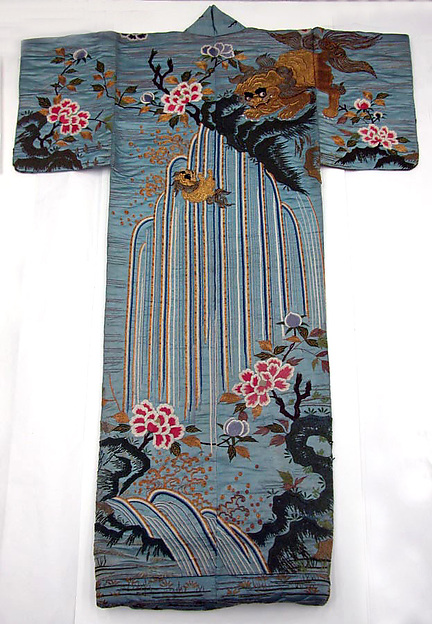
Kabuki Costume: Outer Robe (Uchikake) with Design of Lioness and Cubs, Second half of the 19th century, Silk, cotton, and metallic thread, glass, embroidered satin. The Metropolitan Museum of Art, Gift of Elizabeth Gordon, 1967, accession 67.177.1.
Look closer: Look at the back. The Met describes a lioness with glass eyes pushing a cub off a ledge to test its endurance, and a second cub climbing up on the front.
Image: The Metropolitan Museum of Art, Open Access (CC0)
The same article records that, in seventeenth-century Japan, feudal laws barred commoners from copying the look of samurai or nobles and from using luxurious fabrics, and that kabuki costumes were groundbreaking for the public and set trends that still exist. A theatre in which the clothes are lavish by design therefore stands against a world in which dress was regulated by rank. It is a point worth carrying into every section below.
This chapter follows the costume from its beginnings, in the dress of the street gangs called kabukimono and in the dances of Izumo no Okuni, through the all-male stage of the Edo period, the bold style and its face paint, the art of the onnagata, and the quick-change devices that make the costume a plot in itself. It ends with the actor prints that preserve the stage wardrobe, a case study in the dance Musume Dōjōji, and notes for anyone considering a theatrical textile.

Nonoyama Kōzan, Kabuki Theater, 1822, Handscroll; ink, color and gold on paper. The Metropolitan Museum of Art, Mary Griggs Burke Collection, Gift of the Mary and Jackson Burke Foundation, 2015, accession 2015.300.84.
Look closer: Look at the format. The Met records a handscroll in ink, colour and gold on paper, dated 1822.
Image: The Metropolitan Museum of Art, Open Access (CC0)
The sister stage is described in Noh Costume: Karaori, Atsuita and Mizugoromo, where the robes are quieter, fixed and older. The history of the theatre itself is told in Kabuki: The Theatre of the Unusual and Kabuki Makeup, Kumadori and the Onnagata, and the wider stage in The Performing Arts Almanac. This chapter confines itself to what the actors wear.
The eccentric dress of the kabukimono
The word kabuki begins with clothes. Wikipedia describes the kabukimono, also called hatamoto yakko, as gangs of samurai in feudal Japan: rōnin, or former retainers of samurai families, who formed street gangs in peacetime. They appeared in the Azuchi-Momoyama period, from 1573 to 1603, as the Sengoku period ended, and were at their height in the Keichō period, from 1596 to 1615, after which the shogunate grew stricter and they faded.
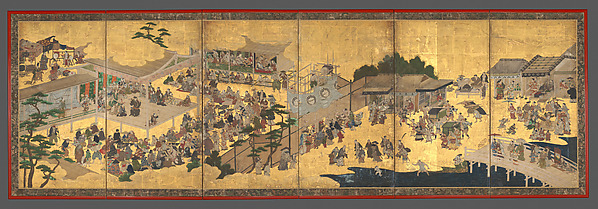
Kano Takanobu, Women’s Kabuki, mid- to late 1610s, Six-panel folding screen; ink, color, gold, silver, and gold leaf on paper. The Metropolitan Museum of Art, Purchase, Mary and James G. Wallach Foundation Gift; Mary Livingston Griggs and Mary Griggs Burke Foundation, Acquisitions, and The Camille M. Lownds Funds, 2017, accession 2017.730.
Look closer: Look at the title. The Met calls the screen Women's Kabuki, made in the years when troupes of women still performed, before the ban of 1629.
Image: The Metropolitan Museum of Art, Open Access (CC0)
Their dress is the most useful part of the record for a textile reader. According to Wikipedia, they wore flamboyant outfits that ignored traditional colours such as light yellow and dark blue. The items it names include haori jackets with lead weights in the hem, velvet lapels, wide obi, and women's clothing, together with European clothing, Chinese hats and jinbaori surcoats made from Persian carpet. They also wore uncommon hairstyles, and carried swords with fancy hilts, large or square guards and red scabbards, and blades usually longer than normal. The haori and the surcoat are the subject of Haori and Hakama: The Jacket and the Divided Skirt and Jinbaori: The Warlord’s Surcoat.
The article ties the gangs to the theatre in a single sentence: the term kabukimono is the origin of the name for kabuki theatre, and kabuki's founder, Izumo no Okuni, was heavily inspired by them. It adds that the characters used to write the word are ateji, chosen for pronunciation rather than meaning, and that the verb kabuku, often translated as strange things or the crazy ones, is believed to come from a word meaning to slant or to deviate.

Utagawa Yoshikazu, Foreigners Enjoying Children's Kabuki at the Gankirō Tea House, 1st month, 1861, Triptych of woodblock prints; ink and color on paper. The Metropolitan Museum of Art, Bequest of William S. Lieberman, 2005, accession 2007.49.160a–c.
Look closer: Look at the title. The Met names a triptych of the first month of 1861 showing foreigners at a children's kabuki performance.
Image: The Metropolitan Museum of Art, Open Access (CC0)
Okuni's own biography is more modest than her fame. Wikipedia says she was born about 1578 near Izumo Province, the daughter of a blacksmith working near the Izumo shrine, and served as a miko, a shrine maiden, at Izumo Grand Shrine. She was sent to Kyoto to perform sacred dances and songs in order to solicit contributions for the shrine, and became known there for the nembutsu odori, a dance honouring Amida Buddha that by her time was largely a secular folk dance. Around 1603 she performed on the dry riverbed of the Shijōgawara in the Kamo River in Kyoto, and at Kitano Shrine, and also for ladies of the imperial court.
Her troupe was all-female, and actresses played both male and female roles. Others labelled the troupe's performances kabuki, from the idea of eccentric, socially daring behaviour. Wikipedia credits her with introducing a forerunner of the hanamichi, the runway through the audience, and says she retired about 1610 and disappeared; the date of her death is variously given as 1610, about 1613 or 1640. The Met holds a six-panel screen, Women's Kabuki, by Kanō Takanobu, dated to the mid to late 1610s, from the years in which women still performed.
Shaved crowns and purple scarves
The first all-female stage did not last. Wikipedia records that in 1629 women were banned from performing, after the shogunate moved to keep order among its samurai patrons. Boys replaced women, and the third shogun, Iemitsu, took an interest in their performances. The all-male form, yarō-kabuki, was established in the decades that followed. Wikipedia's article on the onnagata gives the next episode: wakashū kabuki, in which young men played both male and female roles, began about 1612, and the ban on the wakashū was lifted in 1652 on condition that the actors adopt the adult male hairstyle with a shaved pate.

Torii Kiyomasu I, Kabuki Actors Nakamura Gentaro and Ikushima Shingoro, ca. 1710, Woodblock print; ink and color on paper. The Metropolitan Museum of Art, The Francis Lathorp Collection, Purchase, Frederick C. Hewitt Fund, 1911, accession JP654.
Look closer: Look at the date. The Met places the sheet about 1710, by Torii Kiyomasu I of the Torii school, which Wikipedia says painted theatre signboards.
Image: The Metropolitan Museum of Art, Open Access (CC0)
That condition left a mark on the costume. The same article says that onnagata and wakashū wore a small purple headscarf, murasaki bōshi, to cover the shaved head, and that after the ban on wearing wigs was rescinded a wig replaced it. A hairstyle rule, in short, produced a piece of dress, and then a trade: the wigmakers who, as the next section describes, now make the head of every role.
From these restrictions came the form we know. Wikipedia describes adolescent men as preferred in the onnagata roles, because of their less masculine appearance and higher voices, and records that the onnagata and the wakashū roles were taken over by men in the all-male system. The female part, as Wikipedia describes it, became a stylised expression of femininity with its own dress, posture and voice.
Layers, padding and copper-based wigs
The basic facts are given in Wikipedia's account of costume and make-up. Costumes are multi-layered. Both men's and women's roles sometimes wear hakama, the pleated trousers, and use padding to achieve the correct body shape. The street garments are described in The Kimono Ladder: Furisode, Tomesode, Hōmongi and Komon and the sash that holds the layers in Obi and Its Companions: Scarf, Cord and Brooch.

Torii Kiyotada, Ichikawa Danjūrō II in the Scene "Wait a Moment" (Shibaraku), ca. 1715, Woodblock print; ink and hand-painted color (tan-e) on paper. The Metropolitan Museum of Art, Harris Brisbane Dick Fund and Rogers Fund, 1949, accession JP3075.
Look closer: Look at the title. The Met names the cue Shibaraku, Wait a Moment, and dates the sheet about 1715.
Image: The Metropolitan Museum of Art, Open Access (CC0)
The wig, katsura, is a craft on its own. According to Wikipedia, each actor has a different wig for each role. The wigs have a thin base of hand-beaten copper, custom-fitted to the actor, and real human hair is hand-sewn onto a habotai base, though some styles use yak or horse hair. The hair ornaments that sit in these wigs are described in Kanzashi, Combs and the Dressed Head, and the footwear in which the onnagata train to walk, in Geta, Zōri and Tabi: The Footwear of the Kimono.
The Japan House London talk of November 2023 gives a modern picture of the people who dress the actors. Its notes introduce Ōkubo Hiroyoshi, born in 1979 into a family of craftsmen who made costumes for classical Japanese dance, certified by the Sōke Fujima school in November 1993 at the age of fourteen, who has worked on the making, maintenance, management and kitsuke, the dressing, of kabuki costumes since March 2002. The second speaker came from a family of Kanze-school Noh performers; the Noh side of the vocabulary is set out in Noh Costume: Karaori, Atsuita and Mizugoromo.
Kitsuke is the right word to hold on to, for it names a skill with its own practitioners. The embroidered and woven surfaces that make the layers worth looking at are the subject of Embroidery and Gold Leaf on Japanese Cloth and Nishijin: The Woven Brocades of Kyoto, and the dyed surfaces of Yūzen: The Painted Kimono.
Red lines on white powder
The face is dressed as carefully as the body. Wikipedia names the foundation of kabuki make-up as oshiroi, a white rice-powder base, over which the lines of kumadori exaggerate the face to create animal or supernatural masks. It gives the colours as follows: red shows passion, heroism and righteousness; blue or black shows villainy and jealousy; green shows the supernatural; and purple shows nobility.

Katsukawa Shunshō 勝川春章, Kabuki Actor Ichikawa Danjūrō V, 1774, Woodblock print (nishiki-e); ink and color on paper. The Metropolitan Museum of Art, Rogers Fund, 1922, accession JP1358.
Look closer: Look at the date. The Met dates this Shunshō portrait to 1774; Wikipedia says Shunshō focused on facial features so that actors could be identified across different roles.
Image: The Metropolitan Museum of Art, Open Access (CC0)
The article on kumadori adds that it is worn mostly by kabuki actors in the aragoto style and was originated and developed extensively by members of the Ichikawa Danjūrō family. It describes red as the colour of powerful heroes, often with virtue and courage, and blue as the colour of villains and negative emotions such as fear and jealousy, worn also by ghosts and fox spirits. Brown marks monsters and non-human spirits such as oni, and black is not symbolic but exaggerates features such as the eyebrows and the line of the mouth. Over fifty patterns exist, of which the page names five, among them suji-guma, the best-known red pattern, seen on the hero of Shibaraku, and mukimi-guma, for young, handsome, virtuous heroes such as Sukeroku.
The style has a founder. Wikipedia on Ichikawa Danjūrō I records that he was born in 1660 in Edo, debuted at thirteen at the Nakamura-za in 1673, took the name Danjūrō in 1675, and pioneered the aragoto style associated with Edo kabuki. His performance of 1673 in Shitennō Ochigodachi, as Sakata Kintoki, is credited with the first use of red-and-black striped make-up, now called kumadori. The article on aragoto defines the style as exaggerated, dynamic forms and speech, with bold red or blue make-up and enlarged, padded costumes, and contrasts it with wagoto, the soft style, which emerged about the same time and is more naturalistic.
Aragoto roles are the great costume roles of the male stage because the padding is part of the character. Wikipedia on kabuki adds that the held poses called mie are credited to Ichikawa Danjūrō I and developed during the Genroku period. A mie is the moment at which the costume, the make-up and the posture agree, and the audience sees the character as a single image. That is the same image the print-makers of the next sections were asked to catch.
The three-square crest
The play that shows the bold costume best is Shibaraku, the title meaning Just a Moment. Wikipedia lists it among the Kabuki Jūhachiban, the Eighteen Great Plays, an aragoto history play set at Tsurugaoka Hachimangū in Kamakura, running about fifty minutes and usually inserted between full plays, today mostly on special occasions such as an actor's name-change ceremony. It premiered in 1697 at the Nakamura-za in Edo, staged by Ichikawa Danjūrō I, and became so popular that it was quickly added to the annual kaomise celebrations of the Edo theatres.

Katsukawa Shunshō 勝川春章, The Actor Onoe Matsusuke in Shibaraku in Deep Red Robes, ca. 1781, Woodblock print (nishiki-e); ink and color on paper. The Metropolitan Museum of Art, Rogers Fund, 1925, accession JP1450.
Look closer: Look at the colour. The Met's title records deep red robes for the hero of Shibaraku as played by Onoe Matsusuke.
Image: The Metropolitan Museum of Art, Open Access (CC0)
The title comes from an incident. When fellow actors withheld his cue, the article says, Danjūrō I shouted Shibaraku! and stepped onto the hanamichi. The hero, Kamakura Gongorō Kagemasa, is described there as the stereotypical bombastic hero of the kabuki stage, with red-and-white striped make-up and strong, energetic movements, wearing a magnificent costume bearing the sanshō, the three-square crest of the Naritaya, the Danjūrō family's acting house. He enters from behind the curtain, walks the hanamichi, and sits on a stool to deliver a long monologue. He claims superhuman strength, draws a giant sword, cuts down his enemy's soldiers with one blow, strikes a mie and leaves with the exaggerated exit called roppō.
The Met's prints record this role more than once. A sheet by Torii Kiyotada, dated about 1715, shows Danjūrō II in the scene titled Wait a Moment. Katsukawa Shunshō's sheets of about 1781 are titled for the colour of the robe: Onoe Matsusuke in Shibaraku in deep red robes, and Nakamura Nakazō in Shibaraku in dark green robes. Kubo Shunman's surimono of 1796 goes one step further and shows the costume alone, titled Still Life of Costume of Ichikawa Danjūrō V, for Shibaraku. These titles suggest a role in which the dress carries much of the identity.
Wikipedia adds that Danjūrō VII standardised the play in the early nineteenth century and Danjūrō IX reworked it at the end of that century, and that the version of the latter has been performed since. A parody with a female lead, Onna Shibaraku, emerged about 1746, and its present form was set by Nakamura Shikan V in 1901. The costume survives as a type, and the sanshō on the sleeve is the crest of a family; the logic of crests is described in Mon: The Family Crests on Japanese Dress.
How men learned to wear a woman's kimono
The onnagata, written with the characters for female form, are male actors who play female roles. Wikipedia says they imitate typical feminine vocal intonations rather than copying women's voices exactly, that their make-up is vastly different from that for male characters, and that training includes walking gracefully in geta, adopting a feminine posture with slouched shoulders and bent knees, and speaking in falsetto throughout a performance. The article records that the role took shape in the Edo period as a stylised expression of femininity meant to align with the femininity of real women in Edo society.

Katsukawa Shunshō 勝川春章, The Actor Nakamura Nakazo in Shibaraku in Dark Green Robes, ca. 1781, Woodblock print (nishiki-e); ink and color on paper. The Metropolitan Museum of Art, Rogers Fund, 1925, accession JP1451.
Look closer: Look at the colour. The Met's title records dark green robes for the same hero as played by Nakamura Nakazō.
Image: The Metropolitan Museum of Art, Open Access (CC0)
The famous names it lists run from Sawamura Tanosuke III, who lived from 1845 to 1878, to Nakamura Utaemon V, who lived from 1866 to 1940, and Bandō Tamasaburō V, and it also names Yoshizawa Ayame I. It records that in the Meiji era the ban on women performing was lifted, and some women played onnagata roles, though this was uncommon. Kabuki on Wikipedia adds that the all-female Ichikawa Shōjo Kabuki Gekidan debuted in 1953, and that most troupes remain all-male. The Japan House London notes make the same point more plainly: only male actors perform on the kabuki stage, and the onnagata specialise in conveying femininity through subtle gestures, movements and manner of speaking.
The woman's kimono of the street was a garment of rank, age and season, as the chapters on The Kimono Ladder: Furisode, Tomesode, Hōmongi and Komon and Seasons and Occasions: What to Wear When show. The courtesan's costume belongs to the world described in Oiran and Tayū: The Courtesans of the Yoshiwara, and the dress of the geisha and the apprentice to the world of Geiko and Maiko: The Years of Training. The stage versions of both are the subject of Geisha, Maiko and Oiran: The Costume of the Quarter.
Several Met prints show the type. A sheet by Katsukawa Shunshō, of about 1786, is titled The Actor Segawa Kikunojō as a Courtesan of the Ōmiya Brothel. Utagawa Toyokuni's sheet of 1798 shows Segawa Kikunojō III in a mad female role. Tōshūsai Sharaku's sheet of 1794 shows Segawa Tomisaburō II as Yadorigi in the play Hana Ayame Bunroku Soga. They are the kind of evidence from which, Wikipedia says, today's costumes are reconstructed.
Six robes at Oxford
A modern wardrobe was shown in Britain in the winter of 2023. The Ashmolean Museum in Oxford exhibited six kimonos belonging to Bandō Tamasaburō V, whom its page describes as the most popular and celebrated onnagata on the kabuki stage today, developed in collaboration with the Japan Foundation London. The Selvedge account gives the first display as running from 21 November 2023 to 8 December 2024; the museum's own page gives a later display from 14 December 2024 to 9 November 2025, and describes earlier displays of some of the robes.

Kubo Shunman, Still Life of Costume of Ichikawa Danjūrō V, for Shibaraku, 1796, Woodblock print (surimono); ink and color on paper. The Metropolitan Museum of Art, Purchase, Marjorie H. Holden Gift, 2012, accession 2012.248.12.
Look closer: Look at the arrangement. The Met titles this surimono a still life of the costume, shown without the actor.
Image: The Metropolitan Museum of Art, Open Access (CC0)
The museum's description is specific about the craft. The roles represented are court ladies, courtesans, geisha and demons, and the techniques are weaving, dyeing, embroidery and hand-painting. Each kimono was hand-made by skilled craftsmen after a highly personalised process of creative consultation between the actor and the maker. The motifs named include wisteria, cherry blossoms, golden peacock feathers and swirling dragons. In the Ashmolean's account, a black silk robe embroidered with egrets, snowflakes and willow branches, made in 2022, was for the courtesan Yūgiri in Love Letters from the Pleasure Quarters, and a crimson robe with peonies and peacock feathers, made in 2001, was for the same role.
The robes for Agemaki, the courtesan of Sukeroku, Flower of Edo, are the most instructive. The Ashmolean describes a black satin robe with New Year decorations, among them a spiny lobster, worn at the Kabuki-za in Tokyo in June 2004; another with cherry blossoms and a ceremonial flame drum and curtain, representing the March Girls' Festival; and a robe with peonies painted in ink and gold pigment by the artist Muroi Toshio, a motif linked to the actor Ichikawa Ebizō, who played Agemaki's lover, Sukeroku. Selvedge adds a sash with a carp ascending a waterfall, embroidered on a pale blue-green satin ground. The other robes include Lady Shizuka's, of weeping cherry and phoenixes on white silk with gold diamond motifs, and a demon woman's, a Noh-style robe woven with maple leaves and gold diamond patterns on a gold ground.
Wikipedia gives Tamasaburō's dates: born Morita Shin'ichi on 25 April 1950 in Tokyo, he first appeared on stage at seven as Bandō Kinoji, took the name Bandō Tamasaburō in 1964, and was named a Living National Treasure in 2012, with the Praemium Imperiale and the title of Person of Cultural Merit in 2019. These dates place the robes in a living career, not in a closed collection.
The outer robe pulled away
The device that most separates kabuki dress from other costume is the reveal. Wikipedia describes hikinuki and bukkaeri as the techniques used to reveal a character's true nature: one costume is layered over another, and a stagehand pulls the outer one off in front of the audience. A related device, hayagawari, is the quick-change technique in which stagehands help actors change costumes rapidly. The outer robe is therefore made to be removed in view of the audience, and the garment beneath is the one the scene is leading to.

Torii Kiyonaga, Ichikawa Yaozo III in the Role of Sukeroku from the Play "Yukari no Edo-sakura", also known as "Sukeroku", 1784, Woodblock print; ink and color on paper. The Metropolitan Museum of Art, The Howard Mansfield Collection, Purchase, Rogers Fund, 1936, accession JP2603.
Look closer: Look at the title. The Met names the role Sukeroku in Yukari no Edo-sakura, in a sheet by Torii Kiyonaga.
Image: The Metropolitan Museum of Art, Open Access (CC0)
The stagehands who do this are the kuroko. Wikipedia describes them as dressed entirely in black, traditionally treated as invisible, adding and removing props, backdrops and scenery in view of the audience. The article on kuroko adds that black clothing signals that they are invisible and not part of the onstage action, that they help with scene and costume changes, and that for scenes such as a snowstorm or the sea they wear white or blue to blend into the background, called yukigo, snow-clad, and namigo, wave-clad. It notes that kabuki actors playing stealthy ninja sometimes dressed as kuroko, which may have helped create the popular image of ninja in black, a suggestion it attributes to the historian Stephen Turnbull, and adds that real ninja usually dressed like civilians.
The audience agrees not to see the person in black, and so the quick change can happen in view. Wikipedia lists the stage machinery of the same theatre: the revolving stage developed in the Kyōhō era, from 1716 to 1735, the traps called seri, used since the middle of the eighteenth century, and the flying called chūnori that appeared toward the middle of the nineteenth century.
The Met's collection includes a related object: a surimono of the 1810s by Kubo Shunman titled Costume for the Butterfly Dance. The museum's label says that performers in the dance wear ornate crowns and colourful costumes that resemble butterfly wings, and that the dance began as a court dance, bugaku, and was later adopted into the Noh and kabuki repertoires. The court origin is told in Gagaku and Bugaku: The Court Music and Dance.
Nine robes in an hour
The dance that shows the change as drama is Musume Dōjōji, the Maiden at Dōjōji Temple. Wikipedia calls it the oldest surviving Noh-based kabuki dance drama, derived from the Noh play Dōjōji, in which a woman, later named Kiyohime, becomes a serpent-demon out of rage at a rejected love and destroys a temple bell that was hiding a priest. A kabuki version may have been staged in the 1670s and was performed in Edo in 1701. The version that became definitive premiered in Kyoto in 1752, by Nakamura Tomijūrō I, and was staged at the Nakamura theatre in Edo the following year. Onnagata are expected to learn the piece to show mastery of classic dance.

Tōshūsai Sharaku, Kabuki Actor Morita Kan’ya VIII as the Palanquin-Bearer in the Play A Medley of Tales of Revenge (Katakiuchi noriaibanashi), 5th month, 1794, Woodblock print; ink, color, white mica on paper. The Metropolitan Museum of Art, Harris Brisbane Dick Fund and Rogers Fund, 1949, accession JP3117.
Look closer: Look at the date. The Met dates the sheet to the fifth month of 1794, within the 1794 to 1795 months in which Wikipedia says Sharaku was active.
Image: The Metropolitan Museum of Art, Open Access (CC0)
The costume is the structure of the piece. Wikipedia notes nearly an hour of dance with nine costume changes, and classifies the work as a hengemono, a change piece. The heroine, Hanako, enters along the hanamichi, adjusts her hair at a mirror and is given a tall gold hat by the monks. She dances the opening in a red costume and the gold hat, in the solemn Noh style, with a fan. She then removes the hat and performs a hikinuki into a pale costume for the livelier kabuki section, and returns with a large circular hat. A second hikinuki reveals the costume for the tambourine dance. At the climax she goes behind the bell, changes costume with her hair hanging in two strands, climbs the bell, and her kimono falls away to reveal a snake costume.
The Noh version of the same revelation is described in Noh Costume: Karaori, Atsuita and Mizugoromo, where the robe is folded down at the waist to show the gold triangles that stand for the scales of a serpent. The two arts use the same idea and different means: the Noh actor folds the robe; the kabuki actor loses it. The dance forms are described in Nihon Buyo: The Dance of the Stage and the Salon.
The Met's prints show how long the role has been a costume role. Ippitsusai Bunchō's sheet of about 1771 is titled Ichimura Uzaemon IX in the role of Kiyohime in Musume Dōjōji. Katsukawa Shunshō's sheet of February 1774 shows Segawa Tomisaburō in the role. The most affecting, by Kitagawa Utamaro of about 1795 to 1796, shows a woman dressing a girl for the dance; the museum's account is that the main scene shows an ambitious mother dressing her daughter for the role of Kiyohime, while a small picture above parodies another play. The dressing is the subject, and the costume is the occasion.
Actor prints as a wardrobe record
Because early costumes were not preserved, the print is the record. Wikipedia on yakusha-e, the actor print, defines it as portraits of kabuki actors in the ukiyo-e style, popular from the Edo period into the early twentieth century. Torii Kiyonobu, who lived from 1664 to 1729, was likely one of the first to make actor prints in the mainstream style, and by 1700 his Fūryū ehon shihō byōbu had set the canon for mie poses. The Torii school painted theatre signboards, and its prints were generalised and promotional.

Tōshūsai Sharaku, Segawa Tomisaburō II as Yadorigi in the Play "Hana Ayame Bunroku Soga", 1794, Woodblock print; ink, color, white mica on paper. The Metropolitan Museum of Art, Harris Brisbane Dick Fund and Rogers Fund, 1949, accession JP3112.
Look closer: Look at the role. The Met names the part Yadorigi in Hana Ayame Bunroku Soga, played by Segawa Tomisaburō II.
Image: The Metropolitan Museum of Art, Open Access (CC0)
In the 1760s, Katsukawa Shunshō focused on facial features so that actors could be identified across different roles. Tōshūsai Sharaku was active in 1794 and 1795, and Utagawa Toyokuni's best-known actor prints appeared in 1794 to 1796. The article makes a point that matters for dress: prints advertised the plays of the season, new productions often came with new costumes, and costumes lasted only some weeks in performance. Some prints were given away free as souvenirs of a performance.
The Met's prints can be read as costume plates. The sheet of the 1790s by Katsukawa Shunkō shows Segawa Kikunojō III and Ichikawa Monnosuke II with two courtesans celebrating the New Year. Torii Kiyonaga's sheet of 1784 shows Ichikawa Yaozō III as Sukeroku in Yukari no Edo-zakura. Wikipedia on Sukeroku records that the play, one of the Kabuki Jūhachiban, premiered in 1713 and is set in the Yoshiwara, that its hero is revealed to be the samurai Soga Gorō, and that the Ichikawa family secured control of the play in 1832 under the title Sukeroku Yukari Edo Zakura. The play thus has a print tradition, and the print tradition has a costume tradition behind it.
Two further Met objects belong to the theatre itself: a handscroll titled Kabuki Theater, by Nonoyama Kōzan, dated 1822, and a triptych by Utagawa Yoshikazu, of the first month of 1861, is titled Foreigners Enjoying Children's Kabuki at the Gankirō Tea House. The later history of the prints in the ukiyo-e world is told in Ukiyo-e Art.
A lioness tests her cub
The Metropolitan Museum's collection includes a kabuki outer robe, uchikake, of the second half of the nineteenth century, given by Elizabeth Gordon in 1967. It is made of silk, cotton and metallic thread, glass and embroidered satin, and measures 172.7 by 118.1 centimetres. The museum's description is a story: on the back, a lioness with glass eyes pushes a cub off a ledge to test its endurance, and on the front another cub climbs up. The story is linked to Mount Tiantai, called Tendai in Japanese, a Buddhist holy mountain in China.

Katsukawa Shunkō, Kabuki Actors Segawa Kikunojō III and Ichikawa Monnosuke II and Two Courtesans Celebrating the New Year, ca. 1790s, Woodblock print; ink and color on paper. The Metropolitan Museum of Art, Henry L. Phillips Collection, Bequest of Henry L. Phillips, 1939, accession JP2830.
Look closer: Look at the title. The Met names two actors and two courtesans celebrating the New Year, in a sheet by Katsukawa Shunkō.
Image: The Metropolitan Museum of Art, Open Access (CC0)
The Met's description is the only account of this robe read for this chapter, and the house does not assign it to a play. The uchikake is the form worn open over the other layers, as the bridal uchikake is worn; the bridal robe is described in Uchikake and Shiromuku: The Bridal Robes. Wikipedia lists the dance pieces called shosagoto, which emphasise sleeve movement, stamping and rhythm, with Musume Dōjōji among them, and a robe with a figure on the back and another on the front suits the movement of the sleeve and the turn of the body.
Four tales of cloth and character
The cue that was withheld. The title of Shibaraku began as an outcry. Wikipedia records that when fellow actors withheld his cue, Danjūrō I shouted Shibaraku! and stepped onto the hanamichi. The play that grew from the incident is still performed, and the hero's three-square crest still names the house of the man who shouted.

Ippitsusai Bunchō, Ichimura Uzaemon IX in the Role of Kiyohime in Musume Dōjōji (the Girl of Dōjōji), ca. 1771, Woodblock print; ink and color on paper. The Metropolitan Museum of Art, The Howard Mansfield Collection, Purchase, Rogers Fund, 1936, accession JP2411.
Look closer: Look at the role. The Met names the part Kiyohime in Musume Dōjōji, in a sheet by Ippitsusai Bunchō.
Image: The Metropolitan Museum of Art, Open Access (CC0)
The knife in the dressing room. The same actor met a violent end. Wikipedia says Danjūrō I was stabbed while performing at the Ichimura-za on 24 March 1704, most accounts saying in his dressing room, though some say on stage, and that his attacker was a fellow actor, Ikushima Hanroku.
The shaved crown. When the ban on the young men's troupes was lifted in 1652, according to the onnagata article, it was on condition that the actors adopt the adult male hairstyle with a shaved pate. A purple scarf covered the shaved head and was later replaced by a wig. The headdress of the onnagata therefore began as a legal compromise.
The robe that left a country. A modern tale is the Ashmolean's. The six kimonos of Bandō Tamasaburō V crossed to Oxford under the British Government Indemnity Scheme, after a process of consultation between the actor and each maker. The museum shows that a stage robe made in 2001 or 2022 can be exhibited as a textile, which is the same step the Met took with its nineteenth-century lioness.
Small surprises behind the curtain
Short facts from the sources, each given as the source gives it.
- Kabukimono wore haori with lead weights in the hem, according to Wikipedia, and surcoats made from Persian carpet.
- The wig base of a kabuki actor is hand-beaten copper, custom-fitted to the wearer.
- A kabuki wig is made for each role, so an actor has a different wig for each part he plays.
- Kumadori has more than fifty patterns, and the page names five.
- The first use of red-and-black kumadori is credited to Ichikawa Danjūrō I, in 1673.
- A costume could last only some weeks in performance, according to Wikipedia on yakusha-e.
- Musume Dōjōji has nine costume changes in nearly an hour of dance.
- The kuroko wear white or blue for snow and sea scenes, called yukigo and namigo.
- The curtain traditionally runs in vertical stripes of black, red and green, with white sometimes in place of green.
- The Kabuki-za opened on 21 November 1889, was burned in 1921 and again in the 1923 earthquake, and the present building opened on 28 March 2013, with 1,964 seats.
- Audio guides were introduced in 1975, and an English version followed in 1982.
- Ichikawa Ebizō's peony links the Agemaki robe in Oxford to the hero, Sukeroku, whom he played.
Words from the green room
The terms used in this chapter, with the garment or custom each names.
| Term | Meaning | Where it appears |
|---|---|---|
| Ishō | Costume | All kabuki dress |
| Kabukimono | The flamboyant street gangs whose name gave kabuki its own | Origins |
| Onnagata | A male actor in a female role | Female roles |
| Wakashū | Roles for adolescent men | Restrictions |
| Murasaki bōshi | The small purple scarf over a shaved head | Restrictions |
| Katsura | The wig, on a hand-beaten copper base | The wardrobe |
| Oshiroi | The white rice-powder foundation | The bold style |
| Kumadori | Exaggerated face lines in colour | The bold style |
| Aragoto | The rough, bold style founded by Danjūrō I | The bold style |
| Mie | A held pose of the actor | The bold style |
| Sanshō | The three-square crest of the Naritaya | A signature role |
| Hikinuki | A stagehand pulls the outer robe away on stage | Quick changes |
| Bukkaeri | A related reveal of a costume beneath | Quick changes |
| Hayagawari | A rapid change of costume with assistants | Quick changes |
| Kuroko | Stagehands in black, treated as invisible | Quick changes |
| Hengemono | A change piece, as in Musume Dōjōji | A case study |
| Uchikake | An outer robe worn open over the layers | In the Met |
| Yakusha-e | An actor print | Pictures |
The wardrobe in the present
Kabuki is performed in a living tradition. Wikipedia reports that UNESCO proclaimed kabuki an intangible heritage of outstanding universal value in 2005 and inscribed it on the Representative List of the Intangible Cultural Heritage of Humanity in 2008. The Kabuki-za opened on 21 November 1889, was rebuilt several times, and in its present form opened on 28 March 2013 to designs credited to Kengo Kuma, with 1,964 seats. Performances run nearly every day, and tickets are sold for individual acts or for whole plays, with the programmes changing monthly.

Katsukawa Shunshō 勝川春章, Segawa Tomisaburo in the Role of Musume Dojoji in "Hanagatami Kazaori Eboshi", February 1774, Woodblock print (nishiki-e); ink and color on paper. The Metropolitan Museum of Art, Gift of Estate of Samuel Isham, 1914, accession JP893.
Look closer: Look at the date. The Met dates this Shunshō sheet to February 1774.
Image: The Metropolitan Museum of Art, Open Access (CC0)
New work continues. Wikipedia records Super Kabuki, which premiered in 1986 with Ichikawa En'ō's Yamato Takeru, and a Super Kabuki adaptation of Final Fantasy X staged at the IHI Stage Around Tokyo from 4 March to 12 April 2023. Za Kabuki, a troupe at the Australian National University, began annual performances in 1976, and the article reports it as the longest-running regular kabuki outside Japan.
The costume itself is still a made thing. The Ashmolean's robes include pieces made in 2001 and 2022 after consultation between actor and craftsman, and the Japan House London talk presented a costume specialist who has dressed actors since 2002. The craft vocabulary of such work is set out in Embroidery and Gold Leaf on Japanese Cloth and Nishijin: The Woven Brocades of Kyoto.
For a reader today the best course is to see a production, and to read the programme with the plays in mind. The house's pages on the theatre, Kabuki: The Theatre of the Unusual and Kabuki Makeup, Kumadori and the Onnagata, describe what the costumes are made for.
Reading a stage robe in the hand
A theatrical textile asks different questions from a street kimono. The first is scale and material: the Met's lioness uchikake carries a large narrative design and glass eyes, and a reader can ask whether a piece is made for effect at a distance. The second is the cut. The sources read for this chapter do not describe how a robe is constructed for a quick change or for padding, so the house does not generalise, and asks to see the seams. The third is wear, and the condition should be read with the methods in How to Read, Grade and Care for a Japanese Garment.

Kitagawa Utamaro, A Woman Dressing a Girl for a the Kabuki Dance “Musume Dojōji,” with “Brother Picture” (E-kyōdai) of a Monkey Trainer, ca. 1795–96, Woodblock print in the e-kyodai format; ink and color on paper. The Metropolitan Museum of Art, Gift of Estate of Samuel Isham, 1914, accession JP985.
Look closer: Look at the pairing. The Met says the main scene shows an ambitious mother dressing her daughter for the role of Kiyohime, with a small parody picture above.
Image: The Metropolitan Museum of Art, Open Access (CC0)
A reader considering a piece should ask for its fibre, weave, decoration, date range and condition, and treat any claim of an actor, a role or a production as one to be checked against records such as the prints illustrated here. Wikipedia notes that early costumes were not preserved, so a robe claimed as early deserves particular care. The concierge desk can compare a piece with the museum record on request. The house's collection of kimono and textile heritage, Kimono and Textile Heritage, is the place to see what the house holds.
The house shelf includes bridal uchikake of the type the Met lioness resembles in form, a haori by Issey Miyake titled for Sharaku, and remade happi coats; each is described as what it is on its own page, and none is described as a theatrical costume.
Neighbouring chapters
The kabuki stage connects to several chapters of this almanac. The older stage is the subject of Noh Costume: Karaori, Atsuita and Mizugoromo, where the same dance of revelation is staged by folding a robe. The court dress that Noh and kabuki both remember is in Court Dress: Jūnihitoe and Sokutai, and the dress of the warrior in Samurai Ceremonial Dress: Hitatare and Kamishimo. The courtesans and apprentices who are played by the onnagata are described in Geisha, Maiko and Oiran: The Costume of the Quarter, and the vocabulary of the whole wardrobe is gathered in Glossary of Japanese Dress and Textile Terms.

Kubo Shunman, Spring Rain Collection (Harusame shū), vol. 2: Costume for the Butterfly Dance (Kochō no mai), 1810s, Privately published woodblock prints (surimono) mounted in an album; ink and color on paper. The Metropolitan Museum of Art, H. O. Havemeyer Collection, Bequest of Mrs. H. O. Havemeyer, 1929, accession JP2152.
Look closer: Look at the label. The Met says performers in the dance wear ornate crowns and costumes resembling butterfly wings, and that the dance was adopted into the Noh and kabuki repertoires from bugaku.
Image: The Metropolitan Museum of Art, Open Access (CC0)
On the wider performing arts, The Performing Arts Almanac gathers the pages on the stage, Bunraku: The Puppet Theatre of Osaka and The Performing Arts Glossary among them. The warrior hero of the bold style is also met in The Warrior and Floating World Almanac, and the printed actors in Ukiyo-e Art.
Robes and coats in the house
The shelf holds a bridal uchikake, a haori by Issey Miyake titled for Sharaku and a remade happi with a warrior portrait. Each is described as what it is, with its age, maker and condition set out on its own page.


Kimono and textile heritage
The collection of kimono and textiles is the house's companion to the stage, and the concierge desk can look for related pieces on request.
Answered plainly
What are kabuki costumes called?
Ishō. Wikipedia describes them as vibrant and multi-layered.
Where does the word kabuki come from?
From the kabukimono, flamboyant street gangs; the verb kabuku means to slant or deviate, according to Wikipedia.
Who founded kabuki?
Izumo no Okuni, who performed with a female troupe in Kyoto about 1603.
Why do men play women in kabuki?
Women were banned from the stage in 1629, and the female roles were taken by male actors, the onnagata.
What is an onnagata?
A male actor who plays female roles, using stylised posture, falsetto and make-up.
What is kumadori?
Exaggerated face lines worn mostly in the aragoto style; red shows heroism, blue shows villainy.
What is aragoto?
The rough, bold style founded by Ichikawa Danjūrō I, with enlarged, padded costumes and kumadori.
What is hikinuki?
A technique in which one costume is layered over another and a stagehand pulls the outer one away to reveal a character's true nature.
What is hayagawari?
A quick-change technique in which stagehands help actors change costumes rapidly.
Who are the kuroko?
Stagehands dressed in black who are treated as invisible while they move props and help with costume changes.
What is a wig base made of?
A thin base of hand-beaten copper, custom-fitted to the actor, with hair sewn onto a habotai base.
How many costume changes are in Musume Dōjōji?
Nine, in nearly an hour of dance.
What is the three-square crest?
The sanshō of the Naritaya, the acting house of the Danjūrō family, worn on the Shibaraku hero's costume.
How do we know early kabuki costumes?
From ukiyo-e records and work with families who have served in kabuki for generations, since early costumes were not preserved.
Is kabuki UNESCO-recognised?
Yes. UNESCO proclaimed it in 2005 and inscribed it on the Representative List in 2008.
Where can I see kabuki costumes?
At the Kabuki-za in Tokyo, which opened its present building on 28 March 2013, and in museum collections such as the Metropolitan Museum's lioness uchikake.
Where next
Sources and image credits
- Kabuki, Wikipedia
- Onnagata, Wikipedia
- Kumadori, Wikipedia
- Aragoto, Wikipedia
- Shibaraku, Wikipedia
- Musume Dōjōji, Wikipedia
- Sukeroku, Wikipedia
- Kabukimono, Wikipedia
- Izumo no Okuni, Wikipedia
- Ichikawa Danjūrō I, Wikipedia
- Kabuki-za, Wikipedia
- Yakusha-e, Wikipedia
- Kuroko, Wikipedia
- Sewamono, Wikipedia
- Bandō Tamasaburō V, Wikipedia
- Kabuki Kimono: Costumes of Bandō Tamasaburō V, Ashmolean Museum
- Kabuki Kimono, Selvedge
- The Costumes of Kabuki, talk at Japan House London, 22 November 2023
- Kabuki Costume: Outer Robe (Uchikake) with Design of Lioness and Cubs, Metropolitan Museum of Art
- Women's Kabuki, Metropolitan Museum of Art
- Still Life of Costume of Ichikawa Danjūrō V, for Shibaraku, Metropolitan Museum of Art
- The Actor Onoe Matsusuke in Shibaraku in Deep Red Robes, Metropolitan Museum of Art
- The Actor Nakamura Nakazo in Shibaraku in Dark Green Robes, Metropolitan Museum of Art
- A Woman Dressing a Girl for the Kabuki Dance Musume Dojōji, Metropolitan Museum of Art
- Costume for the Butterfly Dance, Metropolitan Museum of Art
- Object record: Kabuki Theater, The Metropolitan Museum of Art
- Object record: Foreigners Enjoying Children's Kabuki at the Gankirō Tea House, The Metropolitan Museum of Art
- Object record: Kabuki Actors Nakamura Gentaro and Ikushima Shingoro, The Metropolitan Museum of Art
- Object record: Ichikawa Danjūrō II in the Scene "Wait a Moment" (Shibaraku), The Metropolitan Museum of Art
- Object record: Kabuki Actor Ichikawa Danjūrō V, The Metropolitan Museum of Art
- Object record: Ichikawa Yaozo III in the Role of Sukeroku from the Play "Yukari no Edo-sakura", also known as "Sukeroku", The Metropolitan Museum of Art
- Object record: Kabuki Actor Morita Kan’ya VIII as the Palanquin-Bearer in the Play A Medley of Tales of Revenge (Katakiuchi noriaibanashi), The Metropolitan Museum of Art
- Object record: Segawa Tomisaburō II as Yadorigi in the Play "Hana Ayame Bunroku Soga", The Metropolitan Museum of Art
- Object record: Kabuki Actors Segawa Kikunojō III and Ichikawa Monnosuke II and Two Courtesans Celebrating the New Year, The Metropolitan Museum of Art
- Object record: Ichimura Uzaemon IX in the Role of Kiyohime in Musume Dōjōji (the Girl of Dōjōji), The Metropolitan Museum of Art
- Object record: Segawa Tomisaburo in the Role of Musume Dojoji in "Hanagatami Kazaori Eboshi", The Metropolitan Museum of Art
Last reviewed 28 October 2026. Pictures, where shown, are public-domain or open-access and credited beneath each one.
Looking for a theatrical textile, a stage-related piece or a kimono related to the world described here? The concierge desk replies within one to three business days.
Private concierge
Looking for something in particular?
Describe the piece or the project you have in mind. A senior advisor in Tokyo reads every case file personally and replies within two business days, with fees set out in writing before any work begins.